• Skip to primary navigation
  • Skip to main content
  • Skip to primary sidebar
  • Home
  • About Us
    • Privacy Policy
    • Comment Policy
    • Disclosures & Disclaimers
  • Resources
    • Links, Essays & Articles
    • Fandomology!
    • CLAMP Directory
    • BlogRoll
  • Features & Columns
    • 3 Things Thursday
    • Adventures in the Key of Shoujo
    • Bit & Blips (game reviews)
    • BL BOOKRACK
    • Bookshelf Briefs
    • Bringing the Drama
    • Comic Conversion
    • Fanservice Friday
    • Going Digital
    • It Came From the Sinosphere
    • License This!
    • Magazine no Mori
    • My Week in Manga
    • OFF THE SHELF
    • Not By Manga Alone
    • PICK OF THE WEEK
    • Subtitles & Sensibility
    • Weekly Shonen Jump Recaps
  • Manga Moveable Feast
    • MMF Full Archive
    • Yun Kouga
    • CLAMP
    • Shojo Beat
    • Osamu Tezuka
    • Sailor Moon
    • Fruits Basket
    • Takehiko Inoue
    • Wild Adapter
    • One Piece
    • After School Nightmare
    • Karakuri Odette
    • Paradise Kiss
    • The Color Trilogy
    • To Terra…
    • Sexy Voice & Robo
  • Browse by Author
    • Sean Gaffney
    • Anna Neatrour
    • Michelle Smith
    • Katherine Dacey
    • MJ
    • Brigid Alverson
    • Travis Anderson
    • Phillip Anthony
    • Derek Bown
    • Jaci Dahlvang
    • Angela Eastman
    • Erica Friedman
    • Sara K.
    • Megan Purdy
    • Emily Snodgrass
    • Nancy Thistlethwaite
    • Eva Volin
    • David Welsh
  • MB Blogs
    • A Case Suitable For Treatment
    • Experiments in Manga
    • MangaBlog
    • The Manga Critic
    • Manga Report
    • Soliloquy in Blue
    • Manga Curmudgeon (archive)

Manga Bookshelf

Discussion, Resources, Roundtables, & Reviews

Reviews

Young Miss Holmes, Casebook 3-4

November 20, 2012 by Sean Gaffney

By Kaoru Shintani. Released in Japan as “Christie High Tension” by Media Factory, serialized in the magazine Comic Flapper. Released in North America by Seven Seas.

The second omnibus volume of Young Miss Holmes, I will admit, did not thrill me quite as much as the first. Shintani is starting to have more difficulty inserting Christie and company into the Holmes stories, and I suspect, given there’s 3 volumes (one omnibus) to go after this that he might veer off the canonical road soon. He also has that odd habit that most manga writers who started in the 70s and 80s do of inserting humor – usually quite low humor – at the oddest points, something he no doubt got from Tezuka (you can see traces of this in Adachi and Takahashi’s writing as well). That said, this is still a lot of fun, with Christie being incredibly precocious while avoiding cloying qualities, and some much needed backstory for her two maids.

The first half of the book is taken up with The Hound of the Baskervilles, quite possibly the most famous of the Holmes stories. There are no attempts to alter the outcome of the story such as we saw before, and it spins out (with much compression) as expected. As I noted above, we get lots of opportunities to see Christie be brilliant, making deductions and logical leaps. At the same time, though, she has the patience and drive of a 10-year-old girl, and her maids realize this – though they’re still not able to corral her very well. And, as Shintani knows what’s popular and what isn’t, we get some nice opportunities of seeing Nora using her whip, including a battle with the Hound (which doesn’t go well, but luckily she has an unseen rescuer.) And again, thankfully, Holmes arrives at the solution faster than anyone else, including Christie.

The second story adapted here is The Adventure Of The Six Napoleons, which has a solution that is obvious enough that Shintani can easily write Holmes out of the tale and have Christie solving everything. This also reintroduces Detective Dexter of Scotland Yard, who we briefly saw in Hound, and who pops up every now and then from now on. He has an immediate attraction to head maid Ann Marie, something Christie notes and is quick to take advantage of. Again, the case plays out much like the original, but makes for a nicely entertaining adaptation.

A brief short story, The Memories of Nora, follows, and is what it sounds like: an original story by Shintani showing Nora’s life to date and how she became a maid at the Hope Estate. It’s not a pleasant childhood to say the least (and has some annoying ‘evil gypsies’ stereotypes to boot), but lets us see that Nora has no regrets as to where she’s ended up.

The final Holmes story adapted for Christie is The Five Orange Pips. Wisely, Shintani leaves the main mystery to Holmes, if only so that Christie doesn’t have to feel responsible for the fallout. Christie’s plot rests with Ann Marie, who has a complete freakout when she hears about the pips. As with most modern North American readers, the solution is far more obvious these days – we know what KKK stands for – so the storyline concentrates on Ann Marie’s own tragic childhood, and her change from a sweet little child to an instrument of God’s vengeance (as Holmes rather awkwardly puts it).

I must note once again that Seven Seas’ All Ages rating for the book is entirely inappropriate, in my opinion. Leaving aside the brief non-sexual shots of underage nudity, there’s simply a giant pile of violence here, including lingering shots of corpses with their throats slit, as well as a young girl killing an entire mansion full of people. I get that ratings can sometimes drive sales, and that it’s very hard to sell books starring 10-year-old cuties to adults. But come on.

That said, I am very grateful to Seven Seas for bringing out this series, which is a fast-paced and fun mystery series with a cute and sharp as a whip protagonist, and can’t wait (though I will have to, as it’s not out till September 2013) for the conclusion. And note with amusement that even Christie herself has started to call her maids ‘Herculean’.

Filed Under: REVIEWS

Cross Game, Vol. 8

November 19, 2012 by Sean Gaffney

By Mitsuru Adachi. Released in Japan in 2 separate volumes by Shogakukan, serialized in the magazine Shonen Sunday. Released in North America by Viz.

And so, at last, after two delays (this was supposed to be out in July), we have the final volume of Cross Game. And perhaps the final Adachi in North America or a while, though I hope I’m wrong. If it is the last, though, at least we got this, a terrific story which both encompasses exactly what Adachi does best and also plays with his own cliches. Plus it’s one hell of a final game.

There’s a lot of flashbacks and flashforwards throughout the entire volume, as despite this being the big winner goes to the Koshien game, there’s a lot on everyone’s mind. Wakaba, her dream for Ko and Akaichi, and Akane’s surgery, all of which we are aware of. And Ko and Aoba’s conversation before the game, which we only get half of. Though I think we might be able to guess, especially given that Ko prefaces it by asking if he can lie. The flashbacks are all revelatory even as we reach the final volume. The old man who remembers Ko throwing baseballs against his wall with tears in his eyes is touching and sad, then we get Aoba’s own memories, as she catches him doing it. The manga has made it seem at times as if Ko coasts and doesn’t put in the work – this shows that he’s been doing it all along, but it’s a secret. Or a lie. Take your pick.

Some folks have noted they felt that the Akane plot was superfluous, but as I’ve stated before, I think that Adachi did that deliberately to contrast Aoba, so unlike his usual heroines, with Akane, who’s a carbon copy of the type he normally writes. Akane’s quite never-give-up attitude towards her surgery, her waking up to the satisfaction of seeing Akaishi hit an RBI for the first run of the game, and just generally being sweet. This is probably another reason why Cross Game was the perfect license for North America – we are a land which favors the Aobas of the world.

The game itself is a pitcher’s duel, of course, and Ko gets to show off both his batting and pitching chops. It’s the perfect game for a manga narrative (despite Aoba literally walking over to Adachi to suggest a plot at one point – it’s nice to see the 4th wall being broken right to the end), and the outcome is satisfying on both sides, even if one finds it bittersweet. And all that’s left is the realizations – not just Junpei and his marriage proposal/bet, but also Aoba, who understands as Ko walks towards her that Ko and Aoba were able to satisfy Wakaba’s dream. It’s a very emotional moment, and played as one.

But life goes on, and the final chapter is a scene of everyone getting ready for another trip – even if things have changed between the leads. Ko has always described himself as a liar, but it’s Aoba who gets the last word, with the biggest lie she’s ever told Even after she wonders to herself why she and Ko have to be so alike. A fitting end to a terrific series.

Filed Under: REVIEWS

Strobe Edge Volume 1 by Io Sakisaka

November 18, 2012 by Anna N

Strobe Edge Volume 1 by Io Sakisaka

I’m always curious when Shojo Beat announces a new title, and from the brief description I’d read of it Strobe Edge sounded appealing. While some of Shojo Beat’s recent offerings (Jiu Jiu and Devil and Her Love Song) have a bit of an edgy take on the genre, Strobe Edge is more of a straightforward high school love story.

Ninako is the heroine of Strobe Edge, and she is almost painfully naive. She blindly believes whatever salespeople tell her, and when she consults with her friends at school she allows their opinions to override her own feelings. She has a perpetually surprised look in the first chapter of the manga. As Ninako deals with her first romance, she begins to grow in awareness. All of Ninako’s friends expect that she’ll be going out with her childhood friend Daiki any day now. Daiki seems like a nice, boy-next door type who constantly finds excuses to check up on Ninako at school, unaware of the torrent of feminine gossip that he’ll unleash as soon as he disappears. Ninako cares for Daiki deeply, but she doesn’t even contemplate having any romantic feelings for Daiki until her friends tell her that she likes him. Ninako’s credulity is a bit hard to take, but Sakisaka manages to portray her personality as so fresh and innocent, I was willing to give it a pass in this first volume.

Ninako’s friend-determined destiny with Daiki is derailed when she keeps noticing the main crush object for all the girls, Ren Ichinose. Ren is cool and detached, so of course he’s the most popular boy in school. Ninako manages to have a conversation with Ren when he accidentally breaks her cellphone charm and then brings her a girly butterfly one as a replacement. She treasures it even though she’s not usually into super-feminine things. Daiki notices Ninako’s heightened interest in Ren and asks her if she’s a big fan of his, and she explains it by saying that she views him as if he was a model in a magazine, not someone she likes. But as Ninako keeps encountering Ren randomly on the subway back from school, she begins to see that he’s actually a very kind person instead of the aloof idol she envisioned. When she has a sprained ankle, he pretends to be asleep and deliberately misses his stop so he can walk her home. This is shoujo manga though, so of course there are plenty of additional complications for Ninako to deal with as she discovers her first love.

Sakisaka’s art is expressive and assured, and while I sometimes got a little tired of Ninako’s surprised face, she does certainly look like a sympathetic shoujo heroine. The character designes for the main and supporting cast are varied, making it easy to distinguish between all the characters. Sakisaka wrote at the begining of the volume that her goal in this manga was to capture “the sensation you feel in the window of time between one event and another,” and I think that Strobe Edge pulls it off. Ninako’s inner thoughts gradually become more self aware, and Sakisaka is very good at portraying the excitement and agony of accidentally sitting close to one’s crush object. One thing that I appreciated in Strobe Edge was that it was relatively angst free in terms of having evil protagonists. Daiki starts acting a bit erratic, but both he and Ren seem like basically good people. Even though Ninako’s friends have been pushing their own ideas of what her first relationship should be, when she makes a decision they are generally supportive. Reading a manga with basically nice characters just seems relaxing and refreshing at this point. Of course this is a 10 volume series, so I’m expecting an evil male model or an evil secret fiance to show up at some point. For now though, I’m going to be checking out this series with the hope that Ninako’s journey to self-awareness continues.

Review copy provided by the publisher.

Filed Under: MANGA REVIEWS Tagged With: Strobe Edge

One Piece, Vol. 65

November 18, 2012 by Sean Gaffney

By Eiichiro Oda. Released in Japan by Shueisha, serialization ongoing in the magazine Weekly Shonen Jump. Released in North America by Viz.

I warn you in advance, this is another One Piece volume consisting primarily of one big fight, with many tiny little fights interspersed therein. Luckily, One Piece is dense enough that there’s still stuff to talk about even if the plot is mostly ‘Luffy hits the villain until he wins’.

One reason that the non-Luffy battles are so inconsequential is this is the big opportunity for Oda to show off how far his cast had improved in the two-year gap before the Fishman Island arc. There are some supposedly impressive mimi-bosses, but it’s notable that the only one who makes a really strong impression is the silliest, Zeo. It’s no coincidence that Zeo faces off against Brook, one of the silliest Straw Hat Pirates. He really is fantastically funny, and helps to liven up what might otherwise simply be a long stretch of battle. Usopp, too, has leveled up, and being who he is, gets to lampshade it. He doesn’t have to use fake balloon hammers or Sogeking anymore, he’s not tough enough to take on these bad guys with ease. Even Chopper has leveled up, coming to terms with his monster form and thus becoming able to control it.

The ongoing Fishman Island plot has been about racism, and this volume is no exception. It notes that Hody’s Fishman Uber Alles attitude may be stronger and angrier, but it’s also more hollow – he has no actual experience with what the Fishmen went through, but has merely grown up surrounded by a culture of hate. That’s not something easily changed, not even with a petition or really good thoughts. It has become, as the translation explicitly states, a holy war, and Neptune’s sons finally ask Luffy to do something that they cannot – wreck the entire island, reduce their past culture, with all its hatred, to smithereens.

This, of course, would fit the prophecy while not immediately spelling doom for everyone. Which is good, as this is also a good volume for seeing the good side of Fishman Island, and of One Piece heroes in general. You can always tell a character that Oda likes (even if they may be a villain) by their tendency not to give up even under the face of the worst adversity. Even the children watching the battle refuse to evacuate. And there’s a difference between this sort of strength and obsession, which is what we see from Hody and Vander Decken, who are perfectly happy with taking out countless innocents as long as they achieve their goals.

That said, I will admit to being a bit exhausted by this arc. It looks like it’s going to wrap up soon, for which I am thankful. I also wish we could have seen Nami and Robin do a bit more, but I can’t have everything. At least Sanji wasn’t too big an idiot this time. Next volume we wrap things up here and set off on a new adventure in the New World. Will we add a new crewman as well? I doubt it, but you never know with Luffy…

Filed Under: REVIEWS

Excel Saga, Vol. 24

November 17, 2012 by Sean Gaffney

By Rikdo Koshi. Released in Japan by Shonen Gahosha, serialized in the magazine Young King OURS. Released in North America by Viz.

Given everything that’s been happening over the last few volumes of Excel Saga, this volume might read at first glance like it’s a bit of a breather. Miwa barely appears, and the same can be said for Il Palazzo. A lot of time is spent trying to ‘fix’ Excel – or rather get her to realize the fix she’s in, but this doesn’t really happen either, mostly as relying on Elgala to bring this about is both hilarious and terrible. What we do see here, though, is a continuation of Rikdo’s ongoing deepening of the characterization. Excel, Hyatt, Misaki, Umi, Watanabe, and even Iwata get depth to them here that makes you sit back and think about just how screwed up their lives have become, and how it’s a lot less easy to accept that now that they’re not cartoon people who get blown up a lot but keep reviving.

For all that I didn’t care for the Teriha plotline, its effects continue to be felt by the group. Umi is still devastated by the disappearance of her friend, and a scene with Iwata (who, for once, gives helpful and useful advice – something he lampshades immediately) shows us how desperately she is clinging to Teriha, given the difficulty she has making friends. There’s a rather startling monologue where she notes that her mother initially thought she was a prodigy, but then she met Shiouji and figured out how far from his heights she was. It’s heartbreaking, in that, although it reminds is that Umi isn’t really dumb, just a klutz and a bit ditzy, there’s also the feeling that she could have been more – at such a young age, finding yourself so limited must be crushing, and I think it helps to explain a lot of her personality, as well as why she’s so devoted to Shiouji. I wonder if he ever thinks about any of this?

As for Iwata, he starts off with minimal memories of the last several years, but thanks to an outbreak of mysterious plot (was this Miwa? It doesn’t quite have the same feel), he seems to be back to himself, physically and mentally (albeit still in an indestructible robot body). In fact, as I noted above, he seems to be a bit less thoughtless and jerkass-ish than before, though that might change at any moment (his variable personality continues to be a sign that he may not live past the series). He’s also the one who knows immediately how to get through to Excel, something Elgala has to be coached to say: mention Umi. As for Misaki, she has less to do here, but is getting more distrustful of everything – and I can’t really blame her, given what’s going on with Iwata and what Shiouji isn’t really telling her. Her emotions are becoming more visible by the day.

Watanabe and Hyatt, meanwhile, seem to have resolved their own plot – and I say seemed because things could turn on a dime at any time. This does lend itself to one of the funnier bits of the volume, where Watanabe attempts to stalk Hyatt but keeps getting distracted by things that require a superhero – which, as Kabapu notes, sort of defeats the purpose of a secret identity, even if its intentions are ultimately good. As if to reward him for doing good deeds (as opposed to being the uncaring sleazy louse he’d morphed into during the Teriha arc), he actually does get to catch up with Hyatt and have a conversation with her. And… it doesn’t go his way, as expected. What surprised me was that Hyatt basically confirms here that she does have feelings for Watanabe, and does now remember him again. The only thing holding her back is her loyalty to Il Palazzo. Hyatt is by her nature one of the most opaque of the Excel Saga bunch, so it’s good to see her getting some depth as well.

And then there’s Excel. She now has an indestructible robot body as well – one that doesn’t even need to rest and power up, to Shiouji’s surprise – and can now finally keep up with Il Palazzo in every way. But it doesn’t seem quite enough, and even constantly heaping abuse on Elgala isn’t the same. It doesn’t help that both Iwata and Elgala remind her of Umi, that being the only thing that might distract her from ACROSS. Indeed, we get to see a rare shot of Excel acting tsundere, still attempting to deny that the Teriha memories are not quite as gone as she’s like them to be, and that she may need Umi’s friendship as much as Umi needed hers. (After all, Excel’s two closest female friends, Hyatt and Elgala, are not really all that close.) My favorite moment of the entire volume, though, was when she reported to Il Palazzo, making his only appearance in this scene. It’s arguable whether it’s really him, but let’s not go there right now. Instead of his usual abuse, he invites her to sit down by his side in the chair next to him. Hardly believing it, she does so – and the look on her face is possibly the cutest we’ve ever seen her, as Carl Horn remarks in his notes. For all that Excel’s devotion to Il Palazzo is used for humor, at its core is a deep, unconditional love. And it’s shown here at its purest, making you actually want to root for them to get together.

We now know that Excel Saga will end with Vol. 27. Luckily, Viz has sped up its release to twice a year again (probably as they now know it’s ending), so Vol. 25 will be out this April. Excel Saga has its faults, of course. The plot can get very confusing even if you do have the photographic memory required to deal with all the various subplots. And Rikdo’s fanservice fetish, now allowed to flourish after the series became a hit, can get very annoying to those who recall he used to draw girls with normal, if busty, proportions, and clothing that was a bit more modest. But there’s still no other manga series out there that has me as invested in its outcome as this (and yes, I have the last three in Japanese, but it’s not the SAME). Join me in April as I prepare to overanalyze Vol. 25 as well! And thanks to Carl Horn and Viz for continuing it to completion!

Filed Under: REVIEWS

Strobe Edge, Vol. 1

November 14, 2012 by Sean Gaffney

By Io Sakisaka. Released in Japan by Shueisha, serialized in the magazine Bessatsu Margaret (“Betsuma”). Released in North America by Viz.

As many readers of this blog know, give me a choice between a new series that’s daring, bold, experimental and avant-garde and a new series that’s more of the same as all the other series except with different bits, and I will go for the latter every time. I appreciate the value of alt-manga, but am far more happy reading Vol. 97 of Shoujo Girl X. Usually because every time I do, even if it seems like it’s going to be more of the same, there’s always something that ends up drawing me in. These series all have to compete in Japan with 7,000 other high-school romances. There needs to be something that stood out enough to have it be a success there and get licensed here. Which brings me to Strobe Edge.

The cover really says it all – it’s hard to look at and not feel ‘well, it’s a bit overly sweet, isn’t it?’ without even reading the content. And the first half of the book doesn’t seemingly do much to change that opinion. Ninako is naive and a bit flighty, but not overly ditzy. She’s got a group of close female friends (who so far have stayed her friends, yay!) as well as a male childhood friend that everyone assumes she is in love with, mostly as he is clearly in love with her and that’s how these things go. Ninako, however, isn’t sure what she feels for Daiki is love. And she has *no idea* what these feelings she has are when she runs into Ren, the school heartthrob and all-around mysterious guy.

As I said, so far so normal. If I told you Daiki was blond and Ren had black hair, I assume you’d be totally unsurprised. But gradually I started to realize that more thought was being put into the plot than I suspected. Ninako may seem flighty, but she thinks hard about everything, and once she realizes that what she’s feeling for Ren is love, all sorts of extra problems come up. As for Daiki, he is obviously the ‘unlucky childhood friend’ who is there to provide the love triangle, but this does not make his crush on Ninako any less weighty, especially as we see its origins. He’s a nice guy, as Ninako herself says, and we feel for him even as we root for Ninako to get together with Ren, because that’s how these things go.

The second half of this volume really picks things up, and I was quite startled a few times. Ren, for one, is not really the aloof loner type he presents… or at least not around Ninako, which is a good sign. Of course, things aren’t as simple as ‘if I just worked up my courage to confess, we’d be together’. Ren’s own life intertwines with Daiki’s in very unexpected ways, and as Ninako herself notes, when you fall in love with someone the feelings don’t merely vanish just because you get rejected. I suspect the plot of much of Strobe Edge will deal with that, given the large number of unrequited relationships we bring out here.

Strobe Edge begins with its heroine thinking about what it means to be in love, and I suspect that’s what the whole series is going to be about. It’s working with stock shoujo manga types, but what it’s doing with them is interesting. Which, as I said before, is exactly what I look for in ‘normal’ shoujo manga.

Filed Under: REVIEWS

Missions of Love, Vol. 1

November 12, 2012 by Sean Gaffney

By Ema Toyama. Released in Japan as “Watashi ni xx Shinasai!” by Kodansha, serialized in the magazine Nakayoshi. Released in North America by Kodansha Comics.

There has been a certain growing trend in shoujo manga that gets licensed over here lately, pulling away from the overly perky/helpless female lead in favor of someone a lot more sarcastic, cold, and awkward. And I for one could not be happier. Yes, it can be argued that this type of shoujo doesn’t sell quite as well as Black Bird and the like, but its heroines are usually a breath of fresh air, especially given how they deal with the heroes, many of whom remain the same heartthrob of the school types.

Yukina, the heroine of Missions of Love, is not quite as sharp as the two other heroines she calls to mind, Kanoko from ‘The Secret Notes Of Lady Kanoko’ and Maria from ‘Devil and Her Love Song’. But then this did run in Nakayoshi, which caters to a much younger demographic than the other two titles. The author’s comments even notes that she was told this isn’t really the sort of thing Nakayoshi does. So I suspect that the goal here may be to see how long Yukina’s natural-born snark can win out against the narrative trying to get her to say ‘what is this strange feeling in my heart?’ This is not helped by this being her own goal as well.

Yukina is a secret popular cell-phone novelist, a genre that has not really taken off in North America yet… I think the best description would be drabbles strung together into a narrative. Her talent and intelligence have made her quite a draw, but her social ineptness means that her works lack a certain… heat. So she wants to find out how love feels, but is not callous enough to ask some normal guy to show her what this Earth thing called kissing is. That’s when she spots Shigure, the popular male in the class, getting hit on by someone else. And rejecting her politely. And then… ticking off her name in a book?

Yes, finding out about love is all right as long as there’s no actual emotion involved. So now that she knows Shigure is a jerk, she can feel free to emotionally blackmail him. This is the meat of the book, and also the best part, for several reasons. Shigure has gotten through life by observing people’s likes and faults and playing up to them – he even has a notebook full of traits to note – but Yukina is not only better than him at it but doesn’t need to write it down. He tries to blackmail her right back a few times, unsuccessfully. She’s probably just what he needs. Yukina, meanwhile, is not without fault – she hasn’t mentioned her books at all (she is, after all, a secret author), so her come-ons to Shigure sound even weirder than we know them to be. It’s hard to learn about love when you have no concept of real social interaction.

I didn’t even mention her cousin, who seems poised to be the romantic rival if the cliffhanger to Vol. 1 is anything to go by. But I suspect he won’t be too much of an issue. The reason to read this is the same reason we enjoy watching the best screwball comedies – to see the guy and girl exchange barbs and grow closer even as they both try to manipulate each other. Good stuff. (And, despite the Japanese title, decidedly G-rated.)

Filed Under: REVIEWS

The Immortal: Demon in the Blood

November 11, 2012 by Ash Brown

Author: Ian Edginton
Illustrator: Vicenç Villagrasa and José Luis Río
Original story: Fumi Nakamura

Publisher: Dark Horse
ISBN: 9781616550240
Released: October 2012
Original run: 2011-2012

I picked up the trade collection of The Immortal: Demon in the Blood for one reason–the comic series is an adaptation of Fumi Nakamura’s award-winning novel Ura-Enma, published by Vertical under the title Enma the Immortal. I have read, and absolutely loved, Enma the Immortal. I was interested in seeing how another team of creators would handle the story. Ian Edginton wrote the series script, working with the artists Vicenç Villagrasa, responsible for pencils, and José Luis Río, responsible for inks and colors. I know of Edginton’s work, but before reading The Immortal I was unfamiliar with either of the two artists. The Immortal was first published by Dark Horse Comics in four monthly issues beginning in December 2011. Later it was collected and released as a single, complete volume in 2012. I missed the series when it was first issued, and so looked forward to reading the trade collection.

Amane Ichinose is a traitor and a spy. After being confronted by his fellow Shinsengumi members, he barely escapes with his life. Bleeding and dying, he stumbles onto the doorstep of Baikou Houshou, a talented tattooist. The old man rescues Ichinose, saving his life, but at the same time curses him with immortality. Houshou has given Ichinose an oni-gome, a tattoo which binds a demon to him, keeping him alive. Ichinose isn’t the only one with an oni-gome granting immortality. Yasha, Houshou’s erstwhile apprentice, tattooed his own oni-gome, becoming a cannibalistic monster in the process as the demon bound to him devours his soul. Ichinose comes to realize that Yasha may have been responsible for the death of his sister and is determined to find him no matter how long it takes. After all, time is the one thing Ichinose now has more than enough of.

The Immortal doesn’t actually adapt the entirety of Enma the Immortal, which makes sense for such a short comic series. Instead, the comic focuses its attention on the first two thirds of the novel, taking the story up through the Yokohama Ripper arc. It was a good decision. However, steampunk elements were added to the story of The Immortal. Except for some interesting and attractive illustrations, they don’t seem to serve much of a purpose for either the plot or the setting. I actually found them to be somewhat distracting and even at odds with the supernatural elements of the story. Edginton is particularly known for some of his other steampunk series and steampunk is a popular genre right now, but its inclusion in The Immortal was largely unnecessary.

Ultimately, I can’t say that I was overly impressed with The Immortal. But it’s not because of my loyalty to or love of source material. The comic gets off to a weak start, rushing through the necessary introductory material. The ending, too, isn’t very satisfying; the rules governing how the oni-gome work seem to suddenly change during the story’s climax. But everything in between the beginning and end is pretty great. Ichinose is easily the most well developed character in the series. I enjoyed seeing how he changes as a person over the years even while physically he remains the same. I think The Immortal could have used one or two more issues to more fully develop and flesh out the other characters and address some of the problems with pacing in the series. As it is, the comic is somewhat frustrating overall, especially considering there were parts of it that I highly enjoyed.

Filed Under: REVIEWS Tagged With: comics, Dark Horse, Enma the Immortal, Fumi Nakamura, Ian Edginton, José Luis Río, Vicenç Villagrasa

Negima! Magister Negi Magi, Vol. 36

November 10, 2012 by Sean Gaffney

By Ken Akamatsu. Released in Japan as “Mahou Sensei Negima!” by Kodansha, serialized in the magazine Weekly Shonen Magazine. Released in North America by Kodansha Comics.

With this volume, we finally wrap up the Magic World arc that began almost half the series ago. Even Ken Akamatsu admits that it took a lot longer than expected (which may have ended up having a bigger influence on the end of Negima itself – more on that later), but at least the finale gives us a lot of the shonen tropes we like Negima for best: lots of shonen battles, enemies becoming friends, everyone reaching out with their bonds of friendship to save a fellow classmate… you know, the works.

First off, despite Negi’s best efforts, he and Fate are destined to fight for this final battle. Even if you get the sense that it’s less due to a difference of opinion and more because they really want to. This leads, as many shonen fights do, to a flashback, where we get a better look at the inner workings of Fate’s mind. He’s not just a stoic, he’s a cynical stoic, deliberately crafted to be different from the arrogant and hotheaded Secundus by his creator. This seems to annoy Fate, who I think wants some surety in his life. Unfortunately, part of being human is lacking that surety. As he flashes back to a girl he was unable to save, and to Nagi and Rakan talking about what humanity really means, he finally gives in, and agrees to at least listen to what Negi says.

If you know shonen, you know what comes next. That’s right, they’re both taken out by an influx of MORE enemies. Negima does seem to rejoice in hammering on its cliches, but it does so in such a assured way that you can’t really blame it. This is a Boy’s Own story, and this is how they go. So the enemies show up, and then our heroes have their own teachers and mentors show up to help them, and so forth. Meanwhile, the actual 3-A class is tasked with trying to wake up Asuna, who is still being a giant unconscious magic battery. Naturally, this requires the entire class, even those nowhere near the battle, as well as Yuna and Sayo (conveniently cured).

And it works, and thus Asuna enters the fray (the cover should have clued you in). And this… well, this is where Akamatsu starts to go a bit off the rails. He’d already had pacing problems earlier, resolving Setsuna and Mana’s fights in about 4 pages so he could get them out of the way (and we never see Tsukuyomi again, as the extras for this volume note). Now he has to deal with what happens when one of your characters is basically The Messiah. And, just like Usagi in Sailor Moon, he knows that if you’re going to have the Messiah card, you have to play it eventually. And so, after finally defeating the Lifemaker (whose identity is a plot point that isn’t remotely resolved here, so I’ll ignore it), Asuna proceeds to resurrect everyone and everything. And I mean everything – we hear her muttering about plants and animals as well.

And while this leads to many heartwarming scenes of our heroes being reunited with those who sacrificed their lives for them, it does bring up the point of where to go from here. Any ongoing threats are going to be next to impossible to take seriously. And by now the audience of Negima really is not going to be content to going back to the wacky “oh no, sensei saw me naked” Love Hina shenanigans. We have a giant pile of unanswered questions – Nagi, Arika, Asuna’s fate, Chao – but are those going to require a whole new adventure arc?

Despite the many, MANY unanswered questions, I’ll be honest with you – if you want a very open-ended but satisfying ending to Negima, Vol. 36 is a really good place to drop the series. For those who want to see how everything is resolved in the last two volumes, I will be reviewing them in time. But don’t say I didn’t warn you. Still, this volume is recommended, provided you aren’t allergic to Asuna Ex Machinas.

Filed Under: REVIEWS

Pretty Guardian Sailor Moon, Vol. 8

November 9, 2012 by Sean Gaffney

By Naoko Takeuchi. Released in Japan as “Bishoujo Senshi Sailor Moon” by Kodansha, serialized in the magazine Nakayoshi. Released in North America by Kodansha Comics.

The third arc of Sailor Moon ends here, with more apocalypse than ever before. Given that this arc was all about trying to prevent the Senshi of Destruction from waking and destroying everything – and that in the end they basically fail – it makes total sense that there’s a lot of, well, destruction. Of course, Saturn is not the Plot-In-A-Box that she was in ancient times anymore – she’s also Tomoe Hotaru, and thus can take things in a different direction.

We pick things up, however, with Hotaru still very much being a disembodied spirit held back by Mistress Nine, the Black Lady of the S arc, who is possessing her body. Hotaru thus uses her disembodied spirit power to help save Chibi-Usa, who proceeds to take off with Mamoru so she can join the others for the end of the world, then destroys her body and Mistress Nine’s taking them both out. Of course, this leaves the traditional final boss, a miasma of evil energy. Luckily, our heroes have an insane amount of power, especially when Usagi let’s the Power Of Christ… erm, the Holy Grail compel her and pours a large amount of sweetness and light into the darkness… which just makes it grow stronger and stronger. Whoops.

Sailor Moon, being who she is, decides to turn herself into a giant nuclear bomb and throw herself into the maw of the enemy. This, as if to show the universe finally throwing up its hands and saying “OK, I’ve had all I can stands, I can’t stands no more!”, seems to be what inspires the talismans (with very little input from their three owners, who mostly get to join the Inners is standing around gasping “Sailor Moon!” a lot) to do what they have to do – resurrect Saturn to destroy everything. Saturn, of course, being Hotaru. And give Takeuchi credit – she does indeed destroy everything. Saturn has an INSANE amount of power, and we briefly see shots of the few bits of Tokyo that weren’t taken out by the villains falling over dead and crumbled.

Of course, Saturn does this knowing that they have an ‘out’ clause – Sailor Moon, who is now SUPER Sailor Moon, can resurrect everyone and everything. So after Saturn shoves herself and Pharaoh 90 (the villain, in case you had forgotten) into a different dimension, Moon proceeds to do just that. Everyone and everything not evil (well, supernaturally evil) is resurrected – including Hotaru, who is now a little baby and presumably lacking cybernetic implants.

This arouses the other Outers’ maternal instincts, in a scene that screams ‘crap I only have 10 pages to wrap this up’ but oh well. They grab Baby Hotaru, thank the others, say they’ll surely see them again, and take off in their private helicopters to a land where they can presumably raise Hotaru and be really freaking rich. All they leave behind is a shot of them nude from the shoulders up in the sky, a classic ‘they may be dead but we will always remember them’ shot only slightly marred by their not actually being dead. This whole arc, honestly, has lost something in textual description, and really does sound less silly and more epic if you read it. It’s quite good.

The last third of the book is the start of the fourth arc, which brings us a new set of villains, a new set of adorably quirky minions (the Amazoness Quartet, who get a lot to do in the manga, and the Amazon Trio, who don’t), and a new theme, this one being dreams. Everyone is now in high school (and Makoto has a real uniform that fits at last), and Chibi-Usa is ready to finally return to the future. But don’t sigh with relief just yet. She can’t quite make it due to unknown forces. Could it be the unicorn that appears and begs her for help? Could it be the evil-looking Circus that’s just gotten into town? Or could it be that she still needs to grow up (as does her mother), with Chibi-Usa whining about wanting to be adult and Usagi whining about how kids have it easy. If you’ve ever watched a wacky Disney movie, you can see what the cliffhanger of this volume will be!

Super S’s arc starts off slow here, but will really pick up next volume, as it (finally!) focuses on the other Inners and their own dreams and desires. Still the epitome of magical girl shoujo, even if I sometimes wish it would take a bit to catch its breath.

Filed Under: REVIEWS

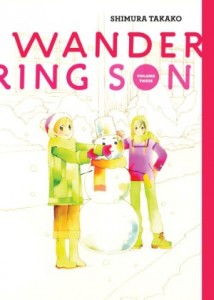
Wandering Son, Vol. 3

November 3, 2012 by Sean Gaffney

By Shimura Takako. Released in Japan by Enterbrain, serialization ongoing in the magazine Comic Beam. Released in North America by Fantagraphics.

One of the things that impresses me most about this manga is how much everything seems to be in flux. Nitori and Takatsuki’s gender identity disorder is the most obvious, but nothing else seems to be clear-cut at all, just as kids feel right around middle school. In this volume we see their secret get revealed to the class, and though a majority of the fallout focuses on Nitori and Takatsuki’s feelings, we also get to see how it affects people like Sasa, who’s just concerned that her friends are all pulling apart, or Seya, who’s falling for Nitori without really knowing the truth, but whose feelings continue to be an issue even after he finds out.

We also meet a new character, Makoto, who takes a surprisingly large role in this volume. He’s surprisingly mature, being a bit more confident in his desires, more ‘intellectual’ in his speech and manners (watch his cutting remarks to Maho when she’s about to insult him), and no doubt also far more emotionally fragile than he lets on. He reminds me a bit of Saori, but she still wears her heart on her sleeve. He’s also shown to be quite attracted to Nitori, which is something we haven’t really gotten into given the age of the protagonists, but no doubt will as the manga advances. What will happen when sexuality starts to come up?

I was pleased to see us moving beyond the school in this volume, with Maho dragging her brother along to her modeling audition. I continue to enjoy reading about Maho, a very ‘bratty big sister’ character whose head you can nevertheless easily get inside. Loneliness and lack of self-confidence lead to some of the more impressively awful scenes in the book, as she sets up Seya on a ‘not date’ with her brother dressed as a girl. That said, after Makoto dresses her down, I think she’s starting to think more about what she’s doing. The final scene, showing her and Nitori defending each other against the overly pushy modeling crowd, is quite heartwarming.

Then there’s the scene with Takatsuki and Yuki. This is a manga that takes place in a slightly lighter, fluffier world than reality, so things don’t turn too dark, and there’s a sense of ‘easily forgiven’ to the whole thing. At the same time, though, Takatsuki’s panic and fear is palpable on the page, and reminds you once again that these are just *kids*. Yuki’s behavior also ties in with Maho’s earlier, and the modeling girls at the end, in that they’re treating Nitori and Takatsuki as objects, even if it’s unconsciously. Takatsuki, who’s already upset that they both got found out but that Nitori is taking the brunt of the class’ reaction, is especially upset by this. Neither she or Nitori are dolls that people can play with as they please, or substitutes that they can live vicariously through.

It took a while for me to get around to reading this volume, but as always I was immensely impressed when I finished it. As I said, this isn’t quite ‘reality’, but it still handles everything realistically, and shows the emotions that everyone goes through. The middle school years are a giant state of flux, and therefore a great place to examine the gender issues that Wandering Son does. Roll on, Volume Four.

Filed Under: REVIEWS

Limit, Vol. 1

October 31, 2012 by Sean Gaffney

By Keiko Suenobu. Released in Japan by Kodansha, serialized in the magazine Bessatsu Friend (“Betsufure”). Released in North America by Vertical.

Keiko Suenobu is a name that might be familiar to those manga readers with long memories. Tokyopop put out several volumes of her shoujo manga Life before Kodansha took their licenses away, and it was a decidedly different shoujo manga from the usual fare. Not that it didn’t feature high school girls, dating, rivalries and bullying, etc. But it also discussed topics such as suicide, self-mutilation, body hatred, and rape, and did not try to give us the usual ‘you will defeat the bullies if you get emotionally stronger!’ message that most manga do. It was quite popular in Japan, winning awards and spawning a live-action drama. And now Vertical has licensed her next project, which takes high school popularity and tosses it into the middle of the unknown wilderness.

If there’s one big issue I had with Limit, it was this: I feel the accident that causes the plot to happen should have been on Page 175, rather than Page 45. We’re introduced to a class and get a quickly sketched out plan of who’s popular and who’s unpopular, with the main characters briefly touched on. But given how much of what happens focuses on Morishige and her feelings of hatred and revenge, I wanted to know more about the class dynamics and in particular about the class’ ‘queen’, Sakura, and our heroine Mizuki. As it is, being thrown into the deep end along with Mizuki helps give a feeling of uncertainty and fear, but it also makes her rather flat. If we’d had a couple of chapters that faked us into thinking this would be a typical coming of age (albeit serious) shoujo, I think the added depth would have helped.

That said, there’s a lot to like here. Teenage drama is something that Suenobu specializes in, and it’s all over the place here. The manga manages to give us the overly dramatic histrionics we’d expect from privileged teens caught in a disaster without making it too annoying or causing it to get bathetic. One might argue, given this is a manga dealing with the ‘strata’ of Japanese classrooms and bullying to a degree, that making the bullied school outcast the main villain is helping to contribute to the ‘blame the victim’ mentality that kids constantly deal with. But this story doesn’t seem to be about bullying per se, nor does it seem to have only one antagonist.

Where the story really shines is in the relationship between Mizuki and Haru, and how quickly group dynamics can change when the catalyst of the group is removed. Even close friends don’t know everything about each other, and here Mizuki finds that her peer group is just as rife with self-doubt and paranoia as she is. Being a popular girl is a two-edged sword, and what may seem to Mizuki like trying to blend in and bond with all the different girls is seen by others as switching sides deftly to avoid getting singled out. Which, as we see in a flashback, is exactly what Mizuki was doing. If you don’t open up or take a stand, you don’t get hurt.

This series looks to be six volumes total, so we’ve only just begun to see how it’ll play out. And I’ll be honest, I have a feeling that some cast members will soon be joining the rest of their classmates in sweet death (coughChikagecough). Hopefully we’ll see more development from our heroine, and more broken social dynamics driving the plot. Mostly as now that it’s broken, I want to see how it gets put together again. Will we get to see the girls work together and forge new friendships? Or is this just six volumes of slowly killing each other?

Filed Under: REVIEWS

Strobe Edge, Vol. 1

October 30, 2012 by Katherine Dacey

One of the most maddening aspects of shojo manga is that it can take 100 or 200 pages for a character to realize what she’s feeling, and another 200 or 300 before she actually tells someone; only the British period drama wrings more tension from its characters’ inability to say what they’re thinking. Strobe Edge, the newest addition to VIZ’s Shojo Beat imprint, isn’t quite as drawn out as Parade’s End or The Remains of the Day, but there are enough meaningful glances, lip quivers, and moist eyes for an entire BBC mini-series.

Strobe Edge focuses on Ninako, a classic shojo everygirl: she’s cute but not gorgeous, bright but not brilliant, liked but not popular. Through a twist of fate, Ninako meets and befriends Ren, her school’s Designated Dreamboat. Ninako is initially happy to be Ren’s pal, but soon finds herself consumed with thoughts about  him: should she tell him how she feels and risk alienating him, or silently resign herself to being his friend?

Author Io Sakisaka certainly evokes the mixture of excitement and fear that grips anyone in the throes of a crush, but she’s less successful at expressing those ideas in a distinctive voice; Ninako is so utterly lacking in personality that everything she thinks and says sounds like a lyric from a Selena Gomez song. (“For some reason, my chest kinda aches,” she muses after one encounter with Ren.) That same blandly polished quality extends to the artwork. Though Sakisaka exercises restraint in her layouts, giving Ninako room to breathe and reflect, her character designs are too ordinary to make much of an impression; I swear I’ve seen this cover before.

Perhaps that’s the point — Sakisaka has created a story and heroine so generic that almost any young teenager could see parallels between her own life and Ninako’s. While that kind of reading experience can be enormously comforting at twelve or thirteen, it’s awfully dull for older readers who need a little more than thousand-mile stares and cryptic conversations to hold our attention; a little subtext or, frankly, context, would make all that angstful withholding more dramatically compelling.

Review copy provided by VIZ Media. Volume one will arrive in stores on November 6, 2012.

STROBE EDGE, VOL. 1 • BY IO SAKISAKA • VIZ MEDIA • 200 pp. • RATING: TEEN (13+)

Filed Under: Manga, Manga Critic, REVIEWS Tagged With: shojo beat, Strobe Edge, VIZ

School Rumble, Vol. 1

October 28, 2012 by Sean Gaffney

By Jin Kobayashi. Released in Japan by Kodansha, serialized in the magazine Weekly Shonen Magazine. Released in North America originally by Del Rey, now released digitally by JManga.

Way back ages ago, I reviewed Del Rey’s omnibus release of Vols. 14 through 16, and noted it left off on a nasty cliffhanger. And there it sits, as Del Rey became Kodansha and Kodansha decided its sales were not sufficient to release more. But now JManga is picking up some of Del Rey’s old abandoned series, and have put all the prior Del Rey volumes up on their site, with more apparently to come. With that in mind, I decided to go back and review Volume 1, and see just how different things were back at the start.

Well, for one, that huge cast is not quite so huge. School Rumble starts off as being very much a two-hander, with the point of view switching back and forth. Our heroine, Tenma Tsukamoto, has a hopeless crush on stoic weirdo Karasuma, but is unfortunately hopeless at romance… and studies… and athletics… and pretty much life. Well, except for cosplaying. She is, however, a happy girl with lots of spirit. Contrasting this is our hero, Kenji Harima, a former biker who is trying to turn over a new leaf, mostly as he’s fallen head over heels for Tenma. Harima is strong and good at athletics, but otherwise is in the same boat as Tenma – he’s not all that bright, and his attempts to woo her are laughable. Add wacky situations and stir.

The comedy is all important here, as it would be through most of the early days of this series. The chapters have a lowered page count compared to most Shonen Magazine series (about 9-12, as opposed to 16-18), a sure sign that the editors consider it one of the funny manga rather than a romantic harem manga. There isn’t even a harem yet, really. Just a love triangle. Harima loves Tenma, Tenma loves Karasuma, and Karasuma… we have no idea what he thinks. This is also an unusual series in that it ran simultaneously in two magazines. The main Tenma and Harima plot ran weekly in Shonen Magazine, while the chapters at the end dealing with ‘side characters’ (the ones with a flat note as opposed to a sharp) ran in the monthly Magazine Special. In this volume they’re focused on Yakumo, Tenma’s younger yet more mature sister.

Ah yes, Yakumo. As I said earlier, there’s a large cast coming, and we see glimmers of it here. Tenma, for all that she is lovable and hyperactive, is pretty much exactly what she seems. Yakumo has a lot more to give us. She’s also a great cook, and pretty, and athletic – her perfection is noted by the boys at her school. When otaku who should know better talk about ‘waifu’ type characters, nine times out of ten they mean someone like Yakumo. Her one fault is her seeming obliviousness to guys. And I say ‘seeming’ because we know something about Yakumo that they don’t – she can read minds of anyone who likes her! (School Rumble has occasional fantasy content – Tenma is telekinetic once – but except for Yakumo, it’s always for the sake of a gag.) And given the typical minds of teenage boys, this has likely served to make her even more shy and retiring than she already is.

As for the other main characters, we do meet Eri, Mikoto, Akira, and (briefly) Hanai, but for the most part they look like they’re just going to be generic best-friend type classmates. Eri is stuck-up, Mikoto is tomboyish, Akira is deadpan. They haven’t been brought into the story, mostly as the story i still just about Tenma and Harima. But as their attempts to confess their love explode outwards, others will be drawn into the web. Especially Eri.

For a first volume, this is big, dumb goofy fun. Both leads are histrionic and over the top, and there’s lots of silly here, with an understanding that no one is going to be confessing their love anytime soon. What’s more, Tenma is still the focus of almost every chapter. As the series goes on, and as the popularity polls start to come out, this will begin to change…

Filed Under: REVIEWS

The Disappearance of Nagato Yuki-Chan, Vol. 2

October 27, 2012 by Sean Gaffney

By Nagaru Tanigawa and Puyo. Released in Japan as “Nagato Yuki-chan no Shoushitsu” by Kadokawa Shoten, serialization ongoing in the magazine Young Ace. Released in North America by Yen Press.

In an earlier post regarding this book’s imminent debut, it was noted that the series is essentially a fanfic AU written by someone who wants to get Kyon and Yuki together, just like you see with the infinite Harry/Hermione or Zuko/Katara fanfics on FFNet. And there’s honestly no denying it; that is exactly what this is. It’s light and fluffy fun, but it is essentially Haruhi with all the spiky bits filed off it. Everyone’s more agreeable, everyone’s more adaptable, and everyone’s simply happier. Including Yuki Sue… um, Yuki Nagato.

Now, this isn’t saying that this manga is horrible. I like it a lot. It’s simply saying that this manga is not particularly gripping or filled with tension. In essence, it’s not really a spinoff of the Haruhi series itself as it is a spinoff of the SD-manga spinoff Haruhi-chan. Various ideas from that series (Ryoko as an onee-sama type, though a comedic one; Nagato’s gaming habits; Haruhi going after Santa) are used in this AU, mostly to show off the author’s own preferences. But whereas in Haruhi-chan everything ends up being a setup for a punchline, here everything is a setup for an adorable heartwarming moment. Even the dramatic moments.

This volume sees the introduction of Haruhi herself (as well as Koizumi, who is essentially a non-entity in this series). She’s not totally unrecognizable. She’s still trying to befriend aliens, time-travelers and espers, and will scream this out to anyone who asks. She’s still bulldozing through people to get her own way, and quickly takes up residence at the literature club even if she goes to a different school. and she’s not above using Kyon as her personal punching bag when a punching bag is needed. But she’s more mature than the Haruhi of the original series, and it’s striking that, even though we see her starting to fall for Kyon here, she’s not going to get all that jealous about it. Haruhi doesn’t have the power to change the world with a bad mood here, and it seems to have made her a better person.

As for Yuki and Kyon, they continue to grow closer, much to Ryoko’s encouragement and chagrin. Valentine’s Day is in this volume, and of course there is chocolate to be made. This leads to what’s probably the best sequence of the book, where we’re led to believe that we will see a cliched misunderstanding lead to heartbreak. It’s not entirely out of the question – this manga isn’t all that original. But this Yuki is more of a ditz than a doormat, and the misunderstanding turns out to have been… well, a misunderstanding. And Haruhi, who’s no dummy and can clearly see that Yuki is head over heels for Kyon, challenges her to step up and go after him. In a genre where high school girls are so often cruel and heartless, it’s fantastic to see love rivals be open and honest.

The flaws I mentioned in Volume 1 are still here. The art simply isn’t all that great, though it’s getting better. And Kyon needs more snark desperately. But of course no one is particularly reading this book for Kyon, but for the moe cuteness. And in that respect, few things deliver on that promise like Nagato Yuki-chan. That said, I’m not sure the series can coast on cute fluffiness forever. I hope that the author comes up with a more serious arc by, say, Volume 4. (Foreshadowing: your key to quality literature.)

(Also, is it wrong of me to ship Haruhi/Ryoko? Cause I totally am.)

Filed Under: REVIEWS

  • « Go to Previous Page
  • Page 1
  • Interim pages omitted …
  • Page 277
  • Page 278
  • Page 279
  • Page 280
  • Page 281
  • Interim pages omitted …
  • Page 346
  • Go to Next Page »
 | Log in
Copyright © 2010 Manga Bookshelf | Powered by WordPress & the Genesis Framework