• Skip to primary navigation
  • Skip to main content
  • Skip to primary sidebar
  • Home
  • About Us
    • Privacy Policy
    • Comment Policy
    • Disclosures & Disclaimers
  • Resources
    • Links, Essays & Articles
    • Fandomology!
    • CLAMP Directory
    • BlogRoll
  • Features & Columns
    • 3 Things Thursday
    • Adventures in the Key of Shoujo
    • Bit & Blips (game reviews)
    • BL BOOKRACK
    • Bookshelf Briefs
    • Bringing the Drama
    • Comic Conversion
    • Fanservice Friday
    • Going Digital
    • It Came From the Sinosphere
    • License This!
    • Magazine no Mori
    • My Week in Manga
    • OFF THE SHELF
    • Not By Manga Alone
    • PICK OF THE WEEK
    • Subtitles & Sensibility
    • Weekly Shonen Jump Recaps
  • Manga Moveable Feast
    • MMF Full Archive
    • Yun Kouga
    • CLAMP
    • Shojo Beat
    • Osamu Tezuka
    • Sailor Moon
    • Fruits Basket
    • Takehiko Inoue
    • Wild Adapter
    • One Piece
    • After School Nightmare
    • Karakuri Odette
    • Paradise Kiss
    • The Color Trilogy
    • To Terra…
    • Sexy Voice & Robo
  • Browse by Author
    • Sean Gaffney
    • Anna Neatrour
    • Michelle Smith
    • Katherine Dacey
    • MJ
    • Brigid Alverson
    • Travis Anderson
    • Phillip Anthony
    • Derek Bown
    • Jaci Dahlvang
    • Angela Eastman
    • Erica Friedman
    • Sara K.
    • Megan Purdy
    • Emily Snodgrass
    • Nancy Thistlethwaite
    • Eva Volin
    • David Welsh
  • MB Blogs
    • A Case Suitable For Treatment
    • Experiments in Manga
    • MangaBlog
    • The Manga Critic
    • Manga Report
    • Soliloquy in Blue
    • Manga Curmudgeon (archive)

Manga Bookshelf

Discussion, Resources, Roundtables, & Reviews

Reviews

One Piece, Vol. 69

December 9, 2013 by Sean Gaffney

By Eiichiro Oda. Released in Japan by Shueisha, serialization ongoing in the magazine Weekly Shonen Jump. Released in North America by Viz.

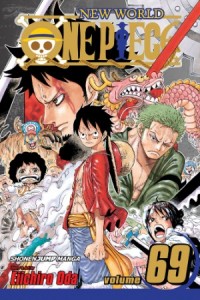
The majority of this volume of One Piece is composed of running around and fighting, as we tend to get when we’re 2/3 of the way through most story arcs in this series. Everyone is coming together from various disparate points (or, in the case of Luffy, getting dumped way the hell away from everyone) to try to stop Caesar Clown, who is upset that he has to kill them all in his secret base rather than out on Punk Hazard’s surface. We also get to see more of the fighting styles of minor villains Monet and Vergo. And thankfully we also get lots and lots of silliness.
op69

One thing that gets a bit more attention this volume is the way that trust works in the world of One Piece. Luffy is, let’s face it, a man who inspires devotion and loyalty in his crew, but he’s not the only one. Most of the pirates, marines and mooks we see here are all fiercely proud and supportive of their leader, to the point almost of mindlessness. This is where Luffy’s crew stands out, of course – being real characters, they’re allowed to disagree with him or tell him he’s being stupid. The nameless marines and villains, however, don’t have that option, so they remain trusting and gullible to an extreme. When it’s someone like Tashigi who inspires them, that’s fine – she would never tell them to do something stupid, and indeed tries to protect them by stating that their foe is not the real Vergo. When it comes to Caesar, though…

Let’s face it, Caesar is a terrible, terrible liar. His “I am a good guy trying to help you all” act is pathetic, and it doesn’t say much for his mooks that they buy into it wholeheartedly. At least the little kids have the excuse of being too young to really understand. (though kudos to the one kid who sacrifices herself for the others, after Chopper finally convinces her what’s really happening). Caesar is not quite as scummy as, say, Spandam, but it’s still very satisfying to see Luffy beat the ever-loving snot out of him here.

There’s also Zoro and Tashigi, who get a lot of spotlight here. Tashigi’s character has always been fairly problematic, and it doesn’t really get any better here, as her compassion wars with her fierce competitiveness and her belief that Zoro is holding back whenever he’s near her because she’s a woman. Zoro, of course, is not about to tell her the real reason, and in any case is so far beyond her skill level now that he can take out Money, let her get in the final blow, and then agree to have her take the credit for it. Makes no difference to him, as that sort of thing is irrelevant when you’re on the level he is. In short, their relationship is still just as amusing yet awkward to read about as ever. (I did love her nerding out about his new sword as he carries her away from the gas, though.)

So overall another solid volume. The crew get chances to show off (Even Nami, whose weather control works well briefly against someone like Monet), and the collective treatment of Brownbeard is a comedic masterpiece. I am, however, looking forward to this arc being done in a volume or two.
Filed Under: REVIEWS

The Nobility of Failure: Tragic Heroes in the History of Japan

December 8, 2013 by Ash Brown

The Nobility of FailureAuthor: Ivan Morris
Publisher: Kurodahan Press
ISBN: 9784902075502
Released: September 2013
Original release: 1975

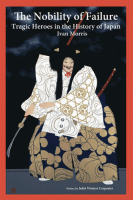
In some ways, Ivan Morris’ The Nobility of Failure: Tragic Heroes in the History of Japan could be considered a companion of sorts to his earlier work The World of the Shining Prince: Court Life in Ancient Japan. While The World of the Shining Prince explores the beauty of court culture in Japan, The Nobility of Failure addresses the country’s more tragic history. Originally published in 1975, The Nobility of Failure has been out of print for years. Happily, Kurodahan Press was able to rerelease the volume in 2013 with a newly added preface by Juliet Winters Carpenter. Happier still, I was selected to receive a review copy of the new edition of The Nobility of Failure through LibraryThing’s Early Reviewers program. The Nobility of Failure is an important work that examines the cultural and historical background of some of the tragic heroes who continue to influence the modern Japanese psyche. I am very glad that I, and others, once again have the opportunity to read it.

While not unheard of in Western tradition, Japan has a particular, and some might call peculiar, predilection for the tragic or failed hero. They are admired for their sincerity and loyalty even when their causes were meet with failure and their goals could be considered traitorous. Above all else, those heroes adhered to their ideals, especially in the face of their own destruction. In The Nobility of Failure, Morris traces Japan’s tradition of the tragic hero back to the fourth century and the archetype of Prince Yamato Takeru. The following chapters explore the lives and influences of Japan’s legendary and historic failed heroes found throughout the centuries: Yorozu, Arima no Miko, Sugawara no Michizane, Minamoto no Yoshitsune, Kusunoki Masashige, Amakusa Shirō, Ōshio Heihachirō, and Saigō Takamori. The volume culminates in an examination of the World War II kamikaze fighters–an unprecedented development in modern warfare which for most countries would have been unimaginable.

One thing that I didn’t realize about The Nobility of Failure before reading the book was how much of an influence Yukio Mishima had on its creation. Morris and Mishima were friends and the book was at least in part written in order to put Mishima’s act of ritual suicide in 1970 into historical context. The volume is even dedicated to his memory. Since I happen to have a particular fascination with Mishima, I found this connection to be especially interesting. Many of the heroes who are the focus of The Nobility of Failure (tragic heroines are only mentioned in passing) were men that Mishima personally admired, but they are also generally recognized as important to Japan as a whole and are even considered to be inspirational figures to some. Japan’s tragic heroes carry immense psychological and cultural significance; their role in Japanese history was crucial to the development of Japan’s national character, perspective, and worldview.

The Nobility of Failure is an extremely illuminating volume. It’s readily clear that Morris put a tremendous amount of thought and research into the volume. In fact, the endnotes, bibliography, and index make up approximately a third of the books’ length. Morris draws upon both primary and secondary materials, including literature, poetry, and theatrical interpretations of the heroes’ stories found in kabuki and Noh. Using a combination of sources, excerpts, and retellings, Morris reveals both the mythic and legendary basis of Japan’s tragic heroes as well as their historical reality and how they have influenced Japan’s culture and psyche. This is particularly evident in the chapter about the kamikaze fighters in which Morris ties in everything that had previously been examined. Even though The Nobility of Failure was written nearly forty years ago, it is still a valuable and fascinating work. Morris’ compassionate analysis deserves to remain in print.

Thank you to Kurodahan Press for providing a copy of The Nobility of Failure for review.

Filed Under: REVIEWS Tagged With: Ivan Morris, Kurodahan Press, Nonfiction

Mobile Suit Gundam: The Origin, Vol. 3: Ramba Ral

December 6, 2013 by Ash Brown

Mobile Suit Gundam: The Origin, Volume 3: Ramba RalCreator: Yoshikazu Yasuhiko
Original story: Yoshiyuki Tomino and Hajime Yatate

U.S. publisher: Vertical
ISBN: 9781935654971
Released: September 2013
Original release: 2007

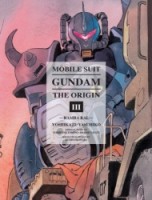
Although I have been aware of the massively popular and influential Gundam franchise for quite some time, my first real introduction to Gundam was through Yoshikazu Yasuhiko’s manga series Mobile Suit Gundam: The Origin. The manga is a reimagining of the 1979 anime series Mobile Suit Gundam which launched the franchise. Yasuhiko was one of the creators heavily involved in the visual development of the original series, so it is particularly interesting to see his personal take on the story. Part of The Origin was initially released by Viz Media in the early 2000s. However, the series is now being published by Vertical in a beautiful deluxe release based on the Japanese collector’s edition. Ramba Ral is the third volume in that series, first published in Japan in 2007 and released in English in 2013. This particular volume also includes delightful contributions from Shimoku Kio, the creator of Genshiken, as well as additional Gundam color illustrations by Yasuhiko.

After the overly ambitious Garma Zabi, the youngest scion of the Principality of Zeon’s ruling family, is killed in battle, his brother Gihren resolves to use his death to rally support for Zeon’s fight, going against the wishes of his father. Garma’s sister Kycilia isn’t about to let the opportunity be wasted, either. Zeon may not have access to the same amount of resources available to the Earth Federation, but it has a cause, charismatic leaders, and more advanced technology. Now that the battle of Los Angeles is over, the Federation’s White Base carrier, along with the newly developed Gundam mobile suit, are en route to Jaburo. Its young crew is closer to reaching the Earth Federation’s headquarters, making resupply easier, but Zeon is more determined than ever to either capture or destroy the Gundam. To make matters even worse for White Base, tension continues to mount between the civilians and the military personnel on the ship, making their mission even more challenging.

One of the biggest problems that the crew of White Base faces is that they are both young and inexperienced. In some cases they are rather immature as well. With all of the excitement and battles going on in The Origin, it can be easy to forget just how young many of the characters actually are. Ramba Ral serves as a good reminder, especially when it comes to Amuro Ray, the Gundam’s pilot. He’s only fifteen–an age at which he is easily distracted and flustered by members of the opposite sex–and he makes some extremely poor decisions in this volume of The Origin. His selfishness and petulance puts everyone on White Base in danger. Amuro may be the person in the best position to save his friends, but his immaturity is what put them at risk to begin with. While I can understand where he’s coming from, I found myself rather annoyed with Amuro in Ramba Ral and wanted to shake some sense into him. Unsurprisingly, many of his cohorts harbor some very similar feelings to mine.

While the crew of White Base is inexperienced, the Zeon forces in pursuit are anything but. In particular, the titular Ramba Ral is shown to be a very capable commander in this volume. He may not have the same arrogant elegance that the dreaded Char Aznable exhibits–Ral is much more down-to-earth and straightforward in how he fights–but he is very good at what he does. He’s not afraid to personally enter the fray and takes a very hands-on approach to battle. Ral’s men are extremely loyal and gladly follow him. Ral and Zeon also have an advantage over the Federation forces. While the Gundam is representative of the pinnacle of the Federation’s technology, Zeon continues to research and improve its own weapons and mobile suits. Combined with skilled and experienced pilots and commanders, Zeon’s military can be devastatingly effective. The arms race shows no signs of slowing in the series; the development of weapons is an important aspect of any war, and so it makes sense that it would be an important part of The Origin as well.

Filed Under: REVIEWS Tagged With: Gundam, Hajime Yatate, manga, vertical, Yoshikazu Yasuhiko, Yoshiyuki Tomino

Happy Marriage, Vol. 3 & Demon Love Spell, Vol. 5

December 5, 2013 by Anna N

Happy Marriage Volume 3

I continue to enjoy Maki Enjoji’s series about an office lady who abruptly finds herself married to a seemingly cold and domineering company president. Chiwa and Hokuto have gradually grown closer over the first two volumes of this series, and the relationship continues to develop further in the third volume. Chiwa finally deals with Hokuto when he’s in a vulnerable position when he suddenly becomes ill, and she has to tend to him at home. One thing I enjoy is the way Enjoji slips into showing action without words or thought balloons in order to show events with more emotional impact. When Hokuto wakes up in the middle of the night and sees Chiwa sleeping by the side of his bed, he looks absolutely shocked, then silently pulls her over so she can sleep more comfortably beside him. There are still some slice of life humorous moments in the manga, like when Chiwa deals with Hokuto’s hidden slovenly habits at home and her tendency to become an “Octopus Woman” when she sleeps.

The big emotional breakthrough in the volume occurs when Chiwa and Hokuto have to go visit his family, and Chiwa sees how poorly he’s treated by his relatives. This explains a great deal about his personality and motivations, and Chiwa gets so angry she is more emotionally honest about her feelings for her husband as she’s sticking up for him than she’s ever been when talking to Hokuto directly. I’m looking forward to what happens next! It is a bit odd to root for a married couple to get together, but Enjoji manages to pull this situation off with an engaging story and sympathetic characters.

Demon Love Spell Volume 5

This volume will be particularly fun for any fans of Mayu Shinjo’s series Sensual Phrase. Demon Love Spell can be depended upon to serve up plenty of humor and paranormal romance hijinks, and this volume picks things up with a funny plot device. Incubus Kagura and priestess Miko decide that they’re going to move out of Miko’s family home/shrine and her father promptly agrees! But before they go Miko’s father uses his priestly powers and puts a curse on Kagura so that he will be utterly incapable of romancing Miko in any capacity. The young teenager and incredibly old incubus struggle with finding an apartment. Miko starts working a part-time job to support them. They barely ever see each other, and it seems like their new apartment may also be haunted!

In any romance manga, misunderstandings get in the way of true love, and when Kagura decides to go into showbiz in order to make some money to support Miko, she promptly becomes jealous and concerned that he’s getting “powered up” from other women. Kagura’s demonic hotness ensures overnight success as a male model, and he soon becomes a pop sensation as well. Much is made of Kagura’s resemblance to the hero Sakuya from Sensual Phrase, and I found it hilarious that Shinjo’s habit of drawing her male heroes in a very similar fashion was acknowledged in this manner. All in all, this was another fun volume of this series. I’m definitely enjoying Demon Love Spell much more than Ai Ore, and I hope that more of Shinjo’s series get translated over here.

Filed Under: REVIEWS Tagged With: demon love spell, happy marriage, shojo beat, shoujo, viz media

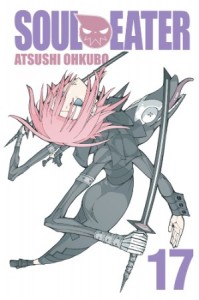
Soul Eater, Vol. 17

December 3, 2013 by Sean Gaffney

By Atsushi Ohkubo. Released in Japan by Square Enix, serialization ongoing in the magazine Shonen Gangan. Released in North America by Yen Press.

One of the most enjoyable things about Soul Eater is the way that the author balances out the seriousness and humor throughout the story. A lot of shonen fighting series tend to have long serious parts, then chapters that are pure goofy. Ohkubo, though, simply lets the humor come in anytime he feels like it, even if it’s in the middle of a pitched battle for everyone’s life. This is not to say that there aren’t pure comedy bits here (the middle chapter, which features Maka’s dad trying to be sympathetic and failing spectacularly – again) but the fact that you can find a goofy face or a silly moment anywhere actually helps add to the mood of the overall work. Soul Eater has always thrived on being one step off the edge, leaning slightly into madness.

souleater17

The converse of this, of course, is that any silly moment can turn on a dime to become serious. Thus Black*Star’s self-aggrandizing has a serious point – the reason why he can push back Crona so easily is due to his own self-confidence and ego, while Crona is simply filled with hatred and loathing. Crona’s “I DON’T KNOW WHO MAKA IS!” is a cry of anguish that once again makes you realize that Crona’s entire life (the manga may choose to say he, but I prefer to be awkward – Crona is genderless on purpose) has been mental torture and abuse by Medusa. Speaking of Medusa, she’s back to being a mad scientist, and is perfectly content to justify her actions by noting she is a witch – not that all witches automatically stand against our heroes, but as Kim has shown us, they are generally assumed to be evil until proven otherwise.

As for Kid, once again we get the goofy stuff – his obsessive-compulsive disorder comes to the fore in a very funny way, as you realize that the one who’s really best at torturing Kid is Kid himself – followed by an unnerving scene where Kid meets another one of the Great Old Ones whose presence has made this world what it is – and is seemingly taken over by it, as the cliffhanger shows. Soul Eater does star Maka and Soul, but has been excellent at giving Black*Star and Kid enough character arcs and development that they also feel like co-stars.

And then there’s the gender-bending. Rule 63 has been around the Internet forever, but has appeared in actual canonical works less so. As such, it’s highly amusing to see the cast transformed into their opposite-gendered selves (though I do have a little niggle with the explanation why – it makes it sound like gays and lesbians don’t exist), particularly as Maka and Soul have to deal with the thing that most annoys them about the other – Maka’s male body is tempted by the succubus, and Soul bemoans the fact that it’s “just big boobs” that turn men on. Judging by the previous, this swap won’t take up too much time, but it’s fun to see.

In the end, this is why Soul Eater is one of the best shonen titles coming out here. It’s fun, but with a tinge of madness that never quite goes away. It skitters at the back of your brain.

Filed Under: REVIEWS

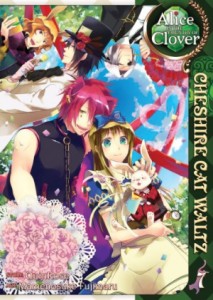
Alice in the Country of Clover: Cheshire Cat Waltz, Vol. 7

December 1, 2013 by Sean Gaffney

By Quin Rose and Mamenosuke Fujimaru, based on the game by Quin Rose. Released in Japan as “Clover no Kuni no Alice – Cheshire Neko to Waltz” by Ichijinsha. Released in North America by Seven Seas.

(Note: this reviews mentions THAT Alice spoiler later on. You know the one.)

Now that this series has finally come to an end, I think it’s a good time to take a look at it in a larger context. Volume-wise, it’s the longest Alice series to date. However, many of these volumes were bloated up with side stories – some featuring Alice and Boris, some not – to the point where I suspect the actual content would struggle to make it to 5 volumes if put together on its own. Overall, I think the series was successful, but its tendency to meander and focus on the romance over the darker themes make it perhaps midrange in overall quality. Let’s see if we can pin down what it did best.

cheshire7

First off, the premise of the Clover world spinoffs (as opposed to Hearts) is that Alice has been there longer and is finding love with someone she already has a friendship with, as opposed to a sudden passionate love. I think it does a pretty good job of that here – much as I’m not a fan of the romance part of this series in general, the author does a good job of showing us Alice and Boris’ friendship, and how that’s affected by their growing love. It also shows off dealing with Boris’ cat-like tendencies – he can wander off, or seem aloof, and is quite changeable – as well as Alice’s mood swings and anger issues. And, of course, jealousy. It didn’t really knock me out, but as a romance it’s perfectly sweet.

The other thing I think this manga did very well is the attention that it gave to the ‘faceless’ inhabitants of Wonderland. Our view of this world has almost entirely come from Alice and the 12 ‘role-holders’, all of whom are naturally drawn to her by their very existence. The faceless are meant to be bodies filling out the story, so unimportant they don’t even get eyes. And yet Alice can tell then apart, something that mildly astounds everyone else. What’s more, here they are shown to have goals and lives beyond support of the heroes and heroine. Some are plotting a takeover against the hatter, some are jealous of Alice’s ability to get someone to love her whether she likes it or not, and some are just doing a job, even if it means their death. I’m still not certain about the faceless overall, but I have a much greater understanding of them after reading this.

And then there’s Lorina. This is the second book we’ve seen recently where Alice is shown abandoning the real world and staying in Wonderland with her love. I’ve discussed how this makes me slightly uncomfortable, something I think is entirely intentional on the author’s part. Cheshire Cat Waltz is not as dark and twisted as, say, Joker and Liar’s Game, however, so we see Alice, who’s having another post-traumatic breakdown, visited by Lorina’s spirit, who reassures her that it’s OK to forget and move on, and that her death (looks, it’s been 15+ books, I am now prepared to reveal the horrible secret of the Alice books) was not Alice’s fault. So her stay in Wonderland is couched in terms that make it look less like escaping from reality and more like accepting this is her new reality. How you feel about that depends on how you view the Alice series as a whole, I think.

As for the major drawback of the series, well, it meanders. It meanders even more than my reviews do. And just when each volume seems to be leading up to an exciting bit, the story ends halfway through so that we can get either side-stories of Alice and Boris in the Hearts world, or even worse, Crimson Empire side-stories that have nothing to do with this world at all. Read all at once, it must be more tolerable. Read over the course of a year, it’s a mess.

Still, overall, I’m pleased to have read this. Alice and Boris are cute, and it fleshed out the personalities of the non-Hatter cast a lot more. (The Hatter cast got a lot to do as well, but they always do.) It’s a good read for fans of the series. Just be prepared for the story to start and stop a lot.

Filed Under: REVIEWS

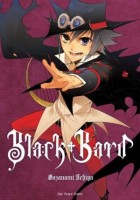
Black Bard

November 29, 2013 by Ash Brown

Black BardCreator: Ichiya Sazanami
U.S. publisher: One Peace Books
ISBN: 9781935548386
Released: November 2013
Original release: 2011-2012

Ichiya Sazanami’s Black Bard was originally published in Japan between 2011 and 2012 in three individual volumes. The English-language edition of Black Bard, released in 2013 by One Peace Books, is a single-volume omnibus with newly created cover art. I wasn’t previously familiar with Sazanami’s work and for good reason–Black Bard was not only his debut manga in English, it was also his first series to be released in Japan after winning the Media Factory Manga Award in 2011. Black Bard was initially serialized in Media Factory’s manga magazine Monthly Comic Gene which is frequently described as publishing shōnen manga for a shōjo fanbase. I haven’t been following the magazine or Sazanami very closely, but the licensing of Black Bard caught my attention for a couple of reasons: one, I generally tend to find One Peace Books’ offerings rather interesting, and two, I can’t resist the combination of music and magic.

Traveling from town to town is a somewhat sullen young man, a wandering minstrel known only as Black Bard. He is famous for his wonderful singing voice; it would not be an exaggeration to call his performances magical. Black Bard enjoys the freedom (and coin) his songs have allowed him as well as the happiness he is able to bring to others through them. Even so, he tries to keep his distance and there are very few people who would dare to call Black Bard their friend. There is Snow-Snow, a young huntress who greatly admires Black Bard and his knowledge of the world, and Windy, a traveling merchant and beast man who first met him when they were children, but Black Bard even discourages their friendship. But now that a powerful organization is interested in Black Bard, his magic song, and the past he’s tried to keep hidden, he needs friends more than ever. Not that he would admit it.

The music aspect of Black Bard was definitely one of the major draws of the manga for me. Black Bard describes himself as a mere musician, but there is undeniably magic in his song. He claims not to cast enchantments, but his music does affect others even when he is not deliberately trying to do so. Of course there are the times that Black Bard very intentionally uses the power of his music to alter reality and manipulate other people. Somewhat surprisingly, by the end of the series Black Bard has almost turned into a battle manga. Music is a significant part of those fights. But in addition to a form of magic, music’s role in Black Bard is also of a more traditional sort. The power of music, both magical and otherwise, provides comfort and brings people together. It is used as a way to convey stories and express emotion, and as a way to keep legends and history from being forgotten.

While it isn’t without its flaws, I had a tremendous amount of fun reading Black Bard. Admittedly, the world building is a mess and the story is all over the place, but I can’t deny that I enjoyed the manga. At first Black Bard seems to be episodic, but once Windy and Snow-Snow make their appearance the story starts to focus in on the Black Bard’s mysterious past. Granted, some of that backstory would have been more effective had it been revealed earlier in the manga and some things are never adequately explained. As the manga progresses, the references to Alice in Wonderland become increasingly prominent. However, those references don’t actually add much to Black Bard except to lend a few names and influence some of the character designs. In general, Black Bard is very attractive art-wise and is an entertaining mix of silliness and drama. I know that I would certainly be interested in reading more of Sazanami’s work.

Filed Under: REVIEWS Tagged With: Black Bard, Ichiya Sazanami, manga, One Peace Books

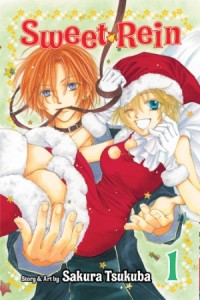
Sweet Rein, Vol. 1

November 28, 2013 by Sean Gaffney

By Sakura Tsubasa. Released in Japan as “Yoroshiku Master” by Hakusensha, serialized in the magazine LaLa DX. Released in North America by Viz.

It’s rare to find a manga series with so many things I’m wary of and so many things that I love in the same package. Sweet Rein manages to hit all my buttons, both the good and bad ones. It’s fortunate that it’s only a 3-volume series, as I suspect this isn’t sustainable in the long-term, but as a short romantic comedy, it’s quite readable. Even the unrelated short story at the end manages to be deeper than I thought while also briefly appalling me. Sweet Rein pulls in about ten different directions.

sweetrein1

The first thing that surprised me is the degree to which this is a magical girl series. Animal companion (who is also the romantic lead, but let’s save that for another paragraph) finds a somewhat melancholic girl dissatisfied with her life and shows her that she can bring happiness to the world. In this case, the animal companion is a reindeer who is actually a young man named Kaito. His entire family is reindeer (on his mother’s side), and when he meets our heroine, Kurumi, it’s love at first sight. In fact, it’s more than that. The Japanese title of this series translates as “Hello, Master!”, and it becomes clear that Kaito is bound to Kurumi, both physically and emotionally. This doesn’t bother him at all, but gives her some difficulties. What part of his feelings are his own heart, and what is the magic “making” him love her?

Because this is a magical girl series deep down, I was a bit more forgiving of some of the more ridiculous plot contrivances, though the Spirit of Christmas curing cancer was a bit much even for me. It’s far more fun to focus on Kurumi, who is a more down-to-earth and practical person than many shoujo heroines, and doesn’t even crack a smile till towards the end of the first chapter. Her background will be familiar to readers of this genre – mother long dead, father works long hours to support them so he’s never home, all her friends out with guys for Christmas. The Japanese reading of Christmas as being “Love + Santa” really comes into play here, with little to no religious subtext. (And thank God for that.) As for the reindeer thing, it would seem that Kaito’s body is ‘default human’, so I can deal. They do make a cute couple.

The side story is unrelated to the main action, being a one-shot about an immortal vampire (who looks like a cute young man) being saddled with a daughter from a woman that he had bedded some time ago. Most of the chapter is actually decent, with a good look at what it’s like to be an immortal and watch everyone you love die, and a nice vampire mythology that basically makes “turning” someone pot luck – either they die or they become vampires, they usually die, and it’s not controllable. Unfortunately, the entire thing is nearly upended by a very unfortunate choice at the end, where the art and storyline dovetail in exactly the way I was hoping they wouldn’t the moment this little girl showed up. Bleah.

Overall, though, I think the good parts of this manga outweighed the bad. It’s the sort of series that I suspect you shouldn’t think too deeply about, which makes it a bad fit for me but a great choice for anyone looking for some Christmas escapism.

Filed Under: REVIEWS

The Mysterious Underground Men

November 24, 2013 by Sean Gaffney

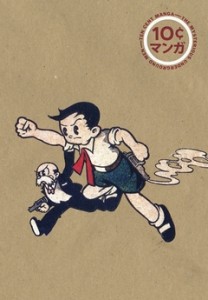
By Osamu Tezuka. Released in Japan initially by Fujishobo; this edition was licensed from Tezuka Pro. Released in North America by PictureBox.

(Note: I spoil the ending in the review, be warned.)

I’m not sure that this manga, one of the first ones produced by the legendary Tezuka, can quite match the surreal heights of Picturebox’s first release, The Last of the Mohicans. It’s just as influential, but its style is more generic and the author’s early flaws show through a bit more. I think this actually works best as sort of a scholarly or critical edition, with the helpful essays by Ryan Holmberg providing a context that gives depth to what feels first time around like a pulpish adventure story. It will likely fare very well with rereads.

osamu-tezuka-the-mysterious-underground-men-3

The entire plot feels like an old Republic serial, and the accompanying essay does mention Flash Gordon as one of Tezuka’s big influences. The main thing you won’t see in a live-action adventure serial, though, is Mimio, the intelligent rabbit who is modified (in a quite disturbing sequence showing the horrors of science for science’s sake) into a humanoid rabbit with feelings and emotions, but in a world where that sort of creature is going to be a pariah. In a later work, this might be the bulk of the story’s premise, but here we also follow John, the young scientist who is trying to follow in the footsteps of his late father and build a tunnel through the Earth (because flying is dangerous), with the help of his rich uncle and the Snidely Whiplash-esque Ham Egg, who many Tezuka fans will know is the villain the moment they see him.

What made this manga so influential to other Japanese artists and writers, of course, was the ending. I’ll admit, I found it rather curt and over the top melodramatic, but killing off one of the main characters and ending on a depressing note was a big sea change in the world of manga right then. Indeed, Tezsuka would come back to this basic storyline both in the 60s and 70s, revising and expanding, something he was known to do with several works (see also Princess Knight). I found it rather sad, given that Mimio not only wasn’t on the cover but didn’t make the cast of characters page. His death is the tragic ending, yet the book’s very design designates him to the forgotten extra pile. (Though this may be to avoid pointing out his disguises later on.)

The one thing this does have in common with its earlier Picturebox neighbor is seeing how the artists worked Western influences into the artwork of the title. Again, Holmberg’s essay is vital here, as the first time through you may simply read the story and characterization and miss the designs. I’d mentioned Flash Gordon, but there’s a lot of Disney here as well, as you’d expect from Tezuka. I also spotted the Popeye faces right off the bat. What I wasn’t expecting was Chic Young’s Blondie to be such a huge influence. Not only is John’s house and several poses reminiscent of Dagwood Bumstead, but the physician who watches over Mimio’s end is none other than Mr. Dithers! I’m not sure you could get away with that these days.

I definitely enjoyed this book, but I enjoyed it more from an academic, historical standpoint. If you’re the sort that loves to look at panels so see which issue of Bucky Bug this corresponds to, or to find out how this title resonates in a larger historical context, than this is the book for you. Well-researched, in a nice small size, and a good example of how, even when his writing is somewhat unformed and amateurish, Tezuka can still fascinate.

Filed Under: REVIEWS

Oh My Goddess!, Vol. 45

November 23, 2013 by Sean Gaffney

By Kosuke Fujishima. Released in Japan by Kodansha, serialization ongoing in the magazine Afternoon. Released in North America by Dark Horse.

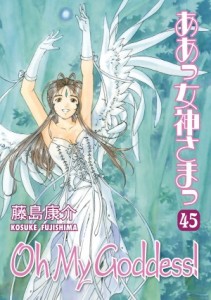
Sometimes there’s just too much to say for a Bookshelf Brief, and that’s certainly the case with this volume of Oh My Goddess. Since my last full review 2 years ago, we’ve been going through hell like a video game, with various mini-bosses being taken down. In the midst of this, Keiichi and Belldandy had to break their contract in order to get past one obstacle. Once they reconnect it, Keiichi notices that his feelings for Belldandy, while just as strong, seem more… arousing than normal. And there’s a reason for that, one that set fandom alight when this chapter first came out about a year and a half ago.

omg45

Like most everyone who has now read this series for 45 volumes – indeed, hardcore fans may have read the series THREE TIMES by now, in 32-page floppies, then the flipped volumes, then the unflipped volumes – and I had always assumed that the total lack of sexual desire between Keiichi and Belldandy was a function of Japanese fandom and the “we must keep our idols pure and virginal” mentality, as well as a strong dose of “if they actually do get it on, the manga will end, and this is a GIANT CASH COW, so nothing can happen.” Now Fujishima is saying this has all been deliberate on the part of heaven, who have locked up Keiichi’s libido magically so that he and Belldandy won’t procreate – because of the past past experiences with demigods.

That wasn’t the thing that made fandom upset. It was that Belldandy and Urd were aware of this all the time, and said nothing. It’s worth noting that for those who remember the very early days of the series, this retcon is very awkward. Keiichi spent most of the first volume or so trying to get into Belldandy’s pants, and this vanished around the same time that his eyebrows stopped being huge and 80s-shaped. What’s more, Urd’s constant attempts at aphrodisiacs and love potions now make a whole lot of no sense. That said, for a manga that is looking forward and not backward, it’s a fascinating twist, and Belldandy clearly feels horrible and self-doubting about it.

There’s not really much to worry about, as K1 is pretty much the perfect boyfriend, so even when Bell and Skuld’s mother suggests they may have lost the trust between them (oh yeah, she showed up as well, forgot to mention that) he’s quick to smile and show that if anything, he loves her even more. Keiichi and Belldandy can be sickeningly sweet even when they aren’t stressing about whether they truly deserve each other, and I have to assume that if you’re still reading the series you’ve just resolved yourself to that happening. It can be adorable in the right mood.

I note Hild’s plotline is resolved here, which was meant to be the main goal of this arc. Instead, it’s turned into a combination of Dante’s Inferno and Orpheus, with Keiichi and Belldandy having everything that they know and trust about their relationship torn apart and destroyed so that (presumably) it can be rebuilt even stronger and with more sweet smiles. Plus hey, Keiichi can now see her and get aroused, which is a big step forward for the wrong type of fan. :) We end up with a cliffhanger that looks as f it may involve past lives, and I suspect won’t work out nearly as well as K1 and Bell have. But we’ll have to wait a long time for that, as the volume likely won’t arrive till August 2014.

(By the way, there is an excellent tribute to the late Toren Smith by Carl Horn at the end of this volume, well worth reading even if you’d dropped the series long ago. This is one of the series that everyone things of when they think of Toren, so it was lovely to see.)

Filed Under: REVIEWS

No. 6, Vol. 3

November 20, 2013 by Ash Brown

No. 6, Volume 3Creator: Hinoki Kino
Original story: Atsuko Asano

U.S. publisher: Kodansha
ISBN: 9781612623573
Released: October 2013
Original release: 2012

Hinoki Kino’s No. 6 manga is one of two adaptations available based on Atsuko Asano’s series of science fiction novels No. 6. My introduction to the story was through the anime series, but I am very glad to see the manga being released in English as well. No. 6, Volume 3 was originally published in Japan in 2012. The English-language edition was released by Kodansha Comics in 2013. Although the manga and the anime both share the same character designs and basic story, they are both different interpretations of the original novels. The manga, which is currently still an ongoing series, actually began serialization before the anime adaptation began airing. I quite enjoyed the No. 6 anime–except for its rushed original ending–which is why I was particularly interested in reading Kino’s manga. I felt the first volume was a bit uneven, but the second volume improved in both world-building and pacing, so I was looking forward to reading the third.

Even though at one point he was considered to be among No. 6’s elite, Shion is now a fugitive hiding outside of the city in West Block. Currently he is living with Rat who has already saved Shion’s life on several occasions and who himself is listed as a violent criminal by No. 6. Fortunately, the city seems to have very little interest in what is going on outside of its walls, so the two young men should at least be safe for the time being. In fact, Shion seems to be adapting surprisingly well to life in West Block, although his kindheartedness and naivety still have a tendency to get him into trouble. Inside the city, Shion’s mother is still afraid for her missing son’s safety and Shion’s childhood friend Safu wants to do anything that she can to find him. The risks involved in searching for Shion are not small and both of the women are under close surveillance by the authorities. A single mistake could lead to their arrest or convenient disappearance.

The relationship between Rat and Shion has always been an important part of the No. 6 manga. This hasn’t changed with No. 6, Volume 3, but the volume also further develops the relationships between them and the other characters. The pacing of the third volume is happily a bit slower than the first two which allows more time for Kino to better explore those relationships. Particularly telling is Rat’s interactions with Dogkeeper and how different they are from his interactions with Shion. Rat normally doesn’t hesitate to manipulate and intimidate other people and is more than willing to resort to violence. It’s his way of distancing himself from others in an attempt to avoid being hurt or taken advantage of. There is a small amount of kindness to be found in Rat’s personality, but he keeps it very well hidden. Shion is Rat’s complete opposite in this and seems to be made up of nothing but kindness, though he certainly has become less of a pushover than he once was.

It’s not only that Shion, Rat, and the others have different personalities, it’s that they have completely different worldviews and ways of thinking. This is a sources of strife in their relationships, but from this conflict comes subtle changes in their attitudes. Shion has an effect on those around him and he in turn is slowing changing as well. As an outsider in West Block, Shion asks questions that no one else would think to ask; he’s not as naive as he first appears, simply more open-minded and optimistic. Those used to living in the harsh environment of West Block have lost that idealism, and in time Shion may lose it as well as he is confronted with the terrible reality of West Block and the truth behind No. 6. He is strangely accepting of his own situation and exile, but when it comes to those he cares about he feels compelled to protect them at any cost, even if it puts him in danger. Each volume of the No. 6 manga continues to improve; I’m definitely looking forward to seeing where Kino takes things next.

Filed Under: REVIEWS Tagged With: Atsuko Asano, Hinoki Kino, kodansha, Kodansha Comics, manga, no. 6

Senran Kagura: Skirting Shadows, Vol. 1

November 20, 2013 by Sean Gaffney

By Kenichiro Takagi and Amami Takatsume, based on the game by Tamsoft. Released in Japan as “Senran Kagura – Shoujotachi no Shinei” by Media Factory, serialization ongoing in the magazine Comic Alive. Released in North America by Seven Seas.

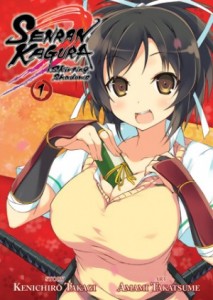
As I’ve noted before, I try not to let this review blog be entirely “wow, this is really terrific”, so sometimes I get a first volume of something that I’m wary of or suspect may not be for me. And yet, looking at the basic premise of Senran Kagura without actually seeing the character designs, this should be quite appealing to me. Five female kickass ninjas battling against the forces of evil. No major male characters to swoop in and save them. Some plotlines that show the attempt at character development. And yet…

senrankagura1

Even though I read it last, the afterword of this volume really sums up the mindset of the creators. Not only do we have several references to “boobs”, but we get at least three to “mega boobs”. The artist, who seems to draw herself as a bell pepper, also pledged to keep drawing the characters’ boobs for the happiness of the audience. And, doing a little research about the game itself, I see there’s nothing out of place about this at all – the game is a side-scrolling platformer whose big selling point apparently is using 3D technology on the lead females’ breasts. You can tell this is the point by the fact that the manga stars five different girls, and even the least endowed of them is still a double-D.

In amongst all the lovingly detailed breasts, we get the girl whose main habit is sexually harassing the other girls, and we also get the girl (named Yagyu, and wearing an eyepatch – we never get first names of these girls, but it’s clearly Jubei) who has a repressed but obvious yuri crush on her best friend. (I had hoped this might actually go somewhere, but again, checking the game work notes that it’s due to “she looks just like my dead sister” rather than, y’know, just being a lesbian.) There’s the cute clumsy one, there’s the stoic class president type, and there’s our naive yet filled with purpose heroine. It’s like they were ticking boxes off a checklist.

I’m no stranger to fanservice, of course – I read Negima, and Cage of Eden, and Excel Saga, and Higurashi. But all of those titles use fanservice as a spice, something that is there to attract the male reader flipping through the magazine to check out the story. The entire volume of Senran Kagura involves the ninja plot being secondary to showing these girls in as many titillating scenes as possible. Honestly, you’d think there’d be MORE here than there is – for all the attention to the bosoms of the leads, there’s no nudity at all. Just lots of busty women running around hitting each other.

In the end, the audience for this is, I suppose, those who played and enjoyed the original games, or saw the anime that also came with it, like most Japanese media franchises. But if you’re just coming to this series cold, and wanted to see a lot of huge-breasted women molesting each other… you’d probably get a better payoff getting a Project H book or something.

Filed Under: REVIEWS

Alice in the Country of Hearts: The Mad Hatter’s Late Night Tea Party, Vol. 1

November 18, 2013 by Sean Gaffney

By Quin Rose and Riko Sakura, based on the game by Quin Rose. Released in Japan as “Heart no Kuni no Alice – Boushiya to Shinya no Ochakai” by Ichijinsha. Released in North America by Seven Seas.

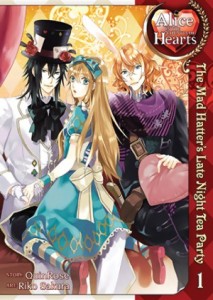
We have now had about seven or eight spinoffs to the Alice series, most of them being variations on “well, what if Alice fell in love with this person instead?”. It’s been so long, in fact, that we may have forgotten that the original manga adaptation was pretty definitive about Blood Dupre being the canonical love interest, and its 6 volumes revolved around that. Of course, being an otome game adaptation, the manga can easily delight in all the possible routes. But it does mean that this spinoff, also dealing with Alice and Blood, is coming to us with a handicap: is there anything introduced here that we can’t get in the main series?

hatter

That’s not the only handicap, unfortunately. I’ve said before that I prefer Alice when it’s a psychological mystery rather than when it’s “which hot guy do I want to go out with”, and despite occasional attempts at a plot, this is very much the second. Alice is clearly attracted to Blood, with only his resemblance to her old tutor and his blunt ways holding her back. And even that doesn’t last long – Alice and Blood are in bed halfway through this first volume. (Again, I note that I am pleased that the series allows Alice to be sexually active without shaming or punishing her for it – probably a benefit to running in Ichijinsha’s josei line, where this sort of thing wouldn’t be out of place.)

As for Blood, well, he’s a charming rogue, and thus has the usual charming rogue issues. He’s attracted to Alice and wants her around, but demands control, and is jealous when she sees other men – particularly Julius. Yes, this is a Hearts world, so the clockmaker is back in the story, and everyone still hates him. I’ve mentioned before how much of this is due to the metatext of the game – his status as a neutral party, his connection with death that might remind Alice of why she’s in Wonderland in the first place – but this is a romance rather than a mystery, so honestly it’s mostly just the fact that they’re different types. Julius offers Alice peace and relaxation, something that Blood simply cannot provide.

There’s a lot of old ground gone over again – this being the Hatter Route, we get the subplot involving his secret relationship with Vivaldi again, as well as his ability to fluster and enrage alice simply by opening his mouth. If you’re a fan of Blood Dupre, you may want to give this a try, but for those wondering if this is a required read as an Alice fan, I’d have to say no. You get most of what happens here in the main series. (I was amused to see that this seems to be the only non-BL series the artist has drawn – she specializes in smutty yaoi.) I still like the Alice series, but the spinoffs are running out of ways to charm me.

Filed Under: REVIEWS

Vinland Saga Vol 1

November 18, 2013 by Anna N

Vinland Saga, Vol 1 by Makoto Yukimura

This is a manga that I think of as having mirage-like qualities. I never thought it would actually be released in the US, just because I assumed a 13+ volume series about vikings would be a bit of a hard sell, despite the almost universal acclaim that Planetes Yukimura’s other English-translated series received. Furthermore the fact that the first volume of this series vanished from amazon (it is still available in kindle format) made it seem all the more hard to get. Fortunately I was able to brave the wilderness of an actual brick and mortar bookstore (isn’t it good these are still around) and track down this volume.

Releasing series that might be slightly less commercial in an omnibus deluxe format seems like a smart move. This hardcover volume features color pages, author notes, and a bonus story, so the higher price point still feels like a bargain. Vinland Saga certainly lives up to its title, as the first two volumes set up a sweeping tale of adventure, simmering revenge, daring battles, amusing cynicism, and manly men being almost too awesomely manly. The story opens mid-battle, as the Viking commander Askeladd observes a battle between Frankish tribes and is determined to enter the battle as a third party and make off with all the spoils of war. Askeladd sends out a pathologically surly young boy to be his messenger, but Thorfinn demands a reward before agreeing to undertake his task. Askeladd knows what Thorfinn wants and promises him his reward if he brings back the head of the commander of the opposing forces.

Bringing back someone’s head might seem like a bit too much of a burden for a young man, but Thorfinn capably negotiates with the frog-like Frankish leader, climbs the walls of the besieged castle, beheads his target, loses the head, retrieves it, then heads back to his companions to demand his reward – a duel with Askeladd. Thorfinn has been raised by Vikings who killed his father, and as he’s grown older and more capable his desire for revenge has increased as well. The battle scenes in Vinland Saga are dynamic and detailed, and it is hard not to root for Askeladd due to his innovative battle tactics and glee in his victories. If this manga only focused on battles, I could see it becoming less interesting, but Yukimura spends just as much time showing the reader the family life of the men who go out to plunder and raid.

An extended flashback throws Thorfinn’s current life in sharp contrast, as the reader sees the peaceful village where he was raised, and the father who he wishes to avenge. While Thorfinn’s family was removed from violence in the past, his father’s legendary martial prowess results in old enemies seeking him out, and Thorfinn’s innocent desire for adventure ends up leading him to experience loss at a very young age. Yukimura’s realistic and detailed style grounds the story effectively, with all of the background elements such as dwellings, ships, and clothing having the well-researched feeling that just allows a reader to slip into enjoying the story easily. While there’s plenty of adventure and action in Vinland Saga what stands out to me more are the human elements that Yukimura focuses on so well. Seeing the world weary desire for peace shown by Thorfinn’s father does more to ground the character than showing all of his past battles. Leif Erikson shows up as a storyteller who enjoys talking about himself far too much. Thorfinn’s sister is hilariously indifferent to the attentions of the village boys, and Thorfinn’s gentle mother is shown with murder in her eyes when she sees her husband not paying enough attention to her newborn daughter. I’m very much looking forward to the next volume of this series.

Filed Under: REVIEWS Tagged With: Kodansha Comics, Vinland Saga

A Centaur’s Life, Vol. 1

November 17, 2013 by Sean Gaffney

By Kei Murayama. Released in Japan as “Centaur no Nayami” by Tokuma Shoten, serialization ongoing in the magazine Comic Ryu. Released in North America by Seven Seas.

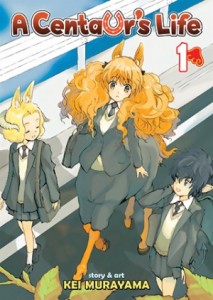
I think the North American marketplace has sort of reached the point where it’s wary of slice-of-life series. There was a huge glut a few years ago, but we’re seeing less of them now. They were quiet, laid-back stories, usually involving a group of girls in high school and their slightly comedic, slightly heartwarming adventures. They’re so huge in Japan that one publisher, Houbunsha, has almost devoted its entire company to making them. But these days you can’t just have cute girls in clubs, or cute girls in bands, or cute girls in yuri relationships. So you need a hook. A Centaur’s Life certainly has that hook.

centaur1

The title literally translates as “A Centaur’s Troubles/Worries”, and indeed the first chapter (which reads like an ecchi doujinshi that was toned down for publication… then again, given it’s Comic Ryu, maybe it wasn’t toned down too much) features our heroine being very worried indeed. She attracts some cute boys, and is concerned about her sexuality. The hook is that Himeno is a centaur, in a world where fantastic creatures are the norm, and her main concern is that she wants to know that she’s … compatible with other humanoids. After all, she has the body of a horse. Her friends Nozomi (a dragon girl) and Kyoko (a goat girl) help her out and calm her fears… not that this helps her romantically.

The first chapter is, not to put too fine a point on it, a bit too concerned with the girls’ privates. Luckily, the chapter does indeed seem to be more of a pilot chapter, and the rest of the series settles down as a slice-of-life that happens to feature a multiracial… indeed, multispecied cast. We see the usual school tropes. The marathon run, and the girls trying to get out of it. The school play. Side jobs as a model, and trying to hide it from the school. There’s also a hint of yuri sprinkled throughout between Himeno and Nozomi, though so far it seems to be mostly just the standard “if it’s you, it’s OK” high school tease.

What makes the manga interesting, and ensures that I will at least try a second volume, is that the writer doesn’t seem to be using the idea of fantastical creature folks as fodder for fetishes or comedy, they’re honestly worldbuilding. Centaurs used to be a slave race, so riding on top of them – even if consensual – can lead to arrest or worse. There’s discussion of “snake people”, and how the term is felt to be derogatory and they prefer “Antarctic people”. We see how Angel clothing deals with wings, what shoes centaurs wear, and how underwear works for those with tails (yes, the fanservice goes way down, but it’s still there at times). This is not just “let’s take these fantasy characters and dump them in cliched situations”, it’s “how would these situations go if these types of characters were involved”.

So far the series is merely adequate – like most slice-of-life, they tend to seem better the more you get to know the characters, so I expect my appreciation to rise as we go along. The girls may be fantastic creatures, but their personalities are still “the naive one”, “the tomboy”, etc. But given that the premise seems like an excuse for weird fetish pornography, I was pleasantly surprised at A Centaur’s Life, which is taking itself more seriously than you would think. I’ll get a second volume.

Filed Under: REVIEWS

  • « Go to Previous Page
  • Page 1
  • Interim pages omitted …
  • Page 261
  • Page 262
  • Page 263
  • Page 264
  • Page 265
  • Interim pages omitted …
  • Page 346
  • Go to Next Page »
 | Log in
Copyright © 2010 Manga Bookshelf | Powered by WordPress & the Genesis Framework