• Skip to primary navigation
  • Skip to main content
  • Skip to primary sidebar
  • Home
  • About Us
    • Privacy Policy
    • Comment Policy
    • Disclosures & Disclaimers
  • Resources
    • Links, Essays & Articles
    • Fandomology!
    • CLAMP Directory
    • BlogRoll
  • Features & Columns
    • 3 Things Thursday
    • Adventures in the Key of Shoujo
    • Bit & Blips (game reviews)
    • BL BOOKRACK
    • Bookshelf Briefs
    • Bringing the Drama
    • Comic Conversion
    • Fanservice Friday
    • Going Digital
    • It Came From the Sinosphere
    • License This!
    • Magazine no Mori
    • My Week in Manga
    • OFF THE SHELF
    • Not By Manga Alone
    • PICK OF THE WEEK
    • Subtitles & Sensibility
    • Weekly Shonen Jump Recaps
  • Manga Moveable Feast
    • MMF Full Archive
    • Yun Kouga
    • CLAMP
    • Shojo Beat
    • Osamu Tezuka
    • Sailor Moon
    • Fruits Basket
    • Takehiko Inoue
    • Wild Adapter
    • One Piece
    • After School Nightmare
    • Karakuri Odette
    • Paradise Kiss
    • The Color Trilogy
    • To Terra…
    • Sexy Voice & Robo
  • Browse by Author
    • Sean Gaffney
    • Anna Neatrour
    • Michelle Smith
    • Katherine Dacey
    • MJ
    • Brigid Alverson
    • Travis Anderson
    • Phillip Anthony
    • Derek Bown
    • Jaci Dahlvang
    • Angela Eastman
    • Erica Friedman
    • Sara K.
    • Megan Purdy
    • Emily Snodgrass
    • Nancy Thistlethwaite
    • Eva Volin
    • David Welsh
  • MB Blogs
    • A Case Suitable For Treatment
    • Experiments in Manga
    • MangaBlog
    • The Manga Critic
    • Manga Report
    • Soliloquy in Blue
    • Manga Curmudgeon (archive)

Manga Bookshelf

Discussion, Resources, Roundtables, & Reviews

Reviews

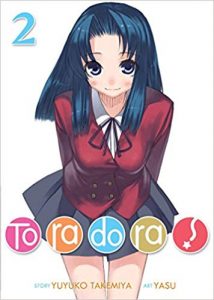
Toradora!, Vol. 2

August 11, 2018 by Sean Gaffney

By Yuyuko Takemiya and Yasu. Released in Japan by Dengeki Bunko. Released in North America by Seven Seas. Translated by Jan Cash & Vincent Castaneda. Adapted by J.P. Sullivan.

Having had a first volume that could easily stand on its own, Toradora! now has a second that has to extend the series. So Taiga and Ryuuji are still spending their every waking moment together and even eating the same bentos, but they aren’t actually together, they are supposedly scheming to help each other get together with their crush – something no one buys for a minute, and nor should they, given the ridiculous chemistry of the two leads. And so naturally, in the second volume, we need an antagonist. She’s got to be something that will drive Taiga absolutely crazy with rage. She’s Kitamura’s childhood friend. She’s a tall, long-limbed beauty. She’s a famous teenage model. She acts “oblivious” in a cutesy way. SHE’S GOT THE SAME FIRST NAME AS SAILOR MERCURY. Clearly she is evil and must be punished. And, while technically there is a punishment scene, the beauty and wonder of this book is that it is not about taking down Ami at all.
I think Takemiya is well aware of the fictional tropes involving “new girl as rival”, and she leans on them in her writing to make for greater impact later. Because Ami and Taiga really do not like each other at all. I’ve mentioned Taiga’s reasons, but Ami has heard a lot about her from Kitamura as well, and Taiga is also beautiful in her own, slightly furious way. So seeing Ami rip Taiga apart in the family restaurant, we are not at all inclined to be favorable to her. Showing up as a new transfer student was possibly the most predictable thing that could have happened as well. And so, at some point, we knew the “mask” was going to come off and that Ami would be taken down in front of the class. Technically this does happen, as Taiga and Minori (who has been laying low this entire time to make the payoff better) humiliate Ami in front of the class by mocking her being blase about dieting.

But then there’s the real, genuinely serious plot. Ami is being stalked. And it’s really unnerving and scaring her. And so when Taiga sees the girl who’s been belittling and mocking her all this time beg her and Ryuuji for help… she immediately helps. Yes, this help might also involve having Ami do karaoke for six hours at her place and recording it for future blackmailing material, but Taiga is well-aware that being creeped on by a stalker is bigger than a petty feud. As things escalate, meanwhile, it’s Ryuuji rather than Taiga who is able to wear Ami’s mask down to the point that she finally snaps and goes after her fan in one of the more cathartically satisfying scenes I’ve ever read – even if Ryuuji correctly points out how foolish it actually was. So now the core cast is in place, and I really can’t wait to see how the third novel shakes out.

This isn’t perfect – it ends far too abruptly, in a scene that almost cried out for a sad trombone noise. What’s more, it runs a bit short, so there’s an extended short story attached about a new first-year student with absolutely terrible luck who somehow gets told that touching Taiga will make him lucky. (I think this was adapted to the anime and he DID end up lucky in a way. Here he’s just sort of a shmoe.) That said, those are the only two minuses in an excellent volume.

Filed Under: REVIEWS, toradora!

Sleepy Princess in the Demon Castle, Vol. 1

August 10, 2018 by Katherine Dacey

Since one in four Americans suffer from insomnia, it seems like there’s a natural market for Sleepy Princess in the Demon Castle, a manga about a character so determined to get a good night’s sleep that she’d risk death or dismemberment for forty winks. Sleepy Princess plays the title character’s insomnia for laughs, however, turning the heroine’s quest for the perfect mattress into a light-hearted romp, rather than an expensive ordeal involving black-out curtains, melatonin, and meditation videos. That the story is fun and breezy is nothing short of a miracle, though older readers may experience a twinge of jealously at Princess Syalis’ ability to fall asleep anywhere, anytime once she has the right gear.

Author Kagiji Kumanomata handles the set-up with great economy: in just two pages, we learn the Demon King has kidnapped Syalis in a bid to conquer the human world. Though the Demon King stashes Syalis in a dungeon populated by fearsome beasts, Syalis quickly sizes up the situation and makes it work to her advantage. “Since I’m hostage, the Demon King has no intention of harming me,” she notes. “I have no duties to take care of here… And the food’s pretty tasty!” The one drawback to her new digs? “I haven’t been able to get a good night’s rest since I was brought here!” she exclaims.

A chance encounter with teddy demons leads to her first epiphany: her captors’ fur is the ideal stuffing for a comfy pillow. Before long, Syalis is roaming the castle in search of softer sheets, mosquito netting, and a more natural light source, the better to regulate her body’s circadian rhythms. Her dogged efforts to sleep longer or more soundly confound her jailers, who are astonished at how brazenly she takes what she needs; Syalis dies at least three times in her quest for the perfect sleep accessories. (Don’t worry; a handsome demon cleric is on hand to resurrect her mangled body.)

As with other one-joke manga, Sleepy Princess occasionally strains for laughs; an episode involving poison mushrooms falls flat, as does a spoof of Princess Knight. The chapters’ brevity helps keep the story from bogging down in bad jokes, as does Kumanomata’s consummate attention to detail; there’s always something funny happening, even if the gags are buried in the background or lurking on the edges of the page. An artful adaptation by Annette Roman helps bridge the translation divide, as do Susan Daigle-Leach’s marvelous sound effects. (If you’ve ever wondered what a posse of demon teddy bears might sound like, she’s got you covered.) Best of all, Kumanomata has barely scratched the surface when it comes to insomnia, leaving the door open for future quests, from finding the right bedtime snack to finding the right temperature for sleeping. Recommended.

SLEEPY PRINCESS IN THE DEMON CASTLE, VOL. 1 • BY KAGIJI KUMANOMATA • TRANSLATION BY TETSUICHIRO MITAYKI • ADAPTATION BY ANNETTE ROMAN • TOUCH-UP ART AND LETTERING BY SUSAN DAIGLE-LEACH • VIZ MEDIA • 174 pp. • RATED TEEN (13+) FOR FANTASY VIOLENCE

Filed Under: Manga, Manga Critic, REVIEWS Tagged With: Comedy, Shonen, shonen sunday, VIZ

Attack on Titan: Junior High, Vol. 5

August 10, 2018 by Sean Gaffney

By Saki Nakagawa, based on the manga by Hajime Isayama. Released in Japan in three separate volumes by Kodansha, serialized in the magazine Bessatsu Shonen Magazine. Released in North America by Kodansha Comics. Translated by William Flanagan and Taka Tanaka. Adapted by Ben Applegate.

Regular readers of my blog may have noticed that my Attack on Titan reviews were getting less and less enthusiastic as the volumes went on, until they finally petered to a stop about 3 volumes ago. Was it the timeskip? Was it the death of [spoiler]? Was it [spoiler] being turned into a baby factory? All those and more, but mostly it’s the fact that I can’t stop turning a blind eye to the fascist tendencies this series has honestly had since the start. For a while it looked like it was going to subvert them – I mean, it does overthrow a corrupt fascist government – but yeah, that’s not happening. So goodbye, Attack on Titan. What will I remember from you? Killing my favorite girl? Throwing another dead lesbian on the pile of dead lesbians? No, I will remember that you had, at one time, excellent characters that we could not only identify with but also parody. And I’m here today, finally, to talk about that parody.

Attack on Titan Junior High ends as it began: by being absolutely ridiculous. Eren is still hating titans (and constantly being called out for racism, which made me smile). Mikasa is still perfect (and has never farted. It’s in this manga, so is therefore canon and 100% fact). Sasha eats, and eats, and literally turns into a villain in order to get more food. (And, let’s face it, probably farts enough for both her and Mikasa). Armin is a crybaby shut-in. Ymir and Krista (who does not get the Historia upgrade in this series) are still joined at the hip. Everyone who’s been dead in the main series for ages gets a chance to shine, especially Levi’s old squad. Heck, we even get chapters devoted to the spinoff characters, who are also not dead. (technically Before the Fall has not killed its entire cast yet, but come on, we know it’s a matter of time.) Junior High wants to put a smile on your face, and it does.

I should say a word about the translation. Or, more accurately, the adaptation. I haven’t seen a series this loosely adapted since Excel Saga. Also, like Excel Saga, I think it’s all the better for it. Purists may carp at references to Sacha Baron Cohen (and boy, did that joke get outdated fast), but it gives the whole series a rambunctious , anything can happen feeling that fits it very well. You want to keep things fast and furious in a gag series, especially one like this that is a three-volume omnibus, which is the worst possible thing for a broad comedy to be. Special attention must also be paid to the fact that this volume was delayed for almost two years. It became comical to see it almost get released… then suddenly have a new release date six months down the road. The translators are very aware of this fact, and mention it in the text several times. I like a series that can mock itself. And again, that’s not something you’d see with a more “literal” translation.

So, as I say farewell to Attack on Titan, this is how I want to remember it. With a bunch of fun, goofy characters doing dumb things. And everyone living happily ever after. That may be the opposite of the point that the original author wanted to make, but that’s fine by me.

Filed Under: attack on titan junior high, REVIEWS

Lazy Dungeon Master, Vol. 1

August 9, 2018 by Sean Gaffney

By Supana Onikage and Youta. Released in Japan as “Zettai ni Hatarakitakunai Dungeon Master ga Damin wo Musaboru Made” by OVERLAP, Inc. Released in North America digitally by J-Novel Club. Translated by Quof.

I tend to review a lot of light novels, and try to keep up as much as I can. That said, with J-Novel Club recently taking it up a notch, I have to come to the conclusion that I can’t keep up with everything. Fortunately, their first new release in this huge batch of licenses, Lazy Dungeon Master, allows me to bow out gracefully. A work that seems designed entirely for the “is there snu snu?” reader, Lazy Dungeon Master has many faults, but its largest seems to be that the laziness of its titular hero is not just “wants to sleep all the time”, but also “his moral and ethical sense is that he can’t be bothered”. This is a shame, as the book made a valiant effort to get my interest in its last quarter, where I was genuinely entertained. But it can’t make up for the beginning, and the afterword suggests this is the toned-down version.

Keima is your average Japanese boy who is transported to a world where he has been summoned by a dungeon, whose core takes the form of a cute, busty girl (who can also transform into a far younger girl, but let’s not go there). He’s there to help save the dungeon from being destroyed. The problem is that the dungeon core, who he names Rokuko, has no common sense whatsoever. And the dungeon is already occupied by bandits, who are using it as a home base. It’s also just one room. As such, Keima has his work cut out for him. Fortunately, he may be lazy and morally bankrupt, but he’s rather clever, and so by use of several items, some tricks, and a dog-girl slave named Niku (more on that later), he is able to save the day and slightly expand the dungeon. As the series goes on, hijinks will no doubt ensue. And yes, Rokuko has already fallen in love with him, and I think Niku has as well. Sadly, all he cares about is their feet.

I’ll start with the good. The moment the dungeon battle begins, the series becomes genuinely entertaining, and I found myself smiling and laughing more than a few times. Well done. Now, the bad: the rest of the book. The bandits are scum, and take two sex slaves (no, really, they’re CALLED sex slaves) back to the dungeon to bang. Keima sees this… and does nothing, as his laziness and self-preservation overcome any horror he may have for what he’s seeing. And given his matter of fact “whoah, they’re raping that girl” narration, he’s not that horrified. Niku, the little girl slave (whose name literally means “Meat”, and I thank the Lord it wasn’t translated that way – leave that to Haganai) is introduced to us as basically a dead-eyed husk, and it’s clear what’s been happening to her before this. The afterword suggests that this book was edited so she’s “too young” and merely used as a servant while the bandits screw the older sex slave, but… you can’t remove a backstory but still have the obvious evidence that it happened. The whole thing is creepy.

There’s other things I didn’t like. Parts of the book where Keima and Rokuko simply sit and comment on the things they’re seeing from inside the dungeon core feel like a bad episode of Mystery Science Theater 3000. Haku is an interesting antagonist who turns out to not really be one, but the yuri scenes seem rather forced and “service, service!” to me. Most importantly: Keima is clever and has the potential to be powerful, but I suspect his uncaring attitude will also keep going. And I don’t trust the author not to make more bad decisions. Recommended for those who are the sort to have read the webnovel version already. I will be moving on.

Filed Under: lazy dungeon master, REVIEWS

The Promised Neverland, Vol. 5

August 8, 2018 by Sean Gaffney

By Kaiu Shirai and Posuka Demizu. Released in Japan as “Yakusoku no Neverland” by Shueisha, serialization ongoing in the magazine Weekly Shonen Jump. Released in North America by Viz Media. Translated by Satsuki Yamashita.

One of the questions I asked last time is answered fairly quickly in this new volume, which is: will our gang of children really escape with everyone, including the little babies? And the answer is no, they won’t. There’s being idealistic and then there’s being realistic, and even Emma knows that. And what’s more, she and Ray actually trust Isabella enough to know that she’s not simply going to do anything to the little kids left behind out of spite. We see a flashback showing us Isabella’s past, and it’s somewhat like you’d expect – she believes there’s no escaping this, so she’s doing what she can to make everyone as happy as possible before they’re taken away. It’s a decision made with love, even if I disagree with it. And it means we leave Phil and company behind (and very nice scene of him understanding what’s going on) and make their escape.

The escape involves a nice fake-out: since the only way to escape the compound is the bridge, every security measure will be there. So the kids instead actually do go over the wall, using rope and various klugded-together implements to cross the chasm and enter a forest beyond. (As a side note, I love your multicultural cast, TPN, it’s really great, but: Jemima? Really? No one called you on that?) The difficulty, of course, is that they know nothing about the terrain beyond the orphanage, and it turns out that the forest is a lot more alive than they’d really like. Oh yes, and they also have to avoid demons. And the main bad guys themselves, who are still very much in the mood to eat their delicious brains. The Promised Neverland always seems to have a fresh new crisis at hand, which is good, as the premise is basically “jumping from crisis to crisis”.

I think the series spent just the right amount of time in the orphanage and planning to escape it, and now, five books in, I look forward to seeing where Emma and company manage to wind up. Of course, that company is getting a bit smaller, as this time it’s Ray who has to sacrifice himself so that the others might move on. It’s amusing seeing Ray do this given all the times he’s tried to in the past and been stopped, but as he himself says, this time he doesn’t plan to sacrifice his life. But that does mean that the group is now led by Emma… who is realizing that being a child, planning a daring escape and also cutting off your own ear can possibly lead to sickness. Fortunately, there’s a robed stranger who is NOT AT ALL SUSPICIOUS to help the rest of the kids. Can Don and Gilda carry on while Emma is ill?

This series is a sort of high-wire act, as you’re never quite sure when its thriller logic is going to run out. But for the moment, it remains one of the best Jump series out there.

Filed Under: promised neverland, REVIEWS

Invaders of the Rokujouma!?, Vol. 15

August 7, 2018 by Sean Gaffney

By Takehaya and Poco. Released in Japan as “Rokujouma no Shinryakusha!?” by Hobby Japan. Released in North America digitally by J-Novel Club. Translated by Warnis.

The basic premise of this series is that all the many and varied girls who have their eye on Room 106 get together with Koutarou to form a family (yes, they all love each other romantically, but “family” is the first thing that comes to mind to describe themselves, and the reader has to agree). And they’re all beset by various types of villains. So it makes a certain amount of sense that the villains are also joining forces in order to fight our heroes. Of course, unlike Koutarou’s group, this is not a particularly equal partnership. Radical Faction leader Tayuma is a classic laughing villain sort, and you expect he’s going to get taken out in the following volume (this volume) is the first of a two-parter) and then quietly forgotten about. But the pairing of Elexis, Theia’s nemesis, and Maya, the Dark Magical Girl, looks more long-lasting, and there’s also some potential romance there. Yes, villains can hook up, too!

As for our “family”, they’re still getting along well. One thing that’s interesting about Rokujouma is the utter lack of inter-harem conflict compared to most series of this ilk. You don’t even have any scenes of people temporarily walking out in an angry huff. (Where would they go, they all live in the apartment.) It can lead to being a bit self-satisfied, as I noted in my previous review, but it’s also sweet and cute, which is what the author is going for, I’m sure. This group is very much still in the initial blush of first love, and it shows in their actions. Koutarou is getting more comfortable with showing physical affection top people not named Yurika, and the other girls are getting better about asking for it. They’re slowly maturing, and yes, that includes Yurika, even though she seems designed to always be whining and complaini9ng because, well, the author loves writing that.

The main plot of this volume involves our heroes teaming up with the sentai group from like 10 volumes ago (remember them? Yeah, me neither…) to take on the Radical Faction’s attempt at causing a natural disaster so great it will allow them to take over the surface once and for all. It’s a total “evil villain” scheme, but it’s treated seriously because of Kiriha, and because the others discuss the actual consequences of such a thing. One reason I enjoy reading Rokujouma so much is the amount of dialogue going on – now that everyone’s mostly revealed their true background and desires, they’re not hiding anything from each other and can be open and direct. Which I’m sure will lead to better solutions in the next volume. They’re not perfect – they were truly suckered in in the last third of the book, and now the bad guys have a better idea of how to fight Koutarou and company – but they’ll come up with something.

This is a short book in the series, and didn’t take long to get through. Fans of Rokujouma!? should enjoy it quite a bit.

Filed Under: invaders of the rokujouma!?, REVIEWS

The Saga of Tanya the Evil: The Finest Hour

August 6, 2018 by Sean Gaffney

By Carlo Zen and Shinobu Shinotsuki. Released in Japan by Enterbrain. Released in North America by Yen On. Translated by Emily Balistrieri.

As has been noted before, Tanya the Evil’s world is essentially an odd mashup of World War I Europe, with appropriate touchstones. That said, it’s perfectly content to mess with the timeline in order to move things along, and the third volume does this incredibly quickly, moving from World War I to World War II in the space of about three months. The victor may have changed, but the players are much the same, though we do get a few new – and more obviously inspired by real life history – characters. The “Duke of Marlborough” is Winston Churchill, complete with color illustration in case we didn’t get it (not to mention the subtitle of the book), and Tanya’s new commander in the African – sorry, Southern Colonies is “von Romel”, which is almost TOO on the nose. And of course there’s Tanya and her crew, who manage to almost single-handedly win the war only to see peace remain elusive. In fact, Tanya’s desperate plea to let her unit stop the Republic from getting away is probably the highlight of the entire book.

We begin with a giant slaughter, as is usually the case in these novels that make no bones about war being hell – at least for Tanya’s opponents. She and the 203rd are literally shot at the enemy on giant rockets, and they proceed to lay waste to most of the republic’s main forces as well as their HQ. It is amusing to see Tanya’s constant cynical, worried POV as the group essentially walks in and walks right back out almost unharmed. There are times when she is unaware of how good she is. So all that remains is to sign a peace treaty and negotiate the end of the war… something not done by the military, alas. The cease fire allows the Republic to regroup and the Commonwealth to stop pretending they don’t care, and thus everything is for naught. As for Tanya, she regards being sent south as a punishment for her freak out at the generals, but when we see them scheming it, it’s more that they just don’t have any real resources, so need to use the 203rd to have any chance of doing anything. The Empire is running out of money and resources.

And we may be getting a new player into the game. The Unified States have been mostly neutral here, but they also have Mary Sue, the daughter of Anson Sue, who Tanya fought and killed back in the previous book. Mary is unaware of this, but she is extremely patriotic and also has a buttload of magical talent, so is ready to fight and die for her country. In terms of the series, she promises to be something of a rival to Tanya, which is good as lately there has been the sense that nothing can stop Tanya once she gets going. It will be nice to see her have a bit of a challenge. Mary Sue seems sweet, but given that we already have the ‘sweet girl’ card in this deck with Visha, I suspect that won’t last long. The illustrations also make her look a bit possessed, to be honest.

Tanya the Evil is still wordy as all get out, and I’d honestly only recommend it if you’ve read military biographies and histories before. But if you want to know what happens after the anime ended, this is the volume to start with, as the anime wraps up about 3/4 through this book. I’m still waiting to see how all this turns out.

Filed Under: REVIEWS, saga of tanya the evil

Black Torch, Vol. 1

August 5, 2018 by Sean Gaffney

By Tsuyoshi Takaki. Released in Japan by Shueisha, serialization ongoing in the magazine Jump Square. Released in North America by Viz. Translated by Toshikazu Aizawa and Colin Leigh.

A lot of the first volume of this new Jump series looks like a prologue, because in a sense it is. In fact, I’d argue that it might have worked better if it were done as a flashback after a few chapters featuring the titular special unit that our hero ends up getting drafted into. As it is, I enjoyed this volume but I’m left a bit dissatisfied as it feels like the story hasn’t quite started yet. There is a bit going on here to make folks want to read more, though. Jiro is somewhat standard Jump style, but “can talk to animals and is also a ninja” is a pretty good starting point, even if he does end the first chapter with a giant hole in his chest. There’s also Ichika, who manages to deal with a “I hate people who belittle me because I’m a woman scene” with her dignity mostly intact, which always pleases me.

We not only have ninjas here but also Mononokes, which seems to be sort of animal demons. Jiro rescues a small cat who turns out to be one of these, and also the only one in the series to date who’s not evil. Unfortunately, when you team up with the one “not evil” monster, you get hard looks from the team hired to take out monsters, which includes grumpy Ichika and her boss, the Captain Gotoh-esque Shiba. They’re the Oniwabanshu of legendary historical fame, now busy being bodyguards and also hunting down these monsters, which have recently popped back up. After a mostly deadly fight, Jiro and Rago are now fused, so he’s something of a trouble spot. That said, he’s pretty good in a fight, and has mononoke powers while still fighting for goodness and niceness, so he’s allowed to join the new team.

There are apparently two more team members we haven’t met, and as I indicated before, I think this feels more like “Part 1 of 2” than other Jump series of this sort. I like Ichika, despite her “I need to properly emphasize my rack for the readers” costume (which is even lampshaded). She seems to be the daughter of a ninja clan family who’s been dealing with “but you’re a girl” her entire life, and it’s made her a big angry and reluctant to accept help. Needless to say, the moment she mentions this, she’s put in a situation where she’s in dire straits and needs help. That said, she shows she’s a damn good fighter, and gets in the final blow, so I think it was pretty well handled. I suspect these two will be the lead “couple”, but I also expect any romance will be about 10th on the list of things this manga wants to do. It’s here to kick ass and take names, not flirt it up.

Add it all up and you have a decent first volume, and one I’d recommend to fans of things like Blue Exorcist. I look forward to the next volume, which should show what the series will actually be doing going forward.

Filed Under: black torch, REVIEWS

So I’m a Spider, So What?, Vol. 3

August 4, 2018 by Sean Gaffney

By Okina Baba and Tsukasa Kiryu. Released in Japan as “Kumo Desu ga, Nani ka?” by Fujimi Shobo. Released in North America by Yen On. Translated by Jenny McKeon.

So yes, readers more familiar with future events in Spider So What were probably laughing at me in my previous two reviews. I admit to being completely taken in. It was easy enough to assume that the spider’s climb up through the dungeon was happening around the same time as the rest of the plot we were seeing on the surface. Except, of course, that doesn’t make sense at all, because the plot on the surface has been happening over the course of the last eighteen years or so. Whereas we’ve more or less been following the spider’s journey up the dungeon since birth, and it has… well, not been eighteen years. So yes, all of my desires for the spider to get to the top and join up with the main plot are somewhat embarrassingly for nought. She IS in the main plot… as the head villain. That said, there’s still something weird going on here.

As always, this is a book of two halves, alternating. The main plot deals with our spider doing what she’s been doing, slowly moving upward and fighting monsters. The interesting thing going on here, which the reader is only partially let in on, is that after her Taboo level reaches 10, she’s apparently given hidden insight into the nature of this entire world. Unfortunately, her hyperactive teen narration does not actually tell us much about this, presumably because spoilers. It likely has something to do with the two mystery “admin” figures we see, one of whom – D – looks to be behind a lot of what’s going on. *are* they trapped in a game? It doesn’t seem likely. The other big news here is the spider’s fight against the dragon that terrified her so long ago – this time, he’s stronger and tougher, and the fight is probably the highlight of the book. It is amusing seeing the spider’s immaturity here compared with what we see in the epilogue.

The other half of the plot involves everything going wrong for Shun. It’s not enough that his brother is dead, but Hugo, the arrogant jerk from last time, seems to have now mind controlled most of the kingdom into doing his bidding and killing the traitor. This includes, seemingly, his little sister, and also his best friend Katia, who is still dealing with a bit of gender dysphoria here. Things go very bad for our heroes, but, oddly enough, not as bad as you’d expect, as several times the villains essentially allow them to get away. They even comment on this. That said, there are a lot of genuine casualties. I wonder if it’s simply that the reincarnated folks are the ones that can’t be killed? In any case, there’s a lot going on here, and most importantly, it helps distract from spider going on about her stats in the main story, which is still happening constantly.

Unsurprisingly, firing off ta few big plot guns pays off, and this was easily the best volume of Spider So What to date. I look forward to seeing what’s happening next, both with the spider and the humans.

Filed Under: REVIEWS, so i'm a spider so what?

Shibuya Goldfish, Vol. 1

August 3, 2018 by Katherine Dacey

Shibuya Goldfish falls somewhere along the horror continuum between Sharknado 3 and Jaws: it’s too competently executed to be a guilty pleasure but too predictable to be genuinely scary. Though the premise has serious camp potential, author Hiroumi Aoi settles for a pedestrian approach to the material, trapping his cast in a high-rise shopping center where death lurks around every corner. There are a few glimmers of imagination here and there, but the overall result lacks the visceral punch, humor, or sheer imagination of other entries in the Killer Fish genre.

The story begins in media res, with a shot of Hachiko — Shibuya’s most famous statue — stained in blood. We then cut to an image of a panting, wild-eyed teen staring incredulously at a monstrous goldfish feasting on a pedestrian in the middle of a busy street. “That day was the first time I ever saw someone die,” Hajime solemnly informs us, before a flashback reveals what led up to this gruesome scene.

I won’t lie: those opening pages are a tantalizing hook for a horror buff. Though Aoi doesn’t reveal where the goldfish came from, he sells the Fish-Gone-Wild concept by emphasizing the predators’ size, numbers, and blank-eyed stares, making us appreciate the sheer incongruity of Volkswagen-sized fish swarming through an urban landscape. The goldfish’s penchant for uttering intelligible phrases — “I’m home, mom,” one burbles — adds another layer of mystery to their existence: are they truly sentient or are they merely ghosts, back to haunt the owners that flushed them down the toilet?

Where Shibuya Goldfish falls short is the human dimension. Hajime is the only character who’s properly fleshed out, an earnest, slightly awkward high school student whose dreams of becoming a filmmaker are dashed by the catastrophe. The other characters are more placeholders than people, dropped into the story to generate conflict or provide useful information about goldfish behavior before dying. In recognition of their liminal status, Aoi only bestows names on a small fraction of the cast, one of whom — the beautiful, bitchy Chitose Fukakusa — is such a vile male fantasy that the introduction of two more competent, sincere female characters in chapters two and three barely erase the memory of Fukakusa’s manipulative behavior and panty flashes.

The other fundamental issue with Shibuya Goldfish is the artwork, which juxtaposes photo-realistic backgrounds and fish with generic character designs. The tension between these two modes of representation ends up robbing volume one’s creepiest scenes of their dramatic impact, as the full horror of what happens to several characters is muted by Aoi’s blandly rendered faces and bodies; the grotesque bodily deformations that make Junji Ito, Hideshi Hino, and Kanako Inuki’s work so arresting barely elicit a “yuck!” in Aoi’s hands. It’s a pity these moments don’t land with more oomph because Shibuya Goldfish flirts with an interesting idea: the notion that a pet as small, helpless, and disposable as a goldfish might be the downfall of humanity, punishing us for our reckless treatment of other living things. Perhaps Aoi will delve into the monsters’ origins in future volumes, but the so-so execution of these foundational chapters didn’t reel me in. Your mileage will vary.

SHIBUYA GOLDFISH, VOL. 1 • BY HIROUMI AOI • TRANSLATED BY KO RANSOM • YEN PRESS • 242 pp. • RATED OT (OLDER TEEN) FOR LANGUAGE, NUDITY, AND VIOLENCE

Filed Under: Manga, Manga Critic, REVIEWS Tagged With: Horror/Supernatural, Shibuya Goldfish, Shonen, yen press

One Piece, Vol. 87

August 3, 2018 by Sean Gaffney

By Eiichiro Oda. Released in Japan by Shueisha, serialization ongoing in the magazine Weekly Shonen Jump. Released in North America by Viz. Translated by Stephen Paul.

Ah, it’s another of those “200 pages of fighting” One Piece volumes. It’s quite enjoyable, but as always somewhat hard to squeeze out 500+ words on it. But let’s do our best. First of all, the cover lies a bit. Looking at Bib Mom there, you’d think that she was in full control of her faculties as she’s attacking everyone else. Nothing could be further from the truth. Luffy and company have come up against some tough ruthless villains in the past, but I don’t think any have quite felt like a giant Force Of Nature as much as Big Mom here once her cake is destroyed. And, as we’ve seen from the flashbacks before, she also has no qualms about completely devouring any allies that happen to be in front of her, either. It’s no surprise that everyone’s immediate goal at the start of this book is “run away”, and for once Luffy even agrees with them – for a while.

We should probably address the other big thing that happens in this book. The old “nobody dies in One Piece” credo has been a bit on the decline since the events of Marineford, but it does merit saying that MOSTLY nobody dies in One Piece. So seeing what happens towards the end of the book here still manages to be a surprise – indeed, there’s a bit after the event when Nami thinks that we’ve somehow managed to have a last-minute escape… but no. Fortunately, Jimbei is with them now and is able to inject a bit of “yes, we’re all grieving, but may I remind you of the fact that we’re about to die?” into the proceedings. As deaths go, it’s not quite up there with the Big One from many volumes ago, but it is pretty sad.

Let’s also talk Charlotte Pudding. Well… I dunno. She seems to be swinging back and forth between a Charlotte who loves Sanji and wants to save him and a Charlotte who wants to see Sanji and everyone else fall to Big Mom’s Pirates. Sometimes she’s swinging back and forth between the two by the second. I’m not sure if this is meant to be Dissociative Personality Disorder, but I rather doubt it – I suspect it might be Oda simply having fun with the “tsundere” archetype. It’s honestly not a very good character twist. Much better handled is Nami, who I always love seeing brutally manipulate people to get what she wants. The Straw Hats are not true-blue Shonen Jump heroes, but all have major flaws and foibles, and I enjoy seeing Nami’s intelligence come to the fore whenever she does this. Also, nice lightning.

With Luffy going back into the mirrir to have a huge battle with Katakuri, it doesn’t look as if we’ll be escaping Big Mom anytime soon. But that’s fine, this arc is already better than the Dressrosa arc, and I look forward to seeing how Luffy gets out of this one, because I’m fairly certain Katakuri is about to hand his ass to him.

Filed Under: one piece, REVIEWS

WorldEnd: What Do You Do at the End of the World? Are You Busy? Will You Save Us?, Vol. 1

August 2, 2018 by Sean Gaffney

By Akira Kareno and ue. Released in Japan as “Shumatsu Nani Shitemasu ka? Isogashii desu ka? Sukutte Morate Ii desu ka?” by Kadokawa Shoten. Released in North America by Yen On. Translated by Jasmine Bernhardt.

There are probably a few people, familiar with my reviews, who are surprised I even picked up this title at all. And it’s true, these days when I see a girl on the cover who, let’s be honest, looks sort of like a magical girl and is crying while staring at the reader, my initial though is to run away. But unlike Magical Girl _________ (please fill in the blank with the Madoka Magica clone of your choice), the essential premise of WorldEnd does not seem to be “let’s torture and kill off these empowered girls one by one for the delight of the audience”. Instead this is a much quieter, softer series, at least so far, that shows us the consequences of surviving the apocalypse, and what happens to kids who spend their lives treated as a living weapon when they find out they’ve been doing the weapon thing incorrectly. It’s not for me, but it’s very, very well done.

After a brief prologue where a young man and his not-quite-girlfriend (who calls him Daddy for reasons that make sense in-story but still makes me uncomfortable) debate the cliches of the soldier going out to face their final battle, we get to the meat of the book. Far in the future, humanity is extinct thanks to an attack by some sort of race. In the process, the other races on the planet (elves, dragons, etc.) all became far less powerful, and we’re now at the point where they can’t even live on the surface anymore. So they build a large number of floating islands, and everyone lives up there, dodging (mostly) any attacks by the Beasts living on the surface. Here those with no distinguishing features (like scales, fox ears, etc.) are treated poorly as they remind the others of humanity. Our hero is Willem, one of those people, who is hired to be the overseer of a bunch of kids at a facility on the outskirts of the islands. Then we find out who the kids actually are and what they’re supposed to do. Then we find out (though we probably guessed) who Willem really is.

For a series that is not my thing, I have to say that I found this book extremely readable. The prose is well-written and translated, and has some excellent turns of phrase. There is an aura of melancholy over the entire book, but that doesn’t stop it from having moments of humor. The kids are cute, and I really like the troll who is their other overseer/team mom. Willem himself is that sort of “deliberately oblivious to others’ feelings” sort, but this is called out right away – in fact, the book deconstructs a lot of the wartime cliches that you’ve read about before. And I liked Chthollly’s journey as well, as she is taught for the first time to NOT WANT TO FIGHT, but goes to fight anyway. The result of the battle is unknown at the end of the first book, but the result is not the point.

It wasn’t really till the epilogue that I realized that, despite how well-written the book was, I was not going to read more. It’s just not my kind of series. But if you don’t mind a book that screams “I will be beautifully tragic”, then I absolutely recommend WorldEnd, which has good depth of characterization and a nice style. You want to see these broken girls and their broken caretaker succeed.

Filed Under: REVIEWS, worldend

Precarious Woman Executive Miss Black General, Vol. 1

July 31, 2018 by Sean Gaffney

By jin. Released in Japan as “Zannen Onna-Kanbu Black General-san” by Fujimi Shobo, serialization ongoing in the magazine Dragon Age. Released in North America by Seven Seas. Translated by Timothy MacKenzie. Adapted by T Campbell.

Sometimes, when reading a manga title, you’re looking for something well-crafted, with gorgeous art, sophistication, and character development. Something that will not only entertain you but make you think. And then there are those other times. Times when you look at the reading pile and say “I need something obnoxiously loud and over the top”. If it’s the latter you’re after, I’m pleased to tell you that Precarious Woman Executive Miss Black General is right up your alley. Another in a current trend of Western Superheroes done in a Japanese manga way titles, Miss Black General will not win any points for subtlety, and you need to be prepared for a lot of sexual innuendo. But I found myself laughing far more than I expected throughout this tale of a desperate young fangirl who has joined the side of the villains so that she can have the hero she idolizes force her to submit.

Our “heroine’, who I don’t think is ever actually named, is part of a rather pathetic organization of evil, headed up by a masked leader and his Riza-Hawkeye-esque assistant. She also has three interchangeably faceless minions to help with her schemes, and later on they pick up an eccentric mad scientist who you can tell is eccentric as she has those thick spiral glasses that manga artists love to give “nerd” characters. Together, they are there to take over the world! Sort of. In fact, most of Miss Black General’s plans seem to involve confronting the local hero, Braveman, and embarrassing the hell out of him. She’s his biggest fan (indeed, at the end of the book we see her bedroom and the narrative calls her a “shameless otaku”, and seems to be doing this half-hoping he’ll end up doing something inappropriate. He never does, despite her informing Braveman that she’s a virgin and despite her impressive figure. But that’s OK, there are still battles to win and evil to spread! Except the problem is that even without Braveman around to leer over, she’s still a bad villain.

It should not be particularly surprising that I enjoyed this, given its similarity to another series I adore, Excel Saga. I doubt that Miss Black General will ever get the depth that Excel had at her best moments, but that’s fine. The way she acts and reacts to things is funny. There’s also Braveman, who is absolutely nothing like a certain DC Comics-copyrighted character, thank you very much. Supposedly a stolid hero of justice, you get the feeling he started to dress as a hero so he could stop being arrested by police – he has the face of a thug, and whenever he’s out of uniform he ends up in trouble. There’s no real plot development to speak of aside from the organization recruiting the mad scientist midway through the book. We do see Braveman and Miss Black General meet each other out of uniform, but neither recognizes the other. But that’s fine, we’re here for gags.

This isn’t exactly Hamlet, as I indicated above. But god, it’s big dumb fun, and I want to read more volumes of the ludicrous Black General and her attempts to defeat/woo the stiff, long-suffering Braveman. Recommended.

Filed Under: precarious woman executive miss black general, REVIEWS

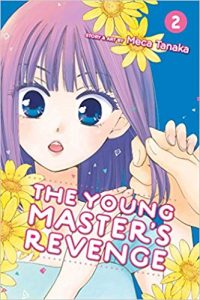
Young Master’s Revenge, Vol. 2

July 30, 2018 by Anna N

Young Master’s Revenge Volume 2 by Meca Tanaka

This manga continues to be perhaps the most adorable revenge story ever illustrated. Leo, bent on revenge and managing his crippling fear of turtles, continues to pursue his horrific yet benign agenda against fallen heiress Tenma with an unwavering devotion that could only be love. As the volume begins Tenma decides that she has to transfer to Suzaku High which is the public high school down the road from Genbu. Cue massive jokes about references to the Four Gods!

As Tenma transfers Leo decides to accompany her mostly to protect her, but also because he finally realizes that his high school is named after a turtle god. The new students then engage in introductions for their new classmates, where Leo’s practiced charm wins everyone over and Tenma’s awkwardness makes everyone assume that she’s a horrible rich snob. When Tenma sees that the public school students have their resources even more limited because the rich Genbu high kids are allowed to take over their practice fields whenever they want she decides that she has to stand up for her new classmantes.

The Suzaku kids now have to fight for the sanctity of their school property. Leo’s manipulation skills are deployed to hilarious effect. One of the reasons why this manga is so amusing is that the revenge plot is such a great contrast to the real feelings of the characters. Tanaka has a way of drawing such endearing facial expressions, it is easy to be captivated by Tenma’s direct yet innocent nature and Leo’s unwavering lack of insight into his own emotions. Things seem to be coming to a turn though, as Leo is forced to confront the thin line between love and hate towards the end of this volume. It is impossible to put this manga down without feeling warm and fuzzy.

Filed Under: Manga Reviews, REVIEWS

Umineko: When They Cry, Vol. 18

July 29, 2018 by Sean Gaffney

Story by Ryukishi07; Art by Eita Mizuno. Released in Japan in three separate volumes as “Umineko no Naku Koro ni: Requiem of the Golden Witch” by Square Enix, serialized in the magazine Shonen Gangan. Released in North America by Yen Press. Translated by Stephen Paul.

Last time we finally got the answer to the riddle of the Epitaph, as well as the revelation of who Beatrice is, though that answer required jumping through a few hoops to avoid showing us a face. For the conclusion of this penultimate arc, however, the answers come fast and furious. In fact, one complaint of the audience that had read the original visual novels is that they’re a bit too much like looking at the answer sheet. When Clair and Will face off, we get her declarations, and we see his sword bluntly cutting them off. But the floating words literally stating what happened in the first four arcs was added to the manga especially. Apparently fans had started to get a bit over the top about how there was no real answer to the arcs, and this was Ryukishi07’s response (he worked closely with the mangaka for the last two arcs especially). And here we also find out the truth of what REALLY happened in 1986. Though, like Ange, I don’t think you’re going to like it.

One of the things that was made very clear was that Kinzo’s magic was money. Money is what has the power to make miracles. And so the solution to what really happens, once you realize that the parents actually put their heads together and all solved the epitaph together, is depressingly obvious. What’s more, it mirrors some of the battles in the prior arcs. Jessica’s fistfights against Kyrie and Ronove contrast with her pathetic demise here, having her face literally being beaten to a pulp. (There’s always a gore warning for Umineko, by the way, but this volume is particularly bad.) Natsuhi also doesn’t get a chance to fight back, and her death starts the chain of everyone else’s. As for the identity of the culprit, I’ll avoid mentioning it here, but I will say that we discover, as the reader was well aware, that Bernkastel’s goal is to see everyone suffer for her own entertainment, and given who she’s been “helping” for so long, you can probably hazard a guess. That said, I’m not sure EVERYTHING we see is exactly what happened. There’s a conversation between two characters about Ange that seems a bit too on the nose to not be “dialogue provided by Bernkastel”, to be honest.

Even Lion doesn’t manage to escape Bern’s mass slaughter, as Bern reveals that even in the ONE universe where Lion exists, their fate is also preordained. That said, three cheers for Will, who says what we all want to hear: mysteries that just end unhappily for everyone are not fun to read. Will is there to bring the reader hope, even if it means losing an arm and fighting along with Lion against Bern and her nightmarish army of cats. (Lambdadelta is there too, but honestly she’s more a passive audience member than anything else. She enjoys it, but it’s all Bernkastel’s show.) But still… we’ve got one big arc to go. We know what really happened in 1986. Is there any way to give Ange a happy ending in 1998? Bern says no, and she says it in red, so it’s going to be tough. (I recommend the digital version for that page, by the way, as the color red is actually used for the statement, and it gives it a lot of impact.)

Clearly the answer, however, is not to take the opposite tack either. We should not see an arc that shows us how everything was all happiness, sunshine and rainbows in 1986, not after everything we’ve seen involving the Ushiromiya family. But there’s no way anyone’s motivations would be that misguided. Right? Tune in next time for Twilight of the Golden Witch, aka “don’t mention this arc in the presence of an Umineko fan”. Same time, same publisher!

Filed Under: REVIEWS, umineko

  • « Go to Previous Page
  • Page 1
  • Interim pages omitted …
  • Page 165
  • Page 166
  • Page 167
  • Page 168
  • Page 169
  • Interim pages omitted …
  • Page 346
  • Go to Next Page »
 | Log in
Copyright © 2010 Manga Bookshelf | Powered by WordPress & the Genesis Framework