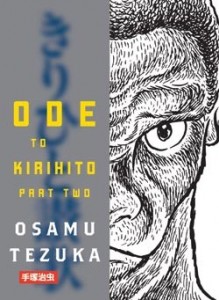
• Skip to primary navigation
  • Skip to main content
  • Skip to primary sidebar
  • Home
  • About Us
    • Privacy Policy
    • Comment Policy
    • Disclosures & Disclaimers
  • Resources
    • Links, Essays & Articles
    • Fandomology!
    • CLAMP Directory
    • BlogRoll
  • Features & Columns
    • 3 Things Thursday
    • Adventures in the Key of Shoujo
    • Bit & Blips (game reviews)
    • BL BOOKRACK
    • Bookshelf Briefs
    • Bringing the Drama
    • Comic Conversion
    • Fanservice Friday
    • Going Digital
    • It Came From the Sinosphere
    • License This!
    • Magazine no Mori
    • My Week in Manga
    • OFF THE SHELF
    • Not By Manga Alone
    • PICK OF THE WEEK
    • Subtitles & Sensibility
    • Weekly Shonen Jump Recaps
  • Manga Moveable Feast
    • MMF Full Archive
    • Yun Kouga
    • CLAMP
    • Shojo Beat
    • Osamu Tezuka
    • Sailor Moon
    • Fruits Basket
    • Takehiko Inoue
    • Wild Adapter
    • One Piece
    • After School Nightmare
    • Karakuri Odette
    • Paradise Kiss
    • The Color Trilogy
    • To Terra…
    • Sexy Voice & Robo
  • Browse by Author
    • Sean Gaffney
    • Anna Neatrour
    • Michelle Smith
    • Katherine Dacey
    • MJ
    • Brigid Alverson
    • Travis Anderson
    • Phillip Anthony
    • Derek Bown
    • Jaci Dahlvang
    • Angela Eastman
    • Erica Friedman
    • Sara K.
    • Megan Purdy
    • Emily Snodgrass
    • Nancy Thistlethwaite
    • Eva Volin
    • David Welsh
  • MB Blogs
    • A Case Suitable For Treatment
    • Experiments in Manga
    • MangaBlog
    • The Manga Critic
    • Manga Report
    • Soliloquy in Blue
    • Manga Curmudgeon (archive)

Manga Bookshelf

Discussion, Resources, Roundtables, & Reviews

Manga

An Introduction to Keiko Takemiya’s To Terra

May 23, 2010 by Katherine Dacey


Welcome to the May Manga Movable Feast! On the menu: Keiko Takemiya’s award-winning sci-fi epic To Terra. If you’ve never dined with us before, here’s how the MMF works: every month, the manga blogging community holds a week-long virtual book club in which we discuss a particular series or one-shot. Each day, the host shares links to new blog entries focusing on that work, while building an archive for the entire week’s discussion. At the end of the week, the group then selects a new host and a new “menu” for the following month.

Our “feast” has two goals. The first is to promote intelligent, in-depth analysis of manga we love (or, in some cases, hate). Previous contributions have run the gamut from straightforward reviews to an interview with Sexy Voice and Robo editor Eric Searleman, a guided tour through Kaoru Mori’s “Emmaverse,” and an essay contrasting Urushibara’s Mushishi with Lovecraft’s Cthulhu Mythos. The second goal is to foster a sense of community among avid manga readers. Everyone is invited to take part in the MMF, regardless of whether you’ve participated before. If you have your own blog, simply send me the link to your To Terra-themed post, whether it’s a brand new essay written expressly for the MMF or an older review that you’d like the share with the community, and I’ll include it in my daily round-up. If you don’t have a blog, send me your text and I’ll post your ideas here. (Click here for my email.) Discussion begins today and will run through the week until Sunday, May 30th.

Below, I’ve provided an overview of the series’ publication history, plot, and place in the manga canon. You can follow the discussion by checking the daily blog posts, clicking on the Manga Movable Feast tag, or visiting the MMF archive: http://mangacritic.com/?page_id=4766.

TO TERRA: THE PUBLICATION HISTORY

To Terra debuted in 1977 in Gekkan Manga Shonen. During its three-year run, To Terra nabbed two honors: the Shogakukan Manga Award and the Seiun Award, an annual prize for the best new science fiction published in Japan. (To Terra was the first manga to receive a Seiun Award; later winners would include Appleseed, Domu: A Child’s Dream, Urusei Yatsura, Cardcaptor Sakura, Planetes, and 20th Century Boys.)  The series was originally issued in tankubon format in 1980 by Asahi Sonorama, and reissued again in 2007 by Square Enix, around the same time Vertical, Inc. released the first English-language edition.

To Terra has enjoyed considerable popularity in Japan, thanks, in part, to several adaptations: a 1979 NHK radio drama; a 1980 movie, produced by Toei Animation; and a 2007 animated television series, produced by Aniplex.

TO TERRA: THE STORY

toterra2To Terra unfolds in a distant future characterized by environmental devastation. To salvage their dying planet, humans have evacuated Terra (Earth) and, with the aid of a supercomputer named Mother, formed a new government to restore Terra and its people to health. The most striking feature of this era of Superior Domination (S.D.) is the segregation of children from adults. Born in laboratories, raised by foster parents on Ataraxia, a planet far from Terra, children are groomed from infancy to become model citizens. At the age of 14, Mother subjects each child to a grueling battery of psychological tests euphemistically called Maturity Checks. Those who pass are sorted by intelligence, then dispatched to various corners of the galaxy for further training; those who fail are removed from society.

The real purpose of these checks is to weed out an unwanted by-product of S.D.-era genetic engineering: the Mu, a race of telepathic mutants. After decades of persecution, the Mu fled Terra, seeking refuge beneath the surface of Ataraxia. Under the leadership of Soldier Blue, they escaped detection by humans. But Soldier Blue is frail and dying (though he has chosen to project a youthful, sparkly-eyed appearance), and seeks a successor in Jomy Marcus Shin, a 14-year-old who possesses both the telepathic ability of a Mu and the hardier constitution of a human. As the series unfolds, we watch Jomy develop into a formidable leader, capable of inspiring passion, loyalty, and sacrifice among the Mu as they struggle to return to their homeworld. Running in counterpoint to Jomy’s story is that of Keith Anyan, an elite solider-in-training and future Terran leader. Keith enjoys a privileged position in human society. Yet he is plagued by doubt: why doesn’t he remember his childhood? Or his foster parents? And why does Mother refuse to eradicate the Mu when the state has deemed them a threat to mankind?

What makes this unabashedly Romantic mash-up of Star Trek, Star Wars, and 2001 both entertaining and moving is the richness of Keiko Takemiya’s universe. On the surface, To Terra is a beautifully illustrated soap opera, the kind of manga in which the heroes have terrific hair, wear smart jumpsuits, and keep psychic squirrels as pets. But To Terra can also be read a cautionary tale about mankind’s poor custodianship of the Earth; a scathing critique of eugenics and social engineering; a meditation on the relationship between memory and identity; and, most significantly, a critique of adult hypocrisy. It’s this multivalent quality that elevates To Terra from a mere allegory to an epic space opera as engaging, beautiful, and thought-provoking as Tezuka’s best work. (This review originally appeared at PopCultureShock on July 16, 2007.)

TO TERRA: ITS PLACE IN THE CANON

As anyone with a passing familiarity with the Magnificent 49ers knows, the 1970s were a watershed in the development of shojo manga. Not that shojo manga was an invention of the 1970s, of course; shojo manga traces its roots back to the 1910s, when girls’ magazines began running short, one-page gag strips, and underwent several major stages of development before evolving into the medium we know today. Until the mid-1960s, however, shojo manga was written by men for pre-teen girls; the stories were sweet, sentimental, and chaste, often revolving around family, class, and identity in the manner of a Frances Hodgson Burnett story. In an interview with manga scholar Matt Thorn, Keiko Takemiya’s former roommate Moto Hagio remembers the manga from this period:

In the girls’ comics, you would have stories in which the woman you thought was the mother turns not to be the mother, and the real mother is actually somewhere else. There was a variety of settings. For example, the poor child in the story turns out to actually come from a rich family, or the child of a rich family turns to have been adopted from a poor family. And one of the standard device was amnesia… It appeared so often, it makes me think that what with the war and the harsh social conditions, people had an unconscious desire to forget everything. So the heroine goes off in search of her real mother, but along the way she develops amnesia, and ends up being taken care of by a string of kind strangers.

Another popular motif was ballet. There was quite a boom in girls’ comics about ballet for a while. For example, the heroine would be a girl from a poor family who’s really good at ballet, but she loses the lead to an untalented girl from a rich family. In the standard story, there would be a mean girl and a kind-hearted heroine, and there would be a very clear-cut struggle between good and evil.
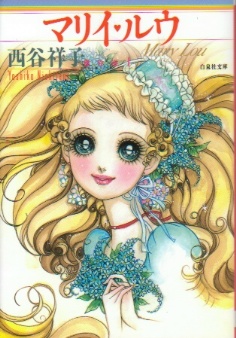
maryloubunkoIn the mid-1960s, pioneering female artist Yoshiko Nishitani began writing stories aimed at a slightly older audience. Nishitani’s Mary Lou, which made its debut in Weekly Margaret in 1965, was one of the very first shojo manga to document the romantic longings of a teenage girl. (As Thorn notes in “The Multi-Faceted World of Shoujo Manga,” the heroines of early shojo stories were too young for crushes and dates, so romance was the provenance of older, secondary characters.) Though tame by contemporary standards, Mary Lou’s emphasis on the heroine’s emotional life and relationships proved highly influential, paving the way for other artists to write stories that focused on the everyday concerns of teenagers, rather than the melodramatic travails of poor little rich girls.

Nishitani was a pioneer in another sense as well: she inspired dozens of women to enter what had been an overwhelmingly male profession. Those artists who followed Nishitani into the field in the 1970s — women like Takemiya, Hagio, and Ryoko “Rose of Versailles” Ikeda — built on her legacy, helping complete the transformation of shojo manga from staid stories about good girls to a multi-faceted storytelling medium capable of dramatizing the characters’ inner thoughts as forcefully as their physical actions. The 49ers embraced genres such as science fiction and fantasy, and developed new ones as well: the entire boys’ love industry owes a debt to Hagio and Takemiya for ground-breaking stories such as “The Heart of Thomas” and The Song of the Wind in the Trees. Whatever the subject matter, however, the 49ers used the comics medium to explore fundamental questions about identity — what constitutes family? what does it mean to be female? what distinguishes the child from the adult? — and love in all its manifestations, from maternal to carnal.

To Terra, which addresses many of the themes found in Takemiya’s other works, is significant precisely because it isn’t shojo; Takemiya was one of the first female artists to write for a boys’ magazine, bringing a distinctly shojo sensibility to her portrayal of Keith and Jomy’s emotional lives. The popular success of To Terra created opportunities for other manga-ka to cross over as well, a trend important enough for Frederick Schodt to make note of it in Manga! Manga! The World of Japanese Comics (1983). Contemporary artists such Rumiko Takahashi, CLAMP, Yellow Tanabe, and Hiromu Arakawa owe a debt to Takemiya, as she helped demonstrate what seems patently obvious to us now: that women are just as capable of writing for male audiences as men are. Oh, and we can draw a pretty bitchin’ space ship if the story calls for one.

FOR FURTHER READING

Aoki, Deb. “Interview: Keiko Takemiya, Creator of To Terra and Andromeda Stories.” About.com: Manga. January 22, 2008. (Accessed 5/23/10.)

Thorn, Matt. “The Moto Hagio Interview.” The Comics Journal 269 (July/August 2005). (Accessed 5/23/10.)

Thorn, Matt. “The Multi-Facted Universe of Shoujo Manga.” Conference paper. 2008. (Accessed 5/23/10.)
Filed Under: Classic Manga Critic, Manga, Manga Critic, REVIEWS Tagged With: Classic, Keiko Takemiya, Magnificent 49ers, Sci-Fi, Shonen, vertical

AX, Vol. 1: A Collection of Alternative Manga

May 21, 2010 by Katherine Dacey

The next time someone dismisses manga as a “style” characterized by youthful-looking, big-eyed characters with button noses, I’m going to hand them a copy of AX, a rude, gleeful, and sometimes disturbing rebuke to the homogenized artwork and storylines found in mainstream manga publications. No one will confuse AX for Young Jump or even Big Comic Spirits; the stories in AX run the gamut from the grotesquely detailed to the playfully abstract, often flaunting their ugliness with the cheerful insistence of a ten-year-old boy waving a dead animal at squeamish classmates. Nor will anyone confuse Yoshihiro Tatsumi or Einosuke’s outlook with the humanism of Osamu Tezuka or Keiji Nakazawa; the stories in AX revel in the darker side of human nature, the part of us that’s fascinated with pain, death, sex, and bodily functions.

Founded in 1997, AX was a direct descendant of Garo (1964-2002), Katsuichi Nagai’s seminal avant garde manga magazine. As historian Paul Gravett explains in his introduction to A Collection of Alternative Manga, both publications served an essential purpose, providing artists a place to break free of the influence of commercial manga publishing — its rigid house styles, tight deadlines, strong editorial presence, and reader polls — and find more idiosyncratic forms of expression. At the same time, Gravett argues, Garo and AX gave artists a platform for speaking out against the dominant culture, to loudly question the truth that everyone can and should be “doing one’s best” while trying hard to fit in.

The thirty-three stories in A Collection of Alternative Manga nicely illustrate Gravett’s thesis, encompassing a true diversity of styles and subject-matters. At one end of the spectrum are artists such as Yuka Goto, whose work reflects a heta-uma, or “bad-good” aesthetic, with crudely-drawn figures in absurd situations (her feuding neighbors resolve their differences with a judo match), while at the other are artists such as Takato Yamato, whose intricate, naturalistic style becomes a vehicle for juxtaposing pornographically beautiful human bodies with explicit images of decay and rot. Most of the work in AX falls somewhere in between: the magical realism of Akina Kondo (“Rainy Day Blouse and The Umbrella”); the primitivist abstraction of Otoya Mitsusashi (“Sacred Light”); the horror-comedy of Kazuichi Hanawa (“Six Paths of Wealth”); the kawaii-grotesque of Mimyo Tomozawa (“300 Years”). Then there are stories which are parodies in the truest sense, borrowing the visual language of shonen manga for dark farce: Namie Fujieda’s “The Brilliant Ones,” in which an earnest group of students tries to help the class loser find a way to shine — even after his body has exploded into a thousand small parasites — and Tomohiro Koizumi’s “Stand By Me,” a story about a pair of peeping teens caught in the act.

For me, the biggest obstacle to enjoying the collection — as opposed to appreciating it — is that for every story like Ayuke Akiyama’s lovely, folkloric “In the Gourd” or Toranasuke Shimada’s historical phantasmagoria “Enrique Kobayashi’s El Dorado,” there are two that read like stunts, deliberate attempts to provoke, and maybe even disgust, the audience by rubbing its nose in taboo subjects and uncomfortable truths. Such confrontational art can be thought-provoking, to be sure, making us reconsider socially determined categories such as “parent,” “teacher,” and “child”: Yusaku Hanakuma’s “Puppy Love” is one such example, a bizarre, funny, upsetting story in which a woman gives birth to a litter of puppies and resolves to raise them as normal children. The struggles she and her “sons” face remind us of how difficult it is for anyone to raise a child whose behavior or appearance makes others uncomfortable; it’s With the Light, minus the easy sentiment (and with a dollop of David Cronenberg’s perverse sense of humor).

The need to elicit a strong, visceral response from the reader can also inspire puerile excess. Shigiheru Okada (“Me”), Saito Yunosuke (“Arizona Sizzler”), Kataoko Toyo (“The Ballad of Non-Stop Farting”), and Takashi Nemoto’s (“Black Sushi Party Piece”) repeated depictions of body parts and bodily fluids reminded me of sixth graders testing out every permutation of a new swearword to see which ones had the greatest shock value. Other stories, such as Yoshihiro Tatsumi’s “Lover’s Bride,” inspire an immediate ewwwww, and maybe a chuckle, but not much else: what deeper truths could possibly be gleaned from a sad-sack character’s decision to woo a primate instead of a human?

My other stumbling block to fully embracing AX is the way in which female characters are depicted in stories such as Yuichi Kiriyama’s “A Well-Dressed Corpse,” Hiroji Tani’s “Alraune Fatale,” and Osamu Kanna’s “The Watcher.” The female characters often seem more like receptacles for male anger, sexual aggression, or disappointment than they do actual human beings. I suppose one could argue that these artists are simply exaggerating a tendency found in manga across the spectrum, making explicit what’s normally implicit in a lot of material directed at male audiences. Yet none of these artists seem to be critiquing the male gaze in any meaningful way; they cast a pitiless, often lascivious eye on their female subjects, reducing them to a monstrous assortment of breasts and mouths and legs. It’s to editor Sean Michael Wilson’s great credit that he includes so many distinctive female voices in the anthology as well, preventing AX from becoming too dourly macho or grossly juvenile.

Yet for all my discomfort and distance from the material, I can’t look away. As a historian, AX excites me, providing a meticulously curated introduction to Japan’s underground comics scene. As a reader, AX challenges me to move beyond my notion of what constitutes manga, helping me understand what artists like Yoshihiro Tatsumi and Yoshiharu Tsuge were trying to do in the 1950s and 1960s with their “manga that isn’t manga”: to push the medium outside its comfort zone, to show us ugly truths, to make us laugh with recognition and discomfort, and to encourage artistic expression that, in Gravett’s words, is “as personalized as handwriting or a signature.” Recommended.

Review copy provided by Top Shelf. AX, Vol. 1: A Collection of Alternative Manga will be released on July 15, 2010.

AX, VOL. 1: A COLLECTION OF ALTERNATIVE MANGA • EDITED BY SEAN MICHAEL WILSON, WITH AN INTRODUCTION BY PAUL GRAVETT • TOP SHELF • NO RATING • 400 pp.

Filed Under: Manga, Manga Critic, REVIEWS Tagged With: Alt-Manga, Top Shelf

The Times of Botchan, Vols. 1-4

May 19, 2010 by Katherine Dacey

Reading The Times of Botchan reminded me of watching Alexander Sakurov’s cryptic 2002 film Russian Ark. Both employ a similar gambit: a literary figure from the country’s past wanders through a landscape populated by real people who played pivotal roles in its modernization. In Russian Ark, the author/protagonist role is filled by the Marquis de Custine, a French aristocrat who published Empire of the Czar: Journey Through Eternal Russia in 1839, while in The Times of Botchan the role is fulfilled by Soseki Natsume (1867-1916), the defining novelist of the Meiji Restoration. Neither Ark nor Botchan employs a clear, linear narrative; both works are episodic — even, at times, picaresque — in nature as their principle characters rub shoulders with poets, composers, czars, and politicians.

When we first meet Natsume, he is writing a novel called Botchan, a short, satirical work about a energetic young man who suffers from a Holden Caufield-esque desire to expose phoniness wherever he goes. Nastume hopes Botchan will help him achieve catharsis from a vague but nagging sense of anxiety brought on by the period’s social, political, and economic upheavals, from the Freedom and People’s Rights Movement to the first murmurs of suffragism.1 Though we occasionally see Natsume in his study drafting chapters, or admiring the inky paw prints left behind by his cat, much of the manga is devoted to Natsume’s travels through Tokyo, which brings him into contact with historical figures from An Jung-Geun, an activist who assassinated the Korean governor in 1909, to Hiruko Haratsuka, a feminist active in the Seito suffrage movement of the 1910s, to Lafcadio Hearn, a Western journalist whose fascination with old Japan inspired him to write Kwaidan: Stories and Studies of Strange Things.

Some of these encounters are the jumping off point for vignettes about Westerners living in Japan, or the state of Japanese literature, while others are mere coincidence and treated in just one or two panels. The resulting manga feels like a tableau, or the Japanese equivalent of a guided tour through Colonial Williamsburg, as our unseen narrator identifies the sprawling cast of characters and mentions key events in Meiji-era history.

Despite its historical ambitions, The Times of Botchan is best read for its quieter moments. Jiro Taniguchi creates intimate scenes that require little or no dialogue to convey their nuance: two acquaintances walking silently through a snowing streetscape, Natsume working in his study. Small details capture the transitional nature of the period, and speak volumes about the characters’ ambivalent relationship with the West, with some embracing European dress, others flatly rejecting it, and most, like Natsume, striking a compromise, combining a yukata with a button-down shirt and bowler hat.

Sekikawa’s script, however, is less artful than Taniguchi’s visuals, as the omniscient narrator often supplies the reader with information that can be readily inferred from the pictures. In one scene, for example, the writer Rintaro “Ogai” Mori2 returns to his family after a prolonged stay in Europe. He intends to tell his parents that he loves — and plans to marry — a young German dancer named Elise Weigert, but cannot bring himself to do so now that he is back on Japanese soil. Taniguchi’s illustrations instill in us a powerful sense of Mori’s estrangement from his roots, using his characters’ body language and placement within the picture plane to convey the emotional distance between Mori and his parents, but Sekikawa’s narrator intrudes on the scene:

At that moment, Ogai felt, for the first time, that he was back in Japan. In this country, individualism was not regarded as a personal virtue, the ‘family’ had to be considered. Ogai was unable to speak the words he had prepared and became mute as a fish.

Such heavy-handed interjections suggest that Sekikawa doesn’t trust us to decode moments of mystery, poetry, or ambiguity on our own; at least the Marquis de Custine never bothered to explain why Nicholas II and victims of the Kursk disaster haunted the same wing of the Hermitage.

The Times of Botchan‘s other great flaw is its deadly serious tone. The two novels that Natsume wrote during the period portrayed in the manga, I Am a Cat and Botchan, are both satirical, filled with wry observations about human nature and sharp critiques of pomposity, greed, toadyism, and empty-minded embrace of Western mores.3 Though the manga is filled with visual signifiers for both works — cats, in particular, are a recurring motif throughout the first two volumes — the manga lacks the delicate touch of either novel; one might reasonably conclude from Sekikawa’s narration that Botchan was a Zola-esque expose on the evils of Westernization, rather than a comedy about a young teacher coping with the inept faculty at a podunk boys’ boarding school.

From time to time, however, the narrative snaps out of its staid, vaguely pompous tone. In one genuinely funny scene, for example, Japan’s leading literary figures gather in the home of a prominent politician for a meeting of “The Perpetual and Immutable Literary Circle.” Two are asked to compose a poem on the spot. The first, intoned by the host, is greeted with respectful, if vague praise (“It reminds one of the tranquility and beauty of Turner’s paintings,” one opines):

The great canon is heard from afar
On the left diagonal of the hands that hold the horse’s reins.

The second stuns them into uncomfortable silence:

When the cowherd makes a poem
A new air rises in the world.

A lively debate follows, with some detecting a whiff of socialism in the cowherd’s profession, and others praising it for its direct simplicity; not until the group’s acknowledged expert interprets both poems does the group reach consensus on their quality. The punchline comes in the final panel, when one member acknowledges that the first poem made no sense. In that brief scene, Sekikawa and Taniguchi capture the spirit of Botchan without slavishly recreating a scene from it; one could almost imagine the savage nicknames that a younger, less pretentious member of the circle might lavish on his elders as they debated the merits of both poems.

In another rare moment of levity, Natsume witnesses a young suffragette making out with her paramour in a restaurant, noting the length — three and a half minutes — and intensity of their kiss. Taniguichi draws that kiss in almost pornographic detail, with panel after panel of the two lovers’ mouths drenched in saliva, in essence showing us how Natsume views their contact, with a mixture of prurient fascination and revulsion. Sesikawa and Taniguchi then takes things a step further, borrowing a page from Milos Foreman’s Amadeus to suggest how this brief, everyday experience found its way into the pages of Botchan, with the suffragette morphing neatly into the Madonna, a social-climbing temptress who switches romantic allegiances when it suits her interest.

Given the didactic tone and frequent allusions to unfamiliar historical figures, I’m hesitant to give The Times of Botchan an unequivocal endorsement. Some readers will find the book long-winded, confusing, and perhaps even a little boring. But for those already enamored of Taniguchi’s superb draftsmanship or well-versed in Japanese culture, The Times of Botchan offers readers a lovely reward: a window into one of the most fascinating periods in Japanese history, and the creative process of one its most important voices.

NOTES

1. The Freedom and People’s Rights Movement in Japan began in the 1870s. Building on the reforms established in the Charter Oath of 1868 (which abolished Japan’s rigid class structure, among other provisions), urban intellectuals lobbied for the drafting of a constitution and the creation of a parliament.

2. Ogai Mori is best known to Western audiences for his novels The Wild Geese and Sansho the Bailiff, the latter being the basis of Kenji Mizoguchi’s 1954 film.

3. As translator Joel Cohn notes, Botchan (the novel) occupies a similar place in the Japanese canon as Catcher in the Rye and Huckleberry Finn, and is a standard text in most high schools. See the introduction to Natsume Soseki, Botchan, Translated by J. Cohn (New York: Kodandsha International, 2005).

Review copy of volume four provided by the publisher. This is an expanded version of a review that appeared at PopCultureShock on 6/5/2007. The original review focused on volumes 1-3 of the series.

Filed Under: Manga, Manga Critic, REVIEWS Tagged With: Fanfare/Ponent Mon, Historical Drama, Jiro Taniguchi, Natsume Soseki

Saturn Apartments, Vol. 1

May 16, 2010 by Katherine Dacey

If I’ve learned anything from my long love affair with science fiction, it’s this: there’s no place like home. You can boldly go where no man has gone before, you can explore new worlds and new civilizations, and you can colonize the farthest reaches of space, but you risk losing your way if you can’t go back to Earth again.

In Saturn Apartments, the physical distance between us and our terrestrial home is small, but the emotional distance is great. The story takes place in a future where environmental devastation has prompted humans to decamp the Earth’s surface for its atmosphere, where they build an elaborate structure that encircles the planet. That floating city resembles Victorian London in its rigid class system and physical organization: the poorest people live in its bowels, in an artificially lit environment, while the richest live on the uppermost levels, enjoying natural light and unspoiled views of Earth.

Our guide to this stratified world is fourteen-year-old Mitsu, a professional window washer who lives on the lowest level. By virtue of his job, Mitsu has access to the entire city. For a boy who’s joined the workforce at an early age, who lives in a cramped room with few possessions, and whose neighbors suffer the ill effects of chronic light deprivation, his clients, most of whom live on the top floors, seem ridiculous and exacting. At the same time, however, they intrigue Mitsu; not only do they give him a glimpse into a more affluent way of life, they also own things — animals, machines, plants — that connect them to the Earth’s abandoned surface.

As these organisms and objects suggest, all of Saturn‘s characters suffer a strong sense of terrestrial homesickness. Midway through volume one, for example, Mitsu meets an eccentric zoologist who maintains an enormous private aquarium in his apartment. The man’s aquarium and his bizarre request that Mitsu splash water on the windows — something that’s impossible to do at an altitude of 35,000 kilometers — initially seem like a wealthy man’s whims; that is, until Mitsu learns that the zoologist is trying to create a more congenial environment for the aquarium’s prized specimen, the last surviving whale from a failed effort to reintroduce mammals into Earth’s oceans.

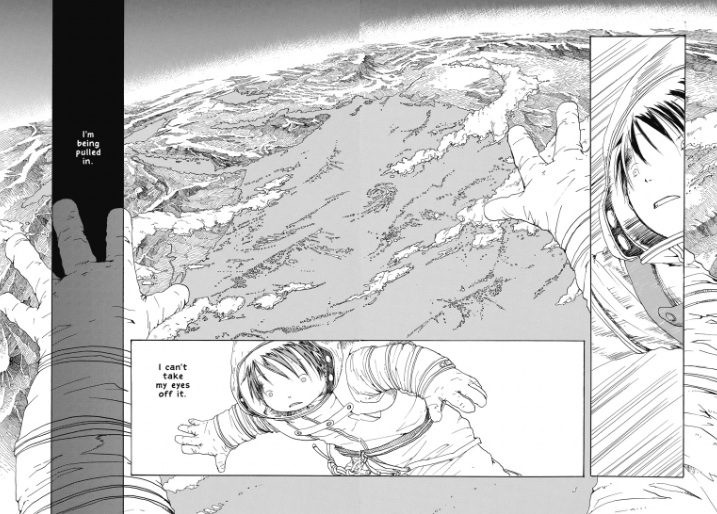
In other chapters, the characters’ longing to go home is more palpable. When Mitsu tackles his first assignment, for example, he finds himself at the very site where his father Akitoshi, also a window-washer, plunged to his death. Mitsu sees evidence of his father’s presence — a frayed rope, handprints on the side of the building — and though he interprets the evidence as proof of Akitoshi’s desperate struggle for survival, Mitsu is briefly seized by the thought that his father wanted to die, that Akitoshi cut the safety line so that he might fall back to Earth. Mitsu himself struggles with that same impulse; caught off guard by a strong solar wind, he finds himself dangling precariously above the Earth, mesmerized by the sight of the African continent spreading below him:

saturn_earth

Only the intervention of Jin, an experienced co-worker, snaps Mitsu out of his dangerous reverie and spurs the boy to take corrective action. Once safely tethered to a lift, however, Mitsu peers over the side for another glimpse of the surface, resolving to one day “find the spot down there where Dad landed.”

Like Planetes, Saturn Apartments is less a tale of intergalactic derring-do than of ordinary people doing extraordinarily dangerous, tedious work in extreme environments. Most of what we learn about the characters comes from observing them on the job, as they banter with co-workers, perform routine tasks, and respond to crises. In Saturn Apartments, Akitoshi’s death — an event that took place five years before the story begins — casts a long shadow over the window washer’s guild. The mystery of what happened to Akitoshi plays an important role in advancing the plot, to be sure, but most of the story explores the way in which Mitsu comes to terms with his father’s death through learning Akitoshi’s profession and befriending Akitoshi’s colleagues.

The other thing that Saturn Apartments and Planetes have in common is beautiful, detailed artwork that conveys a strong sense of place. Hisae Iwaoka’s landscapes bustle with activity, showing us how the apartment dwellers go about their daily business. Each level has its own distinctive appearance, from the basement tenements — where Mitsu and Jin live — to the middle level — a tidy grid of schools and mid-rise buildings dotted with grassy parks — to the very top — a collection of spacious lofts with enormous windows. Iwaoka renders all of these environments in gently rounded, slightly imperfect lines that make the complex look warmly inviting, rather than sterile and prefabricated; even the very lowest levels of the complex are appealing, their close yet friendly quarters reminiscent of fin-de-siecle Delancey and Mulberry Streets.

Saturn Apartments is many things — a coming-of-age story, a set of character studies, a meditation on man’s place in the greater universe — but like all good space operas, its real purpose is to affirm the truth of T.S. Eliot’s words, “We shall not cease from exploration/And the end of all our exploring/Will be to arrive where we started/And know the place for the first time.” Highly recommended.

Review copy provided by VIZ Media, LLC. Volume one of Saturn Apartments will be released on May 18, 2010. To read the first eight chapters online, visit the SigIKKI website.

SATURN APARTMENTS, VOL. 1 • BY HISAE IWAOKA • VIZ • 192 pp. • TEEN (13+)

Filed Under: Manga, Manga Critic, REVIEWS Tagged With: Sci-Fi, SigIKKI, VIZ

Beast Master 2 by Kyousuke Motomi: A-

May 12, 2010 by Michelle Smith

From the back cover:
Leo Aoi looks like a crazy animal with wild eyes, and he goes berserk whenever he feels threatened or sees blood. That doesn’t stop animal lover Yuiko Kubozuka from befriending him, however. In fact, Yuiko is the only person Leo will listen to when he has one of his violent fits…

Leo’s 18th birthday is around the corner, but celebrating seems impossible as someone is after Leo’s life! Can Leo overcome the dangers of his past? Or will this beast-like boy be separated from his beloved “master”… forever?

Review:
I suppose there’s not anything terribly original about these final three chapters of Beast Master. In the first, we get a little more information on Leo’s backstory, including the revelation that he’s worth billions and began living in the wild in the first place to avoid his murderous relations. In the second, Leo’s dad reenters the picture and, after another attempt on his son’s life puts him in the hospital, suggests a move overseas. Finally, Yuiko develops insecurities about how Leo feels about her upon seeing how popular he’s become with other girls.

What makes this series so special, then, is how truly sweet it is. Not some cloying and irritating approximation of sweetness, either, but something truly genuine and moving. After Yuiko witnesses Leo being hit by a car, it makes sense that she’d support his father’s plan to relocate him someplace safer, and the scene where she attempts to maintain a brave face as she bids him good-bye, only to break down as he drives off is perfectly painful. Although we, as readers, can expect him to return, Yuiko’s sadness is nicely portrayed, as she realizes that simply knowing he’s safer will not make her miss him any less.

The final chapter’s a nice spin on the “I don’t know how he feels about me” idea, too. It works here because Leo is so child-like, Yuiko has to wonder whether he even realizes that there are different levels of liking someone. He can “like” a girl classmate who loans him some CDs, but does he feel anything more than this for Yuiko? Well, of course he does, and his eventual shy confession is so adorable it made me sniffly.

Rounding out the volume is “Cactus Summer Surprise,” a short story about a body-swapping cactus. Yes, you read that right. In a nutshell, Akira is a cactus fan who once gave her prized plant to her middle-school crush, Kaito, who told her that he threw it away. They’ve been enemies ever since—though, of course, it’s obvious they really fancy each other—and through the machinations of a middle-aged female spirit who transitions from the cactus in which she resides into possessing Kaito’s body, they manage to patch things up. Again, like Beast Master, this story ends with a particularly adorable scene of a guy trying to get his feelings across.

When I finished this volume, my first thought was, “That was good! I’d like to read something longer by Kyousuke Motomi.” And my second thought was, “Oh yeah! Dengeki Daisy is coming in two months!” Thank you, VIZ!

Filed Under: Manga, Shoujo Tagged With: Kyousuke Motomi, shojo beat, VIZ

My Girlfriend’s a Geek, Vol. 1

May 5, 2010 by Katherine Dacey

The prince who turns out to be a toad is a staple figure in romantic comedies: what Jane Austen novel didn’t feature a handsome, wealthy suitor who, in the final pages of the story, turned out to be ethically challenged, penniless, or engaged to someone else? My Girlfriend’s a Geek offers a more up-to-the-minute version of Mr. Willoughby, this time in the form of a nice young woman who looks like a dream and holds down a responsible job, but has some rather unsavory habits of mind.

The hapless protagonist of My Girlfriend’s a Geek is Taiga Motou, a perpetually broke, somewhat flaky college student who aspires to be a novelist. Taiga is on a quest to find the perfect job, one that “pays big” and is “close to college and easy to do and not too sweaty”; bonus points if the staff includes “a beautiful, hard-working big sis-type chick.” When he stumbles across a clothing company with a “Help Wanted” sign in the window and an attractive manager in the office, he jumps at the chance. Once employed, Taiga does his best to flirt with the beautiful Yuiko, though his opportunities are few and far between: a chance encounter in the lunch room, an after-hours search for missing inventory. Yuiko’s signals are hard to decode — she blows hot and cold, and ditches him to fiddle with her VCR — but she eventually agrees to go on a proper date with him.

Taiga doesn’t have much opportunity to savor his conquest, however, as Yuiko makes a startling confession at the end of dinner: she’s a geek. But not a run-of-the-mill geek; she’s a self-proclaimed fujoshi with a butler fetish and a tendency the slash the hell out of every shonen manga she reads. Taiga tries to play along with her interests for a while, but quickly finds her exasperating, with only Yuiko’s cougarness to keep him invested in their relationship. (The author never states their age difference, though we’re clearly meant to see her as a few years Taiga’s senior.)

Yes, we’ve been to this well before with series like Fujoshi Rumi in which a “normal” person tries to make sense of an otaku’s ecstatic and excessive behavior, and indeed, some of Geek‘s jokes have a been-there, done-that quality to them: is it really news that fujoshi like butler cafes? Other gags, however, hit the mark. In one scene, for example, Yuiko manipulates Taiga into writing fanfic by appealing to his authorial ambition — “I was really hoping I could read a novel written by you,” she tells Taiga — while in another, an innocent conversation between Taiga and his studly pal Kouji leaves Yuiko trembling in anticipation, as she hears their exchange as a prelude to a steamy make-out session.

Though the source material for My Girlfriend’s a Geek is told from a male point of view — Pentabu, the original novel’s author, writes about his girlfriend with a mixture of awe, fear, and confusion — the manga has a decidedly more feminine tone. The artwork has a strong shojo flavor, with pretty male characters, close-ups of blushing faces, and flowery and starry backdrops galore. Artist Rize Shinba pulls off the neat trick of showing us events from both the regular-guy and fujoshi perspectives: when Taiga puts on his glasses, for example, Shinba represents him first as a college student in corrective lenses, then as a handsome seme superimposed on a bed of sparkles and roses. The humor, like the artwork, is a little gentler and cleaner than the original novel’s (to judge from the excerpt that appears at the end of volume one, at least), though it’s clear Yuiko harbors some disturbing fantasies; if you wondered what sort of person would squee over Ciel Phantomhive, Yuiko’s behavior provides an important clue.

From what I’ve been able to glean from web sources, it looks like My Girlfriend’s A Geek is a two-volume series, which seems just right for its fujoshi-say-the-darndest-things premise: long enough for us to develop an interest in the leads and chuckle at Taiga’s folly, but short enough to avoid repeating the same jokes with minor variations. I can’t say it’s the funniest or most original thing I’ve encountered, but it’s a quick, entertaining read, perfect for the beach or a plane trip.

Review copy provided by Yen Press. Volume one will be released on May 18, 2010.

MY GIRLFRIEND’S A GEEK, VOL. 1 • ART BY RIZE SHINBA, STORY BY PENTABU • YEN PRESS • 192 pp. • RATING: OLDER TEEN (16+)

Filed Under: Manga, Manga Critic, REVIEWS Tagged With: Fujoshi, Romance/Romantic Comedy, yen press

Twin Spica, Vol. 1

May 3, 2010 by Katherine Dacey

Asumi Kamogawa is a small girl with a big dream: to be an astronaut on Japan’s first manned space flight. Though she passes the entrance exam for Tokyo Space School, she faces several additional hurdles to realizing her goal, from her child-like stature — she’s thirteen going on eight — to her family’s precarious financial position. Then, too, Asumi is haunted by memories of a terrible fire that consumed her hometown and killed her mother, a fire caused by a failed rocket launch. Yet for all the pain in her young life, Asumi proves resilient, a gentle girl who perseveres in difficult situations, offers friendship in lieu of judgment, and demonstrates a preternatural awareness of life’s fragility.

If Asumi sounds like a stereotypically optimistic manga character, a can-do kid who maintains a positive attitude through every set-back, the first volume of Twin Spica reveals her to be more complex and damaged than her firm resolve might suggest. Mr. Lion, her imaginary friend, is proof of the wounds she carries: she “met” him when she was six, never quite outgrowing the need for his counsel or company. When Asumi suffers a traumatic flashback to the Yuigahama disaster, for example, she calls out Mr. Lion’s name; when her father responds angrily to the news that she passed the space academy’s placement test, she asks Mr. Lion if she should enroll or abandon her dream of becoming “a driver on a rocket.”

Though Asumi’s story ran in Comic Flapper, a seinen magazine, Twin Spica works surprisingly well for both adults and teens. The storytelling is direct and simple without being didactic, filled with the kind of characters that younger readers will recognize and embrace as true to their own experiences. At the same time, however, Twin Spica‘s subtexts are rich enough to sustain an adult’s interest, as the supplemental stories “2015: Fireworks” and “Asumi” attest. Both explore Asumi’s response to her mother’s death, acknowledging and validating Asumi’s curiosity about her mother’s appearance (Mom suffered disfiguring burns) and about dying itself. (Six-year-old Asumi scandalizes funeral-goers by leaning over her mother’s casket to see what death “smells like.”) Without a trace of mawkishness, Yaginuma shows us how Asumi makes sense of what happened to her mother, recognizing his young heroine’s keen emotional intelligence in the way she chooses to honor her mother’s memory. Tween and teen readers may well find these passages moving, as they touch on one of childhood’s most primal fears, but adult readers will find them more unsettling, as they remind us of our inability to protect children from painful experiences, and of the moment when we first grasped death’s finality.

The artwork, like the narrative, has a direct, expressive quality that keeps the focus on the characters’ interactions, rather than the gizmos and laboratories where their training takes place. Yaginuma draws his tyro astronauts in a simple, stylized fashion that treats them as collection of distinctive geometric shapes: Fuchuya, one of Asumi’s classmates, sports a ‘do evocative of Eero Saarinen’s iconic TWA terminal, while Asumi resembles a kokeshi doll with her exaggerated round head and tiny body. The characters’ slightly awkward proportions register as a deliberate artistic choice — call it studied naivete or primitivism — though at times the art seems a little clumsy and flat; readers will be forgiven for thinking Yusinuma’s storytelling skills outstrip his draftsmanship.

Whatever conclusions the reader reaches about Yusinuma’s style, it’s impossible to deny the emotional power of Twin Spica as a coming-of-age story about one girl’s journey from childhood to adulthood, and one nation’s journey from terrestrial power to space race competitor. A beautiful, thought-provoking book for star gazers of all ages.

Review copy provided by Vertical, Inc. Volume one of Twin Spica will be released on May 4, 2010.

TWIN SPICA, VOL. 1 • BY KOU YAGINUMA • VERTICAL, INC. • 192 pp. • NO RATING

Filed Under: Manga, Manga Critic, REVIEWS Tagged With: Sci-Fi, Space Exploration, Vertical Comics

Bokurano: Ours, Vol. 1

May 1, 2010 by Katherine Dacey

Among the most discussed scenes in the new Kick-Ass film is one that pits a tweenage assassin against a roomful of grown men. To the strains of The Banana Splits theme song, thirteen-year-old Hit Girl dispatches a dozen gangsters with a gory zest that has divided critics into two camps: those, like Richard Corliss, who found the scene shocking yet exhilarating, a purposeful, subversive commentary on superhero violence, and those, like Roger Ebert, who found it morally reprehensible, a kind of kiddie porn that exploits the character’s age for cheap thrills. What’s at issue here is not children’s capacity for violence; anyone who’s run the gauntlet of a junior high cafeteria or cranked out an essay on Lord of the Flies is painfully aware that kids can be beastly when the grown-ups aren’t looking. The real issue is that Hit Girl seems to be enjoying herself, raising the far more uncomfortable question of how children understand and wield power.

Mohiro Kitoh, creator of Shadow Star and Bokurano: Ours, likes to muck around in this uncomfortable space. In Shadow Star, for example, Kitoh pairs teens with powerful supernatural allies — in this case, “shadow dragons” — who become instruments not for fighting evil but for exacting revenge on their masters’ peers and asserting their masters’ primacy in the school pecking order. Shadow Star‘s graphic violence and sex scenes clearly made some folks uneasy, as a few of the later chapters were censored here in the US. (Dark Horse dropped the series before completing it.) Bokurano: Ours hasn’t crossed that line — at least not yet — but once again finds Kitoh subverting a familiar manga trope to suggest the darkness of the underage psyche. This time, he takes a stock shonen formula — kids piloting giant robots to save Earth from aliens — and gives it a nasty twist: the pilot of a successful sortie dies after completing his mission.

The first volume of Bokurano: Ours is neatly divided into three acts, the first explaining how Kokopelli, a mysterious computer programmer, dupes fifteen kids into “playing” this lethal game; the second profiling Waku, a brash jock who pilots the first mission; and third profiling Kodama, a ruthless loner who leads the second. In just a handful of pages, Kitoh establishes both boys’ personal histories and personalities with efficiency and nuance. Waku, for example, views his mission in the same light as a soccer match, as something to be won, while Kodama views his sortie with calculated detachment: by stomping flat an entire neighborhood, he hopes to create work for his father’s construction business. (He’s a youthful Donald Trump, minus the comb-over.)

As these first two sorties suggest, Kitoh seems intent on laying bare the unspoken truth about the giant-robot genre, that kids’ power fantasies are seldom as heroic and self-abnegating as we’d like to think; given the opportunity to control an enormous, destructive piece of machinery, many kids would just as soon turn it on others as save the day. His point is well-taken, but is driven home with such grim determination that it feels more punitive than insightful. The same could be said for his fight scenes, in which he meticulously documents the destructive effects of the children’s behavior. Kitoh’s robots look more like flesh-and-blood creatures than machines, making every body blow and puncture as viscerally real as a wound. The fights aren’t exciting; they’re exhausting, grim spectacles with terrible consequences for everyone caught in the crossfire.

Which brings me back to Kick-Ass: if a story’s tone is serious and dour, rather than cheeky and excessive, how are we to process the sight of young children committing terrible acts of violence? I wouldn’t go as far as Ebert and pronounce Bokurano: Ours morally reprehensible, as I think Kitoh recognizes that a child’s capacity for inflicting — and enjoying the sight of — pain comes from a different place than an adult’s, something that’s less self-evident in the Kick-Ass movie. At the same time, however, there’s something undeniably exploitative about Kitoh’s fondness for depicting children in peril; he seems to take pleasure in stomping all over the idea that children are more innocent and pure than adults, even though he’s devised an unfair scenario for testing that hypothesis. (As I note above, the kids are tricked into “playing” what they believe is a game, with no way to renege on their contract.) I’m not sure if his aim is to shock or simply tell unpleasant truths, but either way, his relentlessly pessimistic view of human nature wears thin fast.

BOKURANO: OURS, VOL. 1 • BY MOHIRO KITOH • VIZ • 200 pp. • RATING: OLDER TEEN

Filed Under: Manga, Manga Critic, REVIEWS Tagged With: Mecha, Mohiro Kitoh, Seinen, SigIKKI, VIZ

Kobato, Vol. 1

April 26, 2010 by Katherine Dacey

Kobato Hanato has a job to do: if she can fill a magic bottle with the pain and suffering of people whose lives she’s improved, she’ll have her dearest wish come true. There’s just one problem: Kobato is completely mystified by urban life, and has no idea how to identify folks in need of her help. Lucky for her, Ioryogi, a blue dog with a foul mouth and fierce temper, has been appointed her sensei and guardian angel, tasked with helping Kobato develop the the street smarts necessary for completing her mission.

It’s perfectly possible to read Kobato as a story about a sweet, clueless girl who teams up with a gruff but lovable animal to collect wounded hearts. That book is beautifully drawn, but isn’t terribly interesting; most of the stories follow the same template so, well, doggedly, that even the most committed fan of cute would find Kobato too repetitive to be much fun. A more productive way to understand Kobato is as a moe parody, a gleeful skewering of an entire genre in which the cute, underage heroine’s primary role is to endear herself to readers with her mixture of enthusiasm, naivete, and sensitivity.

Exhibit A in the case for moe parody: CLAMP has provided Kobato with a name and a mission, but no history that would explain her bizarre behavior. (Is she an amnesiac? An alien? A simpleton?) Nor does CLAMP reveal Kobato’s deeper motivation for collecting wounded souls. “There’s a place I want to go!” she cheerfully tells Ioryogi without elaborating on the why and where. Exhibit B: Kobato’s behavior seldom endears her to anyone. When Ioryogi instructs her to “do the things that are appropriate for Christmas,” for example, Kobato casually asks a stranger to spend the night with her in a hotel, to the consternation of his girlfriend, while an old man interprets her request to “heal his heart” as a solicitation for sex. Exhibit C: Ioryogi has a sadistic streak that far outstrips the basic demands of the plot. Though his comments are shockingly abrasive at first, it doesn’t take long for the reader to realize that Ioryogi’s assessment of Kobato is spot-on; in effect, he gives the audience permission to dislike Kobato, despite her sweet face and Holly Hobbie outfit.

CLAMP has performed this sleight of hand before with Chobits, another series that can be read as a straightforward genre exercise or a parody. In the case of Chobits, CLAMP starts from the basic nebbishy-guy-meets-magical-girl premise, adding some perverse ruffles and flourishes that call attention to the genre’s more unsavory aspects. (Chi, the magical girl/robot/love interest, behaves like a horny frat guy’s idea of the perfect girlfriend, eschewing underwear, hanging on her owner’s every word, and buying him porn magazines as a gift.) The complexity of the story and the size of the cast eventually overwhelm the satire, however, making it hard for the reader to know how, exactly, she’s supposed to react to Chi and Hideki’s relationship. In Kobato, on the other hand, CLAMP strips things down to the bare essentials, putting the focus squarely on the darkly comic hijinks.

Lest I make Kobato sound unbearably mean-spirited, the manga equivalent of kicking a puppy, let me assure you that it’s actually good fun. Ioryogi, the unquestionable star of the series, is a hoot; CLAMP wrings considerable laughs from the cognitive dissonance between his cute, doll-like appearance and his destructive rages, martial arts moves, and unsavory habits. (Like Mokona Modoki, Ioryogi is always jonesing after beer or sake.) Long-time CLAMP fans will enjoy the cameos sprinkled throughout the book, as characters from Chobits, Suki, and xxxHolic cross paths with Kobato in subtle, unexpected ways — think Where’s Waldo for the Card Captor Sakura crowd. (Bonus points if you can identify the characters without consulting the translation notes.) As one might expect, the artwork is clean and elegant, filled with beautiful costumes, lovely title pages, and crisply executed action sequences in the manner of Tsubasa: Reservoir Chronicles.

A quick glance at the Wikipedia entry suggests that future volumes of Kobato may cant more towards romance than satire. So long as Ioryogi is along for the ride, however, I’m confident that Kobato will remain edgy enough for readers, like me, who have a limited tolerance for insipid heroines. Recommended.

Review copy provided by Yen Press. Volumes one and two of Kobato will be released simultaneously on May 18, 2010.

KOBATO, VOL. 1  • CLAMP • YEN PRESS • 160 pp. • RATING: TEEN (13+)

Filed Under: Manga, Manga Critic, REVIEWS Tagged With: clamp, Comedy, Fantasy, yen press

Your & My Secret, Vols. 1-5

April 25, 2010 by Katherine Dacey

If you ever wondered what Freaky Friday might have been like if Jodie Foster had switched bodies with Leif Garrett instead of Barbara Harris, well, Ai Morinaga’s Your & My Secret provides a pretty good idea of the gender-bending weirdness that would have ensued. The story focuses on Nanako, a swaggering tomboy who lives with her mad scientist grandfather, and Akira, an effeminate boy who adores her. Though Akira’s classmates find him “cute and delicate,” they declare him a timid bore — “a waste of a man,” one girl snipes — while Nanako’s peers call her “the beast” for her aggressive personality and uncouth behavior, even as the boys concede that Nanako is “hotter than anyone.” Akira becomes the unwitting test subject for the grandfather’s latest invention, a gizmo designed to transfer personalities from one body to another. With the flick of a switch, Akira finds himself trapped in Nanako’s body (and vice versa).

The joke, of course, is that Nanako and Akira have found the ideal vessels for their gender-atypical personalities. Nanako revels in her new-found freedom as a boy, enjoying sudden popularity among classmates, earning the respect of Akira’s contemptuous little sister, and discovering the physical strength to dunk a basketball. Akira, on the other hand, finds his situation a mixed bag: for the first time in his life, his sensitive personality endears him to both male and female peers, but many of the things his maleness had previously exempted him from — housework and cooking, menstrual cycles, unwanted advances from boys — turn out to be much worse than he’d imagined. He struggles to feel comfortable in Nanako’s skin, insulted by the grandfather’s refusal to do chores and bewildered by his old buddy Senbongi’s growing attraction to him.

Much of the humor in Your & My Secret stems from the war between head and hormones. Akira still identifies as a boy, lusting after Nanako’s sweetly feminine friend Shiina and suffering volcanic nosebleeds in the girls’ locker room, yet his body is drawn to Senbongi; after Senbongi makes a pass at him, the flustered Akira wonders how Senbongi “got to be such a good kisser.” Nanako, who is quick to embrace her new male identity, struggles as well; though she asks Shiina out, she’s reluctant to consummate their relationship, and shows an all-too-prurient interest in Senbongi’s, um, equipment. Making things even more complicated for Akira is that he’s trapped in the body of the girl he adores. He’s both disgusted and aroused by the sight of himself, and filled with conflicting emotions about the growing relationship between Nanako and Shiina.

Perhaps the most interesting wrinkle in Your & My Secret is that Nanako’s experiences transform her into a sexist pig. She rebuffs Akira’s pleas to reverse the experiment, belittling his gentle, conciliatory personality and asserting her right to have fun in his body. At the same time, she insists that Akira refrain from dating, having sex, or exploring her body; she repeatedly describes her body as a sacred temple that must remain “unpolluted” before her wedding day, and threatens Akira with humiliation if he acts on his conflicted feelings for Senbongi — or Shiina. (Apparently, Nanako is a bit of a homophobe, too.)

While the gender-swapping hijinks provide most of the comedic fodder for Your & My Secret, Morinaga also has a ball poking fun at manga tropes from incestuous infatuation to cultural festivals. The best of these gags revolves around the school’s manga club: in a sly nod to Tezuka, the group is helmed by a beret-wearing artist who transforms Akira and Senbongi’s friendship into a steamy boys’ love comic in which Akira is the seme and Senbongi is the uke. (“It’s not that I like guys,” Akira’s avatar tells Senbongi’s. “The person I fell in love with just happened to be a guy.”) Morinaga also wrings laughs from her characters’ desperate behavior; the grandfather, for example, thinks nothing of blackmailing Akira to get closer to Shiina (he dreams of having a pretty teenage girl sit in his lap and clean his ears), while Senbongi hatches up a love-hotel scheme to drive a wedge between Akira and Nanako.

Yet for all the black comedy, Morinaga still allows her characters moments of vulnerability and decency, preventing the humor from curdling into pure meanness. She wisely avoids the trap of making her characters too dumb to notice the transformations in Akira and Nanako, allowing her to sustain the body-swapping premise without straining credulity or testing the reader’s patience. Morinaga avoids another trap as well: that of making her leads so repellent the reader wishes for their comeuppance. (Even Nanako — she of the karate chops and withering put-downs — demonstrates a capacity for kindness and selflessness when wooing Shiina.) The artwork supports Morinaga’s characterizations, showing us both their nastier and nicer sides. When Akira assumes ownership of Nanako’s body, for example, there’s a visible softening of Nanako’s features, her lips becoming moistly inviting, her chin turning ever-so-slightly upward, and her eyes shining like a proper shojo heroine’s. If provoked, however, Akira’s body language and gestures revert back to Nanako’s coarse, tomboy persona, right down to the maniacal gleam in his eye; the gap between the two personalities proves smaller than either would like the admit.

No, it isn’t Taming of the Shrew, but Your & My Secret manages to make some worthwhile points about gender roles (and gender norms) while serving up plenty of dopey slapstick and risque jokes. Frankly, I’d take a big helping of Morinaga’s un-PC humor over an earnest, socially responsible “girls’ comic” any day of the week. Highly recommended.

This is an expanded version of a review that originally appeared at PopCultureShock on 3/12/08. The original review can be read by clicking here.

Filed Under: Manga, Manga Critic, REVIEWS Tagged With: Ai Morinaga, Comedy, Tokyopop

Kingyo Used Books, Vol. 1

April 19, 2010 by Katherine Dacey

Kingyo Used Books starts from a simple premise: an eccentric group of people run a second-hand bookstore in an out-of-the-way location. Various customers stumble upon the shop — usually by accident — and, in the process of browsing, find a manga that helps them reconnect with a part of themselves that’s been suppressed, whether it be a youthful capacity for romantic infatuation or a desire to paint expressively.

Is there such thing as agit-manga? Because Kingyo Used Books seems like the brainchild of an editor who’s desperately trying to convince adults that one never outgrows manga. In the first story, for example, a salaryman tries to unload his collection at the store, telling the owner, “I’m not a kid anymore. Besides, it’s kind of pathetic to keep reading manga forever.” He gets a gentle comeuppance at a class reunion, where his friends’ fond memories of Dr. Slump remind him what an important role manga played in their young lives. The story is pleasant and enjoyable, but suffers from a bad case of predictability; as soon as the salaryman sees his friends engaged in tearful, rhapsodic discussions of their childhood reading habits, he’s overcome with emotion and — natch — a strong desire to keep the manga he’d previously hoped to sell.

<!—more—>

Other stories in volume one follow the same basic template. In “Far Away,” for example, an archery champion discovers that laughter and downtime are as essential to winning as practice, thanks to a pair of Kingyo employees whose snot-rolling-down-the-face, tears-in-eyes response to Moretsu Ataru inspires the archer to pick up a manga instead of his bow and quiver. “Fujiomi-kun,” another chapter that adheres to this formula, focuses on a frustrated housewife who makes some small but important changes in her life after rediscovering Chizumi and Fujiomi-kun, a romance about a handsome athlete who falls in love with a clumsy but kind-hearted girl.

The series’ episodic structure cuts both ways, see-sawing between a fun exercise in formula — which manga will feature prominently in this story? who will be drawn into the store? — and a frustratingly obvious collection of beats culminating in a character’s decision to make a change in her life. I’d be lying if I didn’t admit the appeal of a series that highlights some famous (and, sadly, untranslated) manga, or that validates my own experiences as an adult manga reader; like many of the characters in Kingyo Used Books, I, too, have found titles as different as Suppli, Phoenix, and Night of the Beasts an outlet for emotions that don’t always find expression in my daily life. In settling for such a tidy approach to dramatizing manga’s transformative power, however, author Seimu Yoshizaki misses an opportunity to really move readers, instead treating us to sentimental, sometimes mawkish, scenes in which adults recover childhood memories of favorite books. Yoshizaki never acknowledges the messiness or risk that her characters take when acting on their epiphanies or experiencing personal growth, choosing instead to end every story on a positive note.

The artwork is clean, conveying the characters’ interior lives with directness and simplicity. Though her style isn’t particularly distinctive, Yoshizaki does a fine job evoking other artists’ styles, recreating images from famous series and altering one of her own characters to look like the hero of his favorite manga. The most striking image in the book is just such a recreation: it’s Hokusai’s iconic wave print, drawn in the sand by two students who then watch the incoming tide erase it. In the story’s final panels, the two reflect on their emotions as they watch their work vanish. One is pensive and wishes the work was permanent; the other responds by noting that permanence can be its own trap. “I’ve seen the pictures Hokusai drew when he was our age,” he says. “They really sucked.” Here’s hoping that volume two has more of these frank, funny, and true-to-life moments and fewer scenes of tearful housewives and salarymen reliving their childhoods through manga.

KINGYO USED BOOKS, VOL. 1 • BY SEIMU YOSHIZAKI • VIZ • RATING: OLDER TEEN (16+) • 208 pp.

Filed Under: Manga, Manga Critic, REVIEWS Tagged With: Drama, SigIKKI, VIZ

Diamond Girl, Vol. 1

April 15, 2010 by Katherine Dacey

Part Bad News Bears, part Boys of Summer, Diamond Girl follows a time-honored sports-comedy formula in which a team of losers have their pennant dreams rekindled after an unlikely but undeniable talent joins their ranks. In Diamond Girl, those hard-luck athletes are Baba, Seto, and Takagi, the heart and soul of the Ryukafuchi High School baseball club. The trio discovers, by accident, that the new transfer student has the throwing arm of a youthful Roger Clemens, capable of nailing a moving object hundreds of feet away or throwing a shotput with the ease and precision of a softball. The catch: Tsubara is a girl, making her ineligible to play.

Actually, there’s another obstacle to Tsubara joining the team: she doesn’t want to. At first, Tsubara vehemently denies her skills, feigning bewilderment at her ability to snatch a line drive from the air, bare-handed. When Tsubara’s classmates remain unpersuaded, Tsubara finally concedes her athletic prowess, but rebuffs Baba and Takagi’s suggestion that she play baseball in drag. (“We hide her chest by wrapping it up in bandages,” Takagi confidently asserts. “I see no problem.”) How Tsubara came by her skills, and why she refuses to play, are the central mysteries of volume one, and provide most of the series’ comedic — and dramatic — juice.

Anyone expecting a baseball version of Crimson Hero will be in for a rude shock with Diamond Girl. There’s fan service a-plenty, from a “whoops, I didn’t mean to collide with your chest!” gag to a bath scene that seems calculated to reassure readers that Tsubara is 100% girl, even if she could beat the snot out of her teammates, on or off the field. (The author annotates one panel with the cheerful admission that “Today, we bring you more fan service than usual.”) Aside from a truly distasteful scene in which the team pervert assesses Tsubara’s panty preferences — he bemoans her tendency to wear “little kid underpants” — the fan service is easy enough to overlook, even for an old feminist curmudgeon like me.

The real joy of Diamond Girl is watching Tsubara lose herself in the moment. Midway through volume one, for example, a monkey steals Tsubara’s treasured purse, ripping it open and fleeing to the safety of the school roof to examine its contents. Tsubara doesn’t hesitate; she transforms herself into a human pitching machine, lobbing balls and rocks at the culprit until one well-timed throw knocks the purse of the monkey’s hands. A similar sense of joyful abandon informs a scene in which Tsubara plays fetch with her dog Hachi, who shares his mistress’s talent for fielding extreme fly balls — as well as her ability to tune out her surroundings. (He crash-lands on top of Tsubara’s classmate, ball in mouth.) Tsubara runs their game with the intensity of a drill sargeant or big league coach, treating Hachi as if he’s a star right fielder.

Manga-ka Takanori Yamazaki demonstrates a genuine knack for caricature, neatly encapsulating each character’s personality in a few gestures: a mohawk for the slightly chubby, irreverent Takagi; a row of earrings and a maniacal gleam for the more energetic Baba; a pair of ratty pigtails and a scowl for Tsubara. Though Yamazaki makes a game effort to immerse us in the action, his fondness for dramatic camera angles and freeze-frames occasionally results in an awkwardly composed drawing; in more than one scene, he foreshortens characters to such a degree that they look a bit squashed. Yamazaki also relies on tracing just a little too often, as the monkey scene attests; all of the monkeys have a straight-off-the-lightbox quality that suggests a National Geographic spread on the hot-tubbing macaque of Honshu. Even with such obvious limitations, however, the artwork suits the story’s broad comedic tone without becoming too frantic.

If the one-note characters and suggestive situations prevent Diamond Girl from scoring a homerun, it’s certainly a solid base hit, offering an enjoyable mixture of game play and humor that should appeal to baseball enthusiasts, manga lovers, and female athletes of all stripes. Recommended.

DIAMOND GIRL, VOL. 1 • BY TAKANORI YAMAZAKI • CMX MANGA • RATING: TEEN (13+) • 160 pp.

Filed Under: Manga, Manga Critic, REVIEWS Tagged With: Baseball, cmx, Comedy, Sports Manga

Ode to Kirihito, Vols. 1-2

April 7, 2010 by Katherine Dacey

“When he heard his cry for help, it wasn’t human” — so went the tagline for Ken Russell’s Altered States (1980), a bizarre fever-dream of Nietzchean philosophy, horror, and mystical hoo-ha in which a scientist’s experiments result in his spontaneous devolution. That same tagline would work equally well for Osamu Tezuka’s Ode to Kirihito (1970-71), a globe-trotting medical mystery about a doctor who takes a similar step down the evolutionary ladder from man to beast. In less capable hands, Kirihito would be pure, B-movie camp with delusions of grandeur — as Altered States is — but Tezuka synthesizes these disparate elements into a gripping story that explores meaty themes: the porous boundaries between man and animal, sanity and insanity, godliness and godlessness; the arrogance of scientists; and the corruption of the Japanese medical establishment.

At its most basic level, Ode to Kirihito is a beat-the-clock thriller in which a charismatic young doctor named Kirihito Osanai tries to discover the cause of Monmow, a mysterious condition that reduces its victims to hairy, misshapen creatures with dog-like snouts. Kirihito’s superior, the ambitious Dr. Tatsugaura, dispatches Kirihito to Doggodale, a remote mountain village where hundreds of residents have developed suggestive symptoms. Once in Doggodale, Kirihito contracts Monmow himself, thus beginning a hellish odyssey to escape the village, arrest the disease’s progress, and share his findings with the medical community.

kirihito2At a deeper level, however, Ode to Kirihito is an extended meditation on what distinguishes man from animal. Kirihito’s physical transformation forces him to the very margins of society; he terrifies and fascinates the people he encounters, as they alternately shun him and exploit him for his dog-like appearance. (In one of the manga’s most engrossing subplots, an eccentric millionaire kidnaps Kirihito for display in a private freak show.) The discrimination that Kirihito faces — coupled with Monmow’s dramatic symptoms, such as irrational aggression and raw meat cravings — lead him to question whether he is, in fact, still human. Throughout the story, he wrestles with a strong desire to abandon reason and morality for instinct; only his medical training — and the ethics thus inculcated — prevent him from embracing the beast within.
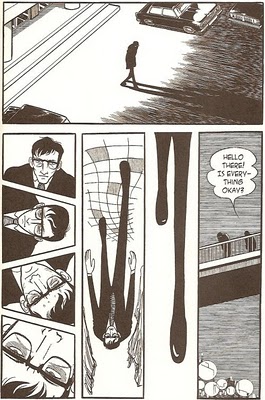
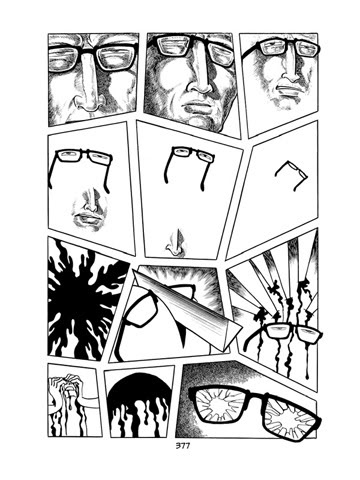
Tezuka explores the boundaries between the rational and the instinctual in other ways as well. Running in tandem with Kirihito’s metamorphosis is another devolution of sorts: Kirihito’s colleague Dr. Urabe, who descends into madness after uncovering a sinister plot within the administration of M University Hospital. When we first meet Urabe, he’s a self-interested cad who lusts after Kirihito’s fiancee Izumi, views Kirihito as more rival than friend, and lacks the will to challenge Tatsugaura, even when data suggests Tatsugaura’s hypothesis about Monmow is flat-out wrong. The slow dawning of Urabe’s conscience, however, precipitates a dramatic change; his psyche splits in two, with one half striving after truth and the other succumbing to base impulse. Even as Urabe begins to redeem himself, collaborating with Izumi to reveal Tatsugaura’s dishonesty, he frequently lapses into savage, sexual aggression.

Other characters’ reactions to these transformations — especially characters in positions of authority or power — provide Tezuka with ample opportunity to engage in one of his favorite activities: exposing institutional hypocrisy. The scandal surrounding Tatsugaura’s Monmow hypothesis, for example, lays bare the corruption within the barely fictional Japanese Medical Association. In his relentless quest to become head of the organization, Tatsugaura seeks to establish an international reputation as an infectious disease expert, even going so far as to suppress evidence that contradicts his thesis. Yet the revelation of Tatsugaura’s deceit does little to jeopardize his position among his peers; only the young doctors find his behavior objectionable, yet they cannot dislodge him from his powerful position.

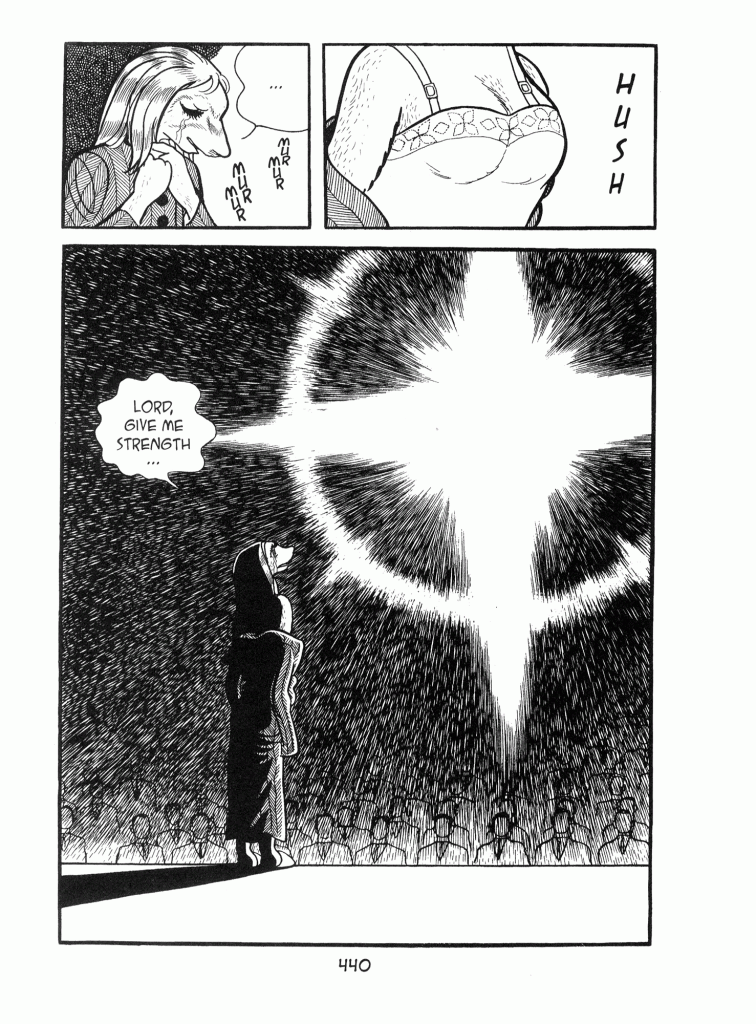
One of the key figures in revealing Tatsugaura’s treachery, Sister Helen, also provides Tezuka a chance to tear away the veil of hypocrisy from another institution — in this case, the Catholic Church. Midway through the first volume, a priest attempts to murder Sister Helen after she contracts Monmow disease. When confronted with his act, he acknowledges his intent but denies his purpose was evil; he insists on protecting the Church’s reputation at all costs, fearing that news of Helen’s condition would bring a scandal, as the received wisdom about Monmow disease held that Caucasians were immune to it.

sisterhelen

At the same time, however, Tezuka uses his characters’ metamorphoses to reveal the human capacity for selflessness and spirituality. Sister Helen provides the most obvious example; after entertaining thoughts of suicide, she has an epiphany — literally, as the cross imagery above suggests — and begins emulating Christ’s example, eventually finding her place ministering to the residents of an impoverished industrial town. Other characters demonstrate a similar capacity for selfless behavior: Urabe, for example, devotes himself to finding Kirihito, while Reika, a circus performer, helps Kirihito escape from captivity and reassert his humanity by practicing medicine.

One could certainly view Ode to Kirihito as heavy-handed allegory; there’s nothing subtle about its Christian imagery or Elephant Man storyline. Yet Tezuka’s fondness for Baroque subplots, over-the-top action sequences, and larger-than-life villains demands an equally bold approach for exploring the story’s greater themes. After all, Kirihito features dog men, sideshow freaks, an evil millionaire who hosts his own private circus, a German geneticist sporting a monocle, and an acrobat who risks life and limb to become human tempura; had Tezuka played things straight, or tried to state his man-vs-inner-beast conflict in less obvious terms, the story would seem preposterous and arty, a surreal experiment devoid of genuine human feeling.

As he would do in MW (1976-78), Tezuka pushes the boundaries of the comics medium in Ode to Kirihito, aiming for a cinematic style capable of immersing us not only in the action but in the characters’ own thought processes. Though Kirihito has its share of artfully staged chases, fights, and dramatic confrontations, the most visually arresting sequences depict Urabe’s fragile mental state:

urabe_breakdown2urabe_breakdown

The panel shapes alone are a brilliant stroke; not only do they suggest his fractured and chaotic thought process, they also have a hint of the insect about them, as if we’re viewing Urabe’s consciousness through a fly’s eye. The knife and blood imagery are cliche, to be sure, but the shattered glasses are a novel and unsettling gesture open to multiple interpretations. Even the more conventional sequence on the left, in which Urabe leaves a hospital in a murderous rage, employs its share of neat visual tricks: Tezuka dramatizes Urabe’s personality shift by rotating the character’s image until he appears to be walking through an upside-down hall of mirrors. Amplifying the effect is the ambiguous way in which Tezuka draws Urabe’s legs in the bottom panel; as Matthew Brady observed in his review of Ode to Kirihito, the image simultaneously evokes dripping blood and moving limbs.

Perhaps the best compliment I can pay Ode to Kirihito is to say that Tezuka achieves on paper what John Frankenheimer achieved on film with The Train, Seven Days in May, and The Manchurian Candidate, transforming the humble thriller into a vehicle for telling thought-provoking, challenging stories that enlighten as they entertain. Kirihito may not surpass the narrative sophistication or visual poetry of Phoenix, but it comes awfully close. A must-read for serious manga lovers.

Review copies provided by Vertical, Inc.

ODE TO KIRIHITO, VOLS. 1-2 • BY OSAMU TEZUKA • VERTICAL, INC. • RATING: OLDER TEEN (16+)

Filed Under: Manga, Manga Critic, REVIEWS Tagged With: Action/Adventure, Classic, Horror/Supernatural, Osamu Tezuka, Vertical Comics

Little Butterfly Omnibus

March 27, 2010 by Katherine Dacey

As a feminist, yaoi puts me in a difficult position. On the one hand, I love the idea of women creating erotica for other women, of creating a safe and fun space where female readers can explore their sexual fantasies. (I don’t know about you, but Ron Jeremy has never factored into any of mine.) On the other hand, I’m often uncomfortable by the way in which rape is conflated with extreme romantic desire in yaoi; it’s disappointing to see the “you’re so irresistible, I couldn’t help myself!” defense trotted out as a justification for sexual violation. To be sure, the rape-as-love trope abounds in romance novels and mainstream pornography as well, but as a feminist, it makes me just as uncomfortable to encounter it in yaoi as it does to encounter it in an episode of General Hospital. Then, too, there’s the issue of the characters’ homosexuality, which is sometimes trivialized (i.e., they’re not gay, they’re just so good-looking they couldn’t help themselves!), ignored, or “explained” by a character’s tragic past, as if sexual orientation were a simple, situational decision.

Still, I’d be remiss in my manga critic duties if I ignored such an important publishing category. With a little encouragement from readers, therefore, I decided to take a chance on Hinako Takanaga’s Little Butterfly (DMP), a title I’ve heard praised by folks whose interest in yaoi fell everywhere on the spectrum between Can’t Get Enough to Not My Cup of Tea. And you know what? I liked it. So much, in fact, that I would recommend Little Butterfly to just about any manga fan as a first-rate character study about two teens exploring the boundary between friendship and love.

Those teens are Kojima, a popular, cheerful student, and Nakahara, brooding loner with a troubled home life. (Dad is abusive; mom is mentally ill.) Kojima finds Nakahara intriguing and makes a concerted effort to befriend him — overtures that Nakahara ignores or rebuffs until circumstances (namely, a class field trip) throw them together. To his great surprise, Nakahara discovers that Kojima is kind and sympathetic, while Kojima discovers that Nakahara is intelligent and mature for his years, qualities that Kojima greatly admires. (In a genuinely funny and revealing scene, Nakahara names an NHK newscaster as his “favorite celebrity.”) As the teens spend time together, Nakahara develops an intense, romantic attachment to Kojima that leaves Kojima bewitched, bothered, and bewildered: is he falling for Nakahara? Is he gay? And is he ready for a sexual relationship?

What makes Little Butterfly work is Hinako Takanaga’s ability to capture the ebb and flow of close, same-sex friendships; anyone who’s ever felt a strong attachment to a high school friend will recognize the dynamic between Kojima and Nakahara as it vacillates between intense candor and intense self-consciousness. As their friendship shades into romance, Takanga shows us, through her characters’ awkward body language and behavior, how uncertain both boys are about what to do next. In one chapter, for example, Kojima frets that his lack of sexual experience will be a turn-off for Nakahara (who, in reality, isn’t much more experienced than Kojima is), nearly derailing their relationship in the process. That realism carries over to their actual encounters, which are clumsy, start-and-stop affairs, characterized by miscommunication and fumbling as each boy tries to figure out what he feels comfortable doing. These scenes feel real enough, in fact, that they aren’t sexy; anyone reading this book out of prurient interest will be sorely disappointed.

Though Takanaga handles the boys’ friendship with great sensitivity, Little Butterfly has some dramatically unpersuasive moments. In one unintentionally comic scene, for example, Kojima throws his arms around a friend to gauge his interest in other men, concluding that he only has eyes for Nakahara. (Presumably he didn’t get the memo that being gay doesn’t mean you’re attracted to every member of the same sex.) Takanaga also lays it on thick with Nakahara’s home life; not only is Nakahara’s father violent and emotionally distant, he’s also willing to use his wife and son as a bargaining chip for a loan, while Nakahara’s mother is such a perfectionist that she suffered a psychotic break after Nakahara failed to gain admission to an elite elementary school. I suppose these things happen — undoubtedly, New York Magazine has published a trend piece about Upper East Side moms afflicted with the same condition — but these touches register as melodramatic excess, as if having an abusive father and a crazy mother wasn’t quite enough to explain why Nakahara sought an emotional and physical connection with Kojima.

Still, it’s impossible not to read Little Butterfly without growing attached to the characters; their sincerity and awkwardness are genuinely endearing. I can’t say that Little Butterfly worked for me as yaoi, but I certainly enjoyed it as a coming-of-age story (no pun intended) that captured the difficulties and joys of teenage relationships in an engaging, emotionally honest manner. Recommended.

LITTLE BUTTERFLY: OMNIBUS • BY HINAKO TAKANAGA • DMP • RATING: MATURE (18+) • 560 pp.

Filed Under: Manga, Manga Critic, REVIEWS Tagged With: DMP, LGBTQ, Romance/Romantic Comedy

Dr. Slump 1 by Akira Toriyama: C+

March 24, 2010 by Michelle Smith

From the back cover:
When goofy inventor Senbei Norimaki creates a precocious robot named Arale, his masterpiece turns out to be more than he bargained for!

Basking in the glow of his scientific achievement, Senbei scrambles to get Arale in working order so the rest of Penguin Village won’t have reason to suspect she’s not really a girl. But first Senbei needs to find her a pair of glasses and some clothes…

Review:
This series was recommended to me after I enjoyed Toriyama’s COWA! so much. Unfortunately, this one’s not really my cup of tea. I had originally borrowed the first three volumes from the library, but struggled to make it through just one. To be fair, its advocate was completely forthcoming about the “cracktastic humor.” It just didn’t turn out to be the kind that works for me.

This is the story of a socially inept inventor named Senbei Norimaki and the girl-shaped robot he creates. It begins promisingly enough, with a fun sequence detailing Arale’s creation, but quickly derails into zany, juvenile humor as Senbei ventures into a department store to buy undies for his creation. Some chapters are kind of fun—like when super-strong Arale is hounded by every sports club at school or when she finds a camera Dr. Norimaki invented that takes photos of the future—but many feature boogers, butts, and boobies.

I’m sure this would delight the young male audience for which it was intended, and it’s not as if COWA! was completely devoid of this kind of humor itself. The thing is—COWA! had real heart. I think I’ll always fondly remember the scenes of the monster kids and their wonderment as they took in the human world, but there are no similar moments in Dr. Slump, at least so far. That said, some of the gadgets are intriguing enough—like the camera—that I might give it another chance at some point. I do think, though, that it’s going to be one of those series that’s best in small doses.

Filed Under: Manga, Sci-Fi, Shounen Tagged With: Shonen Jump, VIZ

  • « Go to Previous Page
  • Page 1
  • Interim pages omitted …
  • Page 20
  • Page 21
  • Page 22
  • Page 23
  • Page 24
  • Interim pages omitted …
  • Page 26
  • Go to Next Page »
 | Log in
Copyright © 2010 Manga Bookshelf | Powered by WordPress & the Genesis Framework