• Skip to primary navigation
  • Skip to main content
  • Skip to primary sidebar
  • Home
  • About Us
    • Privacy Policy
    • Comment Policy
    • Disclosures & Disclaimers
  • Resources
    • Links, Essays & Articles
    • Fandomology!
    • CLAMP Directory
    • BlogRoll
  • Features & Columns
    • 3 Things Thursday
    • Adventures in the Key of Shoujo
    • Bit & Blips (game reviews)
    • BL BOOKRACK
    • Bookshelf Briefs
    • Bringing the Drama
    • Comic Conversion
    • Fanservice Friday
    • Going Digital
    • It Came From the Sinosphere
    • License This!
    • Magazine no Mori
    • My Week in Manga
    • OFF THE SHELF
    • Not By Manga Alone
    • PICK OF THE WEEK
    • Subtitles & Sensibility
    • Weekly Shonen Jump Recaps
  • Manga Moveable Feast
    • MMF Full Archive
    • Yun Kouga
    • CLAMP
    • Shojo Beat
    • Osamu Tezuka
    • Sailor Moon
    • Fruits Basket
    • Takehiko Inoue
    • Wild Adapter
    • One Piece
    • After School Nightmare
    • Karakuri Odette
    • Paradise Kiss
    • The Color Trilogy
    • To Terra…
    • Sexy Voice & Robo
  • Browse by Author
    • Sean Gaffney
    • Anna Neatrour
    • Michelle Smith
    • Katherine Dacey
    • MJ
    • Brigid Alverson
    • Travis Anderson
    • Phillip Anthony
    • Derek Bown
    • Jaci Dahlvang
    • Angela Eastman
    • Erica Friedman
    • Sara K.
    • Megan Purdy
    • Emily Snodgrass
    • Nancy Thistlethwaite
    • Eva Volin
    • David Welsh
  • MB Blogs
    • A Case Suitable For Treatment
    • Experiments in Manga
    • MangaBlog
    • The Manga Critic
    • Manga Report
    • Soliloquy in Blue
    • Manga Curmudgeon (archive)

Manga Bookshelf

Discussion, Resources, Roundtables, & Reviews

Manga Critic

The Best Manga You’re Not Reading: Blue Spring

January 11, 2011 by Katherine Dacey 5 Comments

As depicted in most shojo and shonen manga, the Japanese high school is the epitome of order, with students in neat, military-style uniforms diligently studying for exams, tidying up classrooms, staging plays, and participating in cultural festivals. Students who don’t fit into the school’s established pecking order — social, athletic, or academic — quickly find themselves ostracized by their peers for lack of purpose.

Taiyo Matsumoto, however, offers a very different image of the Japanese high school in his anthology Blue Spring. His subjects are the kids with “front teeth rotten from huffing thinner,” who “answer to reason with their fists and never question their excessive passions” — in short, the delinquents. Kitano High School, the milieu these kids inhabit, is a crumbling eyesore with graffiti-covered walls, trash-filled stairwells, and indifferent faculty. Students cut class and fill their after-school hours with girlie magazines, petty crime, and smack-talk at the local diner, marking time until they join the world of adult responsibility.

Gangs, bullies, disaffected teens playing at thug life — it’s familiar territory, yet in Matsumoto’s hands, these potentially cliche stories acquire a new and strange quality. Matsumoto eschews linear narrative in favor of digressions and fragments; as a result, we feel more like we’re living in the characters’ heads than reading a tidy account of their actions. Snatches of daydreams sometimes interrupt the narrative, as do jump cuts and surreal imagery: sharks and puffer fish drift past a classroom window where two teens make out, a UFO languishes above the school campus. Even the graffiti plays an integral part of Matsumoto’s storytelling; the walls are a paean to masturbation, booze, and suicide, cheerfully urging “No more political pacts–sex acts!”

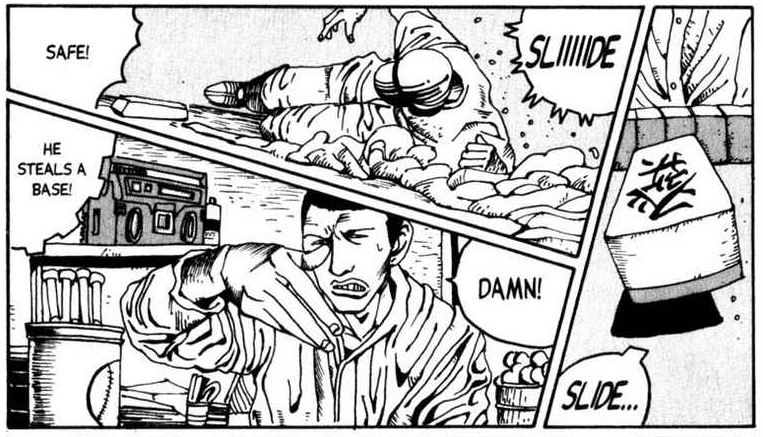
One of the most arresting aspects of Blue Spring is Matsumoto’s ability to manipulate time. In one of the book’s most visually stunning sequences, for example, Matsumoto seamlessly blends two events — a baseball game and a mahjong game — into a single sequence:

Matsumoto makes it seem as if the gambler’s action precipitated the slide into second base. It’s an elegant visual trick that establishes the simultaneity of the two games while suggesting the intensity of the mahjong play; the discarding of a tile is portrayed with the same explosive energy as stealing a base.

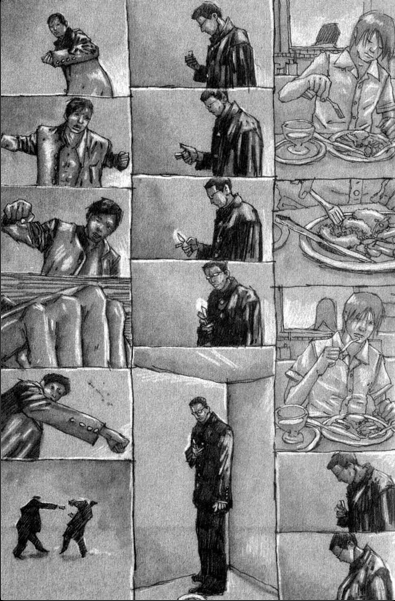
Some of Matsumoto’s time-bending sequences are more cinematic, evoking the kind of split-screen technique popularized in the 1960s by filmmakers like John Frankenheimer and Richard Fleischer. The prologue, for example, contains a series of short, vertical strips in which we see unnamed teenagers preparing for a day at school. Matsumoto deliberates re-frames the activity in each panel, drawing back to show the full scene in some, and pulling in close to reveal the blankness of a characters’ face in another:


It’s an effective montage, largely for the way it juxtaposes the banal with the violent; the fist-fight is presented in the same, matter-of-fact fashion as the student eating breakfast, suggesting that conflict is as routine for some of Blue Spring‘s characters as catching the train to school. The transitions, too, are handled deftly; the eye can process these little vignettes in a sequence while the brain grasps the entire prologue as a simultaneous collage of events, a representative cross-section of high school students going about their business on a typical day.

Matsumoto’s stark, black-and-white imagery won’t be to every reader’s taste; I’d be the first admit that many of the kids in Blue Spring look older and wearier than Keith Richards, with their sunken eyes and rotten teeth. But the studied ugliness of the character designs and urban settings suits the material perfectly, hinting at the anger and emptiness of the characters’ lives. Matsumoto offers no easy answers for his characters’ behavior, nor any false hope that they will escape the lives of violence and despair that seem to be their destiny. Rather, he offers a frank, funny and often disturbing look at the years in which most of us were unformed lumps of clay — or, in Matsumoto’s memorable formulation, a time when most of us were blue: “No matter how passionate you were, no matter how much your blood boiled, I believe youth is a blue time. Blue — that indistinct blue that paints the town before the sun rises.”

This is an expanded version of a review that appeared at PopCultureShock on 4/30/07.

BLUE SPRING • BY TAIYO MATSUMOTO • VIZ • 216 pp. • RATING: MATURE (18+)
Filed Under: Manga Critic Tagged With: Seinen, Taiyo Matsumoto, VIZ

The Best Manga You’re Not Reading: Blue Spring

January 11, 2011 by Katherine Dacey

As depicted in most shojo and shonen manga, the Japanese high school is the epitome of order, with students in neat, military-style uniforms diligently studying for exams, tidying up classrooms, staging plays, and participating in cultural festivals. Students who don’t fit into the school’s established pecking order — social, athletic, or academic — quickly find themselves ostracized by their peers for lack of purpose.

Taiyo Matsumoto, however, offers a very different image of the Japanese high school in his anthology Blue Spring. His subjects are the kids with “front teeth rotten from huffing thinner,” who “answer to reason with their fists and never question their excessive passions” — in short, the delinquents. Kitano High School, the milieu these kids inhabit, is a crumbling eyesore with graffiti-covered walls, trash-filled stairwells, and indifferent faculty. Students cut class and fill their after-school hours with girlie magazines, petty crime, and smack-talk at the local diner, marking time until they join the world of adult responsibility.

Gangs, bullies, disaffected teens playing at thug life — it’s familiar territory, yet in Matsumoto’s hands, these potentially cliche stories acquire a new and strange quality. Matsumoto eschews linear narrative in favor of digressions and fragments; as a result, we feel more like we’re living in the characters’ heads than reading a tidy account of their actions. Snatches of daydreams sometimes interrupt the narrative, as do jump cuts and surreal imagery: sharks and puffer fish drift past a classroom window where two teens make out, a UFO languishes above the school campus. Even the graffiti plays an integral part of Matsumoto’s storytelling; the walls are a paean to masturbation, booze, and suicide, cheerfully urging “No more political pacts—sex acts!”

One of the most arresting aspects of Blue Spring is Matsumoto’s ability to manipulate time. In one of the book’s most visually stunning sequences, for example, Matsumoto seamlessly blends two events — a baseball game and a mahjong game — into a single sequence:

Matsumoto makes it seem as if the gambler’s action precipitated the slide into second base. It’s an elegant visual trick that establishes the simultaneity of the two games while suggesting the intensity of the mahjong play; the discarding of a tile is portrayed with the same explosive energy as stealing a base.

Some of Matsumoto’s time-bending sequences are more cinematic, evoking the kind of split-screen technique popularized in the 1960s by filmmakers like John Frankenheimer and Richard Fleischer. The prologue, for example, contains a series of short, vertical strips in which we see unnamed teenagers preparing for a day at school. Matsumoto deliberates re-frames the activity in each panel, drawing back to show the full scene in some, and pulling in close to reveal the blankness of a characters’ face in another:


It’s an effective montage, largely for the way it juxtaposes the banal with the violent; the fist-fight is presented in the same, matter-of-fact fashion as the student eating breakfast, suggesting that conflict is as routine for some of Blue Spring‘s characters as catching the train to school. The transitions, too, are handled deftly; the eye can process these little vignettes in a sequence while the brain grasps the entire prologue as a simultaneous collage of events, a representative cross-section of high school students going about their business on a typical day.

Matsumoto’s stark, black-and-white imagery won’t be to every reader’s taste; I’d be the first admit that many of the kids in Blue Spring look older and wearier than Keith Richards, with their sunken eyes and rotten teeth. But the studied ugliness of the character designs and urban settings suits the material perfectly, hinting at the anger and emptiness of the characters’ lives. Matsumoto offers no easy answers for his characters’ behavior, nor any false hope that they will escape the lives of violence and despair that seem to be their destiny. Rather, he offers a frank, funny and often disturbing look at the years in which most of us were unformed lumps of clay — or, in Matsumoto’s memorable formulation, a time when most of us were blue: “No matter how passionate you were, no matter how much your blood boiled, I believe youth is a blue time. Blue — that indistinct blue that paints the town before the sun rises.”

This is an expanded version of a review that appeared at PopCultureShock on 4/30/07.

BLUE SPRING • BY TAIYO MATSUMOTO • VIZ • 216 pp. • RATING: MATURE (18+)
Filed Under: Manga, Manga Critic, Recommended Reading, REVIEWS Tagged With: Seinen, Taiyo Matsumoto, VIZ

The Best Manga You’re Not Reading: Gun Blaze West

December 31, 2010 by Katherine Dacey 6 Comments

Let me begin this review with a disclaimer: Ken Burns would not approve of the historical liberties taken by Gun Blaze West creator Nobuhiro Watsuki. The dialogue, for example: the characters speak in a distinctly modern patois, filled with phrases never uttered by Sitting Bull or General Custer. The scenery, for another: verdant Eastern forests abut rugged desert canyons, even though the story begins in Illinois. (I particularly liked Watsuki’s rendering of Saint Louis as a kind of Budapest on the Mississippi, complete with majestic buildings.) Even the saloon names feel a little off-kilter, as one group of outlaws patronize a joint called Bella Donna. Such incongruities may offend Mr. Burns, but they’re just part of this boisterous series’ charm. (Did I mention the knife-throwing samurai girl? Oh, Mr. Burns, the horror!)

Gun Blaze West focuses on Viu Bannes, a ten-year-old boy who dreams of visiting Gun Blaze West, a mythical city populated by the world’s greatest gunslingers. (On the map, it appears to be located in Seattle, making me wonder if Gun Blaze West is, in fact, populated by the West’s most caffeinated gunslingers.) When a down-on-his-luck cowboy wanders into town, Viu pesters him for shooting lessons. Marcus reluctantly agrees to show Viu the gunslinging ropes, but before Viu can complete his training, the notorious Kenbrown gang arrives in Winston Town, terrorizing the citizens and threatening Viu’s older sister. Viu and Marcus’s standoff with the Kenbrown gang ends with an unexpected turn of events — one that sets the stage for Viu’s subsequent cross-country odyssey.

As in many shonen adventure series, the hero is the least interesting member of the cast. Viu seems to have been ordered straight from the SJ catalog: he’s fast, strong, and so single-minded in pursuit of his dreams that he often comes across as stupid. He also spends a lot of time declaring that he’ll “do his best” and extolling the value of friendship — two other perennial Shonen Jump themes.

In spite of the numerous capitulations to formula, however, Gun Blaze West is one of the most enjoyable shonen titles that VIZ has published. The Western setting proves a welcome change of pace from feudal Japan, modern-day Tokyo, and fantasy realms where teens go mano-a-mano with demons and undead souls. Though the characters possess exaggerated skill and strength, there’s nothing supernatural about Viu and his friends; they come by their talents honestly, through practice, hard work, and mistakes. The story, too, proves surprisingly adult at times, exploring the consequences of violence and rash behavior more realistically than many titles in the Shonen Jump canon.

What really makes Gun Blaze West tick, however, is its playful intermingling of shonen and Western tropes. Gun Blaze West actually feels like a Western, minus some of the obvious anachronisms and geographical gaffes. Marcus is a classic oater type, the gunslinger who’s developed a strong distaste for violence; he’s reluctant to participate in a shoot-out of any kind, adopting a foolish persona to camouflage his skill. When the bullets start flying — and there several lengthy gun battles sprinkled throughout the series — the tone shifts dramatically to underscore Marcus’ abhorrence of fighting. The supporting cast, too, is filled with familiar Wild West archetypes: salty saloon keepers, feisty young women, straight-arrow lawmen, sadistic villains, and traveling circus performers. Even the plots stick closely to the John Ford playbook, whether a small town is under siege from criminals or a local business owner is being harassed by a rival’s private army of thugs.

If you’re a fan of Buso Renkin or Rurouni Kenshin, you know what to expect from Watsuki’s art: dynamic fight scenes, villains with memorable mugs, and nonstop sight gags. The art’s relentless, antic quality wears a little thin towards the end of the series; I found myself wishing that Watsuki would pause to savor the landscape or linger at the sight of a lonely gunslinger’s tombstone instead of uncorking another fart joke or chase scene. Yet for all the artwork’s implied dynamism, the images themselves are never too busy; like Eiichiro Oda and Akira Toriyama, Watsuki relies primarily on lines and evocative shapes to convey the physicality of the people and objects in his stories, rather than heavy patches of screentone. Watsuki isn’t quite Oda or Toriyama’s peer when it comes to backgrounds and peripheral characters — his repertory of towns and bit players is more limited — but his pages exude the same boisterous energy as theirs do.

Best of all, Gun Blaze West is short, clocking in at just three volumes. Given how many shonen titles overstay their welcome with repetitive, drawn-out story arcs, that kind of brevity is admirable; that Gun Blaze West finishes on a high note makes its brevity seem like a stroke of creative genius.

This is an expanded version of a review that originally appeared at PopCultureShock on 3/31/08.

GUN BLAZE WEST, VOLS. 1-3 • BY NOBUHIRO WATSUKI • VIZ • RATING: TEEN (13+)

Filed Under: Manga Critic Tagged With: Shonen, Shonen Jump, VIZ, Western

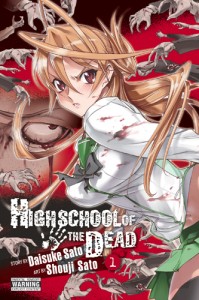
Highschool of the Dead, Vol. 1

December 27, 2010 by Katherine Dacey

A poor man’s Dawn of the Dead — that’s how I’d describe Highschool of the Dead, a slick, violent zombie story that borrows shamelessly from the George Romero canon. Whether that’s a good thing depends a lot on your relationship with Romero. If you thought Dawn of the Dead was a sly poke at American society — its consumerism, class divisions, and latent racism — Daisuke Sato and Shouji Sato’s manga will seem awfully thin, as the authors are more concerned with dishing out panty shots than revealing how threadbare the social fabric really is. If you found Romero’s film unnecessarily burdened with subtext, however, you might just cotton to the Satos’ ultra-violent update.

As the title implies, the story begins at an ordinary high school in Tokyo. When the staff contract a mysterious disease that transforms them into zombies, they wreak havoc, infecting hundreds of other people as they chomp, rend, and tear their way through campus. A small band of students take refuge on the roof, hoping for a helicopter rescue. What they discover, however, is that the entire city has descended into chaos, leaving them little choice than to find a safer place to wait out the crisis.

From a narrative point of view, Highschool of the Dead follows the zombie playbook to the letter. The zombies are slow and shambling; the the story takes place in a closed environment where the zombies’ sheer numbers give them a decided advantage; and the characters can barely stand each other, setting aside their mutual contempt only for the zombie-fighting cause. But while Romero made the most of his film’s shopping mall setting, the Satos treat their high school’s corridors and classrooms as just another indoor space filled with convenient weapons. (Call me crazy, but I don’t remember nail guns lying around the Newton North science labs.) The fight scenes are choppy and poorly staged, giving little indication of how the characters are moving through the space or where, exactly, they are in relation to the school’s main entrance. Even the violence-porn flourishes lack imagination: zombies die by baseball bat, power drill, broom handle, sword, and fire hose, but none of the characters improvises an interesting weapon out of something unique to the school.

The script is as predictable and clumsy as the fight scenes; the characters speak in exposition-heavy soundbites that bear little resemble to real conversation. (Sample: “Rumor has it that your childhood girlfriend ended up in your class when she stayed back and is going out with Igou now, right?”) Daisuke Sato assigns each character a few defining personality traits, raising the possibility that the characters’ economic and social disparities might inform the way they interact. The characterizations are so meager and inconsistent, however, that it’s tough to remember who’s who; I learned more from reading the Wikipedia article on Highschool of the Dead than from the manga itself, never a good sign when the characters, in fact, do have important backstories that shape their opinions of one another.

The biggest problem with Highschool of the Dead is its relentless commitment to cheesecake. The Satos work fanservice into as many scenes as possible, taking full advantage of every stairwell, fight, fall, and female death to flash derrieres and panties; only an episode of Strike Witches has more up-skirt imagery. Adding insult to injury is Shouji Sato’s willful disregard for basic female anatomy. Several of the female characters’ bust lines are so monstrously distended that it would be impossible for the characters to actually stand up and walk in real life, let alone fight zombies. (Hint to aspiring manga artists: large breasts do not look like grossly misshapen lemons or balloon animals.) I realize that costume failures and nubile girls are a staple of horror movies, but when the cheesecake is so poorly done, it’s hard to imagine who would find it arousing; the Satos could take a few tips from Robert Rodriguez on how to incorporate plausible, sexy women into a monster flick.

And when the scariest thing about a zombie story is the way the female characters’ breasts are drawn, well… I’d say the creators have fallen down on the job. The bottom line: unless you’re a die-hard zombie fan or panty-shot connoisseur, you’re better off seeking undead thrills elsewhere.

Review copy provided by Yen Press. Volume one of Highschool of the Dead will go on sale January 25, 2011.

HIGHSCHOOL OF THE DEAD, VOL. 1 • STORY BY DAISUKE SATO, ART BY SHOUJI SATO • YEN PRESS • 160 pp. • RATING: MATURE (18+)

Filed Under: Manga Critic Tagged With: yen press, Zombies

Highschool of the Dead, Vol. 1

December 27, 2010 by Katherine Dacey

A poor man’s Dawn of the Dead — that’s how I’d describe Highschool of the Dead, a slick, violent zombie story that borrows shamelessly from the George Romero canon. Whether that’s a good thing depends a lot on your relationship with Romero. If you thought Dawn of the Dead was a sly poke at American society — its consumerism, class divisions, and latent racism — Daisuke Sato and Shouji Sato’s manga will seem awfully thin, as the authors are more concerned with dishing out panty shots than revealing how threadbare the social fabric really is. If you found Romero’s film unnecessarily burdened with subtext, however, you might just cotton to the Satos’ ultra-violent update.

As the title implies, the story begins at an ordinary high school in Tokyo. When the staff contract a mysterious disease that transforms them into zombies, they wreak havoc, infecting hundreds of other people as they chomp, rend, and tear their way through campus. A small band of students take refuge on the roof, hoping for a helicopter rescue. What they discover, however, is that the entire city has descended into chaos, leaving them little choice than to find a safer place to wait out the crisis.

From a narrative point of view, Highschool of the Dead follows the zombie playbook to the letter. The zombies are slow and shambling; the the story takes place in a closed environment where the zombies’ sheer numbers give them a decided advantage; and the characters can barely stand each other, setting aside their mutual contempt only for the zombie-fighting cause. But while Romero made the most of his film’s shopping mall setting, the Satos treat their high school’s corridors and classrooms as just another indoor space filled with convenient weapons. (Call me crazy, but I don’t remember nail guns lying around the Newton North science labs.) The fight scenes are choppy and poorly staged, giving little indication of how the characters are moving through the space or where, exactly, they are in relation to the school’s main entrance. Even the violence-porn flourishes lack imagination: zombies die by baseball bat, power drill, broom handle, sword, and fire hose, but none of the characters improvises an interesting weapon out of something unique to the school.

The script is as predictable and clumsy as the fight scenes; the characters speak in exposition-heavy soundbites that bear little resemble to real conversation. (Sample: “Rumor has it that your childhood girlfriend ended up in your class when she stayed back and is going out with Igou now, right?”) Daisuke Sato assigns each character a few defining personality traits, raising the possibility that the characters’ economic and social disparities might inform the way they interact. The characterizations are so meager and inconsistent, however, that it’s tough to remember who’s who; I learned more from reading the Wikipedia article on Highschool of the Dead than from the manga itself, never a good sign when the characters, in fact, do have important backstories that shape their opinions of one another.

The biggest problem with Highschool of the Dead is its relentless commitment to cheesecake. The Satos work fanservice into as many scenes as possible, taking full advantage of every stairwell, fight, fall, and female death to flash derrieres and panties; only an episode of Strike Witches has more up-skirt imagery. Adding insult to injury is Shouji Sato’s willful disregard for basic female anatomy. Several of the female characters’ bust lines are so monstrously distended that it would be impossible for the characters to actually stand up and walk in real life, let alone fight zombies. (Hint to aspiring manga artists: large breasts do not look like grossly misshapen lemons or balloon animals.) I realize that costume failures and nubile girls are a staple of horror movies, but when the cheesecake is so poorly done, it’s hard to imagine who would find it arousing; the Satos could take a few tips from Robert Rodriguez on how to incorporate plausible, sexy women into a monster flick.

And when the scariest thing about a zombie story is the way the female characters’ breasts are drawn, well… I’d say the creators have fallen down on the job. The bottom line: unless you’re a die-hard zombie fan or panty-shot connoisseur, you’re better off seeking undead thrills elsewhere.

Review copy provided by Yen Press. Volume one of Highschool of the Dead will go on sale January 25, 2011.

HIGHSCHOOL OF THE DEAD, VOL. 1 • STORY BY DAISUKE SATO, ART BY SHOUJI SATO • YEN PRESS • 160 pp. • RATING: MATURE (18+)

Filed Under: Manga, Manga Critic, REVIEWS Tagged With: Horror/Supernatural, yen press, Zombies

The 2010 Manga Hall of Shame Inductees

December 24, 2010 by Katherine Dacey 34 Comments

While there’s no shortage of boring or cliche manga available in English — even with fewer titles being released this year — grade-A turkeys are going the way of the dodo. I had so much difficulty compiling this year’s Manga Hall of Shame Nominees, in fact, that I turned to Twitter for help. Some folks named The Melancholy of Suzumiya Haruhi-chan for being dull and incomprehensible; others fingered Saving Life for unsexy fanservice and dopey characters; one person chastised You Higuri for foisting Nighthead Genesis on the world; and one brave soul bucked conventional wisdom by naming AX: A Collection of Alternative Manga as her Worst of 2010. (You can see more reader nominations at #badmanga2010.) The conversation made me laugh, but it also helped me clarify my own thinking about the subject. Common to all five titles on this year’s list is a flagrant disregard for the reader; no matter how interesting the initial premise, these stories derailed quickly, thanks to lousy artwork, disjointed storytelling, and/or a juvenile fixation on body parts and bodily functions.

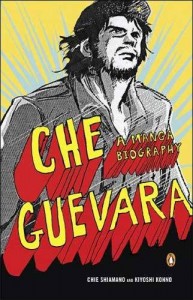
5. CHE GUEVARA: A MANGA BIOGRAPHY (Penguin)

In the opening pages of Che Guevara: A Manga Biography, the creators promise to reveal the flesh-and-blood person behind the iconic images on t-shirts and posters. The authors never deliver on that promise, however, instead relying heavily on Guevara’s own self-promoting essays for most of their information. That commitment to primary sources might be laudable if the authors made any effort to reveal the inconsistencies in Guevara’s beliefs, but Guevara’s heroism is never in doubt; he’s always portrayed as brave, strong, and capable, even when abandoning his first family or serving in Fidel Castro’s administration. (The authors also gloss over Guevara’s enthusiasm for the Stalinist regime, perhaps because it’s hard to put a positive spin on anyone or anything associated with that period in Soviet history.) More frustrating still is how choppy and uneven the manga is; the authors compress major battles and periods of Guevara’s life into one or two pages, leaving no room for them to explore these events with any nuance. Clumsy character designs and endless talking-head scenes complete the not-so-pretty picture.

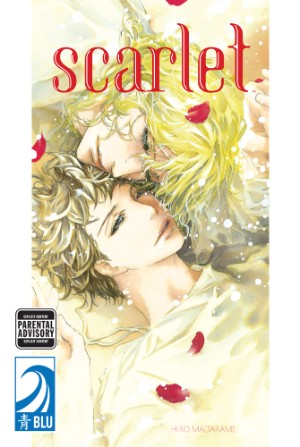
4. SCARLET (BLU Manga)

Hiro Madarame may draw achingly pretty manga, but her stories are surprisingly ugly and unpleasant, filled with Tragically Gay Characters and manipulative, shrewish women who drive men to homosexuality. The nadir of this slim anthology is the titular story, which includes a brutal rape scene that’s disturbing both for its sadism (it wouldn’t be out of place in David Fincher’s ultra-gory Seven) and for the speed with which the victim and the attacker reconcile. It’s true that many domestic abuse victims go through cycles of leaving and reuniting with their tormentors, but Madarame presents this act of violence as testament to her characters’ deep attachment to one another, rather than evidence of their pathologically unhealthy relationship. Call me a curmudgeonly old feminist if you must, but romanticizing rape and possessive behavior — no matter what the gender or sexual orientation of the parties involved — just isn’t very sexy. –Reviewed at The Manga Critic, 8/31/10

3. PINK INNOCENT (Del Rey)

The title screams soft-core porn, but Pink Innocent is, in fact, G-rated shojo comedy. The story revolves around Kotona, a ditzy rich girl who stalks and smothers Reiji, a befuddled nerd who finds Kotona almost as annoying as readers will. The jokes are profoundly unfunny: Kotona destroys Reiji’s computers, burns down his apartment, and stars in her class production of Romeo and Juliet so that she can woo him. (One shudders to think what she’ll do in future volumes: carpet bomb his home by accident? Run over his brother with a car?) Adding insult to injury is the artwork: it’s sub-par Arina Tanemura, with sparkles on top of sparkles, and a heroine so saucer-eyed she resembles a chibi squid. Unless Orange Planet was a bigger hit than I remembered, it’s hard to fathom what inspired Del Rey to license Pink Innocent; shojo fans deserve better than this dumb, repetitive stinker.

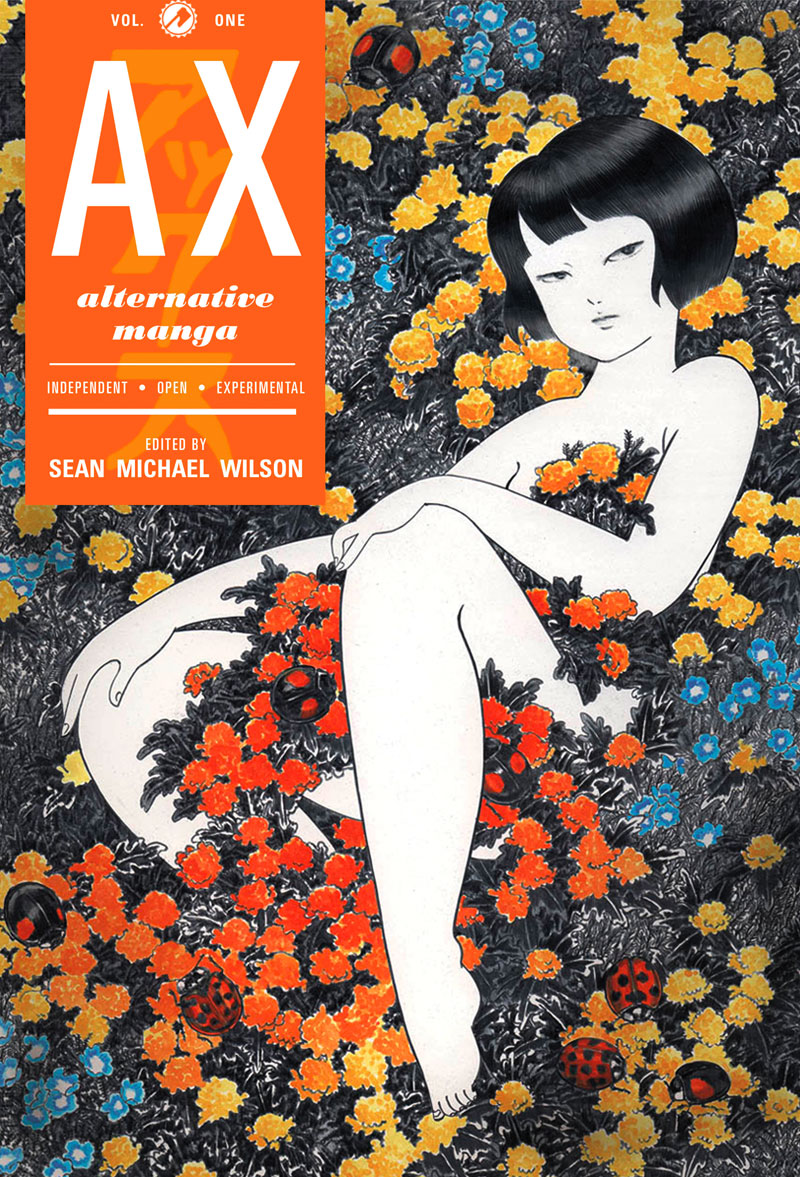
2. “BLACK SUSHI PARTY PIECE” AND “ARIZONA SIZZLER,” FROM AX: AN ALTERNATIVE COLLECTION OF MANGA (Top Shelf)

David Welsh said it best when he declared, “While AX is one of the books I’m happiest to have bought this year, it does contain some seriously bad manga.” Many of the stories in AX push the boundaries of good taste, aesthetic and otherwise, but the best of them — “Puppy Love,” “Six Paths of Wealth,” “Push-Pin Woman” — are genuinely thought-provoking. Two, however, earn demerits for their sheer pointlessness. The first, “Black Sushi Party Piece,” is a festival of excrement, anuses, and Butt Head-ugly character designs, with no real ambition other than to turn the stomach. The second, “Arizona Sizzler,” features a desert showdown between an irritated young woman and an enormous set of genitals. I have no doubt that in the hands of someone like Terry Gilliam this kind of cock-and-balls story might be funny, but the crudeness of the execution robs “Sizzler” of any potential playfulness; instead, it seems like a dumb joke dragged out to epically unfunny lengths, the manga equivalent of a Benny Hill sketch. –Reviewed at The Manga Critic, 5/21/10

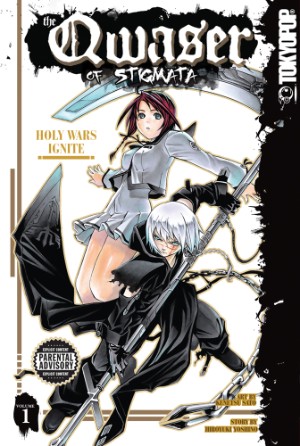
1. THE QWASER OF STIGMATA (Tokyopop)

The creators of Qwaser of Stigmata have erected a sturdy framework on which to hang boobs and bishonen: their story takes place at a parochial boarding school filled with nubile teens, allowing them to indulge every manner of fetish, from schoolgirls in short skirts to hotties of the cloth. Alas, Hiroyuki Yoshino and Kenetsu Sato’s only novel idea was to substitute Russian Orthodoxy for Catholicism, the go-to religion of manga-ka in search of cool outfits and arcane rituals. The rest of the story is a fever-dream of incoherent fight scenes, topless girls, and… breast feeding. (That’s the source of the characters’ super-strength: breast milk. I’m not making this up. Really.) The central plot, which revolves around a Russian icon, makes even less sense than the fight scenes; I’m not an expert on any form of Eastern Orthodoxy, but I don’t think it’s a stretch to say that an observant person would find it offensive. (Or silly.) The saddest part is that an imaginative artist could write a boffo manga about the Russian Orthodox Church, which has a long and rich history, filled with mystics, heretics, and believers so hard core they’d set fire to themselves before accepting small changes to the liturgy. –Reviewed at The Manga Critic, 8/11/10

So… I turn the floor over to you: what titles do you think belong in this year’s Manga Hall of Shame?

Filed Under: Manga Critic Tagged With: Bad Manga

The 2010 Manga Hall of Shame Inductees

December 24, 2010 by Katherine Dacey

While there’s no shortage of boring or cliche manga available in English — even with fewer titles being released this year — grade-A turkeys are going the way of the dodo. I had so much difficulty compiling this year’s Manga Hall of Shame Nominees, in fact, that I turned to Twitter for help. Some folks named The Melancholy of Suzumiya Haruhi-chan for being dull and incomprehensible; others fingered Saving Life for unsexy fanservice and dopey characters; one person chastised You Higuri for foisting Nighthead Genesis on the world; and one brave soul bucked conventional wisdom by naming AX: A Collection of Alternative Manga as her Worst of 2010. (You can see more reader nominations at #badmanga2010.) The conversation made me laugh, but it also helped me clarify my own thinking about the subject. Common to all five titles on this year’s list is a flagrant disregard for the reader; no matter how interesting the initial premise, these stories derailed quickly, thanks to lousy artwork, disjointed storytelling, and/or a juvenile fixation on body parts and bodily functions.

5. Che Guevara: A Manga Biography
By Kiyoshi Konno and Chie Shimano • Penguin Books
In the opening pages of Che Guevara: A Manga Biography, the creators promise to reveal the flesh-and-blood person behind the iconic images on t-shirts and posters. The authors never deliver on that promise, however, instead relying heavily on Guevara’s own self-promoting essays for most of their information. That commitment to primary sources might be laudable if the authors made any effort to reveal the inconsistencies in Guevara’s beliefs, but Guevara’s heroism is never in doubt; he’s always portrayed as brave, strong, and capable, even when abandoning his first family or serving in Fidel Castro’s administration. (The authors also gloss over Guevara’s enthusiasm for the Stalinist regime, perhaps because it’s hard to put a positive spin on anyone or anything associated with that period in Soviet history.) More frustrating still is how choppy and uneven the manga is; the authors compress major battles and periods of Guevara’s life into one or two pages, leaving no room for them to explore these events with any nuance. Clumsy character designs and endless talking-head scenes complete the not-so-pretty picture.

4. Scarlet
By Hiro Madarame • BLU Manga
Hiro Madarame may draw achingly pretty manga, but her stories are surprisingly ugly and unpleasant, filled with Tragically Gay Characters and manipulative, shrewish women who drive men to homosexuality. The nadir of this slim anthology is the titular story, which includes a brutal rape scene that’s disturbing both for its sadism (it wouldn’t be out of place in David Fincher’s ultra-gory Seven) and for the speed with which the victim and the attacker reconcile. It’s true that many domestic abuse victims go through cycles of leaving and reuniting with their tormentors, but Madarame presents this act of violence as testament to her characters’ deep attachment to one another, rather than evidence of their pathologically unhealthy relationship. Call me a curmudgeonly old feminist if you must, but romanticizing rape and possessive behavior — no matter what the gender or sexual orientation of the parties involved — just isn’t very sexy. —Reviewed at The Manga Critic, 8/31/10

3. Pink Innocent
By Kotori Momoyuki • Del Rey
The title screams soft-core porn, but Pink Innocent is, in fact, G-rated shojo comedy. The story revolves around Kotona, a ditzy rich girl who stalks and smothers Reiji, a befuddled nerd who finds Kotona almost as annoying as readers will. The jokes are profoundly unfunny: Kotona destroys Reiji’s computers, burns down his apartment, and stars in her class production of Romeo and Juliet so that she can woo him. (One shudders to think what she’ll do in future volumes: carpet bomb his home by accident? Run over his brother with a car?) Adding insult to injury is the artwork: it’s sub-par Arina Tanemura, with sparkles on top of sparkles, and a heroine so saucer-eyed she resembles a chibi squid. Unless Orange Planet was a bigger hit than I remembered, it’s hard to fathom what inspired Del Rey to license Pink Innocent; shojo fans deserve better than this dumb, repetitive stinker.

2. “Black Sushi Party Piece” and “Arizona Sizzlet,” AX: An Alternative Collection of Manga
Edited by Sean Michael Wilson • Top Shelf
David Welsh said it best when he declared, “While AX is one of the books I’m happiest to have bought this year, it does contain some seriously bad manga.” Many of the stories in AX push the boundaries of good taste, aesthetic and otherwise, but the best of them — “Puppy Love,” “Six Paths of Wealth,” “Push-Pin Woman” — are genuinely thought-provoking. Two, however, earn demerits for their sheer pointlessness. The first, “Black Sushi Party Piece,” is a festival of excrement, anuses, and Butt Head-ugly character designs, with no real ambition other than to turn the stomach. The second, “Arizona Sizzler,” features a desert showdown between an irritated young woman and an enormous set of genitals. I have no doubt that in the hands of someone like Terry Gilliam this kind of cock-and-balls story might be funny, but the crudeness of the execution robs “Sizzler” of any potential playfulness; instead, it seems like a dumb joke dragged out to epically unfunny lengths, the manga equivalent of a Benny Hill sketch. —Reviewed at The Manga Critic, 5/21/10

1. The Qwaser of Stigmata
Story by Hiroyuki Yoshino • Art by Kenetsu Satō • Tokyopop
The creators of Qwaser of Stigmata have erected a sturdy framework on which to hang boobs and bishonen: their story takes place at a parochial boarding school filled with nubile teens, allowing them to indulge every manner of fetish, from schoolgirls in short skirts to hotties of the cloth. Alas, Hiroyuki Yoshino and Kenetsu Sato’s only novel idea was to substitute Russian Orthodoxy for Catholicism, the go-to religion of manga-ka in search of cool outfits and arcane rituals. The rest of the story is a fever-dream of incoherent fight scenes, topless girls, and… breast feeding. (That’s the source of the characters’ super-strength: breast milk. I’m not making this up. Really.) The central plot, which revolves around a Russian icon, makes even less sense than the fight scenes; I’m not an expert on any form of Eastern Orthodoxy, but I don’t think it’s a stretch to say that an observant person would find it offensive. (Or silly.) The saddest part is that an imaginative artist could write a boffo manga about the Russian Orthodox Church, which has a long and rich history, filled with mystics, heretics, and believers so hard core they’d set fire to themselves before accepting small changes to the liturgy. —Reviewed at The Manga Critic, 8/11/10

So… I turn the floor over to you: what titles do you think belong in this year’s Manga Hall of Shame?

Filed Under: Manga, Manga Critic

Tezuka: A Bibliography for English Speakers

December 21, 2010 by Katherine Dacey 7 Comments

For the English-language reader interested in learning more about Osamu Tezuka, there’s a growing body of scholarship exploring his life and work. Frederik L. Schodt, who was a personal friend of Tezuka’s, has done more than just about anyone to introduce Tezuka’s manga to Western audiences, writing in an accessible style that eschews academic formality but is nonetheless rigorous and well-researched. Schodt reproduced a chapter from Tezuka’s Phoenix in Manga! Manga! The World of Japanese Comics (1983), paid tribute to Tezuka’s work with an essay in Dreamland Japan: Writings on Modern Manga (1996), and devoted an entire book to one of Tezuka’s best-known characters in The Astro Boy Essays: Osamu Tezuka, Mighty Atom, and the Manga/Anime Revolution (2007). Readers who find Schodt’s approach congenial should also investigate Helen McCarthy’s recent book The Art of Osamu Tezuka: God of Manga (2009); like Schodt, McCarthy is interested in bringing Tezuka’s work to a wider audience of comics fans and moviegoers, rather than subjecting Tezuka’s work to close readings.

Academics, too, have been exploring Tezuka’s work from a variety of perspectives, as numerous articles in The International Journal of Comic Art, The Journal of Popular Culture, and Mechademia attest. Natsu Onoda Power’s God of Comics: Osamu Tezuka and the Creation of Post World-War II Manga (2009) is among the most user-friendly of these recent scholarly tomes; she writes in a clear, unfussy style that provides readers insight into the historical, social, and economic conditions in which Tezuka lived and worked. Readers may also find Philip Brophy’s Tezuka: The Marvel of Manga (2007) a helpful bridge between mainstream and academic discourse about Tezuka. Though Marvel of Manga is as much a museum catalog as a scholarly work, Brophy’s contextual essays do a fine job of introducing the different stages of Tezuka’s career, as well as some of the themes that were central to Tezuka’s work.

…

Read More

Filed Under: Manga Critic Tagged With: Osamu Tezuka

Osamu Tezuka: A Bibliography for English Speakers

December 21, 2010 by Katherine Dacey

For the English-language reader interested in learning more about Osamu Tezuka, there’s a growing body of scholarship exploring his life and work. Frederik L. Schodt, who was a personal friend of Tezuka’s, has done more than just about anyone to introduce Tezuka’s manga to Western audiences, writing in an accessible style that eschews academic formality but is nonetheless rigorous and well-researched. Schodt reproduced a chapter from Tezuka’s Phoenix in Manga! Manga! The World of Japanese Comics (1983), paid tribute to Tezuka’s work with an essay in Dreamland Japan: Writings on Modern Manga (1996), and devoted an entire book to one of Tezuka’s best-known characters in The Astro Boy Essays: Osamu Tezuka, Mighty Atom, and the Manga/Anime Revolution (2007). Readers who find Schodt’s approach congenial should also investigate Helen McCarthy’s recent book The Art of Osamu Tezuka: God of Manga (2009); like Schodt, McCarthy is interested in bringing Tezuka’s work to a wider audience of comics fans and moviegoers, rather than subjecting Tezuka’s work to close readings.

Academics, too, have been exploring Tezuka’s work from a variety of perspectives, as numerous articles in The International Journal of Comic Art, The Journal of Popular Culture, and Mechademia attest. Natsu Onoda Power’s God of Comics: Osamu Tezuka and the Creation of Post World-War II Manga (2009) is among the most user-friendly of these recent scholarly tomes; she writes in a clear, unfussy style that provides readers insight into the historical, social, and economic conditions in which Tezuka lived and worked. Readers may also find Philip Brophy’s Tezuka: The Marvel of Manga (2007) a helpful bridge between mainstream and academic discourse about Tezuka. Though Marvel of Manga is as much a museum catalog as a scholarly work, Brophy’s contextual essays do a fine job of introducing the different stages of Tezuka’s career, as well as some of the themes that were central to Tezuka’s work.

A word about this bibliography: it isn’t comprehensive, nor is it intended to be. What I’ve done is compile a list of resources that a journalist, college student, or serious comic fan would find helpful in learning more about Tezuka’s life and work. The list is divided into three sections: the first focuses on articles and books about Tezuka, the second on websites, and the third on Tezuka’s manga in translation. Please feel free to suggest resources I have overlooked; this list is meant to be a living document, updated on a regular basis.

ARTICLES AND BOOKS ABOUT TEZUKA

Arnold, Andrew D. “Born Again.” Rev. of Phoenix, by Osamu Tezuka. Time 17 July 2004. Web. 21 December 2010.

Bird, Lawrence. “States of Emergency: Urban Space and the Robotic Body in the Metropolis Tales.” Mechademia 3 (2008): 127-48. Print.

Brophy, Philip, ed. Tezuka: The Marvel of Manga. Victoria: National Gallery of Victoria, 2007. Print.

Covert, Brian. “Manga, Racism & Tezuka.” Japan Times Weekly 18 April 1992: 1-4. Print.

Eiji, Otsuka. “Disarming Atom: Osamu Tezuka’s Manga at War and Peace.” Trans. Thomas LaMarre. Mechademia 3 (2008): 111-25. Print.

Gravett, Paul. “The Father Storyteller: The Life and Role of Osamu Tezuka, Originator of Story Manga.” Manga: Sixty Years of Japanese Comics. New York: HarperCollins, 2004. 34-47. Print.

Inuhiko,  Yomata. “Stigmata in Tezuka Osamu’s Works.” Trans. Hajime Nakatani. Mechademia 3 (2008): 97-109. Print.

Kuwahara, Yasue. “Japanese Culture and Popular Consciousness: Disney’s The Lion King vs. Tezuka’s Jungle Emperor.” Journal of Popular Culture 31.1 (1997): 37-48. Print.

LaMarre, Thomas. “Speciesism, Part II: Tezuka Osamu and the Multispecies Ideal.” Mechademia 5 (2010): 51-85. Print.

Kinsella, Sharon. Adult Manga: Culture and Power in Contemporary Japanese Society. Honolulu: University of Hawaii Press, 2000. Print.

Ma, Sheng-mei. “Three Views of the Rising Sun, Obliquely: Keiji Nakazawa’s A-bomb, Osamu Tezuka’s Adolf, and Yoshinori Kobayashi’s Apologia.” Mechademia 4 (2009): 183-96. Print.

MacWilliams, Mark Wheeler. “Japanese Comics and Religion: Osamu Tezuka’s Story of the Buddha.” Japan Pop! Inside the World of Japanese Popular Culture. Ed. Timothy J. Craig. New York: M.E. Sharpe, 2000. 109-37. Print.

McCarthy, Helen. The Art of Osamu Tezuka: God of Manga. Foreword by Katsuhiro Otomo. New York: Abrams, 2009. Print.

O’Luanaigh, Cian. “Osamu Tezuka: Father of Manga and Scourge of the Medical Establishment.” The Guardian 21 July 2010. Web. 21 December 2010.

Onoda, Natsu. “Drag Prince in Spotlight: Theatrical Cross-Dressing in Osamu Tezuka’s Early Shojo Manga.” International Journal of Comic Art 4.2 (2002): 124-38. Print.

——— . “Tezuka Osamu and the Star System.” International Journal of Comic Art 5.1 (2003): 161-94. Print.

Palmer, Ada. “‘You, God of Manga, Are Cruel!’: Karma and Suffering in the Universe of Osamu Tezuka.” Manga and Philosophy. Ed. Adam Barkman and Joseph Steiff. Chicago: Open Court, 2010. Print.

Patten, Fred. Watching Anime, Reading Manga: 25 Years of Essays and Reviews. Foreword by Carl Macek. Berkeley, CA: Stone Bridge Press, 2004. Print.

Power, Natsu Onoda. God of Comics: Osamu Tezuka and the Creation of Post-World War II Manga. Jackson, MS: University Press of Mississippi, 2009. Print.

Randall, Bill. “Achieving Godhood in Pen and Ink.” Rev. of Phoenix, by Osamu Tezuka. The Comics Journal 246 (2002): 109-13. Print.

——— . “Behold Japan’s God of Manga: An Introduction to the Work of Osamu Tezuka.” The Comics Journal 5 (2005): 46-57. Print.

Schilling, Mark. “Tezuka, Osamu.” The Encyclopedia of Japanese Pop Culture. Trumbull, CT: Weatherhill, 1997. 263-68. Print.

Schodt, Frederik L. The Astro Boy Essays: Osamu Tezuka, Mighty Atom, and the Manga/Anime Revolution. Berkeley, CA: Stone Bridge Press, 2007. Print.

——— . “A Tribute to the God of Comics.” Dreamland Japan: Writings on Modern Manga. Berkeley, CA: Stone Bridge Press, 1996. 233-74. Print.

Thorn, Matt. “Tezuka’s Modernism.” Introduction. Adolf: The Half-Aryan. By Osamu Tezuka. Trans. Oniki Yoji. San Francisco: Cadence Books, 1997. 7-11. Print.

WEB RESOURCES

Anthropology of Anime and Manga: Site includes a useful overview of Tezuka’s Phoenix saga, with links to English and Japanese resources.

Osamu Tezuka, Father of Manga: Site provides a biography, timeline, and a brief discussion of Tezuka’s influences.

Tezuka in English: Site maintained by American scholar Ada Palmer; provides a comprehensive list of Tezuka’s work in translation, as well as overview of Tezuka’s star system.

TezukaOsamu.net: Official website of Tezuka Productions, Inc. (Link is to English-language content.) Includes summaries of major works, as well as Japanese-language previews of manga such as The Three-Eyed One, Unico, IL, and New Treasure Island.

Wikipedia entry on Osamu Tezuka. See also the Wikipedia entries on Tezuka’s anime and manga, as well as the Wikipedia entry on Tezuka’s star system. The quality of the entries varies considerably; use in conjunction with other sources.

TEZUKA IN TRANSLATION

Adolf. San Francisco: Cadence Books, 1995-97. 5 volumes.
Apollo’s Song. 2nd ed. New York: Vertical, Inc., 2010. 2 volumes.
Astro Boy. Milwaukie, OR: Dark Horse, 2002-04. 23 volumes.
Ayako. New York: Vertical, Inc., 2010.
Black Jack. New York: Vertical, Inc., 2008-10. 12 volumes, ongoing.
The Book of Human Insects. New York: Vertical, Inc., 2011. [N.B. Announced at New York Comic-Con 2010. Also known as Human Metamorphosis.]
Buddha. New York: Vertical, Inc., 2006-07. 8 volumes.
Crime and Punishment. Tokyo: The Japan Times, Inc., 1990.
Dororo. New York: Vertical, Inc., 2008. 3 volumes.
Lost World. Milwaukie, OR: Dark Horse, 2003.
Metropolis. Milwaukie, OR: Dark Horse, 2003.
MW. 2nd ed. New York: Vertical, Inc., 2010. 2 volumes.
Nextworld. Milwaukie, OR: Dark Horse, 2003. 2 volumes.
Ode to Kirihito. 2nd ed. New York: Vertical, Inc., 2010. 2 volumes.
Phoenix. San Francisco: VIZ Media, LLC, 2004-08. 12 volumes.
Princess Knight. Tokyo: Kodansha International, 2001. 6 volumes.
Swallowing the Earth. Gardena, CA: Digital Manga Publishing, 2009.

Filed Under: Classic Manga Critic, Manga, Manga Critic Tagged With: Osamu Tezuka

Manga Artifacts: Princess Knight

December 19, 2010 by Katherine Dacey 11 Comments

What Osamu Tezuka’s New Treasure Island (1946) was to shonen, his Princess Knight (1953-56) was to shojo. Both were long-form adventure stories that employed the kind of camera angles, reaction shots, and action sequences that suggested a movie, rather than an illustrated novel or a comic strip. Neither could be said to be the “first” shonen or shojo manga, but both had a profound influence on the artists who came of age in the 1940s and 1950s, offering a new storytelling model for them to emulate.

Princess Knight debuted in Shojo Club magazine in 1953, serialized in three-to-four page installments over a three-year period. The story proved so popular it inspired a radio play, a ballet, and a sequel, Twin Knight (1958-59), which followed the adventures of Princess Sapphire’s children. Ever the tinkerer, Tezuka revisited the story twice in the 1960s: first for Nakayoshi magazine, from 1963-66, and then for Shojo Friend, from 1967-68. Both the Nakayoshi and Shojo Friend versions re-told the original story with new artwork and subtle changes to the cast of characters. While the Nakayoshi version was a certifiable hit, and came to be regarded as the definitive edition of Princess Knight, Tezuka’s fourth go-round with the series was, by the author’s own admission, a commercial flop, an ill-conceived tie-in with an anime version that was airing on Fuji TV at the same time.

The basic outline of the 1953 and 1963 stories is the same: a mischievous angel named Tink gives the unborn Princess Sapphire an extra heart — and a boy’s heart, no less. Before Tink can recover the spare, however, Sapphire is born into the royal family of Goldland, a country in which only men can inherit the throne. Eager to avoid a crisis of succession, Sapphire’s parents raise her as a boy — a fraud that their enemy, Duke Duralmin, reveals just before Sapphire is crowned the new king. Sapphire escapes, then adopts a new, masked persona, using the skills she acquired as a king-in-training — horseback riding, swordsmanship — and the physical strength granted by her male heart to rescue her subjects from Duralmin’s tyranny.

Reading Princess Knight in 2010, it’s impossible to ignore Tezuka’s myriad borrowings. The story is an affectionate pastiche of Christianity, Greek mythology, and European fairy tales, at once utterly derivative and completely fresh in the way it appropriates plot points from “Cinderella,” Hamlet, Dracula, and “Eros and Psyche.” A Disney-esque sensibility smooths over the rough edges of this collage; resourceful mice and talking horses provide both aid to the heroine and comic relief, while the deities bear a strong resemblance to the prancing satyrs and nymphs of Fantasia‘s “Pastoral” interlude. Characters even burst into song, prompting Tezuka to draw several elaborate, full-page spreads that resemble Busby Berkeley routines.

What makes this pastiche especially interesting is the way in which Tezuka’s childhood fascination with the Takarazuka Revue informs his female characters. As Natsu Onoda Power observes in God of Comics: Osamu Tezuka and the Creation of Post-World War II Manga, Tezuka never fully camouflages Sapphire’s female identity; Sapphire adopts male speech patterns and dress, yet retains feminine attributes — a shapely waist, thin eyebrows — when in drag. Neither the reader nor the other characters doubt she is a woman; only Friebe, a beautiful female knight who falls in love with Sapphire, is convinced of Sapphire’s maleness. Like the otoko yaku (male role specialists) of Takarazuka, Sapphire doesn’t impersonate a man so much as embody a feminine ideal of masculinity. Kobayashi Ichizo, founder of the Takarazuka Revue, intuitively understood that female audiences favored such idealized portrayals over verisimilitude. “When a woman performs as a man,” he explained, “she is able to craft an image of a man that is better than a real man, from a woman’s perspective.” (Power, 118)

For young readers, however, the real draw is the story’s mixture of swashbuckling adventure and conventional romance. Sapphire scales walls, dons disguises, duels with her rivals, and escapes from prison several times, yet is still beautiful enough to win the heart of a pirate king and a Prince Charming (no, really — her primary love interest is named Franz Charming), even when she’s posing as a man. It’s an irresistible fantasy: a girl can be brave, strong, and resourceful, and still inspire the kind of devotion normally accorded more passive, conventionally feminine characters. Small wonder Princess Knight beguiled several generations of Japanese girls.

American readers interested in reading Princess Knight have two options. The first is a bilingual edition published by Kodansha in 2001, which reproduces the Nakayoshi version from 1963-66. The small trim size and occasionally colorful translation don’t do the material any favors (“Get away from me, you shitty little cherub!” an evil witch screeches), but the artwork is reproduced very cleanly, making it easy to appreciate Tezuka’s draftsmanship. A number of Japanese booksellers have been offering used copies on eBay; expect to pay anywhere from $7.00 to $30.00 per volume. (I purchased all six volumes through mkbooks2003.) The second is a brief excerpt from the Shojo Club version, which was reproduced in the July 2007 issue of Shojo Beat. For readers who don’t want to commit to buying the bilingual editon, the chapters reproduced in Shojo Beat offer a nice, representative sample of the work, and are accompanied by a helpful contextual essay. Expect to pay $6.00 to $18.00 for a back issue in good condition.

UPDATE, 1/28/11: Vertical, Inc. has just announced that it has licensed the Nakayoshi edition of Princess Knight for the North American market. The series will be published in two installments: volume one will be released on October 4, 2011 and volume two on December 6, 2011. Both volumes will retail for $13.95. Anime News Network has more details. Hat tip to CJ for breaking the news to me!

Manga Artifacts is a monthly feature exploring older, out-of-print manga published in the 1980s and 1990s. For a fuller description of the series’ purpose, see the inaugural column.

Filed Under: Manga Critic Tagged With: Classic, kodansha, Osamu Tezuka, shojo

Manga Artifacts: Princess Knight

December 19, 2010 by Katherine Dacey

What Osamu Tezuka’s New Treasure Island (1946) was to shonen, his Princess Knight (1953-56) was to shojo. Both were long-form adventure stories that employed the kind of camera angles, reaction shots, and action sequences that suggested a movie, rather than an illustrated novel or a comic strip. Neither could be said to be the “first” shonen or shojo manga, but both had a profound influence on the artists who came of age in the 1940s and 1950s, offering a new storytelling model for them to emulate.

Princess Knight debuted in Shojo Club magazine in 1953, serialized in three-to-four page installments over a three-year period. The story proved so popular it inspired a radio play, a ballet, and a sequel, Twin Knight (1958-59), which followed the adventures of Princess Sapphire’s children. Ever the tinkerer, Tezuka revisited the story twice in the 1960s: first for Nakayoshi magazine, from 1963-66, and then for Shojo Friend, from 1967-68. Both the Nakayoshi and Shojo Friend versions re-told the original story with new artwork and subtle changes to the cast of characters. While the Nakayoshi version was a certifiable hit, and came to be regarded as the definitive edition of Princess Knight, Tezuka’s fourth go-round with the series was, by the author’s own admission, a commercial flop, an ill-conceived tie-in with an anime version that was airing on Fuji TV at the same time.

The basic outline of the 1953 and 1963 stories is the same: a mischievous angel named Tink gives the unborn Princess Sapphire an extra heart — and a boy’s heart, no less. Before Tink can recover the spare, however, Sapphire is born into the royal family of Goldland, a country in which only men can inherit the throne. Eager to avoid a crisis of succession, Sapphire’s parents raise her as a boy — a fraud that their enemy, Duke Duralmin, reveals just before Sapphire is crowned the new king. Sapphire escapes, then adopts a new, masked persona, using the skills she acquired as a king-in-training — horseback riding, swordsmanship — and the physical strength granted by her male heart to rescue her subjects from Duralmin’s tyranny.

Reading Princess Knight in 2010, it’s impossible to ignore Tezuka’s myriad borrowings. The story is an affectionate pastiche of Christianity, Greek mythology, and European fairy tales, at once utterly derivative and completely fresh in the way it appropriates plot points from “Cinderella,” Hamlet, Dracula, and “Eros and Psyche.” A Disney-esque sensibility smooths over the rough edges of this collage; resourceful mice and talking horses provide both aid to the heroine and comic relief, while the deities bear a strong resemblance to the prancing satyrs and nymphs of Fantasia‘s “Pastoral” interlude. Characters even burst into song, prompting Tezuka to draw several elaborate, full-page spreads that resemble Busby Berkeley routines.

What makes this pastiche especially interesting is the way in which Tezuka’s childhood fascination with the Takarazuka Revue informs his female characters. As Natsu Onoda Power observes in God of Comics: Osamu Tezuka and the Creation of Post-World War II Manga, Tezuka never fully camouflages Sapphire’s female identity; Sapphire adopts male speech patterns and dress, yet retains feminine attributes — a shapely waist, thin eyebrows — when in drag. Neither the reader nor the other characters doubt she is a woman; only Friebe, a beautiful female knight who falls in love with Sapphire, is convinced of Sapphire’s maleness. Like the otoko yaku (male role specialists) of Takarazuka, Sapphire doesn’t impersonate a man so much as embody a feminine ideal of masculinity. Kobayashi Ichizo, founder of the Takarazuka Revue, intuitively understood that female audiences favored such idealized portrayals over verisimilitude. “When a woman performs as a man,” he explained, “she is able to craft an image of a man that is better than a real man, from a woman’s perspective.” (Power, 118)

For young readers, however, the real draw is the story’s mixture of swashbuckling adventure and conventional romance. Sapphire scales walls, dons disguises, duels with her rivals, and escapes from prison several times, yet is still beautiful enough to win the heart of a pirate king and a Prince Charming (no, really — her primary love interest is named Franz Charming), even when she’s posing as a man. It’s an irresistible fantasy: a girl can be brave, strong, and resourceful, and still inspire the kind of devotion normally accorded more passive, conventionally feminine characters. Small wonder Princess Knight beguiled several generations of Japanese girls.

American readers interested in reading Princess Knight have two options. The first is a bilingual edition published by Kodansha in 2001, which reproduces the Nakayoshi version from 1963-66. The small trim size and occasionally colorful translation don’t do the material any favors (“Get away from me, you shitty little cherub!” an evil witch screeches), but the artwork is reproduced very cleanly, making it easy to appreciate Tezuka’s draftsmanship. A number of Japanese booksellers have been offering used copies on eBay; expect to pay anywhere from $7.00 to $30.00 per volume. (I purchased all six volumes through mkbooks2003.) The second is a brief excerpt from the Shojo Club version, which was reproduced in the July 2007 issue of Shojo Beat. For readers who don’t want to commit to buying the bilingual editon, the chapters reproduced in Shojo Beat offer a nice, representative sample of the work, and are accompanied by a helpful contextual essay. Expect to pay $6.00 to $18.00 for a back issue in good condition.

UPDATE, 1/28/11: Vertical, Inc. has just announced that it has licensed the Nakayoshi edition of Princess Knight for the North American market. The series will be published in two installments: volume one will be released on October 4, 2011 and volume two on December 6, 2011. Both volumes will retail for $13.95. Anime News Network has more details. Hat tip to CJ for breaking the news to me!

Manga Artifacts is a monthly feature exploring older, out-of-print manga published in the 1980s and 1990s. For a fuller description of the series’ purpose, see the inaugural column.

Filed Under: Manga, Manga Critic, REVIEWS Tagged With: Classic, kodansha, Osamu Tezuka, shojo

Ayako

December 17, 2010 by Katherine Dacey 12 Comments

Ayako is an odd beast. Structurally, it resembles a Russian realist novel, using a once-powerful family of landowners to embody the political and economic upheaval caused by America’s seven-year occupation of Japan (1945-52). Temperamentally, however, Ayako feels more like a John Frankenheimer movie, with subplots involving a Communist organizer, an assassin who stashes orders in his empty eye socket, and a witness whose family condemns her to lifelong imprisonment in an underground cell. Though Tezuka makes a game effort to reconcile his literary and cinematic influences, the results are uneven: Ayako is powerful, disturbing, and, at times, flat-out ludicrous, yet it lacks the winking self-awareness of MW or the profound humanism of Ode to Kirihito, instead offering an engrossing but not entirely persuasive portrait of a family torn apart by the emergence of a new social order in post-war Japan.

Ayako revolves around the Tenge clan. The patriarch, Sakuemon, is a glutton and a bully, indulging his voracious appetites for food and sex while aggressively policing his family’s behavior. His sons aren’t much better: Ichiro, the eldest, is a manipulative coward who barters his wife for Sakuemon’s loyalty; Jiro, the middle son, is a disgraced war veteran who’s been coerced into spying for the US military; and Shiro, the youngest, is a fierce truth-teller who is slowly corrupted by his family’s secrets.

Two events threaten the Tenge’s equilibrium. The first — a murder — condemns the youngest family member to a dungeon, lest Ayako reveal a key piece of evidence linking a clan member to a murdered political dissident. Though the Tenge women are appalled by the plan, they’re powerless to help; the rest of the family views Ayako as a threat, as she’s both Sakuemon’s daughter and Ichiro, Jiro, and Shiro’s half-sister. The second — a decree from the government — forces the Tenge clan to redistribute their land among tenant farmers. Despite Ichiro’s vigorous protests, the government arrives on the property, intent on razing the structure that has kept Ayako out of public view for more than a decade.

Though the characters’ behavior is more extreme than anything found in Tolstoy or Sholokhov — unless I missed the incest in The Don Flows Home to the Sea — the spirit of Russian realism informs Ayako. Tezuka had already been to the Russian realist well before, loosely adapting Fyodor Dostoevsky’s Crime and Punishment in 1953. He wasn’t alone in taking inspiration from Russian literature; other Japanese artists — most notably Akira Kurosawa — adapted Dostoevsky and Maxim Gorky’s work, too, transplanting the settings from Russia to Japan. (Kurosawa’s Red Beard, borrows liberally from Dosteoveksy’s 1861 novel Humiliated and Insulted; The Idiot and The Lower Depths follow the original source material more faithfully.) It’s not hard to imagine what made these Russian authors so attractive to Japanese artists of the 1950s, 1960s, and 1970s: the realists’ work was both grand and intimate, using sympathetic characters to dramatize the toll — physical, economic, and psychological — of social unrest and change.

Of course, the realist approach has a potential pitfall: characters can feel contrived, lacking an identity outside the cause they represent. Ichiro and Jiro, the eldest brothers in Ayako, both have obvious symbolic intent: Ichiro represents the last vestiges of feudal Japan, a landlord in danger of losing his fields, his farmers, and his source of power, while Jiro embodies the complicated relationship between the Japanese and their American overlords, caught between the Japanese desire to restore normalcy and the American desire to refashion Japanese society in its own image. For all their symbolic baggage, Ichiro and Jiro still register as fundamentally human: they’re flawed, inconsistent, and corrupted by what little power they have, yet both are strongly driven to pursue what they believe to be in their best interests.

Ayako, however, is more a receptacle for other characters’ anger and lust than a true individual. She’s an innocent victim who endures over a decade of isolation, emotional neglect, and sexual abuse at Shiro’s hands, emerging from her ordeal with no real beliefs or desires of her own. Her lack of individuality makes her the most transparently symbolic member of the Tenge clan; it’s not much of a stretch to interpret her character as a representation of occupied Japan. That symbolism is underscored by one of the book’s most arresting sequences. In it, we see Ayako writhe and shed her skin like a molting insect, casting aside her girl’s body for a woman’s. The images are stark: Ayako is rendered in white lines on a jet-black background, and her ecstatic expression suggests an erotic awakening — a metaphorical re-enactment of lost innocence during a period of confinement and darkness.

The symbolic intent of Tezuka’s characters is more apparent in Ayako than in some of Tezuka’s other mature works, I think, because Ayako is more  self-consciously literary than MW or Ode to Kirihito. The absence of humor or cartoonishly evil characters — two staples of MW and Kirihito — cuts both ways. On the one hand, Ayako is sobering and adult; we can appreciate the gravity of the characters’ actions because Tezuka doesn’t punctuate serious moments with low comedy; there’s no reprieve from our discomfort with the characters’ behavior, no mustache-twirling villains on whom to pin our disgust. On the other hand, Tezuka has a natural instinct for blending high and low, using pulp genres as vehicles for exploring big questions about human nature. The heightened reality of the stories is fundamental to their success; Tezuka uses his character’s extreme behavior and dramatic physical transformations to tear away masks, to lay bare real hypocrisy, selfishness, and cowardice. That pulpy spirit asserts itself from time to time in Ayako (see “spy who stashes orders in his eye socket,” above), but there isn’t quite enough of it; the thriller elements feel tacked on, rather than fundamental to elucidating Tezuka’s central themes.

Yet Ayako is compelling, in spite of its flaws. It’s a fierce, angry work, at once intensely critical of American efforts to re-engineer Japanese society, and intensely critical of the old Japanese social order, portraying the Tenges as feudal overlords out of step with the modern world. It isn’t Tezuka’s best work, but it’s one of his most ambitious, a sincere and emotionally wrenching attempt to show the lingering effects of World War II on the Japanese psyche. Recommended.

Review copy provided by Vertical, Inc.

AYAKO • BY OSAMU TEZUKA • VERTICAL, INC. • 704 pp. • RATING: OLDER TEEN (16+)

Filed Under: Manga Critic Tagged With: Classic, Osamu Tezuka, Seinen, vertical

Ayako

December 17, 2010 by Katherine Dacey

Ayako is an odd beast. Structurally, it resembles a Russian realist novel, using a once-powerful family of landowners to embody the political and economic upheaval caused by America’s seven-year occupation of Japan (1945-52). Temperamentally, however, Ayako feels more like a John Frankenheimer movie, with subplots involving a Communist organizer, an assassin who stashes orders in his empty eye socket, and a witness whose family condemns her to lifelong imprisonment in an underground cell. Though Tezuka makes a game effort to reconcile his literary and cinematic influences, the results are uneven: Ayako is powerful, disturbing, and, at times, flat-out ludicrous, yet it lacks the winking self-awareness of MW or the profound humanism of Ode to Kirihito, instead offering an engrossing but not entirely persuasive portrait of a family torn apart by the emergence of a new social order in post-war Japan.

Ayako revolves around the Tenge clan. The patriarch, Sakuemon, is a glutton and a bully, indulging his voracious appetites for food and sex while aggressively policing his family’s behavior. His sons aren’t much better: Ichiro, the eldest, is a manipulative coward who barters his wife for Sakuemon’s loyalty; Jiro, the middle son, is a disgraced war veteran who’s been coerced into spying for the US military; and Shiro, the youngest, is a fierce truth-teller who is slowly corrupted by his family’s secrets.

Two events threaten the Tenge’s equilibrium. The first — a murder — condemns the youngest family member to a dungeon, lest Ayako reveal a key piece of evidence linking a clan member to a murdered political dissident. Though the Tenge women are appalled by the plan, they’re powerless to help; the rest of the family views Ayako as a threat, as she’s both Sakuemon’s daughter and Ichiro, Jiro, and Shiro’s half-sister. The second — a decree from the government — forces the Tenge clan to redistribute their land among tenant farmers. Despite Ichiro’s vigorous protests, the government arrives on the property, intent on razing the structure that has kept Ayako out of public view for more than a decade.

Though the characters’ behavior is more extreme than anything found in Tolstoy or Sholokhov — unless I missed the incest in The Don Flows Home to the Sea — the spirit of Russian realism informs Ayako. Tezuka had already been to the Russian realist well before, loosely adapting Fyodor Dostoevsky’s Crime and Punishment in 1953. He wasn’t alone in taking inspiration from Russian literature; other Japanese artists — most notably Akira Kurosawa — adapted Dostoevsky and Maxim Gorky’s work, too, transplanting the settings from Russia to Japan. (Kurosawa’s Red Beard, borrows liberally from Dosteoveksy’s 1861 novel Humiliated and Insulted; The Idiot and The Lower Depths follow the original source material more faithfully.) It’s not hard to imagine what made these Russian authors so attractive to Japanese artists of the 1950s, 1960s, and 1970s: the realists’ work was both grand and intimate, using sympathetic characters to dramatize the toll — physical, economic, and psychological — of social unrest and change.

Of course, the realist approach has a potential pitfall: characters can feel contrived, lacking an identity outside the cause they represent. Ichiro and Jiro, the eldest brothers in Ayako, both have obvious symbolic intent: Ichiro represents the last vestiges of feudal Japan, a landlord in danger of losing his fields, his farmers, and his source of power, while Jiro embodies the complicated relationship between the Japanese and their American overlords, caught between the Japanese desire to restore normalcy and the American desire to refashion Japanese society in its own image. For all their symbolic baggage, Ichiro and Jiro still register as fundamentally human: they’re flawed, inconsistent, and corrupted by what little power they have, yet both are strongly driven to pursue what they believe to be in their best interests.

Ayako, however, is more a receptacle for other characters’ anger and lust than a true individual. She’s an innocent victim who endures over a decade of isolation, emotional neglect, and sexual abuse at Shiro’s hands, emerging from her ordeal with no real beliefs or desires of her own. Her lack of individuality makes her the most transparently symbolic member of the Tenge clan; it’s not much of a stretch to interpret her character as a representation of occupied Japan. That symbolism is underscored by one of the book’s most arresting sequences. In it, we see Ayako writhe and shed her skin like a molting insect, casting aside her girl’s body for a woman’s. The images are stark: Ayako is rendered in white lines on a jet-black background, and her ecstatic expression suggests an erotic awakening — a metaphorical re-enactment of lost innocence during a period of confinement and darkness.

The symbolic intent of Tezuka’s characters is more apparent in Ayako than in some of Tezuka’s other mature works, I think, because Ayako is more  self-consciously literary than MW or Ode to Kirihito. The absence of humor or cartoonishly evil characters — two staples of MW and Kirihito — cuts both ways. On the one hand, Ayako is sobering and adult; we can appreciate the gravity of the characters’ actions because Tezuka doesn’t punctuate serious moments with low comedy; there’s no reprieve from our discomfort with the characters’ behavior, no mustache-twirling villains on whom to pin our disgust. On the other hand, Tezuka has a natural instinct for blending high and low, using pulp genres as vehicles for exploring big questions about human nature. The heightened reality of the stories is fundamental to their success; Tezuka uses his character’s extreme behavior and dramatic physical transformations to tear away masks, to lay bare real hypocrisy, selfishness, and cowardice. That pulpy spirit asserts itself from time to time in Ayako (see “spy who stashes orders in his eye socket,” above), but there isn’t quite enough of it; the thriller elements feel tacked on, rather than fundamental to elucidating Tezuka’s central themes.

Yet Ayako is compelling, in spite of its flaws. It’s a fierce, angry work, at once intensely critical of American efforts to re-engineer Japanese society, and intensely critical of the old Japanese social order, portraying the Tenges as feudal overlords out of step with the modern world. It isn’t Tezuka’s best work, but it’s one of his most ambitious, a sincere and emotionally wrenching attempt to show the lingering effects of World War II on the Japanese psyche. Recommended.

Review copy provided by Vertical, Inc.

AYAKO • BY OSAMU TEZUKA • VERTICAL, INC. • 704 pp. • RATING: OLDER TEEN (16+)

Filed Under: Manga, Manga Critic, REVIEWS Tagged With: Classic, Osamu Tezuka, Seinen, vertical

Black Jack, Vols. 1-2

December 15, 2010 by Katherine Dacey 9 Comments

Black Jack practices a different kind of medicine than the earnest physicians on Grey’s Anatomy or ER, taking cases that push the boundary between science and science fiction. In the first two volumes of Black Jack alone, the good doctor tests his surgical mettle by:

  • Performing a brain transplant
  • Separating conjoined twins
  • Operating on a killer whale
  • Operating blind
  • Operating on a man who’s been hit by a bullet train
  • Operating on twelve patients at once… without being sued for medical malpractice.

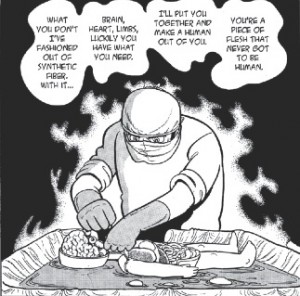
Osamu Tezuka’s own medical training is evident in the detailed drawings of muscle tissue, livers, hearts, and brains. Yet these images are beautifully integrated into his broad, cartoonish vocabulary, making the surgical scenes pulse with life. These procedures get an additional jolt of energy from the way Tezuka stages them; he brings the same theatricality to the operating room that John Woo does to shoot-outs and hostage crises, with crazy camera angles and unexpected complications that demand split-second decision-making from the hero.

At the same time, however, a more adult sensibility tempers the bravado displays of surgical acumen. Black Jack’s medical interventions cure his patients but seldom yield happy endings. In “The Face Sore,” for example, a man seeks treatment for a condition that contorts his face into a grotesque mask of boils. Jack eventually restores the man’s appearance, only to realize that the organism causing the deformation had a symbiotic relationship with its host; once removed, the host proves even more hideous than his initial appearance suggested. “The Painting Is Dead!” offers a similarly bitter twist, as Jack prolongs a dying artist’s life by transplanting his brain into a healthy man’s body. The artist longs to paint one final work — hence the request for a transplant — but finds himself incapable of realizing his vision until radiation sickness begins corrupting his new body just as it did his old one. Jack may profess to be indifferent to both patients’ suffering, insisting he’s only in it for the money, but that bluster conceals a painful truth: Jack knows all too well that he can’t heal the heart or mind.

The only thing that dampened my enthusiasm for Black Jack was the outdated sexual politics. In “Confluence,” for example, a beautiful young medical student is diagnosed with uterine cancer. Tezuka diagrams her reproductive tract, explaining each organ’s function and describing what will happen to this luckless gal if they’re removed:

As you know, the uterus and ovaries secrete crucial hormones that define a woman’s sex. To have them removed is to quit being a woman. You won’t be able to bear children, of course, and you’ll become unfeminine.

Too bad Tezuka never practiced gynecology; he might have gotten an earful (and a black eye or two) from some of his “unfeminine” patients.

I also found the dynamic between Jack and his sidekick Pinoko, a short, slightly deformed child-woman, similarly troubling. Though Pinoko has the will and libido of an adult, she behaves like a toddler, pouting, wetting herself, running away, and lisping in a babyish voice. She’s mean-spirited and possessive, behaving like a jealous lover whenever Jack mentions other women, even those who are clearly seeking his medical services. These scenes are played for laughs, but have a creepy undercurrent; it’s hard to know if Pinoko is supposed to be a caricature of a housewife or just a vaguely incestuous flourish in an already over-the-top story. Thankfully, these Pygmalion-and-Galatea moments are few and far between, making it easy to bypass them altogether. Don’t skip the story in which Jack first creates Pinoko from a teratoid cystoma, however; it’s actually quite moving, and at odds with the grotesque domestic comedy that follows.

If you’ve never read anything by Tezuka, Black Jack is a great place to begin exploring his work. Tezuka is at his most efficient in this series, distilling novel-length dramas into gripping twenty-page stories. Though Tezuka is often criticized for being too “cartoonish,” his flare for caricature is essential to Black Jack; Tezuka conveys volumes about a character’s past or temperament in a few broad strokes: a low-slung jaw, a furrowed brow, a big belly. That visual economy helps him achieve the right balance between medical shop-talk and kitchen-sink drama without getting bogged down in expository dialogue. The result is a taut, entertaining collection of stories that offer the same mixture of pathos and medical mystery as a typical episode of House, minus the snark and commercials. Highly recommended.

This is a synthesis of two reviews that originally appeared at PopCultureShock on 10/26/2008 and 11/4/08. I’ve also reviewed volumes five and eleven here at The Manga Critic.

BLACK JACK, VOLS. 1-2 • BY OSAMU TEZUKA • VERTICAL, INC.

Filed Under: Manga Critic Tagged With: Classic, Medical, Osamu Tezuka, vertical

Black Jack, Vols. 1-2

December 15, 2010 by Katherine Dacey

Black Jack practices a different kind of medicine than the earnest physicians on Grey’s Anatomy or ER, taking cases that push the boundary between science and science fiction. In the first two volumes of Black Jack alone, the good doctor tests his surgical mettle by:

  • Performing a brain transplant
  • Separating conjoined twins
  • Operating on a killer whale
  • Operating blind
  • Operating on a man who’s been hit by a bullet train
  • Operating on twelve patients at once… without being sued for medical malpractice.

Osamu Tezuka’s own medical training is evident in the detailed drawings of muscle tissue, livers, hearts, and brains. Yet these images are beautifully integrated into his broad, cartoonish vocabulary, making the surgical scenes pulse with life. These procedures get an additional jolt of energy from the way Tezuka stages them; he brings the same theatricality to the operating room that John Woo does to shoot-outs and hostage crises, with crazy camera angles and unexpected complications that demand split-second decision-making from the hero.

At the same time, however, a more adult sensibility tempers the bravado displays of surgical acumen. Black Jack’s medical interventions cure his patients but seldom yield happy endings. In “The Face Sore,” for example, a man seeks treatment for a condition that contorts his face into a grotesque mask of boils. Jack eventually restores the man’s appearance, only to realize that the organism causing the deformation had a symbiotic relationship with its host; once removed, the host proves even more hideous than his initial appearance suggested. “The Painting Is Dead!” offers a similarly bitter twist, as Jack prolongs a dying artist’s life by transplanting his brain into a healthy man’s body. The artist longs to paint one final work — hence the request for a transplant — but finds himself incapable of realizing his vision until radiation sickness begins corrupting his new body just as it did his old one. Jack may profess to be indifferent to both patients’ suffering, insisting he’s only in it for the money, but that bluster conceals a painful truth: Jack knows all too well that he can’t heal the heart or mind.

The only thing that dampened my enthusiasm for Black Jack was the outdated sexual politics. In “Confluence,” for example, a beautiful young medical student is diagnosed with uterine cancer. Tezuka diagrams her reproductive tract, explaining each organ’s function and describing what will happen to this luckless gal if they’re removed:

As you know, the uterus and ovaries secrete crucial hormones that define a woman’s sex. To have them removed is to quit being a woman. You won’t be able to bear children, of course, and you’ll become unfeminine.

Too bad Tezuka never practiced gynecology; he might have gotten an earful (and a black eye or two) from some of his “unfeminine” patients.

I also found the dynamic between Jack and his sidekick Pinoko, a short, slightly deformed child-woman, similarly troubling. Though Pinoko has the will and libido of an adult, she behaves like a toddler, pouting, wetting herself, running away, and lisping in a babyish voice. She’s mean-spirited and possessive, behaving like a jealous lover whenever Jack mentions other women, even those who are clearly seeking his medical services. These scenes are played for laughs, but have a creepy undercurrent; it’s hard to know if Pinoko is supposed to be a caricature of a housewife or just a vaguely incestuous flourish in an already over-the-top story. Thankfully, these Pygmalion-and-Galatea moments are few and far between, making it easy to bypass them altogether. Don’t skip the story in which Jack first creates Pinoko from a teratoid cystoma, however; it’s actually quite moving, and at odds with the grotesque domestic comedy that follows.

If you’ve never read anything by Tezuka, Black Jack is a great place to begin exploring his work. Tezuka is at his most efficient in this series, distilling novel-length dramas into gripping twenty-page stories. Though Tezuka is often criticized for being too “cartoonish,” his flare for caricature is essential to Black Jack; Tezuka conveys volumes about a character’s past or temperament in a few broad strokes: a low-slung jaw, a furrowed brow, a big belly. That visual economy helps him achieve the right balance between medical shop-talk and kitchen-sink drama without getting bogged down in expository dialogue. The result is a taut, entertaining collection of stories that offer the same mixture of pathos and medical mystery as a typical episode of House, minus the snark and commercials. Highly recommended.

This is a synthesis of two reviews that originally appeared at PopCultureShock on 10/26/2008 and 11/4/08. I’ve also reviewed volumes five and eleven here at The Manga Critic.

BLACK JACK, VOLS. 1-2 • BY OSAMU TEZUKA • VERTICAL, INC.

Filed Under: Manga, Manga Critic, REVIEWS Tagged With: Classic, Medical, Osamu Tezuka, vertical

  • « Go to Previous Page
  • Page 1
  • Interim pages omitted …
  • Page 22
  • Page 23
  • Page 24
  • Page 25
  • Page 26
  • Interim pages omitted …
  • Page 39
  • Go to Next Page »
 | Log in
Copyright © 2010 Manga Bookshelf | Powered by WordPress & the Genesis Framework