• Skip to primary navigation
  • Skip to main content
  • Skip to primary sidebar
  • Home
  • About Us
    • Privacy Policy
    • Comment Policy
    • Disclosures & Disclaimers
  • Resources
    • Links, Essays & Articles
    • Fandomology!
    • CLAMP Directory
    • BlogRoll
  • Features & Columns
    • 3 Things Thursday
    • Adventures in the Key of Shoujo
    • Bit & Blips (game reviews)
    • BL BOOKRACK
    • Bookshelf Briefs
    • Bringing the Drama
    • Comic Conversion
    • Fanservice Friday
    • Going Digital
    • It Came From the Sinosphere
    • License This!
    • Magazine no Mori
    • My Week in Manga
    • OFF THE SHELF
    • Not By Manga Alone
    • PICK OF THE WEEK
    • Subtitles & Sensibility
    • Weekly Shonen Jump Recaps
  • Manga Moveable Feast
    • MMF Full Archive
    • Yun Kouga
    • CLAMP
    • Shojo Beat
    • Osamu Tezuka
    • Sailor Moon
    • Fruits Basket
    • Takehiko Inoue
    • Wild Adapter
    • One Piece
    • After School Nightmare
    • Karakuri Odette
    • Paradise Kiss
    • The Color Trilogy
    • To Terra…
    • Sexy Voice & Robo
  • Browse by Author
    • Sean Gaffney
    • Anna Neatrour
    • Michelle Smith
    • Katherine Dacey
    • MJ
    • Brigid Alverson
    • Travis Anderson
    • Phillip Anthony
    • Derek Bown
    • Jaci Dahlvang
    • Angela Eastman
    • Erica Friedman
    • Sara K.
    • Megan Purdy
    • Emily Snodgrass
    • Nancy Thistlethwaite
    • Eva Volin
    • David Welsh
  • MB Blogs
    • A Case Suitable For Treatment
    • Experiments in Manga
    • MangaBlog
    • The Manga Critic
    • Manga Report
    • Soliloquy in Blue
    • Manga Curmudgeon (archive)

Manga Bookshelf

Discussion, Resources, Roundtables, & Reviews

Reviews

Raven of the Inner Palace, Vol. 4

October 8, 2023 by Sean Gaffney

By Kouko Shirakawa and Ayuko. Released in Japan as “Kōkyū no Karasu” by Shueisha Orange Bunko. Released in North America by Airship. Translated by Amelia Mason.

Usually when you see character development, it’s meant to be heartwarming, or affirming, and generally a good thing. And there is that here. Seeing Jusetsu gradually open up to being around others, helping people, and growing more comfortable in her own skin is absolutely a good thing, and the Emperor knows it. That said, the fact that she is the Raven Consort makes this a bit of a double-edged sword. The classic joke “I’m not like other girls” is eerily true here, and that’s why there’s a sense of this series moving faster and faster down a hill towards a crash that Jusetsu is not going to be able to stop. It does not help that certain factions in the court are trying to apply the accelerator rather than the brakes, and suddenly instead of being fond of Jusetsu, or looking up to Jusetsu, they are WORSHIPING Jusetsu. And that’s definitely a bad thing, give that’s she’s already a part of a god, and the other god who is the enemy may be getting back to full strength.

The main plot shows the Crane Consort’s father, Choyo, arrive at the palace, supposedly in order to apologize to the Emperor for what happened in the last book, and grace him with some of their most valuable silkworm cocoons. In reality, Choyo is there to blackmail/threaten the Emperor with the knowledge that he knows who Jusetsu is and that she should stay isolated in her own quarters. Meanwhile, the man responsible for the events of the third book, Hakurai, may have lost an eye but is not remotely down and out, and he’s here to try to kill Jusetsu *and* destroy her reputation – and nearly succeeds at the second. And, of course, these events are interspersed with the meat and potatoes of this series; a ghost is in the palace, let’s figure out why.

Generally speaking the main reason to read any of these “inner palace of the Emperor” series, be it Apothecary Diaries, Though I Am an Inept Villainess, or this one, is for the court politics, and that’s no exception here. Jusetsu is trying her best, helping people and making sure to right wrongs and save those who can be saved (and send to the afterlife those who can’t). But by the end of the book she’s basically been asked to stay shut up until further notice, and while I doubt that will last long, it feels like a loss for her. This is not to say that Choyo wins, however. Banka easily gets the most interesting plotline and the best moment in the book, as she’s seemingly ineffectual, useless, and getting sicker and sicker over the course of the book. I say seemingly because she confronts her father angrily near the end, reveals a secret she’s been holding back that upends a lot of what will be coming, and basically says “I’m not your toy anymore”. It’s great. I can’t wait to see how she nobly dies in a future volume.

Good intrigue, great characters, worrying that it will end with half the cast dead, but hey. Romance is sort of vaguely there but very much in the background. To sum up: read this, it’s good.

Filed Under: raven of the inner palace, REVIEWS

Maiden of the Needle, Vol. 2

October 7, 2023 by Sean Gaffney

By Zeroki and Miho Takeoka. Released in Japan as “Hariko no Otome” by Kadokawa Shoten. Released in North America by Yen On. Translated by Kiki Piatkowska.

I’m still really enjoying this series, possibly more than it deserves. It’s not exactly groundbreaking, being another variation on the Cinderella story we’ve seen come up a lot in light novels lately. The first volume features Yui being rescued from her terrible fate and given all the love and comfort she’s ever wanted, but the second volume shows that things are not exactly happily ever after yet. There’s still far too many curses around this kingdom, be it from the old king’s late wife or from Yui’s twisted family. But Yui is developing at just the right pace, not abusing her “I’m from Japan” buttons too much, and frankly still unable to eat more than half a plate of dinner or speak for longer than 30 seconds without coughing. I appreciate that the abuse has not gone away no matter how loved she is. As for the rest of the cast, well, this is a book filled with people discovering their old family bonds. Sometimes they were deliberately hidden, and sometimes they were nearly destroyed.

Due to her constitution, Yui is leaving Rodin’s employ for the moment and going with Argit to Menesmetlo, which has winter weather – and also a labyrinth where they might be able to find some things to help undo all the curses. Once there, all the girls quickly check out the hot springs – but what at first seems like a “wacky” comedy scene with everyone trying to stop Mimachi from sexually harassing Yui gets more serious when she accidentally activates a long-buried underwater terminal, which can apparently transport certain people to the Gods’ dwelling. No, Yui does not go to the gods – but Senri, a commoner maid who’s as normal as can be except for her superhuman strength, does, and finds out a lot of secrets about her family. Meanwhile, Yui’s old family is quickly sliding faster and faster into evil, and a purge is required.

The other girl on the cover, by the way, is Yui’s sister Meilia, who, like the rest of her family, had turned on Yui over the years, but is pretty much the only one who regrets it, and finds herself wishing she could see Yui again. The scenes with Meilia may be the best in the book, filled with subtle horror (the pain Meilia is in from the weight of the spider on her shoulder, showing that it’s turned into a monster even though she never looks at it), non-subtle horror (the end of the Nuir family itself, as well as the friendship bracelet from Yui being what saved Meilia’s life and soul), and also bittersweet redemption (Mei is saved, but has lost her memories, and the implication at the end of the book is that she’ll live the rest of her (admittedly very happy) life without ever seeing Yui again). It’s hard being a child in a dissolute family of spider monster manipulators.

Unfortunately, this series comes out VERY slowly in Japan, and the third book is not yet on the horizon. Till then, enjoy this story of fairies, spiders, and girls who don’t realize they’re descended from gods.

Filed Under: maiden of the needle, REVIEWS

The Angel Next Door Spoils Me Rotten, Vol. 5.5

October 6, 2023 by Sean Gaffney

By Saekisan and Hanekoto. Released in Japan as “Otonari no Tenshi-sama ni Itsu no Ma ni ka Dame Ningen ni Sareteita Ken” by GA Bunko. Released in North America by Yen On. Translated by Nicole Wilder.

Oh dear, it’s a short story volume. Worse, it’s a short story volume that takes place entirely before the lead couple get together. So right after I write a review that basically says “I’m so glad we’re no longer frustrated waiting for these two dipshits to confess”, I get an entire book filled with scenes where these two dipshits are not confessing. So as you can imagine a majority of this volume is filled with short stories where our two leads clean the house, or cook a meal, or play a videogame, and pine for each other. If you enjoyed the earlier volumes, this is great for you, though unfortunately the author’s narrative voice can occasionally make both of them come across as a bit creepy some of the time. Fortunately there are three stories that aren’t about Amane and Mahiru’s relationship, and they actually have plot!

In among the stories I mentioned above, we get three others. The first is Mahiru’s perspective on her childhood, and so as you can imagine is rather sad and depressing. Sometimes trying to be the best so that your parents will notice you simply doesn’t work out. No amount of Angel is going to make her mother care. The second story has Chitose telling a curious Mahiro how she and Itsuki started to date, and it’s much more serious than you’d expect given Chitose’s entire vibe. She was all about track, and did not really care about anything else – but rejecting Itsuki’s confession leads to unforeseen consequences. Then we hear about how Itsuki and Amane became friends, which is also more serious than expected and relies on Amane’s terrible memory for faces.

The whole point of this series is that its two leads are ridiculously pure. Nothing is going to happen, especially in this book, where they aren’t even a couple yet. But it’s still being sold to GA Bunko readers, so a certain amount of horniness is required by publisher statute. As a result, you get a lot of times, pardon me, where you just want to yell at the writer “It’s OK to say erection!”. Several scenes in the book are blatantly Amane getting aroused around Mahiru and feeling embarrassed and awkward about it – the worst of which comes when she sees him, supposedly asleep (he’s faking) and rubbing his exposed stomach… then drifting lower. It really creates this … not quite a “moe gap”, but in that neighborhood, and it makes the two even sweeter, somehow. Still, it’s actually a surprise later in the book when Chitose says “boobs” – and Mahiru’s reaction to this is exactly like Amane’s. As for the serious stories, well, all four leads have gone through major events that have caused them to change the way they behave around others. For Itsuki and Chitose’s that’s been a net positive. Mahiru and Amane are still working their way towards that.

So, short story volume. Fluffy, sweet, a few deep things. Horny, but in a Saturday Morning Cartoon sort of way. Back to being a couple next time.

Filed Under: angel next door spoils me rotten, REVIEWS

The Girl I Saved on the Train Turned Out to Be My Childhood Friend, Vol. 4

October 5, 2023 by Sean Gaffney

By Kennoji and Fly. Released in Japan as “Chikan Saresou ni Natteiru S-kyuu Bishoujo wo Tasuketara Tonari no Seki no Osananajimi datta” by GA Bunko. Released in North America by Yen On. Translated by Sergio Avila.

This book tends to work against my fragmentary memory. It’s been almost a year since the last volume, which doesn’t help. Nor do Fly’s illustrations, which in this series tend to make everyone look very similar to each other. And, of course, everyone refers to each other by different names – be they polite “last name only” folks, childhood friend first names, cute nicknames, etc. What all this ends up meaning is that I find myself constantly trying to remember which girl is which and what their backstory is. But then that’s also what Ryou is doing here, of course. His entire childhood seems to be a blur, and even the promise with his childhood friend turns out to be something of a lie. He can remember things when literally confronted with them, as we see in a beach scene. But he’s too buried in his own self-loathing to really try experiencing anything else, such as, say, dating one of the girls in love with him.

The bulk of this volume is concerned with making the movie everyone has decided to do, with Ryou as the director, Shizuka as the writer, and Hina and Ai as the actresses, with the clever conceit that the guy they’re both in love with is never seen, but merely implied offscreen. Of course, there are a few hiccups to get through. Getting a camera requires getting a part-time job, but fortunately Ai’s agent can help Ryou out. A scene filmed on the beach turns into an entire vacation day at the beach, and Ryou and Hina almost, ALMOST moving forward in their relationship but still failing. The big subplot, though, is that Hina, the talented amateur, and Ai, the former-idol-turned-actress, are both up for the same role in a production. Only one can get the job, while the other is doomed to disappointment. What can Ryou’s role be in regards to both of them? And can he find a path of his own?

Probably the most gripping scene in the book is where Ryou, at the absolute limits of his utter loathing of himself, starts pouring words out into a notebook for the entire night, and they end up turning into another, different film that he wants to make – this one with Shizuka as the lead. We can probably guess why – given that it’s a product of his own frustration and despair, it makes sense that he’d turn to the girl in his life who’s also gloomy and self-hating to get the right vibe. But the frustration and despair stem from the two main girls in his love triangle (sorry, Shizuka), who are both gorgeous, talented, and know what they want to do with their life – or at least, that’s what he thinks. We know from the occasional non-POV narration we get from them that both are also feeling a bit lost and afraid, which is why Ai’s agent asks Ryou to step in and help in THAT way at the book’s conclusion.

There are better “summer of my youth” romances out there, but there’s nothing really wrong with this one.

Filed Under: girl i saved on the train, REVIEWS

A Late-Start Tamer’s Laid-Back Life, Vol. 7

October 4, 2023 by Sean Gaffney

By Yuu Tanaka and Nardack. Released in Japan as “Deokure Tamer no Sono Higurashi” by GC Novels. Released in North America by J-Novel Club. Translated by A.M. Cola.

I will admit that disbelief is starting to be a bit TOO suspended in this series. The whole plot is that Yuto does stunningly amazing things without actually realizing it, is a huge celebrity without knowing it at all, and exudes this “aw shucks, I’m just a dull weak gamer” aura that puts even the most modest of Japanese protagonists to shame. But his ignorance to the actual gaming world is getting to be ridiculous. We know he reads forums. We know he tries to look for solutions, and he’s aware of upcoming events. So the idea that not only is he unaware of a new video channel for the game where players can get money by posting popular videos, but that *he* is the #1 videos thanks to his cute monsters weaponizing radio calisthenics… I mean, there’s innocent young boy who we must protect, and there’s deliberately thick. Especially given that Yuto is, in real life, an office worker. He’s not really a teenage boy! Sheesh.

Most of the book is the usual stuff: Yuto goes on adventures with his monsters where they fight things and almost die but eventually win; Yuto experiments with various types of weird things and usually has failures but sometimes comes up with something really interesting; and, of course, standing around while people gawp at him. The most important things he does in the book are a) buy another property, this one a Japanese-style house that comes with monsters that fit the mood… something that seems unavailable to other players. And he also finally makes it to Zone 5, which means he can try to achieve things he can’t do by hanging out at the starter’s line. This includes a huge underwater battle… which comes about as a result of realizing that the salmon tastes different depending on which color it is.

The series runs a great deal on “it’s OK because they’re so cute”, which is mostly fine (especially once the new “you can’t sexually harass the monsters” rule comes into play), and sometimes less fine (I’ve complained before about the “no homo” aspect of this series when it comes to guys who look feminine unnerving our hero, and will again, as I doubt it’s going away). Like Bofuri, though, this is a real game, not a “trapped in a game” or “isekai but it’s stats” world, so you get things like moderators actually doing their jobs and logging people out when their arguments get too heated. This is meant to be a world for people like Yuto, a relaaxing stroll through cool things, and anyone getting too upset about not getting the first doodad on the shelf should really be playing some other game. Besides, it’s far too late. Yuto gets all the first doodads. He even has a “first doodad boy” title.

This won’t win new fans, but old fans will like it. A slow life series that works.

Filed Under: late start tamer's laid back life, REVIEWS

Invaders of the Rokujouma!?, Vol. 42

October 3, 2023 by Sean Gaffney

By Takehaya and Poco. Released in Japan as “Rokujouma no Shinryakusha!?” by HJ Bunko. Released in North America by J-Novel Club. Translated by Warnis.

One of the strengths of the Rokujouma series has been the attention paid to its major antagonists. Even from the start, the villains got opportunities to show us their point of view, be sympathetic in some way, shape or form, or at least show why people trust them despite their being Obviously Evil. That stays true to the present books, as Ralgwin, despite being one of the main bad guys, is a Good Boss, cares about his underlings, and even fires one of his strongest supporters just so that she’ll be away from the bad stuff when it happens. Unfortunately, the bad stuff is absolutely going to happen, mostly as evil scientist (boo) has refined his living corpse makers so that he can resurrect the dead better (and thus use Ralgwin as a spare body for his ancestor), and the Grey Knight, who is “Koutarou but evil”, is still trying to kill Sanae, and presumably will get his inevitable redemption saved for near the end of the series. Assuming this series ever ends.

The format is the same as the last book: half a book of cute stories and buildup, and half a book of battles and payoff. Kenji ad Koutarou brought baseball equipment along, and now Koutarou and Shizuka can flirt… erm, I mean, practice to see if they can use the equipment with their powers. Koutarou then tries to figure out how to spend the giant pile of money he has without being too influential towards one side or another. Everyone then goes to inspect the new Blue Knight ship, which of course looks exactly like a giant robot, complete with detachable parts, because this series is still very teenage boy even as its readers age into their 40s. And then Ralgwin makes one last, desperate attempt to kill Koutarou once and for all, but has reckoned without a defector in his ranks.

The Yurika watch will be brief this review, as she’s barely in the book, except for one scene where she starts to think out loud that Koutarou looks like an Emperor/King until a terrifying glare from Elfaria shuts her up. Clearly Elfaria’s agenda involves much greater things for Koutarou than just “go back to Earth and live in my 6-tatami room”. The big deal here, though, is Fasta’s defection. The sniper has been a major thorn in our heroes’ side for a while now, but after being sent away by Ralgwin so that she’s not quietly killed while trying to save him, she decides to up her game by betraying him in order to save him later, after he’s arrested and imprisoned. It’s a bold move, and I was surprised that it actually worked, but I guess Ralgwin also saw the writing on the wall, putting everything into one last ‘kill Koutarou” attempt – which fails. I also liked that the girls were content to let her escape and try to rescue Ralgwin after his capture – everything they’ve done since about Book 9 or so has basically been “all for love”, so they can understand the feeling.

Good fights, amusing jokes, some incremental plot development. Everything you’d want in a Rokujouma book.

Filed Under: invaders of the rokujouma!?, REVIEWS

Earl and Fairy: A Gentle Proposal

October 2, 2023 by Sean Gaffney

By Mizue Tani and Asako Takaboshi. Released in Japan as “Hakushaku to Yōsei” by Shueisha Cobalt Bunko. Released in North America by J-Novel Heart. Translated by Alexandra Owen-Burns.

If you’re looking at that subtitle and thinking to yourself “Oh good, we’re going to move past the shoujo “bad boyfriend but so hot” tropes and have them get together, I have some very bad news for you. This series is 3 volumes into a 33-volume run (in Japan, I’m not expecting miracles from JN-C), and the closest you’re going to get in this volume is Lydia saying she will “think about” falling in love with Edgar. And honestly, it would be far too fast right now, given where the characters are. This is an old series that came out back in the day when you could greenlight something long, so the development is slow and languorous. Edgar is still trying to figure out where to prioritize getting revenge for everything that’s happened to him and what he feels for Lydia. Lydia, meanwhile, cannot fathom ANYONE being interested in her, and still regards everything Edgar says as false. Which is not 100% true – but is not quite a lie either.

Edgar and Lydia’s back and forth, will-they-won’t-they is soon joined by a new inhabitant of Edgar’s house: Paul, an artist who Edgar has decided to give a bit of patronage to. They seem to have a past history, which is very interesting given Edgar’s past. Indeed, Paul is not even sure if this is the same boy, given that the last he’d heard the boy and his entire family were all dead. There’s also a fairy with a moonstone ring, trying to get Edgar to accept it so that he can be married to the Queen of the Fairies. Unfortunately, the ring has been stolen by a kelpie, who has known Lydia a long time and wants to use the ring to have HER return with him to Fairyland forever. As for Lydia, she mostly just wishes everyone would go away and let her get on with her work.

The frustration is the point, of course. At many points in this volume you want to strangle both Edgar and Lydia. Crucially, it’s rarely at the same time. Edgar ends up coming across much better when he stops pressing so hard, but he simply can’t find it in hiself to keep that up, and when he presses too hard he comes across as a bit scary. Lydia is already a girl who rarely dealt with real humans as a kid, and the one party she went to had the classic “boy who likes her pretends he asked her as a joke because it’s too embarrassing” plotline, and it’s twisted her entire viewpoint of herself. (The red hair doesn’t help – remember, redheads are still abused in this period.) But when push comes to shove, they will both sacrifice themselves to save the other, and that’s what really matters.

I don’t think it will take 30 more volumes to get a confession, but I suspect we’ll have the status quo for a bit. If you like old-school shoujo with good worldbuilding, this is perfect.

Filed Under: earl and fairy, REVIEWS

My Magical Career at Court: Living the Dream After My Nightmare Boss Fired Me from the Mages’ Guild!, Vol. 1

October 1, 2023 by Sean Gaffney

By Shusui Hazuki and necomi. Released in Japan as “Black Madōgushi Guild o Tsuihō Sareta Watashi, Ōkyū Majutsushi to Shite Hirowareru: White na Kyūtei de, Shiawase na Shinseikatsu o Hajimemasu! ” by SQEX Novels. Released in North America by J-Novel Heart. Translated by Mari Koch.

As we have seen a large increase in the number of light novels written for women over the last few years, we have also seen that a great deal of them tend to involve an overworked, exhausted office lady escaping the terrible job she has by getting summoned to another world, or rescued by an improbable coincidence, or even simply dying and being reborn elsewhere. The original Japanese title of this book references “black companies”, the workplaces that violate labor standards but are nevertheless there for people who desperately need jobs. That said, I’m not sure we’ve seen a power fantasy quite as blatant as the one in My Magical Career at Court, whose entire plot revolves around our underappreciated heroine getting fired by her mean bosses and then ending up with the perfect job, where she impresses literally everyone around her by being outstanding. It is a cry of freedom from the heart. Or rather, from the page.

The book starts in the first paragraph with the words “you’re fired”. Noelle lives in a backwater town, trying to live her life as a mage, even in a job she’s not really suited for, because she loves magic. Sadly, her boss doesn’t really care – and is, in fact, so sadistic that he makes sure she can never get a job in the town that uses magic. Fortunately for her, she runs into Luke, her old friend and hated rival from magical school, where the two of them were constantly competing for the top spot. He’s now working for the royal court, and is delighted that he can offer her a job. As she moves to the capital and starts her new job, she is stunned at every turn by now nice everyone is, how she gets real time off and normal work hours, and how expectations for her are not ludicrous. That said… what she gives them *is* ludicrous. She’s a bit OP.

Other folks have compared this to The Sorcerer’s Receptionist a bit, and I get it, but Noelle doesn’t seem to be all that similar to Nanalie except in the fact that they both have a boyfriend/rival figure. Indeed, how much you like this book may depend on how much you can tolerate Noelle being another one of THOSE heroines, so beaten down by life that any sign of obvious affection is completely missed, and folks trying to praise her gets constantly brushed off. It’s Japanese modesty taken to an aggravating degree. That said, overall I found her a lot of fun. I was surprised at the subplot, where we see what happens to the “bad guild” after she leaves. I’m so used to the sorts of stories where everyone is so evil they’re disgraced and end up dying a coward’s death, but no… the end goal of this story is that the old bosses see what Noelle is really like and regret that they let her go so easily. That’s it. In the end, this really is an office lady revenge story, it’s just the revenge is “I am happy now, ha ha ha”.

This has a second volume, which I will check out, but also feels pretty complete in one book, despite the romantic subplot slamming against Noelle’s heroic self-deprecation. Recommended for those in a bad job who like to fantasize.

Filed Under: my magical career at court, REVIEWS

From the Vault: Mitsukazu Mihara’s The Embalmer

September 30, 2023 by Katherine Dacey

This month, I’m reaching into the PopCultureShock vault for a review of Mitsukazu Mihara’s The Embalmer, one of those offbeat titles that Tokyopop published back in the aughts. It’s not hard to see why Tokyopop thought there was an audience for Mihara’s work, as she played an important role in defining the Gothic Lolita aesthetic. Tokyopop licensed five of her works—Doll, Haunted House, IC in a Sunflower, Requiem in Phonybrian, and The Embalmer—but they didn’t really catch on with North American readers. That’s a pity, as titles such as The Embalmer, Doll, and IC in a Sunflower were anything but cookie cutter, tackling difficult subjects with sensitivity and style. (Well, most of the time; some of the stories in Sunflower haven’t aged particularly well.) Readers interested in tracking down The Embalmer should note that Tokyopop only translated four of the seven volumes before canceling the series; used copies are relatively easy to obtain through Amazon and eBay, however. A quick search of WorldCat indicates that there are public libraries around the US that still have copies as well.

Mitsukazu Mihara’s The Embalmer, Vols. 1-4
Story and Art by Mitsukazu Mihara
Published by Tokyopop

Let’s face it: even in a medium known for exploring a diverse array of topics—cooking, Viagra, Linux, vampires—embalming doesn’t sound like a promising subject, yet Mitsukazu Mihara’s gripping manga is less an examination of death and decay than a meditation on how coping with loss gives meaning to life.

The series focuses on embalmer Shinjyurou Mamiya. At first glance, he looks like the quintessential bad boy with his skate punk wardrobe, rock star ‘do, sloppy digs, and fondness for the ladies. That’s certainly how Atzuki Natsui, his housekeeper and love interest, views him. Shinjyurou, however, proves more substantial than his casual demeanor might suggest. In a country where Buddhist custom dictates that bodies be cremated, his profession inspires hostility and suspicion from grieving families and medical professionals alike. Shinjyurou, however, reaches out to skeptics with the argument that embalming is a service for the living, not the dead. By preserving (and sterilizing) the body of a tuberculosis victim, for example, Shinjyurou allows the man’s young son to hug his father goodbye—something that would have been impossible during the man’s final days in quarantine—while Shinjyurou’s reconstruction of a badly mangled ballerina helps her grieving fiance imagine the wedding and professional debut she was denied by a deadly car crash.

Each volume of The Embalmer has a slightly different rhythm; some read like anthologies of thematically related stories, while others contain more conventional, multi-chapter story arcs involving the lead characters. Volumes one and two, for example, consist primarily of vignettes about Shinjyurou’s clients with a sprinkling of chapters exploring his personal life. In volume three, Mihara shifts gears, delving into Shinjyurou’s past to explain how an aspiring medical student from Okinawa ended up studying mortuary science in Pittsburgh. Volume four returns to the same format as volumes one and two, offering both glimpses of the embalming profession and scenes from Shinjyurou’s muddled courtship of Atsuki.

Volume four also includes an afterword from Mihara explaining her interest in embalming. Contrary to what one might expect from a manga-ka best known for her goth-loli motifs and dark themes, Mihara’s curiosity about the practice stemmed from personal experience, not a general fascination with death:

The inspiration for this book came from the death of my friend. Because of the funeral schedule, I didn’t feel like I was able to properly say goodbye. I think embalming is a technique well suited to Japan, where we often have very little time. So the circumstances led me to investigate embalming…

It’s this personal investment in the material, I think, that prevents The Embalmer from shading into ghoulishness or sentimentality. Mihara did her homework on the subject. Each volume includes extras explaining the practice—origins, tools, training—and the difficulties faced by Japanese professionals in a country where cremation is the norm. At the same time, however, each volume contains vivid, poignant scenarios that dramatize the very human need for closure when a loved one dies unexpectedly, showing us how personal tragedy leads to catharsis. Mihara’s highly stylized figures—often rendered with slender, angular frames, coal-black eyes, and dark shocks of hair—and empty backgrounds amplify her characters’ shifting moods from despair to peaceful acceptance.

Tokyopop has done Mihara’s work justice with a smooth, idiomatic translation, helpful notes explaining pop culture references, and a distinctive cover design in a muted palette of green, gray and black. It’s a worthwhile addition to every serious manga fan’s collection, and a fine introduction to the unique art and storytelling of Mitsukazu Mihara.

This review originally appeared at PopCultureShock on September 18, 2007 at http://www.popcultureshock.com/manga-review-mitsukazu-miharas-the-embalmer-vols-1-4/42616/.

Filed Under: Manga, REVIEWS Tagged With: From the Vault, Mitsukazu Mihara, Tokyopop

I Want to Escape from Princess Lessons, Vol. 1

September 30, 2023 by Sean Gaffney

By Izumi Sawano and Miru Yumesaki. Released in Japan as “Kisaki Kyōiku kara Nigetai Watashi” by PASH! Books. Released in North America by J-Novel Heart. Translated by Camilla L.

I went into this wanting to like it. I’d heard rumors that it was being disparaged on forums because it had one of THOSE shoujo boyfriends. You know, controlling, possessive, etc. The sort that seemed to be in every title from Viz Media circa 2002. The rumors are not QUITE true… OK, they’re maybe half true, but that’s not why this book doesn’t work. The book doesn’t work, chiefly, because its heroine is a dimbulb, and not in the fun way. She wants to be Katarina Claes, but she’s just too manic, too aggravating, and the eccentricities that are supposed to explain why everyone is doing this after ten years just read like her not bothering to try to deal with anything at all. Add to this a writing style that screams “I’m so wacky!” every page, a big brother that makes the sadistic prince look like a cupcake, and the standard “anytime I am embarrassed, I overreact in a ridiculous way” character tic, and this is hard going.

Leticia is a duchess who has been engaged for the last ten years to Clarke, the crown prince. This means she has been getting grueling lessons in how to be royalty for those last ten years. So when she spots her fiance with Brianna, a buxom black-haired beauty, she leaps to the conclusion that their engagement is broken (perhaps she’s read this plot in 87 other light novels) and immediately flees the palace, flees her house, and flees to a backwater part of the country, where she plans to climb trees, fish, and do all the other things that she was never able to do when she was a princess in training. There’s just one problem. She’s still engaged. Clarke really, really, really loves her. And now she’s coming back with him, and will not be allowed to escape once more. Even though she keeps trying. Again and again and again.

I hate reading too much into this plot, because it’s clearly meant to be a broad comedy, and everyone in it should be treated as a caricature. But the moment you try to apply a realistic lens to any of this, it becomes desperately horrible. We only see one flashback of the “princess lessons” themselves, but they’re apparently so brutal that they essentially shut Leticia down for ten years, to the point where she doesn’t even listen or react to people in any normal way. Um… that sounds like abuse? Clarke, at least, calls off the lessons once she is captured. As for Clarke himself, the book can’t decide if he’s a sweet lovestruck prince pretending to be a yandere sadist, or if he really is a yandere sadist. Oh yes, and the entire plot is resolved by the 112th page, meaning the last third of the book is a series of after stories giving us various short clips of what comes next, all with the same thrown together style.

On Twitter I called this the stupidest light novel I’d ever read, which ended up not being quite true. The plot did justify itself within its own framework. But boy was this a chore to get through. Somehow there’s a Book 2, which actually might be better than the first, as it focuses on Brianna, the gold-digging girl who keeps hanging around even after her role in the “plot” is long since dispensed with. That said, it’s not enough for me to read it.

Filed Under: i want to escape from princess lessons, REVIEWS

Ascendance of a Bookworm: I’ll Do Anything to Become a Librarian!, Part 5: Avatar of a Goddess, Vol. 6

September 29, 2023 by Sean Gaffney

By Miya Kazuki and You Shiina. Released in Japan as “Honzuki no Gekokujou: Shisho ni Naru Tame ni wa Shudan wo Erandeiraremasen” by TO Books. Released in North America by J-Novel Club. Translated by quof.

This is another Bookworm volume that’s more relaxed and peaceful than others. The last book promised a huge upheaval in Rozemyne’s life, and this volume is all about how that upheaval is going to affect everyone around her. Its pretty much got everything you’d want in a Bookworm volume… well, OK, there’s a long, long, extended story told from Detlinde’s point of view. That was nightmarish to read. But other than that. The most amusing thing about the volume is the fact that everyone knows that something is going to happen soon to knock everything off the rails, because Rozemyne’s life is a series of such events. They have a year till she moves to the Sovereignty, those she employs have three years… but they’re all preparing to move at a moment’s notice because bad things always happen to this girl. Admittedly, she always makes them into good things, but that is beside the point.

Returning from the Archduke’s Conference, there’s a lot to discuss, namely how Rozemyne is moving to the Sovereignty in one year’s time. She’ll need servants, but not all of them can go with her, and Ehrenfest can’t lose ALL the people attached to her. So some folks have to choose whether to stay or go, which is made more difficult by the fact that Rozemyne, who is trying to be considerate, is not making her own feelings very clear. Meanwhile, she’s managed to save Ferdinand for now, at least, and proceeds to send him enormously valuable paper, and he sends her piles and piles of gifts in return, along with a letter that even asks, in obscure noble language, “do you like me in a romantic way?”. Rozemyne being the glorious asexual hamster that she is, does not understand this at all. (Yes, I know, Rozemyne’s asexuality will last exactly until the author decides to have her be attracted to Ferdinand, but let me have this for now.)

There’s a lot of great stuff happening here. Wilfried, given everything that’s been going on around him, and his low point in the last two books, took things a lot better than I expected. The scene with the four siblings having a tea party was marvelous, and it was amusing seeing Charlotte and Rozemyne trying to one-up one another in praise. Elvira and Rozemyne also had a long heart-to-heart, and we get a better understanding of just how AWFUL everything was in Ehrenfest before Hurricane Rozemyne arrived a good 20 or so books ago. Of course, there’s still some ominous rumblings going on – the aforementioned Detlinde story is a walking collapsing disaster, and Sylvester’s story basically has to have him talk his way out of a cleverly engineered trap (probably by Georgina, let’s face it). So yeah, even we don’t think everything will go smoothly in a year’s time.

Next tie we’re back to the academy, but no one cares, because if you look at the cover for the next book in the series… it’s finally happening! Join us for literal character growth.

Filed Under: ascendance of a bookworm, REVIEWS

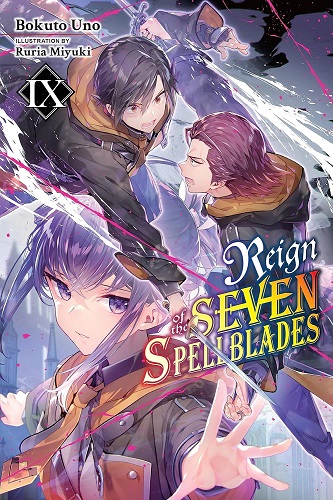
Reign of the Seven Spellblades, Vol. 9

September 28, 2023 by Sean Gaffney

By Bokuto Uno and Miyuki Ruria. Released in Japan as “Nanatsu no Maken ga Shihai suru” by Dengeki Bunko. Released in North America by Yen On. Translated by Andrew Cunningham.

Well, the good news is the Spellblades anime was not the complete disaster the way, say, Spy Classroom is. The bad news is that it wasn’t all that great, either, and I doubt a lot of folks who hadn’t read the books will be reading the anime and going “whoah, need to read that”. Which is a shame, as these really are a series of great light novels, but alas, “first rule of anime: drop the internal narration” strikes again. As for this volume, it was mostly excellent, with one major exception which I will get to. It also had a hell of a cliffhanger, as for once the author did NOT write the end of an arc with “and I’ve run out of pages, so bye”, but instead teases us with something that I really don’t want to have happen but will also be really interested in if it does. That said, most of this is the last of the tournament, so fight, fight, fight.

There are three big battles in this book. First, Oliver, Nanao and Yuri have to fight Ursule Valois and her other team members, Generic Person 1 and Generic Person 2. This gets into a long discussion of sword styles but is derailed a bit by a flashback that made me want to drop the series. After that, Stacy, Fay and Chela go up against Richard Andrews and his team of final bosses, and do their best despite Chela basically being told “you can’t win because the teacher is your dad”. Finally, Team Andrews and Team Horn get a knock-down, drag-out battle which allows Yuri to actually become a real live boy but gives Nanao her worst nightmare: an erotically charged swordfight between Oliver and someone who isn’t her.

There are so many ways that this series feels like it was written by an emo 24-year-old boy. Sometimes this is awkward but endearing, such as Horn and Andrews battling to see if they get to call each other by their first names and maybe hang out sometimes. Sometimes this is pretty damn cool, such as Katie sticking to her principles so much that she might eventually turn evil and die, or Chela needing to be Bright Slapped by her dad. And sometimes it’s really awful and stupid. I don’t like “let me show you a flashback to my super evil abusive family to show you why I am super evil and abusive” to begin with, but this one adds a kitten to the trauma to make things extra horrible. There was no need for that, and I say this as someone who wrote very similar things when *I* was 24. That said, I’m never going to be able to stop Spellblades wearing its heart on its sleeve, which means that sometimes you get really awesome stuff, and sometimes you get this. It’s all just out there on the page, everything.

So the arc is over, go in peace. Tune in next time to see if Yuri dies, if Katie turns evil, or if Oliver and Nanao finally bang. The first two are far more likely than the third.

Filed Under: reign of the seven spellblades, REVIEWS

Bofuri: I Don’t Want to Get Hurt, So I’ll Max Out My Defense, Vol. 10

September 26, 2023 by Sean Gaffney

By Yuumikan and KOIN. Released in Japan as “Itai no wa Iya nano de Bōgyoryoku ni Kyokufuri Shitai to Omoimasu” by Kadokawa Books. Released in North America by Yen On. Translated by Andrew Cunningham.

Good news! This is a far stronger volume of Bofuri than the previous two were, and I think I can see why: the last book I really enjoyed was also pretty much just Maple and Sally, with the others barely appearing. I definitely enjoy the rest of the guild, there’s nothing wrong with them. But something about the main duo of the series causes the author to up their game. Now, don’t get me wrong, there’s no major character development for Maple here or anything, she’s pretty much the same. (Sally… well, I’ll get to Sally.) But it’s simply fun and relaxing watching these two besties steamroll through the dungeons on earlier floors that they missed just to be able to see a really great view, or have a picnic, or learn about new ludicrous techniques. Well, only Maple gets that last one, as she manages to turn dark angel (scary) and also make her weird Atrocity ball do a Katamari Damacy (scarier).

Everyone’s still on the 7th level, and there’s no sign we’re seeing the 8th right away. So Maple and Sally decide to go sightseeing, going back to the earlier levels and taking in things they didn’t get to the last time around. They also meet new characters while they’re at it, because you can’t JUST have Maple and Sally and no one else, alas. Appropriately, of the two pairs they meet, one feels very Maple (Velvet, a brawler pretending to be an ojou, and Hinata, her introverted backup) and the other feels very Sally (Wilbert, an insanely powerful archer, and Lily, his maid backup… except when Lily is the powerful warrior and Wilbert is the butler backup). These two pairs make Sally worried, as she knows that they’ll be doing PvP before long, and she is concerned that she and Maple don’t have the synergy of the other two pairs… despite the entire book being evidence to the contrary.

The first anime had finished when this was being written, and I’m not sure if the author noticed the Maple/Sally yuri fans and decided to play it up a bit, or if this was always the case. Regardless, there’s a lot more yuri subtext than usual here, almost all of it on Risa/Sally’s end. Risa is a gamer girl who has struggled with the fact that her best friend has never really been able to keep up with her in any of them. Now they have this game, which plays to Kaede’s eccentric strengths, and it’s like heaven. She notes that she wants to keep playing with Maple like this forever (romantic, but hopefully not a death flag – I can’t see Bofuri ever getting dark), but she also wants to FIGHT Maple directly, even as she knows that Maple really isn’t into that sort of gameplay. It’s a combination of competitive tension and romantic tension, and it makes me wonder if the final book in the series will be Maple and Sally duking it out.

That said, pretty sure Maple will win. It’s her series. This was a terrific volume, though, and next time the rest of the cast should be back as well.

Filed Under: bofuri, REVIEWS

A Pale Moon Reverie, Vol. 2

September 25, 2023 by Sean Gaffney

By Kuji Furumiya and Teruko Arai. Released in Japan as “Tsuki no Shirosa o Shirite Madoromu” by DRE Novels. Released in North America by J-Novel Club. Translated by Jason Li.

This is very much a book of two halves – literally, of course, because this author’s books are always 2-in-1 omnibuses, but also figuratively. The first half of the book is very much in the horror vein, as Sari and Xixu try to figure out why all of a sudden courtesans are closing their businesses and moving out of the city – and why everyone seems to be 100% OK with it. It’s an “eerie mind control” mood. Then we get the second half of the book, which runs on pure frustration at the two leads. I’m used to book where the romantic couple aren’t a couple because neither of them bother to communicate with each other, but here it’s weaponized, as Xixu’s heroic-but-dumb need to put Sari’s desires above literally everything else leads to Sari abandoning her humanity entirely, and it will take a huge shock to get her back to an equilibrium. and no, the huge shock is not going to be a kiss. This is a far darker series than that.

There’s finally a new shadeslayer in town to take some of the workload off the others. He’s… nice. Very nice, but a bit weird. And also obviously super evil? Sadly, the denizens of Irede are very quick to open up to him, and worse, to listen to what he suggests. This includes Sari, much to Xixu’s dismay. It will take outside help to try to fix this problem… and unfortunately, the outside help may end up being even more of a problem. Then Sari turns 17, and she seems to be growing into her godhood by the day. Something that is accelerated when a new courtesan arrived at the pale Moon, and she turns out to be Xixu’s childhood friend and first love. But Sari doesn’t care about that, not at all. She’s a god, after all, she has no need for pesky human feelings.

As you’d expect, this is a very good book, if difficult to read at times. I am starting to wonder if any of the cast bar Xixu are going to live through the series. I like that we don’t snap back to normal at the end of a crisis – the villain essentially brainwashes a large number of courtesans to leave Irede and go to other cities, and… they don’t return when everything is resolved. Likewise, we find that the villain is a normal shadeslayer who was possessed… but unfortunately, the possession “overwrote his ego”, so there’s no saving him. Hell, even the first book ends up having some of its minor victories overwritten here, as one of the characters sacrifices themselves, and another is ALSO possessed by evil. That said, I think in the end most readers will be agreeing with Thoma: if only these two had simply gone to bed with each other and not been considerate to a hellish degree, everyone would be MUCH better off.

The author indicates that the next volume will be the last, which is good, as the books are worth reading but also exhausting. Definitely recommended, though.

Filed Under: a pale moon reverie, REVIEWS

Suppose a Kid from the Last Dungeon Boonies Moved to a Starter Town, Vol. 13

September 24, 2023 by Sean Gaffney

By Toshio Satou and Nao Watanuki. Released in Japan as “Tatoeba Last Dungeon Mae no Mura no Shonen ga Joban no Machi de Kurasu Youna Monogatari” by GA Bunko. Released in North America by Yen On. Translated by Andrew Cunningham.

There have been quite a few antagonists over the course of this series, but, with the exception of a few, they’ve mostly been pathetic mooks whose job it is to get humiliated and destroyed by Lloyd. That said, this is not a series that is really interested in killing off its villains, for the most part, so something had to happen to them. Why not a high-security prison? Because, of course, Last Dungeon Kid also enjoys making fun of various types of cliched plotlines, and “prison break story” is certainly one of them. The only problem there is that imagining Lloyd breaking out of prison is… ridiculously easy. He wouldn’t even break a sweat. Especially if he’s not even aware that it’s a prison at all. Ah well, it’ll lead to some good comedy. Well, right until the end, of course, when Eve makes sure we have a dramatic twist.

Rinko and Alka are trying to research all the evil things Eve has been doing, and have noticed that she seems to be getting a lot of experimental corpses from somewhere. A likely place is Hell’s Lock, the prison for those who commit the worst crimes in the kingdom. Clearly they need to send in someone to investigate, and they do… but somehow, because this is that sort of series, Lloyd ends up taking their place. Unaware he’s investigating, or even in a prison, Lloyd thinks this is essentially a training camp for mental fortitude. The evil warden does not take kindly to his cavalier attitude, and decides to torture and kill him on the sly, because (of course) the warden is the one supplying Eve with bodies. Still, killing Lloyd may prove a challenge…

This took a while to get going, like a lot of books in this series. It tends to run on “farce” principles, and thus is always better when everything is fast and chaotic, rather than providing setup. It didn’t help that I had honestly forgotten a few of the recurring villains, though some of them came back to me more easily than others. (Phyllo’s continued rage at the man who destroyed her family is both in character and very funny. She also gets the best joke of the book.) That said, as I noted last time, there is still a vague serious component to this series that occasionally rears its head. The warden’s sudden realization of who he really is is somewhat chilling, but it’s Eve taking off the bunny suit to reveal her face that’s the payoff. Well, OK, it’s probably the payoff for next book, which I assume will be Selen-based. I also liked Lloyd’s rage and fury, which given his normal attitude was quite refreshing.

All in all, a pretty good volume. More madcap next time, maybe?

Filed Under: REVIEWS, suppose a kid from the last dungeon boonies moved to a starter town

  • « Go to Previous Page
  • Page 1
  • Interim pages omitted …
  • Page 50
  • Page 51
  • Page 52
  • Page 53
  • Page 54
  • Interim pages omitted …
  • Page 345
  • Go to Next Page »
 | Log in
Copyright © 2010 Manga Bookshelf | Powered by WordPress & the Genesis Framework