• Skip to primary navigation
  • Skip to main content
  • Skip to primary sidebar
  • Home
  • About Us
    • Privacy Policy
    • Comment Policy
    • Disclosures & Disclaimers
  • Resources
    • Links, Essays & Articles
    • Fandomology!
    • CLAMP Directory
    • BlogRoll
  • Features & Columns
    • 3 Things Thursday
    • Adventures in the Key of Shoujo
    • Bit & Blips (game reviews)
    • BL BOOKRACK
    • Bookshelf Briefs
    • Bringing the Drama
    • Comic Conversion
    • Fanservice Friday
    • Going Digital
    • It Came From the Sinosphere
    • License This!
    • Magazine no Mori
    • My Week in Manga
    • OFF THE SHELF
    • Not By Manga Alone
    • PICK OF THE WEEK
    • Subtitles & Sensibility
    • Weekly Shonen Jump Recaps
  • Manga Moveable Feast
    • MMF Full Archive
    • Yun Kouga
    • CLAMP
    • Shojo Beat
    • Osamu Tezuka
    • Sailor Moon
    • Fruits Basket
    • Takehiko Inoue
    • Wild Adapter
    • One Piece
    • After School Nightmare
    • Karakuri Odette
    • Paradise Kiss
    • The Color Trilogy
    • To Terra…
    • Sexy Voice & Robo
  • Browse by Author
    • Sean Gaffney
    • Anna Neatrour
    • Michelle Smith
    • Katherine Dacey
    • MJ
    • Brigid Alverson
    • Travis Anderson
    • Phillip Anthony
    • Derek Bown
    • Jaci Dahlvang
    • Angela Eastman
    • Erica Friedman
    • Sara K.
    • Megan Purdy
    • Emily Snodgrass
    • Nancy Thistlethwaite
    • Eva Volin
    • David Welsh
  • MB Blogs
    • A Case Suitable For Treatment
    • Experiments in Manga
    • MangaBlog
    • The Manga Critic
    • Manga Report
    • Soliloquy in Blue
    • Manga Curmudgeon (archive)

Manga Bookshelf

Discussion, Resources, Roundtables, & Reviews

Reviews

Ranma 1/2, Vols. 5 & 6

July 13, 2014 by Sean Gaffney

By Rumiko Takahashi. Released in Japan by Shogakukan, serialized in the magazine Shonen Sunday. Released in North America by Viz.

One of the benefits of re-reading this series after so many years is seeing which characters I’ve changed my opinion on in the interim, and after more experience with anime and manga in other forms. Most of this volume deals with the Chinese Amazons – Shampoo, who returns to Nerima; her great-grandmother Cologne, who is determined to marry her to Ranma; and Mousse, Shampoo’s childhood friend who loves her but is unable to take no for an answer. I’ve never really liked any of the characters, and made an effort to avoid writing any of them in the Ranma fanfics I wrote back in the day. To an extent, that’s still true; Mousse is a creep, and his “master of hidden weapons” schtick is something he uses as a license to fight dirty. Shampoo is surprisingly passive in this volume, mostly relying on either her body or her grandmother in order to win Ranma; she still needs a stronger personality. That leaves Cologne, and she was the one I found myself appreciating more this time around.

ranma5-6

Cologne is your standard trickster mentor character, and for all that she’s here to ensure Shampoo marry Ranma, this becomes a secondary concern once she realizes that Ranma has real potential. She’s sizing him up, testing his resolve and his stubbornness along with his martial arts skills. Not to spoil anything, but it’s notable that she’s the one major antagonist he never defeats through the series – at least not in a physical fight. After their first major battle, which is mostly ‘you will stay a girl forever till you agree to marry Shampoo’, Cologne surrenders the cure because Ranma actually made her try hard in a fight – something she hasn’t done in “over fifty years”. This isn’t just about Shampoo’s spouse anymore, Cologne wants to train Ranma personally.

That said, Ranma is not the type to simply acquiesce to this, so we see the start of many training matches couched as something else – in this case, a fight with Ryouga deep in the mountains. Ryouga too is reluctant to accept Cologne’s help in training, until he realizes that Ranma, driven by the events in the first half of this book, has grown MUCH better as a martial artist – to the point where Akane is almost giving him a pitiful look, his worst nightmare. Cologne takes him on, not so much for Ryouga’s sake as to drive Ranma into more desperate situations. Ranma tends to learn fastest when he’s under duress or threat of some sort, and Ryouga’s sheer toughness helps there. Akane, unfortunately, is used as kidnap bait here – she’s as disgusted with this as we are, thankfully, and for the most part rescues herself.

Speaking of Akane, she’s now settled into her standard characterization – whenever jealous, embarrassed, or otherwise emotionally overwhelmed, she lashes out at Ranma, mostly with drop kicks. Now that the majority of the cast are miles above her in martial arts talent (leaving her merely one of the most talented martial artists in the entire town – just wanted to note that), she tends to function as a Greek Chorus a lot, and her sideways flat glance, with implied, “…really?”, will also become a trademark. Akane has, I think, been burned out by too much chaos in her life all at once, and it will take a long time to sort out.

If I forgot to mention Gosunkugi, that isn’t a surprise. He’s played up as a non-entity from the start, with people not even noticing him till he draws attention to himself. He’s a grade A stalker creep, though, managing to learn of Ranma’s secret weakness by hiding under floorboards, in bushes, etc. He also has a fondness for voodoo dolls, which seem to accomplish nothing. The anime wrote him out of the early episodes, replacing him with the Kuno’s comedic ninja, Sasuke (who is anime-only). It didn’t really affect anything to see him dropped, either. He does, however, allow us to see the Cat Fist, which shows off the sheer stupidity of Genma Saotome. Genma tries to imply that he hadn’t read the instruction noting how stupid the training was, but honestly, I think he’d have done it anyway – certainly Ranma’s cat Fist *is* strong, and I think mental and emotional trauma would not bother Genma in the least if this was the result.

There are some long running gags that get introduced here: Akane’s horrible cooking, and her inability to swim, as well as the Saotome Secret Technique, one of the best gags in the entire volume. We also get Martial Arts Watermelon Smashing, which given it’s a beach story I can just about accept, and then we see Martial Arts tea ceremony, which is right about where the idea loses touch with reality altogether. Though it doesn’t help that this is easily the weakest arc in the book, with Sentaro being painfully stupid, and the story being too short to really develop anything further than ‘lol, my fiancee is a gorilla’.

The art is, as with the previous two omnibuses, taken from cleaner scans and looking much nicer in general. The translation is pretty much the same as before, with some nice lines (“Shampoo, I think it’s time we had a talk about bathtubs and men”.) Shampoo still talks in broken Japanese, but Cologne does not – her excellent Japanese is commented on, which is fine, as she’s over 100 years old. Mousse seems to speak perfect Japanese too, and one worries that Takahashi is using Shampoo’s accent for comedy effect. It also has a tendency for Western readers to devalue her intelligence (which varies from story to story, but generally she’s more with it than one would expect).

By the way, the design of Cologne is striking – Cherry was short and wizened in UY, but still looked vaguely human. Cologne’s wizened form in Ranma resembles a bird more than an old woman, something not helped by the way she pogoes around on her walking stick. In the next volume of Ranma 1/2, we’ll meet her male counterpart – one of the most loathed characters in the entire series, both in universe and out. Duck, everyone, Happosai is coming soon to a bookstore near you.

Filed Under: REVIEWS

Say I Love You, Vols 1 and 2

July 12, 2014 by Anna N

Say I Love You Volume 1 by Kanae Hazuki

Say I Love You
has a premise that is shared among plenty of shoujo series, as it details an improbable romance between a misfit girl and the most popular boy in school, but it has interesting combination of humor and some grittier than usual plot points, resulting an a series that is more entertaining for being slightly quirky.

Mei Tachibana goes throughout life without having any friends. She doesn’t say much to her classmates, and it is easy to understand why, since she’s been singled out as a target for bullies from an early age. Yamato Kurosawa is extremely handsome, and is one of the most popular boys at school. He’s pleasant, but not very interested in girls who are overly interested in him. Mei captures his attention when one of his friends trips her. Later on, his friend grabs the hem of her skirt and she responds with a silent but deadly roundhouse kick, nailing Kurosawa in the face. Yamato laughs as he’s recovering from the blow and proclaims that Mei is interesting. Yamato asks Mei to be friends and while she doesn’t respond, she calls Yamato later when she is in trouble with no one else to turn to.

Mei decides that even though Yamato is a “nonsensical guy” she’s beginning to trust him a little bit. Her classmates begin to treat her differently when they notice Yamato saying “Hi” to her at school. Gradually they start to get to know each other better, through a series of slight misadventures where Yamato proves himself as steadfast and emotionally intelligent. Mei continues to be feisty and a bit withdrawn, but her lack of caring what other people think comes into play when she defends a girl named Asami after hearing the other girls gossip about her. One of the things I like about this series is that it doesn’t focus only on the slowly developing romance between Mei and Yamato. The first volume shifts over to showing how Asami and Nakanishi get together, with some surprisingly insightful advice from Mei prompting Nakanishi to actually express his feelings.

The art in the first volume is a bit rough. The poses of the characters are stiff, the proportions are sometimes a bit wonky even by manga standards, and the paneling and backgrounds aren’t that interesting or detailed. But I found myself charmed anyway, just because Hazuki draws such cute faces! The art is something I’d expect to improve a bit as the series continued, and I thought that towards the end of the first volume and start of the second it was starting to look a bit smoother.

Say I Love You Volume 2 by Kanae Hazuki

One of the things that makes Say I Love You a little different from many of the other shoujo series that are translated into English, is that it is a bit more forthright when dealing with issues centering around sex. Asami is bullied because she has a well-developed figure. Aiko has a jealous crush on Yamato, and tries to drive off Mei by pointing out that she’s already slept with him. In some shoujo series this revelation would result in Mei and Yamato being kept apart for a couple chapters at least, but Mei asks him if it is true shortly after she finds out. Yamato explains the circumstances behind his encounter with Aiko as something that he regrets, and they are able to move on.

I enjoyed the bit of backstory Hazuki introduces to explain Mei and Yamato’s personalities. He has direct experience with bullying, when one of his friends was harassed so much that he transferred schools. Mei’s withdrawn nature is a bit more understandable when we see her relationship with her overprotective father, who tragically died young.

Mei slowly begins to transform a bit, growing her hair longer and meeting Yamato’s friend Kakeru, who unlike Yamato uses his popularity to sleep around with as many girls as possible. Aiko convinces him to make a pass at Mei, with predictably disastrous results. Mei abruptly leaves the restaurant, leaving food behind and Yamato immediately knows that Kakeru made a pass at her because her habit is to clean her plate every time she eats at a restaurant. Instead of Kakeru immediately becoming a sleazy villain, the next chapter explores more of his world, and the unending and undemanding devotion of his childhood friend Chiharu who actually appreciates him for reasons that go beyond his superficial popularity.

Overall, I really enjoyed the structure of the plot in Say I Love You, since the extended cast seems to be just as interesting as the main couple. With Kimi Ni Todoke wrapping up, I think Say I Love You would appeal to readers wanting something a little bit similar, but different enough to still be interesting. I bought these volumes on my kindle, and I can see myself investing in more e-book versions of this title as it comes out, for sure.

Filed Under: REVIEWS Tagged With: kodansha, Say I Love You

Comics: A Global History, 1968 to the Present

July 11, 2014 by Ash Brown

Comics: A Global History, 1968 to the PresentAuthor: Dan Mazur and Alexander Danner
Publisher: Thames & Hudson
ISBN: 9780500290965
Released: June 2014

Comics: A Global History, 1968 to the Present was published by Thames & Hudson in 2014. Written by Dan Mazur and Alexander Danner, both of whom are involved in comics as creators, educators, and scholars, the volume is one of the few works that attempts to outline a comprehensive history of the comics medium on a global scale, though it has a particular emphasis on the comics traditions from North America, Japan, and Western Europe. I first learned about Comics: A Global History when I came across an essay by Mazur on early shoujo manga, which excerpted and expanded sections from the book. My curiosity was piqued. Although I now have a particular interest in manga, I first started out and still enjoy reading American comics. My experience with comics from other regions of the world is somewhat limited, but those that I have read I have liked. I simply enjoy comics, regardless from where they originate. That being said, I’m not actually very familiar with much of their history, and so Comics: A Global History appealed to me immensely, especially considering that it is heavily illustrated as well.

Comics : Global History is divided into three parts (“1968-1978”, “1978-1990”, and “1990 Onward”) and nineteen chapters in addition to a preface, introduction, notes, bibliography, index of creatives, and index of comics. The preface puts the volume into context and notes its limitations, though the authors have tried to present as comprehensive a history as possible of comics from the three major comics cultures. They identify 1968 as the year in which “a number of creators in Japan, America, and Europe began to aggressively demonstrate that comics could be more than an ephemeral vehicle for children’s entertainment” and the year in which a rise in comics-as-expression was seen. It was for those reasons that 1968 was selected as the starting point for their modern history of comics. The introduction provides a brief overview of the state of comics worldwide in the postwar era and of the development of comics for an adult audience. Five chapters in Comics: A Global History are specifically devoted to American comics, five address manga (including an entire chapter on Osamu Tezuka), four present European comics, and four take a more general, border-crossing approach.

No matter how thorough it would be impossible for a single volume to address every single detail of something as complex and wide-reaching as the history of the comics art form, but from what I can tell, Mazur and Danner have done an excellent job covering the major trends, noteworthy movements, critical events and developments, influential creators, and important works in Comics: A Global History, paying attention to both mainstream and alternative comics and markets. The individual chapters can largely be read separately and follow a loose chronology rather than adhering to a strict timeline, allowing the authors to address related topics in a more thematic fashion and logical progression. There is some analysis, criticism, and review to be found in Comics: A Global History, but the volume focuses more on chronicling what was happening where, when, and by whom than it does on in-depth critique. What Comics: A Global History may lack in minute detail it makes up for in its wide breadth.

Comics: A Global History is an impressively informative and valuable text. My only real complaint is that it’s lacking a topical index. However, the chapters are presented and formatted in such a way that, combined with the two existing indices, makes the volume fairly easy to browse or search for a particular subject. I learned a tremendous amount by reading Comics: A Global History. While the volume doesn’t go into extreme detail, it does provide an excellent overview of the history of modern comics and presents enough information that readers could pursue anything that particularly captured their interest. At least I know that my reading list has certainly grown substantially as a result. Comics truly are a global art form. Though different geographical regions each have their own histories and traditions, over time they have also influenced one another. Comics: A Global History is a fantastic introduction to comics and how they have developed over the last several decades and how they continue to evolve internationally as a medium of expression.

Filed Under: REVIEWS Tagged With: Alexander Danner, comics, Dan Mazur, manga, Nonfiction

My Love Story!!, Vol. 1

July 10, 2014 by Sean Gaffney

By Kazune Kawahara and Aruko. Released in Japan as “Ore Monogatari!!” by Shueisha, serialization ongoing in the magazine Bessatsu Margaret (Betsuma). Released in North America by Viz.

There are precious few manga series where one can finish the first volume, set it down, and say “Wow, that was just adorable.” Luckily, we now have a new one with Viz’s release of My Love Story!!. Its unlikely lead does not detract in any way from the fact that this is sweet, heartwarming, and designed to make you smile broadly. Takeo may look and act like he’s from some other, less fluffy genre, but he really is a shoujo character at heart – this isn’t like dropping Onizuka into a shoujo manga. The juxtaposition is the starting point, but by the end of the first volume you’ll wonder why you ever doubted he’d fit in at all.

mylovestory1

The fact that this is adorable and heartwarming should not be a surprise given that it’s Kawahara; after all, 3/4 of High school Debut ran on that same fuel. We have a different artist here, who has been working steadily in Japan at the same magazine but who’s being seen in North America for the first time. (Her Yasuko and Kenji series was briefly announced by JManga before they closed.) The art is excellent, though, with every shot of Takeo reminding you that he stands out like a bright primary color. Everything he does is BIG and LOUD and he has no idea how to deal with more subtle emotions. Not that this stops him from being the BEST FRIEND EVER, though. It’s clear from the outset that Yamato fell for Takao on first sight. His best friend, the cool and reserved Sunakawa knows that. The reader knows that. Yet Takao knows that girls like her falls for guys like his friend, and so gets everything wrong.

I get the sense this was written as a one-shot and then picked up for series, like many shoujo manga are. The first chapter could easily be stand-alone, and resolves everything nicely. Luckily, we get more later on, which gives some added depth and adds Sunakawa’s older sister, who it turns out also had feelings for Takeo but hadn’t said anything as he was still too young. It’s amusing seeing her attempt to derail his budding relationship, only to be thrown off by the fact that Yamato is an utter sweetie pie who shares many of Takeo’s traits. (Yamato’s confession that she’s not pure as she’s fantasized about holding hands with Takeo makes you want to say “…”) Luckily, both siblings are basically nice people and more importantly, both get why Takeo is who he is and appreciate him deeply. Sunakawa has not been rejecting girls left and right as he’s a cold male shoujo lead, he did it because they kept calling his friend ugly. It’s touching.

I anticipate that future volumes of this series are going to have to add more conflict and a few characters that don’t make you want to say “aww”. But for the moment, we can enjoy this romantic comedy, whose lead is meant to be incredibly out of place but in actuality fits right in, and is someone that every reader can root for. An absolute delight.

(Also, the entire manga is worth buying just for Vol. 1’s final gag, which is AMAZING.)

Filed Under: REVIEWS

The Girl Who Leapt Through Time

July 9, 2014 by Ash Brown

The Girl Who Leapt Through TimeAuthor: Yasutaka Tsutsui
Translator: David Karashima
U.K. publisher: Alma Books
ISBN: 9781846881343
Released: May 2011
Original release: 1967

One of my favorite animated films is Mamoru Hosoda’s 2006 The Girl Who Leapt Through Time which was inspired by Yasutaka Tsutsui’s short novel The Girl Who Leapt Through Time, originally released in Japan in 1967. Tsutsui is an award-winning and extremely well-known author of Japanese science fiction, though Western audiences are probably more familiar with the various anime and live-action adaptations of his works. The Girl Who Leapt Through Time is one of Tsutsui’s most beloved and popular stories. It has been the basis for several television series, films, and manga in addition to Hosoda’s anime. The novel, translated by David Karashima, was released in English by UK-based publisher Alma Books in 2011. The English edition of The Girl Who Leapt Through Time is based on the 2009 republication of the volume which collects Tsutsui’s story The Stuff That Nightmares Are Made Of as well as The Girl Who Leapt Through Time.

The Girl Who Leapt Through Time was originally serialized between 1965 and 1966 before being collected in 1967. The titular girl, Kazuko, discovers that she has gained the ability to slip through time and space after fainting in her high school’s science lab. Although the power has its advantages, it’s not one that she wants. She wishes that her life would go back to normal and that her two closest friends and classmates, Goro and Kazuo, would be able to treat her in the same way that they always have. Initially Goro is skeptical of Kazuko’s newfound ability, at least until she is able to offer him proof. The more laid back Kazuo on the other hand takes the whole situation in stride; at first he doesn’t seem to be bothered by it at all. The Girl Who Leapt Through Time is a charming story, but I will admit that I largely prefer the anime’s version of the tale. Many of the scenes are similar between the two, but the novel is much simpler and more direct. Even so, I can understand why Tsutsui’s original has inspired so many other creators—it’s imaginative science fiction with just the right touch of romance.

Whereas The Girl Who Leapt Through Time is science fiction, The Stuff That Nightmares Are Made Of leans more towards realistic psychological horror. The story follows Masako, a young woman who has started to avoid visiting her friend Bunichi’s household, though she can’t quite recall the reason why she has been staying away. After helping to dispel some of the fears of her younger brother—showing that his wild imaginings are rooted in real world happenings—she decides to face and investigate the causes of her own. Initially Bunichi teases Masako, but realizing that she really is frightened he agrees to accompany her on her mission, getting quite a scare in the process. Considering the short length of The Stuff That Nightmares Are Made Of, Tsutsui is able to incorporate an impressive number of story twists. Masako is an appealing lead—smart and clever, though perhaps a little reckless and with room to grow and mature. Her willingness to confront her fears and to improve herself is admirable, but it can also cause some problems for her and the people around her, too.

Although The Girl Who Leapt Through Time and The Stuff That Nightmares Are Made Of are two, unrelated stories, they do share some similarities. The protagonists are both intelligent, likeable young women, for one. Tsutsui’s style has a subtle, understated humor to it and the writing is simple and straightforward, making both stories approachable for younger readers. Each of the tales has a bit of romance in addition to a quickly paced plot. (The entire volume can fairly easily be read in one or two sittings.) But what I found to be the most striking commonality and difference between The Girl Who Leapt Through Time and The Stuff That Nightmares Are Made Of was Tsutsui’s use of and approach to the themes of memory and truth. Both are important elements in the two stories, but are handled oppositely: The Girl Who Leapt Through Time carries a sense of nostalgia over the loss of memory, the truth ultimately being hidden while in The Stuff That Nightmares Are Made Of it is only after a particular memory is regained that the truth is completely revealed.

Filed Under: REVIEWS Tagged With: Girl Who Leapt Through Time, Novels, Yasutaka Tsutsui

Arpeggio of Blue Steel, Vol. 1

July 8, 2014 by Sean Gaffney

By Ark Performance. Released in Japan as “Aoki Hagane no Arpeggio” by Shonen Gahosha, serialization ongoing in the magazine Young King Ours. Released in North America by Seven Seas.

This is not really what I was expecting when I first saw this manga licensed. That should not be a surprise, as of all the major manga companies Seven Seas is the one that – for both good and ill – manages to surprise me the most. Still, when you see a manga whose premise seems to be ‘cute girls are battleships’ come out shortly after a ‘cute girls are fighter planes’ and ‘cute girls playing with tanks’ manga, you expect something along the same lines. But this is actually an action-oriented techno thriller manga, with lots of tactics and politics in among its occasional cute girl. It actually reminds me a lot of another Young King Ours title from way back. No, not Excel Saga, stop anticipating me. I’m referring to Geobreeders, which also had a tac unit fighting a mysterious organization with the help of a cute girl who was an enemy agent who had switched to work for our heroes.

arpeggio1

This is one of those alternate future AUs, as aliens have come to Earth and made the seas impassable with their Fleet of Fog, which can stop almost any vessel humanity can put out there. Enter our hero, Chihaya, who has a dark past (his father sided with the aliens) and a somewhat shrouded upbringing (we know very little of what got him to this point). One thing he does have, however, is an alien ship that’s on his side. Iona is the ‘mental model’ (which is to see, personification of a cute young girl) of a submarine that can get through the Fleet of Fog with help and a certain amount of dangerous firepower. Now he and his crew (including an eccentric engineer who *really* reminds me of Geobreeders) take on tasks for the government, though always needing to beware of behind the scene manipulation by the United States (who, naturally, don’t come off too well here) or the aliens themselves (who have their own ships).

As an action thriller, this works quite well. The battle scenes are fast-moving and don’t confuse, there’s a good amount of tension even though you know our heroes are going to make it out of this somehow, and it’s balanced out by a large chunk of plot and backstory. Iona is sufficiently cute that we like and sympathize with her, but doesn’t make you want to be sick like some overly moe types. The hero seems a little one-dimensional so far, but I suspect backstory will come out in a volume or two to help there. Same with the crew – though I’m not sure we’ll ever find out why one of the crewmen wear a mask.

There’s nothing that really reaches out and grabs you here, but there’s also not much that does anything wrong. This is simply a good, solid, well-drawn manga, and you finish it wanting to see what happens next. That’s good enough for me.

Filed Under: REVIEWS

Battle Royale: Angels’ Border

July 6, 2014 by Ash Brown

Battle Royale: Angels' BorderAuthor: Koushun Takami and N-Cake
Illustrator: Mioko Ohnishi and Youhei Oguma

U.S. publisher: Viz Media
ISBN: 9781421571683
Released: June 2014
Original release: 2012

In 1999 Koushun Takami’s controversial cult classic Battle Royale was released upon the world, the novel soon after spawning a fifteen-volume manga adaptation illustrated by Masayuki Taguchi and inspiring two live-action films. I became a fan of the original novel after reading the 2009 English translation, and so was very interested to learn that Takami (with the assistance of N-Cake) had returned to Battle Royale with the manga Angels’ Border. Released in Japan in 2012, the collected volume includes two related episodes about the young women whose efforts to survive a brutal government sponsored death match by grouping together end in tragedy. The first story is illustrated by Mioko Ohnishi while the second is illustrated by Youhei Oguma. I was happy that Viz Media licensed Battle Royale: Angels’ Border, releasing the manga under its Signature imprint in 2014. Angels’ Border makes a nice addition to Viz’s other recent Battle Royale releases: The Battle Royale Slam Book, and a new English translation of Takumi’s original novel.

Every year a class of ninth grade students from the Republic of Greater East Asia is selected to participate in the Program. The students are given a small survival pack, a random weapon, and forced into a situation where they must either kill or be killed. In the end, only one person will survive. This year’s Program pits the forty-two students of Shiroiwa Junior High’s ninth grade, Class B against each other. Under the leadership of Yukie Utsumi, six of the girls band together, taking shelter in the lighthouse on the island serving as the Program’s arena. There they hope to avoid and wait out most of the violence. The group includes her best friend Haruka Tanizawa, who has recently come to the realization that she is in love with Yukie, though she hasn’t been able to confess those feelings. Another girl at the lighthouse, Chisato Matsui, has her own secret–she shares a special connection with Shinji Mimura, a star basketball player with smarts, good looks, and dangerous anti-government tendencies. But because she has joined up with the other young women for safety, it is unlikely that she will ever see him again.

People who have read the original Battle Royale, or who have experienced its adaptations, know very well how the incident at the lighthouse plays out; those who haven’t can probably very easily guess. Most (but not all) of the violence occurs off-page in Angels’ Border, but the characters still have to deal with its aftermath. The atmosphere at the lighthouse is strained but relatively quiet; the tension, fear, and despair is present even as the young women are resigning themselves to their fates. They witness the deaths of their fellow students and try to come up with excuses for the classmates who have resorted to killing one another, partly because they are in denial about what is happening and partly because the entire situation is incomprehensible to them. For a time they are safe, but every decision that they make for their own survival has an impact on the survival of everyone else forced to participate in the Program. The alliance formed by the six young women and their trust in one another are extraordinarily fragile things. None of them want to kill, but none of them want to die either, even though they know it will be impossible for all of them so survive. The result is a highly stressful and volatile scenario.

Generally, Angels’ Border can be read on its own, but it will probably appeal most to those who are at least familiar with Battle Royale. I hadn’t anticipated it when I began reading Angels’ Border, but both of the manga’s episodes are actually love stories. Granted, because they occur within the context of Battle Royale, they are both dramatic romantic tragedies. The first story is told by Haruka as she deals with what she sees as the futility of her feelings for Yukie as well as with the futility of the situation in which they find themselves. She reflects briefly on their past friendship, but generally the episode’s focus is on their unfortunate present and bleak future. The second story is seen from Chisato’s perspective. Much of it is devoted to a single encounter between her and Shinji six months before the start of the Program. Both episodes are more about the characters’ interpersonal relationships than they are about death and violence, although those are certainly a constant concern and bring those relationships into sharper focus. Both stories also talk about “forever,” which is heart-wrenching; “forever” for these young people will be a tragically short period of time.

Filed Under: REVIEWS Tagged With: Battle Royale, Koushun Takami, manga, Mioko Ohnishi, N-Cake, viz media, VIZ Signature, Youhei Oguma

Black Rose Alice, Vol 1

July 3, 2014 by Anna N

Black Rose Alice Volume 1 by Setona Mizushiro

I am always happy to read silly paranormal shoujo series, as evidenced by my affection for series like Midnight Secretary and Demon Love Spell. But it is also nice to read some supernatural shoujo that is genuinely creepy, so I’m excited to see the addition of Black Rose Alice to the Shojo Beat lineup. North American readers may already be familiar with Setona Mizushiro through the series After School Nightmare, which was a very surreal series I’ve always regretted not finishing. The first volume of Black Rose Alice shows a unique and visually arresting take on the vampire genre.

The manga starts off by telling the story of Dimitri, an up and coming tenor in 1900s Vienna. He’s been taken in by a wealthy family and given the benefits of education and training that allows him to live in upperclass circles, but he’s still held apart from his adopted family in many ways. Dimitri is in love with Agnieska, the fiancee of his Theodor. Seething with unexpressed emotions, Dimitri gets trampled by a horse and almost dies. A butterfly alights on his prone body. Shortly after he wakes up he sings in a rehearsal, and shortly thereafter all the other musicians start dying in a series of improbable incidents. Dimitri notices a strange rose mark appear on the back of his neck, and a strange man names Maximillian greets Dimitri, telling him “You don’t appear to have noticed…but you are a vampire.”

Vampires in the world of Black Rose Alice are a bit like plants, as the seed of a vampire master implants itself on the fresh corpse of a handsome young man. Maximillian warns Dimitri that he may start exhibiting the personality traits and attitudes of the previous vampire that is now using Dimiri as a vessel. Dimitri scoffs at Maximilian’s advice and later sings a few bars to one of his lovers, who promptly throws herself off a balcony. As Black Rose Alice progresses, the effects of vampirism become more visually arresting. Mizushiro has a great talent for portraying horrific scenes in a surreal and yet oddly delicate way. Dimitri’s transition soon starts to have a terrible impact on the people who surround him. The concluding half of the volume flashes forward to Japan in the year 2008, where a fully vampiric Dimitri entangled himself in the lives of a high school student and his teacher for his own evil vampire reasons.

Black Rose Alice does a great job setting up an intriguing mystery through the contrast between 1900s and 2000s Dimitri, he’s innocent and tormented at first and the cold and dispassionate personalty he exhibits later in the volume represents a stark change. Mizushiro’s art does a great job portraying Dimitri’s personality shift, as well as the elements of visual horror that make the feeding habits of vampires in the world of Black Rose Alice extremely disturbing. Vampires as plants is an unusual twist on the genre, and I would recommend this manga to anyone looking for a unique supernatural shoujo series.

Filed Under: REVIEWS

Phantom Thief Jeanne, Vol. 3

July 3, 2014 by Sean Gaffney

By Arina Tanemura. Released in Japan as “Kamikaze Kaitou Jeanne” by Shueisha, serialized in the magazine Ribon. Released in North America by Viz.

There are spoilers here, FYI for those who want to avoid them.

I’d mentioned in previous reviews of this title that it’s a standard magical girl series with a core of darkness. Of course, that applies to most magical girl series, to a greater or lesser degree – Madoka Magica did not invent the genre, they only removed the optimism. Jeanne’s background as a parentless child has been a core of the series, and we’ve also seen how difficult it is for her and Chiaki to trust each other given they’re on opposite sides. This new volume takes us even further down the rabbit hole, giving us dead, sexual assault, and a shocking plot twist that pretty much alters everything we’ve seen to this point.

jeanne3

What seems to be the big event of this volume happens with the arrival of a new teacher, Hijiri. He’s the one who saw Maron at the end of the last volume, and he’s not afraid to take advantage of that. He also seems to know far more about what Maron is doing as Jeanne regardless of whether he saw her or not. This culminates in a fight over the next victim, an isolated dying boy whose demon is the only thing keeping him alive. The boy, Zen, naturally falls for Jeanne (we still have to obey the rules of the genre here) and Maron is desperate to find a way to keep him alive and still not have the evil consume him. This is not helped by Sinbad, who, having had something explained to him offscreen by his magical familiar (we conveniently don’t hear it) is more determined to stop Jeanne than ever.

The aftermath of what happens devastates Jeanne and she’s clearly unwilling to discuss it with Chiaki. This is exactly what Hijiri wanted, as he turns out to be a figure from her past… no, not Maron’s past, Jeanne’s past as Joan of Arc. This culminates in the most disturbing scene in the volume, even worse than the cliffhanger, where Hijiri attempts to rape Maron in order to seal off her powers (which are said to be only due to her virginity). This scene goes on for quite some time, and I’d actually put a trigger warning on the volume for those who want advance knowledge. Unfortunately, while Hijiri does get beaten up and stopped, he does not leave the plot or Maron’s life, which is rather annoying.

Finally, everything seems to be resolving. Chiaki doesn’t outright say he loves Maron, but he comes close. They go on what is clearly a date, even if it’s because he promises to “tell Maron everything” – in fact, it’s such a date that Miyako, who was spying on them, flees the scene, finding herself more devastated that she’s not the closest one to Maron right now than that Chiaki is in love with someone else. Unfortunately, Chiaki then tells Maron something that she absolutely does not believe – so much so that she returns to her apartment just to verify it’s not true. But it is true – Jeanne has not been collecting chess pieces for good, but for evil! The revelation comes out of nowhere to a certain degree – not that Maron is being deceived, but who’s doing the deceiving, as Finn has been mostly an annoying ditzy mascot to this point. But there was some signposting, and we still have 2/5 of the series to go, so I’m sure we’ll see what’s going on.

There’s a lot of Arina Tanemura out there thanks to Viz, and I’ve never really been grabbed by much of it. This is the exception. Phantom Thief Jeanne is shaping up to be her best work, though, with thrills, romance, humor (Maron’s obsession with getting swine flu here is highly amusing) and a very deep plot. It’s a fantastic license rescue, and I can’t wait for the next volume.

Filed Under: REVIEWS

Haganai: I Don’t Have Many Friends, Vol. 7

July 1, 2014 by Sean Gaffney

By Yomi Hirasaka and Itachi. Released in Japan as “Boku wa Tomodachi ga Sukunai” by Media Factory, serialization ongoing in the magazine Comic Alive. Released in North America by Seven Seas.

Much as I try to tell my readers whether or not they will enjoy a particular volume or series, in the end this is still my review blog where I mostly review to my tastes. I tend to like most of what I review. And my taste can be unpredictable from series to series. I do sometimes wonder about it. Why am I OK with fanservice in Cage of Eden or Negima when it drives me nuts in Food Wars or Monster Musume? Sometimes predicting what I like doesn’t really work. Usually a series I think I’ll dislike or drop early turns out to have some hidden depth or plotline or characterization that I latch on to, and suddenly it’s on my ‘surprisingly good’ list.

haganai7

No series typifies this more than Haganai: I Don’t Have Many Friends. I decided to review this new volume, the 7th in the series, mostly as I saw that the ALA convention had a Best/Worst manga of the last three years panel. This is thankfully mostly dedicated to spectacular manga that the panelgoers may not have seen, but there is a section devoted to, shall we say, the bottom feeders. The results were both surprising and non. The surprising was Bakuman, which I knew had a healthy crowd that disliked its ongoing issues with sexism (including me – I dropped it early), but I wasn’t aware it was that healthy. The other two titles, Haganai and High School DxD, were firmly in the otaku harem grenre.

I get this. The harem genre is far more popular in Japan than it is in the US, and has large inherent sexism issues, just like Bakuman. It tends towards blatant fanservice, generic ‘nice’ heroes, and heroines who tend to fall into very obvious types. And no argument about High School DxD, whose first volume I was sort of lukewarm to but additional research has shown I’ll likely be dumping it pretty soon. That said… c’mon, voters, Haganai over Mayo Chiki? Over Triage X? Over I Don’t Like You At All, Big Brother!!? Is it just Haganai’s increased visibility?

I have perhaps chosen a non-typical volume with which I defend my enjoyment of Haganai. This particular volume does not have Kodaka’s gothloli younger sister in it at all, and the other resident loli, Maria, makes only a token appearance (though a cliffhanger implies Vol. 8 may be quite different). And Sena does not run through the pages naked with her breasts bouncing up and down in a grotesque parody. Instead, for the most part, this deals with the aftermath of Yozora cutting her hair, and subsequent jogging of Kodaka’s memories.

There’s still plenty of humor here, which is (more than the harem possibilities) the main reason to read Haganai. Yozora’s becoming a “pretty boy” to troll Maria is wonderful, Yozora and Rika trolling an oblivious Sena into a truly ridiculous hairstyle is magnificently over the top, and the entire parody of yaoi manga artwork is worth the price of the book alone. That said, the best parts of this volume are showing off how close the “not friends” have become, or seeing their vulnerability.

Yozora gets the bulk of the pages here, and it’s sweet yet also depressing seeing her inability to socialize, which is far more crippling than Kodaka and Sena’s simple mild personality quirks. A bonus chapter shows is the events of the start of the series from her POV, and her frustration is palpable. I also liked Sena’s immediate acceptance of Yozora’s new hair, and though she attempts to bully her about it it’s really a token attempt – these two are actually getting along quite well now. And Rika with her glasses off is actually briefly vulnerable, before the front comes slamming back up.

I get why folks would dislike Haganai, and admit it’s not for everyone. But there’s a lot of depth, humor and heart here, and compared to some of the other titles we’ve seen lately in the same genre, I can’t agree it’s among the worst. I’ve come to greatly enjoy this series. Now we’ll see if I can still say the same after what promises to be a loli-nun heavy Vol. 8.

Filed Under: REVIEWS

Cage on the Sea

June 29, 2014 by Ash Brown

Cage on the SeaAuthor: Kaoru Ohno
Translator: Giles Murray
U.S. publisher: Bento Books
ISBN: 9780983951384
Released: March 2014
Original release: 1998

Cage on the Sea is the first book by Kaoru Ohno to be translated and released in English. The novel, originally published in Japan in 1998, was released in English by Bento Books in 2014 with a translation by Giles Murray. It was Bento Books’ involvement that brought Cage on the Sea to my attention. Though he has written novels, Ohno is primarily known as a journalist and as an author of nonfiction works with a particular emphasis on Japanese military history and World War II. Cage on the Sea suits Ohno’s interests perfectly. Based on a true story and meticulously researched, Cage on the Sea is about a group of Japanese holdouts on Anatahan, a remote island in the Marianas, and their eventual repatriation after World War II. Their tale of survival was sensationalized by the mass media in the 1950s and has served as an inspiration for various other films and novels in addition to Ohno’s Cage on the Sea. Though once a well-known story, more than fifty years later relatively few people are as familiar with this particular history of Anatahan.

In 1944 three Japanese ships–the Hyosukemaru, Akebonomaru, and Kaihomaru–were destroyed by American air raids on the Mariana Islands, stranding the surviving crew on the sparsely populated island of Anatahan. They expected reinforcements and rescue to follow soon afterwards, but days, weeks, months, and eventually years passed before they would leave the island. Initially sheltered by employees of the South Sea Development Company supervising copra production on Anatahan, the more than thirty men quickly exhausted the food stores and supplies meant for less than a handful of people. With resupply increasingly unlikely and with the continued bombardment by the Americans, the group fled for the island’s forested interior, doing their best to survive off of the land by foraging and growing what they could and by capturing lizards and bats for food. After the war in 1950, James B. Johnson, a United States naval commander, began attempts to peacefully remove the Japanese holdouts from the island, hoping to prevent additional casualties on both sides. But by that point, due to injury, disease, and infighting, only twenty men and a single woman, Kazuko Higa, were still alive.

Despite the multitude of named characters (all of whom are based on actual people), Cage on the Sea primarily follows the perspectives of three men: Lieutenant Commander Johnson, Sugataro Nakai, a seaman aboard the Hyosukemaru and a balladeer, and Seargent Junzo Itami of the Kaihomaru, the highest ranking member of the Japanese military present on Anatahan. But the person with the most vital role in Cage of the Sea, the focus to the point of obsession for many of the men and the reason for so much of the group’s conflict and strife, is Kazuko Higa. Johnson’s account actually provides the framing story for the novel, looking back on the events surrounding the repatriation of the Anatahan holdouts from the perspective of his retirement. In particular, he wonders what has become of Higa. Nakai and Itami’s narratives deal more specifically with the efforts to survive on a nearly uninhabited island for seven years, capturing the constantly shifting social dynamics and alliances among the group–a mix of civilians, seamen and fishermen, and enlisted men.

Frequently, Cage on the Sea almost feels as though it’s a documentary. Ohno has put a tremendous amount of research into the work, motivated by the question of what it must have been like to have lived and survived from one day to the next on Anatahan Island for all of those years. He read the memoirs of Michiro Maruyama, one of the survivors; he spoke with and interviewed the holdouts and those who knew them; perhaps most importantly, he gained access to Johnson’s personal archives and to the materials recording the efforts to peacefully rescue the Japanese from Anatahan. Prior to the Anatahan mission, holdouts who resisted surrender were met with force. Johnson’s innovative approach unquestionably saved lives. In the end, Cage on the Sea is a novel, so to some extent the events and key players have been fictionalized and dramatized–but Ohno treats the story with realism, sympathy, and respect, avoiding sensationalism and presenting a much more nuanced version of the events and the people involved than had previously been seen.

Filed Under: REVIEWS Tagged With: Bento Books, Kaoru Ohno, Novels

Sword Art Online: Fairy Dance, Vol. 1

June 26, 2014 by Sean Gaffney

By Reki Kawahara, abec, and Tsubasa Haduki. Released in Japan by ASCII Mediaworks, serialized in the magazine Dengeki Bunko. Released in North America by Yen Press.

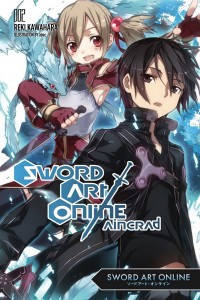
As I’ve mentioned a couple of times before, after my highly positive reviews of the first Sword Art Online manga, several people told me that the series took a big nosedive with the next arc. I was therefore quite interested to see what happened here, and how exactly the series lost all of the goodwill it gained. I initially though I might have to wait until the arc finished to get the full story, but no, that’s not the issue here. Everything that I suspect people hated about this arc is laid out right at the beginning of the story, to the point where I wonder if the author did this deliberately to tweak fans a little bit. After all, he is having to come up with a way to continue what was a fairly self-contained story.

fairydance1

Let’s run through the basic problems, which I think fall into three big categories. First, there is the introduction of Suguha, the younger sister of Kazuto/Kirito, our hero. As we hear from her angsty narration, she was told that she and Kirito were not really siblings, but cousins, while he was trapped in SAO. This allows her to have ‘legal in Japan’ feelings for Kazuto, which given that the reader spent the last two volumes marveling at Kirito and Asuna’s relatively quick and happy relationship can be a bit grating. Moreover, we discover she’s also playing an MMO to see what Kazuto found so amazing about them, and is now teaming up with him – without either one knowing that they’re really teaming up with their real-life sibling. Wackiness, as they say, ensues. (Oh yes, and there’s fanservice of Suguha’s naked, buxom form in the shower.)

Secondly we get introduced to the villain of the piece, Sugou, aka Oberon. I feel that it’s OK to spoil that he is the villain given that the story does so immediately after his first appearance. His entire personality is designed to be evil, which means he gets all the usual evil attributes, including gloating about his evil plans (which he explains in great detail to both Kazuto and Asuna), and openly discussing sexually assaulting a girl who openly hates him without her content. He’s a loathsome prick, and one wishes he had a bit of the subtlety of SAO’s first villain, who at least had better justification in his head for mass murder.

Lastly, after expecting a tearful reunion of Kirito and Asuna in the real world, we find that not only has Asuna not woken up, not only is she trapped in another MMO designed by her evil fiancee, but she is literally being kept in a BIRDCAGE and tormented by Sugou/Oberon, unable to even escape (though she may be trying to change that at the end of this volume). Seeing our favorite action girl as a prize to be won, passive and caged, is possibly the one thing that grated on me the most here, if only as her role is then handed over to Leafa/Suguha.

That said, there are things I did greatly enjoy here. The basic premise is still solid, if ridiculous. (The fact that these VR MMOs weren’t banned after SAO’s mass deaths came out is totally ludicrous.) Kirito is a very likeable hero, and I admired his resolve and willingness to use his cheat skills to get ahead in order to save the one he loves. The reunion with Yui was too short for my liking, but still very heartwarming, and I’d love to see her reunite with her mother as well. The narrative flows smoothly, with the battles being interesting and not taking over the entire book. The new game is sufficiently different from the first to add new depth. We have a new artist here, who seems to mostly be an artist-for-hire on light novels, and the artwork is pretty decent. And I did enjoy the brief glimpses we got to see of the real world – I wish we’d seen a bit more. (I wonder if the novel, due out in December, has some of the missing depth here.)

So overall, no, I didn’t loe this as much as the first series, for the reasons I mentioned above. It’s clearly retooling itself to attract new readers, and in order to do that burning a few of its bridges. That said, it’s still a lot of fun, and I would really like to see what happens next, so I’d call it a success overall. Let’s not lock up our heroines for the entire story in the future, though.

Filed Under: REVIEWS

The Hentai Prince and the Stony Cat, Vol. 2

June 24, 2014 by Sean Gaffney

By Sou Sagara and Okomeken. Released in Japan as “Hentai Ouji to Warawanai Neko” by Media Factory, serialization ongoing in the magazine Comic Alive. Released in North America by Digital Manga Publishing.

I was a bit ‘meh’ about the first volume of Stony Cat, which I felt showed promise but also had several flaws. The second volume is for the most part better, even though it has many of the same flaws, because the flaws are starting to look like they’re built into the work as a whole. This is not a manga about easy fixes – its very premise shows off the dangers of trying to fix your personality quirks with mere wishes – and we delve deeper into that here, as Yoto’s attempt to cheer Azusa up fail on a spectacular level, partly due to his being unable to avoid telling the truth but mostly due to his misconception about how deep her issues run.

hentaiprince2

There is a certain awkwardness that permeates the entire volume – indeed, the adaptation helps it along with some translation quirks that I’m not certain are deliberate. Azusa’s two old ‘friends’ from middle school, in the aftermath of the botched ‘date’, speak in a sort of stilted robotic tone, ending everything in ‘I did’ or ‘we did’. Indeed, everyone seems to talk a bit more formally in this series. It’s likely just a case of ‘how can I deal with this regional dialect’, but it helps to add an additional disconnect to what’s going on in the series.

Azusa is merely the most obvious example of someone whose ruined self-image is causing great pain in her life (even her mother, who seems to be one of those standard ditzy anime moms, is not really helping her). Tsukiko is pretty unhappy with Yuto’s plan, but of course can barely express it thanks to her wished-for stoicism (unlike Yuto, who is able to get his wish reversed halfway through this book, she’s still stuck with her face being the way it is.) Yuto himself is the typical well-meaning but overzealous teen guy, deciding that he knows how to fix things without really thinking about how they’ll affect the person he’s trying to fix. Getting his ability to lie back allows him to defuse things with Tsukiko’s sister (who turns out to be the “Iron King” track star we saw in Vol. 1), but I suspect his basic personality flaws will continue to plague him.

Aside from that, this series has most of what you’d expect from a harem romance based on a light novel that runs in Comic Alive. There’s lots of comedic violence, misunderstandings, some blatant nudity at the end of the book. The aforementioned Iron King gets to show off her physical prowess, but also shows off how little she understands the human brain (similar to the rest of the cast) when she accepts Yoto’s ‘that was my evil twin brother’ story at face value. Despite the added depth revealed in this volume, it’s still filled with flaws, and I wouldn’t recommend it except to those who like its genre to begin with. But for those people, there’s things to like here, or at least things to muse upon in the hope that future volumes will run with them further.

Filed Under: REVIEWS

Seraph of the End: Vampire Reign Vol 1

June 22, 2014 by Anna N

Seraph of the End: Vampire Reign Volume 1 by Takaya Kagami, Yamato Yamamoto, and Daisuke Furuya

I highly enjoy vampire manga, so I was looking forward to checking out Seraph of the End. I think this series is a manga spin-off of a light novel series set in the same world. I was expecting more detailed world building from this manga, and I wasn’t disappointed. The series starts off by introducing a dystopian society where a virus has destroyed adults, leaving behind vampires and the young children they use as a blood bank. Yuchiro Hyakuya is the brash young hero who spends most of his time researching vampire lore and attempting to make himself stronger so he can fight back against his captors. His best friend and adoptive brother Mikeala is a bit sneakier, outwardly appeasing his vampire masters in order to gather useful intelligence. When Mikeala finds a map indicating a pathway to the surface, the orphans band together and try to make a break for the outside, only to find out that it was all a set-up. Yuchiro’s siblings are killed by vampires, and Mikeala is mortally wounded and urges his brother to continue the escape attempt. Yuchiro makes it up to the surface of the earth only to discover that it looks vastly different from what he was taught to expect.

Yuchiro is promptly picked up by the Japanese Imperial Demon Army, a vampire fighting paramilitary organization, and enrolled in a school. Several years later he’s older but still in the same mental space – eager to fight vampires, not following orders, and not yet finding his place in the world. Guren Ichinose, a Lieutenant Commander in the Army says that Yuchiro can’t progress and function as a vampire hunter until he is actually able to demonstrate that he gets along with his classmates. Towards the end of the volume Yuchiro has made some progress in his number of vampires killed, as well as beginning to form some bonds of friendship with his monitor Shinoa and his classmate Yoichi. Overall, I was impressed with the amount of ground Seraph of the End managed to cover in one volume. Yuchiro’s world and back story were set up, we see his character progress a bit both in terms of fighting demons and gaining a tiny bit more emotional maturity.

The art is clear and easy to follow, except I thought the character designs for Yuchiro and Yoichi were a bit too similar. Sometimes I had to doublecheck and read back a bit to remind myself who was who. While Yuchiro is very much the typical shonen hero, his back story is filled in here and there with flashbacks, which helped a lot in terms of explaining his motivations. I found the supporting cast interesting too. Guren Ichinose (the main character in the light novels) shows up and demonstrates his badass vampire fighting abilities at key points, and Shinoa as the main female character is both snarky and weird. I also enjoyed the power imbalance between her and Yuchiro, since serves as a bit of an instructor and is keeping track of his behavior improvements to report back on to command. Overall, I found this first volume enjoyable and am looking forward to the second. I can see this series easily appealing to fans of Blue Exorcist, or even (a bit of a stretch) Full Metal Alchemist, since there are some similar plot elements and themes shared by all three series. Definitely recommended if you’re looking for a solid shonen vampire series to try!

Filed Under: REVIEWS

No. 6, Vol. 7

June 20, 2014 by Ash Brown

No. 6, Volume 7Creator: Hinoki Kino
Original story: Atsuko Asano

U.S. publisher: Kodansha
ISBN: 9781612625539
Released: June 2014
Original release: 2013

I have been following Hinoki Kino’s manga adaptation of Atsuko Asano’s science fiction novel series No. 6 since its beginning. The manga got off to a bit of an unsteady start, but it quickly improved its pacing and setting development, each passing volume becoming stronger and building on those that came before it. No. 6, Volume 7 was initially published in Japan in 2013 while Kodansha Comics’ English translation, which includes a bonus story from Japan’s special edition, was released in 2014. I haven’t read Asano’s original novels (sadly, they have yet to be licensed in English) so I can’t directly compare the manga series, but I have seen the anime adaptation. In fact, it was because I liked the characters from the anime so well that I sought out another interpretation of their story. Though both the anime and the manga began around the same time, the anime was completed in 2011 while the ninth and final volume of the manga was released in 2014. The anime and manga share many similarities with each other, but in the end they are their own works.

Rat and Shion’s daring plan to infiltrate the city of No. 6’s Correctional Facility has so far been surprisingly successful and, with a little outside help, they have been able to penetrate the building’s first line of defenses. Gaining access to the Correctional Facility and surmounting the initial challenges preventing the rescue of Shion’s close friend Safu is only the beginning; even with their unexpected luck, things will prove to be much more difficult for Rat and Shion as they continue on their mission and press on farther into the Facility’s interior. Considering that Safu was once counted among No. 6’s elites, Shion is convinced that she must be being held captive in the most secure, upper levels of the Correctional Facility. At best, he and Rat have mere minutes before their intrusion is discovered. After that there is no knowing what they will have to face and they were working with very limited information to begin with. Both Shion and Rat anticipated that the rescue attempt would be extremely dangerous, and at this point there is no turning back.

Since I have seen the anime adaptation of No. 6 and am therefore familiar with many of the important plot points found in the manga, I can’t say that I was particularly surprised by some of the major developments in No. 6, Volume 7. That being said, there are still some incredibly shocking moments which can be attributed to the strength of the underlying story as a whole. Especially potent and devastating is the evolution of Shion’s character over the course of the series. In the last few volumes in particular he has changed so much it seems that Rat’s fears are starting to come true–at times he is no longer even recognizable as Shion anymore. He has become a different person. Gone is the innocent and optimistic young man who was so quick to see the good in people. In his place is a person within whom hatred is growing and whose sense of justice has taken a dramatic and dangerous turn, not only for those around him, but for himself as well.

Taking into account everything that Shion has been through so far, it’s not unexpected that he and his outlook on the world has changed. His own life and the lives of those he holds dearest have been repeatedly threatened. He has personally witnessed the poverty and despair of the residents of West Block as well as the horrors of the Manhunt. Shion has seen senseless violence and death. He has learned about the atrocities committed in the name of No. 6, and yet he still doesn’t know everything. Rat and Shion gained access to the Correctional Facility in order to rescue Safu, but in the process they discover even more of the city’s dark secrets. The truths behind No. 6, its establishment, and its continued existence are not pleasant ones. It’s a so-called perfect society, but the leadership is more than willing to turn on its own citizens in order to maintain that perfection. Shion is trying to come to terms with all of this and to protect the people that he cares about and loves, but in doing so he may very well lose himself entirely.

Filed Under: REVIEWS Tagged With: Atsuko Asano, Hinoki Kino, kodansha, Kodansha Comics, manga, no. 6

  • « Go to Previous Page
  • Page 1
  • Interim pages omitted …
  • Page 248
  • Page 249
  • Page 250
  • Page 251
  • Page 252
  • Interim pages omitted …
  • Page 342
  • Go to Next Page »
 | Log in
Copyright © 2010 Manga Bookshelf | Powered by WordPress & the Genesis Framework