• Skip to primary navigation
  • Skip to main content
  • Skip to primary sidebar
  • Home
  • About Us
    • Privacy Policy
    • Comment Policy
    • Disclosures & Disclaimers
  • Resources
    • Links, Essays & Articles
    • Fandomology!
    • CLAMP Directory
    • BlogRoll
  • Features & Columns
    • 3 Things Thursday
    • Adventures in the Key of Shoujo
    • Bit & Blips (game reviews)
    • BL BOOKRACK
    • Bookshelf Briefs
    • Bringing the Drama
    • Comic Conversion
    • Fanservice Friday
    • Going Digital
    • It Came From the Sinosphere
    • License This!
    • Magazine no Mori
    • My Week in Manga
    • OFF THE SHELF
    • Not By Manga Alone
    • PICK OF THE WEEK
    • Subtitles & Sensibility
    • Weekly Shonen Jump Recaps
  • Manga Moveable Feast
    • MMF Full Archive
    • Yun Kouga
    • CLAMP
    • Shojo Beat
    • Osamu Tezuka
    • Sailor Moon
    • Fruits Basket
    • Takehiko Inoue
    • Wild Adapter
    • One Piece
    • After School Nightmare
    • Karakuri Odette
    • Paradise Kiss
    • The Color Trilogy
    • To Terra…
    • Sexy Voice & Robo
  • Browse by Author
    • Sean Gaffney
    • Anna Neatrour
    • Michelle Smith
    • Katherine Dacey
    • MJ
    • Brigid Alverson
    • Travis Anderson
    • Phillip Anthony
    • Derek Bown
    • Jaci Dahlvang
    • Angela Eastman
    • Erica Friedman
    • Sara K.
    • Megan Purdy
    • Emily Snodgrass
    • Nancy Thistlethwaite
    • Eva Volin
    • David Welsh
  • MB Blogs
    • A Case Suitable For Treatment
    • Experiments in Manga
    • MangaBlog
    • The Manga Critic
    • Manga Report
    • Soliloquy in Blue
    • Manga Curmudgeon (archive)

Manga Bookshelf

Discussion, Resources, Roundtables, & Reviews

Reviews

He’s My Only Vampire, Vol. 1

December 28, 2014 by Sean Gaffney

By Aya Shouoto. Released in Japan as “Junketsu + Kareshi” by Kodansha, serialized in the magazine Aria. Released in North America by Yen Press.

In general, when I’m reading a manga I am looking for an entertaining story that draws me in and makes me want to read more. The originality of that story, however, is way down on my list of necessities. I don’t need a title to be different from all those other titles, I just want it to be well-told. So don’t take it the wrong way when I say that there really isn’t much that is original in this series at all. The author is quite familiar to these shores, as Kiss of the Rose Princess, which runs in Asuka, came out a month or so ago. This is a more serious story so far, though there are light-hearted moments. But for the most part, as I went through I was quite happy with what I was reading, even if I kept thinking “This reminds me of Vampire Knight” or “This is just like Millennium Snow”.

onlyvamp1

Kana is a tomboy-ish heroine, popular at school, who seems to be good at everything, to the point where she joins three clubs a day to help out, then just as swiftly leaves. Of course, this is actually the result of not one but TWO tragic pasts – as a child, she was in a fire that took the life of two twins she was best friends with, and later, while running track, a delinquent’s misfired prank (also involving fire) results in a broken leg AND ligament tear, ending her career. So she’s at a loss in regards to life. The delinquent is still around, trying to make amends as he clearly is starting to fall for her, but that doesn’t seem to be where this story is going. No, instead she runs into one of the twins, now alive – and a vampire!

I frequently joke about titles being licensed only because there are vampires in it, but they’re a popular fictional genre, allowing readers to indulge in forbidden sexuality and darkness. The scenes of Aki (said vampire) biting Kana are drawn sensuously, and you can tell that there’s more pleasure than pain at work here. There’s a certain amount of subservience here – Aki declares Kana is his thrall, and describes her as his “food”. But the narrative starts pushing back against that fairly quickly – he’s clearly acting distant to cover up his feelings, and when he gets into a fight with Jin (the delinquent I mentioned earlier), Kana shows that she will not be content to simply stand there. Actually, the way she stops the fight is really clever, and my favorite part of the book.

There’s a lot of plot hints dropped here that I’m sure will play out in future volumes. Jin transformed into a wolf-man hybrid towards the end (see why I mentioned Millennium Snow?), Aki’s twin Eriya seems to be alive but in some sort of stasis (or perhaps evil?), and we see someone who seems to be either Aki’s boss or enemy clearly dislike what he’s doing (because of course vampires have rules that cannot be broken.) That said, the series (just ended in Japan) is 10 volumes long, so I imagine we’ll get our answers soon. There’s a lot of stuff you’ve seen before in this series, but it’s told well, and for me that’s what matters. Recommended, particularly if you like supernatural romance.

Filed Under: REVIEWS

Assassination Classroom Vol 1

December 26, 2014 by Anna N

Assassination Classroom Volume 1 by Yusei Matsui

To be perfectly honest, I would have bought this manga for the title alone. The fact that it is a story about a mysterious tentacled alien teacher looking after a classroom of misfit teenage assassins is just a bonus. The premise of the manga is set up in an effective way, with some elements explained and others just left for the reader to simply accept and move on with the story. The manga opens as the happy face octopus stands in front of the classroom wearing an academic hood and gown. As the day opens the entire class leaps up from their desks with guns and begins to fire away. Their assassination attempts are fruitless, because their teacher can move at super speed and has amazing healing abilities. The assassination classroom is a room full of misfits held in the annex of a normal middle school. One day their teacher showed up, disintegrated a large portion of the moon and said that he would do the same to Earth in one year. Kuro Sensei inexplicably wants to spend a year educating the youth of Earth before he destroys it. The government has offered up a bounty to the member of class 3-E who succeeds in killing their teacher.

Assassination Classroom is filled with humorous elements interspersed with dynamic scenes of assassinations being foiled with ease. For poetry class, Kuro Sensei requires everyone to end their poem with the word “tentacles” and he is always using his supersonic flying power to randomly buy himself treats from around the world. The standout student is Sugino, who spends his days making careful observations of his teacher, slowly gathering intelligence that might eventually lead to a successful assassination. As the volume progresses, more members of the class 3-E are introduced, all of whom have unique abilities. The most amusing aspect of the volume is the fact that for all Kuro Sensei plans on wiping out all of humanity in a year, he is really dedicated to being an excellent teacher. He intervenes in the lives of his troubled students and actually does manage to teach them some useful life lessons. The uplifting aspects of the manga contrast with Earth’s imminent doom in an interesting way. The art is well-executed but somewhat generic. It is amusing to see the variety of expressions on Kuro Sensei’s face, and the unexpected ways his alien powers manifest. I think this series would really appeal to fans of Death Note. So far, Assassination Classroom seems like an ideal pick for people who enjoy manga with a healthy side of dark cynicism on the side.

Filed Under: REVIEWS Tagged With: assassination classroom, Shonen, Shonen Jump, viz media

Master Keaton, Vol. 1

December 25, 2014 by Sean Gaffney

By Naoki Urasawa, Hokusei Katsushika, and Takashi Nagasaki. Released in Japan by Shogakukan, serialized in the magazine Big Comic Original. Released in North America by Viz Media.

A long awaited release on these shores, this is the sort of title that you’d have expected to be licensed back in the old Viz days of the early to mid 90s, filled with Crying Freeman and Mai the Psychic Girl. The series had an anime in the 1990s, but by then the fashion for seinen had passed, and it’s taken a resurgence, helped by the cult popularity of 20th Century Boys and Monster, to see the series out here at last as a deluxe Signature edition. There’s also some question over the actual creation. When it came out in the late 80s, it was credited to Katsushika as the writer and Urasawa as the artist. After Katsushika’s death, Urasawa claimed that they’d fought early in the series, and from that point Urasawa did the story himself, a viewpoint which has led to some criticism. Also, the third author on the cover is the writer for the CURRENT Master Keaton revival, which started in 2012, and which… isn’t this. (As with many Signature releases of older works, this is a release of the Japanese re-release, which may have updated art/storylines.)

keaton1

What is this, then? It’s been called “Indiana Jones manga”, but I’d compare it to another 80s icon, MacGyver. Taichi Keaton is a former SAS soldier turned freelance insurance investigator for Lloyd’s of London. He looks into wrongful death claims, art forgeries, and archaeological digs, all the while finding trouble and managing to maneuver his way out of it by virtue of his amazing survival skills. Sadly, he’s not nearly so competent in his personal live, being divorced and having a teenage daughter, Yuriko, who seems to find her father admirable and aggravating in equal measures.

I understand her frustration. Keaton is a man who it’s easy to admire but hard to like. His lax personality was highly popular at the time, and makes a nice change from, say, Golgo 13 (a series Katsushika also wrote for) or Crying Freeman. These days I think a reader might find it trying, especially his obsession with his ex-wife getting together with someone else (we never see the wife, and actually it occurs to me that Yuriko may have made the whole thing up to attempt to spur him into action). Later in the volume we see Keaton’s father, whose name he disavows (he takes his mother’s last name), and he’s also an eccentric, frustrating individual, who Keaton probably takes after more than he’d like. Keaton as a man seems mostly half-baked and half-hearted.

The series is on firmer ground with the mystery stories, which much of the time turn into spy stories. Master Keaton began in 1988, at the tail end of the Cold War, but feels more like an early 80s tale, with the Communists still exerting their hold behind the Iron Curtain. I wonder if we’ll see that change as the series went on – it lasted till 1994. The first few chapters are not fleshed out enough – Keaton is the sort of story that requires a bit of room to breathe, particularly with all the exposition, and it’s no surprise that it’s the multi-chapter works that are the best in the volume.

Master Keaton, in the end, is classic seinen. If I said this was a mystery series in Big Comic Original in the late 80s, the well-read manga fan would likely be able to predict precisely the types of stories you’d see here. But it’s very well-told, as expected from Urasawa, and when he’s not getting involved in personal business, Keaton makes an excellent investigator. I’ll definitely be picking up more.

Filed Under: REVIEWS

Yukarism Vol. 1

December 24, 2014 by Anna N

Yukarism Volume 1 by Chika Shiomi

I’m always excited for the first volume of a new Shojo Beat series comes out, but I was SUPER EXCITED for Yukarism because I’ve enjoyed previous works from Shiomi so much. My absolute favorite of her series so far is Night of the Beasts. I thought that Yukarism had an interesting premise, so I was very curious!

The couple embracing on the cover of the first volume isn’t a couple, it is the same person in a current and previous life. Yukari is a young teenage genius of an author, producing books set in the Edo period with vivid historical detail. His new classmate Mahoro is fascinated by him, coming up with excuses to stop by with homework or treats when he’s absent from school due to a writing binge. Yukari recognizes something in Mahoro, but when she has a conversation with him, her expectations of talking to a author dedicated to his readers are derailed. Yukari seems to approach the world with a significant amount of detachment, perhaps because he’s haunted by memories from a previous life. When Yukari notices a scar on Mahoro’s wrist, he’s catapulted into the past and wakes up as a courtesan in the Edo period named Yumurasaki. Here, Mahoro’s previous life was as a man named Kazuma who serves as Yumurasaki’s protector.

Shiomi’s art is lovely. The character designs for Yukari and Yumurasaki look like male and female aspects of the same person. The shift in detail in the backgrounds from the sparse modern day to the elaborately decorated Edo period is a treat to see. There are little moments of physical comedy scattered throughout the book, because when Yukari travels to the past he can’t be as graceful as Yumuraski and finds himself overbalanced by headgear and teetering off his shoes. Kazuma is terrified when he sees Yumurasaki casually sitting like a teenage boy with his legs spread apart.

Yukari approaches his sudden experience of his past life like an adventure, but he doesn’t yet seem to be emotionally affected by living Yumurasaki’s life. He’s unconcerned by how his odd behavior might affect her relationships, and his attitude seems to be much more that of a writer observing details than someone who is invested in actually experiencing his life. Yukari’s encounters in the past end up giving him insight into the present, as a tormented girl who works in Yumurasaki appears in the present with psychological issues due to the trauma of her forgotten previous life. Yukari is able to use the knowledge he gained as Yumurasaki to help her.

Overall, I found this first volume very intriguing. I’m looking forward to seeing how the past continues to have an impact on Yukari’s present. Shiomi does a great job coming up with characters who have reticent but interesting personalities. Yukari really acts just as one would expect a teenage boy who used to be an elite courtesan of the past to behave. I’m also curious to see how the relationship between the more dynamic Yukari and the watchful Mahoro develops. Yukarism is a great new manga to kick off the new year!

Filed Under: REVIEWS

Massive: Gay Erotic Manga and the Men Who Make It

December 24, 2014 by Ash Brown

Massive: Gay Erotic Manga and the Men Who Make ItEditor: Anne Ishii, Chip Kidd, and Graham Kolbeins
Publisher: Fantagraphics Books
ISBN: 9781606997857
Released: December 2014

The first major publication of gay manga to be printed in English was The Passion of Gengoroh Tagame: The Master of Gay Erotic Manga. Soon after its release a new project–a gay manga anthology called Massive–was announced by the same team that worked on Tagame’s debut English collection. Originally intended to be released by PictureBox, the anthology was temporarily orphaned when the publisher ceased releasing comics before the volume was completed. I was thrilled when Fantagraphics took on the project. Edited by Anne Ishii, Chip Kidd, and Graham Kolbeins, Massive: Gay Erotic Manga and the Men Who Make It became one of my most anticipated releases of 2014. Gay manga is an extremely underrepresented genre of manga in English. Massive, like The Passion of Gengoroh Tagame before it, is a groundbreaking work. Through manga, interviews, photography, and essays, the anthology introduces nine of the genre’s most influential, respected, and promising creators to an English-reading audience.

The volume’s table of contents is formed by a gallery of photographs paired with full-page color pin-ups illustrated by each of the contributors to Massive: Gengoroh Tagame, Inu Yoshi, Kumada Poohsuke, Takeshi Matsu, Jiraiya, Gai Mizuki, Fumi Miyabi, Seizoh Ebisubashi, and Kazuhide Ichikawa. This is followed by introductory essays written by each of the three editors. Kidd’s “It Feels Too Good” conveys the excitement over the fact that a volume like Massive even exists, while Ishii reveals some of the steps it took to publish the material in “Seeking English Translator.” Kolbeins essay “Glocalizing Gei Manga” is particularly enlightening, providing a greater context for Massive and a brief overview of the history of gay manga and how the volume fits into it. Also included is a timeline of male-male sexuality in Japanese culture, a list of recommended readings, and numerous photographs and illustrations. However, the real meat of the collection is the individual profiles of each of the creators introducing their work and personal histories and exploring their careers and the impacts they have made on the genre of gay erotic manga. The other major highlight of Massive is the inclusion of examples of their manga.

For most of the contributors, Massive marks their debut in English. Excluding Tagame, who has thus far had four collections published, Matsu is the only creator to have had a major release in English. And except for Jiraiya’s “Caveman Guu,” which was previously printed separately, all of the manga collected in Massive is being translated into English for the first time. Some are excerpts of longer works, like Tagame’s Do You Remember South Island P.O.W. Camp? and Poohsuke’s Dreams of the New Century Theatre, while others are shorter, standalone stories. There is humor and playfulness to be found in Yoshi’s “Kandagawa-Kun” and Matsu’s “Kannai’s Dilemma,” more dubious encounters in Mizuki’s “Fantasy and Jump Rope,” Ebisubashi’s “Mr. Tokugawa,” and Ichikawa’s “Yakuza Godfathers”, and even mythological inspiration in Miyabe’s “Tengudake.” The manga collected in Massive is most definitely erotic in nature. Some of the selections are simply suggestive, but many feature explicit, uncensored, and uninhibited sex between hypermasculine, muscular, and otherwise large-bodied men. It is called Massive for a reason, after all.

The profiles of the creators included in Massive are just as engaging as the manga that has been collected. The volume provides an incredibly valuable look into the creation of gay erotic manga and art. Interestingly enough, several of the contributors mention that they would like to create gay manga without as much erotic content, but to successfully do so would be difficult due to the demands of their audience and what is expected from the genre of gay manga as a whole. The artists address many of the same subjects in their interviews but they each bring their own perspective to the discussion. It’s fascinating to learn about how the manga industry has changed and continues to change, the impact and challenges presented by foreign scanlations of manga, the benefits of working within the manga industry or independently outside of it, the use and misappropriation of the term bara both in Japan and in the West, and the relationship between gay manga and boys’ love manga, among many other topics. Massive truly is a spectacular volume and highly recommended for anyone interested in gay manga, its history, and its creators; it’s a fantastic introduction to the genre.

Filed Under: REVIEWS Tagged With: Anne Ishii, Chip Kidd, Fantagraphics Books, Gengoroh Tagame, Graham Kolbeins, manga, Nonfiction, Takeshi Matsu

Sword Art Online, Vol. 3: Fairy Dance

December 23, 2014 by Sean Gaffney

By Reki Kawahara and abec. Released in Japan by ASCII Mediaworks. Released in North America by Yen Press.

The novels are still running a bit behind the manga here in the West, so much of this review will be discussing how the light novel differs from the first two volumes of the manga that I’ve already reviewed. They mostly hit similar notes – Suguha’s crush on her brother is in full force, Asuna is still trapped in a birdcage, and Sougo is an over-the-top villain – but the ability of prose to let you get inside the heads of its leads allows for a greater depth than the manga had, particularly with Kazuto and Asuna. There’s also some nice discussion of Kazuto’s family beyond his sister, as we see his working mother, who he apparently got his obsession with games from. That said, once Kazuto becomes Kirito, we’re back to this series’ raison d’être, which is watching the boy do awesome things.

fairydance1

The contrast between Kazuto and his MMORPG self didn’t come across as much in the manga as it does here, and it may have been my favorite part of the book. Now that he’s not in Sword Art Online, we’re left with a young teenage boy who’s weaker than he’s been the past two years, unable to decide what to do with his life, and with the one thing he cherished more than anything – Asuna – still far away from him. After meeting Sugou, and hearing about Asuna’s arranged marriage, he almost completely falls apart, sounding nothing like the character we’ve known, not even after the death of Sachi in the previous volume. It’s only when he reached ALfheim Online, the successor to SAO, and can become Kirito again that things change. And change they do – Kirito was pretty confident in the first two books, but here he’s almost cocky, showing off his skills (ported over from SAO, for reasons unknown to him) and cleaning house.

As for Asuna, her POV also benefits the story. She goes through the same crisis that Kazuto did earlier in the book, being trapped with only the monstrous Sugou for company and not even being sure if her love is alive. Once Sugou attempts to break her will by saying he is (cartoon villains always seem to make this mistake), she gains new strength, and it’s immediately put to good use – her use of game mechanics and environment to find a way to escape her cage is brilliant, and shows that she’s more than just a prize waiting for Kirito to rescue her here. (Sugou also gets to be even more horrible here – the scenes of him touching her, trying to go far enough so that she’ll punch him and thus “justify” using his supposed mind control on her sooner, are true nightmare fuel.)

Suguha/Leafa is the new character here, and like the other two we enjoy getting inside her head. She’s startled at her brother’s sudden kendo skills, picked up by sheer muscle memory from his days in SAO. The family revelations, which he knew about but didn’t tell her about, also have thrown her off kilter, and that combined with the onset of puberty has led to her accepting that she has feelings for Kazuto – but she can see he’s clearly in love with Asuna. She’s very similar to her brother, and it’s no surprise that when she plays ALO in an attempt to understand what he enjoyed about it, she too got very good very fast and is one of the top players in the game.

If you hated the Fairy Dance arc of the anime, then reading the light novel will probably not change your minds. If you enjoyed aspects of it but felt it fell short, given this version a try. It may read like wish-fulfillment fanfic, but there’s nothing wrong with that if it interests the reader, and I’m still greatly enjoying Kirito, Asuna and Leafa’s adventures. This is a 2-part book, so in April we’ll find how things wrap up.

Filed Under: REVIEWS

Honey Blood Volumes 1 and 2

December 21, 2014 by Anna N

Honey Blood Volumes 1 and 2 by Miko Mitsuki

Two volume manga series are a bit tricky sometimes. They tend to be series that are canceled because they were not entirely successful, and sometimes have unfinished or rushed endings as a result. Sometimes there are two volume series that do end up telling a story satisfactorily, but most of the time when I read them, I either end up acknowledging that I just read a manga that was never going to work or I find myself wishing for just one more volume.

Hinata is a normal high school girl going about her daily life, slightly mystified about the vampire novels that are taking her school by storm. At the same time there have been cases of young girls who are the victims of mysterious attacks in her city. When she comes home one day after school, she bumps into a strange young man in traditional Japanese clothing. He’s accompanied by a clinging female editor. It turns out that he’s Junya Tokinaga, the writer of the novels that Hinata thinks of as ludicrous. Hinata has a tendency to burst out with whatever is on her mind and her first encounter with the famous author has her musing how the central plot point of a vampire giving up immortality to die with the person he loves is difficult to understand. Junya ends up acting bizarrely flirtatious around Hinata while she keeps making comments like “I can’t stand guys like you!”

The neighborhood attacks continue, and Junya saves Hinata from a man who almost assaults her when she is walking alone at night. She begins to be more fascinated with her next door neighbor, and he continues to demonstrate his interest in her. Hinata begins to suspect that Junya is a vampire, and it turns out that Junya’s novels describing a situation where a vampire who kisses a mortal is bound only to her until they both die is based on the conditions of his own vampirism. I thought the art in this series was attractive, but the storyline ended up shoving Hinata and Junya together a little too quickly to be believable. By the end of the first volume, they are almost a couple with Hinata pursuing Junya while he attempts to hold back details of his life from her. The continued vampire attacks make the reader a bit uneasy, as it is unclear if Junya is feeding on other women, or if in fact there are other vampires around.

I think the second volume shows the author throwing a bunch of ideas out to see if anything would stick. Hinata and Junya embark on their unconventional romance. The reader gets a bit of back story when it is revealed that Junya’s long lost love was one of Hinata’s ancestors. Hinata and Junya’s overly solicitous editor get into a conflict of personalities. A rival vampire named Setsuna shows up to complicate the situation further. I liked the romance better in the second volume when Hinata and Junya were an established couple. I also enjoyed the blend of vampire angst and little moments of humor, like when Hinata picks out modern clothes for Junya only for him to promptly become a target for aggressive modeling scouts. As the second volume wrapped up, I found myself wishing that the author had a bit more time to develop the series before launching it in the first place. It seemed like it was starting to get a bit more interesting only to be cut short. If a longer series by Mitsuki gets licensed, I would be interested in reading it, because I’d be curious to see what she could do with more space to develop a series. As it is, I’d recommend Honey Blood for vampire manga collections, or for people who don’t mind reading short manga with abrupt endings.

Filed Under: REVIEWS Tagged With: honey blood, shojo beat, shoujo, viz media

Is It Wrong To Try To Pick Up Girls In A Dungeon?, Vol. 1

December 21, 2014 by Sean Gaffney

By Fujino Omori and Suzuhito Yasuda. Released in Japan as “Dungeon ni Deai o Motomeru no wa Machigatte Iru Darou ka?” by Softbank Creative. Released in North America by Yen On.

For those who see that title and roll their eyes, the commonly agreed on abbreviation, from the Japanese title, is ‘DanMachi’. We’ve seen a few of the cliched light novels with titles as long as their content in manga and anime format before, but this is really the first time we’ve seen one as a light novel. As you’d expect, the longer the title the more likely that this is a romantic harem comedy, and that’s true here. It’s also a fantasy, though, one closely connected to the world of role-playing games (though it’s not players trapped in a game, for once). I think that the fantasy gamers will likely find it easier to appreciate this title than the harem comedy fans, though both will find things to like and dislike. One thing I think everyone will agree on is that the cover blurb is pretty misleading: Bell stops being a ‘damsel in distress’ almost immediately.

dungeon1

That is where we start, however. Bell is our narrator for most of the book, though it does switch off when the author wants to tell scenes without his presence to a third person style. He’s young and naive, wanting to become an adventurer in order to meet girls and get a harem, but he mostly wants that because this is what his grandfather (now deceased) taught him was the way of all things. In reality, he can’t catch a clue when it’s thrust in his face, really. The other protagonist is his sponsoring god, in this world where gods have come down to the real world and form gangs of adventurers to entertain themselves. Hestia has only one adventurer – Bell – but it’s clear that she just needs to mature. It’s also clear that she’s head over heels for Bell, and is somewhat frustrated at his lack of interest. As the book goes on we see more women – the big sister trying to convince Bell not to be stupid, the young waitress with an immediate crush on him, another goddess who wants him mostly to amuse herself – but it’s apparent from the start who the ‘lead girl’ is.

The fantasy aspect fares better, though I don’t really game so it’s possible I’m missing stuff. Bell fights increasingly tough monsters, and when he defeats them gets gems to exchange for money, or ‘drop items’ that might be useful. It honestly takes a little while to get used to the fact that this is meant to be a real world – adventurers have their ‘stats’ printed on their back in runes, for goodness’ sake. But the fights are well-written and go fast, and there’s a nice feeling of suspense to them. The book read very quickly and smoothly, which was nice, and lacks a lot of the self-important narrating we’ve seen in other books this year. There’s also a surprising lack of fanservice – surprising as the color artwork inside the front cover is filled with it. Hestia gets the nickname ‘loli big boobs’, which is unfortunate, but other than that the emphasis here is on the story for the most part.

I may have made this sound more interesting than it is – there’s nothing here that really gets me fired up for another volume. But it’s pleasant enough, and a nice quick read. Harem fans will be annoyed at the obliviousness of the hero and the possessiveness of the heroine, because they always are. Fantasy fans might be entertained by the ‘RPG in real life’ aspect, though, and may want to give it a shot. And fans of the Durarara!! light novels or the Yozakura Quartet manga will recognize the artist. It’s also available digitally, and an anime is due out soon.

Filed Under: REVIEWS

The Early Cases of Akechi Kogorō

December 19, 2014 by Ash Brown

The Early Cases of Akechi KogorōAuthor: Edogawa Rampo
Translator: William Varteresian
U.S. publisher: Kurodahan Press
ISBN: 9784902075625
Released: November 2014
Original release: 1925-1926

Edogawa Rampo, the pen name of Hirai Tarō, was an extraordinarily influential author in Japan, especially when it came to the genre of detective and crime fiction. His influence can still be seen to this day and his work continues to inspire other creators. One of his most famous characters is the detective Akechi Kogorō. Previously, only a handful of stories featuring Akechi had been translated into English: “The Psychological Test,” found in Japanese Tales of Mystery and Imagination; The Black Lizard, which was collected in a single volume along with Beast in the Shadows; “The Stalker in the Attic,” published in The Edogawa Rampo Reader; and The Fiend with Twenty Faces. I have always wished for a volume entirely devoted to Akechi mysteries and so I was very happy when Kurodahan Press announced The Early Cases of Akechi Kogorō. Published in 2014 with translations by William Varteresian, the anthology collects four of the earliest Akechi stories written between 1925 and 1926.

After an excellent and informative introductory essay about Edogawa Rampo and Akechi Kogorō, The Early Cases of Akechi Kogorō opens with Rampo’s very first mystery featuring Akechi, “The Case of the Murder on D. Hill,” a short story about the death of Akechi’s childhood friend, the wife of an owner of a secondhand bookshop he frequents. Rampo hadn’t initially intended for Akechi to become a recurring character in his fiction but readers liked him. The second story in the volume, “The Black Hand Gang,” is narrated by the same protagonist as the first, a relatively new acquaintance of Akechi, and the two of them become involved with an investigation into the disappearance of a young relative. In “The Ghost,” Akechi doesn’t appear until rather late in the story to deal with a peculiar case of a wealthy man suffering from a rival’s deep-seated grudge. The volume concludes with The Dwarf, a short novel well-received by the public but apparently disliked by Rampo himself in which Akechi is faced with an increasingly complicated murder mystery with numerous twist and turns.

All four stories in The Early Cases of Akechi Kogorō were written towards the beginning of Rampo’s career. As is noted in the introduction, Rampo largely wasn’t very happy with them. Although The Dwarf became fairly well-known in part thanks to its film adaptations, the cases collected in the volume are generally not examples of Rampo’s best or strongest work, lacking the polish of later stories. An important component of “The Black Hand Gang” doesn’t even translate very well into English since it relies on a cryptographic method based on the Japanese writing systems. Overall, the included mysteries are still enjoyable but somehow not quite as compelling as many of Rampo’s other tales. He would, however, reuse, rework, and refine many of their elements in subsequent writings. One of the things that makes these four stories particularly notable, and the reason that they have been collected together in the first place, is that they reveal Akechi very early on in his development before has become Rampo’s iconic detective and even before his character has been firmly established.

I’ll admit, I like this early Akechi in all of his eccentricities. In “The Case of the Murder on D. Hill” he begins as a well-read and intelligent young man with a particular interest in and fascination with detective and mystery fiction. The small apartment that he rents is so full of books that there’s barely any room to stand, let alone sit or entertain guests. He’s a flashy dresser and an eloquent speaker with a fondness and flair for the dramatic. By the time of The Dwarf, Akechi has begun to transform into the master detective that he will later be remembered as. He is no longer just an amateur sleuth seeking out strange cases in his spare time as some sort of hobby; Akechi has become a skilled and famous investigator with contacts in the judicial and police forces and a cohort of men working under him. I enjoyed The Early Cases of Akechi Kogorō a great deal specifically because it provides a glimpse of the earliest incarnations of Rampo’s great detective. I do hope to have the opportunity to read even more of Akechi’s stories in translation in the future.

Filed Under: REVIEWS Tagged With: Edogawa Rampo, Kurodahan Press, Novels

Review: Assassination Classroom, Vol. 1

December 18, 2014 by Katherine Dacey

1421576074Assassination Classroom, Vol. 1
By Yusei Matsui
Rated T+, for Older Teens
VIZ Media, $9.99

Americans steadfastly believe that all students need to succeed are a few good teachers—think of how many movies you’ve seen about an unorthodox educator who helps a group of misfits, losers, or underachievers realize their full potential against all odds. Perhaps that’s why American publishers hesitated before licensing Assassination Classroom, a comedy that outwardly conforms to the tenets of the genre while poking fun at its hoariest cliches.

Assassination Classroom‘s star teacher is Koro-sensei, a super-powered alien who can wipe out an army with a swish of a tentacle. His students are class 3-E, the troublemakers and flunkies of Kunugigaoka Junior High School. Instead of studying calculus or Shakespeare, however, Koro-sensei’s charges are learning how to kill him and save Earth in the process—in other words, it’s To Sir With Lethal Force.

If the script isn’t quite as edgy as my summary suggests, Assassination Classroom scores points for the sheer ridiculousness of the premise. Koro-sensei’s relentless enthusiasm and high standards match those of other fictional educators—Michelle Pfeiffer in Dangerous Minds, Robin Williams in Dead Poets Society—but are applied to such activities as shooting and stabbing. He gives the same kind of inspirational speeches that you’d find in those movies, too, reminding his charges that he specifically requested the job because he knows the students’ true potential.

In one scene, for example, timid student Okuda presents Koro-sensei with three deadly potions, imploring him to sample them. “I’m not good at surprise attacks!” she tells him. “But I love chemistry! And I really put my heart and soul into this!” Koro-sensei cheerfully obliges, offering to help Okuda “research a poison that can kill me.” When Okuda proves more skillful at mixing chemicals than persuading her target to drink them, Koro-sensei reminds her that “in order to kill someone, you need to understand how they feel,” skills that she can cultivate through—what else?—reading and writing.

The exchange between Okuda and Koro-sensei is complemented by some of the best visual gags in volume one. One of the poisons, for example, neutralizes Koro-sensei’s Cheshire grin into a flat line, prompting a student to exclaim, “You look like an emoticon!” Although Koro-sensei’s face is the essence of simplicity—a circle with pin-dot eyes and a toothy smile—this subtle tweak of his appearance yields a big pay-off laugh-wise.

At the same time, however, the poison episode illustrates Assassination Classroom‘s biggest flaw: Yusei Matsui wants to have his cake and eat it, too, soft-pedaling the humor with an uplifting, awwww-worthy moment in almost every chapter. Students unironically vow to do their best after Koro-sensei points out the flaws in their technique, saves them from harm, or gives them a pep talk. None of the students harbor a grudge against him—at least not for very long—or question the value of Koro-sensei’s lessons. (Makes you wonder: is Koro-sensei guilty of grade inflation?)

Still, I enjoyed volume one enough to continue with the series, even if Matsui’s efforts to express the Shonen Jump dictum of “friendship, effort, victory” sometimes blunt the edge of his satire.

Filed Under: MANGABLOG, REVIEWS Tagged With: Shonen Jump, viz media

Love at Fourteen, Vol. 1

December 18, 2014 by Sean Gaffney

By Fuka Mizutani. Released in Japan by Hakusensha, serialization ongoing in the magazine Rakuen Le Paradis. Released in North America by Yen Press.

Sliec-of-life can be very difficult sometimes in the West, particularly if it also has romance in it. The genre tends to involve a laid-back quality, with lots of chapters devoted to normal kids doing normal things, and recalling the nostalgia of your teenage years. It’s the antithesis of a title like Naruto or Parasyte. But when done right, slice-of-life can bring a smile to your face, making you want to turn the pages faster so that you can bask in the warm glow of the cast’s feelings. Love at Fourteen is definitely slice-of-life done right; I lost track of the number of times I said “Oh my God, they’re adorable” about halfway through this first volume.

fourteen1

The premise of this volume will not seem unfamiliar to readers of another Hakusensha series, His & Hers Circumstances. Kanata and Kazuki are both the most admired kids in middle school, both having an air of ‘maturity’ about them that sets them above the pack. Of course, that maturity is also what keeps kids from getting too close to them. However, the pair have a secret – they’re childhood friends, and have been “acting” mature as it’s expected of them, when frequently they want to do nothing but relax and let their emotions hang out. The troubles start when the class points out, independently, how gorgeous Kanata’s hair is, and how deep Kazuki’s voice is, things which had never really occurred to two young teens who have hung out for years.

And so they start to realize they’re in love with each other, and are not quite clear how to deal with it. What follows are a series of chapters with lots of heavy blushing, frustrated desires, and sweet reunions. The drama is minimal, mostly as these two don’t make their own drama. “Acting” mature has been the norm for so long that they find they’ve actually *become* mature. What’s more, it’s never stated outright, but I suspect like most Japanese middle schools open relationships are heavily frowned on, so all this has to be kept a secret, which is a pain when you’re having trouble keeping your hands off each other.

I had thought that there was going to be a bit of drama towards the end of the volume, as one of their trysts is observed by Nagai, the class troublemaker. However, before he can start an obvious blackmail attempt he is quickly caught up in problems of his own, stemming from the class music teacher, who’s trying to get him to stop being truant and start singing. I’m a sucker for teachers who can wrap teens around their fingers, and so this was possibly my favorite chapter, and I really hope we see the two of them in the next volume.

In the end, though, this is really Kanata and Kazuki’s series, and there’s an abundance of them to enjoy here. It’s early on, and we haven’t even had a first fight chapter. Things are developing slowly and sweetly, as you’d expect from two kids who’ve known each other so long and now have to redefine each other… and themselves. The book has little definitions interspersed throughout on puberty and developing a sense of self, and you can see our leads develop accordingly. Most importantly, after reading this you will have the biggest goddamn smile on your face you’ve ever seen. Highly recommended.

Filed Under: REVIEWS

After School Nightmare, Vol. 1

December 17, 2014 by Ash Brown

After School Nightmare, Volume 1Creator: Setona Mizushiro
U.S. publisher: Go! Comi
ISBN: 9781933617169
Released: September 2006
Original release: 2004

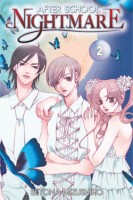
After School Nightmare is a ten-volume manga series by Setona Mizushiro. I first came across the series while working my way through one of my local library’s manga collection which, at the time, was largely shelved alphabetically by title. So, it didn’t take me too long to encounter After School Nightmare. I borrowed and read the first few volumes and on the strength of those alone decided to track down and purchase the entire series which had sadly gone out of print. The manga’s dark, horror-tinged psychological drama and its themes exploring gender and sexuality immediately appealed to me; the series had the potential to be both disconcerting and compelling. After School Nightmare, Volume 1 was originally published in Japan in 2004. The English-language edition of the volume was released in 2006 by the now defunct Go! Comi. After School Nightmare has generally been critically well-received in English, even earning an Eisner Award nomination for Best U.S. Edition of International Material among other honors.

Mashiro Ichijo is an androgynously attractive and well-liked you man, but he’s hiding a secret from his classmates–his body is neither entirely male nor entirely female. This has brought Mashiro some challenges in his life and as a result of his physical condition he struggles with his personal identity and gender. Just how much he struggles is made abundantly clear when Mashiro is requested to join a special after-school class which must be completed in order for him to graduate. In it the students must literally live out their nightmares where they are forced to face their darkest fears and bear witness to one another’s deepest secrets. What’s more is that they aren’t there to offer comfort or support. Instead, circumstances encourage them to strike out against their fellow classmates. And even though what happens in the nightmares isn’t to carry over into the real world, sharing such an intimate experience can’t help but change the young people and how they see one another.

The circumstances surrounding the after-school classes are peculiar. Only the students invited to attend seem to be aware of it. The stairs leading down to the infirmary where the class is held in a basement that shouldn’t exist disappears and reappears depending on the day. The teacher in charge isn’t known by the school’s other faculty. Students who “graduate” quietly go missing and are forgotten. All of these things and more add to the foreboding atmosphere of After School Nightmare and the feeling that something just isn’t quite right about what is going on. The shared nightmares themselves are also ominously disconcerting. The imagery is frightening–a girl whose face and heart are gaping holes, disembodied hands and arms, a cruel knight in black armor–but in the end the students’ psychological torment and distress may be even more troubling and gut-wrenching. The nightmares simply reveal the darkness and confusion that they already carry within themselves.

In the dreams, the students take on their true forms, representative of the issues, abuse, and trauma that they are dealing with. Many of them appear so distorted in the nightmares that its difficult to know their identities in the waking world. That’s not the case for Mashiro who looks exactly the same except that, to his horror, he sometimes is wearing the girls’ skirted school uniform in the dreams. This makes him easily identifiable and a target in the real world. He catches the attention of Kureha Fujishima, a young woman who is afraid of men but feels comfortable around Mashiro after learning his secret. And then there’s Sou Mizuhashi who has a reputation for being a playboy and womanizer but who also seems to have taken an intense interest in Mashiro. Though somewhat conflicted over these developments in his relationships with his classmates, Mashiro largely welcomes the attention from Kureha and is understandably uncomfortable with Sou’s aggressive advances towards him. As the first volume of After School Nightmare shows, reality can be just as terrifying if not more so than any nightmare.

Filed Under: REVIEWS Tagged With: after school nightmare, Go! Comi, manga, Setona Mizushiro

Soul Eater Not!, Vol. 4

December 14, 2014 by Sean Gaffney

By Atsushi Ohkubo. Released in Japan by Square Enix, serialized in the magazine Shonen Gangan. Released in North America by Yen Press.

I had thought that this was the final volume of the series, but apparently not, as there’s an unscheduled Vol. 5 that is likely waiting for a sufficient distance from the Japanese release. It’s unclear whether the plot of the manga will follow the anime, which had already finished (with Ohkubo’s advice) before this ended. That said, we have here a manga that still has the same problems which the first volume possessed, but is also adding some new ones, such as whether a typical ‘yuri’ fan is supposed to enjoy the series or be really pissed off about it, and how much serious plot you can have in a moe slice-of-life type manga before it really starts to feel out of place.

souleaternot4

Please note that by yuri fans I mean MALE yuri fans, the sort who would be quite happy to see the pairings end in a threesome, and who aren’t put off by the chapter of Meme running around naked that we see here. That said, fanservice isn’t everything, and I think most modern yuri fans are finding that the traditional tease just isn’t enough. Kim and Jackie are another good example – there’s lots of suggestion here that Jackie is in love with Kim, and some hints that Kim might one day return it… but this takes place before Soul Eater, where Kim and Ox become a couple. There’s no there there, it’s done solely to be ‘cutesy’ in a harmless way. Likewise, anyone who thinks that the ‘who will Tsugumi choose?’ plotline might actually involve genuine love and emotion has to be appalled at the aforementioned scene with the girls trying to sleep on a very hot night, which, fanservice aside, seems to show off the ‘immaturity’ of the girls for those who want a safe out.

That said, the other suggested romance in the series, that of Tsugumi and Akane, also seems to have vanished, and the manga is happily settling into focusing solely on our three heroines. There is also, among the jokes and 4-koma, a suggestion of the deeper ongoing plot. Eternal Feather is still recovering from her brainwashing two volumes ago. More importantly Meme’s memory issues, which have been used for comedy to this point, are getting to be a bigger and bigger issue, one that causes genuine concern. The final scene of the book is heartbreaking, as Tsugumi tears into Meme for what she sees as an annoying quirk (Tsugumi dealing with grief over a dead pet right now), but then stops seeing Meme expressing real sadness that she forgot something important again. It’s been vaguely implied she’s a mole for the villain, and I wonder if this is connected to that.

Soul Eater Not! is doing its best to try to appeal to a broader otaku market here, but it feels too pandering, to be honest, and could use more seriousness and heart. It still has some strengths – Anya has developed into the most sensible character of the bunch, and is a far cry from the tsundere princess she started as – but really, Soul Eater fans are better off with Soul Eater, and moe/yuri fans can find material that will give them better jokes and a better payoff than I expect this to have.

Filed Under: REVIEWS

Attack on Titan: No Regrets, Vol. 2

December 12, 2014 by Ash Brown

Attack on Titan: No Regrets, Volume 2Creator: Hikaru Suruga
Original story: Gun Snark

U.S. publisher: Kodansha
ISBN: 9781612629438
Released: October 2014
Original release: 2014

Attack on Titan: No Regrets, Volume 2 is the final volume of Hikaru Suruga’s manga adaptation of the A Choice with No Regrets visual novel written by Gun Snark. No Regrets is one of the many spinoffs and adaptations of Hajime Isayama’s immensely popular Attack on Titan manga series. It focuses on the backstory of one of Attack on Titan‘s most beloved characters, Levi, and how he became an exceptionally skilled and valued member of the Survey Corps. The second volume of the No Regrets manga was originally released in Japan in 2014, as was Kodansha Comics’ English-language edition. The volume also includes two short, largely comedic, No Regrets side stories as well as a special interview between Isayama and Suruga discussing the story and characters of the Attack on Titan franchise. I rather enjoyed the first volume of No Regrets and so was looking forward to reading the conclusion of the series.

At one point they were considered to be some of the most notorious criminals in the Underground, but now Levi, Isabel, and Furlan have been coerced into joining the Survey Corps, which may very well be a death sentence. Initially they weren’t well-liked by their fellow soldiers, and the three of them weren’t particularly happy with their situation, either. But during their first expedition outside of the walls, Levi and his crew leave quite an impression by handily dispatching an abnormal Titan with seeming ease. Levi and the others still don’t fit in with the rest of the Survey Corps members, but at least their remarkable skills, especially Levi’s, are recognized and admired. The extra attention they receive after defeating the Titan isn’t exactly welcome, though–Furlan is trying to coordinate a covert mission that will either lead to the three criminals’ ultimate freedom or to their deaths. They have been hired by a high-ranking political figure to steal back incriminating documents from Erwin, one of the Survey Corps’ most promising young leaders, and to end his life in the process.

What I particularly liked about the first volume of No Regrets was that it expanded the setting of Attack on Titan in addition to providing valuable background information about Levi, Erwin, and their relationship to each other. Sadly, the second volume doesn’t add much more that is new; I felt like I had already seen many of the scenes play out before and it was very clear how some of the events were going to end. The second volume of No Regrets spends a fair amount of time explaining the long-distance scouting formation, for example. While it’s noteworthy that No Regrets shows the first time that the maneuver is ever attempted, anyone familiar with Attack on Titan should already be quite aware of how the formation functions and its importance. Likewise, as is to be expected, encounters with Titans never tend to go well. Because in many ways No Regrets serves as a prequel to Attack on Titan, the deaths of major characters in the series are not at all surprising and lose some of their impact as a result.

More than anyone else’s, No Regrets is Levi’s story, but Erwin plays a pivotal role in it as well. Both of the men are exceptionally charismatic leaders, although Erwin is the only one of the two who actually seeks that role. Levi doesn’t want to be responsible for the lives of others while Erwin is willing to shoulder the weight of the sacrifices made in the fight against the Titans. He is extremely intelligent and talented and able to make tough decision. Even at the cost of individual lives, Erwin voluntarily employs dubious methods if he believes that the results will increase the odds of humanity’s survival. His almost fanatical drive and obsession contrasts sharply with Levi’s more reserved and internally focused nature. As is known will happen, eventually Erwin wins Levi over to his cause and gives him a firm direction and purpose, but this foregone conclusion does seem to occur rather abruptly. Still, the exploration of Levi and Erwin’s respective personalities and motivations in No Regrets is probably what the series does best and is what the manga brings to Attack on Titan as a whole.

Filed Under: REVIEWS Tagged With: attack on titan, Gun Snark, Hikaru Suruga, kodansha, Kodansha Comics, manga

Manga! Manga!: The World of Japanese Comics

December 10, 2014 by Ash Brown

Manga! Manga!: The World of Japanese ComicsAuthor: Frederik L. Schodt
Publisher: Kodansha
ISBN: 9781568364766
Released: January 2013
Original release: 1983
Awards: Japan Cartoonists Association Award

Initially released in 1983 and then again in 1986 in a slightly updated and revised edition, Frederik L. Schodt’s groundbreaking Manga! Manga!: The World of Japanese Comics was one of the first, and remains one of the best, surveys of the history of manga and the manga industry available in English. Written and published at a time when manga was virtually unknown to the average comics reader in the West and when only a very few examples of manga had been translated, Schodt was hoping to provide an introduction to the art form, garner interest in manga, and share his love and excitement for the medium. Manga! Manga! was received very well both in Japan where it earned special recognition from the Japan Cartoonists Association as well as in markets focused on English-reading audiences. Although Schodt would follow up Manga! Manga! with his work Dreamland Japan: Writings on Modern Manga in 1996, his initial foray is considered a classic in its subject area and is still well worth reading.

Manga! Manga! opens with a forward by Osamu Tezuka, who Schodt personally knew and worked with. From there Schodt takes over with the first chapter “A Thousand Million Manga,” providing an overview of manga and its readership in Japan. “A Thousand Years of Manga” addresses the history of manga, tracing its origins and development from 12th-century narrative art traditions through its more contemporary influences. “The Spirit of Japan” looks at the portrayal of the bushidō ethic in manga, ranging from historical fiction to the yakuza and sports genres, while “Flowers and Dreams” reveals the significance of comics created for and by girls and women. Other genres, such as salaryman, specialty career-oriented manga, and mahjong manga are explored in the chapter “The Economic Animal at Work and at Play.” Subjects like censorship, violence, and eroticism are the focus of “Regulations versus Fantasy.” Schodt closes his research with a chapters specifically devoted “The Comic Industry” and “The Future.” (Granted, that future is now in many cases the past, but the chapter is still illuminating.)

The editions of Manga! Manga! printed after 1997 also have a short introduction by Schodt but otherwise are nearly identical content-wise to those that were published earlier. In addition to Schodt’s main text, Manga! Manga! also includes an index divided by general subject, creators, and title as well as a bibliography of both English-language and Japanese-language resources. As is appropriate for a work about manga, Schodt incorporates artwork and photographs throughout the volume–rare is the page which isn’t accompanied by some sort of visual component. Particularly noteworthy is the inclusion of translated excerpts selected from four manga: Osamu Tezuka’s Phoenix, Reiji Matsumoto’s Ghost Warrior, Riyoko Ikeda’s The Rose of Versailles, and Keiji Nakazawa’s Barefoot Gen. These examples are among some of the earliest manga in translation readily available to a general English-language audience. Brief biographies of the four mangaka are provided as well.

Manga! Manga! is a fantastic work. Even decades after it was first published it remains an informative and valuable study. And, as I have come to expect, Schodt’s writing is very approachable and easy to read. Manga! Manga! explores the history of manga within the context of Japanese culture and history, ultimately showing that the two cannot be completely separated. Manga and its development reflect, is influenced by, and emphasizes the changing state of Japanese culture, politics, and social mores. It is an art form and a source of entertainment, but it can also be used for educational and informational purposes and even as propaganda. Schodt outlines the importance of manga in Manga! Manga!, both culturally and historically, and what it has to offer to Japan and to the world at large. Manga! Manga! is very highly recommended to anyone interested in learning more about manga, its history, its creators, or the manga industry as a whole.

Filed Under: REVIEWS Tagged With: Frederik L. Schodt, Japan Cartoonists Association Award, kodansha, Kodansha International, manga, Nonfiction

  • « Go to Previous Page
  • Page 1
  • Interim pages omitted …
  • Page 240
  • Page 241
  • Page 242
  • Page 243
  • Page 244
  • Interim pages omitted …
  • Page 342
  • Go to Next Page »
 | Log in
Copyright © 2010 Manga Bookshelf | Powered by WordPress & the Genesis Framework