• Skip to primary navigation
  • Skip to main content
  • Skip to primary sidebar
  • Home
  • About Us
    • Privacy Policy
    • Comment Policy
    • Disclosures & Disclaimers
  • Resources
    • Links, Essays & Articles
    • Fandomology!
    • CLAMP Directory
    • BlogRoll
  • Features & Columns
    • 3 Things Thursday
    • Adventures in the Key of Shoujo
    • Bit & Blips (game reviews)
    • BL BOOKRACK
    • Bookshelf Briefs
    • Bringing the Drama
    • Comic Conversion
    • Fanservice Friday
    • Going Digital
    • It Came From the Sinosphere
    • License This!
    • Magazine no Mori
    • My Week in Manga
    • OFF THE SHELF
    • Not By Manga Alone
    • PICK OF THE WEEK
    • Subtitles & Sensibility
    • Weekly Shonen Jump Recaps
  • Manga Moveable Feast
    • MMF Full Archive
    • Yun Kouga
    • CLAMP
    • Shojo Beat
    • Osamu Tezuka
    • Sailor Moon
    • Fruits Basket
    • Takehiko Inoue
    • Wild Adapter
    • One Piece
    • After School Nightmare
    • Karakuri Odette
    • Paradise Kiss
    • The Color Trilogy
    • To Terra…
    • Sexy Voice & Robo
  • Browse by Author
    • Sean Gaffney
    • Anna Neatrour
    • Michelle Smith
    • Katherine Dacey
    • MJ
    • Brigid Alverson
    • Travis Anderson
    • Phillip Anthony
    • Derek Bown
    • Jaci Dahlvang
    • Angela Eastman
    • Erica Friedman
    • Sara K.
    • Megan Purdy
    • Emily Snodgrass
    • Nancy Thistlethwaite
    • Eva Volin
    • David Welsh
  • MB Blogs
    • A Case Suitable For Treatment
    • Experiments in Manga
    • MangaBlog
    • The Manga Critic
    • Manga Report
    • Soliloquy in Blue
    • Manga Curmudgeon (archive)

Manga Bookshelf

Discussion, Resources, Roundtables, & Reviews

Reviews

Your Lie in April, Vol. 1

April 10, 2015 by Ash Brown

YourLieApril1Creator: Naoshi Arakawa
U.S. publisher: Kodansha
ISBN: 9781632361714
Released: April 2015
Original release: 2011
Awards: Kodansha Manga Award

Your Lie in April is the first and so far only manga series by Naoshi Arakawa to have been released in English. Arakawa is still fairly early on in his career—Your Lie in April was only his third major work—but the series earned him a Kodansha Manga Award in 2013 for Best Shōnen Manga. The first volume of the eleven-book series was originally published in Japan in 2011. In English, the manga was released by Kodansha Comics in 2015. The entirety of Your Lie in April was adapted into an anime series between 2014 and 2015, which is how I first learned about the manga. My interest in the series primarily stems from the prominent role that music has to play in the manga. Music is something that is incredibly important to me and continues to be a major part of my life. Probably unsurprisingly, I tend to enjoy music manga. And so, I was particularly happy to receive an early copy of Your Lie in April from Kodansha for review.

Kosei Arima was a child prodigy, admired for his skill and success as a pianist, winning competition after competition. But ever since his mother died and he had a breakdown in the middle of a performance on stage when he was eleven, he hasn’t been able to play the piano. Not for others and not even for himself. Piano was such an integral part of Kosei’s life that he seems to be somewhat lost without it and he hasn’t been able to completely let music go. Several years have passed since then, leaving Kosei a rather withdrawn and gloomy young man. But then he meets Kaori Miyazono, an extremely passionate violinist who attends the same middle school that he does. Kaori plays the way that she wants to play, disregarding traditional interpretations and technique to make the music her own. Though he is still reluctant and hesitant, watching Kaori’s enthusiastic, free-spirited performances has reignited something within Kosei and she and his friends are determined to see him play once again.

Your Lie in April, Volume 1, page 6A particular challenge faced by music manga like Your Lie in April is expressing sound in a visual medium. It takes more than simply throwing notes on the page to effectively convey the feeling of music in a comic. For the most part, Arakawa handles this aspect of the series quite well. The music itself isn’t heard, but the expressions and reactions of the listeners and musicians, the impact created by the music, can readily be seen. Perhaps the best example of this in Your Lie in April, Volume 1 is Kaori’s performance during a violin competition. The violinists before her are poised and fairly reserved in their playing, but Kaori uses her entire body to emote and express the music. This and the stunned faces of the audience members make it very clear that her invigorated style is drastically different and unexpected. But while music is obviously an important part of Your Lie in April, the real focus of both the artwork and the storytelling is on people’s experiences of that music.

Kosei’s relationship with music, and specifically with playing the piano, is a complicated one. He is struggling with intense psychological distress and it is revealed very early on in Your Lie in April that his mother physically, and very likely emotionally, abused him as well, trying to force her own dreams onto her son. Whether he is aware of it or not, Kosei’s feelings towards music and the piano are very much tied up with his feelings towards his mother. Underneath a relatively calm exterior is a turmoil of conflicting emotions that includes both love and hatred and even some fear. Deep down, Koesi does still seem to have the desire to continue playing the piano, though he denies it to himself and to others. It’s something that he will have to face head-on eventually, but Kaori’s influence threatens to make it something that he will have to deal with sooner rather than later, perhaps even before he’s really ready. I am very curious to see how Your Lie in April continues to develop and the steps Kosei may take to overcome his trauma.

Thank you to Kodansha for providing a copy of Your Lie in April, Volume 1 for review.

Filed Under: REVIEWS Tagged With: kodansha, Kodansha Comics, Kodansha Manga Award, manga, Naoshi Arakawa, Your Lie in April

Let’s Dance a Waltz, Vol. 1

April 9, 2015 by Sean Gaffney

By Natsumi Ando. Released in Japan as “Waltz no Ojikan” by Kodansha, serialized in the magazine Nakayoshi. Released in North America by Kodansha Comics.

Natsumi Ando’s back again, this time with a shorter series – this is only three volumes long, I believe. Which is good, as I felt the pacing was very rapid for a shoujo manga like this – it would only make sense if it was going to be wrapping up fairly quickly. I’m not sure if this was deliberate or not – her previous series, Kitchen Princess and Arisa, were both double digits. But short doesn’t necessarily mean it’s a failure, and there’s much to like about Let’s Dance a Waltz, with its grumpy hero held back by an incident in his past, and a self-deprecating heroine with an unfortunate first name.

waltz1

First off, a word of warning: the moment I saw that our heroine, Hime, was overweight and a bit frumpy, I thought “she’s going to lose all the weight and be gorgeous by the end of this volume, isn’t she?” And sure enough, that’s exactly what happens. She too has a tragic backstory, as her mother, who was the one who named her (Hime means princess, something that gets hammered home quite a bit in this series) passed away from tragic backstory disease when she was just a little girl. (This is a common disease befalling young women in manga – young men tend to have dads disappear (the scum), not die off.) Still, the mother may have had good intentions, but it’s left Hime teased her entire life thanks to the wonderful world of Japanese schools, whose bullying is always important for character development.

Our hero, Tango (no, I’m not making these names up), is dealing with similar peer pressure problems, but from the opposite direction – he’s handsome and popular, and in accordance with his name actually is an amazing dancer. But he doesn’t dance competitively anymore due to a mistake he made in his childhood that haunts him, and prefers to be the class clown, breakdancing and avoiding any mention of the fact that his mother runs a dancing school (because dancing is not “cool”, and kids turn on cool kids who are now uncool faster than anyone except perhaps girls with the name ‘princess’. Tango can be quite the jerk through this volume, but we know he just needs his true love to make him straighten up.

Though there were a few times I was surprised through the first volume – secondary couple Yusei and Sumire, who have no issues whatsoever (possibly as they have standard Japanese first names) are dedicated to helping the two wannabe lovebirds rather than, say, getting jealous, which is what I was suspecting of Sumire when I first saw her – but for the most part this is a manga that runs on timeworn cliches. But this is fine – Ando is an expert at this sort of thing, and it’s nice to sit back and just let a skilled artist take you where she wants to go. At three volumes, this seems like exactly the right length for a sweet manga about a couple who can connect to each other though the wonders of ballroom dancing.

Filed Under: REVIEWS

Maria the Virgin Witch, Vol. 1

April 8, 2015 by Ash Brown

Maria the Virgin Witch, Volume 1Creator: Masayuki Ishikawa
U.S. publisher: Kodansha
ISBN: 9781632360809
Released: February 2015
Original release: 2010

I’ll admit, when I first heard about the manga series Maria the Virgin Witch, I was more than a little skeptical. I’m not particularly interested in witches, which seem to be nearly as common as vampires in translated manga these days, and the emphasis placed on the heroine’s virginity seemed like it could be a little suspect. But then I realized that Maria the Virgin Witch was by Masayuki Ishikawa, the creator of Moyasimon, a quirky manga about microbes and fermentation that I enjoyed immensely. (Sadly, only two volumes of Moyasimon were ever released in English.) If for no other reason, I wanted to give Maria the Virgin Witch a chance because of my love for Moyasimon. I’m very glad that I did; the first volume turned out to be a very promising and intriguing start to the short series. Maria the Virgin Witch, Volume 1 was initially published in Japan in 2010 while the English-language edition was released by Kodansha Comics in 2015.

During the first half of the fifteenth century, England and France were still locked in the Hundred Years War, many of the battles being waged on French soil. Maria is a powerful but young witch living in France. She abhors the killing and senseless violence and so does what she can to disrupt the conflict and protect the villages and people who live near her woods. She has discovered one particularly effective method: by sending an owl familiar in the form of a succubus among the leaders of the armies on the eve of major battles, they often lose their will to fight or their interest in the impending confrontation. However, sometimes more direct action is required and Maria will summon great beasts to wreak havoc and chaos on the battlefield. But causing such a spectacle carries with it the danger of drawing the attention of Heaven and the risk of incurring the wrath of the Archangel Michael. There is a proper order to the world, and Maria poses a threat to it.

Maria the Virgin Witch, Volume 1, page 118 Maria’s outlook on life (as well as her and her familiars’ character designs) does tend to be more contemporary than the rest of the manga’s setting, but I really like her as a character. She has strong convictions, and she is prepared to act on them, doing what she can to right the injustices she sees in the world. Michael and others criticize her for her interference and audacity; Maria is very forthright with her feelings and opinions. She is young, and perhaps a little naive, but I admire her earnestness. Despite her anger and frustration, she has yet to become embittered by the world.  Maria honestly and wholeheartedly cares about people, especially those who are powerless or taken advantage of. Though some of her methods might not be considered to be particularly respectable by most, she and the people she protects believe her to be a force for good. Even so, Maria is considered to be a heretic by the Catholic Church, an institution for which she quite obviously holds no love.

Although Maria the Virgin Witch explores some fairly serious subjects—religion, morality, power dynamics, sexuality—the manga also includes a good deal of humor. Much of the comedy has to do with sex in one way or another, but some of it simply relies of the quirkiness of the characters. Maria, for example, is old enough to be curious about sex, but is still completely embarrassed at even the mere thought of seeing a man naked. As a result Priapus, the incubus she creates, is rather indistinct where it counts and is generally just put in charge of cooking and running errands. The first volume of Maria the Virgin Witch can be a bit crass at times (personally, I could have done without the repeated “cry for me like a little whore”-type comments), but overall the manga is a surprisingly layered work. The more I think about it, the more it grows on me, and the more I want to read the rest of the series. So far, Maria the Virgin Witch is a very interesting mix of historical fiction and fantasy that can be both entertaining and sobering.

Filed Under: REVIEWS Tagged With: kodansha, Kodansha Comics, manga, Maria the Virgin Witch, Masayuki Ishikawa

Yamada-kun and the Seven Witches, Vol. 1

April 7, 2015 by Sean Gaffney

By Miki Yoshikawa. Released in Japan as “Yamada-kun to 7-nin no Majo” by Kodansha, serialization ongoing in the magazine Weekly shonen Magazine. Released in North America by Kodansha Comics.

The debut volume of this series has a war between a plotline I love and a plotline I always find discomforting and embarrassing, and ends up taking it in a rather sedate direction. Of course, this is clearly a slow burner – we’re already a volume in and we have no idea who the seven witches are. But in the meantime we get to see the titular lead, Yamada-kun, make all sorts of amusing faces, and see various high school romantic comedy hijinx. This has been out on Crunchyroll for a while now, so I know that things will ramp up soon, but I was actually surprised at how little happened in this initial volume.

yamada1

Yamada is a delinquent, which I always love, although he’s sort of a sanitized delinquent. Even Onizuka (who appeared in the same magazine 20 years ago) was allowed to have bad habits. Here he’s just a guy with bad grades who sulks around the school wondering why things aren’t more interesting. He also may seem slightly familiar to those who know of Yoshikawa’s former series Yankee-kun to Megane-chan, which also featured a lead delinquent (of a sort) and their supposedly straightlaced female equivalent. The plot kicks in when he accidentally falls down the stairs, dragging a young girl down with him and forcing them to swap bodies, because they fell down the stairs in a high school manga and that is what inevitably happens in these sorts of things.

Urara is more interesting, if only as she takes much of this in stride. While Yamada is busy freaking out, her reaction is more sedate. Of course, she might be quite happy to take a vacation from her body, as we see (through Yamada’s eyes) that she has a lot she has to deal with. She seems fairly stoic, but as she warms up over the course of the volume it becomes apparent that it’s more repressed emotions than anything else. The dynamic between the two of them is interesting but fairly mild, except, of course, for the kisses that allow them to swap bodies at will. As we gain more cast members (Miyamura, whose attempts to convince Urara to continue high education by trying to find blackmail material and ogling her cup size, did not impress me) we will no doubt gain more dynamics.

At the end of this volume, even with the addition of a new girl who promises to make life miserable for everyone, we’re not one step closer to knowing what’s going on. We haven’t met a witch, and we’re not sure why Yamada suddenly can swap bodies with anyone he kisses. Given the author’s success with her prior work, I imagine she has a lot more leeway to develop things the way she wants without the fear of getting cancelled after 15 chapters. Which is fine, but it does lead to a first volume that’s merely average, even as I know it gets better later. Still, if you like school romantic comedies with an emphasis on the comedy, and want to step in before the inevitable harem plot starts up, this is the volume for you.

Filed Under: REVIEWS

A Caring Man

April 3, 2015 by Ash Brown

A Caring ManAuthor: Akira Arai
Translator: Marc Adler
U.S. publisher: Vertical
ISBN: 9781935654179
Released: 2011
Awards: Golden Elephant Award

A Caring Man is Akira Arai’s debut novel and his first book to be translated into English. The novel was brought to my attention primarily because it, along with Fumi Nakamura’s Enma the Immortal (which I absolutely loved), shared the inaugural Golden Elephant Award’s grand prize. A Caring Man and Enma the Immortal are two very different novels, but they are both engaging. Both novels were also released in English by Vertical. The purpose of the Golden Elephant Award was to “produce and publish promising entertainment stories in multiple languages in the global arena.” With that in mind, the jurors from the first award committee were from Japan, the United States, China, and Korea. It was this emphasis on global appeal that inspired Arai, who had previously worked in the music and film industries, to submit A Caring Man. After winning the award, the novel was simultaneously released in 2011 in Japanese and in English with a translation by Marc Adler.

On August 26, 2011, Japan fell victim to an unprecedented tragedy. Without any sort of warning, bombs strategically placed within Tokyo Tower were detonated, bringing the massive structure toppling down, killing and injuring a huge number of people. The special investigation team, a joint operation between the police force’s Criminal Investigation Department and the Public Security Bureau, is treating the incident as a terrorist attack. However, no group has emerged to claim responsibility for the bombing and the team quickly runs out of leads. There seems to be no concrete motive for the attack beyond a perverse desire to destroy for the sake of destroying. Mariko Amo is a freelance photographer working for scandal and gossip magazines who captured the fall of the tower on film, nearly losing her life in the process. Soon after she is given the opportunity to write a feature article on Yoshio Iizuka, a seemingly upstanding young man who recently established the Society of Victims of Abuse for the Prevention of Abuse. Little does she know that he is the very mastermind behind the Tokyo Tower attack.

A Caring Man deals with some very heavy subject matter. In addition to the attacks of terrorism and mass murder, personal killings and more intimate violence, such as child abuse, are also present in the novel. Yoshio himself was a victim of such abuse. Mutilated and abandoned as a newborn infant, he still carries scars on his body. He uses these and his story to gain empathy from others, employing his striking intelligence to manipulate them even further. Yoshio has an odd sort of intensity and charisma; he knows just what to say and how to act to exploit and control other people. A Caring Man, which takes its title from the characters used in Yoshio’s name, in part explores the mind and nature of a psychologically dark, twisted, and damaged young man. Yoshio’s plans are terrifying, and even more frightening is the fact that he has the abilities and influence needed to actually carry them out. The bombing of Tokyo Tower is only intended to be a dramatic prelude to even greater tragedies to come.

The story of A Caring Man is largely seen from three distinct perspectives, although they do intersect at various points in the novel when major players come into contact or become more deeply involved with one another. Those perspectives also reflect the prominent viewpoints of many modern-day crises. Yoshio and the cohort of young men aiding and in some cases nearly worshipping him form one faction as the perpetrators. The detectives, police, and other law enforcement officers are the investigators and protectors, while the third group consists of Mariko and other members of the media and press. They are the observers, chroniclers, and witnesses with the power to influence the opinions of the general public. Overall, A Caring Man is a well-written and engaging novel, particularly impressive as it is Arai’s debut. A few of the plot twists towards the end weren’t as believable or as effective as the rest of the novel, but otherwise A Caring Man is a solid crime thriller with an intense psychological component.

Filed Under: REVIEWS Tagged With: Akira Arai, Golden Elephant Award, Light Novels, Novels, vertical

Yukarism Vol. 2

April 2, 2015 by Anna N

Yukarism Volume 2 by Chika Shiomi

I enjoyed the first volume of this series very much, and was interested to see how the dynamic of gender-swapped past lives would play out in the present for the young novelist Yukari.

I was impressed with the sheer amount of plot and world building Shiomi was able to develop in the first volume, but I was interested to see what would happen in the second volume when character motivations were already established. At first the relationship between Yukari and his female fan Mahoro seemed to mirror the relationship of courtesan Yumurasaki and watchful bodyguard Kazuma. It turns out that the burn mark that Mahoro and Kazuma share across the centuries might be a red herring because when a new character named Satomi appears to act as Yukari’s housekeeper, Mahoro’s fierce possessiveness and sudden magical abilities resemble the Witch Doctor Shizuka. Shizuka was one of Yumurasaki’s most ardent lovers, and Yukari wonders if the Witch Doctor was the cause of his past incarnation’s death.

While much of the first volume focused on established Yukari’s unique time traveling ability and defining his personality as well as Yumurasaki’s, the second volume delves more into the relationships of the people who surround the author/courtesan in the past and the present. Mahoro starts sleepwalking and uttering magical curses when she sees Satomi, and then she switches back to normal with little memory of what she did. The instant antagonism between Satomi and Mahoro is filled with glares and a sense of real menace, since both of them seem to have little control over their actions. Yukari continues to learn more about his past, with a subtle observational approach that fits in well with his personality as an author. Mahoro is falling more and more in love with him, which might make her emotions and connection to her own previous life more extreme. All in all, this was a solid second volume and Yukarism is positioned well to rotate in to fill the paranormal romance slot in your current manga reading list, since a few series in that genre have recently concluded.

Filed Under: REVIEWS Tagged With: Chika Shiomi, shojo beat, shoujo, Yukarism

Karneval, Vol. 1

April 2, 2015 by Sean Gaffney

By Touya Mikanagi. Released in Japan in two separate volumes by Ichijinsha, serialization ongoing in the magazine Comic Zero-Sum. Released in North America by Yen Press.

Karneval is, I believe, one of those titles that is expected to coast by on style alone for the first few volumes, while it lovingly sets up its plot. And to be fair, it has quite a lot of style. There was never a point in reading this omnibus where I was bored and slipping ahead, though there were perhaps a few times when I desperately wanted an organizational chart or a “here’s how this world works”. But that’s not how immersion goes. In the meantime we have a pretty young boy and his grumpy yet also pretty friend/babysitter/audience identification character, running afoul of the bad guys and being rescued by a crack squad of eccentric superheroes who pose as a circus when they’re not causing major property damage or freaking people out.

karneval1

I believe that’s Nai on the cover there – I say “I believe” as he’s staring out at the reader confidently, something the Nai in the books would never do. I said Gareki was for the audience, and he’s desperately needed – in fact, I think he’s the main reason I enjoyed this title as much as I did. He stomps through the whole thing carrying Nai around as if he’s in a manga version of Midnight Run, and also manages to be the one member of the cast with no superpowers that we know of, though he gets by well enough with explosives. As for Nai, I actually thought the revelation about who he really is what the best part of the volume – it actually makes his moeblob tendencies make sense in context, even if it ends up giving us more questions than answers.

As for the rest of the cast, there are several men whose characterization seems to involve looking cool and making passes at each other, though I suspect the genuine BL content in this series will be zero. And they are pretty damn cool, if also ridiculous to a large degree – something I’ve come to expect from Zero-Sum titles. There are also a few women in the cast, who range from stoic to overly affectionate to full-on tsundere, but honestly none of them get as much attention as the guys this time around – hope that changes later on. Oh, and we also meet a set of twins and childhood friends who have “I am here to be tragic and motivate our hero” written all over them, which the cliffhanger seems to agree with me on.

There’s a healthy dose of humor here as well (the nurses’ reaction to their obnoxious doctor boss was probably my favorite), which also helps the medicine go down well. There’s nothing here that’s revolutionary or new, but for a manga that knows what its target audience wants, Karneval delivers quite nicely. Don’t try to think too hard about what’s going on, just sit back and enjoy the snarking, acting cool, and one-liners. Recommended for fans of Zero-Sum.

Filed Under: REVIEWS

Soul Eater, Vol. 25

March 31, 2015 by Sean Gaffney

By Atsushi Ohkubo. Released in Japan by Square Enix, serialized in the magazine Shonen Gangan. Released in North America by Yen Press.

And so here we are at the end of another long-running shonen series. And it’s a good, solid ending, wrapping most plotlines up neatly, giving readers a big battle scene with lots of awesome moves and attacks, and resolving Crona as much as Crona was ever going to get resolved. The cover, as you can see, has Crona looming over our protagonists, and that seems appropriate, as in the end the fight is not so much to defeat Asura as it is to get a chance to try to talk Crona down one last time. And, of course, it would not be long-running shonen without the death of one of the main characters, which is done in such a way that even Excalibur is briefly not annoying. (It’s only briefly though.)

souleater25

It’s also interesting to see the attention paid to Soul and his growth. Soul’s struggles as a weapon have always been closely tied to Soul’s struggles as a musician, and he clearly has a life-or-death performance here. That fact that his music works most effectively when he accepts the madness that roils within himself, and the black blood within, is actually quite well done, even if it makes me wonder if Ohkubo was trying to say something about jazz artists and recreational drugs. But that’s probably just me. More to the point, he and Maka now trust each other completely, which after everything they’ve been through, is a relief. I liked his support when Maka is trying to convince Crona – he says “we believed in what Maka believed in”.

There’s a lot left open after this ending. Kid’s now the new Shinigami, and has already shown that his OCD is not going to magically go away anytime soon. Crona may be rescued someday, but today is not that day, and given all the crimes committed by Crona, it seems appropriate to end with moon sealage. (I have been endeavoring not to gender Crona through these reviews – unlike, say, Hange in Attack on Titan, where an author’s casual joking has spiraled completely out of control, I do believe Crona is quite deliberately not shown to be male or female, and that it works with their character.) As for romance, it was always on the back burner, and remains so – the only couples at the end are Kim and Ox, who get a dance, and Stein and Marie, who are creating new life. You could argue other things might happen in the future (I was rather startled by Maka’s response to Blair’s comment), but for now, things are up in the air.

This wasn’t a perfect ending – the boob jokes at the end fell totally flat with me, even if they do try to justify it in plot as Crona’s subconscious desires, and the “Noah-samas” were just as bad. But it made me happy overall. Eruka Frog was a character I always felt sorry for, so it was nice to see her pardoned and at peace. Rachel had been dropped from the manga the moment she was unpossessed, so it was fantastic to see her with her parents and showing she wasn’t completely broken by what happened to her. And it ends with a party, with everyone singing and dancing in the best One Piece tradition. Well, that and a shot of the city, with its bizarre sun and moon still hovering in the sky. Soul Eater’s world is still strange as hell, and it’s the world that is the main reason I recommend reading every volume of this series.

Filed Under: REVIEWS

Requiem of the Rose King, Volume 1

March 29, 2015 by Ash Brown

Requiem of the Rose King, Volume 1Creator: Aya Kanno
U.S. publisher: Viz Media
ISBN: 9781421567785
Released: March 2015
Original release: 2014

The English-language release of Aya Kanno’s Requiem of the Rose King was one of the manga that I was most looking forward to in 2015. Several of Kanno’s series have previously been translated into English—Soul Rescue, Blank Slate, and Otomen—all of which are quite different from one another, and Requiem of the Rose King is different still. I tend to enjoy Kanno’s work, but I was particularly interested in Requiem of the Rose King because the series is based on William Shakespeare’s Henry VI and Richard III, the first tetralogy of a series of plays that dramatize the Wars of the Roses, a dynastic conflict over the English crown in the fifteenth-century. I adore Shakespeare (I actually used to perform monologues competitively as part of my high school’s speech and drama team back in the day) and so was excited to learn about Kanno’s adaptation and thrilled when Viz Media licensed it. Requiem of the Rose King, Volume 1 was first released in Japan in 2014 while Viz’s English-language edition was published in 2015.

Young Richard is the third son of the Duke of York, a man who many believe to be the rightful successor to England’s throne. The current king, Henry VI, inherited rulership from his father as a child, but the Lancasters are accused of usurping the crown when their house executed King Richard II for treason. Richard desires nothing more than to see his father crowned king and as his son to prove himself worthy of his noble lineage. But Richard’s fate is a troubled one. His body, not fully male, is considered to be deformed and weak, a sign of demonic influence. He is plagued by nightmares, visions, and seemingly prophetic dreams. Richard is adored by his father and loved by his older brothers, but his mother despises him, believing his cursed existence to be a harbinger of evil and death and ashamed of her role in bringing him into the world. Whether or not it is because of Richard’s presence, that world is about to descend into chaos and civil war as the Yorks and the Lancasters vie for the crown.

Requiem of the Rose King, Volume 1, page 58Requiem of the Rose King is not a strict adaptation of Shakespeare’s plays. Instead, Kanno uses them as a source of inspiration, remixing, as she describes it, the characters, dialogue, and settings of Shakespeare’s originals to create a distinct work of her own. The manga’s English translation is excellent. With their refined formality and elegance, the patterns of speech, dialogues, and monologues are reminiscent of Shakespeare without necessarily quoting directly from his plays. A reader does not at all need to be familiar with Henry VI or Richard III to enjoy Requiem of the Rose King. One of the most striking differences between Requiem of the Rose King and Shakespeare’s dramas is the portrayal of Richard. At this point in the series, Kanno’s Richard is a much more sympathetic character than Shakespeare’s ever was. However, there is still a tense and ominous atmosphere that surrounds him in Requiem of the Rose King. It is very clear that the first volume of the manga is a prelude to even grater tragedies to come.

There is always a danger of disappointment when anticipating a manga to such a great extent, but I can honestly say that I loved the first volume of Requiem of the Rose King. It’s theatric and dramatic, with appealing artwork and interesting interpretations of historical figures. Because Requiem of the Rose King is based on plays that were already dramatizations of actual persons and events, the series isn’t rigorous in its historical accuracy. However, I find Kanno’s version to be both fascinating and immensely engaging. The manga is a bit fragmented in its storytelling, quickly moving from one scene to the next and to from time to time overlapping dreams and reality, but I feel this effectively reinforces the turmoil of the era as well as the unrest experienced by the individual characters. Requiem of the Rose King is a beautifully dark and compelling historical fantasy. I’m very much looking forward to reading the second volume and seeing how the rivalry between the Lancasters and the Yorks continues to play out.

Filed Under: REVIEWS Tagged With: Aya Kanno, manga, requiem of the rose king, viz media

Sword Art Online: Progressive, Vol. 1

March 29, 2015 by Sean Gaffney

By Reki Kawahara and abec. Released in Japan by ASCII Mediaworks. Released in North America by Yen On.

I’ve already discussed some of the ideas behind this concept in my review of the first manga, so I’ll try to skim over that and discuss what I enjoyed about SAO:P as a novel. Again, I don’t think it’s a sort of ‘reboot’ where you can read it in place of the original – I think knowing the characters already adds to the depth. But the main reason to read this is to see how Kawahara develops Aincrad, a world he introduced and essentially abandoned in the first book, sequels and side stories aside. And we also get the addition of Asuna’s POV narration, though sadly only for part of the first arc, after which it’s back to all Kirito all the time.

progressive1

Despite this, Asuna benefits enormously from the added face time. We see her at the start, having essentially decided that she wants to attempt to die with dignity, or at least on her own terms, something that Kirito is able to talk her out of. As the book goes on (and it is a BIG book – at 360 pages, almost as big as Fairy Dance put together) and Asuna starts to actually pay attention to the rules of the game and how to succeed, she becomes just as good if not better than Kirito – the skills she’s used her entire life as a girl who has to be in the top of the class for everything now benefit her in the RPG environment, and she also has more socialization than Kirito, meaning she can see people in a way that he’s unable to – this really becomes apparent in the second half of the book, where Kirito has pegged himself as an evil person, and Asuna has to side-eye him several times and go “really?”. Kirito, meanwhile sees potential in Asuna, and wants her to be the role model for the game world that he feels unworthy of being himself. They’re not a couple here, but you definitely see why they’re perfect for each other – they’re both quite similar, and their differences complement each other.

There’s no Klein, Lisbeth or Silica here, and Agil is mostly just support. The new addition is Argo, though she’ll be familiar to fans of the anime. She doesn’t vanish after the first few pages, however, and actually gets to show off some character depth and an awesome ‘to the rescue’ bit. In addition, the “Interlude” focusing on her and Kirito is hilarious, the second funniest part of the book. (The funniest part of the book involves Asuna’s inventory and Kirito’s complete ignorance of a maiden’s true heart, as well as measuring rage in gravitational units – I’ll leave it at that.)

The most interesting part of the book takes place right at the end, where a scheme is uncovered that led indirectly to the death of a player (or so they hear), and the concept of PKing comes up for the first time, this time as capital punishment. When does justice become vigilante justice? Kirito has definite views on the subject, but he’s already burned so many bridges (or at least he thinks he has) that he doesn’t want to make any rallying speeches. Luckily, things defuse before we can go there, but everyone is now thinking about it. We’re not at Laughing Coffin just yet, but the seed has been planted.

This book covers the first two floors of Aincrad, and the afterword says there should be 2 floors per novel, so things will likely continue to move quite slowly. This is the main goal of this series, of course, and I’m greatly enjoying what it’s trying to do. And of course there’s also an additional bonus – this is 8 years after the author first wrote SAO, and his prose has improved a great deal. Sword Art Online fans will love this. (Also, I appreciate that ‘Kuroko’ was likely impossible to translate without a footnote, but ‘Blackie’? Geh.)

Filed Under: REVIEWS

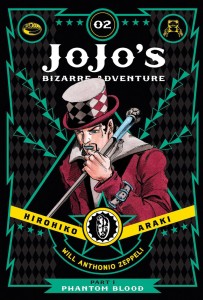
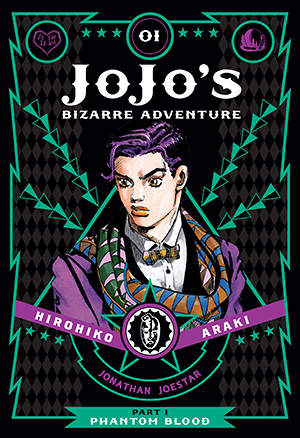
JoJo’s Bizarre Adventure, Part 1: Phantom Blood, Vol. 1

March 27, 2015 by Ash Brown

JoJo's Bizarre Adventure, Part 1: Phantom Blood, Volume 1Creator: Hirohiko Araki
U.S. publisher: Viz Media
ISBN: 9781421578798
Released: February 2015
Original release: 1987-1988

Hirohiko Araki’s multi-generational epic JoJo’s Bizarre Adventure is one of the longest-running manga series in Japan. Araki began the series in 1986 and the manga is still ongoing at well over a hundred volumes. Between 2005 and 2010, Viz Media published the sixteen volumes of the third story arc, Stardust Crusaders, arguably on of the most popular, or at least well-known, parts of the series. In 2012, NBM Publishing released Rohan at the Louvre, a largely standalone manga related to Diamond Is Unbreakable, the fourth arc of JoJo’s Bizarre Adventure. Finally, in 2015, the first part of the epic, Phantom Blood was released in print in English by Viz in a beautiful, deluxe hardcover edition. Phantom Blood was originally published in Japan in five volumes between 1987 and 1988, but was reissued in three volumes in 2002. That release is the basis for Viz’s English-language edition. JoJo’s Bizarre Adventure, Part 1: Phantom Blood, Volume 1 includes the entirety of the first volume and the majority of the second volume of the original Japanese release.

Jonathan Joestar, known as JoJo, is the son of a wealthy 19th-century English nobleman. He lost his mother while still an infant when the entire family was involved in a tragic carriage accident. JoJo survived, but his mother and the driver died and his father was severely injured. Years later, a young man named Dio Brando is sent to live with the Joestars. His father, who recently passed away, was the first person upon the scene of the carriage accident. Lord Joestar believes himself to be in Brando’s debt, under the mistaken impression that he saved his life, and so welcomes Dio with open arms. But Dio isn’t the upright character he often portrays himself to be. His intention is to destroy the Joestar family and take its wealth for his own using anyone and any means necessary, including a mysterious stone mask that grants vampiric powers. JoJo is the only person to suspect Dio isn’t all that he seems, and Dio is determined to make his life miserable. The two of them are raised as brothers, but despite JoJo’s initial attempts at friendship, there is no love lost between them.

Phantom Blood, Volume 1, page 80JoJo’s Bizarre Adventure is a very aptly named series. Phantom Blood is strange and outlandish, proceeding at a breakneck pace with a tremendous amount of drama and flying fists. It’s not subtle by any means, but the series’ uninhibited, over-the-top nature is part of Araki’s style. Heightened action and drama often take precedence over logical consistencies or realism in the manga’s artwork and story. Devastating injuries that would maim or kill most people are easily disregarded or overcome by the series’ heroes and villains, although the pain and suffering they incur certainly leave an impression. JoJo and Dio fight it out on several different occasions in the first volume of Phantom Blood, each battle becoming increasingly more violent and destructive, and they are pretty bloody to being with. And that’s not even taking into account the psychological damage that also results. JoJo’s Bizarre Adventure can be brutal.

Dio is one of the most fabulous antagonists that I’ve come across in manga. Extraordinarily charismatic and completely without scruples, he makes an extremely dangerous opponent. But Dio does have flaws, and he is a much more interesting character because of them. While he is often unable to control his intense anger and arrogance, even at a young age he is able to hold people under his thrall. JoJo on the other hand, especially in comparison to Dio, is astoundingly honest, naive, and kindhearted, a gentleman through and through in both mind and deed. He uses his strength of character and impressive physical fortitude to protect his family and other people he cares about. JoJo’s repeated confrontations with Dio force hem to become even stronger as the series progresses. He grows into a formidable opponent in his own right with a firm sense of and desire for justice. The stark contrast between the two young men and the extreme dynamics of their relationship are a large part of what makes Phantom Blood such an engaging manga.

Filed Under: REVIEWS Tagged With: Hirohiko Araki, JoJo's Bizarre Adventure, manga, Shonen Jump, viz media

Captain Ken, Vols. 1-2

March 26, 2015 by Sean Gaffney

By Osamu Tezuka. Released in Japan by Shogakukan, serialized in the magazine Shonen Sunday. Released in North America by Digital Manga Publishing.

Say what you will about Osamu Tezuka, he certainly knows how to write for his specified audience. This doesn’t dumb anything down, but it is absolutely 100% for boys around 7-12 years old, and almost every single page is filled with chases, fights, gun battles, etc. The conceit here is that this is a Western on the planet Mars, and indeed if you changes the Martians into Native Americans, little about this book would have to change. There’s a plucky young hero, a hotheaded teenager (usually the same person, but Tezuka generally liked his heroes to be very shiny, so the anger gets offloaded onto Mamoru here), a cute young thing with a mysterious past (well, in this case, that’s not quite true, but I don’t want to spoil). It’s classic boys’ adventure.

captainken1

Tezuka was churning out manga at an incredible pace at this period in his life, and there are times when it shows. I’ve seen Tezuka manga where you can tell he has no idea where things are going from chapter to chapter, or even page to page, but this was the first one where I wondered if he drew one panel at a time and then figured out what would happen next based on that. Sometimes this works to the series’ advantage, though. Apparently Tezuka’s plan had been for Ken and Kenn to be the same person (a la Princess Knight, a series he would revisit two years after this one), but so many people immediately wrote in guessing it that he called that off, and instead made it a competition to see what the real connection between Ken and Kenn was. This works well with the narrative, which starts with it being ‘obvious’ that Kenn is finding excuses to go be Ken, but as the excuses become more outlandish and impossible, we become suspicious along with Mamoru.

Those who enjoy Tezuka’s ‘star system’ of recurring characters will be pleased to see that Mamoru is basically Rock, his young hothead from several other titles. He’s fairly straightforward here, not much like the young man we’ll see in titles such as Alabaster later on. Lamp is also there as a villainous gunslinger. Lamp is actually one of the more interesting characters, not being motivated by greed or power as the other villains are, but simply out of a need to be the best at what he does. Sadly, Captain Ken bests him immediately, and later on it’s shown that he’s actually the worst at the style of fighting he specializes in! Poor Lamp, still no respect.

These two volumes are a lot of fun, and really don’t let a reader catch their breath at all. The message of ‘fighting each other is bad’ is a bit heavy handed at times, but that’s not untypical of Tezuka. There’s also quite a bit of Japanese nationalism tucked in here, which is also not untypical of Tezuka. Still, for the most part this tale of Cowboys ‘n Aliens is on the mark, though those who know Tezuka’s tendencies won’t be too surprised at how it ends. Those who only read his titles for older readers might want to give this one a shot.

Filed Under: REVIEWS

Oh My Goddess!, Vol. 47

March 24, 2015 by Sean Gaffney

By Kosuke Fujishima. Released in Japan by Kodansha, serialized in the magazine Afternoon. Released in North America by Dark Horse.

The final volume is not going to have much time for this, so it’s very fitting that this penultimate one is devoted to the greatest love affair in the entire series. No, not K1 and Belldandy, though they’re cute too. I’m referring to the love affair between Fujishima and motorcycles, one which reaches its obvious zenith here as we wrap up a mini-arc where Keiichi must justify his life and earn the right to love Belldandy by driving a really difficult motocross race, something that would sound a bit ridiculous to anyone who hasn’t read Oh My Goddess! before. In fact, ‘really difficult’ may be underselling it – Keiichi’s failure at one point leads to his limbs being broken and his organs tearing apart, something he feels every bit of.

omg47

That said, he ends up perfectly fine, even if his bike is totaled. But wait! A new arrival comes on the scene, who wants to play up the old ‘did you drop this gold motorbike or this silver motorbike’ schtick, but K1 and Bell aren’t having any of that – it’s the Lake Goddess, fresh from the tragic story of Vol. 46. Yes, she is now freed, and yes, it was due to the sheer power of the feelings Keiichi and Belldandy had for each other. This may seem like a hoary old cliche, but honestly, it’s exactly what readers of this title wanted. No one wants to read a grim and gritty Oh My Goddess where our heroes learn that life is pain and suffering.

So yes, she’s free, and able to make fun of Tyr as well. Yes, he’s still testing the couple in his guise as the Gate, even after Keiichi wins the final race, possibly due to the sheer joy of being on a motorcycle – it wouldn’t be the first time he’s won a race for that reason. But there’s one final test, and it’s one that many Oh My Goddess fanfiction writers have theorized about – Tyr offers Keiichi a chance to be a god, so he can stay with Belldandy forever, according to the terms of his deal. Naturally, though, Keiichi is never going to accept that – he is a living embodiment of all that is good about humanity. Take that away and you waste it a bit. Of course, that was a test as well.

The ‘cliffhanger’ ending has Hild explaining exactly over a game of Koi-Koi (and Skuld reading what appears to be Nakayoshi) how she managed to get pregnant with Urd despite losing the same contest that K1 and Bell are going through. But really, the real cliffhanger is knowing that this all wraps up in Vol. 48, and we’re still in the middle of Hell. Will everyone be able to get out? Will K1 and Bell live happily ever after? Is this series really as optimistic as it seems? Yes, yes, and yes. Again, what series have you been reading that these questions aren’t a surprise?

Filed Under: REVIEWS

Requiem of the Rose King, Vol. 1

March 22, 2015 by Anna N

Requiem of the Rose King, Vol. 1 by Aya Kanno

I really admire the way Kanno moves from genre to genre, coming up with unique stories each time, at least with her series that have been translated into English. Blank Slate and Otomen are utterly unlike each other, and now with Requiem of the Rose King there’s an entirely different series to enjoy.

Requiem of the Rose King is a retelling of the story of Richard III, which is a topic I tend to enjoy exploring, going way back to when I first read the classic mystery Daughter of Time by Josephine Tey as a young teenager. So I was really interested in seeing how Kanno was going to tackle this story. It opens with the childhood of young Richard during the Wars of the Roses. Richard is a favorite of his father, but his mother views him as a damaged child due to his physical abnormalities. The introduction to Richard is framed with a reference to Joan of Arc’s sin of dressing like a man. Richard is cloaked, roaming through the forest alone after his mother abandoned him. One of his eyes is more prominent than the other, but his face is entirely in shadow. As Richard’s mother sits back in the castle thinking about how evil her own son is, he’s shown being trapped by vines. Richard’s older siblings are integrated into their mother’s affections, but when Richard’s father goes off to fight the Lancasters, he loses his main source of love and affection.

Richard appears to be intersex, or at least having some feminine characteristics while being raised as a boy. Richard sees visions of Joan of Arc tormenting him. He’s determined to be the best son possible for his father. I wasn’t sure exactly which gender to use to refer to him, but since in the first volume Richard clearly identifies as male, I was just going with that for the sake of this review. Richard accidentally strikes up a friendship with young prince Henry. He also meets a girl named Anne Neville. While Richard experiences battle in this volume on the sidelines, the fear and danger that he’s exposed to being left behind are very real. His mother grows even more hostile throughout the volume, which I didn’t even think was possible given how she was introduced initially.

Kanno’s art is great in this volume, and it seems like the subject matter has given her more room to be experimental. Richard’s visions of Joan of Arc keep popping up to make the events he’s experiencing even more unsettling, and there seem to be shadows about to attack lurking in the woods and in castle corners. Close up of eyes are used for dramatic effect often, showing fear, anger, and mental instability. I feel like with this series and Black Rose Alice, Viz is being a bit more adventurous with some of their current manga that might appeal to shoujo readers. While I enjoy a good romance as much as anyone, I am really happy to get a bit more variety on my shelves.

Filed Under: REVIEWS Tagged With: requiem of the rose king, viz media

Master Keaton, Vol. 2

March 22, 2015 by Sean Gaffney

By Naoki Urasawa, Hokusei Katsushika, and Takashi Nagasaki. Released in Japan by Shogakukan, serialized in the magazine Big Comic Original. Released in North America by Viz Media.

This is another solid volume of Master Keaton, with a bit more attention paid to the mysteries and a bit less to the leading man this time around. As I kept reading, though, one thing kept coming back to me. There were stories of a man stealing to try to help the poor in Italy; Olympic runners who also fell afoul of running for money so they could give to charity; old revolutionaries who have found that betraying a cause or lying for the sake of a woman doesn’t make one happy; and even Keaton’s class, unable to finish its final lesson as the school is being shut down and evil bureaucrats want the mural on the wall behind him. Only occasionally tragic, what this manga really is deep down is sad. It’s about chasing dreams, even as you realize that it destroys your life and you likely won’t succeed very well in any case.

keaton2

This is likely not a surprise to anyone who has followed the career of Urasawa, a man who wrote one of the most depressing manga ever and called it “Happy!”, or Katsushika, who wrote for Golgo 13, another series that tended to end in death and disappointment, just with less focus on the emotions involved. But Master Keaton seems to go that extra mile. it’s the tail end of the Cold War in these stories, and everyone is simply weary. Even the terrorists are giving themselves up as they’ve had enough. The bounty hunters are ex-cops who got tired of letting the criminals get away. Little girls are cynical before their time as they see adultery and cruelty in their daily lives. And even Keaton, a man who loves his ex-wife but let her go anyway because he thinks it helped him grow up.

There are moments of triumph here, but they’re less in the emotions and more in the action and deduction. You see Keaton figure out the story behind a “werewolf”-inspired serial killer, or fend off neo-Nazi assassins to save some Turks in West Germany. There’s also one emotional high point in the story, where Keaton reminisces about his old mentor, who he named his daughter after, and finds his friends and family have managed to track him down for a reunion. Even then, though, the event is muted: Professor Scott looks at Keaton and says he’s turned out well, which brings the man to silent tears. I get the feeling as I read this series that despite being an archaeologist/insurance investigator/ex-SAS soldier/detective/awesome guy, Keaton really doesn’t like himself all that much.

But for this sort of series, I think that’s OK. It’s evocative of a mood, one that fits its time: Europe in the late 80s, with the Soviet Union starting to crumble and the last vestiges of the old guard left with nothing but regrets. I will even forgive this volume for trotting out the old “a man has his dreams” cliche. Keaton is the type of series you want to read while swirling around a glass of brandy and listening to Sonny Rollins. Just don’t be surprised if you’re counting your own regrets after you finish it.

Filed Under: REVIEWS

  • « Go to Previous Page
  • Page 1
  • Interim pages omitted …
  • Page 235
  • Page 236
  • Page 237
  • Page 238
  • Page 239
  • Interim pages omitted …
  • Page 342
  • Go to Next Page »
 | Log in
Copyright © 2010 Manga Bookshelf | Powered by WordPress & the Genesis Framework