• Skip to primary navigation
  • Skip to main content
  • Skip to primary sidebar
  • Home
  • About Us
    • Privacy Policy
    • Comment Policy
    • Disclosures & Disclaimers
  • Resources
    • Links, Essays & Articles
    • Fandomology!
    • CLAMP Directory
    • BlogRoll
  • Features & Columns
    • 3 Things Thursday
    • Adventures in the Key of Shoujo
    • Bit & Blips (game reviews)
    • BL BOOKRACK
    • Bookshelf Briefs
    • Bringing the Drama
    • Comic Conversion
    • Fanservice Friday
    • Going Digital
    • It Came From the Sinosphere
    • License This!
    • Magazine no Mori
    • My Week in Manga
    • OFF THE SHELF
    • Not By Manga Alone
    • PICK OF THE WEEK
    • Subtitles & Sensibility
    • Weekly Shonen Jump Recaps
  • Manga Moveable Feast
    • MMF Full Archive
    • Yun Kouga
    • CLAMP
    • Shojo Beat
    • Osamu Tezuka
    • Sailor Moon
    • Fruits Basket
    • Takehiko Inoue
    • Wild Adapter
    • One Piece
    • After School Nightmare
    • Karakuri Odette
    • Paradise Kiss
    • The Color Trilogy
    • To Terra…
    • Sexy Voice & Robo
  • Browse by Author
    • Sean Gaffney
    • Anna Neatrour
    • Michelle Smith
    • Katherine Dacey
    • MJ
    • Brigid Alverson
    • Travis Anderson
    • Phillip Anthony
    • Derek Bown
    • Jaci Dahlvang
    • Angela Eastman
    • Erica Friedman
    • Sara K.
    • Megan Purdy
    • Emily Snodgrass
    • Nancy Thistlethwaite
    • Eva Volin
    • David Welsh
  • MB Blogs
    • A Case Suitable For Treatment
    • Experiments in Manga
    • MangaBlog
    • The Manga Critic
    • Manga Report
    • Soliloquy in Blue
    • Manga Curmudgeon (archive)

Manga Bookshelf

Discussion, Resources, Roundtables, & Reviews

Reviews

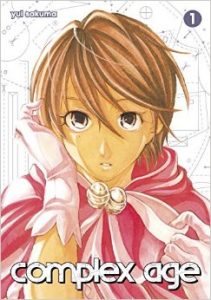
Complex Age, Vol. 1

June 10, 2016 by Ash Brown

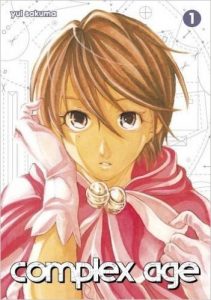
Complex Age, Volume 1Creator: Yui Sakuma
U.S. publisher: Kodansha Comics
ISBN: 9781632362483
Released: June 2016
Original release: 2014
Awards: Tetsuya Chiba Award

I almost passed over the English-language debut of Yui Sakuma’s Complex Age, but I’m very glad that I took the opportunity I had to read it. Complex Age, Volume 1 was first released in Japan in 2014 while the English-language edition of the volume was released in 2016 by Kodansha Comics. I believe that Complex Age is currently the first and only professional work by Sakuma to have been released. The manga began in 2013 as a one-shot which won the Tetsuya Chiba Award. (That one-shot is also included in the first volume of Complex Age.) Then, in 2014, Complex Age was relaunched as a series. While the original one-shot and the longer series don’t appear to be directly related when it comes to characters and plot, they do share a similar basic premise—an adult woman who is growing older and coming to terms with what that means for her hobbies and interests. I actually didn’t know that was what Complex Age was really about before reading the first volume. I thought it was simply about cosplay and since cosplay—the passion of the series’ main character—isn’t a particular interest of mine, I wasn’t anticipating that the manga would be story that I would end up so closely identifying with.

Nagisa Kataura is twenty-six years old, lives with her parents, and works as a temp worker for a tutoring agency, but in her spare time she is an accomplished and admired cosplayer. Her favorite character to cosplay is Ururu from the anime Magical Riding Hood Ururu who represents everything she wants to be as a person. Nagisa pours herself into her creations and is known for her attention to detail and high-quality work. She does all that she can to achieve perfection and to completely embody a character. However, despite cosplay being such a huge part of her life, she keeps her hobby a secret from her family and coworkers. Now that she’s an adult it’s become even more difficult for Nagisa to share her passion with people who aren’t already accepting of cosplay; it’s considered by many to be a frivolous hobby more suited for much younger fans. As she ages, Nagisa becomes more and more self-conscious about her cosplaying and the criticism that she receives becomes harder and harder for her to take. And yet Nagisa still loves what she does and cosplay is a very important part of who she is.

Complex Age, Volume 1, page 32At first, I wasn’t sure that I really liked Nagisa. The opening chapter begins with her preparing for an event at which she will be cosplaying Ururu, putting an incredible amount of effort into making sure that everything is just right. But while she is at the event she is exceptionally rude and judgemental of the other people there, her behavior culminating in an outburst in which she harshly and publicly criticizes another cosplayer for not respecting the hobby and for not taking it seriously enough. However, as Complex Age progresses, Nagisa becomes a much more sympathetic, or at least understandable, character. The reason she is so sensitive is that her confidence, self-worth, and personal identity are almost irrevocably intertwined with her cosplaying. And so what Nagisa perceives as an insult to the hobby becomes an insult to her personally; when someone else is more talented or more physically suited to portray her favorite characters, she can only see her own faults and limitations being emphasized in comparison. She’s genuinely afraid that she is getting too old for cosplay and that voluntarily giving it up or being rejected by others because of her looks or age would result in her losing a large part of herself.

Before reading Complex Age I didn’t know much at all about the behind-the-scenes work that goes into cosplay, but the manga generally  incorporates those sorts of interesting details quite nicely into the story. I’m still not particularly interested in or personally invested in cosplay myself, but Complex Age still resonated with me a great deal. Like Nagisa, I’m an adult interested in media and hobbies that many people look down upon or generally associate with a younger age group (in my case, manga and comics among other things). I also know quite well and understand the dangers of allowing a passion to define one’s self or to impact one’s self-esteem. I have dealt with and, if I’m completely honest, continue to deal with many of the same uncertainties, insecurities, and struggles that Nagisa faces in Complex Age. While so far I do like the series, I think that the Complex Age one-shot about Sawako, a thirty-four-year-old woman letting go of her passion for dressing in Gothic Lolita fashion, made an even greater impression on me. (Also, Sawako’s husband is pretty great.) I’m very curious to see if Sakuma will take Nagisa’s story in a similar direction or if ultimately the Complex Age series will be a little less bittersweet than its predecessor.

Thank you to Kodansha Comics for providing a copy of Complex Age, Volume 1 for review.

Filed Under: REVIEWS Tagged With: Complex Age, kodansha, Kodansha Comics, manga, Tetsuya Chiba Award, Yui Sakuma

orange: The Complete Collection, Vol. 2

June 9, 2016 by Sean Gaffney

By Ichigo Takano. Released in Japan by Shueisha and then Futabasha, serialized in the magazines Bessatsu Margaret and Manga Action. Released in North America by Seven Seas.

I’d mentioned while reviewing the first omnibus of orange that it wasn’t a slam dunk that Kakeru was going to be saved. Fortunately, the author agreed with me, and most of this 2nd omnibus shows us that trying to change the future is hard, especially when you’re dealing with someone who killed themselves – it’s not always something you can fix just by being really nice. Naho and the others don’t really screw much up here, and they try their hardest, but there’s a lot going on in Kakeru’s head, and even Future Vision can’t solve his own inner demons. This leads to a devastating chapter that is easily the best of the book, as we see from Kakeru’s POV the thoughts and actions that led to his suicide in the original world.

orange2

And there is, of course, the romance between Naho and Kakeru as well. I’m pleased that the future flashforwards we see here show that Naho and Suwa’s marriage isn’t an unhappy one – they’re two people who’ve led a good life, and even have a kid, but they’re both still devastated by the boy they couldn’t save. Perhaps this is why, despite all the suggestions and hints, the romance is mostly left on the back burner, and we don’t get a definitive “and they married and lived happily ever after” here. Much like A Silent Voice, this is a series that’s trying to be about friendship and overcoming difficulties. Because in the end, after everything they changed, and every way they tried to make Kakeru feel loved and welcome, he *still* tries to kill himself.

But they did make a difference – he pulls back at the last minute, realizing he doesn’t want to die. (Admittedly, Hagita breaking his bike helped – Hagita is mostly used as comic relief throughout, being the “friend nobody likes” sort, but he’s also quite clever and absolutely one of the gang here.) I was rather surprised that, in their tearful talk after his attempt, they all confess they got letters from the future, and show them to him. The science of how this happened is very vague, and I don’t think we’re meant to dwell too hard on it. In the end, appropriately, the six friends bury the time capsule we’ve seen before, only now dedicated to a new future.

There wasn’t quite enough orange to fill a 2nd omnibus, so we get a short multi-part romance from the same author, Haruiro Astronaut. It’s not as good as the main story, but isn’t too bad, and has some good twists – the romantic setup is theoretically between the cool guy and the sweet guy, but ends up taking a third option, and there’s some talk about actually trying to care about what girls think rather than just trampling all over them. It’s good, but the main draw of this collection is orange itself. It’s excellent, and both omnibuses are absolutely worth your money.

Filed Under: REVIEWS

Everyone’s Getting Married, Vol. 1

June 8, 2016 by Anna N

Everyone’s Getting Married Volume 1 by Izumi Miyazono

As far as I’m concerned, Shojo Beat’s recent practice of releasing the occasional josei title is one of the best things ever. Manga featuring non-highschoolers is still not so easy to find, so I was looking forward to Everyone’s Getting Married. At the same time, just based on the title I was a bit concerned that this would be a josei version of The Rules or something that would involve trapping a man into marriage. I was really happy to discover that I enjoyed the personalities and relationship dynamic between the main couple in this manga.

Asuka Takahashi is a successful real estate agent, but her main ambition in life is to get married and become a homemaker. Asuka takes the idea of being a housewife very seriously, mainly due to the fact that she has strong childhood memories of the type of home her mother provided for her as a child. She’s thwarted in her goal in the first chapter when her long term boyfriend breaks up with her. Asuka has a brief encounter with Ryu Nanami when she’s attending a wedding. He’s a newscaster who is determined to never settle down. Asuka and Ryu have an unusually frank exchange about their incompatible goals in life and then part, fully expecting to never see each other again. He tells her “You seem like a great woman, but it would never work out between us,” and she thinks “This man…is not at all what I am looking for.”

Of course, they get thrown together over and over again, because Ryu is the roommate of Asuka’s co-worker Ono. Ryu and Asuka start getting to know each other better, unconstrained by the possibility of a romantic relationship since they’ve mutually ruled each other out. Asuka sees that Ryu is much more of an ordinary person than he appears to be based on his TV persona. He sees that she’s genuinely kind, and he respects the work that goes into keeping a household running even though he has no desire for a wife. They both begin to fall a little in love with each other, but their goals in life for a family and future remain absolutely different. Miyazono’s art is pretty to look at and easy to follow, even though her style isn’t particularly unique.

egm1

Asuka and Ryu end up both being sympathetic and quirky enough to make me wonder which way this story is going to go, even though I’m totally expecting a happy ending. They’re also balanced out a bit by secondary couple Ono and Rio, who have the opposite relationship dynamic where Ono wants to settle down and Rio is determined to keep dating. Overall, this first volume seems like a great addition to the under the radar josei titles coming out under the Shojo Beat line.

Filed Under: REVIEWS Tagged With: everyone's getting married, Josei, shojo beat, viz media

Franken Fran, Vols. 3-4

June 7, 2016 by Sean Gaffney

By Katsuhisa Kigitsu. Released in Japan by Akita Shoten, serialized in the magazine Champion Red. Released in North America by Seven Seas.

Franken Fran has many grotesque, nasty images throughout. There’s blood, gore, other bodily fluids, and truly disgusting things being done to the human body. And yet the most terrifying thing in the entire series is easily Fran herself, who is quite simply impossible to understand or empathize with, and whose concept of what life is does not remotely cross over with the majority of humanity. Fran is simply a force of nature, and this omnibus shows us several times when your jaw drops at what she carries out. Oddly enough, it’s Veronica, her sister the assassin who was introduced at the end of the last book, who ends up being the voice of sanity in the series (as well as the straight man).

frankenfran3-4

This is not to say that Veronica is a good guy, of course. In one of the more touching chapters in this book, Veronica and walking organ bank Adorea go to a high school undercover to, theoretically, give Veronica “social skills”. (The fact that Fran is the one who says she doesn’t have these is one of the best jokes in the book.) Of course, veronica is a small, sullen, scarred girl, so naturally she proceeds to get bullies to hell and back, with only one other girl nice enough to be friends with her. And then, of course, everything goes even MORE horribly wrong, as we discover a slavery ring and Veronica has to clean house and chop up a few bad guys. If this were a normal, non-funny thriller series, Veronica might be the anti-hero.

And of course there are the plots of the chapters themselves. Franken Fran is to a large degree an anthology horror series, with Fran and her occasional cast dealing with tragic young love, evil matriarchs seeking immortality, and of course at least two chapters dealing with bugs, which are absolutely not for the squeamish. There’s even a cameo by a certain cult religious deity. The two best chapters in the book are two of the most touching (note that I’m defining touching in the venue of Franken Fran, not beyond it) – in one, a suicidal young man who changes his mind is given new life as a children’s mascot, and crosses paths with a young girl who’s being abused by her father. In the other, a young girl’s dog is killed by a truck, and it’s Fran to the rescue, though her new dog is, shall we say, not what you’d expect. The series even mocks itself by having a Hollywood movie made out of the latter chapter, with dire consequences. (“The bestiality was a nice touch.”)

In the end, Franken Fran is about the stories. They won’t make you feel good, they may gross you out, and one or two of them may give you nightmares. But they’re all stories that stay in your head. And Fran, being a protagonist (I refuse to call her a heroine) who is our guide through this twisted world, is just as memorable.

Filed Under: REVIEWS

Umineko: When They Cry, Vol. 13

June 5, 2016 by Sean Gaffney

Story by Ryukishi07; Art by Hinase Momoyama. Released in Japan in two separate volumes as “Umineko no Naku Koro ni: Dawn of the Golden Witch” by Square Enix, serialized in the magazine GFantasy. Released in North America by Yen Press.

“Beatrice was dead: to begin with. There is no doubt whatever about that. The register of her burial was signed by the clergyman, the clerk, the undertaker, and the chief mourner. Lambdadelta signed it. And Lambdadelta’s name was good upon ‘Change, for anything she chose to put her hand to. Old Beatrice was as dead as a door-nail.”

OK, sorry, that just had to be done. Welcome to the new arc of Umineko, folks, and here’s 500 more pages of Rokkenjima antics. And yes indeed, Old Beatrice is dead, and won’t be returning. Luckily for us, Battler is a bit upset about that, and so we have new, Fledgling Beatrice. Sadly, new Beatrice acts meek and mild, and seems to regard Battler as more of a father than anything else. Yes, sorry to say, if you thought creepy incest themes were only in the third arc, guess again.

umineko13

Battler understands how magic really works now, so recreating *a* Beatrice isn’t that hard. But this isn’t his Beatrice, as she has not experienced the thousand years of endless torture that turned her into the Endless Witch. As a result, Battler is a bit upset at her very presence, which is a shame as she really, really wants to be nice to him. Fledgling Beato (the translation does not use the term “Chick Beato” as the games did – I thank them for that) is, personality-wise, much the same as the Beatrice that Rosa found in the secret mansion back in 1967 or so. And Battler is, of course, very reminiscent of Kinzo lately. I don’t like where this is going.

Luckily there are many other aspects to this series, as always. Erika is back as well, and she’s naturally at her best when at her worst, destroying Maria’s concept of magic to such a degree that even Gertrude and Cornelia are calling it completely pointless. Erika is a villain you love to hate, and even though she is also part of the endless cycle of ‘bullied becomes the bully’ thanks to suffering at Bern’s hands, her total contempt for anything other than truth leads her to arrogance and scorn. Also returning, after an Arc’s absence, is Ange, somewhat surprised to not be dead. She’s here to investigate the supposed author of the 3rd-5th arcs, Tohya Hachijo – or rather to her true self, Featherine Augustus Aurora, who seems to be a Witch along the lines of Lambda or Bern, only infinitely more arrogant. (The connection to Higurashi’s Hanyuu, subtle in the VN, is made far more explicit here.)

And then there’s our romantic couples. It is rather sweet seeing Kanon finally work up the courage to confess to Jessica, and she does more happy blushing here than she has in the last five arcs combined. It is also somewhat interesting to see George confess to his past mindset and pettiness – honestly, the entire section makes teenage George sound a bit like an MRA, and I’m glad to see he has matured to a degree where he can confess to how stupid it is. The more interesting question here, though, is the need for magic in order to make them happy. Yes, the whole master/servant relatioship is a worry, but not a big enough worry to require a literal miracle. Why do Shannon and Kanon need magic for their love to be fulfilled? Why is Beatrice so determined to be with Battler even though she keeps calling him father? Why does Ryukishi07 feel the need to introduce a second Greek Chorus to expound just about love? And why does the manga always make Ange a giant brocon, something that isn’t in the VNs? Is it just for the lulz?

The art, by the way, is from the artist who did the Higurashi Massacre volumes, and it’s pretty good. Like several of the other artists, she knows when to emphasize the sauciness in ways readers will like – hence Fledgling Beato and Elder Beato crushing their chests together – but also to make fun of it in the 4komas later. If you enjoy Umineko, there’s nothing to worry about here, except more attention to incestual romances than I’d perhaps like.

Filed Under: REVIEWS

The Manga Revue: I Am a Hero

June 4, 2016 by Katherine Dacey

Can the market support another zombie comic? That’s the question at the heart of this week’s column, as I examine Kengo Hanazawa’s I Am a Hero, a manga about a geeky artist living through a zombie apocalypse. Bone appetit!

I_am_a_HeroI Am a Hero, Vol. 1
By Kengo Hanazawa
Rated Older Teen, for ages 16+
Dark Horse, $19.99

At first glance, I Am a Hero looks like a Walking Dead clone, complete with gun-toting vigilantes and hungry zombie hordes. Peel back its gory surface, however, and it becomes clear that I Am a Hero is really a meditation on being trapped: by a dead-end job, by thwarted expectations, and by fears, real and imagined.

The “hero” of Kengo Hanazawa’s series is thirty-five-year old Hideo Suzuki. Though Hideo tasted success with the publication of his own manga, his triumph was short-lived: Uncut Penis was cancelled just two volumes into its run. He now toils as a mangaka’s assistant, working alongside other middle-aged artists whose professional disappointment has curdled into misogyny and grandiosity.

Compounding Hideo’s problems is his fragile mental state. He hallucinates, talks to himself, and barricades the door to his apartment against an unspecified threat, in thrall to the voices in his head. Despite his tenuous grasp on reality, Hideo is the only one of his co-workers who notices the small but telling signs that something is deeply amiss in Tokyo. Hideo soon realizes that his long-standing fears might actually be justified, and must decide whether to hunker down or flee the city.

Getting to Hideo’s do-or-die moment, however, may be a challenge for some readers. The first act of I Am a Hero is a tough slog: not only does it focus on a cluster of strenuously unpleasant characters, it documents their daily routines in painstaking detail. The tedium of these early chapters is occasionally punctuated by vivid, unexplained imagery that calls into question whether the zombies exist or are a figment of Hideo’s imagination. What the reader gradually realizes is that Hideo’s paranoia makes him alive to the possibility of catastrophe in a way that his bored, self-involved co-workers are not; they’re too mired in everyday concerns to notice the growing body count, a point underscored by the banality of their workplace conversations, and their shared belief that women are the real enemy.

When the zombie apocalypse is in full swing, Hanazawa delivers the gory goods: his zombies are suitably grotesque, retaining just enough of their original human form to make their condition both pitiable and disturbing. Hanazawa stages most of the action in tight spaces–an artist’s studio, a pedestrian footbridge, a hallway–giving the hand-to-hand combat the stomach-churning immediacy of a first-person shooter game. Only when Hanazawa cuts away to reveal a fire-ravaged, chaotic landscape do we fully appreciate the extent to which Tokyo has succumbed to the zombie plague.

It’s in these final moments of the book that Hideo glimpses an alternative to his miserable existence–the loneliness, anonymity, and failure that, in his words, have prevented him “from being the hero of my own life.” How he escapes these emotional traps–and those pesky zombies–remains to be seen, but it seems like a journey worth taking. Count me in for volume two.

A word to parents: I Am a Hero is less gory than either The Walking Dead or Fear the Walking Dead, but contains scenes of disturbing violence and frank sexual content. Dark Horse’s suggested age rating seems appropriate for this particular title.

Reviews: At Brain vs. Book, Jocelyn Allen looks at two untranslated series: Akina Kondoh’s A-ko-san no Koibito, a josei manga about a woman juggling two love interests, and Machiko Kyo’s Nekojou Mu-Mu, a comic about an outrageously cute cat. Matt Brady, host of Warren Peace Sings the Blues, weighs in on the third installment of JoJo’s Bizarre Adventure: Phantom Blood. And at Three if By Space, Robert Prentice explains why My Hero Academia is truly a comic for all ages.

  • Manjiorin on The Birth of Kitaro (The OASG)
  • Demelza on Blood C: Demonic Moonlight (Anime UK News)
  • Adrienne on Cute Life of Mary and Lola (Heart of Manga)
  • Che Gilson on vol. 1 of Fairy Girls (Otaku USA)
  • Tony Yao on Food Wars: Shokugeki no Soma (Manga Therapy)
  • Marissa Lieberman on vol. 1 of Gakkyu Hotel: School Judgment (No Flying No Tights)
  • A Library Girl on vol. 7 of His Favorite (A Library Girl’s Familiar Diversions)
  • Michael Burns on vol. 2 of How to Raise a Boring Girlfriend (AniTAY)
  • Steve Foxe on vol. 1 of I Am a Hero (Paste Magazine)
  • Svetlana Fedotov on vol. 1 of I Am a Hero (Fangoria)
  • Helen on Itihasa (The OASG)
  • Anna N. on vol. 20 of Kamisama Kiss (Manga Report)
  • Khursten Santos on Minori no Te (Otaku Champloo)
  • Saeyong Kim on vol. 1 of Monthly Girls’ Nozaki-Kun (No Flying No Tights)
  • Sean Gaffney on vol. 3 of Monthly Girls’ Nozaki-Kun (A Case Suitable for Treatment)
  • Gabe Peralta on vol. 3 of Monthly Girls’ Nozaki-Kun (The Fandom Post)
  • Gabe Peralta on vol. 1 of My Youth Romantic Comedy Is Wrong as I Expected (The Fandom Post)
  • Ken H. on vol. 1 of Mysterious Girlfriend X (Sequential Ink)
  • Kory Cerjak on vol. 1 of Mysterious Girlfriend X (The Fandom Post)
  • Matthew Alexander on vol. 11 of Path of the Assassin (The Fandom Post)
  • Matthew Alexander on vol. 12 of Path of the Assassin (The Fandom Post)
  • Jason Thompson on vol. 1 of Princess Jellyfish (Otaku USA)
  • Nic Willcox on vol. 1 of Puella Magica Homura Tamura (No Flying No Tights)
  • David Brooke on vol. 2 of Real Account (AiPT!)
  • Rebecca Silverman on vol. 4 of Requiem of the Rose King (Anime News Network)
  • Lori Henderson on The Secret Sakura Shares (Manga Xanadu)
  • Sarah on vol. 5 of Servamp (Anime UK News)
  • Matt on vol. 7 of A Silent Voice (AniTAY)
  • Jason Thompson on Sweetness & Lightning (Otaku USA)
  • Nic Willcox on vol. 1 of Sword Art Online: Girls’ Ops (No Flying No Tights)
  • Demelza on vol. 1 of To the Abandoned Sacred Beasts (Anime UK News)
  • Daniel Boyd on vol. 3 of Ultraman (No Flying No Tights)
  • Sarah on vol. 10 of What Did You Eat Yesterday? (Anime UK News)
  • Sophie Knight on What Is Obscenity? The Story of a Good-for-Nothing Artist and Her Pussy (The Japan Times)
  • Michelle Martinez on What Is Obscenity? The Story of a Good-for-Nothing Artist and Her Pussy (New York Journal of Books)
  • ebooksgirl on vol. 12 of Yotsuba&! (Geek Lit Etc.)
  • Marissa Lieberman on vol. 1 of Yowamushi Pedal (No Flying No Tights)

Filed Under: MANGABLOG, REVIEWS

Kitaro, Vol. 1: The Birth of Kitaro

June 3, 2016 by Ash Brown

Kitaro, Volume 1: The Birth of KitaroCreator: Shigeru Mizuki
U.S. publisher: Drawn & Quarterly
ISBN: 9781770462281
Released: May 2016
Original release: 1966-1968

In 2013, comics publisher Drawn & Quarterly released Kitaro a volume collecting stories from Shigeru Mizuki’s most well-known and beloved manga series GeGeGe no Kitaro. I absolutely loved the collection and so I was thrilled when Drawn & Quarterly announced that it would be publishing more of Mizuki’s GeGeGe no Kitaro in English as part of its Enfant line of kids comics. The Birth of Kitaro, released in 2016, is the first of seven planned Kitaro volumes with stories selected, with input from Mizuki, by the manga’s translator and yokai scholar Zack Davisson. The Birth of Kitaro collects seven stories originally published in Japan between 1966 and 1968, an essay about the history of Kitaro as well as an additional guide to yokai written by Davisson, and an utterly delightful section devoted to yokai-themed activities such as a word search, a maze, and several matching games among other fun challenges.

The tales in The Birth of Kitaro begin with the origin story of Kitaro, a powerful and mostly benevolent yokai boy. (“The Birth of Kitaro” also explains why his father, Medama Oyaji, is a disembodied/embodied eyeball.) The chapter was first published in the influential alternative manga magazine Garo. The other six stories chosen for the collection were created with a slightly younger audience in mind and were serialized in Shonen Weekly and as well as the magazine’s special edition. The second chapter, “Nezumi Otoko versus Neko Musume,” introduces one of the series’ primary recurring characters. Nezumi Otoko, one of Kitaro’s yokai friends even though he is a bit of jerk, tends to either cause trouble or get himself into trouble, needing to be chastised or rescued by Kitaro depending on the circumstances. The other stories included in The Birth of Kitaro are “Nopperabo,” “Gyuki,” “Yokai of the Mountain Pass,” “Makura Gaeshi,” and “Hideri Gami.”

The Birth of Kitaro, page 43As much as I loved Drawn & Quarterly’s original Kitaro collection, I think that I may love The Birth of Kitaro even more. All of the stories selected for the volume are a little bit creepy, a little bit scary, and a little bit gross, but they are also a great deal of fun and can be rather funny, too. I had actually forgotten just how amusing Mizuki’s Kitaro manga could be; the mix of scariness and silliness in the series is marvelous. Mizuki has a terrific sense of humor and comedic timing, perfectly balancing the chuckles with the chills and thrills in the manga collected in The Birth of Kitaro. The horror and the humor work together to create an incredibly enjoyable read. It also doesn’t hurt that Kitaro is a likeable lead to begin with, and that the supporting characters like Nezumi Otoko and Medama Oyaji, with their distinctive personalities and entertaining interactions, add a tremendous amount to enjoy in the series as well.

Mizuki’s Kitaro manga is steeped in yokai lore which I love. Other readers picking up The Birth of Kitaro may not be as familiar with Japan’s mysterious monsters and phenomena, but the volume is still very approachable and accessible. The stories themselves provide an entertaining introduction to yokai (from time to time even Kitaro must do a bit of research in order to effectively confront and deal with troublesome spirits) and for readers who are curious to learn more, Davisson’s “Yokai Files” are an informative addition to the volume. The Birth of Kitaro is an excellent all-ages manga, suitable for younger readers who enjoy a bit of a scare and supernatural excitement while still being entertaining and appealing for adults. It’s also a wonderful overall package, with fun and games, the manga itself, and background information all together in one place. The new Kitaro series in English is off to a fantastic start with The Birth of Kitaro; I can’t wait for the next volume to be released.

Thank you to Drawn & Quarterly for providing a copy of The Birth of Kitaro for review.

Filed Under: REVIEWS Tagged With: Drawn and Quarterly, Kitaro, manga, Shigeru Mizuki

Strike the Blood, Vol. 3

June 2, 2016 by Sean Gaffney

By Gakuto Mikumo and Manyako. Released in Japan by ASCII Mediaworks. Released in North America by Yen Press.

You’ll pardon me if I find myself saying the same things I said in the first two reviews of this series. I have gotten to the point where I almost wish Strike the Blood was worse than it actually was, as that might actually make it slightly more surprising, even in a horrible way. But no, this is very much a series that fulfills its function. It has a lot of cool, well-written action scenes, the plot advances incrementally, the hero gets a couple of new girls who like him, and the heroine sees this and is cool and frosty to him for reasons he can’t quite figure out. It’s very well colored, but never goes outside the lines. Not once.

strike3

Oddly, you would expect a series like this to have varied covers, usually with the hero and a different girl on each of them. that is one thing Strike the Blood does do differently – each cover is Yukina posing for the reader, reminding readers that she is the main heroine whether they like it or not. And as a main heroine, she’s pretty good. The main reason I’m interested in her is that she seems to get frosty when the hero does something that implies he’s not attracted to her, rather than the usual punchy. Her overly earnest personality balances nicely against the more normal childhood hacker friend, the classic tsundere not-lesbian, and (introduced here) the shy princess and her sister, the teasing princess. Of course, the fact that all those are classic harem series archetypes also says something about what we’re reading here.

As for non-harem plot antics, well, trying to turn your adopted daughter into an Angel in order to make her happy is certainly not something you’ll see every day. I did appreciate that Kensei’s motives were given a bit of depth, showing off the somewhat misplaced love he has for her, even if his solution is appalling. It made a nice contrast with Beatrice, who comes to us right out of sneering female villains 101, and is such a cliche that it begins to verge on parody. Same with the elder princess, La Folia, who is noble and very royal, but also introduced to the reader by being found bathing in a stream, and also becomes the latest girl Kojou has to bite in order to release a beast monster to save the day.

I would ideally like something in this series to horribly offend or appall me, so that I could simply drop it and that would be the end of it. But no, Strike the Blood continues to be quietly competent and eminently enjoyable, provided you hate surprises. The hero is a nice guy, but if it weren’t for the illustrations provided throughout, I’d likely imagine him as looking exactly the same as Touma from A Certain Magical Index, a series which this has some similarities with. Index’s prose can be a bear to read, though, and it does throw the occasional curveball. Strike the Blood is batting practice. Straight down the middle, book after book.

Filed Under: REVIEWS

Monthly Girls’ Nozaki-kun, Vol. 3

May 31, 2016 by Sean Gaffney

By Izumi Tsubaki. Released in Japan as “Gekkan Shoujo Nozaki-kun” by Square Enix, serialization ongoing in the online magazine Gangan Online. Released in North America by Yen Press.

There’s not really much in the way of plot or character development in a series like Nozaki-kun (indeed, much of the comedy relies on everyone not growing or learning in any way), so when it comes to reviews such as this, I need to look elsewhere to find things to talk about. This is another great volume, and Chapter 27 is one of my favorites in particular. It’s a pitch-perfect example of how everything is about the gags, but it doesn’t overuse the same gag, and its comedic rhythms are highly suited to the 4-koma style. It bears examining, so let’s do so.

nozaki3

We begin with what is probable the ‘default’ gag in this series, as Nozaki and Mokoshiba show up pretending to be delinquents because Nozaki has to write in a rival character. They’re horrible at it, of course, so this leads to 2-3 pages of them doing something silly or out of place and Sakura giving her best tsukkomi comeback. She fulfills her traditional straight man role. However, we can’t forget that Sakura is in love with Nozaki. And, as we see when he attempts to climb a tree, fails miserably, and her heart skips a beat, she seems to especially be in love with Nozaki being an adorable loser. We then have 3-4 pages devoted to Mikoshiba and his issues, ranging from his embarrassment to simply being unable to climb back down the tree, and both Nozaki and Sakura serve as dual straight men. Finally, they leave and Seo shows up, being a genuine “delinquent”. Now it’s Mikoshiba who’s the straight man, observing Seo’s uncaring, oblivious antics. And Seo ends up getting the final punchline: “I’m late ‘cos a cute guy fell from the sky”.

In non-Chapter 27 news, Seo proves that she can use her obliviousness for good as well as evil when she buys a new exacto knife for Wakamatsu, and they also go on the worst date ever (at last from Wakamatsu’s POV); we see that everything horrible in Ken’s life is a result of Maeno’s very existence; While searching for a flaw that Suzuki could have, Nozaki misses the obvious, which is Kashima’s incredibly horrible singing voice; We find that Hori really is an excellent actor, but has trouble distinguishing between the actors and the characters they play, be it wanting to beat up Kashima or Miko-rin’s resemblance to a shoujo heroine; And Sakura’s attempts to show her affection fail miserably, be it old Valentine’s Day chocolate or someone mistaking her for the third wheel in a love triangle.

If you dislike standard Japanese comedy, this may not be as funny to you – much of the humor still relies on screaming “what the heck?” in disbelief. But for me, this is top drawer humor, and the 4-koma format means it doesn’t have to stop for pesky story development like Oresama Teacher, her other series. I love this series.

Also, though they aren’t as prevalent as before, the tanukis continue onward.

Filed Under: REVIEWS

Kamisama Kiss, Vol 20

May 30, 2016 by Anna N

Kamisama Kiss Volume 20 by Julietta Suzuki

This volume starts dealing more with the issues that inevitably arise when a human and an immortal start developing romantic feelings for each other. It starts out with a conclusion of the class trip storyline, as Tomoe is able to observe what Nanami is like when hanging out with other human girls. When he goes on an errand to an island where he met a human kami many years before, he gets a vivid reminder of how short Nanami’s lifespan is.

Tomoe decides that he has to become human, and he wants that transformation to happen immediately. Nanami thinks that it is good that Tomoe is trying to get closer to humanity through some excessive studying, but she thinks that it won’t happen for several more years. When Tomoe gets his hands on some medicine that might have the power to transform him, she’s worried that he’ll die in a normal human lifespan, but he doesn’t want to remain immortal and watch her age and die. They fight a bit about this, and Tomoe goes off with his usual impulsive nature and takes the medicine, only to turn into a fox instead of a human.

This funny and sad situation brought on by mystical forces is the type of plot that Kamisama Kiss excels at, because it is hilarious to see Tomoe’s body language and cranky attitude manifest while in the form of an adorable fox, but it is also quite distressing that Nanami and Tomoe are being kept apart again. The appearance of Kirihito towards the end of the volume points out that there are going to be even more struggles ahead for the couple.

kamisama20

One of the things I like most about this series are the quiet moments of character interactions, when Tomoe contrasts his memories the human kami he met as a little girl with the old woman she’s become, she mentions that the day she spent with him was one of her fondest memories. Nanami can’t help herself from hugging Tomoe when he’s in fox form, but she’s struck by his body language showing that he’s incredibly unhappy with his unexpected transformation. These types of moments give Kamisama Kiss more depth than the typical shoujo series, and have me happily reading every volume.

Filed Under: REVIEWS Tagged With: kamisama kiss, shojo beat, shoujo, viz media

Overlord: The Undead King

May 29, 2016 by Sean Gaffney

By Kugane Maruyama and so-bin. Released in Japan by Enterbrain. Released in North America by Yen On.

Given the extreme popularity of Sword Art Online, Log Horizon, and similar titles in Japan (and now in North America, where you can’t seen to walk ten feet before hearing about a similar series being licensed), it makes sense that we’d start to see series that play around with the format, or use it as a springboard for something else. Such a series is Overlord, which spends much of its first quarter or so making you think that the main character is going to find himself trapped in the game he loves so much only to end up being somewhere a bit different – he, and all his NPCs, are transported to a different fantasy world. Oh yes, and he played the game as an evil undead skeleton, and his minions are equally evil.

overlord1

With SAO, we saw a brand new game just opening. In Log Horizon, it was a popular game receiving a brand new update. And Overlord has Yggdrasil, which is a popular game whose time has now passed, and it’s getting its servers shut down. Our hero (who has three names throughout the book, but who I’ll call Ainz for convenience) was one of about forty players who had their own guild, which was composed of “monsters”, i.e. non-humanoid characters. Of course, that was a while back. Now he wants to have a party to celebrate the end of the game, and only three other players bother to show, and they all bail early. Right away you get the sense that he is more intensely devoted to the game than the others, but also that he is far more unfulfilled in real life than they are – he admits all he does is work, eat and sleep.

And now he, his group of somewhat cliched NPCs (all of whom have detailed backstories written by the other players, which is how we find out about them), and his giant hellish fortress are bounced into the middle of this fantasy world fighting a battle among three various empires. Luckily, there’s one tiny village that seems to be a focal point for all three, either as “killing everyone in the village will set an example” or “we are heroes, so must save this village no matter the cost”. Into this wanders Ainz, who tries to remain aloof and dispassionate but is still not about to let a cute teenage girl and her sister get run through.

I’ve summarized a lot of plot here, usually a sign that I don’t know what else to write about, but that’s not really true here. There’s a lot to work with after this first book has finished. Ainz is dispassionate because his undead form suppresses emotions – is he even human anymore? He still seems to regard this as a game he’s trapped in – will this change? And then there’s his NPCs, suppliers of most of the humor in the title – Albedo, his main subordinate, has a massive crush on him do to his being stupid before the “server shutdown”, and this leads to typical anime yandere humor. His NPCs also have motivations that go beyond obeying his command, something I don’t think he grasps yet.

So there’s a good many ways this title can go, and I am quite pleased I read it. That said, I do hope that it continues to play with its cliches rather than embracing them – there’s always a danger that this becomes a straight=up male power fantasy sort of title, and I think it could be much more than that.

Filed Under: REVIEWS

Nichijou: My Ordinary Life, Vols. 1-2

May 27, 2016 by Michelle Smith

By Keiichi Awari | Published by Vertical Comics

nichijou1I wasn’t sure I was going to like Nichijou. Gag manga aren’t really my thing, even when created by mangaka whose other works I enjoy. However, the back cover promised character growth and a take on the school genre that it was “just surreal enough,” so that compelled me to give it a shot.

The manga so far focuses on a handful of students who begin with pretty much a single defining trait. Nano Shinonome is a robot who mistakenly believes she’s kept this fact a secret from her classmates. Yuuko Aioi is described as “cheerful,” and proves to be fond of really bad jokes and prone to forgetting to do her homework. Mio Naganohara is “normal,” but might secretly be a BL fangirl. Mai Minakami is “quiet,” but also seems to enjoy pushing Yuuko’s buttons. There are a few other characters too, like the rich boy and the girl who likes to blow him up, but they don’t factor in as much.

nichijou2While I can’t say that any of the gags in these two volumes made me laugh, they did make me smile quite often. Rather than the jokes themselves, I think what I like the best was how Arawi-sensei depicted them. He’s got great comic timing, and just the way the panels are laid out makes things funnier. There’s one moment, for example, where Yuuko realizes she has left the homework she actually bothered to do at home, so we get her anguished cry of “Damn it!” depicted from three different angels in the same panel. I also loved it when the “camera” panned to the side to show someone else reacting to what’s happening with the main characters, and there’s also a fantastic nonverbal chapter about building a house of cards.

My favorite moments in these two volumes, however, involve animals. The one character whom I actually kind of hate so far is “the professor,” the eight-year-old who created Nano and who refuses to remove the wind-up key that Nano is so desperate to get rid of. But in volume two, they take in Sakamoto-san, a talking cat (thanks to a bandana the professor created) who tries his best to be dignified but who can’t resist giving in to his kitty instincts. I also adore the canine whom I have dubbed “solidarity dog,” a pooch who shows up a couple of times when Yuuko has been exiled to the hallway and places a silent paw of commiseration upon her. There’s a great 4-koma relating to him, too.

All in all, I enjoyed Nichijou, and I look forward to the next volume!

Nichijou is complete in ten volumes. Vertical will release volume three in July 2016.

Review copies provided by the publisher.

Filed Under: REVIEWS Tagged With: Keiichi Arawi, vertical

Baccano!: The Rolling Bootlegs

May 26, 2016 by Sean Gaffney

By Ryohgo Narita and Katsumi Enami. Released in Japan by ASCII Mediaworks. Released in North America by Yen On.

If you’re familiar with Durarara!!, then you may know that this was the author’s first major series. It also had a (far less successful) anime. That said, the two fandoms don’t really interact, particularly in North America. DRRR’s fandom is very much about two or three characters that people obsess over, while Baccano’s tends to be more about the books themselves, and overanalyzing its cast to death. Given that DRRR is doing well over here, it was a natural pickup, and I am very pleased to see that Yen On is releasing it. This first volume introduces us to much of the main cast, and shows us how they became involved with demons, alchemy, and immortality.

baccano1

Those familiar with the anime may be disappointed, as we don’t jump around between various time periods in this book (you’ll have to wait till Book 2 for the train). It’s all about what happens in 1930, where various plots are all happening at the same time. A young punk named Firo is joining the ranks of the Camorra (think Mafia, only less Sicilian and more Italian); two incredibly eccentric thieves are trying to turn over a new leaf by stealing for the right reasons, only their reasoning is highly suspect; and an old man and his female chauffeur and bodyguard are trying to resurrect a liquor that will grant complete immortality to anyone who drinks it – something the old man already has, but he wants to recreate it anyway just to show that he can. Gradually these plots and others interact with each other until it all ends in one giant confrontation and there are many dead bodies… of course, given we’re also dealing with immortality, are they really dead?

I suspect the average Baccano! reader over here will already be spoiled as to its plot, which is a shame, as there’s a lot of twists and turns to let us wonder who’s really immortal, who really knows who’s backstory, and what exactly is going on. Like DRRR, the ‘heroes’ of the book are morally ambiguous, in this case mostly being mobsters. Firo is a sweet young kid, except he’s also got a way with a knife, is unflinching at running an illegal gambling den, etc. It’s a matter of degrees. The worst is clearly Szilard Quates, the aforementioned old man, who will use anyone and anything to get what he wants. That said, if you’re looking for a protagonist of this particular volume, I’d say that it’s Ennis, the chauffeur/bodyguard. Thanks to interaction with the cast, she grows and changes more than anyone else, and her inner monologue is both heartbreaking and heartwarming at the same time.

And then there’s Isaac and Miria. They may never be the protagonists of the individual books, but they are the poster children and mascots for the series itself, and their glorious idiocy is on full display here. They both possess an illogical logic, reminiscent of Gracie Allen, and I suspect an entire book of them would be exhausting. But as a spice, they’re perfect. The book gives depth to several characters via thoughts and actions not seen in the anime, and even Isaac and Miria are no exception. It’s never clear if they’re actually lovers or not, but they are most certainly in love with each other. They are a joy and a treat.

It’s hard for me to look at Baccano! with a fresh mind, as I’m so familiar with the series as a whole. For fans of the anime, you’ll see new and changed things. For those who like DRRR, it has a similar chaotic style. If you like characters who are completely trash scum, Dallas Genoard is right up your alley. I would argue that if you are unsure and want to sample the absolute top of the line books in the series, you might wait to sample books 2 and 3 (which come as a set). And the art gets better, honest – it’s very sketchy here, with some characters bearing only minimal resemblance to what they look like 6 or 7 books later. But honestly, this is also an excellent introduction to the clamor and noise that is Baccano!.

Filed Under: REVIEWS

Requiem of the Rose King, Vol. 4

May 24, 2016 by Anna N

Requiem of the Rose King Volume 4 by Aya Kanno

This series continues to impress me, as with each volume Kanno capably delivers a larger cast of characters and more intricate plots centered around the succession to the English throne. While many of the earlier volumes served to establish the motivations of many of the characters, this volume moved into more political plotting, especially as the Earl of Warwick decides to play kingmaker.

I found myself struck by all the ways that Kanno’s art signals character in elegant ways. Richard has a vision of his father as an avenging angel with dark wings, and the swooping black feathers bordering the panels serve to show how isolated Richard is in his inner world. Warwick is often drawn with areas of his face shown in stark shadow, which suits his manipulative personality.

This volume focuses on the fall of Edward, his manipulative wife, and the possible rise of middle brother George. Richard is still an object of desire to Edward, who willingly travels to meet Anne to explore a possible engagement once he knows that Richard is also visiting. For a brief time Richard is able to deepen his friendship with Anne, and he finds some solace in a new friend who lets him be completely himself. This being a tragedy, Richard’s brief period of peace is quickly destroyed, and he has to head back into battle again where he thinks he’s going to find a different kind of escape.

As Warwick’s plots fall into place, Buckingham is determined to provide a different king for the nation and goes off in search of Richard. There are too many kings and would-be kings wandering around England! But it is clear that while they all may be trying to gain the throne, so much of the real power is in the hands of the nobles trying to manipulate all the political uncertainty.

Requiem of the Rose King continues to be a favorite series. The art is absolutely top notch, and the combination of Richard’s surreal visions and complicated inner life against the backdrop of the political struggles for the English crown makes it incredibly compelling.

rrk4

Filed Under: REVIEWS Tagged With: requiem of the rose king, viz media

Ranma 1/2, Vols. 27-28

May 24, 2016 by Sean Gaffney

By Rumiko Takahashi. Released in Japan by Shogakukan, serialized in the magazine Shonen Sunday. Released in North America by Viz.

The difficulty with these omnibuses is that they can feel very unbalanced. This volume contains one of the strongest emotional and physical battles in the series… in its second half. To get there, you have to wade through Vol. 27 first, which features far more Mousse than is really recommended, Principal Kuno returning when no one wants him to, more possessed inanimate objects, and Hinako falling for Soun Tendo, a storyline that was a bit creepy when it was first released in the 1990s, but now reads as SUPER CREEPY today. Hinako may really be in her 20s, and have the body of a statuesque woman when she sucks out ki, but she looks (and acts) like an 8-year-old most of the time, and that fact makes the entire sequence a bit beyond the pale. Fortunately, Soun is totally oblivious to her, still being very much in love with his late wife.

ranma27-28

However, the 2nd half of this omnibus is top-notch. Ryu Kumon’s backstory, once revealed, may be played up a bit for comedy purposes, but it does feature his only parent killing himself by accident, leaving him alone. As a result, even though he is trying to trick her, Ryu is drawn to Ranma’s mother, who mistakes him for her own son, and he realizes that he can bond with her in ways that Ranma, who is cursed to always be female around her, can’t. This leads Ranma to be more emotional than ever, as his desire to be a good son for his mother, fear of the promise to kill an “unmanly” child that she made, and rage at this upstart taking over his life all coalesce, leading him to be a bit more serious than usual in the ensuing fight.

It helps that Ryu is a top-notch martial artist. As ever, Ranma gets the floor wiped with him till he can figure out how Ryu is fighting and the way to counterattack. It helps that the actual “Martial arts _______” fight this time is one of Takahashi’s all-time cleverest, revolving around entering and leaving a house, and you’d be amazed at how much that can translate into fighting techniques. Of course, the trick is that it’s not a tool for fighting at all – which is why Ryu’s father, who thought it was, inadvertently killed himself trying to use it. As always, Genma and Soun are there to provide running backstory, and Genma seems to be at fault, but for once it’s only accidentally his fault. And the action sequences are really good, Takahashi has found her groove here.

Oh yes, I almost forgot to mention the “Cursed Tunnel of Love” storyline. The anime softened this considerably in terms of Ukyou and Ryouga, the manga doesn’t bother. Ranma and Akane mistakenly think the two are a couple, but the idea is meant to be hilarious – the fights between them are nothing like the fights between Ranma and Akane, they’re just simply Ukyou’s frustration at Ryouga being Ryouga. That said, we’re coming near to wrapping up the series, and it would be nice if at least one of the harem candidates (on either side) got paired off. Oh Ryouga, if only there was a girl out there for you…

Filed Under: REVIEWS

  • « Go to Previous Page
  • Page 1
  • Interim pages omitted …
  • Page 214
  • Page 215
  • Page 216
  • Page 217
  • Page 218
  • Interim pages omitted …
  • Page 342
  • Go to Next Page »
 | Log in
Copyright © 2010 Manga Bookshelf | Powered by WordPress & the Genesis Framework