• Skip to primary navigation
  • Skip to main content
  • Skip to primary sidebar
  • Home
  • About Us
    • Privacy Policy
    • Comment Policy
    • Disclosures & Disclaimers
  • Resources
    • Links, Essays & Articles
    • Fandomology!
    • CLAMP Directory
    • BlogRoll
  • Features & Columns
    • 3 Things Thursday
    • Adventures in the Key of Shoujo
    • Bit & Blips (game reviews)
    • BL BOOKRACK
    • Bookshelf Briefs
    • Bringing the Drama
    • Comic Conversion
    • Fanservice Friday
    • Going Digital
    • It Came From the Sinosphere
    • License This!
    • Magazine no Mori
    • My Week in Manga
    • OFF THE SHELF
    • Not By Manga Alone
    • PICK OF THE WEEK
    • Subtitles & Sensibility
    • Weekly Shonen Jump Recaps
  • Manga Moveable Feast
    • MMF Full Archive
    • Yun Kouga
    • CLAMP
    • Shojo Beat
    • Osamu Tezuka
    • Sailor Moon
    • Fruits Basket
    • Takehiko Inoue
    • Wild Adapter
    • One Piece
    • After School Nightmare
    • Karakuri Odette
    • Paradise Kiss
    • The Color Trilogy
    • To Terra…
    • Sexy Voice & Robo
  • Browse by Author
    • Sean Gaffney
    • Anna Neatrour
    • Michelle Smith
    • Katherine Dacey
    • MJ
    • Brigid Alverson
    • Travis Anderson
    • Phillip Anthony
    • Derek Bown
    • Jaci Dahlvang
    • Angela Eastman
    • Erica Friedman
    • Sara K.
    • Megan Purdy
    • Emily Snodgrass
    • Nancy Thistlethwaite
    • Eva Volin
    • David Welsh
  • MB Blogs
    • A Case Suitable For Treatment
    • Experiments in Manga
    • MangaBlog
    • The Manga Critic
    • Manga Report
    • Soliloquy in Blue
    • Manga Curmudgeon (archive)

Manga Bookshelf

Discussion, Resources, Roundtables, & Reviews

Reviews

Baccano!: 1931 The Grand Punk Railroad: Local

September 1, 2016 by Sean Gaffney

By Ryohgo Narita and Katsumi Enami. Released in Japan by ASCII Mediaworks. Released in North America by Yen On. Translated by Taylor Engel.

I’ve mentioned before that some multi-volume arcs, particularly in light novels, can be seen as “the author just wrote a really long book and they had to cut it in half”. This book, the first of a two-part arc, is not that. We get the start of the story, but some characters are introduced and then forgotten as if they were meant to be minor characters, while others take center stage but then vanish 2/3 of the way through. But that’s OK, because this is one man’s journey to show some courage, defeat the bad guys because it’s the right thing to do, kiss his girlfriend for the first time ever, and also, yes, smuggle a huge amount of explosives into New York City in order to sell it off, as they are a gang as well – this is Baccano!, after all. Yes, this volume’s heroic journey is all about Jacuzzi Splot.

baccano2

If you find the name Jacuzzi Splot to be somewhat unusual, or even laughable, well, you aren’t alone. Many people in Baccano! have odd names, but Jacuzzi’s is pretty much the one that gets folks talking. More to the point, you may be wondering why this, the second book in a series, features almost none of the characters from the first book. Firo, Ennis, Maiza and the Gandors make brief cameos, but for the most part we meet a new huge cast, which luckily proceeds to get violently whittled down as the book goes on, though in general the named characters seem to do pretty well for themselves. It all takes place on a luxury train going from Chicago to New York City, which has the misfortune to be taken over by a) black-suited terrorists who profess they’re trying to get their leader, Huey Laforet, released; b) white-suited psychopaths, led by a mobster’s nephew, who are here to kill people because it’s fun, and c) the aforementioned delinquent gang, the closest we get to good guys here.

We also get Isaac and Miria, who are the thread that draws the two books together. They’re on the train as well, having decided to rob a mafia gang in order to buy Ennis an expensive present to cheer her up, because that’s the sort of people they are. As always, they’re hilarious, but as with the first book, the novel gives them occasional hidden depths, such as Isaac’s rather subdued reaction to a cabinful of corpses, as if he’s used to this. They’re at their best when inspiring others, though, particularly Jacuzzi, who is the sort to take crappy lines like “there’s a gun… in everyone’s heart!” and take them completely seriously. In general, the new characters hold up well and deserve your attention. Goose is an exception. As a villain, he’s very flat, and probably the weakest part of the book, mostly as he pales next to the evil flamboyance that is Ladd Russo, who is jaw-droppingly horrible in a riveting way. Also, due to the nature of the book, several characters seem to be very underdeveloped, namely the unfortunate child Czeslaw Meyer, and Ladd’s passive to the point of being disturbing girlfriend Lua.

So yes, like Jacuzzi at the end of this book, the reader still has questions. Why did Ladd suddenly disappear midway through the book? Why was a child cut to pieces and tied to the bottom of the train? Who is the Grey Magician and why was he cut from the anime completely? And if the woman in fatigues isn’t the Rail Tracer, who is? (The anime reader is at a disadvantage here, knowing the answers to all but one of those questions. The book reads better if you don’t know the true identity of several people.) We will find out in the third book, which tells the same events as the second but from several different perspectives. In the meantime, smile with Jacuzzi, laugh with Isaac and Miria, and wonder who the hell Claire Stanfield really is.

Filed Under: REVIEWS

The Irregular at Magic High School: Enrollment Arc, Part 2

August 31, 2016 by Sean Gaffney

By Tsutomu Sato and Kana Ishida. Released in Japan as “Mahouka Koukou no Rettousei” by ASCII Mediaworks. Released in North America by Yen On. Translated by Andrew Prowse.

Multi-volume arcs in light novel series are nothing new, and quite popular. The usual thing to do is a two-volume arc, though they can balloon up to 5 (Baccano’s 1935 arc) or even 10 (SAO’s Alicization arc). It’s rare to see a series begin with a two-volume arc, and as you read the second volume of Mahouka (as the series is commonly abbreviated to), you guess why – this was originally one huge book that the publisher demanded be cut in half. The author admits this in the notes at the end. As such, it’s not something meant to be taken in on its own, and doesn’t try to be. It’s the second half of the first book, with a few more terrorist attacks and less school prejudice.

irregular2

There’s a lot of talk in these volumes, both in regards to how magic works in the world and in how the political landscape is affected by it. The narration is very much down on the side of those with magic, but at least tries to understand the viewpoint of one who does not have such magic skill, and has to look on in envy and frustration at those who do. In fact, I felt one of the biggest flaws of this book was towards the end, where it was revealed that the cute kendo girl who was working for the bad guys was doing so mostly due to simple mind control, rather than her own misguided beliefs. I suppose the author wants to keep her around rather than expel her, but still, you’d be surprised how often misguided beliefs are a good enough reason on their own and don’t need extra help.

I said this last time, and I will again: I have no idea how the anime handles Tatsuya’s thought process, which is constant throughout the book, but if it simply cuts it and goes with what he’s saying out loud, that’s a horrible mistake. There’s several times throughout this book where he’ll say something and then think to himself that he’s saying that just to go along with the flow, or put people off their guard, and that his feelings are almost the opposite. This even applies to the unfortunate incest subtext that’s still hanging around. It’s not all on Miyuki’s end, and we can see that she and Tatsuya both play it up to the hilt because they know if they exaggerate it that others will dismiss it – as Erika seems to here. Of course, this does not mean it isn’t there.

There’s also a lot of fighting towards the end, and it’s reasonably well done, though of course it does point out that Tatsuya is, shall we say, good at nearly everything. This is not going to change anytime soon, and he’s hardly the worst offender in light novels, but it can be frustrating to an audience that is seeking out a more flawed hero. It’s especially frustrating when combined with his stoic personality, though that can also be a blessing, as imagining Tatsuya as some shonen hothead but with the same abilities gives me a headache. In the end, this was a decent if flawed start to the series, and the next two volumes (this time seemingly intentionally written as an actual two-book series) look to show off an athletics festival between the various schools. Note this comes out in North America at the exact same time as A Certain Magical’s Index’s 2-book athletic festival series, which is an amusing coincidence. Fans of Index, SAO, or magic schools might find Mahouka worth getting.

Filed Under: REVIEWS

Kuroko’s Basketball, Vols. 1 and 2

August 30, 2016 by Anna N

Kuroko’s Basketball Volumes 1 and 2 by Tadatoshi Fujimaki

I enjoy a good sports manga, and this omnibus of the first couple volumes of Kuroko’s Basketball was entertaining, due to a unconventional protagonist.

kb1

The manga opens with a bit of a prologue discussing an unbeatable team at Teiko Middle School that was split up and scattered as the team members, known as “The Miracle Generation”, all went to different high schools. While five players were the superstars, there were rumors of a shadowy sixth man who was actually the key to the team’s success. Flash forward to the present day at Seirin High School, all the clubs are out in force trying to recruit new members. Taiga Kagami is an intense first-year student with a superior attitude because he played basketball in the United States who signs up for the club. Tetsuya Kuroko, an unassuming student who formerly attended Teiko signs up for basketball as well.

Taiga is drawn to look a bit like Hanamichi from Slam Dunk, and while both characters share a brash personality and an abundance of natural talent, Taiga isn’t as idiotic as Slam Dunk’s protagonist. The fact that the manga is called Kuroko’s Basketball is a signal that the stereotypical idea of who the hero is in sports manga is going to be subverted a little bit. It turns out that Kuroko has a unique talent of appearing invisible when he’s playing basketball, which turns into an incredible advantage for the Seirin team, as he’s constantly overlooked and underestimated, only to make key passes and plays for all the other players on his team.

Kuroko’s unassuming nature is often played for laughs, as he frequently seems to pop out of nowhere when he’s just overlooked. His talent doesn’t come without a lot of hard work, as when he’s actually playing a game he is paying such close attention to everyone around him and adjusting in response to opposing players, that he can’t log a significant amount of minutes devoted to basketball invisibility without becoming exhausted. The first couple volumes shows the Seinen team coming together under their bossy girl coach Riko. She begins to get a sense that with Kuroko and Taiga on the team, she may be able to build the Seirin team into something special.

I feel like after reading Slam Dunk, the art for any other basketball manga is going to suffer in comparison, especially because as Slam Dunk wrapped up the art was so glorious. But comparing other manga artists to Inoue is like comparing people to Kirby, just fundamentally unfair. So I suffered a few involuntary pangs of wanting some mindblowing basketball action paneling in Kuroko’s Basketball, but on the whole, it was easy to follow all the action in the basketball games, and Kuroko’s deadpan expression is used effectively to provoke a variety of reactions in his teammates.

As this omnibus volume was wrapping up, a tournament style struggle is set up, with the Seiran team placed in a position where they are going to have to face off against other high school teams, each with a standout player from the Miracle Generation. Kuroko is now playing only for the love of the game, he comments that he didn’t want to play with anyone from his former team because they were so focused on winning at all costs, they weren’t truly appreciating basketball. The dynamic that will be explored in future volumes is if Kuroko’s abilities combined with his new team will actually mean that the sixth man will emerge triumphant. I have to say I’m very happy that with Kuroko’s Basketball, Haikyuu!!, and Yowamushi Pedal (which I haven’t read yet), there is a bumper crop of sports manga coming out in English right now.

Filed Under: REVIEWS Tagged With: Kuroko's Basketball, Shonen, viz media

A Certain Magical Index, Vol. 8

August 30, 2016 by Sean Gaffney

By Kazumi Kamachi and Kiyotaka Haimura. Released in Japan as “To Aru Majutsu no Index” by ASCII Mediaworks. Released in North America by Yen On. Translated by Andrew Prowse.

For the most part, the Index series has Kamijou Touma as the viewpoint character, with most of the books being from his perspective. The exceptions we’ve seen are the 5th book, which has a substantial chunk from Accelerator’s POV, and this novel, which has Shirai Kuroko taking center stage, though honestly the way the book is framed also seems to imply that she really shouldn’t be doing this. Not that she isn’t badass and awesome – she does a number of amazing things throughout the book – but the book puts her through even more damage than Touma, and suggests that this is sort of the thing that happens to protagonists. In addition, she and Touma have the same general outlook as to why they’re getting involved, at least when Misaka is involved – protect her worldview. And if Misaka is an optimistic girl who thinks people are basically swell except a few bad apples, then by god it will be so. Which is fine, except Touma is much better equipped to take on said world, which has a lot more to it than Misaka’s clone experiment.

index8

Introduced in this volume: Uiharu Kazari, Kongou Mitsuko (For once I refuse to acknowledge Yen’s official spelling), Musujime Awaki. Technically we’d seen Awaki twice before, but we didn’t know it was her. Continuity-wise… eurgh. This is the volume where it’s very clear that this is being written before A Certain Scientific Railgun has really gotten off the ground – it comes out a full year before the Railgun manga debuts. As such, Uiharu’s characterization seems very odd with her obsession with being ladylike. The “teasing Kuroko” thing is still around, though, and Kuroko still does not react well. This is right around the time Kongou is introduced in the Railgun manga, which is why it sounds like she’s meeting Kuroko for the first time, and talking about Cliques. That said, in the anime, where she’s introduced much earlier, this makes no sense. This is why spinoffs give me a headache. Oh, and Accelerator and Last Order are still in hospital, being watched by Aiho, who it’s revealed here is friends with Yoshikawa Kikyou.

Whenever I’ve discussed Kuroko before, I’ve said I’ll save my beef with her till this review, and here we are. So let’s face it: Kuroko is a “Comedy Lesbian”, something much beloved among Japanese anime and manga authors. Kuroko is a bit more single-focused than many others, but exhibits the same symptoms – a constant desire to get into Misaka’s pants, even if that means sexually assaulting her without her consent. This is OK to the reader because it’s clearly meant as “comedy” scenes, not to be taken seriously, and Misaka always fends her off. It drives me nuts. It particularly drives me nuts as whenever she’s not in that mode, Kuroko is quite a nice character, devoted to keeping the peace as part of the student task force “Judgment”. At least I won’t get as much of it in the novels, where Kuroko is a minor character by dint of simply not being all that involved with Touma.

The storyline itself ties together many of the loose ends from Books 3 and 5, as Awaki helpfully notes, being very much in the “school of villains who love to hear themselves talk’. She is very clearly set up to be a dark counterpart to Kuroko, right down to similar hairstyles and similar powers – they’re both even Level 4! But Awaki’s villainy is based around selfishness and fear, and Kuroko’s heroism, comedy lesbian antics aside, around selflessness and pride. There is much discussion of the powers that Academy City is developing, and how students who are found to have that kind of power really feel about them. There is also a LOT of technobabble, and Kamachi’s flaws as an author sometimes become apparent in that he will get more excited about his worldbuilding than he will about what’s actually going on. That said, the fights in this are top notch, and Accelerator vs. Awaki at the end has a great quotable line.

So another good book for Index fans, and quite short too – I think it’s the shortest in the series to date. Next time won’t be that, though, as we get Index’s first two-book arc, devoted to the Citywide School Athletic Festival.

Filed Under: REVIEWS

Complex Age, Vol. 1

August 29, 2016 by Michelle Smith

By Yui Sakuma | Published by Kodansha Comics

complex1

Twenty-six-year-old Nagisa Kataura is a perfectionist when it comes to cosplay. As a result, she has a tendency to critique the subpar efforts of others, but when she overhears a critical comment at an event that might be directed at her, she is suddenly plunged into self-doubt. Self-conscious of her height and age, she’s further troubled when she meets Aya, a younger and more petite cosplayer who is physically perfect to cosplay Ururu, the magical girl heroine Nagisa is most known for portraying.

Before reading Complex Age, it had never occurred to me that the world of cosplay could be so emotionally fraught. What I like best about it is how Sakuma is using this niche fan culture to explore universal themes like realizing you’re actually not the best at the thing that you love and struggling to accept that though you may not be perfect, you still have something unique and worthwhile to bring to the table. (I also enjoyed learning about things like how to make a custom wig.)

Another important plot thread is that Nagisa is hiding her hobby from most of the people in her life. She doesn’t want anyone’s negativity to defile her world, nor does she feel compelled to ask them to understand her. We glimpse her a few times at her temp job—and I have to wonder, are her work clothes a costume of their own?—where she doesn’t socialize with anyone except a snooty full-timer, only to end on a horrible cliffhanger as said full-timer spies her at a cosplay event.

I was pretty disheartened to find that, instead of the resolution to that encounter, we were getting the original one-shot instead. However, I was in for a pleasant surprise, because rather than an earlier iteration of the same story, the one-shot version of Complex Age is more of a companion piece, exploring similar themes as married thirty-four-year-old Sawako must decide whether it’s time to give up her Gothic Lolita fashions.

Ultimately, I enjoyed Complex Age a lot and look forward to volume two!

Complex Age is complete in six volumes. Kodansha will release volume two next month.

Filed Under: REVIEWS Tagged With: Yui Sakuma

Tokyo Demons: Know What You Want

August 26, 2016 by Ash Brown

Tokyo Demons: Know What You WantAuthor: Lianne Sentar
Illustrator: Rem, Romy-chan, Tacto

Publisher: Chromatic Press
ISBN: 9780993861185
Released: February 2016

Ever since reading You’re Never Alone, the first novel in Lianne Sentar’s Tokyo Demons, I have been nearly consumed by everything even tangentially related to the trilogy. I find Tokyo Demons to be remarkably engaging and as the series has progressed I have become increasingly invested in both the story and its characters. Tokyo Demons has a small but very loyal fanbase, so perhaps it isn’t too surprising that it became one of the flagship titles not only for Chromatic Press and the Sparkler Monthly magazine but also for Cherry Bomb, an imprint that provides an opportunity for Sparkler Monthly creators to explore more mature, sexually-charged stories and themes. Know What You Want, released in 2016, is the first Cherry Bomb collection to be compiled. It brings together four Tokyo Demons Cherry Bomb stories–”Building Up,” “Coming Down,” “Never Again,” and “Save Me/Don’t Save Me”–originally published online between 2014 and 2015. The volume also includes illustrations by Rem and Romy-chan and collects “Once,” a related short story previously released in You’re Never Alone, and “Unsaid,” a comic illustrated by Tacto which was created specifically for Know What You Want.

Some of the stories collected in Know What You Want take place before the beginning of Tokyo Demons, effectively serving as prequels, while others actually take place during the events of the main series. Rather than being organized chronologically, the stories are arranged by character beginning with Ayase and Jo who are the two primary point-of-view protagonists of Tokyo Demons. “Building Up” shows Ayase consciously and subconsciously struggling to come to terms with her complicated and conflicted feelings for Kiyoshi while “Coming Down” delves into some of the more unfortunate parts of Jo’s past. The following three pieces–”Once,” “Never Again,” and “Save Me/Don’t Save Me”–form a triptych which turns to Sachi, a somewhat unexpected Tokyo Demons fan favorite, and more specifically to the shifting dynamics of his relationship with Kadoyuki. (Appropriately enough, Sachi is also the character featured on the collection’s front cover.) Know What You Want closes with “Unsaid” which examines Miki, another member of the series’ extended cast, and the painful ramifications of his devotion to Mitsuko.

"Coming Down"Know What You Want epitomizes what Cherry Bomb is all about. The content is mature but it has purpose and meaning behind it. While there is sex, the real focus is on the characters and their relationships with themselves and with one another. The stories collected in Know What You Want provide additional background details and greater insight into the characters and story of Tokyo Demons. The situations portrayed are alluded to within the novels, but reading Know What You Want isn’t at all necessary to understand the main series. Readers who aren’t interested in erotica can still enjoy Tokyo Demons without needing to delve into Know What You Want, but those who are will discover that the collection expands and deepens the already impressive characterization and worldbuilding present in the trilogy. To varying degrees, all of the stories in Know What You Want can stand on their own satisfactorily, but the collection is really intended for people who have read and who are familiar with Tokyo Demons–the stories lose some of their impact and underlying meaning if removed from the context of the series as a whole.

The Tokyo Demons Cherry Bomb stories have been affectionately termed miserotica by both their creators and fans and rightfully so. Know What You Want is an intentionally uncomfortable, heartwrenching, and heartbreaking collection. Many of the characters in Tokyo Demons are teenagers who come from broken or nearly nonexistent families and homes. They are young, awkward, and apt to make terrible but well-meaning decisions in their social and emotional immaturity. While they are strong in some ways they are fragile in others, understandably desperate for and terrified of intimacy and human connection. The characters of Tokyo Demons are all incredibly well-developed and relatable, but it’s Sachi with his heightened empathy who tends to be the character with whom I most personally resonate. Partly because of this, the fraught relationship between Sachi and Kadoyuki is one of my favorites in the series, so I’m happy to see it receive so much attention in Know What You Want. “Save Me/Don’t Save Me” is a particularly powerful and moving piece (I have honestly cried every time that I’ve read it), but the entire collection is a provocative exploration of the complexities of love, longing, and acceptance.

Filed Under: REVIEWS Tagged With: Cherry Bomb, Chromatic Press, Lianne Sentar, Rem, Romy-chan, Tacto, Tokyo Demons

Otherworld Barbara, Vol. 1

August 23, 2016 by Sean Gaffney

By Moto Hagio. Released in Japan as “Barbara Ikai” by Shogakukan, serialized in the magazine flowers. Released in North America by Fantagraphics. Translated by Matt Thorn.

For many readers, no review is necessary – just seeing the words “Moto Hagio” on the cover will make this a must-buy. But for those of you who have not yet been captivated by one of Japan’s premier artists, let me assure you that this first omnibus volume of Otherworld Barbara is absolutely worth the extra expense of a hefty hardcover. At times melancholy, amusing, heartbreaking and terrifying, it’s a trip through the senses, as with Hagio’s other work that’s recently come out over here (A Drunken Dream). This has the added benefit of being a complete story, and so you can see how she sets up various plot points and then allows them to sit percolating until they can be used again to devastating effect.

otherworld1

I was faked out at first, I admit. We’re introduced to an odd fantasy hybrid of a world, where a little girl who has difficulty flying like her friends do has happy fun adventures, but right away we see that Aoba is odd – eating the book gives it away if nothing else. It’s an odd hybrid of Peter Pan-style fantasy and reality, as there are several quasi-connections with the Tokyo we know. Then all of a sudden we’re away from that, and following the story of Dr. Watarai, a man whose job it is to enter other people’s dreams, and the troubled relationship he has with his teenage son Kiriya, who is a teenage boy in so many ways. I had assumed that the manga would now shift back and forth between the two “worlds”, but no, we don’t go back to the fantasy world till the second half of the book, where it becomes far more relevant – and creepy.

The fantasy stuff is excellent, but the book really shines when getting involved in the interpersonal relationships Dr. Watarai has with everyone from his bitter, slightly hysterical ex-wife to a somewhat overenthusiastic young protege. His fractured relationship with his son feels very real, especially as there are no good, easy fixes. Kiriya is also dealing with difficult times, as aside from his father he’s being courted – well, stalked to a degree – by a classmate, and also dreaming of Dr. Watarai’s latest patient, a woman who’s been in a coma for years ever since a devastating accident involving her parents. Where the two worlds collide is that this woman is named Aoba, and is clearly the same person as the young girl in the fantasy world.

There’s a lot more going on here, including age regression that almost turns into personality overlay, deadly psychic tornados, terrifying killer dolls, and a seeming suicide that makes you go back to the title page for the chapter and say “Really? You really went there?”. It’s definitely not a book for kids. But there’s so much going on here – in plot, which the reader figures out at the same time as the characters do, and in mood, which is always my go-to reason to read Hagio’s manga. things promise to get a lot more complex for the second and final book, as we also find out about a connection to Mars, and a sinister conspiracy led by a not-so-noble priest. If you enjoyed manga that rewards endless rereads with both its art and style, you can’t go wrong with Otherworld Barbara.

Filed Under: REVIEWS

Dorohedoro, Vol. 19

August 21, 2016 by Sean Gaffney

By Q Hayashida. Released in Japan by Shogakukan, serialization ongoing in the magazine Hibana. Released in North America by Viz. Translated by AltJapan Co., Ltd. (Hiroko Yoda + Matt Alt).

I’ve missed Caiman. Yes, there’s a question as to who the real Caiman actually is, but I don’t care, I’ve missed THIS Caiman, the big goofy guy with the lizard head. Nikaido clearly has as well, even though she’s a lot more wary about his appearance than I am, even losing her perpetual happy face for a bit as she tries to work out what happened. Admittedly, what happened it not exactly clear to the reader either: it’s very fitting that when she explains to Caiman everything that’s happened to him for the past year, and asks if he understood, his response is an immediate “No”. I feel you, Caiman. We’ve all been there.

dorohedoro19

After the last volume, I was hoping for a bit less blood and guts, and to a certain extent that’s true, as we exchange it for a lot of scenes of people walking around trying to figure things out or avoid figuring other things out. In addition to Nikaido and Caiman, we have Dr. Kasukabe and Haru, who are trying to outthink our main devil leader and failing rather badly; the decapitated remains of En’s gang, who are having trouble doing much of anything at all, though ironically they may achieve more than the rest of the cast here; and Ebisu and her amnesiac slave, who are just trying to get En’s body back to the rest but are unfortunate enough to be the latest ones to run into Zombie Shin. Hope that goes better for them than it did the last group.

The big fight here is between Haru and Nikaido/Caiman, and it goes very badly very fast. So badly that Dr. Kasukabe is actually killed, and when I saw that I knew what was coming next. Sure enough, after Haru went berserk and annihilated Caiman (who must be getting tired of having his head killed in so many ways… melted this time), Nikaido breaks out her sorcerer’s magic and reverses time so she can stop the fight. This is always a dangerous narrative thing to do. Fans seem to have no issues with resurrecting people from a head in a jar, or a literal hell with devils, or all sorts of other kinds of magic, but time travel to rewrite the past still seems somewhat taboo. Still, we’ve seen Nikaido use it before, and I’m sure we will again, as she has two chances let.

This definitely now has the feel of a storyline that’s building to an ending, though it’s not quite over yet in Japan. I am hoping that the En half of Dorohedoro’s cast herd stops being a pile of body parts and gets to do something soon, and it would be nice to see Shin snap out of whatever zombie funk he’s in. And I’m not sure I want Nikaido being a devil either. With most stories you yearn for the characters to grow and change as the story comes to an end, but I have to admit, I just want my goofy gyoza lovers and violence-happy sorcerers back, please.

By the way, best joke of the volume has to be Caiman getting disgusted by a severed hand on the Store Knife, not realizing that it’s his OWN hand from the aborted future. A joke you can only pull off with Nikaido around.

Filed Under: dorohedoro, REVIEWS

Complex Age, Vol. 1

August 18, 2016 by Anna N

Complex Age Volume 1 by Yui Sakuma

I enjoy being able to break free from my typical shoujo reading fare now and then, so I was curious to check out Complex Age, a seinen manga about an office lady who is starting to age out of her cosplay habit. Nagisa Katura is a temp worker with a rich inner life. After work, she retreats into her room where she spends all her spare time working on her cosplay outfits in honor of a popular magical girl anime. Nagisa is a perfectionist, not only staying up late to get the details of her costumes correct, she’s also an expert on the body language of all the characters in the Magical Riding Hood Ururu show.

I enjoyed this manga, because it focused so much on personality-based growth and conflict. Nagisa’s age and height make her stand out among other cosplayers, and it was sad to see how her joy in her hobby was shaken a bit when some snarky photographers made comments about her age. Another reminder of Nagisa’s growing older comes when a young cosplayer with the perfect looks to portray Ururu shows up and joins her cosplay group. Looks aren’t really a match for experience and knowledge of a character though, and Nagisa approaches her portrayals with the same type of preparation a serious actress would take on when preparing for a role.

I have to admit, cosplay hasn’t really held much appeal for me personally, but I appreciated the detail and realism Sakuma brought to this story. The fictional anime series that Nagisa and her friends follow is fully realized with distinct characters who all have battle cries that incorporate different types of tea, which I thought was hilarious. Sakuma’s art switches between the more realistic real world and the idealized characters of the anime the characters try to emulate with ease. It is clear that Nagisa isn’t fully satisfied with her current life, and she’s going to change or go through some sort of evolution, and I’m interested in seeing what happens along the way in her journey. This volume also features a one-shot story that touches on similar themes but is very different from the main series. It was interesting to see how the characters and concepts in Complex Age evolved to accommodate the longer series.

complex1

Filed Under: REVIEWS

JoJo’s Bizarre Adventure: Battle Tendency, Vol. 4

August 18, 2016 by Sean Gaffney

By Hirohiko Araki. Released in Japan as “Jojo no Kimyou na Bouken” by Shueisha, serialized in the magazine Weekly Shonen Jump. Released in North America by Viz Media. Translated by Evan Galloway.

By now I think the seasoned JoJo reader is used to the ‘Bizarre’ part of the title, to the point that when the vampire horses show up early in this volume it merely earns a slight shrug, as if to say “of course there would be vampire horses, this is JoJo’. And I feel much the same way. That said, the vampire squirrel growing from the villain’s severed hand took even me by surprise, and reminded us of why this title was so successful – it really does not know when to quit. Be it amazingly graphic violence (for a Jump title), badass boasting, cool posing, or even coming back from near death almost a dozen times over the course of the book, Battle Tendency can be exhausting.

jojo4

We’re down to only two villains, each based off of a classic 1980s music reference, and the book is almost entirely devoted to JoJo taking out the two one by one. (What, you thought they would double team him? Get real. This is an HONORABLE fight between MEN!) First we have Wham… pardon me, Wamuu (is anyone else here reminded of the old Bastard!! translations?), who goes all Ben-Hur on JoJo with a chariot race to the death. This gives us a chance to see JoJo’s strength and weaknesses, because trust me, he’s filled with weaknesses. Sometimes you want to strangle the kid for how impulsive he is. It’s also a good way to see how he thinks, though, and to show us that much of his fabled “I’m going to predict what you say/do next” is just bluffing. Then we’re supposed to see his mentor (and, as it turns out, something more) Lisa Lisa fight Cars… sorry, Kars. But alas, this is JoJo’s title, and so she’s reduced to hostage bait. Sigh.

And so we come to the end of another arc. The villain has been destroyed after multiple attempts, but just as in the first series, the hero dies. Or so one might think. As I said in my last review, Caesar’s death allows JoJo to live on, in a parallel of Speedwagon and Erina living on after Jonathan’s death. It also gives us a hilariously silly graveside scene where JoJo shows up with Suzi Q in tow, wondering why everyone is at his grave and surprised to see him. (It also reads as very rushed – I suspect Araki ran out of time, or maybe just didn’t care enough. More Suzi Q, please!) And we see an older, grumpier, and apparently Japanese-hating Joseph at the very end, showing that amazingly, a Joestar *can* live to a ripe old age. This dovetails nicely with the start of the third arc, which takes place in Japan.

I enjoyed Battle Tendency a lot, more, I think, than the first part. It lacks a truly memorable villain like Dio, but Joseph is a lot more charismatic and likeable than Jonathan was. I look forward to seeing how Jotaro is different from both of them. I also look forward to less good-hearted Nazis in the next series. But above all, I hope we can top the vampire squirrels for hands thing, because that’s what JoJo’s Bizarre Adventure, in the end, is all about.

Filed Under: REVIEWS

Attack on Titan, Vol. 19

August 16, 2016 by Sean Gaffney

By Hajime Isayama. Released in Japan by Kodansha, serialization ongoing in the magazine Bessatsu Shonen Magazine. Released in North America by Kodansha Comics. Translated by Ko Ransom.

It feels like it’s been forever since we’ve seen a volume of Attack on Titan that is almost entirely devoted to fighting titans. The stakes are higher this time, though, as we know these titans. Most of the volume is devoted to dealing with Reiner and Bertholt, led by the Beast Titan, doing their best to wipe out the Survey Corps, followed by humanity. Our heroes, of course, are trying their best to stop them, and not only have Armin’s tactics but Erwin’s planning and Hange’s scientific genius. Attack on Titan has done ambiguity well in several past volumes, but there’s little of that here – though they try to portray themselves in a sympathetic way, there’s no doubting Reiner and Bertholt are the bad guys, and both seem to have accepted that, though we still don’t know the big ‘reason’ everyone has to die.

titan19

The most interesting thing here plotwise is the extended flashback we get to Marco, and how he died. Marco was killed off at the very beginning of the manga, but his picture appears in the cast list every time regardless, with a big X through it. This is for a reason – his death was very much a turning point. Now we find out it wasn’t just a turning point for the main cast, but for the secret Titan infiltrators as well. I still have trouble seeing the normally stoic Annie as emotional and panicky as she gets here, but Reiner is handled perfectly. We’ve seen before how he sometimes disassociates himself from the actions he has to take as a traitor, and that certainly comes through here. There’s also an astonishing contempt for Bertholt throughout the book – he’s always been a meek follower, but this just underlines that, with Reiner saying “I’ve never considered you reliable.”

It’s telling therefore that Bertholt’s big screaming confrontation is with Armin, who I think has also felt a bit weak at times, though unlike Bertholt he has the strength of his convictions. Bertholt’s ridiculous demands – give us Eren, and kill all of humanity – cause everyone to just stop and stare, and rightly so. Of course, humanity is not giving in so easily. Hange’s “thunder spears” are quite clever, even if they can also be extremely dangerous, and they may have actually dealt serious damage to Reiner. That said, he is a named character, and for all of Attack on Titan’s reputation as a dark and brutal series, named characters have done pretty well for themselves – Word of God said Sasha was supposed to die in the ninth volume but the editors asked for her to be spared.

That may change soon, though. Did we really see Hange killed off in the last page? Probably not, not in an offscreen manner like that. What about Reiner or Bertholt? And have we totally forgotten about the Beast Titan – what are his plans aside from letting those two try to destroy everything? This volume had a lot of noble fighting and impassioned screaming. I suspect next time may bring us a bit more tragedy.

Filed Under: REVIEWS

One Piece, Vol. 79

August 14, 2016 by Sean Gaffney

By Eiichiro Oda. Released in Japan by Shueisha, serialization ongoing in the magazine Weekly Shonen Jump. Released in North America by Viz. Translated by Stephen Paul.

Well, I did not quite get my wish, as we’re still in Dressrosa at this end of this volume, but the final battle has finished, and Doflamingo is seemingly defeated for good. This is done through a combination of Luffy, who uses his Gear Four rubber monster and a bunch of haki to finally punch Doflamingo into next week, and the rest of the cast, who help Luffy when he needs ten minutes to recover by fighting off minions, pushing back on unpushable deathtraps, knocking over entire buildings, or even (sigh) being a pretty princess and not fighting, because yes, Rebecca is still a massive failure of a character. One Piece shows what happens when everyone puts differences aside and fights for a common goal, and even when the goal is mere survival, it’s still cool.

op79

The fight is good, but the aftermath is where things really pick up. One Piece has never been too much about current political events, insofar as Oda would much rather base Marines on caricatures of old Japanese actors then connect them with military atrocities. But there is a point in this volume where Fujitora, having seem enough (metaphorically speaking) of what’s going on in Dressrosa, gets onto his hands and knees and bows to the ground, apologizing to the King what what has happened, and saying that the World Government allowed it. This wouldn’t be so bad were it not being broadcast worldwide, and he ends up in a huge shouting match with Akainu later (Akainu, you may recall, murdered Luffy’s brother Ace, so is the opposite of a moral compass). There is a great discussion about ‘losing face’ vs. accepting blame and gaining trust. It’s really hard not to imagine this may be commending on some real-world events (Iraq, perhaps).

As with most epilogues in One Piece, we get several chapters showing off where everyone else has been and what they’ve been doing while Luffy and company fight. We see more of the Eleven Supernovas, including fan favorite Eustace Kidd. We see Fujitora resolving to continue to chase after and capture Luffy and company, thus literally taking the place of Smoker, still recovering from the Caesar Clown stuff, and Tashigi, who seems to have literally turned into a kindergarten teacher. We get the backstory for Sabo at last, showing how he was indeed rescued by Dragon but had lost his memory, which is why he never tried to find Luffy and Ace afterwards. It was only seeing news of Ace’s death that triggered his old memories to resurface again. (Also, again, I totally ship Sabo x Koala, as much as any couple in One Piece can ever be shipped.)

And, at last, we see the rest of the Straw Hat Pirates, who have apparently been having unpleasant adventures of their own, being chased after for harboring a mystery girl. I can’t tell you how happy I was to see Nami doing what she does best after all this time: scream in frustration about being surrounded by idiots. I am very hopeful that the next volume will unite all the Straw Hat Pirates, and most importantly get them the heck away from Dressrosa, though I fear we are going to be seeing a few Pretty Princess Dresses and No Swordfighting Ever Again before it’s over.

Filed Under: REVIEWS

Yona of the Dawn, Vol. 1

August 13, 2016 by Sean Gaffney

By Mizuho Kusanagi. Released in Japan as “Akatsuki no Yona” by Hakusensha, serialization ongoing in the magazine Hana to Yume. Released in North America by Viz. Translated by JN Productions, Adapted by Ysabet Reinhardt MacFarlane.

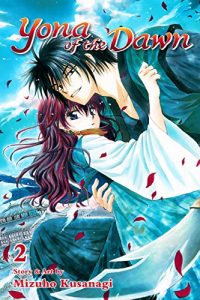
The cover to this first volume features our heroine, Yona, surrounded by swords, and on the back cover we see her confidently wielding one. But on the front she’s looking at them with a look of melancholy, and I feel that this fits the tone of the volume. For although this is the story of a princess who will take up the sword and become a warrior, we’re not there yet. Instead, what we get here is a sweet, sheltered young girl with a crush on her cousin and childhood friend and an antagonistic relationship with her bodyguard and other childhood friend. In other words, were it not for the fantasy castle setting, this could easily be any other shoujo high school romantic comedy. Then… things happen.

yona1

The layout of this volume actually ends up being very odd. We start off with the love triangle setup, and then things rapidly turn serious and deadly with the murder of Yona’s father, the king. We’re told that, as a king, he wsa rather conciliatory, so it’s no great surprise that someone wishes to replace him, but it’s still a chapter of Yona avoiding also being put to death and running for her life. The second half of the book is a series of flashbacks, told as Yona and Hak (the aforementioned bodyguard) hide in the woods and deal with things like leeches and snakes, things that Yona is clearly totally unfamiliar with. The flashbacks show us more of the relationship between Yona, Hak and Su-won (said cousin she’s in love with, and again it’s really sweet and shoujo-ey, as she turns to Hak for advice on how to deal with suitors she doesn’t want, and how they all get colds as kids after a snowball fight and the King tries to make broth for them, which is ridiculously awful but makes her happy.

In other words, we are shown a tragedy, then we get to see why it was so tragic after the fact. Yona’s father does indeed seem to be a rather ineffectual king most of the time, though there’s a hint or two that this is all just a facade. There’s also some backstory that I’m sure will be developed more later, with Su-Won’s father having been killed before the book began, and various tribes (there are five, and one is the “wind tribe”, so I won’t be surprised if we see a water and fire tribe at some point down the road) all jostle for political influence. And then there’s Hak, who is apparently an incredibly strong warrior, but is also devoted to Yona, both because he was “tricked” into doing it by her father, and also because he clearly loves her, though he keeps that hidden for now.

Yona of the Dawn’s first volume is good setup, with an interesting story structure, and I look forward to seeing how its naive and sheltered heroine becomes the confident swordslinger on the back cover. Oh, and we also have a serious dark-haired good guy and a nice but secretly evil blond bad guy as rivals for Yona’s affection, for those of you who play shoujo manga bingo.

Filed Under: REVIEWS

Kuroko’s Basketball, Vols. 1-2

August 11, 2016 by Sean Gaffney

By Tadatoshi Fujimaki. Released in Japan as “Kuroko no Basket” by Shueisha, serialized in the magazine Weekly Shonen Jump. Released in North America by Viz. Translated by Caleb Cook.

I’ll be honest with all of you. Of the ‘big four’ North American sports, I’ve always found basketball the least interesting. Sure, I’ll get excited by March Madness, but the pros do nothing for me, and watching the games on TV just makes me want to do something else. That said, I can’t deny that the sport has an allure that attracts a lot of people, particularly high school kids and promising young manga artists. And now that it appears Viz has vanquished the curse of sports manga in the States once and for all (with the possible exception of baseball – sorry, Adachi), we can see why this series was absolutely huge. The only reason it wasn’t licensed sooner, I expect, is that Viz was still releasing Slam Dunk, the ur-basketball manga, and didn’t want the two to compete.

kuroko1

Kuroko is the blue-eyed stoic on the cover, and the title is pretty telling, as Kuroko’s style of basketball is very much not like the rest of the team, as it’s designed around his own lack of a personality. While this is, for the most part, a typical fiery sports manga, it has its fair share of humor, and a great deal of it revolves around Kuroko’s stoicness and ability to not be noticed even when he’s literally standing in front of someone. Most other basketball manga would star the redhead behind him – indeed, Slam Dunk did, as Kagami is very clearly modeled after that character. But it’s Kuroko that makes this interesting, as he uses his quasi-invisibility to the team’s advantage. He can’t make shots, of course, but it makes him a near-perfect passer. And with Kagami on the team, who is driven by the desire to compete against the strongest teams and win, they become well-nigh unstoppable.

Basketball does not appear to be all that big in Kuroko’s school itself. The manager, also pictured on the cover, is the coach as well, and they sometimes have trouble with school discipline. Riko, by the way, seems to be the sole female in the manga so far, and there’s no hint of romance. Because the other big reason that this manga is getting licensed is that, like many other recent Jump series, it has an absolutely huge BL fandom. There’s none of that in the actual manga itself, of course, but you do get an awful lot of handsome guys sweating and being athletic, and combined with the usual Jump goals of friendship, training and victory the combination can be irresistible. Heck, Kise, Kuroko’s old teammate from middle school introduced as the first semi-antagonist, seems to behave very much like the ex-boyfriend who wants to get back together really badly.

I haven’t talked much about the basketball itself, mostly because, as I said, it’s not my thing. But it’s the majority of the book, and it’s exciting, well-told and well-drawn – I was never confused or bored. Still, you read this for the characters, and I greatly look forward to more of Kuroko and his quiet, eccentric linefaced self.

Filed Under: REVIEWS

Yona of the Dawn, Vol. 1

August 9, 2016 by Anna N

Yona of the Dawn Volume 1 by Mizuho Kusanagi

It is no surprise that I was eagerly anticipating Yona of the Dawn. I feel like there’s been a little bit of a gap in currently translated shoujo fantasy, so I was very much looking forward to this manga. I have a feeling that Yona of the Dawn is one of those manga that will be easier to evaluate once the second volume comes out, because the first volume was mostly set-up. I did enjoy the worldbuilding and some of the plot twists that I wasn’t expecting.

Yona is a sheltered princess whose main issues involve fretting over her red hair. She’s watched over by her guard Hak, and she nurses an intense crush on her cousin Su-won. As she’s getting older the question of her marriage is starting to come up, and her father the king seems to be determined to get her married to anyone but Su-won. Yona is a bit headstrong and pampered, but she still comes across as a sympathetic heroine in the early pages of the manga.

One thing I was dreading a bit is the development of a fairly typical love triangle, because it seemed like that’s the way things might be headed for Yona, Hak, and Su-won at the start of the manga. I was extremely happy when my expectations were foiled within the first couple chapters, and the story took an abrupt turn as Yona has to flee the palace with only Hak by her side. I’ve heard that this series features awesome archery, which is nowhere in evidence yet. I’m much more intrigued by the potential storyline of Yona having to toughen up and learn how better to fend for herself, so I’m eagerly awaiting the next volume.

yona1

Filed Under: REVIEWS Tagged With: shojo beat, shoujo, viz media, yona of the dawn

  • « Go to Previous Page
  • Page 1
  • Interim pages omitted …
  • Page 211
  • Page 212
  • Page 213
  • Page 214
  • Page 215
  • Interim pages omitted …
  • Page 342
  • Go to Next Page »
 | Log in
Copyright © 2010 Manga Bookshelf | Powered by WordPress & the Genesis Framework