• Skip to primary navigation
  • Skip to main content
  • Skip to primary sidebar
  • Home
  • About Us
    • Privacy Policy
    • Comment Policy
    • Disclosures & Disclaimers
  • Resources
    • Links, Essays & Articles
    • Fandomology!
    • CLAMP Directory
    • BlogRoll
  • Features & Columns
    • 3 Things Thursday
    • Adventures in the Key of Shoujo
    • Bit & Blips (game reviews)
    • BL BOOKRACK
    • Bookshelf Briefs
    • Bringing the Drama
    • Comic Conversion
    • Fanservice Friday
    • Going Digital
    • It Came From the Sinosphere
    • License This!
    • Magazine no Mori
    • My Week in Manga
    • OFF THE SHELF
    • Not By Manga Alone
    • PICK OF THE WEEK
    • Subtitles & Sensibility
    • Weekly Shonen Jump Recaps
  • Manga Moveable Feast
    • MMF Full Archive
    • Yun Kouga
    • CLAMP
    • Shojo Beat
    • Osamu Tezuka
    • Sailor Moon
    • Fruits Basket
    • Takehiko Inoue
    • Wild Adapter
    • One Piece
    • After School Nightmare
    • Karakuri Odette
    • Paradise Kiss
    • The Color Trilogy
    • To Terra…
    • Sexy Voice & Robo
  • Browse by Author
    • Sean Gaffney
    • Anna Neatrour
    • Michelle Smith
    • Katherine Dacey
    • MJ
    • Brigid Alverson
    • Travis Anderson
    • Phillip Anthony
    • Derek Bown
    • Jaci Dahlvang
    • Angela Eastman
    • Erica Friedman
    • Sara K.
    • Megan Purdy
    • Emily Snodgrass
    • Nancy Thistlethwaite
    • Eva Volin
    • David Welsh
  • MB Blogs
    • A Case Suitable For Treatment
    • Experiments in Manga
    • MangaBlog
    • The Manga Critic
    • Manga Report
    • Soliloquy in Blue
    • Manga Curmudgeon (archive)

Manga Bookshelf

Discussion, Resources, Roundtables, & Reviews

Reviews

Fruits Basket Collector’s Edition, Vol. 5

October 16, 2016 by Sean Gaffney

By Natsuki Takaya. Released in Japan by Hakusensha, serialized in the magazine Hana to Yume. Released in North America by Yen Press. Translated by Sheldon Drzka.

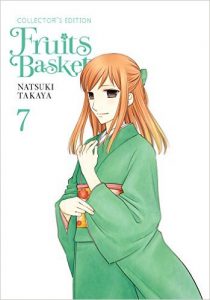
Fruits Basket is, in large part, about a family and its cycles of abuse, and how it makes everyone suffer and endure. That’s why it’s so nice to see, in this omnibus, that there are at least one or two of the main characters whose families are not torn apart by physical abuse, hatred, neglect, suicide, or death. Hanajima during her childhood is, unlike what I talked about with Hiro last time, going through something that the reader is not going to understand, and she really needs to have someone that’s in her corner besides her little brother. I love the fact that immediately after Hana decides to be friends with Tohru and Uo, despite the fact that she may hurt them, she gains control over her powers, as if a switch is flipped. And then there’s Hiro’s mother, who is not only the one Sohma who unreservedly loves her child, but is also pregnant again, which makes everyone happy because the kid can’t be cursed, as all the Zodiac exist already. (More on this later.)

furuba5

There’s actually quite a lot of setup for future plots and pairings here, as clearly Takaya has been told that this is a big enough hit that she can take as much time as she wants. (Ironically, this is also where she hurt her hand, so a long hiatus came between the last volume and this one. The art style will eventually be greatly affected by this, but not just yet.) We meet another Sohma, but not via Tohru and her all-loving heart – this time it’s Uotani, who runs into a handsome yet absentminded young man in her part-time job and seems to fall for him immediately. (The fact that she says he reminds her of Tohru does not help Furuba’s yuri fans at all.) But Kureno seems to be more attached to Akito than the other Sohmas are, and therefore nothing really happens with it.

And then there’s Mayu, who we’ve met as the teacher of Tohru’s class, and were also told was close friends with Kana, Hatori’s lost love. Here we learn that she was in love with Hatori herself, but was so determined not to get in the way that she ended up dating Shigure, even though they’re clearly toxic for each other. (I suspect Shigure enjoyed this more… he seems to love toxic relationships.) Hatori is the stoic type who’s unable to grieve, and so Mayu is the one that grieves for him, for the life that he was never able to live. And Shigure is the manipulator who enjoys both messing with people for the lulz and also giving hem a push whether they want it or not. It’s quite interesting that this arc ends with a flashforward that shows Hatori and Mayu, many years later, together – things will change soon.

There is, of course, drama here as well, most of it stemming from the trip to the beachhouse the Sohmas take during their vacation. (We do meet Kyo’s father, and it is important to Kyo’s character, but he’s so unpleasant and awful I’d rather just not talk about him.) Hiro continues to lash out at things he finds annoying, and Tohru, who is effortlessly close to Kisa in a way he can’t seem to manage, is the biggest thing. It’s quite telling that Hiro is upset at Tohru’s obsession with her late mother – he’s the only one in the entire group who’s always had a warm and loving mother, and so he can’t possibly understand why she would be like this. Kyo, whose mother, it is heavily hinted, killed herself, gets Tohru far better, and immediately figures out that a) Tohru isn’t her usual self, and b) it’s probably because Hiro was rude. He’s maturing rapidly.

The book ends on an ominous note: Akito has followed the Sohmas and is at a neighboring beachhouse, and they all have to go visit – bar Tohru, who is thankfully not invited, and Kyo, who’s always excluded. Kisa being thankful Tohru won’t be there as she worries that Akito will abuse her is one of the saddest moments in the entire book, and will carry over directly into the next omnibus, where Akito decides to pay Tohru a visit after all. Again, if you haven’t read Furuba before, do so, and if you have, these omnibuses are a good opportunity for a reread.

Filed Under: REVIEWS

My Pathetic Vampire Life, Vol. 1

October 13, 2016 by Sean Gaffney

By Ishikawa Rose. Released in Japan as “You no Ataranai Koide-kun” by Futabasha, serialization ongoing in the magazine Monthly Action. Released in North America by Seven Seas. Translated by Amber Tamosaitis. Adapted by Carol Fox.

This is, of course, one of the most inevitable titles ever. Japan loves vampire manga. Japan also loves its laid-back school comedies where nothing happens over the course of several volumes. Why not combine the two? But this particular title I think leans a bit too hard against the latter rather than the former. A complete lack of conflict, despite creating many obvious points where conflict could be achieved, makes this manga seem very underwhelming, as if it’s content to simply ride along on its premise: what if a couple of vampire bros had to live the same year in school, over and over again?

pathetic1

Koide is the main character here, a vampire who is governmentally mandated to stay in high school, since he’s still 16 years old. It’s just that this is the 150th year in a row he’s been 16. And of course, being a vampire, just being near the sun is enough to make him collapse. Luckily, he has a few things going for him. His friend Miura is three times his age, so you’d think would be suffering even more, but seems to have come to terms with it. (He’s a bishonen, which helps – Koide has more of a “I just got out of bed” look.) This could be Koide’s year, though – his classmates seem less concerned than usual about his being a vampire (put politely – put impolitely, they’re a bunch of clueless idiots), he has a couple of girls who seem to like him (though he’s mostly completely indifferent to them), and his teachers are there to help him out (even if the school nurse is a bit creepy). What’s not to love?

You know a slice-of-life title is having trouble when I keep wishing that it would turn darker and more serious. There’s lots of ways this series could have done that. The mere fact that there’s a government crackdown on vampires is a fascinating backstory that’s mostly just used as an expositional gag for why they can’t turn the nurse (who desperately wants to become a vampire, as he’s part of “the Haruhi generation” and would like more excitement). You’d think a lot of the plot would revolve around keeping their true nature hidden from the class, but no, the entire class knows they’re vampires, and are totally cool with it. Even Miura’s somewhat serious backstory of being beaten by farmers in the middle ages is used for humor value.

There are certainly amusing moments throughout – I like Koike’s accidentally antagonistic relationship with the girl who sits next to him, as keep depressing each other without meaning to. The class rep’s attempts to have the class get to know Koike are both well-meaning and awful in the best way, and the ‘i have never seen a photograph of myself for obvious reasons’ chapter has a terrific punchline. But I cannot help wanting to shake the author and say “you could have done so much more with this!” It’s a perfectly acceptable slice-of-life comedy that is content to coast.

Filed Under: REVIEWS

Overlord: The Dark Warrior

October 11, 2016 by Sean Gaffney

By Kugane Maruyama and so-bin. Released in Japan by Enterbrain. Released in North America by Yen On. Translated by Emily Balistrieri.

When we left Ainz at the end of the first novel, he was resolving to find out more about his world he’d been transported into, which was sort of kind of like his old game but not quite, and his evil minions had decided that his wishes amounted to total world conquest. Conquest is put on hold for the moment, though, as Ainz takes one of his minions and disguises himself as a common adventurer. “Common” is perhaps the wrong term, though, as Ainz mostly wants to show off how awesome he is so that his adventurer persona can acquire a reputation. Of course, this would be easier if he could read or write the language. And the minion he takes with him has no social skills whatsoever and regards humanity as worms. Oh yes, and there’s also the evil cult trying to turn an entire city into zombies…

overlord2

As with the first book, Overlord works best when it’s making fun of either Ainz or the world he’s in. Not only is he from modern Japan as a player, but even as Ainz, he sees the world completely differently from someone who actually lives in it. This comes to a head when he has to battle The Wise King of the Forest. He defeats it easily, and the party he’s with, as well as the residents of the city, are shocked and amazed at his badassery. Which is fine, except the Wise King is a giant hamster. Ainz is forced to ride around the city on to prove that he has “tamed” it. He feels a bit foolish, because from our perspective, it’s totally ridiculous. Likewise, his constant frustration with Narberal, who isn’t even attempting to pretend that Ainz is anything other than her lord and master, is equally hysterical.

Sadly, we’re also seeing a bit of what I worried about while reading the first book. As Momon, his adventurer persona he takes on, Ainz is able to cut an ogre in two with his sword just by strength alone. He hands out amazing unseen-before healing potions whose creation flummoxes even the best humans. He chews his way through endless undead with ease, and takes out the smug villain who desperately needs taking out by simply crushing her to his skeletal chest until she breaks. Ainz is not remotely challenged throughout the book. Even as Momon, when he thinks to himself that he was actually slightly damaged or somesuch, we’re quick to recall this is because he’s not using any of his skills as the Undead King, but attempting not to go outside the skill set of an average human. Basically, Ainz is too powerful, and in a book when the rest of the cast is human, it becomes more apparent.

That said, if you get past it, the book is still well written, with evocative descriptions. I liked the way that it tied into the village from the first book (and hey, the one guy in Momon’s party who survived turns out to be the childhood friend (and presumed future love interest, although for once it’s the girl who’s clueless) of the girl Ainz saved in Book 1, who’s still got her goblins. And when it is mocking Ainz and the D&D world he lives in, it can be very funny. There’s a cliffhanger leading into Book 3, which promises less pretending to be an adventurer. I look forward to it.

Filed Under: REVIEWS

Welcome to the Ballroom, Vol. 1

October 4, 2016 by Sean Gaffney

By Tomo Takeuchi. Released in Japan as “Ballroom e Youkoso” by Kodansha, serialization ongoing in the magazine Monthly Shonen Magazine. Released in North America by Kodansha Comics. Translated by Karen McGillicuddy.

For years, the received wisdom of the internet was that sports manga did not sell well in North America. Like most received wisdom, that wasn’t quite accurate. Price of Tennis, Eyeshield 21, and Whistle! all had fairly lengthy runs here. But recently, it would appear that the received wisdom is actually beginning to genuinely die, as we’re seeing more and more shonen sports-style manga come out and do fairly well for themselves. And it helps to show off one basic factor of the Japanese sports manga, which is that it does not actually matter what the sport is. Take a hero with no purpose in life, show him a competition that is amazing and features people showing off awesome bodies and equally awesome speed lines, and then have him train and train and train until everyone realizes that he’s got amazing potential. In the case of Welcome to the Ballroom, that sport happens to be ballroom dancing competitions, but that does not change its essential sports manga-ness.

ballroom1

Our hero is Fujita, and he does in fact remind me a lot of Sena from Eyeshield 21, and not just because of the hair. He’s got his teachers upset because he can’t figure out what to do with his life, he gets harassed by the local neighborhood bullies, and his nights at home are just him an his dad (for once, the mom seems to be divorced rather than dead as in most manga). But then he’s basically kidnapped by Sengoku, who is looking for new recruits for his dance studio, which also happens to feature a pretty girl from Fujita’s school who does ballroom dancing. After initially being totally overwhelmed with self-doubt and self-hatred, Fujita watches a DVD of a dancing competition secretly put in his bag, and falls in love with the way they move. He may lack common sense (his first training session literally lasts ALL NIGHT as he forgets what time it is), but he has an innate sense of movement that is struggling to get beyond his beginner’s body.

Moving on to the review proper, this is a very good start. Fujita is a very believable teenage boy, filled with insecurities and jealousies but a good kid at heart. The heroine, Hanaoka, has dreams of her own that she’s worried about, and so far does not seem to be there simply for the hero to fall in love with, although that does happen to a degree. (It helps that, unlike most sports manga, the women are an innate part of the sport.) And his first rival, Kiyoharu, is way beyond both of them in terms of talent, but I suspect that pushing himself too hard has already gotten to him, and it’s what leads to the first cliffhanger. As with most shonen manga, the way you know it’s really good is that you want to read the next volume immediately. That’s how I feel about Welcome to the Ballroom.

Filed Under: REVIEWS

Franken Fran, Vols. 5-6

October 3, 2016 by Sean Gaffney

By Katsuhisa Kigitsu. Released in Japan by Akita Shoten, serialized in the magazine Champion Red. Released in North America by Seven Seas. Translated by Jocelyne Allen, Adapted by Shanti Whitesides.

One of the strengths of Franken Fran is how it can be both an anthology of one-off horror concepts and also have an increasingly diverse continuity to call on when it needs to. Sometimes this means that one chapter bleeds into the next, as with the actor who has Fran give him pheromones so he can have more personal magnetism, followed by his co-star getting surgery so that she looks like a shoujo manga cover. Sometimes it’s building on previous volumes, as with the increasingly bizarre and over the top stories of the superhero Sentinel and his many knockoff imitators. And sometimes it uses the regular cast of Franken Fran, as when Fran tries to stop the horror that is her sister Gavril by unleashing a never ending army of Kuho clones, which Fran apparently decides to do for no reason other than to show us how hilariously awful Kuho’s life is.

franken5-6

I mentioned Gavril, and there’s no question she’s one of the best things about this volume, as well as possibly the most popular character in North American fandom. Fran saves lives as a doctor but has morals and ethics that make no sense to us whatsoever; Veronica has a moral and ethical sense, but is a killing machine. Combine the two in the worst way and you get Gavril, who loves slaughtering for its own sake, and has a deep desire to kill off Fran. I was wondering how Seven Seas would translate her initial chapter, and readers who may have read the source via other means may rest assured that in this official volume Gavril’s potty mouth is present and correct. With a heap of four and five-letter swears, appalling violent carnage, and walking around with her top unzipped, Gavril is a walking M rating. (Franken Fran is still rated OT by Seven Seaas, in case you wondered.)

Franken Fran’s bread and butter is still its horror and humor, though, and both combine well here provided that you don’t try to sympathize with anyone involved. Several times in this book Fran is overwhelmed with emotion at what she considers to be a touching, tragic story (even when it isn’t), and manages to make it even worse. She is helped out a great deal by her clients, many of whom are horrible examples of humanity. Franken Fran shows us the seedy underbelly of human desires, and the greed, lust, and desire for power within so many people. If your amusement park is filled with mascots that will immediately kill once they stop hearing music… well, that fits in perfectly with the amusement park aesthetic! This volume doesn’t have as many moments when I laughed out loud, but it has many, many moments when I put my hand to my mouth and went “Oh my god.” It’s that kind of series. If you don’t mind horror (and be warned, the cockroaches make a return here) and love twisted humor, Franken Fran remains a must reda.

Filed Under: REVIEWS

A Bride’s Story, Vol. 8

October 2, 2016 by Sean Gaffney

By Kaoru Mori. Released in Japan as “Otoyomegatari” by Enterbrain, serialization ongoing in the magazine fellows!. Released in North America by Yen Press. Translated by William Flanagan.

As you might have guessed from the cover, Pariya is the main focus of this volume, though we do see a brief wrapup of the ‘two wives’ arc from the previous book. We’ve been building up to this storyline for a while, Pariya being the most obvious next bride in line (at least, back at our home base of Amir’s village). But this is definitely going to be a story that will take longer than just one volume, as Pariya’s issues are not ones that are easily solved. I’ve called her the tsundere of A Bride’s Story, but the label doesn’t quite fit her well (indeed, you can argue that most tsunderes don’t fit the label all that well). Pariya is highly emotional, has difficulty focusing, and most importantly, has a low self-image of herself due to everyone’s expectations of what a good wife should be.

bride8

I’ll be honest, it’s very clear that Mori loves drawing Pariya’s faces, especially when she’s frustrated, humiliated, or otherwise blushing her head off. And I love it, even as I sympathize with her. She feels like a modern girl trapped in the late 19th century, and things aren’t helped by the events that begin her arc in this volume: their house burns to the ground, taking with it most of the cloth that had been saved up for her dowry. The family panics; they don’t few Pariya as someone who’s easily married off to begin with, and now without something to give to her potential husband’s family, it’s going to take even more years to make things happen. Pariya, of course, is painfully aware of this, and because she actually DOES like her latest suitor, she’s determined to do something about it, even if it involves… grr… actual needlework.

The scenes of Pariya’s slow, steady progression with the needle, as she drives herself forward by imagining the caustic words of the village elder, who she is literally hallucinating behind her. The good news is that her hard work IS rewarded, and the others are there to show her the joy that can be taken in it – seeing Pariya with a happy blush as opposed to frustrated is also a reward to the reader. That said, the last chapter is darker, as Pariya imagines her future husband dumping her at the altar because of her personality, and then, thanks to her overenthusiastic physical labor during the cleaning of the streams they use for water, she is terrified that he’s scared of the “real” her. (My guess is it’s probably the opposite, but we’ll have to wait till next time to figure that out.)

Pariya is also not helped by having Amir as the perfect example of a superwoman – not only does she have the temperament of a good bride, she also rides horses, hunts big game, can prepare an instant picnic, is good at making friends… she’s the impossible standard that Pariya can’t hold herself up to. No wonder Karluk is trying to improve himself so that he can stand beside her as a good husband. Whether you like Pariya or Amir, though, this is a typically excellent volume of A Bride’s Story.

Filed Under: REVIEWS

Strike the Blood, Vol. 4

October 1, 2016 by Sean Gaffney

By Gakuto Mikumo and Manyako. Released in Japan by ASCII Mediaworks. Released in North America by Yen On. Translated by Jeremiah Bourque.

This volume of Strike the Blood features a) our hero trying to stop a molestor on a subway only to get mistaken for a molestor himself; b) our hero walking naked into a bathroom where two young girls are bathing, and the heroine’s reaction as if this is his fault even though it isn’t; c) a childhood friend that everyone assumes is a boy who’s actually a tomboyish girl, now all grown up, here to make everyone in love with the hero uncomfortable; d) two girls waking up next to each other, and teh teasing one saying “you were wonderful last night” despite nothing actually happening; e) bodyswapping, with all the cliches that this entails; and f) two women presented as the big bads of this volume who turn out to be rather pathetic, and are really just a ruse to cover up the actual big bad, who is herself merely a pawn in the game of the actual actual big bad.

Welcome to TV Tropes: The Light Novel.

striketheblood4

Again, there’s no way to really review a series like this without repeating what I’ve said before, so please put up with it. The books still feel as if they’re an adaptation of a pre-existing anime, rather than the other way around. Kojou remains a somewhat underdone hero, though he’s not helped by the fact that this turns out to be the first book in a longer arc, meaning he doesn’t get a big fight to show off with. This is because he spends half the book in the body of his childhood friend Yuuma, and thus is “a normal human” in the sense that most girls who are bred to be a mind controlled tool to rescue a woman from the most well-kept prison in the world is a normal human. And make no mistake about it, Kojou would definitely insist she’s absolutely a normal human, because if you’re going to be an off-the-rack discount copy of Kamijou Touma, you may as well go all the way.

And the series’ strengths remain strong. It’s a light, breezy read, showing that it may copy Index’s hero but not its prose style. The fight scenes are fun. It has several amusing scenes, mostly involving Yukina, such as when she informs the now female Kojou that he should never use the toilet in that body ever, and telling Sayaka “Stuff happened, so he’s a girl now.” As for Yuuma herself, I’m always a sucker for powerful kids with a past history of abuse who hate themselves and think they’re disposable, especially as most narratives exist, rightly, to prove that they’re wrong. I expect the next book in the series will be a lot more serious, and involve a lot more use of vampire powers. Till then, we have this book, which, like the others in the series, is well-written and completely lacking in ambition. It is what it is.

Filed Under: REVIEWS

Liselotte & Witch’s Forest, Vol. 1

September 30, 2016 by Michelle Smith

By Natsuki Takaya | Published by Yen Press

liselotte1On the one hand, it’s exciting to be reading something new by Natsuki Takaya, creator of my beloved Fruits Basket. On the other, it was kind of weird to embark upon an unfamiliar story whose artistic style was so very familiar to me.

This volume goes by quickly, with its large, pretty panels unencumbered by much in the way of background detail. Liselotte and her two child attendants (twin siblings named Anna and Alto) have recently moved to a remote location, simply referred to as “the east of the east of the east,” and we gradually learn that they are there because Liselotte comes from a noble family and was accused of plotting to overthrow her elder brother. Given the choice between exile or death, she chooses the former and is determined to make the best of it. She’s an interesting blend of optimistic shoujo heroine and someone more mature who has been through some crap. Actually, she reminds me of Anne Shirley a bit!

When Liselotte was younger, she had a friend named Enrich who would tell her stories about “the east of the east of the east,” in particular that witches live there. When she’s attacked by a witch (and is kind of awesomely irritated about it), she is saved by a white-haired guy named Engetsu who seriously reminds her of Enrich, only his eyes are light crimson instead of the blue she remembers. Engetsu decides he’s going to live with Liselotte, and most of the volume involves Alto grumbling about this and ending up sick, whereupon an adorable witch’s familiar named Yomi goes off to fetch him some medicine. (Actually, Alto spends the entire volume grumbling, which is not especially endearing, though he claims he’s frustrated by his beloved master’s situation.)

While this opening installment does feel a trifle insubstantial, it capably introduces the characters and the setting, and puts forth some intriguing ideas. Is Engetsu really Enrich? What happened to him? Did Liselotte actually plot against her brother? Is Engetsu in cahoots with the witches? What else are they planning to do? I’m definitely interested to find out. I just hope we get some answers by volume five, as that’s where the series has stalled because Takaya took an extended hiatus due to illness.

Liselotte & Witch’s Forest is on hiatus in Japan. It currently has five volumes. Yen Press will release volume two next month.

Review copy provided by the publisher.

Filed Under: REVIEWS Tagged With: natsuki takaya

Umineko: When They Cry, Vol. 14

September 30, 2016 by Sean Gaffney

Story by Ryukishi07; Art by Hinase Momoyama. Released in Japan in two separate volumes as “Umineko no Naku Koro ni: Dawn of the Golden Witch” by Square Enix, serialized in the magazine GFantasy. Released in North America by Yen Press. Translated by Stephen Paul.

Two more volumes of the 6th arc in this series, and how’s Battler doing? Not great, it would seem. His game, it is becoming increasingly apparently, is just duplicating what was done last game, simply because that worked. He’s decided to enter the Love Competition that George/Shannon and Jessica/Kanon are having, with Fledgling Beato as his partner, which raises all sort of questions. More to the point, though, Battler is still far too nice to really be good at this sort of thing. (At one point he tries to praise Lambda for the same thing, and she essentially shuts him down cold.) Battler thinks the best of people, and is easily moved by a girl’s tears. This allows Erika and company to get the upper hand, which I’m sure will rebound horribly on him in the final volume of the arc.

umineko14

Speaking of Erika, this volume also attempts to give her something of a backstory, as Dlanor asks her why she hates magic so much. The backstory rings a bit false – partly as it presents an Erika who sounds to me more college age, whereas the Erika we see here is mid-teens at most. But mostly it’s because it is very obvious from the start that Erika is Bernkastel’s “piece” – it’s Bern self-inserting her way into the story to cause havoc. Thus a “real” tragic backstory for Erika pales in comparison to, say, Bern’s own. That said, the background does show us a major theme of the series. Erika couldn’t bring herself to trust her boyfriend as she found circumstantial evidence that he was cheating on her, and though Dlanor tries to present counter evidence that he loved her, she can’t believe it because it’s not “the red truth”. In other words, love requires having faith in someone, which is something Erika can’t do. (She fares far better with Dlanor, honestly, and the yuri tease that was mildly in the VN is amped up here.)

In the meantime, there’s still the murders of the first Twilight, which are framed as part of the love competition going on. George manages to escape his mother’s clutching grasp (Pink Floyd’s ‘Mother’ resonates through this whole scene), and Jessica is able to kill off Kyrie after seeing a truly terrifying example of envy and hatred in action – Kyrie is scary. (Notably, George is rather sanguine about his murder, while Jessica is in tears after hers.) Rosa and Maria are killed fairly perfunctorily, although Maria’s rage at seeing her mother killed is very well-drawn, some of the best art in the book. Fledgling Beato may be confused as to who the man from 19 years ago is (hint: it’s not Battler), but is able to knock off Natsuhi with the help of her father/lover/mentor. (The incest subtext is icky.) And battler manages to top them all by killing himself – yes, in this game board, Battler dies on the first Twilight.

So what’s next? A lot of pain for Battler, I suspect, as I have a feeling he’ll soon be trapped in a Logic Error. And there’s still the remainder of the love competition, as we try to figure out why Shannon, Kanon and Beatrice can’t all be happy with their partners – only one can prevail! Let’s hope that the next volume ends with a nice, happy wedding.

Filed Under: REVIEWS

Kagerou Daze V: The Deceiving

September 29, 2016 by Sean Gaffney

By Jin (Shinzen no Teki-P) and Sidu. Released in Japan by Enterbrain. Released in North America by Yen On. Translated by Kevin Gifford.

Though not without its issues, this is still overall the strongest volume of Kagerou Daze to date. Each volume has quietly doled out tiny bits of the backstory while letting us enjoy the wacky antics of Shintaro meeting the Mekakushi-Dan. This new book ditches Shintaro entirely and focuses instead on Kano and his own tragic past, which he explains to Ene over the course of the book. It really does give me exactly what I wanted to see from the previous books – why Kano appeared to Shintaro as Ayano and gave him a nervous breakdown, why Ayano is no longer with us, a suggestion of who the main villain is (though that’s still not quite clear), and the origins of the Mekakushi-Dan, giving much needed depth to Kano and Kido, and a bit of depth to Seto, who continues to be the one character who gets nothing to do.

kagerou5

As it turns out, most of the kids in the Mekakushi-Dan are orphans. Kano we initially see with his mother, who psychically abuses him (and by the way, Kano’s POV of the abuse and his justification for it is chilling and very well done, possibly some of the best writing in the series to date), but after a burglar kills his mother and living with relatives is messed up by the awakening of his eye powers (turning into a dead woman is never a way to win friends and influence people), he’s sent to an orphanage where he meets Kido, who is a giant ball of anger and can’t control her invisibility, and Seto, who cries an awful lot and is also sometimes telepathic, but again can’t control it. (Kano, by the way, controls his own powers through physical pain, which is utterly horrifying, and he knows it.)

Where this ties into the rest of the plot is when all three are adopted by Ayano’s mother, and she makes the most of becoming their big sister. Unfortunately, this backstory is not meant to show us the few happy, loving years they had – in a matter of a page or two, Ayano’s mother is dead and her father seemingly possessed by the “snakes” we’ve heard about in prior books – snakes which are also in each of the group. And finally we learn why Ayano killed herself. It was not, as it had been suggested, due to self-esteem issues or anything to do with Shintaro (though when impersonating her to fake her death, Kano is not above telling Shintaro it is his fault, which of course leads to his seclusion in the first place), but to stop the snake inside her father. Did it work? Well…

The one flaw the book has to me is the wraparound plot. I knew we’d see Ene becoming Takane again at some point, but it feels very tacked on here, as if the author finally got a cutoff point from his publishers and realized he had to start wrapping things up. (The series is still running in Japan, so we have at least 2 volumes to go after this.) Also, Kano’s ambivalence to his traitorous nature, while it fits his character, is not as emotionally satisfying as I’d like – because he’s always deceiving others and himself, it’s hard to get worked up about him working for the enemy (though I suspect he’s a triple agent, to be honest.) Also, if you’re going to include a child whose physical abuse made such an impression that pain is the main thing that makes him come back to himself, don’t have his best friend constantly hitting him like a tsundere. It sends a bad message.

Overall, though, this volume represents a huge upswing in the franchise, and I am eagerly awaiting the 6th volume in the series (which may be the last for a while – we’re catching up to Japan).

Filed Under: REVIEWS

Kuroko’s Basketball, Vols. 1-2

September 28, 2016 by Michelle Smith

By Tadatoshi Fujimaki | Published by VIZ Media

kuroko1-2

Tetsuya Kuroko is a plain and unremarkable guy with a talent for going unnoticed. On the basketball court, this means that despite his unimpressive physique and lackluster shooting ability, he is extremely valuable because he can get the ball to the right person without giving the opposing team the chance to react. In middle school, he was part of a legendary team that included the five members of the “Miracle Generation,” stellar players who all happened to be born in the same year. Although each of them has now gone on to different elite schools, Kuroko disliked the sole emphasis on winning and so chose to attend newly established Seirin, where he could experience teamwork with people who simply loved basketball. He forms a partnership with his fellow talented first-year, Taiga Kagami, to defeat the Miracle Generation players and make Kagami the best in Japan.

I’ve been reading a lot of sports manga lately, which is great, but also gives me a variety of titles to compare Kuroko’s Basketball to. The emphasis on someone who’s very skilled at helping others score is reminiscent of Haikyu!! and the character of Kageyama, and in both cases I appreciate a potentially unheralded position/skill getting its due. And, of course, how many sports manga are there that feature a pair of special first years? Quite a few, I’d reckon, though Kuroko and Kagami avoid the rivals-butting-heads trope. And how many launch quickly into inter-high qualifying matches? Quite a few.

Still, there are things each series does differently, and in Kuroko, at least so far, I mostly see what has been omitted. Instead of starting off with some practice sessions to introduce the team and familiarize readers with their personalities and specialties, we dive right into a practice game against a team containing one of the Miracle Generation. It’s not until the second volume that the other players on the team even get names. And then, once the qualifiers begin—from which only three teams of 300 will continue on to represent Tokyo at Nationals—three of Seirin’s first four matches are skipped and merely summarized in a panel or two. It’s kind of disappointing.

We do see some evolution of skills, particularly in how Kuroko and Kagami are able to work together, but when they receive a special training regimen in preparation for the inter-high, we only get a brief glimpse of what Kagami learned and nothing at all about what Kuroko was doing. Perhaps that’ll come into play in a future volume.

What appeals to me most so far is the attitude of the players, particularly Kagami, who loves the sport and loves a good challenge, and isn’t afraid to go up against someone even if he might lose. Too, I love the seed of doubt planted in Kuroko’s mind by an opponent—what happens when Kagami achieves his full potential and realizes how great he really is? Will he drift away from his teammates?

Ultimately, I did enjoy this introduction to the series and look forward to the next volume.

Kuroko’s Basketball is complete in 30 volumes. The next 2-in-1 edition from VIZ contains volumes three and four and will be released on October 4th, with further installments proceeding on a bimonthly release schedule.

Review copy provided by the publisher.

Filed Under: REVIEWS Tagged With: Tadatoshi Fujimaki

Attack on Titan Anthology

September 28, 2016 by Sean Gaffney

By Various Artists, based on the manga created by Hajime Isayama. Released in North America by Kodansha Comics.

This review is based on an advance copy provided by the publisher.

The moment this was announced, its potential was always going to be sky-high. Yes, Japan also has some anthologies based on prominent titles, and we’ve seen a few of them over here, but they’ve tended to be either a) only comedic (Evangelion), or b) not very good (Code Geass). But a cross-cultural anthology like this is unusual. Plus the talent announced made the American comics reader sit up and take notice. Faith Erin Hicks, Gail Simone, Scott Snyder, Paul Pope, Evan Dorkin… names so well-known that even the manga-only fan will be familiar with them. And so yes, there was always going to be a high bar to clear. I am pleased to say, though, that it soars over it easily, and manages to be one of the most riveting titles I’ve read this year, taking the world of Attack on Titan and opening it up to become so many other different things.

anthology

For the most part, the main cast of Attack on Titan are used sparingly here, though if you do want to see them there is Evan Dorkin and Sarah Dyer’s hilarious Attack on Attack on Titan, which puts the cast in a Milk and Cheese style gag comic that goes WAY beyond what we’ve seen in Junior High or Spoof on Titan. But you don’t really miss the cast. We do get some stories set within the series proper, or before it, as humanity fights against the titans or against the oppressive rule that constricts them. If you enjoy the fighting in the series, you’ve love Michael Avon Oeming’s Live And Let Die, which shows us a conflict between safety and freedom. There’s also Gail Simone and Phil Jimenez’ Good Dog, an almost wordless tale of a woman and her dog taking on a titan with the best possible derring-do. On a more tragic level, Asaf and Tomer Hanuka’s Memory Maze shows us how the Titans’ existence can devastate one family, even as the years go by.

There are also stories that use the Titans in different settings or in different genres. Genevieve Valentine and David Lopez’ An Illustrated Guide to the Walled Cities starts off cute and gets darker as it goes along, showing us one woman’s attempt to show off the wonders of the city while dealing with a repressive, cruel monarchy. Rihanna Pratchett, Ben Applegate and Jorge Corona’s Skies Above shows us what could have been under that same cruel monarchy, and all the opportunities that were lost, as well as some lovely action and tragic romance. Si Spurrier, Kate Brown and Paul Duffield’s Fee Fie Foh sees the invading titans as a Celtic fantasy, with an added dose of the corrupted hero who must relearn what heroism truly means. And while I found Ronald Wimberly’s Bahamut the most difficult to get into of the stories in this book, it manages to succeed on evocative mood alone.

Be assured, it’s not all grim tragedy in here. Aside from the aforementioned Evan Dorkin comics, we get Faith Erin Hicks’ The Titan’s Laugh, which shows the use of a good jokebook (and also shows us how grim and desperate the battle still is – the punchline wouldn’t be as hilarious if the serious consequences weren’t played up beforehand). Sam Humphries and Damion Scott’s Attack on Playtime is every young child’s revenge fantasy come to life, rebelling against cruel teachers, sadistic gym instructors, and unfeeling administration. And Brendan Fletcher, Cameron Stewart and Babs Tarr show us in Attack on Demoncon that when it comes to sexual harassment at a comic convention, turning into a Titan can be quite empowering.

If you like Attack on Titan, this is a great chance to see its world used to tell dynamic and evocative stories. If you enjoy Western Comics and have heard of the title through the creators, you may be surprised at the grim yet hopeful universe that we see. Both fans should be happy with this anthology, as it is an absolute delight.

Filed Under: REVIEWS

Accel World: Armor of Catastrophe

September 27, 2016 by Sean Gaffney

By Reki Kawahara and Hima. Released in Japan by ASCII Mediaworks. Released in North America by Yen On. Translated by Jocelyne Allen.

Accel World is about a group of elementary and junior high school students fighting battles to the death, and the novels are not afraid to show you the emotional fallout from such a situation. In fact, the first quarter of this book is devoted to a giant flashback to several years prior (when the best you could do is Level 5), where a young couple who have fallen in love in the Brain Burst world (despite not knowing who their real life identities are – oh, and she’s dying in real life as well) discover one of the seven Big Powerups in the game, and as a result are quickly turned on by their supposed friends and fellow players. It’s played for maximum tragedy and drama, and helps to explain why the Disaster Armor currently infecting Haru has a mind of its own.

aw7

And these are kids, even if they supposedly have more emotional maturity from all the time they spend in accelerated time. Nowhere is that more clear than with the confrontation Haru has with Takumu at the end of the book. Takumu’s jealousy of Haru was, of course, part of the plot of the very first volume, and it’s actually good to see that it did not magically go away, because those sorts of things don’t. It’s also not being helped by the new ISS pseudo-Disaster program, which is corrupting him so it’s hard to tell if these are his own thoughts or not. But you also see it with Haru, who is also still just a kid, and whose desire to punch hope into Takumu somehow is shown in the end to be just as foolish and short-sighted in a world where nothing is ever quite as easy as you expect. Which of course, means this is not a two-book series, but an arc, and we’ll see what happens next time.

Elsewhere in the book, Haru and Utai manage to at least get closer to escaping from the Imperial Palace world they’re still stuck in in the Unlimited section, helped along by a mysterious samurai-type who happens to have been in the section all along but refuses to tell them how he got there. It’s fairly clear this young boy is supposed to be a member of the Imperial Family (which explains why he’s there – he lives there), but Kawahara is being very coy about it for reasons that are also fairly clear. And Haru and Kuroyukihime get some nice shippy moments, much to the frustration of Chiyuri and Fuko, which leads to probably the book’s funniest moment (and also makes me think that Fuko is more interested in Kuroyukihime than Haru). And of course Haru remains marked for death, both from the Kings and from a group that has put a bounty on his head, as we realize that the flashback we see at the start of the book may come full circle.

This is mostly a setup book that will likely pay off with big fights in the next volume, but as always it’s eminently readable, and for once the cover is not something you have to hide from the outside world. And there should be less of a wait for the next one – the series seems to be shifting to four times a year.

Filed Under: REVIEWS

Idol Dreams, Vol. 3

September 26, 2016 by Anna N

Idol Dreams Volume 3 by Arina Tanemura

Well, I spent the first two volumes really hoping that Tanemura would be able to pull off the inherently problematic premise of a 30 year old heroine with arrested development suddenly being given the chance to relive her teen years through magic teen idol pills, but as the various love triangles start to develop with Chikage’s two personas I found myself wishing that the series would wrap up quickly before it starts to head into some uncomfortable territory.

One part of this volume that I liked very much is more time spent with Chikage as an adult. She runs into her long-lost crush Haru and they start to reconnect. Tokita keeps interfering in any situation where Haru and Chikage might become more intimate, even though he doesn’t really have a logical excuse for his actions. Haru has been a bit too mysterious so far, so it was good to get some of his backstory filled in, and see how it is clear that he really did care for Chikage when they were teenagers and he still has feelings for her. It was fun to see the teenage bonds of friendship resurface between Chikage and the two men as they hang out as a trio for the first time in years. Haru is very observant, and seeing how Tokita keeps reacting to Chikage, he decides to step back, but this is only temporary. What is more problematic is that Chikage really can’t relate to anyone intimately as an adult, and she reacts like a flustered teenager to Haru’s overtures. At this point, I’m convinced that she needs therapy more than magic teen idol pills.

Chikage’s adventures as Akari in this volume were a bit more dynamic as she has to manage babysitting duties and breaking into a school in disguise. However, what I was hoping wouldn’t happen in this series happened, as Akari decides to date a 16 year old. I find this more creepy than anything, and I hope this is really short-lived. I’ve enjoyed Arina Tanemura series so much in the past, but now I’m wondering if I should just fill in some of the gaps in my Sakura Hime manga collection and going back and reading that instead. I’m still firmly team Tokita, as he’s clearly the only man that Chikage can actually relax around and be herself with. I hope that the romance swings more that way in future volumes.

idoldreams3

Filed Under: REVIEWS Tagged With: idol dreams, shojo beat, shoujo, viz media

My Youth Romantic Comedy Is Wrong, As I Expected, Vol. 1

September 25, 2016 by Sean Gaffney

By Wataru Watari and Ponkan 8. Released in Japan by Shogakukan. Released in North America by Yen On. Translated by Jennifer Ward.

This is a highly anticipated light novel title, for many reasons. First, the anime proved quite popular in the West, and people wanted to see how the original was, particularly as the anime apparently compressed 11 books into 26 episodes. Secondly, Shogakukan has a number of popular light novel titles, but haven’t really licensed to the West before now except maybe via Viz. But most importantly, this series does not feature anyone trapped in a fantasy world, or trapped in a fantasy game, or anyone acquiring amazing superhero-like powers, or immortals, or dullahans. Heck, there’s not even a girl who eats books. No, instead we get something a bit more down to Earth: a Japanese high school where a cynical and belligerent young man with a sullen face is ordered to join a club devoted to helping others.

oregairu1

Of course, just because there’s no fantasy content does not mean that this series is not going to remind long-time anime and manga fans of other series. The retorts between Hachiman and Yukino may remind readers of the caustic relationship between Araragi and Senjougahara in the Monogatari series. And the idea of the club itself, as well as it consisting mostly of people who have difficulty interacting, is a lot like Haganai. But the title of the book si not wrong, at least not right away. Araragi starts off pseudo-cynical but quickly drops that as he gets swept up by events. Kodaka may have the face of a thug and the social kills of a newt, but he is fundamentally a nice guy. Hachiman, on the other hand, is an obnoxious dick throughout much of this book. He spends much of his time disparaging the people around him, including his teacher, his sister, and even the cute popular girl who seems to have taken a liking to him, who he refers to as a “slut” when they first meet. Enjoying this series requires getting over the very difficult hurdle of the hero’s mentality.

If you can get past that, though, there’s much to enjoy. Because the series is (at least at this point, no doubt it will change later) avoiding any serious romantic interaction, we can sit back and enjoy Hachiman, Yukino and Yui spit venom at each other (well, the two girls seem to like each other, they save their venom for him). The insults and comebacks here are very amusing, and don’t rely as much on the obvious ‘tsukkomi shouting’ as some other series. And of course there’s the fact that underneath his obnoxious, caustic front Hachiman does actually seem to want to help people, as he does throughout this book, usually complaining all the while. He’s not rewarded for it, as that would defeat the purpose. But there’s a spark that will no doubt catch fire as the series goes on. Till then, enjoy the fact that the most romantic tension he has in the whole book is with the cute bishie guy, who he can’t stop thinking about.

I suspect this is the sort of series that will reward more as it goes along, much like many series that begin with unlikable protagonists. Till then, I will at least enjoy these somewhat broken high school students snipe their way through their day, while also helping others along the way. And the fact that, at least through one volume, the youth romantic comedy is indeed kept on the back burner.

Filed Under: REVIEWS

  • « Go to Previous Page
  • Page 1
  • Interim pages omitted …
  • Page 209
  • Page 210
  • Page 211
  • Page 212
  • Page 213
  • Interim pages omitted …
  • Page 342
  • Go to Next Page »
 | Log in
Copyright © 2010 Manga Bookshelf | Powered by WordPress & the Genesis Framework