• Skip to primary navigation
  • Skip to main content
  • Skip to primary sidebar
  • Home
  • About Us
    • Privacy Policy
    • Comment Policy
    • Disclosures & Disclaimers
  • Resources
    • Links, Essays & Articles
    • Fandomology!
    • CLAMP Directory
    • BlogRoll
  • Features & Columns
    • 3 Things Thursday
    • Adventures in the Key of Shoujo
    • Bit & Blips (game reviews)
    • BL BOOKRACK
    • Bookshelf Briefs
    • Bringing the Drama
    • Comic Conversion
    • Fanservice Friday
    • Going Digital
    • It Came From the Sinosphere
    • License This!
    • Magazine no Mori
    • My Week in Manga
    • OFF THE SHELF
    • Not By Manga Alone
    • PICK OF THE WEEK
    • Subtitles & Sensibility
    • Weekly Shonen Jump Recaps
  • Manga Moveable Feast
    • MMF Full Archive
    • Yun Kouga
    • CLAMP
    • Shojo Beat
    • Osamu Tezuka
    • Sailor Moon
    • Fruits Basket
    • Takehiko Inoue
    • Wild Adapter
    • One Piece
    • After School Nightmare
    • Karakuri Odette
    • Paradise Kiss
    • The Color Trilogy
    • To Terra…
    • Sexy Voice & Robo
  • Browse by Author
    • Sean Gaffney
    • Anna Neatrour
    • Michelle Smith
    • Katherine Dacey
    • MJ
    • Brigid Alverson
    • Travis Anderson
    • Phillip Anthony
    • Derek Bown
    • Jaci Dahlvang
    • Angela Eastman
    • Erica Friedman
    • Sara K.
    • Megan Purdy
    • Emily Snodgrass
    • Nancy Thistlethwaite
    • Eva Volin
    • David Welsh
  • MB Blogs
    • A Case Suitable For Treatment
    • Experiments in Manga
    • MangaBlog
    • The Manga Critic
    • Manga Report
    • Soliloquy in Blue
    • Manga Curmudgeon (archive)

Manga Bookshelf

Discussion, Resources, Roundtables, & Reviews

Reviews

Reforming an Icy Final Boss: Getting Back at the Self-Proclaimed Villainess with the Power of Friendship, Vol. 2

March 26, 2026 by Sean Gaffney

By Takamedou and Nemusuke. Released in Japan as “”Jishou Akuyaku Reijou” ni Korosareta Last Boss no Yarinaoshi: Bocchi na Reitetsu Koujo wa, Dai Ni no Jinsei de Riajuu wo Mezashimasu” by DRE Novels. Released in North America by J-Novel Heart. Translated by Sheldon Drzka.

The famous Bible quote “the sins of the father are visited upon the son” can apply to daughters as well, and it certainly does here. Milly may be doing her best to make friends, show off, and live her best second life, but her father Kyle is still regarded by everyone as the absolute worst, and he is certainly not above destroying families because he’s in a bad mood. As such, no one wants to be close friends with Milly except those who know her really well – why risk it? What’s more, it turns out that her life is still in danger, mostly because there’s someone else trying to change the current timeline. Not, I hasten to add, because they’re another person who remembers the otome game. No, they just remember the first timeline, and they think the country is headed to ruin and Milly is helping it.

Milly is a bit stressed. She still hasn’t made friends beyond the Student Council and the girls she saved from Angelina’s evil plan in Book 1. And since final exams are upon them soon, there’s no time to make them. Fortunately, she’s good at studying, so can help the others, even if they may not really want her to. And then there’s her class, who are still terrified of her… at least until they see how adorably socially awkward she is, whereupon they fold like card tables. She’s even getting closer to her father, who she still sees as evil incarnate, but who we the reader see is simply very overprotective and even more socially awkward than she is. Will she be able to take first place in exams and get the First Dance at the next ball? Wait, isn’t Angelina still around? And is she the ONLY villain?

Last time I said I wanted to see more of Kyle, Milly’s father, and we do get a lot more of him here. The reason this plot is happening at all is that he’s got so much power, and the future shows him betraying the country, which almost destroys the country. Unfortunately, Milly is not really dealing with that end of the problem, focusing instead on not having everyone at school not care if she gets brutally murdered. She’s also still not great at picking up social cues. She gets that Ike hates her, and wants to fix it, but she hasn’t noticed that there’s someone else in the Council who remains cool to her, and that becomes a big issue. Also, the Council very quickly learns that “we want to keep this quiet so we’ll just keep her under house arrest” is not a great move if she, y’know, escapes. On the bright side, possibly as this is mostly not from the webnovel, Milly’s characterization is more consistent – not too stoic or too goofy.

This is a Dre Novels series, so I assume it will end with Vol. 3, which I don’t believe is out yet. Milly, talk to your father.

Filed Under: reforming an icy final boss, REVIEWS

Even Exiled, She’s Still the Beloved Saint! St. Evelyn’s Weird and Wonderful Friends, Vol. 2

March 26, 2026 by Sean Gaffney

By Harunadon and Kurodeko. Released in Japan as “Tsuihousareta Seijo desu ga, Jitsu wa Kunijuu kara Aisaresugitete Kowain desu kedo!?” by Earth Star Luna. Released in North America by J-Novel Heart. Translated by Camilla L.

It can be difficult for me to do a review of a title that relies so much on just being funny. We aren’t really going to get much in the way of ongoing plot, and while there is character development, it’s not really why folks would want to read this book. This book is read for the laughs. Watching Evelyn suffer, seeing her misunderstand, seeing everyone else just completely losing their minds when she supposedly vanishes, and of course everything about the curse and its aftereffects that we get in this volume. The translator must have had a ball, as there a whole lot of puns that will make even the most inveterate jokester feel a bit sheepish. (Ahem.) Fortunately, there is a dramatic nugget to grab a hold of here, and it’s actually very interesting. It also involves a new character who is, rest assured, just as weird as the others, but can also give Evelyn something she desperately needs – a mother figure.

Evelyn is going through some tough times. She’s trying to learn how to be a proper noble lady, after years of only having to be The Saint. The problem is, she’s not very good at dancing, posture, etc. The bigger problem is all her tutors insists she’s perfect, they have nothing to teach her, and then they quit. Kira is the only one who seems to recognize that she’s upset at all this. So she decides to run away for a bit, taking Kira with her and leaving a note to explain things. Unfortunately, she tried to write the note in poetic language, which means folks think she ran off to commit suicide. She actually ends up at the shore of a lake, one with gorgeous scenery, a mysterious curse, and Europa’s mother, who has a tendency to pass out at the drop of a hat but is otherwise exactly what you’d expect from a light novel mother. She’s called Mamaropa, because of course she is.

There’s some other interesting things in this book, particularly the unexpected friendship (and maybe more? Yuri?) between Theodore’s younger sister Karin and Evelyn’s evil sister Mary, who is still a bit of a brat but is now far less evil thanks to Karin’s tutelage. But the main reason I enjoyed this is seeing Evelyn and Mamaropa interact. Evelyn’s issues in this book stem from one very specific problem – almost everyone in her life puts her on a pedestal, and refuses to tell her she’s doing anything wrong. She needs family guidance, and her family are either dead or mostly still bad people. Mamaropa is very silly (it is a comedy book), and the Mommy jokes can wear a bit thin, but she doesn’t talk to Evelyn like she’s The Beloved Saint, and may even manage to teach her – we’ll see, a third book is coming. Technically there’s also Kira, and he does function as a little brother, but he has to be there to be the tsukkomi when Evelyn can’t do it herself, so he’s too busy.

I think I enjoyed this a bit more than the first book. Assuming you don’t mind – I emphasize once more – this being very, very silly, it’s a fun read.

Filed Under: even exiled she's still the beloved saint, REVIEWS

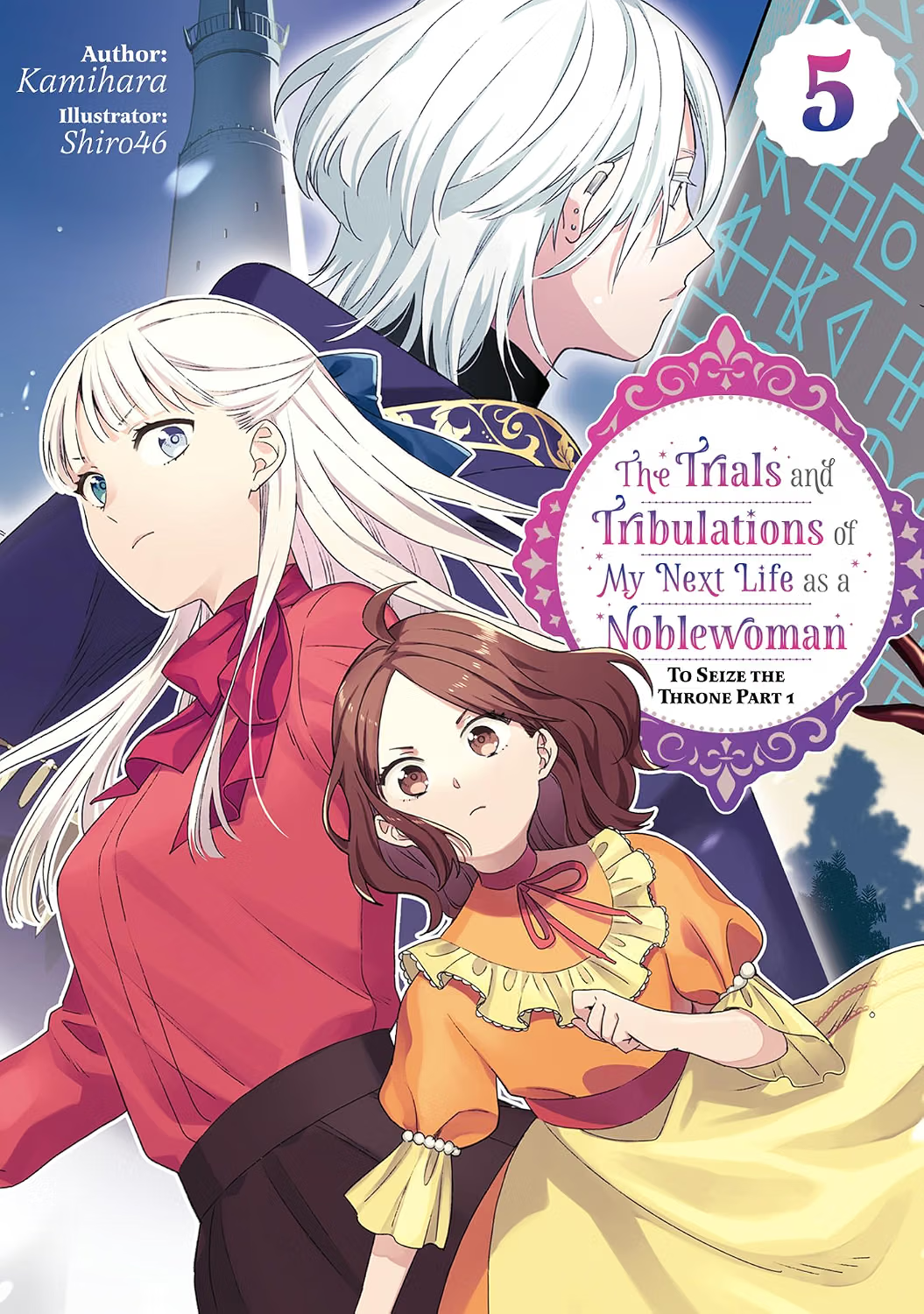
The Trials and Tribulations of My Next Life As a Noblewoman: A Ray of Hope, Part 1

March 24, 2026 by Sean Gaffney

By Kamihara and Shiro46. Released in Japan as “Tensei Reijo to Sūki na Jinsei o” by Hayakawa Shobo. Released in North America by J-Novel Heart. Translated by Hengtee Lim.

The one thing that I think has surprised me most about this series is its dedication to the “My Next Life” part of the title. Let’s face it, in a LOT of these types of series with, if not a villainess, at least a villainess shape, the actual reincarnated from Japan part sometimes gets forgotten. Deliberately so, in many cases – like the male counterparts, a lot of writers write villainess books because people will read that. Trials and Tribulations, though, has quietly continued to point out Karen and Ern’s isekai life, even when it already has a ton of other plot that it could more simply focus on. Last time we saw that Ern was bringing modern guns and gunpowder into a world not ready for it, and the genie really isn’t going back into that bottle. This time, we see there was a country of reincarnators. It even talks about how the original soul “dies” and is replaced with the otherworld one. This series remains a LOT.

As you’d expect, Karen is not doing well after the events of the last book, and ends up in her bedroom basically falling deeper and deeper into depression. Fortunately, she has an angry but kind-hearted tsundere to drag her out and force her to deal with life again. And she also has Reinald, who is not angry or tsundere but is still quietly very interested in her, though she does come far behind his ultimate goal. Karen, though, has far TOO much to deal with. Ern’s parents are being banished for being the parents of a traitor, and while they understandably are a bit pissed at Karen, they also give her a secret message. This allows Karen to discover Ern’s legacy, which can be seen on the cover art but which we’re not quite sure what’s it’s for yet. Six definitely seems to think it’s for him, though. Oh yes, and she’s getting honored by the Emperor for blowing her best friend’s brains out. As one does.

This book is filled with my favorite thing in the series, which is Karen’s matter of fact narration about herself and everything else, followed by someone asking if she could possibly have reactions like a real person. They’d love to see the part early on when she finally gets a delivery of rice, and she’s so overjoyed when she eats she starts to cry. Again, this series has not forgotten its isekai beats. As for Karen and Reinald, I do still think the series is working its way towards them being, if not married, at least engaged by the end. But wow, it’s making me work for that, as that’s quite a Napoleonic goal Reinald has. And it’s so very, very Karen for her advice to him being “why stop there?”. These two absolutely deserve each other. And that’s terrible.

The main flaw of this book is that it is, of course, only half a book. Presumably the subtitle will make more sense after the second part. Still great, though.

Filed Under: REVIEWS, trials and tribulations of my next life as a noblewoman

The Tiny Witch from the Deep Woods, Vol. 3

March 24, 2026 by Sean Gaffney

By Yanagi and Yoh Hihara. Released in Japan as “Mori no Hashikko no Chibi Majo-san” by TO Books. Released in North America by J-Novel Club. Translated by Nathan Macklem.

There’s a famous early episode of M*A*S*H where Hawkeye tries to save a patient but fails, and is despondent about it. Henry Blake, in a rare serious turn, says that the first thing he learned in the war was two rules. Rule #1: Young men die. Rule #2: Doctors can’t change Rule #1. This third volume of Tiny Witch is very much about teaching Misha that lesson, as she goes through all the worst things a doctor – sorry, apothecary – can go through. There’s a pandemic that she finds near impossible to solve, people blame her for it and even attack her at one point, and even once she helps to find an answer, some people still die from it and her relationship with the survivors will never be the same. Being an apothecary is not just handing out magic medicine that makes everyone better. Sometimes people die. Misha does learn this lesson, but there are a lot of tears and breakdowns afoot here.

Misha is having a lot of fun at the Kingdom of Redford. She’s helped the princess regain some of her health, she’s made friends with the local children, and she even gets to walk around a town festival. Unfortunately, then those same kids come to tell her that one of them is sick. Along with her grandmother. And the sickness turns out to be very familiar – it’s the plague that almost destroyed the kingdom a generation ago. Now she has to try to solve what others couldn’t before, and without any other help… or so she thinks, but fortunately, some allies arrive to remind her that while the elves (cough) sorry, People of the Forest are loners who tend not to get involved in other people’s business, they will actually help her if she needs help. Even more fortunately, friends she made along the way in the first book turn out to be more valuable than she thought.

This is very much both a “Misha grows up” volume and also a reminder that Misha is not grown up yet, and also has had a lot of trauma in the past. As it turns out, and I’m sure this won’t become relevant in a later book, the woman who set up the death of Misha’s mother, who was confined to an asylum, has escaped. Her friend tries to ask if it’s OK to tell her the information, but the mere reminder of the incident sends Misha into a panic attack. Because she’s good at remaining outwardly nice and friendly, it’s hard to tell sometimes how she’s barely holding it together, and the plague absolutely does not help. By the end of the book, she’s the definition of sadder but wiser, especially with the children she made friends with, who now see her and can’t help but think “she promised to save my granny but did not”. Misha, think of those you did save as well.

The end of this book suggests that we will spend the next several books stuck in the People of the Forest’s closed-off village, and I am 100% sure that’s not going to happen, so it will be interesting to see how that gets derailed. Till then, this is a very solid fantasy.

Filed Under: REVIEWS, tiny witch from the deep woods

The Villainess Speaks Not: The Awoken Genius and the Once-Lost Pawn

March 22, 2026 by Sean Gaffney

By Kei Yose and Ruria Miyuki. Released in Japan as “Akuyaku Reijou wa Shaberimasen” by Overlap Bunko. Released in North America by J-Novel Club. Translated by Adam.

I always find it very interesting when J-Novel Club puts a villainess title in their “main” imprint rather than in the romance-oriented J-Novel Heart line. The implication is that the romance is not the point in this series, and that’s certainly true in this first volume, where our pre-teen villainess does her best to try to avoid becoming the official fiancee to the crown prince. But more to the point, this is one of those villainess series that runs entirely on politics and intrigue, and that places it squarely in the main line of books. Liliana has assassins try to kill her over and over again in this book, and she’s only six years old for most of it. The kingdom is being torn apart and a coup may be imminent. There’s an aggressive mage running around simply starting chaos on behalf of someone unseen. Then again, give the sheer OP capabilities of Liliana, maybe everyone is right to worry.

I need you to bear with me while I write the next sentence, because I promise this book was really good. Liliana Clarke wakes up from a week-long fever to find that she now remembers her past life from Japan, and also that this is the world of an otome game where she is the villainess. (You can’t be too surprised, given the title and the genre.) She also finds that she can’t speak anymore, due to the illness… or due to a curse. This is not good news, because magic here requires spoken incantations. She can’t even call for help in case assassins attack her. Which, given that her dad is one of the biggest power brokers in the country, is a problem. Fortunately Liliana already knows that most magic is not “ironclad rules” put “power of imagination” Which means she has no need for speaking. Also, she can do literally almost anything.

It’s a rare villainess book that has almost no humor at all. What’s more, while her life is truly terrible, Liliana does have allies in her corner (including the crown prince – she may want to break off their engagement, but not if he has anything to say about it). This is important, because danger lurks around every corner here. Possibly the most chilling moment in the book is when, after a monster stampede that destroyed a town and killed dozens, which she managed to stop but passed out from mana loss, her father happens to be passing my in the aftermath and murmurs “what, still alive?”. Fortunately, Liliana really is OP, and her allies are fun, especially mage Petra (who may treat Liliana too casually but knows her stuff) and mercenaries Gildo and Olga (whho marvel at the fact that she’s not like those other nobles). By the end of the book she’s regained her voice but decides to hide it to fool her enemies. It’s a good plan, especially as the apple-eating bad guy who doesn’t have a name but certainly has a mission to wipe her out continues to hang around.

The webnovel has finished for this, and there are five volumes so far in Japan, so we’ve barely gotten started. What’s more, this was 380 pages, so it’s a beefy book. I felt rewarded, though. Thrilling stuff.

Filed Under: REVIEWS, villainess speaks not

Repeated Vice: I Refuse to Be Important Enough to Die, Vol. 2

March 21, 2026 by Sean Gaffney

By Kuroakawa Hitsugi and Kushiro Kuki. Released in Japan as “Repeat Vice: Akuyaku Kizoku wa Shinitakunai node Shitennou ni Naru no wo Yamemashita” by HJ Bunko. Released in North America by J-Novel Club. Translated by piyo.

This series has one big selling point that makes it a lot better than most of the “reincarnated as some dude who dies” series I’ve been reading lately. Lofus starts this book angry, goes through the book angry, and ends the book angry. He is a perpetually frowning, bitching twelve-year-old, even when he’s rescuing slaves, helping to extend the life of dying wyverns, or helping one of the heroines escape from his family’s deadly crypt. Why does he have to do all this? Why can’t people just leave him alone to get on with escaping his pointless fate? An escape that seems like it might be harder than it sounds, as when the main bad guy of the series shows up to invite Lofus to join his Council of Evil, Lofus really has to struggle to say no. The narrative wants what it wants. Well, mostly. SOMEONE besides Lofus is able to twist the narrative to serve their own devices. I wonder who?

We pick up where we left off last time, as Lofus and his bodyguard Yusurika find themselves teleported to where the slaves are being sent. They find Norn, Faltiana’s friend, almost too quickly, though she’s been raped and tortured by her abusive owner. He also finds Warm, who is another “character” who was part of the Council of Evil (not its real name) and who is, at the moment, just some guy who loves his wyverns – though Lofus feels a need to fight him anyway, as in the previous world he was intensely jealous of Warm. Finally returning home, he’s immediately sent by his dad (another of those “I think he’s horrible but the reader sees he’s just awkward” dads) to investigate a break-in of the family crypt… and finds another “heroine” like Faltiana, who has triggered a trap and is now surrounded by monsters, as this crypt is basically a dungeon.

Setting aside the part that annoyed me first – I accept the author did not want this to be a series that realistically covered the aftermath of a rape and abuse victim, especially if she’s not going to show up much going forward, but “I was told to get over myself” is not really how I wanted her to recover either. Honestly, this series is a bit too quick to have rape as a threat to begin with, because it’s trying to show a tonally dark setting. On the bright side, the new love interest, Lilka, is an absolute hoot, being one of those “bright, talkative, has no sense of personal space or noble customs” girls. The funniest part of the book is where he realizes she must also have knowledge of the game, and tests her… but no, she has no idea what the hell he’s talking about. She *is* different from the game, but not, as far as we can tell, because she’s from Japan.

The book ends with a cliffhanger, but I’ve no doubt that Lofus is going to save the day, have ludicrous amounts of cool magic tricks, and be very, very grumpy. I’m here for it.

Filed Under: repeated vice, REVIEWS

Re: ZERO -Starting Life in Another World – Ex, Vol. 6

March 19, 2026 by Sean Gaffney

By Tappei Nagatsuki and Shinichirou Otsuka. Released in Japan as “Re: Zero Kara Hajimeru Isekai Seikatsu Ex”by Media Factory. Released in North America by Yen On. Translated by Kevin Steinbach.

I know a lot of this review might sound like I’m complaining about the dead dove I found in the bag labeled Dead Dove: Do Not Eat. But it’s been harder lately to forget just how incredibly, punishingly bleak Re: Zero can get when it’s firing on all cylinders. The middle third of this volume is just getting punched in the face by the author over and over again, and I’ll be honest, I did not enjoy it at all. Part of it is that I don’t really enjoy seeing characters suffer – that was the me of thirty years ago – but I think a lot of it is that this is still a side story that talks a lot about how awesome Theresia is and then proceeds to not really show us any of that. Most of this book Theresia is unable to fight for one reason or another, and even though the author lampshades it a bit it’s still annoying. I hate damseling.

After a few volumes that examine other side characters, we’re back to the backstory of Wilhelm, who is now happily married to Theresia. Unfortunately, there’s a problem, which is that Stride and Eight-Arms Kurgan are still at large, and are not likely to simply go back to the Empire empty-handed. As it turns out, Stride has an absolutely epic plan that revolves around the fact that, despite being a country that the dragon will supposedly protect in times of peril, the dragon never appeared during the ten years of their civil war. Was this because it didn’t involve other countries? Or is the dragon thing a lie? To find out, Stride decides to kidnap, murder, and turn into mind-controlled puppets a good part of the cast, and it’s up to Wilhelm, his best friend Grimm, and Roswaal J. Mathers (note the middle initial) to try to save the day.

I’ve talked before about how the way these come out in Japan and here is screwed up, because Yen started late and can’t release this book with Vol. 39 of the main series, as it did in Japan. So there’s some subtext here that will no doubt make sense when we do get that book in 2029 or so. On the other hand, sometimes it does match up with other volumes accidentally quite well. This book comes out here right after Short Stories 4, a book with a large amount of Carol and Grimm, who are old but still powerful folks in the main series and are young powerful folks in this side story. Carol really goes through the wringer, and I am grateful that the “you were mind controlled but you still killed all those people including my dad” plotline is absolutely ignored. This was bad enough without that. And we also say a fond farewell to the Roswaal Mathers of the past, who if nothing else I liked a lot more than the Roswaal Mathers of the present.

This had good fights, and lots of interesting lore. But, like a few other Re: Zero books I’ve read lately, I can sum it up thusly: A Slog.

Filed Under: re: zero, REVIEWS

To Sir, Without Love: I’m Divorcing You, Vol. 1, Part 2

March 19, 2026 by Sean Gaffney

By Kori Hisakawa and Airumu. Released in Japan as “Haikei Mishiranu Danna-sama, Rikonshite Itadakimasu” by Media Works Bunko. Released in North America by Yen On. Translated by Carley Radford.

I had not realized when reading and writing the review of the first book that it’s literally half a book – the books were released in Japan as Part 1 and Part 2, and that’s what we’re getting here as well. As such, it’s not really a surprise that the book concentrates more on the political climate going on around our main couple, which is not only getting dangerous but also might implicate them personally. This is not nearly as lethal as The Trials and Tribulations of My Next Life As a Noblewoman, but I was thinking of that series while reading this, and believe fans of one might like the other. Byletta is a young woman trying to run her own life and have as much freedom as possible, despite this being a world where noble wives are expected to look pretty and give birth. Arnald is someone who finds he’s fallen in love, and simply does not have the communications toolkit to deal with it. Basically, they need to talk but don’t.

Byletta, frankly, has a bit too much on her plate at the moment. She has to rush back to the flood control project because outbreaks of violence are breaking out and the nobles who own the hot springs hotels nearby claim the project is taking their water. The city where she lives is under constant threat of a military coup, with destruction, bombs, and many injuries, and the supposed person behind this coup is said to be her husband. And then there’s her own marriage, as she still struggles to understand Arnald, who usually seems cool and uncaring but occasionally shows a more comforting side. Worst of all, he’s still insisting on acting like her husband in bed at night, and it turns out that, after the horrible first time she had, he’s actually an amazing lover. Is she going to be able to get her divorce after all?

Arnald’s mindset is comparatively easy to understand, and once he realizes what he’s doing wrong, very easy to change. Byletta is a much harder nut to crack, frankly. She’s haunted by the fact that everyone sees her mother in her, she’s desperate to be her own woman, be that by learning to use a sword or start a revolutionary fashion industry, all because she does not want to be trapped by marriage. It’s astonishing how many times she refers to herself as Arnald’s whore or prostitute throughout this book – and it’s using the terms because she means them to be derogatory, she has to think of herself as that, because otherwise she would have to accept that she really is falling in love with Arnald, and in her eyes, that means giving up. She’s a fantastic character, and I appreciate that Arnald realizes the only way to keep the one he loves is to essentially give her everything she asks for. All the freedom she wants, just stay married to him. It’s sweet.

This volume ends definitively, as we see a flashforward to them living a happy life with their two children. Nevertheless, there are seven more books in Japan. We’ll see if we get more, but if we do, I’m happy to read it, even though I suspect it won’t just be post-marital fluff.

Filed Under: REVIEWS, to sir without love

86 –Eighty-Six– Alter. Vol. 2: Fight, Magical Girl Reina ☆ Lena! Go, Starship San Magnolia!

March 17, 2026 by Sean Gaffney

By Asato Asato and Shirabii. Released in Japan by Dengeki Bunko. Released in North America by Yen On. Translated by Roman Lempert.

This ended up being a bit of a headache for me. I didn’t mind the parody. Look at that subtitle, I was expecting a lot of goofball antics. The trouble is that it’s also trying to tell a serious story in there, albeit less serious than the main 86 story. I didn’t mind when everyone was talking about using the star grapheme when shouting the name of their colossal killer weapon, but it feels a bit off when it’s in the middle of a dramatic reunion between family, one of whom is the enemy. Which, I note, happens twice in this book. That said, for the most part this Alter is a bit different than the first one, which was essentially a short story collection. This is basically telling one big alternate universe story that combines magical girls and Macross-style space battles, where men and women get to have cute nicknames, and the 86 get to be cute l’il fairy companions. Will everyone live happily ever after? They certainly have a better shot here.

It’s 86… in… SPAAAAAACCCCEEE! Our heroes have been fighting a hundred year war against the Legion, most of whom are, as the main series indicates, the rampaging grudges of dead wartime soldiers. They’ve got huge battleships, and can use huge beam cannons. However, they also fight in person, in space, in magical girl armor. No, the guys get to wear pants, but they do have to have the ridiculous names and poses. The first chunk of the story shows us Lena and Annette as they fight their magical girl battles with the help of the 86, cute fairies that used to be soldiers. Including her new fairy Shin. In the second part, Shin is now the 86 for Frederica, who is part of the plan to end the war once and for all, despite her young age, immature ideals, and tendency to lake the star grapheme. The third story gives Vika and his family something to do, and can easily be skipped unless you love Vika and Lerche.

As noted, this is far more serious in places than I was expecting, in that it’s not a 100% parody. The basic concept is ridiculous, but it takes its worldview seriously, and when the 86 “die”, which they do (though note the quote marks), people get upset about it. That said, overall, this is very much a yay, happy ending sort of book in the end. Most of the named cast we care about are brought back in some way, shape or form, even a couple of the Legion, and the war is over. Certainly that’s wishful thinking for the cast of the main series. And while I found the tonal dissonance jarring, some of the humor was pretty funny. I liked the fourth-wall breaking noting how little we’d actually seen Vika’s family, and that one of them only appeared in an online only story. LOL.

There aren’t any more Alter novels out in Japan, but the good news is that the 14th volume of the main series came out last fall. Expect less cute magical girl names.

Filed Under: eighty-six, REVIEWS

My Happy Marriage, Vol. 9

March 17, 2026 by Sean Gaffney

By Akumi Agitogi and Tsukiho Tsukioka. Released in Japan as “Watashi no Shiawase na Kekkon” by Fujimi L Bunko. Released in North America Yen On. Translated by David Musto.

It’s been over a year, but we finally have a new volume of My Happy Marriage. (And it’s likely going to be another year till the next one – Vol. 10 just came out in Japan earlier this month.) We’ve now resolved most of the difficulties between Miyo and Kiyoka, and the title is no longer ironic. They’re married and happy. Which means, of course, that normally you would end the series. But the anime of this did quite well. As a result, it’s time to continue, and since you don’t really want to mess up the lovely couple – yet – we need to concentrate on the other part of the plot. As such, this volume returns us to the Earth Spider that is such an important part of Kiyoka and Godou’s backstories. It also introduces new enemies, this time from abroad, who basically want to kidnap Miyo for her powers. But most of all it reminds you that extended family is still family, and it’s really hard to get away from toxic relatives.

Now that Miyo and Kiyoka have dealt with the issues of his own family, as well as Miyo’s horrible former family, we are told that the Kudous are actually a splinter family from the main one, the Miyakoujis. As such, they have to go to the old capital to introduce Miyo to them and try to get their blessing. Miyo is nervous, Kiyoka just seems disgruntled. The head of the family is a very nice guy. The women in the family, fortunately, turn out to be great, and they quickly take Miyo under their wing. The men of the family, sadly, turn out to be horrible arrogant drunks, who are easily manipulated, especially if a passing English “shaman” is trying to stir up trouble for his own benefit. Kiyoka is also distracted because the Earth Spider has escaped from the seal that was put on it years ago, and no one knows where it is.

There’s also a little subplot about Miyo trying hard, now that she knows how powerful she is, to not use her dream powers that much. Naturally, we come across several situations where she has to use her dream powers, one of which helps a young girl (good) but also uncovers a history of family abuse dating back centuries (bad, though getting it out in the open may be good). The My Happy Marriage title and concentration on Miyo’s depression and growing love for her husband has made this feel like a romance most of the time, but the supernatural element is still very much present. Miyo is a hot commodity, and now that the series is willing to go outside Japan, I suspect it’s only a matter of time before she’s kidnapped, like most incredibly powerful people who are also introverted. Still, for the moment, she’s happy and back home.

I’m sometimes wary when a series that reached a natural stopping point keeps going, but this was a really solid volume. Fans should be pleased.

Filed Under: my happy marriage, REVIEWS

The Otome Heroine’s Fight for Survival, Vol. 6

March 15, 2026 by Sean Gaffney

By Harunori Biyori and Hitaki Yuu. Released in Japan as “Otome Game no Heroine de Saikyō Survival” by TO Books. Released in North America by J-Novel Club. Translated by Camilla L.

When I started this series, I had thought it was going to run about six volumes, and here we are at the sixth volume. That said, we’re nowhere near done, and in Japan the tenth volume just came out, and it doesn’t look like the final one either. This series is stretching itself, and I don’t think it’s just because of the long, lovingly detailed fight scenes. There are more of those than ever, of course, though blissfully we have a few less stat screens than usual this time around. One thing I did notice is that now that Alia is in a grim desert town, most of her opponents tend to be about her level, with the exception of her one big showcase fight, where she takes out two hundred mooks and five strong fighters without too much difficulty. There is, rest assured, actual plot in this book, but I need to tell you, this series is here to have fights and do otome game stuff, and it’s more interested in fights.

Alia and Elena are now in the middle of the desert, halfway between the demon lands they were meant to be teleported to and the Kingdom of Claydale. They find their way to a town that’s divided into four factions: merchants, dwarves, beastmen, and yakuza, and they have to negotiate their way around them while also trying to find a way to, if not get Elena back home, at least get word to Claydale that she’s not dead. Because trust me, back home if she’s gone more than three months they will move on. Speaking of back home, Alicia is continuing to be the most irritating girl in the world; Clara once again tries to achieve something and accidentally makes everything much worse; and Karla gets religion… and promptly butchers it. Karla remains my favorite part of this series. She’s awful. I love her.

It is rather interesting noticing the development of each of the female leads of this “otome game”. Elena, originally a villainess, has started to grow and realize what a ruler needs to actually do… and that she wants to do it. Clara is determined to get the prince she loves to love her back, and if this happens to destroy everything, oh well. Sadly, employing assassins who failed to kill Alia is not the answer. Karla is an immoral nightmare, but to be fair the people she murders here are literally torturing children in the name of God, so she gets a handwave. Alicia not only is ignoring the evil voice in her head telling her she’s being too evil, but actually gets a major power up in this book, which is terrible. And then there’s Alia, who is gradually starting to realize that she has friends that she likes and cares for, and not only wants them to live, but wants to live with them. Alia and Elena get the most development, and it’s no surprise that they’re the two I expect to live till the end of the series.

The volume ends with the “rescue Elena” team arriving and being told to attack if they see dark elves or Kal’faan royals, right as Elena arrives in the city with a dark elf and a Kal’faan royal as her bodyguards. That’ll go well. We will have to wait, however, as Vol. 7 hasn’t started yet on JNC, so it may be a while. For fans of beautiful girls covered in blood.

Filed Under: otome heroine's fight for survival, REVIEWS

The Devil Princess, Vol. 3

March 15, 2026 by Sean Gaffney

By Harunohi Biyori and Geso Umiu. Released in Japan as “Akuma Koujo” by K Lanove Books. Released in North America by Airship. Translated by Julie Goniwich. Adapted by Emlyn Dornemann.

One reason that this series works so well is that, no matter how dark or serious the climax of each volume gets, or how many corpses pile up, the start of each new book is mostly fun and often funny. Yulucia spends some time in this volume at the standard noble academy, and her quest to make friends, or at least interact normally with people, suffers from everything about her presence. There’s a great side story about a young girl who also has memories of a past life, and knows that this is a “dating sim”, and is there to game the system… and runs into Yulucia, after which she reforms and we never hear from her again. You can almost hear the sad trombone. Alas for people like the second prince, they are too important to vanish from the narrative, and the second half of this book gets substantially darker, as we learn why it’s a bad idea to poison the saint and use her body to summon God.

This volume, like the others, takes in a 2-3 year period in the life of Yulucia, who is dealing with normal light novel things like “I can’t understand why this tsundere guy keeps hanging around me it can’t be love it must be something else” while also doing things unique to this book, such as eating souls in order to gain power and trying to cultivate evil people, who have the most delicious souls to eat. She also runs into the “so-called hero’s party”, which not only contains her two sisters, but also an elf, whose name is unfortunately a Japanese pun and so she can’t stop laughing. In the back half, though, she’s invited by the evil rival to her mother to come visit, and please bring the prince along as well to visit her sickly daughter. And it turns out the mother’s soul is just what Yulucia likes.

Yulucia literally eating souls is pretty evil, of course, but I will admit to loving my favorite part of the book. Cordelia is the daughter of Isabella, the evil rival woman, and she’s been trained by her mother to be a standard jealous catty bitch… till she meets Yulucia and witnesses her doing super powerful healing magic, at which point she undergoes a conversion and decides to be the best “big sis” ever to Yulucia. The funny part is Yulucia’s reaction to this, as Cordelia’s yummy evil soul has now turned all good and yucky. This author really loves playing in the “rooting for the bad guy” sandbox, and while Yulucia is not quite on the level of Karla from Otome Heroine’s Guide to Survival, she’s still pretty bad. That said, it is notable that even when she’s become a mindless monster lashing out and killing all around her, she tries to avoid killing people close to her. She’s not completely evil.

Which, as it turns out, may be the plot leading into the fourth book, where she’s likely to reunite with the demon who made her what she is today. If you like dark comedy, with the emphasis on dark, this is a good one.

Filed Under: devil princess, REVIEWS

Sword of the Stallion, Vol. 2

March 14, 2026 by Sean Gaffney

By Gakuto Mikumo and Manyako. Released in Japan as “Sword of Stallion: Taneuma to Yobareta Saikyou Kishi, Ringoku no Oujo wo Netore to Meijirareru” by Dengeki Bunko. Released in North America by Yen On. Translated by Jake Humphrey.

Last time I said that this mecha fantasy might be meeting up with a villainess story, and this second volume leans right into that. Ras goes back to his country only to find that they’re immediately returning, as it turns out that Princess Tishna has an assassin that’s been hired to kill her. So they’re moving up their plans to try and cut this off at the past, all while dealing with their own internal politics – they attend an event that features the ex-fiancee of Auriol, the prince that Fiarca is currently impersonating, which is fun – and trying to figure out exactly what Tishna, a so-called Wicked Princess who acts selfishly and horribly but whose selfish actions always turn to be the right thing to do and uncover greater crimes – is up to. Oh yes, and she and Auriol – who is really Fiarca – are getting engaged. Given all this, it’s no wonder Ras has no time to deal with his increasingly poor reputation.

If you’re familiar with my reviewing style, and see that I put the summary of the volume before the cover art, you know spoilers are a-coming. Because I want to discuss my favorite part of the book, which examines the type of plot device that most “time loop” villainess stories use. Generally speaking, for the most part, the books rarely go into the mechanics of the loop itself beyond “stop dying” or “stop being evil” – the protagonist taking actions to prevent her (it’s always her) fate are what’s enough. The main part of this volume is no secret, as it’s discussed in the first few pages – Tishna has gone back in time and is redoing this life. This also explains why she’s being “wicked” in order to ferret out corruption. But she also plans, when she’s achieved her goal, to die. But… is her goal achieved? What evidence does she have that she won’t just wind up back in time again because she died? How much of a happy ending do you need? She can’t know, and thus they’re able to stop her.

Other than that, this is a perfectly decent book that is also not really exciting in any way. I’ve dealt with this author before in Strike the Blood, so I know how things are going to go. The fights are good, the interaction is solid, the characters are types. There’s never going to be anything here that will make you go “wow!” and punch the air. Likewise, you’re never going to go “ew” and put the volume down – even the so-called premise gets undercut at every turn so that we can be assured he’s not actually a sleaze. It is very much written to be adapted into an anime down the line. Whether that happens or not I don’t know – but this is just the sort of book to read on the beach, when you need something uncomplicated.

There’s a lot left up in the air at the end of this book, so I think when I tell you this book came out in 2023 in Japan and there’s no sign of a 3rd volume, you’re just going to be annoyed I made you read the review at all. Sorry! Tee-hee. (bonks head) We can just imagine that they solve everything and he ends up with multiple partners, just like Strike the Blood.

Filed Under: REVIEWS, sword of the stallion

Spy Classroom: The High Plain of Sara

March 13, 2026 by Sean Gaffney

By Takemachi and Tomari. Released in Japan as “Spy Kyoushitsu” by Fujimi Fantasia Bunko. Released in North America by Yen On. Translated by Nathaniel Thrasher.

After the events of the last volume, which were dark but not as dark as the rest of the series, we’re back into pitch black with this volume, which does just about everything except kill one of the main cast off – and even that’s left up in the air at the end. It turns out, amazingly, that being a spy continues to be very hard! And that one of the few things harder than that is starting a revolution. Honestly, this particular book feels very relevant to our times right now in a way that I will try not to go into great detail about. Things aren’t helped by the fact that we’re down a good two-thirds of our regular cast. The team split up to do their big job at the end of the 9th volume, and it’s now over a year later, and they’re still split. Which is good news if you’re a fan of Sara, of course, as well as Erna and Annette, but fans of other girls will have to be patient.

The book consists of one main plotline interrupted by a subplot that happened before the start of it. The main plotline continues the adventures of Erna and Annette that we saw at the end of Volume 9, as they try to incite a revolution among the people, infiltrating an underground organization, investigating a very suspicious mine explosion, and trying their best to avoid getting noticed by Nike, who is the country’s top spy, and would absolutely destroy them. Oh yes, and Erna also has the added problem of Annette, who has basically resolved that she’s just going to get more and more evil as time goes on, and eventually will not be able to be held back. The subplot involved Sara, who objects to Klaus’ plan – not splitting everyone up, but pairing Erna and Annette, which she regards as a bad balance. Klaus takes the opportunity to show Sara how far ideals go in the spy world.

This is technically Sara’s book, despite the fact that the bulk of it is pretty much Erna’s show. I feel very bad for Erna, who after weaponizing her woobiefication finds that being a woobie is something that can happen whether she wants it to or not. By the end of this book she’s a wreck, but I’m sure she’ll get more opportunities for cool things later. Sara, probably not so much. Now, I am not so naive as to think that the author is going to kill off one of its more popular characters. I do, however, think Sara will probably sit the rest of this arc out. Which is fine, as this was a really killer performance by her. The theme of “you are a very competent spy but still about 5000 times less competent than everyone else” is a hard lesson to take in when you are trying to ensure everyone survives and lives happily every after, and it’s very Sara that she accepts the lesson and then decides to be an idealist to the end anyway. It’s no wonder that “big sis” Sybilla says about Sara, “She’s such a mom.”

By now you know what I’m going to say: next is a short story collection? Yup. Still, good start to this arc, which reminds you how difficult it can be to make folks understand who are the right people to hate.

Filed Under: REVIEWS, spy classroom

To the Monster I Love, Vol. 1

March 12, 2026 by Sean Gaffney

By ryunosuke and Gesoking. Released in Japan as “Bakemono no Kimi ni Tsugu” by Dengeki Bunko. Released in North America by Yen On. Translated by Laura Sitzer.

I was on the fence about picking this series up, as let’s face it, I read way too many light novels, and the first I heard about it was hearing complaints about the way the title is translated. (My Japanese is not good enough to go into what it should or shouldn’t be, but the title as chosen certainly can fit the book.) As it turns out, I enjoyed this a great deal. It may be a tad grimmer than I expected, with a high body count overall, but none of those deaths are in the main cast. Instead, the main cast are defined by basically being really sweet – almost ridiculously so at times. The series is about solving crimes, but at the end of the day it’s also about a man who is in love with four women, and they love him, and while the women may not be happy with each other, they’re very happy with what they have now. Also, unlike a lot of “contest winners”, this feels like the start of a series.

We open on an interrogation, as a frankly far too manic researcher has a young man tied to a chair, and wants to ask him questions about his actions of the last month. As it turns out, Norman, the tied-up young man, acts as a detective/detective’s assistant/minder/lover to four different girls, all of whom are designated Unlaw by this city – Unlaw meaning essentially they have magical powers. We hear about how he and Shizuku, a stoic musician, solve a gruesome society murder. About how he and Eltiel, a huge and loyal blonde woman, investigate a depressing string of murders in the slums. About how he and Lonsday, a brilliant but easily bored detective, look into a “phantom thief” stealing from a museum. And about how he and Clareth, a schoolgirl, are lured into a trap involving a train car full of corpses. Is Normal really just a protagonist in a light novel? Or is it something more sinister?

I had expected Normal to be the weak link, as frankly he’s mostly a blank space that the women project themselves on to. But as we find out, that’s on purpose, and I appreciated the fact that his love for the four girls wasn’t to keep them in line, or because that’s the best way to use them, but because he really does love them all as humans, not Unlaw. The girls are, let’s face it, all types set to appeal to a light novel reader in general and a Dengeki Bunko competition judge in particular. Eltiel in particular hits about 5 or 6 buttons alone with her backstory, powers, and appearance. (She’s also the nicest of the four, although that’s by design given the type of “monster” she is.) The final scene also has a really good battle between not-so-blank Norman and the villain, and shows that deep down, the man is a sweetie pie. Though admittedly a sweetie pie who will not hesitate to kill a lot of folks to protect his loved ones.

In the end, they’re all rewarded with a detective agency, which means that the girls may have to – shock, horror – interact more in Book Two. If you like supernatural mystery books, and don’t mind that it feels like a book written to be an anime rather than a light novel, this is quite well done.

Filed Under: REVIEWS, to the monster i love

  • « Go to Previous Page
  • Page 1
  • Page 2
  • Page 3
  • Page 4
  • Interim pages omitted …
  • Page 346
  • Go to Next Page »
 | Log in
Copyright © 2010 Manga Bookshelf | Powered by WordPress & the Genesis Framework