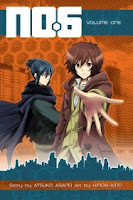
By Atsuko Asano and Hinoki Kino. Released in Japan by Kodansha, serialization ongoing in the magazine Aria. Released in North America by Kodansha Comics.
Dystopias are, as a general rule, not my cup of tea. Those who read this blog on a regular basis already know that I’ll forgive a lot of a story if it has a happy ending; likewise, if a series is just unrelentingly grim, all I really feel is exhausted. But that isn’t to say that a series can’t still win me over with enough interesting things going on. No. 6 is indeed one of those series. It takes place in a supposed elite utopia that turns out to have many deep, dark secrets, and our hero quickly finds out how fast events can turn against him. It’s also shoujo – it runs in Aria, Kodansha’s upscale magazine that’s competing with titles like Asuka and Wings to get the teen “not quite BL” market.
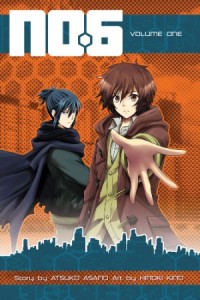
Our hero’s name is Shion, a stoic and reserved young man who is on the fast track for the elite school (and this is among a city of elites) until he lets a young fugitive, who seems to be called Rat, briefly stay at his place, and sews up his wounds. This causes him to lose that elite privilege, something which… really doesn’t bother him much. Several years later, he’s working part-time jobs and staring blankly at his female best friend, who blatantly says she wants to sex him up but is just not registering on his radar, when he comes across a hideous government conspiracy that is killing people by aging them to death. He’s rescued by Rat, and is forced to abandon his life and go on the run, where he’ll find out what the city is really like.
Passive characters like Shion have to be handled very carefully not to be boring. Luckily, these creators are doing a good job so far. Shion may be reserved, but he’s not unemotional, and I like his youthful enthusiasm (which sadly wears down as the volume goes on) and bluntness when he first meets Rat. The scenes with Safu, the aforementioned best friend, are also both quite funny and very telling. It’s not entirely clear if he’s uninterested because he’s not into girls (certainly he bonds better with Rat than he has with Safu) or if the concept of sexual love has simply never occurred to him, but it’s another thing that serves to make him watchable. (By the way, Safu will be dying at some point in this series, sacrificing her life for Shion. I don’t know any spoilers, but bank on this happening anyway, because DUR HEY.)
Rat is less successful, being more of a standard smug pretty boy who has learned not to trust anyone but can’t help but be drawn to our hero. Likewise, the government conspiracy itself, along with its Orwellian officers who administer it, are very much out of the school of Dystopias 101. The aging-to-death thing is pretty horrific, but we don’t know either of the victims long enough for it to really sink in. And the art is serviceable, but doesn’t really pull you in much.
That said, I’m interested to see what happens with Shion, who’s an intriguing enough character that I’ll try another volume of this. The genre isn’t my cup of tea, but the lead may be. And it’s a definite must-buy for anyone who likes conspiracy thrillers with overtones of possible BL romance.


 MJ: Sure! Hmmmm… now the question is, which one? I guess I’ll start with the book I read last, since it’s freshest in my mind, and that would be







 MICHELLE: Sure!
 Moving swiftly from contemporary to classic, our second read this week was the first omnibus volume of Kazuo Koike and Goseki Kojima’s