• Skip to primary navigation
  • Skip to main content
  • Skip to primary sidebar
  • Home
  • About Us
    • Privacy Policy
    • Comment Policy
    • Disclosures & Disclaimers
  • Resources
    • Links, Essays & Articles
    • Fandomology!
    • CLAMP Directory
    • BlogRoll
  • Features & Columns
    • 3 Things Thursday
    • Adventures in the Key of Shoujo
    • Bit & Blips (game reviews)
    • BL BOOKRACK
    • Bookshelf Briefs
    • Bringing the Drama
    • Comic Conversion
    • Fanservice Friday
    • Going Digital
    • It Came From the Sinosphere
    • License This!
    • Magazine no Mori
    • My Week in Manga
    • OFF THE SHELF
    • Not By Manga Alone
    • PICK OF THE WEEK
    • Subtitles & Sensibility
    • Weekly Shonen Jump Recaps
  • Manga Moveable Feast
    • MMF Full Archive
    • Yun Kouga
    • CLAMP
    • Shojo Beat
    • Osamu Tezuka
    • Sailor Moon
    • Fruits Basket
    • Takehiko Inoue
    • Wild Adapter
    • One Piece
    • After School Nightmare
    • Karakuri Odette
    • Paradise Kiss
    • The Color Trilogy
    • To Terra…
    • Sexy Voice & Robo
  • Browse by Author
    • Sean Gaffney
    • Anna Neatrour
    • Michelle Smith
    • Katherine Dacey
    • MJ
    • Brigid Alverson
    • Travis Anderson
    • Phillip Anthony
    • Derek Bown
    • Jaci Dahlvang
    • Angela Eastman
    • Erica Friedman
    • Sara K.
    • Megan Purdy
    • Emily Snodgrass
    • Nancy Thistlethwaite
    • Eva Volin
    • David Welsh
  • MB Blogs
    • A Case Suitable For Treatment
    • Experiments in Manga
    • MangaBlog
    • The Manga Critic
    • Manga Report
    • Soliloquy in Blue
    • Manga Curmudgeon (archive)

Manga Bookshelf

Discussion, Resources, Roundtables, & Reviews

Features

The Favorites Alphabet: D

September 22, 2011 by David Welsh

Welcome to another installment of the Favorites Alphabet, where the Manga Bookshelf battle robot ruthlessly assess the titles in our respective collections to pick the manga title from each letter of the alphabet that makes us feel all floaty, whenever possible. We’re trying to stick with books that have been licensed and published in English, but we recognize that the alphabet is long, so we’re keeping a little wiggle room in reserve.

“D” is for…

Dominion | By Masamune Shirow | Published by Dark Horse – Appleseed is the most ambitious, and Ghost in the Shell the most popular, but I have to admit that I find Dominion and its alternate universe sequel Dominion Conflict One to be my favorite Shirow manga, and one I keep going back and rereading.  It’s the funniest of his works, particularly Conflict, and the Puma Sisters were a major influence on “catgirls” in the Western fandom.  The environmental message is also strongest in these works, with the plotting devoted to ecoterrorism, and set in a future so miserable that if you go out without an oxygen mask, you die.  Most of all, though, Dominion revels in its property damage, and it may rival the Dirty Pair in sheer amount of destruction seen in a series.  Leona is a hothead who does not know the meaning of the words “Stand down”, and in Conflict, where her love interest and morality chain Al is missing, she’s even worse.  Dominion is just sheer fun, and a title I hope that Shirow eventually returns and wraps up some day.  – Sean Gaffney

Dororo | By Osamu Tezuka | Published by Vertical, Inc. – I could very easily have given this slot to Moto Hagio’s A Drunken Dream and Other Stories (Fantagraphics), but if I’m going to be completely honest, the title for this letter that I can read over and over again and take near-complete delight in is this truncated bit of action-fantasy lunacy from Tezuka. It’s about a guy whose greedy father sold all of his body parts to demons to get power, and now the kid has to use his prosthetic body and mad swordsman skills to go get his limbs and organs back. He’s also got a spunky kid thief tagging along, as one does in these circumstances. I could have read about a dozen volumes of this story, but there are unfortunately only three, probably because Tezuka was always doing a million things at once and one must prioritize. It’s hardly Tezuka’s most ambitious work, but, for my money, it’s a prime rendering of his defining qualities: passionate social critique and eye-popping entertainment. – David Welsh

Dororo | By Osamu Tezuka | Published by Vertical, Inc. – Once upon a time, when I was a brand new reader of manga, I was terrified of Osamu Tezuka. I found his status as a master so intimidating, I was actually afraid to read his work lest I be forced to face my own incompetency as a reader. Then, in a moment of madness, I bought Dororo, and less than a chapter in, I realized what it actually meant to be a master. Not only were my fears unfounded—Dororo was a truly thrilling and emotionally affecting manga—but it was Tezuka’s mastery of the craft that made the work so accessible, even today.  Dororo may not be my very favorite of Tezuka’s works, but it will always be special. – MJ

DVD | By Kye Young Chon | Published by DramaQueen – Even though DramaQueen has only managed to release two of DVD’s eight volumes so far, I’ve seen enough to deem this my favorite manga/manhwa starting with the letter “D.”  When Ddam’s boyfriend dumps her, sick of her quirky attributes like the ability to see illusions, her suicidal plans are thwarted by a bizarre pair of fellows, boob fetishist Venu and punk DD, who proceed to attempt to cheer her up in their own inept way. The story is playfully told, with various amusing excursions, and the mystery of Ddam’s gradually solidifying illusions is tantalizing. I continue to buy DramaQueen’s new releases, in hopes that this will help fund more DVD, but really, I am not very hopeful. Thankfully, TOKYOPOP Germany finished the series, so there’s always the Google Translate route. – Michelle Smith

What starts with “D” in your favorites alphabet?

Filed Under: FEATURES

Manga the Week of 9/28

September 21, 2011 by Sean Gaffney

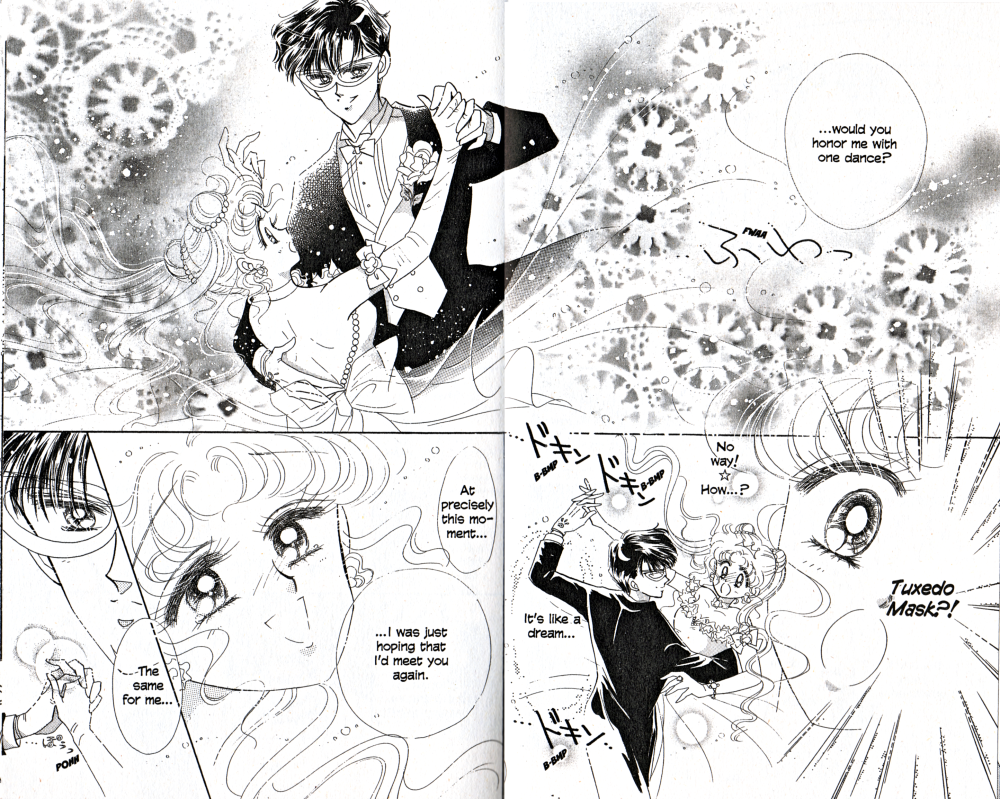
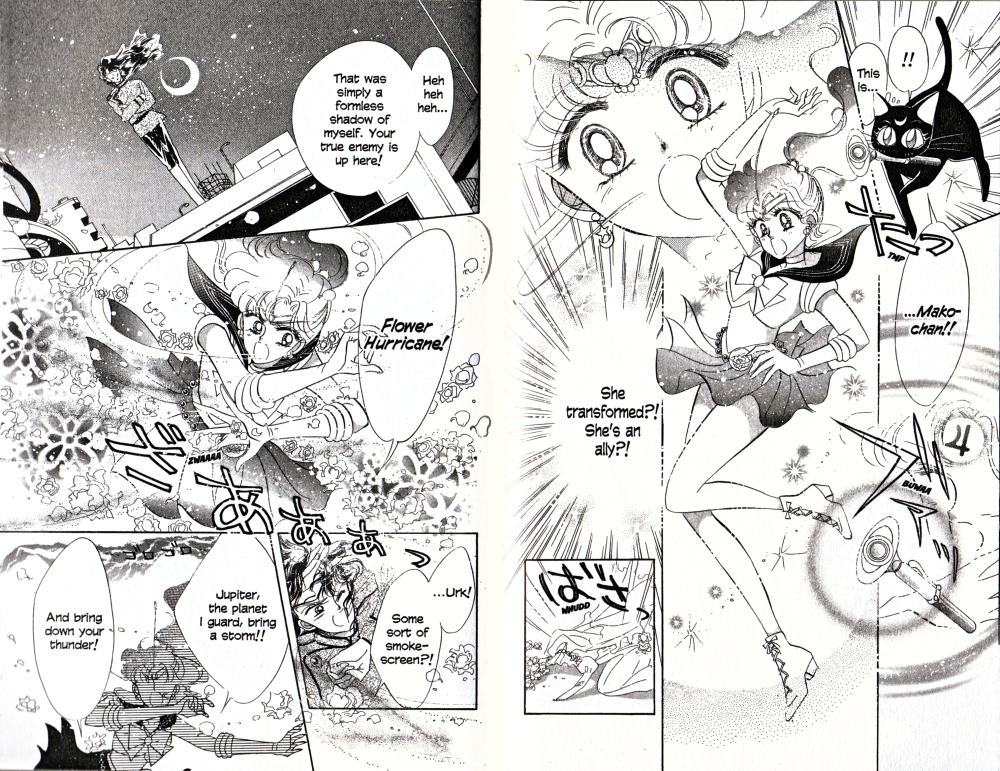
Our long national nightmare is over: Sailor Moon is hitting comic shops. Not Midtown, of course: they have not had a Kodansha release (bar one or two tiny exceptions) in months. But I have my own shop’s list of what’s coming in for me, and it has Kodansha stuff.

I’m not sure of exactly what’s shipping, as I haven’t ordered every Kodansha title for the month, but you should see Sailor Moon and Sailor V 1, Shugo Chara 12, Arisa 4, Negima 31, and Deltora Quest 2. No, not the releases actually due out in bookstores next week – that would be too logical. Only the stuff that’s running 1-3 weeks late. Still, Sailor Moon! And Negima! And Arisa!

In other release news, Bandai has the second volume of Kannagi, with more wacky antics about the girl who already had a boyfriend before the story started and somehow offended an entire otaku species. Oh, and it’s about supernatural shrine maidens as well. :)

Dark Horse has another volume of Berserk, one of their biggest manga series, and one which has caught up with Japan, so a new volume is a treat. If you like dark, gritty violence. Which, let’s face it, many do. It doesn’t hit NYT bestseller lists, but sells very briskly via Diamond.

NBM has the long-awaited Stargazing Dog, a Futabasha title which is the company’s first manga! It looks adorable. (I note the title is also one of the ones JManga offers, though with a different translation.)

Seven Seas is putting out the second volume of A Certain Spinoff Franchise, and I still wait with bated breath to see if Yen will pick up the original. In the meantime, Misaki is fun, and can zap things.

Vertical has the new Tezuka book. No, not Princess Knight, which is a rather nontraditional Vertical title. This is The Book of Human Insects, which is a VERY traditional Vertical title. Provided you don’t mind dealing with horrible people doing horrible things, this promises to be another hefty slice of seinen masterpiece.

And Viz has a new Pokemon book, which will thrill and delight Pokemon fans everywhere! Or possibly be awful. Dunno, have never sampled the series. But it sells like Pokemon, so it has some people who think it’s great.

So what, aside from Sailor Moon and V of course, is appealing to you?

Filed Under: FEATURES

Don’t Fear the Adaptation: Natsume’s Book of Friends

September 16, 2011 by Cathy Yan 4 Comments

Natsume’s Book of Friends | by Yuki Midorikawa | Manga: Hakusensha / Viz | Anime: Brain’s Base / Crunchyroll

Natsume’s Book of Friends is the kind of series that could only be made in Japan. The same plot set-up (young man learns about demons and ghosts, fights some of them and saves others, befriends a supernatural guardian and learns more about his family and himself) when worked over by the United States, well, became Supernatural. Natsume, on the other hand, is a feel-good, low-key series that would gladly eschew demon-slaying for a chance to show an autumn festival in full sway. Less “monster of the week” and more slice-of-life, Natsume’s Book of Friends’ first season tries to bite off more story than it can chew and ultimately left me wavering between dissatisfaction and well-meaning sentimentality.

The eponymous Natsume is a high school boy named Takashi, who has spent his life being ostracized by his family and peers for seeing ayakashi — monsters that are an intersection of mythical beast, ghost, and evil spirit. Takashi’s grandmother Reiko Natsume left him her belongings, among which is the Book of Friends: an old-fashioned notebook filled with names of ayakashi that Reiko had made her followers. The ayakashi whose names were bound in the book were forced to obey Reiko’s commands and, as we discover later in the series, were often Reiko’s only companions.

But Natsume (Takashi)’s connection with the Book of Friends is different. He’s not interested in getting more names; rather, he wants to return the names to the ayakashi. It’s a grueling process that physically and spirtually taxes him. Guided by Nyanko, a dog demon named Madara stuck in the body of fat cat, Natsume finds himself navigating the tricky waters of interpersonal relationships, both with the humans in his life, the ayakashi who won’t leave him alone, and the ayakashi who, surprisingly, need him to guide them through the world of human feelings.

When Natsume’s Book of Friends does its job well, the stories are truly touching. Tsubame, the sparrow ayakashi of episode six, was for me the early standout in this thirteen episode series. Her story arc marks the first time that Natsume gets overly involved in the plight of an ayakashi to his detriment. In his desire to get Tsubame a chance to see the human she loves, Natsume gets trampled on, pushed around, and almost eaten. It’s the kind of dedication that in other anime would result in a love confession. Here, Natsume’s feelings for Tsubame are deliciously kept in the dark, and paired with Tsubame’s unrequited love for a passing human, the whole episode reads bittersweet and touching. Likewise, Hotaru from episode eight has the same melancholy, literary feel to her character arc, much like a short story from Yasunari Kawabata, but animated. At its best, Natsume’s Book of Friends knows when to play the emotional cards close to heart; the most interesting character relationships tended to be the ones that were neither labeled nor even mentioned by anyone in the series.

But other ayakashi who cross Natsume’s path sometimes seemed downright contrived. The kitsune — fox spirit — whose mother is now a pile of rocks (?) had promise as a loner who aims to befriend Natsume, but instead that story fizzled out into a relatively lukewarm conclusion that had me wondering why I was supposed to remember the kitsune kid when he chose to show up in a later episode. Episode three with the dew god was clearly an early foray into the rustic faith of the countryside, but the really interesting religious question (how can you be a god if you have no powers and no followers?) was passed up without any commentary or exploration, while a passable but ultimately silly love story was chosen to cap off the episode. Let’s not even get into the confused emotional climax of episode five, whose musing about friendship between the ayakashi and ill-fated attempt to show us more about Reiko’s personality had me literally falling asleep, despite my best efforts to stay interested. None of the characters in the first season, besides Natsume, get much depth. Sasada, the homeroom president, and Tanuma, one of the few other people who can see ayakashi, had potential to be great foils for Natsume. Instead, Tanuma languishes as a barely realized ally whom Natsume only manages to reach out to in the last episode, and Sasada goes from possibly-no-wait-maybe-not love interest to laughing stock.

In general I found the manga to be more melancholy and on point with the emotional cues. Natsume himself is more gloomy and isolated in the manga, while in the anime, he seems shockingly well-adjusted, making a major sticking point of the story — Natsume’s attempt to build interpersonal relationships — harder to swallow in the anime. Often the anime seemed to be trying too hard for zany or cute or melodramatic or something. I don’t know if it’s because of the switch in medium, but the manga chapters seemed to have an extra air of easy-going softness that was missing from the anime. In many ways, the manga version of Natsume’s life was incredibly fragile. You felt the stories were just like Tanuma’s view of the ayakashi, like if you scrutinized the stories too much they would disappear a little into the background of Natsume’s life. Not so with the anime, where things felt more grounded, more real. Natsume didn’t seem to be the lonely, slightly withdrawn young man he was under Midorikawa’s pen; instead, you felt strongly in the anime that everyone else had had to be wrong to doubt a boy like Natsume. The world of manga Natsume seemed more Japanese, and the ayakashi were everywhere, not just the guest characters they so often were in the anime.

Yet the anime does have its advantages. The ending theme, “Summer Evening Sky”, is a perfect enka-inspired piece that always warms your heart whenever it starts to fade in during the last few minutes of an episode. Kazuhiko Inoue as Madara a.k.a. Nyanko-sensei is a force to behold, easily switching out of Nyanko’s whiny drawl and into Madara’s gruff, no-nonsense bark. And for all my griping that the secondary characters never get development, it’s still refreshing to see a show starring a male character that is neither testosterone-driven nor filled to the brim with ditzy and well-endowed love interests.

Fans of Mushishi and Yumekui Kenbun might consider giving Natsume’s Book of Friends a try (and likewise, those of you who enjoyed Natsume should check out those other two series!). At thirteen episodes, the first season is easy enough to swallow, and the episodic nature of the story arcs makes it easy to start and stop. As for me, I’d put Natsume’s Book of Friends in the box of anime series that neither wow nor disappoint. And, of course, I can only hope the subsequent seasons of the anime learn from Mushishi rather than Supernatural.

Watch it streaming at Crunchyroll

Filed Under: Don't Fear the Adaptation Tagged With: natsume's book of friends

The Favorites Alphabet: C

September 15, 2011 by David Welsh

Welcome to another installment of the Favorites Alphabet, where the Manga Bookshelf battle robot sift through our towering stacks of dog-eared paperbacks to pick a favorite manga title from each letter of the alphabet, whenever possible. We’re trying to stick with books that have been licensed and published in English, but we recognize that the alphabet is long, so we’re keeping a little wiggle room in reserve.

“C” is for…

City Hunter | By Tsukasa Hojo | Gutsoon — One of the saddest parts of the collapse of Raijin Comics and Gutsoon for me was the loss of one of my favorite Shônen Jump titles, City Hunter, which ran in Shueisha’s flagship magazine from 1985 – 1991. A classic action comedy, it focuses on “sweeper” Ryo Saeba, a handsome gun-for-hire who lives in Shinjuku and acts as a private detective for people (invariably young ladies) who need his services, assisted by his spunky young partner Kaori, who is also his love interest. They aren’t together, though, because Ryo is a complete and utter horndog – he will try to sex up any pretty girl he sees (which are many – Hojo draws beautiful women) and his huge erections are not only a running gag, but almost omnipresent – the term “mokkori” is used by City Hunter fans like “baka” or “hai” by other Japanese anime fans, referring to Ryo’s visible manhood (as well as his term for girl hunting). As for Kaori, her anger at Ryo’s antics, short tomboyish persona and use of huge mallets to flatten Ryo into the ground may sound familiar to some fans of Ranma 1/2 – the series ran in rival magazines. The combination of comedy, action and romance was a huge hit in Japan, but less so here, and no one has been able to restart the series. I believe that Hojo has the rights himself. As he’s currently with Shinchosha, perhaps we could ask them if they want to try it as a JManga title? Or even the semi-sequel, Angel Heart? — Sean Gaffney


Club 9 | By Makoto Kobayashi | Dark Horse — If you told me that one of my favorite manga would focus on a country girl-cum-hostess, my inner feminist would have scoffed at you: how could I possibly enjoy a series that celebrated one of the seamier aspects of Japanese business culture? Yet Club 9 is totally, thoroughly winsome, even if it isn’t very progressive. The story focuses on Haruo, a teenager who leaves her backwoods town to attend college in the big city. Through a series of improbable circumstances, she lands a job at a hostess club, disarming salarymen, tycoons, and manga-ka with her direct, down-home manner. Haruo’s innocence is the source of many comic misunderstandings, but Makoto Kobayashi never makes his heroine the butt of cruel jokes; Haruo always gets the last laugh, no matter how outrageous the circumstances. Fabulous caricatures and an imaginative re-write are the frosting on this very tasty cake. – Kate Dacey

Cross Game | By Mitsuru Adachi | Viz Media – I really love sports manga. I love it when it’s kind of juvenile (Eyeshield 21) and I love it when it’s kind of ridiculous (The Prince of Tennis), but mostly I love it when it’s kind of bittersweet, which is where Mitsuru Adachi’s Cross Game comes in. The depiction of the baseball games themselves are a lot of fun, but there is also strong character drama, as lead characters Ko Kitamura and Aoba Tsukushima, united in tragedy by the loss of Aoba’s sister some years ago, butt heads due to their similar personalities but gradually grow closer as they mature and develop a greater appreciation of the other’s worth. Reading this series always makes me sniffle (in a good way), and I am grateful that VIZ has licensed it. Not so grateful that I won’t take this opportunity to beg for more Adachi, however. Might I suggest Rough? — Michelle Smith

Cross Game | By Mitsuru Adachi | Viz Media — There’s a Japanese phrase, mono no aware, that I suspect I probably overuse to the point that I end up sounding pretentious. I actually don’t care, because that phrase, which is often translated as “the pity of things,” frequently pops to mind when I’m really, really loving a given manga. It may seem unlikely to link that phrase, defining a wistful awareness that everything ends eventually, to Adachi’s baseball comedy, but Adachi is about as good at embodying this haunting, preemptive kind of nostalgia as just about any of his peers. So, yes, Cross Game is hilarious, and, yes, it’s about baseball, but it’s also about youth in all of its awful glory, from the off-the-diamond losses you never quite figure out how to endure to the grand possibilities the future presents, even though they scare you a little because you’re not sure you’ll be able to realize them. And there’s a really cute cat. I don’t know what else you could reasonably expect. – David Welsh

Crown of Love | Yun Kouga | Viz Media — Unlike the first two letters we’ve explored here, “C” is a tough one for me. While there are a number of “C” manga I’m very fond of (Cardcaptor Sakura, Chi’s Sweet Home, and Children of the Sea all spring immediately to mind), I don’t have a deeply personal favorite–that kind of manga that just really gets me regardless of its more objectively-measurable qualities.  Except that I totally do. I don’t generally believe in “guilty pleasures” (why feel guilty over taking pleasure in storytelling?), but if I did, this would be at the top of the list. It’s a twisted josei love story that isn’t afraid to explore the possibility that its male protagonist may be genuinely creepy–made even more twisted by the fact that he’s got nothing on the people around him. Though its final chapters are a bit too romantic to suit the story as a whole, at four volumes total, it’s an addictive whirlwind of a series. And sometimes, honestly, that’s “favorite” enough for me. – MJ

What starts with “C” in your favorites alphabet?


Filed Under: FEATURES

Manga the week of 9/21

September 14, 2011 by Sean Gaffney

It’s a typical 3rd week of the month at Midtown, which is to say it’s typified by its untypicalness. (And no, no Kodansha titles, and no Sailor Moon, from Diamond again.)

Viz has the most coming out, including a couple of books that many stores have gotten in a while back. The penultimate volume of Fullmetal Alchemist, which no doubt will be the ‘darkest’ part of ‘it’s always darkest before the dawn’; the 7th Arata the Legend from shoujo turned shonen artist Watase Yuu; new Natsume Ono with House of Five Leaves, which will no doubt have more tortured souls; the penultimate volume of Kurozakuro, which if I recall correctly ended rather abruptly (read: got cancelled), so hopefully gets a good run up to an ending anyway; and two “Educational Biographies” from Shogakukan’s education division. Helen Keller has never looked more like Nanami Kiryuu, nor Thomas Edison more bishie. (The Edison cover in particular is a stitch.)

From other publishers, we have the 4th volume of Blood Alone from Seven Seas. I forget, do volumes with ‘blood’ in the title sell as well as volumes with ‘vampire’? And Midtown is also getting Jiro Taniguchi’s A Zoo in Winter from Fanfare, which I had thought came out ages ago. So it’s not just Kodansha getting shafted by Diamond?

And that’s it. Any titles strike a light?

Filed Under: FEATURES

Manga the Week of 9/14

September 7, 2011 by Sean Gaffney

Given that next week is all about Yen Press, let’s start with them. (Yes, I know Sailor Moon and Sailor V come out 9/13. Did you really expect Diamond to ship it on the same day it hits bookstores? Have you been reading my posts at all this year?) There’s lots of stuff from Yen that deserves mention, but I want to focus on one title in particular first.

With the Light, a manga about a young mother struggling to raise her autistic child, was one of Yen’s first manga series announced, and their most exciting. A josei manga that clearly was intended to be marketed to a much broader audience than anime fans, it was a sign of great things to come. And it turned out to be even better when you read it, heartwarming and inspiring. Sadly, the author passed away before she could finish the series. Yen has worked with Akita Shoten to make the final volume, out next week, as complete as it is possible to be. Everyone who loves manga that goes outside the boundaries of ‘fight, train, laugh’ should pick up this series.

Of course, Yen has other stuff too. There’s Bamboo Blade 10, which is about to start up its next big arc. There’s Bunny Drop 4, which is a big turning point in the series. My Girlfriend’s a Geek 4 will no doubt feature more knowing humor about the fujoshi lifestyle. Zombie Loan… I’ve never read, I admit. I presume it’s about a library where you borrow zombies for things they’d be useful for? And the cute moe librarians who run Zombie Loan? No?

And though I don’t cover manwha, I suspect I would be filleted by my fellow Manga Bookshelf colleagues if I did not mention the new Goong and Raiders manga. And for fans of OEL, there’s Svetlana Chmakova’s new series Witch and Wizard, which is written by some other guy… oh right, James Patterson.

Viz also has titles! Albeit not many. But one is the 18th volume of Hayate the Combat Butler! Yes, it’s down to twice a year, and it seems to only garner bad reviews online these days (that will change when I get a hold of it), but this one resolves the ‘End of the World’ arc in a dramatic way, then kicks back to the comedy. And another final volume, as Detroit Metal City comes to a close. I kind of lost track of the series after the first couple of volumes, but I have a lot of friends who love it.

And Dark Horse is putting out the first volume of Yasuhiro Nightow’s new series, Blood Blockade Battlefront, no doubt meant to appeal to Trigun fans the same way Drifters is clearly designed to appeal to Hellsing fans. Sadly, on advice from my doctor, I can’t actually look at Nightow’s artwork anymore without a 24-hour nurse by my side, so I did not preorder it. But I’m sure hardier people than I will be willing to read it and try to figure out what the hell is happening in the panels.

(Apologies to Dark Horse… if it helps, I’ll be praising Drifters soon.)

So what intrigues you this week?

Filed Under: FEATURES

The Favorites Alphabet: B

September 7, 2011 by David Welsh

Welcome to another installment of the Favorites Alphabet, where the Manga Bookshelf battle robot gingerly approaches our meticulously organized collections to pick a favorite manga title from each letter of the alphabet, whenever possible. We’re trying to stick with books that have been licensed and published in English, but we recognize that the alphabet is long, so we’re keeping a little wiggle room in reserve. And sometimes you can’t pick just one.

“B” is for…

Banana Fish | By Akimi Yoshida | VIZ Media — Given my frequent posts on the subject, this choice likely comes as no surprise. Yet even after all that verbiage, I think I’ve talked very little about one of the main reasons I so love this series. Yes, it’s got fast-paced action, well-developed characters, and an almost-BL vibe to die for, and watching Yoshida’s artistry develop over the course of 19 volumes is truly a pleasure. But one of the series’ greatest draws for me is very simply its sincerity. I recently described another manga as reading like “a bad teen-penned novel,” and while Banana Fish shares some of the same over-the-top sentimentality and naive fancy that tends to characterize stories written by teens, like S.E. Hinton’s The Outsiders, Banana Fish reads like a great one. Yoshida offers up genuine intrigue and compelling action sequences, but her most winning quality as a writer is how sincerely she loves her characters, even when she’s putting them through hell.  This is a series I’ve read and re-read, and will likely read many times more before my eyes finally give out on me. Melodrama and all, it’s one of my favorite manga of all time. – MJ

Basara | By Yumi Tamura | VIZ Media — I hardly know where to start in extolling the virtues of Basara, Yumi Tamura’s epic 27-volume shôjo manga about a girl named Sarasa who assumes the identity of her twin brother Tatara (the so-called “child of destiny”) after his death and leads her people in revolt against a tyrannical king. Sarasa is highly competent and inspires the admiration and loyalty of people from all walks of life, but Tamura never lets us forget that this strong leader is also just a girl who experiences feelings she doesn’t understand and who denies herself a lot in order to be who the people need her to be. Just thinking about the reveal that it’s actually Sarasa who’s been the “child of destiny” all along literally gives me goosebumps. I’d urge everyone to read Basara, even though some volumes are notoriously hard to come by. It really is worth the effort. — Michelle Smith


Black Blizzard | By Yoshihiro Tatsumi | Drawn & Quarterly — I’ve found most of Yoshihiro Tatsumi’s work too bleak, too macho, or too bleakly macho to appeal to my own sensibilities, but Black Blizzard is a notable exception. Dating from the late 1950s, it’s thoroughly enjoyable pulp: a young murder suspect and a jaded criminal escape from custody into a raging snowstorm, police hot (cold?) on their heels. The story’s weaknesses are easy to catalog: the plot developments can be seen coming from a mile away, the characters are little more than types, and the ending is too compressed to be truly satisfactory. Black Blizzard leaves a fresh impression nonetheless, thanks to Tatsumi’s rough, energetic artwork; with all the slashing lines and images of trains in motion, you’d be forgiven for thinking that an Italian futurist had taken a stab at writing a comic book. — Kate Dacey

Black Jack | Osamu Tezuka | Vertical, Inc. — Part House MD, part globe-trotting adventure, Black Jack is easily Osamu Tezuka’s most accessible work. The stories often flirt with the outrageous: Black Jack performs a brain transplant, treats an extraterrestrial, and operates on himself while fending off dingoes in the outback. Yet the human dimensions of every story are never overwhelmed by the questionable medical diagnoses; at their best, the stories are parables about the importance of humility, responsibility, patience, and loyalty, using illness and injury to show us the best — and worst — of human nature. (Also: to show us that Black Jack is a complete bad-ass with a scalpel.) The series’ popularity meant that Tezuka cranked out more Black Jack tales than he probably should have (see “treats an extraterrestrial,” above), but even the weakest entries in the collection are still a lot of fun. — Kate Dacey

Black Jack | Osamu Tezuka | Vertical, Inc. — I’m going to second Kate’s endorsement of Black Jack for a very specific, possibly irrational reason. Sometimes a title becomes a favorite simply by virtue of the presence of a supporting character. In the case of this series, that character is Pinoko. She’s surly old Black Jack’s adorable kid assistant, except she’s actually a parasitic tumor that gestated for years in her twin sister’s abdomen until the good-bad doctor cut her out and gave her a twee little plastic body and took her in as his ward. Pinoko is wrong on every conceivable level – an 18-year-old woman with no meaningful life experience trapped in the body of an artificial child. On some subliminal level, I think every adorable kid sidekick is creepy, but Tezuka just goes there, and Pinoko’s every appearance is an unsettling, mildly heartbreaking, inappropriately funny treat. There are certainly Tezuka titles I like better than Black Jack, but there’s probably no Tezuka character who haunts me quite like Pinoko. – David Welsh

Bleach | By Tite Kubo | VIZ Media — In general, I enjoy talking about manga because I love it. I love finding underrated series I can promote the hell out of, I love reading the romantic ups and downs of a couple that grow and learn at a snail’s pace because it’s funnier that way, and I enjoy watching big guys hit each other. But sometimes you get obsessed with manga that you like… and hate as well.  It can be so good…  and so frustrating. No title currently being released over here does this to me more than Bleach, the second of Viz’s ‘Big Three’ Shonen Jump titles. Bleach has a fantastic cast of characters… who it abandons for years at a time to focus on other new characters. It has emotional resonance… which can sometimes get incredibly ham-fisted.  And while some manga work better in weekly installments, or in volumes, Bleach is one that works best by reading 5 volumes at a time then ignoring it for 6 months. Oh, and the shipping. God, the shipping. Love it or hate it, folks can’t stop talking about Bleach. Which, honestly, is even more valuable in a manga than a title that’s merely liked by everyone. — Sean Gaffney

What starts with “B” in your Favorites Alphabet?


Filed Under: FEATURES

Manga the Week of 9/7

August 31, 2011 by Sean Gaffney

It’s the first week of the month, and you know what that means. Far, far too much manga. What’s worse, Diamond is finally catching up with Kodansha. (Midtown, not so much). I mentioned most of the titles coming in last week (Bloody Monday, Cage of Eden, Phoenix Wright), but one I did not is the re-release of Gon, the adorable (and fearsome) baby dinosaur manga that is actually getting its third re-release. Kodansha is apparently trying to pitch it for a movie, and I think it could be a big hit with the right company. Naturally, being about the antics of a baby dino, it ran in Kodansha’s magazine for adult salarymen, Weekly Morning.

There is also Dark Horse, which is now releasing the 39th volume of Oh My Goddess. I should note that Dark Horse is worried about how old fans will think the manga is given the high volume number, and so ongoing volumes will also remain Volume 39, in tribute to Jack Benny.

The rest is aaaaaaaaall Viz. From Weekly Shonen Jump: Bleach 36, Death Note omnibus 5, Naruto 7-8-9 omnibus, regular Naruto 52, One Piece 58, and Toriko 6. There’s also Ultimo from Jump Square. All featuring Friendship, Perseverance, and Victory. There’s also Kekkaishi 7-8-9 omnibus as well, which is from Shonen Sunday, so is legally obligated not to have friendship, perseverance, or victory. Sad, really.

On the shoujo end, we have cute Hakusensha mangas! Library Wars 6, La Corda D’Oro 14 (another in Viz’s ‘see, it’s not cancelled, just on a ‘no one buys this at all’ schedule!’ titles), and Oresama Teacher 4. Slightly less cutely, we get Grand Guignol Orchestra 3. We have cute Shueisha manga! It’s another volume of tug-at-your-heartstrings Kimi ni Todoke. We have sexy Shogakukan manga! There’s ‘Who am I to argue with its sales?’ Black Bird 10, as well as techno-thriller shoujo romance Dengeki Daisy 6. And we have one final volume, as not-really-shoujo smutty comedy Butterflies, Flowers ends with Vol. 8. I’m betting on a wedding.

All this and a Pokemon Black and White! Are you prepared for this much manga?

Filed Under: FEATURES

The Favorites Alphabet: A

August 31, 2011 by David Welsh

Welcome to the first installment of the Favorites Alphabet, where the Manga Bookshelf battle robot glances through our respective libraries to pick a favorite manga title from each letter of the alphabet, whenever possible. We’re trying to stick with books that have been licensed and published in English, but we recognize that the alphabet is long, so we’re keeping a little wiggle room in reserve.

“A” is for…

After School Nightmare | By Setona Mizushiro | Go!Comi — Gender-bending is not unusual in manga, but actual exploration of gender is, and that’s just one of several refreshing aspects of this unfortunately out-of-print manga. It’s also a story about teenagers that uses school-mandated shared nightmares as a way of forcing students to display and face their own worst fears right in front of each other. Is it creepy? Yes. It also serves as a pretty accurate metaphor for my own thankfully-distant teenage hell, and I expect I’m not alone there. Though the series’ dream setting places it soundly in the realm of the surreal, that doesn’t make it any less resonant. After all, where do our own fears feel more real than in our fevered dreams? For more about this series from smarter writers than I, look to Jason Thompson  and (of course) David Welsh. – MJ

Antique Bakery | By Fumi Yoshinaga | Digital Manga Publishing — Ostensibly a slice-of-life tale about four men working together in a bakery, Antique Bakery offers more dramatic surprises than one might expect. Early on, charismatic gay pastry chef Ono and cluelessly lovable Chikage emerge as favorites, but as we learn more about the bakery’s proprietor, Tachibana, the more fascinating he becomes. An ordeal suffered in his past has profoundly informed the man he is in the present, and when readers realize the truth of what’s been going on all along, Yoshinaga’s mastery suddenly becomes even more apparent. Yes, there are lighthearted moments in this series. Yes, there is a fun cast of characters who grow and change from working together. But most of all, there is Tachibana’s unforgettable story. – Michelle Smith


Apocalypse Meow | By Motofumi Kobayashi | ADV Manga — Apocalypse Meow does for the Vietnam War what Maus does for World War II, using animal surrogates to re-enact period conflict. In this case, rabbits stand in for American soldiers, and cats stand in for the Vietnamese, while the Chinese (pandas) and Russians (bears) observe from the sidelines. Author Motofumi Kobayashi is clearly a military enthusiast: every volume is studded with sidebars describing combat tactics and weaponry, as well as lovingly drawn maps of troop movement. Yet Kobayashi doesn’t lose sight of the human cost of war; watching a trio of bunnies caught in a brutal fire fight makes the horror of combat fresh and unsettling, especially for readers who have been desensitized to the conflict through years of watching movies and documentaries about Vietnam. The series is long out of print, but enterprising (and patient) readers can find inexpensive copies on eBay. – Katherine Dacey


Aria (and its prequel Aqua) | By Kozue Amano | ADV Manga/Tokyopop — A cynical person might say that what Aria really shows is that slice-of-life, look at the scenery manga with no moe schoolgirls in it will die a financial death here in North America.  But what we saw of this series just made me love it all the more.  For a science-fiction utopia fantasy world, Aria is so relaxed and sedate.  It’s not afraid to devote 30 pages to simply walking to a store in the rain, or visiting a friend.  And as the series goes on, the cast of characters that form the core group grow and change, some more startlingly than others.  It’s a classic example of the sort of series you read and feel a smile on your face and a warmth in your heart.  It ran for a total of 14 volumes between both series in Japan, of which 8 saw publication here (both of Aqua and 6 of Aria’s 12).  Sadly, if you want more, I suspect you’ll have to learn Japanese.  It’s now failed to sell with two different North American publishers, and its Japanese company, Mag Garden, is the *only* major manga publisher with no digital initiative – even Square Enix is striking out on its own, separate from JManga.  It’s a shame, as I’d love everyone to see the end of this. – Sean Gaffney


Astral Project | By Garon Tsuchiya and Syuji Takeya | CMX — Being able to describe this series as “a slice-of-life supernatural mystery” makes me enormously pleased, even though it isn’t by any means comprehensive. A young man’s sister has committed suicide, and he tries to make sense of her death. Along the way, he learns to project his spirit out of his body and encounters other astral travelers who change his perspective on life. Beyond his emotional trauma, we also learn of a decidedly odd government conspiracy that gives Tsuchiya a platform for all kinds of extremely pointed satire aimed at contemporary culture. Astral Project is really, really odd, though it’s ultimately very involving and likeable. It’s further proof that Enterbrain’s Comic Beam publishes some of the most unusual, interesting comics Japan has to offer. It may be difficult to find copies of this four-volume series, as CMX didn’t exactly flood the market with copies the first time, but it’s worth the hunt. – David Welsh

What starts with “A” in your Favorites Alphabet?


Filed Under: FEATURES

BL Bookrack: August 2011

August 26, 2011 by MJ 11 Comments

Welcome to the August installment of BL Bookrack! This month, MJand Michelle take a look at three offerings from Digital Manga Publishing’s Juné imprint, Butterfly of the Distant Day, I Give to You, and A Liar in Love.


Butterfly of the Distant Day | By Tooko Miyagi | Published by Digital Manga Publishing | Rated Mature (18+) – As a fan of Miyagi’s Il Gatto Sul G., I was looking forward to reading this spin-off/sequel, in which Riya Narukawa, one of the main characters of Il Gatto and a gifted violinist now studying in New York, accompanies his pianist cousin Saki to the swanky Berkshires to perform in a concert for young musicians. There, Saki unexpectedly reunites with Irving Russell, a British man with whom he’d had a two-year fling, and ends up renewing this arrangement in an effort to prevent Irving from seducing Riya, which Saki has somehow convinced himself is bound to happen.

Those looking for more about Riya and his boyfriend Atsushi will likely be disappointed; aside from the opening chapter, Atsushi doesn’t appear at all, and Riya is mostly used in a supporting capacity. Instead, the story focuses on Saki and Irving. As Saki falls back into the same pattern of sleeping with Irving in the evening and being dismayed by his detachment the following day, he remembers more about their time together—how it began, how it ended, how he treated Irving—and eventually comes to realize that it was his own insecurity about Irving’s first love that made him defensively insist that what was going on in the present was merely a fling. Afraid to be hurt, Saki had denied the possibility that something real could grow between them and had instead kept Irving at arm’s length while pursuing a series of brief relationships with women. Now that he’s finally realized what Irving means to him, he wants to break this pattern.

There’s a lot to like about Butterfly of the Distant Day. First and foremost, the issues keeping the two leads apart are complicated, leading to the expression of some fairly complex emotions. Secondly, both of these men are adults, so we’re not dealing with a first-love BL scenario but rather a situation where one of the leads has already loved and lost. Miyagi-sensei has also done her homework where music is concerned—Riya and Saki are performing legitimately impressive compositions for the concert (notably a Fauré sonata for violin and piano) and when possible solo options for Saki are discussed, all of the composers mentioned genuinely did write suitable pieces for that instrument. The only glaring error occurs in a key signature; it’s too bad no one told Miyagi about the order of flats!

I did find it a little hard to get into at first and, looking back, the opening chapter with Riya and Atsushi doesn’t really fit with the rest, but overall, it’s quite an enjoyable one-shot.

-Review by Michelle Smith


I Give To You | By Maki Ebishi | Published by Juné | Rated YA (16+) | Buy at Akadot – I have a confession to make: I totally judged I Give to You by its cover. I didn’t know anything at all about the story, but the cover was so interesting and so unlike typical BL covers that I had to check it out. One of the characters has a kitty snoozing on his lap, for example, and there are a couple of cat toys on a nearby coffee table. How could I resist?!

In this case, it turns out that the atypical cover was indicative of the contents, because I Give to You eschews common BL artistic and story tropes. Instead, with its stark, high-contrast art and moody yakuza themes, it almost reads like a seinen series.

Ryoichi Iinuma is on the run. He cosigned a loan for his lover, Hiroshi, and when Hiroshi defaults, the debt collectors come looking for Ryoichi. He ends up at a tea house run by Ren Shirakawa, who allows him to work for room and board. Gradually, Ryoichi begins to learn more about Ren and his helper, Ritsu, like the fact that they’re both former yakuza who are shunned by their neighbors. In fact, the only customer the tea house has is a former detective who drops by periodically to keep an eye on the proprietors.

Ryoichi is openly gay, and that fact plays a big part in his choice to accept Ren, since he has been ostracized himself both for his sexual preference and his indebted status. He takes it upon himself to try to rehabilitate Ren’s reputation in the neighborhood, and though he soon recognizes that his feelings for Ren (whom he believes is straight) are romantic in nature, only gradually does he learn exactly why Ren is purposefully subjecting himself to the scorn and animosity of “civilians.”

I Give to You nicely balances dark and light elements—the story of Ren’s past, for example, is full of despair, but Ryoichi’s optimistic personality helps steer the story in a hopeful direction. (The occasional comic relief provided by the kitty helps, too.) One negative is that some lines of dialogue were difficult to comprehend; this may be a translation issue. On the positive side, I’ve never seen any other BL story depict the moment in childhood in which its protagonist realized he was different from others, and I loved how this experience enables Ryoichi to deflect Ren’s attempts to send him away to pursue a normal life.

Ultimately, I Give to You is unique, interesting, and definitely recommended.

-Review by Michelle Smith


A Liar in Love | By Kiyo Ueda | Published by Juné | Rated Mature (18+) | Buy at Akadot – When smooth operator Tatsuki gets a call from his younger brother seeking dating advice for a gay coworker, things seem pretty simple. Accustomed to letting his looks do all the heavy lifting, Tatsuki falls into his usual pickup routine, ready to love ’em and leave ’em as always. So what’s a jaded player to do when he finds he’s fallen in love?

Reading that description (or the even more generic official blurb) A Liar in Love sounds like nothing special, and in terms of premise, it’s not. Things progress exactly as you might imagine. Tatsuki reacts predictably to the discovery of his own feelings, pushing his lover further away, though there’s never even a moment’s doubt that we’ll eventually get our “happily ever after.” The story’s characters, too, are more of the same. There’s no shortage of beautiful playboy seme or quiet uke in BL manga, and mangaka Kiyo Ueda doesn’t stray much from type. What she does do, however, is bring enough real nuance into those types to remind us that they’re actually based on real, honest-to-goodness people, whom we probably all know or can relate to on some level.

Tatsuki is a typical playboy, confident in his ability to pick up whomever he wants, and dismissive of concepts like love and commitment. He makes his living translating romance novels, and seems content to live as someone who constantly pursues romance without ever dealing with the real-life stuff that follows.

Miura, his target, initially appears to be the typical shy, gullible uke and little else, but as the story goes on, he displays real maturity and insight, particularly concerning Tatsuki’s well-meaning younger brother who, at one point, imagines himself in love with Miura, though he’s never felt attracted to men. It’s a scene between Miura and the brother, in fact, where Ueda begins to display real brilliance, as she carefully exposes the brother’s feelings–sentiments that would pass for true love in most BL manga–for what they actually are: a childish crush with no meaningful connection to romantic love or grown-up sexuality.

Ultimately, A Liar in Love is a kind of rare gem, in that it manages to be a genuinely thoughtful, mature romance between grown-ups with jobs, while completely adhering to established BL tropes, and all in a single volume. Perhaps it actually is possible to please everyone?

-Review by MJ


Review copies provided by the publisher.

Disclosure: MJ is currently under contract with Digital Manga Publishing’s Digital Manga Guild, as necessitated for her ongoing report Inside the DMG. Any compensation earned by MJin her role as an editor with the DMG will be donated to the Comic Book Legal Defense Fund.

Filed Under: BL BOOKRACK Tagged With: a liar in love, butterfly of the distant day, i give to you, yaoi/boys' love

An Introduction to Feel Young Magazine

August 25, 2011 by Erica Friedman 9 Comments

If you’re an average American reader of manga, you have probably never heard of Shodensha Publishing’s Feel Young Magazine. For one thing, it’s Josei, the genre of manga least represented on American manga shelves. Nonetheless, many of the artists featured in the pages of Feel Young have made it over our to shores and so, while the magzine itself lives a life of near-complete anonymity here, it’s practically glows with talent.

Yumi Unita (Bunny Drop,) Moyoco Anno (Happy Mania), Tomoko Yamashita (Dining Bar Akira,) Mitsukazu Mihara (The Embalmer,) Kiriko Nananan (Blue,) Mari Okazaki (Suppli,) Erica Sakurazawa (Between the Sheets,) have all at one time or another penned stories for the adult, female audience that makes up the readership of Feel Young. For this reason, as I perused the piles of magazines that live in my house, I chose to take a look at Feel Young as my first josei magazine.

Feel Young was first launched in 1989, as a sister magazine to the now-suspended FEEL magazine. Its intended audience is adult women and, based on the comments it receives and publishes, it is indeed reaching women 18-45 years of age. Based on the a JMPA’s magazine sales data, Feel Young has a circulation of 45,542 (and one overseas reader….)

While stories in Feel Young often star women in their early 20s, juggling careers and romantic relationships, as in Suppli, stories of women in their 30s and 40s attempting to maintain work-life balance are not uncommon. Recently more stories about one-parent or alternative families, such as Bunny Drop and Ohana Holoholo have been serialized in its pages. When the popular series from the 1980s, Hana no Asuka-gumi was re-started after an 18-year hiatus, it was run in Feel Young to try to attract those women who had been fans of the original series when they were in middle and high school. New Hana no Asuka-gumi ran for an additional 8 volumes, so I think we can say that approach worked. The magazine also occasionally runs stories with Boy’s Love motifs, for an overall feeling of “a little of everything that might appeal to women.”

Other than Bunny Drop, currently running in Feel Young is Mari Okazaki’s new series, &, which combines the popular “young woman making her way in the world” with a stong strain of suspense. If  Suppli is re-licensed and sells well, I would be surprised not to see & licensed. Personally, I’d love to see Yamashita Tomoko’s work, HER be licensed – her current series in the magazine is another set of short character profiles that dig surprisingly deeply into people’s live in a short story format.

I currently read the magazine for Shimano Shino’s Ohana Holoholo, a story about an alternative family made up of a single mother, her former female lover, her child, and the child’s late father’s former male lover. (It sounds more dire than it is. It’s quite cute.) Finally, Shinobu Nishimura’s RUSH is something that I am constantly sure must *certainly* be licensed already, but never is. I know of two companies that were, at some point in time, interested in Yamaji Ebine’s Love My Life – which had a live-action movie based on it come out just a few years ago – but neither company managed to get the book over here.

It would be easy to dismiss Feel Young as something filled with soap operas and daytime dramas, but…it’s not. Feel Young is a consistantly excellent women’s manga magazine, with less of an oppressive “style” than many magazines have. The stories vary in temperment, in tone, in art style and often in levels of reality. Stories of meals at home with the family live right next to dramatic stories of pretty boy detectives tracking down Goth-Loli fantasy figures, gang girls roam the streets of Tokyo right next to a well-meaning hospital staff Office Lady trying to figure out what it means when the Doctor who kissed her also tries to kill her. And these live cheerfully next to stories of raising children and having careers. Of the josei magazines I’ve read, Feel Young stands out as a platform for some of Japan’s best josei talent.

This article was originally published at Mangacast.net.

Filed Under: Magazine no Mori Tagged With: Josei, Manga Magazine, Shodensha

Manga the week of 8/31

August 24, 2011 by Sean Gaffney

Regarding Kodansha: I surrender. This week’s Midtown list, my own comic shop’s list, what the REST of the country is getting from Diamond, and what’s already out in stores are so different… that’s it. So here’s most of what should be out from Kodansha…

Oh wait, other companies first. Alphabetical and all. Besides, Dark Horse has a big debut.

Yes, Hellsing may be over, but the author has a new series with a new badass! No vampires here, though, as this takes place in the Sengoku period, and is a samurai manga. Which apparently ends up getting a bit fantastical. It’s running right now in Shonen Gahosha’s Young King OURS. And oh yes, it’s not just that. Dark Horse also has their annual release of a new volume of Eden: It’s an Endless World! Yes, still not cancelled! Go get it, it’s gripping. It ran in Kodansha’s Afternoon.

There’s some new yaoi from Digital Manga Publishing. They’re still mining Taiyo Tosho, and so we get An Even More Beautiful Lie, from the magazine HertZ; Sky Link, from the same company, the same magazine, and honestly almost the same synopsis; Volume 4 of the yaoi thriller Finder, which runs in Libre Shuppan’s Be x Boy Gold; and Warning Whispers of Love runs in Taiyo Tosho’s other yaoi magazine Craft, and at least has a cover that looks different from the yaoi norm, which puts it a big step ahead in my book. And for those who want more old-school shoujo than modern BL, there’s Volume 6 of Itazura Na Kiss. Which hopefully will resolve the cliffhanger from 5.

Now, on to Kodansha. Midtown actually, amazingly, lists two titles. The second volume of Monster Hunter Orage, from the Fairy Tail author. And the second of Capcom’s seinen Phoenix Wright tie-ins, which will no doubt (shudder) feature more spiders, if only to resolve the case. My own shop is getting in Volume 10 of twisted gag comedy Sayonara, Zetsubou-sensei, which should feature even more Chiri than usual. Literally. And other volumes that may trickle into comic shops include the 19th volume of roller-blading action series Air Gear and the first volume of the reissue of Until The Full Moon, a BL series which originally ran in Be x Boy back in the Biblos days, but which Kodansha now has the rights to, and 4 new series.

Bloody Monday is a blood-filled thriller, one that I suspect should appeal to fans of Del Rey’s Code:Breaker… or, since that apparently didn’t sell well enough for Kodansha to continue it here, of Death Note. Cage of Eden has a Lord of the Flies vibe to it, along with Battle Royale, and everyone loves a good Survivor series, especially if there’s fanservice. Animal Land, a series about a kid raised by a tanuki, from the author of Zatch Bell. And Mardock Scramble, based off of a novel (which is already out here via Viz) that is, and I quote, a pulse-pounding cyperpunk noir adventure. And possibly a desert topping, haven’t read it yet.

So after a week of virtually nothing, we’re back in business, even if the horrors of Diamond delivery and split shipping (Diamond sometimes ships to different Coasts on different weeks) means we may not all see it on the 31st. What are you getting?

Filed Under: FEATURES

Roundtable: Flower of Life

August 21, 2011 by MJ, David Welsh, Michelle Smith, Sean Gaffney and Katherine Dacey 7 Comments

MJ: There’s a lot to love about Fumi Yoshinaga, from her expressive artwork to her rambling dialogue, and she’s one of those writers I consistently love, even for her weakest work. When I find myself searching for what really defines her, though, I always come back to Flower of Life. I’ve talked about this series on my own before, but there’s something about a story so warm and so driven by friendship that begs to be discussed with friends. To that end, I’ve begged asked my fellow bloggers to join me in this roundtable!

Every time I pick up this series, I’m struck again by just how odd it is. On one hand, it’s this meandering, slice-of-life manga filled with idiosyncratic characters, tangential dialogue, and no obvious central plotline. On the other, it’s eerily truthful and genuinely dramatic, often when I least expect it. For those of you re-reading the series or picking it up for the first time, how would you classify something like this? Or is there even any point to trying?

DAVID: I would categorize it as un-distilled Yoshinaga, to be honest, which is a category or genre all its own. Everything she does is really steeped in her own sensibility, and I think Flower of Life is possibly the best translated example of that. And it’s a little strange, but with this re-reading, I really noticed how sneakily structured the story is, at least in terms of its emotional arcs. They don’t really emerge as being as well-formed as they are when you read the series as it’s being published, but if you sit down with the whole series, you really get a lot of unexpected and resonant payoffs.

SEAN: I’ve only read one volume of the series so far, but I wasn’t particularly surprised by its idiosyncrasies, as I had researched it a bit and discovered it ran in Shinshokan’s ‘5th genre’ magazine Wings, which tends to be categorized as shoujo, has more of a josei audience, is predominately fantasy-oriented, and has a large contingent of what could be called ‘not quite BL’, including both Flower of Life and Antique Bakery. Actually, I was rather surprised to find that there wasn’t really any true BL in the volume of FOL I’d read at all, mostly as both that and AB are described as ‘gateway volumes’ for those who want a taste of the BL genre without any of that, y’know, actual GAY stuff. :) It’s just a slice-of-life school story starring a bunch of weirdos. I really enjoyed the volume I read, and will definitely seek out the others. If only for the bishie otaku.

KATE: One of the things that strikes me most about Flower of Life is how accurately it captures teenage experience. Yoshinaga clearly remembers her own adolescence, as she conveys the intensity and sincerity of her characters’ feelings with tenderness. Yet Flower of Life doesn’t behave like a typical young adult story, with characters striving toward a goal; Yoshinaga fiercely resists imposing an obvious dramatic arc on the material, even though her principal characters grow and change over time. I’d classify it as “slice of life,” but I hate that term because reviewers apply it indiscriminately to series as different as Azumanga Daioh and Saturn Apartments. Maybe “true to life”?

MICHELLE: “True to life” works for me! I’m not exactly sure how she does it, but there’s something so organic about the way that we’re introduced to the characters—a really sublime “show don’t tell” going on about their personalities—that, in time, one feels immersed in the class. Example: I am so weary of cultural festivals in manga I could scream, but the one in the second volume of Flower of Life is the best example of same I have EVER SEEN. And that’s because we’ve gotten to know the characters well enough to feel their excitement as they plan. Also, I think I could write 10,000 words about Majima (the aforementioned bishie otaku), but I assume we’re going to get to him later.

MJ: I’m happy to go with “true to life” as well, because that really is what it feels like. Also, Kate, I think your choice of words here is particularly apt. “Yoshinaga fiercely resists imposing an obvious dramatic arc on the material, even though her principal characters grow and change over time.” Yet, as David mentions, there really are some wonderful emotional arcs throughout the story. They just feel so natural, there’s never a sense that this is a result of “plot.” The characters simply live, and somehow it’s kind of a revelation when we realize what that really means.

Sean, it’s interesting that you mention BL here, because I wasn’t actually aware that Flower of Life was considered a “gateway” book, though I certainly spent much of the first volume under the same delusion as Harutaro.

And Michelle, I’m thrilled that you brought up the cultural festival, because I feel exactly the same way! And really, I think that’s where my 10,000 words on Majima would really get going.

DAVID: Can I take it back to how the characters really seem to breathe? Because I agree, and I do so even with the kind of heightened, commentary-rich dialogue. These people don’t just feel things and do things. They think and talk a whole lot, and while it’s not especially naturalistic dialogue, it’s very character-driven, and it actually makes the story barrel along rather than dragging it down.

SEAN: I had a lot of preconceptions before starting Book 1, and one of which was that it would be ‘sorta BL’, i.e. that it would feature gay characters but not gay relationships or something similar. You know, Wings-ish. The way that Tokyo Babylon is. This is probably why I was so amused at the revelation of the teacher’s gender, as having ‘him’ being a flaming gay man didn’t surprise me when I started the book. Which, of course, is exactly what Yoshinaga was going for, in order to get the payoff two chapters later. (There’s some great gags here – I loved the girl’s story about how to ‘properly’ sit on a toilet with a skirt – complete with visualization. Hilarious.)

MICHELLE: I had a similar experience, not because of Wings but just because of what I’ve read of Yoshinaga so far. Of course she’d have a gay couple in her story! I was actually kind of impressed she managed to fool me so thoroughly—as a hardened manga veteran I thought I was pretty savvy in regards to such tricks! It certainly puts all of Saito-sensei’s conversations with the students in a new light—often still inappropriate, but less potentially actionable than they first appeared.

I love, too, how Yoshinaga balances relatively lighthearted day-to-day stories for the students with some pretty serious dramatic issues for the adults, like Saito and Koyanagi’s relationship and the plight of Harutaro’s homebound sister, Sakura.

KATE: I’m really glad you mentioned the adults, Michelle, because Yoshinaga doesn’t reduce them to cartoons — evil principals, hot teachers, overbearing parents — but portrays them as real people struggling with real problems: maintaining authority in the classroom, establishing appropriate boundaries with colleagues and students. That’s one of the reasons I love this series so much: the conversations in the teacher’s lounge have the same ring of truth as the discussions at the manga club’s meetings.

MICHELLE: The presence of so many parents makes me very happy, actually. I especially love how helpful some are with the Christmas party the kids plan, and how the kids then come home and thank them, or tell them about how things went. Very few actual teens are super-powered orphans, after all.

DAVID: It’s reflective of one of the things I like most about Yoshinaga, no matter what category she’s visiting. Her characters tend to have rounded lives. They have friends or lovers, sure, but there are other people who populate their worlds. She’s open to the kinds of digressions that make stories richer for me.

MJ: Speaking of the Christmas party, I think it stands as a great example of why the story’s universe feels so real. The kids are initially over-optimistic in their planning, only to realize as the party actually approaches that they’re all under-prepared on some level. At this point, I’d expect a typical shoujo manga to go in one of two directions. Either the kids would pull together at the last minute and make their spectacular party dreams come true, or everything would be a spectacular failure, but somehow they’d have fun anyway, learning a lesson about what’s really important. Yoshinaga goes in neither of these directions. Instead, some things work out, some don’t, and the stuff that gets pulled together is for the most part not quite what they dreamed of, but adequate for reality. The real story is in the fun they have with each other and not any of the organizational close calls, just as in real life.

So, getting around to some of Michelle’s 10,000 words on Majima, one of the things Yoshinaga seems to specialize in is taking common manga tropes I generally find distasteful, and making them really interesting instead. I’m not a fan, for instance, of student-teacher romances, especially when the student is underage, but I have to admit that the obviously problematic relationship that develops here between emotionally-stunted Majima and his lonely teacher Saito is completely fascinating to me, in all its messed-up glory. Is it just me?

MICHELLE: It isn’t just you! I loved the scene where Saito finally breaks it off with Koyanagi-sensei, wanting him to remain the good father she always loved him for being, and runs into dispassionate Majima’s arms. But then I felt kind of bad for loving it so much. I shouldn’t be rooting for the teacher to choose her sixteen-year-old student!

MICHELLE: The message I got from this is “you don’t have to try to impress your friends, just be yourself.” That same idea comes through when Mikuni is allowed to see the true messiness of Harutaro’s room and they bond as a result. Really, Yoshinaga doles out quite a few lessons about friendship, like, “you don’t always have to like the same things in order to be friends” (Takeda, Isonishi, and Jinnai) or “you don’t always have to agree about everything” (Mikuni and Harutaro)” or “there are one-sided feelings even in friendships” (Yamane and Sakai). I feel like I should hand this out to teenagers as some kind of handbook.

MJ: Michelle, I’m totally with you. Also, I will point out that Yamane/Sakai is one of three questionably-canon “‘ships” I once begged for from fandom. I love their little book-borrowing story just that much.

DAVID: I don’t think I’d go quite so far as to say I liked the relationship, but I certainly understood it. It was a very credible part of the spectrum of imperfect connections that Yoshinaga portrays throughout the series. And I absolutely admire Yoshinaga’s ability to make me invested in a character like Majima without having to like him even a little bit. That’s a tough bit of acrobatics.

MJ: That’s exactly the thing, isn’t it? Yoshinaga doesn’t necessarily make us like everyone in Flower of Life or everything that happens in the story, but she makes it all so compelling, we dismiss the desire to reject it. As little as I like Majima, his character’s journey is one of the most interesting to me, because Yoshinaga never takes the easy way out with him.

I feel a little guilty, leaving Sean behind here when he’s just finished volume one. But Sean, I’m actually really interested in your comments earlier, because it sounds like Majima is actually the character you’re most interested in at this point.

SEAN: Yes, sorry for being so silent. I did only read Vol. 1, and am planning to review it tomorrow, so want to avoid repeating myself too much. :) And yes, Majima fascinated me, if only as there’s no glossing over his otaku-ness. He actually reminded me a bit of Naoto in Itazura Na Kiss, who is early, retro shoujo jerk, so doesn’t have the ‘soft edges’ or occasional pet the dog moments that our modern shoujo jerks get in order to make them appealing. Majima’s otaku creepiness is unapologetic and a little scary, especially to the Japanese who have a definite view of this sort of obsession. The joke, of course, is that he’s an older-looking handsome young man, who would no doubt have friends and potential lovers falling all over him were it not for… well, everything he says and does. Even when people THINK they understand him… witness the chapter where they think he’s offended by their teasing him and try to apologize… but he’s still upset as they go about it the wrong way. I’ll definitely be looking forward to Vols. 2-4, as I’m hoping that, while I’m sure he will gain some depth and kindness in there, he retains his basic creepy unlikeability that makes him so interesting.

MICHELLE: I find him fascinating for much the same reason: he doesn’t seem to have any redeeming qualities. Readers want to like him, but time and again, he gives us reasons not to. I think it’s a pretty stunning portrait of the fixated otaku, personally, with the arrogance and obsession coupled with a preference for 2-D girls (of a very specific forehead-showing, glasses-wearing type) and a lot of hostility towards real women (witness the top three things he has wanted to say to one).

I actually found myself wondering what Tohru Honda would make of him, someone whom her warmth could not penetrate and help to heal. I think she’d find him pretty terrifying.

KATE: I appreciate the fact that Yoshinaga doesn’t try to sand away Majima’s edges; I have a deep loathing for authors who give their curmudgeons and eccentrics falsely redeeming qualities. (It’s one of the reasons I can’t sit through an episode of House!)

Switching gears a bit, one of things I find most fascinating about Flower of Life is that it’s the least mean-spirited satire I’ve ever read. Yoshinaga is clearly having a ball poking fun at series like Genshinken — not to mention every shojo manga that involved a school play — yet at the same time, she isn’t mocking her characters for their passion; their let’s-make-a-manga enthusiasm is contagious. That kind of balance is very hard to pull off, since the story can easily tilt towards snark or flat-out hokum. The results remind me a little of Shaun of the Dead: it works equally well as a zombie-movie parody and a straight-ahead horror flick with comic elements.

DAVID: I think the Shaun of the Dead comparison is really apt, because the characters aren’t only reacting to each other as characters, they’re responding to the ways they fill certain genre tropes. Funny and great as the long set pieces are, like the school festival and Christmas party and study session, there are lots of little moments. A particular favorite is when Sumiko, the female otaku, tucks her hair behind her ear and reveals herself to be unexpectedly beautiful. That’s perfectly executed, especially for the reaction of the onlookers. They all recognize the moment, and it resonates with them, even beyond the actual surprise of the reveal. And I also love how Harutaro and Sakura totally geek out over how adorable Shota is. That’s like a Twitter conversation about favorite characters between enthusiastic fans. But really, that’ one of the great things about this series: that all of the characters are essentially fans of one another, finding those recognizable pop-culture resonances in the everyday people around each other, and celebrating them in these odd, quirky way.

MJ: That’s such a great way of describing it, David! And I think you and Kate have put your finger on one of the reasons the series’ warm feel really works for me. There’s no saccharine quality in it at all. The characters genuinely like each other (mostly) but so much of what holds them together as a group is a common point of reference. It’s odd that this should feel extraordinary, but when I’m reading Flower of Life I become aware of just how rare it is for a writer to really capture that sense of shared pop culture between characters.

MICHELLE: Another thing that prevents that saccharine feeling is that we’re not told over and over that they like each other. Yoshinaga simply shows it, over and over, in marvelous ways. Even the episode that comes closest to bullying—when several classmates gather around Shota and proclaim him a “good fatty”—seems to be born more of ignorance than genuine malice. And, of course, characters argue or disappoint one another. They’re not perfect sunshiney friends 100% of the time, but that doesn’t prevent them from being friends and may, in fact, bring them closer as they recognize their own faults in others.

MJ: As our time runs out, I guess we’d better wind this down. But honestly, I could talk about this manga forever. It’s a favorite that surprises me with its warmth and freshness every time I reread.

Thanks, all of you, for joining me here during such a busy week!

Filed Under: FEATURES Tagged With: flower of life, fumi yoshinaga, roundtables

Manga the week of 8/24

August 17, 2011 by Sean Gaffney

Um… yeah.

That’s it. The third of DMP’s small releases of Yellow 2, its yaoi title featuring two ‘snatchers’ who go up against the mafia.

And… nothing else. No Viz, no Yen. Not even Kodansha, who seem to be absent from my comic shop as well as Midtown. Just… Yellow 2.

With that in mind, why not get some titles from the new JManga initiative?

Filed Under: FEATURES

Guest Feature: Why You Should Read Evyione, Part II

August 16, 2011 by Sara K. 7 Comments

Why You Should Read (and Want More) Evyione: Ocean Fantasy
Part II

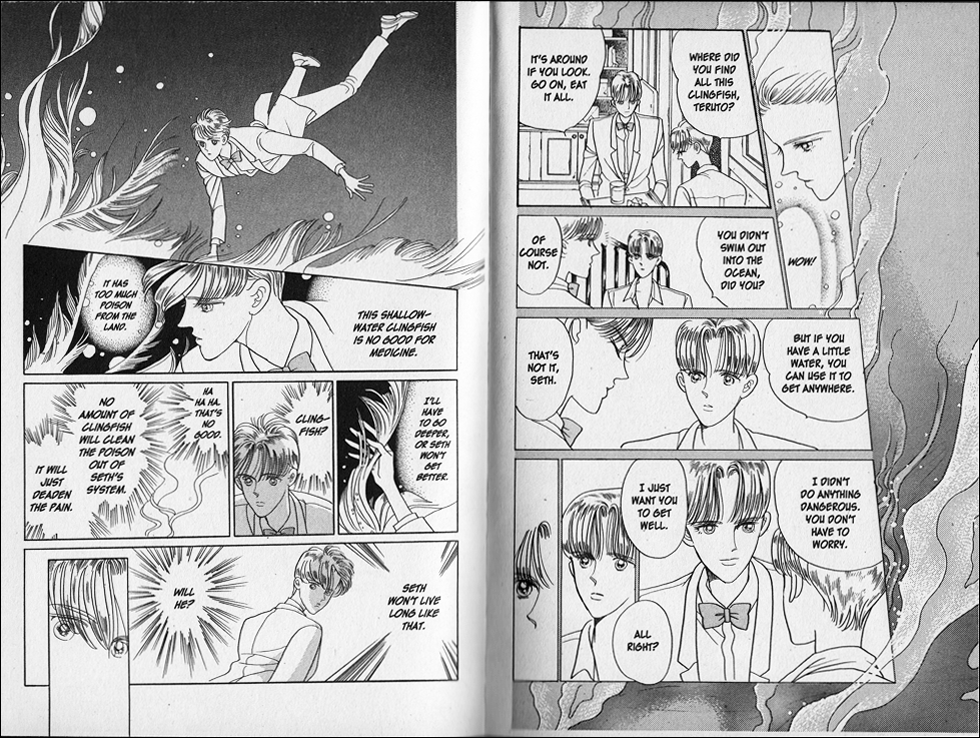
Evyione: Ocean Fantasy, loosely based on “The Little Mermaid,” is a wonderful manhwa which is on indefinite hiatus in English. Here I present the case for continuing Evyione in English.

In Part I I described the merits of the artwork in Evyione: Ocean Fantasy. The artwork was the main draw for me – in the beginning. However, if I only cared about the art, I would advocate bypassing the Udon Entertainment edition and going straight for the original, Korean-language edition. It is because of the story’s impact on me that I am encouraging people to try the Udon Entertainment English-language edition.

What about the story engrosses me so much? The answer, while simple to name, is complex to describe: the connections between the characters.

Character Crystals

The characters are like crystals. At first, the characters seem to be simple yet warmly rendered examples of standard archetypes, just like the characters in well-told fairy tales. Being a comic based on Hans Christian Andersen, this feels appropriate, and it feels even more appropriate because it fits the artistic aesthetic I described in part I. Crystals, too, can appear beautiful yet simple upon a glance. And like crystals, at first the characters seem like they will never change or show depth – just as fairy-tale characters generally do not change or show depth.

Of course, crystals do change and can have hidden complexity, and the same is true of the characters in Evyione: Ocean Fantasy. Kim Young-Hee reveals the humanity in the characters just as a jeweler might reveal the gem in a crystal – by rubbing the characters against each other to gradually uncover an underlying layer, or by striking them against each other to expose a new facet. Different characters pull out different qualities from each other. Watching the characters rub, strike, and connect with each other, slowly exposing themselves, is exactly why I love the story.

This dynamic is not apparent in the first volume. It takes time to reveal the characters and to weave the complex web of their relationships. In volume one, Yaxin pretty much only interacts with the sea witch, Evyione and Fidelis are mostly interacting with each other, and Owain only interacts with Evyione, and not for very long. Fidelis – the less I say about him, the better, because it is hard to talk about him without blowing a significant bombshell. Owain might be my favorite character (aside from my other favorite characters – it is tough to pick just one), and based on the artist commentary section, he seems to be the most popular character among Korean readers too. And of course, Yaxin and Evyione’s relationship is the beating heart of the story. The connections – and potential connections between the characters – drive much of the suspense, and as it takes a few volumes to build things up, it means that it is much harder to be left hanging at the end of volume 6 than at the end of volume 1.

An Example

To really show how engrossing the connections between the characters are requires an in-depth example.

I do not want to use Yaxin and Evyione’s relationship as that example; it is difficult to have a meaningful discussion of their relationship without spoilers. Though if you want a taste of that, the summary would be: the connections between Evyione and Owain, Yaxin and Owain, Evyione and Fidelis, and Evyione and the king’s brother are all worthy reading in their own right – and they all help Evyione and Yaxin’s relationship attain that special something which makes me tear through the volumes, difficult Chinese phrases be damned, to finally get to the scenes between the two.

Anyway instead, I will describe the relationships around the Queen, Evyione’s stepmother.

The Queen

The queen is a very refreshing take on the fairy-tale stepmother. For starters, she is not evil. This grants the queen the freedom to act like a human being instead of a stock villain.

The problem stems from her marriage. The king and the queen do like each other, though ‘love’ is probably too strong a word. However, the queen thinks that when she is no longer young and beautiful, the king will discard her. She thinks that the only way to protect herself is to bear the king’s children … yet after three years of marriage, she still doesn’t have any children. And this kicks off a chain of events.

As a source of comfort and support – or, perhaps not – comes Marie-Anne, the queen’s old lover from France. While the queen is married to the king, Marie-Anne is clearly her real partner. The queen, insecure as she is about her marriage, avoids openly disagreeing with the king, and in the one scene where she does, in fact, say to the king that she disagrees with him, she immediately tries to diffuse the situation. However, when she disagrees with Marie-Anne, she never hesitates to call her out on it. In other words, unlike from her husband, the queen insists on respect from Marie-Anne. If they could have, the queen and Marie-Anne would have probably married each other long ago. Which makes me wonder – is the ultimate cause of the queen’s problems the fact that her society doesn’t accept queer relationships?

However, Marie-Anne’s presence is not exactly beneficial. Her attempts to intervene in the queen’s problems only make them worse. And Marie-Anne has ulterior motives for coming to Emvonia. The queen is partially aware of this. While the queen does not seem to like it, she is not trying to stop Marie-Anne – so far. But when the queen figures out the full extent of Marie-Anne’s activities … to be honest, I do not know what is going to happen, but it will not be good. And there is the question of how Marie-Anne will respond. Marie-Anne really does seem to love the queen. If she had to choose between the queen and her goals — and she probably will have to choose eventually — I am not sure which one she would pick.

While the queen’s sub-plot at first is confined to a few characters, one by one, others get dragged into the mess. Each new character adds to the fray of course adds a whole new set of complications. And each additional character draws out a different part of the queen, making her an ever richer character.

What really breaks my heart is the toll these events are having on the queen’s self-esteem. She really is a good person. However, desperation causes her to do some less than ethical things. That makes her think that she is a bad person. And she is blaming herself even for things which are not her fault. While this tragedy started because the she thinks that her husband does not see any worth in her beyond her beauty, it seems that she now thinks that her husband is right. And that is definitely not true.

Spectacular Moments

When I think of Evyione: Ocean Fantasy, my mind often drifts to specific spectacular moments, the culmination of everything good in this comic. For all that I tried to break the discussion of the art and the story into different sections, the two cannot be completely separated. The artwork provides the potential to be striking; the plot provides the potential to be surprising; the character development provides the potential to be moving; when even two of these things come together, the result is spectacular.

An example I should have used in part 1 – but which also fits here, because it is important for both the artwork and the story – is a scene in which one character wakes up in chains, and then sees another character, wearing a mask, approaching. It is a bizarre scene. Both of the characters have ingested drugs, and it comes through in the drawings. This a wonderful example of how the story supplies a great subject for the artwork. Indeed, this scene is mostly told through what is seen, not what is said. This scene is unexpected, yet so visually imaginative, and yet has seriously scary implications for the characters involved. The first time I read this scene, I was so stunned that I temporarily stopped thinking. Heck, re-reading this scene for the purpose of writing this paragraph made my neck tense up. This particular moment marks the shift of the story into a much darker direction, and was one of the turning points which made me fall for Evyione: Ocean Fantasy that much harder.

Read Evyione: Ocean Fantasy! And Talk about It!

If you think you might like Evyione: Ocean Fantasy, please, please, PLEASE buy volume 1 of the Udon Entertainment edition. It is still available for sale. And if you do, in fact, like it, please tell people about it. Blog about it, if you have a blog. Volume 2 is never going to come out in English without sales and buzz. And volume 2 really should come out in English.

Finale

This review covers a lot. To wrap it all up, I wish to share one of my favorite moments. Enjoy.

*

Yaxin is bathing by the rocky sea shore. Hearing footsteps, he hides.

It is Evyione.

She is wearing a black robe à la polonaise. The area from the top of her stomacher to the bottom of her chin is completely covered in black lace. The engageants (sleeve extensions) are made from a matching set of black lace, yet her sleeves short enough to leave her fair skin exposed between the engageants and her black gloves. And her black hat comes with an elegant set of ribbons. While it is a very fine dress, it is actually plainer than most of the dresses she wears. It is a dress for mourning.

Evyione starts crying.

In many other comics aimed at a female audience, Evyione would have struck a dramatic pose as she cried, artistic flourishes would spill out onto the page, and/or the panels themselves would contort to share in Evyione’s grief. However the artwork of Evyione: Ocean Fantasy, simple and natural as ever, just lets Evyione stand and sob her heart out.

As Yaxin watches, he narrates [quote translated from Chinese] “I do not know why she came to these deserted rocks by the sea, but she looks like she is extremely sad … The sound of the never-ending waves crashing on the rocks seem to be trying to cover the sound of her weeping … The sound of her sobs is gradually ebbing … The sound of her breath is also gradually becoming slower … Now her footsteps sound like they belong to a completely different person … She has straight away turned her body, climbing the stairs, having completely recovered her normal calm self, seeming as if she had never wept.”

I love this moment because this is one of the very few times that Evyione freely expresses her feelings. And after her release, the reader watches her put back on the social mask that almost always wears to cover up her unhappiness.

Evyione is weeping because she believes that Yaxin is gone forever.


Sara K. has spent almost all of her life in San Francisco, California. She got tired of living in San Francisco, so one day she boarded a plane bound for Haneda Airport, and has never been back to San Francisco ever since. She currently lives in an Asian city you have never heard of.

Filed Under: FEATURES, Manhwa Bookshelf Tagged With: evyione, Udon Entertainment

  • « Go to Previous Page
  • Page 1
  • Interim pages omitted …
  • Page 91
  • Page 92
  • Page 93
  • Page 94
  • Page 95
  • Interim pages omitted …
  • Page 114
  • Go to Next Page »
 | Log in
Copyright © 2010 Manga Bookshelf | Powered by WordPress & the Genesis Framework