• Skip to primary navigation
  • Skip to main content
  • Skip to primary sidebar
  • Home
  • About Us
    • Privacy Policy
    • Comment Policy
    • Disclosures & Disclaimers
  • Resources
    • Links, Essays & Articles
    • Fandomology!
    • CLAMP Directory
    • BlogRoll
  • Features & Columns
    • 3 Things Thursday
    • Adventures in the Key of Shoujo
    • Bit & Blips (game reviews)
    • BL BOOKRACK
    • Bookshelf Briefs
    • Bringing the Drama
    • Comic Conversion
    • Fanservice Friday
    • Going Digital
    • It Came From the Sinosphere
    • License This!
    • Magazine no Mori
    • My Week in Manga
    • OFF THE SHELF
    • Not By Manga Alone
    • PICK OF THE WEEK
    • Subtitles & Sensibility
    • Weekly Shonen Jump Recaps
  • Manga Moveable Feast
    • MMF Full Archive
    • Yun Kouga
    • CLAMP
    • Shojo Beat
    • Osamu Tezuka
    • Sailor Moon
    • Fruits Basket
    • Takehiko Inoue
    • Wild Adapter
    • One Piece
    • After School Nightmare
    • Karakuri Odette
    • Paradise Kiss
    • The Color Trilogy
    • To Terra…
    • Sexy Voice & Robo
  • Browse by Author
    • Sean Gaffney
    • Anna Neatrour
    • Michelle Smith
    • Katherine Dacey
    • MJ
    • Brigid Alverson
    • Travis Anderson
    • Phillip Anthony
    • Derek Bown
    • Jaci Dahlvang
    • Angela Eastman
    • Erica Friedman
    • Sara K.
    • Megan Purdy
    • Emily Snodgrass
    • Nancy Thistlethwaite
    • Eva Volin
    • David Welsh
  • MB Blogs
    • A Case Suitable For Treatment
    • Experiments in Manga
    • MangaBlog
    • The Manga Critic
    • Manga Report
    • Soliloquy in Blue
    • Manga Curmudgeon (archive)

Manga Bookshelf

Discussion, Resources, Roundtables, & Reviews

Features

Let’s Get Visual: The Jibblies

December 3, 2011 by Michelle Smith

MICHELLE: So, in our last installment of Let’s Get Visual we celebrated the pretty, so it seems only fitting that this time we devote our attentions to images that make us shudder with a feeling I like to call “the jibblies.” Just like beauty, creepy is a subjective thing, so we’ve each chosen a variety of images that get our personal hackles rising.

MJ, you want to go first this time?

MJ: Sure!

So, as I was perusing my manga collection for things that creep me out, it became increasingly clear to me that I’m very simple when it comes to what scares me. All it takes to really get to me is a single disturbing image–especially one that distorts something human into something sinister. I’m apparently not scared of monsters so much as I am of monsters in human clothing.

My first example comes from Setona Mizushiro’s After School Nightmare. In this series, a group of teenagers is regularly drawn into a shared dreamworld in which they each appear as physical manifestations of their own worst fears. Some of these are visually more disturbing than others. The series’ main character, Ichijo, for instance, most fears his own confusion about gender, so his skirt-wearing dream self is really horrifying only to him. Some of the other students, however, wear their fears in a much more visually distorted manner. This short spread features two of those students.

After School Nightmare, Vol. 1 (Go! Comi)

First, you’ll see a student who appears only as an arm and hand, twisting itself around Ichijo. Second, a girl appears with giant cavities replacing her face and chest. While the second of these has the most stunning, immediate affect on my psyche, the first creeps up on me as I try to move away from the page. Both images stick with me long after I’ve put the book down, and this seems to be the real key to scaring the bejeezus out of me. If I can’t get the image out of my mind, it easily haunts me for days. That’s the power of a single, shocking image.

MICHELLE: My first thought upon hearing of your aversion to “a single disturbing image” is that you shouldn’t read Junji Ito’s Uzumaki, followed by the thought that you should read it.

My reaction to the image above differs from yours, though, in that while these images certainly provoke in me an “ew” reaction, they aren’t the type that haunt me. I definitely think that the slinky arm creature is the more creepy in the image you displayed. For me, it’s because the gaping images of emptiness are immediately recognizable as symbols for what that character is feeling, but what on earth is causing that other student to appear like a grasping, creeping arm?! I feel like their circumstances in life might ultimately be the more disturbing! (This comes from someone who’s read only one volume of After School Nightmare, so I don’t know if this turns out to be the case.)

MJ: I think part of what makes the gaping holes in the second student so horrifying for me, is that (for whatever reason) I’m strongly affected by a lack of face. I have the same reaction to images of people with blank faces. It creeps the hell out of me when I can’t assess a person’s feelings/personality from their expression. It feels very threatening to me.
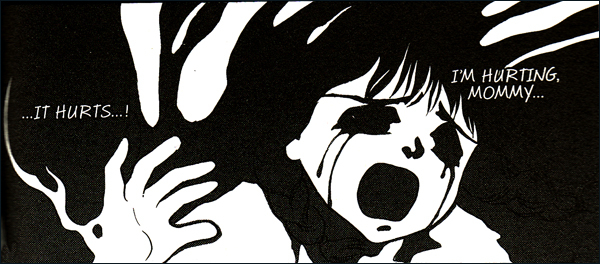
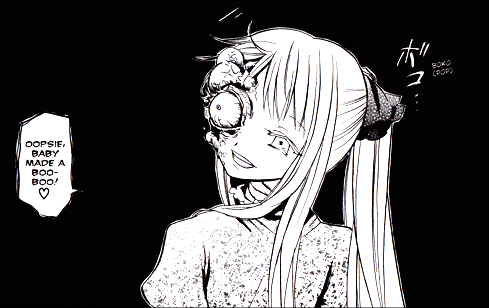
Perhaps it’s further evidence of how much a face means to me, actually, that both of my follow-up images are pretty much face-only. First, from CLAMP’s Tokyo Babylon, we have the face of a dead child who pleads with her mother to avenge her, and secondly, from Jun Mochizuki’s Pandora Hearts, the face of a girl that reveals itself to be a monster underneath.

Tokyo Babylon, Vol. 4 (TOKYOPOP)

Pandora Hearts, Vol. 1 (Yen Press)

I actually find both of these to be creepier than the images from After School Nightmare, though they are much simpler. Something they have in common is that they are presented against a stark, black background, giving the distorted expressions full focus. After that, though, they are nearly opposites of each other. The face of the girl in Tokyo Babylon is all too real, distorted by the power of raw emotion, while the character in Pandora Hearts is revealed to have no emotion at all, or at least none that matched what was on her false human face. Yet in the end, which is more monstrous?

MICHELLE: It’s interesting how much the things that creep us out reveal about us, isn’t it? I’d wager you get the same threatening feeling from the girl who is revealed to be a monster underneath as you do the girl with no face at all. People pretending to be what they’re not, hiding their real selves, etc. That’s definitely something all of us have experienced at one time or another.

Getting back to actual attempts at visual analysis, those deep black backgrounds really do focus the reader’s eye on what the mangaka wants them to see. It’s as if they’re saying, “I don’t want you to be distracted by anything else.”

MJ: Your analysis of me is spot-on, that’s for sure!

And yes, I think the black backgrounds achieve exactly that, while also evoking our natural fear of the dark, or what we can’t see. It’s a powerful tool for both showing us something and not showing us something, if that makes sense.

MICHELLE: It definitely does.

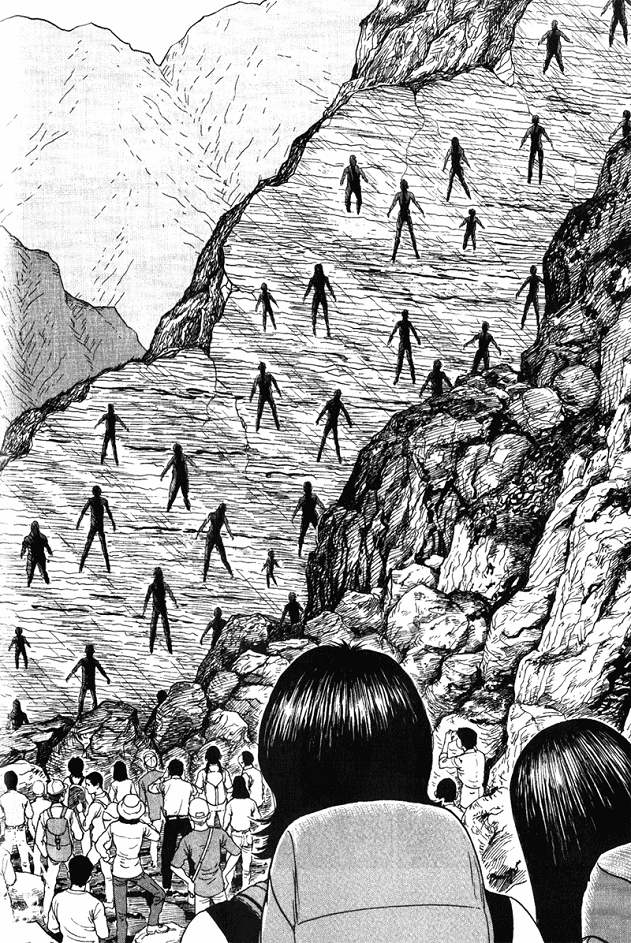
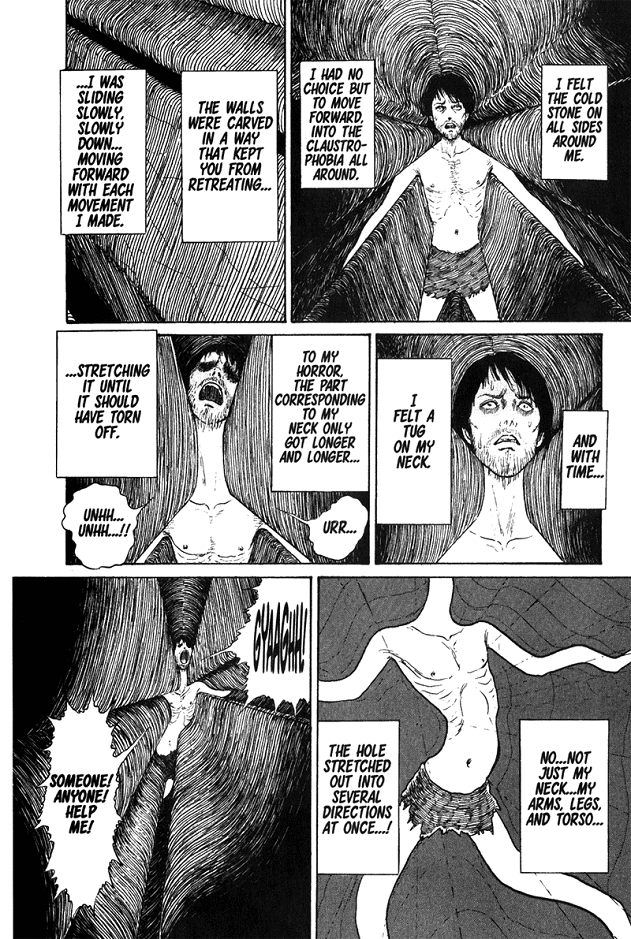
Now I’m reflecting on what the images I’ve chosen say about me. There’s hardly a face among them, for one thing, because I am less creeped out by shocking images than I am by imagining an experience, specifically an experience during which one is forced to endure something horrible for a really, really long period of time with no means of escape. Ugh, just thinking about the short story my images come from—”The Enigma of Amigara Fault” by Junji Ito—has given me the jibblies while typing this paragraph!

Gyo, Volume 2, “The Enigma of Amigara Fault” (VIZ Media)

Page 178

Page 185

Page 198

Page 203

Page 204

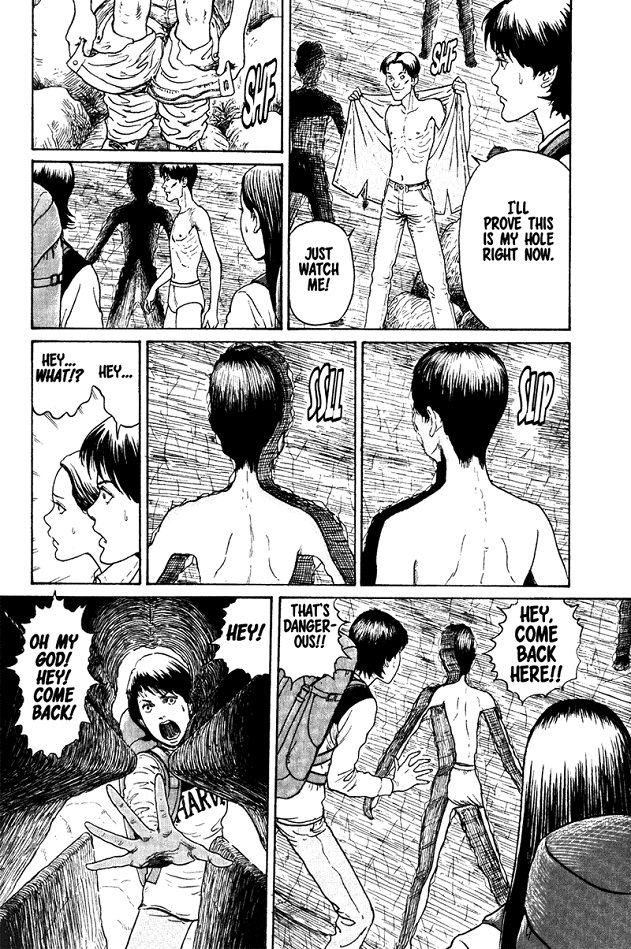
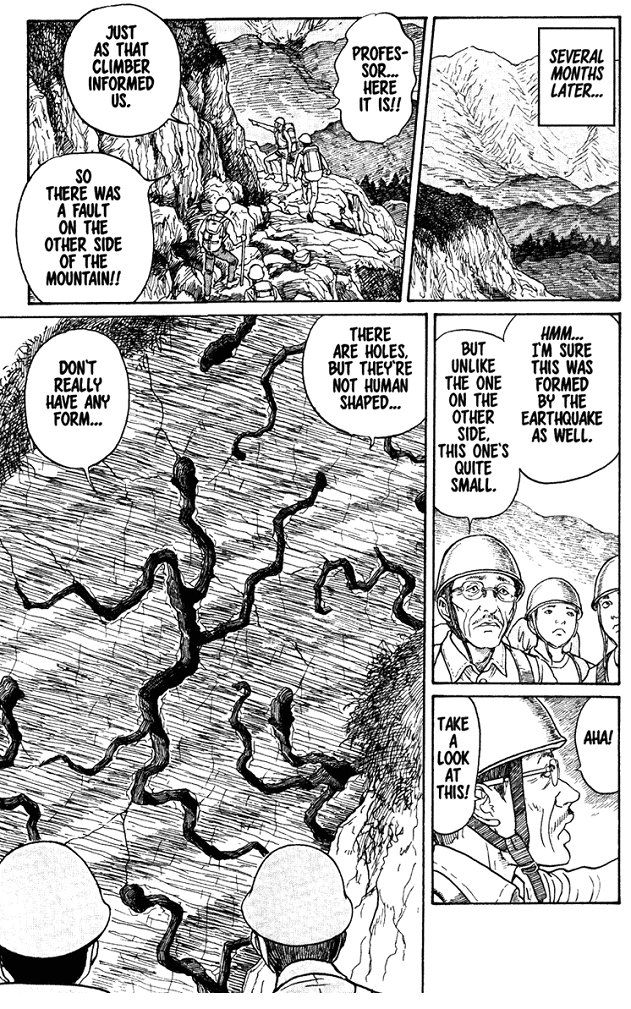
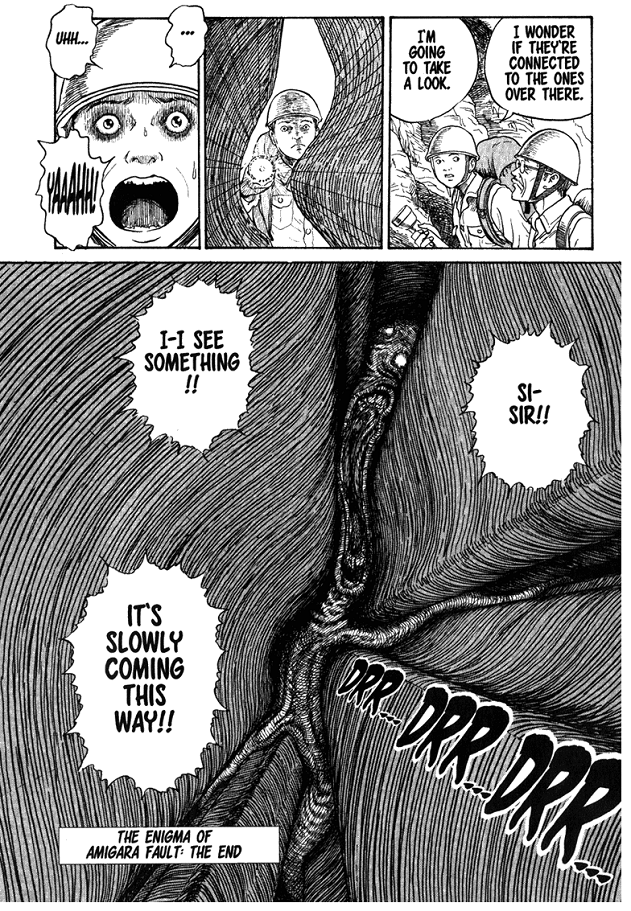
I’ve chosen this particular sequence of images from this short story because they illustrate the entire plot without me needing to introduce it beforehand. By now you probably don’t need me to explain that when the TV news reports on a mountainside full of people-shaped holes revealed by a recent earthquake, people flock to the site and can’t be dissuaded from climbing into their personal holes, where long, icky agony awaits them. At first the site seems innocent enough, if a bit strange, but soon people are walking into holes, having nightmares about what happens to you in a hole, and eventually discovering the exit and…. Holy crap, it’s terrifying. This is the kind of thing that will haunt me for ages.

I’m honestly trying to analyze Ito’s artistic techniques dispassionately here, but I find that the disturbing power of the images is so great that it is affecting my ability to reason even now!

MJ: Hmmm, I’m wondering if what it’s saying is that while I’m terrified of people betraying me, you’re terrified of your environment betraying you. Or something like that.

In any case, these panels are undeniably creepy. Even if they creep me out in a less personal way, I can certainly see what’s giving you the jibblies! Interestingly, we again see the human form distorted, though in this case it’s happening sort of *to* the character we’re relating to rather than in front of him. (Maybe I’m afraid of the people I trust being compromised, and you’re afraid of yourself being compromised?)

This has a Twilight Zone feel to me, where some unexplained supernatural phenomenon is turning the lives of ordinary people into a nightmare. The artist does a great job of evoking the real terror of what’s happening, too. The texture of the stone walls around the man gives the images a three-dimensional look that makes it feel more real than a lot of what we see in manga. It’s the only thing that has that kind of thick texture, too, so it really stands out.

MICHELLE: More like I’m terrified of taking a step that can’t be undone and ending up in eternal torment because of it!

And yes, now that I’ve regained my senses, I agree that it’s the realistic three-dimensional detail that really makes it so disturbing. The details of the setting itself establish it firmly in the here and now, and then we’re shown that within the here and now exists something completely alien and unexplainable! Regarding the texture of the stone walls… it’s that bit of dialogue about how they’re carved to prevent backtracking that really gets to me. It’s mute, immobile stone, and it’s going to be your tormentor for the next several months, slowly inflicting more gruesome horrors upon you than something living could ever do. Uh-oh… jibblies.

MJ: There, there!

MICHELLE: Thanks. I also really love the bottom left panel on page 185, when you see the outside world from inside the tunnel. Interestingly, this is an angle from which the guy who just entered the hole could never have seen the characters. He’s got his back turned to this world, and is resolutely leaving it behind. And, too, I love the “less is more” approach here. We don’t see the distorted figure actually emerge from the mountain and thrash around terrorizing people. One glimpse is enough to confirm what has happened. It’s almost kind of elegant in its structure.

MJ: Yeah, I agree, the threat of what is about to happen is actually scarier by itself than it might be if we actually saw it happen. Or at least it’s creepier that way.

MICHELLE: Well, I fear this column has actually been more about us than the art, but it’s been the art that made us feel that way, and that’s something, isn’t it?

MJ: It is!

MICHELLE: So, that’s it for us this month. What gives you the jibblies?

Filed Under: FEATURES, Let's Get Visual Tagged With: Junji Ito, VIZ, VIZ Signature

Manga the Week of 12/7

November 30, 2011 by Sean Gaffney

You may recall that the past few weeks the Manga Bookshelf teams has had some trouble picking out picks of the week, frequently having to dip into the well of non-manga or simply dropping out. Let’s just say… that won’t be an issue this coming week. Jeepers, there’s a lot of manga.

First off, next week as always brings us this week’s Kodansha releases, as Diamond feels there’s nothing worth doing that can’t wait a week. There’s the debut of the sequel to Until the Full Moon, which is called @Full Moon. It runs in Kodansha’s obscure yet intriguing magazine MiChao!, and still features vampires and werewolves being vaguely gay at each other. Oh, and did I mention it now adds genderbending? In other titles, we see the debut of Shugo-chara Chan!, the adorable 4-koma adventures of the original Shugo Chara cast. (Trust me when I say cute 4-koma adaptations are a hot industry in Japan.) There’s also new volumes of Deltora Quest and Ghost in the Shell: Stand-Alone Complex.

Vertical has the final volume of the iconic Black Jack series, and I am so happy that they finished it. The series may be of highly varying quality, but its inventiveness has always been first rate. And if nothing else, it introduced Western fandom to Pinoko, who shows Chibi-Usa has a ways to go before she hits the big time of controversy.

Viz. Right. (rolls up sleeves) On the Weekly Shonen Jump side, we have a one-two-three-four-five combo punch that would kill any manga reader – new Naruto, Bleach, One Piece, Toriko and Bakuman ALL AT THE SAME TIME. (Naruto is strangely not on Midtown’s list, but my shop says it’s getting it.) There is also Nura and Slam Dunk, which never quite hit the dizzying sales heights of the former but this does not make them unworthy. And from its sister magazine Jump Square, there’s Blue Exorcist, which may soon pass Rosario + Vampire and Claymore to become that magazine’s flagship title.

On the shoujo end, we see the debut of Dawn of the Arcana, a new fantasy romance that runs in Shogakukan’s shoujo for college kids (except it’s actually read by teens who want to be grownups) Cheese! magazine. Shueisha, not wanting to be left out, gives us a new Sakura Hime from everyone’s favorite artist Arina Tanemura. And our friends at Hakusensha remind North America they still exist despite being down to only one venue for their titles, and give us new Grand Guignol Orchestra (the final volume), Kamisama Kiss, Natsume’s Book of Friends, and the penultimate volume of Ouran High School Host Club. I think anyone will be able to find something they’ll like there.

Lastly, and strangely out of place this week (I think it got shoved back from a Week 3, which is where Viz normally releases their Ikki titles), as have a new volume of the slacker artist manga I’ll Give It My All… Tomorrow. Quick, name some other manga titles out over here with ellipses in them. It’s OK, I’ll wait.

And great, now Yen is shipping the first week of the month? That RUINS EVERYTHING! They have to ship second week so as to not CRUSH US ALL! Whine. Flail. Anyway, what have we here? New volumes of Bamboo Blade, still one of my favorites. The second of four Higurashi volumes devoted to its poster child, Rena. A new volume of the CLAMP manga Kobato, which honestly seems strangely forgotten now that Gate 7 is out. The final volume of My Girlfriend’s A Geek, a title for female otaku that I found myself quite enjoying anyway. And the “final” volume of 4-koma sensation K-On!. It’s the final volume of the original series, but as there are now 2 separate sequels going in Japan, I suspect we’ll be seeing a 5th before long. Till then, enjoy Romio and Juritsu.

Exhausted yet? I know I am.

Filed Under: FEATURES

Manga the Week of 11/30

November 23, 2011 by Sean Gaffney

It’s a 5th Wednesday of the month, folks. By all rights, we should be lucky we have any manga at all. Luckily, our friends at Diamond are still giving us Kodansha releases one week after bookstores, so there’s still something to talk about. Oh, and hey, who’s this?

Why it’s MPD-Psycho 10 from Dark Horse! A mere eight years after it came out in Japan, and 2 1/2 years after Vol. 9 was seen on North American shores. See? There’s hope for Translucent after all! In any case, this horror mystery is the darker, more serious counterpart to Kurosagi Corpse Delivery Service, they share the same writer and are both put out here by Dark Horse. Hopefully soon we will see more of KCDS as well!

Meanwhile, Kodansha gives us two more titles. Negima 32 is MOSTLY a breather volume, featuring a few more revelations and some good face time for the Sports Girls. However, danger lurks around the corner, as psycho Tsukuyomi shows up again. And then there’s the cliffhanger. I won’t spoil it, except to say that when Chapter 294 came out in Japan, fans FREAKED OUT. Kodansha also releases the 27th volume of The Wallflower. By now I feel as if I am its only reader anymore, but I don’t care; I don’t need resolution. I just want more goofy Sunako comedy. And here it is.

And while I don’t normally mention manwha here, I have to think of my fellow Manga Bookshelf comrades trying to dredge up a Pick of The Week in a few days. So I will note that Yen Press is putting out the 9th volume of 13th Boy. Churchy LaFemme would be terrified of him, I betcha.

Any picks to brighten up a post-Thanksgiving lull?

Filed Under: FEATURES

Lifting Our Heads for a Little Kiss

November 19, 2011 by Erica Friedman 4 Comments

Kiss magazine, published by Kodansha, has star power. If for no other reason than that one of the most popular and successful Josei franchises of recent years, Ninomiya Tomoko’s Nodame Cantabile, called Kiss home until the series and supplementary chapters came to an end in 2010.

Kiss magazine began publication in 1992 as Monthly Kiss, it is now released on the 10th and 25th of every month. It weighs in at approximately 350 pages an issue, for 450 yen (5.53 USD at time of writing) and pulls in a very respectable 127,962 monthly circulation, according the the JMPA’s 2010 numbers.

Kiss magazine has a website on Kodansha’s Comic Plus system, which offers current volumes for sale, a community on which to share thoughts about one’s favorite series, and a way to send messages to the creators, sample chapters, special sites with interviews, contests for new artists and more.

Series from Kiss are not high on the list for either translation into English as manga or transition to anime. Nodame Cantabile was a notable exception, as it spawned anime, manga, live-action dramas and even documentaries. Currently the series Kuragehime, by Higashimura Akiko, has created some noise as a popular anime.

There is little experimental art in Kiss. The style runs to clean, realistic rendering, even in explicitly fantastic stories like QB Karin – Keishichou Tokushu SP-ban.

Overwhelmingly, the feeling of stories that run in Kiss are stories for adult women. “Kiss and Never Cry,” “Gin no Spoon,” “SatoShio,” “Maison de Nagaya-san,” all are focused on relationships – life, family, career and romance. In fact, if there’s one strong theme running through Kiss, it’s the drive towards life-work balance…a topic that will be of interest to just about any working woman.

Kiss is a gentle magazine. There’s going to be no surprises here, no violence, no sex; fan service comes in the form of adult male characters who treat their women well. Kiss magazine is a familiar touch, a gentle peck on the cheek from a dear friend.

Kiss Magazine, from Kodansha: http://kc.kodansha.co.jp/magazine/index.php/02292


This article was originally published on Mangacast.net.

(Sincere apologies for my extended absence here…work has been “interesting.” ^_^;;)

Filed Under: Magazine no Mori Tagged With: kodansha, Manga Magazine

Manga the Week of 11/23

November 16, 2011 by Sean Gaffney

Sometimes these lists are long and involved. And then there are weeks like this. There’s 3 titles coming out via Diamond, all from Kodansha. Let’s see what they are.

First off, only one week late this time, it’s Volume 2 of Sailor Moon, and the 2nd and final volume of Sailor V. Both volumes are fantastic and worth a buy… and both are also more serious than their predecessors.

If Sailor Moon strikes you as too girly, or perhaps doesn’t have enough boobies for your tastes, may I recommend Volume 8 of Ninja Girls. I believe it’s the 2nd to last volume, which means I’d better work on my ‘Hosana in Excelcis’ pun to make it workable by the time Vol. 9 rolls around.

Since it’s so light, why not buy some non-manga? How about the new Pogo, which I keep shilling? Or the new Carl Barks volume, which has some fantastic storytelling? Or IDW’s Best of Samm Schwartz, which should have lots of Jughead stories? Or even Vol. 1 of the Teenage Mutant Ninja Turtles hardcover, also out next week?

After you’ve bought Sailor Moon and Sailor V, of course.

Filed Under: FEATURES

Re-flipped: not simple

November 16, 2011 by David Welsh

I’m digging into the Flipped archives again. This one came out just as Natsume Ono’s work was starting to be licensed in English. It focuses primarily on her first licensed work, which generated some mixed reaction, though I loved it.

I’ve given up on prognostication. Experience has demonstrated that I’m usually too optimistic, and looking back at my predictions makes me realize that they’re more in the line of affirmations than realistic expectations. I will indulge in one, though: by the end of 2010, a lot more people will be aware of the work of Natsume Ono than they were when the year began.

To be honest, I’d never heard her name at the beginning of 2009. My first glimpse of her work came through a random copy of Kodansha’s Morning 2, which is serializing Ono’s Coppers. I remember thinking that those pages didn’t look much like anything else in the magazine. It took me a while to connect the creator of Coppers with my next encounter with Ono.

That happened at Viz Media’s online IKKI anthology, which serializes chapters of Ono’s House of Five Leaves. It’s one of those series that on first glance leave you not quite sure what you just read, though in a very pleasant way. The opening chapters leave the doors of possibility wide open, and subsequent installments don’t so much shut them as fill in the details of those possibilities.

It’s about an out-of-work samurai, Akitsu, who becomes entangled with a gang of kidnappers. Akitsu doesn’t resemble the standard manga samurai in physicality or disposition, lithe and diffident instead of sturdy and aggressive. It’s easy to see why he’s unemployed, but it’s enticingly unclear why gangster Yaichi lures Akitsu into his circle. It could be that Akitsu is easy to manipulate and the last person you’d expect of ulterior motives, or it could be simple, unexpected fondness. Yaichi might merely like to have Akitsu around.

Ono seems entirely comfortable with leaving readers to guess where things might be headed in terms of event and even intent, though I always have the sense that things are moving in interesting directions. Her work seems both confident and restrained. It also seems just slightly askew of what one might expect when one considers demographics like seinen (comics for adult men), josei (for adult women) or yaoi (male-male romance, which Ono has created under the name “Basso”). So it makes sense that the magazines that have featured her work – Morning 2, Shogakukan’s IKKI, the late Penguin Shobou’s Comic SEED! – seem less designed to cater to a specific demographic than to simply publish an interesting variety of comics by accomplished creators.

The first Ono title to see print in translation, not simple from Viz, arrives this week, and the publisher has posted the first chapter online. Comics creator, editor and critic Shaenon K. Garrity has described the book as “scary good,” and I’m in complete agreement. I think it compares favorably to one of the most acclaimed books of 2009, David Small’s Stitches: A Memoir (W.W. Norton). Like Small’s autobiography, not simple explores the hideous consequences of parental cowardice and cruelty, and, like Stitches, it’s constructed and paced with admirable precision and craft. As was the case in Stitches, I’m reluctant to describe the plot in too much detail, as a great deal of pleasure is derived in the timing with which Ono reveals the underlying facts of her characters’ lives.

The book follows a young Australian man named Ian, barely more than a boy, really, as he searches for his older sister, the only bright point in his grim experience with family life. Along the way, he meets a writer, Jim, who’s taken with Ian’s story both for its inherent pathos and for its narrative possibilities – he wants to know how Ian’s story comes out at least partly because he wants to tell it. Ian’s life and Jim’s novel intersect and overlap, and the story-within-a-story elements aren’t always entirely successful, but Jim’s mixture of sympathy and self-interest give Ian’s tragedies a needed edge and the possibility of at least a little remove on the part of the reader. One of the recurring criticisms I saw for Stitches was that it was just so depressing, a quality compounded by the fact that the events it portrayed actually happened. In not simple, Ono is playing with the idea of tragedy as an entertainment beyond merely presenting a tragic series of events. It’s an intriguing extra element, even if it isn’t seamlessly applied.

Ono doesn’t engage in the kind of experimental illustration that’s sprinkled throughout Small’s work, but her drawings are striking, characterized with a kind of crude fragility that supports the tone and content of her story. Like everything else about not simple, its look is deceptively… well… simple. Fans of Bryan Lee O’Malley’s Lost at Sea (Oni Press) would feel very much at ease with a cartoonish style invested with emotional depth and urgency.

People who have sampled House of Five Leaves, which is scheduled for print release in April of this year, might be surprised that not simple was drawn by the same creator. The former has a lean elegance that’s really in contrast to the more stylized look of the latter. I’m fond of both styles for their individual virtues and for the fact that they both come from the same pen. It’s exciting to see that Ono’s versatility in terms of content and tone extends to her work as an illustrator.

There’s just so much to admire about Ono’s work – its variety, its uniqueness, the level of talent it suggests. I don’t think it’s unreasonable to hope that she becomes one of those creators whose popularity transcends the audience specifically interested in comics from Japan and those who are interested in well-made comics in general. Her work seems to have transcended any specific demographic in Japan, and I believe it will here.


Filed Under: FEATURES

C.J.’s guide to cheap manga

November 15, 2011 by AshLynx 9 Comments

Collecting manga without breaking the bank: A guide to snagging manga for cheap

Hello! I’m C.J. Thomas, a manga fan who has been collecting for about a decade. In order to get my fix, I needed to find new ways to get what I love cheaper. Please enjoy the strategies I’ve developed over years of trial and error, and use them well!

Most of us around here collect manga, and most of us would collect more manga if the cost didn’t add up so quickly. I’m here to share with you my secrets to snagging vast quanities of manga at discounts of up to 60%! And it’s much easier to do then you might suspect.

1) Used book stores

Few used bookstores specialize in manga, but people trade in manga and other comics to them all the time. They will usually resell these for very cheap, maybe $4 a volume or less. These won’t be new manga, but if you are okay with the condition and price, it’s often worth the money. Used bookstores are the best way to find older titles that have been out of print for a while. Some used bookstores will only have what is sold directly to them locally, but other larger ones may have ways of getting more used manga from out of the area. Remainder bookstores may also have manga for very cheap as long as you don’t mind a black mark on the side.

If you don’t happen to live near a used bookstore, many bookstores will have some way of selling books on the internet, too. Alibris.com is one place where you can browse a selection of sellers for cheap manga. With shipping, it may cost a bit more than a brick and mortar used store, but the prices are usually still good and it’s a way to look out of state when you can’t actually get out of the area.

Some used book store successes for me include: Fruits Basket (14 used brick and mortar, 8 used online, 1 new ½ price B&N), GTO (18 used, 6 used at convention, 1 new), and Gimmick! (7 used, 2 via ebay).

2) Comic Book Shops

Ah, the local comic book shops… every Wednesday you can find a stream of people buying new comics, but what most of these people are not buying is manga. Despite this, manga are still comics and most comic shops will carry some manga. Since few people go to comic shops specifically for manga, it can sell at a snail’s pace in some shops, the upside being that very often rare volumes can be found on their shelves. Comic book shops are more likely to be sources for finding rare volumes than volumes for cheap, but keep in mind: sometimes MSRP is the cheapest price for rare manga.

Comic shops are special for other reasons too. First, almost every shop is unique. There are very few chain comic book stores, and the few that do exist are still usually local to a specific area. This makes each worth checking, as whatever random policy one has for keeping manga may be different than another, even one nearby. Comic book shops are also everywhere. Simply check Google if you are traveling to a new area, or visiting a relative. There’s sure to be a unique shop near them.

Secondly, comic book shops communicate with each other. If you try to request a specific volume, most shops will first check their system and supplier. If that fails, many will talk with other shops, and they may just be able to get that hard to find, mid-series volume!

And thirdly: some of the larger, privately owned comic book shops may buy dirt cheap overstock from other stores, and pass the savings on to you! I have found two comic shops that do this, and from both of them I have gotten complete series at ridiculously low prices. A lot of these are new, too.

Some of my comic book shop successes include: Kodocha (all 10 volumes brand new), Marmalade Boy (all 8 volumes brand new), Land of the Blindfolded (all 9 volumes brand new), and Kamikaze Kaitou Jeanne (all 7 volumes, like new).

Some of my comic book shop hard to find volumes include: Swallowing the Earth, Phoenix volume 5, and Emma volume 8.

3) The Library

Now, I don’t necessarily mean to buy manga here. A few libraries will sell used books, but most of them have moved to selling used books online. But what libraries are great for is test-driving manga. Rather then buying a series blind, borrow it first! If something caught your eye but you are not ready to commit, borrow it! Sometimes you will find that it is worth your money, other times not. Either way, you know before you spend your money.

4) Friends

There are many different ways to utilize friends when it comes to manga. Odds are that you can be used by them in turn.

First, there is trading. Sometimes you will discover that you have a series that a friend wants, and a simple trade can be made. Many of the series on my shelf are the result of trades. Not only does this net you new manga, it helps you clear out series that you are finished with. Alternatively, a lot of friends will also sell each other manga instead of trading. So always check out your friends’ sell piles!

Secondly, you can use friends to search for rare manga for you. If they live in another part of the country, they will have access to different used book stores and comic book stores. Just because a volume is not available in your area does not mean it’s not available anywhere. As long as your friend pays you or trades you back for the volume, it can be an easy way for both involved to get manga. This is a great means for extending tips 1 and 2 through other people, both for their sake and yours.

5) The Internet

It’s certainly easy to find manga online. I’ve already mentioned alibris.com, a site I use fairly often, and I’ve used eBay as well. Yes, some people on eBay will ask for ridiculous prices for manga, but it’s possible to find perfectly reasonable deals there, too. Searching for “manga lot” and “manga complete” can bring up a lot of search results. Don’t forget that you can also exclude search words on eBay by adding a minus sign before the word.

The internet also provides book trading sites. Paperbackswap.com is good source for all books (not just manga). Mangatude.com is specifically tailored to manga trading, though you will find anime and other related merchandise and games there as well. Mangatude will let you advertise the manga you want to trade for free and create a wishlist for others looking to trade with you.

Sites I like buying new manga from include rightstuf.com, which regularly has studio sales, saving you up to 40% off manga; amazon.com, which has a price guarantee if they lower their price before the book comes out; and bookdepository.com, a UK based company with free shipping worldwide! Being based in Europe, The Book Depository will often have French and German manga as well, and if you live in North America like I do, Book Depository is likely to be the cheapest way to get European manga.

6) Conventions

Conventions can be great fun for other reasons too, but a dealer’s room is always one of my favorite aspects of a convention. Manga is cheap and plentiful, and I have snatched up multiple complete series for at least 50% off! While many booths will charge full MSRP for anime, few, if any, will charge more than 80% of a manga’s price. Waiting until the last day can bring down the booths who were only selling 20% off, but it is not recommended to wait for any booth already selling 50% off or more. These booths are unlikely to discount any further, and much of their selection may be gone by the end of the con.

You can also meet people and make friends at conventions, furthering what you can accomplish using friends!

Some complete series I have gotten at conventions for 50% or more off the original price include: Kurogane (Kei Toume), Tower of the Future, Oyayubihime Infinity, Moon Child, and Me and the Devil Blues.

7) Learn another language!

This may not get you manga for cheap, but it can help expand your collection nonetheless. Odds are that some of you may know how to speak or read another language, perhaps not as fluently as your primary language, but enough to read and enjoy manga. Japanese is going to be the obvious motherload of manga, but there are wide selections of manga available in (especially) English, German, and French. As I’ve already said, The Book Depository is a great source for you to find manga in your secondary language, delivered to your door for a decent price. And most English speakers are unaware, but Chuang Yi, a Singapore-based company, publishes manga in both English and simplified Chinese.

Selection also varies widely between countries. You can buy some titles in any language, but others only in one. Some countries may also be further along in publishing a specific series. If a US manga publisher has shut down or canceled certain series, their incomplete titles may have been finished in another language. For example, Aria finished publishing in Germany, but was only published to the halfway point in English. If you really can’t find that one hard to find volume, it might be easy to find in another language. As a result, your set may be mismatched, but at least it can be completed!


Check out C.J.’s collection in the August edition of Show Us Your Stuff.

Filed Under: FEATURES

The Favorites Alphabet: I

November 11, 2011 by David Welsh

Welcome to another installment of The Favorites Alphabet, where the Manga Bookshelf battle robot pick a favorite title from each letter of the alphabet. We’re trying to stick with books that have been licensed and published in English, but we recognize that the alphabet is long, so we’re keeping a little wiggle room in reserve.

“I” is for…

Ichigenme… The First Class is Civil Law | By Fumi Yoshinaga | 801 Media – There are some pretty terrific manga that begin with the letter “I,” but as a devoted fan of Fumi Yoshinaga, it’s impossible to pass up an opportunity to talk about Ichigenme, which has the distinction of being not only my favorite of Yoshinaga’s BL works, but one of my very favorite BL series of all time. In terms of my personal taste in the genre, Ichigenme has everything going for it. It’s a character-driven romance between smart, idiosyncratic adults, set in a competitive, career-minded environment that includes smart, idiosyncratic women and gay men who are actually gay. It also features quite a number of genuinely erotic, emotionally affecting sex scenes that actually move the story forward rather than getting in its way. I could go on and on about this two-volume series (and have), but instead I’ll just urge people to read it, especially those who think they don’t like BL. This is what good adult romance should look like. – MJ

I Hate You More Than Anyone! | Banri Hidaka | CMX – Yes, once again I’m picking a series that never finished in North America due to the company closing down.  But I can’t help it.  Intellectually I know this series is flawed – the early volumes have very sketchy art, the plot meanders, the emphasis on cartoon violence has disturbed some – but in the end, it doesn’t matter.  The characters in IHYMTA are hilarious, likeable, and magnificently talkative.  The series is filled with more dialogue than any other shoujo series I’ve seen, as everyone needs to give Kazuha Akiyoshi advice, or listen to her freak out about the latest crisis.  The title, of course, ceases to be true fairly quickly – it’s no spoiler that the series ends with a wedding – but that’s OK too.  This series for me is a tribute to the best and worst of Hakusensha’s Hana to Yume magazine – its high-spirited, tomboy-ish heroines, its silly love stories, and its fly-by-night plot resolution.  And Japan clearly agrees with me – the Akiyoshi family appeared in V.B. Rose as well, and Hidaka-san’s new series running today deals with their offspring.  Clearly folks cannot get enough of this family and their adventures.  (I just wish the companies would stop folding before they finish!) – Sean Gaffney

Imadoki! Nowadays |Yuu Watase | Viz – All Yuu Watase manga are not created equal, but when I like one, I tend to really, really like it. That’s the case with this super-charming series about a country girl who enrolls at a snooty school in the big city. If you’re experiencing uncomfortable flashbacks to Tammy and the Bachelor, you aren’t far off. Like the titular hick played by Debbie Reynolds in that film, homespun Tanpopo upsets the elitist apple cart and falls in love with the cutest, snootiest boy in town. The difference is that Imadoki! is genuinely funny and surprising. Tanpopo is utterly sincere and completely indefatigable in her effort to make friends, and she does it on her own terms. The romance is sweet, the supporting cast is uniformly great, and there’s even an adorable pet fox to raise the cuteness level just that much higher. This book offers a fine blend of warm fuzzies and snarky chuckles. – David Welsh

InuYasha | By Rumiko Takahashi | Viz – Few manga have gone through as many English-language editions as InuYasha, which began its life as a floppy in 1997 and is now enjoying new life as a digital download. Easy as it may be to dismiss InuYasha as second-rate Takahashi, the series’ longevity is no fluke: InuYasha is Rumiko Takahashi’s most accessible story, a rollicking shônen adventure that incorporates elements of folklore, fantasy, and flat-out horror, as well as generous helpings of humor and romance. InuYasha also boasts some of Takahashi’s most appealing characters, from Sango, the tenacious demon-slayer, to Sesshomaru, whose chilling indifference to others makes him a more terrifying figure than the malicious Naraku. Great artwork and imaginatively staged combat help bring the story to life, and carry it through its more repetitive moments. – Katherine Dacey

Itazura Na Kiss | By Kaoru Tada | DMP – Because I can rest assured that my other “I” favorite, InuYasha, is in Kate’s capable hands, I can devote my pick to the shoujo classic Itazura Na Kiss, being released in deliciously chunky two-in-one volumes by Digital Manga Publishing. Some of its plot points might seem cliché—a ditzy heroine in love with a brilliant and aloof guy, circumstances that force them to live together, etc.—but then you realize that it’s Itazura that most of those other series are copying! Lamentably unfinished due to the mangaka’s untimely accidental death, the series is sheer pleasure to read, with a storytelling style and large cast of eccentrics that reminds me more of the seinen Maison Ikkoku than anything you’d find in the Shojo Beat lineup, for example. Goofy, addictive, and satisfying, I love this series and am extremely grateful to DMP for licensing it. – Michelle Smith

What starts with “I” in your favorites alphabet?


Filed Under: FEATURES

Manga the Week of 11/16

November 9, 2011 by Sean Gaffney

You get two images in this post, mostly because every time I post a horizontal image it breaks the Bookshelf site. So let’s start with the actual manga, then get to the things I’m actually super hyper excited about.

Digital Manga Publishing has a few more releases. Lovephobia is a new BL-ish title from Enterbrain’s B’s Log spinoff magazine Kyun!, and features vampires. The author, I know, has written a lot of Gintama yaoi doujinshi. Rabbit Man, Tiger Man hits Vol. 2, and is still not a Tiger and Bunny spinoff. And there is the third volume of A Strange And Mystifying Story, which apparently has demons. Never let it be said that DMP does not have its finger on the pulse of the modern manga buyer.

Kodansha and Diamond seem to have settled nicely into “one week later than bookstores” at this point. So we don’t get Sailor Moon 2. But we do get Fairy Tail 16, which I think wraps up the arc with Laxus, and Arisa 5, which no doubt continues to be thrilling. (It ran very long for a modern-day Nakayoshi series, so much have good chops.) Sorry, folks, you should see Ami and Minako next week.

Yes, just in time for the Manga Movable Feast, it’s a short story collection called Tesoro, which I suspect will be filled with middle-aged men and sweet quiet interludes. If just one volume is not enough for you, meanwhile, why not buy the Fullmetal Alchemist 1-27 box set? You can a) read the final volume early, and b) it makes a nifty blunt instrument! Kurozakuro reaches its final volume, and we get a new Saturn Apartments. Lastly, we’ve apparently caught up with Real enough that we get a new volume of that as well, so Real 10 gives you all the drama you could possibly want.

And Yen press, as always, seems to own Week 3 of our monthly schedule. New Haruhi, new Haruhi-chan. The Giant Hardcover Omnibus of Death for High School of the Dead (I saw that thing at Comic Con. If you can’t afford FMA as your weapon, this will serve.) New Nabari no Ou, Omamori Himari, and Sumomomo Momomo will surely sate your thirst for inscrutable Japanese titles that tell you little about the content. And there are new adaptations of Avi Arad’s the Innocent, and a Gossip Girl tie-in, for those who like things outside the manga box.

Though if you really want to go outside the box next week…

I literally cannot recall a time in my life when I was not reading Pogo. One of the first books I ever read so hard it fell apart in my hands was the Pogo Collection Bats and the Belles Free – and that’s not even one of the best ones! Fantagraphics announced this collection aeons ago, and it apparently has been a long, hard struggle. But trust me, if you buy this, you will see why they put in the effort. Even in these early, first two years of the strip, Pogo has a magic all its own. Anyone who loves reading dialect or the written language will find a treasure trove in Pogo, and anyone who likes biting satire will take it right to their heart. I cannot possibly recommend it enough.

(And yes, there is also the new Donald Duck collection, the first in their Carl Barks reissue project, which is also awesome, but I think Walt Kelly needs to be pushed by the online comics community more than Carl Barks, honestly.)

So what are you getting besides Pogo?

Filed Under: FEATURES

Previews review November 2011

November 9, 2011 by David Welsh

It’s kind of an odd month in the Previews catalog from Diamond. There’s a lot of great stuff, but there’s very little immediately exciting debut material. (There is a fair amount of on-the-fence content, and I could certainly use your feedback on that front.) Let’s start with a few new editions of previously published material:

Dororo Complete Edition, written and illustrated by Osamu Tezuka, Vertical, NOV11 1117: If you haven’t read this brilliant, Eisner Award winning piece of supernatural shônen, this will provide an excellent opportunity to pick up all three volumes in one shot. While it makes me sad that Tezuka ended this series early, the material he did finish is just magnificent: scary, sad, funny, bleak, gruesome… the whole package. This is one Tezuka title that I can recommend without any reservation or qualification.

Girl Genius Omnibus Vol. 1: Agatha Awakens, by Phil and Kaja Foglio, Tor Books, NOV11 1104: This web-to-print success story has been around for a while, and I’m glad to see it get some hardcover, prestige treatment. It’s about a mad scientist who learns that she’s even madder and more inventive than she suspected. Spunky, scrappy Agatha finds herself in a million different kinds of steampunk peril, and it’s great-looking, fast-paced fun.

Now, onto some less chunky but still worthy items:

A Treasury of 20th Century Murder: The Lives of Sacco and Vanzetti, written and illustrated by Rick Geary, NBM, NOV11 1052: I love these crime histories for their smart writing and great, detailed art, but I tend to wait for them to be available in paperback. It means I have to wait a bit to enjoy Geary’s take on highly controversial cases like this one, but I can be patient.

The Kurosagi Corpse Delivery Service Vol. 12, written by Eiji Otsuka and illustrated by Housui Yamazaki, Dark Horse, NOV11 0055: On the other hand, I can’t be any more patient with this title than the publication schedule demands, and damnation, does that schedule demand a lot of patience. Still, this is one of my very favorite Japanese comics ever, and I always get giddy at the prospect of enjoying more misadventures of a group of supernatural investigators.

We’ll wrap up with one on-the-fence item that I didn’t feel like wedging into this month’s poll:

Gentlemen’s Agreement Between a Rabbit and a Wolf, written and illustrated by Shinano Oumi, Digital Manga, NOV11 0962: As you know, I always like to investigate unknown boys’-love quantities before investing in them, so I’d appreciate any feedback either on this title or on Oumi’s work in general. This one sounds promising – a workplace romantic comedy about two guys who work for an advertising agency. The whole predator-prey framing is a little on the nose for me, but I’m certainly open to anything about grown-ups with jobs.


Filed Under: FEATURES

Manga the Week of 11/9

November 3, 2011 by Sean Gaffney

Thank you to all who have patiently seen my blog not updating for days due to the nightmarish power loss here in New England.

Now, next week. Bandai has the second volume of their Tales of the Abyss manga tie in, Asch the Bloody. I somehow suspect the series is not much like Evil Dead, but may be wrong.

DMP has some more BL. The second volume of the amusingly titled Bad Teacher’s Equation. Volume 2 of Border, which seems a lot more dramatic. And a one-volume manga called Yakuza Cafe, which I imagine will have Yakuza… running a cafe! See, who said 5 days with no power impaired my ability to write?

Speaking of BL, or at least BL light, Kodansha has the 2nd and final volume of Until the Full Moon. Which has a teenage vampire/werewolf bishie betrothed to a playboy vampire bishie. In other words, you would think it was a license to print money.

Udon has the 3rd volume of Mega Man Gigamix, which really gets no blogger love whatsoever. Come on, where’s the Mega Man fans? (Yes, I know, pot meet kettle.)

And then there’s Viz, acknowledging that nobody parties like it’s 1999 anymore, with their re-release of CLAMP’s most apocalyptic series, X. I have a general “I like happy endings” objection to this series, especially given it takes the fun couples from CLAMP School Detectives and writes them in here to be part of the disaster, but luckily the series has been on hiatus in Japan for years, so likely I’ll never have to worry about the mass deaths that will inevitably be supplied at the end.

In non-X news, there’s new Dogs: Bullets and Carnage, which has more than two characters, but you’d never know it by the fandom. There’s a new Inu Yasha omnibus, which I believe will have Vols. 25-27. And new Rin-Ne, where Sakura will continue to not get angry. That’s her trait. ‘And Sakura?” “She doesn’t get angry. A lot.” and of course a new Pokemon Black & White, which is filled with the sort of things that makes people Pokemon fans.

What appeals to you?

Filed Under: FEATURES

Re-flipped: Tokyo Zombie

October 28, 2011 by David Welsh

It doesn’t seem right to go through all of the current Manga Moveable Feast without addressing zombies, and it doesn’t seem right to address zombies without considering ironic zombies, so here’s an old Flipped column on a title that checks both off of the list.

I think Yusaku Hanakuma’s Tokyo Zombie (Last Gasp) has helped me crystallize my objections to zombie fiction in general.  Given the limitations of the genre, it very often seems like too much effort has gone into its various renderings.  Tokyo Zombie looks like it was dashed off during study hall, and that works in its favor.

The official tag for the style is heta uma, or “bad, but good.”  I might modify it to “bad, but appropriate,” to be honest.  That Hanakuma’s style of illustration suits the material doesn’t mean it’s aesthetically pleasing in any meaningful way or that a practiced knowledge of the fundaments of drawing seems to be peeking out through a conscious effort at crudeness.  Proportions are odd and shifting, and body language and composition are stiff.  To be honest, the living and the undead aren’t always immediately distinguishable from one another.

But really, the best a zombie story can be is crude, quick, and maybe a little subversive, and Tokyo Zombie is all of those.  The action begins on “Dark Fuji,” a mountain of garbage, studded with illegally dumped toxic waste and human remains.  Whatever the opposite of a primordial soup is reaches boiling point, and the undead begin shambling down from Dark Fuji to do what zombies do – very slowly overtake the living.

A small subculture of survivors build an enclosed area where the rich live on the labor of an oppressed class of slaves, and the balance is maintained by brutal enforcers.  Stripped of most of their comforts and diversions, the rich become extremely bored, and a brutal arena featuring slaves versus zombies springs up.  There isn’t much in the way of subtlety in the way Hanakuma portrays the class conflicts of post-zombie society, but there doesn’t need to be.  It’s just a backdrop for gross-out violence and a source of jokes about brutal things happening to generally terrible people.

Hanakuma’s greatest strength is probably pacing.  He rarely lets a sequence drag on longer than necessary, and he keeps the inventively gross gags coming.  If they’re imperfectly rendered, how much artistry does flesh-eating really require?  There’s plenty of gory event if not detail, and what would lovingly drawn innards really add to what seems intended to be a brisk, coarse outing?

(P.S. Tokyo Zombie was originally serialized in the alternative manga anthology, Ax.  In August of 2009, Top Shelf will publish a 400-page collection of stories from the decade-old magazine.  Kai-Ming Cha has an interview with the translated collection’s co-editor, Sean Michael Wilson, at Publishers Weekly.)

(P.P.S.  Last Gasp is also the publisher of one of the finest comics I’ve ever read, Fumiyo Kouno’s Town of Evening Calm, Country of Cherry Blossoms.  Aside from its publisher and creator’s nation of origin, it has absolutely nothing to do with Tokyo Zombie, but I like to mention it whenever I can, no matter how feeble the pretext.)


Filed Under: FEATURES

The Favorites Alphabet: spooky supplement

October 27, 2011 by David Welsh

We interrupt your regularly scheduled, letter-by-letter installment of The Favorites Alphabet in honor of the horror-tinged Manga Moveable Feast! This week, the Manga Bookshelf Battle Robot retreated to the dank catacombs of our secret base to conjure the spirits of our favorite spooky manga! Read on… if you dare!

 “The Enigma of Amigara Fault” | By Junji Ito | VIZ Media – I haven’t read much horror manga. In fact, aside from the delightfully bizarre Tokyo Zombie and one volume (so far) of The Kurosagi Corpse Delivery Service, my experience is limited to the works of Junji Ito. While Gyo and Uzumaki certainly deliver weird and disturbing tales, it’s “The Enigma of Amigara Fault,” a short story that appeared in Gyo’s second volume, that I find most memorable.  In it, an earthquake has revealed a rock formation riddled with human-shaped holes that go farther back into the rock than researchers are able to measure. People flock to the site, drawn to holes that seem to be custom-made for them. Those who enter the holes are committed to moving forward with some profoundly jibbly-inducing results. Just thinking about it is kind of giving me a wiggins. Look for images from this one in this weekend’s Let’s Get Visual column! – Michelle Smith


The Kurosagi Corpse Delivery Service | By Eiji Ōtsuka and Housui Yamazaki | Dark Horse – Despite my ongoing reviews of Higurashi: When They Cry, I’m not really a big reader of horror manga, tending to find it too scary. Which says more about me than about the genre. However, I picked up Volume 1 of Kurosagi Corpse Delivery Service for its unusual cover, as well as the fact that it was translated and edited by Carl Horn. Imagine my surprise when I got one of the funniest, most satiric, and, yes, scariest manga coming out here. For our heroes, dealing with corpses isn’t like searching for mysteries a la Scooby Doo – it’s a job, and they are usually trying desperately to get paid. It just so happens that their various skills go really well with solving problems involving dead bodies. Nestled in among the sarcastic dialogue and long pointed looks at Japanese politics and society is some really creepy imagery – watch out for the chapter with the birds, or the one with the ears. – Sean Gaffney

Parasyte | By Hitoshi Iwaaki | Del Rey – There are just so many reasons this eight-volume series is awesome, not least of which is Iwaaki’s facility with really gruesome and surprising bits of violence. It’s an invasive-species nightmare scenario featuring bizarre space spores taking over indigenous creatures (mostly human) and turning them into ravenous, shape-shifting, and dangerously intelligent predators. Fortunately, one of the parasites doesn’t quite make it to its host’s brain, turning average teen Shinichi Izumi into humanity’s best protector, and his right hand into a formidable defensive weapon, not to mention an adorable and insightful pet! Iwaaki jumbles a lot of elements together – coming-of-age drama, violent suspense, evolutionary theory, family tragedy, and boy-and-his-dog sentiment. The beauty part is that Iwaaki jumbles it all well, making for one of the most beginning-to-end satisfying tales you’re likely to find on the manga shelves. Originally published by Tokyopop, Del Rey picked up this out-of-print gem and did a bang-up job repackaging it. – David Welsh


School Zone | By Kanako Inuki | Dark Horse – In this odd, hallucinatory, and sometimes very funny series, a group of students summon the ghosts of people who died on school grounds, unleashing the spirits’ wrath on their unsuspecting classmates. School Zone is as much a meditation on childhood fears of being ridiculed or ostracized as it is a traditional ghost story; time and again, the students’ own response to the ghosts is often more horrific than the ghosts’ behavior. Inuki’s artwork isn’t as gory or imaginative as some of her peers’, though she demonstrates a genuine flair for comically gruesome thrills: one girl is dragged into a toilet, for example, while another is attacked by a scaly, long-armed creature that lives in the infirmary. Where Inuki really shines, however, is in her ability to capture the primal terror that a dark, empty building can inspire in the most rational person. Even when the story takes one its many silly detours — and yes, there are many WTF?! moments in School Zone — Inuki makes us feel her characters’ vulnerability as they explore the school grounds after hours. – Katherine Dacey

Tokyo Babylon | By CLAMP | TOKYOPOP – When David suggested that we all pick favorite horror manga for this week, at first I thought I didn’t have any. Though horror movies were a favorite genre once upon a time, that preference never really transferred to print for me, or at least I didn’t think it had. Then I realized that some of my most beloved occult-themed comics fall closer to the horror mark than I thought. My favorite of these (and indeed, one of my favorite comics of all time) is CLAMP’s 20-year-old series, Tokyo Babylon.  Complete in just seven volumes, it’s a decidedly immature work, featuring uneven storytelling, outrageous outfits, and one of the strangest, most over-the-top examples of BL-leaning shôjo I’ve seen to date. On the other hand, not only does it finally rip our hearts out with the precision of a serial killer, but it scares the bejeezus out of us all along the way. This is a dark, cruel little series, that takes real joy in its emotional shock value, and its occult setting provides ample opportunity for that quality. Not that I’m complaining. When I look at the images I chose for my review of the series , I can see that I picked out several of those that had creeped me out the most. For genuine scares and emotional brutality all wrapped up in one delicious “classic” shôjo package, you can’t beat Tokyo Babylon. – MJ

What are your favorite horror stories?


Filed Under: FEATURES

Manga the Week of 11/2

October 26, 2011 by Sean Gaffney

Oh dearie me. (deep breath)

Bandai is shipping the 4th volume of Code Geass: Knight, the doujinshi anthology series that focuses on the male characters for female fans of the series. Expect lots of BL tease with no actual BL.

If you want actual BL, then DMP is the place for you. We get new volumes of the awkwardly titled Great Place High School Student Council, the deluxe edition of Kizuna, Seven Days, and The Tyrant Falls in Love. And there are three new series debuting: Mr. Tiger and Mr. Wolf (no, it’s not a Tiger and Bunny spinoff), Only Serious About You, and Private Teacher. I think this giant pile of BL will satisfy even the most hungry enthusiasts.

Remember when I said we’d get the rest of Kodansha’a October this week? I was indeed correct! New Air Gear, which has hit 20 volumes of rollerblading frenzy. Vol. 2 of Bloody Monday’s intrigue and Cage of Eden’s potboiler antics. And two new thick omnibuses: Love Hina 1-3 (which I reviewed here a couple of weeks ago), and Tokyo Mew Mew 1-2 (for those who can’t get enough magical girl shoujo and can’t wait for Sailor Moon/V).

Speaking of omnibuses, Seven Seas is releasing Vols. 7 & 8 of Gunslinger Girl, which I believe means we’re now caught up with ADV and getting new material. Yes, it’s about killer loli assassins and their kindly adult male guardians, but it actually manages to deal with the serious issues surrounding such a plot and not be too skeezy. Mostly. Well, a lot. OK, over 60% not skeezy. Seven Seas also has the third volume of Toradora, which does star a tsundere, but it actually manages to deal with the serious issues surrounding such a girl and not have her be too tsun. Mostly. OK, maybe 40% dere? Perhaps an actual math degree would help.

Vertical is debuting its new Furuya title, a modern updating of the famous Japanese novel No Longer Human by Osamu Dazai. I’ve also reviewed this, and it maintains Vertical’s reputation for cutting edge manga that makes you think.

And Viz has its first-week madness. From the Jump and Jump Square file, we have new volumes of Claymore, D.Gray-Man, the Death Note “Black Edition”, and Tegami Bachi. On the shoujo side, we have new Ai Ore! and Black Bird, some Dengeki Daisy (which I warn you has another nasty cliffhanger), Haruka: Beyond the Stream of Time (earlier BL manga, I’m sorry I called you unwieldy after reading this), The 11th volume of Kimi ni Todoke (wait, you mean it keeps going after they get together?!?!), and new Oresama Teacher and Story of Saiunkoku. It is a very Viz week.

So, in among that deluge, what do you want to buy?

Filed Under: FEATURES

Re-flipped: GoGo Monster

October 26, 2011 by David Welsh

Okay, I don’t know if this comic counts as horror in the strictest sense of the term, but it’s one of the first titles that came to mind when I considered this month’s Manga Moveable Feast. It’s one of my favorite spooky-ish comics, and yesterday was Taiyo Matsumoto’s birthday, so…

“Yeah, well…” a grade-schooler opines early in Taiyo Matsumoto’s GoGo Monster (Viz), “There’s a kid like that in every class, right?” He’s talking about Yuki, a classmate who claims to sense things no one else can, an invisible population of mischievous creatures and a new insurgence of more malevolent beings. And the classmate is right; if manga is to be believed, the schools of Japan are well stocked with young people who traffic in the eerie. None of them are quite like Yuki, though, probably because not many creators are quite like Matsumoto.

Matsumoto has an extraordinary talent for rendering kid logic, their concepts of loyalty and justice and the way they engage with the world around them. This knack was on vivid display in Tekkonkinkreet: Black and White (Viz), for which Matsumoto won an Eisner Award in 2008. Like that book, GoGo Monster features two temperamentally different boys cleaving together to face the inevitable.

Many supernaturally sensitive manga characters can be divided into two categories. They either use that sensitivity to protect the unaware, or they struggle to conceal their abilities for fear of ostracism. Some are driven by both motives, but Yuki answers to neither. He’s disconcertingly matter-of-fact about the things he perceives, and he’s genuinely immune to the ridicule of his peers. He’s an excellent student, but he’s a disruptive presence. Yuki doesn’t perceive his own abnormality, and he doesn’t feel any pressure to conform.

While Yuki has few allies in the student body or faculty, he does garner the sympathetic attention of a new kid at school, Makoto. Average in every respect, Makoto is less intrigued by Yuki’s beliefs than by his indifference to ridicule. Maybe he recognizes it as a kind of strength of character, or maybe some emerging empathy makes him realize Yuki is at risk. Makoto is engaged in all of the aspects of Yuki’s character, not just his oddity. Instead of limiting him to the role of sidekick, this engagement actually makes Makoto Yuki’s equal in terms of reader engagement, or at least it did with me.

Other benevolent figures in Yuki’s sphere include the school’s elderly groundskeeper, Ganz, who understandably takes the long view of things. While the teachers yearn to fix Yuki, Ganz is content to listen to the boy. Then there’s IQ, who is even more ostentatiously weird than Yuki. IQ, who’s in an older grade than Yuki and Makoto, wanders the school grounds with a box on his head with a single eyehole cut into it. It’s telling and slyly funny that this is less disconcerting to his peers and teachers than Yuki’s less obvious strangeness and bursts of temper. Like Ganz, IQ has an odd kind of faith in Yuki, though the source of that faith is oblique.

The most interesting thing about GoGo Monster, the thing that grounds it, is that it’s ultimately irrelevant whether or not the things Yuki perceives are real. It’s Yuki’s belief in their reality and the possible consequences of that belief that drive the drama. That belief is never in question; Yuki is absolutely sincere, as is Matsumoto.

Tekkonkinkreet was set in a dying fantastical city slowly being destroyed by crassness and consumerism. Treasure Town was a richly imagined, almost living place. In GoGo Monster, the school setting couldn’t be more prosaic, but it’s no less vivid. Matsumoto captures the rhythms of the place, the mundane snippets of conversation, the casual cruelty, and the bustle. Even without the meticulous visual detail Matsumoto lavishes on the place, you can practically smell the food from the cafeteria.

That fidelity makes it all the more effective when you start to see glimpses of it through Yuki’s enhanced perspective. Matsumoto is positively restrained in introducing the weirdness that Yuki sees infesting Asahi Elementary. You glimpse it from the corner of your eye at first, or blink and it disappears. The clearest sense of them comes from Yuki’s crude drawings, and even he admits that they aren’t literal renderings. “This is just a conceptual sketch,” he tells the closest thing he has to a friend. As the school year that constitutes the book’s timeline progresses, Matsumoto reveals more of what Yuki is sensing.

Beyond his marvelous illustrations and elliptical storytelling, the fascinating thing about Matsumoto’s work is his ability to make me root for undesirable outcomes. In Tekkonkinkreet, I found myself hoping that its protagonists would accept the futility of their fight for Treasure Town, that they would cut their losses. In GoGo Monster, I found myself siding with the forces of conformity. Admirable as Yuki’s sense of self is, and enviable as his immunity to social pressure may be, I still was persuaded by Matsumoto’s argument for a healthy, happy Yuki, even if it resulted in a less interesting, less special Yuki.

I should probably mention that GoGo Monster is a beautifully produced book. It’s magnificently colored hard cover comes sheathed in an equally handsome slipcase. The edges of the crisp, white pages are tinged red with a continuation of the cover image. It’s all very lovely, but the book would still be extraordinary even without those bells and whistles. Matsumoto has craft, intelligence, and heart, and he balances those qualities as well as almost any creator alive. In a fairly extraordinary year for challenging, artistically satisfying manga, it seems like a certainty that Matsumoto will garner a second Eisner nomination, perhaps even a second win.

Filed Under: FEATURES

  • « Go to Previous Page
  • Page 1
  • Interim pages omitted …
  • Page 89
  • Page 90
  • Page 91
  • Page 92
  • Page 93
  • Interim pages omitted …
  • Page 114
  • Go to Next Page »
 | Log in
Copyright © 2010 Manga Bookshelf | Powered by WordPress & the Genesis Framework