• Skip to primary navigation
  • Skip to main content
  • Skip to primary sidebar
  • Home
  • About Us
    • Privacy Policy
    • Comment Policy
    • Disclosures & Disclaimers
  • Resources
    • Links, Essays & Articles
    • Fandomology!
    • CLAMP Directory
    • BlogRoll
  • Features & Columns
    • 3 Things Thursday
    • Adventures in the Key of Shoujo
    • Bit & Blips (game reviews)
    • BL BOOKRACK
    • Bookshelf Briefs
    • Bringing the Drama
    • Comic Conversion
    • Fanservice Friday
    • Going Digital
    • It Came From the Sinosphere
    • License This!
    • Magazine no Mori
    • My Week in Manga
    • OFF THE SHELF
    • Not By Manga Alone
    • PICK OF THE WEEK
    • Subtitles & Sensibility
    • Weekly Shonen Jump Recaps
  • Manga Moveable Feast
    • MMF Full Archive
    • Yun Kouga
    • CLAMP
    • Shojo Beat
    • Osamu Tezuka
    • Sailor Moon
    • Fruits Basket
    • Takehiko Inoue
    • Wild Adapter
    • One Piece
    • After School Nightmare
    • Karakuri Odette
    • Paradise Kiss
    • The Color Trilogy
    • To Terra…
    • Sexy Voice & Robo
  • Browse by Author
    • Sean Gaffney
    • Anna Neatrour
    • Michelle Smith
    • Katherine Dacey
    • MJ
    • Brigid Alverson
    • Travis Anderson
    • Phillip Anthony
    • Derek Bown
    • Jaci Dahlvang
    • Angela Eastman
    • Erica Friedman
    • Sara K.
    • Megan Purdy
    • Emily Snodgrass
    • Nancy Thistlethwaite
    • Eva Volin
    • David Welsh
  • MB Blogs
    • A Case Suitable For Treatment
    • Experiments in Manga
    • MangaBlog
    • The Manga Critic
    • Manga Report
    • Soliloquy in Blue
    • Manga Curmudgeon (archive)

Manga Bookshelf

Discussion, Resources, Roundtables, & Reviews

Features

Comic Conversion: The Infernal Devices: Clockwork Angel

December 6, 2012 by Angela Eastman 3 Comments

The Infernal Devices: Clockwork Angel | Novel: Cassandra Clare / Margaret K. McElderry Books | Manga: Hyekyung Baek / Yen Press

Tessa Gray arrives in England to live with her brother, but instead of Nathaniel she finds herself kidnapped. A pair of warlocks keep her locked in a house, forcing her to utilize a power she didn’t know she had—the ability to change into anyone, living or dead, and access their memories simply by holding an object they possessed. Suddenly Tessa is rescued by Will Herondale, a beautiful and dangerous boy who claims to be a Shadowhunter—warriors blessed with angelic power who exist to rid the world of demons. The rest of the Shadowhunters, like the diminutive Charlotte and the kind but sickly Jem, agree to protect Tessa from the mysterious Magister who had her kidnapped, and to help her find her lost brother. But as Tessa, Will, and Jem strive to figure out what is happening, Tessa may uncover some terrible truths.

Cassandra Clare’s first series, The Mortal Instruments, tells the story of Clary and Jace, a pair of superbly star-crossed lovers, which takes place in the present day. When the first three of this soon-to-be six book series was completed, Clare began work on a prequel that takes place over a hundred years before Clary and Jace’s adventures, The Infernal Devices. It’s not necessary to read both series together, but The Infernal Devices does provide some background for the other The Mortal Instruments, giving us a look not only at the ancestors of some of our favorite characters from the first set of books, but also a peek into the earlier lives of some of the immortals that make an appearance in both books. Since I often find myself more delighted with the side characters (in this case, a couple of immortals) than the main pair in The Mortal Instruments, this is a series I couldn’t help but pick up. Yen Press’s release of the manga adaptation was the perfect excuse to give this series a go.

While this novel, and presumably the rest of the trilogy, can stand on its own, there are some times when Clare seems to take for granted that her readers are already familiar with The Mortal Instruments series, as she doesn’t go quite so deeply into the details about Shadowhunters and their history, or spend so much time explaining the problems with Downworlders. The big things are easy to pick up on, though, like the harshness of their lives (most don’t grow very old, as they die in battle, and if they decide to leave they lose all contact with the ones they loved) and the Accords, a deal set with creatures like vampires and werewolves to help keep the peace.

A problem I’ve had with Clare’s writing in the past is the abundance of dead details—in particular, descriptions that have absolutely no bearing on the story. Most things such as dresses and rooms I can let slide, as Clare uses these descriptions to fix her readers in the time period. Other things, however, are entirely useless, like her constant referral to Will’s blue eyes. Bits like this waste time, slowing down the pace of the novel while also leaving little for the reader to imagine herself. Another thing that tends to clunk up the story is the tendency for conversations to veer off course, like when Tessa begins to ask Will to leave her brother alone, then suddenly rants (for pages) about Will’s personality and how he should be looking for Jem’s cure. These conversations just turn into characters saying things the readers already know or that are inconsequential to the story, unnecessarily dragging out the time between plot points.

Even with my gripes, Clockwork Angel is an entertaining young adult book, particularly if you’re already a fan of Clare’s other series. Her story is engaging, with sudden twists and betrayals, which are still exciting even if you can see them coming for ages. The cast is diverse (if predictable), with both the “good” and “bad” boy romantic interests, but even the most seemingly flat characters, like Jessamine, have hidden depths that, even if they don’t reveal themselves completely in this novel, leave the readers to believe that we’ll come to understand these characters as the series progresses.

Now, for the manga. Hyekyung Baek’s adaptation does a good job of keeping us close to Tessa, convincingly converting the narration to her inner thoughts and giving us a shot of her dynamic expressions even in the middle of the excitement. Compared to the novel, the comic’s plot really clips along, with Baek skipping some unneeded scenes and cutting down the rambling conversations. But unfortunately, more often than not this swift pace works against the manga. Characters are moved like props from one place to the next so it’s hard to keep track of their movements, such as in one scene in which Tessa and company shift from the library to an upstairs room seemingly instantaneously. And while I feel readers get a clear understanding of Tessa and her character arc, the too-quick pace is damaging to the development of the other characters: we never get a clear picture of Charlotte’s trouble and insecurities with running the institute, and even snotty, selfish Jessamine comes across more sympathetic in the novel.

I enjoyed Baek’s art in the Gossip Girl adaptation, but while her style worked wonders in that glamorous, sexy world, it doesn’t quite click for me in Infernal Devices. Don’t get me wrong, Baek’s character designs are gorgeous, but I feel her style often makes the teenage characters look too old, and backgrounds are bland and boring, even when she includes detail. Baek also seems to go for prettiness over what was actually described in the novel, most notably when it comes to the maid Sophie’s face. When we first meet Sophie, Clare describes her scar: “a thick, silvery ridged scar slashed from the left corner of her mouth to her temple, pulling her face sideways and distorting her features into a twisted mask.” Baek draws the scar merely as a long scratch on the cheek, which could be taken as a stray strand of hair if Tessa didn’t mention it. One thing Baek’s art definitely improved upon were the goofy asides. Bits that came across as a bit awkward in the novel worked more easily in the comic, as exaggerated expressions and super-deformed characters gave the jokes more punch.

Many of my issues with Clare’s prose are stylistic, and while I wasn’t as invested in this novel as I have been in her other series, the problems I had still did not get in the way of my overall enjoyment of the book. The manga adaptation has its good points, but overall it left me feeling frustrated. While Clare’s novel may meander, the manga’s swift pace just barrels through the plot and skims over characterization. Baek’s adaptation is something fans will likely enjoy, but those looking to get a proper introduction to Clare’s universe are better off going with the novel.

Filed Under: Comic Conversion, FEATURES, FEATURES & REVIEWS Tagged With: Cassandra Clare, graphic novel, Hyekyung Baek, manga, Teen Lit, The Infernal Devices, yen press

Manga the Week of 12/12

December 6, 2012 by Sean Gaffney, Michelle Smith and MJ 3 Comments

SEAN: After the hugeness of this week’s list, next week is looking a lot milder. Though as always, Midtown, Diamond, and bookstores don’t seem to match at all. (My shop got most of the Viz stuff, but none of the Yen releases, which they say are coming out 12/12.) This list is mostly Midtown, with two Viz titles most stores will get 12/12, and one Yen title with the same circumstances. (Midtown gets Yen’s hardcovers later than most?)

Yes, yes, I will stop being a nerd and get on with the list. Kodansha brings us a few new titles. Attack on Titan 3 looks to answer what’s going on with that Ally Titan and why Eren is back, but I suspect I still won’t be able to tell half the soldiers apart from the other half. Come on, at least give them a distinctive scar or something!

MJ: Ack! I’m a whole volume behind in Attack on Titan, and that’s about to grow into two volumes. I need to catch up!

SEAN: Battle Angel Alita: Last Order returns after a very long hiatus and with a new publisher. Kodansha Comics picks up the reins after the author switched Japanese publishers in what was, for Japan, a very loud parting of the ways. Vol. 16 picks up where Viz left off, but for those who need to start from the beginning, omnibuses are coming soon. (Of Last Order, that is. The original is still out of print and likely to remain so.)

The Wallflower is up to Volume 29, and at times I feel I’m the only one still reading it, mainly as I don’t give a rat’s ass when Sunako and Kyohei admit their feelings, I just want to see them kicking people who annoy them in the face. I should get more of that here.

MICHELLE: Three series so far that I haven’t read! I did own the first half dozen volumes of The Wallflower for a time, but I must’ve gotten wind of its terminal lack of resolution, because I quit buying it and eventually gave away the ones I did have.

SEAN: I have no earthly idea what Captain Commando is. It’s by Japanese artists, apparently, but I can’t find out who originally published it. Given Udon is putting it out, is it a Capcom thing, maybe? Anyway, this is Volume 2.

MJ: I suspect this isn’t even remotely for me, yet I feel compelled to read something called “Captain Commando.” I mean. Yeah.

SEAN: Viz somehow missed sending Nura: Rise of the Yokai Clan 12 to shops this week, but it’ll be there next week. I like Nura, which always entertains me without wowing me. It’s a meat-and-potatoes Jump series, much like Psyren.

MICHELLE: I am way, way behind on Nura, but I don’t dislike it or anything. I guess it’s easy to put on the backburner.

MJ: I have a difficult time getting interested in titles like this (I guess I never did like meat and potatoes). Should I try anyway?

SEAN: Depends, do you enjoy generic Jump? Lots of multi-volume fights, a few love triangles, people getting stronger through training and the power of friendship…

Everyone except Midtown will also be getting the 7th volume of Itsuwaribito. I admit I never really followed this series, about a boy trying to redeem the world with his lies. But it’s one of Viz’s few remaining Shonen Sunday series, and I cherish each of those like my own kin. So go get it.

MJ: “I cherish each of those like my own kin.” I have nothing profound to say about Itsuwaribito, I just liked that sentiment. Actually makes me want to read every Shonen Sunday series I can find.

SEAN: Speaking of which, it’s the final volume of Kekkaishi! This is definitely on my list of series to catch up with, and it makes me sad that it’s ending here. But I hear the ending is quite satisfying, so definitely grab grab grab this.

MICHELLE: I have been carefully hoarding Kekkaishi for years and am looking forward to indulging in a marathon. Possibly over Christmas break!

MJ: I have never delved into this series, but I really do want to. Maybe I’ll catch up digitally!

SEAN: Lastly, for some reason not featured with the giant pile of Yen last week, Kaoru Mori’s collection of short stories Anything and Something is due out as well. There’s apparently some commentary and designs for Emma and A Bride’s Story interspersed throughout. I’m not as wild about Mori as some other bloggers I know, but this is still definitely a book to have.

MICHELLE: I haven’t read as much Mori as I should have, but this one looks pretty quirky and fun.

MJ: I’d really, really like to see this, so I can’t wait to get my hands on a copy.

SEAN: Sticking your thumb into any of these hoping for a plum?

MICHELLE: *groan*

Filed Under: FEATURES, manga the week of

It Came From the Sinosphere: A Deadly Secret (Part 1)

December 4, 2012 by Sara K. 3 Comments

It’s high time that I discuss something from China again. It’s high time that I actually review a TV series that is not an idol drama. And it’s high time for me to discuss Jin Yong again. Now, I’m going to do all three at once.

A Scene

Why, it’s a wedding!

It’s a wedding in front of a tomb.

See, both the bride and the groom are dead, so the wedding has to take place at the bride’s tomb.

In wuxia stories, if you promise to marry somebody, you marry them. Death is no excuse.

He’s drinking because he is so happy that his best friend is finally marrying the love of his life (who apparently is also the love of his afterlife).

And he’s swinging his sword around with joy.

Anyway, since the groom and bride are dead, he needs to help them get together. This is the problem with getting married when you’re dead – there’s no privacy when the newly married couple finally gets intimate physical contact.

Wait a minute … why are the bride’s arms stretched up like that?

And there’s writing on the inside of her coffin. That’s only possible if she was put in the coffin while she was still alive.

The writing says that, as a reward to whoever reunites her with the love of her life (afterlife), she is revealing The Deadly Secret (which is not exactly a favor, since people who learn The Deadly Secret have a tendency to die young).

The groom’s cremated ashes are poured onto the bride’s body. What a romantic wedding!

Background

I don’t think it’s possible for a Jin Yong novel to be underrated, but if any of his novels are underrated, it’s this one. It’s my personal favorite of his novels under 1000 pages.

If you don’t know or forgot who Jin Yong is, you can refer to my post about the Condor Trilogy or The Book and The Sword.

There are only three adaptations of this novel: the 1980 movie, the 1989 TV series, and the 2004 TV series. This is (mostly) about the 2004 TV series.

The Story

Di Yun is a country bumpkin who is studying martial arts and is in love with his master’s daughter, Qi Fang. It’s a real bummer when his master disappears, he gets framed for heinous crimes, Qi Fang marries the man who framed him, the prison guards break his body, and he’s put with a cell mate who beats him up for apparently no reason whatsoever.

This is what Di Yun looks like after hearing that Qi Fang is going to marry the guy who framed him and put him in prison.

Why does his life suck so much? Well, you see, there is this ultra-powerful martial arts technique and fabulous fortune that everybody is trying to get … and Di Yun is unwittingly close to this deadly secret.

The Songs and the Production Values

At first I didn’t like either the opening or the ending songs. But the opening song eventually grew on me and, by the end of the series, I even liked the ending song.

If you watch the opening and ending songs, you might notice that the production values are a bit lower than the norm for, say, Hollywood TV shows.

Welcome to China.

Personally, I’d rather watch something with consistently low production values than something with mostly high production values which spectacularly drops the ball, and really, the production values of this TV series really aren’t that bad at all. And ultimately, the quality of the story and acting is much more important to me than the quality of the special effects.

Adaptation

This TV series is 33 40-minute episodes long. The original novel is less than 500 pages long. Before watching this series, I wondered how they could make it so long without lots and lots of padding.

Well, it turns out that there is not that much padding per se. There is quite a bit of added material, but a lot of it is just spelling out things which are merely implied in the novel. Most of the added material is relevant to the story. At worst the new stuff is offensive (because of sexism or ableism) but thankfully most of it is not. Quite a bit is powerfully mediocre. Some of the new stuff, however, is quite good.

The biggest change is not that new stuff is added (since much of it was implied by the novel), but the pacing itself. This novel is quite concise by Jin Yong standards, so things move fairly quickly. In the TV series, things progress in a much slower and more thorough way. In some ways, this increases the emotional impact – for example, we see a lot more of Di Yun and Qi Fang’s relationship, which makes their separation even more heart-breaking. However, in some ways it makes the story harder to watch – it’s much easier to read about Di Yun getting framed in the novel, where events move pretty quickly, than to watch the TV series, where it takes several episodes to watch Di Yun getting framed and tortured in prison.

I also think there is some power in leaving some things left unsaid. That’s one of the things I like about the novel. Sometimes, when the TV series fleshed out the unsaid stuff, it did pretty cool things with it … but I still think leaving things to the reader’s imagination is more powerful.

It’s hilarious to compare the 33-episode TV series to the 90-minute movie. Things which take two episodes in the TV series happen in two minutes in the movie. Of course, the movie cuts out about 60% of the original story (the TV series covers about 130% of the original story).

Ding Dian

Even though Ding Dian only appears in two chapters of the original novel (specifically chapters 2 and 3 of the novel), he is definitely the most memorable character in the story. Apparently, other people agree, because both the movie and this TV series give him plenty of screentime.

A picture of Ding Dian in prison.

On the one hand, he is a bad-ass martial artist, one of the toughest fighters in this story, and he spends a great deal of time cultivating his kung-fu skills. In fact, he can even (under certain specific circumstances) bring dead people back to life. But it turns out martial arts is not his greatest passion in life.

His great passion, it turns out, is flowers.

Ding Dian at the flower fair

He is a flower encyclopedia (this is most apparent in the novel, but also indicated in the TV series). He goes to a flower fair. His greatest joy in life is watching flowers. It turns out that one of the villains is also a flower-arranging geek, so he gets to communicate with Ding Dian via flowers.

Of course, there are other reasons to love Ding Dian. He is a person of great integrity, and intensely loves his friend and his sweetheart. But being a badass martial artist who loves flowers above all else (except maybe his friend and his sweetheart) clinches the deal.

The Female Characters

In some stories, I would be annoyed if the female characters were constantly relying on the male characters to rescue them. Not in this story. It is clear that they are just as innately competent as the male characters. However, patriarchy has so badly stacked the deck against the female characters that they can’t rescue themselves. They do still manage to rescue the male characters when it is in their power to do so.

A picture of Qi Fang

All of the main female characters – Qi Fang, Ling Shuanghua, and Shui Sheng – have the same problem; they were born into a society that is so patriarchal that even their own families, who ‘cherish’ them, ultimately consider them to be merely disposable possessions. Sure, their families claim to love their daughters and other female relatives dearly, but when push comes to shove, in this TV adaptation [SPOILER WARNING] one female character is murdered by her father, another female character, after having almost been murdered by her fiancee, is driven to suicide by her uncle, and the last one is murdered by her husband [END SPOILER WARNING].

And the fact that Baroque China was an extremely patriarchal society makes it that much easier for their families to oppress them, in fact, without the patriarchy helping their families bully them, these female characters would have definitely had much happier outcomes.

A Picture of Ling Shuanghua

A Picture of Ling Shuanghua

An interesting thing I noticed is that the female characters don’t want to believe that their families regard them as (potential disposable) possessions. They want to believe that they are being loved as full human beings. I can understand this, since the truth is very cruel. In a way, it’s easier to keep on believing one is being valued and loved properly. But reality catches up with all of them.

I appreciate that this TV series gave a lot more attention to the female characters than the novel. On the one hand, some of the new material is powerfully mediocre (at worst, offensive). On the other hand, some of it is good, and definitely fleshes out the females characters more than the novel does. In particular, the TV series is a bit more sympathetic to Qi Fang, and treats us to the Extended Adventures of Shui Sheng (granted, it’s a mixed bag).

A Picture of Shui Sheng

Yes, the adult female characters even talk to each other in the TV series, which is not true of the novel (they mostly talk to each other about men though). That said, I actually think it’s okay that this story fails the Bechdel test, because the female characters’ isolation is one of the worst ways the patriarchy has stacked the deck against them. Two of the female characters’ families hardly ever let them leave home, and only with supervision, and the third one gets kidnapped, which drastically limits her opportunities to bond with other women.

What is really interesting is that, even though all of the main female characters have the same problem, they react to the problem in different ways.

You Think I’m done Talking? Bwa ha ha ha ha…

I definitely have more to say about this TV series, but this post is getting long, so I guess I’ll have to wait until Friday to say more.

Next Time (not Friday): The Bride with White Hair (novel)


Sara K. plans to discuss every single Jin Yong novel at Manga Bookshelf. She is now halfway there, having discussed six novels and having six novels left to cover. Her plan is to discuss Tales of the Young Fox, Sword Stained with Royal Blood, and The Laughing Proud Wanderer next, in that order, but that’s only a tentative plan.

Filed Under: It Came From the Sinosphere Tagged With: A Deadly Secret, China, jin yong, wuxia

JManga the Week of 12/6

November 30, 2012 by Anna N, MJ, Michelle Smith and Sean Gaffney 2 Comments

SEAN: After a somewhat desolate week this week (with one huge treat, of course), next week’s JManga schedule looks a lot more promising.

JManga and Shueisha are on the fast track with their releases of Crazy for You and Pride! This will take Crazy for You over the halfway mark. Both recommended (why is it so hard to stay caught up, though?)

MICHELLE: I am having the same problem with staying caught up, but am supremely delighted that releases are coming so quickly with these series! I’m not sure why, but it kind of gives me hope that once these two are finished, more Shueisha shoujo will be on its way. This is the place where I predictably suggest/beg for Cat Street.

ANNA: I like plenty of JManga titles, but these are the ones I am most enthusiastic about currently. I hope that these signal a trend of more shojo for JManga, and I would also love to see them get Cat Street too.

MJ: I am thrilled by the pace they’re keeping with these, because I am completely hooked on both!

SEAN: We have the final volume of Comic High’s Otaku-Type Delusion Girl, which Media Blasters released part of ages ago as Fujoshi Rumi. Given that it’s about a bunch of BL fangirls, but runs in Comic High!, I can guess the audience reaction over here to be somewhat mixed? Anyone try it?

MICHELLE: I never have, but I have a friend (female) who likes it.

SEAN: There’s also a new Neko Ramen, rescued from Tokyopop and available once more for our cat-loving pleasure.

MICHELLE: Yay! Though I’ll really be rejoicing when they get to volume five, the first one not to be released by TOKYOPOP.

SEAN: The big release of the week, for the 2nd week in a row, is by Takako Shimura. I think Ohta Shuppan, which has released 3 titles in the last month or so to JManga, has started to realize that they can really promote their brand here. The short stories collected in The Devil Is So Cute ran in various magazines, including Comic High (Futabasha), Comic Blade Zebel (Mag Garden), and Young King OURS (Shonen Gahosha). But really, the best thing I can say is IT’S MORE SHIMURA! READ IT!

MICHELLE: Yes, I am really looking forward to this one!

MJ: Count me in!

SEAN: Another Futabasha series wraps up, as we get the last two volumes of The Perfect Girlfriend, one of the first of their Web Comic High! online series. I read part of the first volume, and while it didn’t grab me, it wasn’t all that awful. I can see it appealing to the anime-loving crowd.

Lastly, a second Tokyopop rescue, The Good Witch of the West is a shoujo fantasy adventure series I’ve been meaning to catch up on (especially after reading Erica’s recent review. This side-story volume seems to take place after the main story.

MICHELLE: It’s one that’s been on my radar for some time—mostly due to my local library having it in their collection—but I’ve never yet managed to actually read it. One of these days.

ANNA: I read the first four volumes or so, and this is a solid fantasy series, although I wasn’t compelled to collect all the print volumes. More Tokyopop rescues would be good! I only hope that one day more of my beloved Demon Sacred gets translated.

MICHELLE: Oh yes, me too!

MJ: I would also really like to see Demon Sacred. But I’m pleased to see things like this on the list. I missed a lot of Tokyopop titles the first time around.

SEAN: Lots of varied stuff. I may have to load up on points again.

Filed Under: FEATURES, manga the week of

License Request: Additional Higurashi Manga

November 30, 2012 by Sean Gaffney

Higurashi When They Cry is, let’s face it, a franchise by now. And as such, it’s not the sort of series that was going to stop merely because the story ended. Heck, even the author of the original visual novels released an extra one with several stories after Matsuribayashi-hen was completed. The anime did two series of OAVs. Indeed, Yen Press has already released an extra side-story as an omnibus volume. So even though they still have over a year of Higurashi still to release, I thought I’d take a look at what’s out in Japan and see what, in my ideal Higurashi world, I would want licensed.

First, I’ll cull off things that can be skipped or are expendable. There are a giant PILE of Higurashi anthology books by various artists, with the vague tacit approval of 7th Expansion. Some are terrifying, some are hilarious, but all are basically one step removed from the ‘official product’. They’d be nice, but not necessary. The same goes for the Higurashi 4-koma volumes, which go under the title All You Need Is Love. There is a one-volume manga starring Shion, who is investigating a murder at the private school we see her attend at the very start of Eye-Opening; it got cancelled/cut short by the publisher, but is only one volume, so might be looked at. There’s also a one-volume manga that revolves around mahjong that was also cut short; due to the subject matter, it won’t be looked at.

So that basically leaves us with four books. All are done in one, though one may be continuing, I’m not sure. Publishers like single-volume books.

1) Dice-Killing Chapter. This is probably the closest the series will get to a genuine, actual post-series sequel. And, unlike most of the post-series stuff that’s come out, it’s mainly serious. The premise has Rika, overdosing on having escaped her unhappy fate and free of the endless June, not looking where she’s going and getting hit by a truck. Aheh. She wakes up in a different Hinamizawa, where no one was ever killed, the dam project is going through, and everyone’s happy and content. Well, everyone except Rika. This was taken from one of the post-series VNs, and I find a lot of its basic themes very disquieting. But then, that’s what makes a Higurashi series.

2) Daybreak Chapter. For all that I call Higurashi a game, it’s actually a series of Visual Novels. You don’t do anything but hit enter a lot. So naturally, one of the first things fans did was to make the series into a third-person shooter. This was a big success, and they even got Ryukishi07 to do the scenario, which involved a magatama that forced people into love confessions. This was then adapted into several manga. I prefer Mion with Keiichi, and there is a version of that which Kadokawa put out, but it’s not as good. This is the best of the lot, and is about as Keiichi/Rena shippy as you can get.

3) Heart-Healing Chapter. This was one of the titles that Kadokawa Shoten taunted us with by sticking the synopsis up on JManga’s site, before we realized they had no plans to actually release any of these. As such, it’s a good fit with Yen. Note it is the only non-Square Enix title on the list – it ran in Kadokawa’s Comp Ace. It’s the most heartwarming of these choices, dealing expressly with Rika’s feeling after the end of the series about having to finally move on and think about life. I like heartwarming fluff a lot.

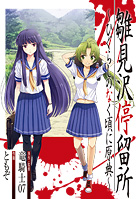
4) Hinamizawa Bus Stop. Sorry for the tinier image, but this one only had its cover image released a few days ago -it’s not out in Japan yet! The latest of the Higurashi tie-ins, this one is supposedly based off the original scenario that Ryukishi07 had in mind before he moved away from it to make Higurashi proper. It stars a 17-year-old Rika, with her goofy friend Mion, so definitely falls into the ‘alternate universe’ category – and not in the usual Higurashi way. But the plot still revolves around that pesky dam, there’s still the threat of Oyashiro-sama, and there’s still scary faces galore. I’m not sure if this is complete as of this volume or still ongoing – guess we’ll have to wait and find out.

As you can see, it’s a Higurashi world out there. Any of these four volumes coming out over here would make me very happy indeed.

Filed Under: FEATURES, LICENSE REQUESTS

Manga the Week of 12/5

November 29, 2012 by Anna N, MJ, Michelle Smith and Sean Gaffney 5 Comments

SEAN: What we have feared for so long has finally come upon us. Viz’s first week has combined with Yen’s monthly shipments. But that’s OK. We can get through this if we just stay together. (I can’t actually confirm Yen’s stuff via Diamond just yet, but it’s definitely coming into Midtown.) So let’s get going.

First, a brief stop off with Dark Horse, where the Shinji Ikari Raising Project has reached Vol. 12. I don’t follow most of the Evangelion AUs, but this is supposed to be one of the fluffier ones. Given that, if you like Evangelion but hate that everyone keeps getting killed (sorry to spoil that 17-year-old anime for you), this may be a winner!

MICHELLE: I’m pretty surprised that series has gotten up to twelve volumes without me noticing! I guess that shows how far under my radar it is.

SEAN: And now (oh dear) for Viz. Let’s start off with Arata the Legend 12, Yuu Watase’s stab at shonen that hasn’t quite won as many readers as Fushigi Yuugi, but has quite a cult following.

ANNA: I’ve been following this, but slowly. I still haven’t quite forgiven Arata for not being Fushigi Yuugi, but Watase is such a pro I find myself enjoying this shonen fantasy series. I have a couple volumes of Arata on my “to read” stack.

MICHELLE: I really like Arata!

SEAN: Bakuman finished in Japan, so there’s no reason not to have the American release GO GO GO to catch up. Here’s Vol. 17.

Black Bird has reached 15 volumes, and its cover still has that same look, thankfully with less actual blood than the last time I read it. But hey, Shojo Beat readers adore it.

ANNA: I read the first couple volumes and then later volumes somewhat sporadically, but this is one of those shojo series that I just can’t seem to connect with.

MICHELLE: Yeah, I gave up long ago.

MJ: I’ve hated this series for so long, my relationship with it seems somehow… intimate. And isn’t that just sad?

SEAN: Two more Bleach volumes, still strangely Aizen-less. Poor Ichigo’s lost his powers! Who can help? Why Rukia can… unless she’s distracted by adorable plush toys. But hey, what are the chances of that happening?

D.Gray-Man 23 tells us about a group of demons called Noah. Right! What’s a Gray-man? And why is it D? Did they have three Gray-men before it? (Look, I’ve gotten into the bad habit of trying to be funny with these. Bear with it, it’ll be over soon.)

Dawn of the Arcana 7 is out, another in a series of shoujo manga from Viz I’ve gotten behind on, so I’ll let my colleagues try to be funny here.

ANNA: I didn’t realize I’d gotten so far behind on this series either! This fantasy series has a slow but rewarding pace, and a refreshing heroine. I see myself stocking up on Dawn of the Arcana for some quality vacation reading next month.

MICHELLE: I’m behind too, but somewhat on purpose so I can have a small stack to marathon next time I feel like catching up on it. (Sorry, can’t think of anything funny!)

SEAN: Oh boy, another Mayu Shinjo series! I am feeling equal parts eagerness and trepidation, given her past record. Demon Love Spell seems to be made up of shrine maiden, sexy demon, lots of seduction. I suspect I will both enjoy and be repelled by it.

ANNA: I am very much looking forward to this series. After not being quite sure what to make of Ai Ore, I have come to the conclusion that it is entirely satirical, and the second series settles down a bit into being a shojo comedy. Still, I enjoy Mayu Shinjo series when she brings the crack, as found in all the bondage, forced drug addiction, bondage, kidnapping and sex in unusual places that she treated readers to in Sensual Phrase. If this series is more like Sensual Phrase than Ai Ore, I can see myself enjoying this very much.

MICHELLE: I was actually reading the back cover blurb of Demon Love Spell to a friend on the phone last night, and snickering unkindly that the wholly original name for the shrine maiden is…. Miko. While I’d like to believe Ai Ore is satire, I still pretty much hated volume seven, so that doesn’t leave me too eager for this new series, though I will still probably check it out.

MJ: I don’t know what to think of this. I really dislike Ai Ore!, but I’ve never read Sensual Phrase, so I suppose there’s still hope?

SEAN: Devil and Her Love Song 6 is a Shojo Beat series that I am keeping up with, and it hasn’t lost its spark yet. Here’s hoping we get a bit less angst and a bit more bite this time, though.

ANNA: I enjoy this series every time I pick up a volume, but it isn’t the type of series that I see myself rereading very much in the future. I’m glad though that Shojo Beat is releasing such a good variety of manga under their imprint currently.

SEAN: The Earl and The Fairy light novel series is 29 volumes and counting, but its manga equivalent finishes here with Vol. 4. Given I think that Vol. 2 was a perfectly serviceable ending, I’m not sure what to think. But hey, I liked 2 better than 1, maybe I’ll like 4 better than 3.

Natsume’s Book of Friends has rapidly become one of my can’t miss titles, and seeing it’s hit Vol. 13 fills me with happiness. (And yes, there won’t be enough Taki in it. There’s never enough of my OT3. Ah well.)

MICHELLE: I too am rejoicing over volume 13 of Natsume.

MJ: Likewise!

SEAN: I can’t remember the last time Viz wasn’t putting out a Tanemura series, and this is definitely not one of those times. Vol. 9 of Sakura Hime is due out next week.

Slam Dunk has reached a quarter century of volumes! I think this means it only has a few more to go, in fact. Perhaps when it finishes we can see Kuroko no Basket?

ANNA: SLAM DUNK RULES! I have no other comment than that.

MICHELLE: I can get behind Anna’s sentiments 110%! But yes, after this one there are only six volumes left. And I’d love to see Kuroko no Basket released here. Now that Cross Game has finished, are there any other sports manga coming out here now? I can’t think of any off the top of my head…

SEAN: There’s Cross Manage, which runs in Shonen Jump Alpha.

Toriko 13 has our heroes realizing that it’s time to GET STRONGER! Oh dear, a training arc? Not quite. Getting stronger in Toriko means BETTER KNIVES. Food preparation is still serious business.

As for Vol. 2 of Yu-Gi-Oh Zexal, when did this series start to sound like it was written in On Beyond Zebra? Did I miss Yu-Gi-Oh Yuzz?

Now then, Yen. I bet you thought “What would it be like if I had even more Alice in the Country of Hearts spinoffs? Can my heart even take another harem route?” Now’s your change to find out, as My Fanatic Rabbit is the March Hare route, sitting nicely next to your Cheshire Cat volumes.

ANNA: I’m taking a bit of a wait and see attitude towards the Alice In the Country of Hearts spinoffs. I did enjoy the original series very much, but I wasn’t a big fan of the first Alice in the Country of Clover: Cheshire Cat volume. I’m going to rely on the opinions of other reviewers before I contemplate picking this up.

MICHELLE: Cheshire Cat was actually loads better than Bloody Twins, even though it wasn’t great. Still, I am kind of fond of the March Hare, so I might like Fanatic Rabbit. We shall see!

SEAN: I first saw Blood Lad a while ago and remarked that it would no doubt be licensed as it had Vampires in it. And here I am, proven right again. The burden of being me can be overwhelming sometimes.

MICHELLE: Hee hee.

SEAN: Given I now share this list with my fellow Manga Bookshelf peeps, I can’t just skip over manwha like I used to. So, Chocolat Vol. 8. Anyone?

MICHELLE: Chocolat is a manhwa series by the creators of Very! Very! Sweet, originally licensed here by Ice Kunion. Yen took over with the fourth volume and and released through volume seven by the end of 2008. Then the series languished for four years, even though it wrapped up in Korea. But now we’re finally getting the ending! Though it’s labelled as volume eight, Yen’s site notes that it’s actually a 512-page omnibus containing the final three volumes of the series. I’m sure this is making a lot of people happy! I hope the final volume of Comic is next!

MJ: YES! YES! YES! I’ve have been anxiously waiting for this series to continue! I’ve really missed all of those Ice Kunion licenses, and Yen has nearly reached the end of them, without much hope for more of the same as far as I can see. I’m grateful for one more taste.

SEAN: Another in the series that I seem to like a lot more than most everyone else online (though it sells, unlike my usual obsessions), Higurashi When They Cry. Vol. 20 is the middle of the Massacre arc, containing Vols. 3-4 from Japan, and features everyone in the entire world trying to make child services see reason. Also, I finally get to stop pretending I don’t know who the real villain is, as they’re revealed here.

Maximum Ride: The Manga is still by James Patterson, even after 6 volumes.

The Melancholy of Haruhi Suzumiya continues to be the dullest of the 3 Haruhi manga currently running, but it’s trying its best! Currently documenting the events of the 7th novel.

Why are so many series hitting Vol. 13 these days? Here’s Pandora Hearts.

MJ: Always happy to see more of this series. Yes, indeed.

SEAN: Madoka Magica’s manga may not quite have the impact of the anime it’s based on, but it still manages to shock. Vol. 3 is the final volume of the main series (be prepared for spinoffs and AUs).

The Raiders have finally found the Blood of Christ, but are stopped by Jeanne D’Arc. This description of Raiders Vol. 9 is almost enough to make me try to go back and pick up the rest.

MICHELLE: I’ve read most of Raiders, and while it often doesn’t make complete sense, there’s something about it that keeps me returning to see what’s going to happen next.

SEAN: Lastly, there’s the Collector’s Edition GN of Twilight, which everyone except Midtown seems to have had for a month now.

So, any stocking stuffers?

Filed Under: FEATURES, manga the week of

It Came from the Sinosphere: North City, Book of a Hundred Drawings

November 27, 2012 by Sara K. 4 Comments

The cover of 'North City, Book of a Hundred Drawings'

Would you like to sit down for coffee? Actually, I prefer tea myself. Let’s compromise and order a manhua instead.

The Stories

This manhua is a collection of three short stories, all of which are set in the year 1935. Each story include a young Japanese man who owns a cafe, “Hall of a Hundred Drawings,” in the heart of Taipei. He can detect the supernatural, and has a crow as a companion, called Ian.

The first story, “Soaring Boy,” is about the little brother of a waitress who comes to Taipei to visit her. At first he doesn’t understand why his sister wanted to leave their hometown to work in the city … but in the city, he sees an airplane for the first time.

In the second story, “Pantomime and Song,” the cafe owner encounters the ghost of an Atayal girl (the Atayal are one of the indigenous peoples of northern Taiwan). I’ve mentioned the Atayal before, and Vic Chou, one of the stars of Black & White, has Atayal heritage.

The third story, “Room of Memories,” describes how the young Japanese man acquired the building where he set up his cafe (hint: the building was haunted).

Background

This is a color illustration for the story ‘Soaring Boy’.

All of the stories in this collection were originally published in Creative Comics Collection, which I have previously discussed.

Akru is a regular contributor to Creative Comics Collection, and is one of my favorites. This is her second published manhua (and the first one collecting her work in Creative Comics Collection).

History

Taiwan was ruled by the Japanese for 50 years. Taiwanese people have mixed feelings about this period.

On the one hand, the Japanese did a great deal to improve Taiwan’s infrastructure, which was the foundation for Taiwan’s later prosperity. The train system was practically built by the Japanese, and more of Taiwan first became electrified under the Japanese. The Japanese spread modern medicine through Taiwan and greatly improved public health (a big deal in a densely populated tropical island). Many advances in gender equality also happened under the Japanese—they banned the practice of footbinding (even though their purpose was to suppress Chinese culture, it was still a plus for women), and the Japanese era was the first time it was feasible for a girl who was not from a rich family to get an education. Overall, governance under Japanese rule was considered quite good.

The problem was the inequality.

There were two education systems in Taiwan—one for Japanese people, and one for everyone else (guess which one got more and better resources). Japanese people were preferred for government jobs, particularly well-paying government jobs, etc. Though there were Taiwanese people who wanted independence, based on the histories I’ve read, most of the population would have been okay with Japanese rule if they had been treated as equal citizens.

Though the manhua doesn’t directly address the equality, it makes references to it. For example, it mentions the segregation of Taipei into Japanese and Taiwanese districts, and it’s worth noting that the owner of the cafe is Japanese, not Taiwanese.

Another legacy of Japanese rule was increased contact with the outside world, particularly the world beyond East Asia. While various European powers had colonized parts of Taiwan, none ever got deep control over the island, and it was actually Japan which spread many European and American ideas in Taiwan (baseball, for example).

1935 was probably the peak of the Japanese era in Taiwan. It was the year that the exhibition to celebrate 40 years of Japanese rule was held (which is featured in “Soaring Boy”). Taiwan had already become much more developed and wealthier, and was relatively peaceful. Yet that was before World War II make things turn for the worse.

Anyway, here is some footage of Taipei in the Japanese era.

Fashion

When it comes to 20th century fashion, the 1930s is definitely my favourite decade. What I like about 30s fashion is that it is so mature. It can be simple, severe, and practical, and still look great (little black dress FOR THE WIN). 1930s fashion can also look stunningly gorgeous … without losing its sense of proportion.

Taiwanese fashion in the 1930s has the distinction of blending Chinese, Japanese, and European influences.

Akru researched specifically how waitresses dressed in 1930s Taipei. Notice that it looks both a little Japanese and a little European.

Akru clearly loves 1930s Taiwanese fashion, as she features clothing very heavily in most of her stories for Creative Comics Collection. She says that one reason she is so interested in fashion from the Japanese era is that there are so many historical TV shows set in the Ming and Qing dynasties that everybody is familiar with the clothing from those eras … but most people are not familiar with the clothing of the Japanese era.

The Japanese man is bargaining for the building ... in a nice-looking coat.

And it’s not just Akru. Dihua street, which was a key commercial street in the Japanese era (specifically, it was the main commercial of Dadaocheng, which some of the characters visit in “Soaring Boy”) is now turning in a hub for young Taiwanese fashion designers. I’ve seen some of their exhibitions, and they certainly seem to be drawing from the neighborhood’s historic roots.

Artwork

Akru’s artwork is like good Chinese calligraphy – elegant, yet vigorous, yet balanced lines.

a demonstration of the linework

A girl standing with the city in the background

Let’s look at this picture. First of all, it’s got a nice hint of sepia while still being in color (this looks better when my cheap camera is not involved). And is has nice composition. We have the girl on the left as the focus. The round circle featuring the city makes a nice background—it adds “weight” to the right side of the picture, making it feel balanced, but without any object standing out it doesn’t take focus from the girl (it’s a good background, heh heh). There are some nice electric poles on the right adding more vertical lines to balance out the girl’s “weight,” but since they are nice and black, they don’t take away focus.

A pilot looks up from his cockpit on the right; a boy looks up into the sky on the left.

I like this composition too. The lack of objects in the center really conveys the openness of the sky.

The waittress and her kid brother are seeing the aquarium exhibit

Notice how on the right the swimmers seem to dive down on to the page. Notice on the center left how there is that panel (or un-panel?) which shows just the sister, brother, and white space. If that’s not a visual pause, I don’t know what is.

But I think one of the things I like most about Akru’s artwork is that she can make the ordinary seem wonderous. For example, the act of reading:

The Atayal Ghost is reading

Availability in English

Well, it’s not available in English. I think that’s too bad. I think that if any digital comics publisher showed an interest in licensing manhua, this would be a good choice—since it’s just one volume, it can’t be that great of an economic risk. Alternatively, since Creative Comics Collection is partially non-profit, it might be nice if they put forth a free English version online to promote Taiwanese culture.

Conclusion

The theme which binds all of these stories is that one has to step outside one’s comfort zone to really get to know the world. It might mean a boy from a rural town who visits the big city for the time, it might mean an Atayal girl who leaves her village to learn reading, writing, and Japanese, is might mean a young man from Japan who comes to Taiwan to open a cafe … and it just might mean a Manga Bookshelf reader moving from the city where she grew up to the other side of the Pacific Ocean.

This building is still around, in fact, I have spent a *lot* of time around this building.

No, seriously. The first and the last stories are set in they very same neighborhood that I lived in when I first moved to Taiwan. Okay, so I was there more than 70 years later, but still. I lived in a Japanese era building. I wandered the same streets the characters wandered, and the Japanese era left a very strong mark on the area. In fact, the same neighborhood is shown in Cheerful Wind.

I love this manhua because it taught me some news things about Taipei history. I love this manhua because it brings back memories. But most of all, I love it because, even across the gulf of time, I can identify with the characters.

Next Time: A Deadly Secret (TV series)


Sara K. is participating in this month’s Carnival of Aces. You can find her first post here … and yes, it just happens to be about a certain Chinese-language novel which she has previously discussed at Manga Bookshelf.

Filed Under: It Came From the Sinosphere Tagged With: Akru, Creative Comics Collection, manhua, Taipei, taiwan

JManga the Week of 11/29

November 23, 2012 by MJ, Michelle Smith and Sean Gaffney 6 Comments

SEAN: JManga is not taking the holidays off this week, and next week promises even more new content. Let’s see what we’ve got.

I had written before about manga JManga could pick up, and suspected they already had Teekyu, which had an anime air this fall. Sure enough, they announced it at NYCC, and here it is. It’s from the increasingly omnipresent Earth Star Entertainment, and seems to be a cute tennis comedy.

MICHELLE: I like sports manga, but I’m wary of the moe factor.

MJ: I only *sort* of like sports manga, so I’m probably feeling even more wary than Michelle.

SEAN: Kemonogumi is also an Earth Star title, and I know absolutely nothing about it except it’s by ESE, who also does the Wanna Be Strongest In The World! wrestling manga on JManga’s site. Given that title’s over the top fanservice, and the fact that the cover to Kemonogumi features what seems to be a poodle with large breasts next to a bunny girl, I suspect I am not the audience for this series.

MICHELLE: … Wow.

MJ: Um. Yeah.

SEAN: Gokujyo Drops is the smutty yuri title of this week, a manga from Ichijinsha’s Yuri Hime that was actually released initially as a cellphone manga. It seems to be in that genre of yuri that thinks that sexual harassment is incredibly erotic. That’s not me, so I think I’ll move on.

MICHELLE: So far, this list isn’t looking too promising.

MJ: I was okay with “smutty yuri” until it got to the part about sexual harassment. That’s disappointing.

SEAN: I met the creator of Soredemo Machi wa Mawatteiru at New York Comic Con, and he was very nice and easy to talk to. I need to catch up to his low-key but funny maid cafe manga, which has reached Vol. 9. It’s not belly laughs, but it does put a smile on your face.

MJ: I really should read this. It doesn’t really look like my kind of thing, but I heard great things all-around about the mangaka from those who met him at NYCC, and I’ll admit that goes a long way.

SEAN: Peacemaker Kurogane is at Vol. 3. That’s not the final volume, so I assume that peace is not made.

MICHELLE: *snerk*

SEAN: Lastly, and for me the big release this week, we have Vol. 1 of Sweet Blue Flowers (Aoi Hana), a slice-of-life yuri series from the creator of Wandering Son. This is still running in Ohta Shuppan’s Manga Erotics F (Shimura is also still doing Wandering Son for Enterbrain’s Comic Beam – she’s incredibly prolific), and is simply one of the best manga titles out there, yuri or otherwise. I absolutely cannot wait for this!

Saved the best for last.

MICHELLE: You certainly did! I am really, really excited for Sweet Blue Flowers! (It feels weird to type that after calling the series Aoi Hana for so long.) I actually bought the first six volumes in Japanese just so I could look at them, so I am thrilled to actually have the chance to read the series.

Even after a largely disappointing list, JManga redeems themselves in the end with this one!

MJ: Yes! I was so excited when JManga announced this license, and I hadn’t realized it was due out so soon! This really does turn the entire list around.

SEAN: What intrigues you this week?

Filed Under: FEATURES, manga the week of

License This! Aozora Yell by Kazune Kawahara

November 23, 2012 by Travis Anderson 7 Comments

Hi! I guess I should introduce myself. My name’s Travis and I’ve been reading Manga Bookshelf since it was just MJ’s blog, and have known her for even longer. I’ve never thought of writing here, since I don’t read manga in English, but then when MJput out her most recent call for contributors, I thought, well, maybe I could write about stuff I really love that I wish were published in English so that more people could enjoy them, and so License This! was born. For right now, I’m going to aim for a monthly column, because I don’t want to overcommit (a bad habit of mine), but I could also see possibly doing twice a month, so we’ll see where that goes.

As for what type of manga I’ll be writing about, the answer to that is pretty much “everything.” If pressed, I’d probably choose shoujo as my favorite genre, but I read very, very widely. And while I’ve chosen a currently running series for my first post (mainly because I didn’t have that much time to prepare and thus wanted something fresh in my mind, rather than an old favorite I haven’t read for years and may have to reread in order to remember it well enough to write about), I’ve been reading manga for almost twenty years, so I have a lot of favorites that are long since over.

Cover of Aozora Yell 10 And now with that out of the way, on to the first title! I’m sure a lot of you are familiar with Kazune Kawahara from her series High School Debut (also one of my favorites), but I am sad to see that nothing besides that one series has been published in the US. Admittedly, she only has two other long series, and the rest of her stuff is one-shots or single-volume series, but it’s all really great. I know that her art style is not to everyone’s tastes (especially anything that came before High School Debut), but the stories more than make up for it.

Kawahara is one of my favorite shoujo authors, but I think her sweet/innocent style may not be what US readers want to see (or at least what publishers think they want to see). It seems like a lot of what’s published in English is more edgy/gritty or else has fantasy elements (or both), but I really like this sort of heartwarming slice-of-life stuff. It’s just cute! Another thing Kawahara does well that I like in my shoujo romance is female friendships. So many romances (not just in manga, but western media as well) are all about girls fighting over guys, and while my favorite authors may include a rival sometimes, they also make sure to give their heroines good friends as well.

Aozora Yell (aka Yell for the Blue Sky) is Kawahara’s current series. With volume eleven just released yesterday in Japan, it’s looking to be quite a bit longer than High School Debut, maybe even as long as her first big hit, Sensei! (also a favorite of mine), which clocks in at twenty volumes total.

Our protagonist is Tsubasa, a first-year high school student who has enrolled in Shirato High because of their brass band. After seeing the brass band play on TV during a Koushien game (the high school baseball championship), she decided that’s what she wants to do…the only problem being she’s never played an instrument before. When she joins the band, she finds that everyone else has way more experience than her, having been playing since middle school or even longer.

Unlike many stories that start off this way, Tsubasa does not turn out to be a genius at the trumpet. In fact, as of the most recent volumes (which have reached the beginning of her second year), she is still the worst player in the band. However, she is working hard and slowly getting better. One of the things that keeps her going is that her dream has become more personal. It’s not just the idea of playing for a generic baseball team anymore, or even for her school. It’s a specific person she wants to cheer on, a boy on the team named Daisuke whom she has become good friends with. More than friends, in fact, but although she told him how she feels, he rejected her, saying he wants to focus on baseball for now. They’re still good friends, though, and encourage each other to practice hard and get better.

While I would definitely categorize this series as romance, the focus is just as much, if not more, on the band (and if you’re tired of school stories that focus on the same old annual events, at least band competitions are not something that’s been done to death) and on relationships in general (with friends, and with bandmates both friendly and not). You can’t help but root for Tsubasa as she struggles to be, not even great, but just good enough to be allowed to play with the rest of the band rather than sitting out a competition.

As I mentioned above, this doesn’t seem to be a genre that US publishers are all that interested in, but I think High School Debut did fairly well (certainly it seems like I know a ton of people who liked it), and I know that Kimi ni Todoke is quite popular, so I’m hoping that maybe this one has a chance.

Filed Under: FEATURES, License This! Tagged With: Aozora Yell, Kazune Kawahara, shoujo

Manga the Week of 11/28

November 22, 2012 by MJ, Michelle Smith and Sean Gaffney 3 Comments

SEAN: After three weeks that absolutely buried us in manga, it’s a relief to find that the last week of November is reasonably small. If only as I’m so far behind I may never catch up. Let’s see what we’ve got…

First off, I’m pleased to see that Dark Horse has reached Lucky Vol. 13 of Kurosagi Corpse Delivery Service. It comes out so infrequently but that makes us love it all the more, especially Carl Horn’s expert liner notes, which get more glib with every passing volume. Last time we heard that Karatsu and Sasaki were in Hawaii on a case, so I’m hoping that we see said case here.

MJ: I know I’m late to the party here, but I’ve finally started reading this series, and of course it’s just as good as you’ve been telling me all this time. I expect I’ll make it to volume 13 before the next one comes out, from the sound of it!

MICHELLE: I read volume one a long time and liked the characters a lot, but got really grossed out by one page in particular. I’ve never gone back to it, even though I own through volume eleven or so. One of these days!

SEAN: Kodansha has a few new things as well. Deltora Quest hits its penultimate volume, and is one of the few manga released here under the ‘kodomo’ genre – i.e. it’s for little kids in Japan.

Fairy Tail is in the middle of its big alternate world with personality-swapped heroes arc, and Vol. 22 will feature lots of fighting, I’m going to guess.

MICHELLE: I generally read Fairy Tail courtesy of my local library, but I’m glad to see it’s still going strong. It seems popular amongst the young adult patrons, as well.

SEAN: Finally, for those of you who may have missed out on Sailor Moon 1-6 when they were first released, there’s now a big box set. It has stickers! (But no new content.)

MJ: It’s a great time for them to release something like this, too. It’s a natural choice for probably every manga gift guide that’ll come out this year.

SEAN: From Vertical, we have GTO Shonan 14 Days Vol. 6. I’m not sure if these twins are going to be the final Big Bad, but they’re proving to be very difficult for Onizuka. Not that this is going to stop him at all, of course. It’s Onizuka, we know what’s coming. DETERMINATION (and some perversion).

MJ: Have I mentioned how much I love this series? I really love this series. It was one of my biggest surprises of the year, really. I wouldn’t have thought it’d be my thing, but it is—very much so. Can’t wait to read this!

MICHELLE: I echo your sentiments, but must point out once again how much Sean’s commentary amuses me. :)

SEAN: There’s also Vol. 2 of Limit, where I’m going to take a wild guess things are going to go from bad to worse.

MJ: I’m looking forward to this as well! Vertical’s been on a roll for me lately.

MICHELLE: Me, too!

SEAN: Lastly, it’s not on the list, but Yen also apparently released Is This A Zombie? Vol. 3 two weeks back, and since it hasn’t shown up via Diamond yet I’ll give it a mention here. There is much debate about whether it’s a parody of magical girls/harems/zombie manga or just a mulched-up pastiche. I’ll let others keep reading it to make that choice for themselves.

MJ: I… Ugh. I have nothing more to say, really.

MICHELLE: I was totally going to write “Ugh.”

SEAN: All this plus the debut of the My Little Pony comic from IDW! What appeals to you turkey-stuffed individuals?

Filed Under: FEATURES, manga the week of

It Came from the Sinosphere: You Are the Apple of My Eye (film)

November 20, 2012 by Sara K. 3 Comments

A bunch of high school boys are looking at the same thing

The Shen Chia-yi fan club

You Are the Apple of My Eye is one of the most popular novels and, more recently, one of the most popular Taiwanese movies of the last ten years. The Mandarin title ‘Nà​ Xiē Nián,​ Wǒ​men Yī​qǐ Zhuī​ de Nǚ​hái’ ​​​​(那些年,我們一起追的女孩) roughly means “Those Years, The Girl We Pursued Together,” and I think that’s a more accurate description of this story.

The Story

The story starts with a senior high school student, Ko Ching-teng, in Changhua. Changhua is to Taiwan as Indiana is to the United States, in other words, a place generally not known to people outside of Taiwan that is noted for … not being very interesting (the tourist town of Lukang nonwithstanding).

Ko Ching-teng head is lying on his desk at home

Ko Ching-teng and all his buddies have a crush on the same girl, Shen Chia-yi. The story is basically about the progression of Ko Ching-teng’s relationship with Shen Chia-yi in senior high school, college, and afterwards.

About Giddens Ko

So, I’ve talked about Giddens before, but considering that this is one the most popular novels he ever wrote *and* he is the director of this movie, I think it’s time to talk more about him.

A bunch of ... monks? ... collapsing in front of a Buddha at night

This is what a Giddens high school romance looks like

Last time, I talked about one of Giddens’ quasi-wuxia stories. Well, in addition to writing quasi-wuxia, he also writes high school romance. That in itself is rather admirable.

Notice the “Ko” in “Giddens Ko.” It’s the same as the “Ko” in “Ko Ching-teng.” “Giddens” of course is a pen name; his name in real life is … Ko Ching-teng. That’s right. Though this is labelled as fiction, the novel is basically a memoir (though I don’t know to what extent it is accurate and to what extent Giddens has changed things for entertainment purposes).

This is not going to be the last time I talk about Giddens, so I think that’s enough for now.

Novel vs. Movie

It’s striking just how different the novel is from the movie. I think this is actually a good thing. I can’t really imagine the novel working well as a movie, and most of the changes do make the story more cinematic.

First of all, the time frame of the movie is shorter than the novel. The novel starts when Ko Ching-teng is 12 years old, the movie … I’m not clear, but at the earliest the movie starts when Ko Ching-teng is 15 years old.

The movie focuses a lot on juvenile humor, and depicts Ko Ching-teng as your everyday class clown. The novel is much more centered on nostalgia, and the force of Ko Ching-teng’s thoroughly geeky personality is much more apparent. For example, the novel drops references to Windows 3.1 and TV shows which were popular in Taiwan in the early 1990s, all absent from the movie.

Somebody is reading the Taiwanese Edition of Dragonball

In the movie, Shen Chia-yi tutors Ko Ching-teng in English (well, not just English, but the movie focuses on the English). In the novel, IIRC, it says that that Chinese and English were the only subjects in school that Ko Ching-teng actually got good grades in because he was destined to become a novelist. Shen Chia-yi had to prod him into studying other subjects.

In fact, there are lots of changes between the novel and the movie. What doesn’t change is the main idea. And that’s the point. Anybody (who can read Chinese) who wants the novel can read the bloody novel. If communicating the main idea—that first love is valuable even if it doesn’t last—is what’s important, then the movie is actually rather faithful.

Look! It’s a Pingxi Sky Lantern!

The three main towns in the Pingxi District—Shifen, Pingxi, and Jingtong—are some of the most touristy towns in Taiwan. They are supposed to represent an idyllic rustic Taiwanese town (if you want to visit the area but without the hordes of tourists, I suggest visiting the little village of Lingjiao, between Shifen and Pingxi, which has some nice stuff, and is much quieter). Of course, my favorite town in the Keelung valley is Houtong, which is finally getting discovered (I don’t know whether to be happy or sad about that).

Ko Ching-teng and Shen Chia-yi walk the train tracks of Jingtong

These are the train tracks right outside Jingtong’s quaint Japanese-era train station. If you’re seen the idol drama Devil Beside You (adapted from the manga The Devil Does Exist), then you might have noticed that the main characters also spend some time in Jingtong.

One of the most famous things about the Pingxi District is their custom of launching sky lanterns, in particular during the Lantern Festival (an island-wide celebration). Many tourists choose to launch their own sky lantern when they visit.

Ko Ching-teng and Shen Chia-yi launch a sky lantern

Now, I have been to the sky lantern festival in Shifen, and to be honest, I think it’s overrated. But my main objection to the sky lanterns is the environmental toll. The Pingxi district is a great place to go hiking—both for people who like easy strolls and people who like strenuous treks on knife-edge ridges—and the woods are filled with fallen lanterns. Made out of plastic. I think they should, at the very least, use some compostable material to make the lanterns, and if that makes it a lot more expensive, so be it. If the tourists don’t want to pay for it, then they can pass.

Of course, when I see this, I think about how kitchy this tradition has become, as well as the woods filled with discarded plastic. But in the context of the movie, it’s actually a nice symbol of the characters’ hopes.

About that Juvenile Humor

Two high school boys masturbate in class.

The boys are having fun in class (notice where their left hands are).

I have a confession to make.

I actually like the humor in this movie. Yes, even though much of it revolves around masturbation and erections and other sexual subjects.

But it works.

It works because it’s authentic. Giddens isn’t using the humor just to score lafs. This is a movie about the transition from adolescence to adulthood, and 1) many adolescents and young adults spend a lot of time masturbating and thinking about sex and b) it’s really awkward, and sometimes humor is the best way to talk about something awkward.

Why I Have Trouble Relating to the Movie

Shen Chia-yi is mad at Ko Ching-teng

I didn’t have a “Shen Chia-yi” in my teenage years. There was nobody who I waxed romantically about even 10% as much Ko Ching-teng does about Shen Chia-yi. If I made a list of the things that I was most preoccupied with during my teenage years, “romance” would not make it to the top ten (likewise, the things that would appear in my top five don’t seem to be so important to Ko Ching-teng, at least not in this story). There is such a disconnect between my experience as a teenager and Ko Ching-teng’s experience as shown in both the novel and the movie, that I get the feeling that this story is not for me.

But that’s okay. Not all stories have to be about me. And the popularity of both the novel and the movie prove that it does resonate with a lot of people.

Availability in English

This movie is available on DVD with English subtitles.

Conclusion

Everybody I have asked says that the novel is better than the movie. I cannot argue with them. The novel gives a much deeper and more thorough description of Ko Ching-teng’s feelings, makes it easier to understand why Ko Ching-teng and Shen Chia-yi are attracted to each other, makes Ko Ching-teng seem more like a unique person, and makes it clearer why Ko Ching-teng and Shen Chia-yi are not actually a good match. I think MJ would like the novel more that the movie too.

Yet I happen to like the movie more than the novel.

I respect the novel. But as I said earlier, it is not easy for me to relate to this … and there is page after page after page about Ko Ching-teng’s feelings.

The movie puts more emphasis on humorous hijinks. It’s more entertaining, and it’s much faster. And the movie still manages to get the main point across. Whee!

Next Time: North City, Book of a Hundred Drawings (manhua)


Sara K. thinks that the popularity of Giddens is evidence that Taiwan is a society of geeks. It’s probably more accurate to say the subset of the population that actually reads novels is extremely geeky, but even so, Giddens’ works have a much higher geek factor than the vast majority of bestsellers in the United States.

Filed Under: It Came From the Sinosphere Tagged With: Giddens, You Are the Apple of My Eye

BL Bookrack: Best of 2012

November 17, 2012 by MJ and Michelle Smith 51 Comments

MJ: As BL discussions have cropped up in comments over the past couple of weeks, both in the 2012 fannish highlights thread and in this week’s Manga the Week of, Michelle and I thought we’d use this month’s BL Bookrack column to open up some official discussion on our favorite BL of the year. We’ve seen a wealth of new BL titles hitting the shelves in 2012, though our “shelves” have been largely virtual, thanks to new digital publishers like SuBLime, JManga, and the Digital Manga Guild. So before we get down to naming favorites, let’s talk a little about the genre’s move to digital.

Given the North American BL industry’s overall shift to digital distribution over the past year, I admit I was a bit surprised by the level of vitriol aimed at Hikaru Sasahara’s recent announcement regarding DMP’s print hiatus. Though comments run the gamut from reluctant understanding to pointed rage, at least half of the fans who took the time to weigh in specifically mentioned how little they like the company’s digital releases.

Part of my surprise, I think, is due to the largely positive feedback from BL fans regarding Viz’s SuBLime Manga—a mostly-digital imprint whose print releases make up a relatively small portion of their catalogue. In our “fannish highlights” thread, for example, a reader named Lee named DRM-free digital BL as her most significant fan experience of the year, crediting SuBLime as the leader of the pack. So does fan disappointment with DMP stem from the quality and delivery method of their digital releases, or digital in general?

I’m inclined to believe it’s a little of both, and I agree pretty strongly on the first bit. Though I haven’t been a fan of SuBLime’s licenses, they crush DMP so far in terms of both visual quality and ease of delivery. While manga delivered by way of DMP’s iPad app looks like a million bucks, their Kindle releases are far from it (see this article for an example), and eManga’s built-in reader is an incredibly limiting choice for those of us who don’t enjoy reading comics on our computers. I’ve been endlessly frustrated by the fact that I can’t read books from my eManga account in the iPad app (and vice-versa), and though downloadable PDFs wouldn’t be my first choice for delivery, they are at least transferrable from one device to the next. I have high hopes for the upcoming revamp of eManga—and I hope easing off their print schedule is helping to move that along more quickly—but for the moment, SuBLime is absolutely in the lead.

And then there’s JManga. Though not specifically (or even significantly) a BL publisher, JManga’s BL releases have been some of my favorites this year. They’re also behind in terms of delivery—their flash-based reader doesn’t work on my tablet, and though their Android app has been live for a month or so, their iOS release lags behind. And the potential for downloadable PDFs is not even on the table, to my knowledge.

As far as digital distribution in general… I never thought I’d be a convert. I love the look and feel of print books, and I really dislike reading comics on my computer. But I’m absolutely in love with my tablet. Reading on the iPad—both prose books and comics—is a real pleasure. I mentioned to someone at New York Comic Con—Robert Newman, maybe—that if I could read all the manga I wanted on my iPad, in high quality, I’d never buy a print book again. That’s probably not entirely true. High-end hardcover releases from companies like Vertical, Fantagraphics, and (recently) Yen Press would always have a place on my bookshelves. But my space for books is increasingly limited, and it would be relief to be able to just carry them all with me on one small device.

MICHELLE: My experience is pretty different, as I own neither smartphone nor tablet. All I have is a Kindle—which, as mentioned, is useless for manga—and a personal computer. Still, I am not peeved at all by the move toward digital distribution.

True, reading manga on my computer is not nearly as comfortable as curling up on the corner of the couch with a printed volume. However, when doing so gives me access to books I may like to read but not own permanently—as is largely the case with BL, I’m afraid—I have no complaints whatsoever. And when doing so has the additional bonus of giving me access to books that may never have seen the light of day in a printed edition—JManga’s licenses, some of the DMG ones, as well—I really have no complaints at all.

Honestly, what it boils down to for me is company survival. If this is what DMP thinks they need to do to stay afloat as a company, or to revamp their site, or whatever their aims are, then I am fine with it. Would fans rather have no BL at all if they can’t have printed copies?

MJ: So, let’s get to our favorite titles, shall we? I probably read fewer BL releases this year than last, but time constraints ensured that I was pickier about what I read, which means I liked more of them overall.

My greatest BL highlight of the year was absolutely JManga’s release of Setona Mizushiro’s Dousei Ai, an eleven-volume epic that has everything I want in a romance story—complicated, slow-building relationships, thoughtful characterization, and a multi-layered, soap-opera plot.

From my review: “This is no casual one-shot or simplistic BL romance. Setona Mizushiro has carefully crafted a complex emotional drama with some of the best-written characterization I’ve ever seen in this genre and a long game that is pretty obviously going to offer up significant payoff for the reader. I mean, going into this it’s clear that we’re in for a killer of a ride, along the lines of something like Sooyeon Won’s manhwa epic Let Dai, only better—much, much better.”

I’m four volumes in now, and just absolutely hooked. This is my kind of romance, for sure, and Mizushiro’s old-school shoujo artwork is just icing on the cake for me.

JManga was a particularly solid source of BL for me this year, also offering up the intensely charming series My Darling Kitten Hair (more, please, more!), the adorably awkward Doukyusei, est em’s awesome Apartments of Calle Feliz, the infectiously cute My Dear Prince, and Keiko Kinoshita’s fantastic set of short manga I Love You, Chief Clerk!

Speaking of Kinoshita, she’s been a favorite of mine since I read the first volume of Kiss Blue several years ago, but her work is suddenly all over the place here, thanks mainly to the Digital Manga Guild, who brought us (among others) You and Tonight and The Boyfriend Next Door—two of my very favorite BL reads this year. Elsewhere from DMP, their Juné imprint did me a solid by re-releasing the BL “classic” Only the Ring Finger Knows, which I honestly adored.

And if my biggest disappointment this year as a BL fan has been my lack of connection with SuBLime’s licenses in general (I talk about this a bit in our roundup this week, which has been continued in comments), books I did like from them include the sweet one-shot Honey Darling, and one of the only BL comedies I’ve ever been able to tolerate, Oku-San’s Daily Fantasies, which was a huge surprise for me.

What about you, Michelle?

MICHELLE: Despite buying several of JManga’s BL titles—mostly those you mentioned above—the only one I actually managed to read this year was The Apartments of Calle Feliz which, as usual for est em, was terrific. And thanks to DMP, I was also able to read another highly enjoyable est em short story collection, the sports-centric ULTRAS.

Like you, most of SuBLime’s licenses don’t really appeal to me, but that doesn’t mean I haven’t been able to find titles to enjoy. The Bed of My Dear King was a quirky and memorable set of stories, The Scent of Apple Blossoms provided yet more proof that Toko Kawai writes my kind of BL, Honey Darling was absolutely flippin’ adorable, and Punch Up! was unexpectedly intriguing, given that it’s more explicit than my usual fare and not adorable at all.

DMP was also responsible for some of this year’s favorites, starting with the engrossing, yakuza-themed Men of Tattoos (which technically came out in 2011). Mangaka Yuiji Aniya does some clever things with this interconnected set of stories that make this a title I’d recommend to any manga fan. Another title I wouldn’t hesitate to recommend is Only Serious About You, whose second volume portrayed the evolving relationship between its main characters with sensitivity and realism.

But my favorite DMP offering, and my overall favorite BL release for the year, is Momoko Tenzen’s Flutter.

In my review, I wrote, “There are so many things to recommend this manga. The atmosphere is sort of… elegant and languid, which suits mysterious Mizuki well and makes an earnest everydude like Asada stand out all the more. The growing friendship between the men is believable—and they’re both completely professional adults, I might add—as is Mizuki’s wary reaction when Asada confesses his feelings.. It’s lovely and complicated, and when the guys do finally get together physically it’s wonderfully awkward.”

Looking back, it sure has been a good year for BL!

MJ: It really has!

Readers, we’d love to hear from you! What were your favorite BL titles this year? Where do you stand on digital distribution? Let us know in comments!


Disclosure: MJ is currently under contract with Digital Manga Publishing’s Digital Manga Guild, as necessitated for her ongoing report Inside the DMG. Any compensation earned by MJin her role as an editor with the DMG will be donated to the Comic Book Legal Defense Fund.

Filed Under: BL BOOKRACK Tagged With: digital manga guild, DMP, JManga, SuBLime

JManga the Week of 11/22

November 16, 2012 by Sean Gaffney, MJ and Michelle Smith 6 Comments

SEAN: Most of what JManga is doing this week is catching up on some new volumes, so let’s look at those.

Crazy for You and Pride both have their Vol. 3s out. Both of these series were hits for me, so seeing more of them is a very good thing. Also, I love the way Kaoru Shiina draws grins.

MJ: I loved both of these, especially Pride! I kinda can’t wait for those new volumes. I’m seriously anxious over here. I would read them right now if I could.

MICHELLE: Me too! I am very happy about both of these, but since we’re talking about shoujo from Shueisha here, I will shamelessly exploit this opportunity to beg JManga to “please get Cat Street!”

SEAN: Elemental Gelade hits Vol. 2, and we are thus one-ninth of the way through this fantasy series! (Sorry folks, I got nothin’.)

MICHELLE: I can muster no enthusiasm for Elemental Gelade.

MJ: Clearly, neither can I.

SEAN: Despite the lack of a translated title (apparently some publishers just don’t want titles changed), Edo Nekoe Jubei Otogizoshi is one of my all-time favorite JManga releases, simply as it’s a supernatural mystery cat manga from a cat manga magazine. Its very existence here in North America for sale justifies digital manga.

MJ: I’m completely ignorant on this one, and now I feel I should be ashamed! More cats!

MICHELLE: I bought a couple of volumes of this but confess that I haven’t read them yet.

SEAN: There are also two new titles. Eleven Soul is a long-running shonen series from Mag Garden’s Comic Blade, and has an intriguing premise of futuristic samurai trying to battle a genetically engineered enemy that has taken over half the world.

MJ: That sounds… well, a little bit “meh.” But I’ll give it a shot.

MICHELLE: I will split the difference and say that it’s a premise that is teetering on the precipice between intriguing and meh. Could go either way.

SEAN: I am presuming that The Narrow Road to the Deep North is not the play by Edward Bond, but the classic Japanese work Osu no Hosomichi, a travel diary through Edo Japan. The original text is quite famous, consisting of both prose and haiku verses, and I wonder how Variety Art Works have managed to convert it to manga.

MJ: I hope this is exactly what you think it is, because that sounds really intriguing. I’m definitely on board for that.

MICHELLE: Me too!

Filed Under: FEATURES, FEATURES & REVIEWS, manga the week of

It Came from the Sinosphere: Princess Pearl (Pt. 2)

November 16, 2012 by Sara K. 5 Comments

Ziwei and Xiaoyanzi

Yet another screenshot from the TV adaptation.

So, last Tuesday I talked about the super-popular novel Princess Pearl. Now I’m going to keep talking about it.

The Friendship/Sisterhood of Ziwei and Xiaoyanzi

I don’t know whether to call them “friends” or “sisters.” As I mentioned in the previous post, Chinese-speaking cultures tend to value family relationships above romantic relationships, and this also applies to friendships. But what happens is that, especially in stories set in historical periods, whenever two people become close friends, they become sworn sisters/brothers. In a way, in Chinese, a “brother” or “sister” is anybody from the same generation with whom you have a close relationship. This can even apply to romantic couples, which weirded me out until I got my head around the fact that in Chinese-speaking cultures, calling one’s lover “sister” or “brother” does not imply anything incestuous.

Okay, I’m calling them “friends.”

One of the things which makes Xiaoyanzi and Ziwei’s friendship so entertaining is that they are opposites. Ziwei is well-educated, has an excellent understanding of the high arts, is a beautiful singer, an excellent chess player, etc. Xiaoyanzi is illiterate, and can’t follow proper etiquette even when her life depends on it. Ziwei, while healthy, is physically weak … whereas Xiaoyanzi is quite good at hand-to-hand combat, jumping over walls, and other physically-demanding feats. Ziwei can’t lie, but she’s very good at staying quiet. Xiaoyanzi can’t stay quiet, but she’s an excellent liar.

And it’s hilarious that Xiaoyanzi has to pretend that she is a princess, while Ziwei has to pretend that she’s not.

What they have in common is their passionate feelings. I think this is ultimately what brings them—and keeps them—together. Xiaoyanzi is willing to brave any danger to keep Ziwei safe … and Ziwei is willing to sacrifice anything for Xiaoyanzi’s well-being. When someone feels that way about you, it’s hard not to respond, and when it’s mutual, it’s hard to break apart. No wonder Xiaoyanzi and Ziwei care more about each other than the charming young men they fall in love with. Ultimately, they even come to the conclusion that their relationship with each other is more important than their relationship with their father, Emperor Qianlong. This is a classic example of how the more one gives, the more one has.

Princess Pearl and Goong

Cover of volume 20 of the Taiwanese eidtion of Goong

Out of all of the Asian comics I am familiar with, Goong feels the most like Princess Pearl. They are both about a teenaged girl from the commoner class who finds herself inadvertendtly becoming a princess, locked away inside the royal court. Neither Xiaoyanzi nor Chae-Kyung are very good at being refined, well-behaved princesses, and it’s their very roughness and lively spirit which eventually wins over the love of almost everybody in the palace.

Princess Pearl and Goong are entertaining for some of the same reasons. There’s plenty of opportunity for comedy as the commoner way of life and the royal way of life clash with each other, yet underneath all of the amusing escapades a potential tragedy is brewing (notice that I say *potential* … I am not trying to imply that either story actually is a tragedy).

Prince Shin is, in some ways, the opposite of Emperor Qianlong. Prince Shin is a big jerk at first, and only later reveals his tenderness; Emperor Qianlong is all sweetness and tenderness at first, and only bares his fangs once the novelty of having a new daughter wears off.

And of course, some of the major details are really different … Goong really is a romance, and Princess Pearl scores way better on the Bechdel test (come to think of it, it’s very rare for two male characters to talk about something other than a woman in Princess Pearl), not to mention the whole time period/location thing. But I think it would be fair to call both of them soap operas.

I don’t think it’s a coincidence that Princess Pearl and Goong feel so much alike. The 1998 TV adaptation of Princess Pearl was extremely popular in South Korea (where it is called “Emperor’s Daughter”). Goong started serialization just a few years later in 2002. I don’t know whether or not Princess Pearl inspired Park SoHee, but considering what I’ve read about the impact Princess Pearl had on South Korea, I think it must have at least been an influence.

Availability in English (rant)

This novel has never been published in English or in any other European language as far as I know. I can’t even find a TV adaptation with English subtitles (though I suspect that it just might be possible to get Singapore DVDs with English subtitles—I haven’t turned over every stone).

This … irritates me.

I do not buy the argument that non-Asians can’t understand the oh-so-mysterious Chinese culture. I think somebody who had never even heard of China before could love this novel. Understanding what it’s like to be a human being is all that’s required, as far as I’m concerned.

And considering that this story has proven extremely popular in places with such different cultures as Mongolia and Indonesia, I don’t see why this couldn’t have been a worldwide hit … aside from reluctance on the part of the media to even try.

*sigh*

Maybe they should make a comic book adaptation … manhua, manhwa, manga, whatever (the original novel and the 1998 TV adaptation are available in both Korean and Japanese) and then get that licensed overseas.

But this is one of the reasons I bother writing this column. I want to help the works which do get translated into English get more attention, and I want to discuss things which don’t get translated into English so that English-speakers at least have a clue about what they’re missing.

Conclusion

I figured that, since this is one of the most popular Chinese-language novels ever, that it would at least be readable. What I didn’t expect is that it would become one of my personal favorites. It’s really a very simple story, yet the simplicity makes me love it harder. Actually, it’s so simple that I’m even a bit embarrassed that I love it so much.

I think one of the fundamentals of human existence is that we crave love and affection from others. The flipside is that we are all afraid of losing that love. This is true whether we are a street urchin or the emperor of China. To some extent, it doesn’t matter where that love comes from—a parent, a sibling, a child, a lover, a friend, a stranger. That craving, and that fear, can drive us to both wonderful and terrible things.

I think this is the chord that this story has struck in a billion people.


Sara K. …. has completely forgotten what she wants to say. Oh well. When she remembers, she can stick it at the end of a future post.

Filed Under: It Came From the Sinosphere Tagged With: chiung yao, my fair princess, princess pearl

Manga the Week of 11/21

November 15, 2012 by Sean Gaffney, Michelle Smith and MJ 11 Comments

SEAN: After a very, very busy first two weeks of November, you’d think the manga industry would let us off easy before Thanksgiving, but no. There’s an awful lot to bite into this week.

First of all, Midtown seems to have caught up with Diamond Comics. If you’re looking for the 2nd week Viz releases or the Seven Seas titles, we discussed them last week.

That still leaves a lot. Starting, as ever, with Dark Horse, who are bringing out the first of their Trigun Maximum volumes. While I always tended to prefer the anime adaptation of this story, I do still have a soft spot for Vash and company, and if you haven’t tried the title out yet, you might want to. Meryl and Milly are a stitch!

MICHELLE: I never have been able to muster much enthusiasm for Trigun, even though I have vaguely good feelings towards it.

SEAN: Digital Manga Publishing has one BL titles and two non. Starting with the BL, we first have Honey Smile, a title from Nihon Bungeisha’s Karen Magazine. Aside from appealing to women named Karen, the premise sounds quite sweet, and the cover only adds to that impression.

MJ: It’s so rare that I like the cover for a BL manga (even when I end up liking the manga), but for once this actually does look like My Kind of BL, right from the start. I’ll definitely be looking out for this.

MICHELLE: Oh, that *is* pretty adorable-looking!

SEAN: I had thought that Lovephobia, Vol. 2 of which is out next week, fell into the BL category as well, mostly as it runs in the hideously named Comic B’s Log KYUN!. But it’s apparently a regular old shoujo title that features vampires. As you know, Congressional Act Pub-L 111-369 decrees that all vampire manga must be licensed for North American audiences, so here we are. Do they sparkle?

MJ: Hmmm, I’m torn between my love for the words “old shoujo” and my increasing weariness with vampires. Which feeling will win?

MICHELLE: I keep mentally conflating Lovephobia with Toko Kawai’s Loveholic, so I’ve been thinking of it as BL as well.

SEAN: I’m not used to seeing DMP dipping its toes into the waters of Media Factory’s Comic Alive, which is usually the purview of our friends at Seven Seas. Here they are, though, with Vol. 1 of Hentai Prince and the Stony Cat. It apparently features a perverted protagonist *and* a tsundere, but we’ll give it a shot anyway.

MJ: This sounds like it could either be awesome or horrible, and I’ll probably wait for someone else to read it first. I’m looking at you, Sean.

MICHELLE: Ugh. Not for me.

SEAN: 3 titles next week (well, this week, but it’s Kodansha, we know the deal) from Kodansha Comics. Animal Land has hit Vol. 6. For some reasons, I always assume this title is geared towards little kids in Japan, but it runs in Monthly Shonen Magazine, also home to Flowers of Evil and Attack on Titan, so I could be wrong. Are there at least animals? In a land?

MJ: There are, but I couldn’t even make it through the first volume, so that’s about all I can tell you.

MICHELLE: I made it through the first one, but never did continue. It’s got tons of poop jokes, so you’re probably right about its intended audience.

SEAN: Love Hina’s omnibus re-release hits Vol. 4, and introduces two of its most controversial plot points. a) Kanako Urashima, Keitaro’s younger sister, and b) Keitaro’s leave-of-absence from the series, and subsequent return with a personality transplant. Still, it has a new translation, and probably better scans, so Love Hina fans (like me) will get it anyway.

Miles Edgeworth: Ace Attorney Investigations hits Vol. 3, and sadly still lacks most of the cast of the games themselves, being content only with Dick Gumshoe. Still, even though Edgeworth is not as silly as Phoenix, he surrounds himself with silly suspects.

Apologies to BL fans: when porting over Viz’s 2nd week releases last week, I missed the two SubLime BL titles. So here they are. Bond of Dreams, Bond of Love has Vol. 2, with a cute feminine little guy trying to attract the grumpy, chain-smoking big manly guy. (I really need to come up with better ways to describe BL.) As for the cover of Vol. 2 of Starting with a Kiss… do necks even BEND like that? Oh my God!

MJ: I admit I’ve been pretty wishy-washy on SuBLime releases in general. I love what they are doing and how they’re doing it (Viz has proven they really get digital distribution, including how it works best for particular audiences—in this case, BL fans), but for the most part, their licenses are simply not to my taste. I am not the BL fan they are publishing for, and titles like Bond of Dreams, Bond of Love really drive that point home. Given the response I’ve seen from BL fans at Manga Bookshelf (and elsewhere), I’m pretty sure they’re making strong choices for the larger fanbase, but I just really don’t care for these titles.

MICHELLE: I have genuinely liked at least one (The Bed of My Dear King) and was unexpectedly intrigued by another (Punch Up!), but on the whole I must agree. I prefer a kinder, gentler sort of BL. And egads, that Starting with a Kiss cover is creepy!

SEAN: Viz also has a few 3rd week releases. Bokurano: Ours has hit Vol. 7, and is still doing what Bokurano does quite nicely. Its uplifting and life-affirming message requires the reader to sit through piles and piles of trauma, and thus I’ve given it a miss.

MJ: Oooh, I bet Michelle has a response to this!

MICHELLE: There’s no denying Bokurano is grim, grim, grim, and that one doesn’t get to learn much about the cast of kids until it’s their turn to pilot the robot and subsequently die. But it’s the mystery of why this is all happening that keeps me fascinated.

SEAN: REAL is still ongoing in Japan, albeit at a very slow rate, and now North America gets Vol. 11. This volume actually promises to feature Nomiya, the delinquent protagonist who got most of the beginning of the series before the focus moved away from him. Still a good story well-told, as you’d expect from Inoue.

MJ: Hurray! Seriously, that’s the only possible response to a new volume of REAL.

MICHELLE: I disagree. I think “Huzzah!” works equally well!

SEAN: And Saturn Apartments, one of the quieter SigIKKI titles, has hit Vol. 6. I think 7 is the last, so it must be getting close to wrapping things up.

MJ: Wow, I’m behind in this series. I need to remedy that, pronto.

MICHELLE: Me, too. I really like it, but I’ve fallen behind by several volumes now.

SEAN: There’s a new omnibus out for CLAMP’s classic shoujo series X, containing Vols. 10-12, and more preparation for the complete and total apocalypse that we still haven’t actually quite seen yet. Still, the preparation is absolutely gorgeous.

MJ: Despite my lukewarm feelings for this series, these omnibus releases are a must-buy. If there’s one thing I really do love about X, it’s the gorgeous, shoujo-tastic artwork, and these volumes show that off to its best advantage.

MICHELLE: I still have yet to read beyond volume one of this series, despite owning it in its entirety and having the first two omnibus editions. I’ve seen the anime, though.

SEAN: Lastly, I had wondered why Diamond didn’t ship it this week with the rest of Yen’s titles, but no matter: The long awaited Thermae Romae Vol. 1 (a two-volume omnibus) is out next week in glorious hardcover. Far more than just a take of Roman baths, this series is another reason why North Americans keep wanting more and more from Comic Beam (also home to Emma and Wandering Son).

MJ: I can’t wait to read this!

MICHELLE: Me, neither! Coming soon to an Off the Shelf near you!

SEAN: It’s Thanksgiving Week for The U.S.! What titles are you thankful for?

Filed Under: FEATURES, FEATURES & REVIEWS, manga the week of

  • « Go to Previous Page
  • Page 1
  • Interim pages omitted …
  • Page 78
  • Page 79
  • Page 80
  • Page 81
  • Page 82
  • Interim pages omitted …
  • Page 114
  • Go to Next Page »
 | Log in
Copyright © 2010 Manga Bookshelf | Powered by WordPress & the Genesis Framework