• Skip to primary navigation
  • Skip to main content
  • Skip to primary sidebar
  • Home
  • About Us
    • Privacy Policy
    • Comment Policy
    • Disclosures & Disclaimers
  • Resources
    • Links, Essays & Articles
    • Fandomology!
    • CLAMP Directory
    • BlogRoll
  • Features & Columns
    • 3 Things Thursday
    • Adventures in the Key of Shoujo
    • Bit & Blips (game reviews)
    • BL BOOKRACK
    • Bookshelf Briefs
    • Bringing the Drama
    • Comic Conversion
    • Fanservice Friday
    • Going Digital
    • It Came From the Sinosphere
    • License This!
    • Magazine no Mori
    • My Week in Manga
    • OFF THE SHELF
    • Not By Manga Alone
    • PICK OF THE WEEK
    • Subtitles & Sensibility
    • Weekly Shonen Jump Recaps
  • Manga Moveable Feast
    • MMF Full Archive
    • Yun Kouga
    • CLAMP
    • Shojo Beat
    • Osamu Tezuka
    • Sailor Moon
    • Fruits Basket
    • Takehiko Inoue
    • Wild Adapter
    • One Piece
    • After School Nightmare
    • Karakuri Odette
    • Paradise Kiss
    • The Color Trilogy
    • To Terra…
    • Sexy Voice & Robo
  • Browse by Author
    • Sean Gaffney
    • Anna Neatrour
    • Michelle Smith
    • Katherine Dacey
    • MJ
    • Brigid Alverson
    • Travis Anderson
    • Phillip Anthony
    • Derek Bown
    • Jaci Dahlvang
    • Angela Eastman
    • Erica Friedman
    • Sara K.
    • Megan Purdy
    • Emily Snodgrass
    • Nancy Thistlethwaite
    • Eva Volin
    • David Welsh
  • MB Blogs
    • A Case Suitable For Treatment
    • Experiments in Manga
    • MangaBlog
    • The Manga Critic
    • Manga Report
    • Soliloquy in Blue
    • Manga Curmudgeon (archive)

Manga Bookshelf

Discussion, Resources, Roundtables, & Reviews

Blog

Town of Evening Calm, Country of Cherry Blossoms

January 4, 2010 by Katherine Dacey

In The Idea of History, author R. G. Collingwood argues that nineteenth-century historians viewed their task in a different spirit than their predecessors. While previous generations of scholars treated history as a simple chain of events, the Romantics wanted to recreate the past through their writings. The Romantic historian, Collingwood explained, “entered sympathetically into the actions which he described; unlike the scientist who studied nature, he did not stand over the facts as mere objects for cognition; on the contrary, he threw himself into them and felt them imaginatively as experiences of his own.”

I found myself revisiting The Idea of History as I read Town of Evening Calm, Country of Cherry Blossoms, a project that might well have resonated with Collingwood’s pioneering nineteenth-century historians in its efforts to “enter sympathetically” into the lives of Hiroshima’s survivors, the hibakusha, a group both pitied and shunned by their fellow Japanese in the years following the 1945 bombing. In the introduction to Town of Evening Calm, manga-ka Fumiyo Kouno explains her approach to the subject in terms that are strikingly similar to Collingwood’s:

I always thought all I needed to know about the bomb was that it was a terrifying thing that happened once upon a time, and a subject best avoided. After living in Tokyo for a while, however, I came to realize that people outside of Hiroshima and Nagasaki didn’t really know all that much about the ravages of the atomic bomb. Unlike me, they weren’t avoiding the subject—they never had the opportunity to learn about it even if they wanted to… I hadn’t experienced the war or the bomb first-hand, but I could still draw on the words of a different time and place to reflect on peace and express my thoughts.

Kouno’s decision to focus on the hibakusha and their descendants makes Town of Evening Calm an immediate, accessible work, one less concerned with recreating a specific historical moment than in imagining what it would be like to rebuild one’s life in the aftermath of that event. It’s a wise strategy, I think, given how difficult it is to convey the horror of war without relying on dramatic devices that can trivialize survivors’ experiences.

Kouno’s approach is not without pitfalls, however. In her review of Town of Evening Calm, Country of Cherry Blossoms, Casey Brienza argues that Kouno portrays her characters as victims of American aggression without acknowledging Japan’s role in precipitating the bombing, a tactic that could be interpreted as a “myopic… preoccupation with [Japan’s] wartime suffering” that “allow[s] the Japanese to forget that they started the war.” At the end of the first story, for example, a woman dying of radiation sickness wonders “if the people who dropped the bomb are pleased with themselves: ‘Yes! Got another one!'” It’s a powerful moment; the character’s comment is shocking in its raw honesty, especially for American readers. It’s an ambiguous moment, too; one could certainly read a note of national self-pity into the character’s words, as she never mentions the war itself, only the suffering caused by the bomb. Yet I think this passage invites a second reading as well, as a very human attempt to make sense of tragedy, to express the character’s understandable need to know why she — a civilian — was subjected to such unimaginable horror, rather than a denial of the suffering caused by the Japanese occupation of Korea, Manchuria, and the Philippines.

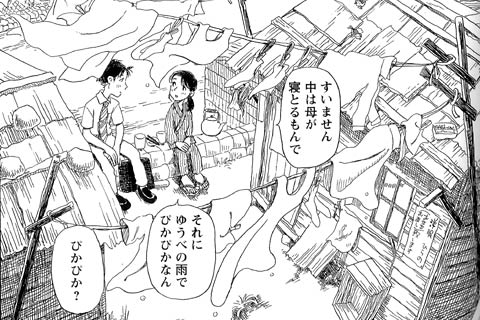
In less skillful hands, scenes like these might be mawkish, but Kouno crafts an emotionally authentic story from survivor narratives, deftly moving between present and past to show us how her characters hear the echoes of August 6th in their everyday lives. The first story, “Town of Evening Calm,” focuses on Minami, a young seamstress living in Hiroshima ten years after the atomic blast. Superficially, the city seems to be healing: its downtown is bustling with activity, as is the dressmaker’s shop where Minami works. Yet subtle signs of the devastation remain, from the ramshackle houses of the residential district to the scarcity of everyday goods. (In a particularly effective scene, we see Minami walk home barefoot so as to preserve her only pair of shoes.) Minami herself bears psychic wounds from the day, as is evident in her brusque demeanor with outsiders and her staunch refusal to leave her ailing mother’s side. Underneath her bravado, we see a fearful, guilt-ridden young woman who wonders when she will succumb to the long-term effects of the radiation, who cannot escape her horrifying memories, and who mourns the disintegration of her family. (Her father and sister perished in the blast; her brother was sent to live in Mito, and had yet to return to Hiroshima.)
town_interior1

The second story, “Country of Cherry Blossoms,” takes place nearly twenty years later in Tokyo. We first meet Nanami, a baseball-addled tomboy, as an eleven-year-old girl. Through a few telling details–Nanami’s dirty baseball uniform, Nanami’s interactions with classmates–we see that she suffers acutely from her mother’s absence. (Her mother, a hibakusha, succumbed to cancer.) Lacking a female role model, she latches onto Toko, a classmate who epitomizes girly grace. Kouno depicts a few ordinary moments from this odd pair’s childhood: a playground discussion of a homework assignment, a baseball game, a trip to the hospital where Nagio, Nanami’s younger brother, is hospitalized with severe asthma.

We then jump forward seventeen years. Nanami and Toko are estranged; Nagio, now healthy, is training to be a doctor; and Asahi, their elderly father, has been behaving oddly. Fearful that Asahi is losing his faculties, Nanami tails him through the streets of Tokyo, where she bumps into Toko. Their initial conversation is awkward and forced; seeing Toko dredges up some of Nanami’s most painful childhood memories. Toko, undeterred by Nanami’s rudeness, furnishes Nanami with a disguise, and the two set off for Hiroshima, where Asahi seems intent on completing a mysterious errand. As Nanami and Toko follow Asahi, we realize that Asahi is the link between the first and second stories; he is Minami’s “lost” brother, the one who was living with relatives when the Americans bombed Hiroshima, returning only after the death of his sister in 1955.

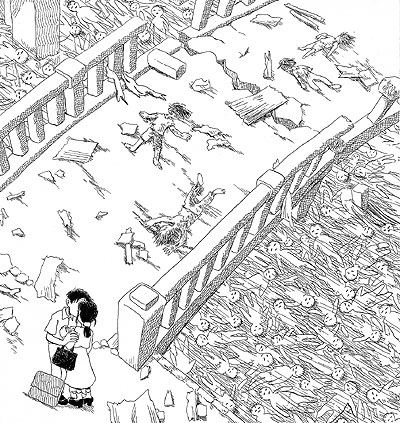
Kouno’s meticulously detailed illustrations create a strong sense of place, underscoring the contrast between Hiroshima’s orderly new business district and the crowded Aioi Doori neighborhood where the hibakusha live. In the few panels alluding to the actual events of August 6, 1945, Kouno’s art becomes more primitive and stylized, suggesting the horrific effects of the blast by depicting the victims as stick figures with swollen faces. The child-like simplicity and directness of these images are startling yet effective, a reminder both of Minami’s youth at the time of the attack and of the radiation’s devastating ability to rob its victims of their identities by destroying their hair, hands, and faces — in short, the very parts of their bodies that give them their individual appearance. These scenes are notable as well for the skillful way in which present and past co-exist within the same panels; we see the landscape as Minami does, alive with vivid, horrific memories of surviving the blast.
town_interior2

Kouno’s character designs exhibit a similar attention to detail and mood as her landscapes. Nanami, for example, bears a striking resemblance to her aunt Minami, not just in her behavior (Minami shared Nanami’s love of baseball and her brusque demeanor) but also in her facial expressions and carriage; she’s a subtle visual echo of the previous generation. Like all of Kouno’s characters, Nanami and Minami have a slightly rough, clumsy quality to them, with heads and hands that seem just a little too big for their wiry bodies. Yet these awkward proportions don’t detract from the beauty of the work; if anything, the illustrations make Kouno’s characters seem more vulnerable, more imperfect, more fragile—in short, more human and more believable. And that honest vulnerability, in turn, makes it possible for readers from all walks of life to enter sympathetically into Kouno’s haunting yet life-affirming story, to look past the politics of suffering and representation to understand the price that civilians pay in every war.

This is a revised version of a review posted at PopCultureShock on March 23, 2007. Click here for the original text; click here for a Japanese translation of the original review.

Filed Under: Manga, Manga Critic, REVIEWS Tagged With: Fumiyo Kōno, Hiroshima, Historical Drama, Last Gasp

Town of Evening Calm, Country of Cherry Blossoms

January 4, 2010 by Katherine Dacey

town_coverIn The Idea of History, author R. G. Collingwood argues that nineteenth-century historians viewed their task in a different spirit than their predecessors. While previous generations of scholars treated history as a simple chain of events, the Romantics wanted to recreate the past through their writings. The Romantic historian, Collingwood explained, “entered sympathetically into the actions which he described; unlike the scientist who studied nature, he did not stand over the facts as mere objects for cognition; on the contrary, he threw himself into them and felt them imaginatively as experiences of his own.”

I found myself revisiting The Idea of History as I read Town of Evening Calm, Country of Cherry Blossoms, a project that might well have resonated with Collingwood’s pioneering nineteenth-century historians in its efforts to “enter sympathetically” into the lives of Hiroshima’s survivors, the hibakusha, a group both pitied and shunned by their fellow Japanese in the years following the 1945 bombing. In the introduction to Town of Evening Calm, manga-ka Fumiyo Kouno explains her approach to the subject in terms that are strikingly similar to Collingwood’s:

…

Read More

Filed Under: Manga Critic Tagged With: Last Gasp, Seinen

Tactics, Vol. 8

January 4, 2010 by MJ Leave a Comment

tactics8By Sakura Kinoshita and Kazuko Higashiyama
TOKYOPOP, 192 pp.
Rating: Teen (13+)

This volume opens with the conclusion to Kantarou’s latest conflict with Raikou Minamoto and his underlings. Haruka arrives to save the day (and to reassure Kantarou of his loyalty) but though Minamoto’s immediate plans are destroyed, the fight ultimately ends in a draw. Things are looking up for Kantarou, however, as Haruka makes a promise to one day tell him about his past. The story then takes a break to make way for a string of short “Bedtime Stories” featuring the series’ regular characters, which provide filler for the latter two-thirds of the volume.

Though the volume starts strong, thanks to the underlying tension between Kantarou and Haruka, it quickly falls apart with the introduction of its short story series, “Record of One Hundred Goblins.” With a single exception, these shorts provide neither humor nor substance sufficient to hold readers’ attention. Fortunately, the volume’s final story, “Otoshi,” about an artist whose ability to paint youkai (supernatural creatures) has mysteriously failed him, has enough strength of its own to turn things around. Focusing on relationships between humans and youkai, this story provides one of the most poignant moments of the series so far, rescuing the volume from its flat middle chapters. “… How precious an ‘existence’ is to youkai,” muses Kantarou, having finally returned the artist’s ability to him. “… That’s why I use my writing to make them immortal and [the artist] uses his art to pass on to future generations.”

Despite its uneven storytelling and tone, the eighth volume of Tactics manages its way out of complete destruction with a healthy dose of true feeling.

Review copy provided by the publisher. Review originally published at PopCultureShock.

Filed Under: REVIEWS Tagged With: manga, tactics

Manhwa Monday: A New Year!

January 4, 2010 by MJ 28 Comments

goong1Happy New Year, Manhwa Monday readers!

Last week at Manga Bookshelf, I invited some friends to help me build a list of our Favorite Manhwa of 2009. Now, to start the year off right, I’m giving away one copy of the first volume of the most popular manhwa on that list, Goong: The Royal Palace. If you’ve not yet been bitten by the manhwa bug, or if you just haven’t gotten around to this addictive girls’ manhwa from Yen Press, here’s your chance!

Just leave a comment to this entry and you’ll automatically be entered in the drawing! You may also enter by sending an e-mail to mj@mangabookshelf.com with the subject line: “Goong.” The winner will be announced in next week’s column. Note: You must be age 13 or older to enter.…

Read More

Filed Under: Manhwa Bookshelf Tagged With: manhwa, Manhwa Bookshelf

Ludwig II, Vols. 1-2

January 2, 2010 by MJ 5 Comments

ludwig2Ludwig II, Vols. 1-2
By You Higuri
Published by Digital Manga Publishing
Rating: 18+ (Mature)

Repulsed by affairs of the state and obsessed with the beauty of the arts, young King Ludwig II of Bavaria would much rather attend the opera than discuss his country’s vulnerability to power-hungry Prussia. As his ministers struggle to turn his focus to politics, Ludwig seeks the company of kindred spirits, particularly attractive young men whom he also desires as sexual partners.

With his greatest love apparently unrequited (that for notoriously decadent composer Richard Wagner, who uses Ludwig’s patronage to conceal his affair with a married woman) and his effusive relationship with Prince Paul of Thurn and Taxis nearing its end, Ludwig becomes infatuated with his new stable boy, an attractive young blond named Richard Hornig, whom he soon appoints as his personal manservant. Despite numerous obstacles, including a criminal plot hatched by Hornig’s brother and Ludwig’s brief engagement to his devoted cousin, Sophie, their mutual love grows, threatened only by political enemies and Ludwig’s increasingly frequent hallucinations.

As a matter of historical fact, King Ludwig II’s tragic and unexplained death can hardly be treated as a spoiler, a point wisely taken by mangaka You Higuri, who uses the event to open the series while also introducing Ludwig’s cousin Elizabeth (Empress of Austria), with whom he shared an exceptionally close relationship. Elizabeth, whose restless spirit earned her the name “The Wandering Queen,” begins as narrator and is portrayed throughout the story as the only person capable of truly understanding her cousin, doomed (as he is) to a fretful life as penance for the sin of dreaming. Higuri also makes good use of Ludwig’s well-known obsession with Wagner and his controversial legacy as “The Mad King,” by giving him recurring visions of a beautiful male “Valkyrie” (mythical Norse maidens who act as angels of death, portrayed extensively in Wagner’s opera Die Walküre) who draws him slowly into darkness and away from Hornig.

Though early on, Higuri tosses in a half-hearted reference to Ludwig’s lifelong struggle with religion and sexuality (as documented in his diaries), Ludwig’s imaginary Valkyrie is given most of the dirty work when it comes to tearing him away from his One True Love, Hornig, as well as the task of explaining his death. That Higuri’s story is highly fictionalized is not only obvious but intentional, yet it is its historical foundation that gives it much of its resonance, so much so that it’s tempting to wish she had gone just a bit further.

Higuri has set up a very attractive tragedy—its beautiful lovers doomed by circumstance, position, and mental instability. This premise, as stated, is perfectly primed for romantic fantasy and certainly a staple of the genre. What’s a bit sad is that the demands of boys’ love must take precedence over the opportunity to illustrate Ludwig’s true tragedy—one better told by historians and biographers. Much more heartbreaking than a tale of star-crossed lovers is that of a sensitive and artistically inclined young man, shackled by position and ruined by wealth, tortured by the impossibility of reconciling his deeply ingrained religious beliefs with the reality of his own sexuality, and doomed to lose lover after lover to disenchantment or, worse, matrimony.

Not only does Higuri romanticize Ludwig’s famously mysterious end, she also carefully leaves out his pain over Hornig’s real-life marriage, which took place years before. Though the true tale, of course, fails to provide the stuff of romantic fantasy, it reveals far more poignant truths about life as a gay monarch in the nineteenth century.

Even the New York Times, in their 1886 obituary, described Ludwig as a man born “too soon or too late”—a reclusive lover of the arts burdened with the weight of deep feeling, and ill-suited to an environment of politics and war. That Ludwig’s loneliness is palpable, even in the coldest historical accounts, is painfully revealing and unfortunately far removed from the world of boys’ love manga, as is his eventual decline into obesity. Given Ludwig’s aesthetic tastes, it is likely that Higuri’s ending for him—young, beautiful, and adored even in his final moments—would better satisfy his sensibilities than the one he came to himself.

One aspect of Ludwig’s personality that Higuri captures quite well is his devotion to his own fantasies—bestowing lavish gifts on those who pleased him and pouring his personal fortune into the construction of a series of elaborate castles—something that caused strife amongst his ministers but inspired considerable loyalty in the Bavarian people. It is Ludwig’s increasing retreat into fantasy that Higuri uses to justify his romantic and beautiful demise, something Ludwig himself would no doubt have appreciated.

Historical inaccuracies aside, Higuri’s tale is undeniably engaging and honestly romantic, despite her tendency to sentimentalize some disturbingly imbalanced bedroom dynamics which, granted, may not be far removed from class-based sexual politics of the day. The series’ detailed artwork and lush, period setting provide a feast for the eyes as well, with special attention given to the emotional tone of each scene. Ludwig’s inner world is especially well established, both visually and otherwise, and Higuri’s ability to portray him equally well in ecstasy as in despair gives him the range necessary to rise above the melodrama as a genuinely poignant character.

With just enough fact behind the fiction, Ludwig II manages to be more than a stylish costume piece, and if it inspires yearning for a deeper look at history, this can hardly be a bad thing. Succinct yet satisfying in two double-sized volumes, this series provides enough substance to please even casual fans of the genre.

Review copies provided by the publisher. Review originally published at PopCultureShock.

Filed Under: BL BOOKRACK Tagged With: ludwig II, manga, yaoi/boys' love

Love*Com, Volume 14

January 1, 2010 by Deanna Gauthier 2 Comments

Guest Review: Love*Com, Vol. 14
By Aya Nakahara
Published by VIZ Media

Review by Deanna Gauthier

love*com14
Buy This Book

In this volume, Risa and Otani’s relationship is once again under attack. To Risa’s horror, her own grandfather has hired a woman to seduce Otani and break them up. Even worse, Otani believes the sob story he’s been given by the beautiful, buxom Hitomi and accuses Risa of lying to him about her grandfather’s scheme. When the truth comes out will it matter who was wrong and who was right now that a jealous and conniving Hitomi has tricked Risa and left her at the mercy of two yakuza thugs?

This is a romantic comedy so of course a plotline like this will never end as tragically as it could. Still, it is the darkest plotline (and Hitomi, the character with the blackest heart) to appear in Love* Com. Being the gullible reader I am, I believed Risa was in real danger. The threat of rape just doesn’t sit right with me as fodder for comedic misunderstanding. Love*Com has always delivered liberal doses of fluffy silliness along with angst as Risa and Otani discover what they mean to each other and learn what it means to like someone, let alone be in love with them. The mangaka, Aya Nakara, has characterized her manga as intended to bring a smile to the faces of her readers and give them even a moment of enjoyment in their lives. In that regard she has always delivered in spades. I found plenty to laugh about in this volume as I have in the volumes that preceded it–not to mention warm and fuzzy moments to make me smile. Risa and Otani are such innocent and awkward leads–two loveable stumbling idiots who are absolutely made for each other. I do not mean to pick on Nakahara too much for this storyline. It just struck me as too serious and dark a dilemma for an otherwise non-threatening shojo romantic comedy.

Speaking of non-threatening, this volume marks the return of the clownishly-drawn, not-too-bright punks who Risa’s brother nearly came to blows with in the previous volume. Nakahara’s artwork is strongest when it comes to facial expression, especially the eyes. Yet the facial features of her yakuza are drawn with very thin lines and no shading, reducing them almost to doodles that look like they don’t quite belong in the same universe as our main characters. I don’t particularly like the design and execution of the yakuza characters. It feels sloppy in comparison to how beautiful (or at least human) the rest of her characters look most of the time. However, I do feel Nakahara successfully uses this same technique of reducing the facial features of the rest of her cast to thin lines that stretch or contort into odd shapes to comically express certain emotions more strongly. It’s funny, but it’s only just now, fourteen volumes into the series, that it occurs to me: Nakahara uses this instead of drawing chibis!

I really am enjoying this series. It has given me reason to smile when I have really needed it during the dreary fall and winter days, and it holds up well to re-reads. It is definitely one for my keeper shelf. I look forward to the final three volumes!

Review copy provided by the publisher.

Filed Under: REVIEWS Tagged With: love*com, manga

Memories of the Future 1 by Wil Wheaton: B

January 1, 2010 by Michelle Smith

memfuture1From the back cover:
The away team returns from the planet with some very good news: it’s clean, it’s beautiful, it’s populated with friendly humanoids… and they really like to do the nasty.

“At the drop of a hat,” according to Geordi.

“Any hat,” Tasha says knowingly.

Picard sends a second, larger team down to the planet to see exactly how many hats they’re going to need.

From “Encounter at Farpoint” to “Datalore,” relive the first half of Star Trek: The Next Generation‘s unintentionally hilarious first season through the eyes, ears, and memories of cast member and fan, Wil Wheaton (Wesley Crusher) as he shares his unique perspective in the episode guide you didn’t even know you were dying to read.

Review:
I came a little late to Star Trek: The Next Generation. I don’t come from a family of Trekkies and didn’t know anyone who watched the original show, so I was not glued to my set for TNG‘s 1987 debut (like I’d later be for Deep Space Nine‘s). Instead, I got into it in 1992, when my brother was watching the episodes in syndication every afternoon and hanging TNG action figures (still in the package, of course) on his walls. I began watching with him and was soon hooked, acquiring Larry Nemecek’s The Star Trek: The Next Generation Companion so that I could read all about the making of the episodes and keep track of the ones I’d seen. (Side note: I still haven’t seen 1.5 of them, but I kind of like it that way. It makes it seem like it’s not quite over.)

Although I eventually came to prefer DS9, TNG still holds a place in my heart. Like many people, I never did much care for the character of Wesley Crusher, but when I spotted Wil Wheaton’s episode reviews on TV Squad, I did read a few of them. In his introduction to Memories of the Future, Wheaton explains how the site lost a chunk of its funding and, therefore, the ability to pay him, but that he wanted to at least complete reviews for the first season, and so this book was born.

If you’re looking for a tawdry tell-all book, you’re not going to find it here. Wheaton doesn’t talk specifically about his castmates much, but when he does, he has nothing but positive things to say about them. Instead, his vitriol is reserved for the writers; he critiques the way various characters are written (Wesley, primarily, but also Worf and Troi, who are particularly one-dimensional during the first season) and points out many logic flaws and other problems with episode construction. I found his arguments to be compelling—especially how, contrary to many fans’ beliefs, Wheaton himself was in no way responsible for Wesley’s tendencies to save the day and be smug about it—and insightful.

There’s a chapter for each episode including a synopsis, quotable dialogue, obligatory technobabble, behind-the-scenes memory, bottom line, and final grade. The synopses are very snarky, though occasionally he’ll break from that mold to praise a particularly nice piece of acting. Many, many pop culture references abound—Strong Bad, Pulp Fiction, Animal Farm, et cetera—which is okay when I get them but rather annoying when I don’t. I have a feeling I was supposed to find some of the snark funny, but I never did, though I think there was a pretty clever/esoteric shabu shabu joke in there.

Memories of the Future is published by Monolith Press, which was founded by Wheaton “on the idea that publication should not be limited by opportunity.” I’m not sure, therefore, whether anyone else ever read and edited the book before its release. There are a few instances where an incorrect but not misspelled word is used—“marshal arts” or “when Picard apologies or something”—and a lot of inconsistency in the treatment of words that come after colons (don’t capitalize them unless they’re proper nouns!). Also, the header for each episode is accompanied by some grey bars with a lot of random numbers on them. I could never figure out whether they have any significance; perhaps they’re supposed to look like an Enterprise computer display or something? In any case, some tighter editorial controls would’ve provided a bit more polish.

(Update: After realizing that the numbers never go above 26, I tried my hand at cryptanalysis. All I could figure out is that the letters for the Introduction spell “Wesley.” Beyond that, it’s either gibberish or a code too complex for a lazy person like me to bother with.)

Ultimately, while I had some complaints I still wished I had volume two immediately on hand after finishing this one and I wish, too, that Wheaton will continue beyond the first season. While he is occasionally (and rightly) critical of some aspects of the show, his perspective is undeniably interesting and, above all, affectionate.

Additional reviews of the first volume of Memories of the Future can be found at Triple Take.

Filed Under: Books Tagged With: Star Trek: The Next Generation

Vampire Knight, Volume 8

December 30, 2009 by Megan M. 2 Comments

Guest Review: Vampire Knight, Vol. 8
By Matsuri Hino
Published by Viz Media

Review by Megan M.

vampireknight8
Buy This Book

Cross Academy is divided into two groups of students: the Day Class, made up of seemingly normal high school students, and the Night Class, whose members are actually vampires. Protecting the human students from the vampires are Yuki Cross (the headmaster’s foster daughter) and her childhood friend, Zero Kiryu. Yuki has always had a strange relationship with the head of the Night Class, Kaname, on whom she must rely to explain the mysteries of her past. Fortunately for Yuki, circumstances have reached a point where Kaname has no other choice but to do so.

I read the first three volumes of this series when they first came out in the U.S., but eventually dropped it. While I found the main plotline interesting and liked Yuki and Zero, I found Kaname to be extremely creepy and his relationship with Yuki even more so. The real deal breaker for me, however, was that the entire cast (excepting Zero) behaved as if Yuki was one of Kaname’s personal possessions. Having now read this volume, there is virtually nothing I can say on this topic that would not be considered a major spoiler, but suffice it to say that the story itself now appears to support this view of Yuki. Not only has Kaname been firmly established as a love interest, but we also learn that Yuki was literally created purely for the purpose of being Kaname’s bride. There are other plot elements that briefly appear–the mythology of the vampire hunters and the dangers of twin hunters, for instance–but these items are clearly secondary.

In addition to giving life to the creepiest implications of the story’s core premise, the overall quality of the series seems to have declined. In early volumes, I recall that Yuki had quite a bit to do. In this volume, she literally does nothing but run around in a nightgown. In addition, Zero does nothing but point his gun and angst. Only Kaname has anything of real substance on his plate, which unfortunately consists of obsessing over Yuki and seeking revenge. Had I not read previous volumes, I would wonder if Hino’s characters were capable of anything but angst (alternately tragic and angry), aside from some supporting characters, whose range extends to ominous, mysterious, and tragic.

The series’ art has also suffered a serious decline. In the past, I’ve found Matsuri Hino’s art to be too cluttered for my taste–more focused on looking pretty than storytelling–but her designs and backgrounds were interesting and appealing, and her art very detailed. Unfortunately, she has degenerated to substituting backgrounds with white space or hazy textures and her characters have become so generic that they are difficult to tell apart except by hairstyle.

I decided to give Vampire Knight another try thanks to a growing fondness for other gothic shojo titles over the last two years. Unfortunately, whatever it is that CLAMP, Higuri You and Kaori Yuki have, Matsuri Hino doesn’t.

Review copy provided by the publisher.

Filed Under: REVIEWS Tagged With: manga, vampire knight

Serenity 2: Better Days by Whedon, Matthews, and Conrad: B

December 28, 2009 by Michelle Smith

serenity2From the back cover:
When the Serenity crew uncovers a heaping pile of cash—marking their first successful heist—they divulge their most outlandish fantasies, and look forward to a little R&R in a tropical paradise. Unfortunately for these space cowboys, someone is hot on their heels in search of a prize more precious than money.

Joss Whedon, creator of Buffy the Vampire Slayer, joins Brett Matthews and Will Conrad—the team that brought you the smash hit Serenity: Those Left Behind—with a new chapter in the lives of Malcolm Reynolds and his roving band of space brigands in Better Days.

Review:
While Serenity: Better Days is the second comic miniseries based on the TV show Firefly to be released, I am not sure whether its events take place chronologically after the end of the show or not. The one thing that would help establish its place in the timeline—Inara’s decision to depart the ship—is not mentioned at all, nor is any reference made to Shepherd Book’s wish to leave (first stated by him in Serenity: Those Left Behind). While the story works just fine without knowing when it happens, this still bugs me a little bit.

The plot of Better Days is extremely simple. For once, things go well and the crew of Serenity is suddenly rich. Several members share the way they plan to spend their money in scenes that nicely capture the warm, family-like times the crew occasionally shares. Meanwhile, the Alliance is looking for Mal (when are they not?), though this guy is special in that he’s one of Inara’s clients, and a builder whose drone Mal stole is out for revenge. I must admit that this peril did not interest me very much, though I’m used to looking past occasionally lame plots in Whedon shows in favor of character interaction. The best character goodness happens here between Inara and Mal, especially in their final scene together, though there’s also some nice continuity between Wash and Zoe as well as an intriguing tidbit regarding Inara and Simon.

Will Conrad is back as the artist for this miniseries, and seems to have a little better feel for the characters now. The likenesses are more consistent and Inara is vastly improved, finally meriting some impressively realistic close-ups of her own. Although a new cover was created for this trade paperback, the original covers of the three comic issues—forming a triptych that depicts the crew lounging atop sacks of money—are reproduced within.

I have now read all of the Firefly-inspired comics currently in existence and enjoyed them a good bit. Any time Dark Horse would like to make more, I’ll be happy to give them my money.

Filed Under: REVIEWS Tagged With: Dark Horse, Firefly

Sayonara, Zetsubou-Sensei, Vol. 4

December 28, 2009 by MJ Leave a Comment

zetsubou4By Koji Kumeta
Del Rey, 192 pp.
Rating: OT (16+)

Suicidal schoolteacher Nozomu Itoshiki (Zetsubou-sensei) and his students are back, with a satirical take on such topics as Christmas, leftovers, societal hierarchies, cooling-off periods, second opinions, and how to deal with dead space. Even exam students are taken to task in this volume, as Zetsubou-sensei despairs over their ability to get away with nearly anything–a privilege he attempts to recapture for himself by engaging in a series of increasingly ridiculous certification programs. Easily passing tests for certifications in flower arrangement and animal breeding (and scraping by in subjects like “love”), he finds himself ultimately unqualified for either “life” or “death” (a certification that requires numerous sub-licenses, such as “writing a suicide note” and “how to leave your shoes”), leaving him trapped ever further in despair.

Since this series has been dismissed by some as relying too heavily on inside jokes and obscure cultural references to be effective with North American readers, it is important to note that volume four is easily the most accessible in the series so far, requiring very few trips to the translator’s notes provided in the back (and virtually none for readers familiar with Japanese manzai characters—the only cultural reference in this volume absolutely required for the understanding of an entire chapter). Smooth reading facilitates smooth comedy, making this volume more universally hilarious than its predecessors as well. For those who have loved this series from the beginning, volume four is yet another fabulous treat provided by tireless translator/adapter Joyce Aurino and the folks at Del Rey Manga. For those who have yet to warm to the series’ charms, perhaps this is the place to start.

Review copy provided by the publisher. Review originally published at PopCultureShock.

Filed Under: REVIEWS Tagged With: manga, sayonara zetsubou-sensei

  • « Go to Previous Page
  • Page 1
  • Interim pages omitted …
  • Page 962
  • Page 963
  • Page 964
  • Page 965
  • Page 966
  • Interim pages omitted …
  • Page 1052
  • Go to Next Page »
 | Log in
Copyright © 2010 Manga Bookshelf | Powered by WordPress & the Genesis Framework