Today’s Saturday morning cartoon is one of my all time favorite anime: Read Or Die!
Blog
Fanservice Friday: Sundome
 |
 |
 |
 |
 |
 |
 |
 |
Welcome to the second monthly edition of Fanservice Friday!
Today’s column is actually collaborative in a sense, and not hosted here in its entirety. Just yesterday, I appeared as a guest on the Manga Out Loud podcast, hosted by Ed Sizemore (Manga Worth Reading), where we discussed the manga series, Sundome, written by Kazuto Okada, and published in English by Yen Press.
The series mainly follows two Japanese teenagers, Hideo and Kurumi, who develop between them something very close to a classic dominant/submissive relationship (Hideo as the submissive party and Kurumi as the dom), presented in a fairly dark context of obsession and deep emotional damage (though not without some surprisingly warm moments).
For in-depth discussion of the series, please check out the podcast, though given the purpose of this column, I will take a moment to specifically mention the series’ dense volume of fanservice. There is so much of it in this series, in fact, I’m not entirely sure it can be properly categorized as “fanservice” which perhaps indicates something extraneous to the story. In the case of Sundome, “extraneous” could not be a less accurate description.
The entire series is steeped in erotic imagery, some of which could be characterized as quite crude, but with such a strong emotional core, it’s difficult to think of it as obscene, even in its most explicit moments. That the characters are high school students only makes the level of eroticism more disturbing, yet again, it’s so appropriate to the narrative and especially to Hideo’s point of view, it’s difficult to imagine the story working well without it. Eroticism is so much a part of the fabric of the story, anything less might just seem unbelievably coy.
One particular type of imagery, however, is used more prominently here than in any other manga I’ve personally encountered (which, in terms of this type of manga, is admittedly not all that much). That would be the constant presence of the cameltoe. Shots down the shirt or up the skirt are incredibly common, even in pretty mainstream shounen and seinen manga, but Okada’s obsession with the cameltoe is something new for me.

Now, obviously I’m not necessarily the most appropriate judge in terms of appeal, but not only do I have difficulty finding this attractive, it mostly looks… kinda painful. Ouch.
As I mentioned in the podcast, given the sexual themes in the manga, I actually find the rather stunning wealth of male-oriented fanservice in Sundome mainly inoffensive, as it seems so integral to the series’ tone and plot. I find it quite a bit less offensive, in fact, than random, less explicit panty-shots tossed into standard fantasy or adventure manga.
What say you, readers?
Be sure to download this week’s Manga Out Loud podcast, and let us know what you think!
PR: Kamisama Kiss Coming Soon From Viz
I tend to only run press releases I am genuinely enthusiastic about, which is definitely the case with the new Julietta Suzuki series Kamisama Kiss. I’d want to get it in any case because I think her series Karakuri Odette is fantastic, and now I’m intrigued with the premise of the story:
Nanami, alone & homeless after her dad skips town to avoid the debt collectors, saves a mysterious man from a dog attack. Grateful for the rescue, he offers Nanami his home with a kiss on her forehead. Little does she know, but Nanami has just taken over his home…AND his job as the local deity! Adjustments and new responsibilities lay ahead as Nanami faces a host of supernatural creatures, and finds what might be love with the recalcitrant yokai caretaker!
Suzuki managed to make the off-putting at first glance premise of an android girl attending high school genuinely interesting and heartwarming, so I’m very curious to see what she does with gods and yokai. Here’s the full press release:
VIZ MEDIA RELEASES DIVINE ROMANTIC COMEDY KAMISAMA KISS
A Kiss On The Forehead Is A Girl’s Ticket To A New Home And An Unexpected Life As A Deity
San Francisco, CA, December 2, 2010 – VIZ Media, LLC (VIZ Media), one of the entertainment industry’s most innovative and comprehensive publishing, animation and licensing companies, will release the shojo manga (graphic novels for female readers) romantic comedy, KAMISAMA KISS, on December 7th. The new series, created by Julietta Suzuki, will be published under the company’s Shojo Beat imprint, is rated ‘T’ for Teens, and will carry an MSRP of $9.99 U.S. / $12.99 CAN.
Nanami Momozono is alone and homeless after her dad skips town to evade his gambling debts and the debt collectors kick her out of her apartment. So when a mysterious man she’s just saved from a dog attack offers her his home, she jumps at the opportunity. But it turns out that his place is a shrine, and Nanami has unwittingly taken over his job as a local deity!
“Plenty of surprises are in store for Nanami as she adjusts to life at the shrine, taking on new responsibilities and facing a whole range of hidden dangers that she doesn’t fully understand yet,” says Pancha Diaz, Editor. “A kiss on the forehead might have bestowed the land-god mark on Nanami, but she will have a lot to learn as she faces a bratty sky god, a mysterious swamp deity, and a strange, cute boy who might have supernatural powers of his own!”
Julietta Suzuki’s debut manga The Day One Becomes A Star appeared in Hana to Yume Plus magazine in 2004. Her other published works include The Devil And Sweets, Karakuri Odette, and Kamisama Kiss, which is currently featured in Hana to Yume.
For more information on KAMISAMA KISS, or other shojo titles from VIZ Media, please visit www.ShojoBeat.com.
Manga Moveable Feast: Stretchy Super Heroes
I’m working on writing up a review of the first couple volumes of One Piece for the Manga Moveable Feast, but I thought I’d take the time to talk about other characters in comics who have similar stretchy powers as One Piece’s enthusiastic protagonist Monkey D. Luffy. While Luffy gained his rubber powers by eating the fruit of the Gum Gum tree, there are plenty of examples of super heroes with magical stretchy abilities in western comics. Here’s a brief overview of some stretchy superheros.
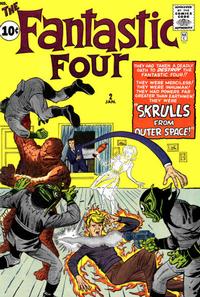
Reed Richards aka Mr Fantastic:
The leader of the Fantastic Four, Reed Richards gained his stretching abilities due to a scientific experiment gone horribly wrong. The funny thing about Reed Richard’s powers is that for someone with such goofy-looking powers, Reed is unquestionably a total stiff in terms of his personality. The contrast between his somewhat frivolous powers and his intellect make him an interesting leader of one of the classic super teams, even though he’d rather spend all of his time in a lab.
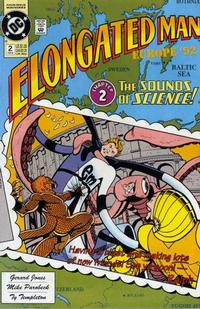
In an amusing coincidence, the Elongated Man’s powers are also fruit based. It seems like poor Ralph Dibney is always going to be a second-string character, because it doesn’t do much good to be a detective in the same universe as Batman. It also doesn’t seem to be all that wonderful to be super stretchy in a universe containing Plastic Man. He’s doomed to be second best and he and his wife seem to be mainly used as cannon fodder in DC crossover event comics.
Jimmy Olsen (Elastic Lad)
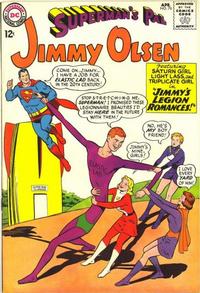
When Superman’s best friend travels forward in time to hang out with the Legion of Super-Heroes, he does so by taking on the abilities of Elastic Lad when he drinks a serum. Unfortunately his super powers do not enable him to make time with the Legion ladies very effectively. Jimmy’s transformation into Elastic Lad were part of a general pattern where he endured being changed into any number of strange creatures. If you’ve been transformed into a giant turtle boy, gorilla, or a radioactive dude having temporary elastic powers seems completely normal.
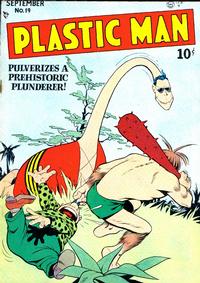
Plastic Man is by far my favorite stretchy super hero, mainly because Jack Cole was an incredibly talented cartoonist who took full advantage of the idea of someone having elastic powers. Eel O’Brian was a thief who was splashed by a strange acid, gaining Most stretchy superheroes have some degree of invulnerability due to their malleable nature, but Plastic Man is able to transform himself into any shape imaginable while still retaining the distinctive red and yellow coloring of his costume. Plastic Man comics end up being delightfully surreal, but comics featuring other heroes with elastic powers often just focus on their stretchy limbs instead of taking full advantage of the possibilities of a person made of rubber.
Luffy seems to be partially invulnerable due to his rubber powers, but he mostly uses his elastic abilities to pack some powerful punches, just based on the first couple volumes. I’m curious to see how his elastic powers are used further into series.
3 Things Thursday: Heroines for 2010
This may not come as a surprise to most of you, but I spend a lot of time thinking about women in manga, both behind the pen and on the page. As I was pondering a topic for this week’s 3 Things, it occurred to me that I might like to pick out some of my favorite female leads from this year’s batch of new manga. What surprised me when I got down to it, however, was the realization that very few of my favorites this year come from the pages of shoujo manga.
While I’m not sure exactly what that says about me or the newest crop of shoujo, I’d certainly be interested in the discussion. In the meantime, lets take a look at three of my favorite heroines from the pages of this year’s debut series.
3 favorite heroines debuting in 2010:
 1. Yukiko | All My Darling Daughters | Fumi Yoshinaga | Viz Media – Perhaps “heroine” is not quite the right word for Yukiko, but as the manga’s various stories are all threaded through her, I’ve decided she qualifies. In any case, I can’t let her go unrecognized.
What’s wonderful about Yukiko is that she’s entirely ordinary, in a way that makes clear just how individual “ordinary” actually is. She’s got average looks, an average job, an average relationship, and even a pretty average outlook on life, and yet both her story and her personality are just as intriguing as any “ordinary girl” who wins the love of a dashing hero, accidentally attains superpowers, and/or saves the world.
Yukiko’s a real everywoman. And every woman is awesome.
 2. Asumi | Twin Spica | Kou Yaginuma | Vertical, Inc. – Asumi is a heroine after my own heart, mainly because of her skyward dreams and her rich inner life. She reminds me of myself as a young girl, though with a kinder heart and a much more tragic past. I’d like to have been strong enough at her age to reach out, without fear, to someone in need, even if that person was unfriendly to me, as she does with her deeply damaged classmate, Marika.
What’s especially enjoyable about Asumi’s journey, too, is that, though her ambitions are no less daunting than those of most fantasy heroines, she isn’t granted any special powers in order to achieve them. Her path entails numerous mundane obstacles, like scientifically-heavy schooling and real-world financial difficulties. Asumi is an idealized version of my young teenaged self, yet real enough that I can pick out exactly the ways in which I could have become her, with just a little more bravery and genuine self-awareness.
 3. Shurei | The Story of Saiunkoku | Sai Yukino, Kairi Yura | Viz Media – Though Shurei’s happy-go-lucky attitude and strong sense of civil responsibility make her an ideal shoujo heroine, there’s a sense of deep intelligence and real mystery about her that somehow defies the norm.
Not that the norm is bad, mind you, but it’s refreshing to encounter a current shoujo heroine who has more on her mind than romance or the standard determination to “do her best!” Shurei does her best, all right, but she’s not necessarily forthcoming about what that is. She’s smart, she’s capable, and she’s every bit as interesting as the male characters who surround her–something that is not quite as common in girls’ manga as a reader might hope.
Honorable mention:
 Chi | Chi’s Sweet Home | Konata Konami | Vertical, Inc. – I don’t cheat often in this column, but Chi is a kitty who demands special treatment, and who am I to refuse?
She’s cute, she’s fearless, she’s defiant when necessary, and she understands the value of good meal. What more could one ask for in a manga heroine? Though lately she’s been hanging with a questionable crowd, her love for her family shines through, even if they are too dense to understand her half the time.
With her bright, wide eyes and spunky personality, who could resist a cat like Chi?
So, readers, who are some of your favorite heroines from this year’s crop of manga?
3 Reasons to Read One Piece
Why would any sane person commit to reading a series that’s still going strong after sixty volumes? I can think of three compelling reasons why you should set aside your shonophobia — that’s Latin for “fear of incredibly long series with interminable fight scenes and characters who do their best” — and give Eiichiro Oda’s One Piece a shot.
1. THE ARTWORK
Though many shonen manga-ka love to populate their stories with flamboyantly ugly villains, Eiichiro Oda’s character designs are more memorable than his competitors’. That’s because Oda doesn’t just add a few scars and a crazy hairdo to distinguish the bad guys from the good; he creates every villain from scratch, making each garment, prop, tattoo, wart, and weapon a direct reflection of the character’s personality and personal history. The same goes for other supporting players: Oda emphasizes the greenness of one pirate’s kiddie followers by giving them vegetal hairdos, and the isolation of a pirate castaway by stuffing the character’s body into an empty treasure chest, with only Gaimon’s unkempt hair and feet poking out. (Gaimon gets one of the series’ best lines: “I used to have two eyebrows!” he exclaims, musing on his twenty years stranded on a remote island.)
Oda’s entire approach to drafting shows a similar thoughtfulness: his pirate ships, tropical islands, and sea coast villages are rendered in clean lines, with a minimum of screen tone. Oda relies instead on playful shapes to help set the stage, from a sea-going restaurant that looks like a cross between a carp and a Hong Kong dim sum parlor, to an island populated by rabbit-cobras, pig-lions, and rooster-foxes.
The only blind spot in Oda’s artwork is his female characters. Though he can draw a marvelous, gnarled pirate queen, as gloriously repulsive as any of the series’ other villains, his young, attractive girls are blandly interchangeable. Even as more female characters are introduced in later story arcs, their appearance seems more calculated to satisfy the male gaze than reveal much about their personality — besides, of course, the near-universal tendency among shonen artists to make a girl’s bust- and neckline a reliable predictor of her villainy.
2. THE LOVING SEND-UPS OF SHONEN CLICHES
One of the reasons I don’t read more shonen manga: I find the characters’ compulsion to shout the name of their fighting techniques kind of silly. (OK, a lot silly.) If anything, it brings back memories of the old Super Friends TV show in which the Wonder Twins clinked rings and announced that they’d be taking “the form of an ice sled!” or “the form of a green-striped tiger!” (If that was meant to be comedy and not a complete abdication of imagination on the writer’s part, I missed it.) Granted, InuYasha and Naruto boast cooler-sounding and more effectual powers, but the minute InuYasha yells “Wind Scar!”, I’m ripped out of the scene, pondering the need for such verbal displays.
In One Piece, however, Oda pokes fun at the practice by assigning his characters goofy powers with goofy names that are fun to say. Monkey D. Luffy’s Gum-Gum attacks are the most frequent and obvious example, as he pretzels himself into a Looney Tunes assortment of weapons and shields, but his crew mates also have a few tricks up their sleeves. The best of them, by far, is Tony Tony Chopper, a blue-nosed reindeer who also happens to be the ship’s doctor. His Human-Human powers enable him to assume a variety of forms, including a gargantuan were-reindeer that wouldn’t be out of place in the pages of Lycanthrope Leo.
Oda also walks a fine line between openly mocking his hero and using him to exemplify the “friendship, effort, and victory” motto that undergirds every Shonen Jump title. Monkey is, to put it nicely, one of the dumbest shonen heroes in the canon — and that’s part of his charm. Unlike, say, Naruto or Lag Seeing (of Tegami Bachi fame), Monkey’s single-minded pursuit of treasure is portrayed as a kind of insanity, not a sign of a stellar character. Monkey goes to extreme lengths to prove himself — not unusual for a shonen hero — but his behavior is clearly meant to be ridiculous. (In the very first pages of the series, he stabs himself in the face with a knife to demonstrate his imperviousness to pain, much to the horror of the assembled pirates.) Yet for all his ill-advised bravado, he’s a kind-hearted goof; anyone who demonstrates valor or integrity is invited to join his crew, regardless of the original circumstances under which they met Monkey. Again, those qualities don’t make Monkey unique, but they do make him appealing; he’s an indestructible hero who’s utterly fallible.
3. THE EXCELLENT ADAPTATION
Any text as thick with puns and pirate-speak as One Piece runs the risk of falling flat in translation, but the English-language adaptation is fluid, funny, and eminently readable. I can’t gauge how faithfully the VIZ edition adheres to the original Japanese, but the script’s buoyant, goofy tone complements the artwork perfectly, leading me to think that VIZ’s editorial team has given American audiences a reasonable approximation of the Japanese-language reading experience. Heck, they’ve even made Oda’s reader correspondence sound like a real, mischievous person answered those fan letters. Now that’s a good adaptation.
3 Reasons to Read One Piece
 Why would any sane person commit to reading a series that’s still going strong after sixty volumes? I can think of three compelling reasons why you should set aside your shonophobia — that’s Latin for “fear of incredibly long series with interminable fight scenes and characters who do their best” — and give Eiichiro Oda’s One Piece a shot.
1. THE ARTWORK
Though many shonen manga-ka love to populate their stories with flamboyantly ugly villains, Eiichiro Oda’s character designs are more memorable than his competitors’. That’s because Oda doesn’t just add a few scars and a crazy hairdo to distinguish the bad guys from the good; he creates every villain from scratch, making each garment, prop, tattoo, wart, and weapon a direct reflection of the character’s personality and personal history. The same goes for other supporting players: Oda emphasizes the greenness of one pirate’s kiddie followers by giving them vegetal hairdos, and the isolation of a pirate castaway by stuffing the character’s body into an empty treasure chest, with only Gaimon’s unkempt hair and feet poking out. (Gaimon gets one of the series’ best lines: “I used to have two eyebrows!” he exclaims, musing on his twenty years stranded on a remote island.)
Oda’s entire approach to drafting shows a similar thoughtfulness: his pirate ships, tropical islands, and sea coast villages are rendered in clean lines, with a minimum of screen tone. Oda relies instead on playful shapes to help set the stage, from a sea-going restaurant that looks like a cross between a carp and a Hong Kong dim sum parlor, to an island populated by rabbit-cobras, pig-lions, and rooster-foxes.
The only blind spot in Oda’s artwork is his female characters. Though he can draw a marvelous, gnarled pirate queen, as gloriously repulsive as any of the series’ other villains, his young, attractive girls are blandly interchangeable. Even as more female characters are introduced in later story arcs, their appearance seems more calculated to satisfy the male gaze than reveal much about their personality — besides, of course, the near-universal tendency among shonen artists to make a girl’s bust- and neckline a reliable predictor of her villainy.
2. THE LOVING SEND-UPS OF SHONEN CLICHES
One of the reasons I don’t read more shonen manga: I find the characters’ compulsion to shout the name of their fighting techniques kind of silly. (OK, a lot silly.) If anything, it brings back memories of the old Super Friends TV show in which the Wonder Twins clinked rings and announced that they’d be taking “the form of an ice sled!” or “the form of a green-striped tiger!” (If that was meant to be comedy and not a complete abdication of imagination on the writer’s part, I missed it.) Granted, InuYasha and Naruto boast cooler-sounding and more effectual powers, but the minute InuYasha yells “Wind Scar!”, I’m ripped out of the scene, pondering the need for such verbal displays.
In One Piece, however, Oda pokes fun at the practice by assigning his characters goofy powers with goofy names that are fun to say. Monkey D. Luffy’s Gum-Gum attacks are the most frequent and obvious example, as he pretzels himself into a Looney Tunes assortment of weapons and shields, but his crew mates also have a few tricks up their sleeves. The best of them, by far, is Tony Tony Chopper, a blue-nosed reindeer who also happens to be the ship’s doctor. His Human-Human powers enable him to assume a variety of forms, including a gargantuan were-reindeer that wouldn’t be out of place in the pages of Lycanthrope Leo.
Oda also walks a fine line between openly mocking his hero and using him to exemplify the “friendship, effort, and victory” motto that undergirds every Shonen Jump title. Monkey is, to put it nicely, one of the dumbest shonen heroes in the canon — and that’s part of his charm. Unlike, say, Naruto or Lag Seeing (of Tegami Bachi fame), Monkey’s single-minded pursuit of treasure is portrayed as a kind of insanity, not a sign of a stellar character. Monkey goes to extreme lengths to prove himself — not unusual for a shonen hero — but his behavior is clearly meant to be ridiculous. (In the very first pages of the series, he stabs himself in the face with a knife to demonstrate his imperviousness to pain, much to the horror of the assembled pirates.) Yet for all his ill-advised bravado, he’s a kind-hearted goof; anyone who demonstrates valor or integrity is invited to join his crew, regardless of the original circumstances under which they met Monkey. Again, those qualities don’t make Monkey unique, but they do make him appealing; he’s an indestructible hero who’s utterly fallible.
3. THE EXCELLENT ADAPTATION
Any text as thick with puns and pirate-speak as One Piece runs the risk of falling flat in translation, but the English-language adaptation is fluid, funny, and eminently readable. I can’t gauge how faithfully the VIZ edition adheres to the original Japanese, but the script’s buoyant, goofy tone complements the artwork perfectly, leading me to think that VIZ’s editorial team has given American audiences a reasonable approximation of the Japanese-language reading experience. Heck, they’ve even made Oda’s reader correspondence sound like a real, mischievous person answered those fan letters. Now that’s a good adaptation.
Off the Shelf: Sentimental Journey
Welcome to another edition of Off the Shelf with MJ & Michelle! I’m joined, once again, by Soliloquy in Blue‘s Michelle Smith.
This week, Michelle continues her look at some final releases from Del Rey Manga, while I check out some new manga from Yen Press and Tokyopop.
MICHELLE: So, MJ. Read anything interesting on the internet today? :)
MJ: HAHAHAHAHAHAHAHAHAHAHAHAHAHAHAHAHAHA. Okay. *whew* Gotta recover here.
MICHELLE: Maybe we can recover by discussing some manga. By the way, you’re looking radiant tonight.
MJ: Why, thank you! You’re exceptionally brilliant, and possibly a little sparkly.
MICHELLE: Why, thank you for noticing. (I’m part vampire, you know.)
MJ: I suspected as much! Well, now that we both feel properly affirmed, I suppose we could talk about some manga.
MICHELLE: It is what we’re here for, after all!
MJ: Yes, yes, it is. So, usually I would save my favorite selection for last, but I admit that tonight I’m so anxious to talk about one of the manga I just read, that I’m going to just give in and go for it. I don’t know if you’ve read it yet, but I suspect you’re looking forward to it. Promise not to shriek when I tell you what it is?
MICHELLE: I will try to contain myself.
 MJ: Good luck! As you may have guessed by this point, it’s Fumi Yoshinaga’s Not Love But Delicious Foods (Make Me So Happy), due out in December from Yen Press. As a fan of Yoshinaga’s previously-translated works, I’ve been eagerly anticipating this release for some time, though I knew very little about it, specifically, before I pulled open the cover. What I discovered inside was even more charming than I’d imagined.
The book is essentially a tour of several of the author’s favorite Tokyo restaurants, highlighting each establishment’s specialties, and including details ranging all the way from atmosphere to parking recommendations. What makes it especially rewarding for Yoshinaga fans, however, is that Yoshinaga herself stars as the main character, surrounded by her circle of friends. How much of this is fictionalized, of course we can’t know, but it feels so authentic, the overwhelming sense for readers is that we’re getting a peek into Yoshinaga’s private world, with a delightful view of her real-life quirks, hopes, desires, and of course, her obsessive love of food.
Yoshinaga portrays herself as an aging, neurotic slacker who eats like a horse, routinely spills food on her clothing, and has a thing for cute, chubby men, all of which makes her even more appealing to an older female reader like me. She strikes exactly the right balance between self-deprecation and self-love, warding off any danger of approaching either desperation or narcissism. She’s neurotic, sure, but also keenly self-aware, and her affection for her friends (be they real or fictional) is palpable.
There isn’t a real story to this manga, just a series of episodes moving from restaurant to restaurant, but what makes each chapter come together is a strong feeling of intimacy with the characters and the author’s characteristic banter. Humorous dialogue is Yoshinaga’s specialty, and she uses it to great advantage in this book, stringing together descriptions of complicated dishes in the most natural way possible. …
Viz Signature Quick Takes – 20th Century Boys, Children of the Sea, and Detroit Metal City
20th Century Boys Volume 11
I made a conscious decision that I was going to invest in one Urasawa series, and that would be 20th Century Boys. I read the first three volumes of Monster, and a couple volumes of Pluto but I just feel more invested in finding out what’s going to happen in the sprawling narrative of 20th Century Boys than Urasawa’s other series. With the eleventh volume, we’re at the halfway mark for the series, and there’s plenty of emotional trauma and action as Kanna finds out the truth behind her parentage and the Friends are on the street persecuting any ally of Kanna’s they can find.
Kanna finds out that her father is the Friend, and lapses into a fugue-like state because she’s utterly unable to process that information. Her connection to her beloved uncle Kenji is severed when her old walkman finally stops working and she’s no longer able to listen to his songs. Seeing Kanna brought down so much made me realize again how young she is, even though she’s exhibited cleverness and charisma as she moves towards being the focus of a resistance movement against the friends. Kanna works through the revelation about her father only to find out that her missing mother was a biomedical researcher who might have contributed the disease outbreak that proceeded the Bloody New Year’s Eve. Sadakiyo makes a final decision about what to do with his life, and Kanna meets up with classmate Kyoko and some of Kenji’s other allies. A special bonus in this volume was the reappearance of Otcho, who is one of my favorite characters. I can see the different threads of Urasawa’s story start to come together, and I’m happy to be on board for the next ten volumes.
Children of the Sea Volume 4
I read the first volume of Children of the Sea and caught a few chapters online, but I’ve missed a some chapters. Fortunately so much of this series is expressed in the beautiful art, it was easy just to crack open the book and let the atmosphere created by the philosophical characters and gorgeous illustrations wash over me.
Ruka has vanished with Umi and quirky scientist Anglade. Her parents and Jim are left alone to unravel the mystery behind her disappearance. While sending out search parties is ineffective, Ruka’s mother who used to be a traditional shell diver sets out to find her daughter along with the wisewoman Dehdeh. Kanoko works through her own relationship with the sea as being on the ocean to find her daughter makes her recall her childhood. Other flashbacks feature the strained relationship between Anglade and Jim, with plenty of scientific theorizing from Anglade as he touches on issues of evolution, astronomy, and the nature of time and space. Ruka and Sora explore a strange underwater world in the presence of a mystical meteorite. I had no idea what was going on with Ruka and Sora, but the images of them encountering bizarre sea creatures were arresting. Igarashi creates this manga with such a unique atmosphere and reading experience. I wouldn’t have thought that the mysteries of the sea combined with child explorers and a healthy dose of scientific theorizing would be so compelling, but Children of the Sea pulls it off admirably.
Detroit Metal City #7
Detroit Metal City is a manga that I’m happy to read if I stumble across a copy, but I probably wouldn’t make a special effort to seek it out. I did think in my review of the previous volume that the hints of an ongoing storyline might combat the repetitive nature of the main joke behind this manga about the meek Soichi who is helpless in the face of his uncanny talent for being a profane front man for a death metal band.
Unfortunately I found that the story carried over from the last volume dragged a little bit. Soichi has found a substitute Krauser II to take his place, but a challenger named Krauser I may destroy DMC. Despite a truly odd sequence of Krauser I raping Tokyo Tower, there wasn’t a whole lot of interest in the Krauser confrontation, as it seems that every contest ends with establishing that Soichi can yell “rape” faster than any human on the planet. I did enjoy Soichi’s ill-fated attempt to connect with his desire to create pop music by entering an artists’ colony. Despite the fact that Wakasugi isn’t the most gifted cartoonist around, seeing the blandly happy faces of the art students and reading Soichi’s lame pronouncements like “the curry might get cold, but never our passion” was hilarious. The volume finished up with a few short chapters about a bad hair day for Soichi and the lengths he will go to in order to prevent his younger brother from losing his virginity. So overall, DMC 7 was a bit of a mixed bag – there were a few very funny moments mixed in with some episodes that were a bit long.
Review copies for Children of the Sea and Detroit Metal City provided by the publisher.
Pick of the Week: Ayako
 Normally I wouldn’t recommend a manga completely sight-unseen, but it’s hard to ignore a new release of anything from Osamu Tezuka, even if my own copy hasn’t reached me yet.
I’m speaking of course, of Ayako, the latest of Vertical, Inc.’s Tezuka acquisitions, released in one gigantic volume (seriously, it’s 740 pages) just in time for the holidays. Not that this is a particularly festive tale. Here’s the description from Vertical’s website:
Opening a few years after the end of World War II and covering almost a quarter-century, here is comics master Osamu Tezuka’s most direct and sustained critique of Japan’s fate in the aftermath of total defeat. Unusually devoid of cartoon premises yet shot through with dark voyeuristic humor, Ayako looms as a pinnacle of Naturalist literature in Japan with few peers even in prose, the striking heroine a potent emblem of things left unseen following the war.
The year is 1949. Crushed by the Allied Powers, occupied by General MacArthur’s armies, Japan has been experiencing massive change. Agricultural reform is dissolving large estates and redistributing plots to tenant farmers—terrible news, if you’re landowners like the archconservative Tenge family. For patriarch Sakuemon, the chagrin of one of his sons coming home alive from a P.O.W. camp instead of having died for the Emperor is topped only by the revelation that another of his is consorting with “the reds.” What solace does he have but his youngest Ayako, apple of his eye, at once daughter and granddaughter?
Delving into some of the period’s true mysteries, which remain murky to this day, Tezuka’s Zolaesque tapestry delivers thrill and satisfaction in spades. Another page-turning classic from an irreplaceable artist who was as astute an admirer of the Russian masters and Nordic playwrights as of Walt Disney, Ayako is a must-read for comics connoisseurs and curious literati.
Sounds like a must-read to me! If you agree, buy this book!