• Skip to primary navigation
  • Skip to main content
  • Skip to primary sidebar
  • Home
  • About Us
    • Privacy Policy
    • Comment Policy
    • Disclosures & Disclaimers
  • Resources
    • Links, Essays & Articles
    • Fandomology!
    • CLAMP Directory
    • BlogRoll
  • Features & Columns
    • 3 Things Thursday
    • Adventures in the Key of Shoujo
    • Bit & Blips (game reviews)
    • BL BOOKRACK
    • Bookshelf Briefs
    • Bringing the Drama
    • Comic Conversion
    • Fanservice Friday
    • Going Digital
    • It Came From the Sinosphere
    • License This!
    • Magazine no Mori
    • My Week in Manga
    • OFF THE SHELF
    • Not By Manga Alone
    • PICK OF THE WEEK
    • Subtitles & Sensibility
    • Weekly Shonen Jump Recaps
  • Manga Moveable Feast
    • MMF Full Archive
    • Yun Kouga
    • CLAMP
    • Shojo Beat
    • Osamu Tezuka
    • Sailor Moon
    • Fruits Basket
    • Takehiko Inoue
    • Wild Adapter
    • One Piece
    • After School Nightmare
    • Karakuri Odette
    • Paradise Kiss
    • The Color Trilogy
    • To Terra…
    • Sexy Voice & Robo
  • Browse by Author
    • Sean Gaffney
    • Anna Neatrour
    • Michelle Smith
    • Katherine Dacey
    • MJ
    • Brigid Alverson
    • Travis Anderson
    • Phillip Anthony
    • Derek Bown
    • Jaci Dahlvang
    • Angela Eastman
    • Erica Friedman
    • Sara K.
    • Megan Purdy
    • Emily Snodgrass
    • Nancy Thistlethwaite
    • Eva Volin
    • David Welsh
  • MB Blogs
    • A Case Suitable For Treatment
    • Experiments in Manga
    • MangaBlog
    • The Manga Critic
    • Manga Report
    • Soliloquy in Blue
    • Manga Curmudgeon (archive)

Manga Bookshelf

Discussion, Resources, Roundtables, & Reviews

Blog

Follow Friday: The MB Gang

June 17, 2011 by MJ 1 Comment

It’s been a while since I put together a Follow Friday post, and with all the recent additions to the Manga Bookshelf family, it seems only right to make sure you all know how and where to follow this fine group of writers. You can check out our About Us page for a full list of everyone who has ever written for this network, but here’s a quick rundown of our current and recent contributors.

Bloggers

Our brilliant main bloggers can all be found on Twitter, and all of them have been more communicative than I have been lately. Manga Critic Katherine Dacey is the @manga_critic there as well, just as Manga Curmudgeon David Welsh is known as @MangaCur. The lovely Michelle Smith of our newest blog, Soliloquy in Blue, can be found @swanjun.

Contributors

A number of our regular contributors are avid twitterers as well, including anime reviewer Cathy Yan (@twoif), manhwa maven Hana Lee (@troisroyaumes) and our newest addition to the team, Okazu‘s Erica Friedman (@Yuricon).

Guests

Furthermore, you should be following all our wonderful special guests! You can find a slew of these lovely folks on Twitter, including Eva Volin (@funnypages), Robin Brenner (@nfntrobin), Khursten Santos (@khursten), Connie C. (@simside), Ed Sizemore (@edsizemore), and Aja Romano (@ajafair).

I can, of course, be found on Twitter (@mjbeasi), and you can keep up with our daily postings at the main account (@mangabookshelf).

Hope to see you there!

Filed Under: Follow Friday, UNSHELVED

License request day: Sakuna Hitona

June 17, 2011 by David Welsh

Looking at the major French awards programs that honor comics from Japan, it’s not hard to conclude that there’s a bit of bias in favor of male creators. All of the current Prix Asie nominees were created by men, as were this year’s manga honorees at Angoulême.

On the plus side, the actual commercial market for comics in France seems just as enthusiastic for Japanese comics by women as you’d expect. As you also might predict, they’re well ahead of us in terms of josei offerings. Just look at Sakka’s selection. Since I’m still in the throes of The Josei Alphabet, I thought I’d pick among Sakka’s josei titles for this week’s license request.

I’m quite taken with the description of Mlle Ôishi, titled Sukana Hitona by original publisher Shodensha for its four-volume run in Feel Young. It’s about a 30-ish woman who becomes engaged to a divorced man and the various difficulties that relationship presents. It follows protagonist Kon from 28 to 32 years old and considers the plight of the Japanese woman in search of her soul mate.

Minami has quite a body of work, a fair amount of which explores yuri themes. She also recently launched a series (Hirake Koma!) in Kodansha’s always-reliable Morning. I’d be very interested to see some of her work in English.


Filed Under: LICENSE REQUESTS

Demon Sacred #4, Shinobi Life #7, and Karakuri Odette #6

June 16, 2011 by Anna N

Ah, the last volumes of series published by Tokyopop. I can’t help but feel wistful when I think about not being able to read the end of these series. And since a decent number of volumes for both of these were published, I can’t imagine another company would pick up the licenses. Fortunately after feeling mournful about Demon Sacred and Shinobi Life, I was able to read the concluding volume of the ever delightful Karakuri Odette.

Demon Sacred #4

After the first few volumes of non-stop insanity with all the demons manifesting on earth as pop idol duplicates and reverse aging syndrome, the fourth volume is a little bit more settled. It felt to me like Itsuki was digging in a bit with her typical slow world building. One revelation I found interesting was that the immortal demons are attracted to humans due to their mortality. If a human ever truely loves a demon, the demon may finally receive the gift of a revered type of death. Shinobu’s evil sister Zophie manages to coax her way into his apartment by bribing K2 with pastries, and as soon as she gets a glimpse of the demon she decides to use her cougar wiles on him. Mona is less than thrilled about her demon running off with an older woman. Rina is dealing with the emotional effects of her reverse aging. Shinobu’s family and the government are introducing an anti-demon military and propaganda campaign and they’ve decided to approach Keito to act as their celebrity spokesperson. I love the way Itsuki manages to construct a story out of the most improbably elements but still manage to make everything happening seem believable and natural. With so many volumes left in this series, I’m really curious about where the story would have gone.

Shinobi Life #7

It seems like with every volume of this series there’s a surprising character revelation. Beni is trapped in the past with a younger version of Kegetora, while Kagetora travels to a time in Beni’s past when she is a little girl and her mother is alive. Beni is navigating through all the treachery and suspicion that surrounds Kagetora’s ninja clan, struggling with her feelings for a teenage Kagetora who hasn’t turned into the man she loves yet. Kagetora gets to observe a young Beni’s interactions with her mother, and he makes the discovery that Beni’s father is a time traveler as well. Beni’s mother describes what happens when travelers meet themselves, and Kagetora is determined to keep jumping through time until he finds her again. This was another great volume of Shinobi Life, and I’m sorry that I won’t be able to read the rest of the series.

Karakuri Odette #6

The final volume of this series has one of those open-ended conclusions that I sometimes find annoying, but Karakuri Odette has always been so episodic it didn’t bother me that no big plots were wrapped up at the end. Odette’s robot girl uniqueness is explored further when the sibling robots of rival creator Dr Owen cause further complications in her life. Travis has decided that Odette should be his robot bride. Even though Grace has a lower level of artificial intelligence, she’s jealous of Odette. Owen sees that Odette is superior to his own creations and is determined to grab her so he can find out how she became so advanced. Owen’s strategies to capture Odette result in horrible failure. He underestimates the capabilities of his own robots to decide on their own actions. He approaches Odette himself with a “Hey little girl” type line that she immediately sees through. Finally, he tries to get Odette’s human best friend Asao to deliver Odette to him, with disastrous results. Odette is working through the idea that she might not have a companion for life. Asao is moving on and graduating, and as much has he professes not to care for the robot girl, he still appears to help her whenever she’s in trouble. Chris just lurks in the background being silently supportive and Travis isn’t suitable for a number of reasons. Odette’s final lesson in her journey to becoming human is understanding the nature of change. As the school year ends, all the characters seem to be capable of moving on in their own ways.

Filed Under: UNSHELVED

Off the Shelf: Good Reads & Oddities

June 16, 2011 by MJ and Michelle Smith 7 Comments

MICHELLE: I just ate an uncooked tortilla full of cheese.

MJ: I am eating bread stuffed with pepperoni.

MICHELLE: Assuming yours was actually cooked, I deem you the more sophisticated snacker. Shall we stop talking food and start talking manga?

MJ: Sure! I had a great week in manga, actually, with new volumes from two of my favorite creators arriving at my doorstep. It began with volume six of Ooku, Fumi Yoshinaga’s historical manga set in an alternate version of feudal Japan in which the male population has been nearly wiped out, leaving women to step into traditionally male roles.

This series has been fascinating from the start, and I’ve written quite a bit about it, especially in terms of the way it portrays a gender-reversed society that is essentially still patriarchal. This is still fascinating, but what really struck me in particular as I was reading this volume is just how much it reads like true history. Everything about this volume evokes a feeling of authenticity so strong, if I didn’t know anything about the history of Japan, I would absolutely believe it was non-fiction. That might not sound like a compliment, considering the quality of writing in a lot of non-fiction, but I absolutely mean it as such.

Every detail here, even the odd speech and awkward cadence, feels authentic. This is enhanced greatly by the strong sense, in this volume particularly, that everything here is far in the past, imbuing the story with an aura of inevitability I can’t quite describe. These events are fact, immutable and accepted by generations of people before us. That’s how the story feels.

The series gets pretty unsavory in places, and this volume is no exception there, but one experiences it with the same acceptance as one must when reading history. Even the ugliest moments are irrevocably part of the story’s time and place.

This may seem like a pretty simplistic observation, but really, it hadn’t hit me so strongly before this point. It honestly felt like a revelation of a sort.

MICHELLE: I wonder if that viewpoint will help me get past the hurdle of volume two. “Fictional cat, fictional cat,” I’ve been trying to tell myself. Maybe my mantra should be “Fictional cat a long, long time ago” instead.

MJ: Perhaps even “Real cat from a long time ago whose memory stays alive through poignant depiction of its fate.”

MICHELLE: That may be pushing it a bit.

MJ: Well then, moving on, what have you read this week? You know, that doesn’t involve an untimely feline death?

MICHELLE: Some interesting stuff, actually! As you might be aware, I’ve had some difficulty in pinpointing how I feel about Julietta Suzuki’s Kamisama Kiss. Each volume has been more or less enjoyable, yet I’ve remained disappointed.

I’m happy to report that the third volume has hopefully changed that. This has less to do with any alterations on Suzuki’s part, however, and more with one I made myself: I stopped waiting to be impressed. Because I liked Suzuki’s Karakuri Odette so much, I was waiting for her to transcend that series with this new one, and it just wasn’t happening. By volume three, this impulse had largely subsided and I was able to simply enjoy the series for what it is: an episodic supernatural sitcom.

Volumes two and three have established a pattern: Nanami goes to school and encounters some new supernatural hottie from whom Tomoe, her slightly grumpy but actually kind shinshi (familiar), must protect and/or rescue her. Volume three’s interloper is Mizuki, a shinshi whose master has disappeared due to lack of worshippers. He takes the form of a white snake, and when he randomly shows up at Nanami’s school in this guise, she prevents other students from harming him. He repays this favor by leaving a mark on her that means they are now engaged.

It’s gratifying to see Tomoe spurred to action on Nanami’s behalf, even as he tries to tell himself it’s only on account of his shinshi dignity, and they are both awakening to their feelings more swiftly than I’d expected. None of this is really new territory—the description “Black Bird Lite” would not be far off—but as long as one stops expecting some sort of innovation, it’s actually a pretty nice story.

MJ: Now, one of the things I liked about the first volume of this series, is that it didn’t contain any of the blatant misogyny so characteristic of Black Bird. Given that you’ve described it as a “Lite” version of that series, what should I expect? Has this changed?

MICHELLE: Oh, no, it hasn’t. I just meant you’ve got a heroine whom supernatural fellows seem to desire—though this is usually on account of her kami powers or her shrine and not because boffing her will convey some benefit—and who has yet another supernatural bishounen to protect her. Tomoe isn’t condescending towards Nanami, in fact he’s beginning to acknowledge her good qualities, and though she’s grateful for his help, it’s not in a creepy “you validate me” sort of way. I guess it’s more or less the premise that’s similar, but the character dynamics are much more tolerable in Kamisama Kiss.

MJ: Makes me want to pick up volumes two and three so I can catch up!

MICHELLE: You should! So, what else did you read this week?

MJ: Well, I also received a copy of Natsume Ono’s La Quinta Camera , due out next month. As you know, I’m a big fan of the author, so I snatched this up to read just as soon as it arrived.

La Quinta Camera (The Fifth Bedroom) peeks into the world of a five-bedroom apartment in Italy, which is occupied by four middle-aged men and a stream of disparate foreign students who temporarily occupy the apartment’s fifth room. The story begins with Charlotte, a Danish student who comes to Italy to study the language, and whose tumultuous entry into the country takes a turn for the better upon her arrival at the apartment. At first, it seems like this will be her story, but by the beginning of the second chapter, Charlotte is already moving out, and suddenly it’s obvious that the real story revolves around the apartment’s constants, rather than its revolving fifth room.

This is early Ono, and there’s no denying it. After reading later series like Ristorante Paradiso and House of Five Leaves, it’s a bit jarring to return to the simpler, less refined art style that characterized not simple. What really shows off this story’s youth, however, is its narrative shakiness. Even slice-of-life manga like this benefits from a strong thread to hold it together, and there’s not all that much here to do the trick.

That said, what is here is brilliant in its own way. Ono’s talent for quiet characterization truly shines, though perhaps even that is overshadowed by her gift for nuance, especially when it comes to human relationships. Though most of the manga’s few threads of story feel woefully underdeveloped, Ono’s characters really live here, and there’s a sense that their lives continue offscreen even as we read. Particularly compelling is the personal journey of Massimo, the apartment’s owner, whose attachment to his roommates becomes tearfully apparent by the end.

Is this my favorite of Ono’s works? No, it’s not. But it’s still Ono, and that’s worth a lot.

MICHELLE: It almost sounds like a dress rehearsal for Ristorante Paradiso, with the young woman coming to Italy to have her lives enriched by a bunch of older men. And even if it’s not Ono’s best, it’s always interesting to read an early work of such a unique creator and chart how she has grown over the years.

MJ: Yes, it really is wonderful to be given the opportunity to trace the evolution of her work like this. I’m so pleased Viz has been releasing so much of her work!

So, what do you bring to us as our last selection for the evening?

MICHELLE: A bit of an odd duck, I’m afraid. I’m talking about the sixth volume of Raiders, published by Yen Press, which has the distinction of being the only manhwa I’ve read that is distinctly geared for a male audience.

Raiders is set in England, and follows a young man named Irel Clark as he first discovers then drinks from a bottle containing the blood of Jesus, which renders him immortal. Also searching for this magical beverage is Lamia, a zombie hoping for a cure, and they eventually team up, with Irel serving as her food supply. By the sixth volume, Irel and Lamia have parted ways and are independently learning some shocking truths about Christianity.

There is so much that’s wrong with Raiders. The story is convoluted and difficult to follow. The same could be said of the action scenes, and the art in general is just too bright/white. It makes me wish the book came with a knob so I could adjust the picture. The breakneck pace makes each volume a breeze to read, but there’s not enough time for plot developments to sink in, and there are still characters whose names I don’t know.

Even with all of these issues, though, I don’t actually dislike Raiders. Though one is bounced between scenes without always understanding how they relate, the scenes are usually interesting enough in their own right, and gradually a picture is beginning to emerge of what the series actually is: a very cynical take on Christianity and religion as a whole. If more people were aware of Raiders, I could imagine it causing a stir with quotes like “Religious zealots are no different than gambling addicts. They are obsessed lunatics.” In the world of Raiders, Christianity is most decidedly a myth, and one created with megalomaniacal aims in mind. Irel, with his newfound immortality, presents a challenge to the man responsible, which could lead to all manner of intriguing developments.

While I can’t really recommend Raiders, therefore, I intend to keep reading it.

MJ: Actually, the whole religion-is-lunacy theme you’re describing here makes me feel suddenly interested in the series.

MICHELLE: I had a feeling it might. There’s a sci-fi angle to it as well, which really doesn’t make any sense at this point (and might never), but that theme is certainly what made me really sit up and take notice.

MJ: You know, I’d become a little jaded about zombie comics, but I think I have to give this one a look, finally.

MICHELLE: Yeah, it’s less about humans having to fend off zombie hordes than it is about zombies being bummed out about their unlives.

MJ: Something we can all relate to. Heh.

MICHELLE: Yeah, though I thankfully haven’t had the experience of my leg failing to reattach itself on account of being sliced by the special sword wielded by an albino vampire.

MJ: You haven’t? Geez, Michelle, you’re so sheltered.

MICHELLE: I should get out more.

MJ: Indeed.

Filed Under: OFF THE SHELF Tagged With: kamisama kiss, La Quinta Camera, ooku, raiders

Taking a Close Look at Ultra Jump

June 16, 2011 by Erica Friedman 11 Comments

This article was originally published at Mangacast.net.

As sure as boys become men, some boys who read manga become men who read manga. And, at some point, battles for ninja clan supremacy fail to fully meet the emotional needs of that audience. No, that audience wants more violence, less focus on teamwork and strangely uncomfortable series that resolve without ending or end without resolving. For these readers, Ultra Jump is the magazine of choice.

Running 16 series currently, Ultra Jump is heavy on the sci-fi/fantasy and action, with some martial arts and a soupçon of magic. Ultra Jump got it’s start in 1999, some 30 years after it’s younger brother Shounen Jump. UJ is a monthly magazine, retailing in Japan for ¥560 ($6.65USD at time of writing) for just over 500 pages and like Shounen Jump, it’s available pretty much anywhere manga magazines are sold in Japan and in most Japanese bookstores in America. The 2010 circulation for Ultra Jump is reported to be 73,20 which is slightly up from 2009’s 70,834 and close to the 2008 circulation.  Ultra Jump has a digital magazine called Ultra Jump Egg, which provides sample chapters of manga series that have just begun to run in the magazine or, are perhaps being considered for it.

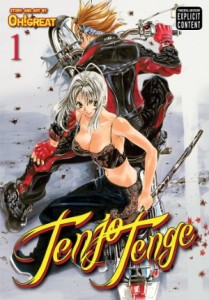
Of the series running currently in Ultra Jump, several have had a checkered experience on US shores. Infamously, Tenjou Tenge, which recently finished, was originally licensed by CMX, who had the nerve to deprive the readership of a glimpse of girl’s underwear and was therefore censured strongly by the folks least likely to actually buy the thing anyway. Viz has rescued this audience from that hell of not being able to see girl’s underwear, and new omnibus volumes are starting to hit the shelves.  Hayate x Blade (the actual reason that I get Ultra Jump) has been licensed and published through volume 6 by Seven Seas. Because Sevens Seas licensed the title from the original publisher, Mediaworks (who ran it in Dengeki Daioh magazine through Volume 8, when it moved to Shuiesha and Ultra Jump,) there is some confusion among fans whether Seven Seas will be able to continue it at least through that point or whether Volume 6 will be as far as the series makes it in English.

Because Ultra Jump is a Shueisha book, it’s no surprise that Viz has a strong presence in the UJ license game. Hyperviolent dystopian Gumn, known here as Battle Angel Alita, has undergone only slightly fewer iterations on these shores as it has in Japan and has managed to successfully reach Volume 14 of the Final Order series. Volume 15 is slated to be released in autumn 2011 Bastard!!, which made it to Volume 19 in English, is known for going on hiatus with some regularity (and has reached that stage of “venerable old series, which means it is serialized on the order of twice a year, perhaps.) Bastard!! is now on hiatus in English, as well. Also currently published by Viz is the hyperviolent dystopian Dogs, Bullets and Carnage.

Ultra Jump series have a tendency to be very long-running as manga series, (Ninku, Tenjou Tenge, Gunm, Steel Ball Run) but if they are turned into an anime at all, the anime tend to be OVAs or short series without second seasons. The overwhelming feeling as a reader is that this is a magazine for readers of manga, as opposed to anime/manga fans. And not just readers, but readers who are in for the long haul, who are content to see the plot develop through long fight arcs and the small spaces in between them. Of the remaining unlicensed titles, I can see Jumbor being ported here, fueled by any success with Takei Hiroyuki’s collaboration with Stan Lee, Ultimo – Jumbor has very similar character designs, but a slightly more classic sci-fi feel. And I wonder if America would be ready for a Wild West manga like Minagawa Ryouji’s Peace Maker. Viz is still slowly popping out Jojo’s Bizarre Adventure, so there’s at least a chance that, when that finishes, Steel Ball Run, a hyperviolent dystopian tale of the meanest polo game you ever did see, might make it over here. That, or when they hit the lottery and want to throw some of that money away on something people want, but will never buy.

The hyperviolent dystopian magical series Anima Chal Lives (one of my personal faves in the magazine), Grandeek Reel, Heaven’s Prison and Hatsukoi Magical Blitz all have about the same chance of being licensed as Needless, which is to say little, for any number of reasons, from constant, uneditable nudity, to constant, uneditable semi-nudity. (The Needless anime was licensed, I’m still not sure why. never was there a better-named series.)

I’ve seen UJ alternately labeled shounen (for boys, say 12-15) and seinen (for young men, say 16-25.) I’d weigh in on the side of seinen. It’s not that young boys can’t or won’t read and stick with long series – One Piece proves the lie on that pretty quickly – but that the sensibility of the stories, and the crises of identities are more “adult,” if you will. When I began this article, I was surprised, pleasantly, at how many of the series for this magazine have made it over here.  Viz has already resurrected Tenjou Tenge and, damn I’d love to hear that Hayate x Blade will be continued.

Ultra Jump, published monthly by Shueisha. http://ultra.shueisha.co.jp/


Erica Friedman write reviews of Yuri Manga, Anime and related media at her blog Okazu .

Filed Under: Magazine no Mori Tagged With: Manga Magazine, Seinen, Shounen, Shueisha

iPadding

June 16, 2011 by David Welsh

Thanks to my partner, who is never quite as much of a cautious adopter as I am, we’re now proud caregivers of a couple of iPads. I’m still figuring out what exactly to do with it aside from coo over the fact that it’s really neat, but I’m sure I’ll be able to incorporate it into my time-wasting infrastructure without too much difficulty.

So far, I’ve only dabbled with a few comics apps and downloaded a few freebies, mostly from Archie, to see how they read. They’ve all looked fine, and my protests of being a dead-tree partisan will undoubtedly abate as more material becomes available. I won’t be quite so cautious when it comes to making unreasonable requests about just what kind of material I’d like to see.

In that direction, it’s very convenient that Kate posted the latest i-nnouncement from Viz Media over at The Manga Critic. My first reaction to the content available on the Viz app was that it was extremely cautious. That’s a sensible enough decision to make from a business standpoint, but it doesn’t exactly set my consumer’s heart racing. Their initial offerings were exactly the kind of titles I’d have absolutely no difficulty finding in any chain bookstore just about anywhere in the continental United States.

The recent round of additions is a bit exciting in that three of my very favorite current Viz titles – Children of the Sea, Cross Game and The Story of Saiunkoku – have been added to the roster, but that’s the excitement of a partisan seeing increased availability of and exposure for products he enjoys and admires. So while it’s rewarding to see Viz add more shôjo and seinen, they have a ways to go before my personal needs will be served.

One of Kate’s suggestions for Viz particularly resonated for me:

“(3) dig into their archives and resurrect out-of-print gems such as A A’, Banana Fish, Eagle: The Making of an Asian-American President, Firefighter! Daigo of Company M, From Far Away, Please Save My Earth, and Urusei Yatsura.”

And since I can never resist the urge to list things, I thought I’d throw out five Viz properties that should be made available on the iPad:

Sexy Voice and Robo, written and illustrated by Iou Kuroda: Part of my love for this comic is the physical production of it, with its phone-book dimensions and appropriately pulpy paper. It’s hard to find, though, and if we can assume that the average iPad user might be a little older, I think this book might find a new audience through this device.

Phoenix, written and illustrated by Osamu Tezuka: Until Vertical works out contractual agreements and unveils its own app, this is seems like a reasonable opportunity to get one of Tezuka’s masterworks available in digital form. You’re in great shape if you can read Japanese, but English-only readers are out of luck so far.

Four Shôjo Stories, featuring works by Moto Hagio, Keiko Nishi, and Shio Satô: This one is a result of pure selfishness, as the available copies of this out-of-print collection are just too damned expensive. From a more self-righteous place, I think every manga publisher should devote at least some effort to publishing challenging, off-the-beaten-path works by women for women. The iPad seems like a natural habitat for that kind of material.

The Drifting Classroom, written and illustrated by Kazuo Umezu: Seriously, is there any mass transit experience that couldn’t be improved by the ability to read deranged Umezu manga? Sure, you risk strange looks from fellow travelers as you giggle at the over-the-top violence and total disregard for the well-being of children, but come on. Tell me this wouldn’t rock. I dare you.

Monster, written and illustrated by Naoki Urasawa: In spite of near-universal critical acclaim, Urasawa’s works don’t seem to have earned matching commercial success, which has always struck me as odd. He writes the kind of genre-bending, sort-of-intellectual thrillers that a lot of prose readers really love. Maybe digital availability would give those prose readers incentive to give a graphic version of their genre of choice a shot.

So what Viz titles would you like to see on one of their digital platforms?


Filed Under: DAILY CHATTER, Link Blogging

PR: iSeeToon Trailers/Interview

June 16, 2011 by MJ 1 Comment

I received a PR piece recently from digital manhwa publisher iSeeToon, announcing three trailers for their upcoming iOS release, Ill-Fated Relationship, a dark romance featuring two serial killers. Two of these are available already, one from the male character’s POV and one from the female character. (See these YouTube links if Storyberry fails in your browser.) A third will be available shortly. If you’re more interested in still shots, they’ve got those too.

Once you’ve watched the trailers, be sure to check out this interview with the series’ creator, Hwang Joon Ho, which was adapted into English by our very own Hana Lee!

Ill-fated relationship in its entirety will be available through App Store for iPhone sometime this month, with an initial sale price of $4.99 (regular price will be $8.99). You can find iSeeToon’s description of the series here.

I reviewed an advanced copy of the comic several months ago here at Manhwa Bookshelf. Here’s the quote from my review they’ve pulled for their PR: “Hwang’s style is sparse, both visually and narratively, creating an environment that feels both intimate and detached at the same time. While the limited use of color suggests a similarly subdued emotional palette, the lack of detail (both background and foreground) brings each emotional beat into sharp focus.”

It really is a fascinating series. I hope those of you with iPhones will check it out!

Filed Under: UNSHELVED Tagged With: ill-fated relationship

The Josei Alphabet: T

June 15, 2011 by David Welsh

“T” is for…

Tamashii no Futago, written and illustrated by Mitsuzaku Mihara, originally serialized in Shodensha’s Feel Young, two volumes. One of Tokyopop’s most focused efforts in publishing josei centered around Mihara’s works like The Embalmer and others. Here’s another Mihara title featuring two ghosts and the people who can see them.

Teke Teke Rendezvous, written and illustrated by George (A Perfect Day for Love Letters) Asakura, originally serialized in Shodensha’s Zipper, two volumes. The aggressive exterior of agricultural student Tayoko masks a novice in the ways of love. She’s working her way through school in a hostess club, so that should help out with the experience shortage.

Ten no Hate Chi no Kagiri, written and illustrated by Waki Yamato, originally serialized in Kodansha’s mimi, one volume. I note this tale of a poetess and seer wooed from a life of celibacy and service by rival princes not so much because it sounds particularly interesting but because its creator seems overdue for introduction to English-language audiences. Yamato is quite prolific, and it seems unfortunate that none of her work is available in print and in English.

Tenpari Ninpu no Shussan Icchokusen! written and illustrated by Tomoko Tamiya, originally published by Futubasha, one volume. This comic was developed to help women overcome their fear of childbirth and to give them strategies to help them enjoy pregnancy. Do you find that cover comforting? I think it looks like something by Junko Mizuno.

Tokyo Girls Bravo, written and illustrated by Kyoko (Helter Skelter) Okazaki, originally serialized in Takarajimsha’s CUTIE, two volumes, published in French by Casterman: A girl from the sticks finally gets the chance to live in Tokyo and fulfill her punk-rock dreams, but obstacles are thrown in her path by her conservative family. Every version of the covers for this book that I’ve seen is absolutely awesome.

Licensed josei:

  • Tomie, written and illustrated by Junji Ito, originally published by Asahi Sonorama, published in English by Comics One and Dark Horse, two volumes.
  • Tramps Like Us, written and illustrated by Yayoi Ogawa, originally serialized in Kodansha’s Kiss, published in English by Tokyopop, 14 volumes.

What starts with “T” in your josei alphabet?

Filed Under: FEATURES

Great performances

June 14, 2011 by David Welsh

It’s not a spectacularly interesting week in local comic shops, so I’ve decided I’d rather talk about two extraordinary performances by actresses that I enjoyed over the weekend.

I saw Follies at the Kennedy Center on Friday. It’s a musical about a reunion of showgirls with a score by Stephen (Sweeney Todd, A Little Night Music, etc.) Sondheim and a book by William (The Lion in Winter) Goldman, and the original production was directed by Harold (Evita) Prince and choreographed by Michael (A Chorus Line) Bennett, and it could hardly have a more prestigious pedigree. I’d never actually seen a full production of it, though I watched and enjoyed a concert version that ran on PBS a couple of decades ago. Seeing it unfold from beginning to end forces me to conclude that it’s got some great songs, some very effective moments, and isn’t very good in terms of sustained storytelling.

The first act sketchily introduces the four leads – two former showgirls and their husbands, one pair being resolutely middle class, the other wealthy and elite – and gives a number of actresses of a certain age (in this case, Linda Lavin, Elaine Paige, Terri White, and others) the chance to bring down the house. The second act focuses more intently on the disintegration of the two marriages, and the piece ends on a spectacular note with a sequence, “Loveland,” where the protagonists each get a dazzling number that articulates their angst in song and dance.

Ostensibly, the biggest draw to the production should be Bernadette Peters, who plays middle-class Sally, the emotionally fragile ex-showgirl who has completely unrealistic hopes for the reunion, most of them centered on her unresolved feelings for rich, elite Ben (played by Ron Raines of Guiding Light fame). You would think the role would be right in her wheelhouse, but maybe she was cast too well. I rarely found myself thinking about the character (who isn’t particularly sympathetic to begin with) as much as the ways Peters’ own narrative intersects with the role.

For me, the knockout, starring performance came from Jan Maxwell as Phyllis, the chorine turned high-society matron who harbors deep (and justified) dissatisfactions under her pristine exterior. I vaguely remember liking Maxwell in some episodes of Law and Order, but I wouldn’t trade the experience of seeing her perform live for anything, even in a show as problematic as Follies. Fairness demands that I acknowledge that Phyllis is probably the best written character in the show, and she certainly gets to perform my favorite numbers (“Could I Leave You?” and “The Ballad of Lucy and Jessie”). All the same, she rips into the role with a seriousness of purpose and a focus that are marvelous to witness. While she’s hardly the best singer and dancer on the stage, her musical numbers are informed by her acting choices, particularly the sense that Phyllis is rediscovering the joy of performing and what it brings to her as an independent entity. Of the “Loveland Numbers,” hers was the one that brought down the house, even with Peters doing a creditable job with the lachrymose cabaret standard “Losing My Mind.”

As for the rest of the cast, their relative success depends on how invested they are in playing a role rather than performing a number. The audience loved Lavin’s “Broadway Baby,” but it seemed to me more of a lively night-club number than an organic part of Follies. Paige’s take on “I’m Still Here” seemed to demonstrate a mighty (and unsuccessful) struggle to make an iconic number personal. White’s “Who’s that Woman?” deservedly stopped the show, partly for the force of her performance and because it’s one of the rare moments when the show’s core concept actually coheres perfectly. White and the other showgirls perform an old favorite as ghosts of their former selves perform with varying degrees of synchronicity, at times displaying the indignities of age. (And, great as White is, the number gave Maxwell the first opportunity to show Phyllis rediscovering herself through performance.)

Raines sings wonderfully well, but his performance isn’t sufficiently complex to make selfish bastard Ben particularly involving. Danny Burstein is close to great as Sally’s long-suffering husband, Buddy. I was delighted to see the actors playing younger versions of the central quartet rewarded for their hard work in thankless roles with spot-on performances terrific songs in the “Loveland” sequence, the wittily written “You’re Gonna Love Tomorrow” and “Love Will See Us Through.” (In truth, I think Lora Lee Gayer gave a better performance as Sally than Peters did, and she gave a pretty good performance as Peters at the same time.)

Because it was devastatingly hot in our nation’s capital, we spent part of the next day in the cool comfort of a movie theatre watching Super 8. Let me tell you, there are a number of worse ways you could spend a hot afternoon. The overall narrative doesn’t offer any surprises, but the execution is packed with craft and grace notes. Sure, it’s basically J.J. Abrams writing and directing a mash note to the films of Stephen Spielberg, but Abrams avoids the worst of his inspiration and executive producer’s tendency towards cheap sentiment while crafting what’s ultimately a really entertaining, nicely paced movie. (I’ve whined before about filmmakers’ tendencies to pad out the final act of a film with totally needless hullaballoo, but there’s none of that here.)

The whole cast is strong, but I was mesmerized by Elle Fanning as I was several summers ago by her older sister, Dakota, in director Spielberg’s War of the Worlds. (Of course, Dakota Fanning was the only thing worth watching in that movie, which made the performance that much more magical.) In Super 8, Elle Fanning plays the generally thankless role of the only girl in a group of boys. I’m not quite sure if it’s because of her performance or due to Abrams’ design, but “the girl” in this case actually has agency and doesn’t just end up being a catalyst for the boys’ reactions. There’s some of that, and the boys are all good at playing their respective archetypes, but Elle Fanning is endlessly watchable and sympathetic. Honestly, I’d like to see her nominated for an Academy Award. She’s just that good.

Filed Under: REVIEWS

Afterschool Charisma Volume 3

June 13, 2011 by Anna N

I’m always happy to read a new volume of Afterschool Charisma. This series about teenage clones of historic figures, their vaguely menacing high school, and the seemingly normal boy trapped with them just has a certain kind of pulpy appeal that I find enjoyable. The cover model for this volume is the uncharacteristically tall teenage Napoleon Bonaparte. At the end of the previous volume non-clone Shiro got a nasty shock when an older version of himself showed up with a pint-sized resurrected Marie Curie, nicknamed Pandora. Mozart yells “Welcome to the clone world, Shiro!” Freud points out that other than the fact that there’s someone that looks a lot like Shiro, they don’t have any confirmation that Shiro actually is a clone. Shiro wants to find his dad so he can ask him about what’s going on. Mozart goes around acting unhinged, and Joan of Arc is preparing to reenact her predecessor’s fiery death.

School director Rockwell reveals a maniacal side underneath his seemingly breezy personality. The shadowy group of people orchestrating the Dolly the Sheep religion finally make themselves known as the school festival draws a variety of visitors who wish to observe the clone’s special talents. One disappointing thing about this volume for me was that we didn’t see much of Clone Freud being awesome. He’s mostly just taking in everything about Shiro, wondering who he actually is, and observing the reactions of those around him. I’m expecting something dramatic from Clone Freud in the future. The pacing for this manga is very good if sometimes a little frustrating. There’s always a dramatic cliffhanger at the end of each volume which leaves me wondering what will happen next.

Review copy provided by the publisher.

Filed Under: UNSHELVED

  • « Go to Previous Page
  • Page 1
  • Interim pages omitted …
  • Page 845
  • Page 846
  • Page 847
  • Page 848
  • Page 849
  • Interim pages omitted …
  • Page 1047
  • Go to Next Page »
 | Log in
Copyright © 2010 Manga Bookshelf | Powered by WordPress & the Genesis Framework