• Skip to primary navigation
  • Skip to main content
  • Skip to primary sidebar
  • Home
  • About Us
    • Privacy Policy
    • Comment Policy
    • Disclosures & Disclaimers
  • Resources
    • Links, Essays & Articles
    • Fandomology!
    • CLAMP Directory
    • BlogRoll
  • Features & Columns
    • 3 Things Thursday
    • Adventures in the Key of Shoujo
    • Bit & Blips (game reviews)
    • BL BOOKRACK
    • Bookshelf Briefs
    • Bringing the Drama
    • Comic Conversion
    • Fanservice Friday
    • Going Digital
    • It Came From the Sinosphere
    • License This!
    • Magazine no Mori
    • My Week in Manga
    • OFF THE SHELF
    • Not By Manga Alone
    • PICK OF THE WEEK
    • Subtitles & Sensibility
    • Weekly Shonen Jump Recaps
  • Manga Moveable Feast
    • MMF Full Archive
    • Yun Kouga
    • CLAMP
    • Shojo Beat
    • Osamu Tezuka
    • Sailor Moon
    • Fruits Basket
    • Takehiko Inoue
    • Wild Adapter
    • One Piece
    • After School Nightmare
    • Karakuri Odette
    • Paradise Kiss
    • The Color Trilogy
    • To Terra…
    • Sexy Voice & Robo
  • Browse by Author
    • Sean Gaffney
    • Anna Neatrour
    • Michelle Smith
    • Katherine Dacey
    • MJ
    • Brigid Alverson
    • Travis Anderson
    • Phillip Anthony
    • Derek Bown
    • Jaci Dahlvang
    • Angela Eastman
    • Erica Friedman
    • Sara K.
    • Megan Purdy
    • Emily Snodgrass
    • Nancy Thistlethwaite
    • Eva Volin
    • David Welsh
  • MB Blogs
    • A Case Suitable For Treatment
    • Experiments in Manga
    • MangaBlog
    • The Manga Critic
    • Manga Report
    • Soliloquy in Blue
    • Manga Curmudgeon (archive)

Manga Bookshelf

Discussion, Resources, Roundtables, & Reviews

Blog

Wandering Son Volume 1

September 10, 2011 by Anna N

Wandering Son Volume 1 by Shimura Takako

I’d procrastinated reading Wandering Son when it first came out. I figured it would be good, just from reading other bloggers’ reviews, but I was wondering if the manga’s premise of a boy who wants to be a girl meeting a girl who wants to be a boy would be a bit ABC Afterschool Special in execution. Fortunately Shimura Takako is a master at portraying subtle events in a slice of life story about adolescence that never feels didactic.

Nitori’s shyness and manners cause him to be mistaken for a girl. He stars the school year by befriending the tomboyish girl Takatsuki. He visits her at her house and she notices his reaction to a dress she has hanging on her closet. She holds the dress up to him and says “It looks good on you. Your face says you want to wear it.” Nitori isn’t able to articulate what he wants and he makes a vague protest that the idea is crazy. Takatsuki says “Don’t you think buying your kid stuff she hates is some kind of harassment?” Nitori takes the dress home to his sister, but he’s left with a heightened awareness of feminine clothing and an idea in his head that he’s afraid to articulate.

One of the things I like about Wandering Son is the way many of the events in the book are simultaneously safe and filled with dramatic tension. As Nitori begins to take tentative steps to express himself, he’s met with acceptance for the most part. His parents seem supportive, but he’s being pushed to experiment with gender before he’s ready. A girl in his class named Chiba figures out Nitori’s attraction to feminine things and gives him an outfit he decides he can’t accept. She arranges for their class to do a gender-swapped class play. Weather she’s trying to help Nitori or merely attempting to collect and manage him as a curiosity is unclear. Takatsuki’s brash behavior causes her to be more bold with experiments as she attempts to pass as a boy in public, and she forces Nitori to go along with her. This might be a good thing, as he wouldn’t necessarily take steps like this on his own.

Like the storyline, Shimura’s art is simple but nuanced. Objects like a headband or a dress take on a symbolic weight for Nitori. His reserved but embarrassed body language portrays the way he’s not comfortable in his own skin, while Takatsuki’s more forthright mannerisms are the posturing of a girl who has to portray herself as outwardly self-assured no matter what she might be feeling on the inside. There’s a great scene of Nitori and Takatsuki getting haircuts together, which is one of the more memorable episodes of the book. He only wants a slight trim so his hair stays long, and Takatsuki demands a haircut as short as his. They end up with almost identical hair and the style that is slightly girlish on Nitori reads as manly on Takatsuki.

As you’d expect from Fantagraphics, the production quality for Wandering Son is excellent. I hope that more manga is on the horizon from them. While I’ll happily read more cheaply produced manga, it is nice to have a variety of options. Carefully curated manga like Wandering Son is a treat.

Filed Under: UNSHELVED

Ship Breaker by Paolo Bacigalupi

September 9, 2011 by Michelle Smith

From the back cover:
In America’s Gulf Coast region, where grounded oil tankers are being broken down for parts, Nailer, a teenage boy, works the light crew, scavenging for copper wiring just to make quota—and hopefully live to see another day. But when, by luck or by chance, he discovers an exquisite ship beached during a recent hurricane, Nailer faces the most important decision of his life: strip the ship for all it’s worth or rescue its lone survivor, a beautiful and wealthy girl who could lead him to a better life…

In this powerful novel, award-winning author Paolo Bacigalupi delivers a thrilling, fast-paced adventure set in a vivid and raw, uncertain future.

Review:
Ship Breaker won the Printz Award this year, and I must say I think it deserved it! It took a little while to grow on me, but I liked it a lot by the end.

At some unspecified point in the future, a community of people has sprung up on Bright Sands Beach (on the Gulf Coast) where the best work to be found is on crews breaking down giant, rusting wrecks of oil tankers. Everyone toils away to meet their quota, all the while dreaming of the lucky strike—oil or other scarce commodities—that could make them rich. Nailer Lopez is fifteen years old and works on the light crew, where his job is scuttling through pipes to scavenge copper, aluminum, and nickel.

After a near-death experience during which his wits and luck save him from drowning in a pocket of oil, Nailer is christened Lucky Boy by his friends. This moniker seems apt when he and his friend Pima discover a valuable wreck left behind in the wake of a hurricane. They set to work stripping it but are stunned to discover a survivor—a very wealthy girl named Nita Chaudhury, who promises her father will reward them for saving her life. When Nailer’s drunken and dangerous father Richard discovers the wreck, however, he opts to trade Nita to her father’s enemies, which forces Nailer to make a whole bunch of difficult decisions.

When he and Pima find the wreck, she urges Nailer to be smart about it. In her eyes, “smart” seems to involve profiting enough to obtain a position of power on Bright Sands Beach. Nailer is aiming higher, however, and makes Nita promise to take him and Pima away and into a better life. The choices he makes from that point on are partly in pursuit of this goal, but also out of a growing sense of loyalty towards Nita, who proves herself capable and quickly loses her prejudices towards those less cultured than she. There are many times where he could have walked away and abandoned Nita to her fate but doesn’t, and ultimately, his concern for her works out in his own favor.

The story ranges over a few different settings, from the beach to the drowned docks of “Orleans” to a clipper ship crewed by people loyal to Nita’s father. As a big fan of the Hornblower series, I liked the ship the best. I hadn’t realized how much I missed depictions of naval battles until the awesome sequence wherein Nailer’s familiarity with the coastline results in a surprise advantage over a superior foe. In fact, the whole final sequence of the book was quite exciting, and makes me think this would make a good movie.

I also found it interesting that the main villain of the work is Nailer’s father, Richard, because Nailer harbors such conflicted feelings about him. He remembers the man his father used to be before his mother died, and though Richard’s now more likely to be high and abusive than relaxed and kind, Nailer feels obliged to care about him and give him chances to be a better person. After many disappointments, he finally realizes that Pima and her nurturing mother, Sadna, are his true family and is able to muster the strength to stop believing that his father is capable of turning over a new leaf at this point. Essentially, he’s a victim of domestic abuse who finally achieves the strength to say, “I’m not going to let you hurt me anymore.”

Lastly, Ship Breaker is commendable for its effortless portrayal of characters of many ethnicities. None of the lead characters is Caucasian. Their skin color is mentioned as part of their physical description, but doesn’t factor in to their relationships at all. Characters are judged purely based on their individual actions. If anything, the only real prejudice left in the world seems to be between the rich (or “swanks”) and the poor, but Nailer’s actions convince Nita, at least, of the errors of her ways, especially since he proves fully capable of functioning in her world if given half a chance.

Although initially a little frustrating—despite my love for dystopic YA, I still get a little frustrated with crappy situations that just seem to be getting crappier—Ship Breaker turns out to be a well-crafted and riveting tale.

Filed Under: Books, Sci-Fi, YA Tagged With: Paolo Bacigalupi, Printz Award

License request day: Fashion Fade

September 9, 2011 by David Welsh

We’re in the midst of another season of Project Runway, one of my favorite reality competitions, even though I hate Josh C. M. to an absolutely unreasonable degree. So I thought I might take a look into the annals of fashion shôjo for today’s license request. (Note: We’re also into a new season of Top Chef: Just Desserts, but I’ve already requested a bunch of pastry manga, so I thought I’d branch out.) As is my way, I looked around for the oldest example I could find.

This led me to Tomoko Naka’s Fashion Fade, which debuted in Shogakukan’s Sho-Comi in 1977. Now, going by my history with the aforementioned rag-off, I’m not naturally inclined to like designers with stupid names (Suede, for example), but I also intensely dislike some designers with perfectly everyday monikers (like Gretchen). So perhaps I shouldn’t judge the heroine of this series too quickly, even though her name is, in fact, “Fade.”

Fade, it seems, grew up in Africa but ended up moving to France to live with her uncle. (Given that this is shôjo of a certain vintage, just about anything could have led to this development. My money is on a car accident that took place while rushing an important serum to a remote village, but my secret heart hopes a pride of lions were involved.) Fade and her uncle don’t hit it off. (Perhaps he prejudges her based on her name.) But she manages by becoming involved in the fashion industry, making friends, and building a career.

It ran for eight volumes originally and was subsequently republished in four thicker volumes. I honestly don’t know if it’s any good, as Naka seems to still be relatively off the radar of English-language readers. She doesn’t even have a Wikipedia page, even though she’s worked steadily since the 1970s. She hasn’t even been published in French. But the covers are pretty in a “Who would ever wear that?” way, aren’t they? The covers have sort of an Erté vibe to them.

Filed Under: LICENSE REQUESTS

Drifters, Vol. 1

September 8, 2011 by Sean Gaffney

By Kohta Hirano. Released in Japan by Shonen Gahosha, serialization ongoing in the magazine Young King OURS. Released in North America by Dark Horse.

Drifters is the newest title from the author of Hellsing and is spanking brand new – even Japan doesn’t quite have Volume 2 yet. That said, it does *not* have vampires. Which means it loses a lot of North America’s strong “I will buy anything with vampires in it” market. Can it get past this obvious handicap and manage to find its own voice?

Yes indeed it can, even though that voice most of the time is a big guy with a sword going “FUCK YEAH!!” Drifters is not particularly a manga for those who want subtle, intricate displays of emotion or great attention to historical detail. It takes famous soldiers from all over earth’s history and plants them in a fantasy world with elves, then watches them simply roll up and start to do battle. And the battle is the main draw of the manga. If you’ve seen Hellsing, you know how much Hirano loves to draw melee combat. This is all about that.

There is, of course, a bit of a plot. Our hero is Shimazu Toyohisa, who is real life was believed to have died in the Battle of Sekigahara in 1600. In this manga, he wanders off the battlefield, wounded, and ends up in a modern-looking hallway, where a mysterious man signs his name onto a sheet and teleports him through a gate to another world, where he’s found by some very Lodoss Wars-looking teens. He’s apparently not the first stranger to be found in these parts, so they dutifully take him off to a ruined castle, where he meets Oda Nobunaga, the Sengoku warlord, and Nasu Yoichi, a famous samurai from 400 years earlier.

They have apparently been brought there to try to stop a great evil from destroying the land (which appears to be controlled by a woman with the amusing name of Easy, who confronts Hallway Guy in a brief scene). What’s more, it would appear they will be joining up with Hannibal and Scipio, both seen here at a different castle that is being laid siege to, as well as Butch Cassidy and the Sundance Kid. Opposing them? Oh, just Hijitaka Toshizo, Joan of Arc, and Anastasia Romanov, all of whom are on the side of the bad guys, and also seem to have supernatural powers.

As you can see, this reads like a fanfiction written by a 12-year-old boy. Luckily, Hirano is mature and has a number of manga series under his best, so the execution is far more interesting. Provided you just turn off your brain and roll with events, this is a hell of a lot of fun. Shimazu makes a good “Who wants strategy, just point me at the enemy!” type hero, and the Black King, although seemingly a straight rip from Lord of the Rings, is a satisfyingly scary villain. And there’s sword fights, and battles, and people saying “Who can possibly save us now?” It is essentially Hirano having a ball every week, drawing whatever the hell he wants. And oddly, it works.

Admittedly, it has anime-style elves, who I normally avoid like the plague. But if you can get past the fantasy setting, what we have here is a bunch of historical soldiers fighting each other wile laughing and making trash talk. It almost reads like something Marvel or DC would put out. Definitely recommended to anyone who likes this sort of thing.

Filed Under: REVIEWS

Off the Shelf: Hungry?

September 7, 2011 by MJ and Michelle Smith 4 Comments

MICHELLE: Mmm… Leftover pad thai.

MJ: Um. Macaroni & cheese from a box? I’m not sure I can *quite* say “yum.”

MICHELLE: We put diced tomatoes in ours. It’s definitely yum. :)

So, what have you been reading this week?

MJ: Well, first I checked out the first two volumes of Eri Takenashi’s Kannagi. The second volume isn’t due out from Bandai Entertainment until October, but the first has been out for a while, and I’m just now catching up with it.

Kannagi tells the story of Jin, a spiritually gifted high school student who pays tribute to his town’s recently cut-down sacred tree by carving a statue of its spirit from the leftover wood. Having met the spirit of the tree as a child, his likeness is close enough to the real thing to actually bring the tree’s guardian deity to life in the form of a human girl. With her tree now gone, the deity, Nagi, has lost some of her power, and must rely on Jin to help her cleanse “impurities” that lurk around looking like insects and snakes. Meanwhile, newly-human Nagi wreaks havoc on Jin’s life, both at home and school.

As a premise, this all works pretty well. Foisting a pretty, domineering, otherworldly girl into the life of a young everyman may not be the most original shounen plot ever, but in-between boob jokes, Takenashi throws in some genuinely quirky stuff. For instance, after watching a magical girl anime on television, Nagi soberly builds her own magical staff out of plastic toys and paper, believing it will help her stamp out the impurities. The book’s early chapters are filled with small bits of humor like this, and even when the first volume beings to drift into harem territory, it retains most of its charm.

Unfortunately, things slide quickly downhill in volume two, when much of the series’ original premise is abandoned in favor of an increasingly obvious harem setup, complete with maid cafes, random swimsuits, and an endless supply of breast/otaku jokes (rotating on a regular schedule). By the end of the volume, in fact, pretty much everything I found charming about the series initially was gone, and it’s hard to say whether I’ll be sticking around to see if it ever returns.

MICHELLE: Oh, that’s too bad. For a while there it seemed like a shounen romantic comedy that any audience could enjoy. I guess it was too good to last.

MJ: Well, maybe I’ve given up too soon. But I’ll admit to being pretty disappointed, after such a promising start.

So what have you got for us this week?

MICHELLE: Like you, I read the first two volumes of a series whose second volume came out recently and its first some time ago (2009, in this case). I’m talking about Angelic Runes, a josei supernatural/fantasy series from Makoto Tateno, better known here for her BL work.

Sowil is a young man possessed of a unique brand of magic who is looking for his father and some answers. Shortly into his quest he comes upon a village where the people are preparing to bury two children alive, believing them to be the source of a curse. Sowil intervenes and ends up taking the kids—a girl named Allueh and a boy named Erudite—with him on his journey. Very quickly he realizes that they’re oracles; Allu can hear the divine voices of demons and Eru the voices of angels. These celestial beings provide Sowil advice on his travels and generally steer him in the direction of people needing his help.

As the trio travels, Sowil ends up helping an ocean-dwelling spirit return home and identifies the being responsible for a series of killings. Both have a connection to the father he is seeking, and gradually Sowil begins to break through the seal that has been placed over his memories and those of the people where he grew up. The angels and demons observing through Eru and Allu are concerned, as well, and through them we see even more investigation of Sowil’s past. Tateno mixes quite a lot of mythologies here, but it’s all in good fun.

What this results in is a kind of low-key story with some genuinely likeable characters, which is definitely my cup of tea. Sowil is really nice—his propensity to help random townspeople reminds me of Rakan from Silver Diamond—but his unique runic magic also makes him somewhat of a badass, so that’s an interesting juxtaposition. I’m also really interested in Allu and Eru, who seemingly have no personalities of their own and simply function as vessels for higher powers. That’s either mysterious or incredibly sad. Perhaps both.

Anyway, there is at least one more volume of this. I hope it won’t be another two years before we see it.

MJ: That does sound like a tasty cup of tea. Why have I been ignoring this series?

MICHELLE: Well, when the first volume comes out and then nothing happens for two years, I think one is justified in thinking, “Hm, perhaps this series has been discontinued.” I like Tateno in general, though, and remembered that Connie (of Slightly Biased Manga) liked the first volume back when we were all part of Manga Recon, so I never forgot about it. It probably doesn’t sell too well, alas, but I hope DMP makes enough through their BL catalog to finance a third volume someday.

What’s your second manga du jour?

MJ: My second read this week was volume one of Bloody Monday, one of Kodansha Comics’ many recent debut series over the past month or so. It’s a thriller about a teen hacker named Fujimaru aka “Falcon.” Though Fujimaru’s skills are often sought out by his special agent dad, he also uses them to do things like liberate his private school from the influence of a harassing faculty member.

When his dad stumbles onto something that gets him framed for murder and puts his family in jeopardy, Fujimaru takes matters into his own hands and, with the help of his high school newspaper crew, continues his dad’s investigation regardless of the danger. Though the series’ super-smart-teen shares some of the more over-the-top qualities of Death Note‘s Light Yagami, he’s at least not a sociopath, which certainly helps in terms of likability, if not in believability. Opening boob and panty shots would suggest that this series shares some other attitudes in common with Death Note-style boys’ comics as well, but at least it seems to feature at least a couple of potentially competent female team members. I suppose time will tell.

Comparisons to Death Note might suggest that I found little to like in Bloody Monday, but actually I enjoyed it more than I expected. Though it’s obviously intended to appeal to fans of the former, I have to admit that its kinder tone goes a long way with me. Despite its highly derivative premise, I expect I’ll continue on with it.

On the petty side, I did notice something early on, Michelle, that made me think of you. There’s a panel in the first chapter that is so poorly laid out in terms of speech bubble placement, that one bit of dialogue looks like it’s being spoken by a character’s hand, or maybe the canister she’s holding. Once I figured out what was really supposed to be going on, I thought, “Michelle would have a field day with this!”

MICHELLE: Probably I would! I kind of relish skewering things like that. I am glad you enjoyed this, though, because it’s written by the same guy behind GetBackers, which is a series I liked a good bit. If GetBackers is any indication, Bloody Monday may well be able to balance the fanservice and competent female characters to your liking.

Now this makes me sigh ‘cos I wish Kodansha would pick up GetBackers, but it’s really been so long…

MJ: I’m definitely interested to see where this goes! I feel a little weird about enjoying something that’s so obviously derivative of a series I was fairly wishy-washy on, but I’m going to just go with it.

So what’s your second offering for the evening?

MICHELLE: I seem to be mirroring you this week, since I also checked out another Kodansha debut. Gon may not be new to American audiences, but it was new to me. I’d seen it praised quite a bit, but never before been compelled to check it out. Now that I have… well… I’m not entirely sure whether I’ll keep reading it.

The premise and execution are certainly unique. Gon is the last remaining dinosaur, and is only a year old. This doesn’t stop him from challenging animals many times his size, however, as this volume finds him facing off against a bear whom he later uses for a bed, convincing a lion to serve as his steed and later eating alongside him as equals, and protecting a nest of eagles from a prowling bobcat. The art is incredibly detailed and entirely nonverbal. So, in that respect, I must say that Gon is really something special.

The thing is… I just don’t like Gon. While I commend mangaka Masashi Tanaka for not making him cute and endearing—he’s fierce and intimidating, even if diminutive—how can I like a critter who basically floods out an entire forest habitat making a dam that makes it easier for him to catch fish? So, on the one hand I’m like “Heh, what a little bastard”—and it is kind of cool how one can so easily invent dialog for all the displaced animals along the lines of “I hate that guy”—but on the other hand I’m like, “Man, what a little bastard!” Can I enjoy bastardly doings for six more volumes? I’m not sure.

One last thing puzzles me. This volume is quite slim. The material has previously been released in the US. And, being without words as it is, is a very quick read, even for a notorious slowpoke like me. These three factors seem to suggest this would be an ideal candidate for omnibus treatment—something Kodansha has shown a willingness to undertake for series like Love Hina and Tokyo Mew Mew—so why not Gon?

MJ: Well, huh. I’m intrigued for sure, though I suspect I may have a similar reaction overall. I find it really difficult to enjoy a series whose protagonist I dislike, especially if there isn’t some other character for me to really latch on to. Your omnibus question is interesting as well. I wonder if it has to do with licensing?

MICHELLE: Probably it does. Or else they’re keeping the volumes small so they’re not intimidating for kids.

MJ: Ah yes, could be.

MICHELLE: So. Um. Good night, then. :)

MJ: And to you, my friend!

Filed Under: OFF THE SHELF Tagged With: angelic runes, Bloody Monday, gon, kannagi

Manga the Week of 9/14

September 7, 2011 by Sean Gaffney

Given that next week is all about Yen Press, let’s start with them. (Yes, I know Sailor Moon and Sailor V come out 9/13. Did you really expect Diamond to ship it on the same day it hits bookstores? Have you been reading my posts at all this year?) There’s lots of stuff from Yen that deserves mention, but I want to focus on one title in particular first.

With the Light, a manga about a young mother struggling to raise her autistic child, was one of Yen’s first manga series announced, and their most exciting. A josei manga that clearly was intended to be marketed to a much broader audience than anime fans, it was a sign of great things to come. And it turned out to be even better when you read it, heartwarming and inspiring. Sadly, the author passed away before she could finish the series. Yen has worked with Akita Shoten to make the final volume, out next week, as complete as it is possible to be. Everyone who loves manga that goes outside the boundaries of ‘fight, train, laugh’ should pick up this series.

Of course, Yen has other stuff too. There’s Bamboo Blade 10, which is about to start up its next big arc. There’s Bunny Drop 4, which is a big turning point in the series. My Girlfriend’s a Geek 4 will no doubt feature more knowing humor about the fujoshi lifestyle. Zombie Loan… I’ve never read, I admit. I presume it’s about a library where you borrow zombies for things they’d be useful for? And the cute moe librarians who run Zombie Loan? No?

And though I don’t cover manwha, I suspect I would be filleted by my fellow Manga Bookshelf colleagues if I did not mention the new Goong and Raiders manga. And for fans of OEL, there’s Svetlana Chmakova’s new series Witch and Wizard, which is written by some other guy… oh right, James Patterson.

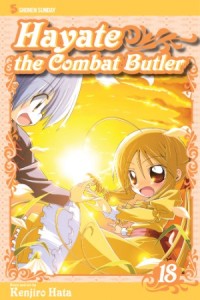
Viz also has titles! Albeit not many. But one is the 18th volume of Hayate the Combat Butler! Yes, it’s down to twice a year, and it seems to only garner bad reviews online these days (that will change when I get a hold of it), but this one resolves the ‘End of the World’ arc in a dramatic way, then kicks back to the comedy. And another final volume, as Detroit Metal City comes to a close. I kind of lost track of the series after the first couple of volumes, but I have a lot of friends who love it.

And Dark Horse is putting out the first volume of Yasuhiro Nightow’s new series, Blood Blockade Battlefront, no doubt meant to appeal to Trigun fans the same way Drifters is clearly designed to appeal to Hellsing fans. Sadly, on advice from my doctor, I can’t actually look at Nightow’s artwork anymore without a 24-hour nurse by my side, so I did not preorder it. But I’m sure hardier people than I will be willing to read it and try to figure out what the hell is happening in the panels.

(Apologies to Dark Horse… if it helps, I’ll be praising Drifters soon.)

So what intrigues you this week?

Filed Under: FEATURES

The Favorites Alphabet: B

September 7, 2011 by David Welsh

Welcome to another installment of the Favorites Alphabet, where the Manga Bookshelf battle robot gingerly approaches our meticulously organized collections to pick a favorite manga title from each letter of the alphabet, whenever possible. We’re trying to stick with books that have been licensed and published in English, but we recognize that the alphabet is long, so we’re keeping a little wiggle room in reserve. And sometimes you can’t pick just one.

“B” is for…

Banana Fish | By Akimi Yoshida | VIZ Media — Given my frequent posts on the subject, this choice likely comes as no surprise. Yet even after all that verbiage, I think I’ve talked very little about one of the main reasons I so love this series. Yes, it’s got fast-paced action, well-developed characters, and an almost-BL vibe to die for, and watching Yoshida’s artistry develop over the course of 19 volumes is truly a pleasure. But one of the series’ greatest draws for me is very simply its sincerity. I recently described another manga as reading like “a bad teen-penned novel,” and while Banana Fish shares some of the same over-the-top sentimentality and naive fancy that tends to characterize stories written by teens, like S.E. Hinton’s The Outsiders, Banana Fish reads like a great one. Yoshida offers up genuine intrigue and compelling action sequences, but her most winning quality as a writer is how sincerely she loves her characters, even when she’s putting them through hell.  This is a series I’ve read and re-read, and will likely read many times more before my eyes finally give out on me. Melodrama and all, it’s one of my favorite manga of all time. – MJ

Basara | By Yumi Tamura | VIZ Media — I hardly know where to start in extolling the virtues of Basara, Yumi Tamura’s epic 27-volume shôjo manga about a girl named Sarasa who assumes the identity of her twin brother Tatara (the so-called “child of destiny”) after his death and leads her people in revolt against a tyrannical king. Sarasa is highly competent and inspires the admiration and loyalty of people from all walks of life, but Tamura never lets us forget that this strong leader is also just a girl who experiences feelings she doesn’t understand and who denies herself a lot in order to be who the people need her to be. Just thinking about the reveal that it’s actually Sarasa who’s been the “child of destiny” all along literally gives me goosebumps. I’d urge everyone to read Basara, even though some volumes are notoriously hard to come by. It really is worth the effort. — Michelle Smith


Black Blizzard | By Yoshihiro Tatsumi | Drawn & Quarterly — I’ve found most of Yoshihiro Tatsumi’s work too bleak, too macho, or too bleakly macho to appeal to my own sensibilities, but Black Blizzard is a notable exception. Dating from the late 1950s, it’s thoroughly enjoyable pulp: a young murder suspect and a jaded criminal escape from custody into a raging snowstorm, police hot (cold?) on their heels. The story’s weaknesses are easy to catalog: the plot developments can be seen coming from a mile away, the characters are little more than types, and the ending is too compressed to be truly satisfactory. Black Blizzard leaves a fresh impression nonetheless, thanks to Tatsumi’s rough, energetic artwork; with all the slashing lines and images of trains in motion, you’d be forgiven for thinking that an Italian futurist had taken a stab at writing a comic book. — Kate Dacey

Black Jack | Osamu Tezuka | Vertical, Inc. — Part House MD, part globe-trotting adventure, Black Jack is easily Osamu Tezuka’s most accessible work. The stories often flirt with the outrageous: Black Jack performs a brain transplant, treats an extraterrestrial, and operates on himself while fending off dingoes in the outback. Yet the human dimensions of every story are never overwhelmed by the questionable medical diagnoses; at their best, the stories are parables about the importance of humility, responsibility, patience, and loyalty, using illness and injury to show us the best — and worst — of human nature. (Also: to show us that Black Jack is a complete bad-ass with a scalpel.) The series’ popularity meant that Tezuka cranked out more Black Jack tales than he probably should have (see “treats an extraterrestrial,” above), but even the weakest entries in the collection are still a lot of fun. — Kate Dacey

Black Jack | Osamu Tezuka | Vertical, Inc. — I’m going to second Kate’s endorsement of Black Jack for a very specific, possibly irrational reason. Sometimes a title becomes a favorite simply by virtue of the presence of a supporting character. In the case of this series, that character is Pinoko. She’s surly old Black Jack’s adorable kid assistant, except she’s actually a parasitic tumor that gestated for years in her twin sister’s abdomen until the good-bad doctor cut her out and gave her a twee little plastic body and took her in as his ward. Pinoko is wrong on every conceivable level – an 18-year-old woman with no meaningful life experience trapped in the body of an artificial child. On some subliminal level, I think every adorable kid sidekick is creepy, but Tezuka just goes there, and Pinoko’s every appearance is an unsettling, mildly heartbreaking, inappropriately funny treat. There are certainly Tezuka titles I like better than Black Jack, but there’s probably no Tezuka character who haunts me quite like Pinoko. – David Welsh

Bleach | By Tite Kubo | VIZ Media — In general, I enjoy talking about manga because I love it. I love finding underrated series I can promote the hell out of, I love reading the romantic ups and downs of a couple that grow and learn at a snail’s pace because it’s funnier that way, and I enjoy watching big guys hit each other. But sometimes you get obsessed with manga that you like… and hate as well.  It can be so good…  and so frustrating. No title currently being released over here does this to me more than Bleach, the second of Viz’s ‘Big Three’ Shonen Jump titles. Bleach has a fantastic cast of characters… who it abandons for years at a time to focus on other new characters. It has emotional resonance… which can sometimes get incredibly ham-fisted.  And while some manga work better in weekly installments, or in volumes, Bleach is one that works best by reading 5 volumes at a time then ignoring it for 6 months. Oh, and the shipping. God, the shipping. Love it or hate it, folks can’t stop talking about Bleach. Which, honestly, is even more valuable in a manga than a title that’s merely liked by everyone. — Sean Gaffney

What starts with “B” in your Favorites Alphabet?


Filed Under: FEATURES

Black Bird Volumes 9 and 10

September 6, 2011 by Anna N

I know Black Bird is wildly popular, but I have a hard time getting into it. I read the first couple volumes and couldn’t get into all the weird wound licking, although I suppose demonic wound licking is at least a twist on the whole vampire romance trope. My main problem with this manga is that I find both of the main characters unappealing. Misao is basically the ultimate trophy bride, since she is a human girl who gives extra powers to whichever demon claims her. The demonic Kyo is just generally unsympathetic.

In Volume 9 Misao and Kyo deal with the aftermath of her allowing herself to be “claimed” by Kyo. Now that she’s Kyo’s woman officially, all the demon clans are on the prowl after her. Kyo’s clan wants Misao for the healing properties of her blood and the other demon clans are fighting back because they don’t want to support the sudden imbalance of power in the demon world. As a result other humans are targeted in the demonic civil war. Innocent humans are possessed by demons and sent after Misao, and Kyo has to fight them off. Misao is filled with guilt, but her response to the situation is to have a nervous breakdown instead of doing something more productive. Kyo is as contradictory as ever, as he orders Misao to “choose humanity” and throws her at demon hunter Raikoh only to suddenly appear and put on a big show by asking Raikoh if he wants to watch him rape her. Now, I’m pretty forgiving of the horrible sexual politics in manga just because I’m willing to forgive a lot for a story that is either humorous (Ai Ore, Butterflies, Flowers) or has a certain over the top soap opera tone (Hot Gimmick). But Black Bird doesn’t have this lighter touch which is why I find myself utterly unengaged in the story after scenes like that.

Volume 10 starts off a little more promising as Kyo’s estranged father pops up to give Misao the lowdown on Kyo’s tragic family past. The wars between the demon clans start to get more serious and it turns out that Kyo’s evil brother is alive and wearing an eyepatch (so you know he is extra evil). Kyo continues to act weirdly schizophrenic as he brings Misao to tears by telling her that she can’t come with him on his mission to restore order to the demon village only to suddenly change his mind and say “Just kidding….silly.” Seriously, Ryoki “You are my slave!” from Hot Gimmick seems like Prince Charming compared to Kyo.

Sakurkoji’s art is fine, with distinct character designs and interesting yet easy to follow panel layouts. I actually liked her short two volume series Backstage Prince, so I just wish that she’s hit it big with a series featuring characters that aren’t acting like jerks or spineless wimps all the time.

Filed Under: UNSHELVED

Upcoming 9/7/2011

September 6, 2011 by David Welsh

As the Manga Bookshelf Pick of the Week can testify, Viz is publishing enough manga this week to choke a horse. It’s even more crowded over at the ComicList than it is at Midtown Comics.

This gives me the opportunity to save another highlight for my own blog: the third three-volume omnibus of Yellow Tanabe’s Kekkaishi (Viz). I’ve been enjoying the heck out of this tale of young exorcists finding their places in the family business, and I fully expect to keep enjoying it, especially since it’s so inexpensive, relatively speaking.

On the shôjo front, there’s the 10th volume of Karuho Shiina’s funky, sweet Kimi ni Todoke: From Me to You (also Viz). Spooky-looking but sparkling-on-the-inside heroine Sawako decides to really express her feelings to down-to-earth dreamboat Kazehaya, which could turn out… any number of ways, to be honest.

Ah, but the ComicList offers a seinen option as well! Vertical releases the one-volume Velveteen & Mandala by Jiro Matsumoto. It’s about schoolgirls who cut class to battle zombies in a satirically dystopian future. As I noted in a recent Bookshelf Brief, this didn’t really work for me, but I think that the comic itself isn’t exactly in my taste spectrum. Fans of this kind of thing, and I know you are numerous, should be perfectly content. It originally ran in Ohta Shuppan’s Manga Erotics F, which has given me plenty of manga to enjoy, so I can hardly complain that this fifth-genre magazine doesn’t succeed for me every time.

Speaking of Bookshelf Briefs, this week’s column includes a brief look at a boys’-love title that I read thanks to your crowd-sourced feedback, Puku Okuyama’s Warning! Whispers of Love (DMP).

Elsewhere on the Manga Bookshelf mother ship, where all of our robot limbs wait gleaming in hangars between battles, I contribute a review to the inaugural Going Digital column. A reasonable price and the lack of a physical copy to clutter my shelves entices me to try the first volume of the classic Lone Wolf and Cub (Dark Horse) by Kazuo Koike and Goseki Kojima.


Filed Under: DAILY CHATTER

Book Girl and the Captive Fool

September 6, 2011 by Sean Gaffney

By Mizuki Nomura. Released in Japan by Enterbrain. Released in North America by Yen Press.

By now I’ve grown somewhat used to how a Book Girl novel will feel. It will be based around a book of some sort (in this case, Saneatsu Mushanokoji’s 1919 novel Friendship) and the mystery plot will parallel the book in some way. It will flesh out the backstory of one of the minor characters we’ve met in the previous books. There will be dark, emotional themes that will connect with Konoha’s own thoughts and emotions. And in the end, Konoha will have grown a little bit more and moved on a bit from the girl in his past he can’t let go of.

But in general, the plot and mystery is not why anyone reads Book Girl. There were a few mystery aspects in this book, but I guessed at the most important one straight away, so they didn’t matter as much. However, it’s the characterization, style and prose that keep you coming back here, and in that respect Captive Fool is a worthy successor to the first two books.

This volume focuses on Konoha’s stoic and calm friend Akutagawa, and the discovery that much of his personality is a mask he puts on to conceal his past tragedies – both from others and from himself. Of course, this sounds a lot like what Konoha is doing now, and the irony is not lost on him. What’s more, the girl who was the focus of the first novel, Takeda, shows Konoha that being ‘cured’ of crushing emotional despair is not something that can happen over the course of a few weeks.

Much of the impetus of this book revolves around being unable to move on from a past tragedy, to the point where self-doubt and pressure make it impossible for you to do anything. Again, these novels are written for 15-17 year old readers, and I think these emotions would resonate well with them. How do you talk with someone after “ruining their life”? What if you make the exact same mistakes? What if one kind action turns out to be absolutely the wrong thing to do?

The author also manages to convey this to Konoha, the one who really needs to hear these words, in a way that doesn’t sound like everyone is acting as his therapist. The book Friendship mentioned above is being performed by the Book Club (and their assorted hangers-on) as a play, and so we see similar doubts and feelings play themselves out on three levels – elementary school (Akutagawa’s past), high school (Konoha’s present), and adulthood (the events of the novel/play). Growing up doesn’t always solve the problem.

Then there’s the ending to the book. I had discussed this with another reader, and it was felt that the revelation (which was a bit of a surprise, but not the complete shocker it was meant to be) was somewhat underwhelming, especially given that we’re only 3 volumes into what promises to be an 8-book “main story”. It seems a bit early for this particular plot gun to be fired off, in my opinion. But if nothing else, t shows us that when you are somebody’s mirror, you take on the same qualities as the person you are mirroring. Even if it’s unintentional.

Again, what I love most about this series is how much it makes me think about human nature. We see the growth of the characters, and even though it’s through artificial “what’s the mysterious tragic past of the novel?” means, that doesn’t make it less valid. And yeah, given the arc, I suspect the next book will focus on whatever demons Kotobuki has. But the writing and characters really make me want to find out what happens next. A great page turner, highly recommended.

Filed Under: REVIEWS

  • « Go to Previous Page
  • Page 1
  • Interim pages omitted …
  • Page 819
  • Page 820
  • Page 821
  • Page 822
  • Page 823
  • Interim pages omitted …
  • Page 1047
  • Go to Next Page »
 | Log in
Copyright © 2010 Manga Bookshelf | Powered by WordPress & the Genesis Framework