• Skip to primary navigation
  • Skip to main content
  • Skip to primary sidebar
  • Home
  • About Us
    • Privacy Policy
    • Comment Policy
    • Disclosures & Disclaimers
  • Resources
    • Links, Essays & Articles
    • Fandomology!
    • CLAMP Directory
    • BlogRoll
  • Features & Columns
    • 3 Things Thursday
    • Adventures in the Key of Shoujo
    • Bit & Blips (game reviews)
    • BL BOOKRACK
    • Bookshelf Briefs
    • Bringing the Drama
    • Comic Conversion
    • Fanservice Friday
    • Going Digital
    • It Came From the Sinosphere
    • License This!
    • Magazine no Mori
    • My Week in Manga
    • OFF THE SHELF
    • Not By Manga Alone
    • PICK OF THE WEEK
    • Subtitles & Sensibility
    • Weekly Shonen Jump Recaps
  • Manga Moveable Feast
    • MMF Full Archive
    • Yun Kouga
    • CLAMP
    • Shojo Beat
    • Osamu Tezuka
    • Sailor Moon
    • Fruits Basket
    • Takehiko Inoue
    • Wild Adapter
    • One Piece
    • After School Nightmare
    • Karakuri Odette
    • Paradise Kiss
    • The Color Trilogy
    • To Terra…
    • Sexy Voice & Robo
  • Browse by Author
    • Sean Gaffney
    • Anna Neatrour
    • Michelle Smith
    • Katherine Dacey
    • MJ
    • Brigid Alverson
    • Travis Anderson
    • Phillip Anthony
    • Derek Bown
    • Jaci Dahlvang
    • Angela Eastman
    • Erica Friedman
    • Sara K.
    • Megan Purdy
    • Emily Snodgrass
    • Nancy Thistlethwaite
    • Eva Volin
    • David Welsh
  • MB Blogs
    • A Case Suitable For Treatment
    • Experiments in Manga
    • MangaBlog
    • The Manga Critic
    • Manga Report
    • Soliloquy in Blue
    • Manga Curmudgeon (archive)

Manga Bookshelf

Discussion, Resources, Roundtables, & Reviews

Blog

Wild Adapter returns!

May 19, 2013 by MJ 7 Comments

wardDreams do come true, my friends—at least for fans of Kazuya Minekura’s Wild Adapter, which has been on hiatus since 2009 due to its creator’s health problems and rumored conflicts with the series’ original publisher, Tokuma Shoten.

It’s no secret that we’re big fans here at Manga Bookshelf, and we’ve been following the news of this series’ possible resurrection since its move to Ichijisha in 2011. Back in August of last year, it was announced that new chapters would begin appearing sometime this spring, and ANN has now reported that the relaunch has begun!

Fans on Twitter have questioned whether the series still has a large enough fanbase to successfully continue, and all we can say here is… DAMN, we hope so.

For more on why we feel that way, check out our Wild Adapter MMF archive, and these posts in particular:

  • Introduction to Wild Adapter
  • BL Bookrack: Wild Adapter Roundtable (with special guest David Welsh)
  • 3 Things Thursday: Wild Adapter
  • Fanservice Friday: The Human Touch
  • Let’s Get Visual: Wild Adapter

What say you, readers? Any Wild Adapter fans still out there? Stand up and be counted!

Filed Under: UNSHELVED Tagged With: kazuya minekura, wild adapter

Neon Genesis Evangelion Omnibus, Vols. 7-9

May 19, 2013 by Sean Gaffney

By Yoshiyuki Sadamoto and GAINAX. Released in Japan by Kadokawa Shoten, serialized in the magazine Shonen Ace. Released in North America by Viz Media.

Well, the party’s over. As if it weren’t obvious from the events at the end of the previous omnibus, the light and fluffy ‘everyone is slightly more tolerable’ manga antics end here, as these three volumes are a brutal kick in the teeth reminding us over and over again that humanity is desperately fighting to survive… and that most of the people in charge actually have a different agenda OTHER than fighting to survive. And, just as we finally add our last major cast member, we also get the first of our major cast deaths. There will be more.

evangelion3

The Evangelion fandom doesn’t use “I mustn’t run away” as a meme for no good reason. This volume sees Shinji in a constant cycle of attempting to flee from his destiny and the responsibilities being thrown at him, and constantly being drawn back as he’s unable to just let everyone else get annihilated. Of course, that doesn’t necessarily mean that he gets to accomplish anything here – he returns, but is basically “sat in the corner” by his father, who punishes him by having him watch everyone get annihilated without his help ANYWAY. The manga is less emotive than the anime, with characters at times seeming to underreact to horrible crises, but that’s unsurprising – the pace of the manga is such that there is a state of constant danger, and I imagine after a while the senses just get numbed.

There’s a lot of backstory here. Kaji’s is designed to make him both more likeable and more vulnerable. For all that we like to pretend that we wouldn’t crack under the threat of death, the reality is that we probably would. And so much of Kaji’s life has revolved around finding out the real reason that things happened the way they did – an attempt to expose what led to his own actions. Shinji at one point notes that Misato still loves him, and indeed he’s clearly in love with her, but these are two people, like the rest of the cast, who are unable to grasp at the happiness that could be theirs. As for the other flashback, Fuyutsuki seems to be the perfect “follower”, and Gendo seems even worse than we’d originally suspected. As for Yui, I suspect that she’s being idolized in the memories of both Fuyutsuki and Shinji when we see her, but I agree that it’s easy to see Gendo could have genuinely loved her.

And then there’s Asuka and Rei. I’ve said before that I find manga Asuka far more likeable, and the counter argument to that is that she’s involved in the manga plotline so much less than in the anime, so doesn’t get the time to be irritating. Asuka’s backstory is also shown to us, which is bad news for her, as backstory in this manga is always followed by trauma. Asuka’s attempts to take out the Angel are interrupted by it raping her – yes, yes, mentally, but given that she screams “don’t come inside me” at one point, I think the distinction is fairly irrelevant here. It’s the most horrific we’ve ever seen the Angel attacks, and she comes away from it basically comatose. Rei, meanwhile, is struggling with a distance growing between her and Gendo as she and Shinji grow closer. Ritsuko seems to realize that Rei is growing more human and less doll-like, something that nearly drives her to murder. This, naturally, leads up to the cliffhanger for this omnibus, showing Rei’s “last stand”.

As for Kaworu, it’s interesting that he arrives right as Kaji departs, given his presence as “the mole”. He’s shipped with Shinji a bit harder than in the anime, with Shinji’s “have some sense of personal space” going unheeded. And the scene with the kitten shows a somewhat unbreakable wall between his own value system and that of the First Child. Nevertheless, you can even see Kaworu getting caught up in the struggle against the Angels, and wonder if he’s oing to be a double/triple/quadruple agent the way Kaji was.

The plot may be going places I don’t want it to go, but the writing is still top notch, with a complete inability to put the book down. The news that the manga will end with Chapter 95 in June means that this is likely to be 5 omnibuses (14 volumes) long, and thus this volume begins the second half of the story. It’ll be hard to make things even more tense after this, but I’m sure we’ll find a way.

Filed Under: REVIEWS

Random Musings: Toronto Comic Arts Festival 2013

May 17, 2013 by Ash Brown

© Taiyo Matsumoto

I first learned about the Toronto Comic Arts Festival (TCAF) in 2011 when Usamaru Furuya and Natsume Ono were invited to the event as featured guests. (As a side note: translations of their diary manga from the trip are included in the 2013 TCAF program guide.) It took me two years to finally work up the courage to attend TCAF myself and get my passport in order. 2013 marked TCAF’s tenth anniversary. This year’s festival featured over four hundred creators from nineteen different countries, including mangaka Taiyo Matsumoto and Gengoroh Tagame. While there were festival events throughout May, TCAF 2013’s main exhibition took place on Saturday, May 11th and Sunday, May 12th.

In order to keep the cost of the trip as low as possible, I crossed over the border into Canada from Michigan early Saturday morning along with my good friend Traci (who contributed a guest post here at Experiments in Manga not too long ago.) I arrived in Toronto in time to see The World of Taiyo Matsumoto, an exhibition at The Japan Foundation featuring original artwork by Matsumoto (creator of Blue Spring, Tekkon Kinkreet, GoGo Monster, and the recently released Sunny.) Matsumoto himself was in attendance for a special interview and artist’s talk. The turnout was huge—standing-room only and some people even had to be turned away. Matsumoto admitted that he never expected so many people to turn out to see him and that he was greatly honored. The event and exhibit, which focused on Matsumoto’s artwork, were marvelous. I certainly learned quite a bit: Matsumoto and Santa Inoue (creator of Tokyo Tribes) are cousins and they regularly talk about manga and help each other out; Tekkon Kinkreet was originally intended to be six volumes long, but ended after three since it wasn’t popular enough to continue (although Matsumoto said that he is satisfied with its conclusion and has no desire to revisit the story); in the beginning, Matsumoto was actually reluctant and even resentful working on Ping Pong, which became his breakout manga; and while Matsumoto has always been an innovative artist, more recent developments in printing technology have allowed him to experiment with different drawing materials and techniques, moving even further away from the use of screentone.

© Maurice Vellekoop

From The Japan Foundation, I headed over to the spotlight on Gengoroh Tagame, a highly influential gay manga artist. Joining Tagame were Anne Ishii, Chip Kidd, and Graham Kolbeins to celebrate Tagame and his work and to discuss the recent release of The Passion of Gengoroh Tagame, which they all had a hand in bringing into being. The panelists were all very enthusiastic and had a great senses of humor. Because of this, the spotlight was engaging and entertaining in addition to being informative. Apparently, there was a rumor that Tagame did not want his work translated into English. He assured us all that this was not true. In fact, he was surprised that it took until now for a collection of his manga to be released in English. It is possible that the rumor may have had a chilling effect on the licensing of Tagame’s materials. Like so many other people (myself included), he is very excited about the publication of The Passion of Gengoroh Tagame. He is also unbelievably happy that others share enjoyment in his fantasies. Tagame is unusual in that very few gay manga artists in Japan are able to make their living on their artwork alone, most hold at least a second job. The panel ended with a very interesting conversation about gay manga and bara (manga typically geared towards gay men) and boys’ love and yaoi (manga typically geared towards women.) It’s difficult to generalize about the genres and the distinction between them isn’t always as clear as some people claim or would like; there can be considerable grey area, crossover, and overlap between the two. For a time, yaoi served as an outlet for gay manga before bara became more publicly acceptable and gay manga magazines were established. Tagame actually started out by submitting his work to yaoi magazines when he was eighteen and he continues to have a large number of female fans. In line for his signing after the talk were people of all (adult) ages, genders, and sexualities, which was wonderful to see.

After having my copy of The Passion of Gengoroh Tagame signed, Traci and I met up together again. We made our way down to The Beguiling Books & Art which is an astounding, award-winning comics store. If you find yourself in Toronto, I highly recommend stopping by The Beguiling. It has new comics, old comics, out-of-print comics, mainstream comics, alternative comics, independent comics, domestic comics, international comics (including the largest selection of manga that I’ve ever seen in one place), and more, more, more. And since the shop was across the street from Koreatown, Traci and I took the opportunity to chow down on some delicious Korean food before heading over to Church on Church to catch the tail end of the TCAF Queer Mixer. Unfortunately, we missed the reception and artist talks, but we still were able to see the exhibit Legends: The Gay Erotic Art of Maurice Vellekoop and Gengoroh Tagame which was well worth the trek across town. (Honestly, I was more interested in the art than I was in the mixer itself, anyways.) On a more personal note, I have never had the opportunity to walk around a queer neighborhood before. It was an awesome and somewhat surreal experience for me; it made me very happy just to be in the Church Wellesley Village area.

On Sunday, I attended the Comics Editing International panel which brought together four comics editors from different countries and backgrounds: Thomas Ragon from Dargaud (the oldest comics publisher in France), James Lucas Jones from Oni Press, Mark Siegel from First Second Books, and Hideki Egami from IKKI/Shogakukan. The group talked about the similarities and differences between their work as editors and the comics markets in their countries. The panel was fascinating. I love IKKI manga, and so was very excited to hear editor-in-chief Egami speak. IKKI is different from most magazines in Japan; it appeals to mangaka who want more control over their work and artistic vision as well as those who want to escape the factory-like system associated with so many of the other magazines. Egami mentioned that the manga industry in general is in decline in Japan, and so publishers are beginning to look outside of the country more and more where once they were almost exclusively focused on the domestic market. IKKI has even started to experiment by publishing left-to-right comics with horizontal text, hoping that they will be more easily adapted, translated, and distributed in other countries. I also attended Sunday’s Queer Comics panel which featured Zan Christensen (who is utterly delightful), Erika Moen, Justin Hall, Chip Kidd, and Gilbert Hernandez and Jaime Hernandez. They talked about queer comics specifically and the representation of queer characters in comics in general, with a particular emphasis on non-binary and fluid sexualities and genders, which I personally appreciated. It was a great group and a great discussion.

My very small, TCAF haul

For the most part, I intentionally flew under the radar while at TCAF. I saw several of my fellow manga lovers around (Deb Aoki, Brigid Alverson, and Jocelyne Allen, just to name a few) and I know that there were even more of us there, too, but I tend to keep to myself and didn’t seek anyone out. I did, however, wander around the exhibitors’ area for a bit. Because I promised that I would, I made a point to introduce myself to the wonderful ladies of Chromatic Press and Tokyo Demons, which is one of my more recent obsessions. (I had been invited to the Chromatic Manga Mixer on Friday night, but I sadly wasn’t in town yet.) I also chatted with Alex Woolfson about  Artifice and The Young Protectors and stopped by Jess Fink‘s table long enough to awkwardly profess my love for her work. Ryan Sand’s new publishing effort Youth in Decline made it’s official debut at TCAF, so I picked up a copy of the first issue of Frontier to show my support. One of the best things about TCAF, other than the chance to see so many fantastic artists who I already follow all in one place (and there were a lot of them there), was the opportunity to discover creators who I wasn’t previously aware of. This is how I ended up bringing home Andrew Fulton‘s minicomic Pubes of Fire, Pubes of Flame which continues to greatly amuse me.

I really do not do well in unstructured, social settings; simply attending TCAF was a huge deal for me and a tremendous personal achievement. I largely consider my first TCAF experience to be a success. I am very happy to report that Traci and I both had a phenomenal time. After only a few hours of being there, I was already making plans for a return visit for next year’s show. Seriously, TCAF is amazing. There was so much going on that I had to make some extremely tough decisions about which programs to attend over others. I saw a ton of incredible work from incredible creators from all over the world and I still feel like there was more that I didn’t get to see. So next year, I’ll be showing up no later than the Friday before the main exhibition and preferably earlier. I’ll be scheduling more time to spend exploring every nook and cranny of the exhibitors’ area. I’ll also be carrying around some snacks with me during the festival; I was so busy and engaged by the programming and exhibits that I actually forgot to eat for most of the day. Next year, I hope to have the guts to actually introduce myself to everyone and maybe even socialize a bit more, too. (Please do not be offended if I didn’t say hello to you this year!) As long as there’s a TCAF, you can expect me to be there.

Filed Under: UNSHELVED Tagged With: comics, Gengoroh Tagame, manga, Taiyo Matsumoto, TCAF

Kare First Love Vols 1-6

May 17, 2013 by Anna N

Kare First Love Volumes 1-3 by Kaho Miyasaka

I was excited to see the first volume of Kare First Love pop up on Viz Digital. I thought this would be a good excuse for me to reread the series. I checked out most of Kare First Love from a library a long time ago, and since then I’ve been slowly acquiring my own copies. Kare First Love was a shoujo manga released before the Shojo Beat imprint came into being. In terms of content, it would skew a bit older than some of the titles in the Shojo Beat line, although Miyasaka doesn’t straddle the josei/shoujo line the way I feel Ai Yazawa sometimes does.

Kare First Love sticks fairly close to standard shoujo plots, but it executes them in an engaging and sometimes slightly more realistic way. Kare First Love also piles on the drama. While there are humorous moments, there’s much more angst as the protagonists navigate their budding relationship. Karin Karino is a shy girl who hides behind her glasses and doesn’t stick up for herself at school. She’s thinking slightly snarky thoughts to herself as she endures her morning bus ride when she’s approached by Kiriya, a handsome student from a nearby boys’ school who is interested in the photography book that she’s reading. A mishap on the bus leaves Karin thinking Kiriya is a pervert, and she slaps him and leaves her book behind. Like many shoujo heroines Karin’s outward actions contract with her inner thoughts, as she meekly gives in when her frenemy Yuka demands her class notes while thinking of what she’d actually like to say in response. All the mean girl shenanigans are deflated a little bit by Nanri, a girl in Karin’s class with a worldly and cynical air about her. Nanri holds herself apart from the rest of the class, but she points out to Karin that she does have the ability to stop being taken advantage of if she would only speak up.

As much as Karin would like to go back to her simple anonymous life Kiriya will not go away. He shows up at her school to return her photography book, and they immediately start bickering. Yuko decides that she’s going to use Kiriya’s odd interest in Karin to pursue him and his group of hot friends. Karin finds herself maneuvered into a series of awkward group dates, and it becomes apparent that instead of being obnoxious, Kiriya is almost saintly for a 16-year-old boy. He goes out of his way to look after Karin, maneuvering her through awkward social situations. Karin can’t believe that Kiriya is actually interested in her, but around him she actually says what’s on her mind without her customary filter of shyness.

As Karin and Kiriya start to spend more time with each other, she learns that he’s estranged from his family and supports himself by working a series of part-time jobs. His main ambition is to be a photographer. There are plenty of misunderstandings and incidents where Karin is swept off her feet while Kiriya says things like “Let me take care of you…or I’ll do something horrible like kiss you again.” Kiriya encourages Karin to rediscover her love for music, which is something that she dropped due to the extreme pressure her parents placed on her studying for school.

One of the things that sets Kare First Love apart from other shoujo manga is the way Miyasaka details the trials and tribulations associated with Karin and Kirya developing the physical aspect of their relationship. The manga goes into more detail than is typical, with Nanri sometimes functioning as a peer counselor for the Japanese equivalent for Planned Parenthood because she keeps handing Karin condoms to ensure that when she does have sex, it will be safe sex. Karin is as scared and timid as you would expect a socially isolated girl to be, and Kiriya is about as patient as one would expect a 16 year old boy to be, which is not very patient. One difficult element of the characterization that Miyasaka manages to pull off is that for several volumes Kiriya is basically pressuring Karin to have sex, but he doesn’t seem like a jerk. He might attempt more physical intimacy in their relationship, but he always backs down when Karin appears uncomfortable.

Teenage romance is always both intense and complicated, and in short order the couple have to deal with Kiriya’s tragic past (the most important accessory of any shoujo hero), Karin’s overbearing parents, Yuka’s bullying, interfering photographers, and Kiriya’s attractive older sister-in-law. In addition to these outside complications, Kiriya and Karin’s relationship turns stormy due to their own lack of communication and misunderstandings with each other. The dynamic of the main relationship in Kare First Love reminded me a bit of Fuyumi Soryo’s Mars, but with much less psychological torture.

Miyasaka’s art is attractive, but most fluid and natural when she’s drawing teenagers. Karin’s father often looks a tad on the robotic side, but that could also be a function of his less than great personality. Karin is believable as a stunning shoujo heroine when she takes off her glasses, and Kiriya’s larger frame and shaggy blond hair contrasts with her more conservative look. Miyasaka does a good job alternating between the outward action and Karin’s thoughts, making all the scenes of breaking up and making up dramatic enough to satisfy any shoujo fan.

I’m very happy that Viz is making their backlist available on digital platforms, and I hope this series finds a new group of fans!

Filed Under: REVIEWS Tagged With: kare first love, shoujo, viz media

Manga the Week of 5/22

May 16, 2013 by Sean Gaffney, MJ, Michelle Smith and Anna N 3 Comments

SEAN: As I try to wean this list away from just what Midtown Comics says and try to take in more alternate sources (mostly Amazon), I find myself sometimes missing books I should have mentioned. Last week was Dance in the Vampire Bund, this week it’s X, which apparently showed up today and I didn’t have on the MtWo list. So, X 3-in-1 5, which presumably has Vols. 13-15. And a picnic? Came out this week.

MJ: I’ve been really enjoying the X 3-in-1 releases. I didn’t enjoy this series much the first time I read it through, but the larger trim size is giving me a fresh appreciation for the artwork, which has really transformed my experience with the series. I’d recommend this new version to anyone who enjoys dramatic shoujo in all its glory.

SEAN: Meanwhile, in stuff coming out NEXT week, Kodansha has a trio of releases. I continue to buy and be entertained by Cage of Eden, even as it hits double digits. Honestly, its faults are the faults of almost have the titles that run in Shonen Magazine – the plot rambles on like a season of Lost without giving much info, and its female characters are all large-breasted nymphs for the males (and reader) to ogle. But – it’s fun snack food manga.

There’s also Ghost in the Shell: Stand Alone Complex 4, which, I would imagine, stands alone. Robert Cormier’s Ghost in the Shell, coming soon.

sailormoon11

And Sailor Moon is in the home stretch, as Vol. 11 brings us the start of the final arc, Stars. Chibi Chibi is on the cover, and if you’re wondering who the hell she is, well, read on and find out!

MICHELLE: I continue to be sad that the Starlights never got a cover of their own.

SEAN: Seven Seas has a new debut in The Sacred Blacksmith, another title I vaguely recall was adapted into an anime a while back, and is no doubt based on a light novel, as that’s how Seven Seas rolls these days. It seems to feature a female swordswoman, which is a good start, and is fantasy-ish? And I hear this is another one where the anime takes great liberties with the heroine – not for the better. Let’s see if it impresses me like Zero’s Familiar did.

ANNA: This seems potentially interesting to me, but I think I’m going to wait until a few people I know read it.

MJ: I’ve become so skittish about Seven Seas. I’m with Anna on this one.

SEAN: Alice in the Country of Joker: Circus and Liar’s Game was one of the most psychological yet, and also took us closer to Alice finding out about her sister than ever before, so I really want to read Vol. 2.

ANNA: I did enjoy the first volume of this series and I plan on reading volume 2 as well. The first volume was not quite as good as Hearts, but not as bad as Clover, so I’m interested to see where this goes.

SEAN: Vertical has Vol. 5 of Limit, which features – shock and horror – a male on the cover. No doubt this is the volume where everything starts to turn around and go great. Aheh.

ANNA: I am feeling guilty that I am three volumes behind with this series! I plan to catch up though. It is always such a nice change of pace, if a Lord of the Flies type scenario featuring stranded schoolgirls could be described as “nice.”

MJ: I’ve been looking forward to this volume quite a bit!

sunny1

SEAN: Viz has a debut from the author of Tekkonkinkreet, Taiyo Matsumoto. It’s called Sunny, and is the manga to give your indie comics friends who hate manga to say “No, see? See?”

ANNA: I also feel guilt that I haven’t read anything by Taiyo Matsumoto. But this is on my to-read list, so hopefully my feelings of guilt will abate when I read it.

MJ: I’ve drooled over artwork I’ve seen from Blue Spring, and I’ve longed to read it ever since I read Kate’s article on the subject, so I’m thrilled to have an opportunity to experience some new Matsumoto along with everyone else.

SEAN: They also have the final volume of Saturn Apartments, one of the quieter Ikki series, but one that had a lot of fans who appreciated just those qualities. Every Ikki series that comes out here is worth it, IMO. Yes, even Bokurano, though I won’t read that.

MICHELLE: I’m looking forward to catching up on/concluding this one.

SEAN: And there is a GIANT PILE OF YEN, which I am getting in a week early, as my shop sometimes does. They will arrive just in time for me to go to Anime North. But it’s OK, as I can bring all my new manga up to Canada! And take it through customs! Hey, wait, found the flaw in my plan.

MICHELLE: Once again, you have made me snerk.

ANNA: I don’t know why, but there isn’t much that Yen puts out that’s on my radar. I need to catch up with A Bride’s Story and want to read Thermae Romae, but that’s about it. Perhaps my problem is that I’ve already read most of their graphic novel adaptations in prose form.

MJ: I’m deeply in love with several current Yen series, so a GIANT PILE OF YEN is always good news for me!

MICHELLE: Lately they’ve released several new action-ish series that I’ve found to be enjoyable, too. I look forward to volume three of Blood Lad, for example.

SEAN: Because the two bestsellers of last year were High School of the Dead and Alice in the Country of Hearts, the most obvious license ever would combine elements of the two in some way. This we have Are You Alice?, which seems to be about characters playing Wonderland ‘roles’ (like the other Alice), and murderous violence. I’m hoping this is more ‘psychological thriller’ and not ‘Saw’ with moe kids.

The 19th volume of Black God is out, and I believe that it is the final volume. It’s a manwha, so I will tag the others here.

MJ: I’ve been collecting this series all along, and I have a marathon planned now that the final volume is out. Look for more on this coming up!

SEAN: Blood Lad has proven to be my big surprise hit of 2013, so I’m really looking forward to the 3rd omnibus, whose cover is also very purple.

MJ: Oh, Blood Lad, how I adore you. I kinda can’t believe I’m saying that, but it’s obviously true.

SEAN: And speaking of survival horror, we have the 2nd volume of BTOOOM!. The first didn’t grab me hard, but I didn’t dislike it, so I will give it a second volume.

MJ: I had moderate fun with the first volume, so I’m looking forward to seeing where it goes.

I’ve spent 3 volumes watching The Disappearance of Nagato Yuki-chan sort of play around with being cute and moe, knowing that Vol. 4 would hit and be FAR more interesting. This is Vol. 4. It’s FAR more interesting.

And the second volume of Durarara!! Saika arc should be interesting as well, and feature a lot of slashing.

Amano_KingdomHeartsFinalMix_V1

One of Yen’s stealth announcements was the rescue/relicensing of the Kingdom Hearts books, with two volumes titled Final Mix coming out this month. I never read the Tokyopop ones the first time around, but I really should check them out, if only for Donald and Goofy.

MJ: This will be my first experience with the series, too, but I’m ready to check it out.

SEAN: Omamori Himari has hit ten whole volumes, which makes it a shame I know next to nothing about it except it has ‘cat demon samurai girls’. (What, no vampires?)

Soul Eater 14 has one of the most minimal manga covers I’ve seen in a while. Love it. As for the plot, hope you’re enjoying Baba Yaga’s Castle, we’re still there.

Thermae Romae has its 2nd omnibus come out, which will no doubt continue to look gorgeous. I’m hoping the storyline can keep it up as well – things were getting dangerous when we left off for our bathing hero.

MJ: I’m certainly interested in seeing where the story goes. It’s difficult for me to imagine how it’s going to hold up over the long term, but it’s lovely to look at, and that’ll take me quite a ways.

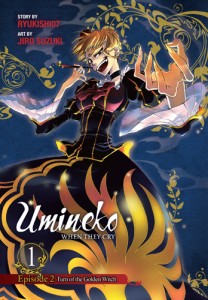
SEAN: Lastly, Umineko: When They Cry (the ‘they’ in this case being Seagulls, not Cicadas) starts its second arc, which is where things really begin to get very, very meta, if I recall correctly. Plus you have to love that insane grin on the cover.

Anything that you’d risk exposing to Canadian Customs?

Filed Under: FEATURES, manga the week of

Laughing at monsters

May 16, 2013 by Brigid Alverson

Lissa Pattillo looks over last week’s new manga in her latest On the Shelf column at Otaku USA.

Lori Henderson talks about Kodansha’s publication of some older Del Rey titles and reviews the manhwa 13th Boy in her latest Manga Dome podcast at Manga Xanadu.

Erica Friedman, who was my roommate at TCAF, files her con report, which is filled with manga encounters of various kinds, including going to the Chromatic Press event on Friday night. Erica also has a fresh edition of Yuri Network News for us.

Also at TCAF, PictureBox announced plans to publish an anthology titled Massive: Gay Erotic Manga and the Men Who Make It. The book is scheduled for a spring 2014 release.

How do we manage to laugh even in the worst of times? Tony Yao looks at humor in darkness in Attack on Titan at Manga Therapy.

The Digital Manga folks announce their plans for Fanime.

News from Japan: Lots of manga are winding up: The yuri series Aoi Hana is coming to an end in July.

Reviews

Connie on vol. 12 of 13th Boy (Slightly Biased Manga)
Connie on vol. 1 of Alice in the Country of Hearts (Slightly Biased Manga)
Justin on Alive (Organization Anti-Social Geniuses)
Ken H on Atomcat (Comics Should Be Good)
Justin and Manjiorin on vol. 4 of Attack on Titan (Organization Anti-Social Geniuses)
Ash Brown on vol. 21 of Blade of the Immortal (Experiments in Manga)
Connie on vol. 22 of Blade of the Immortal (Slightly Biased Manga)
John Rose on vol. 9 of Cage of Eden (The Fandom Post)
Justin on chapter 31 of Cross Manage (Organization Anti-Social Geniuses)
Lesley Aeschliman on vol. 6 of A Devil and Her Love Song (Blogcritics)
John Rose on vol. 3 of The Disappearance of Nagato Yuki-Chan (The Fandom Post)
Connie on vol. 2 of Excel Saga (Slightly Biased Manga)
Erica Friedman on Fu~Fu (Okazu)
Johanna Draper Carlson on vols. 1 and 2 of Happy-Go-Lucky Days (Comics Worth Reading)
Erica Friedman on Heart of Thomas (Okazu)
Erica Friedman on vol. 3 of Hoshikawa Ginza 4-Chome (Okazu)
Erica Friedman on vol. 7 of Ichigo Mashimaro (Okazu)
Kate O’Neil on vols. 3 and 4 of Loveless (omnibus edition) (The Fandom Post)
Sweetpea on Memories of Emanon (Organization Anti-Social Geniuses)
Lesley Aeschliman on vol. 11 of One Piece (Blogcritics)
Rebecca Silverman on vol. 8 of Sailor Moon (ANN)
Kristin on vols. 26-28 of Slam Dunk (Comic Attack)
Connie on vol. 6 of The Story of Saiunkoku (Slightly Biased Manga)
Connie on Tokyo Zombie, Grand Guignol Orchestra, and Reiko the Zombie Shop (Comics Should Be Good)
Justin on chapter 12 of World Trigger (Organization Anti-Social Geniuses)

Filed Under: MANGABLOG

New manga, license rescue, Sabrina sneak peeks

May 15, 2013 by Brigid Alverson

Here’s my look at the past week’s new manga at MTV Geek.

And here’s a manga-Sabrina hat trick: A preview of vol. 2 of the collected edition of Tania Del Rio’s manga-style comic (now rendered in beautiful black and white), an exclusive peek at the cover of vol. 3, and the five things you need to know to get started with this series.

The Manga Bookshelf bloggers discuss this week’s new manga and their Pick of the Week.

Lissa Pattillo notes that SuBLime is bringing back Crimson Spell and also that RightStuf is warning purchasers that Bond of Dream, Bond of Love may be seized by Canadian customs.

M. Alice LeGrow, creator of Bizenghast, has a new graphic novel out, and Crunchyroll gets a peek.

News from Japan: The Asahi Shimbun has a detailed rundown on the Osamu Tezuka Cultural Awards, including interviews with the judges and a look at the winners and competitors in each category. And the Kodansha Awards have also been announced; Makoto Raiku’s Animal Land won the prize for Best Children’s Manga. We had some hints of this and now it’s official: Gantz will come to an end after the next two chapters.

Reviews: Ash Brown looks back on a week in manga at Experiments in Manga. The Manga Bookshelf bloggers keep it concise in their latest set of Bookshelf Briefs.

John Rose on vol. 27 of Air Gear (The Fandom Post)
Jocelyne Allen on Bara Hiro no Ho no Koro (Brain Vs. Book)
Leroy Douresseaux on vol. 16 of Black Bird (The Comic Book Bin)
John Rose on vol. 13 of Black Butler (The Fandom Post)
Leroy Douresseaux on vol. 22 of Claymore (The Comic Book Bin)
Anna N. on vol. 12 of Dengeki Daisy (Manga Report)
Katherine Hanson on vol. 1 of Gakuen Polizi (Yuri no Boke)
Leroy Douresseaux on vol. 30 of Hunter x Hunter (The Comic Book Bin)
Kate O’Neil on vol. 30 of Hunter x Hunter (The Fandom Post)
Angela Eastman on vol. 4 of Jiu Jiu (The Fandom Post)
Leroy Douresseaux on vol. 17 of La Corda d’Oro (The Comic Book Bin)
Bob Temuka on Lone Wolf and Cub (Tearoom of Despair)
Lesley Aeschliman on vol. 7 of Naruto (Blogcritics)
Sean Gaffney on Negiho: Mahora Little Girls (A Case Suitable for Treatment)
Leroy Douresseaux on vol. 13 of Oresama Teacher (The Comic Book Bin)
Ash Brown on The Passion of Gengoroh Tagame: The Master of Gay Erotic Manga (Experiments in Manga)
Leroy Douresssaux on Pepito: Takehiko Inoue Meets Gaudi (I Reads You)
Matthew Warner on vol. 9 of Sailor Moon</a> (The Fandom Post)
Derek Bown on
this week’s issue of Shonen Jump (Manga Bookshelf)
Ken H. on vol. 1 of Tiger & Bunny (Comics Should Be Good)
Leroy Douresseaux on vol. 16 of We Were There (The Comic Book Bin)
Kate O’Neil on vol. 16 of We Were There (The Fandom Post)
Sean Gaffney on vols. 1-3 of Zero’s Familiar (A Case Suitable for Treatment)

Filed Under: MANGABLOG

Dengeki Daisy, Vol. 12

May 14, 2013 by Anna N


Dengeki Daisy Volume 12 by Kyousuke Motomi

It occurred to me as I was reading volume 12 of Dengeki Daisy that more shoujo titles should feature yacht kidnappings as standard plot points. Think about it! Instead of evil male models, frenemies, and surprise fiances, there would be random kidnappings taking place on luxurious ships! Wouldn’t it lend a bit of excitement and suspense to most manga?

I enjoy Dengeki Daisy so much because it portrays a slightly unconventional romance with some elements of techno thriller action. As you might guess, volume 12 features a yacht kidnapping, as Teru and her hacker/school janitor/almost boyfriend Kurosaki team up with the rest of the Scooby Gang to rescue Rena from her evil fiance Morizono. They storm the party in a variety of disguises. Kurosaki pretends to be a clueless foreigner. Teru gets all dolled up and stages an elaborate and hilarious distraction by pretending to be Morizono’s spurned lover. Hasegawa disguises himself as a waiter. As the group secures Rena, Kurosaki stumbles across yet another hacking conspiracy. Akira’s presence is almost negligible, as Kurosaki works to foil the plan to sell the Jack Frost virus and encounters someone else from his past – a person who started the tragic actions that lead to the creation of the Jack Frost virus in the first place and the death of Teru’s brother.

Dengeki Daisy always manages to cover a wide variety of emotional scenes in an effortless way. There’s the fun caper of the team storming the yacht where Rena is held captive, followed by a celebration afterwards where Rena and Hasegawa start inching towards the development of a new relationship. Nothing is ever simply happy in Dengeki Daisy for long though, as Kurosaki is horribly affected with his encounter with the mysterious new hacker. Kurosaki is in many ways the exact opposite of the cool shoujo hero, and the level of vulnerability he displays to Teru shows the reader just how traumatized he is as well as how much he trusts her. They’re one of my favorite shoujo manga couples of all time, and each volume of the series tends to show a new aspect of their relationship. Even though each conspiracy tends to lead to yet another conspiracy and I am wondering why every hacker that shows up in this manga has long bangs, after twelve volumes of Dengeki Daisy I’m still looking forward to seeing what happens next.

Filed Under: REVIEWS Tagged With: a devil and her love song, Dengeki Daisy, shojo beat

Weekly Shonen Jump Recap: May 13, 2013

May 14, 2013 by Derek Bown 1 Comment

May 13 CoverThese past two weeks have been a bit strange for me. A few years ago Golden Week was like some kind of massive torture perpetrated against me by the Japanese people. How dare they take an entire week off and deprive me of my new manga chapters!?

Please keep in mind this is a comedically exaggerated representation of a much more immature me.

Jump forward to this year, and I found myself mostly unconcerned about there being no new manga chapters last week. I attribute it to being a lot busier than when I first started reading manga on a weekly basis. It almost felt like a bit of a relief not to have new chapters, though that I attribute mostly to the fact that I didn’t have to write up a recap. As much as I enjoy this, a break is nice every now and then. But, now we’re back and we won’t be off for the next several months. I’m pretty sure there’s a week or two during the summer that we don’t get new chapters, but the only extended break in Japan I’m aware of is closer towards Christmas and New Years.

Blue Exorcist Ch. 046
There was once a time when I would have raged at a chapter like this. I hated romantic drama, and to an extent I still do. In a way, I remind myself of a certain fictional manga artist, “But I don’t want to make it hard for my main character.” Thank goodness for perspective. There are certainly plenty of reasons to rage about this chapter, depending on one’s varying levels of shipping aptitude. But the main thing I took from this is that Shura is my perfect woman. Not because of her fashion sense, but because she just doesn’t give a crap. All this teenage romantic drama and the only thing she cares about is giving Yukio a hard time. Were she real I would ask her to marry me. Sadly, she is not, so I’ll just sit back and keep enjoying chapters like these.

Naruto Ch. 629
There are a few things I could go off on in this chapter. The first thing that really stuck out was the giant hole Obito now has in him. But I was able to remember that part of his body is actually made up of a Zetsu clone. So chances are, he can survive with a giant hole through his chest because that’s not actually part of his body.

What really got me going was the reveal of how Rin actually died. I’m going to go off on a slight tangent here, but one of the reasons I really like the series Fairy Tail is because it’s one of the only manga series that addresses the fact that “one can die for their loved ones and have said loved ones be okay with it” is a pretty arrogant conceit. The sacrifice is no less noble, but one should not approach it without the understanding that while your loved ones’ lives will be saved by your sacrifice, they will still be severely hurt by your death. Because they love you so much that they would rather they die and you live, and vice versa.

That being said, I don’t know what exactly was going through Rin’s mind when she decided to jump in front of Kakashi’s attack. Certainly she was sacrificing herself to prevent the Three Tails from going on a rampage in Konoha, but besides Obito’s word we have no proof that the higher ups in Konoha couldn’t have controlled the Three Tails somehow. In fact, the majority of this series is about how Jinchuriki can control their tailed beasts. Does Kirigakure have some special way of forcing her to go on a rampage? We don’t know, we’re never told that information. Perhaps she couldn’t control it because she wasn’t a Jinchuriki from birth? We don’t know. That crucial bit of information, upon which the validity of her sacrifice hinges, is never actually explained.

Naruto

We’re given the most bare bones explanation, and are expected to feel sad just because someone died for someone else. (Semi)Pro Tip for aspiring writers, if you’re considering a plot twist that will just make readers pause and ask, “Say wha?” and you don’t intend to explain it later, then perhaps you need to rethink what you are writing!

And if it wasn’t bad enough that the entire sacrifice is dubious at best—why in the world are we supposed to think that there is some kind of deep significance in Rin using Kakashi to commit suicide? “She decided to die at the hands of someone she loved in order to protect Konoha.” From that sentence alone her actions are portrayed as something meaningful. But instead all I can see is a poorly written character deciding that it was a good idea to force the person she loved to kill her!

Now we get to the relevance of my Fairy Tail tangent. If dying for others without understanding the pain the survivors go through is a bad enough sin, then forcing them to be the one to kill you—forcing them to live with that guilt—is the most selfish thing I can imagine. We barely know what Rin’s personality was like, besides her being a proto-Sakura, but already she’s probably the worst character in this entire series! I make no effort to hide that I think Naruto has some poorly written women. But it’s a testament to Kishimoto’s skill that he could take a character we’ve barely even met and make her the most despicable character in the entire series. And what’s worse, we’re supposed to like her for what she did. It doesn’t work like that! We’ve got an entire series worth of Kakashi feeling guilt over his comrades dying. This isn’t making Rin’s death seem noble or anything, rather it’s just compounding how awful she is.

And what gets me is that we’re supposed to think this is anything other than the most awful thing anyone could do to someone they love.That’s the impression I’m getting. Why can’t we have characters in this series that don’t make the worst decisions ever? Or at least don’t ask us to accept that their decisions are not the worst decisions ever. I still haven’t forgotten that Naruto told Sasuke they would die together! Why is nobody pointing out how stupid that plan is!?!

Mario One-Shot
Fortunately Mario was a lot more tolerable than Naruto was this week. It’s a fair shake at a more serious story, though it still has those little flaws in Kishimoto’s writing that always get to me. For one, why exactly does Mario apparently die at the end? I know he says he’s sick of the world or something, but that’s not exactly a good reason. And once again we’re supposed to accept the events of the manga without questioning it. The ending practically screams, “This is meaningful and touching, don’t you dare question it!” To which my only response is, “Now wait just one darn minute!”

Mario

I think, if nothing else, that is my biggest problem with Kishimoto’s writing—that he does things not supported by any kind of logic, and expects me to buy in unquestioningly. That may work for some authors but it doesn’t here, because I have far too many questions every time I read one of his pieces. He focuses far too much on the emotional aspect of the story without backing it up with logic. Considering I’m a fan of Doctor Who I can’t exactly complain about relying on emotion more than logic. However, there is a certain level of logic required for the emotion not to crumble under the weight of questions. Consider the logic the cake and the emotion the sweet, sweet frosting. Frosting tastes good on its own, but if you try and form it in the shape of a cake you better have a crap ton of frosting or it’s either going to collapse or be a much smaller cake. And ultimately it won’t be nearly as satisfying. A sweet little nothing, without the backing of more solid food.

One Piece Ch. 708
All this talk about cake has made me hungry, but sadly the next series is not Toriko, so that segue has been wasted this week. Still, One Piece was excellent again. By this chapter, Luffy’s attempts to hide his identity are pointless, though I will give him credit for not being the instigator of his unmasking. I expected him to be dumb enough to once again tell someone that he’s Luffy. But rather than pulling that joke for a second time, Oda gave him the benefit of the doubt and let him slip up only after someone else called him on his identity. I look forward to seeing how the C block fights turn out. By that point I imagine his identity will become general knowledge and everyone will be ganging up on him.

This chapter also featured the best segue from Luffy’s scene to the B block fight. It’s a simple thing, but it’s so well done in its simplicity that I can’t help but take a moment to appreciate it. The fight itself is moving into the final phase with some of the prominent fighters from last week being taken down, allowing us to focus on the true powerhouses for this fight. I imagine that we’ll have one more chapter before we’re down to the final two, which I’ll predict to be Bellamy and Bartolomeo.

Toriko Ch. 232
Toriko continues to prove that we really can’t know what will happen week to week. It defies my attempts to predict exactly what will happen. Characters dying that I didn’t expect, others turning out to be members of this mysterious third party… The fight seems pretty equal between the IGO and Gourmet Corp, but the only safe prediction I feel I can make is that both sides will be pretty much devastated after this war. And unless Toriko pulls himself together fast he’s going to lose this fight. And then Komatsu will become one of the rare male damsels in distress.

Toriko

Nisekoi Ch. 073
I really need to stop falling in love with manga characters. Rakku’s teacher is possibly the master troll, and supreme not-give-a-crap master. Once again I find that the only way I can review Nisekoi is by giving a detailed summary about what was funny in this chapter. Which would result in me recapping the entire chapter and just butchering the jokes. So instead, go read it if you haven’t. You’ll need to read the chapter from two weeks ago, since this is a direct continuation of that. In fact, Viz has the first three volumes as digital editions. Go pick those up.

Nisekoi

World Trigger Ch. 013
By this point my interest in World Trigger is null. I feel unfair writing a series off like that, but there really isn’t anything left for me to say. This is not a very engaging manga, and I can’t quite pinpoint why I’m not engaged by it. As a critic it’s been driving me mad. I should be able to point out why exactly something isn’t very good, but in this case I really can’t say anything but that this series is just dull. The premise was interesting at first, but the pacing has been atrocious (oh hey, that’s a specific right there!). It’s taken this long to come close to something even resembling a main focus, but by now it’s pointless. I’m already annoyed by this manga’s general lack of anything interesting to say. The fact that a missing piece has finally been inserted into the story doesn’t take away the fact that I’ve all ready seen how dull this story is.

Bleach Ch. 536
Well then, this chapter has an interesting panel in it. I won’t dwell on it, though it’s kind of hard not to, but am I the only one who noticed way more detail put into Masaki’s chest than I thought Shonen Jump allowed? Anyone else? Fine then, I guess I’m just a pervert, but I swear that’s way more detail in the nudity than I thought was allowed.

By now I think it’s pretty clear that Katagiri is Uryu’s mother, or if she isn’t then we’ve been pointlessly mislead. The rest of the chapter prefers to show rather than tell, but since the important part has been shown already I can let it pass. Now all we need to do is sit back and wait to see how much Masaki’s death will be retconned. My prediction, given the general tone of this arc, is that Masaki’s death will actually be because of the militant Quincy faction.

Cross Manage Ch. 032
This week was not quite as strong as the chapter two weeks ago, but it was still very strong. Sakurai and the rest of the team’s despair over how outmatched they are by Chihara is very well portrayed. Personally I would have loved if we’d gotten another twist at the end of the chapter with Komatsu stopping Chihara’s ball, but what we did get was still very solid. By this point I’m pretty certain the Fujioka team will be defeated. It’ll be another loss to mirror their first loss against Chouran. Except this time we actually get to see the game, and the loss comes after many chapters of training and character development. It’s actually a really clever move. Show the standard loss that every sports story needs early on, and then move forward as if still following the formula. By this point the tropes had been matched and I imagine more than a few were thinking Fujioka had a chance against Chouran. By having them actually lose this match, the first loss was a decoy to give the actual important loss that much more of an impact. I imagine next chapter Misora will rally her team together and they’ll fight back, but ultimately I expect them to lose.

Really it all depends on whether the series will continue or not. If it’s being cancelled this would be a good time to have them pull themselves together and win the game. It would be satisfying, after what we’ve gotten so far, but not nearly as good as what they could do if they lose this match and the series keeps going. Considering how good Cross Mangage has been the past few months I would be surprised if it was cancelled. There are worse series in Jump that need to go away well before this one disappears. So I hope we get the more satisfying, long term story, but either way what we’ve gotten so far has been amazing.

Cross Manage

One-Punch Man Ch. 016
One-Punch Man is always good, but sometimes it’s just a little less good than others. The past few weeks have been a bit iffy as far as this manga is concerned. Still good, but not amazing. This week was back to amazing. We go back to the same old joke, but at the same time we get an absolutely awesome color page at the end of the chapter. I had to zoom in real close to determine if the background was just a picture of a sunset, or if it was an actual painting. I’m pretty sure it was a painting, but I could be wrong.

The fact that Saitama barely passed the Hero exam was amusing, especially considering how his full score on the physical test barely represents his actual abilities. He could easily beat Genos, who got a full score on both the physical and the written portion of the exams. It really begs the question, what is more important to a hero? Strength? Or brains? Well, in this case I’d definitely say strength is the most important aspect. Since Saitama can take down any hero, he just needs to study a bit more for the written portion.

Dragon Ball Z Ch. 014
Has it really been fourteen chapters? And here I was thinking not much had happened at all. I used to defend the Dragon Ball Z manga as being much faster paced than the anime, which it is, but I apparently gave it a tad more credit than it deserved. And still, somehow this manga manages to hit the butter zone for what I like in manga pacing. I can’t stand it when it’s too fast, I can’t stand it when it’s too slow, it has to be just right. And while Dragon Ball Z errs on the side of too slow, it’s still much better paced than a good chunk of the manga we’ve seen come and go since Weekly Shonen Jump Alpha started.

The one thing that always bugged me about Dragon Ball in general was how nonchalant the characters were about cutting off Saiyan tails. Sometimes they just popped right off, with no sharp implements needed. I can’t exactly speak for the characters, but I’m pretty sure that if I grew up with a tail I would be more than a little peeved when it got cut off. I probably wouldn’t even know how to properly balance. Because, as I’m sure we all know, animals with tails use them to help maintain their balance. We humans, and most apes, don’t need them thanks to our vestibular system. Though, when it comes to upright balance we’ve got the rest of the apes beaten. Any animal that has a tail generally has it in order to maintain their balance. And without said tail balance would become much more difficult. Unless of course the Saiyans have the same kind of internal balancing system we have, in which case them having tails would be an evolutionary goof.

Why, it’s almost like Toriyama was some kind of comic book artist, and not an expert in biology at all.

Still, I think the characters are cooler with their tails and I don’t get why Toriyama kept cutting them off. It would have been awesome to see them learn how to control their monkey forms. Probably would have taken the series in a completely different direction. Spiky blonde haired, blue eyed martial artists beating each other up, or giant monkeys doing the same thing? Hmmm…


Bit of a long one this week, sorry about that. But, considering we didn’t have anything to discuss last week I think I can get away with a double length review this week. So, anyone getting sick of my Naruto bashing? Or perhaps do you agree? Leave your feedback in the comment section.

If you want to hear more, check out the Manga^3 Podcast Archives. Or go directly to last two episodes, Episode 046 – April 29, 2013 – Manga Endings | Medaka Box, and, Special 002 – May 6, 2013 – Where the $%#! Is My Manga!? – A Discussion of Golden Week | Toriko Vol. 4

Filed Under: FEATURES & REVIEWS, REVIEWS, Weekly Features, WSJA Recaps

It Came from the Sinosphere: The Wushe Incident

May 14, 2013 by Sara K. 3 Comments

A Seediq warrior throws a weapon, with his cape billowing up to his right.

Practically everybody in Taiwan knows about Seediq Bale, the most expensive Taiwanese movie ever made. During my entire time in Taiwan, not a single other movie, Taiwanese or not, has made as much of a stir as that one. What few people know is that it was adapted from a manhua, The Wushe Incident (台灣第一部霧社事件歷史漫畫), which is gratefully back in print thanks to the success of the movie.

The Story

Deep in the central mountains of Taiwan, 1930, the Japanese relentlessly inflict suffering on the Seediq people. Many young Seediq men are anxious to strike back at the Japanese, but their leader, Mona Rudao, stops them, and always placates the Japanese whenever a young Seediq man loses his temper. Of course, Mona Rudao himself hates the Japanese, as they killed his father, ruined his sister’s life, and continue to exploit his people. However, Mona Rudao has also travelled to Japan, and personally witnessed just how powerful the Japanese military is, so he dares not provoke the Japanese … before there is a good opportunity.

Background

If I had to sum up Taiwan in two words, those two words would be “mountain island.” Those two words alone explain a great deal about Taiwanese culture, history, politics, geography, agriculture, economy, weather, etc.

For example, Taiwan is difficult to conquer/unify because it’s a mountain island. That’s why the indigenous peoples speak over 20 different languages – travel was so difficult that most people would never went far from their birthplace.

During my various trips to Taiwan’s mountains, when I didn’t have to deal with road closures, landslides, fog so thick that the driver can’t see more than a meter or two ahead, buses that got cancelled because the road collapsed, etc., I was lucky. To read about the condition of what until recently was one of Taiwan’s most important mountain roads, click here. Right now, I reckon at least half of the major mountain roads in Taiwan are closed or have major obstruction, and there hasn’t even been a typhoon recently. This is why Taiwan has been politically united for less than a hundred years.

Conifers and high-mountain grasses are cloaked in lots of fog.

I took this photo near Wushe, where the story takes place.

Astonishingly, some of the “Japanese” mountain trails are still intact. I’ve been on a couple sections of the former Japanese Hehuanshan trail, which is one of the trails used by the Japanese to send reinforcements to Wushe. Along the trail there are the remains of Japanese police stations, schools to teach the indigenous children how to be more Japanese, and the graves of Japanese police/soldiers who died along the trail (most of them were killed by Mother Nature). Here is a description of an epic Japanese mountain trail running through Taiwan.

The manhua starts with a set of detailed color drawings showing various scenes of Seediq life.

The manhua starts with a set of detailed color drawings showing various scenes of Seediq life.

The creator of the manhua, Qiu Ruolong, got stranded in Wushe (which is near Wuling pass, Taiwan’s highest mountain pass which is car-accessible – though I personally wouldn’t want to drive through it) when his vehicle broke down. While he was stuck in Wushe, he stayed with the local Seediq people, who gradually shared their history with him. This is how he first learned of the Wushe incident, and it fascinated him so much that he did more and more research – for example, he spent six months sewing traditional Seediq clothing. Eventually, he made this manhua.

The Wushe incident is historically significant as the last act of armed resistance to Japanese rule in Taiwan.

The Artwork

I love it.

A page depicting high-mountain scenery.

First of all, Qiu Ruolong manages to capture a bit of the majesty of Taiwan’s high mountains. Just flipping through the pages brings up memories of my trips to the mountains.

It’s not just that he draws spectacular scenery – he populates it with the characters, making both the people and the scenery look solemn and magnificent.

Seediq men carry logs on the left side, while a river flows from a high mountain on the right side.

Sometimes, I just have stop and let my eyes rest on a page for a while.

Mona Ludao walks through a forest as sunlight comes through.

I love that halo of light around Mona Ludao as he walks through the dark forest, as the diagonal rays of sunlight frame him from above.

Which brings me to another point – Qiu Ruolong is great a compostion.

wushe09

Take this page, for example. Here, Qiu Ruolong explains the way the Japanese treated Seediq women. These two pages can be split into about four parts – in the top-right, we see the Seediq women in their native village before any Japanese men bother them, in the bottom-right, we see the Seediq woman marrying the Japanese man and adopting a Japanese hairstyle (she does not look overjoyed), in the top-left we see the Japanese husband beating her, and in the bottom-left we see the Seediq woman weeping, isolated in the midst of Japanese architecture. Notice that the last section is the biggest, and the image of the weeping woman is the single biggest thing on these two pages. That makes that the center of this scene, and all of the other, smaller drawings are supports which explain the existence of this central image.

In the picture below, notice how all of the Seediq warriors with their backs facing the reader circle around Mona Rudao, whose front faces the reader.

wushe11

And in this picture (below), notice how the simple image of the stare, surrounding by black, contrasts with the detailed drawings around it.

wushe05

Qiu Rulong is a master of drawing violence. The way the Seediq warriors chop off Japanese heads is both silent and chilling.

wushe12

However, possibly the best part of the artwork is he really brings the Seediq people (and to a lesser extent the Japanese people) to life. This is partially because the drawings are so detailed, but it’s mainly because he puts a human in every figure.

Seediq people dance at a wedding.

This is How You Make a Historical Graphic Novel

One of my biggest criticisms of In the Fires of 2/28 is that it didn’t focus on any specific characters, so it didn’t make the historical events feel personal. Qiu Ruolong does not make this mistake. While he often goes into digressions about Seediq life, historical background, etc., he centers the story around Mona Rudao and his family. Watching their personal journeys makes the story that much more powerful.

wushe04

That said, I would have liked to have seen a bit more about the Seediq characters who adopted a Japanese lifestyle. The graphic novel shows just enough about them to intrigue me.

Exploited Resource vs. Sovereign Agent

While the Japanese did various bad things to the Seediq people, all of the awful behavior stems from a single root – the Japanese regarded the Seediq people as a resource to be exploited, not as agents with which one should establish mutually beneficial relationships. Some people would phrase this as “the Japanese did not see the Seediq as fully human.” which would be accurate … but I’d like to emphasize that the Japanese had the exact same attitude towards the Seediq people as they did to the other “resources” in the mountains. For example, the Japanese saw the mountain forests as a way to make money quickly (that was one of the main reasons the Japanese wanted to control the mountains), rather than as an ecosystem to steward and preserve.

wushe03

The Seediq people knew that the Japanese were treating them as objects, not as agents. They could feel it. The Japanese were constantly rubbing it in. And passively accepting it was destroying their psyche.

The graphic novel does an excellent job of getting the readers to understand why the Seediq act as they do. First, the manhua patiently describes humiliation and humiliation suffered by the Seediq at the hands of the Japanese, making the reader angry. The worst is when the Seediq have to bow their heads and plead for forgiveness from the Japanese, even when it was the Japanese whose behavior was wrong. It’s like a rubber band slowly being stretched until it … snaps.

wushe14

The Seediq knew that they were not strong enough to drive out the Japanese and restore their independence. But they felt they had to attack anyway. They had to prove to the Japanese, and to themselves, that they have some agency, and that they could not be oppressed without consequences. Suicidal action which proved they still had some power was better than powerlessly submitting to the Japanese.

Availability in English

This manhua is totally unavailable in English. And that’s a shame. This is a downright excellent graphic novel, and it’s only about 300 pages long – would somebody please publish it in English?

Conclusion

This manhua definitely exceeded my expectations. It brings out so many feelings … from relatively benign nostalgia of my trips to the mountains, to the horror of the humiliation and violence, to passionate desire of the Seediq people to assert power over their lives.

Though the Seediq did not drive out the Japanese, they did shatter the Japanese perception that they were just passive objects to be used however the Japanese pleased. And today, the Japanese are long gone, while the Seediq are still there.

This manhua would not have been possible, or at least not as good, without Qiu Ruolong’s passion for the subject. I know the film Seediq Bale has been criticized for historical and cultural inaccuracies, and I cannot judge to what extent this manhua is or is not accurate. Accurate or not, it is clearly something that Qiu Ruolong cares about deeply.

Next Time: Khóohái Lúsînliông (TV show)


Sara K. has had far more fantasies about living in the mountains that living by the beach. She is upholding the San Francisco tradition of disliking beaches (the beaches in San Francisco are at best unpleasant, and at worst life-threateningly dangerous). She is no doubt also influenced by her family – her father, who was born and raised in southern Florida, also has a distaste for beaches, as does her mother, who grew up on the coast of the Mediterranean. That said, it is still good for her to go to beach instead of the mountain once in a while. Heck, last week she went *swimming* for the first time in over five years.

Filed Under: It Came From the Sinosphere Tagged With: manhua, Seediq Bale, taiwan

  • « Go to Previous Page
  • Page 1
  • Interim pages omitted …
  • Page 672
  • Page 673
  • Page 674
  • Page 675
  • Page 676
  • Interim pages omitted …
  • Page 1048
  • Go to Next Page »
 | Log in
Copyright © 2010 Manga Bookshelf | Powered by WordPress & the Genesis Framework