• Skip to primary navigation
  • Skip to main content
  • Skip to primary sidebar
  • Home
  • About Us
    • Privacy Policy
    • Comment Policy
    • Disclosures & Disclaimers
  • Resources
    • Links, Essays & Articles
    • Fandomology!
    • CLAMP Directory
    • BlogRoll
  • Features & Columns
    • 3 Things Thursday
    • Adventures in the Key of Shoujo
    • Bit & Blips (game reviews)
    • BL BOOKRACK
    • Bookshelf Briefs
    • Bringing the Drama
    • Comic Conversion
    • Fanservice Friday
    • Going Digital
    • It Came From the Sinosphere
    • License This!
    • Magazine no Mori
    • My Week in Manga
    • OFF THE SHELF
    • Not By Manga Alone
    • PICK OF THE WEEK
    • Subtitles & Sensibility
    • Weekly Shonen Jump Recaps
  • Manga Moveable Feast
    • MMF Full Archive
    • Yun Kouga
    • CLAMP
    • Shojo Beat
    • Osamu Tezuka
    • Sailor Moon
    • Fruits Basket
    • Takehiko Inoue
    • Wild Adapter
    • One Piece
    • After School Nightmare
    • Karakuri Odette
    • Paradise Kiss
    • The Color Trilogy
    • To Terra…
    • Sexy Voice & Robo
  • Browse by Author
    • Sean Gaffney
    • Anna Neatrour
    • Michelle Smith
    • Katherine Dacey
    • MJ
    • Brigid Alverson
    • Travis Anderson
    • Phillip Anthony
    • Derek Bown
    • Jaci Dahlvang
    • Angela Eastman
    • Erica Friedman
    • Sara K.
    • Megan Purdy
    • Emily Snodgrass
    • Nancy Thistlethwaite
    • Eva Volin
    • David Welsh
  • MB Blogs
    • A Case Suitable For Treatment
    • Experiments in Manga
    • MangaBlog
    • The Manga Critic
    • Manga Report
    • Soliloquy in Blue
    • Manga Curmudgeon (archive)

Manga Bookshelf

Discussion, Resources, Roundtables, & Reviews

Blog

Random Musings: Spotlight on Masaichi Mukaide

August 22, 2014 by Ash Brown

Star Reach, Issue 7

Star Reach #7

While reading Comics: A Global History, 1968 to the Present, I encountered a single sentence that particularly caught my attention: “Star Reach was also notable for printing the first Japanese comics to be translated into English, two short pieces by Masaichi Mukaide; the style displayed was not characteristically Japanese, however, and failed to ignite any further interest in importing manga for the time being.”

Masaichi Mukaide. Though at that point I was unfamiliar with Star Reach, I was pretty sure that I had come across Mukaide’s name somewhere before. And so I decided to investigate.

Star Reach was an influential independent American comics anthology that focused on science fiction and fantasy stories. Mike Friedrich, who was once an editor and writer at both DC Comics and Marvel, established his own press in order publish Star Reach, which began in 1974. In 1978, he also started to release Star Reach‘s sister publication Imagine. At one point or another, both of those magazines included short works by Mukaide. Some of the comics were entirely his own creation while others were collaborations with different writers, both Japanese and American–notably Lee Marrs and Steven Grant. The first of Mukaide’s comics to appear in English, “The Bushi,” was written by Satoshi Hirota and was published in the seventh issue of Star Reach January 1977.

In an interview with Friedrich included in the Star Reach Companion, Richard Arndt asked how it came about that Star Reach published the first manga to appear in America. Friedrich replied:

I’ve never met the Japanese artist I published, although we did present a fair amount of his work. Oddly enough, he’s not a comic book artist in Japan. He was basically a fan artist over there. He could not make his living as an artist in Japan because his work was considered too American! If you look at it now, it was probably the first combination of manga and American comics. His work didn’t quite fit anywhere. But, yeah, there’s a book, Manga! Manga!, which certifies that the first appearance of manga in the United States was in Star Reach. I had no idea that was true.

Well, it turns out that technically isn’t true–Ryan Sands has noted that a 1971 issue of Concerned Theatre Japan included three short manga in translation–but for all intents and purposes, Mukaide’s work was the first exposure that the average comics reader in the United States had to manga.

Try as I might, I’ve been unable to find very much information about Mukaide himself. The best clue that I’ve discovered comes from Friedrich’s editor’s note accompanying Star Reach #18, the magazine’s final issue:

A friend of Masaichi Mukaide dropped by the other day and I found out a bit more about our distant Japanese contributor. He’s a law school graduate who opted out of a legal career to enter the publishing world and keep up his art. His wife is also an artist, working on the local comics (I believe I was told).

However, that’s not the last that was seen of Mukaide in English. Sometime between 1980 and 1982 a volume simply called Manga was released. (ISBN 4946427015 for those who are interested in trying to track down a copy.) This collection is the reason that Mukaide’s name seemed familiar to me–his comic, “The Promise,” concludes the volume. He was also the editor of the collection. Looking more closely at Manga‘s credits, there are also some other names that I now recognize: Friedrich served as the consulting editor, Hirota was the associate editor, and Marrs was a contributing writer.

Manga was one of the first collections deliberately crafted in order to introduce Japanese comics to Western audiences: “Our purpose in publishing Manga is to give the non-Japanese reading public a visual taste of Japan and the creative talents that exist there. Nothing would give us greater pleasure, however, if in doing so we are able to boost the cultural understanding in the west about Japan.”

The Bushi

“The Bushi”

As already mentioned, the first work by Mukaide to appear in English was “The Bushi,” which was written by Satoshi Hirota. Were it not for the historical Japanese setting, there is very little to indicate that the creators themselves were also Japanese. Mukaide’s artwork is not all that different from many of the other comics found in Star Reach. The story is set during the tumultuous time between the age of myth and legends and the age of humans. A young warrior confronts and battles with a demon, seeking revenge for the slaughter of his family, only to become a demon himself.

“The Spider Thread” is based on the well-known short story “The Spider’s Thread” written by Ryūnosuke Akutagawa in 1918. In it, a sinner is given the chance to escape hell because he once saved the life of a spider–the only good deed that he ever committed. However, Mukaide gives his own little twist to the tale at the end of the comic. Considering the seriousness and drama of the story–it almost entirely takes place among the tortured souls in hell–the final panel is surprisingly humorous, turning the comic into a joke. “The Spider Thread” also contains what is probably my favorite single page composed by Mukaide.

Mukaide’s first collaboration with writer Lee Marrs, “The Awakening of Tamaki,” was apparently intended to be the start of a series which would follow the trials of a young woman named Tamaki. After her family is killed, Tamaki is raised in seclusion by her sole-surviving uncle. When he dies as well she must make her own way in the world, disguised as a boy for the sake of her safety. Thanks to her uncle’s training, Tamaki is an excellent swordswoman with exceptional moral strength. As far as I know, there were never any more installments in the series, which is a shame; I really liked the comic.

The Spider Thread

“The Spider Thread”

“The Mission” was Mukaide’s second collaboration with Marrs. Whereas I was very fond of “The Awakening of Tamaki,” “The Mission” is probably my least favorite of Mukaide’s comics in English. It seems like it should be a something that I would enjoy, but it just didn’t grab me. Despite the numerous twists and turns the story takes within its few pages, despite the lies and betrayals, despite the quick pace and all of the action and fighting, for some reason “The Mission” simply strikes me as somewhat generic ninja adventure. Ninja doesn’t even have a name; he’s just Ninja.

When compared to the rest of Mukaide’s English-language comics,  the two-paged “Salvation” stands out because the artwork and story is so simple. Backgrounds are almost nonexistent and the shading and detail of the illustrations are limited as well. The story follows a drunkard who keeps getting kicked out of drinking establishments. He causes a panic by claiming that a doomsday flood is coming in order to sneak back into the bars after everyone else has fled. It’s an amusing and silly short comic that, like most of Mukaide’s other comics, has a bit of a twist at the end.

“The Soldier Who Guards the Gate of the City Freedom” is another two-paged comic by Mukaide, although it is more of a historical allegory instead of a humorous gag like “Salvation.” A young soldier, a man of honor, has the lonely duty of guarding the city gates. He does so willingly, though the eventual enemy attack is a long time in coming. Mukaide’s emphasis on the soldier’s loneliness is the key to the impact of the brief comic. The steady passage of time, too, is important. Mukaide captures this through the use of a very regular progression of narrow panels which are all of the exact same size.

“Crashing,” which was written by Steven Grant, is the only example of Mukaide’s work in the genre of science fiction. All of his other comics published in English are historical in nature, generally with touches of the fantastic. Mukaide’s artwork in “Crashing” is not at all dissimilar to American science fiction comics of the era. It’s a somewhat confusing story, but this is exceedingly appropriate as the comic’s protagonist has gone insane. Mukaide’s artwork supports this as well–the illustrations can be somewhat hallucinogenic and the page layouts are often fragmented.

The Awakening of Tamaki

“The Awakening of Tamaki”

“The Promise,” the last of Mukaide’s comics to be translated, is his rendition of the legend of the Yuki-onna, or the Snow Woman. Lafcadio Hearn’s telling of the story in Kwaidan is probably the version with which English-language audiences are most familiar. Mukaide’s tale incorporates many of the same elements as Hearn’s, but he adds his own touches as well. “The Promise” also shares some similarities with “The Bushi,” especially in style, although “The Promise” tends to be stronger overall. However, the two comics bookend Mukaide’s excursion into English particularly nicely because of their parallels.

After that, Mukaide seems to disappear. I have no idea what happened to him or if he’s even still creating comics. Perhaps he went back to working in law. Either way, a small corpus of Mukaide’s comics released in English in the late 1970s and early 1980s does exist. What particularly strikes me about these works are the changes and adjustments that he makes to his art style and page layouts to better suit each story being told. Although each comic is definitely its own work, there are some common elements as well. For example, his narratives and artwork frequently draw inspiration from traditional stories, tales, and legends. Interestingly, although many of his comics take place within a vaguely historical Japanese setting, he does not exclusively limit himself to Japanese sources. Instead, Mukaide’s work blends together both Eastern and Western influences, which seems oddly fitting for one of the first Japanese comics creators to be released in English.

Masaichi Mukaide Bibliography

  • “The Awakening of Tamaki” written by Lee Marrs and illustrated by Masaichi Mukaide (Imagine #4, October 1978)
  • “The Bushi” written by Satoshi Hirota and illustrated by Masaichi Mukaide (Star Reach #7, January 1977)
  • “Crashing” written by Steven Grant and illustrated by Masaichi Mukaide (Star Reach #18, October 1979)
  • “The Mission” written by Lee Marrs and illustrated by Masaichi Mukaide (Star Reach #15, December 1978)
  • “The Promise” written and illustrated by Masaichi Mukaide (Manga, 1980/1982?)
  • “Salvation” written and illustrated by Masaichi Mukaide (Imagine #6, June 1979)
  • “The Soldier Who Guards the Gate of the City Freedom” written and illustrated by Masaichi Mukaide (Star Reach #18, October 1979)
  • “The Spider Thread” written and illustrated by Masaichi Mukaide (Imagine #3, July 1978)
Salvation

“Salvation”

Further Reading
Comics: A Global History, 1968 to the Present by Dan Mazur and Alexander Danner
Early Manga: A Chronology by Ryan Sands
Incredible First-Ever Manga Translated in 1971 by Ryan Sands
Manga and Mega Comics by Jason Thompson
Manga in the USA by Michael Toole
My Life is Choked with Comics #19a: Manga by Joe McCulloch
My Life is Choked with Comics #19b: Manga by Joe McCulloch
Star Reach Companion by Richard Arndt

Filed Under: FEATURES Tagged With: comics, manga, Masaichi Mukaide

Manga the Week of 8/27

August 21, 2014 by Sean Gaffney, Michelle Smith, Ash Brown and Anna N Leave a Comment

SEAN: The final week of this brutal August, at least before we arrive at a brutal September with just as many books. Yen for once is being fairly quiet, but that’s all right, Kodansha’s here to pitch in.

Dark Horse brings us the 6th Blood Blockade Battlefront, blocked out by the brigand who brought us Brigun!… OK, Trigun. That sort of fell apart at the end there.

MICHELLE: *snerk*

hatsunemix

SEAN: There is also the Hatsune Miku Unofficial Hatsune Mix, a manga compilation about the Vocaloid personality.

Kodansha gives us the 13th Attack on Titan volume, which delves further into Historia’s background, and brings the action back to the Town – for better and worse.

Cage of Eden 15 will no doubt continue its descent into the pyramid of EVIL.

No. 8 is up to Vol. 6… um, I mean No. 6 is up to Vol. 8… guh. Ash, take over.

ASH: Indeed! No. 6 has reached its eighth, and penultimate volume. Also, as a bonus, Kodansha has included a 16-page color illustration gallery in this volume as a thanks to readers for supporting the series.

SEAN: Sankarea is also up to Vol. 8, and continues to try to answer the question “will this romantic harem comedy end with everyone brutally slaughtered?” Actually, that could apply to Cage of Eden as well.

No murders in Say “I Love You” yet, but plenty of teenage trauma and dealing with budding sexualities. Will things get lighter in Vol. 3?

MICHELLE: I look forward to finding out!

ANNA: Me too! this is the only manga I have my eye on this week, which should theoretically give me a chance to catch up with the many piles of unread manga I have stashed around my house.

SEAN: And The Wallflower 33, whose volume arrives a lot faster than 32, and yes, is still coming out in Japan with no signs of ending soon.

Vertical has the 3rd Cardfight!! Vanguard, in which I assume there will be fighting. With cards. And excessive punctuation.

sao2

Yen On brings us the second volume of the Sword Art Online novels. This does not pick up after the end of the first novel, but doubles back to introduce a few more regulars and tell some Aincrad short stories.

Fanservice Overload #1: the 7th volume of BTOOOM!, which still has people to blow up and cleavage to show off.

Fanservice Overload #2: The 2nd High School DxD, where a harem continues to form. Which, given this is a harem manga, is as it should be.

A brief interlude with the penultimate volume of the Melancholy of Haruhi Suzumiya manga. The novel is awaiting a new volume from its writer-blocked author, so the manga ends with Vol. 20 while we see if there will be any more. This, however, is merely Vol. 19, so expect a lot of Sasaki.

Fanservice Overload #3: Triage X Volume 7, which… what the hell is even HAPPENING on that cover?

MICHELLE: Yeah, these fanservice titles are so not for me.

SEAN: Will you be getting fanservice next week? (And honestly, Cage of Eden should be in there as well.) If not, what will you be checking out?

Filed Under: FEATURES, manga the week of

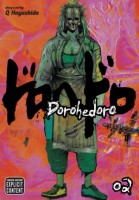
Dorohedoro, Vol. 13

August 21, 2014 by Sean Gaffney

By Q Hayashida. Released in Japan by Shogakukan, serialization ongoing in a Shogakukan magazine to be named later. Released in North America by Viz.

Most of the recent volumes of Dorohedoro have consisted of a lot of what readers are looking for with the series (gore, comedy, the odd gyoza mention) along with small dabs of plot and one big thing that everyone will remember after they finish the book. Last time it was Nikaido’s flashback, which was showing us how traumatized she was as a child and the circumstances that led to her use (and misuse) of her time magic. And I’m pretty sure that after Volume 13, everyone will be discussing what happens in the final moments with Kai and Natsuki. But let’s try to mention a few other things first.

dorohedoro13

Given the traumatic nature of what happens at the end of this volume, I knew we would have some humor in here somewhere, and a lot of it comes from seeing genderbent Nikaido, who has to disguise herself using magic to enter En’s mansion, now taken over by the Cross-Eyes. In her male body, she’s still her regular self, and is I believe what anime fans describe as a “keet”. This leads to more fun when she runs into Kai/Caiman, who is still having memory issues and has difficulty dealing with Nikaido being so informal. Particularly when the spell wears off and she transforms back into her buff, stacked, naked body in front of him. (This is a strong volume for fans of Dorohedoro’s fanservice – Nikaido fights as a man bare-chested for a while, and we also see Noi naked after her recovery.

Yes, Noi and Shin have been rescued from being mushroom’d at the end of the last volume. The fact that there’s yet another mysterious En family member with tremendous powers is played for laughs here – this man is able to become invisible, but does too good a job, so people forget he’s there after a while. She’s able to use smoke to heal Shin (via a full-on kiss, which I think startles Shin more than anything else) and they’re back in action. Actually, a great deal of this volume is the En family regrouping, and trying to resurrect their leader. Hasn’t happened yet, though.

And now let’s talk Natsuki. She’s been one of the most optimistic, hopeful and fun characters in the last few volumes, more of a mascot than a real threat. That changes here when a crisis shows off her repressed magic, which has almost godlike defensive capabilities. She’s delighted, but the rest of the cross-eyes are terrified – they know what Kai does to people with strong magic, and immediately plot to get her away from him. But in the end this is *not* particularly an optimistic, hopeful manga, and Natsuki is not one of the main characters. And thus, right before she leaves she runs into Kai, and gets brutally torn apart, in one of the goriest bits of the entire volume. And unlike En, I’m pretty sure she won’t be coming back. Kai is scary. I miss Caiman.

I expect the fallout from this will take up a chunk of Vol. 14, along with Nikaido’s continued practice of her magic and the search for En’s devil-shaped tumor. In the meantime, another fun yet brutal volume of Dorohedoro, which even in its most confusing moments still manages to be exhilarating through sheer verve.

Filed Under: REVIEWS

The World of the Shining Prince: Court Life in Ancient Japan

August 20, 2014 by Ash Brown

The World of the Shining PrinceAuthor: Ivan Morris
Publisher: Kodansha
ISBN: 9781568360294
Released: June 1994
Original release: 1964

Several years ago I read the entirety of The Tale of Genji, a novel written by Murasaki Shikibu in the eleventh century. It was a pretty big undertaking, but absolutely worth it. I love the novel. Ever since finishing The Tale of Genji for the first time, I’ve been meaning to read Ivan Morris’ The World of the Shining Prince: Court Life in Ancient Japan. The volume takes its title from the hero of The Tale of Genji who is referred to as the shining prince due to his exquisite visage and exceptional character. In many ways, The World of the Shining Prince serves as a companion to The Tale of Genji as Morris explores the historical reality of the aristocracy of Heian-era Japan. The World of the Shining Prince was originally published in 1964. Beginning in 1994, later editions of the work also include an introduction by Barbara Ruch. I recently read and was rather impressed by another of Morris’ works, The Nobility of Failure: Tragic Heroes in the History of Japan, and so was looking forward to reading The World of the Shining Prince even more.

In addition to the introductions, preface, appendices, bibliography, and topical index, The World of the Shining Prince examines a number of different aspects of tenth-century Japan, Heian court society, and The Tale of Genji within it ten chapters. Morris begins with a broad overview of the era in the first chapter, “The Heian Period.” Though the Heian Period lasted from 782 to 1167, The World of the Shining Prince largely, but not exclusively, focuses on the 900s. The next chapter, “The Setting” looks at Heian architecture, city planning, and geography. From there Morris delves into more detailed analysis of Heian culture in the chapters “Politics and Society,” “Religions,” and “Superstitions.” Next, attention is specifically turned to the Heian nobility and aristocracy. “The Good People and Their Lives” details day-to-day activities, amusements, and ceremonies while “The Cult of Beauty” looks at the particular aesthetics of the era. The eighth chapter, “The Women of Heian and their Relations with Men” outlines household and family structures as well as the place of romantic liaisons. The World of the Shining Prince concludes with chapters devoted to Murasaki Shikibu and to The Tale of Genji itself.

Although written more than five decades ago, The World of the Shining Prince has held up remarkably well. Admittedly, it is nearly impossible to write a completely objective cultural study–Morris’ analysis is informed and influenced by his own cultural subjectivity. In the half-century since The World of the Shining Prince was written, Western thought and scholarly approaches to cultural analysis have also changed. (For example, as Ruch mentions in her introduction, views on gender politics and the relationship between religion and superstition has shifted over the years.) The World of the Shining Prince is a product of its time, but that doesn’t at all diminish its value as a resource on Heian-era Japan, and more specifically on Japanese court life in the tenth century. Additionally, the volume is written with a general audience in mind. It is quite approachable, even for the average reader, and is engagingly written. Granted, the subject mater of The World of the Shining Prince is fascinating to being with.

Although Morris does provide some important general context within which he situates The World of the Shining Prince, the volume’s scope is relatively narrow, concentrating on a very specific part of Heian society. However, this specificity also allows him to explore that subject from several different perspectives. Information about the Heian Period is somewhat limited, especially in regards to the lower classes, which is another reason that The World of the Shining Prince is so focused on the era’s nobility. The Tale of Genji is a major source for Morris’ study of the Heian-era Japan, as are other works of contemporary literature–The Pillow Book of Sei Shōnagon especially features prominently–as well as diaries and court records from the time period. The World of the Shining Prince is an extremely informative and absorbing work. It’s more than just a companion to The Tale of Genji and reaches beyond its literary connections. The volume should appeal to anyone interested in learning more about classical  Japanese history.

Filed Under: REVIEWS Tagged With: Ivan Morris, kodansha, Kodansha International, Murasaki Shikibu, Nonfiction, Tale of Genji

My Love Story Giveaway Winner

August 19, 2014 by Anna N

I got some great lists of love stories in the comments to the My Love Story! giveaway. The winner according to Random.org is commenter #8, Dawn whose favorite love story is Amelie.

Filed Under: UNSHELVED

Pick of the Week: Arakawa & More

August 19, 2014 by MJ, Sean Gaffney, Ash Brown, Michelle Smith and Anna N 1 Comment

potsMJ: There isn’t a ton of manga I’m dying to buy this week, but enough that I did have to make a relatively difficult choice. In the end, I’ve embraced a favorite artist, even if it might not be the work I’m most interested in seeing from her–and that would be Hiromu Arakawa and her manga adaptation of The Heroic Legend of Arslan, debuting this week from Kodansha Comics. Since I love Arakawa’s storytelling at least as much as her art, it’s not giving me what I want most (*cough* Silver Spoon *cough*) but I’ll take it.

SEAN: Looking forward to Arslan, but my heart, as ever, belongs to Dorohedoro. Though given the kind of manga it is, it’s possible that my heart may have already been removed. And used as a mask. Or in pies.

ASH: It may be a relatively quiet week for new manga but I’m still interested in quite a few of the releases–the most recent volume of Dorohedoro and the debut of The Heroic Legend of Arslan being only two of them. But my pick for the week is unquestionably Takako Shimura’s Wandering Son. In addition to being a lovely and sensitive story about identity and growing up, it’s also a series that is personally very meaningful to me.

MICHELLE: And I’ll bring it ’round again to Arslan. I haven’t read anything of Arakawa’s aside from Fullmetal Alchemist, so I’m interested to see what she’ll do with this story.

ANNA: The third volume of Gangsta. is coming out this week! I really enjoyed the first two volumes of this stylish and intriguing seinen title, and I’m hoping that the third volume delves into some additional back story about the main characters.

What looks good to you this week?

Filed Under: PICK OF THE WEEK

An updated look at Crunchyroll Manga

August 19, 2014 by Sean Gaffney

When I first looked at Crunchyroll’s new manga lineup back in October, it consisted of about 10 Kodansha titles, and its main purpose was essentially to be the Kodansha equivalent of Viz’s Jump – get the most popular titles out weekly to discourage scanlators. (Which has worked, to a degree – not necessarily for speed but for accuracy. I know a few Attack on Titan readers who wait for CR as it will be coherent.) Now, 10 months later, we have almost fifty different titles on the site. What’s been going on?

gto

Kodansha still has the largest presence on the site, and are still adding new titles that may interest the North American reader, such as the new Onizuka spinoff/continuation. It’s still predominately Shonen Magazine and its subsidiaries, but there has been an effort to add some seinen as well, notably the Morning title Investor Z. (By the way, not all of the licensing is through Kodansha – a large number of the titles on the site seem to be licensed via ‘Cork’, including the Anno ones. Investor Z is one of those.) Most of their titles are ongoing concerns – updated weekly or monthly as their Japanese fellows are. I do note A Town Where You Live has finished, but Vols. 1-11 still seem to be absent from the site – going backwards is not Kodansha’s priority.

buffalo

Moyoco Anno has agreed to let several of her more obscure titles be translated on Crunchyroll, from a variety of genres. Most originally ran in the josei magazine Feel Young in Japan, which her her primary outlet these days, though The Diary of Ochibi is a short one-pages that runs in a newspaper.

Then there’s the former heavy movers and shakers at JManga, all of whom are now involved with Crunchyroll to some degree. LEED Publishing, which is Takao Saito’s company, has put out four of its already finished volumes from JManga onto Crunchyroll, I suspect with the same translation. They’re good series, though. I particularly liked Doll. Shonen Gahosha has both old and new titles – Soredemo Machi wa Mawatteiru and Sun-Ken Rock are basically “license rescues” from JManga that are now on Crunchyroll – not a surprise given they’re both two of the companies more popular unlicensed in print titles – Sun-Ken Rock for its violent content, most likely, and Soredemo for its oddness. They also have Arpeggio of Blue Steel, which Seven Seas is releasing in print here, and Spirit Circle, which gives the appearance of being a fluffy comedy, but… isn’t.

insidemari

And then there’s Futabasha, which now has the 2nd most titles on the site thanks to a big push these past few months. Futabasha was the biggest player in JManga as well, but we’re not seeing any of the content that was on there in the past. These are mostly new, ongoing series that run in their main magazine, Manga Action, which it’s pushing for similar reasons to Kodansha. It’s a very different genre, though – Manga Action is seinen and it shows. Even the one title they have by a shoujo author is that author’s debut in a seinen market. As you can see by the cover image of Inside Mari, which is by the author of Flowers of Evil, there’s a lot more ‘sex and violence’ in Futabasha’s titles – a number of what I’d call ‘sex comedies’ and several violent murder mysteries. Futabasha doesn’t really have much shonen, which may be why they’ve always found it hard to grab a foothold in North America, but it’s good to see them making these titles available for curious readers.

The odd title out on this list is The Tenth Prism, licensed via Cork, which is actually a seinen Shogakukan title, running in Big Comic Spirits. It’s by the author of Firefighter Daigo of Company M, so the author isn’t unknown here. Sometimes with licensing subsidiaries you can see titles in places you’d never expect, which is certainly what I’m seeing here.

What can we see from this list, now that it’s so heavily expanded? Crunchyroll Manga is very much catering to male readers. Almost exclusively, I’d say. There’s only one or two titles on there that might be classed as shoujo, and Kodansha, for all that they’re adding Magazine titles, hasn’t put up any ongoing series from Nakayoshi or Betsufure. Futabasha has a shoujo magazine as well, but we’ve seen nothing from it. And the josei we’re seeing, via Moyoco Anno, is for the adult female reader. I’d like to see a few titles for younger female readers on here. Other than that, the main emphasis for most of these series is simulpub – get them out fast to beat the scanlators. It usually doesn’t beat them, as scanlators work from illegal raws released early, but it’s a better product, so the incentive is to wait.

Will Crunchyroll have expanded even more in 10 months time? And which of their newer titles is your favorite?

Filed Under: NEWS, UNSHELVED

Bookshelf Briefs 8/18/14

August 18, 2014 by Anna N, Sean Gaffney and Michelle Smith 1 Comment

This week, Sean, Anna, & Michelle look at recent releases from Viz Media and Seven Seas.

alice-nightmareAlice in the Country of Clover: Nightmare Trilogy, Vol. 1 | By QuinRose and Job | Seven Seas – Another month, another Alice book. This one has, as you may imagine, Nightmare as the love interest, and mostly delves into Alice being upset and angry that people are afraid of him, and trying to find ways to get them to see the real man. Who is still a giant loser at times, so he’s not helping. Also not helping is the art in this book, which is some of the weakest I’ve seen in the entire series. That does not bode well given this is the first of three. On the bright side, Joker shows up, continuing to force Alice to truly examine her heart and feelings (big sister doesn’t come into play here). There’s also some amusing humor, mostly at Nightmare’s expense. Still, in the end this is one of the weaker entries in the Alice books. – Sean Gaffney

blackrosealiceBlack Rose Alice, Vol. 1 | By Setona Mizushiro | Viz Media – If I were to tell you that this is a shoujo series about vampires, you might think that you’d know what to expect. It’s not, after all, a unique premise. Except that’s exactly what Black Rose Alice is: unique. Dimitri Lewandoski is an ambitious tenor in Vienna in 1908 when he is killed in an accident and ultimately brought back to life by a vampire master who has entrusted him with the procreation of the species. The horror and the “colonization” spur a personality shift in Dimitri, and by the end of the volume he’s striking a bargain that might reanimate the body of his true love, lifeless for a hundred years. That’s pretty strange stuff, and I haven’t even mentioned the bugs! Happily, it’s not too strange and when I finished the volume I was left with a profound sense of “What? That’s it?! I want more!” And that is perhaps the highest recommendation I can give. – Michelle Smith

nura22Nura: Rise of the Yokai Clan, Vol. 22 | By Hiroshi Shiibashi | Viz Media – We’ve just finished a major fight arc, and are about to head into what will be the final arc, so in a sense this is the last breather volume in the series. Like many breather volumes in shonen fighting series, it feels a bit out of place at times, with both heroes and villains putting all their ducks in a row. We do get to see an extensive battle between Nura and a priest who is upset at a forced sword going to an evil Ayakashi (it’s OK, Nura’s one of the GOOD evil Ayakashi), and an attempt on both sides to unite previously fractured clans. That said, Kana and the rest of the class’s presence has become token, and even Tsurara looks to be left behind for the big fight. Nura is starting to overstay its welcome, so it’s good it will be ending soon. – Sean Gaffney

oresamateacher16Oresama Teacher, Vol 16 | By Izumi Tsubaki | Viz Media – The evil student council in Oresama Teacher is generally surprisingly ineffective, sending agents one by one to take down the public morals club, only to find that the dimwitted delinquents in the public morals club end up befriending their enemy. Here we have more of an orchestrated campaign, as blackmail letters start arriving and picking off the public morals club one by one. Soon only Mafuyu and Hayasaka are left to battle things out with the return of their fiendish faculty mentor Saeki. I see troubled times ahead for Yui, as the wanna be ninja has joined his former masters. Oresama Teacher is always silly diverting fun that pays off for the reader. I was happy to see bancho and his pigeon make an appearance in this volume as well. This is the only long-running comedy series that has managed to hang on to my full attention, and I enjoy the ridiculous situations and occasional bursts of violence featured in each volume. – Anna N

toriko23Toriko, Vol. 23 | By Mitsutoshi Shimabukuro| Viz Media – It’s impressive how even in the middle of what is basically a fight between two opposing sides firing power attacks, Toriko can continue to be all about food. The one thing that gets our heroes to work together and take out the monster this time is hearing that the more damage it takes, the more delicious its flesh will taste. And of course there’s Komatsu, who was given ten minutes to make an antidote simpler to cook, took five minutes, then spent the rest of the time figuring out how to make it tastier. It’s no wonder he seems to have picked up another harem member, this one a nameless cook arriving with Setsuno. The way it deals with food makes Toriko a consistent fun title to read. – Sean Gaffney

Filed Under: Bookshelf Briefs

My Week in Manga: August 11-August 17, 2014

August 18, 2014 by Ash Brown

My News and Reviews

So, as I briefly mentioned in my anniversary post this morning, my partners and I very recently became parents. We all ended up spending most of last week at the hospital; needless to say I was a bit preoccupied. But everyone is happy, healthy, and at home now, so everything’s good. Thankfully, I already had a couple of posts typed up and ready to go. Otherwise, it would have been a very quiet week here at Experiments in Manga since I didn’t get much reading or writing done at all. (For some reason.)

Anyway, I did somehow manage to post two reviews last week! First up was Denise Schroeder’s wonderful, delightful, and charming short comic Before You Go. The review is the latest installment in my Year of Yuri monthly manga review project, which focuses on manga and other comics with lesbian and yuri elements. Also reviewed last week was Jamie Lynn Lano’s memoir The Princess of Tennis: My Year Working in Japan As an Assistant Manga Artist. It’s a very interesting and informative book about the manga industry and Japan. The book can currently be purchased through Sparkler Monthly’s Distro program.

Despite being rather busy last week, I did come across a few things online that made for interesting reading. At Manga Connection, Manjiorin wraps up her Swan review project. The fourth Manga Studies column at Comics forum has been posted, focusing on Ishiko Junzō and gekiga. Joe McCulloch has a piece on the early work of Ryōichi Ikegami at The Comics Journal. Mangabrog has a translation of a conversation between Usamaru Furuya and Inio Asano. Also highly recommended is Comics Alliance’s interview with Vertical’s Ed Chavez.

Quick Takes

Gangsta3Gangsta, Volume 3 by Kohske. As can probably be inferred from the cover, much of the third volume of Gangsta delves into the pasts of Nic and Worick, how they met, and their somewhat complicated relationship with each other. In the process more is revealed about the history of Ergastulum and the Twilights, too. Gangsta is a very violent series. Even when Nic and Worick were young they found themselves surrounded by death in a harsh environment of political turmoil. In the case of Nic, he was being kept by a mercenary group hired to act as bodyguards to Worick’s family; he’s done plenty of killing of his own. He apparently has always been somewhat terrifying. The beginnings of Nic and Worick’s exceptionally close connection are seen in this volume. Neither of them come from a good family situation, both of them are seen as socially unacceptable (Nic because he’s a Twilight, Worick because he’s a bastard son), and both of them are physically abused by those who should care about them. Though they get off to a rough start, the two broken young men are able to find some solace in each other’s company. Nic and Worick fascinate me; I’m glad to have gotten more of their backstory in the third volume. I’ve enjoyed Gangsta from the very beginning and continue to do so.

Love Full of ScarsLove Full of Scars by Psyche Delico. Okay. So, Love Full of Scars is a collection of utterly ridiculous and absurd boys’ love stories. The over-the-top humor certainly won’t be to every reader’s taste, but I loved the volume. Though I largely enjoyed all of the short manga included in Love Full of Scars, my favorite was probably the titular story. (It also happens to be the longest, with several chapters devoted to it and side stories of its own.) Kanda is a high school punk who has a crush on Uesaka, the school’s biggest badass. The problem is that every time Kanda tries to confess his feelings, he ends up picking a fight instead. Fortunately, Uesaka is able to see through all of Kanda’s posing. They’re both delinquents so more often than not communicating with their fists and punching each other in the face helps them to solve their differences. The sex in Love Full of Scars, when and if it actually happens, usually ends up being rather awkward and incredibly earnest at the same time. The stories in the collection generally avoid the stereotypical seme/uke dynamics of the boys’ love genre. There is also a bit of a fixation on facial and body hair. And, well, pubic hair, too, for that matter. (Granted, that’s mostly for the sake of gag.) The manga is rough, rude, and raunchy, but I found it to be highly amusing and entertaining.

Tonari no Seki-kunTonari no Seki-kun: The Master of Killing Time directed by Yūji Mutoh. The anime adaptation of Takuma Morishige’s manga series My Neighbor Seki had completely slipped under my radar until Vertical announced that it had licensed the manga. My curiosity was piqued, so I decided to watch the anime while waiting for the manga to be released. The anime was an absolute delight; I wish there was more! I’m definitely looking forward to reading the manga next year. The premise of the series is disarmingly simple. Yokoi and Seki sit next to each other in the back of their high school classroom. But instead of studying, Seki occupies himself at his desk in all sorts of ways, messing around with erasers, shogi pieces, knitting, and so on. The scenarios are actually all very imaginative, creative, and elaborate. Try as she might, Yokoi can’t help but be caught up whatever it is Seki is doing, so she doesn’t get much studying done, either. The anime is much more entertaining than I’ve probably made it sound. Each episode is under eight minutes and they are all very funny. There is very little dialogue in the series. Instead, the narrative relies very heavily on Yokoi’s internal monologue. Yokoi’s voice actress, Kana Hanazawa, does a fantastic job with the role–she is exceptionally dynamic and expressive.

Filed Under: FEATURES, My Week in Manga Tagged With: anime, Gangsta, Kohske, manga, My Neighbor Seki, Psyche Delico

Random Musings: Four Years of Experiments in Manga

August 18, 2014 by Ash Brown

I have been writing about manga, Japanese literature, and other related (and occasionally not-so-related) subjects here at Experiments in Manga for four years now. That’s…kind of incredible in its own small way. I don’t generally delve too deeply into my personal life on the blog, but this past year has been particularly momentous for me, and not just because I’ve managed to keep Experiments in Manga going for so long.

Over the last year or so, I’ve been doing all sorts of coming out both online and off. I’m very fortunate to be in a place in my life where I am able to be more open about who I am, and I’m probably the happiest that I have ever been because of it. My family, friends, and coworkers have all been amazingly supportive. I’m also currently a month into recovering from a major surgery that (without going into all of the gory details) has improved my quality of life tremendously. And a little less than a week ago I and my partners became parents. So, yeah, there have been some big changes in my life over the last year!

As for Experiments in Manga, there have been some changes here, too. Probably the most noteworthy is that Experiments in Manga joined the Manga Bookshelf family of blogs and has now been a part of that cohort for a year. In addition to keeping up with my writing at Experiments in Manga, I also regularly participate in Manga Bookshelf’s group posts. I’ve really enjoyed being a part of Manga Bookshelf and working more closely with other manga bloggers. It’s brought Experiments in Manga more readers and commenters, too, which for the most part has been a lot of fun.

After almost two years of effort, I was finally able to wrap up my Blade of the Immortal review project in November. It was a good and challenging experience for me, and one that I wanted to repeat. So I let Experiments in Manga’s readers pick which manga I would tackle next. In a few months I’ll be wrapping up my Year of Yuri monthly review project and once again I’ll be putting my next review project up for a vote. I also had a couple of smaller, informal review projects over the past year. Back in January I celebrated my very own “Usamaru Furuya Week” by reviewing everything of his available in English that I hadn’t already. And every weekend in March I reviewed a volume of Takehiko Inoue’s phenomenal manga Real. (Because March equals basketball, or something like that.)

Last year saw more queer content discussed at Experiments in Manga than ever before. It wasn’t entirely done intentionally (well, except for the Year of Yuri project), but I’ll admit that it did make me happy. Many of those posts, like my random musings on a lecture about queer theory, Japanese literature, and translation and my review of Jeffery Angles’ Writing the Love of Boys: Origins of Bishōnen Culture in Modernist Japanese Literature, have been some of my most popular, or at least most frequently visited. Gengoroh Tagame also appears to be a perennial favorite; quite a bit of interest continues to be shown in my Two from Tagame post, which looks at two of his manga released relatively recently in English: Endless Game and Gunji.

Actually, one of the posts that I was personally very satisfied with from last year, a Spotlight on Kaita Murayama, was also somewhat queer-related. In general, I’ve been writing more of these Random Musings features. I’ve really enjoyed working on these posts. They allow me to be a little more freeform and talk about things that aren’t necessarily suited for the format that I currently use for my in-depth reviews. Other non-reviews that haven’t yet been mentioned that I was particularly happy with or that were otherwise well received include my thoughts on TCAF 2014, tips on finding manga in libraries, and a list of some of the notable releases of 2013. I had never done one of these end-of-the-year lists before, but it was surprisingly fun, so I’ll most likely do it again.

As for the in-depth reviews from the last year that seemed to be especially popular, I was a little surprised to see the amount of interest shown in some of the nonfiction titles that I read, such as The Nobility of Failure: Tragic Heroes in the History of Japan and The Way of Taiko (both of which were great). My review of the omnibus of the Mobile Suit Gundam trilogy of novels received a fair amount of attention, too. The five manga reviews from the past year that were the most frequently visited included Saki Nakagawa’s Attack on Titan: Junior High, Volume 1, Shigeru Mizuki’s Kitaro, Torajiro Kishi’s Maka-Maka: Sex, Life, and Communication, Volume 1, Yuma Ando and Yuki Sato’s Sherlock Bones, Volume 1, and Makoto Yukimura’s Vinland Saga, Omnibus 1.

By this point I seem to have settled into a fairly predictable posting schedule at Experiments in Manga. Each week sees at least three or four posts, occasionally more if I have some sort of project going on or am feeling particularly inspired. I think I’ve said this every year so far, but I really would love to write more than I do. Sadly, my free time is very limited and from here on out (with the kidling and all) it will be even more so. Right now three to four posts a week still seems like it should be a reasonable and manageable pace for me, though.

I’ve said this every year, too, but as always I would like to extend my thanks and appreciation to all of the readers of Experiments in Manga, both new and old. I mostly write for myself, but it is extremely satisfying to know that Experiments in Manga is at least occasionally interesting or helpful to other people as well. There certainly is plenty of room for improvement–I know there are some things that I don’t do very well and need to work on–but generally I’ve been very happy with the continued evolution of Experiments in Manga and the general direction the site has been taking. Thank you all for your support over the last year. Here’s hoping that the next one will be even better!

Filed Under: UNSHELVED Tagged With: Experiments in Manga

  • « Go to Previous Page
  • Page 1
  • Interim pages omitted …
  • Page 598
  • Page 599
  • Page 600
  • Page 601
  • Page 602
  • Interim pages omitted …
  • Page 1054
  • Go to Next Page »
 | Log in
Copyright © 2010 Manga Bookshelf | Powered by WordPress & the Genesis Framework