• Skip to primary navigation
  • Skip to main content
  • Skip to primary sidebar
  • Home
  • About Us
    • Privacy Policy
    • Comment Policy
    • Disclosures & Disclaimers
  • Resources
    • Links, Essays & Articles
    • Fandomology!
    • CLAMP Directory
    • BlogRoll
  • Features & Columns
    • 3 Things Thursday
    • Adventures in the Key of Shoujo
    • Bit & Blips (game reviews)
    • BL BOOKRACK
    • Bookshelf Briefs
    • Bringing the Drama
    • Comic Conversion
    • Fanservice Friday
    • Going Digital
    • It Came From the Sinosphere
    • License This!
    • Magazine no Mori
    • My Week in Manga
    • OFF THE SHELF
    • Not By Manga Alone
    • PICK OF THE WEEK
    • Subtitles & Sensibility
    • Weekly Shonen Jump Recaps
  • Manga Moveable Feast
    • MMF Full Archive
    • Yun Kouga
    • CLAMP
    • Shojo Beat
    • Osamu Tezuka
    • Sailor Moon
    • Fruits Basket
    • Takehiko Inoue
    • Wild Adapter
    • One Piece
    • After School Nightmare
    • Karakuri Odette
    • Paradise Kiss
    • The Color Trilogy
    • To Terra…
    • Sexy Voice & Robo
  • Browse by Author
    • Sean Gaffney
    • Anna Neatrour
    • Michelle Smith
    • Katherine Dacey
    • MJ
    • Brigid Alverson
    • Travis Anderson
    • Phillip Anthony
    • Derek Bown
    • Jaci Dahlvang
    • Angela Eastman
    • Erica Friedman
    • Sara K.
    • Megan Purdy
    • Emily Snodgrass
    • Nancy Thistlethwaite
    • Eva Volin
    • David Welsh
  • MB Blogs
    • A Case Suitable For Treatment
    • Experiments in Manga
    • MangaBlog
    • The Manga Critic
    • Manga Report
    • Soliloquy in Blue
    • Manga Curmudgeon (archive)

Manga Bookshelf

Discussion, Resources, Roundtables, & Reviews

Blog

Emma, Vol. 4

May 3, 2016 by Sean Gaffney

By Kaoru Mori. Released in Japan in two separate volumes by Enterbrain, serialized in the magazine Comic Beam. Released in North America by Yen Press.

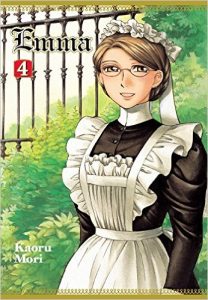
After the last omnibus proved to be quite depressing at times, it’s a relief to see that this new one contains a happy ending, of sorts. Given this is still an interclass relationship in Victorian England, of course, the definition of happy is a lot more repressed than you’d expect, but it works. I was somewhat relieved to see that Emma’s arranged abduction by Big Daddy Campbell was less ‘let’s have her murdered’ and more ‘let’s dump her far away from London and remind her she is merely a working-class girl’, something which Emma sadly takes to heart. Luckily, after a thorough search of all of England (the coincidences fly thick and fast in this volume, but I suspect Mori is well aware of how ridiculous it is – it feels Dickensian), William and Emma are reunited, he managed to break off his engagement to Eleanor (and also his family’s upward mobility, though hopefully that’s temporary), and Emma prepares to enter high society.
emma4

While things are mostly dramatic, there are moments of humor that serve to lighten the mood. Eleanor has been treated horribly by the narrative, and her emotional breakdown would be incredibly depressing were it not for the presence of Hakim’s identical triplet concubines doing their best “staaaaaaaaaaaaaaaaaaaare” at her. And the scene of Mrs. Jones, Mrs. Molders, and Emma trying to sort out the many and varied rules of etiquette, some of which contradict each other, is pure gold. That said, William and Emma’s romance is played with the utmost seriousness, and seeing her decked out in fine fashion at the end of the main story is breathtaking. Mori can draw, and it’s still one of the best reasons to get her works.

Emma proper ends here, but there were three volumes of side stories which were collected as well, and the first of these is the second half of this omnibus. We get to see a young Kelly Stownar and her long-dead husband when they were young just-barely-getting-by newlyweds, trying to save up to see the Great Exhibition, in a very sweet and touching chapter. Eleanor, having been exiled to Brighton as a disgrace by her evil father (presumably she is a disgrace for now being good enough to keep William Jones’ attention despite his being – ugh – a merchant), gets to meet a young student who turns out to have been William’s underclassman at school, and they bond, although I am pleased to see it doesn’t seem to be a rebound relationship – indeed, Eleanor seems to want to emulate him more than romance him. I also liked the chapter devoted to Tasha, the clumsy maid who befriended Emma, and her huge family that she goes home to visit.

Emma is always best when it evokes mood and shows us gorgeous things, and there’s a lot of that in this omnibus. And, of course, if you like William and Emma’s romance, you will be pleased as well. More side-stories follow in the final omnibus, including, I understand, an actual wedding, though it does take place several years after the main plot.

Filed Under: REVIEWS

Bookshelf Briefs 5/2/16

May 2, 2016 by Sean Gaffney and Michelle Smith Leave a Comment

dfrag8D-Frag!, Vol. 8 | By Tomoya Haruno | Seven Seas – I fear that this volume of D-Frag! is still on the island beach adventure, and it drags it out a bit too long, in my opinion. There are still some great gags—one of the all-girls’ school classmates being a clone of Oscar from Rose of Versailles led to some hilarious situations—but I am happy to be back at school in the end. As for the plot, we are reminded that this is still a group of kids who will compete in any competitive game, no matter how stupid or how embarrassing the consequences. (Well, except for poor Funabori, who’s simply an innocent bystander.) Even if they have to rewrite the rules as they go along, they will win. As for the supposed harem aspect, well, that’s mocked as much as everything else. Subpar, but still fun. – Sean Gaffney

sakamoto3Haven’t You Heard? I’m Sakamoto, Vol. 3 | By Nami Sano | Seven Seas – It was inevitable for someone who can draw people into his orbit as much as Sakamoto that he would invariably meet up against a real villain, and we’re introduced to one here: Fukase, a repeat offender who enjoys “erasing” popular kids from the school, and is now out to ruin Sakamoto as much as he can. Of course, Sakamoto is not defeated so easily, and that’s where most of the comedy comes in, as we see him taking on the typical athletic and cultural festivals and coming out on top. Fukase seems made of sterner stuff, though, and I suspect the fourth and final volume will amount to a big confrontation. Or maybe not; after all, this is a gag manga first and foremost. – Sean Gaffney

horimiya3Horimiya, Vol. 3 | By Hero and Daisuke Hagiwara | Yen Press – I genuinely anticipate and enjoy each new volume of this series. Miyamura and Hori are both incredibly likable, and I especially liked getting to see a different side of Miyamura in this installment, as he is reunited with a friend from middle school. Spending time with this crowd is lovely. But… I can’t help wanting the two leads to get together, already! I mean, they’re in that stage where they both kind of know that their feelings are mutual but they’re afraid to ruin their friendship and… argh! Why does it bother me when, say, Skip Beat!, still dragging things out for 30+ volumes, doesn’t? Perhaps it’s that their relationship is pretty much the sole focus of the thing. Maybe next volume they’ll either get together or find some career goals and I will be appeased. – Michelle Smith

sidonia15Knights of Sidonia, Vol. 15 | By Tsutomu Nihei | Vertical Comics – The final volume of Sidonia spends 3/4 of its time locked in a deadly final battle with the Gauna. Sacrifices are made, stuff blows up, and there is much shouting of orders and cool mecha things. As for our hero and surprise heroine, both try their hardest to sacrifice their lives for each other. But in the end, Nihei makes good on his promise that this was a bit less bleak and more hopeful than his other works, and we get what’s fairly close to a happy ending. I’ll admit I was somewhat confused at where we ended up, as the characters get even more genderfluid and speciesfluid than we’d seen before, but the ending—with Izana going to explore space, and Tanikaze staying behind to raise a family, is very sweet. -Sean Gaffney

Knights of Sidonia, Vol. 15 | By Tsutomu Nihei | Vertical, Inc. – I was pretty concerned when I learned Knights of Sidonia would end with the fifteenth volume. It just seemed like there wasn’t enough time to wrap things up in a satisfying way. However, I’m happy to report that, although it’s true some things feel rushed—man, would I have loved more time with the character who changes genders off-camera!—Nihei-sensei is able to impart sufficient epic scope to humanity’s final battle with the Gauna that I found the result downright cinematic. I especially appreciated that, because of what’s happened in the story up to this point, I didn’t feel as though a happy ending was guaranteed. I couldn’t recommend this series more highly. And if you’ve enjoyed it, don’t forget Vertical is releasing BLAME! starting in September! – Michelle Smith

loghorizon2Log Horizon: The West Wind Brigade, Vol. 2 | By Koyuki and Mamare Touno | Yen Press – There are still elements of a harem comedy to this, and the cover promises lots of T&A, but covers lie as always. What we get instead is a surprisingly dark examination of the emotions of those trapped in the game during the first book. This takes place in the middle of Shiroe and company’s trek to rescue Serara, and is adept at showing both the chaos that was going on in Akiba while they were away, and also the leadup to what’s going to happen with Hamelin in the second novel. As for Soujiro Seta, it’s not just his looks that keep the female guild members enamored of him—he can be quite scary when he wants to be, while also keeping an optimism that contrasts with the series’ new villain, Magus. – Sean Gaffney

pandora-urn4Pandora in the Crimson Shell: Ghost Urn, Vol. 4 | By Shirow Masamune and Rikudou Koushi | Seven Seas – I had assumed that the Kabapu cameo would be just that, but no, he’s got a much larger role in this new volume, even if he is now mysteriously a black man. Even more surprising is the appearance of Momochi, who is once again Kabapu’s capable secretary, but shows more emotion in two chapters than she did in 27 volumes of Excel Saga—perhaps working for a man like him has finally started to push her over the edge. So it’s not a must read for Excel Saga fans, but I think they’ll find it of more interest than the previous three. As for Vlind, she continues to have Excel’s personality and Elgala’s luck. If this sounds like I’m ignoring the rest of the manga, you are correct. – Sean Gaffney

yowamushi2Yowamushi Pedal, Vol. 2 | By Wataru Watanabe | Yen Press – Oh, sports manga. Why do you make me get all verklempt when the underdog surprises those who have underestimated him with a new technique? This second volume is comprised entirely of the first years’ welcome race, and it’s so fast-paced and addictive that I plowed through this chunky two-in-one omnibus in record time (which is fitting, I suppose). It’s too early for Onoda to win, of course, but he shows tremendous potential and impresses the older members of the bicycle racing club, whom it was great to get to know. I am extremely happy this series is 44 volumes and climbing in Japan, so I can continue to devour it for years to come. – Michelle Smith

Filed Under: Bookshelf Briefs

My Week in Manga: April 25-May 1, 2016

May 2, 2016 by Ash Brown

My News and Reviews

April has come to a close and May has begun, but there’s still a little time left to enter April’s manga giveaway for a chance to win a duo of superhero manga: Jiro Kuwata’s Batmanga, Volume 1 and Eiichi Shimizu and Tomohiro Shimoguchi’s Ultraman, Volume 1. In addition to the manga giveaway, I also snuck in my review of Setona Mizushiro’s After School Nightmare, Volume 9 last week. It’s a particularly dramatic volume in the series with some major twists and reveals. I’m very curious to see how Mizushiro will bring things to a close in the tenth and final volume. The review was part of my monthly horror manga review project, and I just barely got it written and posted before April ended. I’ve been super busy and stressed out lately, which makes writing even more difficult for me than it usually is. There are plenty of great and wonderful things going on right now in my life, but sadly the busyness and stress probably isn’t going anywhere anytime soon.

Quick Takes

Fairy Tail: Ice Trail, Volume 1Fairy Tail: Ice Trail, Volume 1 by Yuusuke Shirato. There have recently been several manga spin-offs of Hiro Mashima’s series Fairy Tail released, but Ice Trail is the first that I’ve read. (For that matter, I’ll have to admit that I’ve not actually read most of Fairy Tail proper.) What primarily interested me in Ice Trail is that it serves as an origin story for Gray Fullbuster, one of Fairy Tail‘s most popular characters (as well as one of my personal favorites). Gray is a badass ice mage with a tragic past and the propensity for walking around without a shirt. Ice Trail shows Gray’s childhood in the brief time between when his home village was destroyed and when he joined the Fairy Tail guild. Despite the cuteness of seeing Gray as a kid, Ice Trail is very reminiscent of Fairy Tail in both style and tone. Apparently the series is only two volumes long, which may partially explain why the manga moves along at a break-neck pace with one action-packed battle after another. Ice Trail can mostly stand on its own, but will likely be most appreciated by readers who are already familiar with Gray and with Fairy Tail as a whole—though not absolutely necessary, that additional context can be helpful.

Kiss Him, Not Me, Volume 2Kiss Him, Not Me!, Volume 2 by Junko. I do get a kick out of Kiss Him, Not Me! I was a little worried at first since the series’ plot essentially hinges on the heroine’s sudden and drastic weight loss to bring her to the romantic attention of four of the hottest guys at her school. However, the manga quickly moves on from that premise and I don’t think it was even referenced at all in the second volume. Instead, Kiss Him, Not Me! revels in its humor and the comedic situation of a fujoshi finding herself on the opposite side of her usual fantasies. Basically, Serinuma’s life has become an otome game in which numerous young men are vying for her favor. The second volume of Kiss Him, Not Me! primarily focuses on two events: the school festival, during which each of the guys has the opportunity to have a mini-date with Serinuma (with varying degrees of success), and the Winter Comiket, which they all attend together although Serinuma is by far the most enthusiastic about it. One of the things that I particularly appreciate about Kiss Him, Not Me! is that no one asks Serinuma to change who she is at heart—she still gets to be an otaku. The second volume also introduces a new character who greatly intrigues me.

A Silent Voice, Volume 4A Silent Voice, Volumes 4-6 by Yoshitoki Oima. One of the manga to debut last year that I found to be particularly notable was Oima’s A Silent Voice and it continues to be a series that greatly impresses me. It’s not necessarily an especially happy read, though. The manga realistically portrays teenage angst compounded by issues of disability and bullying and explores the accompanying relationships which are extraordinarily messy and complicated. Emotional and physical violence takes its toll not only on the people who are being directly targeted, but also on the people who surround them. For better and for worse, the characters are all trying to deal with the repercussions of their past mistakes as best as they can, and even those who come across as antagonistic generally have their own problems they are working through. Just how deep a wound bullying can leave and how it can literally change a person’s life is more fully expressed in these volumes, and frankly it’s devastating. Thankfully, there are still moments of hope and redemption so A Silent Voice, while very serious and at times emotionally wrenching, never seems to become overwhelmingly bleak, but sometimes it does get close.

Filed Under: FEATURES, My Week in Manga Tagged With: Fairy Tail, Junko, Kiss Him Not Me, manga, Silent Voice, Yoshitoki Oima, Yuusuke Shirato

Pick of the Week: May Flowers

May 2, 2016 by Michelle Smith, Sean Gaffney, Anna N, Ash Brown and MJ Leave a Comment

blancnoirMICHELLE: Regrettably, I’m not too excited about anything coming out next week. However, I am planning to check out the debut volume of The Heiress and Chauffeur, so I reckon I’ll make that my official pick this week.

SEAN: No question about it, Oresama Teacher is what has me excited this week. Its combination of hilarity, delinquency, and brainwashing (yes, really) has been a must read the last few volumes. Go get it.

ANNA: I also pick The Heiress and Chauffeur. I’m always curious about new shoujo, and the historical setting for this manga sounds appealing.

ASH: It’s a little bit of a cheat for me since my copy arrived last week and I already know how gorgeous it is, but my pick this week is for Takeshi Obata’s artbook blanc et noir. I’ve always enjoyed Obata’s artwork, so having an entire book devoted to it great and Viz has done a fantastic job with it.

MJ: Yes, yes, yes, I gotta go with Ash this week! I own Obata’s gorgeous Hikaru no Go artbook, and I’m incredibly excited about this new one. It’s blanc et noir for me!

Filed Under: PICK OF THE WEEK

The Heiress and the Chauffeur, Vol 1

May 1, 2016 by Anna N

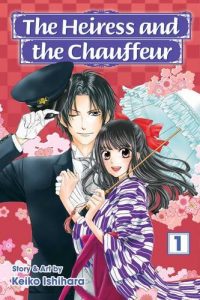
The Heiress and the Chauffeur, Volume 1 by Keiko Ishihara

It is interesting that there are a couple new two volume series (Shuriken and Pleats being the first) coming out from Shojo Beat now. I feel like publishes backed off super-short shoujo for a little bit in favor of mid-range 5 or 6 volume series. Heiress and the Chauffeur is a conventional shoujo series with attractive art that is livened up by a historical setting.

The heiress in question is Sayaka Yoshimura, who is the daughter of a wealthy family. Her chauffeur is Shinobu Narataki, and they were raised closely together as children, resulting in a friendship that is entirely unconventional for a mistress and her servant. Sayaka has to deal with the behavioral rules and rumors swirling at her all-girls school, while running a gauntlet of all her admiring classmates who enjoy staring at Shinobu while he patiently waits to pick her up. Sayaka has a bright, spunky personality and she isn’t afraid to stick up for Shinobu when his habit of barging in to rescue her gets them both in trouble with the school authorities.

heiresschauffeur1

I enjoyed the historical aspect of the manga, and seeing the life of an heiress in the Taisho era portrayed, because that’s a type of setting that I don’t usually see in shoujo manga. I was a bit worried that each chapter would be a replay of the dynamic where Sayaka gets in trouble, Shinobu rescues her, and they have to find their way out of the aftermath, but towards the end of the volume it is made clear that their odd friendship has given Sayaka the tools to stand up for herself independently. That being said, overall the manga was a little bit dull. The art is pretty, but not terribly distinctive, and while the premise and setting is interesting, there isn’t much to distinguish the main characters from any other shoujo series. This is Isihara’s first series though, and it certainly is well executed enough that I’m curious to see what she could do given a bit more space to develop a manga. I think younger teens would enjoy The Heiress and the Chauffeur in particular.

Filed Under: REVIEWS Tagged With: heiress and the chauffeur, shojo beat, shoujo, viz media

Is It Wrong To Try To Pick Up Girls In A Dungeon?, Vol. 5

May 1, 2016 by Sean Gaffney

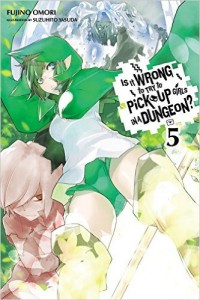
By Fujino Omori and Suzuhito Yasuda. Released in Japan as “Dungeon ni Deai o Motomeru no wa Machigatte Iru Darou ka?” by Softbank Creative. Released in North America by Yen On.

Well, I suppose I asked for it. In the last few reviews of this series I kept mentioning how the mechanics of the series meant that Hestia, the supposed female lead, kept getting less screen time than everyone else. Now we have a book where she actually comes along on a dungeon crawl in order to rescue Bell, and it’s sadly fairly cliched. She can’t use godly powers in there, so she’s useless in the fighting. She spends much of the time post-rescue jealous of the fact that every girl in the entire series has fallen in love with Bell (though honestly, I think what Aiz is feeling is deep jealousy of Bell’s progress, but that doesn’t matter to Hestia), *and* she gets kidnapped and has to be rescued.

danmachi5

The others fare better. Bell too needs to be rescued, but that’s not really his fault, and he, Welf and Lilly show off their excellent teamwork here. (Lilly also shows a lot of jealousy, but she’s more cynical and sarcastic about it, and thus appeals more to Western readers.) Bell’s reputation is starting to precede him, and much of this volume is devoted to the fact that if you are an overpowered character in what is for all intents and purposes an RPG, you’re going to have players assuming you’re cheating, or getting help, or just plain old “who does he think he is?”. And so we see the return of some old bullies from Book 2, who decide to teach Bell a lesson – and by that I mean beat the crap out of him. The trouble is, Bell is just too good for that to work.

The big debut this volume is Hermes, who’s the standard trickster god type, also out to teach Bell a lesson: stop being so naive and realize that some humans are bad people. This lesson does not work, because Bell is Bell, and this isn’t Black Bullet. Hermes is amusing, and I love the fact that everyone just accepts that he’s something of an asshole – indeed, when we get the standard “whoops, Bell is peeking on the girls at the hot spring, lol” scene, literally everyone there knows this isn’t something Bell would do, and blame Hermes instead. I was ecstatic to see that. He also lets the cat out of the bag about Bell’s ancestry, but honestly I think everyone had guessed that by now anyway.

For those who enjoy battles, the one in the last third of the book is very epic, with a huge cast of characters all teaming up to take out a nightmarish monster. Lyu, one of the waitresses from our favorite pub, gets a tragic backstory and a serious chance to show off. In fact, I’d argue the series has more women kicking ass than men by a large margin – which is partly for the service, but it’s also simply nice to see. In the ‘odd’ department, we meet one of the Japanese gods and his all-Japanese human team, who do well but feel out of place in this land of Greek fantasy archetypes. On the whole, though, it’s another strong volume, though I hope Hestia can get over her jealousy soon. (Yes, I know.) Also, we’ve now caught up with the anime, so the next book should be new to viewers.

Filed Under: REVIEWS

After School Nightmare, Vol. 9

April 30, 2016 by Ash Brown

After School Nightmare, Volume 9Creator: Setona Mizushiro
U.S. publisher: Go! Comi
ISBN: 9781933617701
Released: November 2008
Original release: 2007

After School Nightmare is a ten-volume manga series by Setona Mizushiro. Darkly psychological with elements of horror as well as social commentary, After School Nightmare can at times be a deeply troubling and challenging read while still being engrossing and oddly compelling. I first started reading the series several years ago, but have only recently been able to bring myself to read beyond the first few volumes of the manga, largely because I did find it so disconcerting and hard-hitting. Granted, the dark, anxiety-ridden atmosphere which makes the After School Nightmare so intimidating to approach is also what makes the story particularly effective and is an aspect to the manga that I can appreciate. After School Nightmare, Volume 9 was first published in Japan in 2007. The English-language edition of the volume was released in 2008 by Go! Comi. Sadly, the entire series has now gone out of print and is becoming more difficult to find.

One by one the students participating in the special after school class which forces them to share their literal nightmares with one another are graduating and disappearing, leaving only a vague memory of their existence behind. Though at times vicious and cruel, the dreams are intended to allow the students to work through their personal traumas, crises, and fears so that they can let go and move on from their troubled pasts. However, the violence and turmoil they experience within the dreams frequently spills over into their waking lives and graduating doesn’t necessarily guarantee a peaceful resolution. Koichiro in particular has reached his breaking point. He is ruthless in his determination to graduate and leave his overbearing and abusive father behind along with his carefully crafted public persona. Triggered by outside events, the nightmare Koichiro brings down upon the other students as he tries to free himself turns into a shockingly brutal and bloody rampage, signalling the beginning of the end for himself and for those who still remain.

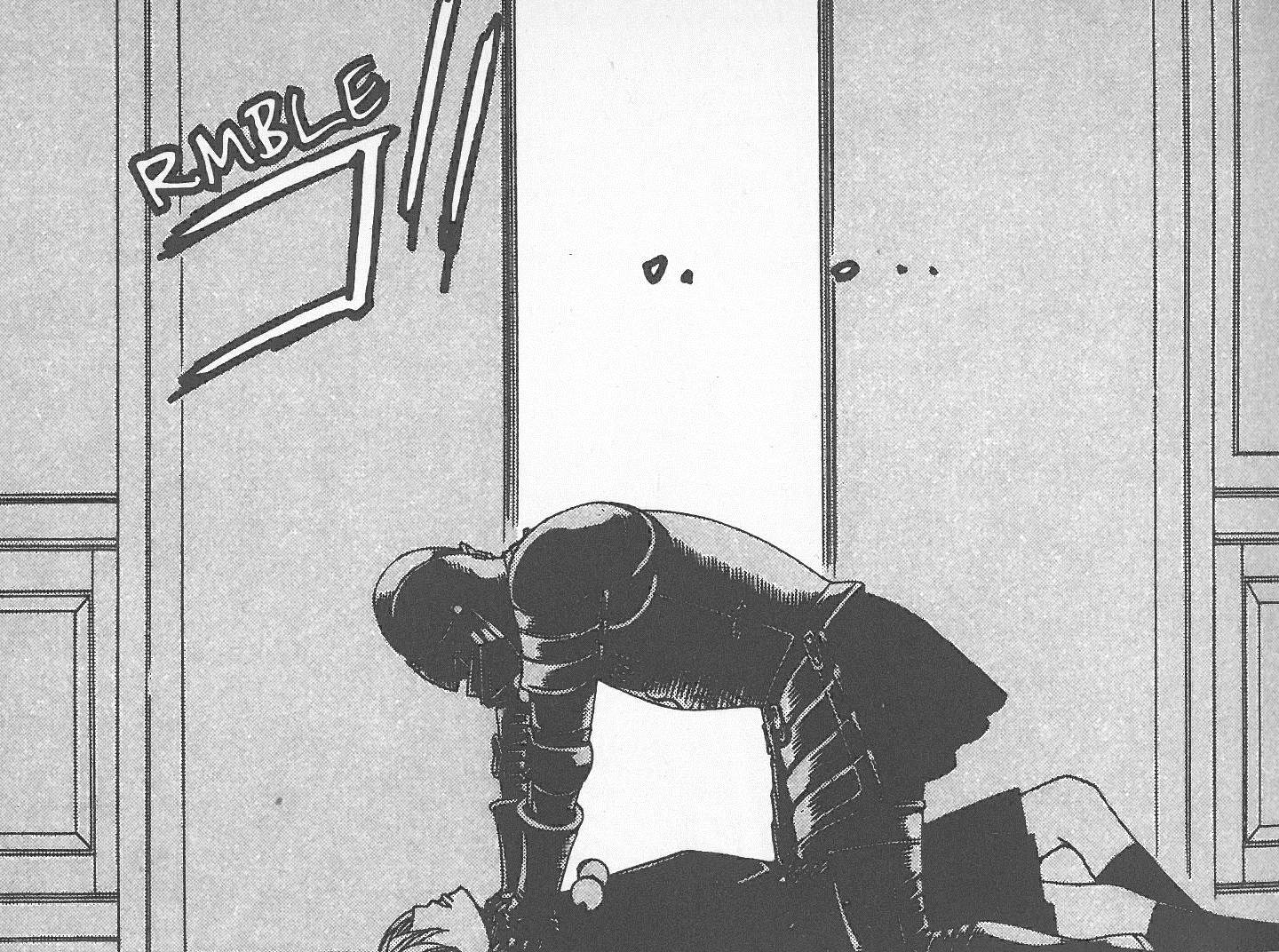
After School Nightmare, Volume 9, page 29A few questions still remain, but for the most part Koichiro’s character arc is resolved in After School Nightmare, Volume 9. Like so many of the other characters’ stories, Koichiro’s is a tragic one and it is heartwrenching to see it play out. The culmination of his anger, pain, and suffering has a direct and devastating impact on the others, ending with a violent attack on Mashiro, the portrayal of which has blatant parallels to a sexual assault. Koichiro was at one point the most stable and seemingly well-adjusted character in the series, so to see such a drastic shift in his outward attitude and behavior is especially startling. He isn’t the only character to have significantly changed over the course of After School Nightmare, though. However, for some the process, while still being extraordinarily difficult, has ultimately been more positive. Just as the dreams have led Koichiro to abandon his self-restraint, they have also allowed Mashiro the freedom to begin to come to terms with his fluid gender identity and the fact that he may feel more comfortable as a girl. Compared to the beginning of the series, Mashiro has greatly matured.

After School Nightmare, Volume 9 has a fair number of major plot twists, surprising reveals, and crucial story developments, many of which call into question everything that has come before in the manga. Some of these things have been foreshadowed and are not entirely surprising but there is still some disorientation as they are revealed to be not quite what they initially seemed. Koichiro dominates the first few chapters of the ninth volume but from there the focus of the manga turns toward Sou as more of his backstory is explored. An explanation of a past that he has not entirely dealt with yet and that has been incredibly damaging both emotionally and psychologically is finally given. After School Nightmare was never a light series, but the ninth volume is a particularly heavy and dramatic one. Considering the very final scene which challenges many of the assumptions that I had made regarding the series, I am very curious to see where Mizushiro takes the story in the final volume. After School Nightmare has been a dark and twisting journey and I have no idea how it will end; I’m almost a little frightened to find out.

Filed Under: REVIEWS Tagged With: after school nightmare, Go! Comi, manga, Setona Mizushiro

The Gods Lie.

April 29, 2016 by Michelle Smith

By Kaori Ozaki | Published by Vertical, Inc.

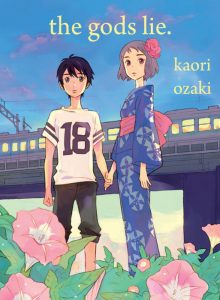
gods-lieThe Gods Lie is a seinen one-shot by Kaori Ozaki, who also brought us Immortal Rain, which I liked very much. Even though it was released recently, Ozaki’s clean and clear artwork somehow conveys a more vintage feeling, a bit like a Miyazaki movie.

Natsuru Nanao is in sixth grade and dreams of becoming a soccer star. The girls in his class have ignored him ever since he rejected the princess of the group, so he’s surprised when Rio Suzumura actually acknowledges his presence. After his beloved soccer coach is hospitalized, the negative and demanding replacement causes Nanao to bail on soccer camp and he ends up spending a lot of time over summer vacation with Suzumura and her little brother, Yuuto (and Tofu, the kitten they have rescued). Nanao lives with his mother, since his father died when he was little, but soon discovers that Suzumura and Yuuto are living on their own after their father took off to earn money fishing in Alaska.

Over the course of the volume, Nanao makes some bittersweet discoveries about life. The new coach causes him to doubt his dreams of soccer stardom. He learns that one of his teammates already has a different career path plotted out. He falls in love with Suzumura and stands by her when her dad fails to return by the summer festival like he promised. He discovers her terrible secret. And, lastly, he begins to understand why “the gods lie.”

I think in this case, the gods of the title are taking the form of parents, and how they might appear to a young kid. Suzumura’s dad has lied to his children, but Nanao reflects that his dad had lied to him, too, promising that he’d surely get better if Nanao was a good boy. People who love you can lie to you, sometimes because they don’t want you to be sad, sometimes because they are assholes who are unworthy of your love. That’s life.

What I like best is that Ozaki lets Nanao take in these revelations without destroying his capacity to dream, or ending the book on a thoroughly depressing note. Indeed, the conclusion is downright hopeful. In the end, I enjoyed The Gods Lie very much, and particularly recommend reading it somewhat slowly, to really evoke that leisurely summer vacation feel.

Review copy provided by the publisher.

Filed Under: REVIEWS Tagged With: Kaori Ozaki, vertical

Manga the Week of 5/4

April 28, 2016 by Sean Gaffney, Ash Brown, Michelle Smith, MJ and Anna N Leave a Comment

SEAN: Let’s face it, there are no light weeks anymore. There’s 21 titles next week, and that’s our new normal. We just have to accept it, manga is popular again.

ASH: All right!

MICHELLE: Yay! Now, can we have back some of those series that disappeared in less prosperous times? Like Silver Diamond? Please?

MJ: I’ll second Michelle on this. :)

ANNA: Silver Diamond, Demon Sacred, I could go on!

SEAN: Dark Horse gives us a 5th volume of Oreimo: Kuroneko, showing that non-canon love interests are always more popular than canon ones, especially when they aren’t related.

Seven Seas gives us a 7th volume of underrated techno-thriller Arpeggio of Blue Steel.

shominsample1

Shomin Sample is a harem comedy based on a light novel, whose title I am abbreviating as it’s too long, and I think that says it all. Vol. 1 comes out from Seven Seas next week.

And there’s a second Testament of Sister New Devil, whose title I actually got wrong in my review of the first volume, it’s that hard for me to keep straight.

Vertical has a 2nd volume of Nichijou, whose first volume I was delighted to see was a big hit. Keep it up!

MICHELLE: I will soon be catching up on Nichijou!

SEAN: There’s a Takeshi Obata artbook coming out, blanc et noir, whose title is very e.e. cummings. MJwill, I’m sure, have more to say.

ASH: My copy arrived early, and it’s gorgeous. The volume includes a fair amount of art from Death Note, but also from Hikaru no Go and some of Obata’s other works, too.

MJ: I haven’t seen this, but you can bet I’ll be picking it up. Whatever I have thought about some of his collaborations, I’ve always loved his artwork. This is a must-buy.

SEAN: Relive those days when everything was Aizen with the 15th Bleach 3-in-1 omnibus.

Blue Exorcist also has a 15th volume, and finally wraps up the Izumo arc, I believe.

Dragon Ball Full Color adds Freeza Arc to its title, in case people had forgotten which edition they were re-re-re-rebuying.

heiress1

The Heiress and the Chauffeur is Viz’s debut this month, and give it’s a LaLa DX series I am contractually obligated to love it. It’s also only 2 volumes, so not a huge investment. Also, Taisho era!

MICHELLE: I’m looking forward to this one, though preemptively sad that it’s so short.

MJ: Same here!

ANNA: Not surprisingly I am too!

SEAN: JoJo’s Bizarre Adventure has been given the go-ahead for hardcovers of the previously released 3rd arc, which is great news. First though, it’s back to Joseph for the 3rd volume of Battle Tendency.

ASH: I’ve really been enjoying these releases. I hope Viz will pick up the later arcs, too!

ANNA: I need to get caught up!

SEAN: Kimi ni Todoke has seemingly finished with its Ayane angst, and so I suspect the 24th volume will give a bit more focus to the other two major couples.

With its 4th volume of omnibuses, Maid-sama! has finally caught up with the Tokyopop releases, and so will feature all new material next time.

MICHELLE: As problematic as this series is, I still wanna see what happens in the volumes we never saw before. Hey, you know what else could get rescued as a 2-in-1 omnibus? Silver Diamond!

MJ: Heh.

SEAN: My Hero Academia 4 has more to tell us about superheroes.

narutosakura

The new Naruto novel is technically called Sakura’s Story, but I’ve heard that Sakura fans are going to be disappointed. Still, it’s Naruto, you have to get all 6 novels to complete the set.

Nisekoi has reached 15 volumes, and it’s still trying to balance its high-wire harem act.

One Piece. 78 volumes. Still in Dressrosa.

One-Punch Man is at its 6th volume. Sadly, this volume has no punching… I kid. There’s always punching.

ASH: I’m still greatly enjoying One-Punch Man.

MICHELLE: I am starting to feel like maybe I would like this.

MJ: You would.

ANNA: I feel like One-Punch Man should be universally beloved.

SEAN: Oresama Teacher reached the big 2-0! Have we learned all of Hayasaka’s secrets? And what of poor, neglected Super Bun?

ANNA: Where is Super Bun? The world wants to know!!!

SEAN: And World Trigger is up to double digits, increasing exponentially the likelihood that I will never succeed in catching up to it.

Lastly, Yu-Gi-Oh has a 6th 3-in-1. Collect ‘em all!

Which of these manga titles makes you cry out in ecstasy and rapture?

Filed Under: FEATURES, manga the week of

The Irregular at Magic High School: Enrollment Arc, Part 1

April 28, 2016 by Sean Gaffney

By Tsutomu Sato and Kana Ishida. Released in Japan as “Mahouka Koukou no Rettousei” by ASCII Mediaworks. Released in North America by Yen On.

Sometimes, when I review a new series, I come into it relatively unspoiled beyond a basic premise. And then there are times where the series is somewhat infamous, and so I’m spoiled no matter what I do. The Irregular at Magic High School, aka Mahouka, is one of the latter. It’s become somewhat infamous on the internet for its immense volume of technobabble, for its bizarre and skewed views of world politics, but most of all for its hero, who tends to get even more flak than Kirito for being perfect in every way. The term “Mary Sue” has been used to incorrectly in recent times that it’s become meaningless, and “Gary Stu” was never really anything more than a desperate attempt to try to not look sexist. That said, one has to admit: Tatsuya’s pretty cool.

irregular1

The basic premise is that our hero and his adoring sister (more on that later) go to a school for magic users. Miyuki is a magic prodigy. Tatsuya, while brilliant in every other way, does not have much in the way of actual magic power in him. As a result, which she’s handpicked for the student council and the freshman representative, he’s placed in Course 2 with the other students who have skills but not actual power behind them. And, this being a typical high school with typical teenagers, that means there’s a lot of bullying and prejudice against Course 2 students. Tatsuya, though, is not going to let a little thing like magic power stop him from using his analytic abilities and natural-born intelligence to be the best. Oh, and his martial arts. So he’s scouted by the discipline committee in order to help keep peace on the campus.

Tatsuya, thank goodness, is not your typical schlub light novel narrator. He’s somewhat stoic and emotionally stunted, and frequently has difficulty grasping the basic concept of people actually wanting to be friends with him – I suspect his past is filled with bad things. We already know he’s estranged from his parents. Luckily, he has a close relationship with his sister – too close, possibly, for many readers. There is a whole load of incestuous subtext in this first book, and it’s not all on Miyuki’s end, though she’s the largest supplier. This plot point, plus the fact that Tatsuya sometimes bends the narrative his way like he’s the star of a Dark!Grey!Independent Harry Potter fic, means the book can be hard to take. Oh, and the technobabble is just as bad as people said it would be.

There are some bright spots. Tatsuya’s narration can be quite amusing, and helps to define his character in much the same way that Kyon’s defines his – I wonder how much of his inner monologue was left in the anime. Mayumi, meanwhile, is a delight – my favorite character so far, a classic student council president type who knows she’s that type and plays it to the hilt. Tatsuya’s frank description of her as “evil” is hilarious but not inaccurate. In general, though, I think this series is one for those with a high tolerance for heroes who can do everything without breaking a sweat, and who don’t mind that the younger sister has an obvious crush on her brother. Yes, that does sound a bit like Sword Art Online as well, but multiply both of those factors by two in this case.

Filed Under: REVIEWS

  • « Go to Previous Page
  • Page 1
  • Interim pages omitted …
  • Page 490
  • Page 491
  • Page 492
  • Page 493
  • Page 494
  • Interim pages omitted …
  • Page 1049
  • Go to Next Page »
 | Log in
Copyright © 2010 Manga Bookshelf | Powered by WordPress & the Genesis Framework