• Skip to primary navigation
  • Skip to main content
  • Skip to primary sidebar
  • Home
  • About Us
    • Privacy Policy
    • Comment Policy
    • Disclosures & Disclaimers
  • Resources
    • Links, Essays & Articles
    • Fandomology!
    • CLAMP Directory
    • BlogRoll
  • Features & Columns
    • 3 Things Thursday
    • Adventures in the Key of Shoujo
    • Bit & Blips (game reviews)
    • BL BOOKRACK
    • Bookshelf Briefs
    • Bringing the Drama
    • Comic Conversion
    • Fanservice Friday
    • Going Digital
    • It Came From the Sinosphere
    • License This!
    • Magazine no Mori
    • My Week in Manga
    • OFF THE SHELF
    • Not By Manga Alone
    • PICK OF THE WEEK
    • Subtitles & Sensibility
    • Weekly Shonen Jump Recaps
  • Manga Moveable Feast
    • MMF Full Archive
    • Yun Kouga
    • CLAMP
    • Shojo Beat
    • Osamu Tezuka
    • Sailor Moon
    • Fruits Basket
    • Takehiko Inoue
    • Wild Adapter
    • One Piece
    • After School Nightmare
    • Karakuri Odette
    • Paradise Kiss
    • The Color Trilogy
    • To Terra…
    • Sexy Voice & Robo
  • Browse by Author
    • Sean Gaffney
    • Anna Neatrour
    • Michelle Smith
    • Katherine Dacey
    • MJ
    • Brigid Alverson
    • Travis Anderson
    • Phillip Anthony
    • Derek Bown
    • Jaci Dahlvang
    • Angela Eastman
    • Erica Friedman
    • Sara K.
    • Megan Purdy
    • Emily Snodgrass
    • Nancy Thistlethwaite
    • Eva Volin
    • David Welsh
  • MB Blogs
    • A Case Suitable For Treatment
    • Experiments in Manga
    • MangaBlog
    • The Manga Critic
    • Manga Report
    • Soliloquy in Blue
    • Manga Curmudgeon (archive)

Manga Bookshelf

Discussion, Resources, Roundtables, & Reviews

Blog

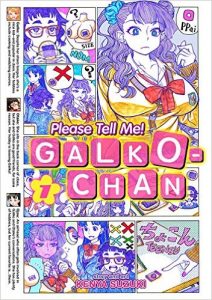
Please Tell Me! Galko-chan, Vol. 1

November 25, 2016 by Sean Gaffney

By Kenya Suzuki. Released in Japan as “Oshiete! Gyaruko-chan” by Media Factory, serialization ongoing in the online site Comic Walker. Released in North America by Seven Seas. Translated by Jennifer McKeon. Adapted by Lianne Sentar.

As I’ve occasionally mentioned before, I am the opposite of most fans. Most fans, from what I gather, watch only anime, and seem rather surprised to find that a manga or light novel exist, and uninterested if they do find out. Whereas I read manga or light novels, and for the most part don’t really watch much anime at all anymore. On the bright side, this can lead to surprises. For example, this series, which I knew nothing about. At first the description made it sound fairly slice-of-lifey. However, as those who’d seen the anime know all too well, it has a lot of sex talk sprinkled throughout. This was what I discovered when I first started to read it, and my general thought was “oh dear, time to plow through this.” Luckily, as the volume went on, despite the sex talk Galko-chan proved to be more what I originally thought it would be.
galko1

The premise is light as air, as are the characters, who all have nicknames related to their specific stereotype (a flashback chapter shows it’s actually deliberate, which is amusing). Galko-chan is the titular character, a Gal in the Super Gals! vein, who is also possessed of very large breasts, which is actually one of the driving plot points as there are many discussions of said breasts. Galko-chan is not quite a 4-koma series, but it’s very much in the vein of such comedies, with little character introductions every single page offering little facts about each character. (Haruchi-chan’s manga has this as well). And because her best friends as Otako, a bookish girl who knows a lot about sex from reading about it and uses that to jump-start conversations, and Ojou, a young rich well-bred girl who’s described as an airhead but who I think is simply sheltered and goes along with any topic no matter what it is, sex comes up a lot.

Each page heading has a specific question that one would ask of high school teens, ranging from “Do friendly sisters borrow each other’s clothes a lot?” to “Is it true that intense exercise can break a girl’s hymen?”. Honestly, they’re more the latter than the former – be prepared for a lot of discussion of breasts, pubic hair, periods, labial size, etc. While this has the potential to be awful, it’s generally not, mostly as all three girls are, despite the saucy talk, really quite innocent – this isn’t even on the level of High School Girls. When not discussing sex, they do normal 4-koma things like go shopping, go to the pool, and worry about school, with the help of their other classmates, who get less attention but still have names that define their stereotype. They’re just… nice kids. Who talk about women’s bodies all the time.

I suspect those who dislike slice-of-life, ecchi stories, and 4-koma style humor already avoided this, but just in case, let me warm you it is all those things. (There isn’t much boke and tsukkomi style humor, though, which is a pleasant change.) It’s also in full color, and the colors are nicely chosen and artistically striking, and the faces are mostly also very good, though Ojou needs to stop having her default expression 90% of the time. This was a cute read, not as ecchi as you’d think t would be, and should please fans of the anime. Which I still have not seen.

Filed Under: REVIEWS

Manga the Week of 11/30

November 24, 2016 by Sean Gaffney, Ash Brown, Michelle Smith, Anna N and MJ 3 Comments

SEAN: You know, for a 5th week of the month, there sure is a ton of stuff next week. Sheesh.

ASH: Woo!

Dark Horse gives us the third Dangan Ronpa volume, as the class continues to choose between hope, despair, or being violently killed.

And there’s a 5th Oh My Goddess omnibus, warring with Dragon Ball for most re-releases.

J-Novel Club is a new publisher of Japanese light novels, digital only, and they’ve finished three volumes that are scheduled to drop next week. Brave Chronicle (Kimi kara Uketsugu Brave Chronicle) is actually finished in one volume, and combines magic school, childhood friends, lots of action, etc.

chuunibyou

More obviously light novel-ey is My Sister Lives in a Fantasy World (Nee-chan wa Chuunibyou), a series about a boy who gains certain powers and his overenthusiastic little sister. It’s 7+ volumes in Japan.

And Occultic;Nine is the most familiar title, as it has an anime currently out, and should also be familiar with punctuation haters everywhere as the successor to Steins;Gate, Chaos;Head, etc.

Kodansha has five new releases this week. They say it’s six, but they still maintain that Animal Land 11 is actually coming out this time, and a ha ha ha, you can’t fool me again. Animal Land is a myth.

ASH: Animal Land? It has been a while!

SEAN: Fairy Tail 57. GAJEVY! GAJEEEVVVYYYY!!! That is all.

The second volume of Happiness will likely be as ironically titled as the first one was.

ASH: Most likely.

SEAN: The Seven Deadly Sins has its 17th volume.

And there’s a 3rd Sweetness and Lightning, which so far has leaned on the sweetness.

ASH: I am really enjoying Sweetness and Lightning so far.

SEAN: We also have a 2nd volume of Welcome to the Ballroom, which I hope will be as dynamic and exciting as the first was.

MICHELLE: I’m really looking forward to this one, and will be picking up Sweetness, too.

ANNA: I am also very much looking forward to Welcome to the Ballroom.

SEAN: The 14th volume of Haganai from Seven Seas continues to move towards a potential breaking point with the Neighbors club.

corpse1

Holy Corpse Rising is a new series from the creator of Ninja Girls, and combines… I know this will shock you for a Seven Seas release… fantasy and fanservice.

ASH: I don’t know much about the series, but the cover art is striking.

Vertical; has an 11th volume of What Did You Eat Yesterday?, which is good, as I wondered what might get Pick of the Week at this rate.

MICHELLE: Heh. I will say I’m looking forward to Ballroom nearly as much.

MJ: Yoshinaga always has an edge where I’m concerned. You know I’ll be getting this.

ASH: I’m still so happy this series is being translated!

SEAN: Yen Press has new digital volumes! All Volume 7s for Aphorism, Crimson Prince, and Sekirei.

They also have some volumes left over from this week’s pile, as apparently there was too much so some got moved to next week. Anne Happy continues to try to rely solely on pluck with its third volume.

Dragons Rioting gives us a 5th volume.

And there’s a 5th Prison School omnibus.

ASH: I’m actually still reading this.

Scumbag Loser is a giant done-in-one omnibus of three volumes, and sounds intriguing, if you can get past the title and cover art, which I suspect most won’t. The author is also known for Tomodachi Game, a survival game manga.

MICHELLE: I’m taking a pass on Scumbag. That sort of creepy losery protagonist just doesn’t appeal to me. Like I’ll Give It My All… Tomorrow, for example.

ASH: Huh.

SEAN: And Sword Art Online gives us MORE DEBAN! with a third volume of spinoff Girls’ Ops.

As I said, that’s quite a lot. Anything for you?

Filed Under: FEATURES, manga the week of

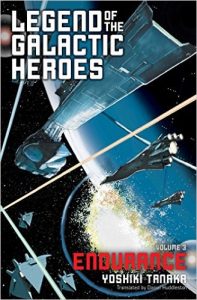
Legend of the Galactic Heroes: Endurance

November 24, 2016 by Sean Gaffney

By Yoshiki Tanaka. Released in Japan as “Ginga Eiyū Densetsu” by Tokuma Shoten. Released in North America by Haikasoru. Translated by Daniel Huddleston.

When we last checked in with this epic space opera, I was saying that this book would show us which direction the series was going to go, and I’m not sure that ended up being the case. Don’t get me wrong, this is an excellent book, with great battles and character examination, but at the end of 300-odd pages I am left with the feeling that not much has changed since we started. Except there are a lot more soldiers dead. Because above all else, Legend of the Galactic Heroes wants to tell us about the folly of war, specifically war for the sake of war. And it does this quite well, whether it be via Yang Wen-li having a long inner monologue about what history has taught us about the military or an evacuation order leading to the deaths of hundreds as panicking soldiers kill other panicking soldiers in their efforts to flee a doomed Death Star.

logh3

Of course, it’s not called a Death Star in the book, but a giant circular battle station that functions as a planetoid for its inhabitants is going to make one think of Star Wars, especially as Japan released this volume in 1984, when that sort of thing was at its height. The plot that kicks off this volume is an ambitious technical general coming up with the idea of building a 2nd Death Star, warping it into position, and then fighting it out with Iserlohn, the old one currently occupied by Yang and his Republic forces. It’s an all-or-nothing plan, and normally Siegfried would be around to try to talk Reinhard into being more sensible. But Siegfried is dead, and while Reinhard is trying to do his best to imagine what the young man would recommend to him (we see this later when he spares the life of another young general), he’s still not very good at it, and spends most of the book unemotionally doing his job and closing himself off from most human contact.

Reinhard and Yang are usually compared and contrasted, and Yang also spends a good deal of this book cut off from his allies. Not by his own design, though, as the Republic have called him in for “a court of inquiry”, which is different from a court martial in that they don’t have to tell anyone or have any actual charges. In point of fact, they imprison Yang for weeks because they just don’t like him, and it drives everyone to distraction – especially the people back on Iserlohn, who are now forced to fight for over a month against the enemy without their tactical genius. The book does especially well in paralleling the Empire and Republic, Reinhard and Yang this time around. They both have corrupt glory hounds, they both assume that people who hold respect and are held in high regard will want absolute power (after all, it’s what they would do). And they both have beautiful young secretaries who have designs on them, though Yang is a little ahead here – he and Frederica are more like awkward teenagers, whereas Hildegarde is having difficulty getting Reinhard to even admit emotion exists after Siegfried’s death.

This was great fun to read, but again, after the whole book we’re mostly in the same place we were. We do learn a lot more about Phezzan, though, which has designs in trying to eliminate one side and prop the other up – as puppets for their economic tyranny. Oh yes, and there’s still the Church. I suspect the next book will have a lot more politics to it. And we get a next book, as Haikasoru have picked up the next three in the series. Great news.

Filed Under: REVIEWS

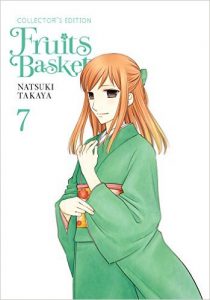
Fruits Basket Collector’s Edition, Vol. 7

November 23, 2016 by Sean Gaffney

By Natsuki Takaya. Released in Japan by Hakusensha, serialized in the magazine Hana to Yume. Released in North America by Yen Press. Translated by Sheldon Drzka.

I’ve discussed before how much Fruits Basket deals with abuse, and it also deals just as much with family. And while the two obviously intersect, especially in this volume, they aren’t always meant to coincide. Not everyone is the same, and no one can go through quite the same situation as someone else. This has shown up most obviously in Yuki and Kyo each being deeply envious of what the other has. In this volume we see Momiji, whose sister has been spying on him and seems to have a sense that they’re related even if she doesn’t know it for sure, choosing to remain apart from her to save his family, even though it hurts him. We also see Yuki, who has mostly repaired his relationship with Ayame (who gets the best entrance in the book here) dealing with the repressive control of his mother, and fighting back against it quite a bit. Yuki is finally growing up.

furuba7

And then there’s Rin, who’s life is so tragic she doesn’t even manage to get a front cover on the omnibus she most features in. Furuba does a good job, as I said, of showing how abuse affects everyone differently, and I won’t say Rin’s is worse than the others, but it’s certainly more explicit than the others, as we see her family, which had been putting on the facade of happy cheer, break apart with just one innocent question from her. If nothing else, it shows how fragile that facade was – even if she hadn’t asked, I doubt it would have lasted much longer. Rin’s flashback is heartbreaking, as she doesn’t even begin to understand where everything went wrong, and assumes it’s her fault – something her parents and Akito are happy to tell her is the case. Luckily, she has Haru, but she’s not in a headspace right now where she can accept her need for Haru, and so drives him away as well. Basically, Rin is fascinating and makes you want to hug her, except she’d run away.

Rin’s interaction with Tohru is also interesting. Like Hiro, she’s reluctant to accept Tohru as this sort of magical healing waif, which the start of the series may have led you to believe she was. Tohru has issues, though, and it’s in dealing with Rin, who’s actively asking her why, specifically, she wants to remove the curse, that Tohru begins to crack a bit. Rin so far is the only one who’s noticed Tohru is “quietly falling apart”, and the minimalistic look at Tohru’s flashbacks suggest it’s due to her mother and her burgeoning love for Kyo (she also reacts badly when he again implies he’s going to let her move on from him). Tohru has been an all-loving heroine, but not all love is the same, and I think Tohru needs a lesson in that before she can start to genuinely help to break the curse.

This being an omnibus, there’s so much more to talk about. Shigure’s self-analysis of his character, which is wonderful – Rin may hate Shigure, but no one hates Shigure the way Shigure hates Shigure. Akito pushing Rin out the window is the most startlingly violent the series has been to date, and the fact that Hiro saw it explains quite a bit from previous volumes. The student council actually do start to have a major impact on the story here, though they’re still somewhat hermetically sealed off from the rest of the cast, and we learn some of why Kakeru is the way he is – though there’s still his connection with Tohru, which remains mysterious. And then there’s Machi, who’s mostly a cypher, albeit a violent cypher. The joy of Fruits Basket is that the omnibus gives you endless time to reread the series and linger over your favorite parts. Also, Kimi is gloriously awful and I love her.

And next month, we get Sorta Cinderella!

Filed Under: REVIEWS

Bookshelf Briefs 11/22/16

November 22, 2016 by Michelle Smith and Sean Gaffney 1 Comment

barakamon12Barakamon, Vol. 12 | By Satsuki Yoshino | Yen Press – The absence of Naru’s immediate family was always very unstated in the series, and it’s unsurprising that Handa thought they were both dead—the reader likely did as well. But her father, at least, is shown not to be dead, but to be away at sea most of the year, and his return for Christmas is what carries most of this volume. Naru is very Yotsuba-esque most of the time, but she is a seven-year-old girl with real feelings, and her need for her father is telling even as she sort of elides it. Her dad, meanwhile, is a well-meaning goof, but should really step up more, and Handa is, as always, a good bridge between the two. Barakamon is sweet and good-hearted and always puts a smile on my face. – Sean Gaffney

nozaki5Monthly Girls’ Nozaki-kun, Vol. 5 | By Izumi Tsubaki | Yen Press – I don’t normally watch the anime versions of the manga I read, but a friend introduced me to the Nozaki-kun anime and it’s pretty great. In fact, watching it gave me a better sense of the comic timing in the series, and I think that has carried over to how I read the manga, because I enjoyed it even more than before. Scenarios in this volume include Kashima having a cold and various guys volunteering to speak for her, the gang going on a drama club training camp, and Nozaki’s search for a cute merchandise-friendly mascot for his series. There is a gag relating to the latter that made me laugh out loud, but I also enjoyed a glimpse at the process for how such things are incorporated into a series, as well as a brief lesson on how cover designs come to be. A little informative, a lot amusing! – Michelle Smith

9781421588667_manga-my-hero-academia-6-primaryMy Hero Academia, Vol. 6 | By Kohei Horikoshi | Viz Media – I did ask for villains, and here they are, including one who seems to be angry at people who are heroes for the wrong reason. This volume has a lot to say about what makes a good hero and what makes a villain. Midoriya gains a mentor, who is impressed at the fact that he can think on his feet and is trying to teach him how to be more intuitive. But more importantly, Ida is bent on revenge against the man who destroyed his hero brother, who will likely never walk again. This is understandable, but revenge is always a BAD reason to be a hero. Luckily, we also see Midoriya being clever here, and he not only saves Ida but also calls for help, something I wish more shonen heroes did. Excellent series. – Sean Gaffney

onepiece80One Piece, Vol. 80 | By Eiichiro Oda | VIZ Media – For a while now, I’ve been ready to move on from Dressrosa, but I’ll be damned if Oda’s farewell narration to the island and its inhabitants didn’t make me a little verklempt. That said, this is one of those volumes full of updates on the world at large, hints about plots to come, and glimpses at future foes. I always enjoy it when the story’s scope widens this way, though it makes me wonder exactly how long the series is going to be (and whatever happened with those obelisk things Robin was studying?). The crew reunion at the end of the volume comes as a welcome relief, and I am further manipulated by Oda into being totally invested in the Sanji cliffhanger. Still addicted after 80 volumes! – Michelle Smith

ooku12Ooku: The Inner Chambers, Vol. 12 | By Fumi Yoshinaga | VIZ Media – When last we left off, ineffectual Ienari was the shogun and his odious mother, Harusada, was capriciously poisoning those of his heirs that displeased her. In this volume, she gets her comeuppance in a satisfying way, plus Ienari grows a spine and makes perfecting and distributing the redface pox vaccine his priority. The story could almost end here, with a victory for the good guys, except that wouldn’t be nuanced enough for Ooku. Instead, time passes swiftly and we see Ienari gradually being corrupted by power and the knowledge of his (and Aonuma’s, Gennai’s, and Kuroki’s) contributions lost to history because Japan cannot admit any weakness with foreigners literally on the horizon. Captivating and bittersweet, this is a series with broad scope and I trust that Yoshinaga has a destination in mind. I’ll be waiting for volume thirteen! – Michelle Smith

yamadakun11Yamada-kun and the Seven Witches, Vol. 11 | By Miki Yoshikawa | Kodansha Comics – And so Yamada-kun finally wraps things up and comes to an end. Yamada cleverly uses his wish to get rid of the witch powers, most of the witches are pretty happy with that, and most importantly, he confesses to Shiraishi and they become an official couple. This has been a terrif… wait, what? The series is still going? Yes, that’s right, welcome to “this is too popular to cancel,” the inverse of “cut short,” as we now have the adventures of the new student council, with some old friends but also some new characters. How this will develop I’m not sure, given it’s barely begun, and I’ll definitely give it a shot, but I do sort of wish that things had ended here, as it was perfect. – Sean Gaffney

Filed Under: Bookshelf Briefs

Monthly Girls’ Nozaki-kun, Vol. 5

November 22, 2016 by Sean Gaffney

By Izumi Tsubaki. Released in Japan as “Gekkan Shoujo Nozaki-kun” by Square Enix, serialization ongoing in the online magazine Gangan Online. Released in North America by Yen Press. Translated by Leighann Harvey.

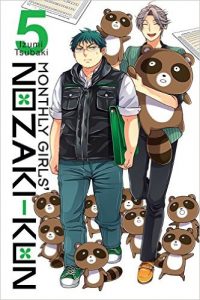
It’s a stretch to say that reading this series can teach you the ins and outs of how the manga industry works – this isn’t Bakuman, or Even a Monkey Can Draw Manga. But when it’s able to be mined for humor, anything is game. And so we get things like Nozaki trying to draw his shoujo heroine as a superdeformed character, or having a mascot for the series, much like Yukari’s endless tanukis (which litter the cover of this volume, so I can’t even make my tanuki joke at the end of the review). We also get a hilarious look at cover art, where the artist likely has to work with a different editor. There may be a seasonal theme. You may have to try to translate your editor’s art, which shows at a glance why they edit and don’t draw manga. So things are learned, but the humor comes first.

nozaki5

This series does not have plot and character development per se, but there are some amusing chapters that make it look as if things might develop. Mikoshiba discovers the tragic truth behind Wakamatsu’s crush on “Lorelai”, and is as horrified as you’d expect. Waka, meanwhile, continues to think that Kashima is a guy, though the beach episode may have cleared that up – it’s left up in the air. Actually, the beach episode is probably the highlight of the volume – the anime actually adapted it into a later OVA as it was too good not to animate. This features the famous “those are just lumps of fat, aren’t they?” line, Seo stealing the drawstrings of all the boys’ swimtrunks, Kashima and Mikoshiba continuing to be endlessly attractive to the same sex, “I’m wearing that lame pink bra you picked out!”, and more.

As for romance, as you’d expect, it’s status quo. Nozaki-kun is about the comedy. This volume, though, does show how natural Hiro and Kashima are with each other when she’s not driving him to violence, and has some lovely Seo/Waka tease, which is really all she wants from Waka at the moment. The majority of the shipping here, though, is Sakura’s seeming one-sided crush on Nozaki. She even admits to Mikoshiba she’s now too scared to confess as she knows it will just be used for manga fodder. She tries changing her attitude in order to get him to notice her more, but that just makes him worry. In the end, as we know, being herself is the best, even if it means Nozaki is still his oblivious self. The sweetest chapter in the book is the final one, where we flash back to Sakura first falling in love with Nozaki – as you’d expect, it was as much from him being a giant loser as it was his looks – and how she unconsciously influenced his heroine for the manga.

Nozaki-kun remains a wonderfully hilarious title, and now has finally gotten away from the anime, so fans of that will want to pick it up to read new material. Go read it, or the tanuki will be sad. (Oh look, I got to work in the joke anyway.)

Filed Under: REVIEWS

Pick of the Week: A Twinkle in Our Eye

November 21, 2016 by Michelle Smith, Sean Gaffney, Anna N, Ash Brown and MJ Leave a Comment

twinle1MICHELLE: Seeing as how I have literally been waiting for this series to be licensed here for YEARS, there is no way I’m not picking Twinkle Stars this week.

SEAN: Man, when will Tokyopop get around to licensing Hoshi Wa Utau… oh wait, here it is, from Yen Press, in gorgeous omnibus editions. Twinkle Stars is the obvious pick.

ANNA: Twinkle Stars for me as well, I can’t believe it is actually being published finally!

ASH: While I’m certainly interested in Twinkle Stars, I simply can’t resist the combination of music, magic, and demon-hunting composers, so it’s Magia the Ninth for me!

MJ: I’m really interested in Magia the Ninth, it’s true, but I think there’s no real choice for me this week except Twinkle Stars. How often do wishes come true?

Filed Under: PICK OF THE WEEK

My Week in Manga: November 14-November 20, 2016

November 21, 2016 by Ash Brown

My News and Reviews

Nothing except the usual My Week in Manga feature was posted last week at Experiments in Manga. I was hoping to have my random musings on Ichigo Takano’s Orange ready for November, but the month has been particularly stressful and energy-draining so at this point it looks as though December will be far more likely. Hopefully, I’ll have an in-depth feature of some sort to share soon. I also have my list of notable release from 2016 to work on, too!

There is one thing from last week that I’m very excited for–the most recent Sparkler Monthly Kickstarter! The campaign is raising funds to support the print edition of Heldrad’s highly-amusing send-up to shoujo manga Orange Junk. I greatly enjoyed the first volume of Orange Junk, which I’ve previously reviewed, but the series gets even better as it goes along. Never read any of Orange Junk? Give it a try over at Sparkler Monthly and if you like what you see please consider contributing to the Kickstarter!

Quick Takes

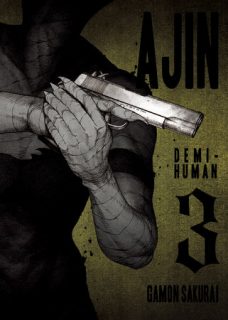
Ajin: Demi-Human, Volume 3Ajin: Demi-Human, Volumes 3-8 by Gamon Sakurai. For a variety of reasons, while I’ve continued to stockpile Ajin, I’ve been rather lax when it some to actually reading the manga. The eighth and latest volume in English was released relatively recently, so I figured it was probably about time that I finally got around to catching up with the series. In retrospect, I’m actually kind of glad that I had a whole stack of Ajin to read all at once. The manga generally tends to be very quickly paced so it was nice to be able to move directly from one volume to the next in succession. Ajin is best, both in art and in storytelling, when there’s action going on. Sakurai’s fight sequences are tremendously dynamic and exciting. The use of the demi-humans’ immortality and black ghosts can actually be quite clever at times, too. While the series continues to be exceptionally violent and brutal, it doesn’t seem to be as gruesome and grotesque as it once was when the demi-humans were shown to be the subjects of live experimentation. The story can be a little heavy-handed, especially when it comes to government corruption and the revelation of everyone’s tragic backstories, but the psychological elements do tend to be handled well in spite of this.

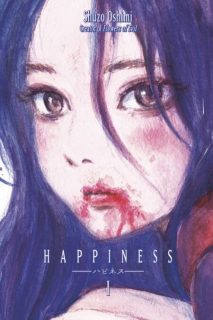
Happiness, Volume 1Happiness, Volume 1 by Shuzo Oshimi. I’m not especially interested in vampires and they seem to have been so overdone lately that there often has to be some sort of extra impetus for me to actually pick up a vampire manga. In the case of Happiness, the additional push that was needed came from the fact that Oshimi is also the creator of The Flowers of Evil, a manga series which left a pretty big impression on me. Oshimi is incredibly skilled at establishing the mood and atmosphere of a series. Happiness is about Okazaki, a bullied high school student who survives being attacked by a vampire only to become one himself. The pacing of Happiness is leisurely, showing only the first few days of Okazaki’s new existence as he struggles to adjust to his emerging symptoms. Given how the first volume unfolds, Okazaki’s descent into vampirism can easily be read as a metaphor for puberty and sexual awakening; it will be interesting to see if the manga continues in that direction. Happiness has an underlying sense of eroticism mixed in with its horror which, at least in my opinion, is exactly how a vampire story ought to be. There is also a fair amount of angst in the manga, something that I’ve come to expect from Oshimi’s work.

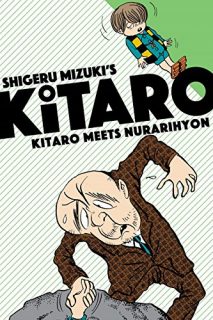
Kitaro, Volume 2: Kitaro Meets NurarihyonKitaro, Volume 2: Kitaro Meets Nurarihyon by Shigeru Mizuki. I am still absolutely thrilled that more of Mizuki’s Kitaro manga is being released in English. However, I was a little sad that the second volume of Drawn & Quarterly’s new series didn’t include the same sort of bonus activities that were present in the first. Those were fun. But then again, Kitaro Meets Nurarihyon is plenty of fun in and of itself. In addition to an opening essay and a closing set of yokai files by the series’ translator Zack Davisson,  the volume collects seven of Mizuki’s short Kitaro manga, most of which are from the latter part of the 1960s although one is from the late 1970s. Generally when I think of yokai, I think of traditional Japanese folklore. However, the term can also be applied more broadly. In Kitaro, Mizuki doesn’t limit himself and incorporates mythology, urban legends, and popular culture from both within and outside of Japan. For example, in Kitaro Meets Nurarihyon, a descendant of Dracula plays a very important role in one of the stories. Sometimes the results are more cohesive than others, but I particularly enjoy and find it interesting how Mizuki is able to meld seemingly disparate elements and traditions together.

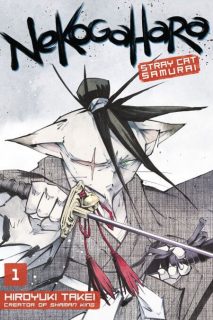
Nekogahara: Stray Cat Samurai, Volume 1Nekogahara: Stray Cat Samurai, Volume 1 by Hiroyuki Takei. Best known as the creator of Shaman King (which I somewhat surprisingly haven’t actually read yet), one of Takei’s most recent manga series is Nekogahara. Story-wise, it’s a fairly familiar tale of a ronin wandering the country, doing good deeds while trying to outrun past tragedies. There are numerous manga, novels, anime, and film that follow a similar premise. What makes Nekogahara stand out from all of those is that all of the principal players are literally cats. Granted, they’re cats dressed in kimono, carrying swords, and so on. Humans exist in Nekogahara, too, more or less as the daimyo, though they are generally discussed rather than seen. The lead of Nekogahara is Norachiyo, a scarred tom who was once a kept cat but who is now living his life as a stray. He is an extremely capable fighter and legend has it that he once even killed a person. Both the story and the visuals of Nekogahara rely on chanbara tropes. The actual flow of movement and action can sometimes be difficult to discern, but overall the artwork and character designs are rather stylish. Nekogahara is played fairly straight, but the characters’ more cat-like behaviors do bring levity to the manga.

The Black Cat Takes a Stroll: The Edgar Allan Poe LecturesThe Black Cat Takes a Stroll: The Edgar Allan Poe Lectures by Akimaro Mori. Bento Books doesn’t release very many titles, but the publisher’s books tend to be interesting so I make a point to keep an eye out for them. The Black Cat Takes a Stroll is one of Bento Books most recent releases. In addition to being the first volume in Mori’s Black Cat series, it was also the winner of Japan’s inaugural Agatha Christie Award for mystery fiction. The book collects six largely episodic but related short stories featuring the Black Cat, a young but respected professor specializing in aesthetic truth, told from the perspective of his personal assistant, a female graduate student whose research focuses on Edgar Allan Poe. I really wanted to like The Black Cat Takes a Stroll more than I actually did. I love the series’ basic concept and all of the literary and cultural references found in the stories. Sadly, the mysteries come across as trying too hard to be intellectual or overly academic and their solutions are frequently convoluted and coincidental. In addition to that, despite having a few charming and endearing quirks (such as his fondness for strawberry parfaits), the Black Cat tends to be infuriating more than anything else, misusing his intelligence in a way that is deliberately cryptic and intentionally manipulative of both the narrator and readers.

Filed Under: FEATURES, My Week in Manga Tagged With: Ajin, Akimaro Mori, black cat, Gamon Sakurai, Happiness, Hiroyuki Takei, Kitaro, manga, Nekogahara, Shigeru Mizuki, Shuzo Oshimi

Re: ZERO ~Starting Life in Another World~, Vol. 2

November 21, 2016 by Sean Gaffney

By Tappei Nagatsuki and Shinichirou Otsuka. Released in Japan by Media Factory. Released in North America by Yen On. Translated by ZephyrRz.

I always enjoy it when the second volume of a new series is stronger than the first, and that’s exactly what we have here. Subaru has managed to finally defeat death and get out of that crossroads, thus proving he is better than Robert Johnson. Now he’s recovering at the castle of Emilia’s eccentric mentor, who is apart of a series of strong new characters, including sarcastic twin maids, a grumpy loli that Subaru promptly labels as such, and, sadly, a new save point, as about 1/3 of the way through the book, Subaru dies… again. Only this time he dies in his sleep, and now has a harder job: figuring out who’s killing him and why.

rezero2

Of course, the book does still have its faults, chief among them still being Subaru. I mentioned while I was reading the series that he reminded me a bit of Bugs Bunny, mostly in the way that he enters a situation he knows very little about and responds with glib sarcasm and tsukkomi retorts. This makes the book a breezy, fun read, but at the expense of realism a bit – Subaru’s one-liners still feel overwritten, in a way that, say, the twins’ abuse does not. He’s doing much better when he’s emotionally stressed or panicking, which means the second half of the book is much stronger. Of course, this also means he’s failing downwards – he goes from blithely befriending everyone, to running away, to holing himself up in his room and avoiding everyone. Finally he even gets protection from a magic user, which saves him, but… at what cost?

We do learn a bit more about the world we’re now in here, though it’s a bit limited as the entire book remains right around the castle that the bizarre Roswaal lives in. His appearance and manner of speech scream out “I am secretly evil”, and while it would be refreshing if that proves not to be the case, I’m not holding my breath. Fandom, however, seems to have fallen in love with the two maids – well, to be more accurate, with one of the two maids. Ironically, Rem gets the lesser focus in this volume, as Subaru finds it far easier to bounce off the more outwardly vindictive Ram than her meeker, but just as vindictive sister. An afterword tells us that the two maids are based off Ran and Lum from Urusei Yatsura, redesigned for the modern age. Given much of this volume implies they are more than they seem, don’t be surprised if horns come up in the next book.

And there will be a next book to resolve this, as this has a cliffhanger ending – well, really, the opposite of a cliffhanger ending, but I meant metaphorically. I assume that Subaru will learn he can survive more than 3 deaths, and we’ve also found that even if he gets past the predestined time of his death, horrible things can still happen. We also learn, in the creepiest scene in the book, that he’s not allowed to tell anyone about his power. Basically, Subaru has his work cut out for him, but I suspect he will blunder into success somehow in the third volume. This is an excellent read, depending on your tolerance of the hero being flip every other line.

Filed Under: re: zero, REVIEWS

Platinum End Vol. 1

November 20, 2016 by Anna N

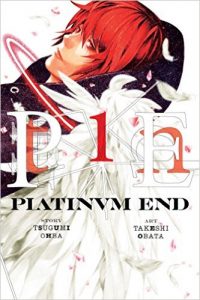
Platinum End Volume 1 by Tsugumi Ohba and Takeshi Obata

I approached reading Platinum End with mixed feelings, I was interested because this series is another work from the team that brought the world Death Note, and I greatly enjoyed Death Note. On the other hand, I wasn’t looking forward Death Note 2: Electric Boogaloo. I ended up putting down the first volume feeling like I was cautiously interested in seeing where Platinum End was going.

The volume opens with Mirai Kagehashi, a high school student who has decided to kill himself. He’s foiled in his attempt by the sudden appearance of an angel who rescues him. Mirai is stuck in despair because he was orphaned when he was young, and taken in by relatives who abused him. His new angel announces that she’s going to make him happy and gives him some new abilities – he can choose between having wings to fly anywhere or mystical red arrows that will cause anyone to fall in love with him. Mirai responds that he’ll ponder what he wants if he’s given both gifts and the angel agrees.

Mirai’s angel Nasse functions more like the devil on his shoulder than a good conscience, as she encourages him to use his powers for the most selfish of reasons. Mirai gets a sense of how deadly the ability to make anyone fall in love with him can be, when he returns to his aunt and uncle and learns the truth behind the death of his parents. In true shonen fashion it turns out that Mirai is caught up in a cosmic game, where God has decided that he’s going to elevate a human to become the next God. 13 angels have been assigned to 13 chosen humans, and the last one left gets to be in charge of the universe.

Mirai says that he would be just content with normal happiness, but Nasse keeps pushing him to use his angel-given superpowers to manipulate and murder his way to having money and happiness. In a way, Platinum End seems more like a horror title than anything else, as Mirai wakes up from nightmares with horrific visions. The other contestants for godhood aren’t using their powers for good either, as one of them decides to disguise himself as a superhero and pick off his opponents one by one, killing a comedian who decides to use the love arrows to assault a group of women.

Platinum End is rated mature and aside from that, one could develop a drinking game centered on the number of panels where Nasse’s disembodied butt is hanging in the air randomly in many panels. The art from Obata is good as always. Overall, this was an interesting manga to read, but not very pleasant. It seems like Platinum End is going to be even darker in tone than Death Note, and that series was pretty dark. At the same time, seeing if Mirai’s inherent sense of morality is going to hold up to the temptation of godlike power is an interesting story to explore, even though it is thematically a bit too close to Death Note. I put this volume down feeling a bit cautious about this series. I’ll be curious to see if in the next couple volumes Platinum End develops into a manga that I’m looking forward to reading. If not, there’s always Death Note!

pe1

Filed Under: REVIEWS Tagged With: Platinum End, Shonen, viz media

  • « Go to Previous Page
  • Page 1
  • Interim pages omitted …
  • Page 462
  • Page 463
  • Page 464
  • Page 465
  • Page 466
  • Interim pages omitted …
  • Page 1048
  • Go to Next Page »
 | Log in
Copyright © 2010 Manga Bookshelf | Powered by WordPress & the Genesis Framework