• Skip to primary navigation
  • Skip to main content
  • Skip to primary sidebar
  • Home
  • About Us
    • Privacy Policy
    • Comment Policy
    • Disclosures & Disclaimers
  • Resources
    • Links, Essays & Articles
    • Fandomology!
    • CLAMP Directory
    • BlogRoll
  • Features & Columns
    • 3 Things Thursday
    • Adventures in the Key of Shoujo
    • Bit & Blips (game reviews)
    • BL BOOKRACK
    • Bookshelf Briefs
    • Bringing the Drama
    • Comic Conversion
    • Fanservice Friday
    • Going Digital
    • It Came From the Sinosphere
    • License This!
    • Magazine no Mori
    • My Week in Manga
    • OFF THE SHELF
    • Not By Manga Alone
    • PICK OF THE WEEK
    • Subtitles & Sensibility
    • Weekly Shonen Jump Recaps
  • Manga Moveable Feast
    • MMF Full Archive
    • Yun Kouga
    • CLAMP
    • Shojo Beat
    • Osamu Tezuka
    • Sailor Moon
    • Fruits Basket
    • Takehiko Inoue
    • Wild Adapter
    • One Piece
    • After School Nightmare
    • Karakuri Odette
    • Paradise Kiss
    • The Color Trilogy
    • To Terra…
    • Sexy Voice & Robo
  • Browse by Author
    • Sean Gaffney
    • Anna Neatrour
    • Michelle Smith
    • Katherine Dacey
    • MJ
    • Brigid Alverson
    • Travis Anderson
    • Phillip Anthony
    • Derek Bown
    • Jaci Dahlvang
    • Angela Eastman
    • Erica Friedman
    • Sara K.
    • Megan Purdy
    • Emily Snodgrass
    • Nancy Thistlethwaite
    • Eva Volin
    • David Welsh
  • MB Blogs
    • A Case Suitable For Treatment
    • Experiments in Manga
    • MangaBlog
    • The Manga Critic
    • Manga Report
    • Soliloquy in Blue
    • Manga Curmudgeon (archive)

Manga Bookshelf

Discussion, Resources, Roundtables, & Reviews

Blog

Baccano!: 1934 Alice in Jails: Streets

December 25, 2018 by Sean Gaffney

By Ryohgo Narita and Katsumi Enami. Released in Japan by ASCII Mediaworks. Released in North America by Yen On. Translated by Taylor Engel.

At the end of this volume Narita announces that they’re making an anime (which we have all already seen, of course), and also that after a Prison volume consisting mostly of old favorites, the Streets book mostly features either new cast members or relatively new ones, such as Christopher. That said, while they may have been new to the reader, I’m sure that the anime watcher is finally relieved to see Gustav St. Germain, his assistant/student Carol, and Graham Specter, who were cameo’d in the last book but show up in a major way here. Narita wrote Gustav and Carol into the anime as bookends commenting on the story in a metatextual way, which fits with what they do, and Graham showed up in one of the OAVs, whose events are described here but not shown. Well, at least I assume that folks are enjoying Gustav and Carol. Graham has a few people who just don’t like him, and I get it – like many, many other Narita characters, he won’t shut up.

Miria is in the foreground of the cover, but doesn’t show up till the end of the book. Same with Huey, whose ominous face takes up the background on the left side. Instead we see Renee, who is introduced to us as almost a parody of the “dojikko” type – busty and gorgeous, but always tripping and bumping into people, and constantly apologizing. Of course, just as we were introduced to Elmer C. Albatross as a smiling, likeable guy and then realized that this was not really correct, it turns out that Renee, like Huey, who she seems to have a connection to, is a bit of a horrible monster. Graham, Gustav and Carol are on the cover as well, in addition to Christopher Shaldred, last seen getting the crap kicked out of him on the side of a building in The Slash. Turns out that had a big effect on him, so in the meantime he’s playing bodyguard to the heir to the Russo family, Ricardo, who turns out to also have some big secrets. Not pictured is Lua Klein, Ladd’s girlfriend, who the Russos have locked up, presumably as leverage. Given Lua’s ultra-passive personality, you’d think they could just tell her to leave, but she does make an effort to escape when it presents itself.

That said, though, I think the most important part of the cast (also not pictured) is Rail, also one of the Lamia/Larva group we’ve come to know, and (as all of them are) one of Huey’s homunculus experiments. Huey’s view of everyone as an experiment tends to dehumanize them, and Renee clearly feels the same way. Add this to their not being “born” the way normal humans are, and the horrific tortures they’ve been forced to undergo, and it’s no surprise that most of Lamia are a bit eccentric. Rail is not sure about such basic things as humanity, and the events in this book really don’t help. That said, the majority of this book, as with a lot of Narita’s works, is a big series of fights and battles, combined with explosions (Rail loves to use bombs, although they are apparently not as good as another bomber we’ve seen in this series).

At the end of the book Miria and Jacuzzi’s gang are back in Chicago, trying to meet up with Isaac, who can only afford rail fare to there. So no doubt Peter Pan in Chains will bring the old and new cast together for a big finale. In the meantime, despite being filled with new characters you’re still learning about, this is a typically fun volume of Baccano!.

Filed Under: baccano!, REVIEWS

My Youth Romantic Comedy Is Wrong As I Expected, Vol. 6

December 24, 2018 by Sean Gaffney

By Wataru Watari and Ponkan 8. Released in Japan as “Yahari Ore no Seishun Rabukome wa Machigatte Iru” by Shogakukan. Released in North America by Yen On. Translated by Jennifer Ward.

This volume was pushed back a month or two, and when it finally did come out I didn’t have the time to read it except in short chunks. This is probably one of the reasons that I feel so exhausted after reading it, but the other is the subject matter. For a book that’s supposed to be a “romantic comedy”, which does have a generous helping of humor, it can be extremely depressing. It doesn’t help that this is exactly what the author is going for – after yet another problem is solved by Hachiman getting everyone to unite in hating him (and thus supporting the girl with the problem), his teacher reminds him that while Hachiman may not care about everyone’s bad feelings, there are others that worry about him. This includes her, as well as Yukino and Yui, but learning this lesson is, I think, going to take a few more volumes. Meaning that I may still be glum about this humorous series.

The subject of the book is the school’s Cultural Festival. Hachiman’s class is putting on a production of The Little Prince, which is not BL despite the best efforts of its adapter. Hachiman himself is on the festival committee, despite his best efforts, in the “Records and Miscellaneous” department, which rapidly becomes “defer everything we don’t want to do to here”. The supposed Festival Chairman is Sagami, a young woman with confidence issues who tries to get herself back in the “cool kids” group by taking this on, but in reality everything is being done by the vice-chairman, Yukino, almost to her physical and mental detriment, because since the chairman is flaking on things, everyone else decides to flake as well. And there’s also Yukino’s older sister lurking around the festival, making things worse in the way that only family can. Is this festival really going to be OK?

Well, yes, it pretty much is. There are no major festival disasters on this watch, mostly as Yukino is very good at organization (delegation, not so much). We are gradually seeing her warm up to a few people, particularly Yui, who remains the bright ball of sunshine in this series despite not having all that much to do in this book. The trouble, of course, is Hachiman, who once again narrates the book in a jaded, cynical and otaku-ish tone that serves to belie the fact that he really does care about these people and, when push comes to shove, wants to help them. But because of his self-image, he feels that it’s fine to solve a problem by throwing himself under the bus. Which is ironic, given how our three leads’ lives interacted at the start of the series. Despite being reminded that there are people who value him, the book ends with Yui taking a reluctant Yukino to the after party, while Hachiman resolutely doesn’t go.

I realize that once Hachiman learns from his past mistakes, we’re reaching the end of the series. And this is still very well written with interesting characters I want to see succeed. But man, it’s a slog, and right now I don’t really want either Yukino *or* Yui to end up with Hachiman. (There is a yuri fandom for it, right?) Definitely recommended for fans of the series, however.

Filed Under: my youth romantic comedy is wrong as i expected, REVIEWS

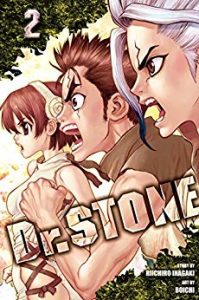
Dr Stone, Vol. 2

December 23, 2018 by Anna N

Dr. Stone Volume 2 by Riichiro Inagaki and Boichi

The second volume of Dr. Stone featured fewer scenes of crazy science action, but it did spend a more time on world building and setting up the conflict between the friends Senku and Taiju and newly revived but reactionary classmate Tsukasa. Senku is determined to push technology forward by manufacturing gunpowder, in order to give his group an advantage. The gunpowder sets off a plume of smoke which is answered by another smoke signal, indicating that the teenagers might not be alone in their post-apocalyptic world where everyone has been turned into stone.

Dr Stone 2

There was a flashback chapter showing Senku, Taiju, and Yuzuriha when they were young and pursuing Senku’s childhood dreams of rocketry. It was nice to see a glimpse of this mini friend group as little kids, and it played in well to how they work together to survive a hostile environment. Taiju and Yuzuriha have to figure out how to rescue their mad scientist friend, and we also get a glimpse of what Senku went through on his own, when he was the only human to wake up. There’s still plenty of dynamic science action in Boichi’s art, and while the second volume was a little less entertaining for me than the first simply because I was no longer as diverted by the initial premise of the manga, I’m curious to see how the conflict between Senku and Tsukasa is going to play out over the long term.

Female characters who exist mainly to be decorative and supportive is one of my shonen pet peeves, and at the end of this volume Dr. Stone seems to be heading in that direction. I’m not sure if all the genuinely enjoyable yelling about paleolithic science will be enough to offset those sort of plot developments, but I’ve liked the series so far.

Filed Under: Manga Reviews, REVIEWS Tagged With: Dr. Stone, Shonen, Shonen Jump, viz media

Sword Art Online, Vol. 15: Alicization Invading

December 23, 2018 by Sean Gaffney

By Reki Kawahara and abec. Released in Japan by ASCII Mediaworks. Released in North America by Yen On. Translated by Stephen Paul.

I was expecting that this volume would be a bit of a letdown after the highs of the previous work. Sadly, it’s even worse than I had anticipated: I actively don’t like this volume. Well, parts of this volume. We can divide the books events in half. Half of it involves Alice, having run away from the Integrity Knights at the end of the last book, living in the woods with Kirito, who is unresponsive and seemingly braindead. She’s struggling to find a purpose to fight, and various circumstances seem to give her that. This is not great writing, but it’s at least decent, and helps to set up the next couple of books. Alas, we then have the other half of the book. Even a Monkey Can Draw Manga discusses Shonen Power Creep, but there’s another aspect that Kawahara really suffers from, Shonen Villain Creep. Each villain has to be worse and more monstrous than the last one, doing even more evil things. So, ladies and gentlemen, meet Gabriel Miller.

Gabriel is introduced to us as a young corporate executive type, and we then flash back to his childhood, where he lived a comfortable life, met a nice sweet young girl to be his childhood friend, and then… well, Gabriel is a sociopath, like so many other of Kawahara’s villains, so you can probably guess. He’s part of a terrorist squad invading the ocean turtle, where Asuna and Kirito’s body are currently, in order to get the results of their experiments – Alice. He seems to regard humans and bugs exactly the same way, and is a thoroughly unpleasant individual. (He is assisted by another evil guy named Vassago, and I suspect that we may be familiar with him from previous volumes, though I will hold off till it’s confirmed.) Gabriel and Vassago are locked away from the Underworld, but they can still become “characters” in it. Which they proceed to do, as Gabriel is now the Demon Lord invading the human world.

The main problem with this book, and it’s teeth-grinding, is that half of it is from Gabriel’s POV. Given I already hate the way Kawahara writes villains, having to experience their thoughts for so long is unbearable. There’s also a couple of horribly violent deaths in the book, both women of course, there to make the reader feel sad and also make me wonder if the author had recently watched Se7en. (Speaking of which, Kawahara is rewriting his webnovel and editing it, and he changed events in Book 11 so that Ronie and Tiese are not, in fact, raped – however, dialogue towards the end of this book shows that he isn’t very good at cleaning up the mentions of it after the fact.) This may come as a surprise to the casual SAO fan, but I really miss Kirito’s POV here. Alice’s uncertainty and Gabriel’s loathsome villainy just make this book very hard to read. Oh yes, and Gabriel has also been in Gun Gale Online, and wants to do nasty things to Sinon as well. So that’s just great.

This was originally written when Kawahara was a much younger man, and it shows – it reads like the sort of thing an emo guy would write in order to be grim and gritty. The author, I think, realizes this – after the anime adaptation of Vol. 11, he publicly apologized for the rape scene, and said he wouldn’t write that sort of thing anymore. Unfortunately, it does mean we still have to plow through this book, which is filled with setup for cooler events to come, as well as appalling sadism. I won’t say to skip it, but you won’t enjoy it.

Filed Under: REVIEWS, sword art online

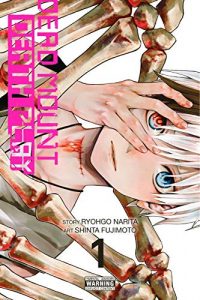
Dead Mount Death Play, Vol. 1

December 22, 2018 by Sean Gaffney

By Ryohgo Narita and Shinta Fujimoto. Released in Japan by Square Enix, serialization ongoing in the magazine Young Gangan. Released in North America by Yen Press. Translated by Christine Dashiell.

Sometimes you get so used to a specific author’s tropes and themes that you can tell from a cursory read that a work happens to be by that author. That said, it took a while for me to feel like this was written by Narita, the creator of Baccano! and Durarara!!. Starting in a fantasy world with a battle between a paladin and a skeleton lord is not really his deal, at least not in what we’ve seen over here. But once we move back to the modern world, and the “hero” starts describing people as toys? Once you see a sociopath who commits the most horrible crimes with a smile on her face? A ganster-like organization with a “family” feel and cops who are not afraid to use suspicious methods to get justice? Yeah, that’s Narita all right. Here he’s doing a “reverse isekai”, as the death lord from the prologue ends up inside the body of a young man in our world.

Polka is that boy, and his actual self seems to have been moved out of his own body so that the corpse lord can take it over. (It’s OK he ends up inside a plushie shark.) You worry Polka will start up his old ways, but it turns out he was a misunderstood corpse lord with friends who were killed because they associated with him, so it’s all good. Unfortunately, the real Polka has an assassin’s contract out for him, and the assassin, Misaki, is a smiling high school girl who is rather annoyed that the kid she stabbed through the throat sn’t dead. That said, she gets over it rather fast, especially once he kills and then revives her as a corpse – which, honestly, she’s much happier being. Along with a young man who doesn’t seem to leave his control room and communicates through drones, he’s here to figure out this magicless world, though he can still use plenty of magic.

Polka, in his “possessed” form, reminds me not a little of Huey Laforet, who also considers people his toys. That said, he’s not QUITE as morally nihilistic as Huey, and can tell right from wrong. Which is more than Misaki, who seems like what you’d get if you fused Anri from DRRR!! and Elmer from Baccano!, horrifying as that thought is. The rest of the cast are still unfolding, though the two police officers seem like they stepped off the pages of Gangsta. For the most part, this is a fun little action manga with a few mysteries, mostly content to coast along on mood. Be advised it’s a rated M title, though you get the sense that this is more the editors telling the creators “insert lesbian sex here” than any real plot relevance. It’s very Murcielago-ish in its lesbian sex scenes.

If you like DRRR!! and Baccano!, you’ll want to pick this up. Fans of reverse isekai and mindless sex and violence might also enjoy it.

Filed Under: dead mount death play, REVIEWS

Kagerou Daze VIII: Summer Time Reload

December 21, 2018 by Sean Gaffney

By Jin (Shinzen no Teki-P) and Sidu. Released in Japan by Enterbrain. Released in North America by Yen On. Translated by Kevin Gifford.

(This review gets even more spoilery than I normally do, FYI.)

I will admit, those who are only familiar with Kagerou Daze via the light novels themselves, rather than the franchise in general, may be a little dissatisfied with the ending. It’s not really that the villains win or even that most of the cast die, it’s that it all ends with a big old reset button. We tried a cool plan, it didn’t work, and so we’re going back to try something else – which, it turns out, they’ve been doing for a long, long time. Kagerou Daze is not a visual novel, but like Higurashi and Little Busters, it revolves around repeating a sequence of time to try and fix things. In the case of the light novel, things don’t get fixed. Oh, there are some survivors – the “side story” in this book deals with Seto and Marie after everything else has already happened, and Hibiya is still around as well – but no one really wins. Not even the villains.

That said, the novels are not all there is to Kagerou Daze. The books are based on a series of songs, and the final song in the “main” series, Summer Time Reload, is also the title of this book. It implies the majority of the cast survive, though they may forget about all this. There’s also the manga, which is just about to wrap up in Japan, and clearly tells a different version of events from the books and the songs. And there’s also the anime, Mekakucity Actors, which may annoy fans for various reasons, but also arguably provides the most closure. All the spinoffs are different kinds of flavoring to the main plot. Here, with prose, we get a lot of monologues showing off the emotional state of the cast – in fact, I would argue that Jin is better at this than he is at actual plotting.

There’s also an awful lot of shipping in this last volume, which surprised me. Kagerou Daze has a large shipping fandom – it’s got about 2.5K fics on Fanfiction.net – both het and otherwise. You don’t see much of the otherwise here, but other shippers should be pleased. Haruka clearly ships Shintaro and Ayano, and is visibly upset when their reunion in the Daze is less about “Sorry I forgot to say I love you before you killed yourself” and more “how do we stop the villains”. Hiyori, who I suspect the majority of readers may have forgotten about, pops in at the end too, and she’s just as tsundere as ever, though she does manage to spit out words very few tsunderes ever have. And the entire book is about Seto and Marry’s relationship, and how they’re family but also clearly want to have more, at least on his side. Sadly, his desire to protect is sort of destroying anything else they might have.

Jin’s afterword is very self-deprecatory, and I get that. These aren’t the best written books, especially in translation – there were several times when I could have used a “this character is now our narrator” slug at the top of the section. And Seto really did get the least focus of any character, coming off as a bit wet in the process. That said, in terms of emotion and character, Kagerou Daze was a fast favorite for me. The books make me want to listen to the songs, read the manga, and watch the anime all in a marathon. Which is all you can ask from a franchise spinoff.

Filed Under: kagerou daze, REVIEWS

Manga the Week of 12/26/18

December 20, 2018 by Sean Gaffney, Michelle Smith, Ash Brown and MJ 1 Comment

SEAN: Christmas is over! At least for Manga the Week of. We’re looking beyond that to Boxing Day. Is there manga? There is!

ASH: Hooray!

SEAN: And there are also light novels. J-Novel Club has a 5th volume of Infinite Stratos and the 3rd Kokoro Connect.

Kodansha has, for print, a 13th Fire Force and a 16th Missions of Love (still not over, but coming out so rarely that it seems like it is.)

ASH: It does seem like it has been a while.

SEAN: Digitally there’s a lot more, as we see Ace of the Diamond 18, Ao-chan Can’t Study! 3, Defying Kurosaki-kun 6, Forest of Piano 9, Liar x Liar 9, and Mikami-sensei’s Way of Love 2.

MICHELLE: Most of that is shoujo that doesn’t appeal to me, but at least there’s Ace of the Diamond and Forest of Piano!

SEAN: The rest of the list is Seven Seas. The new title is Ojojojo, the latest in the “Miss Kobayashi’s Dragon Maid was such a huge hit that we’ll license everything else by the same author” series. It’s coming out in an omnibus of the first two books, and does look pretty cute. It’s about two different types of outcasts who bond at school.

There’s also the 2nd manga volume of Didn’t I Say to Make My Abilities Average?!, the 3rd and final Dragon Half omnibus, a 3rd Giant Spider & Me (also a final volume), the 6th (and, yes, final) volume of NTR – Netsuzou Trap, and the 2nd volume of Slumbering Beauty, which is – try to contain your surprise – the final volume.

MICHELLE: One of these days I really will read Giant Spider & Me.

ASH: I’ve been delighted by it! Dragon Half is fun, too, and I liked the first volume of Slumbering Beauty as well.

SEAN: Has all the manga ended? Or was this merely Seven Seas’ CLEVER PLAN? Also, what are you buying?

ASH: Looks like it will be a Seven Seas sort of week for me!

MJ: Okay, so I’m probably not into any of this, but I just wanted to keep you all company. Hi.

Filed Under: FEATURES, manga the week of

Danganronpa 2: Ultimate Luck and Hope and Despair, Vol. 1

December 20, 2018 by Sean Gaffney

By Spike Chunsoft and Kyousuke Suga. Released in Japan by Mag Garden, serialized in the magazine Beat’s. Released in North America by Dark Horse. Translated by Jackie McClure.

I tried to play the first DR game, but never got far due to frustration over a “gatcha” system giving you random pointless things. In other words, a typical game experience. I do know enough about the franchise, though, to know that the second in the series was more popular than the first, at least over here. As such, licensing the manga seems like a lock. That said, I think that once again this is a manga to read if you’ve already played the games – there’s very little help given to the newbie reader, and the character introductions come fast and furious. Given the large cast, and the complete lack of holdovers from the last game/manga (mostly), it’d normally be hard to get a handle on who we should be following. The player character is clearly Hajime Hinata, a weird fusion of Naegi and Kirigiri from the first series, but being a player character he’s pretty blank and dull. So the manga focuses instead on Nagito Komaeda, who… isn’t.

Danganronpa 2 takes place on an uncharted desert island, where the cast wake up after being in school previkously. They’re supposedly led by a rabbit bascot named Usami, but Monokuma quickly takes over by force and decides to restart the usual killing games. Quite how Monokuma’s mastermind is alive after the last game is not clear, but oh well. Everyone tries to make the best of it with a party, but midway through the power cuts out, and when the lights come back on, oh look, somebody’s stabbed. It’s Byakuya Togami who… seems different from the last time we saw him, and also a lot heavier. OK, frankly, the discerning reader knows it’s NOT Byakuya Togami, but as to why someone is impersonating him… we don’t really find that out either. There are very few answers in this book, but a lot of setup, and a lot of Komaeda. The conceit of this manga is that it’s from Komaeda’s “POV”.

Komaeda is a piece of work, and reminds me quite a bit off Izaya Orihara from the DRRR!! series. He says that he’s trying to prove that hope exists in a world of despair, but seems to want to accomplish this by getting everyone around him to despair and see if someone manages to beat him. He has a lot of “laughing crazy” faces too, as well as a heap of bromantic tension with Hajime. As for the rest of the class, so far there aren’t many standouts. One tanned athletic girl gives me memories of Aoi Asahina. There’s a nurse whose personality and looks are reminiscent of Hinata from Naruto, though Hinata never quite fell and exposed herself quite the way Mikan does constantly. (This seems to be a fanservicey running gag, and it’s awful, frankly. DR is still written for teenage boys in Japan, no matter how much ho yay may be in it.) And there’s a gamer girl who may be the Kirigiri to Hajime’s Naegi. But yeah, mostly still a faceless mass.

I believe this series is only three volumes in Japan, so I’m not expecting much in terms of coherence. That said, if you like Komaeda, it’s an easy purchase. He is all over this manga, and he is dramatic as fuck. Which is all the player wants, really.

Filed Under: danganronpa, REVIEWS

Der Werwolf: the Annals of Veight, Vol. 2

December 19, 2018 by Sean Gaffney

By Hyougetsu and Nishi(E)da. Released in Japan by Earth Star Entertainment. Released in North America by J-Novel Club. Translated by Ningen.

I’m always pleased when a second book in the series proves to be even better than the first, and that’s definitely the case with Der Werwolf. I enjoyed the first book quite a bit, but the second volume steps up its game, showing off Veight’s political and diplomatic skills in the first half, then pulling the rug out from under the reader with a plot twist I wasn’t expecting for a few more books yet. Perhaps best of all, there’s virtually none of the typical isekai cliches in this book – probably as the “I’m from Japan” part is still mostly irrelevant. There’s no gamer terminology, dungeon levels, and the romance is kept very much on the back burner – i.e. there isn’t any yet, though there’s clearly a few women who like Veight. Instead, we are simply reading a fantasy book. It reminds me a lot of The Faraway Paladin, and fans of one should enjoy the other.

At the start of this book, Veight is interested in expanding his allies on the Southern half of the continent, so reaches out to a pseudo-Arabian city along the coast. As with the first book, we occasionally get the viewpoints of other characters (though I wish they were marked off in the text a bit better – it can be tough to tell when we’ve left Veight’s viewpoint and when we return), and that helps here to show off the rock and the hard place that the other city is caught between, and also how Veight thinking that he’s being calm and reasonable is seen by other people as Veight being threatening and terrifying. In fact, there’s a running gag here, even more than the first book, of Veight saying he’s “just a vice-commander” and denying that he’s anything special, despite constant evidence to the contrary. It would be annoying if he were doing it deliberately, but he means it, so it’s just funny.

The second part of the book is much darker. We’d been introduced to the concept of a Hero arriving and challenging the Demon Lord at the start, but this proved to be a false lead (though it did get us another cute girl character, the stressed-out mage who can do illusion magic). Then a real hero does show up, and things go badly very quickly. It’s great to see how the concept of a hero here, in a book essentially narrated by “bad guys”, is that of a fiercely destructive force that none can stand against except the Demon Lord himself. Even more intriguing, there’s clear backstory between the hero and the Demon Lord, apparently involving a woman… but we never really get to find out what it is, except it’s made the hero hell bent on revenge. Actually, I’ll be honest here, I was expecting things to get even MORE dark, but thankfully things got a little better at the end, and Veight gets to go on being the most humble yet awesome vice-commander ever.

This is a pretty long-running series in Japan, so we have a ways to go. This pleases me, as reading these volumes is a treat. I highly recommend Der Werwolf to anyone who enjoys good light novel fantasy without the “light novel” cliches.

Filed Under: der werwolf, REVIEWS

Bookshelf Briefs 12/18/18

December 18, 2018 by Ash Brown, Sean Gaffney and Michelle Smith Leave a Comment

Ao Haru Ride, Vol. 2 | By Io Sakisaka | Viz Media – Changing yourself is hard. As is high school. As a result, much of this volume revolves around Futaba’s good intentions and attempts to make everything somehow work out not succeeding very well. We are definitively introduced to what appear to be the rest of the core cast, though some of them are still mostly ciphers. The main story is still about Futaba and Kou, and they can’t really go backwards. Still, do they want to go forwards? Trying to fall in love while also trying to make friends and get through school is the reason most high school romances don’t work out. Still, this is shoujo manga, so they have a leg up on real life. I’m enjoying this series so far, even though it’s more dramatic than I expected. – Sean Gaffney

As Miss Beelzebub Likes, Vol. 4 | By Matoba | Yen Press – Since my last review, the anime has come out, and while I’m watching it and quite like it, there’s no denying it’s a bit of a bomb in the Western fandom. But I’m sorry, the series is just so cute and fluffy it can’t help but put a smile on my face, except when the shotacon shows up, when I flick pages fast till she’s gone. There is a lot of focus here on Molech, the loud and outgoing demon who is the quintessential obnoxious extrovert stereotype. Since I can be like this at times as well, though never to this level, I can sympathize. Mostly, though, you read this to see Beelzebub and Mullin have adorable crushes on each other, and to see Belphegor’s disastrous crush (and bladder issues, which I could also do without). Not good, but I don’t really care. – Sean Gaffney

The Delinquent Housewife!, Vol. 2 | By Nemu Yoko | Vertical Comics – The first volume had the focus on Komugi, the housewife who’s trying to hide her delinquent past. The second book looks more at Dai, her brother-in-law who is falling in love with her despite himself. I will admit, I’m more interested in Komugi’s past than I am Dai’s crush on an older woman. The reason that Dai’s family hates delinquents so much is one of those things that seems minor but to the people involved is a huge deal, and I like that Komugi gets that immediately. She’s just a nice girl, and I think she should eventually win over the family, assuming her husband ever returns. Will that happen? Good question, and I suspect we’ll get more love comedy chapters before it’s answered. – Sean Gaffney

The Honor Student at Magic High School, Vol. 9 | By Tsutomu Sato and Yu Mori | Yen Press – The trouble with side-story manga like these is that they eventually have to follow the plot of the main series. Which is fine, and it’s nice to see Tatsuya being cool, but watching the main cast of this series sit in the audience and cheer him on is not really the reason I want to read this manga. Fortunately, we get to see Honoka’s match before this, which was not in the novel, and it’s pretty nifty, showing off her abilities to a good extent—she’s no Miyuki, but there’s a reason she does so well. As for Miyuki, we get the scene where she mocks Erika for having a brother complex, but I dunno, I don’t feel it plays as well in this format. A lesser volume of a good series. – Sean Gaffney

Kuroko’s Basketball, Vols. 29-30 | By Tadatoshi Fujimaki | VIZ Media – Kuroko’s Basketball comes to a close in this fifteenth and final omnibus. It’s the Winter Cup finals and Seirin is facing off against Rakuzan, a formidable team that not only includes Akashi but three of the “uncrowned generals.” There is a fair bit here that is ridiculous, like spectators being able to discern when a player has activated his “wild instincts” or accessed another level of “the zone,” but there is also a lot to like, including some welcome spotlights on background players like Koganei and Izuki. I confess that I sniffled when a certain person in the stands yelled encouragement when Seirin was about to give up. And then everyone learns a valuable lesson about teamwork. Ultimately, Kuroko’s Basketball wasn’t the best sports manga I’ve ever read, but it was consistently entertaining and comes to a satisfying conclusion. – Michelle Smith

My Hero Academia, Vol. 16 | By Kohei Horikoshi | Viz Media – I was right about this being all action, and there’s a lot of cool fights throughout, though I wish Uraraka and Tsuyu got more to do. That said, even Midoriya doesn’t get quite as much of a spotlight. Instead we get Kirishima, who’s dealing with his quirk still being a work in progress. We get his past in this volume, where he’s a lot meeker and more indecisive guy. It’s nice to see someone like Kirishima, clearly a different person in middle school, contrast with his classmate Ashido, who is pretty much exactly the same then as now. That said, the bad guys are doing pretty well for themselves, and our heroes still aren’t anywhere near Eri. Oh, and here comes Himiko Toga and her orgasm faces again to make things creepier. Solid volume. – Sean Gaffney

The Promised Neverland, Vol. 7 | By Kaiu Shirai and Posuka Demizu | VIZ Media – The underground shelter that the kids find at the coordinates provided by William Minerva turns out to be amazing—beds, hot water, clean clothes!—but not only is the man himself not present, they’ve got to contend with a mentally unstable guy who made the escape himself thirteen years ago and whose companions all died in a mysterious manner. By the end of the volume, he’s agreed to guide Ray and Emma to the next place while plotting to kill them and has purposefully set a bunch of man-eating creatures on them. This guy is pretty fascinating, and I continue to love the problem-solving elements of the series and the intelligent lead characters, but my favorite aspect is just how badass Emma is getting. Some of the shock value in this series has subsided, but it’s still a really terrific story. – Michelle Smith

Takane & Hana, Vol. 6 | By Yuki Shiwasu | Viz Media – This volume introduces a big wrench in the plot, and it’s just at the right moment, too. Takane was starting to get a bit too far ahead in the relationship, and when you have something like this, with an adult businessman and a high school girl, you just can’t let the power balance get too one-sided. So I approve highly of Takane’s grandfather’s actions, even as they seem to completely break Takane, who we see is far more reliant on having lots of money than even the reader had previously expected. As for Hana, well, she may be falling for him, and admitting it to herself, but let’s face it, it’s all about that last scene, which made me laugh with glee. I love it when these two smug at each other. – Sean Gaffney

Tomo-chan Is a Girl!, Vol. 2 | By Fumita Yanagida | Seven Seas – The expansion of the cast comes at just the right time, as we’ve got a number of volumes still to go, and I know that Tomo and Jun aren’t going to be getting together in any of them. So it’s nice to see that we also have another hilariously oblivious relationship involving Carol, who is not nearly as airheaded as she acts, and her childhood friend Kosuke, who thinks of her as a little sister, much to her exasperation. We also get to see the seemingly perfect and stoic Misuzu get jealous, something that is so unusual that everyone seems to be commenting on it. I am very happy with this series as it does not focus entirely on the romance between Tomo and Jun (or lack thereof), but Tomo’s friendships. – Sean Gaffney

Versailles of the Dead, Vol. 1 | By Kumiko Suekane | Seven Seas – I’m a little worn out on zombie fiction, so it takes a bit more to secure my interest in a series than it simply emerging from that particular subgenre. In the case of Versailles of the Dead, that something extra is cross-dressing and 18th-century French court intrigue. Albert is the twin brother of Marie Antoinette, close enough in appearance that he has on occasion served as her body double. When Marie dies while traveling on her way to become Queen, Albert once again takes her place. There is quite a bit going on in Versailles of the Dead—palace infighting, demonic possession, political and religious schemes, supernatural plots, and the beginnings of a revolution to name only a few prominent elements—so much that the series hasn’t completely found its footing yet. But it’s more than enough for this dark historical fantasy to compel me to read the second volume. – Ash Brown

The Young Master’s Revenge, Vol. 4 | By Meca Tanaka | VIZ Media – “All I can do is try my best to become worthy of her. In order to achieve that, I’m abandoning all my pride and learning to love turtles.” Man, I’d forgotten how dumb The Young Master’s Revenge is. Tenma loves Leo, but she’s convinced he’ll reject her once she admits it, since he told her as much earlier in the story. Leo loves Tenma, but he thinks she hates him for how he treated her. A lot of stupid misunderstandings ensue and then they finally get together—after he learns to embrace the turtle-inflicted scars on his butt as precious memories—and I just honestly could not care less. At least it’s over. – Michelle Smith

Filed Under: Bookshelf Briefs

  • « Go to Previous Page
  • Page 1
  • Interim pages omitted …
  • Page 340
  • Page 341
  • Page 342
  • Page 343
  • Page 344
  • Interim pages omitted …
  • Page 1053
  • Go to Next Page »
 | Log in
Copyright © 2010 Manga Bookshelf | Powered by WordPress & the Genesis Framework