• Skip to primary navigation
  • Skip to main content
  • Skip to primary sidebar
  • Home
  • About Us
    • Privacy Policy
    • Comment Policy
    • Disclosures & Disclaimers
  • Resources
    • Links, Essays & Articles
    • Fandomology!
    • CLAMP Directory
    • BlogRoll
  • Features & Columns
    • 3 Things Thursday
    • Adventures in the Key of Shoujo
    • Bit & Blips (game reviews)
    • BL BOOKRACK
    • Bookshelf Briefs
    • Bringing the Drama
    • Comic Conversion
    • Fanservice Friday
    • Going Digital
    • It Came From the Sinosphere
    • License This!
    • Magazine no Mori
    • My Week in Manga
    • OFF THE SHELF
    • Not By Manga Alone
    • PICK OF THE WEEK
    • Subtitles & Sensibility
    • Weekly Shonen Jump Recaps
  • Manga Moveable Feast
    • MMF Full Archive
    • Yun Kouga
    • CLAMP
    • Shojo Beat
    • Osamu Tezuka
    • Sailor Moon
    • Fruits Basket
    • Takehiko Inoue
    • Wild Adapter
    • One Piece
    • After School Nightmare
    • Karakuri Odette
    • Paradise Kiss
    • The Color Trilogy
    • To Terra…
    • Sexy Voice & Robo
  • Browse by Author
    • Sean Gaffney
    • Anna Neatrour
    • Michelle Smith
    • Katherine Dacey
    • MJ
    • Brigid Alverson
    • Travis Anderson
    • Phillip Anthony
    • Derek Bown
    • Jaci Dahlvang
    • Angela Eastman
    • Erica Friedman
    • Sara K.
    • Megan Purdy
    • Emily Snodgrass
    • Nancy Thistlethwaite
    • Eva Volin
    • David Welsh
  • MB Blogs
    • A Case Suitable For Treatment
    • Experiments in Manga
    • MangaBlog
    • The Manga Critic
    • Manga Report
    • Soliloquy in Blue
    • Manga Curmudgeon (archive)

Manga Bookshelf

Discussion, Resources, Roundtables, & Reviews

Blog

SPY x FAMILY

May 7, 2019 by Sean Gaffney

By Tatsuya Endo. Released in Japan by Shueisha, serialization ongoing in the online magazine Shonen Jump +. Released in North America by Shueisha on the Manga PLUS platform. Translated by Colin Milliken.

Over the last few years, North America and Japan have been trying to do something about piracy in various different ways, one of which has been simulpublishing. Putting out chapters at the same time as they’re released in Japan, for either a nominal charge, a yearly fee, or just plain for free. This means that we’re not merely getting popular new series from Japan after they’ve taken off, but we’re also getting potential hits – or bombs – as they debut. Shueisha, a few months ago, stuck their feet in the water with their Manga PLUS app/website, which gives readers a pile of series to read for free, from older titles like Naruto and Assassination Classroom to the newest chapters of current Jump series. Most of these are, I assume, done in conjunction with Viz Media. But they also had a bunch of debuts that run either in Jump Square or in Jump +, their online magazine, that are translated by the Media Do people. And none have quite hit the manga readership quite as hard or fast as Spy x Family.

Lloyd (aka Twilight) is a brilliant, if somewhat emotionally stoic, young spy, who is known for success. He is asked by his superiors to infiltrate a private school, the only location where a reclusive enemy is known to appear, and take him out. Unfortunately, the school has rigorous rules that are set in place, so in order to infiltrate, he’ll need a wife and child. The child is Anya, who he finds at an orphanage and snaps up when he sees she can read and write. The wife is Yoru, an office lady who is at that age where she really needs to have a man in her life (mostly as the Berlin Wall-esque world they’re living in tends to arrest unmarried older women as security risks). Together they can infiltrate the school. Oh, yes, there are a few more things. Yoru is actually Thorn Princess, a powerful hitman/assassin. And Anya is an esper, and can read the thoughts of everyone around her. The key to the series is that Lloyd and Yoru do not know each other’s secrets, and neither one of them know Anya’s. Anya can read minds, so knows both their secrets, but that’s OK, as they’re SO COOL!

If you’re wondering why this series has gotten so much buzz after a mere four chapters, well, it does nearly everything right. The characters are cool yet flawed, and each also have the opportunity to be funny. The future plotline will, I hope, have Lloyd and Yoru falling for each other for real, and that will be terrific, because they’re perfect for each other. And we all await with baited breath the moment that they find out about each other (though really, Yoru should likely have guessed when she was proposed to using a grenade pin as a ring). The series runs on cool and funny, and carries both off, from the sleek action moves when we see Yoru killing any number of bad guys, running after purse snatchers, or even judo flipping an enraged bull, to the ‘this is ridiculous’ savvy of Lloyd and Yoru packing multiple different outfits just in case their clothing is damaged and they have to change. And then there’s Anya, who is adorable and cute to the nth degree, and you just want to pick her up and hug her forever. Seeing Lloyd trying to open up to her, and her attempts to manipulate things so that he doesn’t abandon her like everyone else has (being a young esper is not a fun life) is incredibly sweet.

To sum up, this is a well-written, cool and hilarious series that you can read legally for free. And it’s only four chapters long (the first chapter is about 85 pages, so there’s a lot of content here), so you aren’t trying to catch up but are getting in on the ground floor. How long will it last? Well, I suspect that’s up to Japanese readers. I will say that it’s currently the 6th most popular series on the Manga PLUS site. Which, given it’s up against most of the current and past Shonen Jump lineup, is quite a feat. Go read it and make it even more popular.

Filed Under: REVIEWS, spy x family

Pick of the Week: Long Awaited Series

May 6, 2019 by Sean Gaffney, Ash Brown, Michelle Smith, Katherine Dacey, Anna N and MJ Leave a Comment

ASH: This week features the debuts of several series which I have been looking forward to a great deal — Diamond Is Unbreakable, Snow White with the Red Hair, Emanon — but Our Dreams at Dusk: Shimanami Tasogare happens to be one of my most anticipated releases of the entire year, so that’s my pick! I have heard nothing but wonderful things about the series.

SEAN: Having just read the first volume, the hype is entirely valid. I really want to read Snow White with the Red Hair as well, but the pick has to be Our Dreams at Dusk: Shimanami Tasogare.

MICHELLE: I plan to read both in the week they are released, which is saying something given the towering size of my to-read stacks, but yes, the edge must go to Our Dreams at Dusk this time.

KATE: I’ll carry the banner for Kenji Tsurata’s Emanon, which debuts this week. It’s a shame that Tsurata’s work isn’t better known in the US; though he isn’t prolific, his manga are beautifully drawn and populated by the kind of feisty, independent female characters that make any kind of story — mystery, adventure, romance — more enjoyable for grumpy old feminists like me.

ANNA: I’m not going to pass up the chance to celebrate a new shoujo title, so Snow White with the Red Hair for me!

MJ: There are a number of interesting titles debuting this week, but Sean is pretty persuasive, and I think I’ve gotta go with Our Dreams at Dusk: Shimanami Tasogare. I am a sheep.

Filed Under: PICK OF THE WEEK

My Next Life As a Villainess! All Routes Lead to Doom!, Vol. 3

May 6, 2019 by Sean Gaffney

By Satoru Yamaguchi and Nami Hidaka. Released in Japan by Ichijinsha. Released in North America by J-Novel Club. Translated by Shirley Yeung.

The author admits in the afterword that the series was supposed to end with the second volume, which was pretty obvious (see my review of said volume), but presumably the series did well enough for more. As such, this is the “difficult second album” for Bakarina, with the first half of the book in particular spinning its wheels and showing us the same sort of thing that we’ve seen before. Katarina goes around the school festival with her classmates, eating lots of food, and coming across her friends one by one as they attempt to either flirt with her or cut off others flirting with her, which Katarina herself remains blithely oblivious. And, of course, we then get to read it again, because one of the conceits of the book (which I sometimes quite enjoy – see the second half of the volume) is that we see Katarina’s POV followed by other POVs of the same scene. It can be exhausting.

The best part of the first half of the book is the play, where one of the actresses falls ill and Katarina has to take on the role of the wicked stepsister. (I thought this was a ploy by Jeord, but apparently not.) Since she blanks on her lines, she just decides to act the part on instinct, and everyone is amazed at how well Katarina can play a villain! It’s metatextually delicious, frankly. The meat of the book, though, is in the second half, as Katarina is kidnapped as part of a plot to get Jeord to give up his claim to the throne. This is supposedly engineered by the second price’s fiancee Selena, but she’s more an easily led dupe. (Her idolization of Katarina also shows that our heroine is not the only one in the cast to completely misinterpret everything.) In reality, it is the smiling “butler” Rufus who is doing this, theoretically on behalf of the eldest son.

There are no real surprises in Bakarina, to be honest – even the secret identity of one of the characters was easily guessed once I saw their reaction to Katarina being Katarina (hysterical laughter – she’s clearly a reader stand-in). You read this series because you enjoy seeing Katarina being dense, and also because you enjoy seeing Katarina converting everyone around her with the sheer power of her niceness. This world, as it’s an otome game, runs on tropes, and this gives Katarina, who has memories from the real world, an advantage at times in dealing with people unable to understand why in God’s name she’d go this far for someone. That said, we may have finally hit a turning point regarding the main relationship, as after being scared out of his wits by Katarina’s kidnapping, and also seeing that Rufus (who now loves her, of course) bit her on the neck, responds by kissing her, and explicitly stating his love. Even Katarina can’t ignore this. Right?

There is some setup for future books here, as graduation is coming soon and we’;re clearly going to have Katarina working for the Ministry with Maria… and no doubt the rest of the cast. Still, this was an enjoyable book despite all its flaws, and got better as it went along. It’s definitely a book where you see the smoke pouring out of the author’s brain as they write, though.

Filed Under: my next life as a villainess, REVIEWS

Dr. Stone, vols 3 and 4

May 5, 2019 by Anna N

Dr. Stone Volumes 3 and 4 by Riicharo Inagaki and Boichi

Dr. Stone’s premise of a post apocalyptic world where the heroes have to invent their way back to human civilization while battling factions of Luddites is much more of a higher concept than one tends to get in shone series, and so far I’ve been enjoying seeing how Senku attempts to invent his way out of sticky situations. In volume 3, the cast of characters for Dr. Stone expands as Senku stumbles across a small village of people who are to him, the missing manpower ingredient need to power even more ambitious science experiments.

He meets Kohaku, the daughter of the village chief who promptly becomes an ally when she realizes that the power of science might save her sister and tribe shamaness Ruri from a terminal illness. Chrome is another villager who is a self-styled sorcerer due to knowledge gained from his own scientific experiments and rudimentary mineral and chemical gathering. With allies in place, Senku decides to build a new “Kingdom of Science” and power his inventions even further out of the stone age, in an attempt to get in a better place to deal with threat posed by the anti-science Tsukasa. The villagers are naturally extremely suspicious of the newcomer, but Senku has a unique solution in the form of food science. He decides to reinvent ramen in order to woo people to his side.

The village brings with it extra drama, as Senku races through inventing electricity, iron, and glass in order to have a functional chemistry lab to produce medicine, Kokaku has to worry about the battle for Riri’s hand in marriage that will determine the next village chief. Her friends prepare to fight to save Riri from the thuggish Magma. Even Senku’s ability to synthesize energy drinks might not be much of a help in a bracket-style fighting tournament that will decide Riri’s future. These two volumes were plenty diverting with the struggles of recreating inventions full of dynamic adventures, but I can’t help but wonder what on earth Taiju is up to! Hopefully in the next few volumes Senku’s expanded science team will come together again.

Filed Under: Manga Reviews, REVIEWS Tagged With: Dr. Stone, Shonen, viz media

Saving 80,000 Gold in Another World for My Retirement, Vol. 1

May 5, 2019 by Sean Gaffney

By FUNA and Touzai. Released in Japan by Kodansha. Released in North America by Sol Press. Translated by Lukas Ruplys.

This is the third of FUNA’s series to be brought over to the West, but it was apparently the first one serialized (though they do say this and Potions debuted almost at the same time). Having now read all three, there’s no question why Make My Abilities Average! got the attention and the forthcoming anime adaptation: it’s the best of then. Potions gets by on Kaoru being somewhat terrifying rather than cute and plucky, and both it and MMAA have the heroines having to deal with situations where they’re dealing with permanently being in another world, even if they’re loaded up with ridiculous cheats. Mitsuha, though she appears to “die” and be reborn in a fantasy world, in fact has it the best of all of them. As a result, the danger level in this first book is fairly low, and it’s not as interesting as a result. That said, if you enjoy FUNA’s ridiculously OP heroines, there’s a lot to like here.

Mitsuha starts off the book pretty badly, to be honest. She’s not dead like Mile or Kaoru, but her parents and older brother are, leaving her alone and dealing with the fallout. One day at a lookout point, she’s attacked by some young creeps (she’s 18 but looks 12, in the best anime cliche tradition) and they accidentally push her off the edge onto the rocky cliffs below. She wakes up in a forest, and after walking herself to collapse finds herself in a rustic cabin… indeed, in a rustic world. Eventually she discovers that she can transport herself between this world and Japan, and, thanks to some friendly deus ex machinas who explain why she isn’t dead, she also can speak any language and has a healing factor. So what’s a young, recently orphaned young woman to do? Why, earn a pile of gold coins in the fantasy world, convert it over in Japan, and live a life of ease! Except she’s a FUNA heroine, so adventure and ridiculousness is bound to follow.

As with Mile, and especially Kaoru, there is a risk of Mitsuha coming off as uber-smug, especially when she’s doing things like bribing mercenaries to teach her how to use knives and guns, or showing off her general store with amazing inventions such as store-bought shampoo. (There’s also FAR more intrustive fourth-wall breaking in this book.) This being the case, I thought the best scene in the book is when she’s ingratiating herself with the local noble family, all of whom are taken in by her sob story (adapted for the fantasy world), and she gets carried away and calls the patriach “Father”… then starts to unconsciously cry. It’s a reminder that the author really does remember the character backstories, and this is a young woman who recently lost her entire family, who appeared to be pretty loving from what we hear (though the brother was a bit of an otaku). It’s a nice bit of grounding that helps you smile and nod when you see Mitsuha use dry ice and the power of FISH to wow everyone at a debutante ball.

This is my first Sol Press purchase. The translation was good, but the digital formatting was merely eh. They need to figure out how to make the interstitial pictures be one page on their own, rather than having text on the same page. That said, if you’re looking for silly heroines, and have run out of Make My Abilities Average!, this is a pretty good purchase.

Filed Under: REVIEWS, saving 80000 gold in another world

Our Dreams at Dusk: Shimanami Tasogare, Vol. 1

May 4, 2019 by Sean Gaffney

By Yuhki Kamatani. Released in Japan by Shogakukan, serialization ongoing in the magazine Hibana. Released in North America by Seven Seas. Translated by Jocelyne Allen. Adapted by Ysabet MacFarlane.

I had heard a great deal of buzz about this title when it was licensed and before, but hadn’t really experienced it beyond people on Tumblr posting pictures of some of the stunning artistic concepts that form part of its story. Having now read the first volume, I remain deeply impressed with the art, but also drawn in by the story and characters. Our Dreams at Dusk gives us a look at LGBT people in Japan and their attempts to deal with these feelings that society – and their own family and peers – tell them is shameful. At its heard is a community founded by the very mysterious “Someone-san”, whose name we don’t know but who has brought together people who need to be able to confess their feelings to, well, someone. It can’t keep being bottled up and repressed. As we see in this first volume, some are more successful than others. And just because you “come out” doesn’t mean your problems are over.

Tasuku is our protagonist, who is high school kid who we fist meet when he’s debating whether he should leap to his death from a high wall. Flashbacks show that someone at high school grabbed his phone and found his browser history, and now are asking if he’s into “gay porn”. He denies it, using a slur he detests, but the truth is that he is gay, though he hasn’t – and feels he cannot – tell anyone or his life will be over. Just the thought of having to return to school the next day drives him to the brink. Before he can do anything, though, he sees a person leap out of a window much higher than where he is. Rushing to the building they were in, he doesn’t find the jumper, but his blurting out that “someone fell” leads him to Someone-san and the group there. Over the course of the book, he opens up to some of them, clashes with others, and continues to go to school, where his crush is on the volleyball team.

Of course, the ensemble cast is important as well. We meet an older man who seems to love Tchaikovsky, a tween-ish child who seems to dislike Tasuku on sight, the friendly and hard-working Utsumi, and Haruko and Saki, a lesbian couple who are still having some issues – Haruko has come out to her family and friends, and dealt with the fallout, while Saki still hasn’t said anything to her family. We also see that the group is not a perfect, all-loving conclave – Saki trying to drag Tasuku into her argument with Haruko shatters the mood a bit. And there is, as I noted, the art, which for the most part is elegant and expressive, but every once in a while shows us a two-page spread of artistic abandon trying to show the torment and desires in the main characters’ hearts. It’d be worth reading the series just for that – but we’re fortunate yo have much more to it.

There’s certainly more to this story, which recently ended in Japan at its fourth volume. I suspect the second one will deal with the kid who clearly does not like Tasuku at all. In the meantime, believe the hype – this is definitely worth your time and money.

Filed Under: our dreams at dusk, REVIEWS

The Devil Is a Part-Timer!, Vol. 13

May 3, 2019 by Sean Gaffney

By Satoshi Wagahara and 029. Released in Japan by ASCII Mediaworks. Released in North America by Yen Press. Translated by Kevin Gifford.

I’ve said for a while now that this series does a good job of having romantic interests in it but sort of keeping it on the back burner rather than being a full-blown romantic comedy. Well, that changes with this volume, which devotes a large chunk to our heroines and how they feel – in this case, Chiho, who has now confessed to Maou TWICE but still hasn’t gotten much of anything from him, and Rika, who is in love with Ashiya and decides to do something about it when he invites her out for dinner and cellphone buying. Things arguably don’t go well for either of them, but in Chiho’s case there’s a larger issue, which is that she worries that soon she’s going to have to do other human stuff – study for exams, go to college, etc. – and will not see her supernatural friends anymore. Especially given Laila is still trying to get them on board with her big project, which could take a month to complete… or a hundred years.

There are a lot of confrontations in this book, and it’s interesting that some of them we only hear about secondhand. We see a teary Chiho run into Suzuno, but their conversation is heard second-hand later on, and Maou being “punished” for upsetting Chiho is also off screen (well, the setup, anyway). I’m not sure if this is just because the author is trying to keep the books to a certain length, but it is somewhat odd. We do get a great conversation between Chiho and Rika, two characters who are both best friends with Emilia but rarely interact. I worried that Rika and Ashiya’s date would also be off screen, but we do see that, and also Ashiya rejecting her… in fact, he tries to do the “I am too scary, please never see me again” thing, but Rika’s too smart to fall for that, though he is pretty damn scary. I did enjoy seeing Rika tell Chiho that she could possibly be the exception to the “demons don’t have human lovers” thing.

As for the main plot, Laila provides most of the humor in this volume in her desperate attempts to explain why she needs Maou and Emilia’s help. We first hear about the issues via a term paper (no, really, that’s how it reads), and it helps us to understand why everyone is so wary of her – she’s been living on Earth, but is she just an angel in disguise, or is she actively trying to fit in and be human like the others? We eventually find out it’s the latter, and why she’s been so wary of taking anyone to her apartment, in a joke that you can see a mile away but is no less satisfying. It does, however, lead to the big reveal, which is that what Laila is asking will take forever, and some of the people involved are normal humans who will grow old and die. But Maou isn’t… and neither, it turns out, is Emilia, whose half-Angel background means she could live a lot longer than anticipated.

In the end, Maou tries to be nicer about it, but still hasn’t responded to Chiho’s resolve. He can’t keep avoiding it forever, and it’s not as if the answer is “I like Emilia instead”, as he doesnt. If anything, he’s in love with his work. Which is appropriate for this series. What happens next? Can’t wait to find out. Sure hope the next volume isn’t a collection of short stories or something.

Filed Under: devil is a part-timer!, REVIEWS

Manga the Week of 5/8/19

May 2, 2019 by Sean Gaffney, MJ, Michelle Smith, Anna N and Ash Brown 3 Comments

SEAN: Sometimes one book sort of takes all the attention, like a black hole. We’ll do our best to mention everything else as well, though.

Dark Horse debuts Emanon, by the artist of Spirit of Wonder (anyone remember that series?) and based on an award-winning novel. It looks quiet and mysterious. It runs in Comic Ryu, so that may not be the case, but…

MJ: Hm. Interested.

ASH: I’ve been enjoying Wandering Island, the creator’s other series in English, so I’ll likely be giving this one a look.

SEAN: They also have a World Guide for the NieR: Automata series.

J-Novel Club debuts Campfire Cooking in Another World with My Absurd Skill, another in a series of light novels whose plot is in its title.

They also give us I Shall Survive Using Potions! 2, Kokoro Connect 5, and Lazy Dungeon Master 5.

Kodansha does not have a debut, though the first week of the month is always dangerous to say that about – apologies if they announce something after I post this. In the meantime, in print we get Hitorijime My Hero 3.

And digitally there is Blissful Land 3, Can You Just Die, My Darling? 8, Momo’s Iron Will 2, and World’s End and Apricot Jam 4.

Seven Seas has, technically, other things out next week. Let’s actually mention those first. There’s the print debut of Classroom of the Elite, The Dungeon of Black Company 3, High-Rise Invasion 7-8, and Mononoke Sharing 4.

But no one cares at all, because they are debuting Our Dreams at Dusk: Shimanami Tasogare. One of the most highly anticipated manga debuts since I don’t know when (well, OK, since Saint Young Men two weeks ago), this manga deals seriously with LGBTA themes, contains superb writing and character work, and is highly recommended by everyone I know. I can’t wait to start it.

MJ: Okay, want, want, WANT. WANT. WANT.

MICHELLE: SAME.

ASH: YUP!

SEAN: Tokyopop has a third Yuri Bear Storm, which… is not quite the same sort of series.

Vertical has a 12th volume of Mobile Suit Gundam Wing.

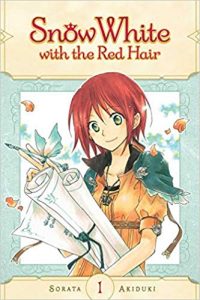
I feel badly for Viz, as any other week I’d be falling over myself praising them for picking up Snow White with the Red Hair (Akagami no Shirayukihime), which has similar plot and characters as Yona of the Dawn but is its own delightful series. (And honestly, who wouldn’t want to be compared to Yona of the Dawn?). It runs in LaLa.

MJ: I’m in!

MICHELLE: Same again!

ANNA: Me too!!!

ASH: I’m also looking forward to this!

SEAN: Other shoujo? Anonymous Noise 14, Kakuriyo: Bed & Breakfast 3, and Shortcake Cake 4.

MICHELLE: I’ll read all of these eventually!

ANNA: Me too!

SEAN: On the shonen end we debut the new arc for JoJo’s Bizarre Adventure: Diamond is Unbreakable. Unlike other new arcs for JoJo’s, this has the same cast as the previous arc.

ASH: I am incredibly pleased that this is being released, especially since it’s a fancy hardcover edition.

SEAN: There’s Black Clover 15, Black Torch 4, Demon Slayer 6, Dr. STONE 5, Dragon Ball Super 5, Haikyu!! 32, Kaguya-sama: Love Is War 8 (I’m giving in and making it shonen, as that’s how it’s marketed here), One Piece 90 (Christ, ONE PIECE NINETY!!!), One-Punch Man 16, and Twin Star Exorcists 15.

Seriously, buy Shimanami Tasogare. I want to see it sell like hotcakes. What are you getting besides that?

Filed Under: FEATURES, manga the week of

Penguin Highway

May 1, 2019 by Sean Gaffney

By Tomihiko Morimi. Released in Japan by Kadokawa Shoten. Released in North America by Yen On. Translated by Andrew Cunningham.

For once, the book came first here. Yen has started a side business of publishing novelizations based on famous anime movies, but Penguin Highway was a novel turned into a movie. The prose is one of the best reasons to pick it up, as its narrator may be ten years old but he thinks that he’s a precise, logical scientist, and the book has fun with him sounding like this most of the time but sometimes letting the child come through. To Aoyama’s credit, he is pretty damn smart, though his two friends are no slouches either. I don’t remember doing quite as much scientific experimentation when I was their age, but then I was always more arts than sciences. The book helpfully is both, as the basic premise involves things such as eddies in the space-time continuum, but also has the sheer beauty, which must have looked great animated, of a can of Coke transforming into a penguin bit by bit.

As noted, Aoyama is smart and knows it, and tries not to get too egotistical but frequently fails, especially in his narrative headspace. He spends the days hanging out with best friend Uchida and fellow intellectual Hamamoto, avoiding the bullying of Suzuki and his two minions (why is it always one bully and two minions?), and getting his teeth cleaned as much as possible because he has a massive crush on the dental assistant, who is never named but is called “The Lady” throughout. Things are normal till one day, a bunch of penguins suddenly appear in a vacant lot. They don’t seem too bothered by being in Japan rather than Antarctica. Even more disturbing, a clearing in a local forest has The Sea, a giant sphere of water that seems to be influencing local topography. More things to analyze and write down, but also dangerous. And there are blue whales? And creatures that The Lady/Aoyama are calling Jabberwocks. Why is all this happening/ And how does it tie in with The Lady?

The plot is good, but Aoyama’s narrative is the best reason to read it. I started off the book laughing at him, as he sounded very much like a snooty fourth-grader, but as the book went on I really started to be drawn into his world. He is very smart about logical and scientific things, though when it comes to matters of the heart he’s lagging way behind, as even his best friend Uchida is able to see why Hamamoto is mad at him. For much of the book The Lady remains something of an enigma to us, and there are a few red herrings thrown around that are brushed off when the truth comes out (The Lady’s memories of her past, in particular). Also, loved Aoyama and Hamamoto’s dads, who both do their best to fully support their children so long as they don’t run into danger (which they do here, repeatedly).

The story ends on a somewhat bittersweet note, as with the best Japanese novels. It also has an afterword by famous manga author Moto Hagio discussing Aoyama and his tendency to be too clever by half. In the end, I don’t really have much to say about Penguin Highway except it was a really good book, and I’m glad I read it.

Filed Under: penguin highway, REVIEWS

Bookshelf Briefs 4/30/19

April 30, 2019 by Ash Brown, Sean Gaffney and Michelle Smith Leave a Comment

Arpeggio of Blue Steel, Vol. 14 | By Ark Performance | Seven Seas – Last time I wondered if Arpeggio of Blue Steel really was going to become a high school series, and it’s certainly trying its best, with a School Festival arc in the offing. That said, the tone of the series is still very much Tom Clancy, with much of the volume taken up by I-402’s negotiation with retired general Ryokan on behalf of the Fog. Meanwhile, we also get a flashback as to how Gunzou started all this in the first place (Iona basically forced it on him, but it doesn’t take much pushing), and start to see pieces shifting into position for the next big battle. Will that battle take place at the school? It might start there, but my guess is we’ll be back to the Navy before long. Still underrated. – Sean Gaffney

Crocodile Baron, Vol. 3 | By Takuya Okada | Kodansha Comics (digital only) – Crocodile Baron comes to an end without evolving much since volume two. Alfardo and Rabbit Boy run into the former’s bad older brother, who seemingly turns his life around after eating some ramen. Alfardo eats spicy curry with a desperate warthog and possibly saves his marriage. Rabbit Boy hates Christmas because it’s his birthday and buys a cake from a camel. A lovelorn elephant filmmaker finds his muse and eats pond smelts. They have an Okinawan adventure during which Rabbit Boy nearly drowns. Honestly, I cared about no one and found it all boring. If there had been more emphasis on the food, I might’ve felt differently, but this was a big ol’ yawn banquet. – Michelle Smith

High School Prodigies Have It Easy Even in Another World!, Vol. 3 | By Riku Misora and Kotaro Yamada | Yen Press – Again, I beg the authors for a character sheet. There are quite a number of interesting things going on in this volume, but I suspect the reader may have trouble finding them among all the bouncing boobs. The fanservice is laid on with a shovel here, and can be hard to take. That said, there’s a nice scene with Tsukasa and Lyrule where she berates him for feeling guilty over not prioritizing saving her. The bulk of the serious plot goes to Shinobu and Elch, gathering intel at a seemingly friendly village with a very dark secret. Fortunately (assuming that it’s not a double cross), she may also have come across the resistance. Too many boobs spoiling the pie, alas. – Sean Gaffney

How to Treat Magical Beasts, Vol. 3 | By Kaziya | Seven Seas – Lest we try to run on “the sweet and heartwarming adventures of a vet” for too long, this volume introduces a smiling maybe-villain-maybe-not, who helps Ziska with a cat’s injury and then takes her way out into danger to attend to a wounded Greif, because no series with apprentices and magic is quite complete without a test to see if they’ve got the right stuff. I assume Ziska does have the right stuff, but we’re caught up to Japan, so it may be a while till we find out. In more sweet news, that is one adorable gargoyle, and I’m happy it’s found a friend. Seven Seas has carved out a genre niche with these types of series, and I quite enjoy it. – Sean Gaffney

Mob Psycho 100, Vol. 2 | By ONE | Dark Horse – I keep wanting to call this MPD Psycho, but that is something very different. This is the story of an unassuming boy named Shigeo Kageyama who possesses super powers but wants to live without relying on them. This challenges the worldview of another superpowered boy named Teru, who spends two-thirds of the volume flinging his power at Kageyama in order to make him fight back. (Kageyama is resolute that he won’t use his powers against another person.) The anger meter appears again (with a fun gag about how Teru’s exorcism of Mob’s sycophantic spirit companion doesn’t actually change it at all) and only when his life is in true peril does Kageyama reach “???%.” Will he wreak havoc in the next volume? The story’s definitely getting more interesting, but I’m still not in love with the art. – Michelle Smith

My Hero Academia: Vigilantes, Vol. 4 | By Hideyuki Furuhashi and Betten Court | Viz Media – This gets better with each volume. I had not realized that the Vigilantes series takes place a few years before the main series (though the authors cheat (and say so) for the extra side story). I had suspected that Knuckleduster was somehow connected with the villains, but that connection turns out to be much closer than imagined, and leads to possibly the best fight of the series. Meanwhile, Pop Step finds her confidence and does something only she can do to help out. All this and one of the most horrific images in the manga to date (which also made me wonder if the authors had seen a certain meme about bees). This has become essential. – Sean Gaffney

My Pink Is Overflowing, Vol. 1 | By Yuki Monou | Kodansha Comics (digital only) – I bought this hoping it would be hilariously trashy, and for the most part it was. The premise has a girl who’s tired of being screwed over by pick-up artists decide she’s only going to date virgins from now on… then find out that her boss, seemingly an overly serious taskmaster, is one! They enter into a relationship so fast it boggles the mind, especially since their first kiss is interrupted by her having an orgasm as she does it. At its heart, this is a “ditzy girl/serious guy” title with a decent heart, but the girl can get very over the top at times, and the series seems to want to go as far as it can while keeping the hero a virgin. Plus there’s that title. For fans of Cosplay Animal. – Sean Gaffney

Teasing Master Takagi-san, Vol. 4 | By Soichiro Yamamoto | Yen Press – It has to be said, a lot of the teasing that’s going on here is Takagi-san being as obvious and blatant as she possibly can that she loves Nishitaka. You’d have to be a brick—or a male protagonist—not to get it, and indeed sometimes it’s so blatant he almost shows sings of figuring it out. But this is a long-running series, and resolution just isn’t in the cards right now. So we get Takagi-san visiting his room, playing poker, chasing cute cats, and getting each other’s emails so that now she can tease him whenever she wants to (and have cute photos of her on his phone). Everyone else in their class knows they’re going out. Most of what they do qualifies as a date. But… so dense. Love this series. – Sean Gaffney

Witch Hat Atelier, Vol. 1 | By Kamome Shirahama | Kodansha Comics – Even before it was licensed in English, Witch Hat Atelier was a series that had caught my attention, in large part due to Shirahama’s gorgeous, sumptuous artwork, but also because my Japanese-reading friends spoke so highly of it. At times, the exposition is a little heavy-handed in the first volume as the premise of the the world’s history and magic are introduced. (I expect this to become less of an issue as the series progresses.) However, the explanations are regularly incorporated in a way that makes sense—Coco, the story’s heroine, is also new to the basics and she’s learning right alongside the readers. Coco is a young woman who has always been fascinated by magic not realizing that she has a natural talent for it. Unfortunately, the initial budding of her magical skills ends in tragedy as she hasn’t had the training needed to fully understand or control them. – Ash Brown

Yowamushi Pedal, Vol. 11 | By Wataru Watanabe | Yen Press – No, the Inter High still hasn’t come to an end, but this is still a pretty satisfying volume, what with all the inspirational performances and teary appreciation of same! Watanabe does a good job getting readers to root for Hakone, too, and we learn why Arakita is so motivated to propel Fukutomi to the finish line, right before he runs out of speed. Yes, it’s a harsh truth that all six members of Sohoku aren’t able to ride together for long. The first-years prepare themselves to make the sacrifice for their teammates, but that isn’t how it turns out at all. I was fully expecting that Kinjou would be the one to win this, given his experience in the previous year’s competition, and was honestly surprised when he’s sidelined by injury. I suppose the next book will wrap things up but I kinda don’t even remember what this series is like when it’s not the Inter High! – Michelle Smith

Yuri Is My Job!, Vol. 2 | By miman | Kodansha Comics – Now that Hime is aware of who Mitsuki was in her past, everything is terribly awkward, and the number of times “she must really hate me” is said in this volume boggles the mind. If you guessed it’s all based on misunderstanding what the other is thinking, give yourself a gold star. For all that Hime tries to be the perfect little sister, it’s only when she’s honest with herself that things really take off in the cafe. I’m hoping that things will improve soon, but there’s also the problem of Kanoko, Hime’s best friend from school whose phone turns out to be entirely devoted to Hime. I dislike the term “yandere,” but I have a sneaking suspicion we’re going to see the tropes that lead to its overuse in the next book. – Sean Gaffney

Filed Under: Bookshelf Briefs

  • « Go to Previous Page
  • Page 1
  • Interim pages omitted …
  • Page 319
  • Page 320
  • Page 321
  • Page 322
  • Page 323
  • Interim pages omitted …
  • Page 1050
  • Go to Next Page »
 | Log in
Copyright © 2010 Manga Bookshelf | Powered by WordPress & the Genesis Framework