• Skip to primary navigation
  • Skip to main content
  • Skip to primary sidebar
  • Home
  • About Us
    • Privacy Policy
    • Comment Policy
    • Disclosures & Disclaimers
  • Resources
    • Links, Essays & Articles
    • Fandomology!
    • CLAMP Directory
    • BlogRoll
  • Features & Columns
    • 3 Things Thursday
    • Adventures in the Key of Shoujo
    • Bit & Blips (game reviews)
    • BL BOOKRACK
    • Bookshelf Briefs
    • Bringing the Drama
    • Comic Conversion
    • Fanservice Friday
    • Going Digital
    • It Came From the Sinosphere
    • License This!
    • Magazine no Mori
    • My Week in Manga
    • OFF THE SHELF
    • Not By Manga Alone
    • PICK OF THE WEEK
    • Subtitles & Sensibility
    • Weekly Shonen Jump Recaps
  • Manga Moveable Feast
    • MMF Full Archive
    • Yun Kouga
    • CLAMP
    • Shojo Beat
    • Osamu Tezuka
    • Sailor Moon
    • Fruits Basket
    • Takehiko Inoue
    • Wild Adapter
    • One Piece
    • After School Nightmare
    • Karakuri Odette
    • Paradise Kiss
    • The Color Trilogy
    • To Terra…
    • Sexy Voice & Robo
  • Browse by Author
    • Sean Gaffney
    • Anna Neatrour
    • Michelle Smith
    • Katherine Dacey
    • MJ
    • Brigid Alverson
    • Travis Anderson
    • Phillip Anthony
    • Derek Bown
    • Jaci Dahlvang
    • Angela Eastman
    • Erica Friedman
    • Sara K.
    • Megan Purdy
    • Emily Snodgrass
    • Nancy Thistlethwaite
    • Eva Volin
    • David Welsh
  • MB Blogs
    • A Case Suitable For Treatment
    • Experiments in Manga
    • MangaBlog
    • The Manga Critic
    • Manga Report
    • Soliloquy in Blue
    • Manga Curmudgeon (archive)

Manga Bookshelf

Discussion, Resources, Roundtables, & Reviews

Blog

Bookshelf Briefs 6/19/19

June 19, 2019 by Ash Brown, Sean Gaffney and Michelle Smith Leave a Comment

Anonymous Noise, Vol. 14 | By Ryoko Fukuyama | Viz Media – Well, that didn’t last long. In a series about the heroine singing in a band, when she can’t sing if she’s dating one of the guys she likes, it’s best to end it. Or at least that’s what Momo thinks, anyway. Time to see who wins the battle of self-sacrifices. Elsewhere, it’s dawning on the band that they need to think past high school, and Haruyoshi is waffling about the direction he wants to go next. I won’t spoil how this is resolved, but it’s sort of hilarious *and* touching. And of course there’s Nino’s part in all this, as she has to deal with a breakup as well, in addition to trying to find her voice—again. Anonymous Noise never seems to lack for things to happen, and it continues to putter along smoothly. – Sean Gaffney

Ao Haru Ride, Vol. 5 | By Io Sakisaka | Viz Media – Sadly, going to the festival turns out to not happen—again—as Kou is once again being drawn away from Futaba, this time because he’s trying to help a distant friend with personal problems. And also possibly because Futaba is hanging out and chatting with Toma, who’s handsome and nice and also has fallen head over heels for her, something Futaba realizes not one bit. And so much of this volume returns us to the halcyon days of Kou being avoidant and difficult. At least Futaba angsting over telling her friends about her feelings for Kou is quickly nipped in the bud. I do really like the reverse costume cafe they do. (They’re right; Murao does look amazing as a butler.) Will this cliffhanger affect anything? Oh, probably. – Sean Gaffney

Ao Haru Ride, Vol. 5 | By Io Sakisaka | VIZ Media – Futaba and Kou had gotten close to confessing their mutual feelings, and he even invited her again to the summer festival they didn’t get to attend in junior high. But then he suddenly cancels and is incommunicado for the rest of summer vacation. When school resumes, it seems he’s actually in good spirits, but is preoccupied with his phone. Eventually it emerges that he’s helping a former classmate get over the death of a parent, and though Futaba thinks this is admirable, she nonetheless feels left out. The fact that this classmate is female is obvious but is held as a reveal until the final page. Meanwhile, a male rival must be introduced too, and so we meet Toma Kikuchi, a boy who Futaba accidentally groped, who comes to like her after realizing she’s perceptive, honest, and not as tough as she might appear. Standard shoujo, but still enjoyable. – Michelle Smith

As Miss Beelzebub Likes, Vol. 6 | By Matoba | Yen Press – No one seems to be more surprised than the artist that this series has reached six volumes, which results in a meta gag when Azazel’s assistant Samyaza appears, and they note it’s far too late in the series to introduce someone like him. He bounces off Mullin well, though—perhaps a bit too well for Beelzebub’s taste, as she worries that they’re both too shippable with each other. Elsewhere, the exchange diary between Belphegor and Azazel is actually not a half-bad idea, but too many cooks spoil a bit of the pie. Unfortunately, there’s more Eurynome as well, and trying to indicate she’ll eventually be shipped with Samyaza does not balance out her continued lust for young boys. Read it if you already are. – Sean Gaffney

A Certain Scientific Accelerator, Vol. 9 | By Kazuma Kamachi and Arata Yamaji| Seven Seas – As it turns out, the girl that Last Order ran into in the previous volume, despite giving off immense “I am a secret villain” vibes—mostly to Last Order, to be fair—turns out not to be a villain. She is, however, a twin, and it’s her sister who seems to have the villain card as well as the tragic past. It’s also startling to see the princess from the previous book captured fairly easily (possibly as Accelerator is healing so AWOL this book), and the cliffhanger, which involves repeated use of the food/death metaphors that litter the book, is really chilling. That said, if there’s one thing that defines this volume of the series, it’s the big ol’ fight in the middle of it, which is very well done. – Sean Gaffney

Dead Dead Demon’s Dededede Destruction, Vol. 5 | By Inio Asano | Viz Media – I admit I avoided reading this for a while. I still expect it to end with everyone either dead or depressed. I mean, it’s Asano. But as always, when I finally started to read it it was fantastic. The art alone is a main reason to read this. Plus, now that everyone is in college, relationships are allowed to develop more naturally. Unfortunately, in both cases this may end up being a mistake. Oran has bonded with the alien in disguise, and hides him by saying he’s her boyfriend… something that may be coming true. As for Kadode, I was sort of hoping that graduation would mean the end of the crush on her teacher, but apparently it means there’s nothing standing in the way anymore. Will either girl find happiness before the end of humanity that continues to be implied here? – Sean Gaffney

My Solo Exchange Diary, Vol. 2 | By Nagata Kabi | Seven Seas – The sequel to My Lesbian Experience with Loneliness ends with the second volume; the conclusion of the series is just as achingly and brutally honest as its beginning. Kabi’s struggle with anxiety and depression continues through its highs and extreme lows. The success of her autobiographical manga ultimately compounds the issue for her as she starts to feel guilty about some of the things that she’s said about family members and has to deal with the consequences of revealing so much of herself to a public audience. A central portion of the second volume of My Solo Exchange Diary is devoted to Kabi’s stays in two different hospital wards—part of her ongoing efforts to get her life back on track. Due to the subject matter of My Solo Exchange Diary, the series isn’t always the easiest to read, but it is still an approachable, compelling, and noteworthy work. – Ash Brown

Queen’s Quality, Vol. 7 | By Kyousuke Motomi | Viz Media – We’re down to twice a year for this series now, the same as Japan, but it’s making those volumes count. We get lots of Fumi being awesome (toilet brush or no), lots of romantic sizzle between her and Kyutaro, overcoming self-loathing and doubt, and a whole lot of testicle jokes. In case you wondered what all the “golden ball” stuff was. The beauty of this artist is that she’s not afraid to have things get completely silly even in the middle of a dramatic fight, and alternatively have the silliest moments give way to drama. We also get a lot more insight into Kyutaro’s late parents here. But, and the cliffhanger doesn’t quite tell us, will someone finally realize that Fumi + Fuyu = Fuyumi? – Sean Gaffney

Ran the Peerless Beauty, Vol. 4 | By Ammitsu | Kodansha Comics (digital only) – Ran and Akira are now officially a couple, and this volume features milestones like calling each other by first names, going on a real first date, holding hands, and Christmas. While it cannot be denied that the plot is fairly formulaic at this point, there’s still something special about Ran the Peerless Beauty. Part of it, I think, is that we see just as much of Akira’s emotions as we do Ran’s, and it’s often the case that when she’s nervous or embarrassed or unsure, he confesses that he’s right there with her. Too, Ammitsu’s art is very expressive. I loved a particular smirk of Akira’s (after purloining a strawberry) very much but actually laughed out loud at the panel in which her father finally comprehends that Akira is Ran’s boyfriend. I hope this one gets a print release so it might reach a wider audience. – Michelle Smith

Sweetness & Lightning, Vol. 12 | By Gido Amagakure | Kodansha Comics – I wasn’t prepared for the final volume of Sweetness & Lightning to make me verklempt, but that’s because I didn’t know the final chapter would see Tsumugi going off to college in Hokkaido. Before this, we got a sequence of chapters with Tsumugi at various ages, where we see her growing in independence and culinary skill. And, finally, heading out to experience life on her own. It’s very nice! Too, I really appreciated that nothing about the finale hinges on whether Inuzuka and Kotori might get together now that she’s somewhere in the neighborhood of 30. It’s clear that Tsumugi would like that, but to the end, this is the story of a father and daughter and how they have stuck together after the loss of someone they love. I enjoyed it very much. – Michelle Smith

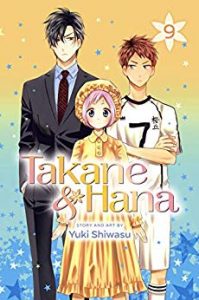
Takane & Hana, Vol. 9 | By Yuki Shiwasu | VIZ Media – I know it’s contrived and rather over-the-top, but the meddling chairman forcing his grandson and the Nonomura family to live together really works for me. In order to convince Takane to go along with it, Hana has to honestly confess that she wants to live with him, something she later reiterates to Okamon, who is very worried about her whole situation and finally ends up confessing. I’m not sure Hana and Takane are really getting closer—for every sweet study session there’s a misguided, extravagant bedroom redecoration—but the whole setup does at least put a fresh spin on their arrangement and provides, in the chairman’s words, “a place for you two to become certain about each other.” This series continues to be a lot of fun. – Michelle Smith

Filed Under: Bookshelf Briefs

Animeta!, Vol. 1

June 19, 2019 by Sean Gaffney

By Yaso Hanamura. Released in Japan by Kodansha, serialization ongoing in the magazine Morning Two. Released in North America by J-Novel Club. Translated by T. Emerson.

Learning how to be an animator is the name of the game here (the title even reads “Animator” when read out loud), though it’s not quite as bad as the foodie manga that are out these days – there are a few interstitial pages of instructions about pencil type, etc. but for the most part this is meant to entertain. Well, entertain and warn. Our heroine is Miyuki Sanada, a freshly graduated girl who was sort of wandering through life without much of a purpose until she saw a magical girl anime that CHANGED HER LIFE. Now she wants to be an animator, and has decided to try out at the studio that created it. She gets past the first stage, so must have some drawing chops, but she’s woefully unprepared for what lies beyond. And even if she gets hired, it’s just gonna be cleaning and inbetweening, and the wages aren’t enough to live on. Can her love of anime be enough to power past all the reasons to get a better job?

And so the thrust of Animeta! is twofold. On the one hand, you see that this is not a career for those who are really good at drawing and need a career. It’s thankless, the pay isn’t great unless you’re a god-tier animator, and, as Miyuki finds out, everyone seems to be better than her. She’s a pure newbie, so doesn’t even know what cleaning and inbetweening are, and her drawing speed is far too slow for what they need to do. What’s worse, her instructor is of the “I am going to be as blunt and rude to you as possible to see if you quit” school of teaching, though rest assured we do see the heart of gold underneath. Everyone else in the company is wondering why Miyuki was hired at all, but… we the reader know she has that certain something. And yes, it’s something beyond “I really love anime!”.

That’s the thing I liked best about this first volume, which is mostly introductory; it’s got a great balance in Miyuki. Her love of anime may be what keeps her going, along with a few notes from a “mysterious” helper (mysterious to her, we guessed), and I liked her perspective at the end when the crew are looking for mistakes in the animation and she keeps pointing out the things that were really great. But there are also signs that with proper development she could be a real talent. It’s why the director hired her (he saw her quick memory when some change was dropped), and also why the woman teaching her is also intrigued – she may not be very good at inbetweening, but her art shows that she might be better when it comes to key animation – what inbetweeners dream of graduating to.

So Animeta! is a fun workplace manga, and you want to see Miyuki succeed. It’s out digitally at the moment, but a print release is due in the fall. Recommended for those who imagine Noa Izumi from Patlabor as an animator.

Filed Under: animeta!, REVIEWS

Yona of the Dawn, Vol 18

June 18, 2019 by Anna N

Yona of the Dawn Volume 18 by Mizuho Kusanagi

At long last, a Zeno volume! I’m going to attempt to talk around some major spoilers, but I found this volume both immensely satisfying and surprising. Zeno, as the smiling and enigmatic Yellow Dragon has always been a bit apart from Yona and the rest of her companions. He just pops up one day without much backstory, and his power of regeneration as a shield in battle was hidden for many volumes. Now the reader finally sees his power unleashed, and I wasn’t expecting Kusanagi to take a detour into action-centric body horror, but she certainly did. As Zeno is hurt and regenerates, he is able to tap into powers of strength that were previously undemonstrated but he does so at a great personal cost. In the hands of a lesser artist, his stand on the battlefield would be much more difficult to execute.

Most of this volume ends up being an extended flashback where we see the original four dragons and the Crimson Dragon King. Kusanagi is so clever with character designs, body language, and expressions, we can see how traces of the original dragon warriors remain in their reincarnated versions in Yona’s present day. In the end, the reader is left feeling like Zeno is fully integrated into the group, knowing the hidden meaning behind his smiles that initially seemed too easy. The depth of story that Kusanagi has built up over 18 volumes is considerable, I’m always putting each volume of Yona of the Dawn wondering how it is going to get even better, and it never fails to deliver.

Filed Under: Manga Reviews, REVIEWS Tagged With: shojo beat, shoujo, viz media, yona of the dawn

Outbreak Company, Vol. 9

June 18, 2019 by Sean Gaffney

By Ichiro Sakaki and Yuugen. Released in Japan by Kodansha. Released in North America by J-Novel Club. Translated by Kevin Steinbach.

Honestly, returning to Japan for a visit was an obvious plotline. So obvious, in fact, that the anime (which I haven’t seen) apparently also used it in an original story. This time Shinichi hears that his light novel author dad is hospitalized and worries, so he asks if he can return to Japan, despite the fact that the Japanese government recently tried to kill him. But there’s been a regime change since the series began, and maybe he’s not quite as wanted? So he returns, with Minori as his guard, Myusel and Elvia also has his bodyguards (and disguised), and Petralka hiding in the luggage so she can come too. Fortunately, his dad is fine. Unfortunately, that leaked soccer game footage has led to everyone in it being wanted by most major world governments. As a result, Minori is captured by the Russians, while Shinichi and the others are menaced by Chinese and Americans. And worst of all, his sister has turned into a tsundere!

The first three-quarters of this book is set up for comedy, and it’s decent comedy, with only one of two instances of “dur… boobs!” from our hero. Shinichi’s parents are just as over the top as they were in the first novel, and his dad in particular is amusing and reminds me very much of Shinichi himself. As for the little sister, you can see why she’s frustrated with her entire family, but also why “Shinichi’s gone to India to find himself” did not really fly. Not sure how much more we’ll see of her, but she’s cute. The sections in Akiba are also fun, with Petralkas getting lured in by gatcha games, Myusel maid fangirling, and Elvia really REALLY wanting some expensive artbooks. It’s only as they get surrounded by more and more people who recognize them that you realize how foolish it was to return (and really, Minori should have realized this would happen) and things get very serious very fast.

We are unlikely to see more Outbreak Company animated, which is a shame, as the car chase that is towards the end of the book is top tier, and shows Elvia, Myusel and Shinichi all being pretty damn badass. The book ends on a cliffhanger as, having returned home for lack of other safe havens, they are surrounded by more bad guys. There are also a few other odd hints here and there that Japan and Eldant may be meshing together a bit as, while magic mostly does not seem to work here as it does there, there are moments where that does not seem to be the case – in particular, moments where the girls who can’t speak Japanese are acting like action heroes. Also, how much of an international incident is everyone going to make of this? And is Minori OK? We never saw her after she was captured. It’s a good thing this series is light-heated in nature…

Outbreak Company is a fast-paced comedy that also has some really good character beats. I still enjoy it.

Filed Under: outbreak company, REVIEWS

Pick of the Week: So Much To Pick From

June 17, 2019 by Sean Gaffney, Michelle Smith, Katherine Dacey, Ash Brown, Anna N and MJ Leave a Comment

MICHELLE: In an unprecedented move for me, I’m picking a light novel this week! Restaurant to Another World has spawned various adaptations but I’ve experienced none of them. Still, it seems rather low-key and charming, which sounds lovely.

SEAN: So much I want to talk about… new Silver Spoon, new Hatsu*Haru, another silly isekai debut… for my pick, I’ll go with Animeta!. I’m a sucker for “manga/anime about breaking into the manga/anime industry”.

KATE: I’d be remiss if I didn’t plug Again!! and Silver Spoon, two of my favorite series, but this week, my heart belongs to Saint Young Men. Show some love for Kodansha and read it, since no one ever thought this one would be available in the US.

ASH: Hoo, boy, there’s so much coming out this week that I’m actively reading! Again!!, Gangsta, Golden Kamuy, and Silver Spoon are definite priorities for me, but I’ll be joining Michelle with the print debut of Restaurant to Another World as my official pick.

ANNA: I’m so far behind, but I’m gonna go with Gangsta as my pick!

MJ: Okay, I’ll go ahead and be the one to throw my whole heart at Silver Spoon. SILVER SPOON. SIIIIILVER SPOOOOOOOOON. What I’m saying is Silver Spoon.

Filed Under: PICK OF THE WEEK

Arifureta: From Commonplace to World’s Strongest, Vol. 9

June 17, 2019 by Sean Gaffney

By Ryo Shirakome and Takayaki. Released in Japan as “Arifureta Shokugyou de Sekai Saikyou” by Overlap. Released in North America digitally by J-Novel Club. Translated by Ningen.

The last few Arifureta reviews have begun with me discussing some aspect of Hajime’s personality, but for the most part, after realizing he now has a way to return to Japan, Hajime’s character arc seems to be coming to an end. There is discussion here about how he can possibly fit in back home after all the changes he’s gone though, but Hajime’s attitude to this is basically “can’t do anything about it now, so will see what happens when it happens”. There’s also a side story towards the end of the book that shows that he’s not really as changed as everyone may think, as we see much of his core character even as a bullied high school student. Instead of discussing Hajime, I’d like to focus on the two characters who get the most attention during this volume (the first of a two-parter), and that’s Kouki and Shizuka. Who are suffering from the same problem but going in two very different directions.

The function of this final dungeon, aside from the snow and ice and a bunch of bigfoot monsters, is to make those who try to conquer it confront their negative traits. This starts as whispers in the ear, and ends with a full on “my evil twin” confrontation. We don’t actually see Kouki’s battle in this volume, but I’m going to go out on a limb here and say he’s not going to pass. In fact, I’ll even go further: I don’t think Kouki as an antagonist is going to be resolved in the series. I’m not sure it will get to the point where he’s an outright villain like Eri, but Kouki sees the world, and those around him, in black and white, and as long as he keeps doing that he’s never going to accept that Hajime isn’t “bad” in some way. It can be very frustrating to the reader – and indeed the other cast members, all of whom know exactly what his inner turmoil is but refuse to bring it up as they know once they do he’ll snap and that will be it. Expect snapping next book.

As for Shizuku, who is getting yet another picture on the cover, she not only has to confront her repressed love for Hajime, which has been bubbling up for some time, but also her repression of everything else in her life. We see her backstory as a girl who wants to do feminine things but has an amazing talent for kendo, and as a result is slotted in as ‘tomboy’ by almost everyone. Her friendship with Kouki’s who’s more an annoying little brother than anything else, also causes her to be ostracized, and it’s only Kaori who’s able to save her. (This also gives insight as to why she’s so willing to put up with Kaori’s eccentric behavior bordering on stalking towards Hajime – and why she refuses to admit her own feelings.) In the end, Shizuku’s main issue is that she needs to be more selfish. She takes a good first step at the end.

As noted, this turns out to be a two-parter, and the author says he’ll show the other cast members confronting their dark selves, including Kouki. I suspect they’ll conquer the dungeon, but the question is what will they do about the rest of the plot, which takes a back seat here aside from occasional mentions of Eri. The latest volume comes out in Japan next week, so we may need to wait a few months to find out.

Filed Under: arifureta, REVIEWS

The Promised Neverland, Vol. 10

June 16, 2019 by Sean Gaffney

By Kaiu Shirai and Posuka Demizu. Released in Japan as “Yakusoku no Neverland” by Shueisha, serialization ongoing in the magazine Weekly Shonen Jump. Released in North America by Viz Media. Translated by Satsuki Yamashita.

We’ve seen this series go back and forth between “all the demons are monsters who want to eat brains” and “not ALL demons”, and as a result it’s not really a surprise that you see Emma here, always the most idealistic of any group she’s in, attempting to reason with Leuvis towards the end of this volume. I mean, it makes sense. The demons don’t do this because they are required t or they’ll die. It’s hunting, which Emma admits that she has done as well. And what’s more, while she may loathe Leuvis for killing some of her new-found friends, she is not driven by a desire to end his life. So… can they come to an agreement. There are, however, a few flashbacks that help to show us that the answer is no, at least here at Goldy Pond. Reason and pluck will win the day elsewhere, but not for Leuvis, who spouts something about needing to be in conflict but we see what it really is is that he does this for the thrill.

For all that TPN has a reputation of existing on “will they die or not?”, there really aren’t TOO many deaths if you look at the course of the series. And we just had two more a volume or two ago. So I wasn’t really expecting any of the child soldiers here to get killed off, but the art made me wonder a lot of the time. In general, I don’t recommend breaking out the “monster is holding someone up by their head” pose unless you really plan to go through with crushing that head. That said, thanks to Flashbacks we do still get a few deaths – this is not a series for little kids. But we also do see their brief triumphs, and also taking care of the wounded back at home base. These kids are just as much of a family as the Grace Field kids are, despite the fact that it’s still coming down to Emma to fight the big bad.

Fortunately, reinforcements are on the way, as Ray and “that geezer” have finally caught up to Emma, and can help her just when it seems there’s no hope. I do wonder how this is going to play out. We’ve had a few volumes now with Emma on her own, but she’s best balanced with Ray and Norman beside her. We know Norman is alive now, but he’s nowhere near them. Ray is now there, though, and I think will be the first to point out that when a psychopath who loves to kill children for the sport of it taunts you, it’s OK to perhaps not give him one more chance. (He may then find out that he missed Emma doing exactly this – I mean, Emma may be badass, but it’s a very shiny sort of badass.) So, as we finish up this very well done Promised Neverland, one question is in my mind above all others: will the “geezer” guy finally be officially named in story?

Filed Under: promised neverland, REVIEWS

Der Werwolf: The Annals of Veight, Vol. 4

June 15, 2019 by Sean Gaffney

By Hyougetsu and Nishi(E)da. Released in Japan by Earth Star Entertainment. Released in North America by J-Novel Club. Translated by Ningen.

One of the things that Veight has been lacking as we travel through these books is a strong enemy on the opposite side. The Hero was sort of a generic type, brought to life to have a climax to the book. The Senate are, as we see in this book, pathetic and ineffectual, trapped in political backstabbing and vituperation. Most of the ‘antagonists’ Veight goes up against in battle are either cannon fodder or won over to his side fairly quickly. He needs someone to fight against who’s actually good at what they do. Not TOO good, of course – the basic premise of the book still has Veight being super awesome while insisting he’s just a mild-mannered vice commander. But enough to force him to actually think out a couple of different plans – especially necessary given that his subordinates are trying harder and harder to make sure that he does not try to do everything himself. (They almost succeed. Almost.)

Conveniently, we’re starting to learn about countries and territories outside of “the northern parts of the country” and “the southern parts of the country”. There’s apparently nations past the demon forest, and on the other side of the dry desert. And there’s also a nation over the mountains up north, a nation who we see in this book really wants to get a fingerhold into Meraldia. To that end, they’ve joined forces with a few of the north’s cities who don’t like the Senate too much, and also sent over Eleora, their sixth princess, who is Veight’s distaff counterpart. She’s crafty, good at military matters, and also has a crack brigade of mages who reminded me quite a bit of Tanya the Evil much of the time. (She even has her own Visha, this one named Natalia.) Her nation, Rolmund, has succession issues, and this is very much a succeed or die sort of mission. Too bad there’s Veight.

There’s a lot of fun here. Every time Veight denies that he’s really strong or impulsive is wonderful, if only as it’s getting harder to believe he’s not doing it on purpose. Speaking of which, the funniest parts of the book involve coming up with a series of plays that will serve as propaganda. In reality, they’re basically bodice rippers, with each play involving a handsome actor playing Veight winning handily and causing his actress of the moment (playing Airia, Melaine, Firnir, etc.) to swoon and coo. Veight is rather embarrassed by all this, though the others (who no doubt hope Veight will catch a clue sometimes) have no issues. The final play we see involves Eleora and her own attack on Meraldia. I’m not sure whether she’ll join the list of women in love with Veight yet (honestly, I suspect it will be Airia if anyone), but the afterword definitely says the next book will involve Rolmund, so I’m sure we’ll see more of her.

I sometimes feel like I’m overpraising things, but I really can’t get enough of this series. Each volume is fun, easy to read, not too short or too long, has good characters and great humor, and makes Veight overpowered and harem lead-ey without him feeling like a stock light novel guy. Really, start reading these books.

Filed Under: der werwolf, REVIEWS

Komi Can’t Communicate, Vol. 1

June 14, 2019 by Sean Gaffney

By Tomohito Oda. Originally released in Japan as “Komi-san wa Komyushou Desu” by Shogakukan, serialization ongoing in the magazine Shonen Sunday. Released in North America by Viz Media. Translated by John Werry.

When you get a basic description of this series, it sort of sounds like a few other “aloof beautiful girl at school is really just super shy” titles. But Komi is a bit more complicated than that. The Japanese title can translate as “Komi Has a Communication Disorder”, and we certainly see that here, as she finds it nearly impossible to speak in front of others, let alone interact with them. And that’s a shame, as she really wants to have friends – 100 friends, in fact, like the Japanese children’s song. Fortunately, she has some help when starting high school. Tadano is an average, nondescript guy – in fact, that’s what he’s aiming for – but he’s seated next to Komi, not only earning him the hatred of all the other guys in the room, but also meaning he’s able to notice that she’s trying hard but not succeeding. And so he vows to be her first friend – and help her make more.

It’s not easy. Not only is Komi unable to properly communicate beyond writing on chalkboards, talking over the phone and the occasional babbling attempt to speak, but the school that they’re in is deliberately filled with “characters”, priding itself on individuality. This means even other introverts have a few eccentricities here and there. I’ll admit sometimes this works and sometimes this doesn’t. I liked Agari, who is a normal shy wallflower type, whose difficulties in talking to the class pale in comparison to Komi’s, but could have done without the “I’ll be your pet” gag ending to her storyline. Likewise one of the minor characters in this book, Yamai, reads like a worryingly stereotypical psycho lesbian, and I really hope it doesn’t go down that road.

There is also, however, Tadano’s childhood friend Najimi Osana. The most obvious of the pun-based names the cast all have, they are Tadano’s childhood friend. They are also non-binary. Najimi wore a man’s uniform and acted like a guy in middle school, is wearing a girls’ uniform and acting girly in high school, and is perfectly okay with this – and so is the rest of the cast so far, though Tadano has a few tsukkomi reactions to the whole thing. I’ve seen this sort of character in manga and anime before, but usually we the reader know what they gender assignment at birth is – not in this case. And that’s fine, as Najimi’s real role here is to be the super popular one with piles and piles of friends. This eventually includes Komi, though they get off on the wrong foot as Najimi finds Komi’s intense stare a bit terrifying.

In the end, though, this manga is about Komi. She’s moved a little further forward by the end of the first volume, but only a little – speaking to someone in person is still beyond her. I also love the way the art changes her face when she’s distressed or shy – she’s normally the gorgeous beauty, but her face turns wide and superdeformed when overwhelmed – which is nearly all the time. This was a fun series, and I look forward to following Komi’s growth.

Filed Under: komi can't communicate, REVIEWS

Manga the Week of 6/19/19

June 13, 2019 by Sean Gaffney, Michelle Smith, Anna N, Ash Brown and MJ 4 Comments

SEAN: OK, I double checked the Kodansha list this time, so we should be good to go.

We’ll start off with Dark Horse, who has the 10th I Am A Hero omnibus. I think the 11th is the last.

ASH: I’m a few volumes behind in my reading so I’m not sure how things have progressed, but the series started out very strongly.

SEAN: Apologies to J-Novel Club, who have a bunch of digital manga debuts, including ones I missed that came out this week. First what I missed: An Archdemon’s Dilemma: How to Love Your Elf Bride, How a Realist Hero Rebuilt the Kingdom, The Magic in This Other World Is Too Far Behind! and Seirei Gensouki all have Vol. 1s drop this week. (They’re not on Kindle or Nook because of various reasons, but are on all other digital platforms.)

Next week the big digital debut is Animeta!, a Morning Two title (always a good thing) that isn’t based on a light novel (even better) about a girl trying to be an animator. I want to read this.

MICHELLE: That sounds potentially good! I await your review!

SEAN: They also do have more manga adaptations of light novels, as we also see Ascendance of a Bookworm, Infinite Dendrogram, and The Master of Ragnarok and Blesser of Einherjar get Vol. 1s digitally.

And lest you think they’ve abandoned light novels, we see I Saved Too Many Girls and Caused the Apocalypse 14, Infinite Dendrogram 9, and Outbreak Company 9.

Kodansha has no debuts, but has a lot of stuff. That is coming out next week. I promise. Print? We’ve got Again!! 9, Happiness 9, and O Maidens in Your Savage Season 2.

ASH: Oh, hey! I’m reading all those series.

SEAN: Digitally there is Are You Lost? 4, DAYS 14, Defying Kurosaki-kun 10, Heaven’s Design Team 3, Mikami-sensei’s Way of Love 5, Saint Young Men 2, and Starving Anonymous 7.

MICHELLE: Again!! and DAYS for sure. I hang my head in shame that I haven’t yet managed to read the first volume of Saint Young Men. I really will, I swear!

ANNA: I am sad that I am behind on Again!! and Saint Young Men.

MJ: Saint Young Men!!

SEAN: Seven Seas has the print debut of Restaurant to Another World, which is very good but you’d better be a foodie.

ASH: I’ll be picking this up now that it’s coming out in print. It seems like it’ll be right up my alley.

SEAN: There’s also A Certain Scientific Accelerator 9, Nurse Hitomi’s Monster Infirmary 9, and (digitally) the 2nd Skeleton Knight in Another World.

Tokyopop has the 2nd Aria the Masterpiece omnibus and Yuri Bear Storm 3. You may have seen both these volumes in prior lists. Kodansha’s not the only one with surprise last-minute delays.

Vertical gives us a 3rd APOSIMZ. And the Inc. side has the 2nd omnibus (Vol. 4-6) of Katanagatari’s novels.

Viz has a 4th 20th Century Boys: Perfect Edition, the 5th Gangsta: Cursed (as well as a digital catch-up), Golden Kamuy 10, Tokyo Ghoul: re 11, and Ultraman 12.

ANNA: Need to get caught up on Gangsta too!

ASH: Since I read the first edition of 20th Century Boys, it’s Gangsta and Golden Kamuy that have most of my attention from this list.

SEAN: Yen Press moved all but one of its manga debuts to the last week of June, but we do have one light novel debut. The Hero Is Overpowered But Overly Cautious is one of those “the title is the plot” books, but at least has a novel twist by having the hero not be the narrator – from what I understand it’s the summoner.

Also coming out on the novel side: Accel World 18, The Asterisk War 10, A Certain Magical Index 19, The Empty Box and Zeroth Maria 6, Is It Wrong to Try to Pick Up Girls in a Dungeon?: Sword Oratoria 9, My Youth Romantic Comedy Is Wrong As I Expected 7.5 (a short story collection), Re: ZERO 10, and Woof Woof Story 2.

On the manga side… let’s start with the news that not only do we get the 11th My Youth Romantic Comedy Is Wrong As I Expected manga, but we also get Vols. 1-11 digitally. The Shogakukan dam is breaking!

There’s also a yuri one-shot: Whenever Our Eyes Meet: A Women’s Love Anthology. The gimmick here being that the romances are office and workplace rather than middle and high school.

MICHELLE: Hooray for grown-ups.

ASH: Indeed!

MJ: That does sound wonderful!

SEAN: And lastly (well, sort of… there’s a lot of lastly), we get As Miss Beelzebub Likes 6, Bungo Stray Dogs 11, Dead Mount Death Play 2, For the Kid I Saw in My Dreams 2, Goblin Slayer Side Story: Year One 2, Hakumei & Mikochi 6, Hatsu*Haru 7, Kakegurui: Compulsive Gambler 10, One Week Friends 7, Prison School omnibus 13, Silver Spoon 9, A Terrified Teacher at Ghoul School 7, and The Witch’s House: the Diary of Ellen 2.

MICHELLE: Insert obligatory Silver Spoon deliquency admission and apology here.

ASH: You’re going to have a great time ahead of you once you get a chance to catch up! Silver Spoon is terrific.

MJ: Oh, hi, Silver Spoon, you own my heart and soul.

SEAN: Years ago I used to break these down one line per book. I am so glad I don’t do that anymore. What’re you drowning yourself in?

Filed Under: FEATURES, manga the week of

  • « Go to Previous Page
  • Page 1
  • Interim pages omitted …
  • Page 310
  • Page 311
  • Page 312
  • Page 313
  • Page 314
  • Interim pages omitted …
  • Page 1048
  • Go to Next Page »
 | Log in
Copyright © 2010 Manga Bookshelf | Powered by WordPress & the Genesis Framework