• Skip to primary navigation
  • Skip to main content
  • Skip to primary sidebar
  • Home
  • About Us
    • Privacy Policy
    • Comment Policy
    • Disclosures & Disclaimers
  • Resources
    • Links, Essays & Articles
    • Fandomology!
    • CLAMP Directory
    • BlogRoll
  • Features & Columns
    • 3 Things Thursday
    • Adventures in the Key of Shoujo
    • Bit & Blips (game reviews)
    • BL BOOKRACK
    • Bookshelf Briefs
    • Bringing the Drama
    • Comic Conversion
    • Fanservice Friday
    • Going Digital
    • It Came From the Sinosphere
    • License This!
    • Magazine no Mori
    • My Week in Manga
    • OFF THE SHELF
    • Not By Manga Alone
    • PICK OF THE WEEK
    • Subtitles & Sensibility
    • Weekly Shonen Jump Recaps
  • Manga Moveable Feast
    • MMF Full Archive
    • Yun Kouga
    • CLAMP
    • Shojo Beat
    • Osamu Tezuka
    • Sailor Moon
    • Fruits Basket
    • Takehiko Inoue
    • Wild Adapter
    • One Piece
    • After School Nightmare
    • Karakuri Odette
    • Paradise Kiss
    • The Color Trilogy
    • To Terra…
    • Sexy Voice & Robo
  • Browse by Author
    • Sean Gaffney
    • Anna Neatrour
    • Michelle Smith
    • Katherine Dacey
    • MJ
    • Brigid Alverson
    • Travis Anderson
    • Phillip Anthony
    • Derek Bown
    • Jaci Dahlvang
    • Angela Eastman
    • Erica Friedman
    • Sara K.
    • Megan Purdy
    • Emily Snodgrass
    • Nancy Thistlethwaite
    • Eva Volin
    • David Welsh
  • MB Blogs
    • A Case Suitable For Treatment
    • Experiments in Manga
    • MangaBlog
    • The Manga Critic
    • Manga Report
    • Soliloquy in Blue
    • Manga Curmudgeon (archive)

Manga Bookshelf

Discussion, Resources, Roundtables, & Reviews

Sean Gaffney

Takane & Hana, Vol. 1

February 2, 2018 by Sean Gaffney

By Yuki Shiwusa. Released in Japan by Hakusensha, serialization ongoing in the magazine Hana to Yume. Released in North America by Viz Media. Translated by JN Productions. Adapted by Ysabet Reinhardt MacFarlane.

I am known for being notoriously easy to please, but it has to be said, I have a type. I have a certain kind of manga that I will automatically pick up sight unseen, and will always assume I will love unless proven otherwise. That type is shoujo manga from Hakusensha’s Hana to Yume magazine. From Skip Beat! and Oresama Teacher back through Fruits Basket and the complete works of Banri Hidaka all the way back to Here Is Greenwood, Hana to Yume is almost always a win for me. So I was prepared for Takane & Hana to please me. And yet I admit to surprise. It surpassed my expectations. What’s more, it surpassed them on the inside cover page. When you can win over a reader before the table of contents, you’re doing something right. Best of all, it kept my attention and kept me laughing and grinning the rest of the volume.

Hana is a cute high school girl with the misfortune to be the younger sister to a girl that is absolutely gorgeous. Her father also works as a corporate guy for a rich conglomerate, and the head of said conglomerate wants his grandson to marry – and thinks that Hana’s sister is pretty and would be just the thing. Unfortunately, the sister blows the whole thing off, so (as the grandfather is getting on and they may as well) they disguise Hana as her sister and try to have the marriage meeting anyway. It is, predictably, a disaster. The grandson, Takane, is arrogant, grumpy, and insensitive, and Hana blows up and storms out. Except… Hana blowing up intrigued Takane, and now he’s taken an interest in her. What follows is their hilarious semi-courtship, involving Takane’s social ineptness and sneering visage, and Hana’s razor-sharp tongue.

I cannot begin to count the things that this series does that are right in my strike zone. Even the cover has her pulling on his tie – I love shots like that. Hana is a down-to-earth girl with a line in retorts, and realizes right away that this is a war to see who can be the most in control. At the start she’s winning over him hands down, as underneath the arrogant persona Takane is awkward and doesn’t really know many social cues – and also is seemingly a genuinely good businessman, something that impresses her. As the volume goes on we see Takane get his own back a bit as Hana has to realize that yes indeed, she may have feelings for him after all. This is all conveyed through some excellent art, particularly the faces – Takane’s one-sided sneer, which is how Hana can tell he’s genuinely happy. Hana’s various reactions to the dumb things that he does. Hell, even when she points at him in an accusatory way at one point, her finger has a little mini-Hana face on it. The art fits the story, which is to say it’s hilarious but also can be romantic when it wants to be.

Essentially, if you are me, this is essential reading. Thankfully, most of you are not me, but even so I highly recommend Takane & Hana. I haven’t been this excited about a shoujo title in some time.

Filed Under: REVIEWS, takane & hana

Manga the Week of 2/7/18

February 1, 2018 by Sean Gaffney, Ash Brown, Anna N, MJ and Michelle Smith 1 Comment

SEAN: The shortest month of the year does not mean there’s less manga. There’s as much manga as ever. If not more.

Bookwalker apparently snuck out a 2nd volume of loli-shogi light novel The Ryuo’s Work Is Never Done! this week, so if you hit that demographic, go and get it.

J-Novel Club has a 9th volume of Invaders of the Rokujouma!?, which should be back in the present, and my guess is lighter in tome.

Kodansha’s sole print release next week is the 15th Yamada-kun and the Seven Witches, which seems to be cut down to twice a year, or the “Hayate the Combat Butler” curse, as I call it.

ASH: I really enjoyed the early part of the series, but I’ll admit that I’ve fallen behind with the manga as it seemed to constantly reboot itself.

SEAN: Kodansha does have a pile of new digital as always, though. Ace of the Diamond 8, Altair: A Record of Battles 7, Hozuki’s Coolheadedness 4, Magical Sempai 4, Pumpkin Scissors 18, and Yozakura Quartet 20, the last two being Del Rey rescues.

MICHELLE: I still intend to read Altair and Hozuki’s Coolheadedness one of these days. I’m definitely keen on Ace of the Diamond.

MJ: I’ve given up any thought that I’m going to make it to these digital releases. I feel like a bad person.

SEAN: Seven Seas has no manga next week, but it does have two novels, one light and one not so light. The light novel is a print edition of Arifureta: From Commonplace to World’s Strongest.

The other novel is Perfect Blue: Complete Metamorphosis, the novel which spawned the huge hit anime movie from the late 1990s. Like Lodoss Wars, it’s a surprise to see this licensed, but I’m not complaining.

ASH: I’m on board for this! I’m also looking forward to the release of the sequel anthology later this year, too.

It’s the first week of the month, and you know what that means. Viz blitz! Let’s break it down into Shonen and Shoujo.

On the shonen side, we have Assassination Classroom 20, Black Clover 10, Bleach’s 22nd 3-in-1, a 22nd Food Wars!, Haikyu!! 20, a 6th volume from the 3rd JoJo’s Bizarre Adventure arc, the 10th Kuroko’s Basketball 2-in-1, My Hero Academia 11 (wasn’t it supposed to be speeding up?), One Piece 85, The Promised Neverland 2, and Toriko 41. A lot of really good stuff here, but let me highlight The Promised Neverland once more, as I can’t wait for the 2nd volume.

ANNA: So much Viz! I’m also looking forward to The Promised Neverland 2.

ASH: So much great, Viz, too! The second volume of The Promised Neverland will probably be on the top of that stack for me.

MICHELLE: So much goodness!

SEAN: For shoujo, we’ve got Behind the Scenes!! 5, Oresama Teacher 23, the 2nd and final SP Baby, and a 10th Yona of the Dawn. I am torn between Oresama and Yona in terms of most excitement.

ANNA: I’m not torn, I find Yona the most exciting.

ASH: I only recently started reading Oresama Teacher, but I’m loving it. I don’t have nearly the same backlog with Yona of the Dawn, though.

MICHELLE: I’m fond of Oresama, but yeah, I’m not especially torn, either.

SEAN: They also have a shoujo debut, Takane & Hana, which is a Hana to Yume title that, warning, does involve a rich arrogant ass who’s far too immature. That said, I have heard VERY good things about this manga, and the female lead is supposed to be great also, so I am looking forward to it. Plus, Hana to Yume. My shoujo alma mater.

ANNA: Sounds great!!!!

MICHELLE: Had this run in another magazine, I’d be way more dubious about it, but the fact that it’s a Hana to Yume title inclines me to give it a chance.

MJ: I’m definitely on board with this.

SEAN: What, you thought we were done? Nope, there’s the rest of Yen’s January releases, now moved to early February. There’s a 4th Big Order omnibus, a 3rd Grimgar of Fantasy and Ash manga, a 4th volume of Kakegurui – Compulsive Gambler, a 3rd No Game No Life Please! (which has had three volumes come out since the last light novel was released), a 3rd Sekirei omnibus, and a 9th Taboo Tattoo.

There’s also new releases, starting with Kemono Friends, which is also an omnibus. and I believe complete in one volume. It ran in Shonen Ace, has an anime, and seems to involve animal people?

Oh My Sweet Alien! (Yome ga Kore na Monde) is also an omnibus complete in one volume. A story about a man and his wife, except the wife is… well, you can probably guess. It ran in Enterbrain’s fellows! and Harta, which means I have high hopes for it. That said, it ended quickly as the author passed away, so there won’t be any more of it.

ASH: Oh, intriguing! This series wasn’t on my radar at all.

SEAN: Lastly, there’s a 1st manga volume for The Saga of Tanya the Evil. If you can’t bring yourself to read the brick that is the Tanya light novel, this is a good alternative.

It’s cold out here. What manga are you curling up with?

Filed Under: FEATURES, manga the week of

Strike the Blood, Vol. 8

February 1, 2018 by Sean Gaffney

By Gakuto Mikumo and Manyako. Released in Japan by ASCII Mediaworks. Released in North America by Yen On. Translated by Jeremiah Bourque.

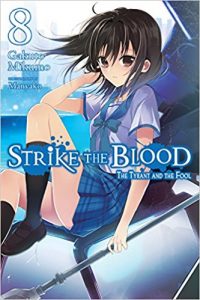
This does not quite hit the highs (relatively speaking) of the previous volume, mostly as the entire volume is “let’s reveal the backstory the reader has been in the dark about for so long” and not much else, but it’s still a pretty solid volume of Strike the Blood. While we’re technically carrying on from the end of the last book, most of this is Kojou (and Asagi, along for the ride for some reason) remembering the events that led to him becoming the Fourth Primogenitor, which took place just before the start of the series. There’s a lot of attempts at worldbuiding and introducing potential new antagonists, which doesn’t work quite as well as the author likes. The good news is that there were a couple of genuine surprises in this volume, which is especially impressive given that Strike the Blood is one of the most by-the-numbers light novels out there.

Despite being on the cover as always, there’s very little Yukina in this book, which makes sense given it’s predominately a flashback. (This, by the way, means we have now gone TWO WHOLE BOOKS without her catchphrase of “No, sempai, this is OUR fight!”. I feel like I’m going through withdrawal.) She and Natsuki have removed Kojou and Asagi to her dream prison space so that Kojou can recover the memories of what really happened and be controlled if that happens to drive him insane (spoiler: it doesn’t.) What we see is not particularly surprising: Kojou is a natural at empathizing with others, which is why all the girls fall for him, and that also works here for Avrova. I hate to break it to people who may roll their eyes at the appearance of another one, but Avrova is, in fact, a blond vampire girl with the body of a child. That said, while she occasionally tries to be haughty in a Shinobu Oshino sort of way, she’s really more introverted and scared. Her bonding with Kojou was the best part of this book.

I’d mentioned surprises, and it comes in the form of Veldiana, who we’d met in the prior volume as a somewhat harried colleague of Kojou’s father. (Speaking of which, both Kojou’s parents appear quite a bit in this book, and while they are admittedly trying their best to save Nagisa’s life, it doesn’t change the fact that they are terrible, terrible parents.) Veldiana is played, in the first half of the book, as something of a comic relief character, and we assume that this is going to be her role in the book. But no, she’s here to teach a darker lesson about what happens when you let revenge consume you, and (leaving the epilogue aside, which I wasn’t too fond of) it works very well. There are also one or two scenes that are not surprises, but the way that they work out with precision timing is also well handled – watch for Kojou bribing the enemy with ice cream.

Strike the Blood is never going to rise to the level of the top light novels being released over here. But it has at least risen to the level where I don’t feel the need to make fun of it or wonder if it’s written by a Light Novel artificial intelligence. As always, the fights are well written and make you want to see them animated. It’s a decent volume in what has become a decent series.

Filed Under: REVIEWS, strike the blood

Juana and the Dragonewts’ Seven Kingdoms, Vol. 1

January 31, 2018 by Sean Gaffney

By Kiyohisa Tanaka. Released in Japan as “Ryuu no Nanakuni to Minashigo no Juana” by Mag Garden, serialized in the online magazine Alterna pixiv. Released in North America by Seven Seas. Translated by Adrienne Beck. Adapted by Ysabet Reinhardt MacFarlane.

The immediate gimmick of this series, one that’s not uncommon in fantasy but which I haven’t seen too much in manga, is that of a foundling story. The world we’re in is populated mostly by dragonewts, including the hero on the cover, who seems to spend his days scavenging the immediate area for old relics of the previous long-dead civilization, the Muernandes (or “humans”, as we would call them). He finds an egg, and inside is Juana, which is very odd. She comes out of the egg looking about six years old and speaking Spanish, which is even odder. Nid, the dragonewt who found her, is determined to see if there are others like her, so sets off on a journey to the northern lands where they might find a bit more evidence. That is, of course, if they can get past Nid’s naivete, Juana’s tendency to run off when she’s curious, and very dapper villains.

While Nid is not much of a mentor, being the equivalent of a young adult himself, this series feels very much in the mold of other gentle Seven Seas fantasies like The Ancient Magus’ Bride and The Girl from the Other Side. The worldbuilding is done by showing, not telling, which I always approve of, and while Nid has a tendency to be ostracized (again for the meat-eating thing, which I found quite fascinating – a reminder that this is indeed a dragonewt world with dragonewt prejudices) he does have one or two allies… or at least boisterous loudmouths. As for Juana, she spends the entire book speaking untranslated Spanish, which means (unless you also speak Spanish, which I admittedly do not) that the reader is as much at a loss as Nid as to what she’s saying. That said, she’s pretty good at making her needs known anyway. And at least even I know what “Me gusta!” means.

There are, honestly, a LOT of mysteries still to discover here. We need to know more about this world, which is so different from ours and yet has many similarities i9n terms of the types of people in it. The cliffhanger reminds us that there are still bad guys floating around, though with a top hat and cane it has to be said that the bad guys look fabulous. And of course, everything about Juana is simply odd, though she’s fairly unconcerned herself. In addition to the mysteries, though, I’d argue the main reason to read this is it’s simply pretty well written. There’s elements of comedy, involving the large and boisterous dragonewt who makes Juana her clothing for their long journey (a spacesuit – it’s much hotter on the planet now). There’s elements of sadness, such as running across a dying old dragonewt in the middle of the forest, and realizing that there’s not much they can do except listen to his story. And there’s honest to god terror at the end, as Mr. Smith shows his true intentions and Nid appears to be headed towards a rapid death.

Juana is only two volumes and counting in Japan, so we’ll catch up pretty quickly, but I’m definitely on board. Another well-crafted and likeable fantasy manga is always welcome.

Filed Under: juana and the dragonewts' seven kingdoms, REVIEWS

Bookshelf Briefs 1/30/18

January 30, 2018 by Michelle Smith and Sean Gaffney Leave a Comment

Frau Faust, Vol. 3 | By Kore Yamazaki | Kodansha Comics – I see we’re doubling down on the “religion of EVIL” here, even if the priest is seen to regret what he’s done. It’s no surprise that a series called Frau Faust would have a plot revolving around… well, Faustian bargains, and as we see here, it doesn’t end well. That said, we do meet some new cast members, who show that some people are a little better than others when it comes to resisting the call of the demon. I like Sarah, and hope bad things don’t happen to her. Certainly I have more hope for her than I do for Johanna. The series is still just finding its feet, but I’m greatly enjoying each volume, and I recommend it especially for fans of The Ancient Magus’ Bride. – Sean Gaffney

Frau Faust, Vol. 3 | By Kore Yamazaki | Kodansha Comics – I love that Johanna deals with the priest’s daughter-turned-monster with both compassion and certainty and, I might add, not before assigning Marion the task of discreetly making off with Mephisto’s leg while Lorenzo is distracted. We see more of the priest’s fate than I expected and got some ominous hints about what the church is up to. Then it’s off to the town where Johanna went to university. Her former roommate Sarah is a great character! At first it just seems she’s there to mend Nico, but then you realize that she’s got a fascinating backstory of her own, and fills Marion in on Johanna’s college years. This series is seriously so well crafted. I am already bummed there are only two more volumes. – Michelle Smith

Golden Time, Vol. 9 | By Yuyuko Takemiya and Umechazuke | Seven Seas – This feels like it wrapped up far too fast, though I’m pretty sure the novels were about the same. I think it needed an extra chapter of “epilogue,” especially after all the horrible emotional trauma going on here. Banri’s issues with amnesia are not just wacky amnesia that you see in other manga, he’s dealing with two different sets of memories and selves, and the one we’ve come to know and love is on the losing end. It’s no surprise that Kouko can’t take it and tries to pull back to where SHE began the series. It all ends OK, though, and I’m happy I read the manga—but I suspect this series is one I’d enjoy more as a light novel. Maybe if Toradora! sells well… – Sean Gaffney

My Boyfriend in Orange, Vol. 2 | By Non Tamashima | Kodansha Comics (digital only) – Shoujo manga has its share of series in which the heroine repeatedly requires rescue, but the first volume of My Boyfriend in Orange made it seem as if such rescues were the whole point, and it was quite tiresome indeed. This second volume is a little better, though that might be damning it with faint praise. Moe Sasaki has recently lost her father, and so she’s drawn to handsome firefighter Kyosuke Ebihara because he makes her feel safe. This is the kind of story where, when Moe’s little brother suddenly goes missing at a cookout, there’s absolutely no suspense because it’s a foregone conclusion that Ebihara will save the day (and that Moe will do something dumb like fall in a river). Likewise, the male classmate we meet is going to have feelings for her. The result isn’t horrible, just exceedingly bland. – Michelle Smith

My Neighbor Seki, Vol. 10 | By Takuma Morishige | Vertical Comics – Bad news for Seki fans, as the series is going on hiatus after this volume—not only here, but in Japan as well, as the author admits he’s taking a break as it’s hard to think up new things for Seki to do that are unique and fun. You do sort of see his point, as when the purpose of your series is seeing which Rube Goldberg device Seki has come up with today, there’s a desire to keep topping yourself. My favorites were Seki testing video games, the school cultural festival, and Seki’s cardboard fort being so hard to figure out Yokoi gets stuck under his desk trying to do so. Yokoi may not think of Seki as a friend, as the epilogue shows us, but everyone else can see what’s really going on between them. – Sean Gaffney

SP Baby, Vol. 2 | By Maki Enjoji | VIZ Media – SP Baby (the SP stands for “security police”) is a two-volume josei series from the creator of Happy Marriage?! and, I must admit, it’s pretty ridiculous. Tamaki Hasegawa has been hired as a bodyguard to Kagetora Sugou (the prime minister’s handsome nephew) and is trying to adhere to a professional working relationship, but he keeps dressing her in skimpy miniskirts and kissing her (while he is engaged to someone else). But we’re supposed to root for them because she has past trauma about being unable to save her little sister from drowning, whereas Kagetora is someone she has been able to save . It’s all very flimsy and the resolution is swift, complete with a “Tamaki takes out armed attackers with the power of kicks” finale. Sometimes, a brief, light story like this might hit the spot, but I just wasn’t feeling it this time. – Michelle Smith

To-Love-Ru, Vols. 3-4 | By Saki Hasemi and Kentaro Yabuki | Seven Seas – To-Love-Ru is a series for teenage boys that ran in Weekly Shonen Jump (at least at this point), and it certainly knows exactly what teenage boys want—if you took all the fanservice in Nisekoi, you might get about two pages of the fanservice in To-Love-Ru. In some ways I feel that the fanservice *is* the plot. As for the supposed actual plot, again I feel that the authors wanted to rewrite Urusei Yatsura but couldn’t get permission from Rumiko Takahashi. Nothing here is necessarily terrible, and the main cast is nice enough, but again every single beat of this is terribly predictable, except perhaps that Lala and Haruna really like each other. If you’ve never read a single harem series, To-Love-Ru is for you. – Sean Gaffney

Filed Under: Bookshelf Briefs

Pick of the Week: Predictable Yet Welcome

January 29, 2018 by Sean Gaffney, Michelle Smith, Katherine Dacey and Ash Brown Leave a Comment

SEAN: Some interesting stuff out this week, both in manga and light novels. I will be predictable, though, in choosing the first Baccano! manga. I read this when it came out as chapters digitally, and am greatly looking forward to seeing it in print. Plus, content that wasn’t in the novels!
MICHELLE: I will be predictable by expressing my anticipation for another installment of Giant Killing, but I’m awarding my official pick to the ninth and final Full-Time Wife Escapist. I’ve enjoyed this series very much!

KATE: I second Sean’s pick of Baccano!, since I am obsessed with the flashback scenes in The Godfather Part II and will watch or read anything that reminds me of them. I realize that Baccano! is even MORE over the top than anything Mario Puzo ever wrote, but I think that’s actually a good thing. It’s an offer I can’t refuse!

ASH: With the promise of a little bit of yuri, a little bit of boys’ love, and a whole lot of complicated relationships, the debut of Nameless Asterism is the release I’m most curious about this week!

Filed Under: PICK OF THE WEEK

My Youth Romantic Comedy Is Wrong As I Expected, Vol. 4

January 29, 2018 by Sean Gaffney

By Wataru Watari and Ponkan 8. Released in Japan as “Yahari Ore no Seishun Rabukome wa Machigatte Iru” by Shogakukan. Released in North America by Yen On. Translated by Jennifer Ward.

I think I have to come to terms with the fact that the pacing of this series is going to be glacial at best. Much as I have been clamoring for a bit less isekai and a bit more real world in my light novels, I’m pretty sure that other slice of life books must have plots that move faster than the main one in OreGairu. That said, the author is clearly settling in for the long haul, and I’m not sure if I’m just used to him or if he was less appalling, but Hachiman was not nearly as punchable this time around. He’s still a cynic and misanthrope of the worst order, but his analysis of group dynamics, once unpacked from his own mindset, is very clever and not entirely wrong. He works best when paired off with Yukino, who is very similar to him though I think they’d both rather not admit that. As for Yui… I want to give her a hug and send her to a different series.

Despite Komachi starring on the cover, she’s more of a supporting character this time around. The premise, which is actually quite a good one, is that over summer break the teacher gets the Service Club and its auxiliaries, as well as the Cool Kids group, to help supervise an elementary school camping trip. While they’re there, they notice, as often happens with a class of students, that one girl is being shunned by all the others. Hachiman sees her attempts to power through it and be cool and uncaring as Yukino; Yukino sees her desire to be one of the gang but awkward failures as Yui; Yui just sees a sad young girl she wants to help. That said, the attempts to try to fix the group dynamics are somewhat terrible, and it’s only after Hachiman comes up with a clever but incredibly cruel plan that things are even vaguely helped. And even then you aren’t sure if it did any good.

We get a bit more development of Hayama and his group here, and see he has a past with Yukino that I think makes him a bit jealous of Hachiman. And yes, Saika is here as well and we get endless accounts of how attracted to him Hachiman is, which I’ve come to accept is simply never going to go away. But as always, the best reasons to read the book are the prose, particularly Hachiman’s twisted narration, which can be utterly hilarious, brutally on point, or just plain pathetic – sometimes all three at once. In particular, his strange desire to tell stories of his incredibly pathetic childhood, with only the occasional “this happened to someone else” attempt at a cover up, borders on the needy. But it’s what makes this series compulsively readable, and it’s another good, solid volume for this series. That said, the only major plot development happens on the last two pages. Perhaps that bodes well for the next book.

Filed Under: my youth romantic comedy is wrong as i expected, REVIEWS

Made in Abyss, Vol. 1

January 27, 2018 by Sean Gaffney

By Akihito Tsukushi. Released in Japan by Takeshobo, serialized in the online magazine Manga Life Win +. Released in North America by Seven Seas. Translated by Beni Axia Conrad. Adapted by Jake Jung.

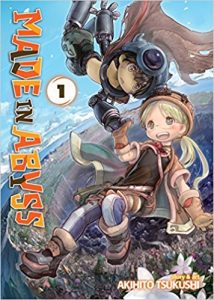
The idea of doing serious and sometimes dark and deadly plotlines with adorably cute characters is not new to manga – in fact, one might argue it’s been around since manga first began. The last few years, though, particularly since the advent of Puella Magi Madoka Magica, we’ve seen a number of series that deliberately want the dissonance to be part of the point, showing us young happy people and then having very bad things happen to them. In general in some prior reviews I’ve tended to be more annoyed at the plotline than the art style; I tend to like happy endings, as people know, and don’t like characters put through the ringer just for the sake of being mean. Fortunately, Made in Abyss is not that series. You can tell there’s a lot of care put into the basic concept of the world, and the darkness of the first volume is balanced out by the cheerfulness of the heroine.

We are in a fantasy world that exists on the edge of a giant pit, wherein are treasures beyond compare but which is also super lethal, especially as you get further down. Our heroine is Riko, who delves to the shallowest depths of the pit with her fellow orphan children in order to be trained to be an actual adventurer and go deeper. She’s an orphan as both of her parents went into the pit and haven’t returned… that is, until the city gets a message from Riko’s mother. Most of the city chooses to treat this as confirmation of her death, since she was clearly in the “if you go to this level you will die” area. Riko, though, takes it as a sign that she needs to disregard the slow, filled-with-rules training and go down the pit to find her mother, accompanied by Reg, an amnesiac robot boy who wants to find out who he really is. The volume ends with their illegal descent.

Riko and Reg are the best reason to read the series. Riko is a great heroine, being impulsive and bratty but without tipping over into obnoxious, and she’s balanced well by the thoughtful, withdrawn Reg. You sense that her descent is clearly a bad idea and I have no doubt things will get much worse, but she’s the heroine and I want to root for her anyway. Also, the concept of the pit and the levels therein is quite well drawn, being overly complex without requiring the reader to actually remember all of it. If there’s one big drawback, it’s that this time around I *am* more annoyed at the art style than the plotline. I think the series might have worked better for me if the cast looked a bit more realistic and a bit less, well, Madoka Magica. It does not help that the artist at one point as a gag shows us Riko naked and strung up as “punishment” for rule breaking; it’s not as explicit as I feared, but please, do not show naked children in your fantasy adventures, PLEASE. Especially for the lulz.

Despite that, I will be trying another volume of this, mostly as I am very curious to see what happens next, and I hope Riko succeeds.

Filed Under: made in abyss, REVIEWS

Manga the Week of 1/31/2018

January 25, 2018 by Sean Gaffney, Michelle Smith, Ash Brown and Anna N Leave a Comment

SEAN: So Yen is splitting its shipment, pushing a bunch of its titles into the first week of February. Lucky for all of you, or next week would be even bigger than it already is.

Ghost Ship has a 2nd omnibus of To-Love-Ru, and a 2nd volume of its sequel To-Love-Ru Darkness.

Three new volumes from J-Novel Club, as we see a 7th Grimgar of Fantasy and Ash, a 5th How a Realist Hero Rebuilt the Kingdom, and a 2nd Outbreak Company.

Kodansha Digital seemingly has nothing out next week if you look at Amazon and B&N. Kodansha’s own site, however, says they’ve definitely got some stuff. We have Black Panther and Sweet 16 6, Giant Killing 10, Living Room Matsunaga-san 2, and Until Your Bones Rot 4.

MICHELLE: Hooray for Giant Killing!

ASH: Hooray!

SEAN: We also have the 9th and final volume of The Full-Time Wife Escapist, which I’m still running behind on but remains my favorite digital license from Kodansha.

MICHELLE: I’m very much looking forward to this.

ANNA: I like this series even though I’m so far behind, maybe I will binge a bit on the weekend.

SEAN: There’s also print, with a 3rd Kiss Me at the Stroke of Midnight, and a 9th volume of endurance test Welcome to the Ballroom.

MICHELLE: Heh. Here’s hoping it lightens up sometime soon.

ANNA: This is not inspiring me to get caught up on Ballroom!

ASH: I’m already behind on Kiss Me at the Stroke of Midnight, but I did enjoy the first volume more than I thought I would.

SEAN: Seven Seas debuts a light novel digitally next week, though the print edition is not out till June. It definitely has a light novel title: Didn’t I Say To Make My Abilities Average in the Next Life?!. It does have a female lead, though. I’m all for light novels with female leads.

The manga debut is Nameless Asterism (Nanashi no Asterism), a Gangan Online series that seems to be about a love polygon, and may also have elements of BL and yuri.

ASH: I’m rather curious about Nameless Asterism; looking forward to giving the first volume a try!

SEAN: Seven Seas also has a 3rd Alice & Zoroku, and a 4th Plum Crazy!.

MICHELLE: Kitty!

SEAN: Vertical has a 6th Immortal Hounds, which is now caught up with Japan, I think.

And so we come to Yen. There’s digital-only titles, as we get Crimson Prince 14, Kuzumi-kun, Can’t You Read the Room? 4, Now Playing 4, and Sekirei 14. There’s also a digital release of the light novels Kieli’s vols. 2 and 3.

Yen On has light novels, though thankfully this is a small month after the deluge in December. We get Death March to the Parallel World Rhapsody 4, My Youth Romantic Comedy Is Wrong As I Expected 4, Overlord 6, and Strike the Blood 8.

As for Yen Press, there’s several titles out next week (unless you get manga from Diamond Comics, in which case their monopoly is pointing and laughing at you). Debuting is Baccano!, a manga adaptation of the first light novel. Actually, the first volume is mostly an original prequel to the novels written by Narita, featuring Firo and the Gandors a few years earlier. It’s already come out digitally, but now you can enjoy it in print.

The other debut is Val x Love (Ikusa x Koi), an ecchi fantasy series from Shonen Gangan that sounds like it will appeal to fans of High School DxD.

Ongoing series unrelated to light novels include Akame Ga KILL! 13, Black Butler 25, Gabriel Dropout 2, and The Royal Tutor 5.

Ongoing series that are either adaptations of or spinoffs from light novels include A Certain Magical Index 12, Hybrid x Heart Magias Academy Ataraxia 2, DanMachi Sword Oratoria 2, Overlord 5, Re Zero Arc Three 2, and the 6th Sword Art Online Progressive.

And that’s all for Yen for next week, but stay tuned to the week after. Anything appealing to you here?

Filed Under: FEATURES, manga the week of

RWBY

January 25, 2018 by Sean Gaffney

By Shirow Miwa, based on the series created by Monty Oum. Released in Japan by Shueisha, serialized in the magazine Ultra Jump. Released in North America by Viz Media. Translated by Joe Yamazaki. Adapted by Jeremy Haun and Jason A. Hurley.

I have never actually seen the RWBY series, though I know of it via Tumblr osmosis. What I know can be summed up as a) there’s a team of fighting girls; b) two of them are super gay; c) OK probably not canonically but fandom thinks they’re super gay. That’s about it. So I was looking forward to seeing this series. It’s always interesting when Japan does a manga of a Western property, though in this case obviously RWBY has a certain anime style to begin with. The manga serves as a prequel to the series, showing off the four main characters, as well as another team that also works with them, as they protect the world from enemies while also attending what seems to be superhero school. I enjoyed it quite a bit, but I suspect that this may be more a book for newbies than the hardcore RWBY fan.

The girl on the cover is Ruby Rose, the R of the group, and she gets the first of what turns out to be an introductory story for each of the team. She’s essentially the standard Shonen Jump hero, only female. I like her, she’s very straightforward. Less straightforward are Weiss, who is fighting with the team despite the objections of her rich, upper-class family, who have other plans for her; Blake, who is a faunus, aka a catgirl, and who has a dark past and seems to have once been a terrorist; and Yang, Ruby’s sister, who likes to be a big sister type, punching things, and Blake, not necessarily in that order. The stories are not particularly deep – Weiss and Blake’s, being more serious, had greater impact for me – but they sketch out the personalities of the team pretty well.

The ending story tries to focus on one of the other teams in the series, Team JNPR, whose leader seems to have a crush on Weiss, and also an extreme case of self-doubt. Unfortunately, this is a one-volume title, so we don’t really get to know the rest of his team that well, but that’s what the series is for. Again, there’s nothing particularly surprising here – Jaune’s team leaves early to battle a monster so that he can prove how awesome he is, only to run into trouble and need to get bailed out by our heroines. We get a few cameos from people who are clearly also regular cast members (I liked the flying robot girl), as well as a hint of GREAT EVIL afoot that no doubt also will appear in the show rather than this manga.

As I said, this seems to serve more as an introduction to RWBY for those who haven’t seen it – fans may want to wait for the anthology series that Viz just licensed. It’s not great, but I felt it had a lot of style, just like the team it’s trying to show us. It made me curious about the series, which is probably all it was designed to do. Definitely worth a shot.

Filed Under: REVIEWS, rwby

Paying to Win in a VRMMO, Vol. 6

January 24, 2018 by Sean Gaffney

By Blitz Kiva and Kuwashima Rein. Released in Japan as “VRMMO wo Kane no Chikara de Musou suru” by Hobby Japan. Released in North America digitally by J-Novel Club. Translated by Elizabeth Ellis.

One benefit of reading light novels on my phone rather than in print is that there’s less tendency for me to look back at the color pages. These pages, seen in most light novels, are basically a preview of the book, showing various exciting scenes in color to whet the appetite. When done well, they do just that, and show off the drama, excitement, or humor within. Sometimes, though, they can actually be major spoilers, revealing the surprise climax before you’ve even started the book. Fortunately, by the time I got to said climax, I’d forgotten that I’d already read it in the color page the day before. Which is good, as the climax is brilliant, showing off the protagonist at their best, in a magnificent display of everything we love about her. Yes, that’s right, her. Ichiro may be the one Paying to Win, but in the end Iris gets the cover of this final volume, and rightly so.

This volume picks up right where the last one left off, and certainly has a nice little starting point: Ichiro is arrested. Of course he’s not guilty, but the problem is that announcing the guilty party would be problematic for many different reasons. As such, after posting bail, he and Airi (who has rushed to see him at the station due to, well, sheer outrage, I think) set about trying to figure out a way to fix this. It gradually becomes clear that there’s no quick and easy way to do that, and that it looks as if Ichiro is going to have to break his own “rules” he’s set for himself in order to do so. But fortunately, the people he has met in the game over the past few months are here to help him, as are a few of his friends outside the game. And there’s always Airi/Iris and her use of her sharp tongue, though for once it’s not the words that are as effective as simply, wonderful violence.

Not to spoil but there was a scene in this volume that had me cheering out loud. I’ve made no bones in prior reviews about how much I did NOT want to see Ichiro and Iris as a romantic pairing, and I got my wish. Rosemary, the AI from the prior volumes, is asking various “rivals” how they feel about Ichiro, and Iris comments that she sees him as “an enemy”, someone to show up and surpass. She also notes she’s not attracted to him. I love this because I feel Iris’ character is so much better when she has this goal in mind. She’s never been a tsundere, much as the narrative might have occasionally tries to shoehorn it in. She’s just determination in one small package. (Actually, there may be more rivals out to defeat Ichiro than there are rivals for his love – Megumi may have lucked out there.) Pay2Win ended up with precisely zero romantic pairings over the course of the book, and that was very refreshing, especially for this genre.

Aside form Iris’ violence at the finale, I must admit my favorite moment in the book was the use of a popular meme. It was first seen as part of a montage of players discussing Ichiro and how they felt about him, and was a very amusing gag – there’s always that one player who wants to speak in meme. Then it shows up again later, and I felt “Oh, no, he ruined it by trying to use it again. Minus five points.” But its use as the big villain reveal at the end of the book left me with my jaw dropped, as suddenly I went “Oh my goooooood, of COURSE.” Honestly, I’ve felt that way throughout the last couple volumes of this series. It started off unevenly, and got better as it went along. J-Novel Club has better written light novels, but there are few that have genuinely entertained me as much as Paying to Win in a VRMMO. Can we get that “Irish Sniper” web-only side-story as an extra?

Filed Under: paying to win in a vrmmo, REVIEWS

Bookshelf Briefs 1/23/18

January 23, 2018 by Michelle Smith and Sean Gaffney Leave a Comment

A Certain Scientific Accelerator, Vol. 7 | By Kazuma Kamachi and Arata Yamaji| Seven Seas – Much to my surprise, there was one less death than I predicted in my last brief. Other than that, though, this went sort of how I expected—our heroes fought a long, hard battle and won eventually, though Estelle is warned by Accelerator that she should stay out of “the dark side” of Academy City. From what I recall in the main Index series, that’s easier said than done, though of course Accelerator simply means stay away from HIM. Of course, Accelerator cannot stop being a trouble magnet, just like Touma. And, just like Touma, he now has a beautiful girl fall out of the sky in front of him. Index was hung like a futon, and this new princess seems to have been in a suitcase. What will happen next? Good times in any case. – Sean Gaffney

My Monster Secret, Vol. 9 | By Eiji Masuda | Seven Seas – Akemi and Aizawa are on the cover this time, as if to announce that the harem sweepstakes, which has never exactly been a small part of this series, is now ramping up quite a bit. Of course, this all stems from Youko’s actions at the end of the last volume—something she’s still freaking out over, to an extent. There’s a lot of comedy but very little forward progress here, as you’d expect from this sort of series. Still, the comedy is funny, and there’s even a bit of plot. It’s also amusing to have the characters we aren’t allowed to see play a big role—Akemi from the future and Shiho’s mother. If you get frustrated by lack of forward progress, come back in a volume or two. Otherwise, this continues to be funny. – Sean Gaffney

Spirit Circle, Vol. 2 | By Satoshi Mizukami | Seven Seas – I’m really enjoying this series, but it’s surprisingly grim, even from the creator of Biscuit Hammer, which was also filled with lots of trauma. It’s probably for the best, as the humor here is not the high point. What is the high point is that we get another past life for Fuuta, which takes us back to Ancient Egypt. It shows how his past lives can get screwed over by Kouko’s past lives even if they don’t kill each other. That said, his life was not terrible. Unfortunately, doing all of this reliving of past lives may be unlinking Fuuta to his own identity, which could have ominous consequences. Spirit Circle‘s plot is intriguing and its characters are likeable. I want to see where it’s going. – Sean Gaffney

Waiting for Spring, Vol. 4 | By Anashin | Kodansha Comics – This is a shoujo romance and not a shonen basketball manga, so the result of the game may not go the way everyone wants it to. We do get some nice interaction between Mitsuki and the four guys, though, and also some suggestion that this may be a reverse harem after all, as there’s some brief ship tease with Rui and Kyousuke. This does lead us to a very good point regarding this romance, which is that things can’t progress until Mitsuki admits her own feelings, something she seems to slowly be coming to terms with. I was also amused by a healthy dose of humor AND fanservice, as everyone imagining their hot guy/girl in a swimsuit gave us a lot of amusing reactions. This is a cute, fun romance series. – Sean Gaffney

Waiting for Spring, Vol. 4 | By Anashin | Kodansha Comics – In my long review of the first three volumes, I wished for a little more basketball and this time I got my wish. Anashin-sensei achieves a good blend of tournament action and shoujo romance here, particularly as the guys are worn out from their first game and can’t sustain their lead in the second. Their loss turns into an opportunity to show rather than tell how much they’ve accepted Mitsuki into their inner circle, as she’s permitted to be present when they discuss their feelings, self-recriminations, determination to improve, etc. Ryuji endeared himself to me by crying over the loss, and even playful Rui had some harsh words for himself. I’m starting to feel like this heartwarming series might be just what I need to sustain me when Kimi ni Todoke wraps up its run in another couple of volumes. Definitely recommended. – Michelle Smith

Wake Up, Sleeping Beauty, Vol. 2 | By Megumi Morino | Kodansha Comics – It’s rare that we get to see a male lead dealing with his weaknesses as much as Tetsu does here. Still dealing with family issues, his general fear of the supernatural, and the simple nature of what’s going on with Shizu, he’s not making the best choices all the time. But he’s trying, and he’s a good kid. As for Shizu, we do eventually see more of her actual self, though that may be a worrying part of the story—due to her constant possession, she has very little idea of who she is or what she likes. That said, she’s starting to like Tetsu, and I’m wondering what will happen when she decides that she wants to control her own action more. Meanwhile, yay, a clearly villainous dad arrives just in time for the cliffhanger! Intriguing. – Sean Gaffney

Wake Up, Sleeping Beauty, Vol. 2 | By Megumi Morino | Kodansha Comics – I really appreciate Tetsu’s sense of ethics here. He’s still afraid of Shizu and her situation, but thinks to himself, “I have to earn what I’m being paid. I have to stop being scared and be a better friend to her.” Soon, he realizes that he’s not actually afraid of Haru and Shinobu, the friendly spirits who regularly inhabit Shizu and look after her, and even infuriating Mirei helps him to loosen up. It’s just Shizu herself who scares him, since she lacks a strong sense of self, but he endeavors to learn her likes and dislikes and soon realizes that she’s actively trying to make him happy. She just has an utterly self-sacrificing way of going about it. What could’ve made her this way? Enter Evil Dad, right on cue. I will definitely be seeing this short series through to its conclusion. – Michelle Smith

Filed Under: Bookshelf Briefs

Pick of the Week: My Manga Is Orange

January 23, 2018 by Sean Gaffney, Katherine Dacey, Michelle Smith and Ash Brown Leave a Comment

KATE: I suspect I’m not the only one who’s eager to read orange: future; I still get the sniffles just thinking about orange, and am eager to see how Ichigo Takano continues the story. Looking over this week’s new arrivals, though, I’m also curious about Made in Abyss, which sounds like a dark fantasy-adventure with an interesting heroine. And I’ll also give a plug for PTSD Radio, despite its unfortunate title and godawful covers. It’s a solid horror series that benefits from unique artwork and an unusual narrative structure.

SEAN: There’s several titles I’m interested in, including a final volume of Golden Time and the debut of Made in Abyss. But yeah, in the end the clearly obvious Pick of the Week is orange: future, which I reviewed here in a spoilery fashion, as Seven Seas helpfully noted. It may not please everyone, but it’s well-crafted.

MICHELLE: Having now read and loved the first two volumes of Frau Faust, I am definitely looking forward to volume three. But, yes, my heart really does belong to orange: future. I’m a little afraid of what it might reveal, given how much I loved the original series, but there’s no way I’m skipping it.

ASH: I’ll definitely be reading more of Frau Faust, and I’m rather curious about Made in Abyss, too, but orange: future is unquestionably my pick this week. Like so many others, the original series made a huge impression on me.

Filed Under: PICK OF THE WEEK

Infinite Dendrogram: Franklin’s Game

January 22, 2018 by Sean Gaffney

By Sakon Kaidou and Taiki. Released in Japan by Hobby Japan. Released in North America by J-Novel Club. Translated by Andrew Hodgson.

Last time we had the setup, and this time we do get the payoff. Well… most of the payoff, as this fourth volume unfortunately does end mid-battle. It is somewhat puzzling that the author says the climax was too long to fit into this book, given that this book is significantly shorter than the previous three. But that said, it’s a solid volume overall, provided you like fighting, because that’s pretty much all that it is. We get a nice punchable villain, get to see Hugo agonize about the life choices he’s made, and get some more detailed backstory on a few of the others, including Rook, who turns out to have been the offspring of Saint Tail all along. (OK, not really.) The fights are also solid, with each of the characters helpfully narrating every single thing that’s happening, which may be annoying to some, but I have difficulty with visualization so I find it quite refreshing.

Again, one of the more unique things about the Dendrogram series is that it is actually a game, and not people trapped or living in a game-like environment. As such, Franklin, our sneering villain, can feel free to kill off a bunch of Masters with impugnity and the reader is not inclined to think of him as history’s greatest monster the way that we did when the NPC children were being slaughtered in the second book. Franklin, in order to make things fun and also make sure that he gets the one battle he wants to have, ensures that low-level masters – like Ray and Rook, conveniently – can escape the arena and go to try to stop him. Naturally this is going to backfire horribly on him, because Ray and Rook are not just any old newbies. Again, we’re informed of the difference between those who simply treat this world and those in it as a game, and those (like Ray) who can’t help but see the people suffering inside it as real. (Marie also gets something to do, by virtue of who she is, but her fight with the conductor, while cool, felt more like an excuse to pad the book out than anything else.)

One thing I really liked about this book is the addition of three minor female masters who follow Ray and Rook to go do battle. They’re introduced as tagging along because Ray and Rook (especially Rook) are really handsome, and I was expecting them to be either a) cannon fodder, or b) a source for annoying gags. Imagine my surprise when they get (admittedly brief) characterization and backstory of their own, team up well to take out some minor monsters, and do fairly well for themselves. I’m not sure if we’ll see them in future books, but it was nice to see them taken seriously even though they’re fangirls. As for Ray’s battle with Franklin, it’s still in media res, so to speak, but I was amused by the fact that everyone thinks of Ray as a big dumb shonen hero filled with justice and righteousness, which isn’t wrong, but when we switch to his POV his mind is filled with analysis and quick thinking. This is no Luffy.

It took a while to grow on me, but I’ve come to quite enjoy Dendrogram. If you like “game-style worlds” and aren’t annoyed that it’s an actual game for once, this is a good series to follow.

Filed Under: infinite dendrogram, REVIEWS

Kitaro: Kitaro the Vampire Slayer

January 21, 2018 by Sean Gaffney

By Shigeru Mizuki. Released in Japan as “Gegege no Kitaro” by Kodansha and Shogakukan, serialized in various magazines. Released in North America by Drawn & Quarterly. Translated by Zack Davisson.

I’m sure that if I looked at my previous reviews of Kitaro they would find me saying the same thing as I’m about to say here, so I apologize for the repetition, but I love Nezumi Otoko. He is the number one reason to read this series, even more than the cool adventure plots of the weird, goody and terrifying yokai. And that is simply because he is SO TERRIBLE. He is just the worst. When Mizuki wrote his Hitler book, and needed a narrator who could enchant the reader while still being able to get away with throwing his arms around Hitler as if they’re buddies, there was only one real choice. This volume shows Mezumi Otoko getting in a fight with Kitaro (meaning he slaps him across the chops – his signature move), team up with the titular vampire, sell out his friend and have Kitaro reduced to a skull, etc. Even when he is supposedly on the side of our hero, you’re reminded that his stench is repellent and his farts are lethal. He’s so much fun.

In non-Nezumi Otoko discussion of this new volume of Kitaro, I admit that when I saw the cover, I was expecting more of a Beatles parody than I actually got. Sure the vampire has a Beatle haircut, and carries a guitar with tempting music, but otherwise he’s just a garden-variety Mizuki villain. Not that this is entirely a bad thing, as Mizuki’s yokai can be real pieces of work – Kitaro needs a lot of help to triumph here. There’s also a second vampire story in the book involving, of all things, a vampire Marilyn Monroe. Kitaro needs a lot of help here as well – in fact, in this book, his eyeball father may get more heroic things to do than he does. But sadly, such is the way of adventure thrillers, where the new villain has to be shown to be impressive by making mincemeat of the hero – at first.

The last two stories in the book feature Kitaro in a bit more of a heroic mode. All the stories, however, are exemplary in their economy. The non-yokai cast may be a bit bland – honestly, between the dialogue and the hangdog expressions he gives everyone you’d be forgiven for thinking that all the humans in Kitaro’s universe speak in a monotone – but there’s something happening on every page, and we rarely get too many subplots or sidesteps, even in the longer tales such as the title one. These stories are not really here to make people debate backstory or create Kitaro High School AU fanfiction, like other, more modern manga. They tell a story well, fast, and then move on to the next story. As such, Kitaro should be a lot of fun to anyone who enjoys reading a good story. And, as previously stated, they have Nezumi Otoko. Who is just awful. Seriously.

Filed Under: kitaro, REVIEWS

  • « Go to Previous Page
  • Page 1
  • Interim pages omitted …
  • Page 236
  • Page 237
  • Page 238
  • Page 239
  • Page 240
  • Interim pages omitted …
  • Page 382
  • Go to Next Page »
 | Log in
Copyright © 2010 Manga Bookshelf | Powered by WordPress & the Genesis Framework