• Skip to primary navigation
  • Skip to main content
  • Skip to primary sidebar
  • Home
  • About Us
    • Privacy Policy
    • Comment Policy
    • Disclosures & Disclaimers
  • Resources
    • Links, Essays & Articles
    • Fandomology!
    • CLAMP Directory
    • BlogRoll
  • Features & Columns
    • 3 Things Thursday
    • Adventures in the Key of Shoujo
    • Bit & Blips (game reviews)
    • BL BOOKRACK
    • Bookshelf Briefs
    • Bringing the Drama
    • Comic Conversion
    • Fanservice Friday
    • Going Digital
    • It Came From the Sinosphere
    • License This!
    • Magazine no Mori
    • My Week in Manga
    • OFF THE SHELF
    • Not By Manga Alone
    • PICK OF THE WEEK
    • Subtitles & Sensibility
    • Weekly Shonen Jump Recaps
  • Manga Moveable Feast
    • MMF Full Archive
    • Yun Kouga
    • CLAMP
    • Shojo Beat
    • Osamu Tezuka
    • Sailor Moon
    • Fruits Basket
    • Takehiko Inoue
    • Wild Adapter
    • One Piece
    • After School Nightmare
    • Karakuri Odette
    • Paradise Kiss
    • The Color Trilogy
    • To Terra…
    • Sexy Voice & Robo
  • Browse by Author
    • Sean Gaffney
    • Anna Neatrour
    • Michelle Smith
    • Katherine Dacey
    • MJ
    • Brigid Alverson
    • Travis Anderson
    • Phillip Anthony
    • Derek Bown
    • Jaci Dahlvang
    • Angela Eastman
    • Erica Friedman
    • Sara K.
    • Megan Purdy
    • Emily Snodgrass
    • Nancy Thistlethwaite
    • Eva Volin
    • David Welsh
  • MB Blogs
    • A Case Suitable For Treatment
    • Experiments in Manga
    • MangaBlog
    • The Manga Critic
    • Manga Report
    • Soliloquy in Blue
    • Manga Curmudgeon (archive)

Manga Bookshelf

Discussion, Resources, Roundtables, & Reviews

Sean Gaffney

Full Metal Panic!: Ending Day by Day, Part 2

January 4, 2020 by Sean Gaffney

By Shouji Gatou and Shikidouji. Released in Japan by Fujimi Fantasia Bunko. Released in North America by J-Novel Club. Translated by Elizabeth Ellis.

This is also quite a short book, though not as short as the first part, and it might have flowed better as one long volume. But light novels were shorter in general back when FMP! came out. What’s more, it might have simply been too exhausting: the events in this book are designed to grind our hero and heroine down to the point where they’re both mentally broken, and succeed in doing so, though thankfully no permanent harm is done. Having this as the entire second half of one book might have demoralized the reader. As it is, be prepared for Sousuke to get more and more depressed and distracted, to the point where he’s zoning out and thinking of Kaname during an actual mission, leading to an accident and Mao having to try to clean up after him. (One weakness of the book is that we don’t see him meeting Mao after this occurs and he stalks off, possibly as she’d break his jaw and he needs that jaw.)

After spending most of the last few books seemingly getting killed and then coming back like Richard Nixon, Gauron finally bows out here, though not before making Sousuke’s life even more miserable than it already is. His new squad commander shows he doesn’t trust the Arbalest, which Sousuke agrees with – this despite talking with “Al” and finding the AI a lot more human than he had imagined. Unfortunately, he does not have the opportunity to work this out off-duty, as Hing Kong is about to descend into civil war thanks to Amalgam, whose leader turns out to be Tessa’s brother Leonard, who is there to give us a new bad guy to hate now that Gauron (finally) dies. Gauron was after Sousuke – Leonard is after Kaname. Kaname is possibly helping out, as after finding that Sousuke has removed himself from her life, she goes on a rampage in an effort to get her new “watcher” to take action… something that has almost lethal consequences.

It has to be said, a number of Kaname’s actions in this book beggar belief, and are the very definition of “don’t try this at home”. In particular, if you are being watched and want your tail to make themselves known, don’t take some stranger to a love hotel so he can try to assault you. However, Kaname gets a number of good (if fanservicey) scenes in this book, none more so than her reappearance and thrashing of Sousuke after he had been told she was dead, which is one of the best moments in the entire series. Unfortunately, it also highlights the pacing problems – this book is all backloaded, meaning the front part drags. Clouseau wipes the floor with Sousuke, but then seems to mostly vanish, with only a brief suggestion that his trashing of their late commander was entirely an act. Oh yes, and Tessa’s apology to Sousuke was cute, but reminds us again that she’s a very, very distant second in this love comedy race for Sousuke’s heart.

The next volume promises to be a longer one, and also lighter in tone, likely with more of the “wacky” comedy parts of FMP that sometimes work and sometimes read like the author read too many shonen manga with tsunderes. This is a flawed but readable angst-and-action book in the meantime.
Filed Under: full metal panic!, REVIEWS

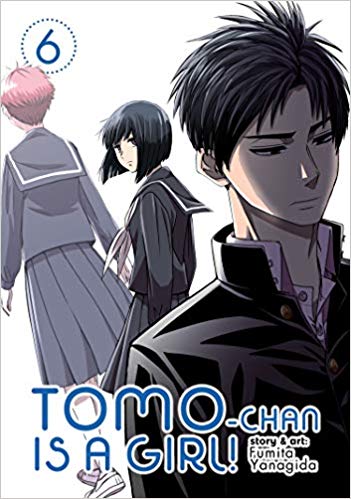
Tomo-chan Is a Girl!, Vol. 6

January 3, 2020 by Sean Gaffney

By Fumita Yanagida. Released in Japan as “Tomo-chan wa Onnanoko!” by Star Seas Company, serialized on the online site Twi 4. Released in North America by Seven Seas. Translated by Jennifer and Wesley O’Donnell. Adapted by T Campbell.

After the first volume, as I do with most series I follow, Tomo-chan Is a Girl! moved to Bookshelf Briefs. But sometimes you have things to say that cannot be condensed into 150 words, and this volume is a very good example – it’s almost the perfect Tomo-chan volume. We resolve Carol and Misaki’s romance, and given Carol possibly the best material she’s ever gotten, as Misuzu’s attempts to “break” her work all too well. The marathon chapter is one big long take on the Japanese saying “idiots don’t catch colds”, which Tomo proves wrong, to everyone’s shock and horror. And we get two chapter’s worth of flashbacks, showing how we got to the present setup – Tomo and Jun’s middle-school years, Jun’s own realization of his feelings, and possibly the most disastrous couple in the history of manga. If you love this manga series, this may be the pinnacle – there’s two more volumes after this, but it’s hard not to argue that this is the high point.

Carol has sort of been the breakout star of Tomo-chan, and her default reaction is, of course, smiles and good cheer. Now we, as the reader, and also Misuzu, have seen that cheer fall sometimes – notably when thugs were threatening Misuzu and she tried to protect Carol by saying they weren’t friends. But Misaki doesn’t see this, partly as Carol will never deliberately show that side to him, and partly as he’s scared to look further for fear there’s nothing behind her smile. Now, arguably Misuzu’s action here are appalling – something she realizes immediately. But they do work, and we get, as Tomo says, a wonderful few pages that show us that Carol can have real human emotions as well. (I was also amused at Carol’s mother cutting her off before she can go in for a kiss – given Ferris had Carol when she was thirteen, you can see why she’s going to step in. That said, given the omake chapter at the end, Ferris has little to worry about on Misaki’s end.)

I will admit that the two flashback chapters do run on a very old and creaking cliche, which is that Jun does not realize, for years, that Tomo was a girl, despite seeing her literally using the girls’ bathrooms at events. It always makes the main lead feel a bit too stupid, and it does here as well. But what follows is all too real and familiar, as Jun cuts himself off from Tomo after he doesn’t know how to be around her, and she too is hurt and retreats. Jun then realizes he needs to make an effort here, and does so… in a bizarre way. The brief, a few days relationship between Jun and Misuzu feels so wrong you want to scream, and both of them know it. Despite that, I loved that even though they knew that, both acknowledged that dating another person, having those feelings, felt good.

So we now have all the backstory, all we need to do is get Tomo and Jun on the same page and confessing. This has taken 6 volumes and we’re still not there yet, but the good news is that the end is in sight. Till then, Tomo-chan Is a Girl! is one of the best 4-komas I’ve read in some time. Funny and sweet.

Filed Under: REVIEWS, tomo-chan is a girl!

Manga the Week of 1/8/20

January 2, 2020 by Sean Gaffney, Ash Brown, Anna N, Michelle Smith and MJ Leave a Comment

SEAN: OK, now it’s actually January. You can tell as the Viz books are all pouring in. But first…

J-Novel Club has a giant pile of things due out. For print books, we have Animeta! 2, An Archdemon’s Dilemma 3, Ascendance of a Bookworm 3, and Infinite Dendrogram 4.

ASH: I’ve been meaning to give Animeta! a try now that it’s available in print.

MICHELLE: I thought the first volume was pretty fun.

SEAN: On the digital side, there’s Animata! 3, Demon Lord Retry! 2, Der Werwolf 6, In Another World with My Smartphone 18, the 2nd Marginal Operation manga, Otherside Picnic 2, and There Was No Secret Evil-Fighting Organization (srsly?!), So I Made One MYSELF! 2.

From Kodansha Comcis, we get, in print, Grand Blue Dreaming 9 and Tales of Berseria 2.

There’s a lot more digitally. The debut is That Blue Summer (Ao Natsu), a Betsufure series from the creator of To Be Next To You, which we saw debut digitally this week. That’s a big grin that girl has on the cover.

And we get All-Rounder Meguru 12, Chihayafuru 18, Magical Sempai 6, My Sweet Girl 10, Smile Down the Runway 5, and To Write Your Words 2.

ASH: Both J-Novel Club and Kodansha Comics have some great digital offerings this week.

ANNA: Nice, maybe I’ll use my remaining week of vacation to get more caught up on Chihayafuru.

MICHELLE: Yay for more shoujo and super yay for more Chihayafuru!

SEAN: Seven Seas has quite a bit, including a couple of debuts. Dungeon Builder: The Demon King’s Labyrinth is a Modern City! (Maou-sama no Machizukuri! ~Saikyou no Danjon wa Kindai Toshi~) is a manga adaptation of a light novel (which I don’t believe is licensed) that runs in Overlap’s Comic Gardo. Demon Lords create labyrinths to trap people and consume their despair… but this one just wants to be super nice.

ASH: That actually sounds kind of amusing.

SEAN: My Room Is a Dungeon Rest Stop (Boku no Heya ga Dungeon no Kyuukeijo ni Natteshimatta Ken) is also based on a light novel… which again I don’t think we have here… that runs in Takeshobo’s Web Comic Gamma. A guy buys a dirt-cheap apartment, then finds that it also leads to a fantasy dungeon. Can he help adventurers in trouble and show them the wonders of modern plumbing?

Also out from Seven Seas: Akashic Records of Bastard Magical Instructor 8, the print edition of the 2nd Arifureta ZERO novel, the print edition of Vol. 1 of Magic User: Reborn in Another World as a Max Level Wizard, the print version of the 4th Mushoku Tensei novel, and Tomo-chan Is a Girl! 6.

Vertical has a 2nd volume of the Bakemonogatari story, which finishes up Senjogahara’s story and starts Hachikuji’s.

Viz has no debuts next week, but it does have the 18th and final volume of Anonymous Noise. Will the romantic triangle resolve?

MICHELLE: I mean, it’s gotta, right?

SEAN: We also get, on the shonen/seinen side, Black Clover 19, Demon Slayer: Kimetsu no Yaiba 10, Dr. STONE 9, Haikyu!! 36, Kaguya-sama: Love Is War 12, and The Promised Neverland 13.

ANNA: Good stuff!

On the shoujo/josei side, we get Daytime Shooting Star 4, An Incurable Case of Love 2, and Snow White with the Red Hair 5.

ASH: I’ll read all of those, honestly.

ANNA: Nice! It is a week for Anna!

MICHELLE: I enjoy quite a few of these but am most excited about Snow White with the Red Hair and Haikyu!!.

MJ: I can’t believe this is the first time I’m speaking up here with all this manga, but I’m here for Snow White with the Red Hair!

SEAN: Lastly, Yen has two stragglers that got delayed from December. Yen On gives us the 18th and NOT final volume of Sword Art Online, though this does wrap up the giant massive-10-volume Alicization arc.

For manga, we get Chio’s School Road 7.

Some interesting stuff there. What are you picking up?

Filed Under: FEATURES, manga the week of

Beatless, Vol. 1

January 2, 2020 by Sean Gaffney

By Satoshi Hase and redjuice. Released in Japan by Kadokawa Bunko. Released in North America digitally by J-Novel Club. Translated by Ben Gessel.

This is a doorstopper of a book, and I think my largest issue with it is that it could easily have been split into two normal-sized books. There’s a lot going on in it, yes, with a large number of very cool action set-pieces, but the book also wants you to know that it’s going to be talking about what hakes a human and what makes an artificial intelligence, and it does. In great detail. It’s quite interesting, but after a while it can be exhausting. I also wish we had spent a bit more time with hIEs (that’s the series name for the artificial intelligences mankind has built) other than the five main modern units, as they’re clearly meant to be more special and more human than the usual shopkeeper hIEs and the like. It’s a bit difficult to hear one of the cast talking about them as if they’re cars that can be sold when you get to see their POV briefly and see they do have wants and needs beyond their owners.

This takes place almost a century from now, where humanoid intelligences (hIEs) have gotten to the point where they’ve started doing the “drudge” jobs for humanity and also are hard to tell apart from humanity. Our hero is Arato, who at times almost seems a parody of “generic anime protagonist”. He’s aggressively normal, except for the fact that he always wears his heart on his sleeve and tries to think of everyone as basically kind. He’s also kind to hIEs, seeing them as people, which his friends Ryo and Kengo certainly don’t. His father is a major player in the hIE world, but we barely meet him. His sister is even a classic anime little sister. That said, it all changes when, coming across a bizarre flower attack on the hIEs in the street, he’s rescued by Lacia, a clearly far more advanced than the usual hIE who asks him to become her “owner”. He agrees, but she also has a lot of secrets – like how she’s connected to five hIEs who broke out of a lab and are being hunted down.

This book does get a lot of things right. Arato is simple and earnest without being boring, and you get why people naturally like him. Yuka is a spoiled little sister but also not annoying. Ryo, his best friend and the heir to a hIE organization, is probably the most interesting and nuanced character in the book, and we watch him slowly go from being Arato’s best friend to a villain in stages so gradual you barely notice it. The action movie set pieces are fantastic, the best being a massive firefight at an airport that also involves one of the cast trapped in a slowly burning limo. It does, however, love to have everyone and their brother talk about the role of hIEs in society, and whether they are like people (Arato’s view) or like toasters (seemingly everyone else’s view). Towards the end the book even becomes a zombie survival novel, but never lets go of the nature of hIEs even then.

Given its length, there’s a lot more I didn’t get into here, like Lacia’s modeling career, or the somewhat abbreviated terrorist career of Arato’s other best friend Kengo (who is then mostly removed from the rest of the book, presumably as his function is finished). I think it might read better if you pace it out over several days. I do recommend it for fans of action-filled works, near-future SF what-ifs, and of course those who have seen the anime.

Filed Under: beatless, REVIEWS

Silver Spoon, Vol. 12

January 1, 2020 by Sean Gaffney

By Hiromu Arakawa. Released in Japan as “Gin no Saji” by Shogakukan, serialized in the magazine Weekly Shonen Sunday. Released in North America by Yen Press. Translated by Amanda Haley.

You can tell that the new year is starting in Silver Spoon because there’s a new freshman, and she’s interested in horses. This despite being in the dairy program. Again, it’s great to see that even at an agricultural school like Ezo, you don’t have to necessarily be slotted into the drawer that your family farm and/or business puts you in. It also once again shows the value of trying even after failure (she tried to get in on the science track, failed, and tried again on the ‘general’ track), which is good, as Hachiken is also dealing with some repeated failures in his life as well. On the positive side, his father is reading his business proposals and taking them seriously. On the negative side, they’re still not good enough, and he’s still not investing any money in them. That could change as we see the start of something that seems obvious but was never thought of much before: Hachiken needs to earn money and invest in his own business.

Of course, sometimes taking that once-in-a-lifetime chance can also lead to failure in the end – there’s a two-week student program in France that’s offered to Hachiken but he passes it on to cheese-loving Yoshino, who jumps at it… and then finds that for the two weeks, she’s at a high school specializing in fish. And yet, even with this obvious punchline, she manages to eat lots of French cheese and has a better idea about the direction she wants to go in. Any experience is good experience if it can show you a better way forward. That also applies to Komaba, who9 still has everyone telling him not to simply give up and abandon all his dreams, including his own family, and Mikage – indeed, the scene between him and Mikage is possibly the best in the volume.

As for Hachiken, he’s sticking with what he knows best – which is to say, pigs. Pigs and pizza. The section of the book dealing with pasturing pigs, free-range style, is fascinating, as with most of the “here is how you do agriculture” stuff in this series. He’s also found a way to solve the problem of Ookawa’s ongoing awfulness – hire him as company president, as when he’s working he’s far more reliable. It’s a character development that makes sense and is hilarious. As for romance, well, it’s pretty much on the back burner until Mikage manages to get into college – though that’s not stopping others (Sakae) from trying to get them to “go all the way”. And there’s also a suggestion that more equestrian action may be in his future – this despite the fact that he’s not picked for the preliminaries. They’re saving him! Again, seeing Hachiken from Vol. 1 and comparing him to this Hachiken is like night and day.

I’m not sure what to add. Another very good volume in a stellar series. Read it.

Filed Under: REVIEWS, silver spoon

I’ve Been Killing Slimes for 300 Years and Maxed Out My Level, Vol. 6

December 31, 2019 by Sean Gaffney

By Kisetsu Morita and Benio. Released in Japan as “Slime Taoshite 300 Nen, Shiranai Uchi ni Level MAX ni Nattemashita” by GA Novels. Released in North America by Yen On. Translated by Jasmine Bernhardt and Taylor Engel.

There is a literary device known as lampshade hanging, wherein the author, knowing that a plot point is ridiculous or obvious, points this out in the narrative, thus taking the curse off it a bit. A classic example is Bruce Willis in Die Hard 2 bemoaning that he’s having the same bad Christmas as Die Hard 1. Readers of Killing Slimes for 300 Years, therefore, should be ready for a number of instances in this book, even more than the usual, where our heroine just straight up says “wow, it’s just like we have in Japan”. The temple visits, the way that weddings happen, various types of spirits… boy, it seems really familiar somehow. This, of course, is because the author is Japanese and doesn’t want to spend too much of a slice-of-life book developing a world when she can have the cast go to the beach instead. Even the Beelzebub side story (which makes a welcome return) has as the central gag Japanese office politics, only with demons.

As with previous volumes, it’s a grab bag of what are basically short stories with Azusa and the gang. While visiting her “mother”, she eats something that turns her small, allowing her a few days to be treated like a real child. She goes to a “singles event” that turns out to be filled with much older men than expected, then meets the local spirit, who tries to officiate weddings but has had bad luck with no one coming by lately. No one in the cast is ready to get married, so they do a “sister’s wedding” between Falfa and Shalsha, inviting most of the regulars. After an injury causes her to revert to her slime form, Fighsly enters a fighting tournament anyway. The cast, as I said above, go to a jellyfish-filled beach, and then we see Halkara’s hometown, and find she’s the responsible one. Then we get more of Beelzebub’s origin story, as she has to deal with crooked administrators and murderous former colleagues.

There’s nothing really to analyze here – it’s not as if people have character development in a series like this – so the goal is to see how cute and fluffy everything is. The answer is very. The wedding may be between two sisters, but features all the things you’d expect, and will put a smile on your face. Halkara’s family were funny and also helped make a character who can grate on a reader fairly easily more sympathetic. There’s more wacky spirits – one talks like a dazed hippie a lot of the time, and another is interested in painting portraits… but the portraits may not come out the way others like. And the Beelzebub chapters are great, showing how even when she’s unsure of herself she still kicks eleven kinds of ass.

Anyone wanting depth and ongoing plot should run far away from this series. But if you like “cute girls doing cute things”, it’s right up your alley.

Filed Under: i've been killing slimes for 300 years, REVIEWS

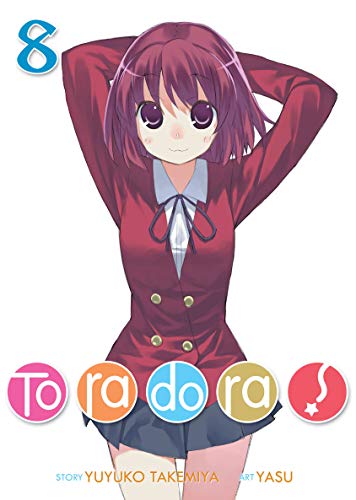
Toradora!, Vol. 8

December 30, 2019 by Sean Gaffney

By Yuyuko Takemiya and Yasu. Released in Japan by Dengeki Bunko. Released in North America by Seven Seas. Translated by Jan Cash & Vincent Castaneda. Adapted by Will Holcomb.

Last time everything was terrible, and I asked is some of that could be fixed by the end of this book. The answer is mostly no, though we do get one major revelation that I expect will eventually lead to the endgame. Till then, though… this was a good volume, with lots of relatable teenage angst, but I have to admit that it feels very much like an author being told to stretch out a series to a nice round ten books and therefore just having everything continue to disintegrate. Minori in particular is still making all the wrong choices, trying to pretend that everything between her and Ryuuji is still exactly the same. Sadly, she’s much better at pretending than he is, so he assumes that his almost-confession meant nothing to her. Ami calls her out on her bullshit, which leads to a major fight between them. And then there’s the ending of the book, which I’ll get into later but leaves Minori sobbing alone in a corner. This is not a wacky fun Toradora! volume.

The tone of the book is set up right off the bat, as the much-awaited trip to Okinawa is cancelled when the hotel they were supposed to stay in burns down. As such, the class trip is a much shorter skiing trip, which pleases absolutely no one. As for Ryuuji, he’s still devastated by events of the previous book, and only JUST manages to get back to himself by halfway through the book. This thankfully allows for the brief bit of comedy we get – the tracksuit outfits picked out for the class are deliberately tacky and awful, and there’s various “Ryuuji and Taiga can’t ski” jokes that are a lot of fun – at least till the end. The main plotline remains the love septangle going on. Taiga is trying to distance herself from Ryuuji, and has also gone so far as to give Minori the hairclip Ryuuji was going to give her. She’s really pushing Ryuuji/Minorin hard. As for her crush on Kitamura, well…

As with the previous book, events in the last twenty pages of the volume almost consume everything else. After another fight, Taiga ends up disappearing off a cliff, and Ryuuji is the one to go down and rescue her. Unfortunately, Taiga, who is groggy from concussion and blood loss from the fall, sees Ryuuji’s goggles and thinks it’s Kitamura. We’ve heard that Taiga and Kitamura had a talk at New Year’s (which Ryuuji, in the hospital with flu, missed) and now we get the pretty obvious answer of what it was about – Taiga is incredibly devastated that despite her best efforts, she still loves Ryuuji. Naturally, she’s unaware she’s telling this TO Ryuuji. It’s so sweet and sad and heartwarming and terrible all at once, and I do feel that Ryuuji made the right choice for the moment of pretending that he was not her rescuer, but this isn’t going to go away.

If you like Toradora! and its teen comedy-drama, this one is almost all drama, but should definitely appeal. Next time, one hopes, Minori will finally open up, but I suspect nothing will really be resolved until the final volume.

Filed Under: REVIEWS, toradora!

Pick of the Week: What Did You Eat In 2019?

December 30, 2019 by Ash Brown, Sean Gaffney, Michelle Smith and MJ Leave a Comment

ASH: Although there are a few manga being released this week that I’m interested in, without a doubt my pick goes to the latest installment of What Did You Eat Yesterday? in English. The series is such a delight and it’s been more than a year since the last volume was published, so I’m really looking forward to reading more.

SEAN: What Did You Eat Yesterday? never gelled for me, so I’ll go with the latest Monogatari as my pick. Owarimonogatari: End Tale is one of many times that Nisioisin has said that he’s ending the series, and it does actually wrap up the main plotlines, to be fair, if not the books themselves. This is the first of three volumes, dealing with Araragi’s first year in high school and the mysterious Ogi Oshino.

MICHELLE: I’m very much looking forward to more 10 Dance and Waiting for Spring, but given that my spirits had a noticeable uptick when I noticed this volume on the calendar, it’s gotta be What Did You Eat Yesterday? for me!

MJ: I’m interested in a few titles in the upcoming New Year’s batch, but I’m going to have to go with Ash and Michelle. Fumi Yoshinaga always wins with me, and I’m thrilled that we’re finally seeing more of What Did You Eat Yesterday? this week!

Filed Under: PICK OF THE WEEK

Bookshelf Briefs 12/29/19

December 29, 2019 by Ash Brown, Sean Gaffney and Michelle Smith Leave a Comment

As Miss Beelzebub Likes, Vol. 8 | By Matoba | Yen Press -Aside from the cute slice-of-life aspects of the series, much of it revolves around the fact that everyone seems to have a crush on someone in the cast, but it’s either the wrong person or they’re too shy/tsundere/unable to see it to do anything. I was reminded of that in this volume, which literally has Beelzebub and Mullin going on a date to the aquarium… but they’re still not actually a couple, even if they are treated as an eventual one. We see this again with a mixer that Mullin is forced to go to, where we see a girl who a) is so cute she even gets Mullin’s brain briefly off his boss for a bit, and b) has a great meet cute scene with Samyaza… who it turns out has a crush on Eurydice, the shotacon. Sigh. That’s the manga. – Sean Gaffney

Komi Can’t Communicate, Vol. 4 | By Tomohito Oda | Viz Media – One thing I really like about this series is that, while Komi has trouble communicating and is trying to improve, the series never shows it as a bad thing per se, and never really judges her for it. Her family is the same way, with the exception of her talkative mother, who we get more of here. A bulk of the story is devoted to the athletic festival, where, as you might expect, both Komi and Tadano are in a position to save the day and win for their group. There’s a bit of selfishness, mostly courtesy of Yamai, who is still around, but for the most part the series really runs on sweet kids doing their best, and also finds the time to be funny. I admire that. – Sean Gaffney

My Father Is a Unicorn | By Monaka Suzuki | Seven Seas – Sometimes you get a book that falls between two stools, and it can be even more disappointing than if it was too much of one thing or the other. This wants to be a funny comedy about a guy trying to live with his out-of-touch stepfather who is really a unicorn, bad at transforming at the worst of times, and also a big flake. This also wants to be a series about found family and giving new people a chance when they mean well and are trying. Unfortunately, too often it tries to do both at once, and the tone is wrong. There’s also a number of times when, even for the broad comedy this is sometimes going for, the characters are so stupid they beggar belief. If you like silly monster “guy” manga you may like it, but… eh. – Sean Gaffney

One-Punch Man, Vol. 18 | By ONE and Yusuke Murata | Viz Media – Another volume that is very funny when it’s trying to be, but isn’t trying 3/4 of the time anymore, so it’s just serious fighting stuff. The best bits were the restaurant and the dining and dashing, which felt a lot like the OPM of old. We’re also making Garo into less of a villain by having him do more protecting of a kid, which is fine but does remind you that everything about this world is absolutely terrible—in the end, the kid even ends up captured anyway. Now, arguably you could call this a pastiche of the tendency in modern comics, especially superhero comics, for “grim and gritty,” but this isn’t a parody anymore—it’s just a lot of serious fighting with more gore. My Hero Academia is looking better by the day. – Sean Gaffney

Saint Young Men, Vol. 1 | By Hikaru Nakamura | Kodansha Comics – It’s a Christmas miracle! Despite great interest in the series, Saint Young Men has been unlicensable in North America for years, at least in part due to concerns over how more conservative Christian groups in the United States might react to the manga’s blatantly irreverent humor. The premise is simple enough—Jesus and Buddha are taking a break from their heavenly duties and are sharing an apartment together in Japan. Hilarity ensues as they live their day-to-day lives while trying to keep their identities a secret. Readers who already have some familiarity with Christianity and Buddhism—and to to some extent Japanese culture, as well—will likely appreciate and get the most out of the series, but Kodansha has included plenty of notes after each chapter of this release to help along those who aren’t. Personally, Saint Young Men brings me great joy and laughter; I’m thrilled it’s being translated. – Ash Brown

Seven Days: Monday→Sunday | By Venio Tachibana and Rihito Takarai | SuBLime – Handsome Toji Seryo has a reputation for agreeing to go out with the first girl to ask him on Monday morning and then breaking up with her on Sunday evening, saying, “I’m sorry I couldn’t fall for you.” Impulsively, Yuzuru Shino (also popular with girls due to his looks) asks Seryo out and is surprised when he agrees. From there, their week as a couple unfolds, during which each guy develops feelings for the other, with Seryo convinced that Yuzuru is not going to seriously return his feelings and Yuzuru convinced that what’s happening between them has also happened with all the other girls Seryo has dated. It’s sweet and angsty and features some poor communication, and I enjoyed it a lot. They each finally found someone who loves them for who they really am and I am totally happy for these fictional boys. Strongly recommended. – Michelle Smith

Yuri Is My Job!, Vol. 5 | By miman | Kodansha Comics – Despite the events of the last volume, this one is devoted to showing us that nothing is really solved. Hime is trying a bit harder but is still too much of a flake to really be a good waitress (though she’s better as a schweister), Kanoko is still really in love with Hime, a situation not helped by them going out on a shopping “date” and Hime giving Kanoko a special present. Most importantly, Mitsuki is still tortured and tormented, and it’s coming out by her lashing out at Hime whether she deserves it or not. This is a good story in a tortured sort of way, but I have to admit this specific volume was not so much “fun to read” as “crawling across broken glass.” But the glass *is* very pretty and shiny, and there is hope things will get better. – Sean Gaffney

Filed Under: Bookshelf Briefs

Invaders of the Rokujouma!?, Vol. 27

December 29, 2019 by Sean Gaffney

By Takehaya and Poco. Released in Japan as “Rokujouma no Shinryakusha!?” by HJ Bunko. Released in North America digitally by J-Novel Club. Translated by Warnis.

Another “short-story” volume of Rokujouma, although honestly it’s more three short stories and a half-novel, as the story written especially for the book is a continuation of the previous book and not really skippable. The three short stories are all essentially character pieces. The first focuses on Nana, who has been slowly drawn into the secondary orbit of the main cast, although she’s not in the Koutarou sweepstakes. It involves making changes to her mostly cyborg body to have her look more of her actual age… as well as various other members of the cast envying how Koutarou interacts with each of them. The slightest of the three stories has Shizuka and her “dragon” uncle going to a hot springs. The third involves an eating contest that all the cast enters, but it’s mostly about Sanae and Theia, along with making Yurika the butt monkey again, because, well, we’re back on Earth. All three stories are the same as we’ve seen in previous volumes – nice character pieces, but slight.

The final story is more significant, and starts with an obvious problem: Koutarou being on Forthorthe is ruining the economy, as anywhere he goes is automatically where everyone else wants to go, and everything he buys, everyone else does… meaning all the competitors are being ruined. This is a tad ridiculous, but serves to give him an excuse to quietly go back home with everyone except the main Forthorthe cast. That said, they’ve been away from Earth a LONG time. Various people on the magical girl side have been pretending to be them in class, but that’s not helping their actual studies, so they have to take a test to prove that they’re up to date… and failure means repeating a year. You can imagine who panics most about this, but Sanae and Koutarou are also not great students.

Now, I will partly hand it to Yurika, despite whining and moaning the entire time, she really did seem to earnestly study. That said, I do like how this book shows that all the studying effort in the world can’t help you when you start from so far behind. I also liked how Maki kept Yurika motivated – yes, Koutarou would still let her stay there if she had to repeat a year, but he’s be so disappointed… as you can imagine, the thought horrifies Yurika. The other main plot here involves the cast being followed around by various guys in suits and sunglasses who look straight out of Urusei Yatsura. This was amusing, but feels more like a setup for next book, where I expect Forthorthe is going to have to go public. In fact, the author said there’s a lot of setup for the next book in this story.

So overall not bad, and sets us up nicely for the next two books, which are the final ones in the “main” storyline, though the series continues after that. Rokujouma fans should be happy.

Filed Under: invaders of the rokujouma!?, REVIEWS

Baccano!: 2002 [Side A]: Bullet Garden

December 29, 2019 by Sean Gaffney

By Ryohgo Narita and Katsumi Enami. Released in Japan by Dengeki Bunko. Released in North America by Yen On. Translated by Taylor Engel.

The first volume of this two-parter reminds me very much of the fist volume of the last two-parter we had, The Slash. It’s very short, almost all setup, and seems to be saving all its tricks for the back half. It also features a new character I don’t care for, and once again brings up Firo’s paralyzing fear of sexuality, which is not a plotline I like either. Adding this all together makes it one of the more “average” volumes in the series, and it feels sort of like the first volume in a DRRR!! arc as well – you’re reading along waiting for fun, only to be told the fun is four months from now. Fortunately, there is a BIT of fun to be had here – Claudia and Charon *are* new characters I like, being genderswapped carbon copies of their great-grandparents, Czes gets a lot to do an an ominous foreboding about what’s going to happen, and Illness is a treat, though her terrifying backstory reminds me of Huey and Elmer – deliberately, of course.

Firo and Ennis, we are told, married somewhere around 1980, fifty years after they first met, but have never had a honeymoon – or indeed consummated their relationship. On finding out about this, the Camorra bosses pay for him and Ennis to travel on an ocean liner’s maiden voyage – and, Firo still being extremely wary of what comes with a honeymoon, he invites Czes to come as well, much to Czes’s frustration. The cruise also features Claudia and Charon, great-grandkids to Claire and Chane (who, while not immortal, are both still alive and active in their nineties), who are in the film industry; Angelo, a sniper who is out for revenge on the terrorists who wiped out his South American gang; said terrorists, the Mask Makers, whose name seems awfully familiar to Firo and who have a love of modern cinema; and Bobby Splot and his gang, who stow away on the boat to get revenge on people because… well, because Bobby is terrible. He’s a disgrace to his great-grandfather Jacuzzi.

I am aware that Bobby will likely improve in the next book, but, like Maria in the first Slash volume, I have to rate him based on this book alone, and boy, he grates. To be fair, this is deliberate, as the book wants to have him NOT be his great-grandfather, in contrast to Claudia, but still. The plotline going on here seems complex, and you get the sense that we’ve barely seen the start of it. Someone seems to want to recreate the 1931 train incident, only without Isaac and Miria (who briefly appear, but are not on the boat). The Mask Makers are clearly a reference to the same group we saw in the 1705 novel, which makes you wonder what they’re doing here almost 300 years later. And, to make things even more interesting, the terrorists’ plan involves meeting up with the SISTER ship of this huge luxury liner, which is going in the other direction and scheduled to pass them.

We briefly hear what’s happening on the other liner, and honestly it sounds a lot more interesting than events here. As such, I suspect that the 2nd and final book in this 2002 arc will be far more exciting and interesting. Till then, enjoy Claudia, Charon and Illness, who are a lot of fun.

Filed Under: baccano!, REVIEWS

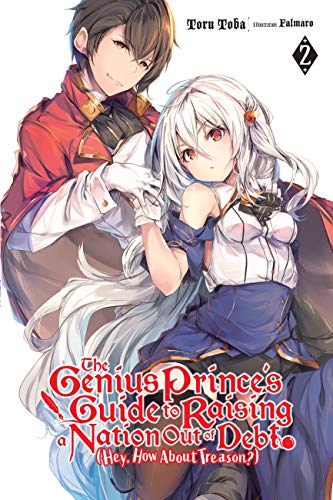
The Genius Prince’s Guide to Raising a Nation Out of Debt (Hey, How About Treason?), Vol. 2

December 28, 2019 by Sean Gaffney

By Toru Taba and Falmaro. Released in Japan as “Tensai Ouji no Akaji Kokka Saisei Jutsu ~Sou da, Baikoku Shiyou~” by GA Bunko. Released in North America by Yen On. Translated by Jessica Lange.

I had a lot of fun with the first volume of this series, and am pleased to report that I liked the second volume even better. For one, it’s a relief to be living in a world of political intrigue and mind games, one where our protagonists actually are people born in that world and have not been transported from modern day Japan. There is no adventurer’s guild… or indeed adventurers at all, nor do we appear to have any magic. It’s just a series with a clever young prince and his clever aide doing battle (at least in this novel) with an equally clever princess from the strife-torn Empire, still dealing with the death of its Emperor that we heard about in the last book. It feels a little bit like an episode of Blackadder if everyone were as clever as he was. There’s even a minimum of light novel cliches – the readers get a scene of the main female cast in a hot springs, but Wein is absent doing paperwork – no accidental peeping here. These are adults.

As noted, the main thrust of this volume is that Wein’s kingdom is visited by the 2nd Princess of the Empire, Lowellmina, who rumor has it is looking for a political marriage. As it turns out, she’s someone both Wein and Ninym have met before, though they were unaware that she was a princess. Wein correctly guesses she has another plan behind the public one, but has trouble figuring out the REAL plan she has behind the second one. She, meanwhile, is also trying to see what he does and how he reacts, relying on his being exceptionally clever to keep the ball rolling along. In among this we have the usual political crises. The Empire is trying to figure out which of the three sons of the Emperor should be in charge. Two territories in Wein’s kingdom who have always been at each other’s throats are coming to a boiling point. And a lovestruck, foolish son of an aristocrat from a neighboring nation may cause everything to fall apart for both Wein AND Lowellmina.

I mentioned in my last review that the best part of the book was the relationship between Wein and Ninym, and that remains the case. At the moment, it’s impossible for anything to happen between them, mostly as Wein is a noble Prince and Ninym is a non-noble from a race that many countries are severely prejudiced against. I suspect that will change before the series ends, because let’s face it, Wein and Ninym have been “married” for years now, in terms of closeness and knowing each other’s hearts. Lowellmina is also a great character, not as overdramatic as Wein can be when things go wrong (there’s some amusing faces in the illustrations) but still cut from the same cloth. There’s also some fun scenes showing Wein and Ninym at the Empire’s military academy from two years prior (which is where they met the in-disguise princess), and I’d love to see more from that period as well.

Certainly I’d recommend this for fans of series like Realist Hero and other kingdom-building books, but also for those who enjoy a light novel series without having to make excuses for half of the events that take place in them. Glorious fun.

Filed Under: genius prince's guide to raising a nation out of debt, REVIEWS

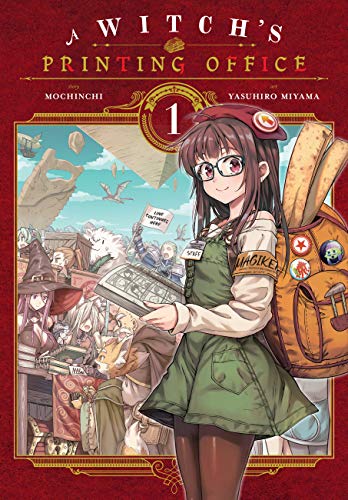
A Witch’s Printing Office, Vol. 1

December 27, 2019 by Sean Gaffney

By Mochinchi and Yasuhiro Miyama. Released in Japan as “Mahoutsukai no Insatsujo” by Kadokawa Shoten, serialization ongoing in the magazine Dengeki G’s. Released in North America by Yen Press. Translated by Amber Tamosaitis.

It’s become something of a running gag that “isekai” is the way to sell your title to a publisher, no matter what the series is. “I’ve got this idea about two philosophy students meeting in a coffee shop to discuss Kokugaku and Rangaku.” “…why would that ever sell?” “You see, the coffee shop is… IN ANOTHER WORLD!” That said, sometimes the isekai prototype does help to make a series more interesting because it’s baked into the plot, especially when the series can avoid the usual pitfalls of having the same thing happen – no guilds, adventurers, etc. Without its isekai plotline, this would just be one of seventy different kinds of “we’re working in an office and also connected with Comiket” titles that come and go with no one remembering them. But, let’s face it: Recreating Comiket in a fantasy world, using magic tomes as the draw… that’s a very clever idea. And from this idea we get the story of Mika, whose desire to get back home led to all this.

The actual circumstances of Mika ending up in another world are mostly glossed over in this first volume – when we come across her, she’s been in this fantasy world for some time. She has one magical skill, Copy, which is what it sounds – she’s a human copier machine. Trying to find a spell that can transport her back home, she’s created her own printing office to help out people who desperately need things copied, such as the magic spell that can drive away monsters, which with Mika’s help can be given to every villager. That said, magic books and spells don’t just walk up to you, even if you are a printing company. And so Mika has decided to help organize Magiket, a massive convention where people buy and sell magical spells. Can she keep the convention from going off the rails? And can she find a spell that will get her back home?

I will admit, “magical Comiket” is just the sort of high-concept idea I like, so I was already on this manga’s side to begin with. Mika might remind many people of Yomiko from Read or Die, at least in appearance, but she’s also a very can do sort of woman who sometimes exhausts herself trying to achieve something and help others. There’s various subplots at the Magiket itself: some people aren’t selling well, at least not until a spell is urgently needed; some folks are trying to sell illegal or illicit spells; and of course there’s the usual problems with lines and keeping everyone moving. I’m not spoiling anything to say that by the end of this book Mika has not found a way to return home, but she has managed to carve out a niche for herself, starting a company with enthusiastic employees and organizing a massive publishing event. Honestly, she’s achieved more in one book than a lot of isekai slackers have in ten.

I don’t expect too many serious or ongoing plots in this series, which when you boil it down is another workplace slice-of-life. But adding the isekai made all the difference for once, and I look forward to seeing what the next Magiket brings us.

Filed Under: a witch's printing office, REVIEWS

Manga the Week of 1/1/20

December 26, 2019 by Sean Gaffney, Ash Brown, Michelle Smith, MJ and Anna N Leave a Comment

SEAN: Happy New Year! And yes, I know most of the titles I’m mentioning here go with the OLD year, coming out on 12/31. What do we have?

J-Novel Club has a new debut, The Holy Knight’s Dark Road (Seinaru Kishi no Ankokudou). Our hero is a holy knight beloved by his people and his goddess… but he feels he’s starring in the wrong light novel archetype, and so goes to join a magical academy! Hijinks no doubt ensue.

J-Novel Club also has Full Metal Panic! 5 and Outbreak Academy 12.

In print, Kodansha gives us 10 Dance 5 and Waiting for Spring 12.

ASH: I’ve been enjoying 10 Dance a great deal. I’ve liked what I’ve read of Waiting for Spring, too, though I’ve fallen behind.

MICHELLE: I’m looking forward to both of these!

MJ: I’m incredibly behind on 10 Dance but I really need to catch up!

SEAN: Digitally, we get another debut with To Be Next To You (Tonari no Atashi), a Betsufure shoujo title about a girl in love with her neighbor who is horrified one day to find him kissing another woman! Maybe she should finally confess?

MICHELLE: There are a whole bunch of shoujo debuts happening digitally for Kodansha over the next couple of months. I approve.

MJ: Same.

ANNA: I also approve, although I have given up on keeping up on them.

SEAN: There is also GTO Paradise Lost 11, Hotaru’s Way 11, Kakafukaka 9, and Kounodori: Dr. Stork 12. (Lotta Vol. 12s this week.)

MICHELLE: One day I’ll read Hotaru’s Way.

SEAN: Seven Seas has but a single title with Machimaho: I Messed Up and Made the Wrong Person Into a Magical Girl! 4.

Tokyopop (at least according to Amazon – don’t be surprised if this is bumped) has a new BL title, Don’t Call Me Dirty (Dirty Darling), from Mag Garden’s UVU. A man trying to get over his crush (who turns out not to be gay) takes in a vagrant, and things go from there. This actually sounds kind of sweet. It’s complete in one volume.

MJ: That… title.

SEAN: Vertical has quite a bit. Owarimonogatari: End Tale is the latest (and last?) in the Monogatari Series, and is divided into three parts. This first book in the series delves into just WHY Araragi got to be the misanthrope we saw at the start of the series.

Seraph of the End: Guren Ichinose, Resurrection at Nineteen sure is the latest light novel spinoff series from Seraph of the End – in fact, it’s a sequel to the first light novel spinoff.

And Manga Bookshelf will be delighted to hear we get What Did You Eat Yesterday? 14, the first volume in almost a year and a half.

ASH: Excellent! I most certainly am delighted!

MICHELLE: Me, too!

MJ: I, too, am delighted! So exciting!

ANNA: Yay!

SEAN: And we end of Yen. On the Yen On side, no debuts, but we get The Alchemist Who Survived Now Dreams of a Quiet City Life 2, The Irregular at Magic High School 14, Is It Wrong to Try to Pick Up Girls in a Dungeon? 14 (yes, at last, after three long delays), Our Last Crusade or the Rise of a New World 2, and Spice & Wolf 21.

On the manga end, the debut is Magia Record: Puella Magi Madoka Magica Side Story, another in the endless series of Madoka Magica spinoffs. This one adapts a mobile game, and runs in Manga Time Kirara Forward.

There’s also Kakegurui -Compulsive Gambler- 11 and Sacrificial Princess and the King of Beasts 8.

And that’s it! What manga come to mind in these days of Auld Lang Syne?

Filed Under: FEATURES, manga the week of

Banner of the Stars: The Ties That Bind

December 26, 2019 by Sean Gaffney

By Hiroyuki Morioka and Toshihiro Ono. Released in Japan by Hayakawa Bunko. Released in North America by J-Novel Club. Translated by Giuseppe di Martino.

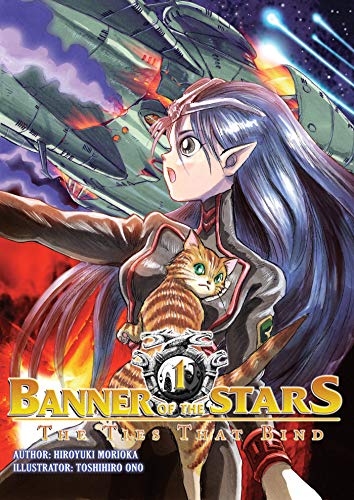
These are novels rather than light novels, so you don’t get cute interstitial artwork. This may be why we get this cover, with Lafier trying to look cool and captainlike while a cat is climbing on top of her. The cat is Jint’s (it’s Jint now. Don’t ask. Or rather, ask Hayakawa Publishing.), and spends much of the book wandering around places where it shouldn’t be and basically being a cat. That said, after the massive firefight that dominates the second half of the book, it’s probably for the best that the cat ends up being given a permanent home on planet. The cat also provides a different source of humor from the usual in this book, which is banter. Everyone in Banter… erm, Banner of the Stars is in a two-person team of back and forth dialogue as if they’re Nick and Nora Charles – indeed, Jint and Lafier are not nearly as caustic about it as many of the others, perhaps showing the feelings they have for each other. It’s almost Moonlighting in space.

This book takes place three years after the events of Crest of the Stars, with Jint now reunited with Lafier as her Clerk and right-hand man on her brand new ship. She’s just one of many ships that are setting out to fight the enemy, though, and we get a large amount of time devoted to space combat, things blowing up, and last-minute escapes. We meet Lafier’s crew, with Number Two Sobash, stoic Ecryua (stoic may be the wrong term given her love on Jint’s cat) and lovable drunk Samson. There’s also her Assault Unit Commander, who happens to be the sister of the guy that Lafier killed in Crest of the Stars. Sporr is still hanging around and being fabulous. And we also see Neleth and Nefeh, two twin brothers (unusual among the Abh) with a propensity towards being exceptionally weird. Everyone talks back and forth at each other like it’s His Girl Friday. Oh yes, and there’s the planet they’re fighting to conquer, which irritatingly hasn’t surrendered yet.

As I said, Jint and Lafier are also part of this, and we do get some choice banter (the thing about Lafier thinking her mother was a cat is brought up by Jint multiple times, to her displeasure). At the same time, there is a certain fatalistic quality to Jint that the reader, and Lafier, may find disturbing. Atosryua invites Lafier and Jint to a dinner to commemorate the life of her brother… the one Lafier killed… but it’s all very polite and no hard feelings. Afterwards, Jint remarks how he doesn’t have anyone who would miss him after he died anyway, and the look that Lafier gives him burns through the page and onto your fingers. She makes it more explicit later that she would miss him, dammit, but it’s fairly clear that if there is any romance going on between the two, she will need to break through a bit of his self-debasement first.

The author notes that each book in this series will be self-contained, which is probably a good thing given the first came out in 1996 and the 6th in 2018. As with Crest of the Stars, it will bury you in vocabulary, and some of the eccentricities of the characters feel like the author is being cute rather than letting it develop naturally. Still, this is a good solid start to the “second season” of Jint and Lafier.

Filed Under: banner of the stars, crest of the stars, REVIEWS

  • « Go to Previous Page
  • Page 1
  • Interim pages omitted …
  • Page 176
  • Page 177
  • Page 178
  • Page 179
  • Page 180
  • Interim pages omitted …
  • Page 382
  • Go to Next Page »
 | Log in
Copyright © 2010 Manga Bookshelf | Powered by WordPress & the Genesis Framework