• Skip to primary navigation
  • Skip to main content
  • Skip to primary sidebar
  • Home
  • About Us
    • Privacy Policy
    • Comment Policy
    • Disclosures & Disclaimers
  • Resources
    • Links, Essays & Articles
    • Fandomology!
    • CLAMP Directory
    • BlogRoll
  • Features & Columns
    • 3 Things Thursday
    • Adventures in the Key of Shoujo
    • Bit & Blips (game reviews)
    • BL BOOKRACK
    • Bookshelf Briefs
    • Bringing the Drama
    • Comic Conversion
    • Fanservice Friday
    • Going Digital
    • It Came From the Sinosphere
    • License This!
    • Magazine no Mori
    • My Week in Manga
    • OFF THE SHELF
    • Not By Manga Alone
    • PICK OF THE WEEK
    • Subtitles & Sensibility
    • Weekly Shonen Jump Recaps
  • Manga Moveable Feast
    • MMF Full Archive
    • Yun Kouga
    • CLAMP
    • Shojo Beat
    • Osamu Tezuka
    • Sailor Moon
    • Fruits Basket
    • Takehiko Inoue
    • Wild Adapter
    • One Piece
    • After School Nightmare
    • Karakuri Odette
    • Paradise Kiss
    • The Color Trilogy
    • To Terra…
    • Sexy Voice & Robo
  • Browse by Author
    • Sean Gaffney
    • Anna Neatrour
    • Michelle Smith
    • Katherine Dacey
    • MJ
    • Brigid Alverson
    • Travis Anderson
    • Phillip Anthony
    • Derek Bown
    • Jaci Dahlvang
    • Angela Eastman
    • Erica Friedman
    • Sara K.
    • Megan Purdy
    • Emily Snodgrass
    • Nancy Thistlethwaite
    • Eva Volin
    • David Welsh
  • MB Blogs
    • A Case Suitable For Treatment
    • Experiments in Manga
    • MangaBlog
    • The Manga Critic
    • Manga Report
    • Soliloquy in Blue
    • Manga Curmudgeon (archive)

Manga Bookshelf

Discussion, Resources, Roundtables, & Reviews

Michelle Smith

Oresama Teacher 1-2 by Izumi Tsubaki

June 30, 2011 by Michelle Smith

Sometimes, one just wants to read a silly, goodhearted comedy. And on that front, Oresama Teacher delivers admirably.

Mafuyu Kurosaki used to be the bancho of her school (though she didn’t realize it at the time) until she got nabbed by the cops and expelled. Her mother finds a school in the country that will accept Mafuyu, and ships her off for a fresh start. Although Mafuyu is a skilled and savvy fighter, the allure of life as a normal girl is appealing, and she embraces the opportunity to start over, full of self-assurance developed from her days as a gang leader.

Alas, she soon encounters her childhood first love (Tamaoki Saeki), who was responsible for steering her toward the path of delinquency in the first place. Worse, he’s now her homeroom teacher, and embroils Mafuyu and her lone-wolf classmate Hayasaka (another brawler) in his wager with the principal that he can boost the school’s enrollment by quelling the disciplinary issues arising from the lax admittance policy. Mafuyu and Hayasaka are the muscle to keep the other delinquents in line, essentially. Mafuyu is not very keen on this, especially because she’s enjoying how Hayasaka treats her like an ordinary girl, so masquerades as a couple of other people (a boy called Natsuo and Super Bun, a rabbit-mask-wearing girl whom Hayasaka idolizes) when administering the necessary smackdowns.

I almost wrote “hilarity ensues” at the end of the prior paragraph, because that’s just what one does after detailing a suitably wacky premise like this one, but the thing is… Oresama Teacher really is funny, and that’s got everything to do with the characters. I don’t care much for Saeki—mangaka Izumi Tsubaki resists the temptation to endow him with redeeming qualities—but he works as the instigator of over-the-top situations, and some of his interactions with Mafuyu are very amusing (like the scene in which they discover that neither of them can cook).

More to my liking is the relationship between Mafuyu and Hayasaka, which persists despite both of them frequently misunderstanding the other’s motivations. When she tries to find out more information about Saeki (in order to confirm he really is the same boy who used to live next door), for example, Hayasaka assumes she’s looking for material with which to blackmail him. At first, Hayasaka resists the idea that they are friends, but his prickly attitude gradually starts to dissipate. He’s incredibly dense and easy to fool with lame disguises, but Mafuyu, used to being looked up to by her followers/friends, likes the way he treats her as an equal. At one point, he begins to suspect that she is his idol, Super Bun, forcing Mafuyu to dissuade him of the notion just so he’ll stop looking at her all dreamy-like. It’s lonely being revered.

I never did read Tsubaki’s other Shojo Beat series, The Magic Touch, as general consensus seemed to be that it wasn’t that great, but I’m exceedingly glad I didn’t let that stop me from checking out Oresama Teacher, which is a genuinely entertaining read. Tsubaki herself doesn’t seem all that keen on the story—she makes several references in her author’s notes to the fact that various elements of the series were dictated by her editors—but you can’t tell while reading it. And anything that makes me snicker as much as these two volumes did is definitely a keeper.

Review copies provided by the publisher.

Filed Under: REVIEWS Tagged With: shojo beat, VIZ

Wanted: YA or Children’s Fiction from Australia and New Zealand

June 28, 2011 by Michelle Smith

At some point in the unspecified future, we three bloggers who comprise the Triple Take project would like to do a series on YA and Children’s Fiction by authors from Australia and New Zealand. The problem is, we don’t know too much about it yet. I mean, I’ve heard of Maurice Gee (NZ) and I positively adore John Marsden (AU), but there’s got to be more out there.

So! If you know of any good or even just potentially interesting books that would qualify, please let me know! It’s a bonus if they’ve been published in the US, but not a requirement.

Filed Under: NEWS, UNSHELVED

Pick of the Week: Women’s Manga

June 27, 2011 by MJ, David Welsh, Katherine Dacey and Michelle Smith 12 Comments

MJ: Something that’s been on my mind, lately, thanks to a yet-to-be-released podcast David and I recently participated in as well as the relative shortage of adventurous new readers for this month’s Manga Moveable Feast, is how difficult it can be to successfully sell manga intended for female readers, especially adult women. So, given the somewhat lackluster selection this week at Midtown Comics, I asked my fellow critics of the battle robot to join me in recommending a few series for women that tend to get overlooked.

I’ll begin with a recommendation for one of my favorite romantic comedies, Tomoko Ninomiya’s Nodame Cantabile, originally published in Kodansha’s Kiss magazine, and partially released in English by Del Rey Manga. Though the series was very popular in Japan, it never really took off here, leaving its run perilously stalled at 16 volumes (out of a possible 25). The story follows a group of music students through graduate school and into the beginnings of their careers, particularly eccentric pianist Megumi “Nodame” Noda and aspiring conductor Shinichi Chiaki. Though complaints can (and have) been made about the conservative nature of the students’ musical repertoire, the series’ music school setting rings stunningly true to my own experience, and its exploration of ability vs. ambition is pretty hard to beat. More than that, though, it’s terrific romantic comedy that just gets better and better as the series goes on. Though there’s been no inkling at all that Kodansha Comics might pick up here where Del Rey left off, I’d personally walk around in a Nodame sandwich board if I thought that would help make it happen. Give us more Nodame Cantabile! Please?

DAVID: Okay, Hinako Ashihara’s Sand Chronicles (Viz) is technically shôjo, having run in Shogakukan’s Betsucomi, but I believe the estimable Ed Chavez of Vertical once described it as something along the lines of “stealth josei,” so I feel recommending it in this context. I also feel comfortable doing so because it’s flat-out excellent, following its heroine from early adolescence to womanhood, dividing its time pretty much equally among high school, college, and working life, which makes it something quite unique in serial comics, at least in my experience. The scope of the story gives Ashihara so many opportunities to really dig into Ann’s psyche, her milestones, and her choices, good and bad, and Ashihara makes the most of those opportunities. Does Sand Chronicles occasionally indulge in melodrama? Yes, it certainly does, but that melodrama is characterized by sincerity and urgency rather than cheapness and manipulation. The eight-volume core story is supplemented by two additional collections of shorts that give insights into supporting characters and really enhance the whole tapestry.

KATE: At the risk of sounding like a broken record, my recommendation is Mari Okazaki’s Suppli, one of many casualties of Tokyopop’s demise. I’d call it “working girl manga,” but that has an unsavory connotation, so instead I’ll call it “career woman manga.” The story focuses on a twenty-something college grad whose dedication to her job tanks a long-standing relationship. Not surprisingly, Minami turns to work to fill the void left by her boyfriend, pulling all-nighters, pitching her own ideas, and becoming more involved with her co-workers’ personal lives. She soon discovers that the office is teeming with romantic prospects, and plunges into a steamy affair with a co-worker while carrying on an aggressive flirtation with another. Though the sudsy story is a big draw, the art is the real star of Suppli: it’s crazy-gorgeous, filled with some of the most sensual imagery I’ve seen in a licensed manga. (No one does floral imagery quite like Okazaki.) Don’t let Suppli‘s unfinished state deter you from trying it; it’s smart and sexy, and makes an awesome bathtub read.

MICHELLE: I don’t think Fumi Yoshinaga is in danger of being overlooked, but when it comes to manga for adult women, one simply can’t say enough about All My Darling Daughters. The short stories in this collection revolve around Yukiko Kisaragi, a woman whose still-beautiful mother embraces life after a cancer scare and impulsively marries a much younger man. As Yukiko struggles to accept that the relationship is genuine, the other stories flesh out the lives of her friends, acquaintances, and relatives, showing how words and actions can have unintended consequences and that sometimes dreams just don’t come true. That makes it sound like a downer, but really the message is an uplifting one, as Yukiko comes to realize not only that her mother’s new husband is good for her, but that her own life is pretty damned good, as well. Sniffles will ensue, but they’ll be the good kind.


This is just the tip of the iceberg, of course. Readers, what titles would you like to add?

Filed Under: PICK OF THE WEEK Tagged With: all my darling daughters, nodame cantabile, sand chronicles, suppli

Bookshelf Briefs 6/27/11

June 27, 2011 by Michelle Smith, MJ, Katherine Dacey and David Welsh 3 Comments

This week, Michelle, MJ, Kate, & David take a look at new releases from Viz Media, Yen Press, and Archie Comics.


Bleach, Vol. 35 | By Tite Kubo | Viz Media – The battle to rescue Orihime and foil Aizen’s plans to destroy Karakura Town continues! Too bad that it mostly does so in the form of an interminable match-up between Kenpachi Zaraki, badass Soul Reaper captain, and Nnoitora, the irksome Arrancar. You just know that when an opponent in shounen manga brags incessantly about how it’s impossible to cut him, he is gonna wind up getting cut. And so it goes, though the fight itself is a confusing mess of blows, explosions, and sound effects like “wooo” and “klang.” There’s finally a bit of progress in Aizen’s plans, and if I cared enough I’d ferret out what seems to be either sloppy plotting or a retcon, but the truth is that it’s really best not to think too much about such things when reading Bleach, which in this volume embodies mindless entertainment at its best. – Michelle Smith

Blue Exorcist, Vol. 2 | By Kazue Kato | Viz Media – Exorcist-in-training Rin has been slacking in class, but when a tough-looking classmate proves to be surprisingly smart, it acts as some motivation to get his act together. Then he and the other students are thrust together for the Esquire Examination, with the pleasing result that we get to know quite a few other kids in a short period of time. There’s a real Hogwarts vibe happening too, with the varieties of courses and specialties available for exorcists. One aspect of the story leaves me cold, though, and that’s Rin’s ultimate goal. Now that I have insight into the Shonen Jump editorial process courtesy of Bakuman。, I can’t help but think that “I’ll become an exorcist so I can defeat Satan!” is someone’s calculated attempt to meet the requirements of a popular battle manga. – Michelle Smith

Highschool of the Dead, Vol. 3 | Story by Saisuke Sato, Art by Shouji Sato | Yen Press – After escaping school grounds, resisting the authority of a charismatic but dangerous teacher, and rescuing a small girl from an undead mob, our heroes stumble across a band of paranoid survivors who believe that the zombies are, in fact, an elaborate government hoax. Though this twist provides welcome relief from the endless parade of panty shots and girl-on-girl teases, Highschool of the Dead is still a chore to read; the dialogue is so stiff and unnatural that it’s hard to suppress a giggle, even when the authors are dead serious. Sloppily staged fight scenes and poorly drawn figures do little to make the very thin story more palatable to discerning zombie fans. – Katherine Dacey

Kimi ni Todoke, Vol. 9 | By Karuho Shiina | Viz Media – As sweet as Kimi ni Todoke is, its one potentially frustrating element is its heroine Sawako’s inability to see herself as equal to her would-be suitor, Kazehaya. Fortunately, her friends (and even one of her foes) finally give her what for in in volume nine, the results of which leave us waiting breathlessly for volume ten. As usual, Karuho Shiina plays things out in perfect high school shoujo romance fashion, while also refreshing the genre as she goes. Shiina pushes Sawako’s stubborn self-deprecation to the point of parody early in the volume, without damaging the series’ sincere tone in the slightest. Meta has never tasted so sweet. Always recommended. – MJ

One Piece, Vol. 57 | By Eiichiro Oda | Viz Media – I never thought I’d type these words about this series, but I’m ready for the current story arc to be over. Luffy, our pirate hero, is struggling mightily to save his brother Ace from a terrible fate. He’s inadvertently assembled an army of new friends and old foes along the way and is waging a pitched battle against the forces of the Navy. This is all executed well, and there are some particular highlights. (Any story arc that heavily features a super-powerful, anarchist drag queen can’t be all bad.) But I can’t get past how much I miss the participation of Luffy’s regular crew, the Straw Hats, and I’m not able to see the virtue in sidelining them during such an important milestone in their captain’s life. Eye-popping mayhem is all well and good, but it’s better when there are old friends in the thick of it.– David Welsh

Time and Again, Vol. 6 | By JiUn Yun | Yen Press – In the final volume of Time and Again, author JiUn Kim explores the family curse that ultimately set Baek-On on the path to becoming an exorcist. A deft mixture of folklore, horror, and intergenerational conflict, Baek-On’s back story would be a stand-out in any ghost-of-the-week drama; here, however, it provides a fitting capstone to an ambitious, if sometimes uneven, collection of stories about a young man struggling to carve out his own path, even though his divination skills all but ensured that he would assume his father’s profession. Kim’s artwork is elegant yet restrained, striking the right balance between sumptuous period detail and spare staging of events. N.B. Die-hard fans of Time and Again will enjoy the afterword to volume six, in which Kim cheerfully discusses the historical and continuity errors she made in the course of writing the series. – Katherine Dacey

Veronica Presents: Kevin Keller #1 |By Dan Parent, Rich Koslowski and Jack Morelli |Archie Comics – It’s awfully cool of Archie Comics to introduce a gay character and commit to him as an ongoing citizen of fictional Riverdale. Even nicer is the fact that, aside from a few troll-ish comments from people who’ve probably never read an Archie comic in the first place, response to the addition has been overwhelmingly positive. The net result, at least based on the evidence of this particular comic, is that Riverdale has another uncomplicated, good-natured teen resident, sort of a gay male Betty. Kevin is out to his family and friends, and readers get to see flashbacks to that process. The underlying plot is more about Kevin’s hopes to serve in the military someday, following in his supportive father’s footsteps. Basically, though, it’s an Archie comic about nice kids being nice. Seriously, did anyone honestly think there’d be any other outcome? That the White Party would swing through Riverdale? – David Welsh

Filed Under: Bookshelf Briefs Tagged With: Archie Comics, bleach, blue exorcist, Highschool of the Dead, kimi ni todoke, One Piece, time and again

MMF: Wild Adapter Roundup the Last

June 26, 2011 by Michelle Smith 3 Comments

Sadly, it’s time to bid farewell to the Wild Adapter MMF. But we’re not going down without a few final submissions!

First up is Jason S. Yadao at the Honolulu Star Advertiser, who writes in his Otaku Ohana column about his decision several years ago to pass on Wild Adapter and his newfound regard for the series. “It’s definitely worth tracking down, though. Take it from the guy who took four years to get it—both in the “have them physically in my hands” sense and the “ahhh, now I understand what the appeal is” sense.”

At my blog, Soliloquy in Blue, MJand I devote our monthly Let’s Get Visual column to Wild Adapter, specifically the tricks Minekura uses to control access to Kubota’s thoughts and to create a snug and private moment for her characters to inhabit.

Justin Stroman reviews the first two volumes of the series for Organization Anti Social Geniuses. He didn’t care much for the prologue aspect of volume one (I believe his exact words are “meh”), but the characters and pacing won him over in volume two.

Lastly, Anna at Manga Report provides the second Saiyuki reread post of the Feast (though she has reviewed Wild Adapter in the past), and compliments several aspects of Minekura’s storytelling that also apply to Wild Adapter. She also notes, “I’m not even sure if this manga ever actually ended, because it seems to spawn any number of sequel and prequel series. But the point of Saiyuki is the journey, not the destination.”

MICHELLE: A lot of good stuff there, eh, MJ?

MJ: Yes, there really is. I’m especially pleased to see some participation from readers who are new to the series here at the end. If there’s one outcome I’d hope for from all this, it would be that a few more readers might spend some time reading this month’s contributions and take a chance on the series themselves.

MICHELLE: That would be nice! Lousy series generally don’t get chosen for the MMF, after all.

MJ: Indeed! Many thanks to everyone who participated in this month’s Feast, especially our battle robot cohort David Welsh, who went over and above this past week on behalf of Wild Adapter.

And speaking of both David and non-lousy series, shall we take a moment to introduce next month’s Feast?

MICHELLE: Let’s do. David will be hosting a Fruits Basket MMF at his blog, Manga Curmudgeon, the week of July 24-30. Fruits Basket is a series that requires little introduction, but it has the distinction of being something that’s both very popular and very good. If you’re interested in participating, watch David’s blog for announcements!

MJ: Aaaaand, that’s a wrap! Thanks, everyone!

MICHELLE: Don’t forget to tip your waitress.

The complete archive of the Wild Adapter MMF can be found here.

Filed Under: UNSHELVED Tagged With: Manga Moveable Feast, MMF, wild adapter

Let’s Get Visual: Wild Adapter

June 25, 2011 by Michelle Smith

MICHELLE: Hey, MJ, did you know there was a Wild Adapter MMF going on?

MJ: I’ve heard rumors to that effect. Terrific series, Wild Adapter. Whoever is hosting it must have great taste!

MICHELLE: I’m relieved you think so, because in honor of the Feast, we’re devoting this month’s Let’s Get Visual column to that series!

MJ: We are? Oh! Yes, we are!

MICHELLE: One of the hosts has already done an admirable job scanning some of the many significant images from the series (at great personal cost) but that won’t stop us from talking about a few more.

In Wild Adapter, creator Kazuya Minekura tells her story through the eyes of observers. Sometimes these figures are opposed to our main protagonists—Makoto Kubota and Minoru Tokito—in some way, such as the detective in volume four or the new youth gang leader in volume six, and sometimes they are with them, either in a personal way (their young neighbor Shouta in volume five) or a more business-like fashion (Takizawa the journalist in volume three). In every case, though, we rely on their interactions with Kubota and Tokito to learn more about said fellows, since we are denied access to their thoughts.

As I reread the series, I noticed that Minekura also uses her art to support this narrative choice, and that she, in particular, uses a similar device several times where Kubota is concerned. (Click on images to enlarge.)

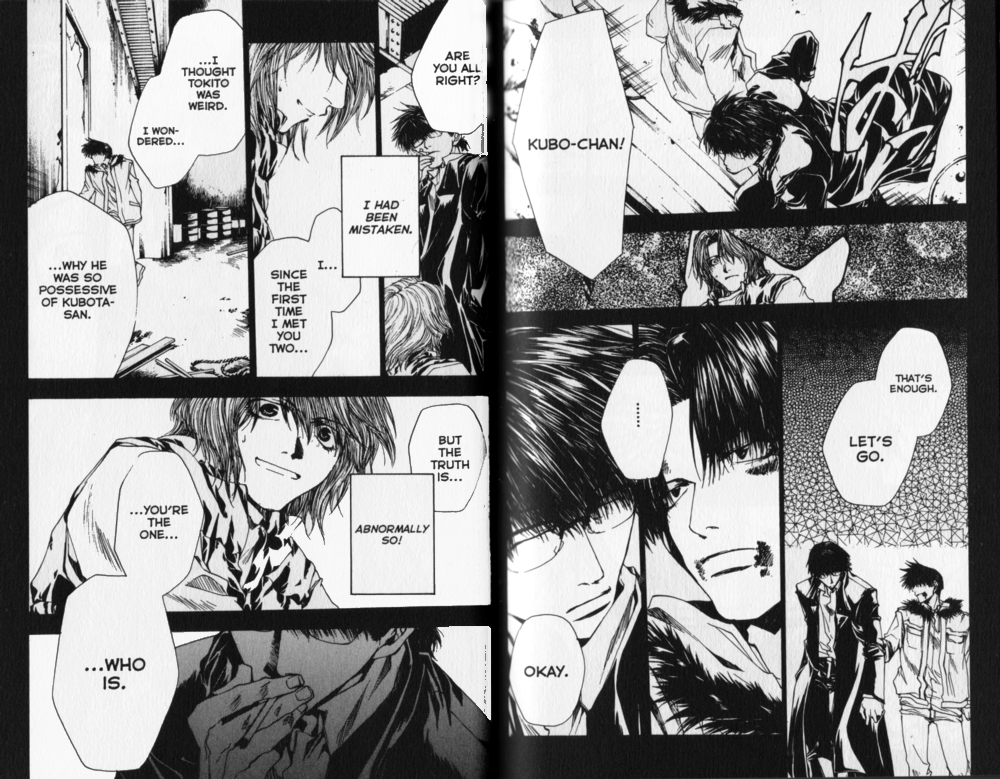
Volume 2, Chapter 11 (TOKYOPOP)

Here, Tokito stops Kubota, who has violently come to his rescue. Kubota instantly sheds any vestige of excitement, and throughout this two-page spread, his eyes, like his thoughts, feelings, and motivations, remain shielded. He’s distant and aloof. Yet when Saori suddenly realizes that Kubota is the one who’s possessive of Tokito, he offers her a small smile. She finds the experience scary, and I agree that it could be construed as an ominous expression, but it’s also a stunning moment of access to what Kubota feels.

MJ: I agree that it’s a stunning image, and while I can appreciate Saori’s response, like you, I’m mostly fascinated. As you say, Kubota is a character who deliberately shuts himself off from other people, and now, as we’re granted this tiny moment of access, it becomes really clear why. In these rare moments, with just a small smile and a real look into the eyes, he’s suddenly wide open to us, and the guy that we see in there is nothing like the person he displays the rest of the time. And that’s a guy he really doesn’t want people to know. Maybe he thinks that guy is scary, I don’t know. But it’s clear that when he does grant access, he’s pretty much an open book—probably more so than characters who are generally open to begin with. Does any of that make sense?

MICHELLE: It does, and you’ve provided me with an excellent introduction for my next example!

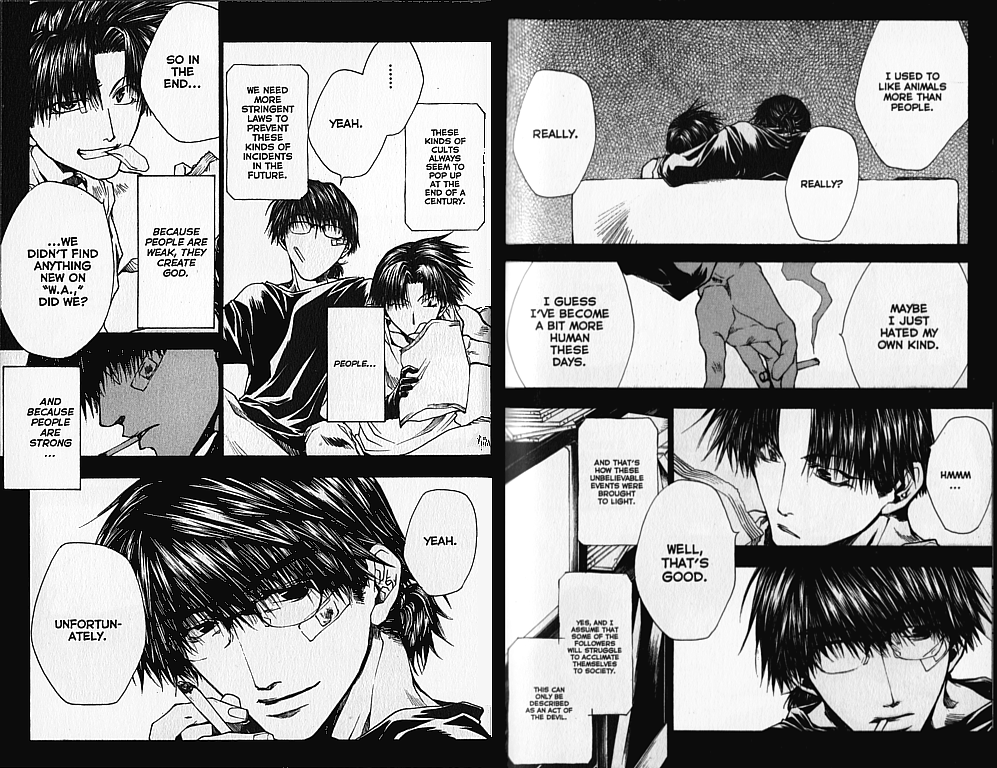
Volume 3, Chapter 18 (TOKYOPOP)

This scene takes place near the end of volume three, during which Kubota and Tokito have infiltrated a cult that they erroneously believe is connected to Wild Adapter. Here, the guys are looking very casual and cozy, and while Kubota admits to Tokito that he has become more human, he does it while facing away from the audience. We see the back of his head and a hand holding a cigarette as he speaks. This is a moment reserved for he and Tokito alone.

Kubota doesn’t say it outright, but it’s clear that it’s Tokito making him feel this way. And when Tokito goes on to lament their progress in their investigation, the warm and open-eyed smile of Kubota’s at the bottom of page two makes it clear he hasn’t yet changed mental gears. He’s still thinking about Tokito.

MJ: To me, these soft, openly caring eyes are just as much of a shock as the more terrifying look we see in your first example. It’s clear that both of these looks are genuinely Kubota, but you get the feeling that Tokito is the first thing that’s ever inspired the feelings behind this look.

I have to really admire Minekura’s skill with expression here, too. Though some aspects of her artwork are very detailed, she actually doesn’t include a lot of detail when it comes to eyes. Yet what she’s able to do with just the barest nuance is, frankly, incredible.

MICHELLE: But wait, there’s more! Minekura uses this technique again in volume four, with very different results!

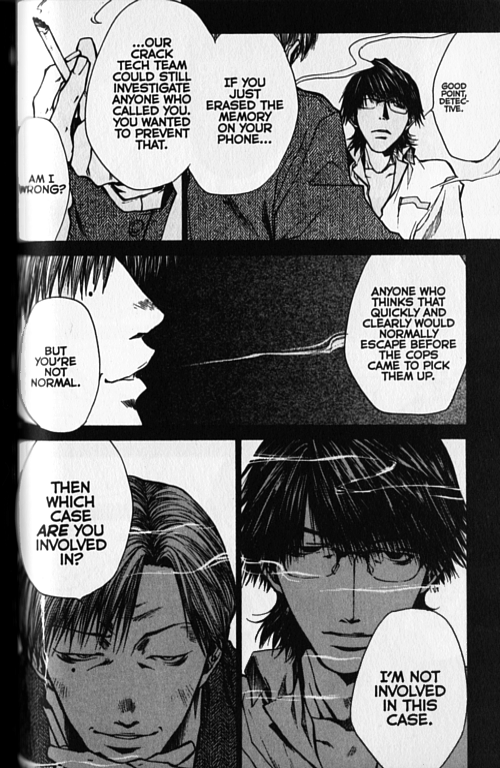
Volume 4, Chapter 22 (TOKYOPOP)

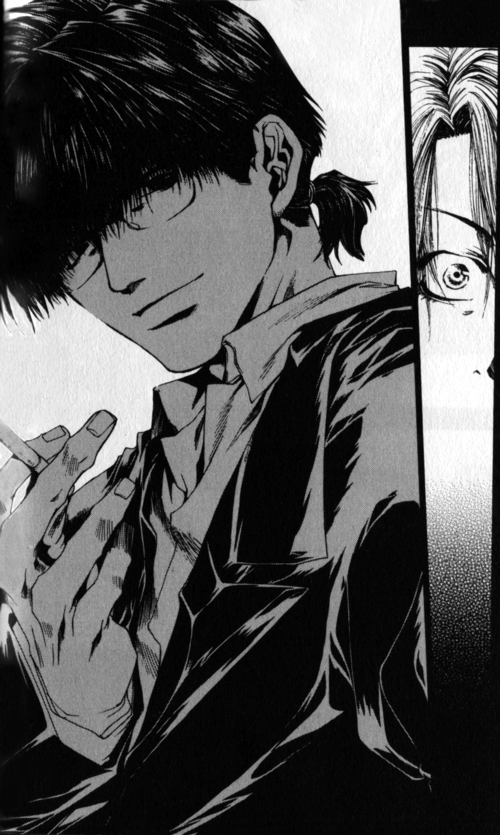
Here, we see Kubota being interrogated by Hasebe for a murder that was committed in a hotel. Kubota’s not giving up any information, so it makes perfect sense that he would be evasive, as indicated by the closed eyes on the first page. Hasebe continues to push, however, and Kubota finally gives up pretense and opens his eyes, allowing us access once more. Only this time, we’re not seeing a warm and friendly Kubota; we’re seeing a coldly resolute one. The grey screentone over his face emphasizes that this is just a partial disclosure—he’s revealing the extent of his determination, but anything else is still off-limits.

MJ: It’s the narrowness of his gaze that really achieves this effect, but again, it’s done with most subtle detail. And you’re right, he’s giving the detective just exactly as much as he wants to give him, no more, no less. It really gives you a strong sense of how carefully he controls everything about himself, and just how rare the two previous examples really are.

MICHELLE: Yes, you’re quite right! The amount of openness Kubota will permit with other people is infinitesimal compared to what Tokito is allowed to see.

Well, that’s it for me and Kubota’s eyes. What images did you want to talk about?

MJ: I’d like to talk about a scene from the end of volume two. It’s one I’ve discussed a couple of times before, both in my initial review of the series and in my infamous post on “intimacy porn.” It’s one of my favorite scenes in the series, and I’ve already explained quite a bit about why.

Volume 2, Chapter 12 (TOKYOPOP)

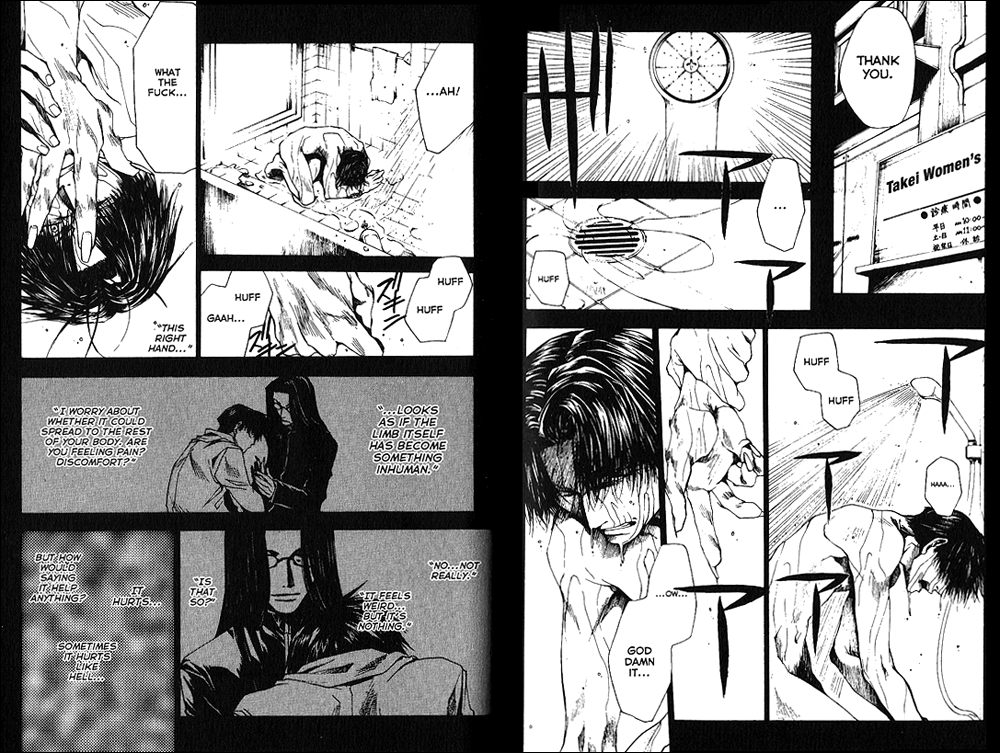
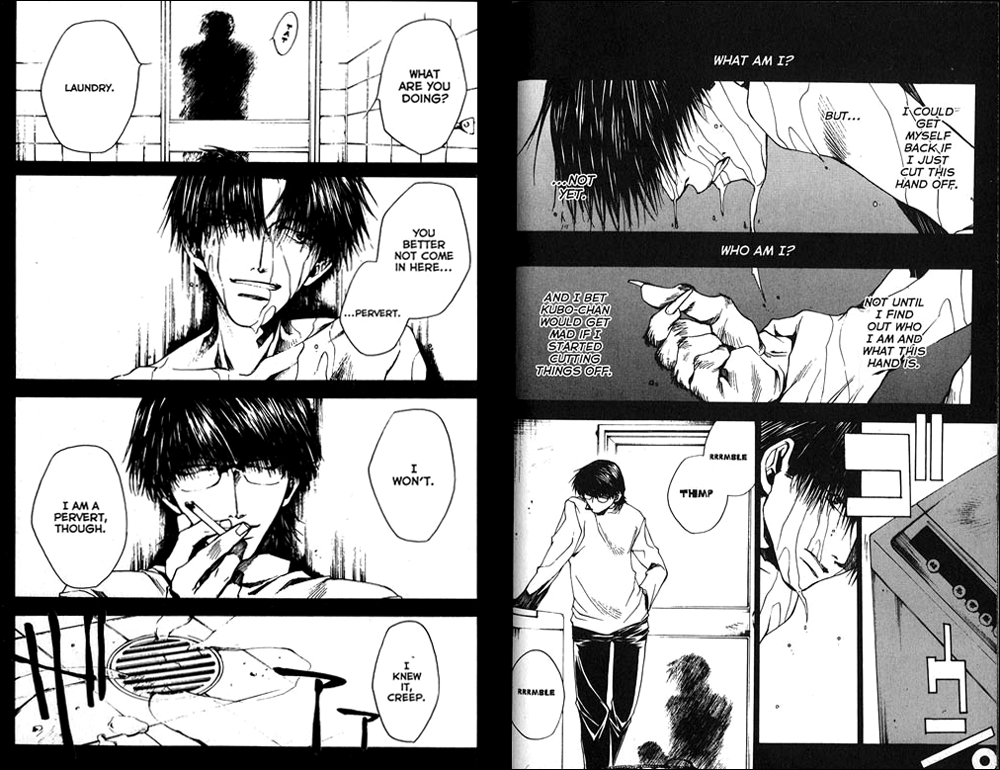
As you can see, Tokito has hidden himself away in the shower to deal with pain in his claw hand, and as he wrestles with both the physical pain and emotional turmoil the hand causes him, he realizes that Kubota is on the other side of the shower door, doing laundry.

When I’ve talked about this scene before, my focus has always been on the incredible intimacy of it, and how beautifully Minekura creates this intimacy while putting a physical barrier between them. What I’ve never discussed before, however, is the detail that, in my view, is almost solely responsible for bringing us into the scene as readers, and that would be the sound effects.

I have no idea what the sound effects really say. I don’t read Japanese, and I haven’t asked anyone to interpret them for me, but really, I don’t have to. It’s actually the visual effect of the Japanese sound effects that makes them so effective.

We feel it from the beginning, with just Tokito—the soft sounds of the shower accompanying his thoughts. Then the rumble of the washing machine joins in as Kubota enters the scene. By the end, we’re surrounded by it all, the soft shower and the muffled rumbles of the machine, creating a shell of sound around the characters, isolating them from the rest of the world, but including us as intimate onlookers.

I’m always impressed by writers and artists who can create a real sense of place on the page, and Minekura has done this by surrounding us in these familiar sounds. We can imagine ourselves in the room—feel the rumble of the washing machine under our feet and the thick humidity of the steam as it wafts out around the edges of the shower door. It’s so beautifully done.

MICHELLE: Oh, I love the image of a shell of sound. I like, too, how the initial thump of the washing machine literally intrudes onto Tokito’s thoughts in the way that the sound effect bleeds over the edge of its panel and onto the next, where Tokito, with water streaming down his face, has now been momentarily distracted.

MJ: Yes, I love that frame you’re talking about, where the sounds of the washing machine suddenly intrude into Tokito’s thoughts. It’s as though the washing machine has spoken up to say, “We can hear what you’re thinking in there, and yes, he would be angry if you cut off your hand.”

MICHELLE: Do you actually want me to tell you what the sound effects say? Or is it better not to know?

MJ: Sure, tell me!

MICHELLE: The first one you see, and the one that appears most often and prominently, is “zaa,” which is frequently used alongside rain or falling water. It’s the “a” sound that travels down that first page and drifts across the final two-page spread. On the second page, when Tokito clenches his hand in pain, the sound effects say “zukin zukin,” or “throb throb.”

I was unfamiliar with the “goun” sound accompanying the first image of the washing machine, so consulted Google and found a site that helpfully describes “goun” as “the sound of a washing machine.”

MJ: Ah, helpful indeed.

MICHELLE: One of my motivations for teaching myself kana in the first place was to be able to decipher untranslated sound effects. It slows me down, reading each and every one, but it does add something to the atmosphere, I find.

Another thing I notice in this example is how Minekura treats the “zaa” sound effect, allowing it to trickle down the page along with the water in the first instance, and in the last, depicting it wafting laterally past Kubota, almost like escaping steam.

MJ: What’s really amazing to me, is how successfully this effect is achieved even without understanding the kana. The visual representation of the sound is so powerful all on its own.

MICHELLE: Definitely. Even if the sound effects weren’t there at all, one would still imagine the sound of running water. Their presence emphasizes the sound and its insular quality, though. I’m reminded of an earlier column, where we talked about the sound effects in Banana Fish. There, an image of a passing train automatically conjured the associated sounds, but the sound effects, through their domination of the page, took it to the next level by mirroring how the sound dominated the moment for the characters.

MJ: Here, the sound sort of cradles the moment, creating a sense of comfort and familiarity around something extremely vulnerable.

MICHELLE: Ooh, good verb. In both cases, the sound effects define the sound in some way, rather than simply reiterating that it’s there.

MJ: When I first started reading manga, I found sound effects distracting. I was so new to comics, I had a lot of trouble digesting all the visual information on the page, and sound effects just made that more difficult. Over time, however, I’ve come to appreciate just how much they contribute to the atmosphere of a scene, and how powerful they can be in the right hands.

MICHELLE: It’s like this whole other tool in the mangaka’s kit, and one that we don’t automatically think about.

MJ: Well said!

MICHELLE: Which brings us back around to the inescapable truth that Kazuya Minekura is brilliant and everyone should read Wild Adapter.

MJ: Yes, they should!

For more reviews, roundtables, and essays on Wild Adapter, check out the complete MMF archive.

Filed Under: FEATURES, Let's Get Visual Tagged With: Tokyopop

MMF: Wild Adapter Roundup the Third

June 24, 2011 by Michelle Smith 1 Comment

Hey, have you noticed there’s a Wild Adapter MMF going on? Just thought I’d mention it…

The fun continues this morning with five new entries! First up is David Welsh at the Manga Curmudgeon, who has devoted his Friday License Request column to “more Minekura,” specifically the two-volume Executive Committee, which features the protagonists from Wild Adapter in a school comedy. Also, did you know Minekura’s one-volume Bus Gamer was published in English? I did not! A copy is now on its way to me, which means David has convinced me to spend money yet again.

Next, in her Fanservice Friday column, Manga Bookshelf’s MJ takes a look at how the casual yet intimate touching in Wild Adapter embodies the fan service that most appeals to her. Her post includes many lovely and loving images, including the one shown here.

Over at Manga Xanadu, Lori Henderson revisits the first three volumes of another Kazuya Minekura series, Saiyuki, and concludes “It’s really just a lot of fun, which is exactly how I want my manga to be.”

At Experiments in Manga, Ash Brown makes her second contribution to the MMF, this time in the form of a review for volume one.

Lastly, Chou Jones contributes a special feature to Manga Bookshelf about the themes present in Wild Adapter. I particularly like this segment, which is just more evidence of Minekura subverting expectations:

But contrary to common genre tropes, Wild Adapter isn’t a story about how Tokito’s innocence and decency save Kubota from himself. Kubota is himself from start to finish. If there’s saving going on, it’s mostly the kind couples do for each other in real life: providing each other support, making up for each other’s weaknesses, having a place to come home to. Amidst the trappings of action-adventure, Kubota and Tokito’s relationship is reassuringly slice-of-life.

If you’d like to participate in the Manga Moveable Feast, see this post for instructions. If you haven’t got a blog of your own, let us know and we’ll post it for you. A complete archive for the Wild Adapter MMF can be found here.

Filed Under: UNSHELVED Tagged With: Manga Moveable Feast, MMF, wild adapter

March on Earth 1-2 by Mikase Hayashi

June 23, 2011 by Michelle Smith

Man, I miss CMX. They had an awful lot of cute, short shoujo series, most of which were thankfully published in their entirety before the company’s tragic demise. One of these is the two-volume March on Earth by Mikase Hayashi. It’s a quiet little story and worth checking out, especially if you’ve burnt out on action or angst and just want to read about people being kind and helping each other out for a while.

The basic premise is somewhat implausible. Fifteen-year-old Yuzu Takamiya was raised by her teenage sister Tsubaki after their parents passed away, and now that Tsubaki has died in a car accident, it’s up to Yuzu to raise her two-year-old nephew, Shou. The city welfare guy has paid them a visit, but has allowed Shou to remain in Yuzu’s care, largely because their friendly landlady, Mrs. Kusano, is around in a supervisory capacity.

Yuzu goes to school while Shou is in daycare, but she’s never able to participate in any clubs or go on class trips. “Sometimes I’m vaguely jealous of their carefree lives,” she notes. “Even though I chose this path myself.” The chapters are largely episodic, as Yuzu must overcome her fear of cars to get Shou to a doctor, or contend with budget constraints while still providing Shou with a happy Christmas. Even though it’s tough for her to manage all of this, Shou’s adorableness—and the final picture book her sister completed prior to her death—helps remind her what she’s doing it all for.

Eventually, she meets Shou’s father, Takatoh, and together they begin to develop a sense of family. Yuzu also comes to rely more and more on Seita, the neighbor who has long had feelings for her (she’s one of those romantically obtuse heroines) and who is always there when he’s needed, like when Yuzu feels trapped and unable to pursue her dream of becoming a lawyer. In fact, one of the overall themes of the story is that people are fundamentally good and will be there to help you, whether it’s nice ladies in the supermarket who will buy the strawberries (or “stwawbewwies,” as Shou calls them) your nephew supposedly damaged or the schemey girl in class who will nonetheless look after Shou when he gets lost on a camping trip. Yuzu certainly wants to repay the kindness of others, but she’s not too proud to accept help.

I like Yuzu and Seita, but the real star of March on Earth is Shou. Now, I admit that he is a totally idealized version of a toddler. He does have a few flare-ups of disobedience, but for the most part he’s simply sweet and loving all the time. He has a speech impediment, gets dressed in cute outfits, and is impossibly delighted with a miniature version of the toy he really, really wanted for Christmas. No real kid could possibly be this angelic. But who cares? This is warm-fuzzy manga; relax.

Is March on Earth going to rock your world? No. But it might put a smile on your face.

March on Earth was published in English by CMX and is complete in two volumes.

Review copies provided by the publisher.

Filed Under: REVIEWS Tagged With: cmx

Unwind by Neal Shusterman

June 23, 2011 by Michelle Smith

From the front flap:
In a society where unwanted teens are salvaged for their body parts, three runaways fight the system that would “unwind” them.

Connor’s parents want to be rid of him because he’s a troublemaker. Risa has no parents and is being unwound to cut orphanage costs. Lev’s unwinding has been planned since his birth, as pat of his family’s strict religion. Brought together by chance, and kept together by desperation, these three unlikely companions make a harrowing cross-country journey, knowing their lives hang in the balance. If they can survive until their eighteenth birthday, they can’t be harmed—but when every piece of them, from their hands to their hearts, [is] wanted by a world gone mad, eighteen seems far, far away.

Review:
At some time in America’s future, the second civil war is fought over the issue of abortion. In the end, a compromise is reached. Known as the “bill of life,” the law says that life cannot be touched between birth and age thirteen, but between thirteen and eighteen parents can choose to retroactively abort a child in a process known as “unwinding,” by which the child does not technically die but is instead used for organ donation. Unwinding has now become a common and accepted practice in society.

This is a lot to swallow. One wonders why on earth anyone would agree to such a compromise, and I admit I struggled with the concept. After a while, though, one just accepts it and moves on, enjoying the story Shusterman lays out.

Unwind features three kids who are due to undergo the unwinding process. Connor Lassiter has trouble thinking through his actions and controlling his temper, causing his fed-up parents to decide to have him unwound. Risa Ward is a ward of the state. She’s been living in a state home, working hard to distinguish herself as a pianist, but she’s just not flawless enough to be worth saving, and is scheduled to be sent off to “harvest camp” in order to keep orphanage costs low. Lev Calder is a “tithe,” who was brought up by his parents and church to believe that his eventual unwinding is somehow a holy thing. Circumstances bring the three together, tear them apart, and bring them together again, with no one remaining unchanged.

While the plot of Unwind is certainly fast-paced and frequently surprising, the best thing about it is the way in which the characters are developed. At first, Connor’s lack of foresight and impulse control is maddening. He runs away to avoid being sent to harvest camp, but leaves his cell phone on, making him easy to track. He reacts to a baby left on a doorstep without thinking, saddling him and his companions with an infant they don’t have the resources to care for. In short, he’s more like a typical teen than a typical hero. Very gradually, and with the help from the more logical Risa, Connor evolves. He learns to keep his cool and discovers a talent for fixing things, be they mechanical or societal in nature. He becomes a leader, a genuine hero, and his progress is entirely believable.

Lev also changes a great deal. The youngest of the three, he’s only thirteen, and has spent his whole life being indoctrinated in certain beliefs. When Connor impulsively saves him from his “glorious fate,” Lev is not grateful at all, and turns Connor and Risa in at the first available opportunity. When he realizes that not even his pastor believes that what his family is doing is right, Lev’s world is thrown into turmoil. Separated now from Connor and Risa, he travels on his own, quickly becoming street-wise and meeting up with CyFi, a smart but troubled teen who once received a partial brain transplant from an unwind and is now contending with strange impulses from that other kid. Thrust into the harsh world with no preparation, Lev hardens quickly and learns to think for himself. Through learning of sin and evil, he becomes a much better person than he ever was before.

Risa doesn’t change as dramatically as the others, since she was always level-headed and cognizant of her possible fate. With her, the fact that she’s begun to allow herself to finally hope is what’s significant. I’m fond of her characterization in general, though, especially that she’s capable, competent, and so frequently the voice of reason. Her ability to keep a cool head during medical emergencies is also welcome.

Ultimately, while I could not completely suspend my disbelief in order to buy into the premise of this dystopic future world, I still liked Unwind a great deal. Even though Shusterman makes some Important Points, his approach is still balanced, as he questions whether it’s fair to bring unwanted children into the world in the first place even while his characters struggle so very hard for the right to live. Lastly, I must commend him for a positively chilling depiction of the unwinding process. That will seriously stick with me for a long time.

In conclusion, Unwind is good. Go read it. And Shusterman, get cracking on that sequel (Unwholly, TBA).

Filed Under: Books, Sci-Fi, YA Tagged With: Neal Shusterman

MMF: Wild Adapter Roundup the Second

June 23, 2011 by Michelle Smith 7 Comments

The celebration of Kazuya Minekura’s brilliant Wild Adapter continues!

At Experiments in Manga, Ash Brown considers how Kubota’s skill at majhong reflects his overall personality. Here’s a particularly insightful quote:

While on the surface mahjong may at first appear to be mostly about luck, there is actually a huge amount of strategy involved, especially as players become more skilled. In many ways, you have to make your own luck. Mahjong requires mental flexibility, the willingness to change strategies, quick thinking, and the ability to make accurate deductions from limited information.

Sounds like Kubota to me!

At The Manga Curmudgeon, David Welsh reposts a Flipped column on Wild Adapter that, unlike other old reviews, does not inspire the urge for a rewrite.

And here at home, MJ devotes her Three Things Thursday column to guilty pleasures in Wild Adapter that aren’t so guilty after all. I’m quite fond of her closing comment:

So while I am certainly adamant that non-fans of BL should give Wild Adapter a try, that’s not because the story isn’t BL. They should read it because it’s really good BL, and people should know what that looks like.

If you’d like to participate in the Manga Moveable Feast, see this post for instructions. If you haven’t got a blog of your own, let us know and we’ll post it for you. A complete archive for the Wild Adapter MMF can be found here.

Filed Under: UNSHELVED Tagged With: Manga Moveable Feast, MMF, wild adapter

MMF: Wild Adapter Roundup the First

June 22, 2011 by Michelle Smith Leave a Comment

The Wild Adapter MMF has begun, and the posts are beginning to trickle in.

Over at AnimeMiz’s Scribblings, Linda shares her impressions of the first volume, ultimately deciding to try again another day.

At Manga Curmudgeon, David Welsh dubs Wild Adapter “bathtub manga,” and lists the qualifications for that position as well as some other series (like NANA and Antique Bakery) that meet the requirements. Have bathtub manga of your own? David has provided a forum for confession.

Lissa Patillo of Kuriousity devotes the inaugural post of a brand-new feature, Cover Watch, to the first volume of Wild Adapter. It’s a nifty read, and as a fellow fan of cover-gazing, I look forward to more entries in the series!

Lastly, MJand I devote our monthly BL Bookrack column to a Wild Adapter roundtable, where we are joined by David Welsh. Topics include our favorite aspects of the story, how it is and isn’t like typical BL, and whether the fact that it’s unfinished should be a deterrent to checking it out (spoiler: no).

If you’d like to participate, see this post for instructions. If you haven’t got a blog of your own, let us know and we’ll post it for you. A complete archive for the Wild Adapter MMF can be found here.

Filed Under: UNSHELVED Tagged With: Manga Moveable Feast, MMF, wild adapter

BL Bookrack: Wild Adapter Roundtable

June 22, 2011 by David Welsh, MJ and Michelle Smith 43 Comments


MICHELLE: In celebration of the Manga Moveable Feast, we’re devoting this month’s BL Bookrack column to a discussion of Kazuya Minekura’s Wild Adapter. Joining MJand me is our fellow Manga Bookshelf blogger and Wild Adapter enthusiast, David Welsh.

There was a time when I’d visit bookstores several times a week to assess their new manga acquisitions, and I vividly remember spotting early volumes of Wild Adapter lurking on the bottom shelf. It wasn’t until 2009, though, that I was sufficiently swayed by public opinion and actually read them. I’d been borrowing a set from one of MJ’s friends but knew very quickly that this series was something I would have to own for myself. Its vast reread potential was already evident.

What was your first experience with Wild Adapter?

DAVID: I was an early Adapter adopter. I’ve always found Lillian Diaz-Przybyl to be a very reliable source of recommendations, even when she was editing a book and obviously had a heightened personal stake in a given title’s commercial success. She’s a straight shooter, and our tastes often overlap, so I tried the series right out of the gate. Obviously, I’ve had no reason to regret that.

MJ: I was still quite new to manga when my friend Deanna Gauthier reviewed the first volume of Wild Adapter here in this very blog. I had never even heard of the series, but she was a huge fan, and after she had read all six volumes, she put them in the mail and sent them to me.

She had wrapped them in plain brown paper for shipping, and when they arrived, bundled up neatly in a anonymous little brick, my husband jokingly asked if she had sent me a package of cocaine. Later that evening, as I emerged from our back room, having ravenously devoured the first volume and eager to begin the second, I told him that he’d actually been right after all, because Wild Adapter was like crack.

MICHELLE: And then you sent that same package to me and got me addicted. It’s a vicious cycle!

As mentioned in the introduction to the Wild Adapter MMF, the series is composed in such a way so that each volume is self-contained, with the first volume serving as prologue and the fifth later filling in the gaps between volumes one and two. As I stated in the post referenced above, the fifth is my favorite (and remained so on a reread), partially because I love Shouta so much. Do either of you have particular favorite arcs?

DAVID: For me, it’s a dead tie between the first and the fifth. I think the thing that they have in common is that they objectively should not work. The first is all about characters trying to convince the reader that the protagonist is fascinating, which is such a recipe for failure in so many cases, but Minekura’s work is so subtle and assured that I found myself nodding emphatically. The fifth runs the very great risk of lapsing into Cousin Oliver Syndrome, inviting readers to see the leads through fresh, adorable eyes. Of course, Shouta is as complex in his own way as Kubota and Tokito are, so another common land mine is sidestepped. Minekura is amazing.

(click images to enlarge)


MJ: I agree with both of you, and probably I have the same answer as David, but I also am fairly fascinated with volume four, which is partly seen through the eyes of a lonely salaryman who snaps after killing a prostitute in a drug-induced rage. That volume uses the Japanese concept of kotodama as its overarching theme, and uses it better than any of the more supernaturally-themed series I have mostly seen it crop up in.

There is a quote at the beginning of the volume that stuck with me for a long time. “In this country, we have something called ‘kodotama.’ The spirit of words,” the salaryman says. ” Whatever you say with intent becomes… real. When I was in elementary school, we had to write essays on what we wanted to be when we grew up. I wrote, ‘Section Chief.’ My teacher laughed. ‘What a small dream.’ Those words hit the air, and I breathed them in and just as the teacher said… I grew up to be a perfectly small man.” He later tries to harness kotodama himself by repeating over and over again how he’ll get away with his crime and how everything will be fine. It’s kind of heartbreaking to watch, even though he’s not an especially sympathetic character, and it completely shatters the pattern we’d usually see in a supernatural manga by suggesting that the power of kotodama really is just all in our heads. It’s startlingly true to life.

One of the things Minekura does so brilliantly in this series is that she doesn’t just use her side characters as windows into the protagonists’ lives, but also as windows into the lives of her readers and their world, for better or worse, and sometimes that can be just as revealing.

MICHELLE: And sometimes their interactions with Kubota and Tokito actually affect how they relate to the world at large. Going back to Shouta, there’s a scene where he casually mentions to Tokito (unnamed at this point) that his first name might be Minoru. It’s obvious that Shouta thought he was going to be springing a good surprise, and is completely stunned when his comment instead triggers a traumatic memory and sends Tokito into violent freakout mode. The experience stays with him, and later informs his decision not to ask his parents about the arguments he’s been overhearing. “But I don’t ask them anything about it. I can’t. The moment I touch that subject, everything will fall apart.”

One of the things I like about volume five so much is that here are a couple of guys who arguably would be a bad influence on an impressionable kid, but because of the context in which he knows them (Shouta never learns the details of what Kubota does for a living, for example) they end up being a good influence. When Kubota, surprised by Shouta’s insightful observation, “Saying you don’t want to hurt something because it’s precious isn’t fair. Because it’s not an object… it’s a living being with a heart,” tells him that he’ll be a great writer, it brings to mind the kotodama idea all over again. Maybe Shouta will believe it and come to embody it, just because Kubota expressed confidence in him.

DAVID: I think you’re getting at something that’s at the core of the appeal of the series: the protagonists don’t really fall anywhere on the hero/villain continuum. They’re fascinatingly amoral in that they’re extremely focused on their own interests. Pretty much everything else is kind of collateral. It’s incredibly interesting to see these two do what amounts to the right thing and know that the rightness of that action is only a small component of why they chose to do it.

MJ: Your discussion here reminds me of a scene in the fourth volume in which we’re given a glimpse into Kubota’s past and his acquaintance with a woman named Anna who turns to him for consolation after her abusive boyfriend has run off with all her cash. Anna laments the fact that she always falls for “guys like that” and wishes that she could have fallen in love with Kubota (just a young teen at the time) instead. Later, when Kubota has beaten Anna’s ex-boyfriend nearly to death with an iron pipe, he says to her, “See? Aren’t you glad it wasn’t me?”

As a reader, we’re on Kubota’s side. He’s protected his friend from an abusive guy and (from our perspective) avenged her for wrongs done up to that time. But from another perspective, he’s just terrifying, calmly beating a man to a pulp with no real concern for what’s “right” at all, outside of the way things affect him and those he cares about in some way or another. And he’s far more brutal when protecting Tokito, whom he cares about much, much more.
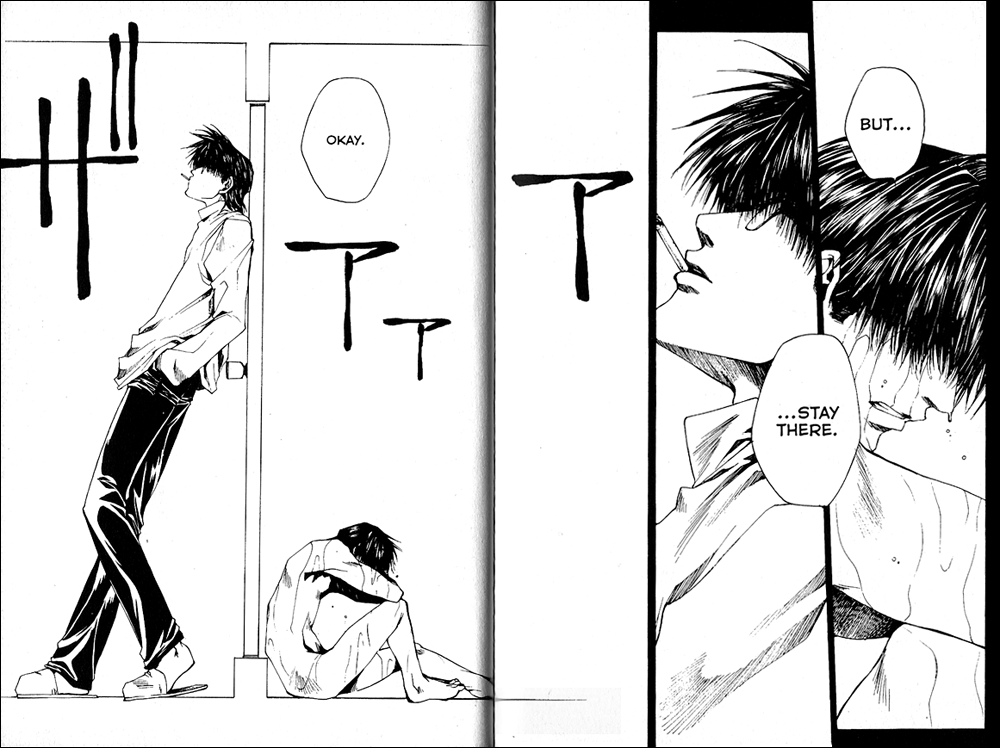
MICHELLE: When Kubota kills in volume one, his mentality can be summed up by the line “It was him or me, and I always choose me.” After he meets Tokito, the jobs he takes may be dirty, but they’re not deadly. This side of him reemerges in volume six when his old boss, Sanada, orders Kubota’s replacement, Osamu, to kidnap Tokito and grill him for information related to Wild Adapter. Kubota’s revenge is swift, sure, and incredibly, incredibly lethal. Osamu realizes that he’s to blame for “baiting the monster,” which ultimately leads to an absolutely haunting page when Tokito and Kubota together take aim at Osamu and fire. They’ll leave you be if you return the favor, but provoke them and they will do anything to protect what they care about.

DAVID: And I think the key phrase there is do. I’m a big fan of talky manga where characters really articulate and examine their feelings, like in so many of Fumi Yoshinaga’s works. But the way that Minekura has these characters express the depth of their feelings for each other in actions is so effective and fascinating. It’s a brilliant execution of the “Show, don’t tell” mentality of storytelling. There’s terrific, astute, consise dialogue in Wild Adapter, but Minekura’s techniques in sharing the emotional truth of her leads is just amazing. It’s an appropriation and subversion of stereotypical masculinity, the whole “You touched my stuff” thing, and it’s been given so much urgency and truth.

MJ: That’s exactly it, isn’t it? That’s how Minekura so successfully creates such intimacy between her characters without ever having to pull them out of character by forcing them to reveal themselves with words they’d never say. In your post about volume three, David, you described the series as containing, ” improbably sexy characters posing through mostly outlandish scenarios, all of which manage to be unexpectedly involving beyond their considerable surface sheen.” And this is really how she manages that. Whatever else is going on–all the crazy plotting and stylized sensuality–it’s always grounded in emotional truth, which allows us to enjoy the cracktastic plot for all the fun that it is without sacrificing any of the stuff we’re really reading for. It’s satisfying on multiple levels.

MICHELLE: And it’s that very intimacy that helps the series to function as boys’ love without containing any scenes of overt sexuality. The art helps, too, of course. My favorite sexy pose is at the very beginning of volume six, where we first see Kubota lying shirtless in bed with Tokito’s discarded glove next to him, and then on another page see a shirtless Tokito holding Kubota’s glasses in his beasty hand. The glasses are such a part of Kubota, that for Tokito to be holding them in so familiar a manner is positively suggestive.

DAVID: Not to derail anything, as everything we’ve just been talking about is entirely true, but I feel like we’re neglecting the fact that the series is frequently, intentionally hilarious. There’s character-driven humor and some extremely clever scene construction.

MJ: I was thinking about that during our introduction, and trying to find good examples to scan in, but I realized that so much of it is hilarious over the course of a really well-crafted scene, it was often difficult to capture in a single page or two. Minekura’s humor is so much more clever than just a series of gags or punchlines.

MICHELLE: She does play with readers’ BL expectations a few times, though, by having Tokito make suggestive sounds while Kubota is beating him in a video game, or having them both play out a seduction scene for the benefit of the guys in a surveillance van outside. One of my favorite amusing things isn’t actually laugh-out-loud funny at all but just really neat, and that’s seeing the characters depicted in the style of the shounen manga Shouta is drawing. I especially loved Kou’s scientist persona.


MJ: Michelle, I’d say that Kou in general is some of what I find most funny in the manga. I absolutely adore his coded conversations with Kubota.

DAVID: Kou is a treat, no doubt. And that surveillance scene is still possibly the funniest scene I’ve ever read in a manga, just slightly ahead of the school festival in Flower of Life and the synchronized swimming in Sgt. Frog. It’s funny because that dialogue is note-perfect BL, right down to the faux-reluctance.

Minekura is an amazing mimic, and not just with BL tropes. Her seinen credentials also seem particularly strong, and I don’t think Wild Adapter would be out of place in something like Big Comic or Ultra Jump, especially with contemporary catering to a fujoshi audience. Frankly, her capacity to render credible, dramatic violence is right up there with the stars of the noir seinen category.

MJ: I absolutely agree, David, and I’ve wondered if there are regular MMF participants who have decided not to try Wild Adapter because they generally don’t like BL. I’m hoping that’s not the case, but I expect it might be. If so, that’s a shame. Not that there’s any guarantee they would like Wild Adapter, of course, but it’s definitely not exclusive to that audience in terms of appeal.

DAVID: I can honestly think of few series with BL elements that would cast as wide a net as Wild Adapter could.

MICHELLE: There’s definitely a lot about Wild Adapter that isn’t typical of the BL genre, and I totally agree that it would not be out of place at all in a seinen magazine. Fujoshi would see what they want to see, but for everyone else, the relationship between Kubota and Tokito could be read as a kind of intense bromance, like the one between Ban and Ginji in the thoroughly seinen GetBackers. In reality, though, the series run in a BL magazine (Chara). I’m wondering what about the series (if anything) does seem like typical BL to you.

DAVID: For me, the thing that’s most BL-ish is the lack of examination of sexual orientation or identity. It’s merely an intense and surprising relationship that happens to be between two men. There are asides where supporting characters wonder whether Kubota is gay or not, or prefers guys to girls, if that’s their reference point, but that’s just one component of the character’s mystique that people around him find puzzling. But Kubota and Tokito are both so enigmatic that a definition of their specific sexual orientation doesn’t really matter, though. For me, it’s one of those rare cases when that kind of real-world consideration wouldn’t make the BL elements any sharper or more interesting or persuasive. Minekura delivers their relationship without delving into specifics.

MJ: I agree with David about this being the most prominent BL element in the series, and I’ll also add that I actually quite appreciate the fact that other characters speculate about their sexual orientation, because it softens this issue for me a bit. Generally I dislike this aspect of BL, but at least Minekura acknowledges that same-sex orientation exists in the world and that people are thinking about these characters in those terms. Actually, along these lines, there’s a scene in one of the uncollected chapters of the series in which Tokito asks Kubota what kind of relationship they have, because somebody has asked him. Kubota’s reply is basically to say that it’s fine to just tell people something casual and vague, at which point he abruptly changes the subject. It’s a pretty interesting little moment, and it does make one wonder if Minekura might have planned to revisit the question later on in the series.

Other than that, I think the next most BL-like aspect would be the vilification of the series’ actual gay characters, Sanada (the yakuza boss who comes on to Kubota in volume one) and Sekiya, the youth leader from a rival group who is overtly feminized (in the Japanese version, he refers to himself with the feminine “atashi”) and frequently insulted by other characters using anti-gay slurs. The fact that both these characters are villains in the story actually reminds me a lot of Banana Fish, in which all the gay characters are rapists or pedophiles. Not that Banana Fish is BL (we’ve discussed that at length in this blog already), but you get my point. I’m not saying that Minekura intends to vilify gays. I don’t think she does. But homophobia is pretty common in BL, in my experience, so it does spring to mind.

MICHELLE: Wild Adapter does seem to have a touch of the everybody-is-gay syndrome that one sees in BL from time to time. Even though this isn’t overtly specified for the leads, you do have Sanada and Sekiya right off the bat, with each of them (in varying degrees) seeming to expect sexual favors from their underlings. So I don’t know that it’s a case of Minekura vilifying gays so much as the villains are just gay, too.

On the other hand, we do see plenty of other characters whose sexual orientations are not known or even part of the story, like Kou, Kasai, and Takizawa. And there’s some hetero boffing going on as well.

DAVID: For me, part of the appeal of the series is that Minekura is so vague about the specifics of the core relationship. It’s not that she’s entirely being a tease, because the emotional architecture is entirely clear, but she clearly has her own idea of what constitutes necessary detail beyond that. She either trusts her readers to come to their own conclusions, or she wants to leave the potential spectrum of those conclusions wide open, and she’s talented enough to get away with it.

MJ: I think you’re right, she does get away with it, and beautifully too. In that way, it’s more successful than Banana Fish and most other manga I’ve read in which the mangaka deliberately keeps the specifics of the main relationship vague. And actually, given the characters’ particular circumstances and personalities, I think it’s entirely possible (maybe even probable) that the specifics are vague on their part, too, which aids the believability of the whole thing.

MICHELLE: I’m conflicted a little on this point, because although I definitely think Minekura has skillfully crafted their relationship, I’m still a fairly literal-minded person, so I simultaneously wish for some kind of confirmation while being glad that Minekura isn’t giving me any. Does that make sense? Until I see proof otherwise, I’m going to assume they aren’t sexing it up. That obviously doesn’t preclude loving each other, of course.

DAVID: Count me among those who assume that they are sexing it up all the time, but I think your point is totally fair. And I’ve certainly enjoyed titles where we know exactly where the potential couple is on their road to intimacy. I’d list Sanami Matoh’s Fake (Tokyopop) as my very favorite from that subcategory. But I do have a weakness for mangaka who are confident and skilled enough to leave things unspoken.

MJ: And just to clarify my position, I’m assuming they probably are, but that it’s none of my business. So I suppose I’m in-between.

MICHELLE: And thus we provide a bit of something for everyone! :)

DAVID: And thus confirm Minekura’s genius.


MICHELLE: Earlier, MJ mentioned that some regular MMF participants might have decided not to try Wild Adapter because they’re not big fans of BL, but another deterrent for some potential readers might be the fact that it remains unfinished (though, I stress, it does not end on a cliffhanger). How much does that impact your enjoyment of the series?

DAVID: It does make me sad that the series is on hiatus, but it doesn’t leave me dissatisfied with the series itself. As you both noted in the introduction to the series, the volumes are largely self-contained, and they can be enjoyed individually. (I can’t really understand how someone could read one volume of Wild Adapter and not want to read all of them, but that might just be me.)

There are so many reasons that readers of translated manga may not see the end of a series — the publisher cuts its losses on a commercially unsuccessful property or goes out of business altogether — that can result in perfectly legitimate complaining, but I always feel reluctant to get up in a mangaka’s business when he or she is facing health issues. I mean, I’d love to read more Wild Adapter, volumes and volumes of it, but I don’t feel any sense of grievance about it. Does that make sense?

MJ: That makes a lot of sense to me, and I feel much the same way about it. Wild Adapter could go on forever, and I’d be thrilled. And yes, I’d very much like to get to the bottom of the W.A. mystery and learn the truth behind Tokito’s past, but the overarching plotline was never really the point. So while I’d read as much of it as Minekura and Tokuma Shoten were prepared to give me, I don’t feel left in a lurch at all. I do wish we would see some official release of the five chapters that have been left hanging. I’d buy that in a second, whether they filled an entire volume or not.

I will admit a bit of utterly unjustified pettiness over the fact that various incarnations of Saiyuki (which I like much, much less) demanded so much of Minekura’s time when she might have been producing more Wild Adapter, but I realize how ridiculous and entitled that sounds. I mean, seriously.

MICHELLE: I’ve only read a tiny bit of Saiyuki (the first three volumes) but I definitely understand your grievance.

And, like you say, the plotline is not really the point. I’m less interested in W.A. and Tokito’s past (though of the two, the latter is far more compelling) than I am in the characters’ reactions to this. There’s a particularly poignant scene in, I believe, volume six where Kubota has engaged Kou to look for Tokito and says something like, “If he’s regained his memory, then you don’t need to tell me where he is.” He also believes there’s a chance that Tokito, like some amnesia patients, might forget everything that happened while he was “ill.” Kubota isn’t hindering Tokito’s quest for answers, but at the same time, he realizes that when Tokito gets them, things may be over for both of them. That is the part of the story I’m most sad we haven’t seen and maybe never will see.

DAVID: And I am becoming leery of series about hot, emotionally disturbed, possibly romantically involved boys who are linked in some way to illicit pharmaceuticals. Between Wild Adapter and CLAMP’s Legal Drug (Tokyopop), I’m wondering if these series ever get finished.

MJ: You do have a point. Sadly.

MICHELLE: I guess the only thing left for us to do at this point is wish Minekura-sensei a full and speedy recovery.

MJ: Well said, Michelle. Thank you, David, for joining us for this special edition of BL Bookrack!

DAVID: It was my pleasure!

Filed Under: BL BOOKRACK Tagged With: Manga Moveable Feast, MMF, roundtables, wild adapter, yaoi/boys' love

Pick of the Week: Diversity

June 20, 2011 by Katherine Dacey, Michelle Smith, MJ and David Welsh 11 Comments

Another week, another batch of new (and not so new) releases at Midtown Comics. Check out our picks below!


KATE: This week’s new arrival list looks a little wonky. It includes a large batch of Vertical titles that have already been released (e.g. both volumes of Apollo’s Song) as well as a smattering of Tokyopop manga that most of us never expected to see the light of day (e.g. the final volume of Hanako and the Terror of Allegory). Buried among the reprints and orphans, I spotted the third volume of Afterschool Charisma, one of my new guilty pleasure titles. The story focuses on an academy for gifted teens. But the students at St. Kleio’s are no ordinary high schoolers; each has been cloned from a famous historical figure (e.g. Marie Curie, Joan of Arc, Napoleon) and is being groomed for a life of public service. Though the first two volumes were a bit of a mess, see-sawing between suspense and wacky hijinks, the story finds its legs in volume three, offering a nifty, third-act plot twist that casts the entire cloning project in a new and sinister light. And really, what’s not to like about a manga that depicts Sigmund Freud as a petulant bishonen who likes to tease his classmates about their daddy issues?

MICHELLE: I’ve already spoken of my love for the seventh volume of 13th Boy in a recent Off the Shelf column, so while I definitely still recommend checking out that series, the item that most intrigues me this week is the first volume of another Yen Press series, The Betrayal Knows My Name. I don’t know much about it, other than it ran in Asuka and seems to be a supernatural story with BL flavor. Although this is the first shoujo release for Hotaru Odagiri in English, she has had some BL titles released here, like Time Lag and Invisible Boy. As an added bonus, Yen is releasing the series in 2-in-1 omnibus editions!

MJ: I too must praise 13th Boy, but of the items on this week’s list that are actually new, my attention is most drawn by the second volume of Jason Thompson and Victor Hao’s King of RPGs. It’s been a year and a half since Del Rey released the first volume of this OEL series and I’d actually begun to fear that it was all we’d ever see, so I was pretty thrilled to spot it on the list. I reviewed the first volume as a guest at About.com, and while I have to acknowledge its nerd-specific appeal, as the spouse of a serious gamer, it could not have delighted me more. To quote my bottom line, “With its endless stream of geeky jokes and wildly exaggerated gaming scenes that easily rival the most outrageous shounen sports manga, King of RPGs barely comes up for air as it races to the end of its intense first volume. Crafted with deep and obvious affection, this comic is a love letter to gamers and manga fans everywhere.” Volume two, bring it on!

DAVID: I feel ambivalent about my pick, but I feel ambivalent about all things Tokyopop. It’s wistful and strange to see their last few new arrivals. And it’s downright unnerving to realize I didn’t dodge the bullet fired by readers of my blog in a previous dubious manga poll. So my pick is Nanki Satou’s Maid Shokun which is about maids and is not Emma,, so I think my anxiety can be forgiven. On the other hand, Lillian Diaz-Przybyl did compare it favorably to Honey and Clover, so maybe I’ll be pleasantly surprised. By the one volume of the series that may ever be published in English. Ambivalence! Like, cubed!


So, readers, what looks good to you this week?

Filed Under: PICK OF THE WEEK Tagged With: afterschool charisma, king of rpgs, maid shokun, the betrayal knows my name

Bookshelf Briefs 6/20/11

June 20, 2011 by David Welsh, Katherine Dacey and Michelle Smith 3 Comments

This week, David, Kate, & Michelle take a look at a handful of titles from Vertical, Viz Media, and Digital Manga Publishing.


Black Jack, Vol. 14 | By Osamu Tezuka | Vertical — This volume of Tezuka’s medical melodrama classic run right down the middle in term of quality. It’s solidly entertaining throughout, and there are very few clunky moments, but there aren’t as many knock-it-out-of-the-park episodes as you might find in the best installments of the series. Since there’s no real cause for complaint overall, I’ll focus on my favorite piece, “A Rapid Current.” For my money, the best Black Jack stories throw our antihero out of his comfort zone and force him to set aside his hard-case persona. In “Current,” the good-bad doctor is stuck on a rapids-battered raft with an unflappable lady in an advanced state of pregnancy. The story is surprising, suspenseful, funny, and mournful, and it’s a perfect reminder of why it’s always worthwhile to pay a visit to this corner of Tezuka’s universe. –David Welsh

Grand Guignol Orchestra, Vol. 3 | By Kaori Yuki | Viz Media — With each new volume, this series comes closer to becoming the kind of glittering, gruesome guilty pleasure I hoped it would be. Yuki’s tale of traveling musicians who fight zombies is far from perfect, and Yuki is prone to some serious narrative gobbledygook, but the fun, creepy bits are gaining ground. This installment features vicious nuns, decadent nobles, shocking betrayal, cross-dressing espionage, and just enough grotesque perversion to keep things lively. I’ve always found Yuki’s manga visually beautiful, but I’ve also often found it incomprehensible. Moment-to-moment plotting still isn’t her strongest suit, but this is easily her best effort that I’ve sampled. I may even come to care about the characters beyond gawping at their violent high jinks. Even the sidebar notes – particularly the one where Yuki wishes good riddance on a villainous character she hated drawing – are entertaining. –David Welsh

Higurashi When They Cry: Demon Exposing Arc | By Ryukishi07 and En Kito | Yen Press – So far, the only portions of the Higurashi manga I’ve read have been peripheral to the main storyline, but each has convinced me that I will have to remedy that soon. This two-in-one omnibus collects the entirety of the Demon Exposing Arc, which depicts the insanity that befalls former Hinamizawa residents after said village is destroyed by a gas explosion. Normal teen Natsumi witnesses the madness firsthand and lives a bizarre double life wherein the boy she likes is confessing his feelings to her one moment, and her Hinamizawa-born grandma is drowning puppies in the bathtub the next. Soon her mother is exhibiting symptoms, leaving Natsumi with nowhere to turn. If the appeal of Higurashi is innocent-looking girls spattered with blood, then this creepy side story definitely lives up to the original. -Michelle Smith

La Quinta Camera | By Natsume Ono | VIZ Media – This collection of short, interconnected vignettes was Natsume Ono’s professional debut. Like Gente and Ristorante Paradiso, La Quinta Camera is set in Italy, and explores the lives of five people who share a common space — in this case, a five-room apartment inhabited by a handful of eccentric bachelors and a young Danish exchange student named Charlotte. As in Ono’s other Italian works, not much happens; characters plan parties, discuss the merits of living abroad, and occasionally share painful memories. The biggest difference between Camera and Ristorante Paradiso is craft: not only do the characters look flatter and squatter than the elegant gents of Casetta dell’Orso, but the writing is also not as polished, relying heavily on coincidence and sudden, emotional outbursts to advance the narrative. Despite its limitations, Camera still charms, offering a pleasant, if aimless, look at life in urban Italy. -Katherine Dacey

Moon and Blood, Vol. 1 | By Nao Yazawa | Digital Manga Publishing – There’s hardly anything to this short little volume from Nao Yazawa, better known here as the creator of the magical girl series Wedding Peach. It’s almost as if Yazawa is writing with a shoujo manga checklist in hand and marking off the clichés as she goes. Dense heroine, check. Mysterious boy, check. Jealous and excitable childhood friend, check. Situation in which boy—who is brilliant, athletic, and a great cook—is the son of a family friend and will now be living with the heroine and attending her school, check. There’s a small amount of supernatural intrigue—apparently the boy is a vampire and his cat-like sire is feeding off the heroine’s family—but it’s not enough to spark any genuine interest in this decidedly lackluster title. -Michelle Smith

Filed Under: Bookshelf Briefs Tagged With: black jack, Grand Guignol Orchestra, La Quinta Camera, moon and blood

MMF: Introduction to Wild Adapter

June 19, 2011 by MJ and Michelle Smith 7 Comments


MJ: Hello, everyone! I’m MJ.

MICHELLE: And I’m Michelle Smith.

MJ: We come before you today to introduce the subject of this month’s Manga Moveable Feast, Kazuya Minekura’s Wild Adapter.

MICHELLE: It’s rather hard to describe Wild Adapter in a succint manner, so I think I am just going to quote myself, from my 2009 review of the series:

“On its surface, Wild Adapter is the story of Makoto Kubota, a former leader of a yakuza youth gang who is looking into a string of gruesome deaths, victims transformed into beasts by overdosing on a drug known as Wild Adapter. He takes in a “stray cat,” Minoru Tokito, with no memory of his past and a bestial right hand that indicates he’s had at least some exposure to the drug. Together, they attempt to unravel the mystery while Tokito strives to regain his memories and rival yakuza groups pursue Kubota for various reasons. Delving deeper, Wild Adapter is about two broken men who care for each other deeply but are so damaged that their affection manifests in unusual ways.”

Each volume can stand alone, as Kubota and Tokito, for example, infiltrate a cult with possible connections to Wild Adapter (volume three) or undergo questioning as a person of interest in a murder investigation (volume four). One unique trait of the series is that, in each volume, a new supporting character is introduced through whose eyes we see the lead characters. This results in all manner of interesting observations regarding them and their relationship. Kubota generally comes off as mysterious and untouchable and Tokito as brash yet honest, but only the more astute observers recognize how deeply the aloof Kubota, who has never cared for much of anything before, cares about and relies on Tokito. It’s pretty fascinating.

MJ: Wild Adapter has been serialized in Tokuma Shoten’s Chara since 2001, with six tankobon releases to date, all of which were published in English by TOKYOPOP (the last in November of 2008). The series has been on hiatus since 2009, leaving five chapters hanging without tankobon release or official translation. Given the author’s other obligations and many health problems it is unclear when or if it will be continued.

Minekura is best known for her series Saiyuki and its many offspring, originally published in Square Enix’s pretty, pretty shounen magazine, G-Fantasy and later moving onto the more overtly female-aimed pages of Ichijinsha’s Comic Zero-Sum, a progression that highlights one of the elements that makes Wild Adapter so appealing. With her talent for fantasy-adventure, Minekura prefers to explore the relationships between her male characters in the thick of battle rather than in the bedroom, even in a boys’ love series like Wild Adapter. She also prefers sly innuendo over explicit romance, which forces her to create intimacy in other ways, something I find particularly refreshing in a BL series. Like Akimi Yoshida’s Banana Fish, Minekura’s non-romance feels more intimate than many outright love stories. Unlike Yoshida, Minekura also has an unbeatable sense of style and a wicked sense of humor about the genre that’s difficult to resist.

MICHELLE: The fifth volume of the series is my favorite, because it combines all of the elements MJjust mentioned into a touching whole. This volume backtracks to fill in the missing year between volumes one and two and depicts the early days of Tokito and Kubota’s acquaintance, as seen through the eyes of their lonely elementary-school neighbor, Shouta. There’s action, as Kubota is pursued by yakuza toughs, and there’s humor, particularly in the form of the shounen-style manga Shouta is drawing about his neighbors, but the most affecting part of the story is the wary way in which Kubota and Tokito gradually get closer, as caring for someone else this much is new territory for both of them.

MJ: But why just take our word for it? Here are a few thoughts from other reviewers online:

“The third volume of Wild Adapter offers everything I loved about the first two: improbably sexy characters posing through mostly outlandish scenarios, all of which manage to be unexpectedly involving beyond their considerable surface sheen. From time to time, it’s also hysterically, intentionally funny. There’s a bit in the third volume that I don’t want to spoil, but it made me laugh out loud. It combines everything that I love about the book: deft plotting, high style, and Minekura’s standing as one of manga’s premiere teases.”
– David Welsh, The Manga Curmudgeon

“At risk of sounding like a repeat of my review of volume five, Wild Adapter continues to keep me completely hooked with its fast paced action, potent character drama and wickedly dark tone. My only disappointment is how short each volume feels by the time I’m done. As usual I’m looking forward to the next one with great anticipation and hope the series continues to maintain its grittily-charged charm.”
– Lissa Pattillo, Kuriousity

“Let’s not mince words. You’ve got a story about drugs and the mafia, so the M for Mature rating on the back cover should come as no surprise to you. There’s also a bit of boy love going on during several pages, so if that’s not your cup of tea, you might also consider passing on this series. Those who stick around, though, are in for a very well written series that definitely creates a dark and gritty tone…perfect for this kind of story. There’s a lot of roughness to the book, both in terms of artistic style and panel placement, which keeps things just a bit off center, never allowing the reader to feel truly balanced. Accidental or intentional, it complements this book nicely.”
– A. E. Sparrow, IGN

“I think this series is considered by many to be Kazuya Minekura’s strongest work, and it’s not hard to see why. The pacing and story construction of Wild Adapter are deliberate, artistic, and effective. The entire first volume works as a sort of prologue with a definite beginning, middle, and end, and the second lead doesn’t appear until the very end of said volume; it’s simultaneously self-contained and an excellent starting point for a broader premise. I like Volume 2 even more. Wild Adapter has its fair share of homosexual themes, but with the exception of a silly yazuka kiss, they’re handled with surprising care and subtlety–a far cry from the ridiculous nature of most Boy’s Love stories.”
– Lianne Sentar, Sleep is For the Weak

MICHELLE: Please join us throughout the week as we highlight more coverage of this remarkable series. Participation is highly encouraged (see this post for details) but not mandatory.

But, seriously, you really should read it.

MJ: We’ll be posting special Wild Adapter-themed features here from Wednesday through Saturday, and of course we’ll be collecting links to your contributions! All links will be archived on this page. Please remember to e-mail or message one of us with links to your posts. And if you happen to be blogless, we’ll be happy to post on your behalf!

Enjoy Wild Adapter!


Filed Under: FEATURES Tagged With: Manga Moveable Feast, MMF, wild adapter

  • « Go to Previous Page
  • Page 1
  • Interim pages omitted …
  • Page 138
  • Page 139
  • Page 140
  • Page 141
  • Page 142
  • Interim pages omitted …
  • Page 182
  • Go to Next Page »
 | Log in
Copyright © 2010 Manga Bookshelf | Powered by WordPress & the Genesis Framework