• Skip to primary navigation
  • Skip to main content
  • Skip to primary sidebar
  • Home
  • About Us
    • Privacy Policy
    • Comment Policy
    • Disclosures & Disclaimers
  • Resources
    • Links, Essays & Articles
    • Fandomology!
    • CLAMP Directory
    • BlogRoll
  • Features & Columns
    • 3 Things Thursday
    • Adventures in the Key of Shoujo
    • Bit & Blips (game reviews)
    • BL BOOKRACK
    • Bookshelf Briefs
    • Bringing the Drama
    • Comic Conversion
    • Fanservice Friday
    • Going Digital
    • It Came From the Sinosphere
    • License This!
    • Magazine no Mori
    • My Week in Manga
    • OFF THE SHELF
    • Not By Manga Alone
    • PICK OF THE WEEK
    • Subtitles & Sensibility
    • Weekly Shonen Jump Recaps
  • Manga Moveable Feast
    • MMF Full Archive
    • Yun Kouga
    • CLAMP
    • Shojo Beat
    • Osamu Tezuka
    • Sailor Moon
    • Fruits Basket
    • Takehiko Inoue
    • Wild Adapter
    • One Piece
    • After School Nightmare
    • Karakuri Odette
    • Paradise Kiss
    • The Color Trilogy
    • To Terra…
    • Sexy Voice & Robo
  • Browse by Author
    • Sean Gaffney
    • Anna Neatrour
    • Michelle Smith
    • Katherine Dacey
    • MJ
    • Brigid Alverson
    • Travis Anderson
    • Phillip Anthony
    • Derek Bown
    • Jaci Dahlvang
    • Angela Eastman
    • Erica Friedman
    • Sara K.
    • Megan Purdy
    • Emily Snodgrass
    • Nancy Thistlethwaite
    • Eva Volin
    • David Welsh
  • MB Blogs
    • A Case Suitable For Treatment
    • Experiments in Manga
    • MangaBlog
    • The Manga Critic
    • Manga Report
    • Soliloquy in Blue
    • Manga Curmudgeon (archive)

Manga Bookshelf

Discussion, Resources, Roundtables, & Reviews

Michelle Smith

Tess Monaghan, Books 1-4 by Laura Lippman

May 9, 2013 by Michelle Smith

In the mood for a new mystery series, I decided to check out the Tess Monaghan books by Laura Lippman. They’re compulsively readable, inspiring me to proceed to the next in the series practically immediately, but I found I hadn’t much to say about each. Therefore, a column of brief reviews was clearly called for!

baltimorebluesBaltimore Blues introduces us to 29-year-old Baltimore native Tess Monaghan, underemployed former newspaper reporter and fitness buff, who undertakes a surveillance job for a rowing buddy whose fiancée has been acting weird. There wouldn’t be much of a book if this assignment didn’t turn out to be more than she bargained for, and in due course, a famous local lawyer is dead and the rowing buddy the chief suspect.

Now retained by the buddy’s lawyer, Tess continues to snoop about. She’s just supposed to be finding enough information to achieve reasonable doubt, but is instead driven to solve the mystery. And, ultimately, she does. It was an outcome that I didn’t expect, and the various plot threads and loose ends are wrapped up reasonably tidily, though the suggestion that a second killer is still roaming free was relegated to one blink-and-you-miss-it sort of line.

Tess herself is a little bit generic at this point, but she’s likeable enough. It’s interesting that she’s an investigator who isn’t technically tied to law enforcement, so she’s not obliged to divulge full details about crimes, with the flip side that because she lacks status she probably couldn’t divulge anything anyway without irrefutable proof. Baltimore emerges as a character of its own, too, and I loved that there was a Homicide: Life on the Street shoutout. Actually, there was a Mystery Science Theatre 3000 reference, too. Does Lippman know how to woo me, or what?

charmcityCharm City is the second in the Tess Monaghan series, set about five months after the first book. Tess has both a full-time job and a full-time boyfriend for the first time in two years, but her boss encourages her to accept an offer to investigate how an inflammatory story, originally not on the printing schedule, wound up on the front page of the local newspaper. Eventually, deaths ensue. Meanwhile, some shady guys hospitalize her uncle Spike and stalk Tess and her family members.

The good things about this sophomore outing revolve around Tess and her personal relationships. She comes into sharper focus as a character, first of all, but also makes some serious changes and/or mistakes in her personal life. And yet, this doesn’t read like one of those chick lit mystery series—my mind goes immediately to Meg Cabot’s dreadful Size 12 Is Not Fat—where the protagonist seems too easily distracted by the male characters. Tess just seems… normal.

On the negative side, the subplot (involving the aforementioned shady guys) was a real yawner and there were a couple of instances where twists were really obvious to the reader, making Tess appear incredibly slow on the uptake. And though the final big reveal did surprise me, in retrospect it shouldn’t have, because it was essentially the same gimmick used in the first book! Is a pattern forming? As I head into book three, I will definitely be looking for a certain type of character and setting my suspicious sights on them from the start.

Overall, Charm City was a little disappointing, but certainly not bad. Onward ho!

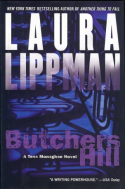
butchershillIn Butchers Hill, Tess has set up shop as a private investigator in a not-so-great part of town. Her first two clients are looking for children—one wants to make amends to the witnesses of a crime he committed five years ago, while another wants to know that the daughter she put up for adoption is doing alright. Neither client has been completely honest with Tess, however.

This was a really interesting installment of the series. I appreciate that Lippman was able to create multiple African-American characters who feel like full-fledged, sympathetic individuals (though I do wonder what an African-American reader would make of them). There’s commentary here on race relations in Baltimore, among other things, but it doesn’t feel too heavy-handed. I also like that Tess is not strictly a homicide investigator, though her cases have all involved murder eventually.

Speaking of murder, after Charm City, I was a little worried that it would be easy to predict the perpetrators in subsequent books, but actually, I didn’t see this one coming. And that’s a good thing, though the reason why I didn’t was that it was a rather implausible twist. Despite that (and the one aspect of the ending that I predicted), the conclusion to this one is surprisingly affecting. I hope some of these new characters stick around.

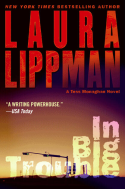
inbigtroubleIn Big Trouble takes Tess away from her hometown of Baltimore and into the unfamiliar environment of San Antonio, Texas. When she receives an anonymous letter that Crow, her former boyfriend, is in big trouble in Texas, Tess ends up contracted by his parents to track him down. She finds Crow in fairly short order, but he is greatly changed and is also involved with a crazy young woman whose influential local family is tied to a notorious murder 21 years ago.

This was a bit of a weird one. I can’t say I disliked it, or that I predicted anything about it, but Tess is so off-balance personally for the duration that it sort of feels like the story never really gets… grounded, or something. Unlike the others in the series, I was able to set this one aside for a long time—like, weeks—and didn’t feel any particular urge to get back to it. That said, I did think the San Antonio setting was portrayed well, and Lippman successfully instilled a serious hankering for some authentic Mexican food.

In the end, I’m enjoying the Tess Monaghan series quite a lot! I’m going to take a break here for a bit, but I do intend to return to the series in the near future.

Filed Under: Books, Mystery Tagged With: Laura Lippman

Bookshelf Briefs 5/5/13

May 6, 2013 by MJ, Sean Gaffney, Michelle Smith and Anna N Leave a Comment

This week, MJ, Sean, Michelle, and Anna look at recent releases from Yen Press, Viz Media, and Kodansha Comics.


fantaticrabbit2Alice in the Country of Hearts: My Fanatic Rabbit, Vol. 2 | By QuinRose, Delico Psyche, and Owl Shinotsuki | Yen Press – As I suspected, this volume was a lot more focused on romance and not so much on the psychology and psychotics. That said, there are points of interest here. It’s odd that Elliot, who was once imprisoned for destroying the clock of his best friend, is cavalier about killing Alice’s sister. And it’s good to give him a reason to be angry at Alice being close to Julius that isn’t jealousy. That said, in the end it mostly does turn out to be jealousy, and when the book details romance it gets far more generic. There’s also some nasty dream manipulation to stop Alice from returning home – which one can argue, given what we’ve inferred about her real life, is justified, but still comes across as harsh. An ambiguously good volume, but hey, the series is short.-Sean Gaffney

devil8A Devil and Her Love Song, Vol. 8 | By Miyoshi Tomori | Viz Media – At no point has A Devil and Her Love Song actually been bad, but the “Anna arc” of recent volumes—in which Maria attempts to achieve some level of understanding with her former best friend—just retread the same ground over and over and felt like it would never end. And so I am profoundly relieved that we’re moving on to something different, even if it’s taking the form of Shintaro Kurosu, a brash new first-year who’s interested in Maria and takes every opportunity to get close to her. We’ve seen this sort of character in shoujo manga many times before, but any catalyst that causes Shin to confront his feelings for Maria is fine by me, and because Shintaro shares some qualities with our insightful heroine, he’s quite adept at getting under others’ skin. I still recommend this series, but if we never see Anna again it’ll be too soon for me. – Michelle Smith

fairytail25Fairy Tail, Vol. 25 | By Hiro Mashima | Kodansha Comics – Fairy Tail will probably never get away from One Piece comparisons, but one big difference it has is that Mashima does tease romance between his characters quite a bit. In this volume we not only get Elfman and Evergreen getting past Mirajane with a shocking revelation – theoretically false, but I sense a setup – but we also have Levy’s giant crush on Gajeel, which is quite cute provided you forget him crucifying her a while back. Literally. Meanwhile, the S-class exams are interrupted not only by the arrival of a dark guild, led by Ultear, but also a young sobbing man who would seem to be Zeref, the evil wizard who has been mentioned before, and definitely doesn’t seem to be possessing anyone this time. It would seem that the exam arc is going to get a lot longer and more serious before anyone wins their S-class.-Sean Gaffney

corda17La Corda d’Oro, Vol. 17 | By Yuki Kure | Viz Media – This final volume reads like a series of closing doors—at least for Kahoko’s suitors, who take turns examining their feelings, though it’s clear most don’t have a shot. Ryotaro’s epiphany is most significant, and his heartfelt confession throws oblivious Kahoko for a loop. Everyone knows that Kahoko will end up with Len, but when it gets right down to it, their final scene is oddly anticlimactic. Kahoko is predictably breathless and embarrassed, and Len is awkward and brusque, but as a romantic climax it’s surprisingly non-committal. We don’t even get a good kiss out of it. As a jaded fan of romance, I should be grateful for anything unexpected, but in a story that’s always been so conventional, it’s honestly a letdown. Though perhaps the most disheartening truth is that they’re still hung up on “Ave Maria.” What can you do? Farewell, La Corda d’Oro, I’ll miss you. – MJ

kenshirestoration1Rurouni Kenshin: Restoration, Vol. 1 | By Nobuhiro Watsuki | Viz Media – Watsuki says in the afterward that the genesis for this reworking of Rurouni Kenshin was the production of the recent live action movie. This shows in the first story of the volume which puts familiar characters into a battle arena situation with no real plot or character development. There’s a back-up prequel story that has more interest as Kenshin encounters a unique western doctor struggling to provide care for low-income patients. While it was nice to revisit the characters for a little bit, this parallel story reminded me of how much more I liked the original series. This is only for die-hard Kenshin fans, most people will be better served reading the very good first series. – Anna N.

strobe4Strobe Edge, Vol. 4 | By Io Sakisaka | Viz Media – What’s interesting about Strobe Edge, is the way that Io Sakisaka has managed to take the most trite characteristic of her series early on—namely, her heroine’s unbelievable innocence—and turned it into a real asset. That Ninako wouldn’t realize that there are unavoidably negative consequences to unrequited love seems ridiculously naive, but it also allows Sakisaka to explore those consequences more honestly than is typical, even for romance manga. The way both Ninako and Ren begin to recognize and forced to deal with the ramifications of their ongoing friendship in the face of Ninako’s (and now, Ren’s) feelings is surprisingly fresh. I’m reminded immediately of the personal agony I suffered while watching Shoji developing feelings for someone other than his girlfriend, Nana Komatsu (NANA), but this time I’m experiencing it with “other woman” Sachiko as my heroine. It’s an emotional punch in the gut, and very well-executed. Recommended. – MJ

wewerethere16We Were There, Vol. 16 | By Yuuki Obata | Viz Media – This is the second concluding Shojo Beat series for me this week, but what a contrast! Though this series’ romantic conclusion was no less predictable than La Corda d’Oro‘s, the execution could not be more different—much like the two series themselves. There was a time when I’d given up on Nanami and Yano’s torturous romance as simply too destructive to bear, so it’s a real testament to Obata-sensei’s gifts as a writer that she’s managed to bring me back around to loving them together once more. Everyone’s story ends with dignity, even that of long-suffering Takeuchi (my personal hero of the story) but the real centerpiece is our primary couple, with whom Obata completely sweeps me off my feet. Their ending is so poignant and so well-earned, it’s a genuine pleasure to read. Thanks for everything, We Were There. You’ve been quite a ride. Highly recommended. – MJ

Filed Under: Bookshelf Briefs Tagged With: a devil and her love song, alice in the country of hearts, Fairy Tail, la cord d'oro, rurouni ken shin: restoration, Strobe Edge, we were there

Pick of the Week: Dancing to the Shojo Beat

May 6, 2013 by MJ, Michelle Smith, Sean Gaffney and Anna N Leave a Comment

potw5-6-13MJ: This week’s pick is an extremely tough one for me, particularly when faced with choosing between beloved series like Wandering Son, Strobe Edge, and even Bakuman,which is heading into its last couple of volumes. But in the end, I’m going to go with an end—that of Yuuki Obata’s melancholy romance, We Were There, which has charmed me all the way from its very first volume, through its soul-crushing volume four, and so on and so forth, to the last, sweet moments here in its final volume. This series has been an especially emotional ride for me—I’d recommend it to anyone—and its ending is extremely well-earned. It’s an obvious pick for me, I suppose, but for very good reasons.

MICHELLE: And it’s my pick, as well. “Well-earned” is right, and I could go into detail about why it’s more satisfying than your average shoujo conclusion, but that would probably be rather spoilery. Instead, you should see for yourself!

SEAN: I’ll go with the new volume of Dengeki Daisy, a shoujo manga with the plot of an action movie. It’s rather impressive how even the people normally creeped out by older guy/high school girl romance don’t seem to mind it in Dengeki Daisy – both in the story itself and in the readers. Perhaps because of the comedy that comes with it, or the way that Teru isn’t being tricked, seduced, or blackmailed into it. But probably mostly due to the writing – a lot can be forgiven in a romance if both leads are simply great people you want to see get together. Well, right after they solve this kidnapping. Yes, another one.

ANNA: Since other people have picked We Were There and Dengeki Daisy, I’ll go with Strobe Edge. The fourth volume has come a long way in terms of plot development and art. Even though some of the plot elements are a bit stereotypical, there’s plenty of emotional resonance in the developing love triangle.

Readers, what looks good to you this week?

Filed Under: PICK OF THE WEEK Tagged With: Dengeki Daisy, shojo beat, Strobe Edge, we were there

Off the Shelf: Black Butler, Pepita, Gundam

May 4, 2013 by MJ and Michelle Smith 2 Comments

MJ: Good morning, Michelle! It’s a gorgeous morning here on Free Comic Book Day. Perfect for reading comics in the park. Do you have any comics-related plans for the day?

MICHELLE: Not in regards to Western comics, no, but I am looking forward to reading some Psyren later today!

MJ: I’ve got a nice stack of manga waiting for me as well. So I guess this is our cue to start talking about our comics-related activities earlier this week! What have you been reading?

blackbutler13MICHELLE: Well, one thing I’ve been doing lately is revisiting some of the series that I first talked about in the early days of Off the Shelf. Of course, there aren’t many that are still running—they’ve either finished or the publisher has disappeared—but there are a few, and one of them is Black Butler. Here’s my initial summary from back in January 2011:

In this series, a thirteen-year-old named Ciel Phantomhive is the head of his family after a fire claimed the lives of his parents. To assist him in his plans for revenge he has entered into a contract with a devil who is serving him in the guise of his butler, Sebastian. The Earls of Phantomhive have always served as a “watch dog” for the crown, a duty Ciel is now expected to perform for Queen Victoria.

At the time, I said that the emphasis on solving mysteries was pretty fun, but does that still hold true in volume thirteen? Well, sort of. Up until the previous arc, which involved a series of murders at Phantomhive Manor and the inspiration they provided a young Arthur Conan Doyle, the answer was yes. This current arc, though—which can pretty much be summarized as “zombies on the Titanic“—seems to be more about mass carnage than detection, even though Ciel got involved in the first place because he thought the Queen would want to know what was behind news reports of the dead being reanimated. The one bright spot is that Elizabeth, Ciel’s betrothed, turns out to be a secret badass with swords.

I was actually planning to talk about Black Butler even before you posted your 3 Things Thursday column about how you just couldn’t like it, and now your post has made me wonder why I’m still reading it. I like Sebastian, and sometimes there are amusing bits, but overall, I don’t feel connected to any of these characters or invested in their fate. Ciel could get devoured by a zombie at this point and I would not be affected in the least. So why am I reading? Unfortunately, I think the answer is… because Yen Press is still sending this to me. It’s an easy and uncomplicated read for me, and I don’t hate it, and so I read it. If I had to fork over $12 for each volume, though, I suspect I would’ve dropped it some time ago. It’s just not a satisfying enough read to justify that kind of price tag.

MJ: Discussion of Black Butler seems especially timely for me right now, not only because of that 3 Things Thursday post, but because my recent obsession with Yun Kouga’s Loveless has forced me to confront the question of why I can tolerate certain problematic fanservice in that series when I’m unwilling to stick with Black Butler. And by “forced to confront” I mean that I’ve been asked the question directly, and justifiably so! And the only answer I really have is that, well… Black Butler bored me—at least as far in as I was willing to go—well, and that I have pretty specific reasons for liking the relationships in Loveless that don’t really apply to Black Butler. But in any case, I’ve been asking myself a lot of questions about it, and pondering yet again whether I should give Black Butler another go. Given your reaction here, though, I’m thinking… no, not really.

MICHELLE: There really isn’t much fanservice of that kind in Black Butler, anyway. I mean, very occasionally there are pages where I think Toboso-sensei is throwing fans a juicy little tidbit, but on a straightforward reading, I am personally not seeing the overt, emotional subtext there like one gets in Loveless. Although… can something be simultaneously “overt” and “subtext”? Perhaps I need a better word…

MJ: I think subtext can be incredibly overt. Perhaps you could go for “generous.” Though I think there’s an argument to be made that part of the difference is that Loveless moves the subtext pretty well into the text, which means that Kouga actually forces us to deal with it instead of just giving us a nod & a wink.

MICHELLE: I think you’re right. I never take the “nod and a wink” stuff seriously.

Anyway, what have you been reading this week?

pepitaMJ: Well, on a very different note, my main solo read this week is not actually manga, though it’s of great interest to both of us (and, I expect, many of our readers). That read would be Pepita: Inoue Meets Gaudí , a sort of art book/travelogue released last month by Viz. The book combines prose, drawings, and photographs to chronicle the travels of Takahiko Inoue (Slam Dunk, Real, Vagabond) as he traces the life and work of Spanish architect Antoni Gaudí.

The book opens with a heartfelt introduction in which Inoue describes his first encounter with Gaudí’s work and how his detached view of Gaudí as a tourist in Barcelona differed from what he experienced in his quest to really know the man behind the work. It’s a passionate little piece that perfectly sets the tone for the book itself, which is informational and (of course) beautiful, but above all, personal.

Through Inoue’s quest to understand Gaudí, I felt that I was also given an opportunity to understand Inoue—and in a very different way than what I’ve learned about him through his own work. There’s a sense of wisdom and confidence in a series like Real, for instance, that makes me, the reader, feel that I’m the student; I’m learning about humanity through the eyes of a master. Here, Inoue is the one seeking wisdom from a master, and that alone gives us a very different glimpse of him as an artist and a person than what we’d ever see otherwise.

Though I don’t know that Inoue gets the answers he was looking for on his quest (he gets answers, but it’s complicated, I think), the journey itself is glorious to behold. The book is filled with Inoue’s detailed, inspired scribblings alongside (and sometimes inserted into) breathtaking photographs of both Gaudí’s work and the Spanish region he grew up in. It’s a visual treat of the very best kind. It also offers a wealth of information about the life and work of Gaudí through bits of researched history, interviews with artisans and Gaudí scholars, and Inoue’s personal observations.

I’m sure very little of the information offered will be new for serious students of Gaudí, but I am kind of thrilled at the thought that it might serve as an introduction to Inoue (and perhaps manga artists in general) for lovers of architecture, just as it might open up a new world of architectural beauty for fans of Inoue. It certainly did for me.

MICHELLE: That sounds glorious. Now, I have to ask… how detailed were the pictures of Gaudí’s work? Did Inoue attempt to draw any of them? Building geek that I am, I would love that most ardently.

MJ: The pictures are plentiful, though there isn’t a particular focus on the detail, if that makes sense. And though Inoue does sketch them occasionally, I’ll admit that he spends the bulk of his time drawing Gaudí’s surroundings—the streets, people, countryside, mountains—the things that he felt must have most deeply influenced Gaudí’s work, rather than the work itself. He ponders for quite a while Gaudí’s relationship with nature and how some of his buildings were designed to become part of the natural landscape—it’s fascinating, really. I think you’d enjoy it quite a lot.

So, to take a fairly drastic turn once again, would you like to introduce our mutual read for the week?

gundam1MICHELLE: Sure! This week, MJand I decided to venture out of our comfort zone and into the realm of… mecha.

Back in late March, Vertical, Inc. released a deluxe hardcover edition of the first volume of Mobile Suit Gundam: The Origin. Vertical has licensed the aizouban edition of the series, rather than the 23-volume tankouban version, so this first release (subtitled “Activation”) is quite substantial and contains some bonus essays. Mobile Suit Gundam is a relatively recent manga adaptation of the first Gundam anime, and was originally serialized in a magazine called Gundam A, which sounds like it’s for hardcore Gundam enthusiasts. I’d never actually read or seen anything Gundam-related before, so I wasn’t sure how I’d make out, but it turned out to be newcomer-friendly.

In Earth’s distant future, a large chunk of the population is living in gigantic, orbiting colonies. War breaks out when some of the colonies declare themselves the independent Republic of Zeon. A nicely ominous color introduction informs us that the resulting battles wiped out half of the population. “All men grew to fear their own deeds. The war entered a stalemate, and eight months went by…” Fighting resumes when a Zeon mecha force infiltrates a Federation colony where a new mobile suit is being developed.

Long story short… the civilian colonists end up escaping on a rather unwieldy ship, fleeing from their enemy who fight with red-eyed metallic soldier things, and… anyone else here getting some serious Battlestar Galactica flashbacks?

MJ: Heh, well I’d say yes and no. I mean, yes, of course I see where you’re going with that. And I’d say that the plight of the civilians on the ship is the thing that interests me most in Gundam so far. Several of the civilians find themselves sort of spontaneously becoming part of the military operation—in particular Amuro, a civilian teen who accidentally finds himself the pilot of a new mechanical suit prototype, Gundam, and Sayla, who begins as part of the volunteer medical team. The conflict among the military command over the assimilation of the civilians is compelling, but as I struggle to describe any of it here, I think I’m actually hitting upon the thing that least reminds me of something like BSG and is also the source of my own difficulties with the book as a reader. The thing is, unlike BSG or even most of the other Japanese mecha-based series I’ve been able to get into (Evangelion, of course, or more recently, Knights of Sidonia), Gundam is for me, at least so far, a bit too much about the mecha.

As I say this, I’m aware that I’ll probably be criticized for it—and perhaps justly. As one of the two or three manga fans left in the world who has never seen even a second of this very famous anime series, I’m a total novice. I think my nervousness in approaching a series as iconic as this one is pretty similar to Phillip’s trepidation when he decided to read and talk publicly about Sailor Moon. I’m out of my depth and I know it. But as I read through this volume, gorgeous as it is (and it really, really is—seriously, it’s visually epic), I found that I had difficulty remembering characters’ names or really identifying with their story. And I felt pretty detached from the suit itself, which really seemed like the thing I was supposed to be appreciating the most. Is it just me?

MICHELLE: It is not just you at all. As you say, the manga is visually epic, and the overall atmosphere carries the story along even more than the plot does. (There were things about the plot that confused me, for example. Like why is civilian teen Amuro suddenly the pilot of the mecha, when there was an officer slated for that role? Did I miss his demise or something?) But the characterization is where things really fall flat. I don’t feel like we know Amuro even a little teensy bit, other than he seems to have some natural aptitude for piloting a big fighting suit. And where this might put him in direct comparison to Nagate of Knights of Sidonia, at least I have a sense with the latter that it’s Tsutomu Nihei’s intent that his lead be inscrutable. That’s just his style. With Mobile Suit Gundam it feels more like characterization was deemed unimportant in the grand scheme of things.

MJ: I’m grateful to hear you say this, because I really feared that my reaction was a case of reader failure more than anything else, which is to say that it quite surprised me—and saddened me, actually. Not because I feel like loving Gundam a grave necessity in my life, but because the book is so, so stunning to look at, and so obviously created out of a deep love for the source material. One doesn’t even need to read any of the heartfelt essays in the back of the book to feel the sense of reverence and devoted fandom that went into the making of this manga. And Vertical takes that fandom seriously in their production of the book as well. From the bright semi-gloss paper to the gorgeous color pages, Vertical made sure that this labor of love was presented in the most reverent light possible. If I was a fan of the franchise, I’d feel that this was a tremendous gift, I’m sure. And honestly, I could look at the artwork all day long.

MICHELLE: The artwork really sells it for me, and I was especially impressed that the space battles are drawn with such clarity. True, I did weary of the space battles by the end, but at least they weren’t incomprehensible, as could easily have been the case. Too, I never got the sense with this that I was reading an adaptation. I wonder how it reads to those who have actually seen the anime.

Ultimately, though I get the sense that you’re not planning to continue with the series, I think I will. While I might not care about the characters much—though several of the female ones seem to have potential for awesomeness—I still like the story and the sheer scope of what mankind is facing.

MJ: I can see how you’d draw that conclusion, but actually I suspect I will continue with it. Despite my feelings of detachment at this point, the artwork alone is enough to carry me on, at least long enough to see if the characters might begin to really grab me. I like to give any series at least three volumes or so to pull me in, and Gundam surely merits that much. Who knows what might happen?


Note: MJ & Michelle will be taking a break from this column for the next two weeks, in order to prepare for the upcoming Yumi Tamura Manga Moveable Feast. Can you guess what they’ll be reading?

Filed Under: OFF THE SHELF

Manga the Week of 5/8

May 2, 2013 by Sean Gaffney, Michelle Smith and MJ 11 Comments

SEAN: This week gives us a variety of titles to choose from. Let’s delve right into them.

Midtown’s list said that they’re getting in Fantagraphics’ Wandering Son Vol. 4 right as Fantagraphics solicited 5 (for August) noting that 4 was running a bit late. I’ve no idea who is correct, but I’ll lean towards Midtown, as Fantagraphics tends to ship to comic shops long before Amazon and other related stores. It’s a must buy whenever it comes out.

MICHELLE: Yeah, it’s too bad releases of this one aren’t more reliable. I’ve fallen somewhat behind because of that.

MJ: I’ve had this volume on preorder for a very long time, so I’ll be very happy when it finally turns up. I’ll believe it when I actually see it, though.

SEAN: For those who enjoyed Negima from Kodansha Comics but felt that it would be even better if all the girls were 5 years old and Negi was their preschool teacher, well, Negiho! is the title for you! For the rest of us, I’m hoping it comes across as amusing and cute rather than, as I fear, creepy and vaguely illegal.

MICHELLE: Ugh.

MJ: What she said.

zeros1

SEAN: Seven Seas has another huge omnibus, this one containing the first three volumes of Zero’s Familiar. All I know about this series is that the lead girl is worse than Shana, Taiga and Nagi combined, and there’s a lot of ‘comedic violence’. If you write ‘xxxxx gets a spine’ fics, then, this may be your kryptonite.

MICHELLE: See above re: ugh.

MJ: Indeed.

SEAN: Viz, naturally, has a giant pile of stuff. Bakuman is almost done, which means that he must be close to hooking up with that girl, right? At least that was the plot back when I was still reading Bakuman… In any case, Vol. 19 is filled with Jump goodness.

MICHELLE: At this point, I’m just stockpiling Bakuman until the final volume comes out, then I’m gonna marathon it. I think that might be fun.

MJ: I’ve been keeping up so my anticipation is high!

SEAN: I fear that I’m sounding cranky all of a sudden in these descriptions, and unfortunately Black Bird 16 will not change that. Man, it sells great, though. I like to think its sales help pay for all the poor-selling stuff I like.

MICHELLE: That’s a good way of looking at it.

MJ: If one must look at it.

SEAN: Bleach has its 5th omnibus, which is right in the middle of its strongest arc. Anyone who wonders why everyone is still paying attention to (and complaining about) such a slow-paced behemoth needs to check out these pacey, funny and heartwarming volumes.

MJ: You’re really making me want to go back and re-read Bleach!

SEAN: Claymore has gotten much praise from friends I trust, and I keep meaning to go back and grab it. Till then, here’s Vol. 22 for said friends.

MJ: I’m looking forward to this, too! I have a couple of volumes to catch up on, so I plan to read them all together.

SEAN: Dengeki Daisy has gotten much praise from me, and I can’t wait to see Vol. 12. This is the anti-Black Bird, being a shoujo thriller that respects its female characters and kicks eight kinds of ass. May I note that it and Black Bird run in the SAME DAMN MAGAZINE? Now that’s variety.

MICHELLE: I’m behind on this one, too, but intend to catch up in the coming weeks.

SEAN: How did Hunter x Hunter get to 30 volumes? Does that mean it’s also had 30 hiatuses? Still, its ability to return from long breaks over and over again must mean it’s a damn fine series, and so here we are, Vol. 30.

corda17

Ah, the final volume of La Corda D’oro! Sadly, it fell victim to “the sales suck, but we’re not allowed to cancel it, so let’s put it out as slow as possible instead.” A quiet, sometimes overly frustrating reverse harem about a girl and her violin, this LaLa series already has a sequel in Japan. Don’t expect that. Enjoy this, though.

MICHELLE: Someday I will read this. I own practically the whole thing.

MJ: I’ve enjoyed this series consistently, despite its flaws, so you can count me in here.

SEAN: Naruto also has Vol. 5 of its omnibuses releases, and I think it’s towards the end – at last – of the exam stories. This is also Naruto towards the height of its powers, I believe, so definitely recommended.

And we also get Naruto 61, which has Sasuke and Itachi’s tearful, loving reunion. D’aww…

Otomen 15 looks to focus on Tomomine, at least to start, and his being torn between what his parents want and his love of makeup. I am still basking in my love of Vol. 13, so as long as Ryo still appears once or twice, I’m fine with it.

Psyren has made it to 10 volumes, and I believe is at the point where he finally get some mysteries solved in addition to all the angst and action.

MICHELLE: Otomen and Psyren are two more I’m aiming to catch up with soon.

SEAN: Strobe Edge continues to try to work with its love polygon and make it realistic, keeping everyone sympathetic. Will that keep lasting with Vol. 4? Let’s find out…

MICHELLE: I hearts it.

SEAN: Tegami Bachi: Letter Bee delivers its 13th series of letters. Sorry, I got nothing on this series. Anyone want to chime in who reads it?

MICHELLE: I’m pretty behind on it. I like the world and the art, but sometimes the humor is very… shounen.

wewerethere16

SEAN: Speaking of final volumes, We Were There has run out of manga, therefore I assume Vol. 16 must run out of ways to make everyone as sad as possible and comes up with a happy ending. Yay!

MICHELLE: It’s a great ending!

MJ: Agreed! I plan to talk about this shortly on the site.

SEAN: Lastly, not technically manga, but Yen Press has the first New Moon Graphic Novel, which will sell well enough to let them pick up some more series similar to Thermae Romae. I hope.

MICHELLE: Me, I’m hoping for manhwa.

MJ: I’m with Michelle. I’m also steeling myself to read New Moon. I’ve never been able to get up the gumption to read the novels, but these at least move quickly.

SEAN: So what titles give you feels this week? (Is this Tumblr?)

Filed Under: FEATURES, manga the week of

Pick of the Week: Twin Spica goes digital!

April 29, 2013 by Sean Gaffney, Michelle Smith, Anna N and MJ 3 Comments

twinspica1SEAN: I feel bad not picking the elite, first of its kind groundbreaking gay manga, but I’m not going to be reading it, as I’m not an audience for explicit gay bondage no matter how well put together it is. So my pick of the week is the digital release of Twin Spica, which I discussed in “Manga the Week of” earlier. A sublime, subtle story about growing up, overcoming hardships and tragedies, and the allure of space. Will love to read it all over again.

MICHELLE: I’m going to have to agree with Sean on every point, this week.

ANNA: I also hope that Twin Spica gets some extra love, now that it is being released in digital format. This reminds me that I need to go back and read the print volumes I’ve been stockpiling.

MJ: Well, I guess I’ll make it unanimous. While I’m definitely planning to check out The Passion of Gengoroh Tagame, I’m unreservedly enthusiastic about Twin Spica‘s move to digital. This is a series I named as a Best of the Year upon its debut, and then again as it concluded, and I’ve been very sad that low sales have forced it out of print. I hope very much that its digital venue can give it much-deserved new life!

Readers, what looks good to you this week?

Filed Under: PICK OF THE WEEK

Bookshelf Briefs 4/29/13

April 29, 2013 by MJ, Michelle Smith and Sean Gaffney Leave a Comment

This week, MJ, Michelle, and Sean look at recent releases from Yen Press, Viz Media, Dark Horse Comics, Kodansha Comics, and Vertical, Inc.


bunnydrop8Bunny Drop, Vol. 8 | By Yumi Unita | Yen Press – This volume has been greatly anticipated and feared by fans—me included. And though I had faith that Unita-sensei would execute the much-feared plot twist—Rin’s developing romantic feelings for her guardian, Daikichi—in a thoughtful and inoffensive way, my reaction was mixed at best. While I’m happy to report that this volume is, indeed, inoffensive, it’s also hard to swallow—not because of any breach of propriety, but because it just doesn’t quite ring true. Rin’s inner monologue about her awakening feelings is written sensitively, and on the surface it makes some sense. For a girl who craves consistency above all else, Daikichi’s steadfast loyalty can’t be beat. But even as I read Rin’s careful dissection of her own feelings, I’m just not buying it. The words are there, but the attraction is… not. That said, I’m invested enough to stick around for more. Recommendation pending. – MJ

Bunny Drop, Vol. 8 | By Yumi Unita | Yen Press – (Look away to avoid spoilers!) My primary reaction upon completing this volume can best be summed up as a sort of grudging respect. MJalways had faith that Unita could get readers to accept the romantic pairing of Rin and her much-older guardian, Daikichi, but I had remained dubious. Still, it’s hard to maintain such a feeling when Rin is so absolutely clear about her feelings and what she wants to do with her life. It’s worth noting, too, that so far Rin is convinced that getting what she wants is impossible, and that trying to achieve it would destroy what they have now. Is this Unita’s clever ploy to actually get me to root for them as a couple? And could it actually be working?! In any case, I’m not as leery of the final volume as I once was. – Michelle Smith

sidonia2Knights of Sidonia, Vol. 2 | By Tsutomu Nihei | Vertical, Inc. – This is absolutely riveting stuff, with your hands turning the pages as fast as your eyes can process. The battles are tense and visually clear, and you feel for the hero even though he, like most of the cast, tends to be fairly unemotional. Actually, that’s probably for the best – if everyone in this cast started crying when bad things happened, there would literally be nothing but 100 pages of sobs Bad things happen constantly in this story, and even when you get a happy, redeeming moment, it’s merely setup for an even more crushing blow later. And we’re still wondering what’s so special about Tanikaze that everyone is going out of their way to accommodate him. Whatever it is, I’m sure it will be a really depressing backstory. That will once again make me want to turn the pages even faster. – Sean Gaffney

loveless5-6Loveless, Vol. 3: 2-in-1 | By Yun Kouga | Viz Media – Everyone should know by now that I’ve fallen in love with Loveless, so a positive review of Viz’s latest omnibus edition is surely no surprise. Despite that, I must continue to register my surprise over Kouga-sensei’s ability to portray complex emotions and moral ambiguity with a combination of thoughtfulness, humor, and razor-sharp honesty. Over and over again as I read this omnibus volume, I was struck by bits of complicated emotional truth that most writers would carefully avoid—especially in the sort of deceptively fluffy genre tale that Kouga weaves here. Kouga’s insight into the human heart seems boundless, resulting in a story that is occasionally shocking, often dark, and always brilliant. Oh, Soubi… poor Soubi. Look for further discussion of this volume as the week goes on. Highly recommended. – MJ

missions3Missions of Love, Vol. 3 | By Ema Toyama | Kodansha Comics – I know that I sometimes read shoujo manga for different reasons than everyone else. This is probably why I’m still enjoying the really, really problematic Missions of Love, which is apparently trying to spice up Nakayoshi in a way I’m not used to from this company (what is this, ShoComi or something?). Yukina is horrible much of the time, which is only somewhat excused by her complete ignorance of love and the emotions of other people. Akira does indeed step up his game, as predicted, and comes across as obsessed. And we also meet Shigure’s old friend (and past love, according to everyone but him) Mami, who I am sort of desperately hoping does not become the standard evil rival bitch character or many shoujo manga but I know she will be. In short, this is a fun little trainwreck, and if the lead female were weak or whiny, I’d drop it like a stone. But she’s a horrible person too. So I like it. Go figure. -Sean Gaffney

goddess44Oh My Goddess!, Vol. 44 | By Kosuke Fujishima | Dark Horse – The most interesting part of this volume actually won’t have its real impact until Vol. 45, which is the dissolution and then reconnection of their contract. Keiichi, who goes along with this because he trusts Belldandy, immediately notices one big difference – Belldandy looks much sexier to him, and indeed he’s reacting in ways we haven’t seen in years. But the meat of this particular volume is the sisterly bond between Urd and Skuld, and how strong it has to be given the control Urd has – or doesn’t have – over her demon side. Urd loves and trusts Skuld enough to kill her if she gets out of hand, and Skuld loves and trusts Urd enough to find a way out that doesn’t involve that. So now everyone’s coming together again, including Hild, whose arrival will make Vol. 45 even more fun than you’d expect. -Sean Gaffney

wewerethere16We Were There, Vol. 16 | By Yuuki Obata | Viz Media – Now that is one satisfying and well-earned ending. Yano begins reaching out to Takahashi, but because she’s so busy at work, they play phone tag for a while, and right after they reach each other, she ends up in the hospital. In the hands of a lesser mangaka, such a plotline would be rife with melodrama, but here it’s urgent and scary and the catalyst for putting things in crystal-clear perspective. Truly, this is a splendid ending that goes beyond what one would expect, taking the time to acknowledge how important Takeuchi has been to both Yano and Takahashi and bringing the series full circle with a return to the peaceful countryside of Hokkaido. Have I gushed sufficiently? It’s wonderful. If you like shoujo manga even a little, you need to read We Were There. I’m already looking forward to rereading it, that’s how good it is. – Michelle Smith

Filed Under: Bookshelf Briefs

The CMX Project: Cipher

April 26, 2013 by Michelle Smith and Karen Peck

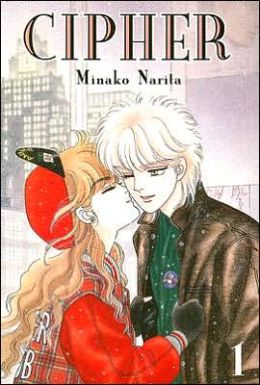
cipher1MICHELLE: Hello, and thanks for joining us for the second installment of The CMX Project, in which we turn our attention to Cipher! (Please kindly overlook the fact that this column was promised for February; life has a nasty habit of upending one’s plans.) This month we’ll also have a special guest, but before the big reveal, how about another of your fabulous summaries, Karen? (Since you did so well with
Land of the Blindfolded!
)

KAREN: Goodness, Michelle, all that praise is going to go to my head!

This month we have Cipher, by Minako Narita. Published by Hakusensha, it ran in Lala and Lala DX in the early/mid-’80s. Narita began working in the ’70s, with an eight-volume series (Alien Street) coming before Cipher. She would later go on to do a sequel to Cipher, Alexandrite, and her current work is Hana Yori Mo Hana No Gotoku, coming out very slowly in the bimonthly magazine Melody.

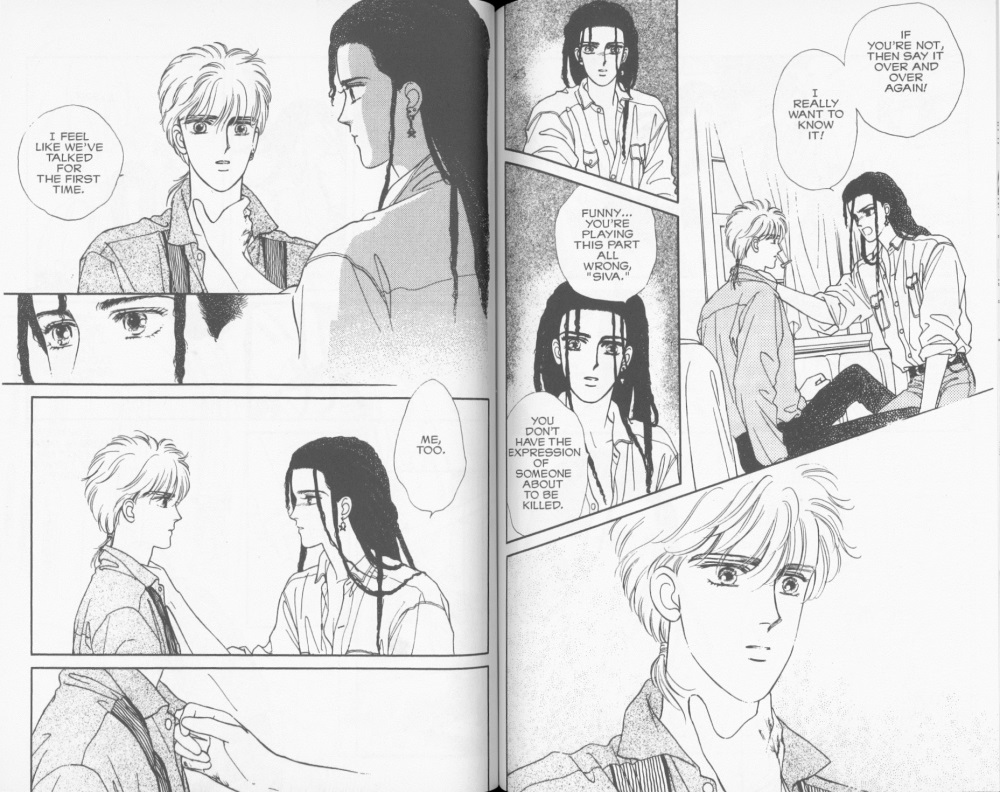
Cipher is the story of Anise, a girl in high school in New York City in the 1980s, and how she pursues a friendship with former child star Siva, breaking through his cool detachment with the force of her personality. Through Siva, she meets his twin brother Cipher, and discovers a mystery surrounding the brothers—that they’ve been changing places with each other for years. Which one is which? And why do they do this? I feel as if I’m not crafting a summary that does the story justice; instead, I hope our conversation will unfold just like the story—there’s a lot of layers to peel back, but I found the effort to do so very worth it.

But before I start going on and on, Michelle, please tell us about our special guest this month!

resized1MICHELLE: Well, I have the good fortune to be Facebook friends with none other than Asako Suzuki, who was director of manga at CMX from 2006 until its untimely death! I shared our Land of the Blindfolded column with her, and when she mentioned that her favorite CMX series was Cipher, I invited her to join us!

Welcome, Asako!

ASAKO: Hi Michelle and Karen! Thank you for having me, and thank you VERY much for this wonderful project remembering CMX! I am honored and excited to be with you today to talk about my favorite manga series, Cipher!

Cipher is a very special manga series to me, and I have lost count of how many times I read it. In fact, I have just read the entire series (of course in Japanese) not long ago.

MICHELLE: Can you tell us how Cipher came to be licensed and published by CMX?

ASAKO: Actually, I inherited Cipher with some other early acquisitions when I joined CMX. That being said, before I joined CMX, I assisted the acquisition team and made some suggestions. Cipher (and [a] few other titles that were eventually published) was one of the titles I recommended, but I didn’t know if DC Comics had acquired it or not until I started my position. When I saw it on our production schedule, I was very happy!

KAREN: Wow, Asako, that must have been a great surprise to come into CMX and see Cipher there!

resized3Now that I’m past the awesome summary-writing part, I can give my opinion—that I loved this title. I went in with preconceived notions—that this was That ’80s Manga. And while yes, it is very much set in the ’80s, it’s not done with artifice. It’s clear that Narita adored American pop culture—she even mentions doing a Thompson Twins doujinshi!—and it’s all done so lovingly. Real teens are a part of the music, movies, and current events, and it’s only in hindsight that the ’80s seem so cheesy. She also doesn’t gloss over some of the gritter aspects of the times—New York was still recovering from a terrible ’70s. Ironically, Cipher and Siva’s apartment is now in a very trendy area!

What surprised me was how the story was very much a coming of age tale—and not just for the heroine, Anise, but for the boys as well. At times, especially in the second half, she’s much more in the background, but her role seemed to be as much as a catalyst to make the bigger, darker story of the twins happen. Anise is still very childish at 16—there’s the very funny part where it’s pointed out that she really, really needs to start wearing a bra—despite her maturity and insight in some areas, she’s having a hard time seeing herself as growing up.

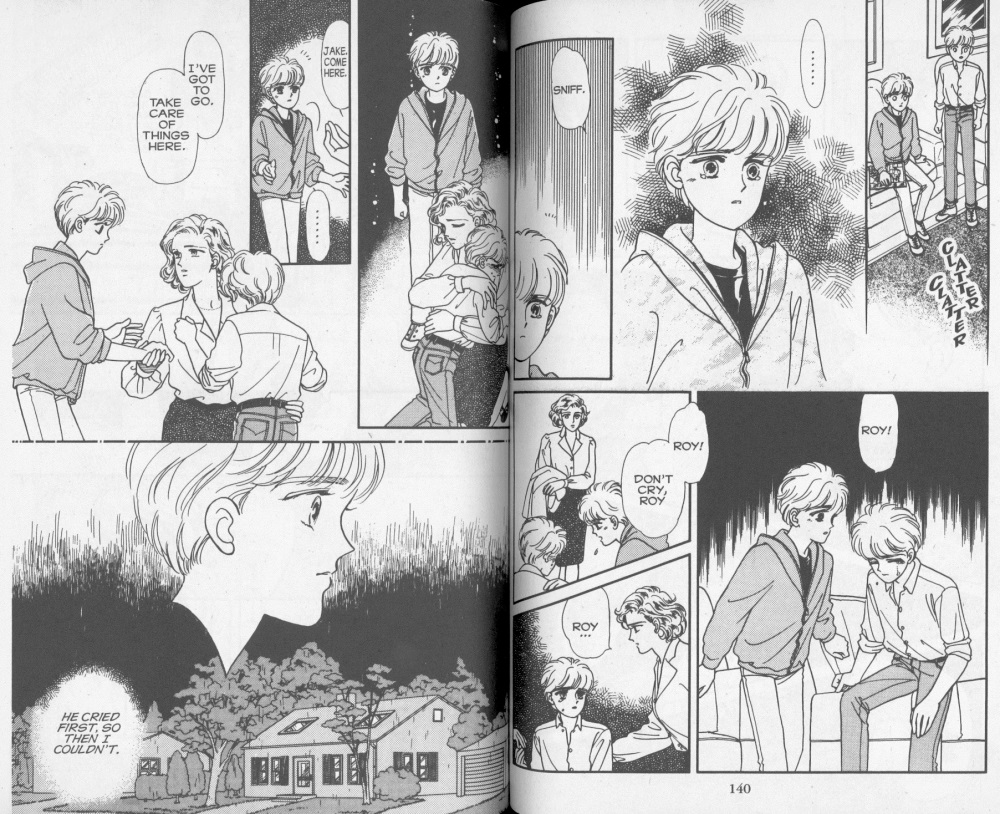
And then we have our former-child-star twins, Siva and Cipher (whose real names are Jake and Roy, respectively). Michelle and Asako, what’s your take on them? And do you still love the ’80s?

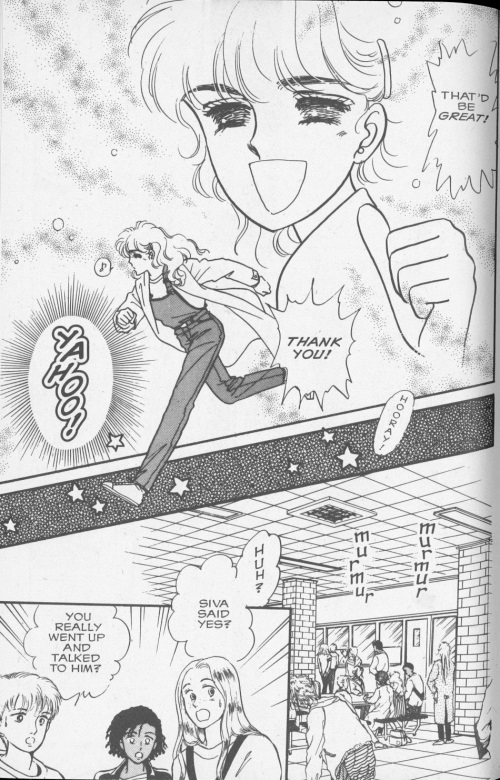
MICHELLE: Similar to Land of the Blindfolded, this is another case where focus drifts from the heroine and onto the two boys in her life, who each have past trauma to deal with. Anise isn’t as perpetually sunny as Kanade, but she’s still much less interesting than the twins. Or, rather, I felt like Narita-sensei was less interested in exploring her as a character. It was especially odd to me that we never learn what her focus is at the performing arts school! She narrates in volume one that “lots of people come to this school hoping to become painters, dancers, musicians, or actors.” So, which is Anise? What is her ambition for being there? As someone who actually attended a performing arts school, your “major” was vitally important.

So, that said, I feel a little grumpy that the boys got so much more love, but can’t deny that they’re pretty fascinating. I especially like when the story begins to focus more on Siva and we see events from his perspective that we later see again from Cipher’s perspective. Siva felt that Cipher’s openness made him more easy for his parents to love, while Cipher felt that Jake’s reliability made his own behavior seem childish in comparison. I also really liked how the friends they make while they’re apart affect them.

resized6

ASAKO: I am a huge fan of Anise; she was my hero! The reason why I wanted to come to the United States was because I wanted to be like, and live like her. To me, Anise was more realistic and easy to relate to compared to other manga protagonists, thanks to Narita-sensei’s amazing psychological descriptions throughout the series.

Narita-sensei is an amazing writer; I can easily tell how much she loved her characters, and she treated each differently. The way she shifted focus from one character to another was just incredible. I actually had a deep conversation with one of the manga editors in Japan (can’t say who!) about Cipher and how talented Narita-sensei is!

See, Narita-sensei introduced Cipher and Siva to us through the eyes of Anise and once we got to know the twins better with Anise, we were able to learn more about them individually through the twins’ perspectives. If Anise stayed as the center of the story the whole time, the story would have been shallow. With appearance of Dana, the focus was subtly shifted to Jake, and we got to know the secret of the twins and why Jake was protective yet envious of Roy. Then we learn more about Roy in LA… I really enjoyed the multi-dimensional story telling.

resized7

Speaking of details, have you noticed of the characters’ mix-and-match wardrobes? That’s amazing!

Also, there is something I have always wanted to know and never understood… can I ask you both a question? When you say “manga from the ’80s,” what does that mean? How do you distinguish the manga from the ’80s from the recent ones and why would you get less excited about manga from the era? That always puzzled me…

KAREN: Michelle—I wondered that too! I was really hoping she would have some great talent that drove her to commute all the way in from Queens!

I missed Anise during the second half of the series when the twins separated. She was still there, but the second half was really about the twins apart, and each making friends on their own, without having the other to hide behind. I don’t understand why some places categorize this as a shounen-ai title, the only love is friendship and the twin’s kissy-kissy… is anything but that.

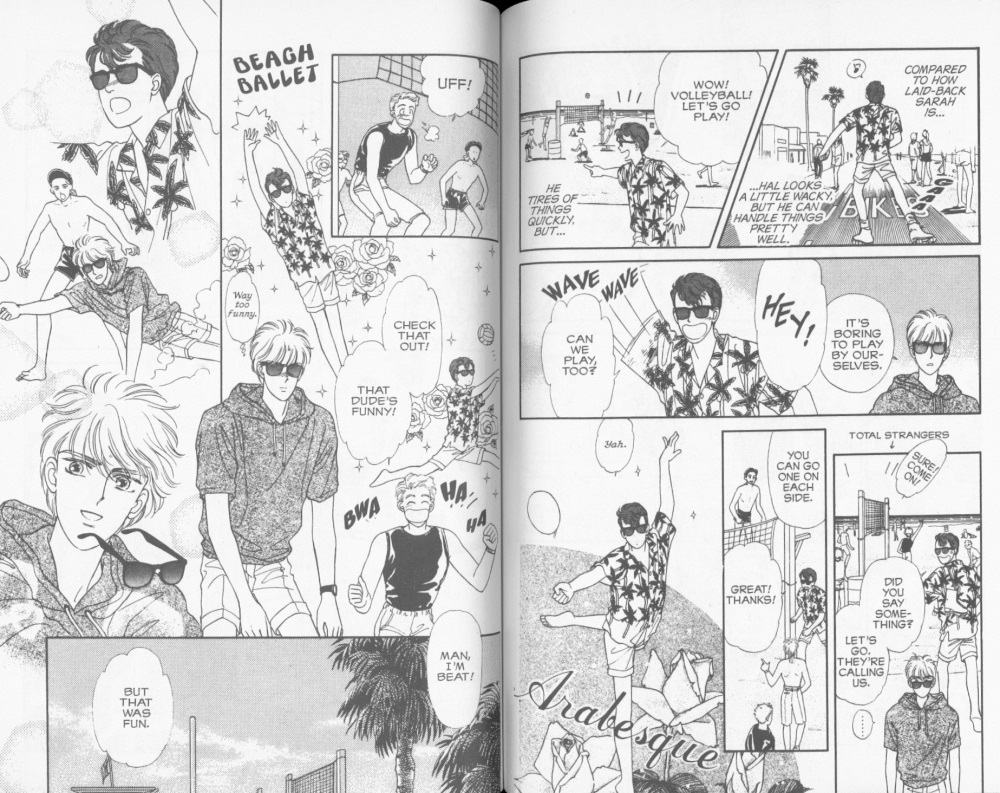
There’s a lot of subtle tonal shifts in the story—the Dana storyline being one of them—a beautiful, talented young girl on the verge of falling in love and being loved is tragically, suddenly killed, and it has a way of breaking apart the entire premise of the story. The twins don’t just grow apart, they fly apart—Roy quite literally to the West Coast, leaving Anise behind. The ruse of one twin playing another will never work again, so they had to be apart, and make friends on their own terms, and the switching between coasts feels like two different stories but… they mirror each other, like Cipher and Siva did. Alexandra and Hal are different people, but they carry their own insecurities and pasts into their friendships—friendships they needed as badly as Jake and Roy did.

resized11

I didn’t notice the wardrobes, except that I loved how detailed they were. Narita-sensei must have been importing magazines! It stuns me about the accuracy of the details—reading this series sent me into a flurry of research (yes, with the extensive use of Google Maps) and it’s amazing that she did this in the pre-internet era—unless she was here herself? Asako, do you know any of that background? She did three series set in the US so it really seems she had a feel for the place.

To answer your question, Asako, and “’80s manga” generally means the style of art that I think is viewed as rather old-fashioned—not as extreme as ’70s manga, but it still looks “dated.” However, Narita-sensei’s art doesn’t suffer as much in comparison, and I think the rep that this title has for being an ’80s manga has is because it’s set in the 1980s, and references to George Michael and Hall and Oates are funny to a modern reader who looks at it all through a lens of nostalgia. I personally adore older manga, and wish there was more of it, but sadly publishers have said it doesn’t sell—that’s one thing I loved about CMX was that they brought out Swan and Cipher.

Speaking of art, I found it very well done, and I really want to hunt down one of those out-of-print artbooks now!

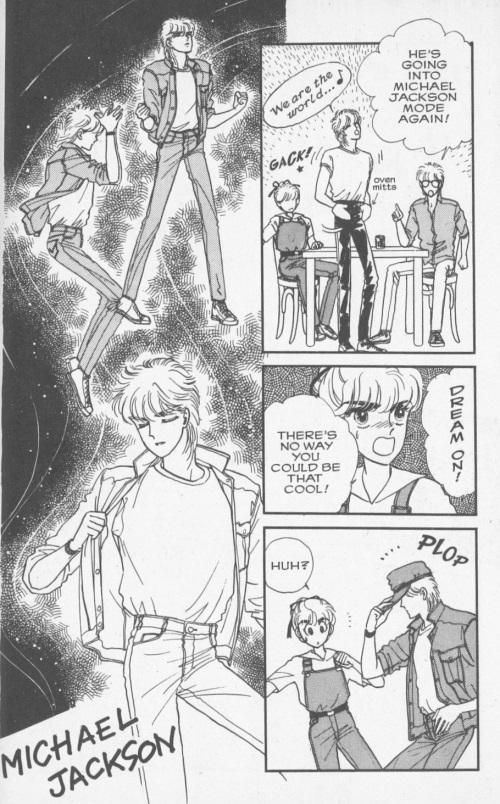
MICHELLE: I think there’s a general sense of affectionate amusement about most things coming out of ’80s culture, really. I love ’80s manga, personally, but yes, I did find it pretty funny when a dancing Cipher is deemed to be as cool as Michael Jackson, or when Narita-sensei professes in the comments, “The source of my strength, just like always, has been The Thompson Twins.”

Asako, you make a great point about Narita’s layered storytelling. I didn’t think of it like that—introducing us to the twins first through Anise’s eyes, then widening the story’s scope with a purposeful sequences of events. I really loved each brother’s relationship with his newfound friend. We learn that Roy felt that he behaved childishly in his past, and so perhaps he had tried to grow up too fast and hadn’t enjoyed some of the simpler pleasures that Hal makes it his mission to introduce him to. Jake felt he always had to be the reliable one—in fact, he wanted to be needed—but then he makes friends with Levine (aka Alex, Alexandra), who is sensitive but also resilient and tough.

resized14

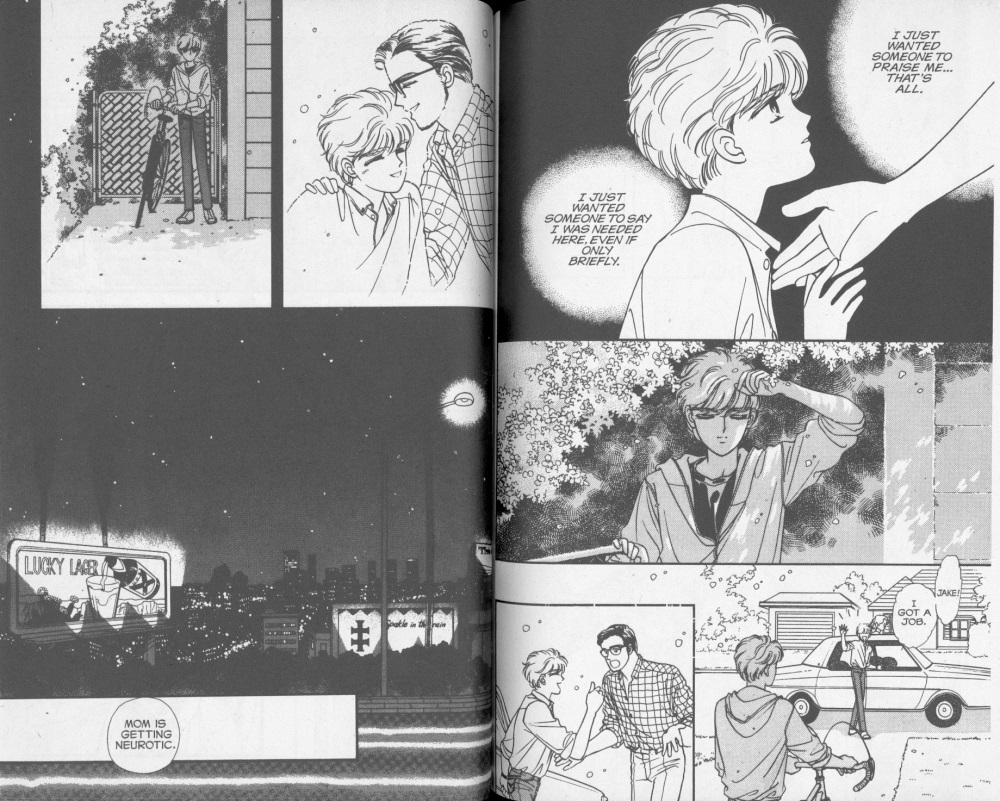
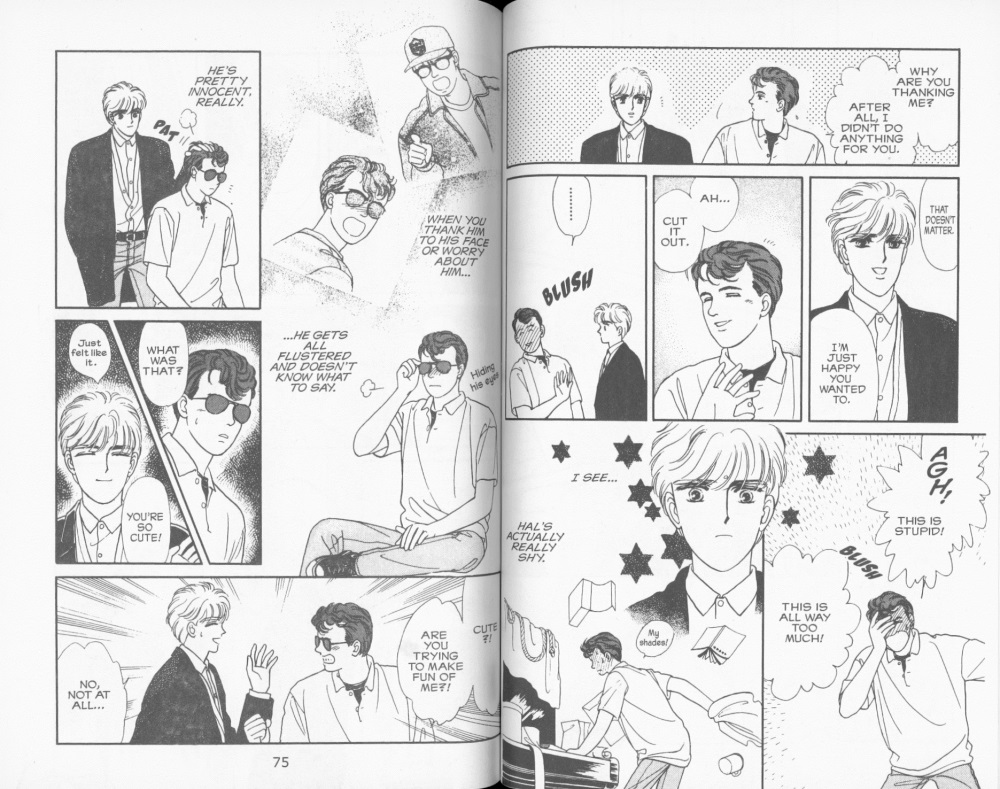
When Jake first meets Levine, he can’t bear to think of Roy and Dana at all, but gradually he allows himself to think about them, and then to talk about them. When one of Dana’s relatives has a baby and names it after her, Jake instantly adores the girl, and ends up breaking down a barrier with his mother for her sake. It all seems to happen very naturally. Too, I love that when everyone meets up again at the end, Hal and Levine are completely baffled that anyone could’ve ever mistaken one twin for the other.

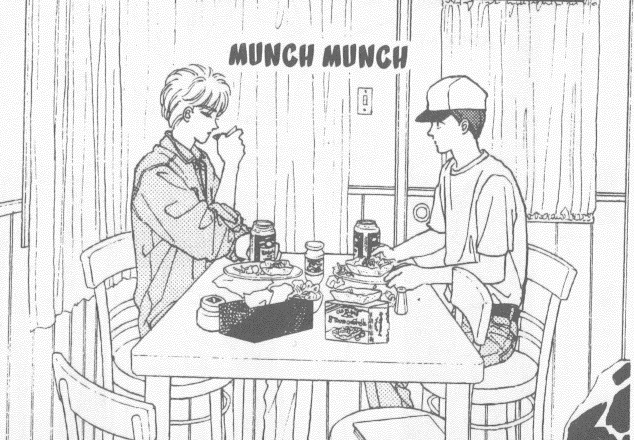
And I, too, appreciated the details that Narita-sensei got right. I was delighted to note that, in one scene, characters are eating an Old El Paso dinner kit of some sort.

resized12

ASAKO: In the first volume of the Tankobon edition, Narita-sensei talks about her trip to NYC, and she shares some pictures that she took during the trip. It sounds like she toured different neighborhoods to choose the neighborhood where twins and Anise should live. I thought it [was] funny but I was impressed at the same time that Narita-sensei even took pictures of TV commercials she watched in her hotel room. (Did you notice Cipher was watching a Betty Crocker’s new cake mix commercial?!) Very detailed artist.

Ah, thank you for explaining about the ’80s manga. To be honest, I have never thought of manga [as] “dated.” Well, in retrospect, I did notice different printing/layout techniques and art style. Maybe I am more comfortable with the ’80s manga because that’s what I grew up reading. Haha.

Back to Cipher, may I ask who is your favorite character(s) and why? I’m curious.

KAREN:That’s great to know some of the background of the creation! I think we’re all so spoiled with just being able to Google everything that people forget how hard it was to do research on such mundane topics—like cake commercials—in those days.

Asako, since you’ve had the advantage of seeing the Japanese versions, I had two questions—what is volume 12 of Cipher about? I’ve seen it listed on information sites and on Amazon.jp—is it side stories or does it add something? Also, have you read the Alexandrite sequel series—how is it in relation to Cipher?

My favorite character in Anise. She’s the entry to the world, and even when she’s in the background, she plays an important role. For all of the ways that she seems a little less mature, she shows such kindness and understanding, and that’s what breaks the shell around the twins. She can tell them apart at the end of the “challenge” but chooses not to—but she’s already opened up their world. I like her spirit, and watching her mature through the course of the series. It may not be as dramatic as what happens to Roy and Jake, but she becomes an important part to helping Jake discover his new life and gives Roy the space he needs until a reconciliation can happen.

I also like Hal—he’s so goofy at first but turns out to be so endearing.

resized13

MICHELLE: I really like Hal, too, but I’d have to say my favorite is Siva. I like his complexity in that he’s the reliable one who is secretly dependent upon being depended upon, and I like how experiencing love (for both Danas, the original and her namesake) frees him to become his own person and to begin to understand the pain of others.

ASAKO: To be honest with you, I don’t remember what was in the twelfth volume. As soon as the bunko edition came out, I gave my tanko edition to my best friend (here in the US). That was long, long time ago. I vaguely remember it was about Levine, but I am not entirely sure. I’m sorry!

Dealing with the difference between tanko edition and bunko edition was a challenge for CMX. We had to make the English edition of the original tanko edition off of the bunko edition—does that make sense?? (:D). The pagination and proportion differences required a lot of effort on our end, and what’s more, cover materials were provided in transparencies (positive films), so they had to be scanned, cleaned and color corrected before we could use on the covers. It happened many times for other CMX books, too, but some of the cover images were not available from the licensor, so we had to scan art books or whatever the resources we could find (and of course, with Licensor permission and extensive approval process) to come up with something.

KAREN: That’s great information, Asako—but I think CMX did a great job, the covers especially were very pretty. Other companies seemed to have problems reformatting the Hakusensha-style “box on the cover” design to something that works in the American market, but this was very well done. Speaking of artbooks, I’m going to have to chase down that out-of-print artbook that came out way back when.

Cipher is thankfully one of those titles that’s easy to collect—it’s all out-of-print, of course, but most volumes go for well below cover, and a couple of others are above cover but nothing crazy—it’s an easy one to collect, so that shouldn’t be a deterrent to hunting down and enjoying this title. Yeah, it’s set in the ’80s, but there’s so much more to it than that.

MICHELLE: We hope we’ve inspired you to check it out, and would also like to extend our very sincere thanks to Asako Suzuki for joining us for this conversation!

ASAKO: Thank you for having me! Looking forward to more CMX reviews in the future!

MICHELLE: You’re in luck, because Oyayubihime Infinity is up next!

Filed Under: FEATURES, The CMX Project Tagged With: cmx, Minako Narita

Manga the Week of 5/1

April 25, 2013 by Sean Gaffney, Michelle Smith and MJ 2 Comments

Tagame-cover-sketch-1SEAN: Given that most companies regard 5/1 as 4/31, it’s no surprise that there’s not a lot of stuff this week. Trust me, that giant pile of Viz will be waiting for you on 5/8. In the meantime, let’s turn our attention to other offerings.

It has to be said, the most anticipated book for this week is definitely not for the kids. That said, the buzz for The Passion of Gengoroh Tagame: The Master of ‘Bara’ Manga is really high. This is not cute BL with pretty androgynous boys manga. This is MANLY gay manga, with lots of MANLY bondage and discipline. In fact, it’s quite violent and filled with sadism, I hear. But if you want a taste of something different, and don’t mind explicit stories, Picturebox has the collection for you.

MICHELLE: Sometimes one can be glad something exists without really wanting to check it out for themselves. This is one of those times.

MJ: I might check this out, though my threshold for sadism is relatively low.

SEAN: Vertical’s lone print offering this week is Vol. 4 of the Stan Lee penned Heroman, which is a must for manga fans who also love Stan Lee.

twinspica1MICHELLE: I do have to wonder how many such fans exist.

MJ: I wish I could like this, just for Vertical’s sake. I really do. Does that count for anything?

SEAN: The big news from Vertical is digital, though, as three of their series are available on Kindle and Nook as of April 30th. 7 Billion Needles is gripping sci-fi horror, Drops of God is a wine lover’s dream, but the big news for me is the now out-of-print series Twin Spica getting its first two volumes out. Twin Spica is the brilliant and heartwarming epic about a girl who yearns to be in space, and it never did as well here as I’d hoped. Here’s hoping that a digital release will give it new fans!

MICHELLE: That’s a hope I can share!

MJ: Now, this is something to cheer about. It makes the whole week, really!

SEAN: So what’s your kink this week?

Filed Under: FEATURES, manga the week of

Pick of the Week: Pandora Hearts, Doubt, Negima!

April 22, 2013 by MJ, Michelle Smith and Sean Gaffney 2 Comments

potw-4-21MJ: The shipping list this week is formidable, and while I expect Tezuka’s Unico will get a lot of the manga blogosphere’s attention, there are also new volumes forthcoming of favorites like Bunny Drop and even an intriguing debut series, Doubt. But given my personal excitement over the latest volume of Jun Mochizuki’s epic fantasy series, Pandora Hearts, I’ve got to do the predictable thing and give that series another boost. I got a chance to read volume fifteen this weekend, and I have to say that it’s even more dramatic than I expected; Even as a consistent fan of the series, I’ll admit I’m blown away but several of the volume’s major revelations, and… yeah, wow. That’s all I can really say. Despite the fact that most of my favorite characters barely register in this volume, it’s got me firmly in its thrall. And I may have new favorite characters. This remains to be seen. Oh, Pandora Hearts, you intrigue me so!

MICHELLE: Gah, I don’t even know what my pick is this week. I’m a few volumes behind on Pandora Hearts and I’m feeling a little trepidatious about Bunny Drop these days. So I guess I’m going with Doubt, a series that I know virtually nothing about except that it involves a deadly survival game of some sort.

SEAN: Despite my many issues with its abrupt, inconclusive ending, my pick of the week is going to be the 38th and final volume of Negima!, mostly as I enjoyed the series for so long and it produced so many awesome characters to root for. A series that started as merely “Harem Potter” turned into a very emotional, action-oriented battle manga, even if it never quite abandoned what Kodansha wanted Akamatsu to write: more nude girls. I hope that someday he revisits it to answer a few of the questions the audience still has after this volume.

Readers, what looks good to you this week?

Filed Under: PICK OF THE WEEK Tagged With: doubt, negima!, pandora hearts

Off the Shelf: Angel Sanctuary, MMF Edition

April 21, 2013 by MJ and Michelle Smith 8 Comments

thumb-6169-AGS_01_webMICHELLE: Hey, MJ! When two angels meet, what do they say to each other?

MJ: Well, judging from the title we’re reading this week, something like, “Die, die, DIE!”?

MICHELLE: The punchline is technically “Halo!,” but I admit that your suggestion is much more appropriate!

I can’t remember whose turn it is to summarize, but I have a feeling you’ll do a great job with Angel Sanctuary, so want to give it a go?

MJ: I’ll do my best!

So, this month’s Manga Moveable Feast is dedicated to the works of Kaori Yuki, an artist whose work I’d had essentially no exposure to at all before the past few days. Though most of her existing work in English was published before I became a manga fan, Viz Media’s new practice of re-releasing older shoujo series in digital form has suddenly made one of them easily available. As Michelle has already indicated, that series is Angel Sanctuary, currently being released at VizManga.com.

Angel Sanctuary begins with the story of Setsuna Mudo, a scrappy high school student with a reputation for fighting, though his weakness as a fighter is that he falls asleep at the sight of blood. His other, greater weakness is that he harbors strong feelings of romantic love for his younger sister, Sara—feelings that she unfortunately returns in kind, which is a source of deep shame for them both.

As it turns out, Setsuna is actually the reincarnation of Alexiel, a powerful angel who long ago rebelled against the growing cruelty of the angelic realm, following the disappearance of God. Alexiel was ultimately defeated and sentenced to be reincarnated into misery, over and over again, but not before sealing away her twin brother, Rosiel, who had led the fight against her.

Though Alexiel has never retained memories from one reincarnation to the next, she’s been protected through all of them by a demon-like personage who makes agreements with humans to carry out their deepest wishes in return for taking control of their mortal bodies to keep himself in Alexiel’s company. In Setsuna’s lifetime, this demon lives in the body of Sakuya Kira, Setsuna’s oldest friend and protector.

(click images to enlarge)

IMG_0402

Meanwhile, Rosiel’s faithful seek to awaken him from exile by way of a video game called “Angel Sanctuary,” which sacrifices the lives of the humans who play it in order to gather the power required to return Rosiel to corporeal form. This quest is led by Katan, a former lower being who was elevated to angelic status by Rosiel back during the height of his power.

IMG_0399

MICHELLE: Nicely done! (Of course, the backstory doesn’t come out nearly as cleanly or clearly in the actual manga, but after a first volume that is, frankly, somewhat of a mess, the pacing for these revelations improves a good deal.)

After tainting himself by taking innocent human life, Katan is dismayed to find that Rosiel, whom he had hoped would end an ongoing power struggle in Heaven, is insane (and probably always has been) and obsessed with tormenting Setsuna to the point that Alexiel awakens, so that he might kill her.

IMG_0400

Meanwhile, Kurai and Arachne—two demon survivors formerly protected by Alexiel—also seek the awakening, but for different reasons. This is complicated when Kurai falls in love with Setsuna, since he would cease to exist if Alexiel were to return.

MJ: I’d actually like to return to your parenthetical point up there, because this is really a pretty big deal. After all, I think we both originally thought we’d simply stop after the first excruciating volume, and it was only duty that pushed me on further, at which point I discovered that the story really does get going at long last. Before that, Angel Sanctuary is, to use your words at the time, “quite the slog.”

Unfortunately, some fairly crucial revelations (in terms of making this story work at all) are withheld until the third volume—I’m thinking particularly of the truth about Alexiel’s painful reincarnations. Up until that point, Setsuna and Sara’s agonizing love story feels more like some kind of authorial fetish rather than a meaningful plot point, and given that this is one of the most important relationships in the series, I think this contributed greatly to the “slog” impression, at least on my part. Admittedly, I’m also vastly more interested in the relationships and general character development than I am in the series’ complicated angel mythology, so perhaps this affected me more strongly than it might others, but damn. A little explanation earlier on would have gone a long way towards compelling me forward with something approaching enthusiasm. As it is, I crawled my way to volume three with hands and knees increasingly bloodied. It was not pleasant.

MICHELLE: My experience was quite the same. I don’t have exact quotes to hand, but something about Yuki-sensei’s author-talk columns gave me the feeling that she was congratulating herself for her audaciousness for tackling the subject of incest, so that put me off somewhat. And I have almost no interest in angel power struggles at any time, so hard-to-decipher angel power struggles are even less compelling. This ties in with what I think is the chief flaw of Angel Sanctuary in the early chapters—information overload, before we’ve had time to get to know or care about these characters.

There’s a telling note at the end of volume two, actually, where Yuki-sensei writes:

When someone says, “If you take this part slowly, there’ll be more feeling.” I have to reply, “But this chapter needs to go up to this part of the storyline.” And so, I cut out some, but it’s not enough, so I end up taking out sappy dialogue.

I think she should’ve listened to those people a bit more! Not that I necessarily want more sappy dialogue, but taking things more slowly might’ve, for example, allowed readers to be able to see Sara as her own person—someone who turns out to be stronger and more interesting than I initially expected—before focusing on how she and Setsuna are in love with each other.

MJ: Yes, exactly. I was surprised to find that, by the end of the third volume, I was actually beginning to care about their relationship. And that in itself should be surprising, because it’s the kind of relationship I normally would find compelling from the start, if I cared about the characters in the slightest. It’s worth noting that amidst the recent spate of fanservice-laden, incest-themed moe titles we’ve been seeing, Satsuna and Sara’s plight reads as particularly poignant. It’s never played for laughs, it’s genuinely heartbreaking—it’s got classic romantic tragedy written all over it. It’s more Flowers in the Attic than I Don’t Like You At All, Big Brother!! and I’ll admit I ate that series up with a spoon when I was a teen.

(click images to enlarge)

IMG_0409

MICHELLE: And though it may be tragic, it’s not as if the characters are playing at a bit of drama. One of the first scenes that got me interested in Sara occurs early in volume two, when Rosiel’s flunky has distributed pictures that look as if Setsuna and Sara are kissing, and she’s been called in to the office at her school. The nun lectures, “Feelings of love between brother and sister belong only to silly, spoiled girls who have fantasies of being some tragic heroine.” Sara’s internal denials of this were what, for the first time, made me realize that she truly was equally serious in her love for Setsuna.

And thankfully, despite the shaky start, I did come to care about other relationships in the series, too. I have a great deal of sympathy for Katan, for example, who sacrificed much for Rosiel’s sake, only to be cast aside for not being obedient enough. And then there’s Kira, who was the one bright spot early on and who continues to be fascinating, as he at first denies that he could possess any affection for Setsuna the “mere human,” but eventually must acknowledge that the merger with his human host has rendered him capable of love.

MJ: I agree—both the relationships you mention here end up being very compelling, and I’d like to discuss them both, too. Let’s start with Katan and Rosiel, because it’s one that gets fleshed out a bit earlier than the others, I think. What I find most heartbreaking here are Katan’s realizations over the course of the first few volumes, because he really is so loyal. He sees Rosiel as a true savior, and is utterly devastated when he finally realizes that, with the exception of himself, Rosiel has acquired all his devoted followers by using some kind of magic capsule to turn them into mind-controlled puppets. I found it particularly interesting that it wasn’t just the discovery of Rosiel’s means that horrified Katan, but specifically that Rosiel resorted to this method when many of his puppets actually had been truly loyal to Rosiel before they were turned. The fact that Rosiel was unwilling to trust that he could lead by appealing to others’ free will seemed to be what really upset Katan.

IMG_0414

Then, of course, when Rosiel reveals that he’s not even willing to trust Katan‘s long-proven loyalty, it’s like a dagger to the heart.

MICHELLE: I genuinely loved that reveal about Rosiel’s army, both for the emotional impact on Katan but because it also sparked a tiny glimmer of interest in the angel power struggle. Katan’s dismissal made me wonder—and you’ve read farther than I have, so you might know the answer to this—whether he might eventually defect to the other side and help to defeat Rosiel.

MJ: You are *so* right. After endless pages of wordy exposition filled with names like “Raziel,” “Zaphikel,” and “Sandalphon,” and who’s who in the angelic hierarchy, having a little genuine intrigue and, for lack of a better word, humanity thrown in the mix was a lifesaver. I think this whole thing, including the realization that Rosiel has genuinely gone mad, also helps to make all the characters sympathetic in some way, which is a big deal for me, honestly. I’ve never really been interested in epic stories of good vs. evil (because I don’t really believe in the purity of either one), so the more Yuki grays things up, the better. I like things messy, in every way possible.

It’s this kind of nuance that really makes Kira’s story shine as well. We’re only just beginning to understand his true nature, but one thing that has become central to the story in volumes three and four is his own realization that he’s developed human attachments, and what that means for everyone involved. I was incredibly moved by scenes featuring Kira’s human father, who could not learn to hate his son, even after finding out that the Kira he’d raised from age eleven on wasn’t even his son at all. Some of this may come after the point you’ve read to, but oh, Michelle, it’s some of the best writing in the whole series so far.

IMG_0421

MICHELLE: I agree entirely about the scenes between Kira and his father, in which we learn that Kira has been behaving awfully in an attempt to cause this man to abandon his love for his son in preparation of a time when Kira no longer needs that body, and he ends up dying for real, this time. (All of which is at the request of the original Sakuya, with whom demon!Kira is seemingly able to hold conversations.)

Honestly, with supporting characters like Katan and Kira around, I pretty much don’t give a flying flip about Rosiel and Alexiel’s conflict and drama. Perhaps Yuki-sensei will be able to make me care about that, as she was eventually able to do with some other plot elements.

MJ: It’s true, the whole Rosiel vs. Alexiel story is the least interesting thing to me in this entire series, at least by the end of volume four. Which is not to say that I have no interest in them as characters, but despite the fact that they are holding on to this old rivalry so tightly, it’s really their relationships with the other characters that make them who they are in the present. I suppose this is the real tragedy that only the reader can see, and perhaps that’s even something Yuki-sensei is trying to show us—that if Rosiel, especially, could put aside the thirst for power that drove him mad in the first place, and actually recognize the real love and loyalty available to him, vengeance might lose its urgency. I suppose this really is just a lesson for Rosiel, as it seems clear that Alexiel actually prefers to be Setsuna than herself. An early scene that caught my attention is one between Alexiel and Kurai, in which Alexiel admits she’d like to be reborn as a man.

Actually, gender, and particularly unhappiness with one’s biological gender, is an ongoing theme in this series. And while there are some fairly problematic elements in Yuki’s discussion of the subject, there’s so much discussion that it’s difficult to dismiss it all as the usual heteronormative manga gender-bending. It’s difficult to smash the gender binary in English, because we’re so dependent on gender-specific pronouns, but at least one character refers to herself as a “third gender,” and Kurai, for example, manages to be much more nuanced than the typical “tom boy” characterization. So as weary as I get with the endless statements about women only needing to be beautiful and to be protected, there seems to be some deeper thought behind it all.

IMG_0420

MICHELLE: Oh, yes, I meant to bring up those statements. I thought it was interesting that most of the lines like “A girl needs to be protected; only then will she be beautiful and gentle” and “Find yourself a guy who’ll protect you” come from one character: Alexiel. That made them a little easier to stomach, like these are her opinions for some reason—she also implies that if she had a man’s love, she might never have conflicted with the other angels—and not necessarily the mangaka’s. True, Setsuna idealizes Sara and believes she must be protected, but then Yuki-sensei shows us that Sara’s not so weak or oblivious, after all. So, I wasn’t as irked by those comments as I otherwise might have been. (But, y’know, still a little irked.)

thumb-6433-AGS_4_webMJ: I’ll be interested to see where that line of thinking goes as the series continues. I’d like to think that these are beliefs that Yuki-sensei is interested in proving wrong, but it would be foolish to get my hopes up too high on that point.

As I flip through the first few volumes, looking for accompanying artwork, I realize that there are a whole host of characters we haven’t brought up at all, and I have to believe that this is mainly because, so far, they’re really just a part of the whole angelic political turmoil, in which neither of us has the slightest interest. I think it’s quite telling that the characters we have discussed are the ones who have become important in other ways.

MICHELLE: I feel like probably we should talk about Ruri, Sara’s friend, but I really don’t have much to say about her, since we see her as her actual self only briefly. Really, her fate just falls under the “Rosiel schemes to torment Setsuna” heading. And we haven’t even mentioned the super supreme angelic being everyone’s so in awe of, because he simply has no impact on the story as a character. He just appears once and, like, reattaches Setsuna’s arm. (Sidebar: there is a fair amount of arm reattachment in this series.)

MJ: I’d actually be interested in reconvening our discussion sometime after you’ve read volume four, because that’s when the “super supreme angelic being” (aka “Adam Kadamon”) finally becomes something truly significant in the story. The beginning of volume four offers up revelations on most of the topics we have discussed as well, including Kira and his father, Rosiel and Katan, and even Setsuna and Sara, whose story only becomes more poignant as Setsuna finds that he must force himself awake from a dreamworld in which he and Sara are a run-of-the-mill high school boyfriend and girlfriend (no familial ties at all), coexisting happily with all of their friends. Everything comes to a head in the beginning of volume four, leading to the beginning of a new arc just a chapter or so in that I’m hoping will finally make the story’s supernatural politics into something meaningful.

MICHELLE: For all its stumbling at the beginning, I think I’m invested in Angel Sanctuary enough to continue with it, so I am amenable to that suggestion!

MJ: I look forward to it!


Volumes 1-5 of Angel Sanctuary are currently available at VizManga.com. For more of the Kaori Yuki Manga Moveable Feast, keep your eyes on The Beautiful World!

Filed Under: OFF THE SHELF Tagged With: angel sanctuary, Kaori Yuki, Manga Moveable Feast, MMF

Manga the Week of 4/24

April 18, 2013 by Sean Gaffney, MJ and Michelle Smith 6 Comments

SEAN: It’s a healthy fourth week of the month here at Manga the Week of Central, with something for everyone. Let’s delve deeper.

Dark Horse gives us lucky Vol. 13 of Bride of the Water God, which is manwha, so I defer to those who know it better than I do.

MJ: This series is incredibly beautiful to look at. I’m behind a few volumes at this point, but it’s one of those I absolutely try to keep up with in print, just because it’s so pretty. It’s a keeper.

SEAN: There’s also Vol. 27 of Gantz, where bad things continue to happen to everyone, but at least they’re all in rubber lycra outfits.

MICHELLE: *snerk*

unico

SEAN: Unico has shipped to most of its Kickstarter backers by now, but it finally hits retail next week. I have a review out that gives a deeper opinion, but suffice to say it’s cute, sad, and a little bit weird, like the best of Tezuka. Also, although there are lots of Pink Lady refs, be assured there is no Jeff Altman.

MJ: Children’s manga is rarely my thing, but your description is pretty compelling.

MICHELLE: Yeah, “cute, sad, and a little bit weird” sounds like a winning combination to me.

SEAN: Kodansha seems to have indicated that sales for Bloody Monday are meh, so I suspect this may be the penultimate volume over here. It’s still filled with action, intrigue, and lots of dead folks.

MJ: I dropped this early on, not because it wasn’t interesting, but because it wasn’t interesting *enough* to earn my money, volume after volume. I guess it’s not just me.

MICHELLE: I bought a couple of volumes but then never read them. I like the creative team, but just never found the time.

SEAN: Fairy Tail is a quarter of the way to 100 now, as Vol. 25 continues the S-class battles, with Fairy Tail fighting itself to see who is strongest. I suspect a third-party will get involved and ruin everything, myself…

negima38

The last of Del Rey Manga’s four debut series reaches its end, albeit at Kodansha Comics. Negima hits Vol. 38, with an ending that, um, well, it’s certainly something people talk about! Aheh. I’ll have more to say in my review, but let’s just say: Fandom *hates* Where Are They Now? endings.

MICHELLE: Even though I’m not a Negima! fan, it’s still something of an achievement that it’s finally complete in English.

SEAN: And then there’s Yen. The latest Alice spinoff, My Fanatic Rabbit, ends with its second volume. I really liked the balance between romance and psychosis, and hope it stays even in Vol. 2, though I admit I’m not optimistic.

Another lucky 13, with Black Butler. Though given the sheer power of its cast, I don’t think they really need to worry about black cats. I understand this volume has some nice Sebastian revelations.

MJ: I wish I could like this series. I would really like to like it. But every time I try, it’s a complete failure.

MICHELLE: I’m planning to talk about this volume soon on Off the Shelf, so I look forward to hearing about your attempts. For me, this is a series I kind of like, or at least find easy to read, but have no intentions of rereading.

SEAN: Ah, Bunny Drop has hit Vol. 8. I think this means that the matter of “that spoiler” may now be discussed. And may I say I’m almost relieved? In any case, I’m sure it will be SAFE AND FUN.

MJ: I’m really looking forward to seeing how this plays out! I have a lot of faith in the mangaka.

MICHELLE: I’m a bit more dubious, but will certainly be finishing out the series.

doubt1

SEAN: A new series, in handy omnibus form! Yen has the first 2 volumes of Doubt, whose cover has everyone wearing bunny heads, but trust me, Bunny Drop this ain’t. It’s another survival game title, where you learn not to get too attached to anyone at all.

MJ: I suspect this may not be for me, but I fully intent to give it a try! These omnibus releases are great for that, because you get a really substantial go at it.

MICHELLE: Maybe it’ll turn out to be kinda fun, like BTOOOM!.

SEAN: Is This A Zombie? 4… yeah. Moving on.

Kieli has its 8th novel published. The story of a girl who can see ghosts, and her relationship with a man named Harvey. Who is not a 6-foot-tall pink rabbit, though it would fit with this week’s accidental theme.

The Melancholy of Haruhi Suzumiya 15 continues to adapt the 7th novel, and has steadily improved, though not to the point where I can say “you don’t have to read the book”. Because you do.

Pandora Hearts is also at 15, and I think I will yield to MJfor this one.

MJ: Oh, Sean… as you know, this series basically owns my soul. I’m expecting an enormous amount of drama in this volume, given where we left off. I’m expecting at least one heartbreaking loss. And I just can’t wait. Expect a flustered review of some kind to show up over the next week. I think this one’s gonna be a doozy.

MICHELLE: I’m a few volumes behind with Pandora Hearts. Clearly, I must rectify this.

SEAN: Lastly, there’s the 8th novel of Spice & Wolf, a title that always reminds me of Playboy Magazine, in that people always say they read it for the economics.

Getting anything interesting this week?

Filed Under: FEATURES, manga the week of

Pick of the Week: Pepita, Dorohedoro, Sidonia

April 15, 2013 by Michelle Smith, MJ, Sean Gaffney and Anna N 1 Comment

potw2MICHELLE: I’ll definitely be picking up a few things on this list, and am particularly eager for the second volume of Knights of Sidonia. However, it’s not often that two of my interests—architecture and Inoue Takehiko—come together, so I am going to have to vote for Pepita: Takehiko Inoue Meets Gaudi. Honestly, I have no idea what to expect from this book but I have no doubt that it’ll be gorgeous.

MJ: I’m with Michelle all the way, this week. I, too, am looking forward to volume two of Knights of Sidonia (and the latest volume of Flowers of Evil as well) but my most-anticipated release is Pepita: Takehiko Meets Gaudi. It promises to be beautiful and fascinating.

SEAN: I’m not as hyped up about it as Excel Saga, but that’s because I’m not as hyped up about anythng as I am about Excel Saga. But those who follow my reviews have likely guessed my pick this week is Vol. 9 of Dorohedoro. The plot really picked up last time, which can be a problem with a series as dense as this one is—it’s another title that rewards multiple re-readings. Will Caiman finally discover his past? And does he really want to?

ANNA: I also agree with Michelle and MJ. I’m interested in both Pepita and Knights of Sidonia, but I’ll probably wait a little bit to pick up Pepita. I’m going to be reading Knights of Sidonia much sooner, so that gets my pick.

Readers, what looks good to you this week?

Filed Under: PICK OF THE WEEK Tagged With: dorohedoro, knights of sidonia, pepita

Manga the Week of 4/17

April 11, 2013 by Sean Gaffney, Michelle Smith, MJ and Anna N 3 Comments

SEAN: After a relative deluge the last two weeks, it’s much quieter this week. So what have we got here?

I admit that I’ve never been able to get into Animal Land, the shonen series that Makoto Raiku started up when he left Shogakukan loudly and angrily and moved over to Kodansha. But then I was never into Zatch Bell either. That said, I know some people who really enjoy this series about humans, animals, and families. And it’s still going in Japan, so don’t expect Vol. 7 to be the last.

MICHELLE: I read volume one and wasn’t sure what to make of it. I liked some things, but the art was ugly and there was lots of pooping and in the end I could never convince myself to read a second volume.

SEAN: I had actually thought that Arisa ended with Volume 10, but it turns out that it has two more volumes after this. Presumably the manga has not finished its advanced course on psychological drama and twin switches. Not that I’m complaining, it’s good stuff, even if I’ve fallen way behind.

MICHELLE: I’m several volumes behind, too, but I’ve been really looking forward to catching up when volume ten comes out.

kanokon_vol1-2_full

SEAN: Drawn and Quarterly have said that despite Amazon saying their Kitaro collection is out next week, this is not the case – May is the date being given. But if you want yokai, only about 20 times more moe, why not try Seven Seas’ Kanokon omnibus? It features a busty fox girl yokai, and is also a classic harem with meek male lead. I suspect the crossover audience between D&Q’s yokai title and Seven Seas’ is zero, myself. But these series do pretty well for the publisher, as we found out in this interview.

Vertical gives us two of the hotter new series out there. Flowers of Evil hits Vol. 5, and people are certainly talking about it now that it has an anime adaptation! Hey, all publicity is good publicity. Plus it’s still a riveting psychodrama, no matter what the characters look like.

MJ: I’m not a big anime person, but I’ve been quite a fan of this manga series, so I’ll always look forward to more.

SEAN: There’s also Vol. 2 of Knights of Sidonia, which MJjust praised earlier today. I expect to see lots of space battles, lots of angst, and probably not a lot of humor. But hey, these sorts of series have surprised me before. Perhaps more bears?

MJ: Probably this goes without saying, given my post earlier, but YAY! I really can’t wait.

MICHELLE: I enjoyed volume one very much, and can’t wait for the second installment!

ANNA: I am looking forward to this as well!

SEAN: Speaking of series getting closer to their end, Bokurano: Ours must be running out of characters to kill off, as it only has 3 volumes to go after this. I admire the plot of the story and what the author is trying to say, but oh, so not for me.

MICHELLE: It *is* very depressing, but I still like Bokurano: Ours a lot. I think it’s the grim horribleness of the truth behind what’s happening that really hooks me.

SEAN: Dorohedoro, on the other hand, is not ending anytime soon, possibly to Viz’s chagrin. Still, I am pleased they’re still churning it out, as it remains my absolute favorite Ikki series, and it has the RIGHT kind of nihilism for me to get into (even if, yes, it also kills off a lot of its cast).

inouegaudi

And it’s not manga, but it’s probably the most anticipated release of the week. Pepita: Takehiko Inoue Meets Gaudi is, in Viz’s own words, “Half travel memoir, half art book, all beauty.” Given the love folks have for Vagabond/Slam Dunk/Real, and the love many manga and non-manga fans have for Antoni Gaudi, this has all the hallmarks of a seriously impressive book. I hope to be amazed.

MJ: This is definitely my most-anticipated release for this week. I’m thrilled about the existence of a book like this in English, and I can’t wait to read it!

MICHELLE: I love architecture and I love Takehiko Inoue, so I don’t know how I could fail to love this book.

ANNA: This and Knights of Sidonia are honestly the only things I’m excited about this week. I plan to check it out!

SEAN: What are you buying this week? Also, doesn’t “God’s Architect” sound like the title of a Stephen Chow movie?

Filed Under: FEATURES, manga the week of

Pick of the Week: Excel Saga & some other stuff

April 8, 2013 by Sean Gaffney, MJ, Michelle Smith and Anna N 5 Comments

potw-4-8-13SEAN: (flat stare)

MJ: There’s quite a bit on the menu for this week, but honestly not too much for me, which makes it incredibly easy to go for an older series that’s one of my new favorites. That, of course, would be Yun Kouga’s cat-ear-sporting, battle-filled, BL-tinged fantasy Loveless, currently running in Ichijinsha’s Comic Zero Sum and recently licensed-rescued by Viz. I’m a Kouga junkie of a sort, and Loveless delivers on everything I crave most from her series—idiosyncratic characters, complicated morality, and messy, messy relationships. My reaction to the release of a new omnibus volume is pretty much, “Gimme.”

MICHELLE: Yeah, not much for me on this list, either. Still, Punch Up! really has grown on me of late, so there’s no way I’d miss its fourth and final volume!

ANNA: Not a lot for me on this list. I’m going to go with Crimson Empire 1: Circumstances to Serve a Noble though, just because I decided not to resist the siren song of yet another Quinrose manga and I ordered it! We’ll see if I regret this pick once I actually read it.

Readers, what looks good to you this week?

Filed Under: PICK OF THE WEEK Tagged With: crimson empire, excel saga, loveless, punch up!

  • « Go to Previous Page
  • Page 1
  • Interim pages omitted …
  • Page 114
  • Page 115
  • Page 116
  • Page 117
  • Page 118
  • Interim pages omitted …
  • Page 182
  • Go to Next Page »
 | Log in
Copyright © 2010 Manga Bookshelf | Powered by WordPress & the Genesis Framework