• Skip to primary navigation
  • Skip to main content
  • Skip to primary sidebar
  • Home
  • About Us
    • Privacy Policy
    • Comment Policy
    • Disclosures & Disclaimers
  • Resources
    • Links, Essays & Articles
    • Fandomology!
    • CLAMP Directory
    • BlogRoll
  • Features & Columns
    • 3 Things Thursday
    • Adventures in the Key of Shoujo
    • Bit & Blips (game reviews)
    • BL BOOKRACK
    • Bookshelf Briefs
    • Bringing the Drama
    • Comic Conversion
    • Fanservice Friday
    • Going Digital
    • It Came From the Sinosphere
    • License This!
    • Magazine no Mori
    • My Week in Manga
    • OFF THE SHELF
    • Not By Manga Alone
    • PICK OF THE WEEK
    • Subtitles & Sensibility
    • Weekly Shonen Jump Recaps
  • Manga Moveable Feast
    • MMF Full Archive
    • Yun Kouga
    • CLAMP
    • Shojo Beat
    • Osamu Tezuka
    • Sailor Moon
    • Fruits Basket
    • Takehiko Inoue
    • Wild Adapter
    • One Piece
    • After School Nightmare
    • Karakuri Odette
    • Paradise Kiss
    • The Color Trilogy
    • To Terra…
    • Sexy Voice & Robo
  • Browse by Author
    • Sean Gaffney
    • Anna Neatrour
    • Michelle Smith
    • Katherine Dacey
    • MJ
    • Brigid Alverson
    • Travis Anderson
    • Phillip Anthony
    • Derek Bown
    • Jaci Dahlvang
    • Angela Eastman
    • Erica Friedman
    • Sara K.
    • Megan Purdy
    • Emily Snodgrass
    • Nancy Thistlethwaite
    • Eva Volin
    • David Welsh
  • MB Blogs
    • A Case Suitable For Treatment
    • Experiments in Manga
    • MangaBlog
    • The Manga Critic
    • Manga Report
    • Soliloquy in Blue
    • Manga Curmudgeon (archive)

Manga Bookshelf

Discussion, Resources, Roundtables, & Reviews

Archives for February 2019

Yona of the Dawn, Vol. 16

February 8, 2019 by Sean Gaffney

By Mizuho Kusanagi. Released in Japan as “Akatsuki no Yona” by Hakusensha, serialization ongoing in the magazine Hana to Yume. Released in North America by Viz Media. Translated by JN Productions, Adapted by Ysabet Reinhardt MacFarlane.

The actual resolution of the plot in this arc is treated as an afterthought, with Hyo, the villainous drug merchant, getting blithely killed off so that we may reach the real confrontation of the book. Because, having spent several chapters deliberately having Hak not meet Riri’s new bodyguard, when the moment arrives it takes pride of place above anything else that might be going on. It is truly an amazing setpiece, and shows off how good Kusanagi is at her craft. The rage that pours from Hak, his desire to kill Su-Won dripping off of him, is stunning to see. And you know that, at this point in time, it would be the absolute worst thing in the world for Hak to do that. Thank goodness for Jaeha, and later on Yona herself, for pointing out what’s important here: Yona is fine, she doesn’t need Hak to get revenge for her. Not like this. It’s only one chapter in this volume, but what a chapter.

I also definitely want to talk about the continued growth of Riri. Having stolen her father’s political seal as a means of showing that she has his power, she puts it to good use, getting the soldiers and merchants to unite to defend against Hyo’s fleet. What’s more, when events wrap up, she’s ready to take her punishment for what she did, even if that means being killed. That said, Riri’s political activism seems to have finally sunk in , as her father not only “punishes” her by exiling her to Sensui, where she can continue to do what she was planning to anyway. What’s more, he himself is now no longer content to be passive – which means that the tribes are now united in taking a more active role in the kingdom… even if that means war. All this from a young woman who was inspired by Yona (and is arguably in love with Yona, because their final scenes together really read like Riri wants to say something but chooses to hold back).

Riri is not the only woman in this volume who is awesome. Yona and Tetra are recovering from serious injuries, and are visibly exhausted, but are not letting that stop them from doing what needs to be done. Indeed, Tetra and Ayura have figured out Yona’s secret (such as it is), but are content to let her get on with what she needs to do. Heck, even the Sensui divers, who at first look to be introduced as a joke to show off “Jaeha is a player”, are swimming out towards enemy ships with bombs strapped to their heads. One of the best reasons to read Yona of the Dawn is that the cast is trying to effect change, and we see everyone who wants it step up and make that happen. It’s made explicit here with Riri’s father, but previous volumes also show that everyone Yona comes into contact to takes up her idealism… even if they’re cynics. It’s nothing to do with romance, though her own party does have guys who like her. It’s her sheer presence and drive.

I will end this review as I have many previous Yona reviews. This is possibly the best shoujo manga currently coming out in English. Everyone should be reading it.

Filed Under: REVIEWS, yona of the dawn

Off the Shelf: Still kicking

February 7, 2019 by Michelle Smith and MJ Leave a Comment

MICHELLE: MJ, after we finish this one we will have done as many columns in 2019 as we did for the entirety of 2015-2018! Go us!

MJ: *laughs weakly* Yes… “go us.” Um. Wow. When you put it that way, we sound terribly unimpressive.

MICHELLE: Well, the alternative would’ve been to let it disappear, so I think we deserve a bit of credit for resuscitating it! Anyhow, I expect that you’ve been reading some manga!

MJ: I suppose you’re right! WE ARE BASICALLY GODS.

…

Okay, maybe not. But yes, I have indeed been reading some manga, or at least rereading, which is to say that I took some time this week to look at the new omnibus edition of CLAMP’s four-volume manga, Wish, originally published in Kadokawa Shoten’s Mystery DX, adapted into English in the early 2000s by TOKYOPOP, and resurrected just a few weeks ago by Dark Horse Comics, with their usual omnibus treatment—larger trim size, very nice-looking print, and a somewhat refreshed translation.

For those who missed Wish the first time around, it’s the story of an angel, Kohaku, who has been sent to Earth to find Hisui, one of the four “Master Angels” (why they don’t just say “Archangel” is a mystery to me, but maybe there’s something I don’t get), who disappeared from Heaven after a visit to the bridge between Heaven and Hell. During their mission, Kohaku—who appears human-sized during the day but reverts to tiny cherub form at night—is rescued from an attacking crow by Shuichiro, a local human doctor. Complications ensue when it turns out that Hisui actually defected to Earth in order to be with Kokuyo, the actual son of Satan, with whom they have fallen in love. Meanwhile, Kohaku becomes confused by their own growing feelings for Shuichiro.

There’s a whole lot packed into this short series, including more angels and demons, time travel, reincarnation, messenger rabbits, cats (some of whom are actually demons), and a tree fairy, but generally speaking it’s all just incredibly CLAMP from start to finish, and if you’re into that, you know what I mean. Someone even sacrifices an eye. This thing honestly couldn’t get any CLAMPier. It’s not my favorite of their series—I could live very happily never reading another manga about angels for the rest of my life—but as most CLAMP fans will know, the big deal about this edition is the translation, which is certainly what caught my attention.

In CLAMP’s original vision, there is no gender in Heaven or Hell, but in early 2000s publishing, it was unthinkable to convey that in English, especially when it came to the angels, who, in Japanese, referred to themselves with genderless pronouns. This led to a decision to choose genders for each of the angels, based on heteronormative standards regarding appearance and romantic entanglement, outraging some fans but satisfying style guides. Fast forward to 2019, when publishing has finally recalled that singular “they” is a thing, and our angels are genderless at last.

I’ve already mentioned that Wish is far from my favorite of CLAMP’s work, so I wasn’t especially eager to reread it, but I was surprised to note just how much more enjoyment I got out of it this time around. As someone who identifies as nonbinary, I realize this may be of greater importance to me than most, but whatever CLAMP’s intention really was when they filled their comic with genderless angels, it feels like representation, and for something originally published in the 1990s, that is kind of a big deal. Freeing the angels from gender expectations breathed new life into them for me, made the story richer, and opened up its universe to the notion that love and attraction might be based on something other than a person’s gender expression or whatever reproductive organs they happen to possess. These are not novel ideas for many of us, but with all the hand-wringing over this series back in 2002, it feels revolutionary. Mostly, though, what I’m struck with as I read this edition, is how easy it would have been to publish it exactly as it is now, then. The sentences are not awkward. There is nothing that feels labored or unnatural in this translation. How has it actually taken publishing this long to figure that out?

MICHELLE: It’s been a long time since I read Wish, and it was also not my favorite, but I definitely feel a greater spark of interest when I imagine a translation that represents the angels as genderless! It makes me want to shake TOKYOPOP and demand, “Would that have been so hard?!?!” (They had other similar issues back in the day, too, and not just with genderless protagonists. I distinctly remember a character in GetBackers being assigned feminine pronouns when, in fact, he is very much a dude and if anyone had actually bothered to learn anything about the series they were translating, they would’ve known that. SIGH.) I can totally see how it would make the whole story richer as a result.

MJ: Yeah, nobody could be more surprised than I am to be describing Wish as “rich” in anything other than CLAMP’s beautiful, swirly artwork, but I genuinely enjoyed rereading it, and I’d even recommend it, at least to fans of shoujo manga, and particularly to other enbies. It’s an unusual treasure of representation for the time period. And messenger bunnies! Who doesn’t love messenger bunnies?

There is one jarring panel in the first volume, where one of the demons seems to misgender Kohaku as “she,” but I don’t know if that was an editorial oversight (that’s how it’s translated in TOKYOPOP’s version, too) or if it was actually written that way in Japanese. But in over 800 pages, that one panel wasn’t significant enough to mar my enjoyment overall.

So what did you read this week, Michelle?

MICHELLE: Maybe that demon was intentionally being a jerk.

I checked out the first volume of Hitorijime My Hero by Memeco Arii, one of the first boys’ love manga published in print by Kodansha Comics. (They did release a handful of others digitally in 2018.)

As a kid, Masahiro Setagawa hated tokusatsu shows because he knew that, no matter how miserable his life was, no hero would come to save him. But when he fell in with a group of delinquents in middle school and became their gofer, a hero did come in the form of Kousuke Ohshiba, the so-called “bear killer,” who defeated the thugs and ended up with Setagawa as his new underling. Setagawa befriended Ohshiba’s younger brother, Kensuke, and as the manga begins, some time has passed. He’s dealing with the fact that Kensuke is now in a relationship with another boy named Asaya Hasekura and that Kousuke is a teacher at their high school.

Almost immediately, Kousuke is confronting Setagawa about the feelings he believes Setagawa has for him, saying, “Even if you feel that way I won’t be able to return those feelings.” Setagawa is too dumbstruck to deny it, and then Kousuke (an adult) keeps sending him (a teenager) mixed signals, like suddenly smooching him or calling him “the guy I like.” It turns out that Kousuke is basically trying to make Setagawa realize he is gay. This eventually works. And then they do it. Eyeroll.

Because this series is a spinoff from an earlier series, we’re just kind of thrown into a confusing timeline and a mix of characters without a lot of context. I’ve seen the first couple of episodes of the anime, and they handle all of this material far more clearly. The manga does a little to show why Setagawa likes Kousuke—he’s strong, smart, and capable—but none at all to show why Kousuke likes Setagawa, aside from one page where he talks about how his devotion helped him retain his humanity or something. Really, it’s all pretty disappointing so far. I know it’s a popular series, so I’m hoping it gets better.

MJ: I can’t help but roll my eyes along with you. This basically sounds like a collection of my least favorite BL tropes, though maybe (hopefully??) at least without the younger, smaller guy wincing in pain and horror every time they have sex? Please tell me it at least doesn’t have that. Though maybe it doesn’t matter. I know the student/teacher thing is a common trope too, but I really hate it, especially when it’s the main romantic plot line. I know it’s a popular series, but I honestly can’t imagine reading it by choice.

MICHELLE: To its credit, it absolutely does not have that. It’s fully a fade-to-black scenario with some evidence afterwards that Setagawa enjoyed himself tremendously. As for the student-teacher thing, this is a slightly different variation in which the two people concerned knew each other for years before Setagawa came to the school where Kousuke teaches, so the power imbalance between them is not so much that Kousuke is in an official position of authority but that Setagawa has kind of idolized him.

MJ: Either way, I’m guessing it’s not for me. I’ll wait to hear what you think of future volumes before taking the risk.

MICHELLE: Okay. I can handle at least one more. Speaking of Kodansha’s advances into the realm of print BL, would you care to do the summary honors for our mutual read this time?

MJ: Sure!

This week, we both read the first volume of the much-anticipated series 10 Dance, by Inouesatoh, also from Kodansha Comics, as Michelle mentioned above.
The story involves two ballroom dancers with similar names—Shinya Sugiki, who is an international champion in Standard Ballroom, and Shinya Suzuki, who is the Japanese national champion in Latin Dance. Their relationship with each other is both admiring and rivalrous, and when Sugiki asks Suzuki and his partner to train with with him (and his partner) for the 10-Dance Competition (combining the 5 Standard and 5 Latin dances), Suzuki finds it impossible to refuse.

Over the course of the first volume, the four dancers train together—the men in particular working to be able to lead in each other’s specialty—and that’s literally all that happens in the story, but as we watch the two of them butt heads (and other things) throughout the training, it’s honestly just riveting. This story is all about personality and relationships, and certainly we’re expecting some steamy romance between the two male leads down the line, but even in this preliminary volume, where nothing overtly romantic happens, there’s so much interpersonal entanglement to enjoy.

The two men couldn’t be more different. Suzuki, who grew up in Cuba, has been dancing with his partner since childhood, while Sugiki changes partners constantly, never quite settling in with anyone. Suzuki’s strength is showing passion on the floor, while Sugiki’s is the elegance of his form. And though things are slowly heating up a bit, I honestly believe I would be happy just watching them dance together as I learn new details about Standard and Latin ballroom rules, pretty much forever. It’s that entertaining.

MICHELLE: I enjoyed it tremendously! From the start, the cover art reminded me of est em, and the content within does, too. With est em, I was always struck by the way her characters would talk while engaged in intimate acts, and although Sugiki and Suzuki aren’t having sex, they’re still engaged in physical activity—indeed, they’ve been dancing until dawn together for months—that puts them in close proximity, gettin’ sweaty, maintaining eye contact, et cetera. And they’re talking throughout, gradually becoming closer and revealing details about their personal lives in the process. I love the slow development of their relationship and how this, in turn, makes small moments so pivotal. The one that stands out is when Sugiki has gone to London to defend a championship title. When he succeeds, it’s Suzuki that he calls, and when this reserved man actually smiles when being told “Hurry up and come home,” it has such impact! Of course, they go right back to butting heads after that.

MJ: I agree on est em, though I’d go even further and say it feels like an est em/Fumi Yoshinaga hybrid, with the additional warmth of their observations about each other’s habits and idiosyncrasies and the scene where they dance together at a restaurant, because trying to make points about dance while sitting at the table just isn’t working. It’s got all of est em’s sexiness and suave, along with Yoshinaga’s warm goofiness, and the underlying elegance of both.

MICHELLE: “Warm goofiness” is a great way to describe the scene where Sugiki, frustrated by Suzuki’s attempts to lead the waltz, gets Suzuki to adopt the woman’s role and proceeds to very thoroughly make him feel like a princess. “I feel like I could pop out a dozen babies for you right now!” And you’re absolutely right about elegance, too; these dance scenes are drawn so beautifully.

If you’ll forgive somewhat of a non-sequitur, although I don’t know the kanji used for Sugiki and Suzuki’s given names (and, indeed, it might not even be the same), one definition for “shinya” has a meaning that’s very applicable to the story. Check it out.

MJ: I believe I read somewhere that the kanji for each of their names is slightly different from the other, but I’m tickled by that meaning all the same. It certainly is appropriate!

Bottom line, I can’t wait to read more of this series, and I’m thrilled that Kodansha brought it over for us!

MICHELLE: I enthusiastically concur!


Thanks for joining us for another installment of Off the Shelf! The winner of last column’s giveaway is Joseph Miller! Joseph, send over an email or drop a message to MJ on Twitter to collect!

Filed Under: OFF THE SHELF

Toradora!, Vol. 4

February 7, 2019 by Sean Gaffney

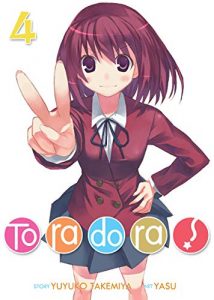
By Yuyuko Takemiya and Yasu. Released in Japan by Dengeki Bunko. Released in North America by Seven Seas. Translated by Jan Cash & Vincent Castaneda. Adapted by Will Holcomb.

This fourth volume of Toradora! does a very good job of playing to the series’ strengths. The core of it is getting the five main characters to become closer and bond as friends, and it achieves that. That said, there is also the romantic comedy/drama part of it, and that’s even better. It was always going to be hard for a series where the winning pairing is literally in the name to try to have “who will they end up with?”, but this volume comes closer than any so far. Ryuuji is still crippled by his awkwardness around Minori, but when he tries to can actually have a really meaningful conversation with her where she opens up (obliquely) about her own insecurities. As for Ami, not only does Ryuuji force her to open up a bit more (a very little bit more) about her own insecurities, but she also flat out states she thinks Minori and him would be a bad match, and that he should hook up with her. As for Taiga? Well, there’s the puppy dream.

The puppy dream is great. Starting off as ridiculous, with both Taiga and Ryuuji completely disgusted by it, the reader is immediately thinking “they’re sharing dreams now!”. By the end of the book, Ryuuji is seeing how the dream could also be taken as really sweet and familial. That said, for the most part the Taiga/Ryuuji antics take a backseat here… or at least the boil settles down to a mild simmer, as there are no shortage of scenes showing them being each other’s perfect halves. Taiga fares far less well in the romance department here, partly as she’s still cripplingly shy and partly as Kitamura is even more Kitamura than usual, complete with accidental flashing. I do sort of wonder how clued in he is to everything going on around him – like Minori, he thinks that Ryuugi and Taiga are meant to be a couple, if not already, but it’s not clear that he’s realized Taiga’s feelings.

That said, this is Minori’s book in the end, as she shows off a fragile vulnerability here, and there’s the first signs that she may feel something for Ryuuji as well. Unfortunately, both are the sort to back off at the last minute – as Ami bluntly points out, they can’t get close to each other. But we also have lots of Minori acting goofy, and of course the giant “let’s try to scare Minori” horror movie plotline, which gives us the opportunity for some great laughs. Toradora! holds up over a lot of other comedy romances in that the comedy does not feel forced or cliched, a la “whoops I just fell into your boobs”. The humor is natural, realistic, and both situational and character-driven. But it’s the drama that readers may take away from this volume. Will things change when they go back to school? Will Ami press her suit/ Will Minori do anything? Will Taiga yell at Ryuuji? At least one of those things is guaranteed to happen!

Filed Under: REVIEWS, toradora!

Arifureta Zero, Vol. 2

February 5, 2019 by Sean Gaffney

By Ryo Shirakome and Takaya-ki. Released in Japan as “Arifureta Shokugyou de Sekai Saikyou Rei” by Overlap. Released in North America digitally by J-Novel Club. Translated by Ningen.

In my review of the first book in this prequel series, I said that it was Miledi’s book and Miledi’s series. Here I’ll go further: I think that Miledi is meant to compare directly with Hajime. Yes, in terms of personality, she reads more like a horrible fusion of Shea and Tio, but as we see a lot in this book, even more than the last one, she is wedded to her ideals and prepared to do anything in her power to preserve them, even if that means taking on the Church, a bunch of pirates, or even a giant seas monster with her ungodly gravity powers. (Ungodly would suit her fine, I think). As for Oscar, he has Hajime’s snark down pat, but after this book we really know who he’s meant to be. He’s Shinpachi from the Gintama series. No, really, the author even straight up ripped off the glasses joke. Oh yes, and we get a new Liberator as well. That’s her on the cover.

The author suggests that the seemingly sweet big sister type who’s really a sadistic tease is a surprise for this book, something which… isn’t true, but whatever. Meiru is a lot of fun, though, and is not only a big sister to her captured real sibling, but also to a huge pirate family that she heads up. Yes, it’s Arifureta does One Piece. Miledi and company are arriving at the city the pirates work out of to find the next Liberator, and after a host of misunderstandings that eventually get resolved, find she… doesn’t want to join them. Well, that’s fine, we went through this in the first book. Till then, there’s sea monsters that get attracted to Miledi’s magic, and casino capers, etc. Of course, eventually the Church is ordered to destroy these pirates once and for all, which leads to the last half of the book, which is one giant melee battle that is highly entertaining provided you love 120-130 pages of fights.

Honestly, I’m surprised there isn’t a much higher body count in this prequel. We already know it’s going to end badly, and it always seems like there’s going to be some dead innocents, but so far the author has done a pretty good job of having them saved at the last minute. (There are a couple of Oscar’s orphan kids who are in a coma from the last book, but Meiru may be able to save them too). In fact, despite the grim Church and the ever-present threat of death, this is a fun book – I would say of all the Arifureta books, this one balances the wacky humor and the thrilling serious plot the best. Miledi is annoying as hell, but not to the reader, just to the characters – an important development! Even the art is really good, showing off both the silly and dramatic (the picture of Miledi giving the finger to the villain may be my favorite).

This is a long book, like most of the Arifureta series, but for fans, it’s a must read. Even casual readers who are turned off by Hajime being Hajime in the main series may want to give the prequel a shot.

Filed Under: arifureta, REVIEWS

Bookshelf Briefs 2/4/19

February 4, 2019 by Ash Brown, Sean Gaffney and Michelle Smith 1 Comment

DIVE!!, Vol. 1 | By Eto Mori and Ruzuru Akashiba | Yen Press – Tomoki Sakai has loved diving since the second grade, when he was awed by the diving of another boy named Youichi Fujitani. Now, six years later, he and Youichi are both members of Mizuki Diving Club, which is in trouble as the new president of the sporting goods company that sponsors it is considering shutting it down. Enter their new coach, Kayoko Asaki, who hopes to keep the MDC open by sending one of its members to the Olympics. To this end, she starts training Tomoki hard since his natural flexibility gives him an advantage. So too does his work ethic, but this does little to soothe the wounded pride of his long-time teammates Ryou and Reiji, who think the coach is playing favorites and refuse to acknowledge that they’re slacking off in comparison to Tomoki. There’s not much else to say about DIVE!! at this point, but I’m intrigued. – Michelle Smith

I Want to Eat Your Pancreas: The Complete Manga Collection | By Yoru Sumino and Idumi Kirihara | Seven Seas – Out of all of the versions of I Want to Eat Your Pancreas, including Yoru Sumino’s original novel and its various film adaptations, it was the manga series that provided my introduction to the story. A touching friendship develops between two high school students—Sakura, who has a terminal illness she is hiding from everyone but her family, and an extremely introverted classmate who discovers her secret. The end of the story is known from the beginning, but I Want to Eat Your Pancreas takes a startling turn to get there. Even though it’s foreshadowed, initially it feels a little unfair, but that’s exactly the point and the characters have to come to terms with it, too. So far I’m unfamiliar with the other incarnations of I Want to Eat Your Pancreas and therefore can’t offer a comparison, but the manga adaptation is a pretty solid work on its own. – Ash Brown

I Want to Eat Your Pancreas: The Complete Manga Collection | By Yoru Sumino and Idumi Kirihara | Seven Seas – Shiga Haruki is an introverted kid who claims to have no interest in other people. Odd, then, that for the majority of the series he substitutes his own name with whatever he assumes other people are thinking about him. His outgoing classmate Yamauchi Sakura is intrigued, and when she comes upon Shiga reading the diary in which she has written about her terminal illness, she seizes the chance to get to know him. Gradually, she draws him out of his shell, and it’s really gratifying to see him start to display passionate emotion when he senses that her diagnosis has gotten worse. Knowing her changed him for the better. My one complaint is that, after a pretty random plot twist, the story just speeds along to the end. I might have to check out the original novel to see if the pace is any more leisurely. Definitely recommended. – Michelle Smith

Manga Plus | By Various Artists | Shueisha – I’ve never reviewed an app here before, but this is a biggie. Shueisha how has all of Shonen Jump out Sunday afternoon—yes, including the tiny “unlicensed” series—as well as selected Jump Plus and Square titles, such as Blue Exorcist. This is day/date with Japan (it really is—don’t make me explain it again). It allows you to see obscure series you’d never expect over here, like theatre nerd series Curtains Up, I’m Off. And you can see the latest popular Jump chapters too, and marvel at how freaking awesome (and strong!) Uraraka was in the latest Academia, or the snugglepiles in the new Neverland. This is basically the app all of us have been waiting for, and it’s free! Go read it now. – Sean Gaffney

Murcielago, Vol. 9 | By Yoshimurakana | Yen Press – The first third of this volume wraps up the previous arc, and does it pretty well. It also gives us even more hints that Hinako is some sort of experimental child a la A Certain Magical Index‘s darker volumes. The majority of the book, though, is much lighter in tone, with Kuroko and Chiyo’s relationship resolved much faster than I expected (Chiyo admits she sort of likes Kuroko when she’s being… well, Kuroko), and also a beach episode that then segues into giant robots that destroy the apartment complex! It’s very silly and filled with large-breasted women acting cool, which is two of the things that people read Murcielago for, and has a an over the top lesbian sex scene with Kuroko and Chiyo, which is another. Fun. – Sean Gaffney

Now Loading…! | By Mikan Uji | Seven Seas – This is a new yuri series from Seven Seas, and given it’s also the final volume you know not to expect too much. It’s cute. It’s basically New Game if they actually went in that direction explicitly. We see a game company with a bright-eyed newbie and a game designer with a tragic past… well, OK, it’s not tragic, it’s just “reality happens, this is Gametown.” Sakurazuki ends up kissing Takagi at the end of the first chapter, and the rest of the book shows how they slowly talk about how and why that happened and maneuver their way into being a couple. There’s also a beta couple of two other employees, which is cute. This will make you smile, but you’ll likely forget what happens in a day. – Sean Gaffney

Spirit Circle, Vol. 6 | By Satoshi Mizukami | Seven Seas – This final volume wraps up the Fortuna life, which is as terrible as possible, and then heads back to the present, where unfortunately Fortuna has hijacked Fuuta’s body. Things are not looking good for this not ending in death. But then a tragic prediction ends up going horribly… not tragic at all, and the day is saved by a butterfly net that the alien couple gave our heroes, which is a sentence that only makes sense if you’ve read this series. Kouko theoretically gives Fuuta a final kiss and then leaves him to Nono, but let’s face it, given those last wishes from Rune and East, we know what’s really going to happen. This was an awesome series, just the right length—just like the author’s prior series, in fact. – Sean Gaffney

The Voynich Hotel, Vol. 3 | By Douman Seiman | Seven Seas – The series continues to veer between terribly silly, terribly dark, and somewhat nauseating. There’s a sense of everything coming to a head here, and that’s the case, but honestly I was struck by how many more people survived than I was expecting. This is probably as close to a happy ending as The Voynich Hotel was going to get, and there’s potential in both the adventures of the now adult detective gang as well as Elena (who I keep thinking of as Maria because she looks just like Maria in Zetsubou-sensei) and Tarou ending up as a couple and opening up to one another. Not for the faint of heart, but if you like weird and heartwarming, this is a good series to check out. – Sean Gaffney

Yuri Is My Job!, Vol. 1 | By miman | Kodansha Comics – I’m very happy that Kodansha has begun licensing yuri titles (or, yuri-adjacent, at least), but I really wish they’d started with anything other than this. Hime Shiraki is a cute first-year high school student who has cultivated an angelic façade in order to snag a billionaire husband. But aside from her looks, she has nothing going for her, so when she’s manipulated into helping out at a café where the waitresses pretend to be prim and proper ladies from an all-girls private school, she proves largely incompetent. What’s worse (and supremely frustrating) is that she fails to comprehend that anyone other than her might be putting on an act, so when a coworker speaks harshly to her in private but gently in front of customers, she is utterly baffled. Honestly, it’s just bad. I liked no one and it was a chore to make it through a single volume. – Michelle Smith

Filed Under: Bookshelf Briefs

Pick of the Week: Shoujo, Kino, Boogiepop and Mari

February 4, 2019 by Sean Gaffney, Michelle Smith, Ash Brown, Katherine Dacey, MJ and Anna N Leave a Comment

SEAN: There’s a ton coming out that I’m interested in. Light Novel-wise, we have the 2nd Bakarina and the debut of Classroom of the Elite. And there’s the new Kino’s Journey manga. But yeah, there’s also a ridiculous amount of Viz. Including Oresama Teacher, which I still love to bits. It’s my pick.

MICHELLE: There are lots and lots of shoujo releases that I’ll be eagerly devouring, but since volume seventeen of My Hero Academia will mark the first time I’m all caught up on the series, I’m going with that!

ASH: It’s not manga, but I’m very excited for the chance to finally read the fourth and fifth Boogiepop novels, so the second omnibus in the series is my pick this week!

KATE: Yikes–that’s a lot of good stuff arriving in stores next week! If I had to single out one title for praise, it would be Inside Mari, a body-swapping story that takes the idea of waking up in someone else’s body seriously, rather than a set-up for tacky jokes about anatomy and clothing. The first volume was honest to the point of squirm-inducing, but it was also compulsively readable — just like Shuzo Oshimi’s other work (The Flowers of Evil, Happiness, The Drifting Net Cafe.)

MJ: I am a huge fan of the anime adaptation of Kino’s Journey and was devastated about the cancellation of the novel series way back when, so that has to be my pick this week. I don’t always love manga adaptations, but in this case, I can’t feel anything but excitement and so much hope. Maybe too much hope. Time will tell.

ANNA: I have to go for the shoujo, but I can’t choose between Ao Haru Ride and Shortcake Cake because they are both so good! They are my picks of the week!

Filed Under: PICK OF THE WEEK

For the Kid I Saw in My Dreams, Vol. 1

February 4, 2019 by Sean Gaffney

By Kei Sanbe. Released in Japan as “Yume de Mita Ano Ko no Tame ni” by Kadokawa Shoten, serialization ongoing in the magazine Young Ace. Released in North America by Yen Press. Translated by Sheldon Drzka.

This author has previously written the mystery thriller Erased, a series which I could see was very well done and I could also see was probably not for me. This feels like the same sort of thing – even without a hardcover-style release to make it fancier, this manga just seems “important” as you read it. The art is compelling, the characters are, if not likeable, at least someone you want to follow. Senri is our “hero”, a young man who in his childhood had his parents brutally murdered. He also had an older twin, who hid him from this (in fact, the father was abusive, and the twin was hiding him from the abuse – the murder was incidental). Senri always had a connection with his twin, in a “psychic powers” sort of way, but shortly after this he gets a vision of his brother being killed, and that’s it for psychic connections. So how does he grow up? Consumed with vengeance, of course.

There’s a common trope in manga where you see the hero, supposedly a bad guy, who beats up other, scummier villains to show off that he’s really good deep down. The manga fakes us out by making it seem that grown up Senri is the same… but no, he’s actually in league with the bullies, and is extorting money. I mean, he needs SOMETHING else to do beyond trying to track down his parents’ and brother’s killer. (They may not, in fact, be the same killer, but I’m guessing.) He runs on suppressed rage, and is fascinating to read but also somewhat exhausting. He also seems to have little regard for human life, unsurprisingly, and there are a couple points in the book where he’s driven to almost murder in his efforts to find out what happened back then. He also gets beat up a lot. He’s a very grim protagonists, in all senses of the word.

Fortunately, we also have Enan, the saving grace in this book. She’s Senri’s childhood friend, as they were in the same orphanage after his parents were murdered. She’s from a tragic home as well, as her dad was a murderer and her mother killed herself because of the harassment – which she gets as well, because we all know that children are their parents. Senri does not believe this, and says so, possibly the one nice thing he does in the entire book. As a result, Enan is his best (and it seems only) friend, and yeah, probably likes him romantically, though that doesn’t really come up. She’s there to prevent him from turning evil, and has a ways to go, frankly. I liked her a lot. Usually these sorts of characters are fresh-faced innocent types, but Enan is a jaded “gal” sort, though she’s good with kids in her daycare job. I hope nothing horrible happens to her.

As I said, this may not be the sort of title I want to keep reading. But it’s good, and I am interested in seeing what happens next, assuming Senri doesn’t die from the skull fracture he seems to get at the end of the volume and the rest of the series is just light music played over blank pages. Fans of dark thrillers will absolutely want to check it out.

Filed Under: for the kid i saw in my dreams, REVIEWS

Log Horizon: Krusty, Tycoon Lord

February 3, 2019 by Sean Gaffney

By Mamare Touno and Kazuhiro Hara. Released in Japan by Enterbrain. Released in North America by Yen On. Translated by Taylor Engel.

It’s been a long time since the last volume of Log Horizon – almost a year. It may be even longer till the next volume as well, as there’s no sign of it in Japan. That said, this is a big volume for fans of the series, as it’s the first volume that has not actually been animated. As such, it will prove to be entirely new material. Appropriately, it focuses to a large degree on Kanami’s party, who were the subject of the 9th book (which was adapted the least by the anime), and have now reached the equivalent of Mongolia. But as you may have guessed by the title, the other major participant in this volume is Krusty, who is having memory issues but is not letting that stop him from living the easy life, as he’s essentially in the game equivalent of heaven being waited on by cute animal person servants. The book’s main thrust has a scheming villainess try to pit the two parties against each other.

The book mostly succeeds, but it is worth noting, once again, that there is a truly ridiculous amount of gaming chatter and discussion in these volumes, and that it can quickly get tedious, especially when you’re in the middle of a large battle. Classes, levels, aggro… I don’t really care. But someone cares, and that someone is Elias, who we get to know a lot more about in this book. From the last book, we know that he labors under a curse that means he never gets the last hit in – he can’t be the one to kill the monsters. Of course, since Log Horizon was a game, and he was one of the bigger NPCs, it makes sense. The players make the big kill. But here we see how this weighs heavily on him, and also how his party seems to have been broken, and possibly killed, simply by hinting at their very nature – Elias, throughout the book, seems to be shying away from thinking that he’s just an NPC in a game.

So it’s pretty easy to get him to go all out against Krusty, who’s perfectly happy to have people think he’s a villain if it gets him a good fight. We get a lot of Krusty’s own background from Earth here too, and it fits with his personality to a T. Krusty really can’t stop Elias, especially given he’s dealing with his own curse. Kanami is there to be Haruhi Suzumiya and not much else. I like her, but she’s completely at peace with everything about herself, so is terrible at this sort of thing. And Coppelia is still pretty much monotone. That leaves Leonardo, still a frog and not a turtle, to deliver the big verbal cooldown speech to Elias. I won’t spoil it, as it’s easily the best part of the book, and made me smile quite a bit. When Log Horizon isn’t pouring verbiage into its worldbuilding, it can be pretty heartwarming.

We’re almost entirely in ‘the China server’ this volume, with only one chapter back in Akiba to show us that Raynesia’s noble friends are all getting engaged, which I suspect means that an arranged marriage is in her future. Her noble friends also think she’s in a relationship with Krusty, which she’s not. In the next volume, whenever that may be, I suspect we’ll be headed back to Shiroe and company. Till then, enjoy this look at what it means to be “cursed”, and how to resolve it.

Filed Under: log horizon, REVIEWS

Outbreak Company, Vol. 7

February 1, 2019 by Sean Gaffney

By Ichiro Sakaki and Yuugen. Released in Japan by Kodansha. Released in North America by J-Novel Club. Translated by Kevin Steinbach.

For the most part, I tend to wait at least a day before writing a review of something. Reflection can be a good thing, and so sometimes my opinions on Twitter – which are as I read – don’t match up with what’s here. And, let’s face it, this volume had an uphill battle to win my affection in the first place. I enjoy Outbreak Company a great deal, but not for the fanservice. Thus when you have a volume that, in one way or another, doubles down on such things, you’re going to be losing me. That said, it is not without interest. If you can ignore the fact that the entire first story seems to revolve around Minori’s tits, it’s actually a lot of fun, and there is some actual suspense in there briefly – that turns out to be undercut. It’s Outbreak Company’s excuse to do a beach episode with swimsuits, something it admits within the text, and as such is fine. The other two stories were a bit more problematic with me.

The second story should have easily been my favorite, as it’s an emotional character-driven piece. It’s also from the POV of Myusel, which makes for a great change. We’ve known since the first book that she’s half-elf, but the subject of her parents has never come up. Now, all of a sudden, due to changes in the family, her mother has arrived (she’s the elf) and wants Myusel to leave the mansion and come live with her. Myusel, we know, really does not want to do this at all, but runs up against everyone seemingly thinking it’s a done deal and accepting that it has to happen. And if Minori and Shinichi are already arranging for her replacement, how can she say no? I was struck by how obtuse everyone was being in this part. Frankly, as a reader, Myusel’s depression could not be more obvious if she’d tried, and the fact that the characters all assume she’s fine with it really bothered me. Do they really know her all that well? This was well-written but the characterization just felt… off.

The third story was apparently written with the help of one of the author’s female assistants, who is a fujoshi. He clearly said to her “I want a story where Minori is going through BL withdrawal, make it as exaggerated as possible.” And boy howdy, that’s what happened. Again, the issue I have is with the characterization. I’m fine with Minori being like this. Though the constant chants of “homo, homo” are perhaps a bit… insensitive, shall we say, they certainly fit with a certain type of fujoshi. I was more annoyed with this essentially turning into a fujoshi zombie movie, with Minori infecting everyone else in the story (even Myusel, though she holds out at first, for reasons that everyone but Shinichi understand) so that the entire cast are suddenly mindless BL maniacs. Yes, that’s the exaggeration, but it didn’t sit well with me. That said, if you enjoy over the top comedy, this may be your favorite segment. It’s certainly that. And OK, the “Vitamin BL” gag was very funny.

This was certainly a volume of short stories. There were some interesting parts, but I am hoping that next time around we get back to the main plot.

Filed Under: outbreak company, REVIEWS

  • « Go to Previous Page
  • Page 1
  • Page 2
  • Page 3
 | Log in
Copyright © 2010 Manga Bookshelf | Powered by WordPress & the Genesis Framework