• Skip to primary navigation
  • Skip to main content
  • Skip to primary sidebar
  • Home
  • About Us
    • Privacy Policy
    • Comment Policy
    • Disclosures & Disclaimers
  • Resources
    • Links, Essays & Articles
    • Fandomology!
    • CLAMP Directory
    • BlogRoll
  • Features & Columns
    • 3 Things Thursday
    • Adventures in the Key of Shoujo
    • Bit & Blips (game reviews)
    • BL BOOKRACK
    • Bookshelf Briefs
    • Bringing the Drama
    • Comic Conversion
    • Fanservice Friday
    • Going Digital
    • It Came From the Sinosphere
    • License This!
    • Magazine no Mori
    • My Week in Manga
    • OFF THE SHELF
    • Not By Manga Alone
    • PICK OF THE WEEK
    • Subtitles & Sensibility
    • Weekly Shonen Jump Recaps
  • Manga Moveable Feast
    • MMF Full Archive
    • Yun Kouga
    • CLAMP
    • Shojo Beat
    • Osamu Tezuka
    • Sailor Moon
    • Fruits Basket
    • Takehiko Inoue
    • Wild Adapter
    • One Piece
    • After School Nightmare
    • Karakuri Odette
    • Paradise Kiss
    • The Color Trilogy
    • To Terra…
    • Sexy Voice & Robo
  • Browse by Author
    • Sean Gaffney
    • Anna Neatrour
    • Michelle Smith
    • Katherine Dacey
    • MJ
    • Brigid Alverson
    • Travis Anderson
    • Phillip Anthony
    • Derek Bown
    • Jaci Dahlvang
    • Angela Eastman
    • Erica Friedman
    • Sara K.
    • Megan Purdy
    • Emily Snodgrass
    • Nancy Thistlethwaite
    • Eva Volin
    • David Welsh
  • MB Blogs
    • A Case Suitable For Treatment
    • Experiments in Manga
    • MangaBlog
    • The Manga Critic
    • Manga Report
    • Soliloquy in Blue
    • Manga Curmudgeon (archive)

Manga Bookshelf

Discussion, Resources, Roundtables, & Reviews

Archives for February 2018

Bookshelf Briefs 2/5/18

February 5, 2018 by Michelle Smith, Sean Gaffney and Ash Brown Leave a Comment

The Full-Time Wife Escapist, Vol. 9 | By Tsunami Umino | Kodansha Comics (digital only) – And so, The Full-Time Wife Escapist comes to a close. It’s a little disappointing that Mikuri and Hiramasa spend most of their time fine-tuning their living arrangements (divvying up chores, etc.) and not rejoicing in their love for each other, but they do get some nice moments near the end. I was way more interested in the Yuri/Kazami pairing anyway, and this finale did not leave me hanging in that regard (although I’d like to kick Kazami’s audaciously meddling coworker Igarashi to another planet). Even Numata gets a boyfriend, though it’s not quite “pair the spares,” since Mikuri’s friend remains single. She’s the one who speaks what I reckon might be the theme of the series: “There are all sorts of directions you can go in life, huh?” Indeed. This series has been a very enjoyable demonstration of that fact. – Michelle Smith

Giant Killing, Vol. 10 | By Masaya Tsunamoto and Tsujitomo | Kodansha Comics (digital only) – For the first time in three years, East Tokyo United has made it through the Japan Cup qualifier league. They face a challenge in their next regular match, though, since Murakoshi and Gino are sidelined (for reasons of penalty and injury, respectively) in the game against a team with a lot of talented young players. Tatsumi decides to field many of the older veterans in the match, but temporarily awards the captain’s armband to Tsubaki to help him build confidence. It’s your typical exciting soccer stuff, really, though I appreciate meeting another coach who cares a lot about seeing his players grow and Tatsumi’s curry party with the fans was nice, too. I’m starting to get a sense for more of the players on the team, and they’re starting to buy into Tatsumi’s vision. Perfectly executed sports manga! – Michelle Smith

Haikyu!!, Vol. 20 | By Haruichi Furudate | Viz Media – Here I am once again, trying to fill up a Bookshelf Brief with words that are more than “Well, that sure is volleyball” while also trying to convey that I am genuinely enjoying this series. We go from the fourth to the fifth set here, and it’s starting to take its toll on both teams, who are becoming rather exhausted. There’s more injuries to deal with too, as Tsukishima, already having achieved his character development, seems to break a pinky. But the most interesting part to me was the breaking of the “back and forth” scoring, as Karasuno runs up a big lead and then sees it vanish and they end up in a big hole. Haikyu!! makes volleyball seem exciting and I hope makes young kids want to play it. – Sean Gaffney

Kiss Me at the Stroke of Midnight, Vol. 3 | By Rin Mikimoto | Kodansha Comics – Still having fun, and I’d call this series ‘solid’ now. As the back cover makes clear, the faces continue to be a comedic highlight—the top of page sixteen is probably not as filthy as I thought it was, but it made me chuckle regardless. Much of this volume is devoted to a narcissistic member of Kaede’s old idol group, and his desire to seduce Hinana just so that he can rub it in Kaede’s face. This goes about as well as you’d expect, which is to say not at all. No, if there’s an upcoming serious danger, it may be more on the career front. I like how this manga is quite sexy without going into the sometimes sordid side that you see in some shoujo titles. Definitely a keeper by now. – Sean Gaffney

orange: future | By Ichigo Takano | Seven Seas – This sixth volume of orange features Suwa as the protagonist. The first part gives an accelerated version of his point-of-view of the original story and culminates in a “ten years in the future” moment that the future selves get to see in a shared dream. The rest of the volume shows how the future originally played out after Kakeru’s death, and how Suwa wooed Naho with some of the things Kakeru had said he wanted to do with her (thus using him and feeling like a scumbag for it) but managing to win her heart by being himself. It’s sweet, and though theirs is a different sort of love, it doesn’t feel unearned. I was happy that Takano-sensei has recaptured the same magical feeling; no need to worry that reading this will spoil your orange experience. – Michelle Smith

Red Colored Elegy | By Seiichi Hayashi | Drawn & Quarterly – Several volumes of Hayashi’s avant-garde manga have now been released in English, but the first and perhaps most immediately accessible was Red Colored Elegy, an influential work from the early 1970s which originally graced the pages of the alternative manga magazine Garo. The book has since gone out of print, but happily Red Colored Elegy will soon be re-released in a new edition accompanied by an extensive and incredibly illuminating essay by comics scholar Ryan Holmberg outlining the context and legacy of Hayashi and his manga. Red Colored Elegy is a stylistic and moody love story following the lives of Ichiro and Sachiko, two struggling young artists working in the animation industry, and the tumultuous relationship between them. It’s been a few years since I first encountered the manga, but even after multiple readings it remains a tremendous and beautifully crafted work with striking visuals and an emotionally resonant core. – Ash Brown

SP Baby, Vol. 2 | By Maki Enjoji | Viz Media – The author implies in the afterword that this series ended at only two volumes because of her pregnancy and subsequent childbirth, but honestly I suspect it wouldn’t have had a long life regardless. There was one section of the book I genuinely really liked, which had Tamaki reliving her traumatic past after an attempt of Kagetora’s life, which felt real and earned. Unfortunately, this is followed by such a manufactured climax that I had trouble realizing what actually happened before it was already resolved. At least we did have her realize she’s much rather kick ass as a bodyguard than stand around being a housewife. Still, in the end this is a bit of a damp squib. – Sean Gaffney

Toriko, Vol. 41 | By Mitsutoshi Shimabukuro | Viz Media – Still lots of fights, still very little food preparation, though they at least attempt to discuss how to prepare god. Sadly, I fear that in the end Toriko is far more influenced by battle manga than I’d like, and I miss the series’ early charm. Also, Komatsu is almost entirely absent from this book, and it shows. This despite the fact that we get what seems like every single cast member since volume one showing up to help in the final fight. (Tommyrod? Really?) If you like shounen GAR, there’s plenty to sink your teeth into here, with lots of “you fool, you underestimated me.” “No, you underestimated ME!” going on. As for me, still counting down to the end of this series that’s worn out its welcome. – Sean Gaffney

Filed Under: Bookshelf Briefs

Didn’t I Say to Make My Abilities Average in the Next Life?!, Vol. 1

February 5, 2018 by Sean Gaffney

By FUNA and Itsuki Akata. Released in Japan as “Watashi, Nouryoku wa Heikinchi de tte Itta yo ne!” by Earth Star Entertainment. Released in North America digitally by Seven Seas. Translated by Diana Taylor. Adapted by Maggie Cooper.

A lot of the transported/reincarnated to another world titles tend to follow the same series of events. If reincarnated, there’s sometimes a talk with and apology from God. Then the hero shows up at the standard vaguely medieval town, starts fighting fantasy monsters, and slowly amasses a group of young women around him. Oh, and is also ludicrously powerful. With this particular series, the hero is a heroine, but for the most part the exact same thing happens. The former Misato, killed rescuing a girl from being hit by a truck, is allowed by God to reincarnate in a fantasy world with magic and monsters and the like. That said, in her former life in modern Japan she was a talented, gifted girl good at anything… except making friends. And so she begs God to just make her an average girl in this new world. Hilariously, God has a ridiculously literal take on the word ‘average’. But that’s OK, as the heroine is just as ridiculous.

For the most part this story is a comedy, and the source of the comedy is Misato, who in this new world is first named Adele, and later takes on the name Mile. As she wanders through this new world like a bull in a china shop, you realize that even if God HAD made her an ordinary human she’d still have managed to stand out regardless. What she finds is that she’s average, not compared to the typical human, but average against everything in the world, including elder dragons. As such, she has super strength, super magic powers, and super reflexes. This horrifies her, and she spends most of the book trying desperately not to stand out. She is incredibly bad at this, to a ridiculous degree. Fortunately, she is a bit better at actually making friends this time around, first at the Academy for Slightly Lesser Nobles she is sent to, and then later on at the Hunter Academy when the series reboots itself.

The big flaw in the series, of course, is that it was originally a webnovel, and feels like it. As I said, about a third of the way through the book the author clearly decides that they have a better idea of what to do with their heroine, and so Misato/Adele ends up in a new country with a new name and at a new academy, but the situations she’s in are much the same – she even gets three other friends who seem wary/annoyed with her at first but quickly warm up to her after realizing that she’s less of a snooty genius and more of a hot mess. The reader may wonder why the first section wasn’t simply excised in editing. Once things do settle down, though, we get a number of fun, entertaining and funny scenes. Mile and her friends form a nice cohesive unit, and I like how she tries to teach them how to be more powerful by working the magical system this world has while also telling them it’s SUPER SECRET. And, of course, we see her being ridiculously overpowered, which is so ridiculous it turns out to be contagious.

The book tends to meander a bit, and anyone who gets annoyed by “OP heroes” should steer well clear. That said, I found reading this book an absolute hoot, and it was also nice to see a standard “other world” series where the focus is on a girl and her friendships and not possible romantic interests. The print book ships in June, and given that the second book is slated for August, I’m hoping we can read it digitally earlier than that. Also, what with this series, Walking My Second Path in Life, the upcoming I’ve Killed Slimes for 300 Years, and (sort of) So I’m a Spider, So What?, we’re finally getting a decent number of light novel heroines who are women. About time.

Filed Under: Didn't I Say to Make My Abilities Average in the Next Life?!, REVIEWS

The Manga Guide to Microprocessors

February 4, 2018 by Anna N

The Manga Guide to Microprocessors by Michio Shibuya,‎ Takashi Tonagi, and Office Sawa

I’ve always been interested in didactic manga, back to the time when Japan Inc (remember that?) was one of the few manga volumes available back in the late 80s. I’ve seen the No Starch Press booth from a distance at library conferences, but I haven’t tried out one of their manga guides before.

The Manga Guide to Microprocessors starts out with a framing story to ease the reader into an introduction to foundational computer science concepts. Ayumi is a champion shogi player who agrees to take on a computerized version of the game programmed by Yuu. She’s beaten by the machine and is determined to learn everything she can about computers so she can redeem herself. Crazy computer genius Yuu then starts taking Ayumi through everything she (and the reader) need to know about the guts and internal logic of computers.

One thing I appreciated about this book was the varied visual layouts for each chapter. There are several pages of story/manga as some foundational concepts are introduced, a few pages of text, broken up by small graphics and illustrations, and occasionally pages of text dialog between both characters as they explore different concepts together. There’s always something visually interesting to look at, which is important if you don’t naturally find discussions of floating point arithmetic super compelling. The illustrations are serviceable, without a whole lot of style, but fabulous art isn’t really the reason why anyone would read a book like this. Throughout the book Ayumi and Yuu gradually become more friendly, although their tendency to fight livens up the explanations.

Overall, I thought this was a good introduction to the subject, and I plan on checking out the Manga Guide to Statistics next, because I feel like I could use some basic knowledge of that topic.

Filed Under: Manga Reviews, REVIEWS Tagged With: no starch press

Oresama Teacher, Vol. 23

February 4, 2018 by Sean Gaffney

By Izumi Tsubaki. Released in Japan by Hakusensha, serialization ongoing in the magazine Hana to Yume. Released in North America by Viz. Translated by JN Productions.

Last time I reviewed Oresama teacher I thought that it might be wrapping up in 2-3 volumes. Well, perhaps I was being a bit hasty. The cover art has all the feel of a “Next stage!” sort of deal, and indeed we now begin the new year with a new bunch of first years and Mafuyu getting to be a sempai. The rest of the volume is also content to roll out new subplots, as we get not one but TWO new villains to contend with. That said, it is starting to feel a little overextended, especially given how monstrous this cast has become, and especially because, despite graduating last volume and moving on to college, Miyabi and Okegawa both end up coming back to help the Public Morals Club out. Which is probably for the best, because Mafuyu and company are finding themselves in over their heads, and Takaomi is not around to save them.

The main villain, as it turns out, is the next wave of Hanabusas. Miyabi’s sister Toko has surprised everyone by not going to school in Tokyo to be near him, but instead enrolling at Mafuyu’s school to… well, cause trouble, it seems. She’s not there to help her father, or so she says, but she’s certainly doing a good job of it anyway. That says, she does bring up a good point regarding why Miyabi went there, as he’s graduated with all the people he was trying to protect still there. Now, I suspect Miyabi feels that they’re strong enough to carry on without him, but they’re already going through withdrawal pangs. That said, Miyabi feels a lot like Momochi, there to be a potentially bad villain who will be converted by the power of Mafuyu’s shininess.

The other villain is less obvious, but I have a feeling will be a lot more trouble. Mafuyu and Hayasaka are rather surprised at first that Takaomi is NOT their homeroom teacher for their third year. In fact, he’s teaching the first years, including Toko… at first. Instead, the new third year homeroom teacher is Mr. Maki, who is seemingly nice but airheaded… but his airheadedness is actually destroying the public morals club twenty times faster than actually standing against it would do. With new attacks both direct and indirect, Mafuyu and Hayasaka have things looking bad for them right away.

Of course, it’s not all drama – this is still a series written by Izumi Tsubaki. There’s loads of laughs here to be found, particularly once you realize what actually happened to Takaomi. We also get Hayasaka’s unfortunate summer break, Yui once again breaking out the world’s worst ninja skills, and (as always) the entire conversation between Mafuyu and Okegawa. But there’s a lot more serious here than usual, the most we’ve seen since Hayasaka’s brainwashing, and I have a feeling that when Vol. 24 rolls around things are going to get worse before they get better. That said, for fans of Oresama Teacher this is still an essential volume.

Filed Under: oresama teacher, REVIEWS

How a Realist Hero Rebuilt the Kingdom, Vol. 5

February 3, 2018 by Sean Gaffney

By Dojyomaru and Fuyuyuki. Released in Japan by Overlap, Inc. Released in North America digitally by J-Novel Club. Translated by Sean McCann.

There is something of a cliche about light novel fans, many of whom are teenage boys and young men, that when a new light novel is announced and the plot summary appears, the first questions asked by said fans is whether there is sex in the series. (Actually, they tend to say “snusnu’, which is a Futurama reference, for added nerd appeal.) I mentioned on Twitter the other day that if I saw one more fan asking about whether a light novel has snusnu, I was going to flip tables. It therefore amused me greatly that a great deal of the plot of this fifth light novel in the Realist Hero series involves the fact that he hasn’t yet had sex with any of his fiancees, and that it’s beginning to annoy people who want an heir. This being Realist Hero, of course, we get long discussions of why heirs are important, the succession order, and the pros and cons of why Souma should or should not take Liscia to bed before he feels ready. That said, fans may relax. There is sex in this. But it’s offscreen, so they may stay frustrated.

Fortunately, there’s a lot more going on in this book than just wondering when Souma and Liscia will get it on. In fact, I’d argue it’s the strongest volume to date. There are finally hints that we’re going to be getting, if not forward plot motion, at least more just than running to stand still. The religious theocracy country has sent a representative to Souma to ask him to accept their religion as his country’s own, as well as make him a Holy King. Given they’re already angry at Maria of the Empire for daring to call herself a Saint, even though that’s a nickname not of her choosing, the reader is not inclined to hold them in high esteem. That said, the author does not appear to have it in for religion in general, unlike other light novels (hi, Smartphone), and Souma’s solution as to how to avoid the Papal State while not inciting them to foment rebellion is quite clever. We also get a setup for the next volume, showing that we will be meeting the Dragon People, who (given we’re told they can take human form and mate with Knights) I suspect will be providing another fiancee for our busy king.

There’s also some ridiculousness, as we’ve seen every volume. Souma bringing children’s television to the masses is a heck of a lot of fun, combining aspect of Sesame Street with the sentai superhero shows he recalls from Japan. And he’s also trying to think of ways to improve the nation, ranging from aircraft carriers disguised as islands to turning the wyverns into aircycles (which Kaede and Hal are in charge of, in case you were wondering about the cover). And of course the “bridal training” mentioned earlier, which is being handled by Excel Walter (you do remember Walter, right?) with the help of some truth serum spiked in Souma’s alcohol, which I was not happy with, but at least she didn’t try to bed him after that. We even have a discussion of idealism vs. realism, which I found quite amusing given that I myself sometimes tend to forget that this is not supposed to be “about an Idealist Hero”.

Essentially, a very good volume to the series. Also, feel sorry for Liscia, who even her own fiancee says is the standard, ordinary heroine. All she has going for her is her Saberface. Sad!

Filed Under: how a realist hero rebuilt the kingdom, REVIEWS

Takane & Hana, Vol. 1

February 2, 2018 by Sean Gaffney

By Yuki Shiwusa. Released in Japan by Hakusensha, serialization ongoing in the magazine Hana to Yume. Released in North America by Viz Media. Translated by JN Productions. Adapted by Ysabet Reinhardt MacFarlane.

I am known for being notoriously easy to please, but it has to be said, I have a type. I have a certain kind of manga that I will automatically pick up sight unseen, and will always assume I will love unless proven otherwise. That type is shoujo manga from Hakusensha’s Hana to Yume magazine. From Skip Beat! and Oresama Teacher back through Fruits Basket and the complete works of Banri Hidaka all the way back to Here Is Greenwood, Hana to Yume is almost always a win for me. So I was prepared for Takane & Hana to please me. And yet I admit to surprise. It surpassed my expectations. What’s more, it surpassed them on the inside cover page. When you can win over a reader before the table of contents, you’re doing something right. Best of all, it kept my attention and kept me laughing and grinning the rest of the volume.

Hana is a cute high school girl with the misfortune to be the younger sister to a girl that is absolutely gorgeous. Her father also works as a corporate guy for a rich conglomerate, and the head of said conglomerate wants his grandson to marry – and thinks that Hana’s sister is pretty and would be just the thing. Unfortunately, the sister blows the whole thing off, so (as the grandfather is getting on and they may as well) they disguise Hana as her sister and try to have the marriage meeting anyway. It is, predictably, a disaster. The grandson, Takane, is arrogant, grumpy, and insensitive, and Hana blows up and storms out. Except… Hana blowing up intrigued Takane, and now he’s taken an interest in her. What follows is their hilarious semi-courtship, involving Takane’s social ineptness and sneering visage, and Hana’s razor-sharp tongue.

I cannot begin to count the things that this series does that are right in my strike zone. Even the cover has her pulling on his tie – I love shots like that. Hana is a down-to-earth girl with a line in retorts, and realizes right away that this is a war to see who can be the most in control. At the start she’s winning over him hands down, as underneath the arrogant persona Takane is awkward and doesn’t really know many social cues – and also is seemingly a genuinely good businessman, something that impresses her. As the volume goes on we see Takane get his own back a bit as Hana has to realize that yes indeed, she may have feelings for him after all. This is all conveyed through some excellent art, particularly the faces – Takane’s one-sided sneer, which is how Hana can tell he’s genuinely happy. Hana’s various reactions to the dumb things that he does. Hell, even when she points at him in an accusatory way at one point, her finger has a little mini-Hana face on it. The art fits the story, which is to say it’s hilarious but also can be romantic when it wants to be.

Essentially, if you are me, this is essential reading. Thankfully, most of you are not me, but even so I highly recommend Takane & Hana. I haven’t been this excited about a shoujo title in some time.

Filed Under: REVIEWS, takane & hana

Manga the Week of 2/7/18

February 1, 2018 by Sean Gaffney, Ash Brown, Anna N, MJ and Michelle Smith 1 Comment

SEAN: The shortest month of the year does not mean there’s less manga. There’s as much manga as ever. If not more.

Bookwalker apparently snuck out a 2nd volume of loli-shogi light novel The Ryuo’s Work Is Never Done! this week, so if you hit that demographic, go and get it.

J-Novel Club has a 9th volume of Invaders of the Rokujouma!?, which should be back in the present, and my guess is lighter in tome.

Kodansha’s sole print release next week is the 15th Yamada-kun and the Seven Witches, which seems to be cut down to twice a year, or the “Hayate the Combat Butler” curse, as I call it.

ASH: I really enjoyed the early part of the series, but I’ll admit that I’ve fallen behind with the manga as it seemed to constantly reboot itself.

SEAN: Kodansha does have a pile of new digital as always, though. Ace of the Diamond 8, Altair: A Record of Battles 7, Hozuki’s Coolheadedness 4, Magical Sempai 4, Pumpkin Scissors 18, and Yozakura Quartet 20, the last two being Del Rey rescues.

MICHELLE: I still intend to read Altair and Hozuki’s Coolheadedness one of these days. I’m definitely keen on Ace of the Diamond.

MJ: I’ve given up any thought that I’m going to make it to these digital releases. I feel like a bad person.

SEAN: Seven Seas has no manga next week, but it does have two novels, one light and one not so light. The light novel is a print edition of Arifureta: From Commonplace to World’s Strongest.

The other novel is Perfect Blue: Complete Metamorphosis, the novel which spawned the huge hit anime movie from the late 1990s. Like Lodoss Wars, it’s a surprise to see this licensed, but I’m not complaining.

ASH: I’m on board for this! I’m also looking forward to the release of the sequel anthology later this year, too.

It’s the first week of the month, and you know what that means. Viz blitz! Let’s break it down into Shonen and Shoujo.

On the shonen side, we have Assassination Classroom 20, Black Clover 10, Bleach’s 22nd 3-in-1, a 22nd Food Wars!, Haikyu!! 20, a 6th volume from the 3rd JoJo’s Bizarre Adventure arc, the 10th Kuroko’s Basketball 2-in-1, My Hero Academia 11 (wasn’t it supposed to be speeding up?), One Piece 85, The Promised Neverland 2, and Toriko 41. A lot of really good stuff here, but let me highlight The Promised Neverland once more, as I can’t wait for the 2nd volume.

ANNA: So much Viz! I’m also looking forward to The Promised Neverland 2.

ASH: So much great, Viz, too! The second volume of The Promised Neverland will probably be on the top of that stack for me.

MICHELLE: So much goodness!

SEAN: For shoujo, we’ve got Behind the Scenes!! 5, Oresama Teacher 23, the 2nd and final SP Baby, and a 10th Yona of the Dawn. I am torn between Oresama and Yona in terms of most excitement.

ANNA: I’m not torn, I find Yona the most exciting.

ASH: I only recently started reading Oresama Teacher, but I’m loving it. I don’t have nearly the same backlog with Yona of the Dawn, though.

MICHELLE: I’m fond of Oresama, but yeah, I’m not especially torn, either.

SEAN: They also have a shoujo debut, Takane & Hana, which is a Hana to Yume title that, warning, does involve a rich arrogant ass who’s far too immature. That said, I have heard VERY good things about this manga, and the female lead is supposed to be great also, so I am looking forward to it. Plus, Hana to Yume. My shoujo alma mater.

ANNA: Sounds great!!!!

MICHELLE: Had this run in another magazine, I’d be way more dubious about it, but the fact that it’s a Hana to Yume title inclines me to give it a chance.

MJ: I’m definitely on board with this.

SEAN: What, you thought we were done? Nope, there’s the rest of Yen’s January releases, now moved to early February. There’s a 4th Big Order omnibus, a 3rd Grimgar of Fantasy and Ash manga, a 4th volume of Kakegurui – Compulsive Gambler, a 3rd No Game No Life Please! (which has had three volumes come out since the last light novel was released), a 3rd Sekirei omnibus, and a 9th Taboo Tattoo.

There’s also new releases, starting with Kemono Friends, which is also an omnibus. and I believe complete in one volume. It ran in Shonen Ace, has an anime, and seems to involve animal people?

Oh My Sweet Alien! (Yome ga Kore na Monde) is also an omnibus complete in one volume. A story about a man and his wife, except the wife is… well, you can probably guess. It ran in Enterbrain’s fellows! and Harta, which means I have high hopes for it. That said, it ended quickly as the author passed away, so there won’t be any more of it.

ASH: Oh, intriguing! This series wasn’t on my radar at all.

SEAN: Lastly, there’s a 1st manga volume for The Saga of Tanya the Evil. If you can’t bring yourself to read the brick that is the Tanya light novel, this is a good alternative.

It’s cold out here. What manga are you curling up with?

Filed Under: FEATURES, manga the week of

The Promised Neverland, Vol. 1

February 1, 2018 by Michelle Smith

Story by Kaiu Shirai, Art by Posuka Demizu | Published by VIZ Media

First off: The Promised Neverland is amazing and you should go buy it. I’d heard good things about it, but hadn’t expected this degree of exhilarating awesomeness. Secondly: I will do my best to avoid major spoilers, but a few are unavoidably required to describe (and compliment) the plot. Take heed!
Emma is an eleven-year-old with a sunny disposition and boundless energy. She lives at Grace Field House, an orphanage, and is one of the oldest of 38 kids. She loves them all. Everything seems normal to them, including the numbers tattooed on their necks as well as the daily test, which is dramatically revealed in a two-page spread. Emma and her fellow eleven-year-olds Norman and Ray always get perfect scores on the test, and I particularly enjoyed that the ensuing story actually shows their intelligence instead of merely telling readers that they’re smart.

Every now and then one of the kids finds a home, but oddly, none of the children who’ve left have ever sent any letters. The place is comfortable, with plenty of food and a forest to play in, but they’re forbidden from going near the main gate or a fence in the forest. One day, when one of the younger girls who wasn’t doing well on the tests is headed off for her new home, she leaves behind a beloved stuffed rabbit. Emma and Norman decide to break the rules and head toward the gate to return it to her, whereupon they learn something shocking (via another very effective two-page spread) and realize they must escape.

It’s riveting watching the kids try to figure out what’s going on, how much their caretaker (whom they call “Mom,” though we learn she’s named Isabella) knows about what they know, how to defeat the trackers Mom makes sure they know exist, etc. Basically, laying out the rules of their confinement that they’re going to have to overcome. Too, although analytical Ray points out that their chances in the outside world would be far better with just the three of them—and also that it’s 2045 and they don’t have any books published after 2015, so who knows what the outside world is like now—idealistic Emma is insistent that they’re not going to leave any of the kids behind, even including the dozen or so who are three and under.

It’s clear that this story has been carefully thought through, and I love how little things are foreshadowed that later prove significant. For example, in the early scenes, the kids are playing outside and Emma is thinking about how they know the forest around Grace Field House inside and out, including which tree has a hole in its trunk. Later, there’s a nonverbal moment where she and Norman choose that as a hiding place for some table cloths they hope to use to get over the wall surrounding the property. It’s subtle, but ultimately reassuring.

Happily, volume two comes out in five days. After that, I’ll be studiously avoiding spoilers, even though I’m sure the wait for new volumes will be agonizing.

The Promised Neverland is ongoing in Japan, where it is up to seven volumes. The second will be released in English on Tuesday.

Filed Under: Manga, REVIEWS, Shounen, Supernatural Tagged With: Kaiu Shirai and Posuka Demizu

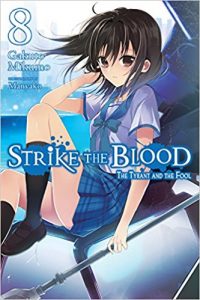
Strike the Blood, Vol. 8

February 1, 2018 by Sean Gaffney

By Gakuto Mikumo and Manyako. Released in Japan by ASCII Mediaworks. Released in North America by Yen On. Translated by Jeremiah Bourque.

This does not quite hit the highs (relatively speaking) of the previous volume, mostly as the entire volume is “let’s reveal the backstory the reader has been in the dark about for so long” and not much else, but it’s still a pretty solid volume of Strike the Blood. While we’re technically carrying on from the end of the last book, most of this is Kojou (and Asagi, along for the ride for some reason) remembering the events that led to him becoming the Fourth Primogenitor, which took place just before the start of the series. There’s a lot of attempts at worldbuiding and introducing potential new antagonists, which doesn’t work quite as well as the author likes. The good news is that there were a couple of genuine surprises in this volume, which is especially impressive given that Strike the Blood is one of the most by-the-numbers light novels out there.

Despite being on the cover as always, there’s very little Yukina in this book, which makes sense given it’s predominately a flashback. (This, by the way, means we have now gone TWO WHOLE BOOKS without her catchphrase of “No, sempai, this is OUR fight!”. I feel like I’m going through withdrawal.) She and Natsuki have removed Kojou and Asagi to her dream prison space so that Kojou can recover the memories of what really happened and be controlled if that happens to drive him insane (spoiler: it doesn’t.) What we see is not particularly surprising: Kojou is a natural at empathizing with others, which is why all the girls fall for him, and that also works here for Avrova. I hate to break it to people who may roll their eyes at the appearance of another one, but Avrova is, in fact, a blond vampire girl with the body of a child. That said, while she occasionally tries to be haughty in a Shinobu Oshino sort of way, she’s really more introverted and scared. Her bonding with Kojou was the best part of this book.

I’d mentioned surprises, and it comes in the form of Veldiana, who we’d met in the prior volume as a somewhat harried colleague of Kojou’s father. (Speaking of which, both Kojou’s parents appear quite a bit in this book, and while they are admittedly trying their best to save Nagisa’s life, it doesn’t change the fact that they are terrible, terrible parents.) Veldiana is played, in the first half of the book, as something of a comic relief character, and we assume that this is going to be her role in the book. But no, she’s here to teach a darker lesson about what happens when you let revenge consume you, and (leaving the epilogue aside, which I wasn’t too fond of) it works very well. There are also one or two scenes that are not surprises, but the way that they work out with precision timing is also well handled – watch for Kojou bribing the enemy with ice cream.

Strike the Blood is never going to rise to the level of the top light novels being released over here. But it has at least risen to the level where I don’t feel the need to make fun of it or wonder if it’s written by a Light Novel artificial intelligence. As always, the fights are well written and make you want to see them animated. It’s a decent volume in what has become a decent series.

Filed Under: REVIEWS, strike the blood

  • « Go to Previous Page
  • Page 1
  • Page 2
  • Page 3
 | Log in
Copyright © 2010 Manga Bookshelf | Powered by WordPress & the Genesis Framework