• Skip to primary navigation
  • Skip to main content
  • Skip to primary sidebar
  • Home
  • About Us
    • Privacy Policy
    • Comment Policy
    • Disclosures & Disclaimers
  • Resources
    • Links, Essays & Articles
    • Fandomology!
    • CLAMP Directory
    • BlogRoll
  • Features & Columns
    • 3 Things Thursday
    • Adventures in the Key of Shoujo
    • Bit & Blips (game reviews)
    • BL BOOKRACK
    • Bookshelf Briefs
    • Bringing the Drama
    • Comic Conversion
    • Fanservice Friday
    • Going Digital
    • It Came From the Sinosphere
    • License This!
    • Magazine no Mori
    • My Week in Manga
    • OFF THE SHELF
    • Not By Manga Alone
    • PICK OF THE WEEK
    • Subtitles & Sensibility
    • Weekly Shonen Jump Recaps
  • Manga Moveable Feast
    • MMF Full Archive
    • Yun Kouga
    • CLAMP
    • Shojo Beat
    • Osamu Tezuka
    • Sailor Moon
    • Fruits Basket
    • Takehiko Inoue
    • Wild Adapter
    • One Piece
    • After School Nightmare
    • Karakuri Odette
    • Paradise Kiss
    • The Color Trilogy
    • To Terra…
    • Sexy Voice & Robo
  • Browse by Author
    • Sean Gaffney
    • Anna Neatrour
    • Michelle Smith
    • Katherine Dacey
    • MJ
    • Brigid Alverson
    • Travis Anderson
    • Phillip Anthony
    • Derek Bown
    • Jaci Dahlvang
    • Angela Eastman
    • Erica Friedman
    • Sara K.
    • Megan Purdy
    • Emily Snodgrass
    • Nancy Thistlethwaite
    • Eva Volin
    • David Welsh
  • MB Blogs
    • A Case Suitable For Treatment
    • Experiments in Manga
    • MangaBlog
    • The Manga Critic
    • Manga Report
    • Soliloquy in Blue
    • Manga Curmudgeon (archive)

Manga Bookshelf

Discussion, Resources, Roundtables, & Reviews

Archives for August 2012

Last stop before Labor Day

August 31, 2012 by Brigid Alverson

It may be the last week of summer vacation, but there are plenty of new manga to get you through the long weekend, as I observed on MTV Geek. Sean Gaffney checks out a bountiful list of next week’s new manga.

Shaenon Garrity fills in for Jason Thompson on this week’s House of 1000 Manga column at ANN, with a discussion of Tokyopop’s short-lived josei manga imprint Passion Fruit.

Philip wraps up this month’s Manga Moveable Feast with roundups of days 5 and 6 of posts about The Kurosagi Corpse Delivery Service.

Ash Brown is giving away a copy of vol. 1 of Read or Dream at Experiments in Manga.

Reviews

Lissa Pattillo on vol. 12 of 13th Boy (Kuriousity)
Lori Henderson on vol. 5 of Ai Ore (Manga Village)
Erica Friedman on vol. 7 of Aoi Hana (Okazu)
John Rose on vol. 3 of Gate 7 (The Fandom Post)
Leroy Douresseaux on vol. 8 of Ikigami: The Ultimate Limit (The Comic Book Bin)
John Rose on vol. 1 of Oreimo (The Fandom Post)
Michelle Smith and MJ on Sakuran (Manga Bookshelf)

Filed Under: MANGABLOG

Off the Shelf: Sakuran

August 30, 2012 by MJ and Michelle Smith 4 Comments

MICHELLE: Hey, MJ! What’s red and bad for your teeth?

MJ: Um. I got nothin’.

MICHELLE: A brick!

MJ: Well. Huh. Um. So, hi!

MICHELLE: Howdy! So, once again, we’re devoting our column to a single series. This time it’s Sakuran: Blossoms Wild by Moyoco Anno, published by Vertical. Although I own a couple of other complete series by Anno, this was my first time actually reading one of her works. I definitely enjoyed it, but found myself somewhat stuck between enjoying it for what it was and wishing it was somehow more uplifting.

But maybe I’m getting ahead of myself and we should offer readers a synopsis.

MJ: Okay!

Sakuran tells the story of Kiyoha, a young woman in Edo-era Japan who was sold to a brothel in Yoshiwara as a child. Over the course of the story, she endures the path towards becoming an oiran (the highest-ranking courtesan), very little of which is particularly graceful or glamorous, and after suffering through some unexpected heartbreak finally seems to accept the brothel as her home.

It’s a rather cynical tale that does not attempt to gloss over the fact that Kiyoha will most likely live her entire life in servitude (either to the brothel, or to some future man who might buy her freedom), and manages somehow to make the brothel feel like the better fate in the end.

MICHELLE: Yeah, it may be a difficult life, but at least Kiyoha seems to have made peace with it by the end.

Which is, really, not exactly the end, as Sakuran follows a similar structure to Ooku, in that the first chapter is “current day” in the life of its protagonist, followed by detail on how exactly Kiyoha came to be in that situation. Kiyoha’s not an easy person to like at first—one of the first things she does is clobber and pee on another courtesan—but I did grow to sympathize with her by the end, especially when her love proves false. “Cry, and you lose. Love, and you lose. Win, and you lose.”

MJ: I admit that I sympathized with her practically from the start, but especially as soon as Anno began to tell Kiyoha’s story from the beginning. Her intense desire to escape the pleasure quarter felt so real and relatable, I couldn’t help but side with her from then on.

One of the things I was immediately struck by was what a different kind of story this was from Blade of the Courtesans, a prose novel Vertical released a few years ago. Though the novel had some stirring moments, one of the comments I made in my review was this:

The story constantly describes the power of women in the Yoshiwara society, yet in the midst of an impassioned explanation of how the women are able to come to Yoshiwara to “rinse away their origins” and escape from the persecution of their clan, it is revealed that they are indentured to the various houses in the pleasure quarter (all owned by men) until their 28th birthday, at which time they may choose to get married or to remain courtesans for the rest of their lives. That these women, shackled to a system that values them only for their skills in lovemaking, are held up as the pinnacle of female beauty and sovereignty is inexpressibly sad.

If there is one thing Sakuran does not do, it’s try to romanticize or glorify the life of an indentured courtesan. For that, I am very grateful.

MICHELLE: It definitely does not do that.

It was an interesting experience reading this at about the same time as I was getting caught up on Ooku, because both of them deal with women forced to take many sexual partners but for vastly different reasons. It’s the courtesan’s job to do so, but so too the female shogun (who supposedly has all this power) must take lover after lover in the desperate attempt to produce a child hearty enough to become her heir. In reality, are they really so different, the shogun and the courtesan? In both cases, their fates are bleak as they submit to (or compel) their parade of lovers, very rarely finding true love.

MJ: That’s a great point, Michelle. Despite the power having supposedly been transferred to women out of necessity in Ooku, it’s ultimately still a story about women trapped in a society that values them really only for their sexual organs, one way or another.

Heh, you know, with all this in mind, I have to admit that I was pretty surprised to hear at the beginning that you had any hope or expectation of Sakuran being “uplifting.” Given the circumstances, it’s hard for me to imagine how it could be!

MICHELLE: Well, I don’t know, I thought she might actually escape or something! But, of course, her options really wouldn’t have been any better outside Yoshiwara (without a husband, at least), which Anno makes clear. So it would’ve completely been a fallacious fantasy to read a story about a courtesan getting out and living happily ever after. Not challenging for a reader, but kind of… satisfying.

MJ: I can understand the impulse to wish for a more unambiguously happy ending. Yet the ending as it is isn’t exactly bleak, even if it seems like it should be. That’s actually one of the book’s greatest strengths, really. It manages not to be just grim, which is kind of amazing.

MICHELLE: Definitely. I want to add here that if we’d actually been given a happier ending, I probably would’ve hated it and chastised Anno for not being brave and taking a darker route. I guess I’m just conditioned now to expect creators to go for uplifting instead of ambiguous, since it has happened so many times before.

MJ: Probably one of the reasons we’re able to get a more ambiguous ending here is the fact that, aside from something like Sugar Sugar Rune, Moyoco Anno mainly writes for adults–and most often about adult women. But since manga about teen girls is sort of the default for female-centric manga imported to the US, that’s really what we’ve become accustomed to.

MICHELLE: Yes, you’re definitely correct. And when we do encounter a story aimed at teen girls that takes a more painful route—We Were There, 13th Boy, to some extent…—we tend to love it to pieces.

MJ: We do! Now, I’m not sure if I’m prepared to say that I love Sakuran to pieces. I enjoyed it very much, and I think it’s very well-crafted, but it’s not the kind of story that resonates really strongly with me on a personal level the way some others do.

That said, as a critic there is so much here to enjoy. One aspect we haven’t really touched on yet is the artwork, which is really quite stunning, especially with Vertical’s particular touches. The paper choice, color pages, and beautiful foil cover let you know right away that Sakuran will be a visual treat.

MICHELLE: Well, no, I didn’t love Sakuran either, but I really admire it, if that makes sense.

Going in, I wasn’t sure how I’d feel about the artwork, since Anno has such a distinctive style, but I ultimately enjoyed it and thought she did a terrific job capturing the atmosphere of the tea house. I did have some problems with telling a few of the courtesans apart, though.

MJ: That makes perfect sense. I think that’s where I was at with it, too, though I did really feel strongly for the main character, which is always a big plus. And one of my favorite aspects of the artwork has to do with her as well. I was really impressed by Anno’s ability to visually portray both Kiyoha’s spite and her vulnerability, which is not a combination that always translates well to the page.

MICHELLE: I hadn’t thought about that specifically, but it’s true that even nearly two weeks after I read Sakuran, I can still easily conjure some of Kiyoha’s expressions falling into both of those categories. Actually, I can still vividly remember quite a few scenes, including specifics of panel layouts. And that’s not something I could say about quite a lot of other manga.

MJ: One thing Anno has accomplished, perhaps specifically by writing Sakuran as a collection of story snapshots rather than a long narrative, is that the moments she’s chosen to highlight are genuinely memorable, and that goes for individual images as well.

MICHELLE: Yes, that is true, though I still wish it could’ve been longer. Carlo Santos at ANN put it well: “This volume offers a glimpse into a fascinating world, but closes up before we ever get a chance to peek around the corners.”

MJ: I certainly would have read much, much more of it!

Filed Under: OFF THE SHELF Tagged With: Sakuran

‘Porky and Friends: Hilarious Ham’ Announced

August 29, 2012 by Sean Gaffney

Hot on the heels of the 2nd Platinum Collection, we have this 18-cartoon set for fans of Porky Pig, as well as the smaller one-shot characters that come with him on the back of the collection. As always, the question is “If I have the Golden Collections, do I have to buy this?” Let’s find out.

Cartoons in this set will be (I’ll summarize the ones not out yet):

1) Tom Turk And Daffy (1944, Jones) – NEW TO DVD – Featuring a MYSTERY WRITER (and boy, is there a long, confusing story about that), this is a great early Daffy cartoon where he’s being an utter brat.
2) Wagon Heels (1945, Clampett) – GC5
3) Mouse Menace (1946, Davis) – NEW TO DVD – Art Davis’ first cartoon at Warners, this is another one pitting Porky against a mouse, this time utilizing a robot cat. It doesn’t go well.
4) One Meat Brawl (1947, McKimson) – NEW TO DVD – Porky and the Foghorn Leghorn dog are out hunting for groundhog, and the groundhog is determined to make them pay for it. McKimson’s earliest cartoons are some of his best.
5) Curtain Razor (1949, Freleng) – NEW TO DVD – Porky is a talent agent auditioning acts. A few gags (including the gasoline one) would be reused in Show Big Bugs by Daffy.
6) The Pest That Came To Dinner (1948, Davis) – NEW TO DVD – Can the world handle two Art Davis cartoons on one collection? Porky has termites, and tries various horrible methods to remove them.
7) Riff Raffy Daffy (1948, Davis) – NEW TO DVD – I guess the world can, as here’s a third Davis cartoon! I always liked ‘Daffy is screwy and Porky isn’t’ cartoons, though the question of how sane Porky is comes into question here.
8) Boobs in the Woods (1950, McKimson) – GC1
9) Dog Collared (1950, McKimson) – NEW TO DVD – Porky gives brief affection to a dog (no, not Charlie Dog), and lives to regret it.
10) Thumb Fun (1952, McKimson) – NEW TO DVD – A hitchhiking Daffy makes Porky’s life miserable. Some call this the final screwball Daffy cartoon, which isn’t true, but he *is* a screwball here.
11) Fool Coverage (1952, McKimson) – NEW TO DVD – I adored this cartoon as a kid. Daffy sells Porky insurance. “And one baby zebra!”
12) Corn on the Cop (1965, Spector) – NEW TO DVD – The final Porky Pig cartoon of the classic years. Shame it sucks. He and Daffy are police officers.
13) Corn Plastered (1951, McKimson) – NEW TO DVD – A wise-cracking crow annoys a farmer, who tries to kill him in various ways. The crow is a lot of fun.
14) Gone Batty (1954, McKimson) – NEW TO DVD – Stars Bobo the Elephant, in his 2nd and final cartoon, where he ends up at a baseball game.
15) Ant Pasted (1953, Freleng) – NEW TO DVD – Always nice seeing Elmer in a cartoon on his own. He’s taking on ants during a 4th-of-July picnic.
16) Dog Gone People (1960, McKimson) – NEW TO DVD – Another Elmer cartoon, but Arthur Q. Bryan had died by this time, so his voice sounds horrible. Elmer has to babysit his boss’s dog, who thinks he’s a human.
17) Bunny and Claude – We Rob Carrot Patches (1968, McKimson) – NEW TO DVD – The first of two appearances of Bunny and Claude, an obvious parody. Watch for the scene where it’s suggested they have sex on a pile of carrots. No, I’m not making this up.
18) The Great Carrot Train Robbery (1969, McKimson) – NEW TO DVD – And here’s the second B&C cartoon. It’s not as good.

So, worth getting? Well, 16 of the 18 cartoons are new to DVD. HELL YES! An absolute must-buy. Can’t wait.

Filed Under: UNSHELVED

Manga the Week of 9/5

August 29, 2012 by Sean Gaffney

There is an awful lot of it, huh? I think Gon was annoyed at being by himself last week and called in his friends… and this isn’t even counting the Seven Seas titles my store is apparently getting in but Midtown isn’t.

Remember about a month ago when I said I’d heard good things about that long-titled quasi-incest thing? Turns out I was thinking of OreImo, out this week from Dark Horse, rather than Seven Seas’ Big Brother title. OreImo’s full title is Ore no Imōto ga Konna ni Kawaii Wake ga Nai, aka My Little Sister Can’t Be This Cute! This title has far less incest but just as many tsunderes, if not more, and is rumored to be good. So I will check it out to see if this is the case.

Bloody Monday from Kodansha Comics has hit lucky Number Seven, though I’ve gotten so far behind on it I may never catch up. Is it still the Japanese 24?

Sublime, Viz’s BL line, has Volume 1 of His Favorite. It has the typical BL seme with his arms around his man and a smirk on his face, but the fact that the other’s guy’s face, instead of fear or uneasiness, or even arousal, reads like “must control fist of death” made me smile.

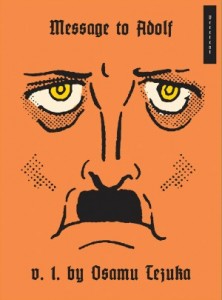
Tempted as I was to give Hayate the Combat Butler the cover image just to see how many folks I could annoy, the clear winner this week is Vertical’s new Tezuka tome, the first part of Message to Adolf. I never got the series back when Viz put it out ages ago, so this was a must-buy for me. And it’s nice to see some late-period Tezuka as well, as this is a 1980s title. Vertical is also releasing the underappreciated yet fantastic penultimate volume of GTO The Early Years, and the adorably cute 9th (and penultimate?) volume of Chi’s Sweet Home.

PILE O’ VIZ time. Including some stuff Midtown is listing that I had thought would be next week. This includes the 11th volume of Watase Yuu’s shonen series Arata the Legend, 20th volume of still not cancelled and funny as hell Hayate the Combat Butler (Greece Edition), a new House of Five Leaves for you Ono fans, and 9th volume of recent License Rescue Loveless.

There’s also a pile of Jump stuff, which I was expecting this week. There’s new Bakuman! Two more volumes of Bleach, which is still not done with Aizen, believe it or not. Hunter x Hunter, taking time from its busy hiatus to give us a new volume. Naruto! One Piece! Two great tastes that few fans enjoy together, for some reason (can’t the ninja and pirate fans just get along?). And of course Psyren, which should be at the ‘exposition’ part of its fight/exposition/fight trend.

Shojo Beat is the bigger winner here, though, with some of my favorites out next week. There’s new Library Wars, new Oresama Teacher *and* a new Otomen. Now admittedly the three series have flaws. Library Wars doesn’t have enough war for some people; Otomen continues to be a BL series with no BL; and Oresama Teacher is written by Izumi Tsubaki, who is the ‘oooooh, shiny thing!’ of Beat authors. This does not make the series less awesome. Other titles out this week include Earl and Fairy 3and a new Fushigi Yuugi Sequel Thingy volume. (It is possibly that the title does not actually have the word thingy in it.)

Lastly, Viz’s younger fans will be delighted to hear there are new Fluffy Fluffy Cinnamonroll *and* Winx Club titles out next week.

That’s a lot. What’re you getting?

Filed Under: FEATURES, manga the week of

Yuri comes into its own

August 29, 2012 by Brigid Alverson

At Eeeper’s Choice, Philip rounds up the links for Day 4 of the Kurosagi Corpse Delivery Service edition of the Manga Moveable Feast.

Erica Friedman discusses how yuri, unlike all other manga genres, has broken free of the standard manga demographics.

News from Japan: Duel Masters Rev., a manga adaptation of the Duel Masters game, launches this week in Shonen Sunday. GTO creator Tohru Fujisawa and his collaborators have ended their manga Hachikō-Mae -another side-, which ran in the digital magazine Dengeki Comic Japan.

Reviews: Carlo Santos delivers the verdict on a stack of recent releases in his latest Right Turn Only!! column at ANN.

Connie on vol. 21 of 20th Century Boys (Slightly Biased Manga)
Kate O’Neil on vol. 4 of The Betrayal Knows My Name (The Fandom Post)
Sheena McNeil on vols. 46 and 47 of Bleach (Sequential Tart)
Connie on vol. 1 of Castle Mango (Slightly Biased Manga)
Connie on vol. 20 of Claymore (Slightly Biased Manga)
Leroy Douresseaux on vol. 3 of The Earl and the Fairy (The Comic Book Bin)
Lissa Pattillo on vol. 3 of Gate 7 (Kuriousity)
Wolfen Moondaughter on vol. 20 of Hayate the Combat Butler (Sequential Tart)
Connie on Onward Towards Our Noble Deaths (Slightly Biased Manga)
Connie on vol. 7 of Ooku (Slightly Biased Manga)
AstroNerdBoy on vol. 9 of Rin-ne (AstroNerdBoy’s Anime and Manga Blog)
Lesley Aeschliman on vol. 6 of Sailor Moon (Blogcritics)

Filed Under: MANGABLOG

Jiro Taniguchi’s The Face-Punching Man

August 28, 2012 by Brigid Alverson

Philip brings us a roundup of links from Day 3 of the Manga Moveable Feast, which this month features The Kurosagi Corpse Delivery Service.

Erica Friedman has news of three more yuri titles coming to JManga.

At Fist of the North Star, Milo takes a look at a side of Jiro Taniguchi that is unfamiliar to those of us who read his work in English: The side that delights in drawing men punching other men.

Three Steps Over Japan takes a look at Bessatsu Shonen Magajin, the magazine home of Attack on Titan, Animal Land, and The Flowers of Evil.

Reviews: Ash Brown looks back on a week of manga reading at Experiments in Manga.

Leroy Douresseaux on vol. 13 of Bakuman (I Reads You)
Kristin on vols. 42 and 43 of Bleach (Comic Attack)
Kate O’Neil on vol. 6 of Dorohedoro (The Fandom Post)
Ken Haley on vol. 12 of The Kurosagi Corpse Delivery Service (Sequential Ink)
Lesley Aeschliman on vol. 22 of Ranma 1/2 (Blogcritics)
Alex Hoffman on Wolf (Manga Widget)
Lori Henderson on vols. 6 and 7 of Yu-Gi-Oh! GX (Good Comics for Kids)

Filed Under: MANGABLOG

It Came from the Sinosphere: Xuanji Tu

August 28, 2012 by Sara K. Leave a Comment

The book cover of 'Xuanji Tu'.

I realize that I’ve been writing a column on Chinese-language pop culture for months … without featuring a single creative work from mainland China. This was not on purpose.

More than anything else, it reflects that Taiwan is my vantage point. I have better access to Taiwanese media than other Chinese-language media and, knowing a few things about Taiwan, I’m also more comfortable commenting on Taiwanese media. If I were writing this column from San Francisco, it would probably be really different.

Taiwan, in some ways, has deeper cultural ties with the Chinese-speaking communities in south-east Asia than with China itself, and from the conclusion of the Chinese civil war up until about 15 years ago, contact between mainland China and Taiwan was limited.

Things are changing now, but they are changing slowly. Change is happening fastest in TV. Since Mandarin is understood in both China and Taiwan, many TV shows are based on stories popular in both China and Taiwan, and Chinese TV shows sometimes cast Taiwanese actors in order to get their fans’ attention. Change is happening slowest in print media, because there is the traditional characters/simplified characters barrier. Since many Taiwanese people do not want to learn to read simplified characters, it means that to bring Chinese literature over to Taiwan, a publisher has to produce a traditional-character edition. It’s not easy to persuade a publisher that this is worth the risk.

Nonetheless, a publisher decided to publish Wu Way’s novels in traditional characters, and a lot of Taiwanese bookstores decided to put her novels on their shelves.

Wu Way

Wu Way (吳蔚) is a writer of historical novels and has contributed to historical TV shows as well. She is originally from Hubei Province, China. She says that she finds her life in old piles of paper—in other words, digging through historical materials is her passion.

Recently, her novels have been published in Taiwan in traditional Chinese characters, and that’s how I got a copy of this novel.

Brief Story Overview

This novel is set towards the end of the reign of Wu Zetian, China’s only female empress regnant.

It is about five friends, all members of the upper class: Di Xiao, Wang Zhihuan, Wang Han, Li Meng, and Xin Jian. One night, Wang Han disappears … and then right after he comes back, he’s arrested for a brutal rape-and-murder. In order to clear his name, his friends investigate the crime to find the true culprit. There are more murders and even more mysteries, which all seem to revolve around the “Xuanji Tu.” The more they investigate, the more they become involved in intrigue right at the heart of the Tang court.

The Xuanji Tu

The Xuanji Tu is a famous and complex palindrome poem by Su Hui. For more details, read the wikipedia entry for Su Hui (note: normally I would not cite Wikipedia as a source, but I really cannot find any other website in English which describes the Xuanji Tu, and this is not an academic paper). I had no idea that the Xuanji Tu existed before reading this novel.

In addition to pursuing the Xuanji Tu, some of the characters are also trying to get an original copy of one of Wang Xizhi’s works. I can attest that Wang Xizhi is the calligrapher whom I hear of or read references to the most often.

Historical Background

I’ll be honest. My understanding of Chinese history is quite basic, and even that might be an overstatement. I get that the Ming dynasty ruled China more than a thousand years after the Han dynasty, but if you asked me how China under the Ming dynasty was different from China under the Han dynasty, you would get a blank stare from me.

Thanks to this novel, I know a heck of a lot more about the reign of Wu Zetian. Before, I just had a vague notion that she liked to collect attractive men to satisfy her desires—the truth about Wu Zetian’s sexual relationships is a bit more nuanced than that, and she did even more interesting things outside the bedroom.

And boy does this novel go into historical detail. Wu Way claims that 95% of the characters (including all of the main characters) are genuine historical figures. And the life of the upper class under the Tang dynasty is described in exhaustive detail. There are a lot of endnotes, which I eventually stopped reading.

I’m afraid much of the historical detail was lost on me.

On The Genre

Detective fiction happen to be one of my least favorite genres. Unless I can be convinced that it’s the most awesome detective story ever, these days it is almost impossible to entice me to read detective fiction that is not crossed with some other genre (science fiction, for example).

This book, of course, does cross genres. It bills itself as a “historical wuxia detective novel.” I’ve see it in both the historical fiction and wuxia sections (though some bookstores combine the wuxia and historical fiction section, I consider them to be as distinct as science fiction and fantasy). The “historical” part is definitely justified (see above). The “detective” part is also justified, since the first half or so of the novel is about finding out who the criminal is. The “wuxia” part … okay, yes, the characters often have to use their martial arts skills to climb over a wall or something. But there is precious little combat, and most of the characters don’t seem terribly concerned with martial arts, or with acting in a xia manner (they’re upperclass-types, not peasants seeking justice in an unjust society). So I don’t think labeling this novel as “wuxia” is justified.

As it so happens, I liked the story more after they found out who the true criminal is, because then it became less of a detective novel and more about intrigue in the Tang court, which is more interesting to me.

Brutality

While this novel is only gory once in a while, when it gets gory, it really gets gory. This is an example (which you should skip if you are not sure you can stomach it).

“On the steps before the gate there was a man hanging, dripping with blood, naked, his entire body covered with every kind whip lash, burns from hot irons … his hands and feet had already been cut off, his face had been reduced to a pulp, his eyes had been dug out, his ears, nose, and tongue had all been cut off. He looked, not like a human, but a demon that had risen from the depths of hell.”

I picked this example because it is relatively brief, not because it is the most horrifying (at least, not to me).

As readers may have noticed, I have a tendency to enjoy fiction with a lot of violence, but this novel managed to shock even me.

My Personal Reaction

I had to try reading this novel twice. The first time, I was overwhelmed because it wasn’t what I was expecting (I wanted a wuxia novel and got a detective story instead) and the language in this novel is particularly difficult (definitely a couple notches more difficult than a Jin Yong novel). The second time, I came in with a better attitude, and actually enjoyed it.

I rather like history, so while a lot of the historical stuff did go over my head, I did learn a lot, and found it quite interesting. When I have time, I really do need to do my homework on Chinese history.

And eventually, I did get caught up in the characters. I appreciate the development of the relationship between the five friends, and the various people they encounter. And the brutality is most shocking, not when it’s based on pure gore, but when it’s tied into personal relationships. For example, there is a husband who does something astonishingly cruel to his own wife. That particular plot line definitely got my attention, in a jaw-dropping way. And finally, while I can’t judge how historically accurate it is, I think Wu Way did a good job of personifying Wu Zetian and her family, and I got caught up in their side of the story.

Availability

Availability in English … ha ha ha.

It is, of course, available in both simplified and traditional Chinese characters.

Conclusion

This is one of those novels which I would not expect to like, but nonetheless I ended up being glad that I read it. It’s not to be taken lightly, due to the difficulty of the language and the copious historical details, but there are definitely things in the novel which have stayed with me. I don’t know if I’ll ever try Wu Way’s other novels, but if there’s a convenient opportunity, I probably will.

Next time: Pinoy Sunday (movie)


Sara K. loves history in general, but really getting to know history takes time, and she’s already spending a lot of time improving her Chinese. Her favorite way to learn history is travel—whether it’s walking the streets of San Francisco with a knowledgeable guide, or walking through an interesting corner of Taiwan and reading all of the signs explaining the local history.

Filed Under: It Came From the Sinosphere Tagged With: Chinese Historical Fiction, Wu Way, Wu Zetian, Xuanji Tu

Manga Moveable Feast launches Kurosagi week

August 27, 2012 by Brigid Alverson

This month’s Manga Moveable Feast is being hosted by Philip of the Eeeper’s Choice Podcast, and he has jumped right in with an overview of the series as a whole, individual overviews of vols. 1-4 and vols. 5-8, and link roundups for Day 1 and Day 2.

The Manga Village team picks the best of the past week’s new releases.

Jason Thompson is going with a Seven Deadly Sins theme in his House of 1000 Manga column at ANN, and this week he goes with “Lust,” counting down seven sexy manga that are more perversion than porn.

Erica Friedman presents a new episode of Yuri Network News at Okazu.

MJ and Michelle Smith discuss their favorite yaoi in their latest BL Bookrack column at Manga Bookshelf.

Also at Manga Bookshelf, Matt Blind looks at some up-and-coming manga in his latest Manga Radar feature.

And finally, Manga Bookshelf is polling its readers to see if they want a forum. Vote now or forever hold your peace.

News from Japan: According to the retailer Mangaoh, vol. 15 of Gunslinger Girl will be the last one. Manga-ka Yoshinori Kobayashi, best known for his manga defending Japan’s role in World War II, has called for Japan to abandon nuclear power, aligning himself with a movement that mostly occupies the opposite end of the political spectrum from his usual roost.

Reviews

Lori Henderson on vols. 12 and 13 of Bakuman (Manga Xanadu)
Leroy Douresseaux on vol. 1 of A Devil and Her Love Song (I Reads You)
John Rose on vol. 3 of D.Gray-Man (The Fandom Post)
John on issue 14 of GEN (AnimeNation Anime News)
Laura on vol. 1 of Jiu Jiu (Heart of Manga)
Diana Dang on vol. 1 of Kamisama Kazoku (Stop, Drop, and Read)
Leroy Douresseaux on vol. 20 of Kaze Hikaru (The Comic Book Bin)
Ash Brown on vol. 1 of Kurosagi Corpse Delivery Service (Experiments in Manga)
Anna on vol. 8 of Library Wars: Love and War (Manga Report)
AstroNerdBoy on vols. 7 and 8 of Rin-ne (AstroNerdBoy’s Anime and Manga Blog)
Lesley Aeschliman on vol. 6 of Sailor Moon (Blogcritics)
TSOTE on The Three-Eyed One (Three Steps Over Japan)
Lissa Pattillo on vol. 11 of Toriko (Kuriousity)
Jocelyne Allen on vol. 1 of Wet Moon (Brain Vs Book)
Linda on Wolf (Anime Diet)

Filed Under: MANGABLOG

Links! And a poll!

August 24, 2012 by MJ 7 Comments

Oh, readers, it’s been fairly chaotic behind the scenes at Manga Bookshelf lately, and we’ve fallen behind in so many ways. In the interest of catching up ever so slightly, here are a few links that have piled up over the past few weeks:

To my great delight, ANN recently reported that Kazuya Minekura’s action-packed BL epic Wild Adapter, which has been rerunning from the beginning in Ichijinsha’s Monthly Comic Zero-Sum since sometime last year will be resuming fresh serialization next spring, now that Minekura’s health is back on track. This is particularly big news here at Manga Bookshelf, where some of us (as you may recall) are very big fans.

Moving on from BL to Yuri, JManga is going all out for its new series YuruYuri. From their press release:

In celebration of the release, JManga has released a special “YuruYuri” feature including a character introduction and relationship chart, famous scenes, as well as a special article on Yuri manga by Erica Freidman (Yuricon, ALC Publishing). Additionally, JManga is holding a special quiz contest for YuruYuri fans from August 23rd to 29th (PST). Fans simply need to take the 4 question quiz, and get all the answer right, to be automatically entered into a special drawing for YuruYuri merchandise straight from Japan!

Don’t miss that contest!

At CNN’s “Geek Out!” blog, Danica Davidson discusses why female readers are drawn to manga (spoiler: FEMALE CREATORS), including quotes from people like VIZ’s VP of Publishing, Leyla Aker, and super-librarian Robin Brenner. Definitely a must-read!

Lastly, a quick poll! A while back I’d talked to my fellow Manga Bookshelf bloggers about the possibility of opening up a discussion forum on the site. At the time, everyone agreed that limiting discussion to comment threads on our individual posts helped keep things focused and easy to manage, so I shelved the idea. Just recently, however, I’ve had a request from a reader that we open up a forum here, so I thought I’d bring it to the rest of you for discussion as well. Please note that in any scenario, we would be leaving our posts’ comment threads exactly as-is, rather than moving comments into the forum space, so the forum would exist as a separate entity for discussion.

[poll id=”4″]

My current ideas for what might happen in the forums include: reader reviews (best get promoted to the MB main page), demographic/genre-specific threads, tips for buying manga on the cheap, featured weekly topics, sharing your picspam, ‘shipper’s forums, fanfic recs, and more!

Note: Any discussion forum at Manga Bookshelf would be both fandom-friendly and highly moderated. We are, as always, dedicated to creating a safe space for all.

Please feel free to elaborate or share suggestions in comments! And please vote!

Filed Under: UNSHELVED Tagged With: polls

Fated to Love You (Special Post)

August 24, 2012 by Sara K. 7 Comments

Cunxi draws a family in a sandbox.

So, on Tuesday I made the case for why people should watch Fated to Love You. In this post, I assume you are already in bed … er … on board with the idea that this show is worth watching, so instead I am going to explain things which would not be apparent to viewers who are not familiar with the Chinese language and/or Taiwan.

Let’s start with that pun, in bed vs. on board.

Fun with Language

Fated to Love You is very playful with its language. The most commonly used pun on the show is shàng chuán (board a boat / on a boat) vs. shàng chuáng (get in bed / in bed). Some of the significant events in the story happens on boats (and in beds). I don’t think you need to know anything about Taiwanese culture to appreciate the comedic value.

There’s also a pun on Paris vs. Bali. In Mandarin, “Paris” is pronounced as “Bālí,” and “Bālǐ” is a district of New Taipei City (I talk more about “Bālǐ” below).

Fun with language can be difficult to translate. Take this scene for example:

A picture of Anson

Pinyin:

Anson: Wǒ dǒng le.
Cunxi: Dǒng shénme a!
Anson: Zhè jiù shì jiānghú shàng liúchuán yĭjiŭ de “mŭzhū sài Diāo Chán.”
Cunxi: “Mŭzhū sài Diāo Chán?”
Anson: Hĕn jiăndān de luóji, jiăndān de dàolĭ ma.

Translation:

Anson: I understand.
Cunxi: Understand what?
Anson: This is [a saying] that has been passed down for a long time in jianghu “the female pig overtakes Diao Chan.”
Cunxi: “The female pig overtakes Diao Chan”?
Anson: The logic is simple, the reasoning is quite simple.

Anson then goes on to explain that “the female pig overtakes Diao Chan” means that when a man hasn’t been around beautiful women for a long time, but he is around a plain-looking woman, he will start finding the plain-looking woman more attractive than the beautiful women he saw a long time ago.

First of all, what is jianghu? It is usually used to refer to the world where wuxia stories take place, but it also sometimes used to refer to the gangster underworld (for example, The Outsiders 1 & 2 are set in “jianghu”). It is a bit like the concept of “the wild west” in American culture—a place of adventure where laws aren’t exactly obeyed and people must struggle for their personal honor.

Now, who is Diao Chan? She’s is one of the Four Great Beauties of ancient China (yes, there is an official list of the great beauties of ancient China).

Now, for those who are not familiar with Chinese, the language is full of chengyu—sayings (usually of four characters) often based on allusions to classical Chinese literature. If you’ve ever seen the Star Trek: Next Generation episode “Darmok,” think of Chinese as being a bit like that language. Good and frequent usage of chengyu demonstrates that one is well-educated, so some Chinese-speakers (both native and non-native) put a lot of effort into mastering them. What Anson is doing is that he is making up his own chengyu (at least I think it’s made up—I was not able to find it in any of my references), and since Cunxi doesn’t know it, he’s asking for an explanation.

So yes, this show has lots of fun with words. But so far I have been dealing with pure Mandarin (or Mandarin peppered with Classical Chinese). This show also uses quite a bit of Taiwanese, as well as a little English, and even a teensy bit of Cantonese.

Mandarin vs. Taiwanese

I think it would be fair to call Taiwan the “island of Babel.” Nonetheless, there are two dominant languages: Mandarin and Taiwanese. While there is a significant portion of the population that is not fluent in Mandarin and there is a significant portion of the population that is not fluent in Taiwanese, the vast majority of Taiwanese are fluent in at least one of those two languages. The choice of which language is used has serious social and political implications (high-profile Taiwanese politicians generally have to know both languages lest they offend voters) which I cannot explain here.

Most characters in Fated to Love You speak Mandarin. The most significant Taiwanese-speaking character is Chen-Lin Xishi.

Chen-Lin Xishi and one of her daughters.

The fact that most of her dialogue is in Taiwanese communicates that she is an older, rural woman. In Taiwan, Taiwanese tends to be the language of older people, and Mandarin tends to be the language of younger people. Furthermore, Mandarin tends to be an urban language, whereas Taiwanese tends to be a rural language. Mandarin is also associated with the elite, whereas Taiwanese is associated with the working class. There are significant exceptions, of course.

Chen-Lin Xishi also occasionally speaks in Mandarin. She speaks Mandarin with a heavy accent (coming from me, that’s the lump of coal calling the kettle black), but doesn’t seem to have any problem with conversational Mandarin. However, there’s one scene where she tries to speak in very formal Mandarin, and she trips over words so much that she needs her daughter’s help to complete sentences. It’s quite funny.

And then there’s Ji-Wang Zhenzhu, who happens to be one of my favorite characters.

A picture of Ji-Wang Zhenzhu

It’s obvious from the way Ji-Wang Zhenzhu speaks that she grew up in China, not Taiwan. The biggest giveaway is that she speaks with an “erhua.” “Erhua” is a certain style of speaking Mandarin in which it seems that every other word ends with an “r” sound. “Erhua” is strongly associated with the Beijing area. In Taiwan, if someone speaks with an “erhua” it’s generally assumed that they came from China.

Now, as someone who grew up in a region of China where people speak with an “erhua,” Ji-Wang Zhenzhu would not be expected to speak Taiwanese (Taiwanese is actually a dialect of Hokkien, and Hokkien is spoken in Fujian province, but Fujianese people generally do not speak with an “erhua”). However, when talking to Chen-Lin Xishi, who was failing at formal Mandarin, Ji-Wang Zhenzhu does sometimes use some Taiwanese. I know very little Taiwanese … but the way Ji-Wang Zhenzhu uses Taiwanese seems a bit awkward to me. It was clearly a move to save Chen-Lin Xishi’s face, as well as to show respect to her.

In a later scene, Chen-Lin Xishi tries to show her respect for Ji-Wang Zhenzhu … by speaking with an “erhua.” Even to me, Chen-Lin Xishi’s “erhua” sounds really artificial (Ji-Wang Zhenzhu’s “erhua,” on the other hand, sounds quite natural). And it’s funny because Chen-Lin Xishi is the last person in the drama who would have a genuine “erhua.”

Indeed, one of the many wonderful things about the drama is subtle development of the relationship between Chen-Lin Xishi and Ji-Wang Zhenzhu, two older women who come from very different walks of life. I’m afraid there’s no way to prevent a little of that from being lost in translation.

Music

The characters will occasionally burst into song spontaneously. No, Fated to Love You is not a musical. Instead, the characters burst into song the same way that people might start singing the George Harrison song “Something” if someone said “I don’t know why I like her, there’s something about her.”

I admit, I don’t recognize all of the songs. But I recognize some. For example, one song that gets referenced a couple times is “Ní Wáwa” (“Clay Baby”), which is a traditional children’s song that has been covered by many artists. It’s basically a child singing about their own clay doll, saying that since it’s not a real baby and doesn’t have a mommy or daddy, the child will have to be the mommy and daddy. Here is a really slow version of the song on YouTube.

Does Jiangmu Dao (Ginger Island) Exist?

Much of this drama is set in a place called Jiangmu Dao (Ginger Island). Does Jiangmu Dao exist?

The answer is: yes and no.

A view of Zhentoushan from the drama

Some of the Jiangmu Dao scenes were filmed at Zhentoushan. Zhentoushan is a peninsula (not an island) in Shimen resevoir in … Taoyuan county. I live in Taoyuan county, and my tap water comes from Shimen resevoir.

Cunxi swims in Shimen resevoir.

Hey dude, get out of my drinking water!

Even though it is technically a peninsula, there is no road to Zhentoushan, so the only way to get there is by boat (in other words, it practically is an island). About 50 households live in Zhentoushan.

Zhentoushan has an interesting place in Taiwanese history. If I remember correctly, it was a site of Atayal resistance against the Japanese (actually, that might have been Jiaobanshan, but Jiaobanshan is really close to Zhentoushan). Later, Chiang Kai-Shek (who was at the time the de-facto dictator of Taiwan) decided to build a villa in the area with views over Zhentoushan. The villa no longer exists, but I have visited the site and have verified that the view of Zhentoushan is indeed spectacular.

After the success of the drama, the residents of Zhentoushan have even gone so far as to rename their home “Jiangmu Dao” in order to draw in tourists. And the drama has increased tourism in this specific area a lot. There are tours from Amuping (another settlement next to Shimen resevoir) to Zhentoushan which have the name of the drama written on the boats. While riding the boat, they even show clips from the drama.

However, the thing is, most of the scenes supposedly set on “Jiangmu Dao” were not filmed in Zhentoushan.

First of all, some of the scenes which were supposed to be “Jiangmu Dao” were actually filmed in Amuping. If you actually know the area, the drama can sometimes be confusing, because the characters will say that they are leaving Jiangmu Dao, when in fact they are clearly leaving Amuping and going towards Zhentoushan.

Also, I don’t know where this boat terminal is, but it’s not in Amuping or Zhentoushan.

The mysterious boat terminal

This is the dock at Amuping.

The dock at Amuping

And there is no factory in Zhentoushan (the place has no road access, no one would put a factory there).

A warehouse shown in the drama.

This temple is not in Zhentoushan (there is only one temple in Zhentoushan, which is really a shrine and not a temple, and it’s much smaller).

A picture of a temple from the drama

There is no school in Zhentoushan (I’ve been told that the children have to take the boat to get to school).

a picture of a classroom from the drama

There are no rice fields in Zhentoushan (Zhentoushan doesn’t have much flat ground, though there are some rice fields on a terrace on the other side of Shimen resevoir.

Zhentoushan does have running water and electricity (the electric wires cross the water), but it’s not much more developed than that (again, there is no road access). It’s certainly not as developed at the Jiangmu Dao depicted in Fated to Love You.

In fact, most of the Jiangmu Dao scenes look like they were filmed in a lowland town (albeit spiffed up—this is an idol drama after all). It seems they used Amuping / Zhentoushan mainly because a) so they should show the characters travelling by boat to and from an “island” and b) because the scenery is nice. Otherwise, they are depicting a lowland town, not the backwaters of Taoyuan county.

It’s worth noting that this is not the only idol drama filmed in the rural areas of Taoyuan county. In fact Ethan Ruan, who is the male lead in Fated to Love You, also acted in an idol drama Green Forest, My Home which it set even deeper in the backwoods of Taoyuan County.

Environmental Injustice for Profit

One of the themes in Fated to Love You is a greedy businessperson trying to take over a rural area against the inhabitants’ will so his company can poison the environment with impunity. This is also a theme in Autumn’s Concerto. In fact, it’s a common theme in idol dramas.

Unfortunately, this is a reflection of reality. There are many examples of this kind of thing happening in Taiwan. Some examples: the naphtha cracker plant in Yunlin (that naphtha cracker plant was originally supposed to be built in a small town in Yilan—I know someone from that small town, and she says she’s very grateful that the government in Yilan rejected the plant), the destruction of the Alangyi trail, and the nuclear waste in Lanyu.

Then again, considering how much water is being poisoned by fracking, not to mention countless other examples, this is an issue in the United States too…

Star Cruises

A picture of a star cruises boat from the drama.

Star Cruises, which is featured in the first episode, is *the* cruise line in East Asia. In addition to their Taiwan-Hong Kong cruises, they also offer cruises from Taiwan to the Yaeyama islands. Even though the Yaeyama islands are governed by Japan, they are closer to Taipei than Tokyo. If it weren’t so astronomically expensive, I might be interested in taking a trip to the Yaeyama islands. Why? Among other reasons, part of Basara, one of my favorite manga, is set in the Yaeyama islands.

Museums!

Inside the Yingge Ceramics Museum

One of the museums featured in this drama is the Yingge Ceramics Museum. Some of Mars was also shot in the Yingge Ceramics Museum, but it makes much more sense in Fated to Love You. Yingge is one of the three or so centers of ceramics production in Taiwan, and is the most famous. After visiting the museum, my brain was crammed with more facts about pottery and ceramics than I thought I would ever know in my lifetime. Yingge is very close to Taoyuan city, where I live.

A shot filmed at the Shihsanhang museum.

There is also a scene set at the Shihsanhang Museum of Archaeology in Bali (I told you I would mention Bali again). It is next to the Shihsanhang site, where archaeologists have found some of the earliest evidence of human habitation in Taiwan.

This shot gives a nice view of the hills of Bali.

Shanghai

Chen Xinyi and Dylan in Shanghai

I have never been to Shanghai, and quite frankly I know very little about the city. I do know there is an exhibit at the Taipei Fine Arts Museum of paintings and sculptures from Shanghai artists, so there are certainly attempts to cross the strait with fine art.

The Thirteen Levels

A picture of the Thirteen Levels

The Thirteen Levels, in Shuinandong, is one of the most iconic buildings on Taiwan’s north coast. There is another idol drama I plan to discuss which features Shuinandong, so for now I will just say that Shuinandong is just below Jinguashi, which is next to Jiufen, an important town in Taiwanese culture which I have mentioned previously.

Conclusion

The point of this post is not to point out every clever use of language, explain every cultural reference, and to discuss every location. First of all, I did not catch every clever use of language, understand every cultural reference, or recognize every location. And I did not discuss everything I did recognize because this post is already long enough as it is.

What I want to do is give readers the sense that, behind this drama, there stands an entire culture and society. I think it’s entirely possible to enjoy Fated to Love You without understanding any of this. I also think that being aware of these extra layers deepens one’s experience of the drama.


Sara K. likes see how various things connect together. It is one of the finest pleasures in her life. She is also happy to squeeze a Basara reference into a post about a Taiwanese idol drama.

Filed Under: It Came From the Sinosphere Tagged With: Fated to Love You, Mandarin, Shanghai, taiwan, Taiwanese, Taoyuan

Manga Radar: 19 August 2012

August 24, 2012 by Matt Blind Leave a Comment

Database Additions this week

Bloody Monday 7 – Kodansha Comics, Aug 2012
Hunter x Hunter 28 – Viz Shonen Jump Advanced, Sep 2012
Clockwork Sky 1 – Seven Seas, Sep 2012
The Hentai Prince and the Stony Cat – DMP, Nov 2012
Is This a Zombie? 3 – Yen Press, Nov 2012

Hot & Steamy 1 – DMP Project H, Jan 2013
Bleach 55 – Viz Shonen Jump, Feb 2013
Awkward Silence 3 – SuBLime, Feb 2013
One Piece 66 – Viz Shonen Jump, Mar 2013
Negima! 38 – Kodansha Comics, Apr 2013
Black Butler 13 – Yen Press, Apr 2013
Bunny Drop 8 – Yen Press, Apr 2013
Naruto 61 – Viz Shonen Jump, May 2013
Dengeki Daisy 12 – Viz Shojo Beat, May 2013
Awkward Silence 4 – SuBLime, May 2013

The Clockwork Sky is a prequel of sorts by Madeleine Rosca, to her 3-volume (internationally Award winning) Hollow Fields – it’s “not manga” for those who are purists about these things, but Hollow Fields was a lovely steampunk-schoolkids romp and the book trailer Tor put out to promote the book promises more of the same. I say ‘prequel of sorts’ as I don’t know how, or how directly, Clockwork Sky is related to the characters & story of Hollow Fields, but obviously I’m looking forward to this one.

There is a whole of of “volume n+1” up there, with all the usual suspects from Kodansha, Viz, and Yen. The only real head-scratcher was The Hentai Prince and the Stony Cat. A quick search pulls up DMP’s web listing for the book – and despite the title, this isn’t a Project H or 801 book – it’s under DMP’s main imprint. As a single volume one shot (and given the premise) I’m not so sure about this one, but I’ll read the reviews to see if I’m wrong.

##

It was just last week that Yu-Gi-Oh finally overcame Sailor Moon, and we all know Yugi is popular, and there’s the cartoon, trading card game, and all of that so it’s not a huge surprise.

Unlike Sailor Moon, though — which is showing strong sales and strong preorders for the unreleased books, only the five most recent Yu-Gi-Oh titles make the Top 500 this week. There is a bit of a drop-off as well, much further down the charts, as nothing that isn’t 5Ds, Zexal, or GX manages to crack the top 1000. To me this suggests a ‘subscriber’ model where new books get picked up by current fans, but fewer readers are picking up the series from the beginning. We could compare Yu-Gi-Oh to Naruto, which has vols 1-5 all still in the Top 500 [Naruto Vol. 1 was released in 2003] or even One Piece, volume one of which current outranks Naruto 1 and Bleach 1. Not every ‘bestseller’ works in quite they same way, and there are many different ways to consider sales.

Of course, it might not be fair of me to lump all the Yu-Gi-Oh series and spinoffs into a single block, as kids currently watching the cartoon likely only think of their version as the one worth following – even so, I’d expect stronger sales from 5Ds or Zexal — or maybe fans need to tie-up the plot & storylines because 4Kids never aired the 4th season of the Anime?

The Top 10 Yu-Gi-Oh books are:

1. ↔0 (1) : Yu-Gi-Oh! GX 9 – Viz Shonen Jump, Aug 2012 [425.0] ::
148. ↑29 (177) : Yu-Gi-Oh! Zexal 1 – Viz Shonen Jump, Jun 2012 [77.8] ::
329. ↑83 (412) : Yu-Gi-Oh! 5Ds 3 – Viz Shonen Jump, Jun 2012 [37.1] ::
438. ↑2 (440) : Yu-Gi-Oh! 5Ds 2 – Viz Shonen Jump, Feb 2012 [25.7] ::
499. ↑12 (511) : Yu-Gi-Oh! GX 8 – Viz Shonen Jump, Jan 2012 [21.6] ::
524. ↑175 (699) : Yu-Gi-Oh! Zexal 2 – Viz Shonen Jump, Dec 2012 [20.6] ::
738. ↑26 (764) : Yu-Gi-Oh! GX 1 – Viz Shonen Jump, Nov 2007 [10.5] ::
762. ↓-31 (731) : Yu-Gi-Oh! GX 2 – Viz Shonen Jump, Nov 2008 [9.8] ::
773. ↑67 (840) : Yu-Gi-Oh! GX 6 – Viz Shonen Jump, Mar 2011 [9.4] ::
1001. ↑27 (1028) : Yu-Gi-Oh! GX 7 – Viz Shonen Jump, Aug 2011 [4.4] ::

and the top 12 Sailor Moon:

2. ↑2 (4) : Sailor Moon 3 – Kodansha Comics, Jan 2012 [422.3] ::
3. ↔0 (3) : Sailor Moon 4 – Kodansha Comics, Mar 2012 [396.5] ::
4. ↓-2 (2) : Sailor Moon 1 – Kodansha Comics, Sep 2011 [392.6] ::
5. ↔0 (5) : Sailor Moon 2 – Kodansha Comics, Nov 2011 [378.3] ::
9. ↔0 (9) : Sailor Moon 6 – Kodansha Comics, Jun 2012 [325.5] ::
12. ↑2 (14) : Sailor Moon 7 – Kodansha Comics, Sep 2012 [288.8] ::
13. ↓-1 (12) : Sailor Moon 5 – Kodansha Comics, Apr 2012 [285.8] ::
18. ↓-5 (13) : Sailor Moon 9 – Kodansha Comics, Jan 2013 [262.1] ::
19. ↑2 (21) : Sailor Moon 8 – Kodansha Comics, Nov 2012 [246.9] ::
21. ↓-1 (20) : Sailor Moon Codename: Sailor V 2 – Kodansha Comics, Nov 2011 [244.1] ::
27. ↓-2 (25) : Sailor Moon Codename: Sailor V 1 – Kodansha Comics, Sep 2011 [212.4] ::
29. ↓-3 (26) : Sailor Moon 10 – Kodansha Comics, Mar 2013 [204.3] ::

…a casual observer might note, every last Sailor Moon book is in the top 30, at least based on online sales — and that 3 of these books aren’t even out yet — and that the #2 ranked Yu-Gi-Oh book comes in ranked at 148th for the week.

Filed Under: Manga Radar, UNSHELVED

BL Bookrack: August 2012

August 23, 2012 by MJ and Michelle Smith 14 Comments

Welcome to the August installment of BL Bookrack! This month, Michelle takes a look at Flutter from Juné Manga and the debut volume of Punch Up! from SuBLime, while MJchecks out the first two volumes of Setona Mizushiro’s Dousei Ai at JManga. In Brief: Awkward Silence (SuBLime), Honeydew Syndrome, Vol. 2 (New Shoe), My Boyfriend the Mad Dog (DMG), and Starting With a Kiss, Vol. 1 (SuBLime).


Dousei Ai, Vols. 1-2 | By Setona Mizushiro | Published by Libre Publishing Co., Ltd./JManga | Rated Mature – When innocent middle-schooler Tsubaki tells his classmate Kaoru that he loves him, he is completely unprepared for the consequences of his words. Devastated by Kaoru’s violent rejection, Tsubaki begins to withdraw from his other friends and, as he reaches high school, enters into a sexual relationship with a male teacher in order to ease his growing sense of isolation. As graduation approaches, Tsubaki becomes anxious to get out of the increasingly one-sided relationship with his teacher. But when he tries to break up, the teacher reacts by dramatically outing him to his family—sending Tsubaki running to Tokyo to escape his parents’ visible pain and disapproval.

If the entire series was Tsubaki’s alone, his poignant tale would be more than enough to keep me hooked. But its second chapter makes it immediately clear that Mizushiro has much bigger plans, as she introduces the series’ second protagonist, Koutarou.

Having mainly been raised by his kind, domestically-inclined older brother, Koutarou is a fairly manipulative, smart-ass kid who privately prides himself on being able to “beat” his brother at anything. When his brother brings home a girlfriend for the first time, it seems he’s finally bested Koutarou at something, but the girl sneaks into Koutarou’s bed during the night, providing Koutarou with both the loss of his virginity and proof that he’s still on top (so to speak). Things take a downward turn, however, when Koutarou’s brother announces that he’ll be marrying the girlfriend, who is pregnant with a child he believes must be his. Wracked with guilt and self-loathing, Koutarou falls into a pattern of loveless one-night-stands with any women (and later, men—which eventually establishes itself as his preference) who express interest, all the while keeping up appearances as the guy who’s got it all together.

That was probably more summary than I’ve ever included in a single review in my entire career as a manga critic, but in those two paragraphs you will find evidence of both the best (and worst) things about Dousei Ai. In the category of “best,” well… wow. This is no casual one-shot or simplistic BL romance. Setona Mizushiro has carefully crafted a complex emotional drama with some of the best-written characterization I’ve ever seen in this genre and a long game that is pretty obviously going to offer up significant payoff for the reader. I mean, going into this it’s clear that we’re in for a killer of a ride, along the lines of something like Sooyeon Won’s manhwa epic Let Dai, only better—much, much better. Both Tsubaki and Koutarou are rich, genuinely fascinating characters, who somehow manage to remain sympathetic even as they fall into their individual patterns of using others in order to get by with their own pain. And as the second volume wraps up it becomes clear that the main cast will continue to grow as the series goes on. I can’t wait. Seriously, I can’t.

On the downside—and perhaps at least partially due to the era in which this was originally released—Mizushiro puts a lot of work into making sure we know just how broken her protagonists are, which wouldn’t be a problem if she didn’t also hint at their personal trauma being at least partly responsible for their sexuality. I’m giving her a pass on this so far, since it hasn’t been stated outright from an authorial point of view, but it is the one small bruise on this otherwise deliciously epic treat. And while I’ve heard the series’ old-school ’90s artwork (it began serialization in 1996) described as “ugly,” it satisfies my admittedly-retro tastes with near-perfection.

If you’ve got a hankering for lighthearted comedy or sweet romance, this series is emphatically not the ticket. But for my part, Dousei Ai may be the BL epic I’ve long been waiting for. Highly recommended.

– Review by MJ


Flutter | By Momoko Tenzen | Juné | Rated Mature – Sometimes I’m tempted to write a review that simply says, “This is really good. Go read it.” Flutter is just such a case, but I suppose I ought to present at least some evidence in its favor.

Masahiro Asada works in the sales division of a company. Although straight, he’s transfixed every morning by the sight of a beautiful male coworker, Ryosuke Mizuki, who is so impeccably dressed and put together that he almost doesn’t seem human. When a project brings them together, Asada gets to know Mizuki—and his all-too-human flaws, sorrows, and weaknesses—and finds himself even more attracted.

There are so many things to recommend this manga. The atmosphere is sort of… elegant and languid, which suits mysterious Mizuki well and makes an earnest everydude like Asada stand out all the more. The growing friendship between the men is believable—and they’re both completely professional adults, I might add—as is Mizuki’s wary reaction when Asada confesses his feelings. Mizuki’s been hurt before, and is concerned he might be tempted to just use Asada to make his ex jealous.

It’s lovely and complicated, and when the guys do finally get together physically it’s wonderfully awkward. I’m always a little embarrassed when BL lets us get to know the guys well before they start getting intimate, because then it feels like we’re spying on something we shouldn’t be seeing. Thankfully, the love scene fades to black before this becomes an issue.

Ultimately, Flutter is the best BL oneshot I’ve read in a long time. This is really good. Go read it.

– Review by Michelle Smith


Punch Up!, Vol. 1 | By Shiuko Kano | Published by SuBLime Manga | Rated Mature – Shiuko Kano has had a lot of manga published in America, but somehow, despite owning several volumes, I’ve never managed to read any of her work until this first volume of Punch Up!, which is itself a spinoff of Play Boy Blues.

The concept is pretty simple: Maki Motoharu is a gay architect with a lively appreciation for attractive men. When he learns that his lost cat has been found and cared for by Ohki Kouta, a construction worker helping to build his latest project, and that Kouta has quarreled with his landlord because of that, he offers the younger man a place to stay. Kouta soon realizes that Motoharu’s fancy digs (and cat) are woefully neglected, and ends up bonding with the cat (Nyanta) far more than her owner ever had.

Pretty soon Kouta’s concern for Nyanta translates to concern for Motoharu, and they hook up. What’s interesting about their relationship is that it’s not sweet at all. This isn’t some dreamy romance manga. Motoharu is pretty much a crappy person, but not in an over-the-top villainous kind of way. Kouta realizes this, bemoaning his own lousy taste in men, and has no expectations that their relationship is going to last. And somehow… this seems to give the story a lot of potential to go in various soapy directions while seeming at least a little more realistic than the thoughtful/adorable BL to which I typically gravitate.

Though a lot more explicit than I usually prefer, and tonally different as well, Punch Up! has at least intrigued me enough to check out the next volume, though I don’t see it becoming a permanent fixture in my collection.

– Review by Michelle Smith


In Brief:

Awkward Silence, Vol. 1 | By Hinako Takanaga | Published by SuBLime Manga | Rated Mature – With his impassive face, Satoru Tono has always had trouble expressing his feelings. He can’t even visibly convey his happy surprise when Keigo Tamiya, a popular athlete and object of Satoru’s long-time crush, asks him out. Various obstacles and misunderstandings ensue—drama over a lost cell phone charm, jealousy over a flirtatious female transfer student, and a persistent sempai with an eye for Satoru— but the boys reaffirm their affections as needed and engage in end-of-chapter “romping” with predictable regularity. If you’re thinking, “Gee, that sounds pretty generic,” you’re absolutely right. It’s not actively bad, so I might have read a second volume if the series had ended there, but it looks like it’s up to four volumes in Japan and still ongoing! I am, quite frankly, astounded that Takanaga was able to extract that much material from this tired premise. – Michelle Smith

Honeydew Syndrome, Vol. 2 | By New Shoe | Rated Teen – With Metis and Josh’s relationship well in hand, volume two of this charming BL comic turns the camera on quiet, easygoing Jay and his growing interest in Metis’ caustic friend Charles, as well as a few other members of Metis’ idiosyncratic social sphere. Though this can feel a bit choppy as a volume, the individual stories are just as engaging as the first half of the series, and perhaps more so in places—evidence of this team’s growth over the course of the series. The print version of this webcomic also includes a a terrific prose story about Jay and Charles that offers up some essential character notes on both of them and is not to be missed. Still recommended. – MJ

My Boyfriend, The Mad Dog | By Sanae Rokuya | Digital Manga Guild – Akae is an eccentric mangaka who expects his assistants to, er, “assist” with more than just artwork. Honma is a highly sought-after freelancer with ample talent for the job. If this sounds like the introduction to a little mindless porn, you’d only be partly right. Though their story is far from deep, there is some fairly nuanced characterization here, especially in Honma, who refuses to be cast as simply the blushing uke. Unfortunately, the volume’s second couple—an aspiring artist who hasn’t learned the word “no,” and his (apparently) desperate editor—is pretty cringe-worthy throughout. If you don’t enjoy persistent non-con, proceed with caution.– MJ

Starting with a Kiss, Vol. 1 | By Youka Nitta | SuBLime Manga | Rated Mature – As a fan of multi-volume BL, I’m usually pretty anxious to try out anything with a volume number in its title, though results are frequently negative or mixed at best. Starting with a Kiss falls squarely into the latter category, with its mix of confusing narrative and comically rushed romance alongside some genuinely interesting characterization. Though Youka Nitta’s yakuza are intriguing, her jumps between past and present read as awkward rather than illuminating. Furthermore, her plentiful sex scenes are hampered by unbelievable relationships that seem to form in the blink of an eye. Fortunately, with multi-volume series, there’s always hope for next time. Not yet recommended. – MJ


Review copies of most titles provided by the publishers.

Disclosure: MJ is currently under contract with Digital Manga Publishing’s Digital Manga Guild, as necessitated for her ongoing report Inside the DMG. Any compensation earned by MJin her role as an editor with the DMG will be donated to the Comic Book Legal Defense Fund.

Filed Under: BL BOOKRACK Tagged With: yaoi/boys' love

Shuho Sato is at it again…

August 23, 2012 by Brigid Alverson

New manga time! I check out the latest releases at MTV Geek, and Lissa Pattillo gives her picks in her On the Shelf column at Otaku USA. Sean Gaffney looks forward to next week’s new release—yeah, that’s not a typo. Midtown Comics has just one new manga title next week.

It’s not manga, but definitely of interest to manga readers: Matt Alt and Hiroko Yoda, the husband-and-wife team behind Yokai Attack, talk up their new book, Yurei Attack! The Japanese Ghost Survival Guide, at Crunchyroll.

Ash Brown talks about buying manga at RightStuf.

Shuho Sato, who has experimented with a number of different publication strategies for his Say Hello to Black Jack, is going to stop enforcing his copyright on the series after September 15, allowing people to copy, remix, and reuse the manga. He is even going so far as to allow a copier at an upcoming exhibit of his work, so people can copy the pages.

News from Japan: A woman who submitted manga to Shonen Jump claims that an editor touched her and made suggestive comments to her on two different occasions. The Sept. 5 issue of Margaret will feature Jitsuroku! Fudanjuku Monogatari, a 12-page, full-color manga by Arina Tanemura. Umineko When They Cry artist Sōichirō will draw a new manga based on the game Rose Guns Days for Square Enix’s Gangan Joker magazine.

Reviews

Wolfen Moondaughter on vol. 11 of Arata: The Legend (Sequential Tart)
Karen Maeda on vol. 10 of Dengeki Daisy (Sequential Tart)
Rebecca Silverman on vol. 1 of Soul Eater Not! (ANN)

Filed Under: MANGABLOG

Manga the Week of 8/29

August 22, 2012 by Sean Gaffney

That’s it. Remember when last week of the month brought Tokyopop stuff? In the meantime, enjoy Gon. He’s awesome.

Filed Under: FEATURES, manga the week of

Urasawa speaks!

August 22, 2012 by Brigid Alverson

Rebecca Silverman gets the interview we all dream of, a sit-down with Naoki Urasawa (Monster, Pluto, 20th Century Boys).

The latest Manga Out Loud podcast features guests MJ, Kate Dacey, William Flanagan, and Shaenon Garrity discussing CLAMP with host Ed Sizemore.

Matt Blind compiles the big list of manga best-sellers for the past week, and he looks forward to some new manga releases in the next six months in his Manga Radar column.

At Blog of the North Star, Milo kicks off a multi-part appreciation of Ken Ishikawa, who started his career as Go Nagai’s assistant.

Jeff Blagdon reports in from Comiket, in a story that makes me sorta glad I didn’t go but happy that he did.

The Asahi Shimbun reports on JManga’s translation contest—and quotes Deb Aoki.

News from Japan: Robotics;Notes – Rival Legacy, the fourth spin-off the visual Robotics;Notes visual novel, has launched in Ultra Jump. Manga-ka Azure Konno (Koe de Oshigoto) and Ayami Kazama (The World I Create) announced their marriage via Twitter yesterday.

Reviews: Ash Brown looks back on a week’s worth of manga reading at Experiments in Manga.

Lori Henderson on vol. 13 of Black Bird (Manga Village)
Kristin on vols. 38 and 39 of Bleach (Comic Attack)
Sean Gaffney on vol. 5 of A Certain Scientific Railgun (A Case Suitable for Treatment)
Milo on Doll the Hotel Detective (Blog of the North Star)
Ken Haley on Dolls Don’t Cry (Sequential Ink)
John Rose on vol. 6 of Kobato (The Fandom Post)
Erica Friedman on Metersarete Kya (Okazu)
Alex Hoffman on MW (Manga Widget)
Leroy Douresseaux on vol. 10 of Nura: Rise of the Yokai Clan (The Comic Book Bin)
Matthew Warner on vol. 5 of Psyren (The Fandom Post)
Lissa Pattillo on vol. 1 of Soul Eater NOT (Kuriousity)
Kristin on vol. 11 of Toriko (Comic Attack)

Filed Under: MANGABLOG

  • Page 1
  • Page 2
  • Page 3
  • Interim pages omitted …
  • Page 5
  • Go to Next Page »
 | Log in
Copyright © 2010 Manga Bookshelf | Powered by WordPress & the Genesis Framework