• Skip to primary navigation
  • Skip to main content
  • Skip to primary sidebar
  • Home
  • About Us
    • Privacy Policy
    • Comment Policy
    • Disclosures & Disclaimers
  • Resources
    • Links, Essays & Articles
    • Fandomology!
    • CLAMP Directory
    • BlogRoll
  • Features & Columns
    • 3 Things Thursday
    • Adventures in the Key of Shoujo
    • Bit & Blips (game reviews)
    • BL BOOKRACK
    • Bookshelf Briefs
    • Bringing the Drama
    • Comic Conversion
    • Fanservice Friday
    • Going Digital
    • It Came From the Sinosphere
    • License This!
    • Magazine no Mori
    • My Week in Manga
    • OFF THE SHELF
    • Not By Manga Alone
    • PICK OF THE WEEK
    • Subtitles & Sensibility
    • Weekly Shonen Jump Recaps
  • Manga Moveable Feast
    • MMF Full Archive
    • Yun Kouga
    • CLAMP
    • Shojo Beat
    • Osamu Tezuka
    • Sailor Moon
    • Fruits Basket
    • Takehiko Inoue
    • Wild Adapter
    • One Piece
    • After School Nightmare
    • Karakuri Odette
    • Paradise Kiss
    • The Color Trilogy
    • To Terra…
    • Sexy Voice & Robo
  • Browse by Author
    • Sean Gaffney
    • Anna Neatrour
    • Michelle Smith
    • Katherine Dacey
    • MJ
    • Brigid Alverson
    • Travis Anderson
    • Phillip Anthony
    • Derek Bown
    • Jaci Dahlvang
    • Angela Eastman
    • Erica Friedman
    • Sara K.
    • Megan Purdy
    • Emily Snodgrass
    • Nancy Thistlethwaite
    • Eva Volin
    • David Welsh
  • MB Blogs
    • A Case Suitable For Treatment
    • Experiments in Manga
    • MangaBlog
    • The Manga Critic
    • Manga Report
    • Soliloquy in Blue
    • Manga Curmudgeon (archive)

Manga Bookshelf

Discussion, Resources, Roundtables, & Reviews

Archives for October 2011

Upcoming 10/26/2011

October 25, 2011 by David Welsh

Thank goodness Viz is taking the week off on the ComicList, because a couple of other publishers are really bringing it.

The first volume of Drops of God, written by Tadashi Agi and illustrated by Shu Okimoto, arrives courtesy of Vertical. This series has the interesting distinction of having been covered by dozens of newspapers prior to ever being licensed. (And those articles were subsequently picked up via service by hundreds of other newspapers.) This phenomenon occurred because the manga has boosted the wine industry wherever it’s been published. Will that occur here? Will Wine Spectator feature it in the next issue? Hard to say, but I’m really looking forward to reading this tale of a race to find a roster of legendary vintages. (I’ll probably stick with Three-Buck Chuck myself, but at least I’ll know what I’m missing.)

Vertical also unleashes the seventh volume of Kanata Konami’s Chi’s Sweet Home, so you can balance rare wine with adorable pets.

Not to be outdone in the cute and funny department, Yen Press delivers the tenth volume of Kiyohiko Azuma’s Yotsuba&! I predict low-key, identifiable antics will ensue, and that I will probably giggle.

I also predict that my jaw will drop at the quantity and quality of pretty contained within the second volume of Kaoru Mori’s A Bride’s Story. I discussed this in more detail last week at Manga Bookshelf, though I couldn’t muster a Midtown-dependent pick this week. I did manage to provide a couple of Bookshelf Briefs.

Kodansha isn’t quite as impressive in its generosity, but it does offer the 11th volume of Koji Kumeta’s very funny Sayonara, Zetsubou-Sensei, which is not to be overlooked. (In other Kodansha news, I thought the first volume of Mardock Scramble was fairly promising, and I barely escaped the first volume of the unbearably shrill Animal Land with my sanity intact, but more on that later.)

So, what looks good to you?


Filed Under: DAILY CHATTER

Higurashi: When They Cry, Vol. 15

October 25, 2011 by Sean Gaffney

Story by Ryukishi07; Art by Karin Suzuragi. Released in Japan as “Higurashi no Naku Koro ni: Tsumihoroboshi-hen” by Square Enix, serialized in the magazine Gangan Powered. Released in North America by Yen Press.

It’s Halloween, and time for all good bloggers to discuss horror. And so I will talk about Higurashi, which may be a mystery series, and may also be a harem series, but is first and foremost known for its graphic horror. This volume starts a new arc, with events once again reset to the middle of June. There’s a basic horror in the premise: the cast are dying in horrible ways over and over, each time with someone falling into a spiral of paranoia and insanity. Worst of all, the young priestess Rika seems to be aware of the previous iterations. Will this arc, focusing on the cute redhead Rena, be any more optimistic?

Well, probably, but not in this first volume. This is the start of the “Atonement” arc, which is the mirror of the first arc of the entire series, the ‘Abducted by Demons’ arc. Unlike the previous Shion arc, however, which told the same events but from a new perspective, this is showing an entirely different plot, focusing on Rena. We do start off bright and happy as always, with Rena and the rest of the club playing a penalty game with water guns in gym class. As the story goes on, though, we realize that the chapter title “Happy Rena” is misleading, and that she uses a smile to mask her inner pain and sadness. And what’s more, it’s getting obvious.

Rena is an interesting case. Most of the previous arcs have shown the protagonist (Keiichi at first, then Shion) start off relatively well-adjusted, then slowly the paranoia and madness seeps into them as they start imagining things that aren’t really happening. Rena’s backstory shows us that she’s already been committed for a long period after her parent’s divorce, and has attempted suicide as well as assault. And while moving back to Hinamizawa helped briefly, now that a new woman is cozying up to her father, the old feelings are starting up again.

In addition to Rena not really needing much impetus to get her started into killing other people, the people she’s dealing with are those that we’re not really going to miss. It turns out that her father’s new love is a gold digger who leeches onto men and gradually strips them of their money… something she casually brags about in a cafe while on the arm of Satoko’s uncle. Remember him? Back in the Curse Killing arc, we saw his physical and mental abuse of the fragile Satoko. Combined with his new love, they’re a couple that Rena is allowed to kill while still retaining the audience’s sympathy… or are they? Does anything justify murder?

As for the horror elements in this volume, for those who were creeped out by the fingernail torture in the Eye Opening Arc, well, we may have found a way to top it. Rena’s repressed rage and despair apparently comes into her head in the form of imaginary maggots that are inside her skin. Note they don’t feel imaginary to her – or to us, as we see them a few times, most notably bursting from her neck as she tries to kill herself in a flashback. Karin Suzuragi’s art is generally considered the “cutest” and most “moe” of the group of artists adapting the series, so this is particularly grotesque. There’s also Rena’s murder of Rina, the aforementioned gold-digger. The anime keeps things vague and silhouetted, but the manga has no trouble being graphic, showing Rina being beaten to death with a pipe (after trying to strangle Rena, to be fair) and begging for her life once she realizes what Rena will do. Oh yes, and eyeballs bulging from sockets, a Higurashi classic.

Higurashi makes for an excellent horror series, but it’s the mystery and characters that keep me coming back after so many deaths and resets. This isn’t the final arc, so I know things will turn south – they already have. But I want to know if the heroes can get any closer to redeeming Rena, and if she can find the “atonement” the arc title implies. I also want to know why this reset keeps happening. There’s got to be more to it than just torturing teenagers over and over again. Gripping, unnerving, and with a jarring contrast between art and events. Welcome to Hinamizawa.

Filed Under: REVIEWS

Show Us Your Stuff: Myrah’s Tower of CLAMP

October 25, 2011 by Katherine Dacey 25 Comments

Welcome to the latest installment of Show Us Your Stuff! Today’s contributor is Myrah, an educator-in-training who’s passionate about books, baking, and CLAMP. Her collection is modest but catholic, and includes some rare Antique Bakery doujinshi. Here’s what this very busy woman had to say about her growing manga library.

Hello! I’m an undergraduate working on a major in English and minors in Education and Asian Studies. I’ve always enjoyed reading and writing and I’ve wanted to be a teacher for as long as I can remember. My decision to pursue Asian Studies is a more recent thing, partly influenced by my love for manga, and partly by my general interest in World History. I’m working on my Chinese and will hopefully study abroad in China for a semester in the near future.

I don’t have much free time between class and working as a teacher’s aide, but when I do I like to bake yummy things, ride my bike, and pet my cats. Besides my manga collection, I also have a rather large library of novels, anthologies, plays, non-fiction, and other graphic novels. Simply put, I love books!

What was your first manga?
That would be Sailor Moon, which is kind of strange because I never saw the anime. My sister (who doesn’t like books, let alone manga) borrowed the first few volumes from a girl on her school bus, and since I read everything I came across back then, I gobbled them up. I wound up buying most of the series, but sadly sold it years ago. I was very happy to hear Kodansha would be re-releasing it. (But I still haven’t seen the anime…)…

Read More

Filed Under: Manga Critic Tagged With: Awesome Manga Collections, clamp, fullmetal alchemist, fumi yoshinaga

Sherlock Holmes Volume 1

October 24, 2011 by Anna N

Sherlock Holmes Volume 1 by Toya Ataka
One volume available on Jmanga.com

This shonen mystery manga creates a breezy and fun mash-up of the Sherlock Holmes mysteries combined with fantasy fighting elements. I was pleasntly surprised by the Sherlock Holmes adventures in this manga, which were made more entertaining by a genuinely creepy mystery and an irreverent approach in portraying the classic characters of Holmes and Watson. Here, Watson is an alarmingly competent and somewhat sarcastic tall drink of water, who affects a checkered eye patch that goes well with the checkered accents on his vest. Holmes is a tiny teenage whiz kid with a mystical shadow power that provides him with heightened powers of perception. Poor Holmes is also unable to control his tendency to blush. The first case the duo is tasked to solve hooks the reader effectively. A popular actress dies after giving a performance, with her teeth mysteriously disappearing before she drops dead in front of her audience. There are no witnesses to the crime, and Watson and Holmes have to piece together what happened as they interview the actresses patron and stumble across a creepy piece of jewelry.

Part of the fun of this manga for me was seeing the roles of Holmes and Watson swapped so effectively. Watson is worldly and sarcastic, taking the lead on the cases but having Holmes use his mystical powers to aid in the investigation. While Holmes is young and inexperienced, he’s still powerful and doesn’t hang back from taking initiative. Holmes’ shadow powers are illustrated effectively as his eyes turn into photo negative images when he calls on his shadow. Having mystical fight scenes take the place of more cerebral detection is only to be expected in a shonen version of Sherlock Holmes, but I found the entire volume entertaining. I’ll be on the lookout for the second volume.

Filed Under: UNSHELVED

Call for contributors

October 24, 2011 by MJ 3 Comments

With autumn well underway and NYCC pretty well wrapped up, it’s time to do a little gussying up here at Manga Bookshelf! We’ve got a new full-time blogger on deck to join us shortly and we aren’t seeking more, but we’ve still got ample room for regular contributors.

Join us!

Got a great idea for a weekly or monthly column? Send us your pitch! Contact us with the following:

Your name
Your pitch
Links to 2 samples of similar writing you’ve done

Your pitch should include a theme for your column, a general outline for the column’s inaugural entry, how often you’d write it (weekly or monthly), and how you envision maintaining its theme over time. If your idea is a one-shot or short series of posts, please indicate that as well. We are particularly interested in columns that offer something different than what we do now, including types of comics we don’t currently cover or other aspects of Japanese or Korean pop culture, especially if these things can be tied in to comics (example: Cathy Yan’s Don’t Fear the Adaptation). Please allow at least four weeks for a response.

At this time, we are unable to offer monetary compensation for contributors, but we look forward to doing so in the future.

If you’re not a writer, but you’d like to support the site, click here to find out how!

Filed Under: UNSHELVED

Pick of the Week: Sayonara, Mardock, Dorothy

October 24, 2011 by Sean Gaffney, MJ, Katherine Dacey and Michelle Smith 2 Comments

Dark Horse and Kodansha Comics dominate this week at Midtown Comics. Check out the Battle Robot’s picks below!


SEAN: It’s a fairly small week this time round, and so I’m glad to devote my pick of the week to the 11th volume of Sayonara, Zetsubou-sensei. There are lots of comedic manga out there that use gags to drive their humor, but they always seem troubled by silly things like plot and character development. Zetsubou has none of that, and so is free to do anything anytime it wants – the main character has been murdered several times by now. And, like the best negative continuity series, it doesn’t cause you to stop caring – Chiri is still fun to watch even if she’s an insane shovel-killer, just as it never gets old seeing Itoshiki moan on about his latest modern issue. And even if it’s packed with obscure Japanese pop-culture references every week, it’s still funny without knowing what they are. Glad it’s hit double-digits.

MJ: It is a small week indeed, and though there are a few things on the list I plan to buy (including Sayonara, Zetsubou-sensei), I’ll give my pick this week to the second volume of the manga adaptation of Mardock Scramble. Here’s what I said about the first volume: “Novel adaptations are hit-and-miss with me.Too often, I think they try to rush the story, or try too hard to be visually thrilling (especially in terms of fanservice) when really they just need to practice good storytelling. But I’m on the edge of my seat with this one. There’s still a lot to be revealed, and mangaka Yoshitoki Oima has left us with quite a bit of mystery (and a pretty big cliffhanger) at the end of the series’ first volume, but I’ve been given enough to be pretty well hooked.” I’m pretty anxious to pick this up.

KATE: Since I’m not following any of the titles on the list, I’m going to recommend the second issue of Skottie Young and Eric Shanower’s Dorothy and the Wizard in Oz (Marvel). Young and Shanower’s Oz comics have been a revelation: they follow the plot and spirit of the original Oz novels, but the playful artwork, vivid color palette, and brisk pacing really bring these books to life — in fact, I’d much rather read these Marvel adaptations than the source material that inspired them! If the title of Young and Shanower’s latest collaboration doesn’t ring a bell, you might find this Wikipedia entry helpful; it was the fourth book in Baum’s series, and certain plot details were inspired by the 1906 San Francisco earthquake. It isn’t the best or most interesting of the Oz books, but the comic-book adaptation is delightful nonetheless.

MICHELLE: And I’ll bring us back ’round full circle by seconding Sean’s pick of Sayonara, Zetsubou-sensei‘s eleventh volume. I just completed a lengthy catch-up effort with this quirky comedy and am looking forward to remaining current henceforth. As Sean notes, Itoshiki’s various rants are still amusing even when one doesn’t catch many of the esoteric references, but I like the series best when it’s at its most universal. Recent volumes have supplied ample chapters that anyone can relate to, and I hope the trend continues in future. Koji Kumeta’s clean and stylish art is also a treat, as are most of the recurring gags. I still feel really sorry for that poor dog, though.


Readers, what looks good to you?

Filed Under: PICK OF THE WEEK

Bookshelf Briefs 10/24/11

October 24, 2011 by David Welsh, Katherine Dacey, MJ, Sean Gaffney and Michelle Smith 3 Comments

This week, David, Kate, MJ, Michelle, & Sean take a look at recent releases from NBM/Comics Lit, Viz Media, Kodansha Comics, and Vertical, Inc.


Black Jack, Vol. 16 | By Osamu Tezuka | Vertical, Inc. – One of the many great things about Black Jack is that it keeps giving me new reasons to praise it, even in its penultimate volume. The quality that really asserts itself in this volume is the tremendous variety of story types Tezuka provides. There’s sentimental romance, creepy revenge drama, potentially lethal hubris, fraternal turmoil, and, in a dazzling, extra-long piece, a blend of baffling medical mystery, religious argument, and geopolitical drama all in one. It’s hard to think of a series that provides better volume-to-volume value than Black Jack, especially when you consider Tezuka’s bodacious skills as an entertainer and his seemingly limitless ambition as an artist. Yes, his long-form pieces are breathtaking, but you get a fuller sense of his genius when you see what he can do with 20-odd pulp-infused pages. And you get a great deal of entertainment along the way. What more could you ask? – David Welsh

Blue Exorcist, Vol. 4 | By Kazue Kato | VIZ Media – Unusually for a Jump manga, the fighting is not really drawing me into Blue Exorcist – it’s straight out of the Boy’s Book of Shonen. What is interesting here is Rin’s continual struggle against revealing his powers, and the reaction of everyone else once they do get revealed. It’s clearly a long-term plot – to our surprise, his friends do not immediately say “Oh, it’s OK, you’re just Rin to us”, but seem genuinely unnerved that Rin is the son of Satan. It’s a reminder that this is not something to be taken lightly in this series, and that Satan is not just a wacky final end boss. Meanwhile, Mephisto continues to show why he’s one of the better ‘playing all sides against one another’ long planners, and Shura and Yukio have a nicely developing relationship. As always, it’s the characters that make a series likeable. – Sean Gaffney

House of Five Leaves, Vol. 4 | By Natsume Ono | VIZ Media – With a delicate web of relationships already in place, it doesn’t immediately strike me as profitable for Ono to introduce a significant newcomer to her beguilingly battered gang of kidnappers. Given the new character’s puckish youth, it’s not unreasonable to detect a bit of Cousin Oliver Syndrome in play. But while the arrival of Ginta, a self-declared negotiator, seems a bit improvisational, it ends up moving the narrative forward in some satisfying and unexpected ways. Ginta is bright and observant, but he’s also got a reservoir of bitterness and distrust, so he fits right in with the damaged goods of the Five Leaves. He also disrupts their very controlled methodology and adds to the mounting worries of their leader, Yaichi. My conclusion is that, while Ono may not have every beat and twist of this story mapped out in advance, she’s got a very sure hand on the tone that story evokes. Highly recommended. – David Welsh

Mameshiba ♥ Winter | By Traci N. Todd and Thomas Flintham | VIZ Media – Based on the original characters by Sukwon Kim, Mameshiba ♥ Winter follows the adventures of a collection of adorable creatures (some kind of cross between beans and dogs) as they attempt to build the perfect snow castle. This is a children’s picture book, short on plot (well, short in general) and geared towards activity more than reading overall. Only twelve pages long, the real focus of the book is a pop-up snow castle at the end and a selection of pop-out Mameshiba, complete with ornamental stickers. None of the Mameshiba are well-introduced here, so previous familiarity with the franchise is recommended, especially for kids on the older end of its target audience, who might otherwise wondering who all these characters are. Though the story seems unsubstantial, even for a picture book, it’s pretty difficult not to be charmed by the super-cute Mameshiba. Lighthearted activity for a snowy afternoon. – MJ

Psyren, Vol. 1 | By Toshiaki Iwashiro | VIZ Media – Gantz with training wheels — that’s how I’d describe this mediocre addition to the Shonen Jump line. Like Gantz, Psyren deposits a large and varied cast of characters in an alternate reality, forcing them to participate in a contest reminiscent of a video game. The winners live to play another day; the losers die in gruesome fashion, often after disregarding advice from the story’s youthful hero. Though Psyren isn’t nearly as slick or violent as Gantz, it does have one big advantage over its seinen big brother: Amamiya, who turns out to be one of the toughest, smartest participants in the game, showing her male peers that true grit isn’t necessarily about physical strength or speed (though she’s pretty handy with a sword). The art is serviceable, but not particularly memorable, an observation that could be extended to the script and characters as well. – Katherine Dacey

Skip Beat!, Vol. 25 | By Yoshiki Nakamura | VIZ Media – First off, thanks to Viz for not licensing Tokyo Crazy Paradise, so I can make that “from the creator of” joke for at least another few months. Now for the main event. Clearly Kyoko and Ren will be the final couple whenever Skip Beat! decides to end, but I have to admit I still find Sho the more fascinating of the two lead males. I don’t *like* him more than Ren, but there’s a fantastic cunning to him, and he’s never more at his best than when he’s burning with jealous hatred. His move here to get Kyoko to think of only him is brilliant in its godawful dickishness, and Ren’s response, whiole very sweet, doesn’t quite pack the same emotional punch. I actually preferred Ren threatening Kyoko – a nice reminder of his true feelings. All this plus some cute Moko scenes. Now that Valentine’s is over, what’s next? – Sean Gaffney

Stargazing Dog | By Takashi Murakami | NBM Comics Lit – I may be a cat person, but I am certainly not immune to the touching tale of a good-hearted and grateful dog who is faithful to his master until the very end. Christened “Happie” by the little girl who plucked him out of a cardboard box, the cheerful dog chronicles the gradual changes in his owners’ lives, culminating in a divorce and a seaward journey with “Daddy,” who gradually loses what little possessions he has left. The outcome of the story is made clear from the beginning, but that doesn’t make what transpires any less poignant. My one complaint—setting aside the various typos plaguing the volume—is that NBM chose to flip the art. Backwards signage and sound effects are distracting enough on their own, but when dialogue expressly states that they’re keeping the sea on their left and when it is subsequenly shown to be on their right, it’s downright annoying. – Michelle Smith

The Wallflower, Vol. 26 | By Tomoko Hayakawa | Kodansha Comics – In case anyone is still reading this in order to get some romantic resolution, please. Stop. You’re only hurting yourself. There is no development here, the author has admitted she has no idea how to romantically resolve anything, and all we have is comedy hijinks we’ve seen before. That said, it’s pleasant enough – there’s nothing egregiously bad about this volume, and once you place your desires in park, it can be quite fun. The best chapter is probably the final one, where some boys from class use Sunako’s creepiness as part of a plan to excuse their bad grades – it’s a nice parody of the power of parent organizations. The worst chapter is the one with Sunako’s aunt, which contains not one thing we haven’t seen before. If you buy things out of pure inertia, you’ll still enjoy this. If you don’t, you likely dropped it long ago. – Sean Gaffney

Filed Under: Bookshelf Briefs

Re-flipped: Kazuo Umezu

October 24, 2011 by David Welsh

For this week’s blood-soaked Manga Moveable Feast, I thought I’d revisit some old Flipped columns that have a horrific bent.

With so many aspects of the manga industry apparently in question, there is one thing I can say without too much fear of contradiction:  it’s a good time to be a fan of horror comics from Japan.

CMX is offering the creepy-cute moralizing of Kanako Inuki’s Presents.  Dark Horse is serving fans of Shaun of the Dead-style self-aware chills with The Kurosagi Corpse Delivery Service, written by Eiji Otsuka and drawn by Housui Yamazaki.  Old-school angst and energetically rendered savagery take center stage in Hitoshi Iwaaki’s Parasyte from Del Rey.  In spite of some moments of uncertainty along the way, Tokyopop did a great public service by finishing the apocalyptic ten-volume run of Mochizuki Minetaro’s Dragon Head. Viz Media released new editions of Junji Ito’s Uzumaki and Gyo in its Signature imprint.

What really makes this a mini-golden age for horror devotees, and the Signature line a relative horn of plenty for such readers, is the quantity of Kazuo Umezu manga on offer.   Umezu’s tykes-in-trouble classic, The Drifting Classroom, recently wrapped up an 11-volume run, and Viz just released Cat Eyed Boy in two fat, prestige volumes.

The Drifting Classroom begins with an elementary school blowing sky high.  The community is devastated by the apparent deaths of hundreds of students and their teachers, not realizing that the victims should have been so lucky.  Instead of a quick and relatively merciful end, the school has been cast into a hellish, post-apocalyptic landscape filled with mysterious perils.  The grown-ups are less than useful, giving in to panic and madness.  Umezu dispatches them with ruthless efficiency, placing the focus on the kids and their attempts to survive external and internal threats.

I’ve rarely seen a comic with as much insanity per page.  Umezu’s pace is relentless as he tosses the dwindling student body from frying pan to fire and back again.  It’s like a child’s worst nightmares woven into one and infused with adrenaline.  Grown-ups are useless, and peers are even more pernicious than they suspected.

The brutality never becomes wearying, because Umezu has seemingly boundless imagination in finding new ways to render horrible things happening to children.  Some moments have slowly mounting terror, like a panicked stampede of kids charging at a handful of out-of-their-depth faculty.  Others pop out of nowhere with the kind of jarring effect that slasher film-makers only wish they could muster.

It’s incidental, but the series provides additional pleasure when you remind yourself that The Drifting Classroom was originally created for children, originally serialized in Shogakukan’s Shônen Sunday.  One shudders to think what Fredric Wertham would have made of manga.

After the hyperactive terror of The Drifting Classroom, Umezu’s Cat Eyed Boy seems almost serene.  Like a lot of horror manga, it’s episodic in its construction, following a half-demon protagonist as he’s drawn to scenes of horrible things happening to terrible people.

Actually, “protagonist” might be the wrong term.  Cat Eyed Boy has no vested interest in the misfortunes he witnesses.  Sometimes, he’s just an observer.  He can demonstrate a penchant for taunting humans, playing on their superstitions.  If he sometimes finds himself opposed to malevolent forces, it’s generally a matter of self-preservation.  He’s not admirable by any means, but he’s understandable.  If Cat Eyed Boy’s odd existence has taught him anything, it’s that people generally suck.

This is most clearly demonstrated in what might be described as his origin story, “The Tsunami Summoners.”  Rejected by both the human and demon sides of his family, Cat Eyed Boy is taken in by a lonely spinster in a seaside village.  The community doesn’t share his foster mother’s benevolence, and his childhood is characterized by alienation and hostility.  The Cat Eyed Boy becomes the scapegoat for the town’s misfortunes, blinding them to more insidious threats on the horizon.

“The Tsunami Summoners” is a wonderfully twisted morality play, easily my favorite entry in the first volume.  It delivers Umezu’s visual imagination, inventive plotting, and ambiguous morality.  The title character could easily be one of those prolific and slightly sickening types – hideous on the outside, but with a pure and childlike heart.  Umezu’s approach is much more interesting; the Cat Eyed Boy owns both his human and demonic heritage.  He can be hurt by human cruelty and fear, but the impish part of his nature earns at least a portion of it.

His foster mother, Mimi, is equally ambiguous to me.  She’s driven by loneliness as opposed to any specific affection for the Cat Eyed Boy; Mimi wants a child, any child.  Even the villagers aren’t entirely unreasonable in their fears; they come out on the wrong end of the moral equation, obviously, but the sliver of sympathy you feel for their fears adds extra spice to the story’s outcome.

If the Cat Eyed Boy is a bit on the adorable side, like a plush toy, Umezu doesn’t stint on disturbing character design.  “The Band of One Hundred Monsters” is a parade of the grotesque.  And ultimately, it’s the internal deformities, that are most disturbing – anger, jealousy, sadism, greed.  Umezu’s mastery comes from his ability to render both.


Filed Under: FEATURES

No Longer Human, Vol. 1

October 24, 2011 by Sean Gaffney

By Usamaru Furuya, based on the novel by Osamu Dazai. Released in Japan by Shinchosha, serialized in the magazine Weekly Comic Bunch. Released in North America by Vertical.

Vertical released 3 new series in quick succession this past month, and this may be the least talked about of the three. However, it should be talked about more, as it’s excellent, with Furuya creating a disturbing mood of suffocation and pretense as he adapts a classic Japanese novel about despair into modern times.

The original novel by Dazai was released in 1948, and is still beloved in Japan. We’ve seen its influence here already; the first Book Girl novel used it as a focal point, and Sayonara, Zetsubou-sensei has many similarities between its protagonist and the narrator of No Longer Human. Furuya uses a bit of a distancing device to bookend the manga, showing himself looking at a website that supposedly describes the life of Yozo Oba, a young man who seems dissolute and bored with life.

The back cover notes that he takes refuge in clowning, but honestly we only see that for the first chapter of the book. In reality, Yozo has a different face for each situation he’s in, and seems to throw on personalities at random. This is not all that uncommon, of course, but he’s also a teenager, and seems to regard his attitude as unique and everyone else as being happy and content. In other words, Yozo thinks too much. As the manga goes on, various bad things start happening to him, but he deals with it by either reacting on the fly or drifting aimlessly. Yozo lacks a purpose.

This isn’t a horror manga (more on that later in the week), but there are certainly several images within that could be right at home in a horror anthology. Furuya loves to draw surrealistic mindscapes showing his characters’ fractured psyches, and so we see swirling faces, blank puppet eyes, and dolls breaking apart in the sea. What Yozo goes through is no picnic, either – he may start out as a rich dilettante, but his family curtails his allowance, then cuts him off completely. And the political group he joins turns out to be a terrorist organization. Is it any wonder he ends Volume 1 where he does?

As with Genkaku Picasso, the emphasis here is on imagery. Furuya is served well by a pre-existing plot, however, even if he’s adapting it to modern times, and so things hold together better than they did in Picasso. This is also for a far older audience than Picasso; there are several scenes with Yozo having sex, and there’s also some violence and graphic situations, particularly at the end of the first volume. No one is going to have their psyche magically fixed by a pen here.

As with most of Furuya’s works, No Longer Human isn’t for everyone. But I definitely regarded it as a step up from Picasso, and it lacks (so far) the sexual violence and gore of Lychee Light Club. Intriguingly, the flipped format we see here *isn’t* flipped – Furuya redrew his entire manga left-to-right for the French market, and Vertical is using that version. It works very well. For those looking for a psychological thriller with intellectual overtones, give this a try.

Filed Under: REVIEWS

Cross Game Volume 4

October 24, 2011 by Anna N

Cross Game Volume 4 by Mitsuru Adachi

Picking up and reading Cross Game feels like a mini vacation sometimes. Adachi’s slow pacing and emphasis on everyday life creates a manga with a very natural tone and pacing, where events in the character’s lives pass by without artificial emotional drama. Ko starts working on his dream of getting to Koshien in earnest, as he starts playing regular high school baseball. Aoba’s handsome and athletic cousin Mizuki starts to attend Seishu Gakuen High School, sending most of the girls in the school into a tizzy until it is clear that the focus of his attention is Aoba. One of the ways Aoba and Ko are similar is the way they are somewhat oblivious to their own skills and attraction. Aoba goes on a date with Mizuki without being aware that there might be any romantic undercurrents, and Ko’s unassuming and hard working despite the fact that key people around him think he’s a baseball savant.

Ace hitter Azuma is so funny with his extremely narrow focus. He’s discussing a batter on a rival team and recalls his name, Keitaro Mishima, but he has absolutely no memory of one of his former teammates who has transferred schools. Mishima is forced to play down his full potential in order to not show up a senior player. Ko and Aoba continue their antagonistic relationship, but they also have moments of perfect understanding. When Aoba is standing alone on the pitcher’s mound Ko quietly walks towards home base and settles into catcher’s position, saying “You wanted to pitch, didn’t you?” When the Seishu Gakuen team plays against Sannou, they’ve been thoroughly scouted beforehand. The opposing team coach sees Ko’s inconsistent pitching and concludes that there isn’t much to his game while Aoba says while she’s watching in the stands “Guess he decided that he needed a little fielding practice.” The Seishu coach watches the game unfold with perfect equanimity, because while his team might have been scouted they are so new at playing together that they can’t help but be surprising.

One of my favorite moments in this volume of Cross Game happened towards the end of the volume, when Ko and Azuma are walking together discussing their upcoming game. Ko makes the pronouncement “I just have to pitch a game that Aoba won’t hell at me about.” Azuma’s typical poker face shifts infinitesimally and Ko asks “Was that a smile?” Azuma replies “Nope…I did not smile.” These little moments of character interaction set against the backgrounds of the playing fields and sky are what makes Cross Game so special. I’m still thoroughly gripped by this story.

Filed Under: UNSHELVED

License request day: Junji Ito josei

October 23, 2011 by David Welsh

As we approach the horror-tinged Manga Moveable Feast, I’m extremely happy that I can kill two license request birds with one stone: more Junji Ito, and more josei. I don’t know that publishers make a lot of money off of licensing Ito’s work, but they keep trying, bless them, so they must love his twisted, meticulous tales as much as I do.

When compiling The Josei Alphabet, I was pleasantly surprised to find that there’s a josei magazine that specializes in horror, Asahi Sonorama’s Nemuki. The fact that Ito has published a lot of stories in Nemuki made me like the idea even more. They’ve been collected in at least two volumes.

Yami no Koe came out in 2002. The mere fact that it has a story in it called “Blood-sucking Darkness” should be evidence enough of its merit, don’t you think?

Shin Yami no Koe – Kaidan started giving people nightmares in 2006. I suspect the highlights of this collection are probably provided by a horrible little boy with a mouth full of nails. French publisher Tonkam has published these stories as Le journal de Soïchi and Le journal maudit de Soïchi. For bonus points, this collection also seems to include a story about an accursed library.

I’m obviously not made of stone, and I would also love to read Ito’s comics about his cat and his one-volume look at Rasputin, but josei horror is just too enticing a prospect not to provide a starting point, you know?


Filed Under: LICENSE REQUESTS

Gate 7, Vol. 1

October 21, 2011 by Katherine Dacey

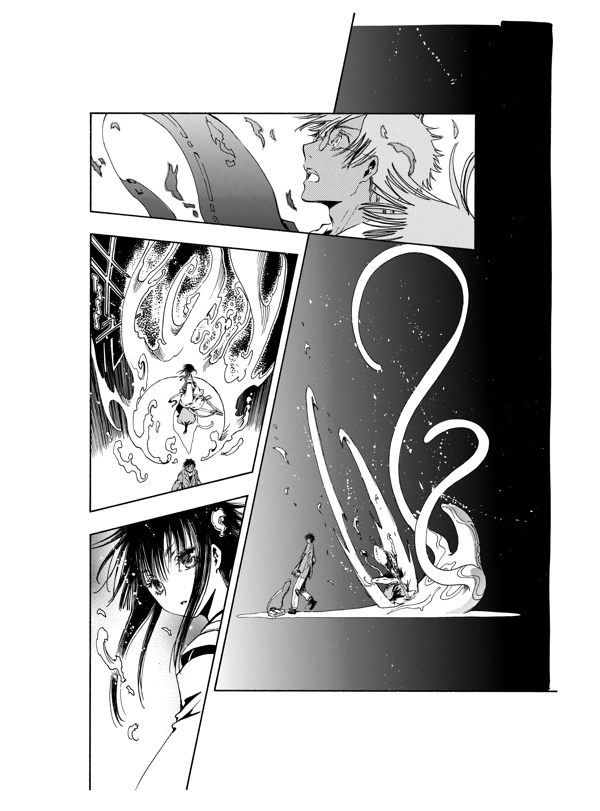
I have good news and bad news for CLAMP fans. The good news is that Gate 7 is one of the best-looking manga the quartet has produced, on par with Tsubasa: Reservoir Chronicles and xxxHolic. The bad news is that Gate 7‘s first volume is very bumpy, with long passages of expository dialogue and several false starts. Whether you’ll want to ride out the first three chapters will depend largely on your reaction to the artwork: if you love it, you may find enough visual stimulation to sustain to your interest while the plot and characters take shape; if you don’t, you may find the harried pacing and repetitive jokes a high hurdle to clear.

Art-wise, Gate 7 most closely resembles Tsubasa. The character designs are elegantly stylized, rendered in delicate lines; though their proportions have been gently elongated, their physiques are less giraffe-like than the principle characters in Legal Drug and xxxHolic. The same sensibility informs the action scenes as well, where CLAMP uses thin, sensual linework to suggest the energy unleashed during magical combat. (Readers familiar with Magic Knight Rayearth will see affinities between the two series, especially in the fight sequences.) Perhaps the most striking thing about the artwork is its imaginative use of water and light to evoke the supernatural. As Zack Davisson observes in his review of Gate 7, CLAMP uses a subtle but lovely image to shift the action from present-day Kyoto to the spirit realm, depicting the characters as stones in the water, with soft ripples radiating outward from each figure.

The story, however, is less satisfying. The plot revolves around high school student Chikahito Takamoto, a timid dreamer who’s obsessed with Kyoto as a place of “history, ancient arts, temples, and shrines.” While exploring the Kitano Tenmangu Shrine, Chikahito is transported to an alternate dimension, where he encounters three warriors: Sakura, Tachibana, and Hana, an androgynously beautiful, child-like figure who possesses even greater spiritual power than the other two. Chikahito watches the trio dismantle a ribbon-like serpent, but before he can question what he’s seen, poof! he finds himself eating noodles with them in a Kyoto apartment as Sakura and Tachibana debate the ethics of erasing Chikahito’s memory.

Hana astonishes Chikahito with an awesome display of power.

The biggest problem with this introductory section is that the subsequent chapter traces a nearly identical trajectory: Chikahito returns to Kyoto, encounters Hana in the streets, then is whisked onto the spirit-plane for another round of magical combat. As soon as the monster is defeated, Chikahito once again finds himself eating a meal with Hana, Sakura, and Tachibana. (This time around, however, they gang-press him into cooking and cleaning for them.) CLAMP even recycles the same gags from the prelude: Hana’s fragile appearance belies a monstrous appetite for noodles, an incongruity CLAMP mines for humor long past the point of being funny.

Other problems prevent Gate 7 from taking flight in its early pages. As we begin to learn more about the Kitano Tenmagu Shrine, for example, various characters take turns explaining its history. These narratives are clearly intended to set the table for a more complex plotline, but have the unintended consequence of stopping the story dead in its tracks. The script also makes some maddening detours into mystical clap-trap; in trying to understand how the seemingly ordinary Chikahito can enter the supernatural realm, characters lapse into Yoda-speak. “We’re alike,” Hana informs Chikahito. When asked, “In what areas?” Hana cheerfully replies, “In areas that are… ‘not.’ Where he’s the same is… ‘not.'”

The most disappointing aspect of Gate 7 is the flimsiness of the characterizations. CLAMP seems to be relying on readers’ familiarity with other titles — Cardcaptor Sakura, Chobits, Tsuaba, xxxHolic — in establishing each character’s personality and role in the drama. Hana, for example, slots into the Mokona role: Hana refers to himself (herself?) in the third person, repeats pet phrases, and behaves like a glutton, yet proves surprisingly powerful. Chikahito, on the other hand, is a carbon copy of xxxHolic‘s Watanuki, a nervous, bespectacled everyman who unwittingly becomes the housekeeper and magical errand-boy for more supernaturally gifted beings. The frantic pace and abrupt transitions between the mundane and supernatural world further complicate the process of establishing Hana and Chikahito as individuals; with so much material stuffed into the first two hundred pages, CLAMP leans too heavily on tics and mannerisms to carry the burden of the characterization. (Cute finger-wagging does not a character make.)

The dramatic introduction of a new character in the volume’s final pages suggests that CLAMP may finally be hitting its stride in chapter four. As promising as this development may be, I can’t quite shake the feeling that I’m reading a Potemkin manga, all surface detail and no depth. Let’s hope volume two proves me wrong.

GATE 7, VOL. 1 • BY CLAMP • DARK HORSE • 192 pp. • NO RATING

Filed Under: Manga, Manga Critic, REVIEWS Tagged With: clamp, Dark Horse, Gate 7, Kyoto

Gate 7, Vol. 1

October 21, 2011 by Katherine Dacey 23 Comments

I have good news and bad news for CLAMP fans. The good news is that Gate 7 is one of the best-looking manga the quartet has produced, on par with Tsubasa: Reservoir Chronicles and xxxHolic. The bad news is that Gate 7‘s first volume is very bumpy, with long passages of expository dialogue and several false starts. Whether you’ll want to ride out the first three chapters will depend largely on your reaction to the artwork: if you love it, you may find enough visual stimulation to sustain to your interest while the plot and characters take shape; if you don’t, you may find the harried pacing and repetitive jokes a high hurdle to clear.

Art-wise, Gate 7 most closely resembles Tsubasa. The character designs are elegantly stylized, rendered in delicate lines; though their proportions have been gently elongated, their physiques are less giraffe-like than the principle characters in Legal Drug and xxxHolic. The same sensibility informs the action scenes as well, where CLAMP uses thin, sensual linework to suggest the energy unleashed during magical combat. (Readers familiar with Magic Knight Rayearth will see affinities between the two series, especially in the fight sequences.) Perhaps the most striking thing about the artwork is its imaginative use of water and light to evoke the supernatural. As Zack Davisson observes in his review of Gate 7, CLAMP uses a subtle but lovely image to shift the action from present-day Kyoto to the spirit realm, depicting the characters as stones in the water, with soft ripples radiating outward from each figure….

Read More

Filed Under: Manga Critic Tagged With: clamp, Dark Horse, Gate 7, Kyoto

Sayonara, Zetsubou-sensei: The Power of Negative Thinking, Vols. 1-10

October 21, 2011 by Michelle Smith

By Koji Kumeta | Volumes 1-8 published by Del Rey, Volumes 9-10 published by Kodansha Comics

When I first set out to read Koji Kumeta’s Sayonara, Zetsubou-sensei, my goal was to finish the first eight volumes in time for Kodansha’s June 2011 release of volume nine.

You can see how well that worked out.

The problem was that this series simply doesn’t benefit from a marathon read. After four volumes, I burnt out and switched to reading it a chapter at a time as the mood struck me. Obviously, it took a lot longer this way, but turned out to be the ideal manga to read on breaks at work or while sitting around in the lobby of the doctor’s office. Interestingly, I found the most recent volumes to be so good that devouring them in their entirety was no problem at all!

There’s not a whole lot of plot to Zetsubou-sensei. Nozomu Itoshiki, the fourth son of a wealthy family, is a high school teacher with a penchant for nineteenth century garb. The title of the manga refers to the fact that when the characters of his name are written too closely together, they can be read as “zetsubou,” or “despair.” Which is convenient, since despairing over various things (and occasionally trying to kill himself) is Itoshiki’s specialty. His class is full of a variety of quirky students, whom we meet gradually, including a girl who sees everything positively, a methodical and precise (and possibly homicidal) girl, a girl who speaks only in text messages, a stalker, a fujoshi, an impoverished housewife, etc. We also meet a few members of his family, including his brother Mikoto, a doctor whose name can be read as “zetsumei,” or “certain death.”

Each chapter follows more or less the same pattern: the first couple of pages establish where the characters are, then something sets Itoshiki off on a rant. (For example, a hinamatsuri display inspires a diatribe about heirarchical societies.) Eventually he spews out a list of items that correspond to the topic of the day. Then the positive girl (Kafuka) will put forth a different opinion and, a couple of pages later, the chapter ends. As I’ve described it, this sounds tedious, but it’s often quite clever and absurd.

Some chapters are more Japanese-centric than others, with copious references to entertainers and public figures or topics specific to Japan, like tanabata or fukubukuro. These can be somewhat less fun to read, especially in earlier volumes when the (admittedly thorough) end notes provide so much information that one ends up reading the book with a finger permanently lodged in the back to reference the explanation as needed. With a change in translator for volume five, most of these notes disappeared.

At first, I was bothered by knowing there were all sorts of references I was missing, but in the end I think I prefer to just cope with ignorance; it helps that more recent volumes have dealt with some universal topics like dream endings, assumptions, jokes you’ve heard a million times, how we perceive the passage of time, modern conveniences leading to inconvenience (“Thanks to Amazon,com, we’ve got piles of books that we haven’t had time to read”), skewed priorities, gifts you feel obliged to accept, and getting sucked into other people’s drama. Somewhat to my surprise, it feels like we’re beginning to learn a little bit more about the characters, as well.

In addition to following the established formula in terms of chapter progression, there are also several recurring gags in Zetusbou-sensei. I’m not very fond of the poor dog with a stick in its butt who appears on occasion, but the creative ways Kumeta finds to insert a panty shot from a particular character are kind of fun, and I’m quite fond of Itoshiki’s stalker, Matoi, who suddenly pops up in the middle of scenes, surprising the characters. “You were here?” And the way in which the characters continue to fail eleventh grade and must repeat it pokes fun at those series—Ouran High School Host Club is the most notorious example to come to mind—where seasons pass but the characters inexplicably fail to graduate.

Artistically, Sayonara, Zetsubou-sensei has a very unique look. Kumeta uses very little screen tone, and all of his characters (except one) have pitch-black hair and eyes. There are many girls in the cast, but they all have distinctive hairstyles. Even if I can’t remember someone’s name, her hairstyle will clue me in. “Oh, that’s the delusional self-blaming girl!” Kumeta’s got a recurring trick for page layout too: frequently, a character will be drawn full-length to one side of the page and depicted with extremely skinny ankles and extremely large feet. In more recent volumes it seems that facial closeups are happening more often, or that characters are being viewed from some new angles, which is a welcome development.

On the whole, I enjoyed Sayonara, Zetsubou-sensei a great deal. I felt that it improved as it went along, and I look forward to remaining current with the series henceforth. It may not have made me laugh aloud continuously, but it was always amusing enough to make me smile, and it’s to its credit that it was still capable of making me giggle in its 100th chapter.

Sayonara, Zetsubou-sensei: The Power of Negative Thinking was originally published in English by Del Rey, who put out the first eight volumes, but is now being published by Kodansha Comics. The series is ongoing in Japan; volume 27 came out there earlier this week.

Review copies for volumes five, seven, eight, and ten provided by the publisher.

Filed Under: REVIEWS Tagged With: del rey

Drifting Net Café, Vol. 1

October 21, 2011 by Sean Gaffney

By Shuzo Oshimi. Released in Japan by Futabasha, serialized in the magazine Manga Action. Released in the United States by Futabasha on the JManga website.

Of all the titles released so far by JManga, no magazine has more examples of its wares than Futabasha’s seinen magazine Manga Action. It’s a bi-weekly magazine that caters to the same sort of reader as all of the ‘Young’ magazines, which is to say each edition features a hot Japanese gravure model on the cover. Now, to be fair, the content is just as varied as any other magazine for men. You have bento manga, medical manga, sports manga, and even Star Protector Dog. That said, you also have manga about guys trapped in loveless marriages who end up with the hot girl of their dreams.

Drifting Net Café stats off with this basic plot. Toki is a salaryman with a pregnant wife, and is dissatisfied with how he got there. Yukie, his wife, is having mood swings; he’s incredibly horny but unable to have sex; and he keeps thinking about the girl he had a crush on in high school, whom he hasn’t seen since then. Then one day as it’s raining he goes into a net café to ride it out, and runs into none other than his old crush!

So far so normal, and the entire first volume is set up so that you’re supposed to root for the adultery. Yukie is cute, and he loves her in that ‘yeah, whatever’ sort of way, but with Tohno it’s clear he still has chemistry and an undefinable spark. Unfortunately, they can’t immediately hook up because the café they’re in is suddenly transported to the middle of a hostile swampy desert in the middle of nowhere.

Yes, that’s right, this isn’t just an adulterous salaryman romance manga, it’s also a takeoff on Kazuo Umezu’s classic horror title The Drifting Classroom. Instead of children, we have bored and jaded young twenty-somethings cast adrift, and the conflict between then erupts almost immediately. We’re only one volume in, so we don’t really get to know the whole cast, but the characters we’ve seen get in the spotlight have issues. I honestly can’t even remember their names, I define them by their roles. The huge guy with some sort of rage disorder. The shallow girl who whines about wanting to go home. The psycho guy.

Speaking of the psycho guy, this is another manga rated M for mature. For most of the volume, that’s due to the occasional bout of violence, with folks beating up other folks because they’re all confused at being transported from Tokyo to a strange swamp in the middle of nowhere. Then right at the end, one of the meek characters, who’s been bullied by his boss since the start, goes nuts. He stabs his boss with a penknife, then grabs the shallow girl and forces her to go down on him at knifepoint. It’s as sordid as it sounds, and made me feel ill. Then another guy pulls out a taser… and that’s our cliffhanger. Didn’t take long for morality to erode, much like its older counterpart.

So we’ve got a wannabe cheating hero, a heroine who through one volume is still somewhat faceless (in flashbacks, she’s shown to be the cool mysterious beauty, but in the present she seems very passive), a lot of violence, and we end with sexual assault. Is there something to like about this title? Well, it’s certainly very good at setting a mood. From the moment we enter the net café, there’s a creeping feeling of horror that is conveyed very well on the page. I’m just… not sure I want to read the mood that this story is good at setting. If you want to see a horror/mystery title with a side of sex and violence, this may be for you. As for me, it lost me by the final chapter.

Filed Under: REVIEWS

  • « Go to Previous Page
  • Page 1
  • Page 2
  • Page 3
  • Page 4
  • Interim pages omitted …
  • Page 7
  • Go to Next Page »
 | Log in
Copyright © 2010 Manga Bookshelf | Powered by WordPress & the Genesis Framework