• Skip to primary navigation
  • Skip to main content
  • Skip to primary sidebar
  • Home
  • About Us
    • Privacy Policy
    • Comment Policy
    • Disclosures & Disclaimers
  • Resources
    • Links, Essays & Articles
    • Fandomology!
    • CLAMP Directory
    • BlogRoll
  • Features & Columns
    • 3 Things Thursday
    • Adventures in the Key of Shoujo
    • Bit & Blips (game reviews)
    • BL BOOKRACK
    • Bookshelf Briefs
    • Bringing the Drama
    • Comic Conversion
    • Fanservice Friday
    • Going Digital
    • It Came From the Sinosphere
    • License This!
    • Magazine no Mori
    • My Week in Manga
    • OFF THE SHELF
    • Not By Manga Alone
    • PICK OF THE WEEK
    • Subtitles & Sensibility
    • Weekly Shonen Jump Recaps
  • Manga Moveable Feast
    • MMF Full Archive
    • Yun Kouga
    • CLAMP
    • Shojo Beat
    • Osamu Tezuka
    • Sailor Moon
    • Fruits Basket
    • Takehiko Inoue
    • Wild Adapter
    • One Piece
    • After School Nightmare
    • Karakuri Odette
    • Paradise Kiss
    • The Color Trilogy
    • To Terra…
    • Sexy Voice & Robo
  • Browse by Author
    • Sean Gaffney
    • Anna Neatrour
    • Michelle Smith
    • Katherine Dacey
    • MJ
    • Brigid Alverson
    • Travis Anderson
    • Phillip Anthony
    • Derek Bown
    • Jaci Dahlvang
    • Angela Eastman
    • Erica Friedman
    • Sara K.
    • Megan Purdy
    • Emily Snodgrass
    • Nancy Thistlethwaite
    • Eva Volin
    • David Welsh
  • MB Blogs
    • A Case Suitable For Treatment
    • Experiments in Manga
    • MangaBlog
    • The Manga Critic
    • Manga Report
    • Soliloquy in Blue
    • Manga Curmudgeon (archive)

Manga Bookshelf

Discussion, Resources, Roundtables, & Reviews

vertical

Knights of Sidonia, Vol. 2

June 13, 2013 by Anna N

Knights of Sidonia, Volume 2 by Tsutomu Nihei

As I was reading the second volume of Knights of Sidonia, it occurred to me that Nihei ably manages a narrative balancing act of giving the reader just a little bit more information in each volume, but not so much that everything feels completely filled in. My curiosity about the history of Sidonia was fulfilled with a bit of backstory about why the massive ship seems to be moving through space alone, isolated except for occasional attacks by the Guana. I’m still intrigued to learn more about Nagate Tanikaze and why he happens to be so good (in a somewhat bumbling way) at piloting the Tsugumori. He also seems to be continually singled out by those in command.

I enjoy the general sense of scale expressed with the illustrations of interior of the giant spaceship – it does really seem massive. The human cost that occurs when it has to maneuver itself suddenly makes it clear that even safely inside a spaceship death can come at any instant. Reading this manga, I get the sense that Nihei plans out all the details of his worlds very meticulously. One negative thing is that generally the characters in this manga suffer a bit from samefaceitius, making it sometimes difficult to sort out who is who absent any extreme differences in hairstyle. However, this is a minor quibble next to the general awesomeness of seeing the Guarde units fly through space in their ringed locked arm formation.

This is not a happy manga about giant space robots fighting aliens. The evolutionary capabilities of the Guana give some scenes a horror comic vibe, and bad things certainly happen to good people. But there’s enough humor in the strained interpersonal interactions of the people aboard the Sidonia that when finishing up a volume of this manga, I’m not feeling oppressed by tragedy but very interested to see what happens next.

Also, for those of you reading this manga solely for talking bear appearances, there is some talking bear in this volume!

Filed Under: REVIEWS Tagged With: knights of sidonia, vertical

Twinkle Twinkle

June 12, 2013 by Ash Brown

Author: Kaori Ekuni
Translator: Emi Shimokawa
U.S. publisher: Vertical
ISBN: 9781932234015
Released: May 2003
Original release: 1991
Awards: Murasaki Shikibu Literary Prize

Kaori Ekuni’s novel Twinkle Twinkle was the first of her works to be translated into English. Ekuni is both a bestseller and a literary award winner in Japan. Initially she wrote poetry and children’s stories before beginning to write for a more general audience. Twinkle Twinkle, originally published in Japan in 1991, was her debut novel and earned Ekuni the Murasaki Shikibu Literary Prize in 1992. Also in 1992, Twinkle Twinkle was adapted into a film directed by Joji Matsuoka. The novel was translated into English by Emi Shimokawa and published by Vertical in 2003. (Twinkle Twinkle was actually the first book ever to be released by Vertical.) Despite being a well-known and admired author in Japan, before reading Twinkle Twinkle I was unfamiliar with Ekuni and her work. After reading Twinkle Twinkle I sincerely hope that more of her writing is translated. Currently the only other novel by Ekuni available in English is God’s Boat.

Shoko and Mutsuki married four months after they first met, much to the delight of their respective parents who feared that their progeny would never find someone to spend the rest of their lives (and hopefully have children) with. Although Shoko and Mutsuki are pleased with their arrangement, each is hiding a secret from their new in-laws. Shoko is an alcoholic and emotionally unstable while Mutsuki is gay and continues to see his long-term boyfriend Kon. Shoko and Mutsuki care for each other, but their marriage is one of convenience more than anything else. They are each free to live their lives how they choose while at the same time are able to keep up appearances for their families. It seems like a perfect marriage as long as they can prevent their parents from discovering the farce. But during their first year together things begin to unravel. Neither Shoko or Mutsuki quite realize what all of the consequences of their marriage might actually be.

Each chapter of Twinkle Twinkle alternates between Shoko and Mutsuki’s individual perspectives. It’s a great technique that lets readers see both sides of their relationship and how they view each other. It also allows a glimpse into the newlyweds’ internal states of being. Throughout the novel it is clear that both Shoko and Mutsuki deeply care about the other. They’re not exactly romantically involved and they may not be having sex together, but they both want the other to be happy and work to make that happen. It’s not always easy, though. Both of them have habits that either baffle or annoy the other and they’re not always sure what to do about it. As Twinkle Twinkle and the first year of their marriage progresses Shoko becomes increasingly unstable—anxious that she isn’t able to adequately fulfill her role. As for Mutsuki, as wonderful as he can be, he’s unable to ease Shoko’s fears; his kindness often makes matters worse.

Twinkle Twinkle is a very peculiar love story between two incredibly imperfect people. But it’s Shoko and Mutsuki’s faults and flaws that make the novel as effective as it is. No marriage is perfect and even a fake one takes a tremendous amount of effort to maintain. To make matters even more complicated there’s Kon, who at times is on better terms with Shoko than he is with Mutsuki. Kon is extremely important to both of them as well as to the story itself. Together Kon, Shoko, and Mutsuki form an intense triangle with relationship dynamics crucial to their development as people and to the development of the novel. Twinkle Twinkle is fairly light in its tone and is immensely readable, but Ekuni still manages to pack several hard-hitting punches into the narrative. Personally, I loved Twinkle Twinkle. It’s one of the best novels that I’ve read recently and I can easily see myself reading it again.

Filed Under: REVIEWS Tagged With: Kaori Ekuni, Murasaki Shikibu Literary Prize, Novels, vertical

Mobile Suit Gundam: The Origin, Vol. 1

April 9, 2013 by Anna N

Mobile Suit Gundam: The Origin Volume 1 by Yoshikazu Yasuhiko

It has been a long long time since I’ve encountered the Gundam franchise. I’m familiar with the basic story, but the Gundam that made a big impression on me wasn’t the first series but Zeta Gundam, which I watched back in the day when people’s only access to anime was attending random university-affiliated clubs that showed fansubbed VHS tapes. I don’t even remember very much about Zeta Gundam other than the fact that young teenage me thought it was awesome. Most anime mecha featuring protagonists with daddy issues owe a lot to the original Gundam series, so it was fun to experience it again through this manga interpretation.

Mobile Suit Gundam: The Origin opens with a glimpse of a future where the human race has a tenuous hold on life in outer space. Humans have migrated to space colonies, which are now gripped in a civil war as the colony Zeon has decided to become independent. Amuro Ray is the young teenage protagonist, and while he does fit in generally with the type of character the reader would expect to see, he’s still interesting and sympathetic. He’s a moody teenage boy who spends his spare time neglecting to clean his room and hacking into his father’s work computer. His father is a scientist who has invented a new type of Zaku (mechanized battle suit). Amuro is out with his friend Fraw when their colony is attacked by Zeon fighters. Amuro stumbles across the unmanned Gundam prototype that he recognizes from his father’s plans and he throws himself into the defense of his colony. Amuro changes from frightened to angry when he sees the civilians under attack, and he stumbles through his first battle aided more by the Gundam’s advanced capabilities than his own skill.

One of the interesting things about Mobile Suit Gundam is the way the story doesn’t only focus on giant battle robots with light sabers fighting each other. The military ship protecting the colony has to take on a large influx of civilian refugees. Amuro is installed as the pilot of the Gundam, and Fraw starts helping out with the civilians. Char Aznable, the masked commander who is the Zeon ace pilot is the Red Baron to Amuro’s Snoopy, but Char is dealing with his own troubles related to the way he keeps losing Zaku that go up against the Gundam prototype. Char’s skills as a pilot outmatch Amuro, but he seems to enjoy the challenge provided by the advanced weaponry of the Gundam. As Char and Amuro clash, Char is toying with the young pilot in a gleeful way that makes him a very entertaining villain. In addition to the growing rivalry between Char and Amuro, there’s a well-developed supporting cast. I was particularly fond of Sayla, whose imperious attitude and willingness to brandish a gun were a good contrast to Fraw’s more gentle personality. Seeing Bright struggle with his new command responsibilities as well as Amuro’s issues with dealing with military protocol helped enhance the general sense of the story taking place in a larger society, where the civilian and military points of view were often at odds even in the middle of a war.

I had a pleasant jolt of nostalgia as I was reading when I encountered dialog like “Release the Minovsky particles at battle density!” and to and was able to experience again what an intriguing antagonist Char Aznable is. This is without a doubt one of the nicest manga volumes I’ve owned, since Vertical chose to print this in an oversized hardcover format with glossy paper. This is a must buy for any past and present Gundam fans, and if you haven’t encountered the franchise before, I’m betting this manga will win you over. I’m actually happy that I don’t remember the exact details of this story so I can be pleasantly surprised as the story unfolds in the next three volumes.

Filed Under: REVIEWS Tagged With: mobile suit gundam, vertical

Paradise Kiss, Vols. 2 and 3

March 31, 2013 by Anna N

I was very happy to have the chance to experience this great series again in the new editions from Vertical. Paradise Kiss is one of the most emotionally nuanced josei manga that I’ve read, and these gorgeous oversized editions make it possible to appreciate Ai Yazawa’s art. One of the reasons why I like this series so much is that for a manga about a group of fashion kids putting on a show, it manages to explore the subject of love in an extremely unromanticized way. Beginning model Yukari is beginning to go through a process of self-examination, deciding for herself what her priorities in life are. She’s pushed to this in part by George, who is one of my favorite romance manga leading men, just because he’s so atypical. Bisexual, ruthless and driven to produce his vision of haute couture fashion, George is showing Yukari a new world but he doesn’t have the emotional sensitivity to be a 17 year old girl’s first love. Add in a wonderful supporting cast in the form of cross-dresser Isabella, the punked-out Arashi and painfully cute Miwako, and the reader of Paradise Kiss gets a manga masterwork.

The second volume shows Yukari deciding to drop out of school. Seeing the ParaKiss team work together to create something meaningful has made the deficiencies in her own life far to clear. Yukari has been dedicating her life to studying due to her mother’s ambitions, and she wants to put school aside and work until she figures out what she wants to do. She ends up running away from home when her mother is less than thrilled with her new life plan. The ParaKiss team is dismayed, but somewhat supportive. George intones “Even if you end up in hell, I refuse to take any responsibility.” Yukari ends up staying at Arashi’s place while he visits his home, and this entire volume shows how sincere and well-meaning he is. Yukari and George end up becoming closer and she moves in with him, but she’s too restless to enjoy lounging around his apartment all day. She looks around for work and helps out with the dress for the big fashion show. The only person from Yukari’s old life who seems to be concerned about her absence from school is Miwako and Arashi’s old friend Tokumori.

There’s more dramatic tension in Yukari and George’s romance, because it is clear from the start that things aren’t going to work out. Yukari is too anxious, trying to meld her personality to reflect her idea of George’s ideal woman, and while George cares for her, he has the self-involvement of a true artist. His work will always come first. Even while Yukari tries to cling on to George, she knows that they are going to end up being incompatible.

Everything turns bittersweet in the concluding volume of the series, as Yukari begins to launch herself into a modeling career, and the ParaKiss group prepares their showstopping dress. Preparing for the show isn’t going all that smoothly as Yukari starts having health issues and difficulty dealing with jealousy when one of George’s old classmates comes back for a visit. There’s a general sense that everything is going to end one way or another after the show. George is making unsuccessful attempts to launch Paradise Kiss as a label, and having difficulty. If the label can’t sustain them, everybody is going to have to split up and get jobs separately. In a more conventional manga, the show would happen, George would get a grand prize for his dress, and everybody would live happily ever after. Paradise Kiss explores the fashion world in a much more realistic manner. While Yukari is tall, she lacks the towering height of a supermodel. George’s own elaborate sense of aesthetics is holding him back from the type of commercial creations that a successful fashion label would require, but he’s not going to compromise his vision. Yukari and George’s relationship goes from a whirlwind of love to a relationship where they’re both burdened by each other’s expectations.

What makes Paradise Kiss so interesting as a romance manga is that so much time is spent exploring the reasons Yukari and George are going to split up. The book basically takes place entirely in Yukari’s head, so it is easy for the reader to be just as uneasy as she is about George’s true feelings. When his grand romantic gesture comes at the end of the series, it is easy to see just how much he cared for her. Paradise Kiss had a very satisfying and realistic ending, which elevates it among most romance manga. It is rare for me to feel like all the aspects of an emotional story arc were fully explored, but Yazawa is just that good. Reading Paradise Kiss again made me pine for more Nana or the possibility of a Gokinjo Monogatari translation. The oversized volumes make it possible to appreciate all the intricate details of the fashion-centric world the characters inhabit. These great editions from Vertical deserve a place on any manga fan’s shelf.

Filed Under: REVIEWS Tagged With: paradise kiss, vertical

Knights of Sidonia, Vol. 1

March 17, 2013 by Anna N

Knights of Sidonia, Vol 1 by Tsutomu Nihei

I was excited to see that Vertical was releasing Nihei’s Knights of Sidonia, because I greatly enjoyed Biomega. As I was reading this manga, I realized that there really is a dearth of giant mecha manga being published in English. One viewing of the Evangelion anime was enough for me, so I haven’t been following the various manga spinoffs. Most shonen seems to be more of the monster of the week/fantasy variety now, and it wasn’t until I was reading Knights of Sidonia that I realized how much I missed GIANT ROBOTS FIGHTING IN SPACE!

Nihei’s manga centers on Nagate Tanikaze, a human on the seed spaceship Sidonia which is carrying humanity away from the destruction of the solar system by aliens called Guana. Nagate lives in an underground area, sharing his cramped apartment with his grandfather’s corpse and spending his time training in an alien combat simulation fighter. The human race has been split to an extent, with most opting for a procedure that allows them to photosynthesize. Nagate still needs regular human food and he is captured by others on the spaceship when he ventures out for rice. Nagate begins to assimilate into current human society, and he gets signed up to pilot a Garde – the mecha who fight the Guana that attack the Sidonia. Nagate is socially awkward but seems to have an odd ability to tolerate pain and heals up very quickly. Being a regular human might give him a bit of an edge over his modified compatriots?

As Nagate trains to fight he meets Izana, a human who can be both genders. He also meets a variety of photosynthesizing clones. Nagate’s isolation causes him to be several years behind with recent developments, but he throws himself into piloting the Tsugumori, the Guarde unit he is assigned to. There isn’t anything else going on with his life. The space battles are where a horror element comes in as the semi-sentient Guana can shift their shapes, even taking on the outward appearance of a human that they’ve killed. They’re blobby and somewhat fetus-like, if a fetus was a giant shifting alien.

One of the things I like about Nihei’s work is that he tells a compelling story without over-explaining everything. I’m getting to the point where having an origin spelled out in the first couple chapters of a manga starts making my eyes glaze over, but Knights of Sidonia manages to be intriguing without being frustrating. I’m interested to find out more about the human society on the Sidonia, the reasons for Nagate’s previous exile, and to learn more about his progress as a Guarde pilot. Knights of Sidonia doesn’t yet have some of the great desolate scenes of beauty that I enjoyed so much in Biomega, but one of the things I enjoy about Nihei’s art is his ability to convey scale and space in his backgrounds. When Nagate falls through a hole into an enormous rice storage bin, it is easy to get a sense of just how massive the Sidonia is.

Most importantly for fans of Biomega, there is a talking bear in Knights of Sidonia. She doesn’t have a machine gun yet, but she does have an artificial arm. Seriously, a talking bear in outer space with an artificial arm is reason enough to buy this manga, and all the great mecha/alien battle scenes and Nagate’s journey are really just a bonus.

Filed Under: REVIEWS Tagged With: knights of sidonia, talking bears, vertical

Limit, Vol. 1

September 28, 2012 by Katherine Dacey 2 Comments

“The world doesn’t suffer fools or fugly people” — so says Sakura, the most popular student in class 2-4. Sakura is a classic Alpha Girl: pretty, manipulative, and confident that at fifteen, she’s discovered the secret to being successful. (“Both studies and make-up. They’re real important for enjoying life, you know?” she informs her pal Konno.) Though Sakura’s friends may not like her, they recognize her power and follow her example; when Sakura declares that the awkward, quiet Arisa Morishige should “die,” Sakura’s friends are all too quick to agree.

The dynamic between Sakura’s clique and Morishige is dramatically reversed, however, on an annual school trip to “exchange camp,” where second-year students spend a week roughing it in a rural setting. En route to camp, a bus accident kills most of the class, leaving a handful of survivors stranded in the wilderness. The remaining members of Sakura’s clique soon discover that their nasty antics have demoted them from the A-list to the D — a demotion that, in their new, desperate circumstances, has potentially deadly consequences.

In a more cynical frame of mind, I might describe Limit as “Lord of the Flies with chicks,” but that cheeky brush-off doesn’t quite do justice to Keiko Suenobo’s story. Her principal characters are just as concerned with survival as William Golding’s private-school boys were, but the girls’ internal power struggles are less a exploration of Hobbesian philosophy than an extreme dramatization of the cliquish behavior found in Japanese high schools. In other words, it’s Mean Girls… with weapons.

Entertaining as that sounds, Limit suffers from a crucial flaw: Konno, the narrator, isn’t very interesting, as her primary role is to be an inoffensive reader surrogate. Konno is pretty and smart enough to be a member of Sakura’s clique, but passive enough that her behavior won’t elicit criticism from most readers; Konno is never portrayed as a ringleader or enthusiastic participant in Morishige’s degradation, though she clearly joined Sakura in harassing Morishige. That’s a mistake, I think, because it permits the reader to side too readily with Konno when the tables are turned, ignoring the fact that Morishige’s rage stems from being bullied on a daily basis by Sakura and Konno.

The other survivors are a more compelling lot, even if each neatly slots into a well-established role: The Principled Outsider, The Timid Girl, The Frenemy. That Suenobo endows each of these girls with more humanity than those roles require is testament to her skill as a writer. Volume one’s most moving scene, for example, belongs to Ichinose, Sakura’s best friend. Though she and Konno have moved in the same social circles, the bus accident reveals that Ichinose views Konno as a rival for Sakura’s friendship. Ichinose’s desperation at being “traded in” for the smarter, prettier Konno is palpable, and the rawness of her angry confession is one of the few moments in the script that doesn’t feel like a rote portrayal of mean-girl politics.

Perhaps the strongest element of Limit is the artwork. Suenobo’s meticulous efforts to dramatize her characters’ inner turmoil reminds the reader that Limit ran in Bessatsu Friend, not Weekly Shonen Magazine. Konno and Ichinose scream and cry as lustily as any character in Cage of Eden, but Limit‘s characters register a much fuller range of emotions than just fear of being lost or eaten; Konno and her fellow survivors are by turns angry, jealous, gleeful, miserable, spiteful, bitter, remorseful, and fearful — of one another. By far the most dramatic example is Morishige, who morphs from cringing, sweaty scapegoat to demonic avenger; her once dull, shark-like eyes are suddenly animated with a fierce, nasty sense of purpose, and she moves with a speed and deliberation that surprise her classmates.

Suenobo also demonstrates a flair for staging action scenes. The bus accident is depicted in a brief but effective sequence that makes creative use of camera angles to suggest the severity of the crash. Likewise, Suenobo firmly establishes how desperate the girls’ situation really is; in a few carefully drawn panels, the reader readily grasps the geographic obstacles to rescue, from sheer cliff walls to impenetrable woods. That no one’s cell phone works feels like an unnecessary touch, given the care with which Suenobo sketches out the crash site and its environs.

If the story is, at times, a little uneven, or ungenerous to Morishige, Limit still shows considerable promise. Suenobo makes good use of her teen-survivor premise to explore the politics of bullying without being too mawkish. At the same time, however, Suenobo manages to write a scary thriller that’s sophisticated and suspenseful enough to sustain an adult’s interest; the story’s occasional Grand Guignol touches add a welcome dash of camp, preventing the story from sinking under the weight of its Very Important Message. I can’t imagine what will happen in volume two, but I’m looking forward to reading it… with the lights on. Recommended.

Review copy provided by Vertical, Inc. Volume one will be released on October 9, 2012.

LIMIT, VOL. 1 • BY KEIKO SUENOBO • VERTICAL, INC. • 176 pp.

Filed Under: Manga Critic Tagged With: Keiko Suenobo, Limit, shojo, vertical

Limit, Vol. 1

September 28, 2012 by Katherine Dacey

“The world doesn’t suffer fools or fugly people” — so says Sakura, the most popular student in class 2-4. Sakura is a classic Alpha Girl: pretty, manipulative, and confident that at fifteen, she’s discovered the secret to being successful. (“Both studies and make-up. They’re real important for enjoying life, you know?” she informs her pal Konno.) Though Sakura’s friends may not like her, they recognize her power and follow her example; when Sakura declares that the awkward, quiet Arisa Morishige should “die,” Sakura’s friends are all too quick to agree.

The dynamic between Sakura’s clique and Morishige is dramatically reversed, however, on an annual school trip to “exchange camp,” where second-year students spend a week roughing it in a rural setting. En route to camp, a bus accident kills most of the class, leaving a handful of survivors stranded in the wilderness. The remaining members of Sakura’s clique soon discover that their nasty antics have demoted them from the A-list to the D — a demotion that, in their new, desperate circumstances, has potentially deadly consequences.

In a more cynical frame of mind, I might describe Limit as “Lord of the Flies with chicks,” but that cheeky brush-off doesn’t quite do justice to Keiko Suenobo’s story. Her principal characters are just as concerned with survival as William Golding’s private-school boys were, but the girls’ internal power struggles are less a exploration of Hobbesian philosophy than an extreme dramatization of the cliquish behavior found in Japanese high schools. In other words, it’s Mean Girls… with weapons.

Entertaining as that sounds, Limit suffers from a crucial flaw: Konno, the narrator, isn’t very interesting, as her primary role is to be an inoffensive reader surrogate. Konno is pretty and smart enough to be a member of Sakura’s clique, but passive enough that her behavior won’t elicit criticism from most readers; Konno is never portrayed as a ringleader or enthusiastic participant in Morishige’s degradation, though she clearly joined Sakura in harassing Morishige. That’s a mistake, I think, because it permits the reader to side too readily with Konno when the tables are turned, ignoring the fact that Morishige’s rage stems from being bullied on a daily basis by Sakura and Konno.

The other survivors are a more compelling lot, even if each neatly slots into a well-established role: The Principled Outsider, The Timid Girl, The Frenemy. That Suenobo endows each of these girls with more humanity than those roles require is testament to her skill as a writer. Volume one’s most moving scene, for example, belongs to Ichinose, Sakura’s best friend. Though she and Konno have moved in the same social circles, the bus accident reveals that Ichinose views Konno as a rival for Sakura’s friendship. Ichinose’s desperation at being “traded in” for the smarter, prettier Konno is palpable, and the rawness of her angry confession is one of the few moments in the script that doesn’t feel like a rote portrayal of mean-girl politics.

Perhaps the strongest element of Limit is the artwork. Suenobo’s meticulous efforts to dramatize her characters’ inner turmoil reminds the reader that Limit ran in Bessatsu Friend, not Weekly Shonen Magazine. Konno and Ichinose scream and cry as lustily as any character in Cage of Eden, but Limit‘s characters register a much fuller range of emotions than just fear of being lost or eaten; Konno and her fellow survivors are by turns angry, jealous, gleeful, miserable, spiteful, bitter, remorseful, and fearful — of one another. By far the most dramatic example is Morishige, who morphs from cringing, sweaty scapegoat to demonic avenger; her once dull, shark-like eyes are suddenly animated with a fierce, nasty sense of purpose, and she moves with a speed and deliberation that surprise her classmates.

Suenobo also demonstrates a flair for staging action scenes. The bus accident is depicted in a brief but effective sequence that makes creative use of camera angles to suggest the severity of the crash. Likewise, Suenobo firmly establishes how desperate the girls’ situation really is; in a few carefully drawn panels, the reader readily grasps the geographic obstacles to rescue, from sheer cliff walls to impenetrable woods. That no one’s cell phone works feels like an unnecessary touch, given the care with which Suenobo sketches out the crash site and its environs.

If the story is, at times, a little uneven, or ungenerous to Morishige, Limit still shows considerable promise. Suenobo makes good use of her teen-survivor premise to explore the politics of bullying without being too mawkish. At the same time, however, Suenobo manages to write a scary thriller that’s sophisticated and suspenseful enough to sustain an adult’s interest; the story’s occasional Grand Guignol touches add a welcome dash of camp, preventing the story from sinking under the weight of its Very Important Message. I can’t imagine what will happen in volume two, but I’m looking forward to reading it… with the lights on. Recommended.

Review copy provided by Vertical, Inc. Volume one will be released on October 9, 2012.

LIMIT, VOL. 1 • BY KEIKO SUENOBO • VERTICAL, INC. • 176 pp.

Filed Under: Manga, Manga Critic, REVIEWS Tagged With: Keiko Suenobo, Limit, shojo, vertical

Sakuran

July 13, 2012 by Katherine Dacey

The oiran, or Japanese courtesan, is a product of seventeenth century Japan. Like the geisha who eclipsed them in popularity, the oiran were not simply prostitutes; they were companions and performers, trained in a variety of arts — calligraphy, music, flower arranging — and prized for their ability to converse with powerful men. Though confined to the official pleasure districts of Edo, Kyoto, and Osaka, they were highly visible, formally parading through the streets in elaborate costumes, attended by a retinue of maids. As a potent symbol of the new, hedonistic culture of urban Japan, the oiran were frequent subjects of ukiyo-e, or “floating world” prints. Artists such as Suzuki Harunobou emphasized the oiran’s refinement, the rarefied world in which they operated, and, in their more explicit shunga prints, the bodily pleasures they offered.

Moyocco Anno’s Sakuran presents a less romanticized image of the oiran, documenting one girl’s rise from maid to tayuu, or head courtesan. We first meet Kiyoha as an eight-year-old child: orphaned and undisciplined, she chafes against the strict rules inside Edo’s Tamagiku House, making several unsuccessful attempts to escape. Shohi, Kiyoha’s mistress, is one of the few people to recognize Kiyoha’s potential: not only is Kiyoha quick-witted, she also boasts a porcelain complexion and delicate facial features, both highly prized assets in a courtesan. Shohi’s method for grooming Kiyoha for her new role is less tutoring than hazing, however, a mixture of slaps, insults, and mind games designed to teach Kiyoha to behave in a more dignified fashion.

Anno’s artwork is uniquely suited to the subject matter: it’s both starkly ugly and exquisitely beautiful, capable of conveying the anger and suffering beneath Kiyoha’s carefully manicured appearance. When we first meet Kiyoha, for example, Anno draws her as a “dirty little turnip” with a snot-stained face, unkempt hair, and an ill-fitting yukata. Though Kiyoha undergoes a remarkable transformation over the course of the manga, we are frequently reminded of what she looked like when she first arrived at Tamagiku. Kiyoha’s face contorts into a grotesque, child-like mask whenever she feels wronged or vulnerable, and she frequently reverts to a feral posture when eating, as if her bowl might be snatched from her hands.

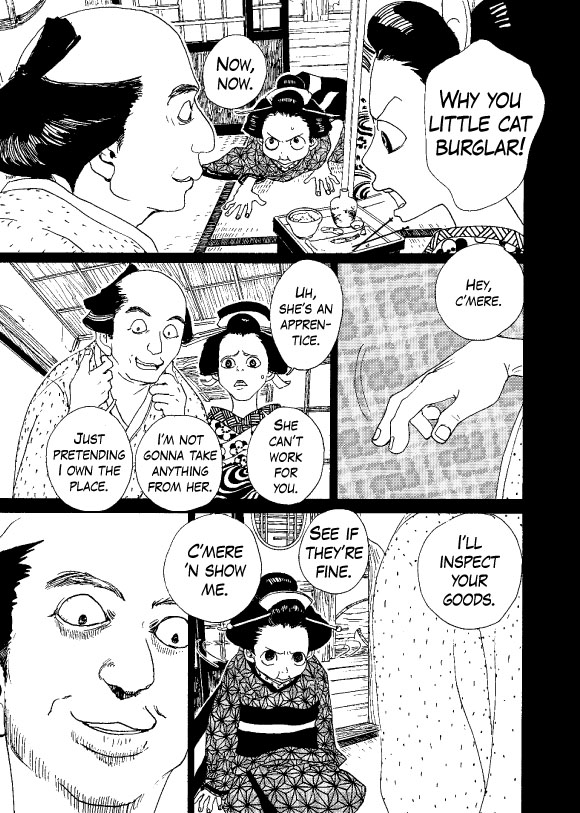
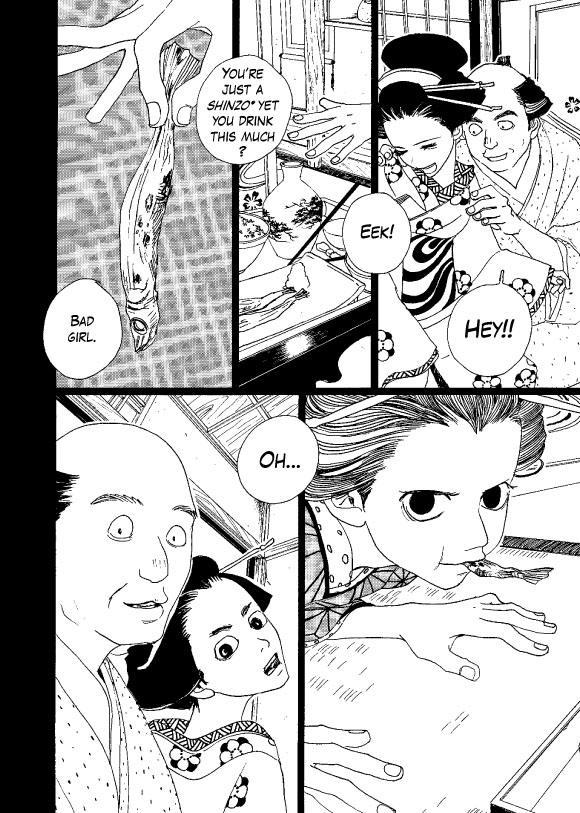
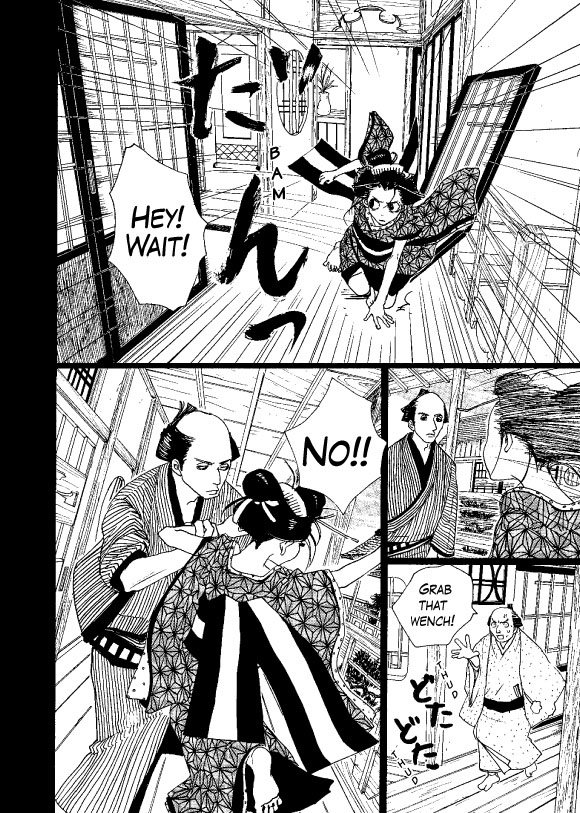
In this sequence, for example, twelve-year-old Kiyoha interrupts a transaction between a shinzu (the lowest ranking courtesan of the house) and a lecherous customer. Kiyoha’s motives for intervening are unclear, since her relationship with the shinzu in question is never carefully delineated. As she tussles with the customer, however, we see Kiyoha’s childhood survival instinct emerge in full force, overriding Shohi’s etiquette lessons:

One of the things this sequence also emphasizes is the discrepancy in power between the low-ranking courtesans and the house clientele; any violation of established protocol could result in severe reprisal. Anno infuses this scene with special urgency by using blunt, contemporary speech in lieu of the archaic language that verisimilitude might demand. It’s a welcome departure from the tortured, Fakespearian dialogue that plagues the otherwise brilliant Ooku: The Inner Chambers, focusing the reader’s attention on visual signifiers of class and gender — eye contact, body language, clothing — rather than honorifics and awkward syntax.

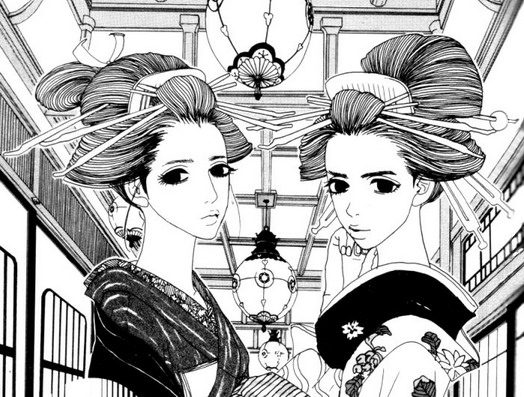
Perhaps Anno’s greatest achievement is her ability to capture her characters’ physical beauty and sensuality without reducing them to objects. Even the most erotic images are carefully framed as business transactions: the dialogue reminds us that the oiran are performing for their customers, creating an illusion of sexual and emotional intimacy for the sake of money, while their customers’ grim expressions and sweaty bodies remind us of their determination to get the most bang for the buck (so to speak).

If Sakuran sounds like a hectoring treatise on prostitution, rest assured it’s not. Anno creates a vibrant, fascinating world, teeming with people from every walk of life. Though her female characters have limited agency, they nonetheless find opportunities to exert influence over their customers, improve their social standing, and choose their own lovers.

Kiyoha embodies all the contradictions and complexities of her environment: she’s impetuous, competitive, and unmoved by her peers’ hardships, yet she has a great capacity for feeling — and transcending — pain. That Kiyoha is, at times, a repellant figure, does not diminish her appeal as a character; we appreciate the mental toughness that her job demands, and admire her efforts to push back against its limits. It seems only fitting that the story ends not with the outcome that a modern reader might choose for this fierce woman, but with one that reflects the heroine’s own clear-eyed understanding of what she is. Highly recommended.

Review copy provided by Vertical, Inc.

SAKURAN • BY MOYOCCO ANNO • VERTICAL, INC. • 308 pp. • RATING: MATURE (VIOLENCE, LANGUAGE, AND SEXUAL NUDITY)

Filed Under: Manga, Manga Critic, REVIEWS Tagged With: Moyocco Anno, Oiran, Sakuran, vertical

Sakuran

July 13, 2012 by Katherine Dacey 11 Comments

The oiran, or Japanese courtesan, is a product of seventeenth century Japan. Like the geisha who eclipsed them in popularity, the oiran were not simply prostitutes; they were companions and performers, trained in a variety of arts — calligraphy, music, flower arranging — and prized for their ability to converse with powerful men. Though confined to the official pleasure districts of Edo, Kyoto, and Osaka, they were highly visible, formally parading through the streets in elaborate costumes, attended by a retinue of maids.

As a potent symbol of the new, hedonistic culture of urban Japan, the oiran were frequent subjects of ukiyo-e, or “floating world” prints. Artists such as Suzuki Harunobou emphasized the oiran’s refinement, the rarefied world in which they operated, and, in their more explicit shunga prints, the bodily pleasures they offered.

Moyocco Anno’s Sakuran presents a less romanticized image of the oiran, documenting one girl’s rise from maid to tayuu, or head courtesan. We first meet Kiyoha as an eight-year-old child: orphaned and undisciplined, she chafes against the strict rules inside Edo’s Tamagiku House, making several unsuccessful attempts to escape. Shohi, Kiyoha’s mistress, is one of the few people to recognize Kiyoha’s potential: not only is Kiyoha quick-witted, she also boasts a porcelain complexion and delicate facial features, both highly prized assets in a courtesan. Shohi’s method for grooming Kiyoha for her new role is less tutoring than hazing, however, a mixture of slaps, insults, and mind games designed to teach Kiyoha to behave in a more dignified fashion.

Anno’s artwork is uniquely suited to the subject matter: it’s both starkly ugly and exquisitely beautiful, capable of conveying the anger and suffering beneath Kiyoha’s carefully manicured appearance. When we first meet Kiyoha, for example, Anno draws her as a “dirty little turnip” with a snot-stained face, unkempt hair, and an ill-fitting yukata. Though Kiyoha undergoes a remarkable transformation over the course of the manga, we are frequently reminded of what she looked like when she first arrived at Tamagiku. Kiyoha’s face contorts into a grotesque, child-like mask whenever she feels wronged or vulnerable, and she frequently reverts to a feral posture when eating, as if her bowl might be snatched from her hands.

In this sequence, for example, twelve-year-old Kiyoha interrupts a transaction between a shinzu (the lowest ranking courtesan of the house) and a lecherous customer. Kiyoha’s motives for intervening are unclear, since her relationship with the shinzu in question is never carefully delineated. As she tussles with the customer, however, we see Kiyoha’s childhood survival instinct emerge in full force, overriding Shohi’s etiquette lessons:

One of the things this sequence also emphasizes is the discrepancy in power between the low-ranking courtesans and the house clientele; any violation of established protocol could result in severe reprisal. Anno infuses this scene with special urgency by using blunt, contemporary speech in lieu of the archaic language that verisimilitude might demand. It’s a welcome departure from the tortured, Fakespearian dialogue that plagues the otherwise brilliant Ooku: The Inner Chambers, focusing the reader’s attention on visual signifiers of class and gender — eye contact, body language, clothing — rather than honorifics and awkward syntax.

Perhaps Anno’s greatest achievement is her ability to capture her characters’ physical beauty and sensuality without reducing them to objects. Even the most erotic images are carefully framed as business transactions: the dialogue reminds us that the oiran are performing for their customers, creating an illusion of sexual and emotional intimacy for the sake of money, while their customers’ grim expressions and sweaty bodies remind us of their determination to get the most bang for the buck (so to speak).

If Sakuran sounds like a hectoring treatise on prostitution, rest assured it’s not. Anno creates a vibrant, fascinating world, teeming with people from every walk of life. Though her female characters have limited agency, they nonetheless find opportunities to exert influence over their customers, improve their social standing, and choose their own lovers.

Kiyoha embodies all the contradictions and complexities of her environment: she’s impetuous, competitive, and unmoved by her peers’ hardships, yet she has a great capacity for feeling — and transcending — pain. That Kiyoha is, at times, a repellant figure, does not diminish her appeal as a character; we appreciate the mental toughness that her job demands, and admire her efforts to push back against its limits. It seems only fitting that the story ends not with the outcome that a modern reader might choose for this fierce woman, but with one that reflects the heroine’s own clear-eyed understanding of what she is. Highly recommended.

Review copy provided by Vertical, Inc.

SAKURAN • BY MOYOCCO ANNO • VERTICAL, INC. • 308 pp. • RATING: MATURE (VIOLENCE, LANGUAGE, AND SEXUAL NUDITY)

Filed Under: Manga Critic Tagged With: Moyocco Anno, Oiran, Sakuran, vertical

The Flowers of Evil, Vol. 2

July 10, 2012 by Katherine Dacey 12 Comments

Do you remember the first time you tried to impress someone on a date? I do: I was fifteen, and thrilled that an older boy had invited me to dinner. (He drove a Mazda two-seater and quoted lines from Wim Wenders’ Wings of Desire, which, in 1988, made him a god.) My strategy for wooing him was to describe, in excruciating detail, the nuances of Igor Stravinsky’s Petrushka, from the opening tableau to the final notes. I was convinced that if he could see my passion for something as dark and powerful as that ballet, he’d understand who I really was, and fall in love with that person. (Needless to say, we didn’t go on a second date.)

Kasuga, the earnest hero of The Flowers of Evil, finds himself in a similar situation at the beginning of volume two: Saeki, the classmate whom he’s loved from afar, has finally consented to go on a date with him. As they wander the aisles of his favorite bookstore, Kasuga confesses to Saeki that Baudelaire’s Fleurs du Mal “changed how I see the world. I felt as though I’d been an ignorant fool my whole life.”  It’s a cringe-inducing moment — not because Saeki mocks Kasuga, or recoils from him, but because Kasuga has exposed himself in such a clumsy, sincere, and godawful manner.

That sincerity is nearly his undoing. Throughout the volume, Nakamura goads Kasuga about Saeki, reacting with fury when Kasuga asks Saeki to enter into a “pure, platonic relationship” with him: how dare he pretend to be normal? Nakamura then redoubles her efforts to reveal Kasuga’s “perversion,” currying favor with Saeki while pouring poison in Kasuga’s ear. But to what end? The final scene of the manga offers some interesting, and surprising, hints at Nakamura’s true agenda while suggesting that Kasuga might, in fact, have more in common with her than he’d care to admit. I won’t reveal what happens, but will venture to say that “orgiastic” is an apt description of those last glorious, frenzied pages.

Review copy provided by Vertical, Inc.

THE FLOWERS OF EVIL, VOL. 2 | BY SHUZO OSHIMI | VERTICAL, INC. | 168 pp.

Filed Under: Manga Critic Tagged With: Flowers of Evil, Shonen, Shuzo Oshimi, vertical

The Flowers of Evil, Vol. 2

July 10, 2012 by Katherine Dacey

Do you remember the first time you tried to impress someone on a date? I do: I was fifteen, and thrilled that an older boy had invited me to dinner. (He drove a Mazda two-seater and quoted lines from Wim Wenders’ Wings of Desire, which, in 1988, made him a god.) My strategy for wooing him was to describe, in excruciating detail, the nuances of Igor Stravinsky’s Petrushka, from the opening tableau to the final notes. I was convinced that if he could see my passion for something as dark and powerful as that ballet, he’d understand who I really was, and fall in love with that person. (Needless to say, we didn’t go on a second date.)

Kasuga, the earnest hero of The Flowers of Evil, finds himself in a similar situation at the beginning of volume two: Saeki, the classmate whom he’s loved from afar, has finally consented to go on a date with him. As they wander the aisles of his favorite bookstore, Kasuga confesses to Saeki that Baudelaire’s Fleurs du Mal “changed how I see the world. I felt as though I’d been an ignorant fool my whole life.”  It’s a cringe-inducing moment — not because Saeki mocks Kasuga, or recoils from him, but because Kasuga has exposed himself in such a clumsy, sincere, and godawful manner.

That sincerity is nearly his undoing. Throughout the volume, Nakamura goads Kasuga about Saeki, reacting with fury when Kasuga asks Saeki to enter into a “pure, platonic relationship” with him: how dare he pretend to be normal? Nakamura then redoubles her efforts to reveal Kasuga’s “perversion,” currying favor with Saeki while pouring poison in Kasuga’s ear. But to what end? The final scene of the manga offers some interesting, and surprising, hints at Nakamura’s true agenda while suggesting that Kasuga might, in fact, have more in common with her than he’d care to admit. I won’t reveal what happens, but will venture to say that “orgiastic” is an apt description of those last glorious, frenzied pages.

Review copy provided by Vertical, Inc.

THE FLOWERS OF EVIL, VOL. 2 | BY SHUZO OSHIMI | VERTICAL, INC. | 168 pp.

Filed Under: Manga, Manga Critic, REVIEWS Tagged With: Flowers of Evil, Shonen, Shuzo Oshimi, vertical

The Flowers of Evil, Vol. 1

May 9, 2012 by Katherine Dacey 11 Comments

If you grew up in a small town, you probably knew someone like Takao Kasuga, the nebbish-hero of The Flowers of Evil. Kasuga is a precocious middle-schooler who copes with provincial life by burying his nose in a book. His peers tolerate him, but find him a little too smug and strange to be one of the guys. Kasuga, for his part, takes pride in his sophisticated reading habits, stashing poems in his desk and telling his classmates that they’re too stupid to appreciate his favorite writer, Charles Baudelaire.

In a moment of impulse, Kasuga steals the gym outfit of beautiful classmate Nanako Saeki — an act witnessed by Sawa Nakamura, the class outcast. Nakamura confronts Kasuga after school, threatening to expose him as the thief unless he complies with her requests. Her motives for blackmailing Kasuga are complex, a mixture of prurient interest in Kasuga’s sexual fantasies and sadistic delight in wielding power over a boy. At times Nakamura  physically dominates him — she punches and tackles him — and at times she manipulates him with humiliating tasks and questions.

I’d be the first to admit that the similarities between Flowers of Evil and Sundome — however superficial — predisposed me to dislike the book. I didn’t think I had the stomach for another story in which a ball-busting girl sexually and psychologically tortured a sad-sack boy. Yet Flowers of Evil proved a far more compelling and honest look at adolescent sexuality than Sundome, thanks, in large part, to Shuzo Oshimi’s sympathetic portrayal of Kasuga.

Throughout the book, author Shuzo Oshimi hints that Kasuga’s character was inspired by his own experiences as a book-toting misfit. “I read Baudelaire’s Flowers of Evil for the first time in middle school,” he explains at the end of chapter one. “I didn’t understand much of it, but the book’s feel — suspicious, indecent, yet nastily noble — made me think, I’m so cool for reading it.” Kasuga, too, clearly feels a sense of superiority for having discovered Baudelaire at a young age; in a fit of self-pity, he muses, “How many people in this town understand Baudelaire?” At the same time, however, he’s keenly aware that his peers think he’s weird. Kasuga may be mature enough to appreciate Baudelaire — or perhaps, more accurately, to think he understands Baudelaire — but he isn’t quite old enough to shake off his classmates’ teasing.

Oshimi also does an exceptional job of dramatizing Kasuga’s inner sexual turmoil. Early in the book, for example, Kasuga catches sight of Saeki. In a flash, he pictures her clad in gym clothes, blushing and telling him, “I love you.” His acute embarrassment at being discovered mid-reverie is all the more palpable for the way in which he’s drawn: Kasuga sinks into his chair, his shoulders slumped, brows furrowed, and body foreshortened, making him look like a moist ragdoll. In later chapters, Oshimi uses surreal imagery — a wall of eyes, a fun-house mirror, a giant sink hole — to suggest that Kasuga’s normal teenage discomfort with sexual feelings has become something more powerful and destructive: shame.

If Kasuga is a sympathetic character, Nakamura poses greater difficulties for the reader. She claims her true agenda is to expose him as a pervert, but nothing about Kasuga’s behavior indicates that he is; if anything, Kasuga is naive, torn between romantic and sexual ideas about love. (That he calls Saeki “my muse, my femme fatale, my Venus” suggests the extent of his confusion.) Nakamura, too, appears to wrestling with complicated sexual feelings; in several scenes, she hints at her own predilections, only to accuse Kasuga of harboring even nastier ones. In short, Nakamura seems intent on finding someone more self-loathing and sexually confused than she is, yet her behavior is so violent and manipulative it sometimes feels as if Oshimi is trying too hard to suggest her disaffection; Nakamura’s character veers dangerously close to being a symbol of castration anxiety, rather than an emotionally damaged teenage girl.

That said, The Flowers of Evil is a shockingly readable story that vividly — one might even say queasily — evokes the fear and confusion of discovering one’s own sexuality. Recommended.

THE FLOWERS OF EVIL, VOL. 1 • BY SHUZO OSHIMI • VERTICAL, INC. • 202 pp. • NO RATING (BEST FOR OLDER TEENS)

Filed Under: Manga Critic Tagged With: Flowers of Evil, Shonen, vertical

The Flowers of Evil, Vol. 1

May 9, 2012 by Katherine Dacey

If you grew up in a small town, you probably knew someone like Takao Kasuga, the nebbish-hero of The Flowers of Evil. Kasuga is a precocious middle-schooler who copes with provincial life by burying his nose in a book. His peers tolerate him, but find him a little too smug and strange to be one of the guys. Kasuga, for his part, takes pride in his sophisticated reading habits, stashing poems in his desk and telling his classmates that they’re too stupid to appreciate his favorite writer, Charles Baudelaire.

In a moment of impulse, Kasuga steals the gym outfit of beautiful classmate Nanako Saeki — an act witnessed by Sawa Nakamura, the class outcast. Nakamura confronts Kasuga after school, threatening to expose him as the thief unless he complies with her requests. Her motives for blackmailing Kasuga are complex, a mixture of prurient interest in Kasuga’s sexual fantasies and sadistic delight in wielding power over a boy. At times Nakamura  physically dominates him — she punches and tackles him — and at times she manipulates him with humiliating tasks and questions.

I’d be the first to admit that the similarities between Flowers of Evil and Sundome — however superficial — predisposed me to dislike the book. I didn’t think I had the stomach for another story in which a ball-busting girl sexually and psychologically tortured a sad-sack boy. Yet Flowers of Evil proved a far more compelling and honest look at adolescent sexuality than Sundome, thanks, in large part, to Shuzo Oshimi’s sympathetic portrayal of Kasuga.

Throughout the book, author Shuzo Oshimi hints that Kasuga’s character was inspired by his own experiences as a book-toting misfit. “I read Baudelaire’s Flowers of Evil for the first time in middle school,” he explains at the end of chapter one. “I didn’t understand much of it, but the book’s feel — suspicious, indecent, yet nastily noble — made me think, I’m so cool for reading it.” Kasuga, too, clearly feels a sense of superiority for having discovered Baudelaire at a young age; in a fit of self-pity, he muses, “How many people in this town understand Baudelaire?” At the same time, however, he’s keenly aware that his peers think he’s weird. Kasuga may be mature enough to appreciate Baudelaire — or perhaps, more accurately, to think he understands Baudelaire — but he isn’t quite old enough to shake off his classmates’ teasing.

Oshimi also does an exceptional job of dramatizing Kasuga’s inner sexual turmoil. Early in the book, for example, Kasuga catches sight of Saeki. In a flash, he pictures her clad in gym clothes, blushing and telling him, “I love you.” His acute embarrassment at being discovered mid-reverie is all the more palpable for the way in which he’s drawn: Kasuga sinks into his chair, his shoulders slumped, brows furrowed, and body foreshortened, making him look like a moist ragdoll. In later chapters, Oshimi uses surreal imagery — a wall of eyes, a fun-house mirror, a giant sink hole — to suggest that Kasuga’s normal teenage discomfort with sexual feelings has become something more powerful and destructive: shame.

If Kasuga is a sympathetic character, Nakamura poses greater difficulties for the reader. She claims her true agenda is to expose him as a pervert, but nothing about Kasuga’s behavior indicates that he is; if anything, Kasuga is naive, torn between romantic and sexual ideas about love. (That he calls Saeki “my muse, my femme fatale, my Venus” suggests the extent of his confusion.) Nakamura, too, appears to wrestling with complicated sexual feelings; in several scenes, she hints at her own predilections, only to accuse Kasuga of harboring even nastier ones. In short, Nakamura seems intent on finding someone more self-loathing and sexually confused than she is, yet her behavior is so violent and manipulative it sometimes feels as if Oshimi is trying too hard to suggest her disaffection; Nakamura’s character veers dangerously close to being a symbol of castration anxiety, rather than an emotionally damaged teenage girl.

That said, The Flowers of Evil is a shockingly readable story that vividly — one might even say queasily — evokes the fear and confusion of discovering one’s own sexuality. Recommended.

THE FLOWERS OF EVIL, VOL. 1 • BY SHUZO OSHIMI • VERTICAL, INC. • 202 pp. • NO RATING (BEST FOR OLDER TEENS)

Filed Under: Manga, Manga Critic, REVIEWS Tagged With: Flowers of Evil, Shonen, Shuzo Oshimi, vertical

GTO: 14 Days in Shonan, Vol. 1

February 6, 2012 by Katherine Dacey

GTO: 14 Days in Shonan is loud and silly, the kind of manga in which the slightest misunderstanding between characters escalates into shouting matches, bone-crunching violence, or incarceration (or all three). It’s the kind of manga in which the hero is over-confident to the point of being dumb. And it’s the kind of manga in which the author trots out the same gags two or three times per volume, repeating them with the insistence of a ten-year-old who thinks no one heard him the first time he said, “Orange you glad I didn’t say banana?”

I loved it.

14 Days in Shonan — a sequel to the wildly popular GTO: Great Teacher Onizuka — follows the same basic template as the original stories, pitting the hellraiser-cum-homeroom teacher against a posse of troubled teens. This time, however, the action unfolds in Onizuka’s hometown, where he takes up residence at a group foster home after disgracing himself on national television. (“I just tried to tell a fun little story, and see what happened,” he fumes.) Hijinks and beatdowns ensue when one of the residents wages a vicious campaign to send Onizuka back to Tokyo — a campaign that repeatedly backfires, thanks to Onizuka’s cheerful determination and  strong constitution. (No one takes a baseball bat to the head quite like Onizuka.)

Though the hijinks are amusing, what makes 14 Days in Shonan work is its sincerity. In many stories told from the teacher’s point of view, the teacher is a sardonic observer of student behavior, bemoaning his charges’ lack of knowledge, manners, or interest in the subject. 14 Days in Shonan, however, offers a rosier picture of teaching, one in which a good educator plays a decisive role in improving his students’ lives, whether they be victims of bullying or survivors of parental abuse. At the same time, however, author Toru Fujisawa pokes fun at the conventions of the To Sir With Love genre, gleefully mocking Eikichi Onizuka’s unorthodox methodology, gullibility, and exaggerated sense of importance; Onizuka may get results, but they almost always come at the expense of his dignity.

And oh! those affronts to his dignity are hilarious. Onizuka is teased by teenagers and cops alike: they insult him, remind him that he’s a virgin, and Photoshop his image, placing him in suggestive situations. Though he tries to maintain a suave facade, Onizuka can barely contain his embarrassment at the way he’s treated; not since Mr. Bean has a character been able to contort his face into so many distinctive states of disgust, arousal, or surprise.

But the most surprising thing about 14 Days in Shonan is its ability to address serious social problems without devolving into an Afterschool Special. The hand-to-hand combat and barrage of condom jokes helps mitigate against didacticism, to be sure, but Fujisawa is skillful enough to make the students’ personal troubles a meaningful — and sometimes moving — part of the story, inspiring Onizuka to new heights of creativity (and silliness) in his efforts to reach them. It’s never entirely clear when Onizuka is deliberately playing the fool, and when he’s genuinely out of his depth, but Fujisawa is always generous in giving his brash hero credit for helping students, even when Onizuka looks ridiculous.

Highly recommended.

Review copy provided by Vertical, Inc.

GTO: 14 DAYS IN SHONAN, VOL. 1 • BY TORU FUJISAWA • VERTICAL, INC. • 200 pp. • NO RATING (SUGGESTIVE SITUATIONS, LANGUAGE, VIOLENCE)

Filed Under: Manga, Manga Critic, REVIEWS Tagged With: GTO: Great Teacher Onizuka, Shonen, vertical

GTO: 14 Days in Shonan, Vol. 1

February 6, 2012 by Katherine Dacey 2 Comments

GTO: 14 Days in Shonan is loud and silly, the kind of manga in which the slightest misunderstanding between characters escalates into shouting matches, bone-crunching violence, or incarceration (or all three). It’s the kind of manga in which the hero is over-confident to the point of being dumb. And it’s the kind of manga in which the author trots out the same gags two or three times per volume, repeating them with the insistence of a ten-year-old who thinks no one heard him the first time he said, “Orange you glad I didn’t say banana?”

I loved it.

14 Days in Shonan — a sequel to the wildly popular GTO: Great Teacher Onizuka — follows the same basic template as the original stories, pitting the hellraiser-cum-homeroom teacher against a posse of troubled teens. This time, however, the action unfolds in Onizuka’s hometown, where he takes up residence at a group foster home after disgracing himself on national television. (“I just tried to tell a fun little story, and see what happened,” he fumes.) Hijinks and beatdowns ensue when one of the residents wages a vicious campaign to send Onizuka back to Tokyo — a campaign that repeatedly backfires, thanks to Onizuka’s cheerful determination and  strong constitution. (No one takes a baseball bat to the head quite like Onizuka.)

Though the hijinks are amusing, what makes 14 Days in Shonan work is its sincerity. In many stories told from the teacher’s point of view, the teacher is a sardonic observer of student behavior, bemoaning his charges’ lack of knowledge, manners, or interest in the subject. 14 Days in Shonan, however, offers a rosier picture of teaching, one in which a good educator plays a decisive role in improving his students’ lives, whether they be victims of bullying or survivors of parental abuse. At the same time, however, author Toru Fujisawa pokes fun at the conventions of the To Sir With Love genre, gleefully mocking Eikichi Onizuka’s unorthodox methodology, gullibility, and exaggerated sense of importance; Onizuka may get results, but they almost always come at the expense of his dignity.

And oh! those affronts to his dignity are hilarious. Onizuka is teased by teenagers and cops alike: they insult him, remind him that he’s a virgin, and Photoshop his image, placing him in suggestive situations. Though he tries to maintain a suave facade, Onizuka can barely contain his embarrassment at the way he’s treated; not since Mr. Bean has a character been able to contort his face into so many distinctive states of disgust, arousal, or surprise.

But the most surprising thing about 14 Days in Shonan is its ability to address serious social problems without devolving into an Afterschool Special. The hand-to-hand combat and barrage of condom jokes helps mitigate against didacticism, to be sure, but Fujisawa is skillful enough to make the students’ personal troubles a meaningful — and sometimes moving — part of the story, inspiring Onizuka to new heights of creativity (and silliness) in his efforts to reach them. It’s never entirely clear when Onizuka is deliberately playing the fool, and when he’s genuinely out of his depth, but Fujisawa is always generous in giving his brash hero credit for helping students, even when Onizuka looks ridiculous.

Highly recommended.

Review copy provided by Vertical, Inc.

GTO: 14 DAYS IN SHONAN, VOL. 1 • BY TORU FUJISAWA • VERTICAL, INC. • 200 pp. • NO RATING (SUGGESTIVE SITUATIONS, LANGUAGE, VIOLENCE)

Filed Under: Manga Critic Tagged With: GTO: Great Teacher Onizuka, Shonen, vertical

  • « Go to Previous Page
  • Page 1
  • Page 2
  • Page 3
  • Page 4
  • Page 5
  • Page 6
  • Page 7
  • Go to Next Page »
 | Log in
Copyright © 2010 Manga Bookshelf | Powered by WordPress & the Genesis Framework