• Skip to primary navigation
  • Skip to main content
  • Skip to primary sidebar
  • Home
  • About Us
    • Privacy Policy
    • Comment Policy
    • Disclosures & Disclaimers
  • Resources
    • Links, Essays & Articles
    • Fandomology!
    • CLAMP Directory
    • BlogRoll
  • Features & Columns
    • 3 Things Thursday
    • Adventures in the Key of Shoujo
    • Bit & Blips (game reviews)
    • BL BOOKRACK
    • Bookshelf Briefs
    • Bringing the Drama
    • Comic Conversion
    • Fanservice Friday
    • Going Digital
    • It Came From the Sinosphere
    • License This!
    • Magazine no Mori
    • My Week in Manga
    • OFF THE SHELF
    • Not By Manga Alone
    • PICK OF THE WEEK
    • Subtitles & Sensibility
    • Weekly Shonen Jump Recaps
  • Manga Moveable Feast
    • MMF Full Archive
    • Yun Kouga
    • CLAMP
    • Shojo Beat
    • Osamu Tezuka
    • Sailor Moon
    • Fruits Basket
    • Takehiko Inoue
    • Wild Adapter
    • One Piece
    • After School Nightmare
    • Karakuri Odette
    • Paradise Kiss
    • The Color Trilogy
    • To Terra…
    • Sexy Voice & Robo
  • Browse by Author
    • Sean Gaffney
    • Anna Neatrour
    • Michelle Smith
    • Katherine Dacey
    • MJ
    • Brigid Alverson
    • Travis Anderson
    • Phillip Anthony
    • Derek Bown
    • Jaci Dahlvang
    • Angela Eastman
    • Erica Friedman
    • Sara K.
    • Megan Purdy
    • Emily Snodgrass
    • Nancy Thistlethwaite
    • Eva Volin
    • David Welsh
  • MB Blogs
    • A Case Suitable For Treatment
    • Experiments in Manga
    • MangaBlog
    • The Manga Critic
    • Manga Report
    • Soliloquy in Blue
    • Manga Curmudgeon (archive)

Manga Bookshelf

Discussion, Resources, Roundtables, & Reviews

moto hagio

Linkblogging: Stuck on Shojo

September 13, 2010 by MJ 4 Comments

So, just as I thought I’d satisfied my obsession with shojo-centric conversation in the manga blogosphere, Deb Aoki posts the transcript from her recent interview with Moto Hagio, rendering me fully obsessed all over again.

The transcript begins with Hagio’s panel appearance at San Diego Comic-Con, and moves into a private interview Deb was able to catch with her later on. Not only does Deb ask wonderful questions (along with SDCC panel attendees), but Hagio’s responses (interpreted by Matt Thorn) and her account of her own career are, frankly, inspiring. This transcript is a must-read for all manga lovers and any woman in the arts, in my opinion. Please check it out!


Now, for a brief recap of all the conversation that’s been happening online… comments exploded in response to David Welsh’s Thursday thoughts, inspiring this response from Brigid Alverson at Robot 6. Part of the premise of Brigid’s post was to refute my assertion that Fruits Basket and Boys Over Flowers have very little in common (an opinion I still hold, by the way, and which I’ll be happy to explain at length for anyone who cares).

Having been called out, I reacted pretty strongly in comments to what I felt was a pretty reductive argument. And though I stand by my reaction, after reading the discussion in comments, I don’t believe Brigid actually meant to dismiss shojo, and I’m distressed by the heat she’s taken for it overall. On the other hand, nobody’s taken as much heat as Chris Mautner, who received a scathing response to his review of A Drunken Dream and Other Stories from passionate editor Matt Thorn.

Elsewhere in the blogosphere, Erin Ptah takes issue with my post about female fans (though I think the argument she actually objects to is one I quoted from an earlier post), and Kate Dacey confesses (in comments) to her own internal conflict over wanting to defend shojo manga against dismissive arguments made by male critics while not really feeling the love for much of it herself. This comment (among others) inspired me to talk about why my love still stands strong.

Lastly, in comments to my original HU post, discussion with a reader named Tacto prompted me to provide a list of shojo and what I’m calling “youth-oriented josei” (focusing on older teens and twenty-somethings finding themselves and so on) from my personal collection, with a view towards illustrating the diversity and quality available in titles that have been translated into English. My collection is laughable compared to what I know some of you own, so feel free to add on!


In the end, though? Go back to Moto Hagio. If you read just one link about shojo manga today, that should be it. It will make your day, I promise.

Filed Under: DAILY CHATTER Tagged With: moto hagio, shojo manga

Pick of the Week: A Drunken Dream

August 24, 2010 by MJ 10 Comments

Buy this book – As I peruse this week’s new arrivals at Comicopia.com, I feel a bit sad. There are a number of new volumes that might normally catch my eye for Pick of the Week. Rasetsu, for instance, has become quite a favorite. And who can resist Sand Chronicles?

This week, however, everything fades in the presence of a newly-released collection of short manga from shojo pioneer Moto Hagio, A Drunken Dream and Other Stories. The book is published by Fantagraphics, and edited and translated by Matt Thorn.

Simply put, this book is gorgeous. You can expect a review here soon at Manga Bookshelf, though there’s no way I’ll come even close to doing it justice, unlike Kate Dacey, whose recent review should be required reading all on its own. Visit Publishers Weekly for a very generous preview, if you’re wondering just what I mean by “gorgeous.” Also, check out the slideshow at Fantagraphics’ website for a glimpse of its spectacular, hardcover glory. This is not a cheap book (in any sense of the word), and it is a must-buy for any fan of sequential art.

For my thoughts on one of the very few of Hagio’s works to be published in English, you can read my review of the out-of-print short series They Were Eleven.

This is a release I’ve been eagerly anticipating since its announcement. Visit your local bookstore to find out why.

Filed Under: PICK OF THE WEEK Tagged With: fantagraphics, matt thorn, moto hagio, pick of the week

A Drunken Dream and Other Stories

July 22, 2010 by Katherine Dacey

The 1970s marked a turning point in the development of shojo manga, as the first time in the medium’s history that a significant number of women were working in the field. These “founding mothers” weren’t the first female manga artists; Machiko Hasegawa was an early pioneer with Sazae-san,[1] a comic strip that first appeared in her hometown newspaper in 1946, followed in the 1950s by such artists as Masako Watanabe, who debuted in 1952 with Suama-chan, Hideko Mizuno, who debuted in 1956 with Akakke Pony (Red-Haired Pony),[2] and Miyako Maki, who debuted in 1957 with Hahakoi Waltz (Mother’s Love Waltz). Beginning in the mid-1960s and continuing throughout the 1970s, more female creators entered the profession, thus beginning the quiet transformation of shojo manga from sentimental stories for very young readers to a vibrant medium that spoke directly to the concerns and desires of teenage girls.

Several figures played an important role in affecting this transformation. One was Osamu Tezuka, whose Princess Knight (1954)[3] is often erroneously described as “the first shojo manga.” (Shojo manga, in fact, dates to the beginning of the twentieth century, when magazines such as Shojo Sekai, or Girls’ World, featured comics alongside stories, articles, and illustrations.) An affectionate pastiche of Walt Disney, Zorro, and Takarazuka plays, Tezuka’s gender-bending story focused on a princess with two hearts — one female, one male — who becomes a masked crusader to save her kingdom from falling into the hands of a wicked nobleman. However conventional the ending seems now — Princess Sapphire eventually marries the prince of her dreams and hangs up her sword — the story was a rare example of a long-form adventure for girls; well into the 1950s, most shojo manga featured plotlines reminiscent of Victorian children’s literature, filled with young, imperiled heroines buffeted by fate until happily reunited with their families.

Another major influence was Yoshiko Nishitani, whose ground-breaking series Mary Lou appeared in Weekly Margaret in 1965. Mary Lou was among the very first shojo manga to feature an ordinary teenager as both the protagonist and romantic lead; its eponymous heroine suffered from the kind of everyday problems — a beautiful older sister, a boy who sends confusing signals — that invited readers to identify with her. Like Princess Knight, the gender politics of Mary Lou may strike contemporary Western readers as nostalgic at best, retrograde at worst, but Nishitani’s ability to make a compelling story out of ordinary adolescent experience struck a chord with Japanese girls, providing an important model for subsequent generations of shojo artists.

Moto Hagio and The “Founding Mothers” of Modern Shojo

In the hands of the Magnificent Forty-Niners and the other women who entered the field in the 1970s,  shojo manga underwent a profound transformation, giving rise to a new kind of storytelling that emphasized the importance of relationships and introspection, even when the stories took place in eighteenth-century France (The Rose of Versailles), Taisho-era Japan (Haikara-san ga Toru, or, Here Comes Miss Modern), or the distant future (They Were Eleven!). Inspired by Tezuka’s cinematic approach to storytelling, they sought to dramatize their characters’ inner lives with the same dynamism that Tezuka brought to car chases, fist fights, and heated conversations. Hagio and her peers placed a premium on subjectivity, trying their utmost to help readers see the world through the characters’ point of view, eschewing tidy grids for fluid, expressionist layouts, and employing an elaborate code of visual signifiers to represent emotions from love to anxiety — symbols still in widespread use today.

Moto Hagio was one of these shojo trailblazers, making her professional debut in 1969 with “Lulu to Mimi,” a short story that appeared in the girls’ magazine Nakayoshi. In the years that followed, she proved enormously versatile, working in a variety of genres: “November Gymnasium” (1971) explores a romantic relationship between two young men, for example, while The Poe Family (1972-76) focuses on a vampire doomed to live out his existence in a teenage boy’s body. Hagio is perhaps best known to Western readers for her science fiction’s unique blend of social commentary and lyrical imagery. A, A’, for example, examines the relationship between memory and identity, while They Were Eleven tackles the thorny question of whether gender determines destiny.

A Drunken Dream and Other Stories

The ten stories that comprise A Drunken Dream span the entire length of Hagio’s career, from “Bianca” (1970), one of her first published works, to “A Drunken Dream” (1985), a sci-fi fantasy written around the same time as the stories in A, A’, to “The Willow Tree” (2007), an entry in her recent anthology Anywhere But Here.

What A Drunken Dream reveals is an author whose childhood passion for Frances Hodgson Burnett, L.M. Montgomery, and Isaac Asimov profoundly influenced the kind of stories she chose to tell as an adult. “Bianca,” for example, is a unabashedly Romantic story about artistic expression. The main narrative is framed by a discussion between Clara, a middle-aged woman, and an art collector curious about the “dryad” who appears in Clara’s paintings. As a teenager, Clara secretly witnessed her younger cousin Bianca dancing with great abandon in a wooded glen, a child’s way of coping with the pain of her parents’ tumultuous relationship. Bianca’s dance haunted Clara for years, even though their acquaintance was brief. “The way [Bianca] danced… the way it made me feel… I can’t describe it in words,” the middle-aged Clara explains to her guest. “But the thrill of that moment still shines today, and still shakes me to my core. And it was my irresistible need to draw that which led me to become a painter.”

Other stories explore the complexity of familial relationships. “Hanshin: Half-God,” for example, depicts conjoined twins with a rare medical condition that leaves one brilliant but physically deformed and the other simple but radiantly beautiful. When a life-threatening condition necessitates an operation to separate them, Yudy, the “big sister,” imagines it will liberate her from the responsibility of caring for and about Yucy, never considering the degree to which she and Yucy are emotionally interdependent. In “The Child Who Comes Home,” the emphasis is on parent-child relationships, exploring how a mother and her son cope with the death of the family’s youngest member. Throughout the story, the deceased Yuu appears in many of the panels, though we are never sure if Yuu’s ghost is real, or if his family’s lingering attachment to him is making his memory palpable.

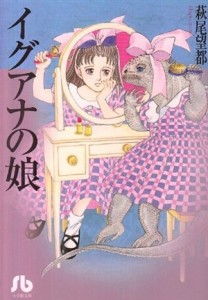
iguanagirlThe emotional core of A Drunken Dream — for me, at least — is Hagio’s 1991 story “Iguana Girl.” Rika, the heroine, is a truly grotesque figure — not in the everyday sense of being ugly or unpleasant, but in the Romantic sense, as a person whose bizarre affliction arouses empathy in readers. Born to a woman who appears human but is, in fact, an enchanted lizard, Rika is immediately rejected by her mother, who sees only a repulsive likeness of herself. Yuriko’s disgust for her daughter manifests itself in myriad ways: withering put-downs, slaps and shouts, blatant displays of favoritism for Rika’s younger sister Mami. As Rika matures, Hagio gives us tantalizing glimpses of Rika not as an iguana, but as the rest of the world sees her: a lovely but reserved young woman. As with “The Child Who Comes Home,” the heroine’s appearance could be interpreted literally, as evidence of magical realism, or figuratively, as a metaphor for the way in which children mirror their parents’ own flaws and disappointments; either way, Rika’s quest to heal her childhood wounds is easily one of the most moving stories I’ve read in comic form, a testament to Hagio’s ability to make Rika’s fraught relationship with her mother seem both terribly specific and utterly universal.
Perhaps the best compliment I can pay Hagio is praising her ability to make the ineffable speak through pictures, whether she’s documenting the grief that a young woman feels after aborting her baby (“Angel Mimic”) or the intense longing a middle-aged man feels for the college friends who abandoned him (“Marie, Ten Years Later”). Nowhere is this more evident than in the final story, “The Willow Tree.” At first glance, the layout is simple: each page consists of just two large, rectangular panels in which a woman stands beneath a tree, watching a parade of people — a doleful man and a little boy, a group of rambunctious grade-schoolers, a teenager wooing a classmate — as they stroll on the embankment above her. A careful reading of the images, however, reveals a complex story spanning many years. Hagio uses subtle cues — light, weather, and the principal character’s body language — to suggest the woman’s relationship to the people who walk past the tree. The last ten panels are beautifully executed; though the woman never utters a word, her face suddenly registers all the pain, joy, and anxiety she experienced during her decades-long vigil.

For those new to Hagio’s work, Fantagraphics has prefaced A Drunken Dream with two indispensable articles by noted manga scholar Matt Thorn.[4] The first, “The Magnificent Forty-Niners,” places Hagio in context, introducing her peers and providing an overview of her major publications. The second, “The Moto Hagio Interview,” is a lengthy conversation between scholar and artist about Hagio’s formative reading experiences, first jobs, and recurring use of certain motifs. Both reveal Hagio to be as complex as her stories, at once thoughtful about her own work and surprised by her success. Taken together with the stories in A Drunken Dream, these essays make an excellent introduction to one of the most literary and original voices working in comics today. Highly recommended.

A DRUNKEN DREAM AND OTHER STORIES • BY MOTO HAGIO, TRANSLATED BY MATT THORN • FANTAGRAPHICS • 288 pp.

NOTES

1. The Wonderful World of Sazae-San ran in newspapers from 1946 to 1974. The collected strips, comprising 45 volumes in all, have been perennial best-sellers in Japan, with over 60 million books sold. It’s imporant to note that Sazae-san is not shojo manga; the story focuses on a resourceful, strong-willed housewife and her family, a kind of Mother Knows Best story. Nonetheless, Machiko Hasegawa is an important figure in the history of the medium, both for the influence of her strip and her trailblazing role as a female creator.

2. For more information about Hideko Mizuno, see Marc Bernabe’s recent profile and interview at Masters of Manga.

3. Princess Knight has a long and complex publishing history. The original story appeared in Shojo Club from 1953 to 1956, was continued in Nakayoshi in 1958, and revived again for Nakayoshi in 1963. The third version is generally considered to be the definitive one; Tezuka re-worked a few details from the original version and re-drew the series. In 2001, Kodansha released a bilingual edition of the 1963 version which is now out of print.

4. Both essays originally appeared in issue no. 269 of The Comics Journal (July 2005).

FOR FURTHER READING

Bernabe, Marc. “What is the ‘Year 24 Group’?” Interview with Moto Hagio. [http://mastersofmanga.com/2010/06/hagioyear24] [Accessed 7/22/10.]

Gravett, Paul. Manga: 60 Years of Japanese Comics. New York: Collins Design, 2004.

Randall, Bill. “Three By Moto Hagio.” The Comics Journal 252 (April 2003). (Full text available online at The Comics Journal Archives.)

Shamoon, Deborah. “Revolutionary Romance: The Rose of Versailles and the Transformation of Shojo Manga.” Mechademia 2 (2007): 3-18.

Schodt, Frederick. Manga! Manga! The World of Japanese Comics. New York: Kodansha International, 1983.

Thorn, Matt. “The Multi-Faceted Universe of Shoujo Manga.” [http://www.matt-thorn.com/shoujo_manga/colloque/index.php] (Accessed 7/21/10.)

Thorn, Matt. “What Japanese Girls Do With Manga and Why.” [http://www.matt-thorn.com/shoujo_manga/jaws/index.php] (Accessed 7/21/10/)

Toku, Masaki, ed. Shojo Manga! Girl Power! Chico, CA: Flume Press, 2005.

Vollmar, Rob. “X+X.” The Comics Journal 269 (July 2005): 134-36.

WORKS BY MOTO HAGIO AND HER PEERS (IN ENGLISH)

Aoike, Yasuko. From Eroica With Love. La Jolla, CA: CMX Manga/Wildstorm Productions, 2004 – 2010. 15 volumes (incomplete).

Ariyoshi, Kyoko. Swan. La Jolla, CA: CMX Manga/Wildstorm Productions, 2005 – 2010. 15 volumes (incomplete).

Hagio, Moto. A, A’ [A, A Prime]. Translated by Matt Thorn. San Francisco: Viz Communications, 1997. (Reviewed at The Manga Critic on 5/31/10.)

Hagio, Moto, Keiko Nishi, and Shio Sato. Four Shojo Stories. Translated by Matt Thorn. San Francisco: Viz Communications, 1996. (Reviewed at The Manga Critic on 5/31/10.)

Mitsuse, Ryu and Keiko Takemiya. Andromeda Stories. New York: Vertical, Inc., 2007. 3 volumes. (Reviewed at The Manga Critic on 5/26/10.)

Takemiya, Keiko. To Terra. New York: Vertical, Inc., 2007. 3 volumes. (Reviewed at The Manga Critic on 5/23/10.)

Filed Under: Manga Critic Tagged With: Classic, fantagraphics, Magnificent 49ers, moto hagio, shojo

A Drunken Dream and Other Stories

July 22, 2010 by Katherine Dacey

The 1970s marked a turning point in the development of shojo manga, as the first time in the medium’s history that a significant number of women were working in the field. These “founding mothers” weren’t the first female manga artists; Machiko Hasegawa was an early pioneer with Sazae-san,[1] a comic strip that first appeared in her hometown newspaper in 1946, followed in the 1950s by such artists as Masako Watanabe, who debuted in 1952 with Suama-chan, Hideko Mizuno, who debuted in 1956 with Akakke Pony (Red-Haired Pony),[2] and Miyako Maki, who debuted in 1957 with Hahakoi Waltz (Mother’s Love Waltz). Beginning in the mid-1960s and continuing throughout the 1970s, more female creators entered the profession, thus beginning the quiet transformation of shojo manga from sentimental stories for very young readers to a vibrant medium that spoke directly to the concerns and desires of teenage girls.

Several figures played an important role in affecting this transformation. One was Osamu Tezuka, whose Princess Knight (1954)[3] is often erroneously described as “the first shojo manga.” (Shojo manga, in fact, dates to the beginning of the twentieth century, when magazines such as Shojo Sekai, or Girls’ World, featured comics alongside stories, articles, and illustrations.) An affectionate pastiche of Walt Disney, Zorro, and Takarazuka plays, Tezuka’s gender-bending story focused on a princess with two hearts — one female, one male — who becomes a masked crusader to save her kingdom from falling into the hands of a wicked nobleman. However conventional the ending seems now — Princess Sapphire eventually marries the prince of her dreams and hangs up her sword — the story was a rare example of a long-form adventure for girls; well into the 1950s, most shojo manga featured plotlines reminiscent of Victorian children’s literature, filled with young, imperiled heroines buffeted by fate until happily reunited with their families.

Another major influence was Yoshiko Nishitani, whose ground-breaking series Mary Lou appeared in Weekly Margaret in 1965. Mary Lou was among the very first shojo manga to feature an ordinary teenager as both the protagonist and romantic lead; its eponymous heroine suffered from the kind of everyday problems — a beautiful older sister, a boy who sends confusing signals — that invited readers to identify with her. Like Princess Knight, the gender politics of Mary Lou may strike contemporary Western readers as nostalgic at best, retrograde at worst, but Nishitani’s ability to make a compelling story out of ordinary adolescent experience struck a chord with Japanese girls, providing an important model for subsequent generations of shojo artists.

Moto Hagio and The “Founding Mothers” of Modern Shojo

In the hands of the Magnificent Forty-Niners and the other women who entered the field in the 1970s,  shojo manga underwent a profound transformation, giving rise to a new kind of storytelling that emphasized the importance of relationships and introspection, even when the stories took place in eighteenth-century France (The Rose of Versailles), Taisho-era Japan (Haikara-san ga Toru, or, Here Comes Miss Modern), or the distant future (They Were Eleven!). Inspired by Tezuka’s cinematic approach to storytelling, they sought to dramatize their characters’ inner lives with the same dynamism that Tezuka brought to car chases, fist fights, and heated conversations. Hagio and her peers placed a premium on subjectivity, trying their utmost to help readers see the world through the characters’ point of view, eschewing tidy grids for fluid, expressionist layouts, and employing an elaborate code of visual signifiers to represent emotions from love to anxiety — symbols still in widespread use today.

Moto Hagio was one of these shojo trailblazers, making her professional debut in 1969 with “Lulu to Mimi,” a short story that appeared in the girls’ magazine Nakayoshi. In the years that followed, she proved enormously versatile, working in a variety of genres: “November Gymnasium” (1971) explores a romantic relationship between two young men, for example, while The Poe Family (1972-76) focuses on a vampire doomed to live out his existence in a teenage boy’s body. Hagio is perhaps best known to Western readers for her science fiction’s unique blend of social commentary and lyrical imagery. A, A’, for example, examines the relationship between memory and identity, while They Were Eleven tackles the thorny question of whether gender determines destiny.

A Drunken Dream and Other Stories

The ten stories that comprise A Drunken Dream span the entire length of Hagio’s career, from “Bianca” (1970), one of her first published works, to “A Drunken Dream” (1985), a sci-fi fantasy written around the same time as the stories in A, A’, to “The Willow Tree” (2007), an entry in her recent anthology Anywhere But Here.

What A Drunken Dream reveals is an author whose childhood passion for Frances Hodgson Burnett, L.M. Montgomery, and Isaac Asimov profoundly influenced the kind of stories she chose to tell as an adult. “Bianca,” for example, is a unabashedly Romantic story about artistic expression. The main narrative is framed by a discussion between Clara, a middle-aged woman, and an art collector curious about the “dryad” who appears in Clara’s paintings. As a teenager, Clara secretly witnessed her younger cousin Bianca dancing with great abandon in a wooded glen, a child’s way of coping with the pain of her parents’ tumultuous relationship. Bianca’s dance haunted Clara for years, even though their acquaintance was brief. “The way [Bianca] danced… the way it made me feel… I can’t describe it in words,” the middle-aged Clara explains to her guest. “But the thrill of that moment still shines today, and still shakes me to my core. And it was my irresistible need to draw that which led me to become a painter.”

Other stories explore the complexity of familial relationships. “Hanshin: Half-God,” for example, depicts conjoined twins with a rare medical condition that leaves one brilliant but physically deformed and the other simple but radiantly beautiful. When a life-threatening condition necessitates an operation to separate them, Yudy, the “big sister,” imagines it will liberate her from the responsibility of caring for and about Yucy, never considering the degree to which she and Yucy are emotionally interdependent. In “The Child Who Comes Home,” the emphasis is on parent-child relationships, exploring how a mother and her son cope with the death of the family’s youngest member. Throughout the story, the deceased Yuu appears in many of the panels, though we are never sure if Yuu’s ghost is real, or if his family’s lingering attachment to him is making his memory palpable.

iguanagirlThe emotional core of A Drunken Dream — for me, at least — is Hagio’s 1991 story “Iguana Girl.” Rika, the heroine, is a truly grotesque figure — not in the everyday sense of being ugly or unpleasant, but in the Romantic sense, as a person whose bizarre affliction arouses empathy in readers. Born to a woman who appears human but is, in fact, an enchanted lizard, Rika is immediately rejected by her mother, who sees only a repulsive likeness of herself. Yuriko’s disgust for her daughter manifests itself in myriad ways: withering put-downs, slaps and shouts, blatant displays of favoritism for Rika’s younger sister Mami. As Rika matures, Hagio gives us tantalizing glimpses of Rika not as an iguana, but as the rest of the world sees her: a lovely but reserved young woman. As with “The Child Who Comes Home,” the heroine’s appearance could be interpreted literally, as evidence of magical realism, or figuratively, as a metaphor for the way in which children mirror their parents’ own flaws and disappointments; either way, Rika’s quest to heal her childhood wounds is easily one of the most moving stories I’ve read in comic form, a testament to Hagio’s ability to make Rika’s fraught relationship with her mother seem both terribly specific and utterly universal.

Perhaps the best compliment I can pay Hagio is praising her ability to make the ineffable speak through pictures, whether she’s documenting the grief that a young woman feels after aborting her baby (“Angel Mimic”) or the intense longing a middle-aged man feels for the college friends who abandoned him (“Marie, Ten Years Later”). Nowhere is this more evident than in the final story, “The Willow Tree.” At first glance, the layout is simple: each page consists of just two large, rectangular panels in which a woman stands beneath a tree, watching a parade of people — a doleful man and a little boy, a group of rambunctious grade-schoolers, a teenager wooing a classmate — as they stroll on the embankment above her. A careful reading of the images, however, reveals a complex story spanning many years. Hagio uses subtle cues — light, weather, and the principal character’s body language — to suggest the woman’s relationship to the people who walk past the tree. The last ten panels are beautifully executed; though the woman never utters a word, her face suddenly registers all the pain, joy, and anxiety she experienced during her decades-long vigil.

For those new to Hagio’s work, Fantagraphics has prefaced A Drunken Dream with two indispensable articles by noted manga scholar Matt Thorn.[4] The first, “The Magnificent Forty-Niners,” places Hagio in context, introducing her peers and providing an overview of her major publications. The second, “The Moto Hagio Interview,” is a lengthy conversation between scholar and artist about Hagio’s formative reading experiences, first jobs, and recurring use of certain motifs. Both reveal Hagio to be as complex as her stories, at once thoughtful about her own work and surprised by her success. Taken together with the stories in A Drunken Dream, these essays make an excellent introduction to one of the most literary and original voices working in comics today. Highly recommended.

A DRUNKEN DREAM AND OTHER STORIES • BY MOTO HAGIO, TRANSLATED BY MATT THORN • FANTAGRAPHICS • 288 pp.

NOTES

1. The Wonderful World of Sazae-San ran in newspapers from 1946 to 1974. The collected strips, comprising 45 volumes in all, have been perennial best-sellers in Japan, with over 60 million books sold. It’s imporant to note that Sazae-san is not shojo manga; the story focuses on a resourceful, strong-willed housewife and her family, a kind of Mother Knows Best story. Nonetheless, Machiko Hasegawa is an important figure in the history of the medium, both for the influence of her strip and her trailblazing role as a female creator.

2. For more information about Hideko Mizuno, see Marc Bernabe’s recent profile and interview at Masters of Manga.

3. Princess Knight has a long and complex publishing history. The original story appeared in Shojo Club from 1953 to 1956, was continued in Nakayoshi in 1958, and revived again for Nakayoshi in 1963. The third version is generally considered to be the definitive one; Tezuka re-worked a few details from the original version and re-drew the series. In 2001, Kodansha released a bilingual edition of the 1963 version which is now out of print.

4. Both essays originally appeared in issue no. 269 of The Comics Journal (July 2005).

FOR FURTHER READING

Bernabe, Marc. “What is the ‘Year 24 Group’?” Interview with Moto Hagio. [http://mastersofmanga.com/2010/06/hagioyear24] [Accessed 7/22/10.]

Gravett, Paul. Manga: 60 Years of Japanese Comics. New York: Collins Design, 2004.

Randall, Bill. “Three By Moto Hagio.” The Comics Journal 252 (April 2003). (Full text available online at The Comics Journal Archives.)

Shamoon, Deborah. “Revolutionary Romance: The Rose of Versailles and the Transformation of Shojo Manga.” Mechademia 2 (2007): 3-18.

Schodt, Frederick. Manga! Manga! The World of Japanese Comics. New York: Kodansha International, 1983.

Thorn, Matt. “The Multi-Faceted Universe of Shoujo Manga.” [http://www.matt-thorn.com/shoujo_manga/colloque/index.php] (Accessed 7/21/10.)

Thorn, Matt. “What Japanese Girls Do With Manga and Why.” [http://www.matt-thorn.com/shoujo_manga/jaws/index.php] (Accessed 7/21/10/)

Toku, Masaki, ed. Shojo Manga! Girl Power! Chico, CA: Flume Press, 2005.

Vollmar, Rob. “X+X.” The Comics Journal 269 (July 2005): 134-36.

WORKS BY MOTO HAGIO AND HER PEERS (IN ENGLISH)

Aoike, Yasuko. From Eroica With Love. La Jolla, CA: CMX Manga/Wildstorm Productions, 2004 – 2010. 15 volumes (incomplete).

Ariyoshi, Kyoko. Swan. La Jolla, CA: CMX Manga/Wildstorm Productions, 2005 – 2010. 15 volumes (incomplete).

Hagio, Moto. A, A’ [A, A Prime]. Translated by Matt Thorn. San Francisco: Viz Communications, 1997. (Reviewed at The Manga Critic on 5/31/10.)

Hagio, Moto, Keiko Nishi, and Shio Sato. Four Shojo Stories. Translated by Matt Thorn. San Francisco: Viz Communications, 1996. (Reviewed at The Manga Critic on 5/31/10.)

Mitsuse, Ryu and Keiko Takemiya. Andromeda Stories. New York: Vertical, Inc., 2007. 3 volumes. (Reviewed at The Manga Critic on 5/26/10.)

Takemiya, Keiko. To Terra. New York: Vertical, Inc., 2007. 3 volumes. (Reviewed at The Manga Critic on 5/23/10.)

Filed Under: Manga, Manga Critic, REVIEWS Tagged With: Classic, fantagraphics, Magnificent 49ers, moto hagio, shojo

A, A’ and They Were Eleven

May 31, 2010 by Katherine Dacey

Though Vertical has published two series by Keiko Takemiya, the Magnificent 49ers’ work remains largely unavailable in English, with a few exceptions: Yasuko Aoike’s From Eroica With Love (which debuted in 1976 in Akita Shoten), and Moto Hagio’s short stories “A, A’ [A, A Prime],” “4/4 [Quatre/Quarts],” “X+Y,” and “They Were Eleven.”* These four stories comprise a mere 330 pages of material, but they offer readers a window into a key stage in shojo manga’s development, when women artists began pushing the medium in new directions, visually and thematically. Hagio’s work, like Takemiya’s, is unabashedly Romantic, filled with yearning characters who are struggling to uncover their true selves, even when that quest puts them at odds with societal norms. Though there is an intense, adolescent sensibility to some of her stories, that — for me, at least — is part of their beauty; Hagio clearly remembers what it feels like to be sixteen or eighteen, yet the way she frames those emotions is so exquisite and refined that the reader can appreciate her craft, even if the drama seems a little overripe from an adult perspective.

If you’ve been curious about what Takemiya’s peers were doing while she was writing To Terra and Song of the Wind and the Trees, or are wondering what to expect if you purchase Hagio’s A Drunken Dream this fall, read on.

aa_coverA, A’ [A, A Prime]

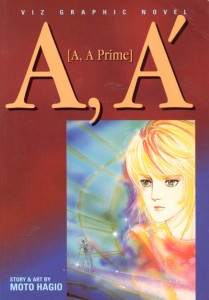
This sometimes lyrical, sometimes bizarre anthology contains three interrelated stories. In the first, “A, A’, [A, A Prime],” a group of researchers struggle to accept Addy, a new team member who is, in fact, the clone of a colleague who perished several years earlier; in the second, “4/4 [Quatre/Quarts],” Mori, a telepath, becomes obsessed with Trill, a strange young woman who’s virtually mute; and in the third, “X+Y,” a now-older Mori falls in love with Tacto, an androgynous young man who resembles Trill. Addy, Trill, and Tacto are Unicorns, a humanoid species bred for deep-space travel. Though Unicorns share common physical characteristics — most notably a shock of red hair running down the center of their heads — and high IQs — their original purpose was to serve as computer technicians on long space missions — they have a hard time negotiating the human world: emotions baffle them, and the act of forming deep attachments to other people can destabilize their personalities.

Though Hagio rehearses some time-honored sci-fi tropes — especially the danger of genetic tampering — one of her most striking themes is the relationship between memory and identity. Addy, for example, is born with all of her predecessor’s memories of childhood, but none of her predecessor’s memories of Proxima, the remote ice world where the original Addy worked for three years before dying in an accident. That gap in Addy’s memory proves especially difficult for her co-worker Regg, who had been romantically involved with Addy’s predecessor. Addy has no idea who he is, and is bewildered that Regg knows about events from her “childhood” — events that Addy hasn’t discussed with anyone. More troubling still, these “memories” are deeply upsetting, even though Addy knows she isn’t reliving her own history.

Tacto, on the other hand, teeters on the verge of a breakdown because his memory is incomplete. As a young child, he stumbled across a gruesome sight, one which his father attempted to erase from Tacto’s memory. That seemingly humane gesture backfired, however, leaving Tacto with only an emotional echo of the traumatic event and no concrete information about what he’d actually seen; only by recovering those painful memories does Tacto escape his emotional paralysis and embrace Mori’s love for him.

Hagio’s artwork supports the intensely Romantic quality of all three stories, as she represents her characters’ memories with symbolically rich imagery. In “4/4,” for example, Trill is haunted by a recurring vision of corpses, each fastened to the floor with a lepidopterist’s pin — Trill’s memory of numerous, unsuccessful attempts to clone her. (Dr. Sazzan, her caretaker, is obsessed with breeding more Unicorns.) Tacto’s unformed memory of his childhood resembles the nightmare paintings of John Fuselli; Tacto sees a disembodied, demonic face emerge from the rocky surface of an asteroid, a swirling black cloud with eyes and a terrible mouth.

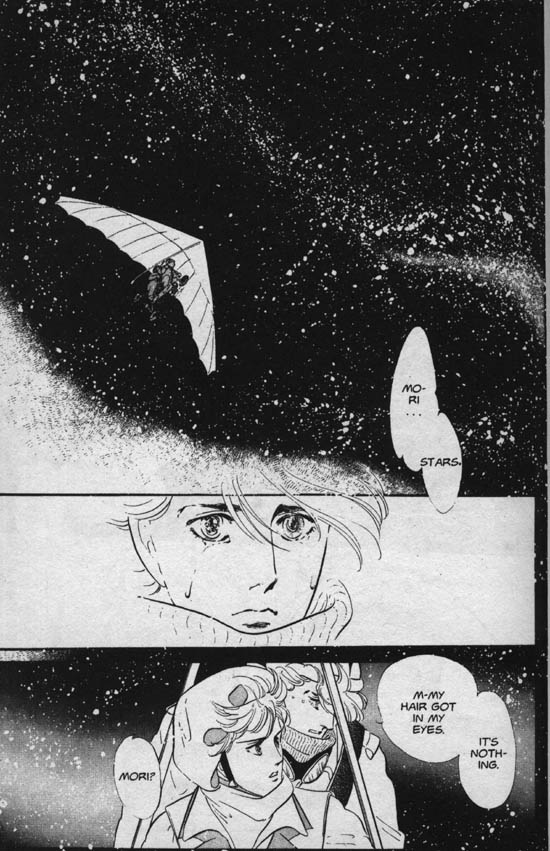
That dream-like quality extends to the settings as well, which mirror the characters’ turbulent emotional states. Trill and Mori, for example, visit a spectacular aviary aboard a space station; it’s a lush, erotically charged setting evocative of a Rousseau painting, and one that suggests the intensity of Mori’s desire for Trill. Hagio performs a similar trick in this sequence, transforming an interstellar reconnaissance mission into an intimate windsailing expedition through the stars:

aprime

Lest A, A’ sound like The Unbearable Lightness of Being in Space, let me assure you that Hagio demonstrates a unique ability to mix the sublime with the ridiculous. Her characters’ names, for example, are just about as goofy as they come: Dr. Wright Moonsault. Regg Bone. Marble. Professor Sazzan. Their costumes, too, have the same overripe quality as the names, with men sporting headbands, half capes, tall boots, and Renn Fair hats, and women clad in off-the-shoulder jumpsuits. The subplots take the cake, however, for their sheer moonbattiness: in “X+Y,” for example, Tacto’s father invents a temporary sex change drug that enables a male colleague to become pregnant, a subplot that actually holds the key to unlocking Tacto’s past.

Now out of print, VIZ originally released A, A’ in 1997. Expect to pay about $25.00 for a decent used copy if you choose to buy it online through ALibris or Amazon’s network of retailers. You might also try the library or your local comic shop’s bargain bin.

theywereeleven3THEY WERE ELEVEN

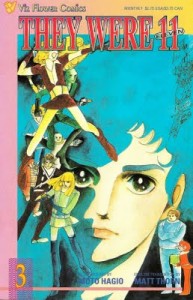
Ten cadets at an interstellar space academy are dispatched to a decommissioned ship. Their task: remain on board for 53 days without pressing the panic button; if they persevere, all ten will pass their final exam. Once aboard the ship, however, the cadets realize something is amiss. Not only do they have an extra crew member, but a series of mechanical failures and explosions threaten to send the ship hurtling into the surface of a neighboring star.

Though the premise could be spun out in the manner of, say, Event Horizon, Hagio favors a Gene Rodenberry approach, emphasizing character development and social commentary over gunplay, robots, or totally icky alien life forms. (You know the kind: they embed themselves in your chest cavity, hunt you down like a rabbit, or just spray toxic venom in your face.) Like the good astronauts of the starship Enterprise, They Were Eleven‘s cast are humanoids of various shapes and sizes. A few seem empathic; one has remarkable healing powers; another is tall and scaly; yet another looks like a distant relative of The Thing; and one pretty character has yet to decide whether it will develop into a man or woman. The dilemmas the cadets face — technical, social, and medical — also place us firmly in Star Trek territory, inspiring the characters to ruminate on issues as varied as gender roles and the ethics of sacrificing an individual for the good of the collective.

In fact, the exploration of gender is one of They Were Eleven‘s most interesting subplots; Frol, the sexually indeterminate member of the crew, is furious that her shipmates construe her as female. “I hate women!” she shouts. “Women are nothing but a waste of space!” Midway through the story, Hagio reveals the source of Frol’s misogyny: her parents want her to become the ninth wife of a prominent nobleman. If Frol passes the Galactic Academy exam, however, she will earn the right to become a man, a privilege usually reserved for a family’s eldest child. (Frol’s people are born hermaphrodites, becoming male or female only in adulthood.) Hagio’s critique of gender roles is both obvious and sly — obvious, in that Frol’s objection to being a woman stems from the division of labor on her home world (men rule the roost; women do all the work and bear lots of children) and sly, in that Hagio uses primogeniture as a metaphor for the broader sense of entitlement that comes with being born male.

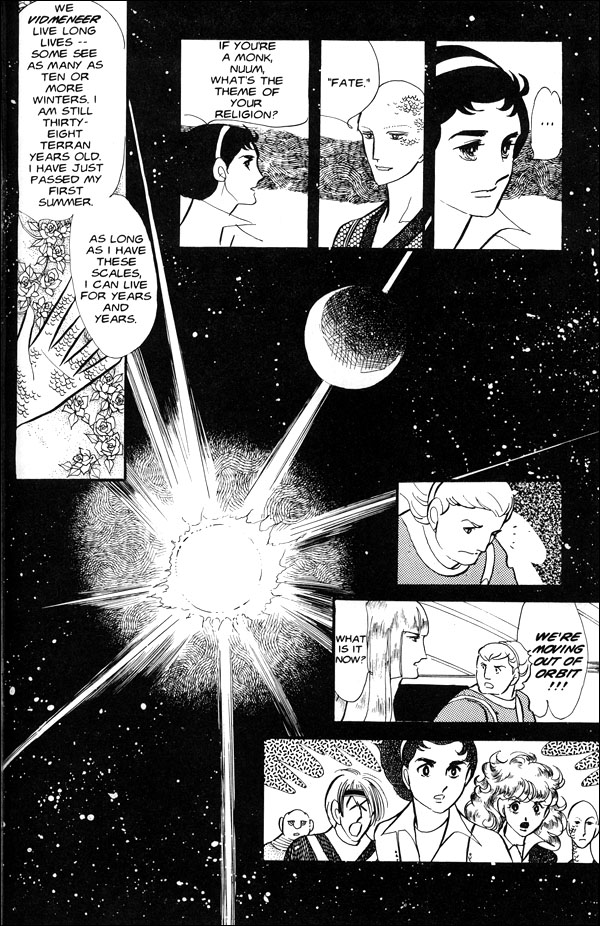
If Hagio’s aliens are strictly by the Star Trek book, all funny foreheads and funky hides, her layouts are stunning, punctuated by several arresting, full-page images: an enormous hall of cadets taking their exams (each in a groovy, womb-like isolation pod to prevent cheating), a picture of the dying star around which the test ship is orbiting, a character’s profile dissolving into a trail of stars. Hagio juxtaposes these expansive images with long, almost claustrophobically tight scenes of shipmates bickering and coping with the latest mechanical failures. It’s a neat trick, giving us a sense of how tight quarters really are aboard the White, and suggesting how that small space exacerbates tensions among the crew. And oh, those interiors! Like Takemiya, Hagio loves to draw detailed banks of computers and rows of tubes and wires and pipes, bringing the ship to vivid life. (Or, perhaps more accurately in the case of They Were Eleven, showing the ship in all its decrepitude.)

theywere11_page

Much as I would like to recommend They Were Eleven, the story is out of print in English. In the mid-1990s, VIZ issued it in two forms: as a four-issue comic (1995), and in the anthology Four Shojo Stories (1996). Used book dealers have gotten wise to the scarcity of this title; copies of Four Shojo Stories generally retail for $60 and up. Though I didn’t have too much difficulty scaring up the old VIZ Flower floppies on eBay (and I rather enjoyed the American-style presentation), it would be great to see this chestnut re-issued for a generation of readers who think that Black Bird is the first and last word in girls’ comics.

* Hagio’s story “Hanshin” was reprinted in The Comics Journal‘s shojo manga issue from 2005 (no. 269). For the purposes of this essay, I’m focusing on Hagio’s commercially available work. And speaking of work by pioneering shojo artists, Swan, which ran in Margaret from 1976 to 1981, is also available in English (CMX), and is the work of artist Kyoko Ariyoshi, who was born in 1950.

This an expanded version of a review that originally appeared at PopCultureShock on 1/20/07.

Filed Under: Manga Critic Tagged With: Classic, Magnificent 49ers, moto hagio, shojo, VIZ

Manga Artifacts: A, A’ and They Were Eleven

May 31, 2010 by Katherine Dacey

Though Vertical has published two series by Keiko Takemiya, the Magnificent 49ers’ work remains largely unavailable in English, with a few exceptions: Yasuko Aoike’s From Eroica With Love (which debuted in 1976 in Akita Shoten), and Moto Hagio’s short stories “A, A’ [A, A Prime],” “4/4 [Quatre/Quarts],” “X+Y,” and “They Were Eleven.”* These four stories comprise a mere 330 pages of material, but they offer readers a window into a key stage in shojo manga’s development, when women artists began pushing the medium in new directions, visually and thematically. Hagio’s work, like Takemiya’s, is unabashedly Romantic, filled with yearning characters who are struggling to uncover their true selves, even when that quest puts them at odds with societal norms. Though there is an intense, adolescent sensibility to some of her stories, that — for me, at least — is part of their beauty; Hagio clearly remembers what it feels like to be sixteen or eighteen, yet the way she frames those emotions is so exquisite and refined that the reader can appreciate her craft, even if the drama seems a little overripe from an adult perspective.

If you’ve been curious about what Takemiya’s peers were doing while she was writing To Terra and Song of the Wind and the Trees, or are wondering what to expect if you purchase Hagio’s A Drunken Dream this fall, read on.

aa_coverA, A’ [A, A Prime]

This sometimes lyrical, sometimes bizarre anthology contains three interrelated stories. In the first, “A, A’, [A, A Prime],” a group of researchers struggle to accept Addy, a new team member who is, in fact, the clone of a colleague who perished several years earlier; in the second, “4/4 [Quatre/Quarts],” Mori, a telepath, becomes obsessed with Trill, a strange young woman who’s virtually mute; and in the third, “X+Y,” a now-older Mori falls in love with Tacto, an androgynous young man who resembles Trill. Addy, Trill, and Tacto are Unicorns, a humanoid species bred for deep-space travel. Though Unicorns share common physical characteristics — most notably a shock of red hair running down the center of their heads — and high IQs — their original purpose was to serve as computer technicians on long space missions — they have a hard time negotiating the human world: emotions baffle them, and the act of forming deep attachments to other people can destabilize their personalities.

Though Hagio rehearses some time-honored sci-fi tropes — especially the danger of genetic tampering — one of her most striking themes is the relationship between memory and identity. Addy, for example, is born with all of her predecessor’s memories of childhood, but none of her predecessor’s memories of Proxima, the remote ice world where the original Addy worked for three years before dying in an accident. That gap in Addy’s memory proves especially difficult for her co-worker Regg, who had been romantically involved with Addy’s predecessor. Addy has no idea who he is, and is bewildered that Regg knows about events from her “childhood” — events that Addy hasn’t discussed with anyone. More troubling still, these “memories” are deeply upsetting, even though Addy knows she isn’t reliving her own history.

Tacto, on the other hand, teeters on the verge of a breakdown because his memory is incomplete. As a young child, he stumbled across a gruesome sight, one which his father attempted to erase from Tacto’s memory. That seemingly humane gesture backfired, however, leaving Tacto with only an emotional echo of the traumatic event and no concrete information about what he’d actually seen; only by recovering those painful memories does Tacto escape his emotional paralysis and embrace Mori’s love for him.

Hagio’s artwork supports the intensely Romantic quality of all three stories, as she represents her characters’ memories with symbolically rich imagery. In “4/4,” for example, Trill is haunted by a recurring vision of corpses, each fastened to the floor with a lepidopterist’s pin — Trill’s memory of numerous, unsuccessful attempts to clone her. (Dr. Sazzan, her caretaker, is obsessed with breeding more Unicorns.) Tacto’s unformed memory of his childhood resembles the nightmare paintings of John Fuselli; Tacto sees a disembodied, demonic face emerge from the rocky surface of an asteroid, a swirling black cloud with eyes and a terrible mouth.

That dream-like quality extends to the settings as well, which mirror the characters’ turbulent emotional states. Trill and Mori, for example, visit a spectacular aviary aboard a space station; it’s a lush, erotically charged setting evocative of a Rousseau painting, and one that suggests the intensity of Mori’s desire for Trill. Hagio performs a similar trick in this sequence, transforming an interstellar reconnaissance mission into an intimate windsailing expedition through the stars:

aprime

Lest A, A’ sound like The Unbearable Lightness of Being in Space, let me assure you that Hagio demonstrates a unique ability to mix the sublime with the ridiculous. Her characters’ names, for example, are just about as goofy as they come: Dr. Wright Moonsault. Regg Bone. Marble. Professor Sazzan. Their costumes, too, have the same overripe quality as the names, with men sporting headbands, half capes, tall boots, and Renn Fair hats, and women clad in off-the-shoulder jumpsuits. The subplots take the cake, however, for their sheer moonbattiness: in “X+Y,” for example, Tacto’s father invents a temporary sex change drug that enables a male colleague to become pregnant, a subplot that actually holds the key to unlocking Tacto’s past.

Now out of print, VIZ originally released A, A’ in 1997. Expect to pay about $25.00 for a decent used copy if you choose to buy it online through ALibris or Amazon’s network of retailers. You might also try the library or your local comic shop’s bargain bin.

theywereeleven3THEY WERE ELEVEN

Ten cadets at an interstellar space academy are dispatched to a decommissioned ship. Their task: remain on board for 53 days without pressing the panic button; if they persevere, all ten will pass their final exam. Once aboard the ship, however, the cadets realize something is amiss. Not only do they have an extra crew member, but a series of mechanical failures and explosions threaten to send the ship hurtling into the surface of a neighboring star.

Though the premise could be spun out in the manner of, say, Event Horizon, Hagio favors a Gene Rodenberry approach, emphasizing character development and social commentary over gunplay, robots, or totally icky alien life forms. (You know the kind: they embed themselves in your chest cavity, hunt you down like a rabbit, or just spray toxic venom in your face.) Like the good astronauts of the starship Enterprise, They Were Eleven‘s cast are humanoids of various shapes and sizes. A few seem empathic; one has remarkable healing powers; another is tall and scaly; yet another looks like a distant relative of The Thing; and one pretty character has yet to decide whether it will develop into a man or woman. The dilemmas the cadets face — technical, social, and medical — also place us firmly in Star Trek territory, inspiring the characters to ruminate on issues as varied as gender roles and the ethics of sacrificing an individual for the good of the collective.

In fact, the exploration of gender is one of They Were Eleven‘s most interesting subplots; Frol, the sexually indeterminate member of the crew, is furious that her shipmates construe her as female. “I hate women!” she shouts. “Women are nothing but a waste of space!” Midway through the story, Hagio reveals the source of Frol’s misogyny: her parents want her to become the ninth wife of a prominent nobleman. If Frol passes the Galactic Academy exam, however, she will earn the right to become a man, a privilege usually reserved for a family’s eldest child. (Frol’s people are born hermaphrodites, becoming male or female only in adulthood.) Hagio’s critique of gender roles is both obvious and sly — obvious, in that Frol’s objection to being a woman stems from the division of labor on her home world (men rule the roost; women do all the work and bear lots of children) and sly, in that Hagio uses primogeniture as a metaphor for the broader sense of entitlement that comes with being born male.

If Hagio’s aliens are strictly by the Star Trek book, all funny foreheads and funky hides, her layouts are stunning, punctuated by several arresting, full-page images: an enormous hall of cadets taking their exams (each in a groovy, womb-like isolation pod to prevent cheating), a picture of the dying star around which the test ship is orbiting, a character’s profile dissolving into a trail of stars. Hagio juxtaposes these expansive images with long, almost claustrophobically tight scenes of shipmates bickering and coping with the latest mechanical failures. It’s a neat trick, giving us a sense of how tight quarters really are aboard the White, and suggesting how that small space exacerbates tensions among the crew. And oh, those interiors! Like Takemiya, Hagio loves to draw detailed banks of computers and rows of tubes and wires and pipes, bringing the ship to vivid life. (Or, perhaps more accurately in the case of They Were Eleven, showing the ship in all its decrepitude.)

theywere11_page

Much as I would like to recommend They Were Eleven, the story is out of print in English. In the mid-1990s, VIZ issued it in two forms: as a four-issue comic (1995), and in the anthology Four Shojo Stories (1996). Used book dealers have gotten wise to the scarcity of this title; copies of Four Shojo Stories generally retail for $60 and up. Though I didn’t have too much difficulty scaring up the old VIZ Flower floppies on eBay (and I rather enjoyed the American-style presentation), it would be great to see this chestnut re-issued for a generation of readers who think that Black Bird is the first and last word in girls’ comics.

* Hagio’s story “Hanshin” was reprinted in The Comics Journal‘s shojo manga issue from 2005 (no. 269). For the purposes of this essay, I’m focusing on Hagio’s commercially available work. And speaking of work by pioneering shojo artists, Swan, which ran in Margaret from 1976 to 1981, is also available in English (CMX), and is the work of artist Kyoko Ariyoshi, who was born in 1950.

This an expanded version of a review that originally appeared at PopCultureShock on 1/20/07.

Filed Under: Manga, Manga Critic, REVIEWS Tagged With: Classic, Magnificent 49ers, moto hagio, Sci-Fi, VIZ

Fantagraphics Makes Dreams Come True

March 8, 2010 by MJ 12 Comments

A thousand giddy manga bloggers just raced to their keyboards in rapturous joy. Why? Because Dirk Deppey has announced officially in his blog that “Fantagraphics has signed an agreement with Shogakukan to launch a full manga line edited and curated by Matt Thorn.”

What does this mean? MOTO HAGIO, that is what it means. The first item being listed by Amazon is A Drunken Dream and Other Stories. I, for one, am counting the days until September when I can own this volume for myself. So little of Hagio’s work has been available in English up to this point, exactly none of which remains in print. This is truly a crime.

For more background and further understanding of why this is so significant for fans of shojo manga, take a look at this brilliant 2005 interview with Hagio…

Read More

Filed Under: NEWS Tagged With: manga, moto hagio

A, A’ by Moto Hagio: B+

January 21, 2009 by Michelle Smith

Back in the late ’90s, Viz dabbled in this weird thing called “shojo manga” and released a few one-shot volumes. A, A’ (A, A Prime), a collection of science fiction stories, was among these, and (lamentably) represents the largest chunk of material from Moto Hagio available in this country. Hagio, along with many other women who were pioneers of shojo manga, was born in 1949. These women came to be known as the Year 24 Group, as 1949 was the 24th year of Japan’s Showa era. Exploring themes of sexuality and gender, many of their works are considered classics. Hagio’s contributions include some of the earliest boys’ love stories, like The Heart of Thomas, and Shogakukan Manga Award-winning story “They Were Eleven,” published by Viz in floppy comic format as well as in the hard-to-find Four Shojo Stories anthology.

The three stories in A, A’ also deal with themes of gender and identity, each involving a member of a genetically engineered race of people called “Unicorns.” In the title story (my favorite), a team of people is working to develop an icy planet. Because of the dangerous nature of their mission, each person’s genetic information was saved prior to their departure so that they can be cloned if they should die. Adelade Lee has just undergone that process, and has returned to her post with no memory of the past three years she spent there or the comrades who greet her so warmly. The original Adelade’s lover has a great deal of trouble adjusting to the clone, insisting that it isn’t really her, but growing confused nonetheless. I really like the resolution to this one and would’ve been happy to read more about these characters.

Instead, the other two stories feature Mori, a young man with telekinetic powers and a “kaleidoscope eye” that allows him to see the infrared spectrum, similar to what the Unicorns can see. In “4/4,” we meet Mori as a teenager who, along with other kids with special powers, is living on Io and training to control his abilities. Things aren’t going well until he meets Trill, a Unicorn who is the subject of a scientific experiment. The pair of them “resonate,” allowing Mori temporary access to more control and also eventually providing Trill with the ability to object to the experiments being performed upon her. This story is my second favorite, and I particularly like how Trill’s lack of emotional involvement is portrayed; there’s a great scene where Mori seizes and kisses her and she just sort of blankly endures it, like a doll.

Unfortunately, I didn’t like the last story, “X + Y,” very much. There’s a conference being held on Mars to discuss plans to improve its conditions, and the team sent from Earth to take part includes a male unicorn named Tacto. On Mars, he meets Mori, four years older now, who becomes obsessed with Tacto. I understand that back when this was written, it was probably a stunning thing for one guy to confess his love to another, but in “X + Y” it all seems far too rushed to me and I never understood why Mori feels that way. He also gets on my nerves by behaving very stupidly when he and Tacto are out riding a space scooter on a ring of Saturn (really!), resulting in a life-threatening accident. The Mars theories don’t make much sense, nor does a subplot about Tacto’s chromosomes. Hagio tries to interject some humor into this tale, mostly by having Tacto (who refers to himself in the third person) say random things like, “Tacto likes pudding.” It’s cute, but not enough to improve my opinion of the story.

To modern eyes, Hagio’s artwork will surely look old-fashioned. Drawn between 1981 and 1984, it features some interesting fashions (particularly for Adelade) and a male romantic lead with a flowing mane of curly hair. There’s a lot of variety in the page layouts, and more than one image of characters superimposed over moons, stars, and other celestial bodies. I may mock it a bit, but I do genuinely like it; it’s nice to read something that doesn’t look like anything else.

For the title story alone, A, A’ is worth picking up. I can’t remember how much I paid for my copy, but I don’t think it was much. There are ten copies listed on Amazon right now so it shouldn’t be hard to find.

Review originally published at Manga Recon.

Filed Under: REVIEWS Tagged With: moto hagio, VIZ

Four Shōjo Stories by Keiko Nishi, Moto Hagio, and Shio Sato: B+

June 26, 2008 by Michelle Smith

From the back cover:
An unprecedented collection of stories by the greatest shōjo manga (girls’ comics) artists of our time!

In shōjo manga, a uniquely literary genre of Japanese comics, the relationships between characters are as meticulously crafted as the story’s action. Shōjo artists are renowned for their visual innovations, as well. Experimenting with page layouts, panel placement, the interplay of text and image, and expressionistic background effects, the three female manga artists of Four Shōjo Stories create a uniquely absorbing reading experience!

Review:
It would be impossible to write a review of Four Shōjo Stories without referencing its unique history. Who better to shed light on its origins than Matt Thorn, the original translator and author of the book’s introduction. Here’s a post he made on MangaBlog in March 2007. Suffice it to say that, although this wasn’t cheap, I am pleased to’ve found a copy significantly below the price range stated in Matt’s comments.

Of the four stories, two are sci-fi works by shoujo creators and the other two are by josei artist Keiko Nishi. I liked those by Nishi least, though they weren’t bad. The second one in particular had a melancholy vibe that I liked, but none of the characters were sympathetic.

I’d expected to like Moto Hagio’s “They Were Eleven,” since I’ve seen it praised before. I wasn’t disappointed. It seemed to drag a little initially (at 120 pp, it was by far the longest story in the collection) but picked up steam and by the end it was clear that all the stuff that happened at the outset had served a purpose. Fans of sci-fi in general but also fans of shoujo series that feature what I call “gender hijinks” would probably enjoy this story.

The surprise for me was Shio Sato’s “The Changeling.” I’d never heard of Sato before, but I liked her story just about as much as Hagio’s. In it, a competent and boyish female space pilot received a signal from a previously uncontacted planet and went to investigate. Her opinions on the inhabitants she encountered were thoughtful and different than I’d expected. The story stuck in my head after I had finished and made me wish something else by Sato would get licensed. It also had a cute final panel.

While the contents of Four Shōjo Stories might not be uniformly stellar, they’re still enjoyable. It’s too bad they probably won’t see the light of day in a readily accessible, $8.99 sort of package any time soon.

Filed Under: REVIEWS Tagged With: moto hagio, VIZ

  • « Go to Previous Page
  • Page 1
  • Page 2
 | Log in
Copyright © 2010 Manga Bookshelf | Powered by WordPress & the Genesis Framework