• Skip to primary navigation
  • Skip to main content
  • Skip to primary sidebar
  • Home
  • About Us
    • Privacy Policy
    • Comment Policy
    • Disclosures & Disclaimers
  • Resources
    • Links, Essays & Articles
    • Fandomology!
    • CLAMP Directory
    • BlogRoll
  • Features & Columns
    • 3 Things Thursday
    • Adventures in the Key of Shoujo
    • Bit & Blips (game reviews)
    • BL BOOKRACK
    • Bookshelf Briefs
    • Bringing the Drama
    • Comic Conversion
    • Fanservice Friday
    • Going Digital
    • It Came From the Sinosphere
    • License This!
    • Magazine no Mori
    • My Week in Manga
    • OFF THE SHELF
    • Not By Manga Alone
    • PICK OF THE WEEK
    • Subtitles & Sensibility
    • Weekly Shonen Jump Recaps
  • Manga Moveable Feast
    • MMF Full Archive
    • Yun Kouga
    • CLAMP
    • Shojo Beat
    • Osamu Tezuka
    • Sailor Moon
    • Fruits Basket
    • Takehiko Inoue
    • Wild Adapter
    • One Piece
    • After School Nightmare
    • Karakuri Odette
    • Paradise Kiss
    • The Color Trilogy
    • To Terra…
    • Sexy Voice & Robo
  • Browse by Author
    • Sean Gaffney
    • Anna Neatrour
    • Michelle Smith
    • Katherine Dacey
    • MJ
    • Brigid Alverson
    • Travis Anderson
    • Phillip Anthony
    • Derek Bown
    • Jaci Dahlvang
    • Angela Eastman
    • Erica Friedman
    • Sara K.
    • Megan Purdy
    • Emily Snodgrass
    • Nancy Thistlethwaite
    • Eva Volin
    • David Welsh
  • MB Blogs
    • A Case Suitable For Treatment
    • Experiments in Manga
    • MangaBlog
    • The Manga Critic
    • Manga Report
    • Soliloquy in Blue
    • Manga Curmudgeon (archive)

Manga Bookshelf

Discussion, Resources, Roundtables, & Reviews

manga

My Week in Manga: May 23-May 29, 2016

May 30, 2016 by Ash Brown

My News and Reviews

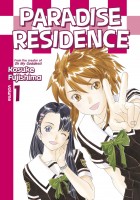
Last week, I was rather preoccupied with my move. The rest of the family and I are now successfully living in the new house, but we aren’t through with moving and there’s still plenty left to do. However, amidst all of the chaos, I was able to post this month’s manga giveaway and there’s still time to enter for a chance to win a copy of Paradise Residence, Volume 1 by Kosuke Fujishima. (The winner will be announced on Wednesday.) Although I wasn’t online much at all last week, there were still a few things that I heard about. Digital Manga announced a new imprint, PeCChi, which will focus on ecchi manga of various types, starting with The Secret Devil-chan by Emu as well as Me and the Impish Devil by Hideaki Yoshikawa. Digital Manga’s most recent Kickstarter project will be released under the Pecchi imprint if it succeeds—Kaworu Watashiya’s controversial Kodomo no Jikan which was previously licensed by Seven Seas but never published. And, completely unrelated, the third part of “The Sparkling World of Shojo Manga,” which focuses on Riyoko Ikeda and The Rose of Versailles Manga, was recently posted at The Lobster Dance.

Quick Takes
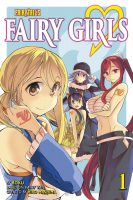
Fairy Girls, Volume 1Fairy Girls, Volume 1 by Boku. Hiro Mashima’s Fairy Tail has inspired a fair number of spinoff manga  and adaptations, several of which have been released in English relatively recently. Fairy Girls, featuring four of the most popular female characters from the Fairy Tail guild—Erza, Juvia, Lucy, and Wendy—is one such spinoff. The series takes place immediately following the Grand Magic Games arc in the original series, but for the most part doesn’t actually require the reader to know much at all about Fairy Tail to follow along. Actually, those who are familiar with Fairy Tail and love these characters might end up more frustrated than not with Boku’s version. Fairy Girls almost reads like an unfunny parody, but I don’t think that was at all the intention. I wanted to like the manga much more than I actually did seeing as the basic premise had such promise. Many of the women in Fairy Tail are great characters, but in Fairy Girls they come across as extremely shallow versions of their true selves. The fanservice in Fairy Girls is somewhat odd, too. Without going back to check the entire volume page-by-page, I believe Boku has managed to completely avoid any panty shots (almost conspicuously so) but the manga does frequently seem to be fairly boob-focused.

LDK, Volume 2LDK, Volume 2 by Ayu Watanabe. I know a few people who really enjoy LDK and so I want to like it, too, but at this point in the series I find it to be more infuriating than anything else. Maybe the manga gets better as it goes along, but I can’t say that I’m particularly interested in finding out since there is very little about the first two volumes that I actually enjoyed. Probably my biggest issue with LDK is that the series’ leading man, Shusei, shows absolutely no respect for Aoi, the series’ heroine, despite supposedly having feelings for her. The second volume of LDK introduces a romantic rival who, likewise, doesn’t actually seem to care about Aoi’s feelings. And I still remain unconvinced that any of the people involved legitimately love or even like any of the others. I believe LDK is intended to be a romantic comedy, but it just doesn’t seem to work as one for me, probably because the characters have failed to win me over. Even though some of the scenarios and situations in LDK are admittedly ridiculous and over-the-top (though not especially original), for whatever reason the humor just isn’t very funny as a whole and the balance between it and the manga’s more serious aspects is off.

Tramps Like Us, Volume 6Tramps Like Us, Volumes 6-9 by Yayoi Ogawa. As the series progresses, the basic premise of Tramps Like Us doesn’t really become any easier to explain without making it sound stranger than it is. Takeshi Gouda is a brilliant dancer trained in classical ballet who is trying to break into modern dance, but he is also Momo, the pet of Sumire Iwaya, a successful journalist who is under a lot of stress in both her love life and career. Their relationship is a very complicated and curious one but it’s very important to them both, which is why it’s concerning for them when it begins to change and they slowly begin to realize that their feelings for each other are less platonic and more romantic. Occasionally Tramps Like Us does feel a little directionless in these particular volumes, as though Ogawa is starting to lose narrative focus or trying to stretch the series longer than it necessarily needs to be. Some of the more stand-alone chapters, while still enjoyable, tend to come across as filler or bonus manga rather than being crucial to the story proper. Even so, I love the characters of Tramps Like Us (Sumire, Iwaya, and all the others) so am glad to be able to spend as much time as I can with them. I am enjoying Tramps Like Us immensely and look forward to reading the final third of the series.
Filed Under: FEATURES, My Week in Manga Tagged With: Ayu Watanabe, Boku, Fairy Tail, LDK, manga, Tramps Like Us, Yayoi Ogawa

Manga Giveaway: Paradise Residence Giveaway

May 25, 2016 by Ash Brown

The end of May is almost here. I’m very aware of this fact since my family’s goal is to be completely moved in, or at least living in, the new house by the end of the month. So this last week of May is crunch time and I’m rather preoccupied, but there’s no way that I could forget this month’s manga giveaway! This time you’ll all have a chance to win Paradise Residence, Volume 1 by Kosuke Fujishima as published in English by Kodansha Comics, which means that the manga also includes Volume 0 as bonus material. And, as always, the giveaway is open worldwide!

Paradise Residence, Volume 1

As mentioned above, I’m currently in the process of moving. There’s been so much cleaning, painting, packing, unpacking, yard work, general maintenance, repairs and such going on that I’ve been keeping very busy. It’s also making me a little nostalgic for the days when I lived in dorms and cooperatives where most of that work wasn’t my responsibility (except for that one year I served as the maintenance manager for a 30-person household). Boarding schools and dormitories aren’t terribly uncommon when it comes to manga and in some series they even end up as one of the primary settings. With that many people living together in one place, there is plenty of opportunity for all sorts of antics and other drama to ensue. In addition to Paradise Residence, Yukie Nasu’s Here Is Greenwood immediately comes to mind as another example, as does the communal apartment in Akiko Higashimura’s Princess Jellyfish even though it’s not associated with a school.

So, you may be wondering, how can you win a copy of Paradise Residence, Volume 1?

1) In the comments below, tell me a little about one of your favorite manga that takes place in a dorm or other communal living arrangement. (If you don’t have a favorite, or haven’t read any, simply mention that.)
2) If you’re on Twitter, you can earn a bonus entry by tweeting, or retweeting, about the contest. Make sure to include a link to this post and @PhoenixTerran (that’s me).

Pretty easy, right? Participants have one week to submit comments and can earn up to two entries for this giveaway. Comments can also be sent to me at phoenixterran(at)gmail(dot)com if needed or if preferred. I will then post the entries in the comments here in your name. The winner of the giveaway will be randomly selected and announced on June 1, 2016. Good luck! (And now back to moving!)

VERY IMPORTANT: Include some way that I can contact you. This can be an e-mail address in the comment form, a link to your website, Twitter username, or whatever. If I can’t figure out how to get a hold of you and you win, I’ll just draw another name.

Contest winner announced–Manga Giveaway: Paradise Residence Giveaway Winner

Filed Under: FEATURES, Giveaways Tagged With: Kosuke Fujishima, manga, Paradise Residence

My Week in Manga: May 16-May 22, 2016

May 23, 2016 by Ash Brown

My News and Reviews

I ended up posting it a little later than I really intended, but my random musings on TCAF 2016 are now available to read. Although I didn’t make it to as many panels this year, I still had a great time and really enjoyed myself. I haven’t had a chance to listen to the audio yet, but I was also happy to discover that some of the panels that I missed The Sparkling World of Shojo Manga. In licensing news, Yen Press has picked up both the light novels and the manga for Death March to the Parallel World Rhapsody and Konosuba. Princess Jellyfish has been doing well enough for Kodansha Comics that the publisher is considering releasing more josei and seinen. In the meantime, expect to see more additions to the Attack on Titan franchise in English from Kodansha as well as Shuzo Oshimi’s manga Happiness. Also, Vertical Comics will be releasing Chihiro Ishizuka’s manga series Flying Witch.

Quick Takes

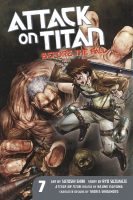
Attack on Titan: Before the Fall, Volume 7Attack on Titan: Before the Fall, Volume 7 written by Ryo Suzukaze and illustrated by Satoshi Shiki. I missed reading a few volumes of the Before the Fall manga, but I have read the original novel that it was based on so I didn’t expect that I would have much trouble picking the series up again. However, I think that the manga might actually be expanding on some of the material of the original, because I don’t recall things playing out exactly in the same way as they are in the manga. Or it could just be that it’s been so long since I’ve read the novel that I’ve managed to forget major plot points. Either way, I do like the way that Before the Fall expands the worldbuilding of Attack on Titan and how the prequel emphasizes some of the scientific and technological advances that are needed to make the main series work. Basically, the main character, in addition to having the requisite tragic backstory, is a test pilot (if that’s the right word) for what will eventually become the Vertical Maneuvering Equipment. A significant portion of the seventh volume of the Before the Fall manga is actually devoted to a field test which, like most encounters with the Titans, ist fraught with danger, disaster, and potential death.

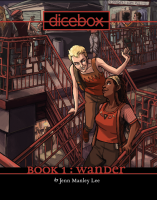
Dicebox, Volume 1: WanderDicebox, Volume 1: Wander by Jenn Manley Lee. I discovered Lee’s ongoing comic Dicebox a couple of years ago while reading Comics: A Global History, 1968 to the Present where it was briefly mentioned. It piqued my interest so I thought I would give Wander, the first book out of four planned volumes (the second book is currently being serialized online), a try. I suspected that Dicebox would probably be a comic I would enjoy, but I didn’t expect that I would become so invested in the characters by the end of the first volume. Wander is almost completely driven by the characters and their relationships—the dramatic story boiling under the surface doesn’t become obvious until the final few chapters. Dicebox follows the lives of Molly and Griffin, two itinerant blue-collar workers moving from one job to the next, from one planet to the next. Molly tends to be fairly well liked, but Griffin, well she tends to piss people off, sometimes intentionally and sometimes not. Eventually it’s revealed that one of the reasons that Molly puts up with Griffin is that they are married. Dicebox is incredibly well-realized near-future science fiction. It’s also undeniably queer, and quite possibly has the widest representation of the variance of human gender and sexuality that I’ve ever come across in a single work of fiction, comic or otherwise. I’m loving Dicebox and definitely plan on reading more of the series.

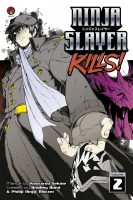
Ninja Slayer Kills, Volume 2Ninja Slayer Kills!, Volume 2 by Koutarou Sekine. I can’t say that I was overly impressed by the first volume of Ninja Slayer Kills and I really wasn’t planning on following the series, but I ended up with a review copy of the second volume, so I figured I might as well give it a try. I am admittedly surprised, but I enjoyed the second volume much more than the first. Almost the entirety of the second volume is devoted to a flashback, which is easy to miss unless close attention is paid to the manga’s prefatory material. Some of my complaints about the manga remain the same—for a series that is so focused on fight scenes and mayhem, the action can be frustratingly difficult to follow—but other aspects have improved. For one, there is absolutely no mistaking at least one of the character designs. Agony visually looks something like a highly-sexualized version of Pinhead from Hellraiser, complete with an enormous crotch-bulge sprouting numerous needles. The design is more disturbing than sexy, but it is memorable. Ninja Slayer Kills is all about being as over-the-top as possible, often reading like an in-your-face parody. It’s deliberately absurd and ridiculously violent, intentionally making heavy use of cyberpunk ninja tropes taken to their extremes.

Filed Under: FEATURES, My Week in Manga Tagged With: attack on titan, comics, Dicebox, Jenn Manley Lee, Koutarou Sekine, manga, Ninja Slayer, Ryo Suzukaze, Satoshi Shiki

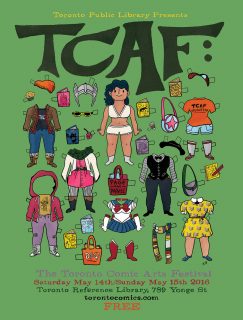
Random Musings: Toronto Comic Arts Festival 2016

May 20, 2016 by Ash Brown

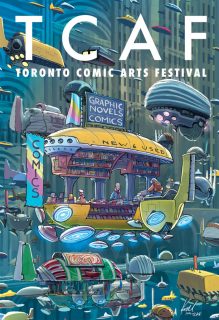
TCAF 2016 Poster - Kazu Kibuishi

©Kazu Kibuishi

As of 2016, I have now attended the Toronto Comic Arts Festival (TCAF) for four years running. TCAF is still the only large comics event that I make a point to attended, although I guess technically I went to an anime/manga/cosplay convention earlier this year since I and the rest of the taiko group I’m a part of were featured guest performers. Anyway, I digress. TCAF is an amazing event and I’m able to enjoy a fair amount of it even though my anxiety (social and otherwise) sometimes prevents me from doing everything that I’d really like to. Each year I attend seems to be a little easier for me, though it’s still certainly not easy. But, I do think TCAF is totally worth trying to push through my issues when I can, which probably says a fair amount about the event itself.

Like last year, TCAF 2016 turned into a family trip, which made me happy. The four of us arrived in Toronto late Thursday afternoon, settled into where we were staying, stretched our legs in a nearby park (which was much needed after spending hours cooped up in the car), and eventually found something to eat for dinner before turning in for the night. Originally, I was hoping and planning to go to the opening of Shintaro Kago’s solo exhibition at Narwhal, but for a variety of reasons I ended up deciding to chill with the family all night instead. Which was also good, since for all intents and purposes TCAF ends up being a vacation of sorts for us all.

Friday, too, was more of a family day, although I did meet up with Jocelyne Allen (who translates Japanese novels and manga, and who is one of the interpreters for TCAF) for coffee in the morning. We chatted about taiko, translation, TCAF, Toronto, Tokyo and all sorts of other things, which was highly enjoyable. It was nice being able to find some time to talk with her in person since we primarily only know each other online and she’s understandably very busy during TCAF. Most of the rest of the day was spent exploring Toronto with the family, including the Royal Ontario Museum which had a really interesting exhibit—A Third Gender: Beautiful Youths in Japanese Prints—about gender and sexuality in Edo-era Japan. Finally, that evening I made my way to the tail end of Sparkler Monthly‘s annual TCAF mixer. It was a fairly small group when I got there, but a good time was had by all, myself included.

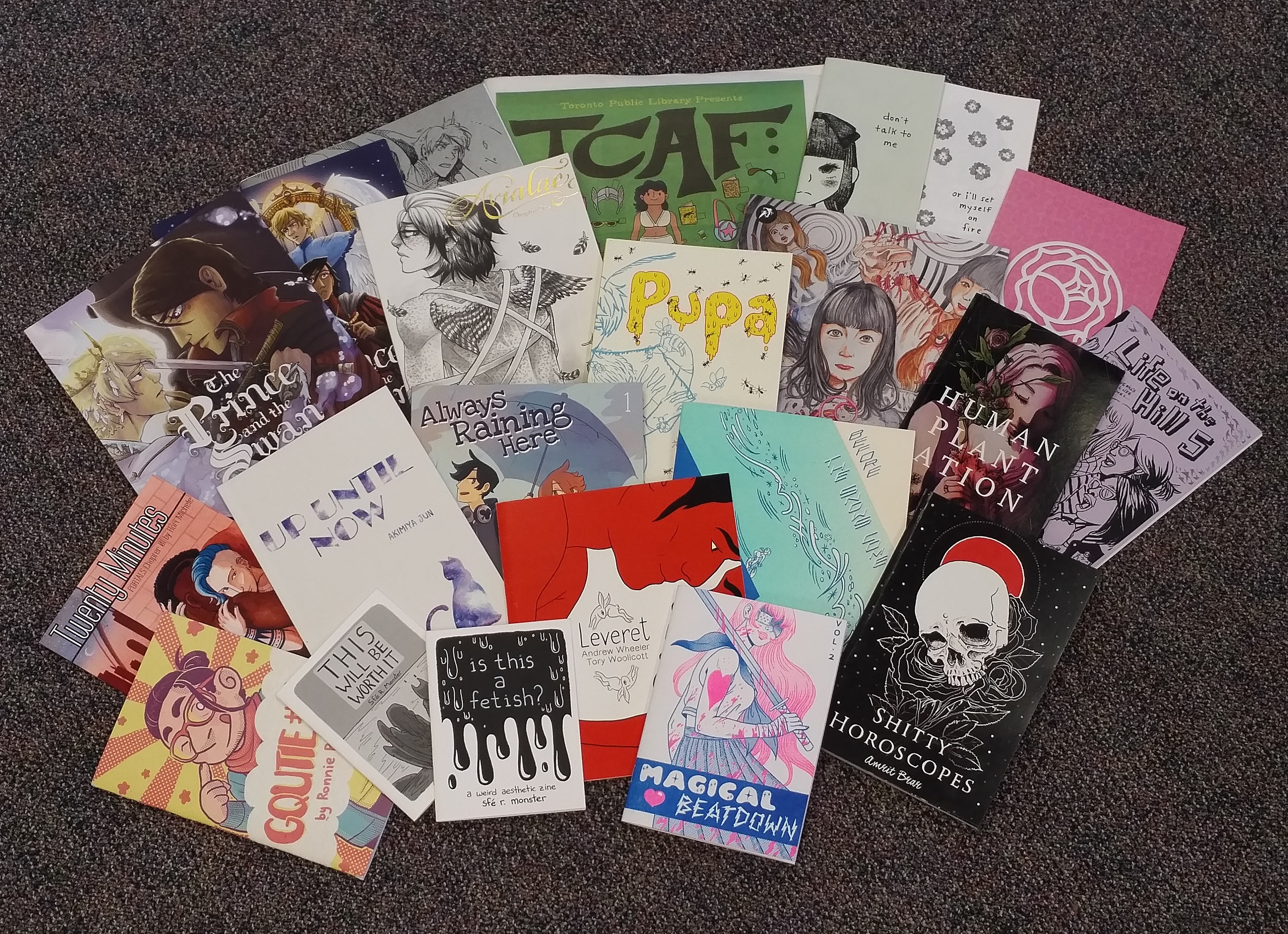
Saturday marks the beginning of TCAF proper, although there are plenty of related events that occur both before and after TCAF weekend. As was the case for the previous couple of years, I started off the 2016 festival in the in the exhibitors’ area before most of the main programming began. I ended up spending my entire comics budget for the weekend before the first day was over, but I was pretty happy with my haul which included some pre-orders, a couple of Kickstarter pickups, a few things I knew beforehand that I wanted to buy, as well as several unplanned, spur-of-the-moment purchases.

TCAF 2016 Poster - Kate Beaton

©Kate Beaton

This year I actually spent even more time on the exhibit floors buying comics, collecting sketches and signatures, and talking to creators than I have in the past. (A few highlights: I was particularly excited to meet Saicoink, whose comic Open Spaces and Closed Places I love, made a point to tell Kori Michele Handwerker how much Portals meant to me, and discovered some wonderful new-to-me creator’s like GQutie‘s Ronnie Ritchie.) That, combined with prioritizing the family more and considering the need for flexible schedules when dealing with a not-quite-two-year old, meant that I didn’t make it to as many panels this year. In some ways, TCAF 2016 for me felt more like TCAF-lite, but I still greatly enjoyed the festival and was thoroughly satisfied by all of the events, panels, and interviews that I was able to attend.

On Saturday, I ended up making it to four panels. The first was the Spotlight on Shintaro Kago, one of TCAF’s featured guests for 2016, who was interviewed by Youth in Decline’s Ryan Sands. Kago is particularly well-known for his horrific, erotic, and grotesque manga and illustrations. Many of Kago’s works are released ero-manga magazines. As he pointed out, his manga isn’t the type of work that would be published in Jump; there is a limited number of magazines (generally erotic or alternative) that would even consider releasing his work. But by submitting to ero-magazines, Kago is allowed a tremendous amount of editorial freedom. As long as the minimum erotic requirements are met, he is able to do almost anything that he wants to with his manga, including highly experimental techniques. An example of this is a work known in English as “Abstraction” which gained a fair amount of international attention when it was translated by a fan and posted online. When asked about his feelings regarding fan translations, Kago responded that in his case he was satisfied with his work becoming more readily available to a worldwide audience since the benefits he received from the original release (page rates, etc.) didn’t amount to much anyway. Another of Kago’s short manga, “Punctures,” was officially translated in English in the anthology Secret Comics Japan. Anecdotally, it was one of the few works by Kago that the editors felt would be safe enough to include and sell. At the beginning of his creative career, Kago actually wanted to be involved in making films. However, he realized that movies are very difficult to make alone, and since he didn’t have any friends to make movies with, he turned to manga as a way to express himself so that he wouldn’t need to rely on others.

After spending a bit more time wandering the exhibitor areas, I then made my way to the panel “Depictions of Sex in Comics” which was moderated by Rebecca Sullivan, a scholar specializing in sex and media as well as gender and cultural studies. The panel featured a variety of comics publishers and creators: Zan Christensen, Chip Zdarsky, Erika Moen, Cory Silverberg, C. Spike Trotman, and Shintaro Kago. Each of the panelists has their own approach to sex in regards to how it is related to and portrayed in their work, whether their focus is on sex education, erotica, some combination of the two, or something else entirely. One cultural difference that emerged during the conversation was that while erotic comics are currently seeing a resurgence in North America (Oni Press recently announced a new imprint devoted to sex positive comics, and there have been numerous, highly-successful crowd-funded projects for feminist and queer erotic comics in the last few years), the market for erotic manga in Japan has always been very strong. A very specific set of constraints exist in Japan in regards to the depiction of sex in media, what can and cannot be shown and so on, but the country probably has the most well-established and easily navigable erotic comics scene in the world. Many Japanese creators (including Kago himself) got their start working in erotic media before moving on to other and more mainstream projects. Interestingly, Kago also mentioned that BL isn’t necessarily always recognized as being “erotic” (possibly because its target demographic is women) and so in some ways the genre can actually get away with more than hentai aimed at heterosexual men which, in his experience, seems to come under public scrutiny and fire more quickly and more often.

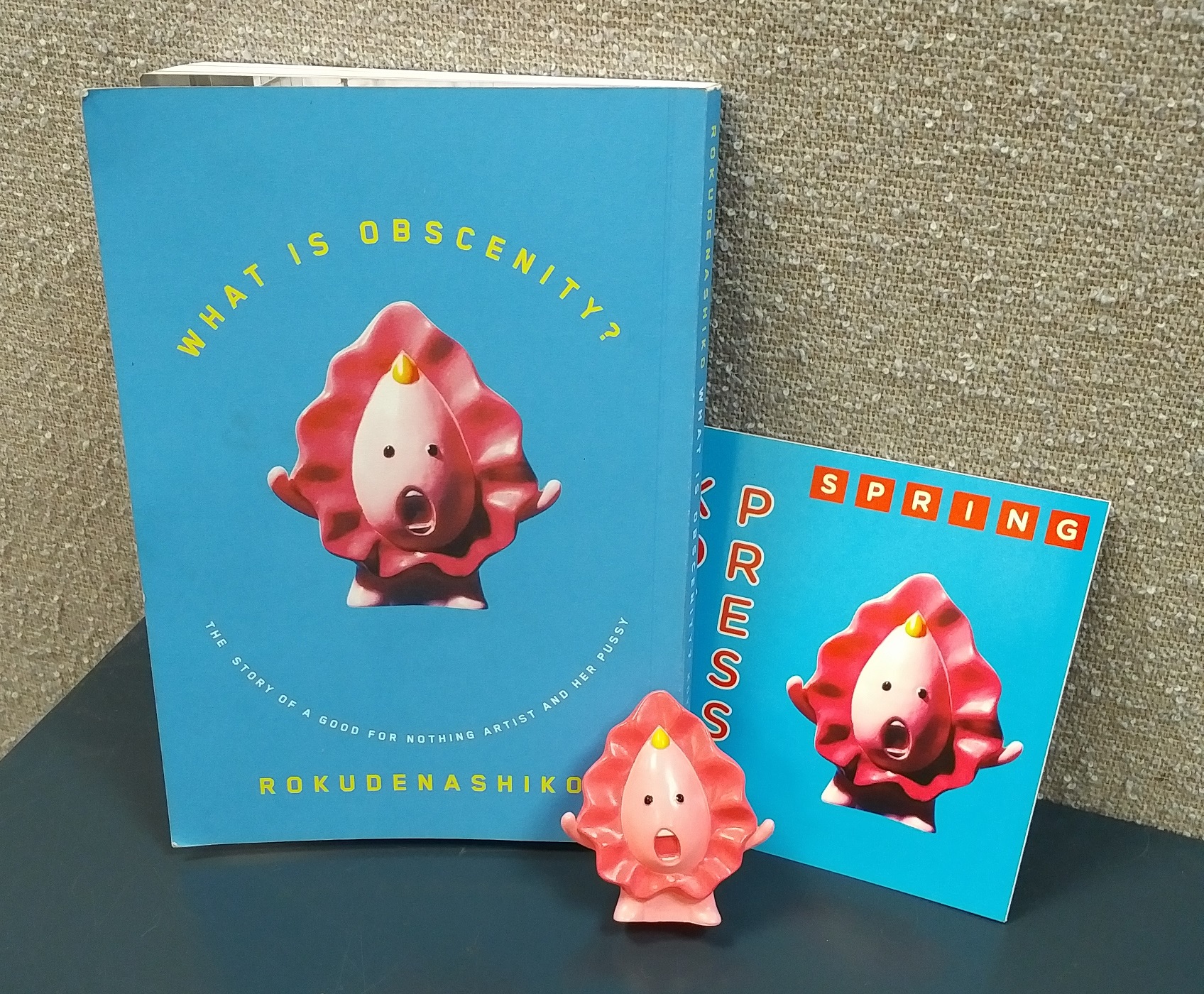
Rokudenashiko's Manko-chan

Manko-chan… in 3D!

The third panel I attended on Saturday was Rokudenashiko’s Spotlight which was absolutely delightful. After a brief introduction by Rebecca Sullivan, Rokudenashiko began by telling her story of how she came to be a vagina artist and activist and how she was subsequently arrested multiple times. Accompanying Rokudenashiko’s talk was a slide show of some of her artwork, and she brought along some of her small sculptures to show as well, including a remote-controlled “Gundaman.” Much of what she talked about I was already familiar with having read her manga What Is Obscenity? (which I highly recommend), but it was wonderful to see and hear her in person. Just like her work, Rokudenashiko is incredibly charming, cheerful, and funny. The humor and cuteness that Rokudenashiko brings to her manga, illustrations, and sculptures is very deliberate on her part. She noted that many feminist creators dealing with similar subject matter frequently use their art to express their anger and sadness which makes for very heavy work. So instead, Rokudenashiko wanted to do something that was more lighthearted and amusing. It was only after she realized that some people couldn’t laugh and have fun with it that she became more aggressive in her activism efforts, but without ever losing her sense of humor and positivity in her artwork. However, some critics and academics don’t appreciate this, feeling that she’s making too light of a serious subject. Rokudenashiko was very pleased with her reception in North America, saying that the long lines of people waiting to meet her would never happen in Japan where most people are generally too embarrassed to engage so publicly even if they recognize her and are interested in and support what she is doing.

Last year at TCAF I attended a panel on manga translation which was fascinating, so when I saw the “Translation” panel listed as part of the programming for 2016 I was immediately interested. This year the panel was moderated by Deb Aoki and featured three panelists: Jocelyne Allen, who translates from Japanese to English, Samuel Leblanc, a Canadian creator primarily working in French whose debut comic Perfume of Lilacs was released in English, and the French creator Boulet who (after a disastrous attempt to work with fans) currently translates his own comics into English. Leblanc was able to work directly with his translator and was able to provide feedback on the translation being done whereas Allen very rarely had the opportunity to be in contact with the creators of the works that she was translating. Although each of the panelists brought their own perspective to the conversation, they all agreed that capturing the appropriate tone and style is one of the most difficult things about translation. That and the fact that it’s nearly impossible to make everyone happy with a translation since so many people are invested in it each for their own reasons, whether it be the original creators, the translators, the publishers, or the readers. Lately however, the trend in comics translation seems to err on the side of the artists’ original choices and intent rather than focusing on localization. There are also different types of translation work which require different sets of skills—translating comics isn’t the same as translating prose literature which isn’t the same as translating technical manuals and so on. One thing that can be particularly challenging for comics translation is that the amount of space allowed for text is often limited. The visual element of the comics can have a great impact on the interpretation of a scene and the resulting word choices as well.

TCAF 2016 Haul

It’s not everything, but it is most of this year’s TCAF haul

On Sunday I was only able to make it to two panels before heading back home. One of the reasons that I enjoy TCAF so much is that it is an incredibly queer-friendly and queer-positive event, both in the exhibitor areas and in its programming. I was especially looking forward to “Queer Science Fiction and Fantasy,” a panel moderated by Melanie Gillman and featuring Megan Rose Gedris, Jeremy Sorese, Dylan Edwards, Andrew Wheeler, Taneka Stotts, and Gisele Jobateh, all of whom are queer creators of queer comics. Historically, queerness in speculative fiction has been relegated to subtext, but more and more that queerness is becoming increasingly obvious and in some cases is even the focus of a work. Speculative fiction allows for the creation and exploration of worlds that reflect upon current societal issues while showing what other possibilities could exist. Several of the panelists mentioned that when they were growing up speculative fiction provided some of the only representation of queerness that they saw in media, such as alternative relationship and social structures or a wider variety of genders and sexualities. Frequently, it was the non-human characters that they were most easily able to identify with and the inherent queerness of speculative fiction helped them to understand and discover their own identities. (All of this rings very true for me, too.) Webcomics and self-publishing efforts have been huge in changing the landscape of the comics market to the point where more mainstream publishers, which are slow to evolve and risk-averse, are now reaching a tipping point where queer content isn’t being automatically rejected. Deliberately, intentionally, and unquestionably queer speculative fiction is an evolving genre. Whether they mean to or not, independent creators are currently defining the expectations, tone, language, and tropes that are being set for queer representation in comics and what queer speculative fiction looks like.

The final panel I attended on Sunday was “Discussing Diversity (More or Less)” which was moderated by David Brothers. The panelists included Karla Pacheco, Cathy G. Johnson, Gene Luen Yang, Anne Ishii (one of the marvelous people behind Massive Goods), Ant Sang, and Bill Campbell. Diversity is a huge buzzword right now and not just in comics and other media. (Even my workplace is trying to focus on issues surrounding diversity, so it’s something I’m thinking about a lot these days.) In many of the conversations taking place in North America, diversity is often broadly defined as being non-straight/white/male which, in reality, is actually most of the world. The panel’s incredibly refreshing approach to discussing diversity was simply to talk about it as if was normal, because it is, rather than treating it as an exception or something unusual. As the panelists spoke about their own personal experiences and work, several common themes emerged, probably the most important being that there absolutely is a market, and a need, for diverse media. Though it can be a deliberate initiative, diversity in comics is a natural and often unintentional extension of creators’ own lives, interests, identities, and perspectives. There is also a distinct difference between providing more diverse representation in mainstream media and allowing a more diverse pool of creators to participate and express themselves within that context. While it might be a starting place, non-straight/white/male characters being written by straight/white/male creators sets an extremely low bar in terms of diversity. New voices and perspectives are just as critical if not more so in order to ensure that the comics market remains healthy as it continues to grow and evolve.

Sadly, because the kidling was getting cranky, I had to leave the festival before the food in comics panel which I was really hoping to attend. I was sad to miss most of the “What Women Want” panel’s third year, too. But I have come to realize that even if I wasn’t leaving “early,” it is impossible to see and experience everything that TCAF has to offer and choices must be made. Actually, this is something that I’ve known since the very beginning. There are always going to be panels I miss or that conflict with one another, and after the fact I’m always going to end up discovering comics that I would have been interested in and creators that I wish I had known about. But even so, that doesn’t detract from my overall enjoyment of the event and I am tremendously happy with what I was able to attend this year. TCAF is such a truly wonderful festival. As always, I’m already looking forward to and planning for my trip to Toronto for the event next year.

Filed Under: FEATURES Tagged With: comics, manga, Rokudenashiko, Shintaro Kago, TCAF

My Week in Manga: May 9-May 15, 2016

May 16, 2016 by Ash Brown

My News and Reviews

Despite being in Toronto for the majority of last week for the Toronto Comic Arts Festival (which I should hopefully have a write-up about soon), I still managed to post a few things here at Experiments in Manga. For those interested in what sorts of manga and other books make their way onto my shelves, April’s Bookshelf Overload is now available. The feature used to be posted fairly early on in the month, but at least for the time being it’s more likely to appear sometime in the second week as I’m following a more relaxed posting schedule. Last week I also reviewed Philip K. Dick’s award-winning novel The Man in the High Castle which explores an alternate history in which Germany and Japan won the Second World War and occupy most of what was the United States. It’s a fascinating, thought-provoking, chilling, and frankly terrifying work.

A few interesting things that I came across online last week while I wasn’t wandering around Toronto: The lead lawyer of Rokudenashiko’s legal team wrote a nice summary and explanation of the recent verdict in her obscenity trial, including the next steps that will be taken in the case. (I reviewed Rokudenashiko’s What Is Obscenity? a couple of weeks ago; the manga is excellent, and I was thrilled to have the chance to meet Rokudenashiko at TCAF.) Over at Publishers Weekly, Brigid Alverson writes about Hachette and Kadokawa’s recently announced partnership and what it means for Yen Press. Finally, Leah Zoller and Kathryn Hemmann have started to post a series of articles at The Lobster Dance based on their panel The Sparkling World of 1970s Shojo Manga, which should be fantastic.

Quick Takes

Noragami: Stray Stories, Volume 1Noragami: Stray Stories, Volume 1 by Adachitoka. Even though I have fallen behind in reading the main series, I have been enjoying Adachitoka’s Noragami. I’m apparently not the only one as the manga has been doing quite well for Kodansha, enough so that the publisher also licensed Stray Stories, a multi-volume series of Noragami side stories. For the most part, the short manga of Stray Stories don’t appear to rely on the main Noragami storyline although it is assumed that readers are at least already vaguely familiar with the manga’s characters and basic premise. So far, Stray Stories reminds me a bit of Noragami‘s earlier, more episodic nature before the series’ overarching plot began to take precedence. The short manga collected in Stray Stories also tend to be more comedic than serious, which I greatly enjoyed. The first volume was a lot of fun, and I’m glad that there will be more side stories to come. Stray Stories allows Adachitoka to expand on the world and characters of Noragami in ways that wouldn’t make sense in the main series but that are still enjoyable in their own right.

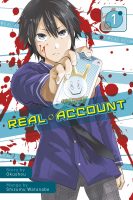
RealAccount1Real Account, Volume 1 written by Okushou and illustrated by Shizumu Watanabe. I’ll admit, I actually wasn’t expecting all that much from Real Account, so I was a little surprised by how much liked the first volume of the series even if there were a few things that didn’t quite work and even if there was at least one minor plot hole. Quite a few manga seem to have come out over the last few years with a similar basic premise in which a group of people find themselves trapped in an online environment where they must survive. If they die onlie, they will die real world as well. In the case of Real Account, that online environment is greatly influenced by social media and the users’ survival depends on them having at least one follower. The titular “Real Account” is something closely akin to Twitter with a few additional elements, like games, mixed in. Some of the deadly games those who are being held hostage are forced to play are actually quite clever and highly psychological, relying on the unpredictable nature of human relationships when self-preservation is on the line. At this point in the series it’s still unclear who is behind it all and what their motivations are, but there is definite and not particularly subtle social commentary being made.

Sense & SexualitySense & Sexuality by You Higashino. Originally released in English in print as part of Media Blaster’s Kitty Media line, Sense & Sexuality is now available digitally from Sublime Manga. I haven’t come across very many manga that take place during Japan’s Taishō Era, but it’s a really interesting time period in the country’s history and one of the reasons Higashino’s boys’ love one-shot Sense & Sexuality was first brought to my attention. The manga follows the sexual conquests of Hanamura and Takakura, two close friends from noble families whose lives are filled with decadence, leisure, and hedonism. They have turned their romances into a game, betting on who will be the first to bed the various attractive young men they have identified as their targets. Eventually though, their sights are set upon each other. For the most part, Sense & Sexuality is fairly episodic. There’s just enough story to hold it all together, but what little plot there is simply provides the excuses needed for the manga’s plentiful and explicit sex. High literature it is not, nor does it need to be. I really liked Sense and Sexuality‘s setting, the characters have a bit more depth to them than it initially seems, and the manga can be surprisingly humorous even though I wouldn’t necessarily describe it as a comedy.

Filed Under: FEATURES, My Week in Manga Tagged With: Adachitoka, manga, Noragami, Okushou, Real Account, Shizumu Watanabe, You Higashino

My Week in Manga: May 2-May 8, 2016

May 9, 2016 by Ash Brown

My News and Reviews

Last week at Experiments in Manga I announced the winner of the superhero duo manga giveaway. As usual, the post also includes a list of manga, in this particular case a list of manga featuring superheros of one ilk or another. Last week I also posted my review of Rokudenashiko’s comic memoir What Is Obscenity?: The Story of a Good for Nothing Artist in Her Pussy which is a wonderfully engaging and important work. Rokudenashiko is one of the featured guests at the Toronto Comic Arts festival which is this upcoming weekend; I greatly admire her and her work, so I’m looking forward to having the opportunity to meet her in person.

Elsewhere online: Rokudenashiko was recently interviewed in preparation for her trip to Toronto. Massive Goods hints at an upcoming announcement regarding an English-language release of Gengoroh Tagame’s award-winning My Brother’s Husband, which I am super-excited about. And Ryan Holmberg wrote a about Katsumata Susumu’s Anti-Nuclear Manga for the Sainsbury Institute and, at the other end of the spectrum, about the Nuclear Literati: Nakashima Kiyoshi’s Furusato Goes to Hell for The Comics Journal.

Quick Takes

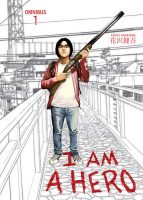
I Am a Hero, Omnibus 1I Am a Hero, Omnibus 1 (equivalent to Volumes 1-2) by Kengo Hanazawa. By this point I’m fairly burned-out when it comes to zombies, but I had heard so many good things about the award-winning I Am a Hero that I had to give it a try. And, I must admit, the manga is one of the most interesting and best examples of the genre that I’ve come across in quite some time. For me what makes I Am a Hero stand out is the lead character, Hideo. After making his debut as a professional mangaka, he’s back to being an assistant when his career failed to take off. He has the tendency to talk to himself, hear voices, and hallucinate, so everything that he experiences has to be questioned. The zombie apocalypse doesn’t really come until the second half of the first I Am a Hero omnibus. Until that happens, most of the hints and clues of the impending disaster can be easily dismissed as part of Hideo’s delusions. When the apocalypse finally does happen the series suddenly becomes horrifyingly brutal and grotesque as the world descends into chaos. Hideo remains surprisingly calm in the face of it all, partially because he initially assumes that the end of the world is just another one of his hallucinations. By the end of the first omnibus there’s already an extraordinarily high body count (most the named characters are done for and even Hideo isn’t completely unscathed), so I am very curious to see where the series goes from here.

Maga-Tsuki, Volume 1Maga-Tsuki, Volume 1 by Hoshino Taguchi. Apparently the initial inspiration behind Maga-Tsuki was originally going to be worked into a shōnen battle manga, but in the end it turned into a harem-ish romantic comedy. Personally, in this case I probably would have been more interested in the action-oriented series, but Maga-Tsuki does offer some variations on the usual tropes that are amusing. It is, however, very trope-heavy and contains the expected levels of fanservice for this type of story. When he accidentally breaks the sacred mirror protected by his family’s shrine, Yasuke finds himself cursed by the goddess sealed within it. In order to lift the curse he must make Orihime, a goddess of calamity and misfortune, happy, which proves to be something of a challenge. In the meantime, his soul has been separated from his body and he must maintain constant physical contact with Orihime or else he will die. A kiss from Orihime will conveniently revive him, though. This obviously results in all sorts of complications and misunderstandings, especially when it comes to trying to confess his feelings to the girl that he likes. I like that Maga-Tsuki makes use of Japanese mythology, otherwise I’m not sure that it would have managed to hold my attention. However, I do have a hard time seeing the sweetly cute and seemingly innocent Orihime as an ancient, all-knowing goddess even if her divine powers are suitably impressive.

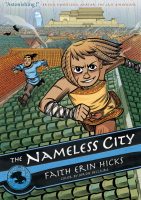
The Nameless CityThe Nameless City, Volume 1 by Faith Erin Hicks with colors by Jordie Bellaire. In general I tend to be fond of Hicks’ work, but I’ve been especially anticipating the debut of The Nameless City trilogy having followed its development and progress online. The titular Nameless City is a city that has been conquered and re-conquered countless times. Situated in a geographically advantageous location which allows the ruling kingdom immense control over the area’s economics and trade it makes a sought-after target. The city is currently under the domain of the Dao and has been for a few decades, but it’s likely only a matter of time before there’s another invasion or the residents rise up in revolt. Inspired in part by Chinese history, The Nameless City is about an unlikely friendship that develops over the backdrop of warfare, clashing cultures, and political intrigue. Kaidu is one of the Dao, sent to the Nameless City to participate in military education and training (though he’d much rather be reading than fighting), while Rat is one of the city’s many orphans whose parents were killed by the Dao. As Kaidu gets to know Rat he gets to know the city, and he learns more about his own people in the process, too. As for Rat, she initially hates Kaidu simply because he is Dao, but that slowly changes as she realizes that not all Dao are the same. I’m really enjoying seeing their relationship develop and look forward to the next volume, The Stone Heart, a great deal.

Filed Under: FEATURES, My Week in Manga Tagged With: comics, Faith Erin Hicks, Hoshino Taguchi, I Am a Hero, Kengo Hanazawa, Maga-tsuki, manga, Nameless City

What Is Obscenity?: The Story of a Good for Nothing Artist and Her Pussy

May 6, 2016 by Ash Brown

What Is Obscenity?Creator: Rokudenashiko
U.S. publisher: Koyama Press
ISBN: 9781927668313
Released: May 2016
Original release: 2015

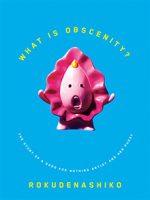
Like many other people both inside and outside of Japan, the work of artist and activist Rokudenashiko (the pseudonym of Megumi Igarashi) was brought to my attention following her arrests in 2014 on charges of obscenity. Rokudenashiko is a self-described manko (pussy) artist, challenging preconceived notions and taboos surrounding female genitalia by creating clever, fun, and silly sculptures incorporating realistic molds of vulvas as well as designing Manko-chan, a cute anthropomorphized pussy. One of Rokudenashiko’s responses to being arrested was to create the manga What Is Obscenity? about her experience. It was originally serialized in the Japanese political magazine Weekly Friday in 2014 before being collected in a single volume along with other material in 2015. The English-language edition of Rokudenashiko’s comic memoir, subtitled The Story of a Good for Nothing Artist and Her Pussy, was published by Koyama Press in 2016 thanks in part to the editing, translation, and production efforts of the fine folks behind Massive Goods.

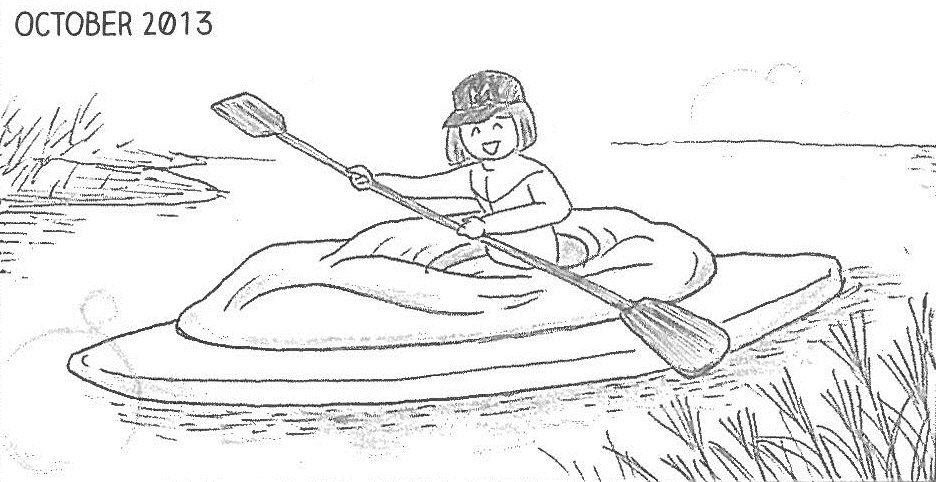
In 2013, Rokudenashiko successfully crowdfunded a project to create a kayak molded from a 3D scan of her genitals. One of the rewards given to some contributors of the campaign was a downloadable vector file of the scan which she encouraged others to use to make their own artwork. In July 2014, this file along with her artwork and other personal belongings were used as evidence to support the obscenity charges that were brought against her. Rokudenashiko was arrested and jailed for a week before being released only to be arrested and indicted again in December of that year. She continues to fight the charges in court and her trial process is currently ongoing, although a judgement on her case is scheduled to be pronounced on May 9, 2016.

What Is Obscenity? collects two short series of autobiographical manga—”What Is Obscenity? How I Became a So-Called Artist” about Rokudenashiko’s first arrest, her time spent in jail, and the immediate aftermath and “Why I Became a Manko Artist” which relates the story of how she almost unintentionally became an activist and started creating pussy-related artwork. Adorable illustrations of Manko-chan are found throughout the volume and “This Is My Story,” a short full-color manga about Manko-chan, is featured as well. The English-language edition of What Is Obscenity also includes additional material such as an introduction by Rokudenashiko, examples of her sculptures and artwork, color photography, cultural notes, and an excerpt of a discussion between Rokudenashiko and the controversial film direction Sion Sono.

What Is Obscenity?, page 11Freedom of expression, and especially freedom from governmental censorship, is something that I am very passionate about. One of my particular focuses in the various copyright and intellectual property law courses I took in graduate school actually happened to be obscenity law which, as in the case of Rokudenashiko, can be used to attempt to silence and punish artists and other creatives as criminals and which are notoriously inconsistent in their application. But Rokudenashiko isn’t allowing herself to be silenced. Her arrest and trial, as well as her willingness to publicly fight the obscenity charges, made not only national but international news. This has given her a larger platform that has allowed her to bring even greater attention to the absurdity of the systemic injustice of a society that objectifies the bodies of women while at the same time treating them as something shameful and obscene. I greatly and sincerely admire her work and efforts; what Rokudenashiko is doing is incredibly important both artistically and socially.

One of the things that makes Rokudenashiko so remarkable is that even in the face of infuriating and intimidating circumstances she is able to retain an outwardly upbeat, bright, and strikingly personable attitude which is then reflected in her work. Even while dealing with some fairly serious issues, What Is Obscenity? is sweet and charming with a wonderful sense of humor and art to match. As with much of Rokudenashiko’s work, What Is Obscenity? can be silly and fun, though many of the events portrayed were probably not nearly as funny while she was actually living through them. Her experiences, everything from the utter lows of personal and family troubles and the jail time caused by her artwork to the immense joy sparked by the unflagging support of her friends and fans, are recounted with a cheeky candidness that makes her story and the subject matter approachable and entertaining while still getting her message across. With its gentle humor and creative cuteness, What Is Obscenity? and the rest of Rokudenashiko’s work is subversively powerful, inspiring, and empowering.

Filed Under: REVIEWS Tagged With: Koyama Press, manga, Rokudenashiko

Manga Giveaway: Superhero Duo Winner

May 4, 2016 by Ash Brown

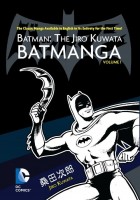
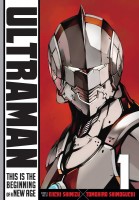
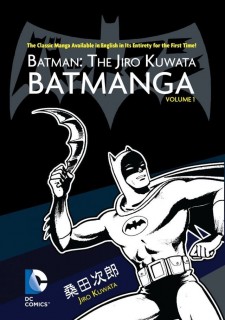
Batmanga, Volume 1Ultraman, Volume 1And the winner of the Superhero Duo manga giveaway is… Cody Kemp!

As the winner, Cody will be receiving a copy of Batmanga, Volume 1 by Jiro Kuwata as well as a copy of Ultraman, Volume 1 by Eiichi Shimizu and Tomohiro Shimoguchi, two superhero manga that were released relatively recently in English. I don’t really consider myself to be a huge fan of the superhero genre, but when I do finally get around to reading manga featuring superheros of one ilk or another, I generally do enjoy them. So, for this giveaway, I asked that participants tell me a little about some of their favorite superhero manga. For everyone’s detailed responses, be sure to check out the Superhero Duo giveaway comments. (The lesson learned from the responses? If you’re not already reading One-Punch Man, you should be!)

Some of the superhero manga available in English:
Apocalypse Zero by Takayuki Yamaguchi
Batmanga by Jiro Kuwata
Big Hero 6 by Haruki Ueno
Dead End by Shohei Manabe
Duklyon: Clamp School Defenders by CLAMP
Hero Heel by Makoto Tateno
Hero’s Are Extinct by Ryoji Hido
Heroman written by Stan Lee, illustrated by Tamon Ohta
Junk: Record of the Last Hero by Kia Asamiya
Lucifer and the Biscuit Hammer by Satoshi Mizukami
My Hero Academia by Kōhei Horikoshi
No. 5 by Taiyō Matsumoto
One-Punch Man written by One, illustrated by Yusuke Murata
Ratman by Sekihiko Inui
Tiger & Bunny by Mizuki Sakakibara
Tiger & Bunny: The Beginning by Tsutomu Ono
Tiger & Bunny: Comic Anthology edited by Asuka Henshubu
Tokyo ESP by Hajime Segawa
Ultimate Muscle: The Kinnikuman Legacy by Yudetamago
Ultraman by Eiichi Shimizu and Tomohiro Shimoguchi

Depending on your definition of “superhero,” the above list could be much longer (or much shorter, for that matter) but it’s probably not a bad place to start for someone interested in reading super-heroic manga. Thank you to everyone who participated in the giveaway and took the time to share your favorite superhero manga with me. Until next time!

Filed Under: Giveaways, UNSHELVED Tagged With: Batmanga, Eiichi Shimizu, Jiro Kuwata, manga, Tomohiro SHimoguchi, Ultraman

My Week in Manga: April 25-May 1, 2016

May 2, 2016 by Ash Brown

My News and Reviews

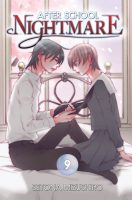
April has come to a close and May has begun, but there’s still a little time left to enter April’s manga giveaway for a chance to win a duo of superhero manga: Jiro Kuwata’s Batmanga, Volume 1 and Eiichi Shimizu and Tomohiro Shimoguchi’s Ultraman, Volume 1. In addition to the manga giveaway, I also snuck in my review of Setona Mizushiro’s After School Nightmare, Volume 9 last week. It’s a particularly dramatic volume in the series with some major twists and reveals. I’m very curious to see how Mizushiro will bring things to a close in the tenth and final volume. The review was part of my monthly horror manga review project, and I just barely got it written and posted before April ended. I’ve been super busy and stressed out lately, which makes writing even more difficult for me than it usually is. There are plenty of great and wonderful things going on right now in my life, but sadly the busyness and stress probably isn’t going anywhere anytime soon.

Quick Takes

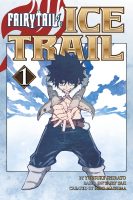
Fairy Tail: Ice Trail, Volume 1Fairy Tail: Ice Trail, Volume 1 by Yuusuke Shirato. There have recently been several manga spin-offs of Hiro Mashima’s series Fairy Tail released, but Ice Trail is the first that I’ve read. (For that matter, I’ll have to admit that I’ve not actually read most of Fairy Tail proper.) What primarily interested me in Ice Trail is that it serves as an origin story for Gray Fullbuster, one of Fairy Tail‘s most popular characters (as well as one of my personal favorites). Gray is a badass ice mage with a tragic past and the propensity for walking around without a shirt. Ice Trail shows Gray’s childhood in the brief time between when his home village was destroyed and when he joined the Fairy Tail guild. Despite the cuteness of seeing Gray as a kid, Ice Trail is very reminiscent of Fairy Tail in both style and tone. Apparently the series is only two volumes long, which may partially explain why the manga moves along at a break-neck pace with one action-packed battle after another. Ice Trail can mostly stand on its own, but will likely be most appreciated by readers who are already familiar with Gray and with Fairy Tail as a whole—though not absolutely necessary, that additional context can be helpful.

Kiss Him, Not Me, Volume 2Kiss Him, Not Me!, Volume 2 by Junko. I do get a kick out of Kiss Him, Not Me! I was a little worried at first since the series’ plot essentially hinges on the heroine’s sudden and drastic weight loss to bring her to the romantic attention of four of the hottest guys at her school. However, the manga quickly moves on from that premise and I don’t think it was even referenced at all in the second volume. Instead, Kiss Him, Not Me! revels in its humor and the comedic situation of a fujoshi finding herself on the opposite side of her usual fantasies. Basically, Serinuma’s life has become an otome game in which numerous young men are vying for her favor. The second volume of Kiss Him, Not Me! primarily focuses on two events: the school festival, during which each of the guys has the opportunity to have a mini-date with Serinuma (with varying degrees of success), and the Winter Comiket, which they all attend together although Serinuma is by far the most enthusiastic about it. One of the things that I particularly appreciate about Kiss Him, Not Me! is that no one asks Serinuma to change who she is at heart—she still gets to be an otaku. The second volume also introduces a new character who greatly intrigues me.

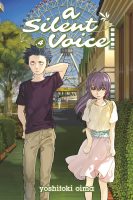
A Silent Voice, Volume 4A Silent Voice, Volumes 4-6 by Yoshitoki Oima. One of the manga to debut last year that I found to be particularly notable was Oima’s A Silent Voice and it continues to be a series that greatly impresses me. It’s not necessarily an especially happy read, though. The manga realistically portrays teenage angst compounded by issues of disability and bullying and explores the accompanying relationships which are extraordinarily messy and complicated. Emotional and physical violence takes its toll not only on the people who are being directly targeted, but also on the people who surround them. For better and for worse, the characters are all trying to deal with the repercussions of their past mistakes as best as they can, and even those who come across as antagonistic generally have their own problems they are working through. Just how deep a wound bullying can leave and how it can literally change a person’s life is more fully expressed in these volumes, and frankly it’s devastating. Thankfully, there are still moments of hope and redemption so A Silent Voice, while very serious and at times emotionally wrenching, never seems to become overwhelmingly bleak, but sometimes it does get close.

Filed Under: FEATURES, My Week in Manga Tagged With: Fairy Tail, Junko, Kiss Him Not Me, manga, Silent Voice, Yoshitoki Oima, Yuusuke Shirato

After School Nightmare, Vol. 9

April 30, 2016 by Ash Brown

After School Nightmare, Volume 9Creator: Setona Mizushiro
U.S. publisher: Go! Comi
ISBN: 9781933617701
Released: November 2008
Original release: 2007

After School Nightmare is a ten-volume manga series by Setona Mizushiro. Darkly psychological with elements of horror as well as social commentary, After School Nightmare can at times be a deeply troubling and challenging read while still being engrossing and oddly compelling. I first started reading the series several years ago, but have only recently been able to bring myself to read beyond the first few volumes of the manga, largely because I did find it so disconcerting and hard-hitting. Granted, the dark, anxiety-ridden atmosphere which makes the After School Nightmare so intimidating to approach is also what makes the story particularly effective and is an aspect to the manga that I can appreciate. After School Nightmare, Volume 9 was first published in Japan in 2007. The English-language edition of the volume was released in 2008 by Go! Comi. Sadly, the entire series has now gone out of print and is becoming more difficult to find.

One by one the students participating in the special after school class which forces them to share their literal nightmares with one another are graduating and disappearing, leaving only a vague memory of their existence behind. Though at times vicious and cruel, the dreams are intended to allow the students to work through their personal traumas, crises, and fears so that they can let go and move on from their troubled pasts. However, the violence and turmoil they experience within the dreams frequently spills over into their waking lives and graduating doesn’t necessarily guarantee a peaceful resolution. Koichiro in particular has reached his breaking point. He is ruthless in his determination to graduate and leave his overbearing and abusive father behind along with his carefully crafted public persona. Triggered by outside events, the nightmare Koichiro brings down upon the other students as he tries to free himself turns into a shockingly brutal and bloody rampage, signalling the beginning of the end for himself and for those who still remain.

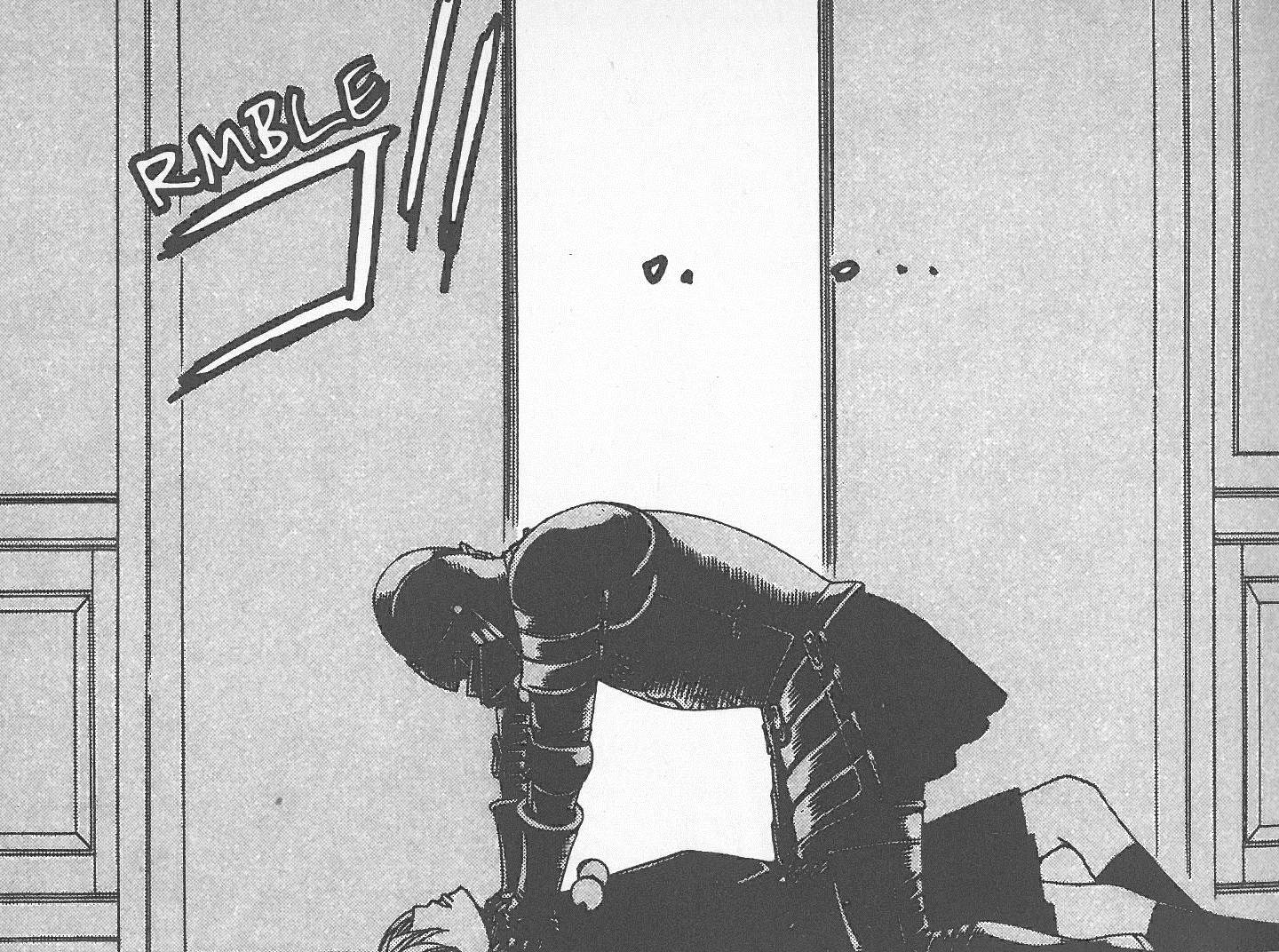
After School Nightmare, Volume 9, page 29A few questions still remain, but for the most part Koichiro’s character arc is resolved in After School Nightmare, Volume 9. Like so many of the other characters’ stories, Koichiro’s is a tragic one and it is heartwrenching to see it play out. The culmination of his anger, pain, and suffering has a direct and devastating impact on the others, ending with a violent attack on Mashiro, the portrayal of which has blatant parallels to a sexual assault. Koichiro was at one point the most stable and seemingly well-adjusted character in the series, so to see such a drastic shift in his outward attitude and behavior is especially startling. He isn’t the only character to have significantly changed over the course of After School Nightmare, though. However, for some the process, while still being extraordinarily difficult, has ultimately been more positive. Just as the dreams have led Koichiro to abandon his self-restraint, they have also allowed Mashiro the freedom to begin to come to terms with his fluid gender identity and the fact that he may feel more comfortable as a girl. Compared to the beginning of the series, Mashiro has greatly matured.

After School Nightmare, Volume 9 has a fair number of major plot twists, surprising reveals, and crucial story developments, many of which call into question everything that has come before in the manga. Some of these things have been foreshadowed and are not entirely surprising but there is still some disorientation as they are revealed to be not quite what they initially seemed. Koichiro dominates the first few chapters of the ninth volume but from there the focus of the manga turns toward Sou as more of his backstory is explored. An explanation of a past that he has not entirely dealt with yet and that has been incredibly damaging both emotionally and psychologically is finally given. After School Nightmare was never a light series, but the ninth volume is a particularly heavy and dramatic one. Considering the very final scene which challenges many of the assumptions that I had made regarding the series, I am very curious to see where Mizushiro takes the story in the final volume. After School Nightmare has been a dark and twisting journey and I have no idea how it will end; I’m almost a little frightened to find out.

Filed Under: REVIEWS Tagged With: after school nightmare, Go! Comi, manga, Setona Mizushiro

Manga Giveaway: Superhero Duo (Batmanga and Ultraman)

April 27, 2016 by Ash Brown

The end of the month once more draws near which means it’s once more time for a manga giveaway at Experiments in Manga! For this month’s giveaway you all have the chance to win not one, but two manga of the superheroic nature, a mix of the old and the new as well as the East and the West: Batmanga, Volume 1 by Jiro Kuwata from DC Comics and Ultraman, Volume 1 by Eiichi Shimizu and Tomohiro Shimoguchi from Viz Media. And, as always, the giveaway is open worldwide, too!

Batmanga, Volume 1Ultraman, Volume 1

It’s a little strange: I would never really go out of my way to describe myself as a fan of superhero comics, nor is it a genre that I specifically seek out. And yet, when I do end up reading about superheroes, I often find that I enjoy myself. Over the last few years, manga featuring superheros seem to have become increasingly common in English, whether it’s a classic like Jiro Kuwata’s Batmanga inspired by American comics or a modern take on a well-established Japanese franchise like Eiichi Shimizu and Tomohiro Shimoguchi’s Ultraman. Some superhero manga are fairly serious, but there have been quite a few with a comedic bent of late as well, such as One-Punch Man by One and Yusuke Murata and My Hero Academia by Kohei Horikoshi. And I have to admit, I’ve enjoyed them all.

So, you may be wondering, how can you win a duo of superhero manga?

1) In the comments below, tell me a little about one of your favorite manga featuring superheroes and why you like it. (If you don’t have a favorite, or haven’t read any superhero manga, simply mention that.)
2) If you’re on Twitter, you can earn a bonus entry by tweeting, or retweeting, about the contest. Make sure to include a link to this post and @PhoenixTerran (that’s me).

And there you have it! Everyone participating in the giveaway can earn up to two entries and has one week to submit comments. If preferred or needed, entries can also be emailed to me directly at phoenixterran(at)gmail(dot)com. Those comments will then be posted here in your name. The winner of the giveaway will be randomly selected and announced on May 4, 2016. Good luck to you all!

VERY IMPORTANT: Include some way that I can contact you. This can be an e-mail address in the comment form, a link to your website, Twitter username, or whatever. If I can’t figure out how to get a hold of you and you win, I’ll just draw another name.

Contest winner announced–Manga Giveaway: Superhero Duo Winner

Filed Under: FEATURES, Giveaways Tagged With: Batmanga, Eiichi Shimizu, Jiro Kuwata, manga, Tomohiro SHimoguchi, Ultraman

My Week in Manga: April 18-April 24, 2016

April 25, 2016 by Ash Brown

My News and Reviews

As I recently mentioned, for a while here I’ll be down to one review a week or so at Experiments in Manga. And so, last week’s review was of The Inugami Clan by Seishi Yokomizo, a popular Japanese murder mystery from the early 1950s that has sadly gone out of print in English. Currently, the novel is the only work by Yokomizo that has been translated, but I enjoyed it a great deal. It vaguely reminded me a bit of Edogawa Rampo’s work, which I don’t at all consider to be a bad thing.

Elsewhere online: YALSA’s 2016 Great Graphic Novels for Teen was recently announced, which includes a fair number of manga, as were the 2016 Eisner Award Nominees. Forbes interviewed Yoshiki Tanaka, the author of The Legend of the Galactic Heroes (a series I hope to find time to actually read sooner rather than later). At du9, Adrian Tomine was interviewed about editing Yoshihiro Tatsumi’s manga for Drawn & Quarterly. And in licensing news, Dark Horse will be releasing Ontama’s Hatsune Miku: Mikubon.

Quick Takes

Forget Me Not, Volume 1Forget Me Not, Volume 1 written by Mag Hsu and illustrated by Nao Emoto. I knew very little about Forget Me Not before reading the first volume. In fact, I didn’t even recall that it had been licensed until the release was in my hands. Forget Me Not is about Yusuke Serizawa, a young man who seems to have terrible luck when it comes to romance, but it’s the sort of bad luck that he’s partly responsible for. The first volume alone features his attempts at three different relationships with three different loves that he had between middle school and high school. Most of them have their sweet moments, but there are also moments that Serizawa will intensely regret for years. He blames himself for the relationships ending in ruin, and in some cases rightly so. The reason that Forget Me Not focuses on Serizawa’s past and the women in it is that one of them recently helped to save his life after he was in a motorcycle accident. Except that he isn’t sure exactly who it is. He’d like to meet her, but he’s also certain that whoever it is he’s done her some great harm, which may explain why it seems like she’s toying with him by keeping her identity secret.

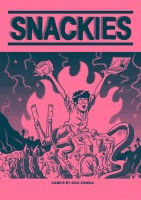
SnackiesSnackies by Nick Sumida. I had a fairly good idea that I would enjoy Snackies, but I don’t think I anticipated just how much I would end up enjoying it. Snackies is a slim volume containing short comics which are at least semi-autobiographically inspired. Many of the comics stand on their own or aren’t necessarily connected to one another, but others are part of short series which become increasingly ridiculous and bizarre, such as the set of comics in which Sumida spies fellow passengers on mass transit who initially seem attractive, but who then turn out to have a really bad haircut or just so happen to be an alien that would aesthetically belong in something like Parasyte. And then there are the comics that seem to come completely out of nowhere. Though at times fairly cynical, playing on the angst and self-deprecation of a young artist, Snackies is very funny. It also has a queer bent to it which I especially enjoyed and appreciated. Snackies doesn’t take long to read, but it gives enough of a taste that I hope to see more of Sumida’s work in the future.

Tramps Like Us, Volume 1Tramps Like Us, Volumes 1-5 by Yayoi Ogawa. I’ve been meaning to read Tramps Like Us for quite some time. It really is a shame that it took me so long to get around to it, because so far I’m absolutely loving the manga. Sumire is highly accomplished, attractive, and well-educated career woman, which unfortunately intimidates her fiancé who feels inadequate in comparison and leaves her for someone else. As a result, Sumire is determined to only date men who are paid more, are better educated, and are taller than she is. Around the same time, Sumire gains a “pet,” a homeless twenty-something ballet dancer that she takes in off of the street and calls Momo. Sumire’s peculiar but earnest relationship with Momo is marvelous. Though they have their disagreements and their communication isn’t always the best, both of them find great comfort in the other. He’s the only person she feels truly at ease with. But then Sumire is reunited with an old flame who she still loves and who happens to meet all of her dating requirements, but their relationship is strained. It’s a strange sort of set up and love-triangle, but all of the varied emotions are convincingly real.

Filed Under: FEATURES, My Week in Manga Tagged With: comics, Forget Me Not, Mag Hsu, manga, Nao Emoto, Nick Sumida, Tramps Like Us, Yayoi Ogawa

My Week in Manga: April 11-April 17, 2016

April 18, 2016 by Ash Brown

My News and Reviews

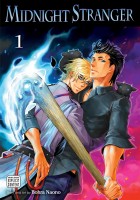
As I alluded to a few months ago, I’ve been in the process of trying to purchase a house. Well, I finally made it happen! I signed all of the papers on Friday, so for the foreseeable I’m going to be a little preoccupied getting things ready and moving over to the new place. It’s all sorts of exciting, but it does mean I’ll have significantly less time to devote to other things for a while. And so, I’m back to a reduced posting schedule at Experiments in Manga for the time being. Expect to continue to regularly see My Week in Manga, but there will probably only be one other review or feature most weeks. That all being said, last week I reviewed the recently released Midnight Stranger, Volume 1, a supernatural boys’ love manga with a sense of humor (as well as some pretty great monster designs) by Bohra Naono. I haven’t seen a lot of manga news over the last week, although I’m sure there has been some, but I did want to mention that Viz Media has licensed Kohske and Syuhei Kamo’s Gangsta: Cursed, a prequel series to Gangsta (a manga of which I’m particularly fond.)

Quick Takes

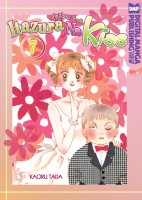
Itazura na Kiss, Volume 7Itazura na Kiss, Volumes 7-8 by Kaoru Tada. It’s been a little while since I’ve read any of Itazura na Kiss, but it’s a pretty easy series to put down and pick up again since nothing of major importance really ever seems to change all that much. I have been enjoying the series, but I’m starting to long for a little more forward momentum and the characters are beginning to wear me down a little. At the same time, while the overall pacing is fairly slow, Tada is expert in changing and moving the story along just enough to keep things interesting. Kotoko and Naoki are now newlyweds, but otherwise their relationship is pretty par for the course. Kotoko is utterly infatuated with Naoki, and Naoki continues to be fairly cold towards her. Thankfully, Kotoko is (slowly) beginning to mature and determine for herself what it is she really wants to do with her life. It can be difficult to tell at times, but Naoki really does love Kotoko and cares for her well-being, he just tends to be a total ass about it which can be tiresome. Granted, it does make it particularly satisfying when he ends up being thrown out of his comfort zone.

The JudgedThe Judged by Akira Honma. Having greatly enjoyed the first two volumes of Honma’s Rabbit Man, Tiger Man boys’ love series, and considering the fact that the third and final volume is unlikely to ever be released in English, I decided to seek out the creator’s other works in translation. I didn’t realize it until I finished reading manga, but The Judged was actually Honma’s first volume to be released as a professional mangaka. The titular story is about a prosecuting investigator and member of the Diet who are navigating a political scandal, while their shared past makes things even more complicated. The Judged also includes Honma’s debut manga “Like a White Phantom” about an initially antagonistic relationship between two young doctors. For the most part, the focus of The Judged is more on the drama and less on the romance. The manga tends to be fairly serious and the relationships aren’t necessarily the most healthy. They’re not always particularly happy relationships, either. Many of the characters have some pretty heavy personal issues do deal with, including physical and emotional abuse.

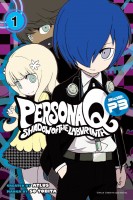
Persona Q: Shadow of the Labyrinth, Side: P3, Volume 1Persona Q: Shadow of the Labyrinth, Side: P3, Volume 1 by So Tobita. The Persona series is perhaps the most popular subset of the larger Shin Megami Tensei video game franchise. Persona Q is a relatively recent spinoff from 2014 made for the Nintendo 3DS which combines characters from Persona 3 and Persona 4—a player can choose to experience the game from either perspective. Likewise, a reader can choose from either the Side: P3 or Side: P4 manga adaptation which present two different sides of the same story. When it comes to manga adaptations of video games, there seem to be two major types, those that are accessible to anyone and those that are intended to be appreciated by fans of the original. So far, the Side P3 manga would seem to be one of the latter, requiring some prior knowledge of the franchise to fully enjoy the series. Very little is explained about the world or the characters in the manga itself. But for those who are familiar with Persona, the Side: P3 manga can be a fun way to quickly experience or re-experience the story and game of Persona Q, though I’m not sure that it really adds anything new.
Filed Under: FEATURES, My Week in Manga Tagged With: Akira Honma, itazura na kiss, Kaoru Tada, manga, Persona, Shin Megami Tensei, So Tobita

Midnight Stranger, Vol. 1

April 14, 2016 by Ash Brown

Midnight Stranger, Volume 1Creator: Bohra Naono
U.S. publisher: Viz Media
ISBN: 9781421579689
Released: April 2016
Original release: 2013

Midnight Stranger is the third boys’ love manga and the first series by Bohra Naono to be released in English. Naono’s first manga to be translated was Yokai’s Hunger which was initially released in print by Media Blasters but is now available digitally through Sublime Manga, the boys’ love line associated with Viz Media. Sublime also released Naono’s second manga in translation, Three Wolves Mountain, which along with Norikazu Akira’s Honey Darling was actually one of the publishers’ debut titles. Midnight Stranger is a short, two-volume series, the first of which was published in Japan in 2013. In English, Midnight Stranger, Volume 1 was released by Sublime in 2016. Like Naono’s other translated manga, Midnight Stranger has strong supernatural elements which can be fun but rather peculiar, a fair amount of comedy, and Naono’s penchant for older men. I’ve enjoyed Naono’s work in the past, so I was very glad to have the opportunity to receive a copy of the first volume of Midnight Stranger for review.

Midnight Stranger, Volume 1 contains two major storylines which aren’t directly related to each other but which could conceivably take place in the same setting. The volume opens with the titular “Midnight Stranger” and its followup chapter “Love-Hate” which are about Roitschaggata, a minor goat spirit, and Xiuhtecuhtli, an old and powerful god of fire. (The two are also the focus of the volume’s bonus chapter, “The Point of a Day Off.”) Centuries ago, due to the ugliness of his original form, Roi was mistaken for a monster rather than the benevolent spirit of healing that he is. He was nearly burned alive by a mob of humans, but was saved and granted more appealing looks by Xiu. The two of them now live together in modern-day Japan—Roi utterly devoted to his god, and Xiu oddly fond and possessive of his adoring servant. The second storyline collected in Midnight Stranger, and the basis for the four-panel comics included at the volume’s end, is “Hollow Romance,” a manga about a seemingly innocent young man named Takara Mori who is both more and less than he seems and the literal demons surrounding him.

Midnight Stranger, Volume 1, page 25Although I’ve somewhat come to expect it from Naono’s manga, the supernatural aspects of Midnight Stranger are all over the place and the worldbuilding isn’t necessarily cohesive. Xiu is based on an Aztec deity, Roi I believe is inspired by Swiss traditions, “Hollow Romance” incorporates Nordic legends, and there is a variety of other mythological beings present in the manga as well. It’s never really explicitly explained why all of these deities, demons, spirits, and legends from vastly different cultures and geographies are interacting with one another, but clearly in Midnight Stranger gods and beliefs aren’t restricted by countries or borders. The unexpected combinations, while seemingly haphazard, can be surprisingly entertaining, though. But while Naono has taken inspiration from multiples sources, which is something that I enjoy about her work, her interpretations are very much her own and frequently very little of the original tales remain. Xiu, for example, retains his name and has an appropriately fiery temper and flashy personality, but otherwise his connection to Mesoamerica is largely nonexistent.

Humor is also prominent in Midnight Stranger, though in tone the manga does shift between comedic and ominous. Granted, there is plenty to find amusing or ridiculous in Midnight Stranger, such as Xiu making his living in the mortal world as an idol or Roi gaining a young boy he cured as a best friend and confidant. Roi is actually the source of quite a bit of the humor in Midnight Stranger. He has a complex about his appearance, not realizing how adorable his new goat form is or how attractive he is as a human. He’s also apparently a little slow in recognizing that Xiu has feelings for him—readers aren’t privy to the hundreds of years of the extremely tedious evolution of their relationship, just the time period in which Roi finally figures it out and the heated sex that follows. Whereas Roi and Xiu’s story becomes more comedic as it progresses, Naono takes the opposite approach with “Hollow Romance” which becomes increasingly darker and grotesque, all while still maintaining a sense of humor. I particularly liked “Hollow Romance,” but I am curious to see what lies in store for Roi and Xiu in the next volume of Midnight Stranger.

Thank you to Viz Media for providing a copy of Midnight Stranger, Volume 1 for review.

Filed Under: REVIEWS Tagged With: Bohra Naono, manga, Midnight Stranger, Sublime Manga, viz media

My Week in Manga: April 4-April 10, 2016

April 11, 2016 by Ash Brown

My News and Reviews

In case anyone was wondering just how much I was looking forward to seeing Akiko Higashimura’s Princess Jellyfish released in English, I apparently ended up devoting an entire week to it at Experiments in Manga. (Sort of.) First was the announcement of the winner of the Princess Jellyfish giveaway, which also includes a list of upcoming manga releases that I and the giveaway participants are especially looking forward to. (Yes, Princess Jellyfish was mentioned multiple times, and not just by me.) The honor of the first in-depth manga review for April goes to the first Princess Jellyfish omnibus which I (unsurprisingly) loved. I’m enjoying the manga immensely, but I’m especially looking forward to getting to the point in the series where the anime adaptation left off. Princess Jellyfish even got a specific mention in March’s Bookshelf Overload, which was posted over the weekend.

There were a few manga-related things caught my eye last week. Brigid Alverson’s article on the state of the North American manga industry, which focuses on the impact of a few of the top-selling series, is now free to read at Publishers Weekly. The translation and quality of Digital Manga’s original release of the first volume of Kou Yoneda’s Twittering Birds Never Fly drew a fair amount of criticism from fans, so much so that the publisher decided to completely revise and re-release it. Apparently 200 of the 223 pages were redone in some fashion. The new edition should be available sometime in late May or early June. Also, Vertical launched it’s most recent licensing and readership survey for anyone who might have any manga or light novel requests. And last but certainly not least—Kodansha Comic’s will be releasing more of Vinland Saga!

Quick Takes

Beyond: The Queer Sci-Fi & Fantasy Comic AnthologyBeyond: The Queer Sci-Fi & Fantasy Comic Anthology edited by Sfé R. Monster. A fair number of independent queer comics anthologies have been released relatively recently, but I’m always happy to see more. Beyond collects twenty works from twenty-seven creators. I was previously familiar with a few of the contributors, but most of them were actually new to me. Overall, it’s a strong, well-thought-out collection.  The anthology shows a wonderful range of stories and characters, but I was especially happy to see a wide variety of diverse trans identities represented. While many of the works in Beyond include some romantic elements, romance isn’t at all at the forefront of the collection. Instead, the stories tend towards science fictional and fantastical adventures—space exploration, battles against monsters, survival in strange worlds, and so on—in which queer characters are not only the protagonists but the heroes of their stories. A second Beyond anthology focusing on urban fantasy and post-apocalyptic worlds is currently in the works; I’m looking forward to it a great deal and will definitely be picking it up.

Goodnight Punpun, Omnibus 1Goodnight Punpun, Omnibus 1 by Inio Asano. The first omnibus of Goodnight Punpun is one of the manga that has left the greatest impression on me so far this year, though I have difficulty coherently explaining why I find it so extraordinary. The series has been described as a surreal and dark coming-of-age story, which is accurate but doesn’t quite capture the intense experience of actually reading the manga. Punpun is the titular character, an elementary school student who, along with the rest of his family, is portrayed as a bird-like creature. This perhaps slightly softens the blows of the story. In addition to dealing with the normal sorts of problems associated with getting older, Punpun’s family is also violently falling apart. And if growing up wasn’t terrifying enough, most of the adults in Goodnight Punpun seem to be on the verge of insanity if they haven’t already succumbed to it. Although there are wonderful moments of hope and humor, the worldview presented in Goodnight Punpun is a pessimistic one and Punpun is learning some very hard truths. Goodnight Punpun is heart-wrenching, but very good.

Paradise Residence, Omnibus 1Paradise Residence, Volume 1 by Kosuke Fujishima. Oh My Goddess! has been one of the mainstays of the North American manga industry, so it’s probably no too surprising that one of Fujishima’s most recent series, Paradise Residence, was licensed. I’m not entirely sure if the series is being released in an omnibus edition or not, but the first volume from Kodansha Comic’s also includes Volume 0 as bonus material at the end. I would actually recommend reading Volume 0 first as some of the jokes and characterization in Volume 1 make much more sense with more context. This is important because the humor, which can be legitimately if inconsistently funny, tends to be based on the characters’ personalities. Despite some of the more outrageous scenarios in Paradise Residence, the comedy is actually fairly subdued. Paradise Residences is a largely episodic manga about dorm and school life at an all-girls boarding school. At times Paradise Residence can be a really sweet and charming series, but every once in a while some nonsensical fanservice is thrown in that’s more distracting than anything else.

Filed Under: FEATURES, My Week in Manga Tagged With: Beyond, comics, Goodnight Punpun, Inio Asano, Kosuke Fujishima, manga, Paradise Residence

  • « Go to Previous Page
  • Page 1
  • Interim pages omitted …
  • Page 8
  • Page 9
  • Page 10
  • Page 11
  • Page 12
  • Interim pages omitted …
  • Page 60
  • Go to Next Page »
 | Log in
Copyright © 2010 Manga Bookshelf | Powered by WordPress & the Genesis Framework