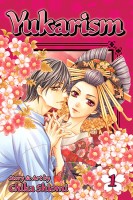
Yukarism Volume 2 by Chika Shiomi
I enjoyed the first volume of this series very much, and was interested to see how the dynamic of gender-swapped past lives would play out in the present for the young novelist Yukari.
I was impressed with the sheer amount of plot and world building Shiomi was able to develop in the first volume, but I was interested to see what would happen in the second volume when character motivations were already established. At first the relationship between Yukari and his female fan Mahoro seemed to mirror the relationship of courtesan Yumurasaki and watchful bodyguard Kazuma. It turns out that the burn mark that Mahoro and Kazuma share across the centuries might be a red herring because when a new character named Satomi appears to act as Yukari’s housekeeper, Mahoro’s fierce possessiveness and sudden magical abilities resemble the Witch Doctor Shizuka. Shizuka was one of Yumurasaki’s most ardent lovers, and Yukari wonders if the Witch Doctor was the cause of his past incarnation’s death.
While much of the first volume focused on established Yukari’s unique time traveling ability and defining his personality as well as Yumurasaki’s, the second volume delves more into the relationships of the people who surround the author/courtesan in the past and the present. Mahoro starts sleepwalking and uttering magical curses when she sees Satomi, and then she switches back to normal with little memory of what she did. The instant antagonism between Satomi and Mahoro is filled with glares and a sense of real menace, since both of them seem to have little control over their actions. Yukari continues to learn more about his past, with a subtle observational approach that fits in well with his personality as an author. Mahoro is falling more and more in love with him, which might make her emotions and connection to her own previous life more extreme. All in all, this was a solid second volume and Yukarism is positioned well to rotate in to fill the paranormal romance slot in your current manga reading list, since a few series in that genre have recently concluded.




 Night of the Beasts may not be Chika Shiomi’s best work, but it’s certainly her most ambitious, a sweeping horror-fantasy with detailed artwork and nakedly emotional dialogue reminiscent of CLAMP’s Tokyo Babylon and X/1999 .
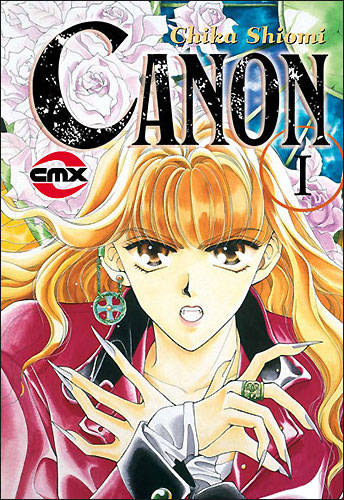
 The eponymous heroine of Canon is a smart, tough-talking vigilante who’s saving the world, one vampire at a time. For most of her life, Canon was a sickly but otherwise unremarkable human — that is, until a nosferatu decided to make Lunchables™ of her high school class. Canon, the sole survivor of the attack, was transformed into a vampire whose blood has an amazing property: it can restore other victims to their former human selves. She’s determined to rescue as many human-vampire converts as she can, prowling the streets of Tokyo in search of others like her. She’s also resolved to find and kill Rod, the handsome blonde vampire whom she believes murdered her friends. Joining her are two vampires with agendas of their own: Fuui, a talking crow who’s always scavenging for blood, and Sakaki, a half-vamp who harbors an even deeper grudge against Rod for killing his family.
 Though some authors get it right on their very first try – say, Ralph Ellison or Harper Lee – most take a few books to develop their voice and storytelling chops. Chika Shiomi is no exception to this rule, as Queen of Ragtonia, an early series, demonstrates.
 Rasetsu is a popcorn movie in manga form, a tasty mix of suspense, humor, and sexual tension with a sprinkling of supernatural elements. Though billed as a sequel to
  Common to all of Chika Shiomi’s supernatural thrillers are her butt-kicking heroines. Whether taming demons or hunting vampires, these unapologetically tough cookies always bag a fetching fellow, personality flaws and conflicting allegiances be damned.
 While Yurara’s premise isn’t particularly novel, I found it a nice bit of wish fulfillment: who wouldn’t want the power to transform into a more competent, attractive version of themselves when the occasion warranted? Shiomi has the good sense to exploit her set-up for laughs as well as chills, milking her awkward love triangle for all its comic potential and populating her story with some goofy ghosts. In volume three, for example, Shiomi introduces us to the spirit of Yurara’s grandfather. Thrilled to be among the living again, he dudes himself out as a seventies hipster — about the decade he would have been in his masculine prime — and swaggers through the streets of Tokyo, oblivious to the fact that only Mei, Yako, and Yurara can actually see his youthful new appearance.