• Skip to primary navigation
  • Skip to main content
  • Skip to primary sidebar
  • Home
  • About Us
    • Privacy Policy
    • Comment Policy
    • Disclosures & Disclaimers
  • Resources
    • Links, Essays & Articles
    • Fandomology!
    • CLAMP Directory
    • BlogRoll
  • Features & Columns
    • 3 Things Thursday
    • Adventures in the Key of Shoujo
    • Bit & Blips (game reviews)
    • BL BOOKRACK
    • Bookshelf Briefs
    • Bringing the Drama
    • Comic Conversion
    • Fanservice Friday
    • Going Digital
    • It Came From the Sinosphere
    • License This!
    • Magazine no Mori
    • My Week in Manga
    • OFF THE SHELF
    • Not By Manga Alone
    • PICK OF THE WEEK
    • Subtitles & Sensibility
    • Weekly Shonen Jump Recaps
  • Manga Moveable Feast
    • MMF Full Archive
    • Yun Kouga
    • CLAMP
    • Shojo Beat
    • Osamu Tezuka
    • Sailor Moon
    • Fruits Basket
    • Takehiko Inoue
    • Wild Adapter
    • One Piece
    • After School Nightmare
    • Karakuri Odette
    • Paradise Kiss
    • The Color Trilogy
    • To Terra…
    • Sexy Voice & Robo
  • Browse by Author
    • Sean Gaffney
    • Anna Neatrour
    • Michelle Smith
    • Katherine Dacey
    • MJ
    • Brigid Alverson
    • Travis Anderson
    • Phillip Anthony
    • Derek Bown
    • Jaci Dahlvang
    • Angela Eastman
    • Erica Friedman
    • Sara K.
    • Megan Purdy
    • Emily Snodgrass
    • Nancy Thistlethwaite
    • Eva Volin
    • David Welsh
  • MB Blogs
    • A Case Suitable For Treatment
    • Experiments in Manga
    • MangaBlog
    • The Manga Critic
    • Manga Report
    • Soliloquy in Blue
    • Manga Curmudgeon (archive)

Manga Bookshelf

Discussion, Resources, Roundtables, & Reviews

Reviews

Last Round Arthurs, Vol. 5: Once King & Future King

July 22, 2021 by Sean Gaffney

By Taro Hitsuji and Kiyotaka Haimura. Released in Japan by Fujimi Fantasia Bunko. Released in North America by Yen On. Translated by Jan Cash.

Yeah, that really did not stick the landing, did it? After a series that mixed up wacky romcom “shout at the appalling girl being appalling” stuff with Shonen Jump battles, the series goes all in on the latter here at the end. Which is fine – given the glimpse of Kay and Emma *still* in fetishwear in the epilogue, I’m quite happy to have a final volume of serious fighting. The trouble is that the fighting is not all that great, and the beats are very, very predictable. I’ve compared it to Jump before, but here it sort of reads like one of those Jump series that gets cancelled 2-3 volumes in and told to wrap things up here. We meet the final boss, who is exactly who you’d expect, and our heroes are almost defeated, as you’d expect, except Luna simply! will! not! give! up!, as you’d expect. What about Rintarou, you ask? Well, he’s trapped in another dimension. Will he make it back just in the nick of time? Take a guess.

We pick up where the last book left off, as our merry crew (minus Rintarou) have gotten back from their Holy Grail Quest to find that New Avalon has been overrun by monsters, and that evacuation of the island is being cut off by magic. Someone wants a massacre here. (Casualties are implied, but we never see or hear about dead bodies, so…) There’s also a massive dark evil castle in the center of the city now. Making their way there, our heroes split up to take on the bad guys: the original King Arthur, who has been corrupted into evil, his two companions, and Morgan Le Fay, who we find in this book would like the entire world to end so that she can be reunited with a nebbish ordinary knight she fell in love with back in the day. Luna may declare herself to be the next King Arthur, but can she go up against the original without Rintarou’s help?

Well, no, because the entire point of the series is that you get a partner for your quest and rely on them. Plus, again, Jump-esque series. When Rintarou showed up to save Luna in the nick of time, all I could think was that she’s going to hit him and tell him “You’re late!”, and sure enough, that’s exactly what happens. There’s a lot of discussion of what makes a king here, especially when Luna gets all the other candidates to basically give up and join her as subordinates. Luna says that being a king is about determination and never giving up, which certainly defines her, though give the fights in this book I sometimes get the sense she’s a Tex Avery dog slamming against a door over and over till it opens. Rintarou basically had his character development finish last time, so he essentially is absent for most of this book until he comes to save the day.

And so we end with Luna in charge, a new Round Table, and a world that is now aware of magic and monsters, which means that we’re seeing more of them across the globe. You get the sense that Luna’s going to turn the new Round Table into a modern-day Avengers. Fortunately, the series ends here, so I don’t have to worry about it. There wasn’t anything really bad with Last Round Arthurs, unless you dislike obnoxious women, but it never really rose above “yeah, it went there” in terms of narrative thrust.

Filed Under: last round arthurs, REVIEWS

Tearmoon Empire, Vol. 5

July 20, 2021 by Sean Gaffney

By Nozomu Mochitsuki and Gilse. Released in Japan as “Tearmoon Teikoku Monogatari” by TO Books. Released in North America digitally by J-Novel Club. Translated by David Teng.

The structure of this book is slightly off, as the author admits that the story got away from them and the island arc that should have concluded the 2nd “arc” of this story ended up being the first third of this 5th book as well. Still, it works out, as we get to see Mia turn a corner and fend off another of her fates written in a long history book… or at least it was long. Yes, sometimes when you’re trying to stop the bad guys who can mess with the fates, you end up finding that your fate can sometimes get even worse. Now Mia’s not being executed at the guillotine or cut down in her adult years for not being Empress, the history books say she’ll be killed in a few scant months. Can she avoid this fate while continuing to work hard to save her kingdom from famine, win over more allies by being kind and charming, and also eat delicious sweets? The answer should be obvious.

The one thing I took away from this book is that I think Mia handles plots against her, or large conspiracies, much better than sudden random events conspiring against her. When she has to deal with a cave-in, a seemingly deadly fish attacking her, or even just horses sneezing in her face, she seems to always end up on the wrong foot. But the larger, more epic scenarios are where she shines – and yes, by now even the narrator is having trouble saying EVERYTHING she does is due to her selfishness and need to eat sweets, although god knows they try to say so anyway. In her confrontation with Esmeralda, where she sees the traitorous past of their nation as found in a secret underground ruin, stares destiny right in the face, and says “to hell with that”, she really is learning to be a good person – and yes, it’s framed as her having to “deceive” Esmeralda by saying they’re best friends, but I don’t doubt it’s actually going to come to pass. Mia is no longer as passive or luck-driven as she was in past books.

The 2nd half of the book, back at school, is even better. Finding from Bel’s now-changed history book how she’s going to die, she takes steps to avoid it, the first of which is getting even better at riding horses. The way she does this is actually quite clever. You see, she gets up early, practices really hard, learns to read the movements of the horse, and treats them well, even going so far as to help save the life of the pregnant horse that she had been eyeing up as a replacement mount (as opposed to the horse that keeps sneezing on her). See? I told you it was clever. Mia is doing things correctly and doing them well. This culminates in the highlight of the book, where she races Ruby, the daughter of the House of Redmoon, in a Belmont Stakes with one of her retainers at stake. The race is fantastic, with Mia being both very much in character (she’s screaming and whining the entire time) but also incredibly awesome. And we also see her changing history once more, as one reason she was executed her first go-round is that she pissed off Ruby so much she persuaded her father not to support them with military might… something that ended up being fatal to them both. This time around, everyone wins, and Mia’s solution to what to do about Ruby is brilliant. I don’t even care if she wasn’t thinking long-term here. It’s still brilliant.

There are, of course, a few plotholes with the new arc, but they’re acceptable. Miabel did not vanish when Mia’s fate changed, despite the fact that she did not live long enough to have kids, much less grandkids. Even the author acknowledges this is a handwave, but it’s fine, as we also get sweet scenes of Miabel managing to stay her innocent, sweet self even in a bad future where she has to be hidden from the world. That said, Mia is still the star, not her granddaughter, and Mia is the reason that these books keep getting better. I can’t wait for the next one, and I would say that this is essential light novel reading.

Filed Under: REVIEWS, tearmoon empire

Culinary Chronicles of the Court Flower, Vol. 2

July 19, 2021 by Sean Gaffney

By Miri Mikawa and Kasumi Nagi. Released in Japan as “Ikka Kōkyū Ryōrichō” by Kadokawa Beans Bunko. Released in North America digitally by J-Novel Club. Translated by afm.

Last time I talked about the similarities between this series and The Apothecary Diaries, but hey, at least Rimi does no go around solving crimes… oh wait, yes, she does. In this volume, there’s a large chunk in the middle with a precious treasure being stolen, and Rimi, being the foreign girl who made food out of “wood”, is suspected of having magicked it away. So, um, yeah. Fortunately, the two books do have one major thing separating them, and that’s the heroine’s personality. Rimi and Maomao could not be more different, with Rimi being a more Usagi Tsukino sort of character, who may not be the sharpest knife in the drawer (though her emotional maturity is developing by leaps and bounds), but who knows just the right things to say to people to earn their trust. Of course, the delicious food helps as well. In fact, Rimi’s biggest problem may be that she’s so lovable that there may be civil war in the future, if the two men who’ve fallen for her don’t work things out…

Rimi is temporarily working with Shusei in the culinary department, and there’s an important assignment. The four consorts have to stand with the emperor soon for an important ceremony, and one must stand next to him and hold the Scattering Lotus, a highly valuable treasure. Needless to say, the competition to be that consort is high, and previous consort battles have even led to death. Shusei and Rimi have to work to pacify the consorts and get them to make a decision about what order to stand in without it coming to blows – even though everyone fears it will. And then, as I noted above, the Scattering Lotus is stolen and Rimi is the prime suspect. Is every book doomed to have her fighting to not be executed? Oh yes, and also the Emperor is far more interested in sleeping with her than any of the Four Consorts. That’s probably going to be a thing.

Rimi remains funny in this story, continuing to speak the language of the country she now lives in slightly off-center, so that things she says sound slightly to very rude. (The Emperor suggests she’s doing it on purpose, which I do not think she is… yet.) But she’s also the nicest person in the book, her life not really damaged by political schemes because she’s been raised entirely apart from everyone else. Sometimes this works against her, but it also allows her to see past the fronts that the other four consorts throw up and see what they truly have in common. I also love the concept of the treasure itself and what the solution was. That said, there’s more concerning things here as well. Someone high up seems to have it in for her, and while she escapes his grasp here I will not be surprised if he’s back in the next book, especially as he seems to regard her as some sort of sorceress.

This isn’t a great light novel, but it’s solidly good, and Rimi is a fun protagonist who I think is not as airheaded as she seems… though admittedly, that’s a low bar to clear. I’m happy to read more.

Filed Under: culinary chronicles of the court flower, REVIEWS

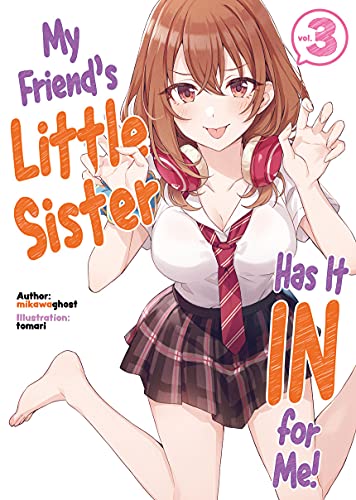
My Friend’s Little Sister Has It In for Me!, Vol. 3

July 18, 2021 by Sean Gaffney

By mikawaghost and tomari. Released in Japan as “Tomodachi no Imouto ga Ore ni dake Uzai” by GA Bunko. Released in North America by J-Novel Club. Translated by Alexandra Owen-Burns.

Someone needs to tell Japan that “having the rest of the cast being creeped out about the appalling character” is not a get out of jail free card for everything the character does. I’ve said in the previous books that the shotacon tendencies of Sumire are not funny but awful. Well, she’s the main character of this book, and so we get a lot more of it than even the previous two, and it’s still awful. Saying that a guy would be the perfect husband if only he were 5 years old is not a “LOL” moment. So be aware as I write the rest of this that this is a big black mark, and made me not enjoy this book nearly as much as the previous two. That said, I’m still reading it, because I do like the cast and the romantic comedy situations. With, well, one exception. Fortunately, this is not We Never Learn, so the teacher has precisely zero chance of winning the romantic sweepstakes.

We pick up right where the cliffhanger left off, as Sumire begs Akiteru to marry her. As expected, her family has decided enough is enough, and is going to arrange marry her soon… which means she won’t be able to draw anymore. This is basically the only reason Akiteru agrees to the scheme. After some “wacky” date situations, which I will not go into as they are dumb, a trip that’s supposed to be to the beach becomes a trip to her remote mountain village, where her father wants to meet Akiteru… and force them to get married immediately. Can they possibly get around the marriage ceremony with a 100% success rate? Can Iroha continue to try to cleverly juggle all these relationships in the air, given sempai is a dense MF and won’t do it for her? And can Mashiro finally admit she’s secretly their star writer?

Again, this series leans pretty hard on the Higurashi pastiche. Their game is subtitled “When They Cry”, and Sumire’s home village essentially turns out to be Hinamizawa, complete with terrifying elders and obscure rituals. Having already mentioned the volume’s big weaknesses, I do want to applaud its really good moment, when Mashiro’s editor (who we meet here, ad boy does it take some fancy footwork to explain her presence) points out to Akiteru that he needs to be able to offer his fellow game creators a reason to stay on with him, or else they’re going to look for other opportunities. What can he personally offers them? (Other than, of course, being the romantic lead who has no idea half the cast are in love with him.) It’s not a question that’s answered here, but I do appreciate it was brought up. Iroha also remains quite enjoyable, a bit less “annoying” than the first two volumes, probably as she’s trying harder to have him “get” her feelings.

That’s unlikely to happen soon, and a cliffhanger means we don’t even get this one resolved in one volume. Still, hopefully it won’t take up all of Vol;. 4. I think two volumes starring Sumire is two too many.

Filed Under: my friend's little sister has it in for me!, REVIEWS

Oresama Teacher, Vol. 29

July 16, 2021 by Sean Gaffney

By Izumi Tsubaki. Released in Japan by Hakusensha, serialized in the magazine Hana to Yume. Released in North America by Viz Media. Translated by JN Productions.

Though it’s not an explicit canon pairing, be warned I do talk about the IMPLICIT canon pairing in this review, so ‘ware spoilers.

The final volume of Oresama Teacher, a series that ran for thirteen years, and one of my own favorites, even though it will likely always be overshadowed by the still-running gag comedy Monthly Girls’ Nozaki-kun. It’s a shonen manga that ran in a shoujo magazine, and certainly had shoujo art, but one look at the plot and characters told you this was essentially a “gang” manga at heart, and featured a lot of “new bad guy arrives -> slowly win them over through being nice and/or beating the crap out of them -> now they’re friends! -> new bad guy arrives” in a circle with Mafuyu as its pivot. We’ve had so many ridiculous situations, so many awesome fights, so many cool teenage girls and dorky teenage guys. The journey to get here was wonderful. So, should I still be disappointed if the ending is not one I personally wanted? I mean… if you exist in fandom, yes, it ruins everything. Fortunately, Oresama Teacher only has 29 fanfics on AO3.

First of all, despite the cover art, this is not an OT3 ending, alas, and we do not see Mafuyu getting married. We start off resolving the cliffhanger from last time, and if it feels a bit like it’s undercutting and mocking the drama, well, that’s what this series has always done best. Adfter this we deal with the last remaining open plot hook – what happened to Mafuyu’s memories when she was a kid? The answer, as Takaomi warns her, is not only something she will regret knowing when he tells her, but also something far less dramatic than you’d expect. It is, however, very in character for her. It even ties into the ending, as it turns out even Mafuyu can get into college if she applies herself… in the wrong way. We then get an extended “where is everyone off to after graduation” chapter, and end with a brief epilogue showing our main characters as adults.

So yeah, surprise, once again Japan loves teacher/student and jerk pairings more than the West. I always suspected that we were going with a Takaomi endgame, particularly when Hayasaka’s past only turned out to be the end of Part II rather than the whole series. Mafuyu’s memory loss ties in to her obsession with him – she couldn’t imagine living without him after he had to leave her to go to educational college, so she literally erased her own memories, somehow, to forget him. That is both in character and EXTREMELY frustrating, frankly. As for Takaomi himself, he’s far less effusive, but honestly, he hasn’t stopped her chasing after him her entire life, so why would he stop now? The epilogue shows he’s started a company (it’s unclear what it does, but it’s implied it’s a “we fix your problems” sort of company) and both Hayasaka and Mafuyu are employees there. And again, while the implication is the “they’ll always be friends!” was meant to be the emotional heft, there’s also his implication he’ll propose to her in three more years. Eh.

So yeah, not the pairing I wanted, but I enjoyed everything else about it. In the end I’ve enjoyed every single Izumi Tsubaki series. Sometimes I am alone in this (I will defend The Magic Touch to my dying day), sometimes I am part of a much larger horde (Nozaki-kun 2nd season WHEN?). Oresama Teacher fits squarely in the middle. Its fans love it, but it’s still a bit of a cult. Its huge, huge cast can give readers a headache. And you’d better love dimbulbs, because this series runs on them. I’ll miss it dearly.

Filed Under: oresama teacher, REVIEWS

Altina the Sword Princess, Vol. 9

July 15, 2021 by Sean Gaffney

By Yukiya Murasaki and himesuz. Released in Japan as “Haken no Kouki Altina” by Famitsu Bunko. Released in North America digitally by J-Novel Club. Translated by Roy Nukia.

I’ve been waiting for plot developments like the end of this volume to happen for some time. Regis is a bit of a Golden Boy throughout the series – that’s the point, he uses his brains and Altina’s brawn and royal presence to help seize the day, even when it’s involving a bubbling under civil war. And now he’s been noticed enough that he’s forced from her side to Latrielle, the heir apparent, and is giving him the best advice fictional books can buy. Now, we’ve seen him lose troops based on his decisions before, to the point where he almost passed out, but the advice was correct and they won the day. Here, though, not to spoil too much, his advice is good but they do not win the day. Someone has anticipated him. They lose, and there are many casualties. And this is when you realize that, for all that the country is supposed to be on the same side fighting Britannia, Regis is very much surrounded by enemies.

Of course, the book is not just about Regis. Jessica, Franziska and Martina want to rescue their brother, but can’t, and they’re deep in enemy territory. So they accept the kind offer of the man who saved them last time to stay at his place. His place, of course, turns out to be the castle, much to their shock. (Elize is there as well, but one senses the author is not really sure what to do with her.) Altina is back at her fortress, dealing with Eric’s game-breaking injury, and finds that even though Regis is away from her side he can still come up with advice to win the day – in this case, suggesting a career change for Eric that would still allow them to remain a soldier protecting Altina. We get a brief glimpse of the enemy, which is dealing with a major problem – Queen Margaret is bored with all this and therefore doesn’t care what happens.

And then, as I noted, we get Regis’ plan to defeat the enemy, which is anticipated and rebuffed. He does get in one small triumph, which allows us to meet yet another new cast member and promises to take up a chunk of Book 10, but it also involves the deaths of a LOT of men – and these are not his own troops of the Fourth Division, which is back at Altina’s side. The generals were already annoyed with Regis for sacrificing their units earlier, they’re now livid. Fortunately for Regis, Latrielle is not stupid, and knows that the plan could have worked and exactly who was clever enough to anticipate it. The generals may be angry, but they know not to argue with their future King. As for Regis, I think it’s a good lesson for him, especially mentally. Now if he can only work on his physical stamina, which is laughably pathetic.

The author already admitted the final part of this book got so long it has to finish in the next book, so we’ll see what happens then. In the meantime, this is a solid volume of Altina that shows events moving along slowly but surely – will we see the end of the war with Britannia next time?

Filed Under: altina the sword princess, REVIEWS

Suppose a Kid from the Last Dungeon Boonies Moved to a Starter Town, Vol. 6

July 14, 2021 by Sean Gaffney

By Toshio Satou and Nao Watanuki. Released in Japan as “Tatoeba Last Dungeon Mae no Mura no Shonen ga Joban no Machi de Kurasu Youna Monogatari” by GA Bunko. Released in North America by Yen On. Translated by Andrew Cunningham.

The previous volume showed us that there really is a long-running plot arc to this book, and gave us hints that it might actually be headed in that direction. The trouble is that even the people who are trying to manipulate the plot the way they want are big goofy flakes. Our two villains are mostly big Lloyd stans, especially in this book, where you get the sense that they came up with the entire plot not to force Lloyd into his hero role but to get Lloyd’s autograph. As for Alka, we do here a BIT more about her past here, but again it takes a back seat to shanigans… as does Alka, who is thankfully absent for most of this book, though I give her credit for showing up at the end and getting the best part of the book to herself. As for the main cast… there’s here to make movies.

Despite the fact that normally technology would not be nearly advanced enough to do this, there is a burgeoning film industry in the next country over. Sending the army to investigate by disguising them as extras and crew, Lloyd is also looking a bit older. After several comments on his cuteness have him depressed about his manly status, Alka gives him a rune that makes him look in his mid-20s… and SMOKING HOT, to the pleasure of everyone in the room. As for the movie itself, the director is the King, who has a few secrets, and the lead actor… has quite a few more. Then there’s the fact that the lead actress seems very familiar to some of the cast, and also the assassin who seems to want to kill Lloyd, though clearly against her will. Can all this converge and make sense?

Well, yes, it can. It makes sense in a wacky comedy plot sense, but it all does come together. The best thing about Last Dungeon Kid is it will not ever back down from being silly. Even titles like Bakarina have the occasional dramatic moment slipped into the book to make the reader tear up, but this book subverts al that with the finest comedy timing. Fortunately, the comedy is pretty good. Alka and Maria are absent most of the book, so there’s less humiliating fanservice this time around, and Selen is honestly behaving herself as much as she ever will. The exception to this is Micona, who I almost wish was still possessed by evil, as her one-note attacks on anyone who gets near Maria are the most tiresome part of the book. I did also enjoy the serious subplot in the book all the way through, including when it had its seriousness yanked out from under it and mocked.

At the start of the book we also met a lot of kings and nation leaders, and next time around we’ll see mo0re of them. For the moment, though, this is quite good comedy, especially if you don’t expect anything more from it, like romantic resolution. That’s not happening.

Filed Under: REVIEWS, suppose a kid from the last dungeon boonies moved to a starter town

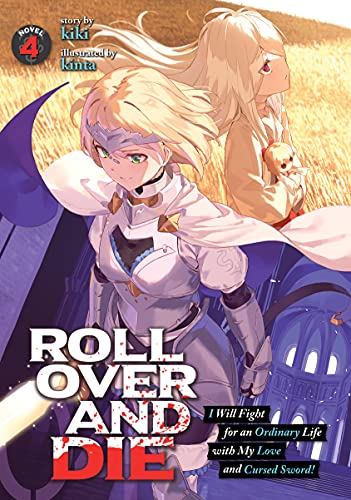
ROLL OVER AND DIE: I Will Fight for an Ordinary Life with My Love and Cursed Sword!, Vol. 4

July 12, 2021 by Sean Gaffney

By kiki and kinta. Released in Japan as “Omae Gotoki ga Maou ni Kateru to Omou na to Gachizei ni Yuusha Party wo Tsuihou Sareta node, Outo de Kimama ni Kurashitai” by GC Novels. Released in North America by Seven Seas. Translated by Jason Muell. Adapted by Brock Wassman.

So I am putting a content warning before this review, something I rarely do. This review will be talking about the plot of the 4th Roll Over and Die novel, and will be describing scenes of graphic horror involving children and infants. If this will upset you, I definitely recommend skipping the review, and the book.

You know, I’m beginning to get the sense that the cute relationship between Flum and Milkit is not really a priority in the mind of the author. Oh, don’t get me wrong, there’s a few cute scenes here. The two emotionally stunted young women are clearly in love with each other but lack the vocabulary or experience to do anything about it. We get a kiss on the cheek. Milkit gets a bit jealous. But really, if you want cute yuri there are so many other books you could read that are not this one. This book is here for one thing and only one thing: detailed descriptions of graphic horror. If you know what an Italian giallo film is, or enjoy the works of Herschell Gordon Lewis, this gore-spattered action novel might be for you. For the rest of us, it is a very long slog through endless pages of mutilated corpses, body possession, and towards the climax of the book infants literally rain from the sky and have to be butchered. It’s a lot.

The majority of this book deals with the rest of Mother’s second-generation children. Ink, the first-generation, is happy with Eterna (and, let’s face it, despite the age difference their relationship is clearly swinging romantic as well). Nekt, the child from the previous book, is dealing with her heel-face turn, and trying to get the other children in her group to join her in becoming human. Unfortunately, they’re far too tied to Mother, and would much rather perform this world’s version of “suicide by cop”, i.e. killing as many innocent people as they can before getting killed. Also unfortunately, the person who might be able to help them turn human also seems to be secretly evil. Honestly, everyone’s a little secretly evil in this book, except our main cast. Can Flum manage to save anyone? Or will the children have to be put out of their misery?

This book is not without its merits. As always, the author can write an excellent fight scene, and is very good at painting a picture of exactly what’s happening, for good and ill. The Hero’s Party (minus Jean, still deliberately left out of the plot except for one scene) are reunited, and falling over themselves to apologize to Flum, who is far more gracious about it than they perhaps deserve. There is an interesting revelation in this volume that suggests that, far from being a generic fantasy world, this world is closer to home than expected. Unfortunately,. I couldn’t enjoy any of this because I was drowning in blood and gore. Men die, women die, children die, babies die. Babies especially die, as Mother’s final battle tactic is to create babies that attack and try to possess our heroes, and have to be killed. They are butchered, hurled against walls, and blown up by magic. And by the end of the book I found it hard to really care about anyone.

There may be more in this series to come – this is the last book in Japan, and it came out 18 months ago, but there’s still lots of content from the webnovel left to go. But I think I’m done here. I prefer my yuri to not be drenched in so much blood that I can’t see the romance.

Filed Under: REVIEWS, roll over and die

Neon Genesis Evangelion: Anima, Vol. 5

July 10, 2021 by Sean Gaffney

By Ikuto Yamashita. Released in Japan as “Shin Seiki Evangelion Anima” by Kadokawa Shoten, serialized in the magazine Dengeki Hobby. Released in North America by Seven Seas. Translated by Michael Rachmat. Adapted by Peter Adrian Behravesh.

And so the light novel series that was written for a magazine dedicated to the selling of plastic models and toys ends the only way that it honestly could: with 250 more pages that show off just how great these Eva battles would look if you put the models together. If you love looking at Evas and imagining them fighting each other, it’s a terrific book. If you do not – and I am counting myself here – it’s a letdown. My expectations were not all that high… indeed, they mostly just involved hoping that we were done with thousands of people turning to salt. (I was wrong, alas.) And there are actual plot and character moments here. But the character moments aren’t enough, the plot is sometimes bad, and the ending merely stops, when it cries out for an epilogue of some sort. Sorry, kids, who knows what happens next, but it will be in a world where giant robots don’t fight, so who cares?

We pick up right where we left off, as everyone’s trying to figure out a way to save the day despite Shinji having .83 seconds to go till Third Impact. Mari is desperately searching for a pack of SOME sort, even if it’s not her original, and does not really give two figs about anyone else. Hikari is possessed by evil. Kaji, also possessed by evil, is being smug in Misato’s direction. The Reis are finally sharing minds again, but that may not be a good thing. The only sensible ones seem to be Asuka and Toji, and unfortunately both of them lose their sense of self as the book goes on. How many apocalypses can Earth go through before it finally gives up the ghost? Can Shinji stop it all? And will we get the weirdest Biblical imagery ever?

The best parts of the book were when it was so over the top I had to laugh out loud. Kensuke and (a now unposessed) Hikari manage to survive certain death by hiding under the Shroud of Turin, a line tossed off so casually it’s brilliant. The way that Shinji, now dead, ends up coming back is so grotesque and awful that my jaw dropped, and to be fair Asuka thinks the exact same thing I did: ew. At the same time, the reappearance of some seemingly dead characters right at the end, and reaction to same, falls absolutely flat, mostly as everything is too chaotic to stay on them for even a moment. Likewise, two characters no longer being evil is barely even given weight because, as I said, apocalypse uber alles. The book keeps such a frenetic pace throughout that you can’t enjoy anything, and then when armageddon is finally avoided (somewhat), it simply stops. The end.

That said, I hear the movies weren’t really satisfying to some viewers either, and the manga (probably my favorite version) also had its issues. Evangelion may simply be too messy a story to have a decent ending for. And these books did have some pretty cool fights. If you want another version of what happens, and aren’t really invested in any one character, this is a series to read. Sadly, my overall reaction to the series ends up being a shrug.

Filed Under: evangelion, REVIEWS

My Next Life As a Villainess: All Routes Lead to Doom!, Vol. 9

July 9, 2021 by Sean Gaffney

By Satoru Yamaguchi and Nami Hidaka. Released in Japan as “Otome Game no Hametsu Flag Shika Nai Akuyaku Reijou ni Tensei Shite Shimatta…” by Ichijinsha Bunko Iris. Released in North America by J-Novel Club. Translated by Marco Godano.

This was a strong volume of Bakarina, despite doing absolutely nothing that I thought it would do. I thought it would be action-filled, instead it’s merely the last quarter or so. I thought it would be more serious, but it’s no more serious than any other volume of the series. But that’s a good thing, as really, who wants to see these characters suffer? Unless they’re suffering because the woman they love is as dense as lead, in which case, yes please. The book also benefits from most of the cast being absent – Katarina is on a secret mission in another part of the country, and so for the most part it’s just her, Maria and Sora. Which is bad news for fans of the other love interests, but very good news for those who love KataMari or KataSora, as both of those pairings get some good attention. As for the actual plot, it goes pretty much as you’d expect, with Katarina walking into the solution.

Katarina, along with Larna, Maria and Sora, are following up on the “kidnapped citizens” plot from last time, heading to the tow “Ocean Harbor” to try to get to the bottom of things. (I love that the name of the town sounds exactly like what you’d name a plot-point town in an otome game.) They end up at a restaurant owned by Larna’s friend… well, frenemy Regina, who uses the restaurant as a front for ferreting out stuff for the Ministry. However, since they have Maria (who can cook) and Katarina (who is not only an excellent waitress but also knows how to market), they can now run it like an actual restaurant, and maybe turn a profit! Was there something else? Oh right, the kids being kidnapped, along with the noble girl. But that’s OK, I’m sure there can be someone for Katarina to befriend who will lead them to the bad guys.

Probably my favorite thing about this book was seeing Katarina as a waitress. Everyone is blown out of the water by how good she is at it, because she’s supposedly the daughter of a duke, but honestly I was surprised as well, as even though we know she has her past life from Japan and probably part-timed as a waitress before, the temptation would be to make her bad at the job for a laugh. Instead, she turns out to be fantastic at the job for a great character moment. I also really enjoyed Katarina’s “dates” with Maria and Sora, which are basically catnip to us readers, and also features Maria once again literally confessing to Katarina and having her say “You lost me” in the best Shirou tradition. Props to Sora, too, for realizing that, rather than Keith or himself, Jeord’s biggest competition in the Katarina Sweepstakes is Maria. As for the plot itself, it proved to be resolved fairly easily, but we got to see Katarina in peril, Katarina biting someone to try to get herself out of peril, Maria being a light magic badass, and so all is well.

It’s still pretty clear that someone is trying to destabilize the countries in some way, and while the reader likely knows who’s behind it, the characters do not as of yet, so expect more investigation in the next book. Till then, enjoy Katarina Claes, waitress extraordinaire!

Filed Under: my next life as a villainess, REVIEWS

Ascendance of a Bookworm: I’ll Do Anything to Become a Librarian!, Part 4: Founder of the Royal Academy’s So-Called Library Committee, Vol. 1

July 7, 2021 by Sean Gaffney

By Miya Kazuki and You Shiina. Released in Japan as “Honzuki no Gekokujou: Shisho ni Naru Tame ni wa Shudan wo Erandeiraremasen” by TO Books. Released in North America digitally by J-Novel Club. Translated by quof.

It’s two years later, and we’re starting a new arc in Ascendance of a Bookworm. The longest one yet, this arc is 9 books long. After Rozemyne wakes up and comes to terms with life moving on without her, she barely has any time to get her footing before she’s supposed to start going to the Royal Academy as a first-year student. Good news: The Academy has a pretty large library, with actual books. Bad news: she can’t go there till she passes all her written and practical starter exams, and thanks to an unthinking Wilfried, everyone else also has to do this. There’s also the usual class struggles, not helped by the fact that she STILL looks seven years old. Still, she’s been thoroughly prepared by Ferdinand for this sort of thing, the people who tried to kill her have gone back into hiding, and she’s making new friends. How hard can a magical academy be?

There’s a lot of new people in this book, many of whom e will probably have to remember – there’s a reason why the best Bookworm fans are the ones with the colored spreadsheets. The most important so far seem to be Hirschur, an eccentric teacher who was fairly hands off with students… till she meets Rozemyne and realizes she’s Ferdinand 2; Solange, the Academy’s librarian who takes a shine to Rozemyne right away when she accidentally activates two dormant magical tools designed to help run the library (those would be the rabbits you see on the cover); and Hartmutt, a new attendant of Rozemyne’s who seems to think she’s the second coming of Jesus Christ. Can’t imagine where he got that idea, given that she’s resurrecting long-dead magical rabbits, plowing through the coursework in record-breaking time, and completely upending the Academy’s music department.

It can be a bit frustrating for the reader to see that Rozemyne is not only still in a short seven-year-old body, but also still tends to get exhausted easily – though not nearly as much as before. It can also be a bit frustrating for her, as she’s not taken very seriously by the nobles that are above her in status – some are ignoring her so they can get closer to Wilfried, some see her as an eccentric wind-up toy, and some seem to only want her for her mana compression teachings. Fortunately, she does have quite a few allies – Wilfried has matured since she was asleep, as has Charlotte (who is now taller than she is, to Rozemyne’s horror) and her attendants are mostly on her side, and also a bit eccentric. Though for eccentricity it’s still hard to pass Angelica, who remains Bookworm’s favorite rock-stupid knight.

Despite Sylvester’s growing horror as he hears of just what Rozemyne has gotten up to in the first few weeks of her classes, this is still mostly setup – we haven’t really had any serious threats or plot shakers yet, although Detlinde might prove to be one. Rozemyne’s biggest enemy right now might be herself, as her lack of court manners leads her down dangerous roads, such as forgetting that she promised to meet after school with the PRINCE. Still, I’m sure she’ll get through it. In the meantime, welcome to a new arc of one of the best novels currently being translated.

Filed Under: ascendance of a bookworm, REVIEWS

Bofuri: I Don’t Want to Get Hurt, So I’ll Max Out My Defense, Vol. 2

July 5, 2021 by Sean Gaffney

By Yuumikan and KOIN. Released in Japan as “Itai no wa Iya nano de Bōgyoryoku ni Kyokufuri Shitai to Omoimasu” by Kadokawa Books. Released in North America by Yen On. Translated by Andrew Cunningham.

While the first volume of Bofuri was concerned with Maple and her introduction to and subsequent interaction with the game, the second book is all about Maple and Sally and their friendship, which shines through both in how they fight well together and their relaxed interaction with each other in non-relaxed moments. These two are best friends, who have known each other most of their lives. And it shows, as we see right away why they’re a terrifying combo if you happen to go up against them. That said… Maple’s not big on the PvP end of the game, preferring to face off against monsters. Sally does not have that issue at all, and you get the sense that she’s generally more comfortable in a role where she can simply stack the bodies high. Maple may be a monster because of her unconventional build and ecentric thought processes, but Sally is a monster simply as she’s a really, really, REALLY good gamer.

The entire book is taken up with the second major event of the game, which involves finding 300 silver medals scattered across a very large map. What’s more, the winners of the FIRST major event already have one gold medal (the equivalent of ten silvers)… and yes, if you kill off the players you get their medals. Maple and Sally team up on this one, and end up in a forest (which has ghosts, Sally’s one weakness), an ice cave (taking on a nigh unkillable monster… and killing it, which nets them two animal companions), an underground maze (where they are chained together – literally – with Kasumi, a samurai player who fights with swords), a beach (where Sally, who can swim, scouts, while Maple befriends a mage named Kanade and they build a sandcastle together), and an underwater area (where they have to fight evil doppelgangers of each other). As this goes on, they do get a few medals, but it’s not quite enough to place in the top 10… so Sally decides to go player hunting.

The most significant cut from the anime is where Maple fights not-Sally and Sally fights not-Maple, two tough fights that get both of them a bit paranoid (which leads to the book’s funniest moment, where they reveal private info about each other to prove they’re the real one, and it’s super embarrassing). The cast is increasing, and it’s nice to see Kasumi and Kanade. I did note that there was some added character drama in the anime… here, after a brief fight at the start, Kasumi gets on fine with Maple and Sally. Two other things I noticed. First, this book really hammers home how often Maple uses poison in the early days… the book is almost coated with poison, to the point where the reader might get a bit bored. The second is that the novel is far more into the gaming mechanics of everything. The anime loves to show off Maple “being Maple”, but the book gives us that plus all the times Maple isn’t being Maple, but just a normal player doing normal things. It can sometimes be a bit tedious… I absolutely see why the anime cut a lot of this book… but it’s also fun if you love these two girls.

This book ends with the “giant turtle makes acid rain” sequence, so I assume the next volume will feature the forming of Maple tree guild. As with the first book, you aren’t really missing vital info the anime skipped, but you do get to see two best friends having a ball fighting things for 250 pages. And that’s enough.

Filed Under: bofuri, REVIEWS

The Sidekick Never Gets the Girl, Let Alone the Protag’s Sister!, Vol. 1

July 4, 2021 by Sean Gaffney

By Toshizo and U35. Released in Japan as “Shinyuu Mob no Ore ni Shujinkou no Imouto ga Horeru Wake ga Nai” by PASH! Books. Released in North America by J-Novel Club. Translated by Tristan K. Hill.

Sometimes you just have to be patient and wait for the author to get around to The Hook. This is especially true with this book, where we get a prologue that clearly shows us that this is not merely just another dumb high school romcom… and then spends most of the first half of the book trying its damndest to hide that fact once again. That said, that fits well with the protagonist, and it’s his narrative voice that we’re getting. As such, you get a book that is about 75% what would happen if the annoying loud guy who’s always best friends with The Main Character was the viewpoint, and it can be really annoying. Like, really annoying. As I said, sometimes you have to be patient, but it’s hard. Fortunately, in the second half, especially the last quarter, we actually get to the meat of the book, and find that “sidekick” is the biggest PTSD-coping mechanism in our hero’s armory.

After a grim, death-filled prologue that makes you wonder if you picked up Roll Over and Die by mistake, where our hero Koh battles the Archfiend… we suddenly cut to modern-day Japan, where Kunugi Kou is late for school, running out of his house with a piece of bread in his mouth (doesn’t work as well as you’d think), and stopping a naked pervert from attacking a young teenage girl. When she asks who her savior is, he says he’s Ayase Kaito… actually the name of his best friend. He then goes off to live his normal school life, where he watches the same Kaito deal with what appears to be a love quadrangle and enjoys being a dumb, loud guy who is on the outskirts of this fun. Unfortunately, the girl he saved is Ayase HIKARI… Kaito’s little sister. Also unfortunately, she’s now really taking a shine to him. And that’s not even getting into the fact that the love quadrangle may be tailing off of its own accord. And what does this have to do with that fantasy scene featuring… Kou? Or Koh?

When we actually get to the serious meat of the story, it’s really good. It’s also something of a spoiler, and I don’t want to give everything away. Suffice it to say that almost everything Kou does is a front, and there are several people who either knew this from the start or become aware of this as things go along. This is really good. I enjoyed it. But it does mean walking through a lot of cliched scenarios written better in titles such as the Rascal series or My Youth Romantic Comedy series, both of which this seems to pastiche in many ways. It’s good in that it eventually gives you insight into how Kou is surviving, and the somewhat bad job he’s doing at it. It’s not good as a reader because it’s not really that FUN. I suspect the author wants it to be, but… sorry.

That said, this is not a long-running series – it apparently ends with the next volume, though I’m not sure if it has an actual ending or if it suffers from cancellitis. And certainly after the cliffhanger we get here, I suspect it will be harder to have “ha ha ha look I’m a goofball!” throughout. Nevertheless, I do recommend reading this if you can tolerate the romcom cliches. It is a very good Hook.

Filed Under: REVIEWS, sidekick never gets the girl

Loner Life in Another World, Vol. 1

July 3, 2021 by Sean Gaffney

By Shoji Goj and booota. Released in Japan as “Hitoribocchi no Isekai Kouryaku” by Overlap Bunko. Released in North America by Seven Seas. Translated by Eric Margolis. Adapted by Veles Svitlychny.

I can’t say I hadn’t been warned. Indeed, that’s the only reason I decided to read the book in the first place. I’m trying to stop reading “I got the worst powers when isekai’d, but it turns out they’re secretly the best” light novel titles, and that’s exactly what this is. The manga was already coming out via Kaiten Books, and I hadn’t read it. But then I heard that the original novel was apparently something of a legend in Japan for being hard to understand and difficult to parse, and that most fans agreed the manga was the way to go. Really, I thought? Now I’m intrigued. And so I picked up this very long book, and started it. About 1/3 through the book, I felt I’d made a mistake. Sure, our loner hero rambles – a LOT – but there wasn’t enough of the comedy I’d heard about to justify reading more. And then he runs into the girls in his class, and the book promptly falls off a cliff while screaming and flapping its arms.

No, that’s not our hero on the cover, as this is in the light novel genre of “why have a guy on the cover when I have so many heroines?”. Our “hero” is Haruka, an eccentric loner who likes to skulk in his class and read. One day his class is transported to another world, but Haruka, familiar with this plot device, leaps up, jumps onto the bookcases in back, and crawls up into the ceiling. This … did not stop him getting isekai’d, but it means he was not transported with the others, and by the time this world’s “god” finds him, well, there are no good skills left. Just a hodgepodge of ones no one wanted. The old “god”, feeling guilty about having Haruka separated from the others, and having trouble dealing with Haruka’s basic personality, gives him ALL the skills left. Including the negative ones. Can he survive as a loner?

God, I hope not, because the parts of the book where he’s by himself are the worst. As I said earlier, he rambles, he’s obnoxious and rude, and he has no common sense, but these things alone do not really separate him from other isekai weirdos we’ve seen before. It’s only when he runs into the 20 girls in his class, fleeing from an event that drove the class apart, that the book really takes off, because Haruka is SO bad at interpersonal skills that it’s almost magic. This is not something he gained from a skill, by the way – he’s called the head of the girls’ group “Class Rep” for the last 11 years despite them having always been in the same class, and in general it’s implied he’s just like this. This allows for the girls to become 20 varieties of tsukkomi (sometimes in unison, which is a trip), and also makes the book far more entertaining, as you keep waiting to see what bullshit he pulls next.

The book can be hard to parse at times, but that’s by design, as that’s how Haruka is. I think the translators did a fantastic job showing off stream-of-consciousness blabbering and how annoying it can be to everyone around you. The book… is not good, to be honest. Because Haruka refuses to think of his class in anything but their “roles” (Class Rep, mean girls, nerds, etc.) his narration does as well, and so there is a certain Goblin Slayer feel to the characters that I didn’t like in that book either. (It doesn’t help that it’s infectious, and Class Rep herself starts thinking in terms of those roles.) The denouement at the end of the book feels out of absolutely nowhere, with very little buildup from Haruka before it’s over. And, of course, it’s still a book about a schlub of a guy who amasses 20 pretty girls around him who are somewhat devoted to him but also yell at him all the time, which means that it won’t attract the sort of fan who also gets mad at Kirito.

But… there’s just something about it. I spent a lot more time screaming at this book than I have with any light novel in the past year or so. The lead’s lack of ANY sense makes your teeth grind. And… it is pretty funny in that regard. It also, honestly, had far less fanservice than I expected from a genre like this, even leaving aside that he names one of the class “Nudist girl”. It makes me want to read the second book, even though I know it will be like getting slapped in the face with a paper fan over and over again. If you want to read a series that dares you to read it, look no further.

Filed Under: loner life in another world, REVIEWS

Konosuba: God’s Blessing on This Wonderful World!: The Crimson Magic Trials

July 1, 2021 by Sean Gaffney

By Natsume Akatsuki and Kurone Mishima. Released in Japan as “Kono Subarashii Sekai ni Shukufuku o!” by Kadokawa Sneaker Bunko. Released in North America by Yen On. Translated by Kevin Steinbach.

Possibly the funniest part of this book is when Kazuma and Megumin end up getting chased in the woods by one of the villains, and while trying not to spoil too much, said villain’s mission is to destroy all “reajuus with harems”. Leaving aside that the publisher/translator is expecting all KonoSuba readers to know what reajuu means, the idea that this describes Kazuma is, at first, hilarious… until you think about it. Isn’t he actually quite content with his life right now? Doesn’t he have a lot of real-life friends, a fulfilling career, and a cute girlfriend? As well as other girls also in love with him? Slowly but surely, Kazuma has become Kirito and no one noticed. That said, technically this is Yunyun’s book… although, because she is Yunyun, most of her plot is spent offscreen and she’s mostly embarrassed. Still, in the end, she achieves her wildest dreams… sort of. Because maybe the real Yunyun wants the friends she meets along the way.

In the last book, also offscreen, Yunyun had Megumin aid her in taking the Crimson Magic Trials to determine the next chief… and both times Megumin blew everything up. It’s not made clear if this was accidental or on purpose, but Yunyun now has only one chance left, so will NOT be taking Megumin this time. Taking first Darkness (disaster, but passed) then Aqua (disaster, but passed), theoretically Kazuma should be helping with the final trial. However, there is a “mad bomber” running around the area who likes to blow up folks that look Japanese, so Megumin – who is absolutely not jealous or making this all up, nosirree – forbids him from doing it. As Yunyun ends up getting “help” from a supporting character we haven’t seen in years (no, not Dust), Kazuma and Megumin try to solve the Mad Bomber problem and also deal with the fact that they’re both very awkward virgins who are not really ready to have sex yet.

This is not the longest story in the world, even for KonoSuba. Indeed, we essentially start the next book in the final chapter, as everyone returns to Axel to find a new priestess, Serena, who claims to be Kazuma’s “fan” and seems to be better than Aqua at, well, everything. It does allow us to have one last fun time with the biggest village full of dramatic dorks ever. Megumin’s mother is all for her daughter getting it on with Kazuma, who has to repeat Megumin’s age a lot (fourteen) to remind himself why he’s not doing this yet. There is a bedroom scene where they get awfully close, as she offers to help “relieve his tension”, but, needless to say, events ensue that prevent this. As for Yunyun, well, she does end up getting her dream come true, but eventually realizes that “Megumin’s greatest rival” is more important to her now than “chief of the clan”. She also gets the second best joke in the book, when an imprisoned and somewhat humiliated Megumin whines at Yunyun, telling her to “go ahead and laugh”, and Yunyun does just that – and points, too.

Given how this book ended, I expect Aqua will be the featured character for the next volume. We’re getting pretty close to the end here. KonoSuba fans should have a lot of fun.

Filed Under: konosuba, REVIEWS

  • « Go to Previous Page
  • Page 1
  • Interim pages omitted …
  • Page 96
  • Page 97
  • Page 98
  • Page 99
  • Page 100
  • Interim pages omitted …
  • Page 346
  • Go to Next Page »
 | Log in
Copyright © 2010 Manga Bookshelf | Powered by WordPress & the Genesis Framework