• Skip to primary navigation
  • Skip to main content
  • Skip to primary sidebar
  • Home
  • About Us
    • Privacy Policy
    • Comment Policy
    • Disclosures & Disclaimers
  • Resources
    • Links, Essays & Articles
    • Fandomology!
    • CLAMP Directory
    • BlogRoll
  • Features & Columns
    • 3 Things Thursday
    • Adventures in the Key of Shoujo
    • Bit & Blips (game reviews)
    • BL BOOKRACK
    • Bookshelf Briefs
    • Bringing the Drama
    • Comic Conversion
    • Fanservice Friday
    • Going Digital
    • It Came From the Sinosphere
    • License This!
    • Magazine no Mori
    • My Week in Manga
    • OFF THE SHELF
    • Not By Manga Alone
    • PICK OF THE WEEK
    • Subtitles & Sensibility
    • Weekly Shonen Jump Recaps
  • Manga Moveable Feast
    • MMF Full Archive
    • Yun Kouga
    • CLAMP
    • Shojo Beat
    • Osamu Tezuka
    • Sailor Moon
    • Fruits Basket
    • Takehiko Inoue
    • Wild Adapter
    • One Piece
    • After School Nightmare
    • Karakuri Odette
    • Paradise Kiss
    • The Color Trilogy
    • To Terra…
    • Sexy Voice & Robo
  • Browse by Author
    • Sean Gaffney
    • Anna Neatrour
    • Michelle Smith
    • Katherine Dacey
    • MJ
    • Brigid Alverson
    • Travis Anderson
    • Phillip Anthony
    • Derek Bown
    • Jaci Dahlvang
    • Angela Eastman
    • Erica Friedman
    • Sara K.
    • Megan Purdy
    • Emily Snodgrass
    • Nancy Thistlethwaite
    • Eva Volin
    • David Welsh
  • MB Blogs
    • A Case Suitable For Treatment
    • Experiments in Manga
    • MangaBlog
    • The Manga Critic
    • Manga Report
    • Soliloquy in Blue
    • Manga Curmudgeon (archive)

Manga Bookshelf

Discussion, Resources, Roundtables, & Reviews

Reviews

Forget Being the Villainess, I Want to Be an Adventurer!, Vol. 2

April 5, 2022 by Sean Gaffney

By Hiro Oda and Tobi. Released in Japan as “Tensei Reijou wa Boukensha wo Kokorozasu” by Kadokawa Books. Released in North America digitally by J-Novel Heart. Translated by Kim Louise Davis.

Well. That escalated quickly. After all the setup from the first book, I was expecting more adventuring, more knight training, and most importantly more school. Sadly, that went off the rails pretty quickly the moment General Avenger says “hey, I’ve found this guy who can give you a good fight!”. Accurate, BUT… now the rest of the book is anything but that. I did enjoy everything that was going on, it was just a bit of a surprise direction. That said, the other thing that happened in this book also surprised me, and that’s on me, I was being dumb. Because most of these villainess stories are, at their core, romance novels. Yes, our heroine may say that she has no desire to get married after being betrayed in the game, etc., but there’s still a guy who is going to be “the one”. After meeting him last time, I assumed it would simmer in the background for several books till Serephione grew up. Then this book covered several years of her life…
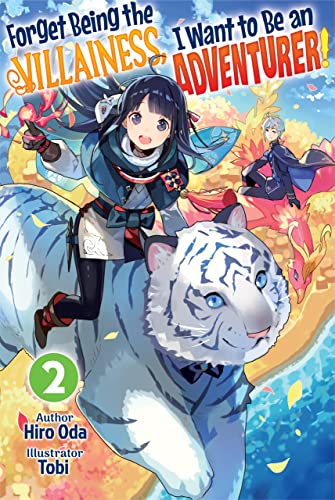
As noted, we do start off the same as last time. Serephione is attending the Knight School while also doing adventuring work on the side, including such things as protecting a royal as she travels to the magic academy. You know, the one that Serephione has been avoiding with great avoid. Then Prince Schneider arrives, and he now knows all about Serephione… and tries to kill her. This turns out to be for slightly better reasons than “I am evil just because”, but only slightly – both have their agendas that they can’t let go of. Now Sere is far from home, and she doesn’t even have Leo for company. She does have Miyu, the cute little snake girl she met last volume, and together they slowly make their way to a country where she can hide from her enemies… mainly =because she accidentally helped along this country’s revolution.

This book is mostly fairly light and adventurey, but when it gets serious it gets pretty damn serious. The fight between Sere and Schneider felt like it belonged to a different book, and this happens a couple of other times in the book. There’s no blending of genres, just a straight tonal shift, and it can be jarring. The other interesting thing is how this world appears to be a port authority for dead Japanese people. We already know about Serephione and her nemesis, the heroine Maribelle (who doesn’t technically appear in this book, but you can tell she’ll be the final confrontation). Now we hear that Schneider is also a reincarnate, and that he hated the Wild Rose novel. So he’s a bit bitter that he’s now in it. We’ve seen this sort of thing in other villainess stories, but usually it’s between people who actually knew each other in Japan. This book just sucks up anyone and everyone.

Despite some hiccups, this was still a fun read, and I’m happy there’s at least one more volume of it. Let’s hope it has more of the badass grandma, who barely appeared in this volume.

Filed Under: forget being the villainess i want to be an adventurer, REVIEWS

Even Dogs Go to Other Worlds: Life in Another World with My Beloved Hound, Vol. 1

April 4, 2022 by Sean Gaffney

By Ryuuou and Ririnra. Released in Japan as “Isekai Teni Shitara Aiken ga Saikyou ni Narimashita – Silver Fenrir to Ore ga Isekai Kurashi wo Hajimetara” by GC Novels. Released in North America by Cross Infinite World. Translated by Mittt Liu.

When I got to the afterword of this first volume and the author revealed that the original idea for the book did not have the dog, I wanted to slap my forehead a bit, given that the dog is the only reason anyone would read this in the first place. Now, don’t get me wrong, it’s not bad. The characters are pleasant, the story is pleasant, the dog is pleasant, and it is a perfectly nice slow life book. It just… verges on boring, that’s all. And by verges I mean that we’ve pulled off the road into the Town of Boring and are booking three nights at the local motel. The second half, where you start to get a vague idea where the series may go, is slightly better. But this book suffers, as so many others do, with the curse of “slow life” books: in order to portray that accurately, you have to have nothing happen.

I’m not precisely sure if Takumi, our hero, dies from overwork or not – he just passes out and wakes up in the fantasy world. But he certainly fits the type, as we get the “I am an overworked corporate slave” intro before this happens. His only good thing in life is his pet Maltese. Now he’s in the middle of a forest, next to a monstrous Silver Fenrir… who apparently IS his Maltese, only she’s now the size of a car. Not sure where he is, he and his dog wander around till they hear a cry for help and end up killing an orc that was about to murder a young woman. Orcs! Is this a fantasy world, like all those novels talk about? Returning to civilization with the young woman, Takumi quickly finds himself out of his depth and having to get used to magic, monsters, and mayhem. Fortunately, he has a pupper. A big pupper.

I think I can sum up my feelings towards this book when Takumi and Claire (the young woman) arrive at her palatial estate, the smaller of her two estates, and meet up with her butler, who is named… Sebastian. Of course. This by now 50-year-old in-joke shows that everything in this book is going to be exactly on the nose, with surprises not on the menu. I did briefly hope that Takumi, who definitely fits the nickname “potato-kun” given to bland isekai protagonists, would be completely powerless and have to rely entirely on his dog, but no, he’s overrpowered too, in the “magical herbs” sort of way that we’ve seen in other slow life isekai series of this nature. Even the romance between him and Claire is predictable. She likes him. He likes her. They’re both shy. Will anything happen? Not in this book.

There are hints that we’ll get more plot development in the next book. And again, this book’s only fault is that it’s dull. The prose is fine, the translation reads great, it’s got dogs. But for me it’s another GC Novel to throw on my pile of GC Novels book I’ve tried and failed to enjoy.

Filed Under: even dogs go to other worlds, REVIEWS

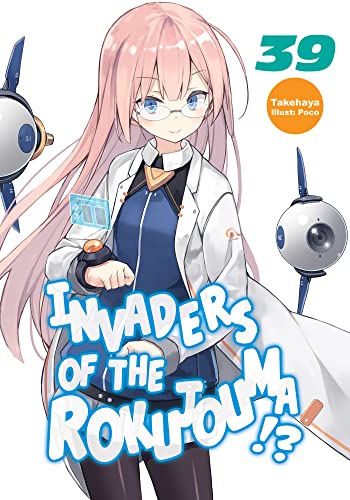
Invaders of the Rokujouma!?, Vol. 39

April 3, 2022 by Sean Gaffney

By Takehaya and Poco. Released in Japan as “Rokujouma no Shinryakusha!?” by HJ Bunko. Released in North America digitally by J-Novel Club. Translated by Warnis.

The Rokujouma landscape post-Volume 29 has thrown a lot more obstacles in the way of our heroes, but it is not frankly in a huge rush to deal with them. This has become a series that has no real plans to stop, so things will get resolved when they get resolved. This also applies to the romance, where we see that Koutarou is still uncomfortable with the idea that all the other girls have already come to accept, which is to say that he’s going to be in a polycule. Physical affection is also a work in progress, as we see in this volume when he’s forced to share a giant robot cockpit with Kiriha. But at least we’ve resolved all the potential love interests and aren’t adding anyone new, right? …right? Well, OK there’s been an asterisk next to that since Vol. 29, but for the most part we’ve ignored it as Nalfa has barely been in these recent volumes. That changes here, and you get the feeling she will be added to said polycule. If she survives.

After the big battle last volume, most of the enemy have fled, likely to regroup around Forthorthe. But the Grey Knight has hung around, trying to figure out why Koutarou’s magical sword is “incomplete”. In the meantime, it’s the start of a new school semester, and there’s going to be a huge influx of alien students. Nalfa has to give the welcoming speech, and it’s making her a bit panicky. That said, everyone else is on edge, suspecting that the Grey Knight is going to be attacking the ceremony. Fortunately, it goes off without a hitch. Unfortunately, the Grey Knight finally clues in and realizes what it is that he is looking for: Nalfa. She’s got some power he needs to draw out. He tries attempting to kill her – this doesn’t work. Then he tries attempting to kill Koutarou – that works. Can our heroes save her with the power of Sanae x 3?

Sanae, Sanae and Sanae fighting against the grey Knight is easily the action highlight of the book, and also gets in a few good one-liners (is it the power of friendship when you’re all the same person?). As for the Grey Knight, well, he may be from a different timeline but he’s still hella powerful and dangerous, and it’s going to take a lot more than Sanaes to get rid of him. As for the romance side of things, if nothing else I think we see here that Nalfa may be the only other addition to the polycule. She’s very blunt about her love for Koutarou, just like the other girls – and not like Kotori, who holds Koutarou on a pedestal compared to her “cheating” brother, but doesn’t see him as a love interest. That said, this is somewhat irrelevant, as any further romantic progress, if it happens at all, will be at the very end of the series.

We’re back to Forthorthe for the foreseeable future in the next book, with a few additions – Kenji, Kotori and Nalfa need to come along so that they’re not used as hostages. (This will kill Kenji’s love life, but he’s comic relief anyway.) Vol. 40 just came out in Japan two days ago, though, so it may be another few months for us.

Filed Under: invaders of the rokujouma!?, REVIEWS

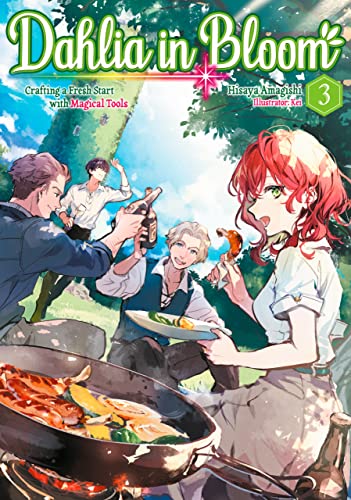
Dahlia in Bloom: Crafting a Fresh Start with Magical Tools, Vol. 3

April 1, 2022 by Sean Gaffney

By Hisaya Amagishi and Kei. Released in Japan as “Madougushi Dahliya wa Utsumukanai” by MF Books. Released in North America by J-Novel Heart. Translated by Nikolas Stirling.

I mentioned this in my review of the second volume, but it bears repeating: These two are a wonderful couple who absolutely should not get together at this point. Even the rest of the cast agrees with me. No one dares bring it up with Dahlia, who is still being treated with kid gloves, frankly (then again, it has only been a month since she was dumped by her fiance the day before her wedding), but everyone is planning for her business to be SO successful that she gets made a baroness, which would solve most of the issues with her marrying Volf. Not that she really has clued in to her own feelings yet. Volf has clued in to his own feelings, but his solution to the problem of class differences is terrible, as is fortunately pointed out to him by his older brother. Really, for the moment, they’re best as they are seen here: inventing new things, creating hilariously bad and terrifying magical swords, and eating and drinking a lot. A whole lot.

Much of this volume is spent with Dahlia trying to find a way to make the portable stove even smaller, so that it can be easily carried by knights when they go on their missions. We get into the nitty gritty of materials needed, cost, and how much to change – this book does not skimp on the business insights. That said, Dahlia is still showing off some painful naivete in this book. She’s trying to deal with the gossip about her and Volf, but it’s not something that you can just smile and hope it goes away. More concerning is the fact that she has so little self-worth that she gives away valuable creations at the drop of a hat, not realizing that she needs to convey a better idea of what she is as a proprietor rather than as a friend. As for Volf, well, his biggest concern is a monster that creates an illusion of a loved one – something Volf has never really had to deal with until now.

We already pretty much knew that Dahlia was having trouble dealing with the death of her father, and here we see that she’s also still having trouble dealing with her previous life in Japan, where she had a still living mother when she overworked herself to death. Honestly, she may have a similar fate here unless events conspire to get her and Volf together, as we see her lose track of the entire day working on another invention. She also says she plans to never get married, which is fine right now given that she and Volf are already acting like – and are mistaken for – a married couple. You can absolutely see where the rumors come from. The scene where they buy the matching glasses and amphora in order to have even better alcohol is really great, and shows that when they do manage to get past their own personal demons, they will be an amazing power couple.

But that’s for future Dahlia volumes. For now there is outside barbecue, a strong cider, and Dahlia’s vague feeling that she wants Volf to be by her side forever. Huh. Wonder what that’s about?

Filed Under: dahlia in bloom, REVIEWS

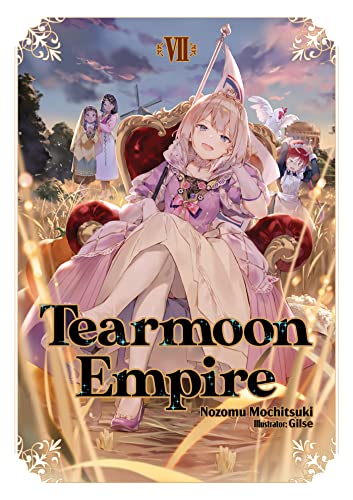
Tearmoon Empire, Vol. 7

March 31, 2022 by Sean Gaffney

By Nozomu Mochitsuki and Gilse. Released in Japan as “Tearmoon Teikoku Monogatari” by TO Books. Released in North America digitally by J-Novel Club. Translated by David Teng.

The narrative voice is one of the most well-known parts of this series, but we do occasionally see inside Mia’s own thoughts as well, and when we do we can sort of get what the narrator is talking about. There are several points in this book where Mia is essentially being a petty, selfish and gluttonous princess – we see how she thinks. In those cases, yes, the fact that everyone misinterprets her can be ridiculous. That said, we also see many times in this volume Mia’s sharp instincts to avoid the guillotine, and those are top-tier. When Mia doesn’t think but simply reacts, be it to a death flag or when she sees one of her friends is unhappy, she shines. And heck, even her selfish pettiness doesn’t last long – her desire to see a money-grubbing merchant suffer is thrown out the window when she sees him legitimately suffering the aftereffects of a heart attack. In this book we really do see that if she does become Empress, she might just do OK.

The first fifth of the book wraps up the third “arc” we’ve been reading, with Mia returning home for the weeklong festival to celebrate her birthday, as we are reminded that her father is, not to put too fine a point on it, a freak. That said, it’s the colors Mia wears to her party that make the impression. After this we move into a new arc which features Mia, having set up an excellent program to combat famine, trying hard to keep it from collapsing. Chaos Serpents are still trying to sow discord, but we also have to deal with those who realize that a famine can be a great way to make a pile of cash if you’re the one delivering the food. Now Mia and Ludwig have to face off against an antagonist who Mia remembers from her past life… when things ended in disaster. Can she turn things around with the help of a commoner studying medicine and the power of wheat?

This is usually the point of every review where I get annoyed at the narrator for harping on Mia being chubby, and yeah, it’s here as well. That said, we also see Mia chiding herself for a different kind of flab. A couple of times in this book she makes the mistake of being complacent, and that’s when disaster pricks at her intuition. Given that there is a secret society whose goal is to destroy her and her kingdom, Mia simply can’t stop and just relax. I think, in time, this will become second nature to her – she just needs to have her thoughts map to her instincts more. She also has help. Ludwig is hilarious here, taking on the brunt of “misunderstand Mia in a positive way” and realizing that if you truly want to change everything about the Empire, might as well also let people like him be Chancellor. As for Shalloak, the “evil” merchant, his story actually ends up being heartwarming and tragic at the same time – the benefits of people dreaming of their past lives in another world.

Add to this one of the best side stories in the entire series, where a search for cake will make you cry, and you have a fantastic volume. Each one of these is a treasure.

Filed Under: REVIEWS, tearmoon empire

Strike the Blood, Vol. 20

March 29, 2022 by Sean Gaffney

By Gakuto Mikumo and Manyako. Released in Japan by Dengeki Bunko. Released in North America by Yen On. Translated by Jeremiah Bourque.

I’d like to welcome you all and thank you for coming to another one of my attempts to review the latest volume of Strike the Blood. If you’re reading this, I assume that either you are a hardcore fan of the series (and have therefore, no doubt, seen the anime that has already adapted this volume) or you just enjoy reading about me trying and failing to get 500 words out of a series whose main plot is “cool action sequences for 279 pages”. It’s always felt like a novelization more than a novel, but here in English, where we’re reading the novels after the equivalent anime, it’s even more apparent. This is, essentially, the final arc, Part 2 of 4. It will therefore not surprise you that it ends with a bit of a downer, though honestly not as much as previous books. That said, fans will feel relieved to hear that Kojou says “my fight” and Yukina corrects him with “No, senpai, this is OUR fight”, so all is present and correct.

As noted, for the most part this is the second part of what we saw last time, so there’s still a lot of Itogami Island being divided into factions that are fighting for supremacy. We do, however, get the reason that this is happening: Avrora is alive again, and that means Kojou does NOT have all 12 beast vassals… meaning he’s essentially about to spiral out of control. There’s two main ways to solve this: kill everyone on the island by removing their memories and reason (bad), or kill Avrora (kind of what they’ve been trying not to do for the last several books). This therefore sets up most of the book, which is a lot of plotting, counterplotting, and friends turning against each other for the greater good and then feeling like absolute crap about it afterwards. That said, Kojou’s actual solution SEEMED like a good idea at the time, but…

The end of the book, i.e. Kojou’s fate, is honestly something I thought we’d have gotten about a dozen novels before now, so I’m relieved to see it here right before everyone gathers for the big finale. It’s still a powerful moment, mostly because it’s so quiet, just him and Yukina sitting watching the horizon after completely failing to stop the end of the world. Also a surprising scene, and showing that the author is perhaps getting a handle on light-hearted stuff at last, is Kojou in the shower, struggling against his vampiric instincts, and then Kanon, Shizuri AND Yukina all offering him their bodies. Separately. Which means it briefly turns into a British farce. That’s not the surprising thing, the surprising thing is that Kojou doesn’t get beaten up for it. Perhaps we have graduated from the Rumiko Takahashi school of slapstick.

Presumably next time we will be headed to the big island in the sky to have yet more exciting battles that are very hard to review. Till then, please enjoy another Strike the Blood. It is what it is.

Filed Under: REVIEWS, strike the blood

The World’s Strongest Rearguard: Labyrinth Country’s Novice Seeker, Vol. 6

March 27, 2022 by Sean Gaffney

By Tôwa and Huuka Kazabana. Released in Japan as “Sekai Saikyou no Kouei: Meikyuukoku no Shinjin Tansakusha” by Kadokawa Books. Released in North America by Yen On. Translated by Alexandra McCullough-Garcia.

One of the strengths of this mostly ridiculous series is that I get the sense the author does not take it seriously. Now, I’m not saying it’s meant to be a comedy – the battles are clearly meant to be dangerous and deadly action sequences, and this volume in particular ends on a big downer of a cliffhanger. What I mean is that it doesn’t take the tropes seriously. It’s a harem genre with a passel of women all in love with our oblivious hero, but there’s no infighting or even any real anger about it – hell, the closest they get to being upset is when Misaki almost spills the beans on what they have to do every night after Arihito goes to sleep. There’s also the reality-bending power of fiction, where our heroes end up being the ones who always fight the strongest monsters, even when they’re told not to. But even then, after they win, they’re told “sorry, you really are that powerful, please have a special title.” It’s just… funny.

We pick up where we left off last time, with our party in a trap laid for them by Shirone, who unfortunately also appears to be trying to do a “suicide by dungeon”. This trap includes monsters that raise your karma if you attack them, and a named monster (of course) that can not only inflict pain on our heroes but also guilt of their past actions and present fears. And while they do end up escaping this and defeating the monster, it’s clear that Elitia is still feeling the aftereffects of this. Things aren’t really helped when they are asked to go to the 5th Level to help to subjugate a swarm of scorpion monsters… the 5th Level being where they were aiming for to try to rescue Elitia’s friend. The scorpion monsters and their leader prove to be fairly easy to take down. But the Simian Lord whose dungeon holds Rury proves, for once, to be too much for Arihito, and he pays dearly.

Despite that cliffhanger, this is possibly the most Rearguard volume of Rearguard ever. We get our heroes taking on THREE named monsters and defeating two of them, something that is almost becoming old hat. Everyone theoretically gets cool things to do, though I will admit that a lot of it is the narrative spewing game stats at us and then trying to figure out what they actually do in terms of visuals. More to the point, Arihito is the star of this series, and it’s made very clear that the narrative of this world knows it. There are other parties who were jealous of how fast he’s risen… then they see how he deals with The Calamity and they fall over themselves to apologize and grant him an even cooler title. As I’ve said before about this series, if you are a fan of light novels who takes them Very Seriously Indeed this must make your skin catch fire. It does not give two hoots.

That said… erm, hope Theresia is OK? Fortunately, we don’t have a year to wait for the next volume in the series as we did last time. Unfortunately, from what I’ve heard, the arc may go on even longer than that next volume. Still, I’ll be reading and enjoying.

Filed Under: REVIEWS, world's strongest rearguard

Durarara!!SH, Vol. 3

March 26, 2022 by Sean Gaffney

By Ryohgo Narita and Suzuhito Yasuda. Released in Japan by Dengeki Bunko. Released in North America by Yen On. Translated by Stephen Paul.

Ryohgo Narita has always struck me as someone who pays closer attention to his fandom than most other authors. His books all interlink in ways that fans love, of course, but here we delve even more deeply into fandom culture. Sometimes you’re so into something that you lose all reason, and sometimes you hate the idea of something so much that you… well, lose all reason. Not so much two sides of the same coin as opposite edges of the same side. And then there’s our new main cast. Deliberately introducing three new high school students who fit very much into the exact same slots that Mikado, Masaomi and Anri did in the previous books, Narita shows us that Kuon has a long way to go in trying to be the next Izaya, mostly as he doesn’t understand how much of what Izaya did was off the cuff, dangerous, and unplanned. As for Yahiro, after praising him for being a nice guy in the previous book, I may have to walk that back a bit.

Remember the slasher plotline at the start of this series? It’s back, sort of, only with hammers. Someone is going around dressed as a character from popular franchise Owl of the Peeping Dead (not based on any real-life series, the author assures us) and hitting people with hammers. No one’s dying, but they’re getting hospitalized. Several people would like to see this stopped. Erika and Walker, who are offended that someone is destroying the reputation of a beloved series. Shizuo, who doesn’t really care until the attacker hits Tom, and then cares A WHOLE LOT. And Ran Izumii, who also hits guys he hates with a hammer, and is upset that someone is stealing his shtick. Hunting down this attacker… or, as it turns out, attackers… are Celty, as always, Yahiro, who’s nice and strong and also weird as hell, and Horada, who is comic relief.

So if Kuon is not Izaya, is he Masaomi? That fits him a little better, to be honest, especially the desire to have people hit him after they realize how involved he is in everything. Still, if you’re trying to be an expy of another character, perhaps don’t pick the only one of the trio so uninteresting he’s been written out? As for Yahiro, he overlays with Shizuo, of course. Certainly better than he does with Mikado, as Mikado is his polar opposite. That said, the last section of the book made me realize that Yahiro reminds me more than a little of Elmer from Baccano!. That’s that vague sense of ‘what the actual fuck?’ that comes across whenever you have to deal with Yahiro for a lengthy period, though it doesn’t help that Kuon’s actions are so contradictory to begin with. He’s certainly the most interesting of the new characters, especially since Himeka pretty much sits this book out.

Next volume promises the return of at least two of the original trio.. But till then let’s enjoy the chaos, and be relieved that DRRR!! can still inspire laughter and badass fighting.

Filed Under: durarara!!, REVIEWS

Altina the Sword Princess, Vol. 13

March 25, 2022 by Sean Gaffney

By Yukiya Murasaki and himesuz. Released in Japan as “Haken no Kouki Altina” by Famitsu Bunko. Released in North America digitally by J-Novel Club. Translated by Roy Nukia.

A lot of Japanese fantasy novels tend to take place in “Europe with the serial numbers filed off”, and Altina the Sword Princess is no exception. That said, in terms of the haves versus the have-nots, one look at the map provided at the front of the book will show that the country belonging to our heroes is head and shoulders above the others. Sure, the battle against Britannia was rough, and Hispania seems to be doing the same sort of piracy that Spain was said to be doing back in the days when massive Empires controlled Europe. But Belgaria, the equivalent of France, is not really hurting either. Especially with its new King on the throne, who is not a dissolute reprobate. Unfortunately, what the new King is is someone who will only want eternal war. As a result, the new head of the army Altina and her strategist are headed down south to try to stop the equivalent of Italy from taking several highly prized cities.

Several surprises await Regis and Altina in this book. First of all, Britannia has finally decided to overthrow its current Queen after that disaster of a campaign and is looking for the next in line… who happens to be traveling incognito with our heroes. Secondly, the generals that have made up the fighting force in the south so far seem… slightly off. The Sixth Army is to be praised for having few casualties… but that’s mostly as it keeps retreating. The Eighth Army is at least more gung ho… indeed, their own general seems a little TOO gung ho. And what’s more annoying, the land and cities that are being lost are some of the most fruitful areas in Belgaria in terms of vegetables and wheat… meaning princes are going up due to shortages. The piracy is not really helping. Given all this, it’s no wonder that stopping Elenore from hitting on Regis is low on Altina’s priority list.

With every volume in this book the stakes have gotten higher, and I appreciate the book calling this out. First of all, we get real dead soldiers here, as Regis has to force the other armies’ hands with his own strategy, while at the same time fighting the Etrurian Army. He can’t rely on tricks and schemes to win the battle anymore… he has to find a way to get peace. Which means that he and Altina have got to do something about Latrielle, because the moment they achieve results here they’re told to invade Hispania. Latrielle will not be happy unless he’s fighting someone, the antithesis of what Altina wants. Something has to give soon, and it’s likely going to mean civil war. We also get some good discussion here on ways to fail but not get removed from your post… unfortunately, with Regis in charge, that changes swiftly. Both southern Generals are a different variety of infuriating, so this is for the best.

So, will the next volume be in not-Spain? Or will the gears of war start turning inward? If you like military fantasy, this continues to be a must buy.

Filed Under: altina the sword princess, REVIEWS

Reincarnated as the Piggy Duke: This Time I’m Gonna Tell Her How I Feel!, Vol. 5

March 24, 2022 by Sean Gaffney

By Rhythm Aida and nauribon. Released in Japan as “Buta Koushaku ni Tensei shita kara, Kondo wa Kimi ni Suki to Iitai” by Fujimi Fantasia Bunko. Released in North America by J-Novel Club. Translated by Zihan Gao.

If there’s one thing that these villainess stories make clear (and this is definitely a villainess story, even if our hero is the “piggy duke”), it’s that “you can’t fight fate” is not an option. You HAVE to fight fate, because fate has already written the otome game/webnovel/anime in question, and it has you being the villain and dying. Much of this book involves Slowe trying his best to stop the anime plot from happening and war from breaking out, and it’s very, very difficult. It does not help that Shuya, who has merely been a minor pain in Slowe’s side in the first few books, is an active antagonist here, being the ultimate in stubborn, wrongheaded anime “heroes”. Unfortunately, that will lead to disaster, so Slowe not only has to try to stop the city from being destroyed, but also has to try to stop Shuya from being possessed and massacring all his friends. Remember when this was just goofy classroom antics?

Slowe and Charlotte do NOT return to their home country, much to Charlotte’s annoyance, but instead are headed to the Dungeon City, Zenelaus, where Slowe hopes to stop war from breaking out. Unfortunately, he can’t exactly tell Charlotte that he knows how the anime went and that’s why they’re here. Alicia is here as well, mostly as Shuya has decided to help everyone in the city out as an adventurer, and is feeling like he’s really achieving something. Alicia just wants to go home, but she can’t convince Shuya to leave. Nor can Slowe. As for the event that kicks off the war, it involves a lich, a dullahan, and the Eye of the Crimson Lotus, who will stop this insidious plot even if it costs his life… in fact, he seems to regard the loss of his life as a fait accompli.

Most of this book is taken up with what is essentially a siege, but it also gives us a lot more insight into Shuya and how his mind works (even if it’s semi-possessed a lot of the time). As with a lot of anime antagonists, he wants to get strong and protect everyone he cares about. Also like a lot of anime antagonists, he mistakes “being the best” for “being strong” and every time he sees Slowe’s effortless OP powers he gets upset. Gotta be honest, Shuya is really goddamn annoying in this book, and I hope we get less of him in the next one. That said, another very interesting part of this book is the interlude we saw with Slowe seeing Shuya in school for the first time and taking an interest. It’s interesting because this is Slowe before he gets his memories of his past life, and, while passive and grumpy, we also see his insight that shows us why his downfall was such a tragedy.

This was not my favorite in the series, mostly as it relied a lot on a) big fights and b) Shuya being a dumbass. But it was still pretty good.

Filed Under: reincarnated as the piggy duke, REVIEWS

Kuma Kuma Kuma Bear, Vol. 9

March 22, 2022 by Sean Gaffney

By Kumanano and 029. Released in Japan by PASH! Books. Released in North America by Seven Seas. Translated by Jan Cash & Vincent Castaneda. Adapted by M.B. Hare.

Well, I did wonder in my last review if Yuna could solve problems by hitting things again soon. More to the point, we’re back at the dark end of this series again. Japanese media in general does not shy away from putting dark things into a show that’s ostensibly for children, as anyone who’s seen the end of the first season of Sailor Moon can tell you. That said, Kuma Bear is clearly written more for light novel adults than it is for kids the same age as the girls in it. As such, it can be very surprising to see things like “please come with me to investigate my master’s torture and murder chamber”. I mean, Non Non Boyori rarely deals with the death of everyone’s entire family, nor does K-On! have a string of child kidnappings. But something about “isekai”, putting something in a fantasy world that is not “modern”, makes the authors want to show us just how dark things can get. We’ve seen it here before. It’s still dissonant.

We wrap up the plot from the previous volume here. The party went well, so our evil noble’s evil grandson decides to solve the problem by having Misa kidnapped, and the kidnapper also punches Fina and Noa in the face while he’s at it. To be fair, evil kid’s dad is also kidnapping children of merchants as blackmail. That said, we really haven’t seen Yuna as mad as she is at the start of this book. She’s so furious that the entire city is terrified of her and her two bears tearing through going after the nobles, and its only Ellelaura that manages to stop her enough that she does not commit murder… something that Yuna, as per usual, only really recognizes and dwells on after the fact. The noble house here is pretty much what Yuna feared after playing so many cliches games and reading all these light novels like … well, like this one. The side stories are 100% serious, dealing with a maid who was blackmailed into working for the noble and her current mental state, which is not great.

After this, we have scenes of Yuna finally getting her ingredients from Wa and making mochi. Because of course we do, it wouldn’t be Kuma Bear without switching from serious to happy on a dime. We get warnings about the dangers of eating too much sugar, and we get piles and piles of stuffed bears given out. (Yuna seems to finally have come to terms with the bear onesie and her bear lifestyle in general.) The second half of the book has the guildmaster’s little sister Luimin come to get them because there’s a crisis at the elf village… a crisis which will presumably wait for Book 10, as the rest of this book is the journey there, which involves a group of adventurers and merchants who appear to be crooked, as well as Yuna showing off that crossing a raging river at high tide is nothing to a girl and her bears.

If you enjoyed the light novels, this will please you just fine. If you enjoyed the anime… be aware they cut the darker bits. And if the mood swings bother you… please just bear with it.

Filed Under: kuma kuma kuma bear, REVIEWS

My Youth Romantic Comedy Is Wrong As I Expected, Vol. 13

March 21, 2022 by Sean Gaffney

By Wataru Watari and Ponkan 8. Released in Japan as “Yahari Ore no Seishun Rabukome wa Machigatte Iru” by Gagaga Bunko. Released in North America by Yen On. Translated by Jennifer Ward.

As I mentioned last time, My Youth Romantic Comedy Is Wrong As I Expected is not a love story between the dour cynic Hachiman and the bubbly optimist Yui. You know it. I know it. Heck, even Yui knows it. But the series ends with the 14th book rather than the 13th, so this volume is devoted to giving our third protagonist as much screen time as it can get away with given that Hachiman is still its first person narrator. She’s on the cover, and she’s also helping Hachiman with his plan, which can basically be summed up as “do dumb Hachiman stuff in order to draw all the consequences to him”, only by now everyone’s savvy enough not to fall for it – not to mention it’s pretty half-assed to begin with. She and Hachiman make a very good team. Unfortunately, everything he does in this book is for Yukino’s sake. There’s a technical cliffhanger here, but no one in their right mind would believe it. Poor Yui.

Yui suffers mostly from being a bright-eyed optimist in a world of bitter cynics. This includes Haruno, who can’t even drink herself into oblivion; Hayama, who likens himself to a scratching post and has a streak of self-hatred a mile wide; Shizuka, who’s being transferred to a different school (as frequently happens in Japan) and desperately wants to see her manipulations actually pay off and not be destroyed; and even Iroha, our little agent of chaos, who spends much of this book boggling at Hachiman still trying to throw himself against the wall that is Yukino over and over again. He can’t help her with prom, mostly because of that bullshit co-dependence thing Haruno spewed out (Yui needing this explained to her was a highlight). What he can do is serve as a distraction, and honestly, that’s what most of this book is; it’s tap dancing in front of us trying to wait till the resolution in the 14th volume.

While I’m still irritated with Haruno, I will grant that her muttered aside in front of Hachiman did save the day, as he quickly realized what was going on with Yukino’s mother… well, quickly realized it after she tore apart his plan like tissue paper. The running gag in this book is that Hachiman’s plan is rather half-assed and pathetic, and no one seems to think it’s good enough – not even the business minded president of their neighboring high school, who is as annoying as ever but has also earned the punishment of having a crush on Orimoto, which I would not wish on anyone. As for Yukino, well, mostly absent, except for a few very important scenes. Words still need to be said. They aren’t. They’re implied – we have BUCKETS of implication in this book. But “a man’s pride” is not good enough.

All this and we still have enough time for the best written sibling relationship in light novels. This is a strong volume in the series, despite the fact that it feels like delaying tactics. Can’t get away with that next time.

Filed Under: my youth romantic comedy is wrong as i expected, REVIEWS

A Tale of the Secret Saint, Vol. 2

March 19, 2022 by Sean Gaffney

By Touya and chibi. Released in Japan as “Tensei Sita Daiseijyo ha, Seijyo Dearuko Towohitakakusu” by Earth Star Novels. Released in North America by Airship. Translated by Kevin Ishizaka. Adapted by Matthew Birkenhauer.

At least I can respect its consistency, as the 2nd volume of Secret Saint has exactly the same flaws as the first volume did. It can be a lot of silly fun, especially when Fia is forced to be the straight ma in the group despite the fact that she is an airhead 100% of the time. This even holds true, mostly, for the fighting scenes when our heroes are battling the most deadly monsters they’ve ever seen before and Fia reacts the same way you would if you spotted a blue tit in your bird book. On the other hand, it does mean that when we get to the more serious stuff involving the pasts of both Fia and Zavilia, it feels out of place. It’s written well, don’t get me wrong, but out of place. Also not helping things is that this book is technically only 130 pages – the other 80 or so are side stories, interludes and bonus stories, meaning we don’t get much of the main plot.

After the events of the first book, it’s clear that Quentin, at least, has figured out who Fia’s tamed familiar really is. Unfortunately, that makes him into goofy airhead #2, as when he’s talking about powerful monsters he gets obsessive and over the top. The knights are going to set out on a mission to try to drive out the black dragon that is presumed to be in the forest and send it back to its lair, thus solving the “why are so many monsters hovering around here lately?” problem. There are two issues with this plan: 1) the reason the powerful monsters are coming around is they’re drawn to Fia; and b) the powerful black dragon is in fact the familiar that she’s putting bows on to make it look cuter. Still, I’m sure nothing will go wrong, even if it means forcing all the soldiers to deny everything they just saw.

While they feel awkwardly out of place, I will admit that the more serious parts of the story are also the most memorable. Zavilia’s past is the Ugly Duckling gone horribly wrong, and its moral is basically “people are assholes even if they’re dragons”. Far more impactful is Zackary, the most sensible of the captains, trying to get Fia to confess who she really is. She almost does, and feels like she can trust him, but when she starts to do so she has a complete panic attack. This is quite well handled, and Zackary does a good job of helping her recover and backing off, but it’s clear that the trauma of her past life is not remotely something she has gotten over, and therefore allies are going to need to either rely on good faith or assume that the world has turned weird.

I’d argue that if you’re looking for fun overpowered dimwitted swordswomen, Reborn to Master the Blade is probably a better choice. This is still pretty good, thogh, I do hope volume 3 gives us a bit less “let’s pad out the book with other people’s POV”.

Filed Under: a tale of the secret saint, REVIEWS

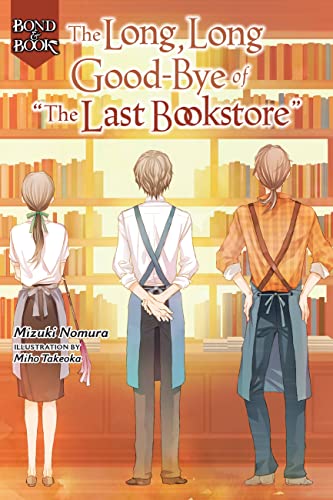
Bond & Book: The Long, Long Good-Bye of “The Last Bookstore”

March 18, 2022 by Sean Gaffney

By Mizuki Nomura and Miho Takeoka. Released in Japan as “Musubu to Hon: “Saigo no Honyasan” no Nagainagai Owari” by Famitsu Bunko. Released in North America by Yen On. Translated by Nicole Wilder.

If you are reading and enjoying Bond & Book, as well as the author’s prior series Book Girl, then I am going to assume that you are a fan of books. Not just “Oh hey, I like reading” or “I always get the new release of Index when it comes out”, but someone whose entire life is tied up in reading and the titles that have impacted them. Certainly this series is both about and for those people, and while it takes the time to explain the books that it focuses on, there’s a greater depth if you’ve already read the stories in question. Not that I expect too many light novel readers will rush out to buy The Field Guide to Extinct Animals, but certainly The Seagull and The Scarlet Letter are very important to this volume, and being familiar with both stories lends them an added emotional impact. Which is surprising, as the author already knows how to pack quite an emotional punch without the references.

After introducing us to what seemed like our main cast in the previous book, this volume sees Musubu on his own. the reason for that is that he’s gone to a distant town where the bookstores have been shutting down one by one. Only one is left now, and its owner just died in what was seemingly a tragic accident. Now it too is going to close, and Musubu is there to make sure that the books are cared for in their final days there. This irritates Minami, the bookstore’s longest-serving part-timer, who not only felt a close kinship with the former owner but is creeped out by this teen who says that he can talk to books – and they talk back. As the days pass and the closing of the bookstore becomes a major event in the town, will we find out about the owner’s past history and secrets?

Unlike the first volume in the series, this one is more of a novel than a short story collection – in fact, the afterword makes me think the author wrote this one first. It overflows with the love that you can get from reading a beloved book, and how that love can also lead to different things. A couple who loved each other from afar when they were teens reunite years later thanks to The Tomb of the Wild Chrysanthemum. A boy who has become terrified of earthquakes is given a fun series about aliens to read that will calm his mind. And, in the main plotline, an actress and a writer both have ties to this bookstore and its owner, and they’re more than just the Chekhov and Hawthorne stories that wrap around their lives. The ending of the book is incredible, wringing emotions out of you, and making you think that, years from now, maybe Bond and Book will be the series that lodges itself in your heart.

There’s two more volumes out in Japan, and this delights me. I just want to read more from this author, whatever it is. And I want to go back and re-read The Seagull. (Not The Scarlet Letter, though. Sorry, Nomura-san, your work can only take me so far.)

Filed Under: bond and book, REVIEWS

Chitose Is in the Ramune Bottle, Vol. 1

March 17, 2022 by Sean Gaffney

By Hiromu and raemz. Released in Japan as “Chitose-kun wa Ramune Bin no Naka” by Gagaga Bunko. Released in North America by Yen On. Translated by Evie Lund.

Manga and light novel trends tend to feel into each other, with parodies, homages, and deconstructions of the hot new thing happening three years later and becoming the next hot new thing. Nowhere is this more apparent than the halls of Gagaga Bunko, home to the cover art where every series looks exactly the same. Gagaga, I’m sure, must also have fantasy and isekai titles… but those aren’t licensed here. Instead we started with My Youth Romantic Comedy Is Wrong As I Expected, where a cynical so-called loner psychoanalyses the nature of high school cliques. Then we saw Bottom-Tier Character Tomozaki, easily the most popular of the subgenre of “the popular kids can even turn you, a loser, into one of their own”. And now we get Chitose Is in the Ramune Bottle, where the main character IS the popular kid, and you will be surprised and shocked that he too has something to say on the nature of popular kids and high school cliques. Everyone’s riffing on someone else.

No, that’s not Chitose on the cover – Chitose Saku is our hero, a handsome cool high school kid who enjoys school and hanging out with his equally popular friends. He has several girls who are interested in him. He’s almost immediately made class president. He’s living the good life. And now he has a job to do, as the teacher has asked him to try to get Kenta, an otaku nerd type, to come back to school – he’s stopped going after getting shut down by a girl he confessed to. Chitose goes along with this, managing to get Kenta out of his room with a nice combination of encouragement, hot girl and good old fashioned violence. But Kenta, who whines about how Chitose gets everything handed to him and an easy life as a popular kid, decides to show Kenta how to actually make an effort.

As you can see, this synopsis bears more than a little resemblance to Tomozaki (Kenta is even named Yamazaki), and we do indeed get the “let’s shop for clothes that are not otaku schlub” and “here is how to actually converse with another person” scenes. At the same time, it also mocks that trend of “self-help” books as unrealistic, showing how difficult it can be to try to change your image and personality and not immediately get attacked. There’s a whole lot of jerks in this book, and the way Chitose and his friends handle them is a good look at “don’t punch down”. As for Chitose himself, he’s a protagonist who cries out for more than one book, so it’s a good thing this won an award and got a series. There’s hints of his past as well as his need to live up to his reputation that might get darker in later books. But overall, he and his friends are very likeable, fun people. If you’re reading this as you heard it was “romcom starring the popular kids”, you won’t be disappointed.

I will note that Chitose can come across – deliberately, he’s clearly doing it on purpose – as smug much of the time, and this may grate on readers who are more used to cynical sad sack narrators. That said, I am very curious to see how this handles being an ongoing series and how much we can peel back Chitose’s hero complex.

Filed Under: chitose is in the ramune bottle, REVIEWS

  • « Go to Previous Page
  • Page 1
  • Interim pages omitted …
  • Page 82
  • Page 83
  • Page 84
  • Page 85
  • Page 86
  • Interim pages omitted …
  • Page 346
  • Go to Next Page »
 | Log in
Copyright © 2010 Manga Bookshelf | Powered by WordPress & the Genesis Framework