• Skip to primary navigation
  • Skip to main content
  • Skip to primary sidebar
  • Home
  • About Us
    • Privacy Policy
    • Comment Policy
    • Disclosures & Disclaimers
  • Resources
    • Links, Essays & Articles
    • Fandomology!
    • CLAMP Directory
    • BlogRoll
  • Features & Columns
    • 3 Things Thursday
    • Adventures in the Key of Shoujo
    • Bit & Blips (game reviews)
    • BL BOOKRACK
    • Bookshelf Briefs
    • Bringing the Drama
    • Comic Conversion
    • Fanservice Friday
    • Going Digital
    • It Came From the Sinosphere
    • License This!
    • Magazine no Mori
    • My Week in Manga
    • OFF THE SHELF
    • Not By Manga Alone
    • PICK OF THE WEEK
    • Subtitles & Sensibility
    • Weekly Shonen Jump Recaps
  • Manga Moveable Feast
    • MMF Full Archive
    • Yun Kouga
    • CLAMP
    • Shojo Beat
    • Osamu Tezuka
    • Sailor Moon
    • Fruits Basket
    • Takehiko Inoue
    • Wild Adapter
    • One Piece
    • After School Nightmare
    • Karakuri Odette
    • Paradise Kiss
    • The Color Trilogy
    • To Terra…
    • Sexy Voice & Robo
  • Browse by Author
    • Sean Gaffney
    • Anna Neatrour
    • Michelle Smith
    • Katherine Dacey
    • MJ
    • Brigid Alverson
    • Travis Anderson
    • Phillip Anthony
    • Derek Bown
    • Jaci Dahlvang
    • Angela Eastman
    • Erica Friedman
    • Sara K.
    • Megan Purdy
    • Emily Snodgrass
    • Nancy Thistlethwaite
    • Eva Volin
    • David Welsh
  • MB Blogs
    • A Case Suitable For Treatment
    • Experiments in Manga
    • MangaBlog
    • The Manga Critic
    • Manga Report
    • Soliloquy in Blue
    • Manga Curmudgeon (archive)

Manga Bookshelf

Discussion, Resources, Roundtables, & Reviews

Reviews

Too Many Losing Heroines!, Vol. 2

October 24, 2024 by Sean Gaffney

By Takibi Amamori and Imigimuru. Released in Japan as “Make Heroine ga Ōsugiru!” by Gagaga Bunko. Released in North America by Airship. Translated by Matthew Jackson. Adapted by Acro.

I had better get used to these books being backloaded in the second half, because I had the exact same experience with this volume that I had with the first. The start of this volume is packed with scenes designed to make the main characters annoying in a funny way, but I mostly found them annoying in an annoying way, particularly our narrator, who may be trying to contrast with the usual light novel romance narrators, but not by much, because like all of them he’s emotionally sensitive to everything but his own mind. As the book goes on, and it delves into the ongoing issues of Losing Heroine #2, and the way that sometimes even after you’ve been rejected you still have to see the guy you like every day, it gets a lot better. When he’s dealing with other people’s love lives, Nukumizu excels. When he’s dealing with his own inability to know what love feels like, you find yourself rooting for Anna. And I hate rooting for Anna.

As mentioned, our three losing heroines have all been rejected, but life still goes on. Anna attends a reunion and is horrified to discover her childhood friend and his new girlfriend acting like they’re already married. Chika is still in the same literature club with the girl who is now dating her crush, and is still being very smug about it. And then there’s Lemon, who seems to be… walking around town with Ayano? What? Is he cheating on his new girlfriend? Is Lemon trying to horn in on a brand new relationship? Nukumizu absolutely does not want to get involved, but he and Anna are forced to when they run into Ayano’s actual girlfriend, Chihaya, who also worries that something is going on between them, and decides to solve the problem by planting tracking devices on her boyfriend and following him around. This is a bad idea, FYI for new couples.

Lemon, frankly, has always given off the impression that she’s supposed to be the dumb one in our cast, but that’s mostly because the characters are all varieties of trope because this book is trying to be a deconstruction (which it succeeds at roughly 1/3 of the time). In reality, she studied hard with her childhood friend and crush so they could go to school together, and concentrates so hard at track because her family are all known for their brains and she doesn’t want to disappoint them, so plays to her strengths. She’s pretty emotionally mature here once she stops literally running away from her problem. As for Anna, who is clearly the secondary protagonist in these books, she kinda likes Nukumizu, and would be amenable to dating him, but she’s still too hurt by her previous relationship. so she needs him to do the job of asking her – and he’s NOT emotionally mature, so that’s not happening. I expect it won’t be happening anytime soon.

All this plus a very funny parody of Villainess isekai which, frankly, could easily be one – Chika should take that to a publisher ASAP. A combination of really irritating and quite heartwarming. In that order.
Filed Under: REVIEWS, too many losing heroines!

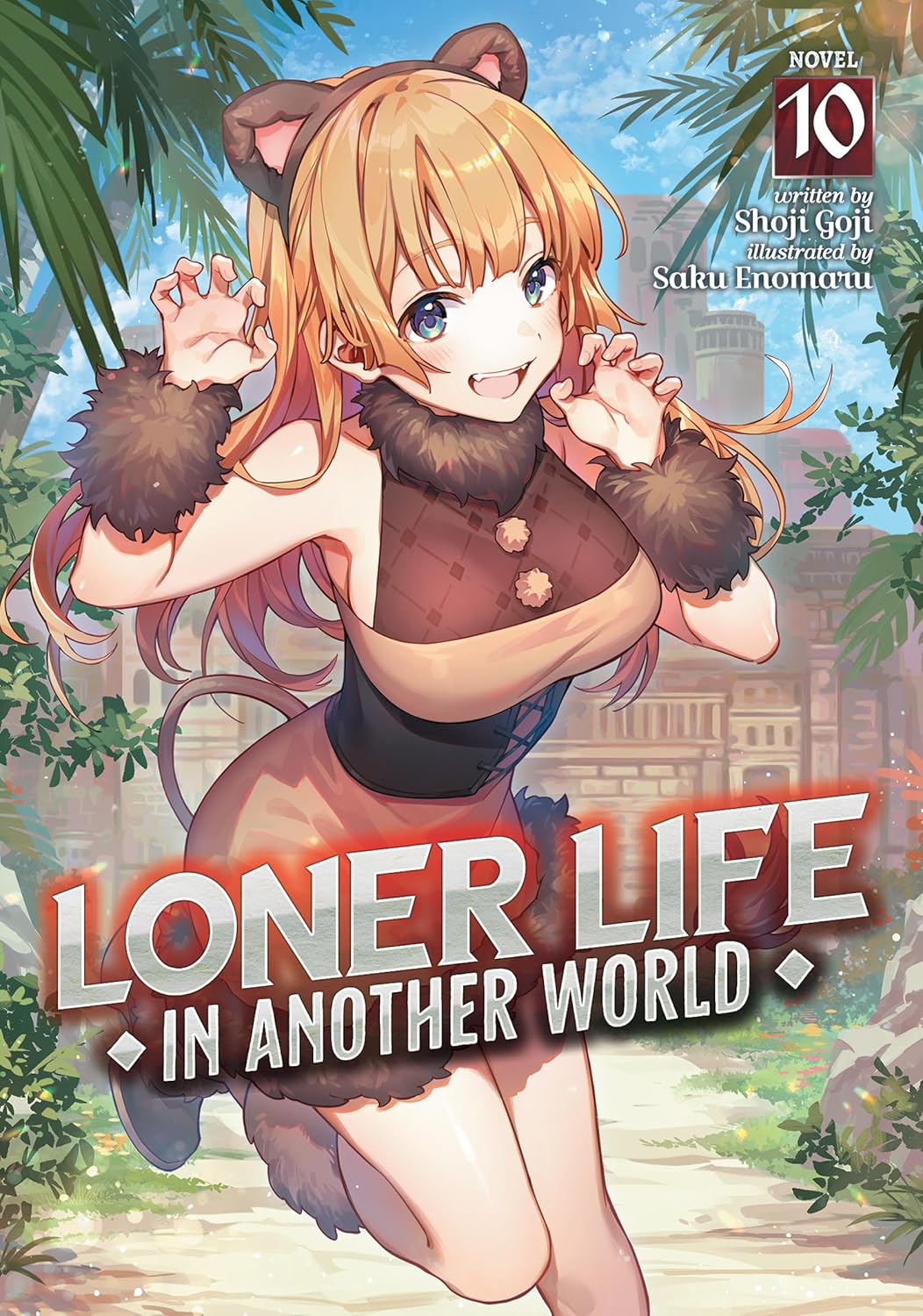
Loner Life in Another World, Vol. 10

October 23, 2024 by Sean Gaffney

By Shoji Goji and Saku Enomaru. Released in Japan as “Hitoribocchi no Isekai Kouryaku” by Overlap Bunko. Released in North America by Airship. Translated by Andrew Schubauer.

First off, we have a change of creative team in the copyright. To Eric Margolis: thank you for your service, please have a rest now. To Lorin Christie: I see you got a promotion, please continue to help us enjoy this as editor. To Andrew Schubauer: Welcome to our new Meat Shield Translator!

I’ve mentioned before that this series does have a real meaning and moral behind “let’s watch Haruka bang his gorgeous monster concubines”. This volume in particular hits it hard at the end of the volume. If you are in power, if you enjoy the largesse of the people, then you have a responsibility to care for those people and make sure they are happy and content. If you do not do this, if you ignore the people saying it’s too hard to help them, or if you actively say that suffering is a good thing, then you are scum and deserve everything you get. When everyone arrives at the Beast Kingdom, the reader is briefly puzzled why Haruka and the girls are so utterly furious, but then it becomes clear – to get there, they had to pass through the devastated beast villages filled with dead people that the rulers didn’t bother to save. As for the Church? Well, using religion to genuinely make everyone’s lives better is still approved of. But the bulk of the Church isn’t doing that. And as for God, no one is impressed.

The last book implied this one would have the visit to the Beast Kingdom and then the attack on the Pope, but you know Loner Life is never going to do things quickly. No, this one is 463 pages, and you feel every one of those pages as Haruka decides to try to level up (remember, something damn near impossible for him to do) by sneaking into dungeons, fighting dungeon bosses, and getting killed/revived over and over till he’s a bloody mess. Needless to say, he does not win any friends by doing this. In his spare time, he rescues some adventurers who had heard about how awesome life was on the frontier, came to test their skills, and then discovered why the frontier is still terrifying. Finally, Haruka ends up setting off for the Beast Kingdom/Battle against the Church, and yes, everyone does come with him – much as he wants to protect them, he can’t put the girls off this time.

One thing that happens at the start of the book is that the Jocks (or Meatheads, as even Class Rep is calling them now) reveal that they’ve gotten engaged to five of the First Division’s warrior women, and, while pretending to be embarrassed, seem pretty happy about it. What’s more, we hear again that the Nerds have gotten into relationships with four of the Beast Girls in their kingdom. Despite all this, Haruka is still talking about searching the Theocracy to try to find something that can get everyone home. Class Rep is already aware that he means “everyone but him”, and that’s just not acceptable. It’s become pretty clear that, much as they miss Japan, the cast have decided that this is their home which they love. The reason Haruka has not cottoned on to this, of course, is because he is determined to distance himself from everyone he cares about and therefore he cannot understand why anyone would want to be around him unless he’s literally enslaved them. And even then, with the Mean Girls, he still doesn’t get it. Class Rep ALMOST confesses to him at the end of this book, but not quite, and it looks like he barely notices.

As I write this, the anime based on the manga is airing, but it really does seem like a completely different series. There’s still a lot to love about this series once you get past everything to hate about this series.

Filed Under: loner life in another world, REVIEWS

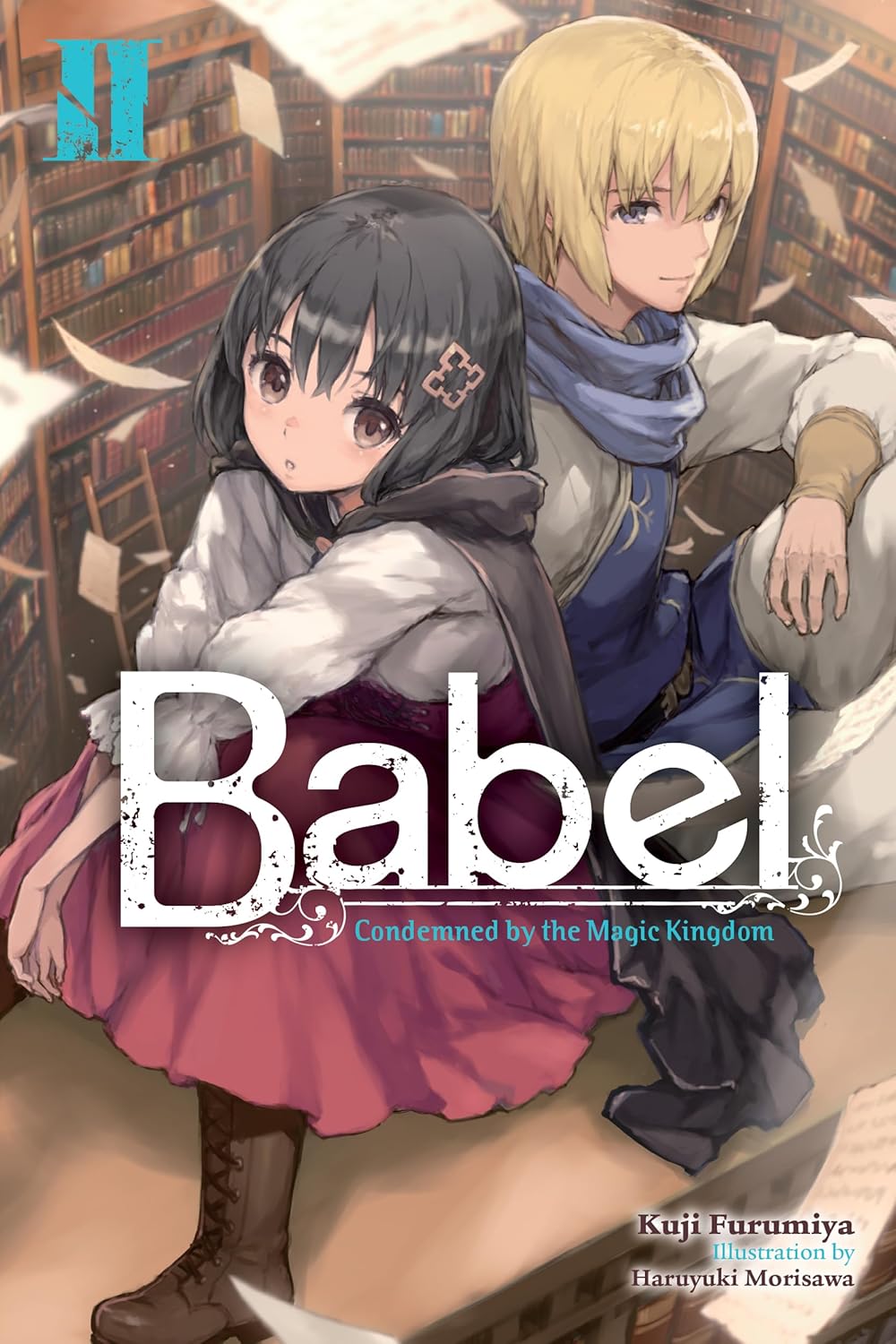
Babel: Condemned by the Magic Kingdom

October 21, 2024 by Sean Gaffney

By Kuji Furumiya and Haruyuki Morisawa. Released in Japan as “Babel II: Mahou Taikoku Kara no Danzai” by Dengeki Bunko. Released in North America by Yen On. Translated by Amelia Imogen Mason.

Being transported to another world is, in many ways, far more difficult than being reincarnated. For one thing, if you’re reincarnated you at least grew up learning basic things like how to walk, talk, etc. in the same way as everyone else in your fantasy world. Whereas the average isekai’d Japanese person is thrown into a town and expected to immediately be able to cope with the Adventurer’s Guild and what exactly mana is. Usually the book simply decides not to bother to deal with it at all, but occasionally you get a handwave that this is a different language, and the handwave usually involves asking whoever is responsible for transporting them to this world (god, usually) to give them the ability to understand everyone. And thank goodness for that, right? As such, it’s only right at the end of this volume, almost halfway through the series itself, that Shizuka realizes, to her horror, what that actually means. And that the title of this series may have more actual impact than expected.

The book is largely divided into two stories, one small and one large. In the first story, Erik and Shizuku, after briefly helping a girl with tremendous magical power who’s spent her life at the top of a tower and her new fiancee, who is named Oscar, find themselves caught up in a revenge wedding ceremony from hell… one where Shizuku is being forced to play the bride. After this, they finally arrive at the Kingdom of Farsas and meet its royal family. (Who are NOT the aforementioned Oscar and young girl, lest readers of Unnamed Memory who haven’t read this get confused.) Unfortunately, the king takes one look at Shizuku and immediately tries to murder her. Apparently there are outsiders who are trying to infiltrate the country, and he decides the best way to make sure Shizuku isn’t one is to kill her and see if she shows her true colors. This test may sound familiar to those who know the history of witches…

Despite the fact that “Shizuku is kidnapped/brainwashed/etc.” being the plot of almost this entire book in one way or another, I greatly enjoyed this volume. Shizuku has the usual self-hatred that so many other light novel protagonists have, but we’re given reasons for it as we go along, and she also doesn’t let it turn her mopey. Some of the best scenes in the book are of her and the king, who reluctantly decides not to kill her right now, snarking back and forth at each other. As with the first book (and let’s face it, it’s the theme of the series), the inability to communicate and get concepts across is what drives this. Shizuku is not able to prove a negative, so everyone views her with suspicion. Erik insists on being guilty, and his own confession means that’s going to happen even when it’s not the entire truth. This all leads up to the revelation at the end, which rocks Shizuku’s world, and possibly makes her return to Japan father away than ever before.

All this and a nasty cliffhanger. Definitely recommended for fans of isekais that don’t use the usual “RPG” tropes, and essential reading for Unnamed Memory fans.

Filed Under: babel, REVIEWS

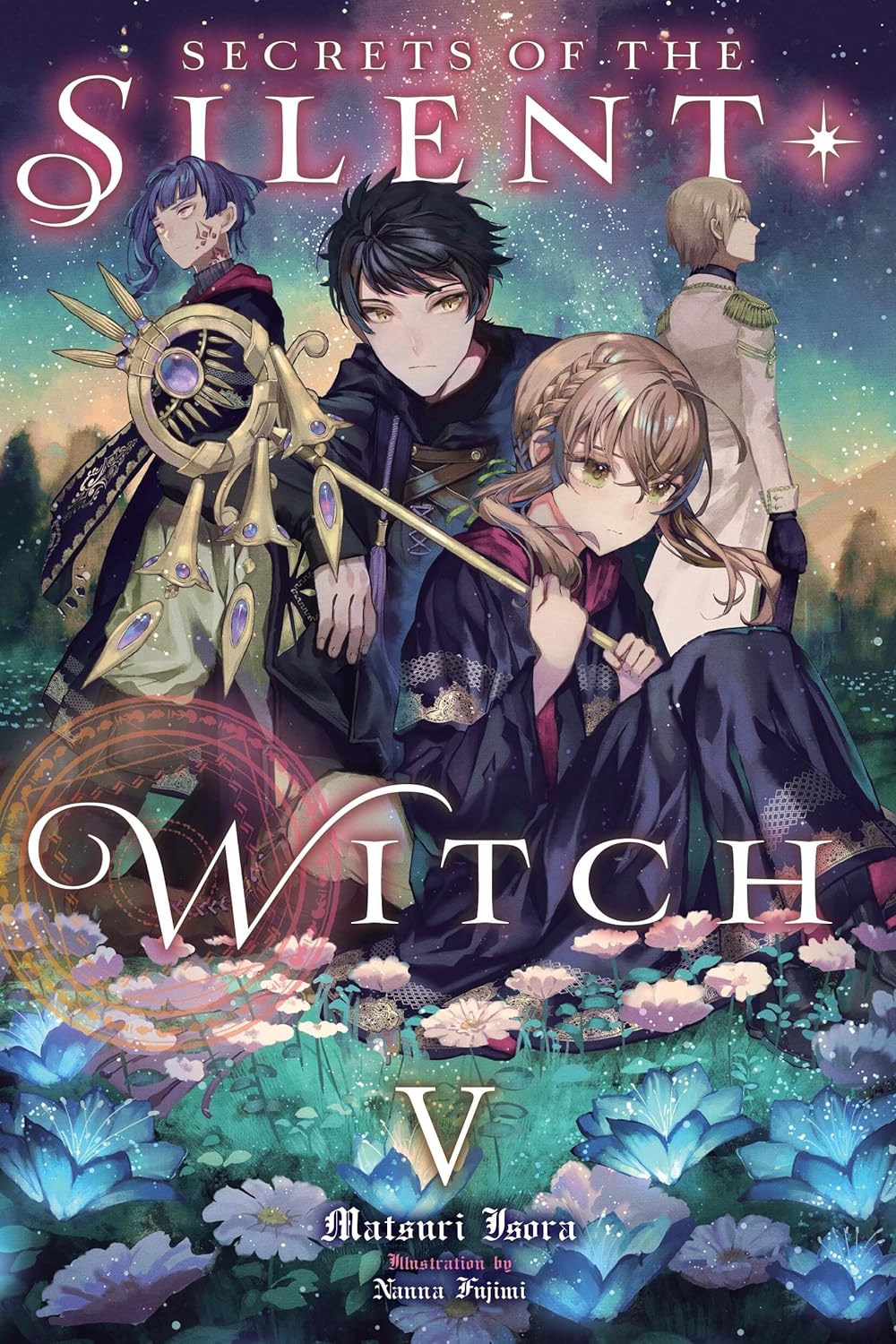
Secrets of the Silent Witch, Vol. 5

October 19, 2024 by Sean Gaffney

By Matsuri Isora and Nanna Fujimi. Released in Japan as “Silent Witch” by Kadokawa Books. Released in North America by Yen On. Translated by Alice Prowse.

This volume definitely has the feel of the author realizing that they can take their time and add the subplots that they were going to skip if this ended up being just 5 volumes long. As a result, we get more ominous foreshadowing as to what Felix’s goal is, and how it ties into what Duke Clockford wants for him… or rather wants to do to him. This ends up being connected to Monica’s own past as well, in a very sinister way. I remains convinced, especially after this volume’s backstories, that this is gonna end with a Felix/Monica pairing, but man, at the moment it would be the worst thing ever and we’d hate it, and I think the author knows that as well. Felix is trying to maniplulate those trying to manipulate him, and the only thing that gives him happiness is his fanboyish obsession with the Silent Witch, who he’d dearly love to meet so he could gush.at her. And hey, good news, Felix!

It’s Winter Break at school, and Monica is hoping to go home, spend some time with her stepmom, spend some time with Isabelle, and dread the upcoming New Year’s event she’ll be forced to attend. Unfortunately, to her horror, she gets a new assignment. Felix is going to Farfolia for some diplomatic work, trying to convince the local lords to set up a military base that is there in case of dragon attack and definitely not in case they decide to go to war with the Empire. Felix needs bodyguards, but Louis is needed on dragon-watching duty, as there’s been prophecy of a dragon attack. So we get Glenn instead… as well as the Silent Witch, who is supposed to guard Felix. Monica is going to have to be extra silent, wear a hood and veil, and hide her identity as hard as possible, lest Felix discover all. Fortunately, she’s already used to wearing a hood and not speaking…

The main plot is excellent, and promises that future books are going to get even darker as Monica tries to redeem her father’s reputation and Felix tries… well, to survive as himself. That said, there’s lots of stuff on the fringes that’s just as interesting in terms of what’s going to happen. Cyril continues to be featured enough that I’m not 100% sold on Felix/Monica being endgame (just 90%), and the scene with him and his mother ended up being the most heartwarming moment in the book. The demise of this book’s bad guy was very reminiscent of the climax of the Sherlock Holmes story “The Speckled Band”, which was nicely gruesome. And we continue to get the threat that Bridget might one day be important, without that actually happening. At this point I wonder if she’s secretly the last boss. (Probably not, it looks more likely she’s just a more serious “jealous girl”.)

The sixth volume promises to follow up on the consequences of this one, and Monica’s identity looks less secure than ever. Can she survive attempts at killing her? Can she survive Felix trying to get her to annotate his thesis some more?

Filed Under: REVIEWS, secrets of the silent witch

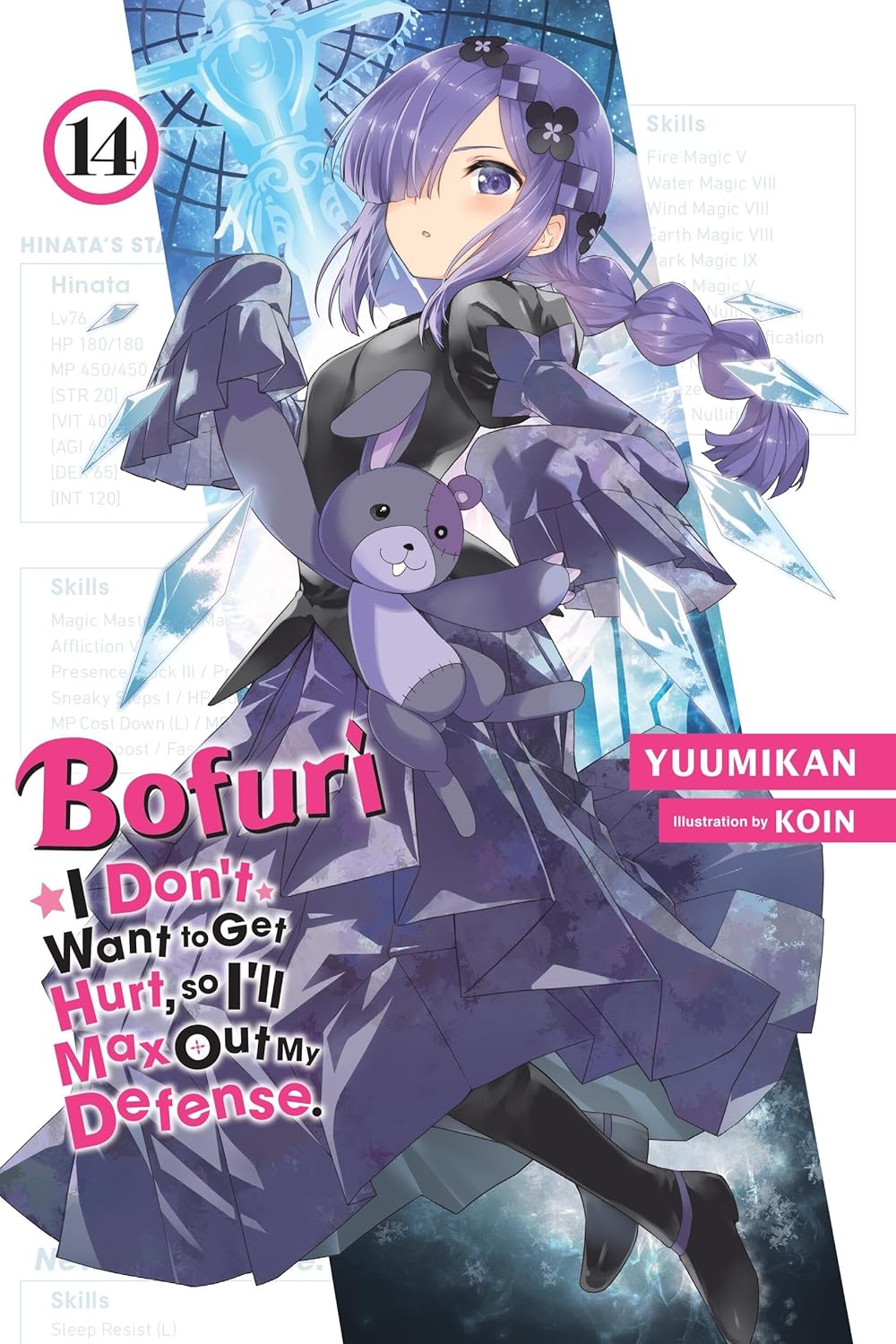
Bofuri: I Don’t Want to Get Hurt, So I’ll Max Out My Defense, Vol. 14

October 18, 2024 by Sean Gaffney

By Yuumikan and KOIN. Released in Japan as “Itai no wa Iya nano de Bōgyoryoku ni Kyokufuri Shitai to Omoimasu” by Kadokawa Books. Released in North America by Yen On. Translated by Andrew Cunningham.

I’m sure I’m not telling you anything you don’t know when I say that this series entirely revolves around its star. Maple is why people read this series, and for the most part Maple is omnipresent throughout this series. Even the PVP events have been heavily Maple-centric, and several books have mostly just featured her and Sally taking over the narrative for 2/3 of the pages. So it was something of a surprise to see that this is easily the most balanced book in the entire series when it comes to the increasingly huge cast. Oh, don’t get me wrong, Maple is here throughout, and gets several things to do that cause people’s jaws to drop. But she’s hanging out with a bunch of other people who also have ridiculous moves, and not just the folks from Maple Tree. This is a book that spotlights its cast so much that even Frederica, who has made her entire name in this series by being second-best to Sally and whining, gets to be cool and powerful.

We’ve started the new PvP event. On one side: Maple Tree and the Order of the Holy Sword, plus a lot of other guilds who, honestly, are there to be cannon fodder. On the opposite side, we have Flame Empire, Rapid Fire, and Thunder Storm. Oddly, Maple is the one on the fire side, with all the monsters, while fire expert Mii is on the human side. What follows is a series of battles, usually featuring our main cast taking care of business pretty easily, followed by a back half of a big battle royale, where our main cast have a much harder time, and the correct answer may be “when is the correct time to run away without getting killed?”. And worst of all, this is a two-parter, so we don’t even get the closure of knowing who won in this book.

So yes, there’s less Maple in this book, but that’s not to say she doesn’t get her usual moments. For those who want “cool Maple”, the shot of her, with both white angel wins and black demon wings, wearing her halo and standing on a ledge looking like the wrath of God, is a treat. For those who love funny Maple, combining the Sheep Mode with Mai and Yui to give hapless players a rapid transit system is well worth the money. Speaking of Mai and Yui, it’s become pretty clear that after Maple and Sally, they’re the most dangerous ones in the party, and they too get “oh my GOD!” moments here that are both awesome and yet still kind of funny. (Every Mai and Yui joke is a variation on “when all you have is a hammer”.) This is a 100% game book, with not a Kaede or Risa to be found anywhere, and it moves at a fast pace. Even Pain manages to be interesting!… OK, that’s a lie. The author isn’t *that* good.

So yes, very Maple, much fight. Bring on the conclusion.

Filed Under: bofuri, REVIEWS

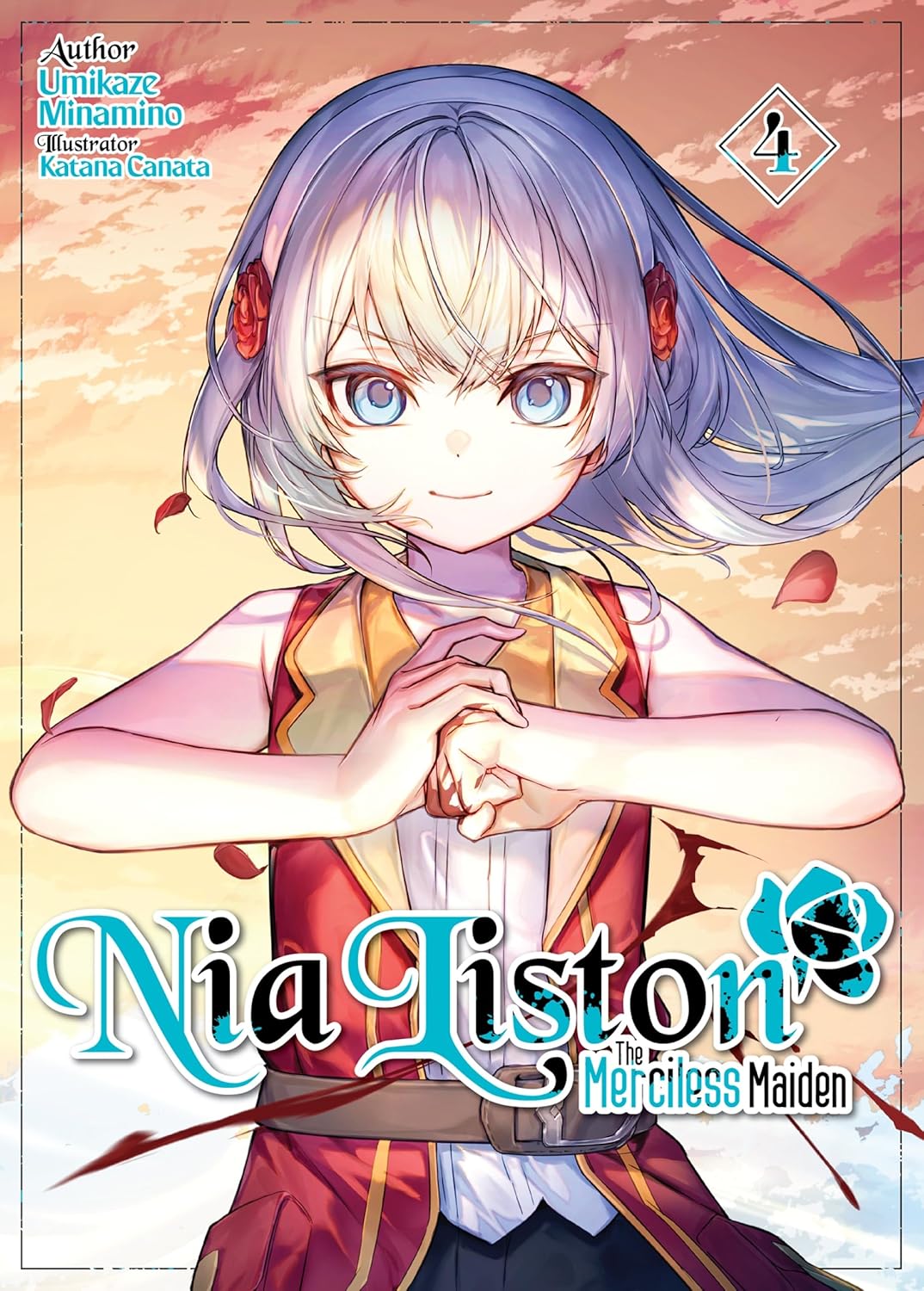
Nia Liston: The Merciless Maiden, Vol. 4

October 17, 2024 by Sean Gaffney

By Umikaze Minamino and Katana Canata. Released in Japan as “Kyōran Reijō Nia Liston: Byōjaku Reijō ni Tenseishita Kami-goroshi no Bujin no Kareinaru Musō Roku” by HJ Bunko. Released in North America by J-Novel Club. Translated by okaykei.

I will admit, as I was reading this new volume about a small little girl beating the absolute hell out of things she has no business beating, I could not help but think of Do-Over Damsel, which has an anime running this fall and also features lots of this sort of thing. They even have similar “this is vaguely creepy but doesn’t quite cross a line, but I’m watching you” characters. That said, whereas with Jill I tend to really enjoy it when she finally lets loose and lets violence be her answer for everything, with Nia there’s no question that the magivision has become more interesting to me. There’s simply not much about Nia murdering ancient giant crabs by punching them a few times that I can say anything about, beyond “nice punch”. But if she’s being manipulated by royalty (again) or trying to think of things to get ratings besides outrunning dogs, I’m intrigued. And, so far, those are the two plots – though that may change soon.

Nia is a bit grumpy at the start of this book. Relia has stolen Nia’s thunder with the paper play show, and everyone in the school is talking about it. That said, she’s not frustrated enough that she won’t help Hildetaura come up with her own popular show – even if the extent of Nia’s help is “let me ask my brother to be clever for me”. Her greater concern, though, is earning that one billion. Adventuring is earnin g tons of cash, but tons is not enough. As a result, she and Lynokis take a trip over the holidays to a different country filled with expensive monsters that Leeno – or rather, Leeno’s child assistant – can murder without destroying their value as a carcass/magic corpse. Unfortunately, doing feats no one has been able to do in a hundred years attracts the wrong kind of attention.

Possibly the most interesting part of this book was the occasional “had I but known” hint that implies things are going to go very badly for Nia at some point in the future, implying she may have to flee the kingdom. Certainly, while she can quickly take action when her future is definitely being threatened, she is otherwise completely uncaring about being manipulated by the two royal princes in order to get what they want – and, let’s face it, Nia’s best resource is her position as Nia Liston, not her secret super strength. She’s a celebrity, and outrunning dogs is all very well and good, but that’s just more important than punching crabs. Unfortunately, a lot more crab punching may be needed to get that tournament, so I suspect we’ll be getting more fighting next time, though it’s also possible that the politics that threatened in this book overflow at last.

This was a decent volume, but again, I’d like a bit less “Nia hits things”, please.

Filed Under: nia liston, REVIEWS

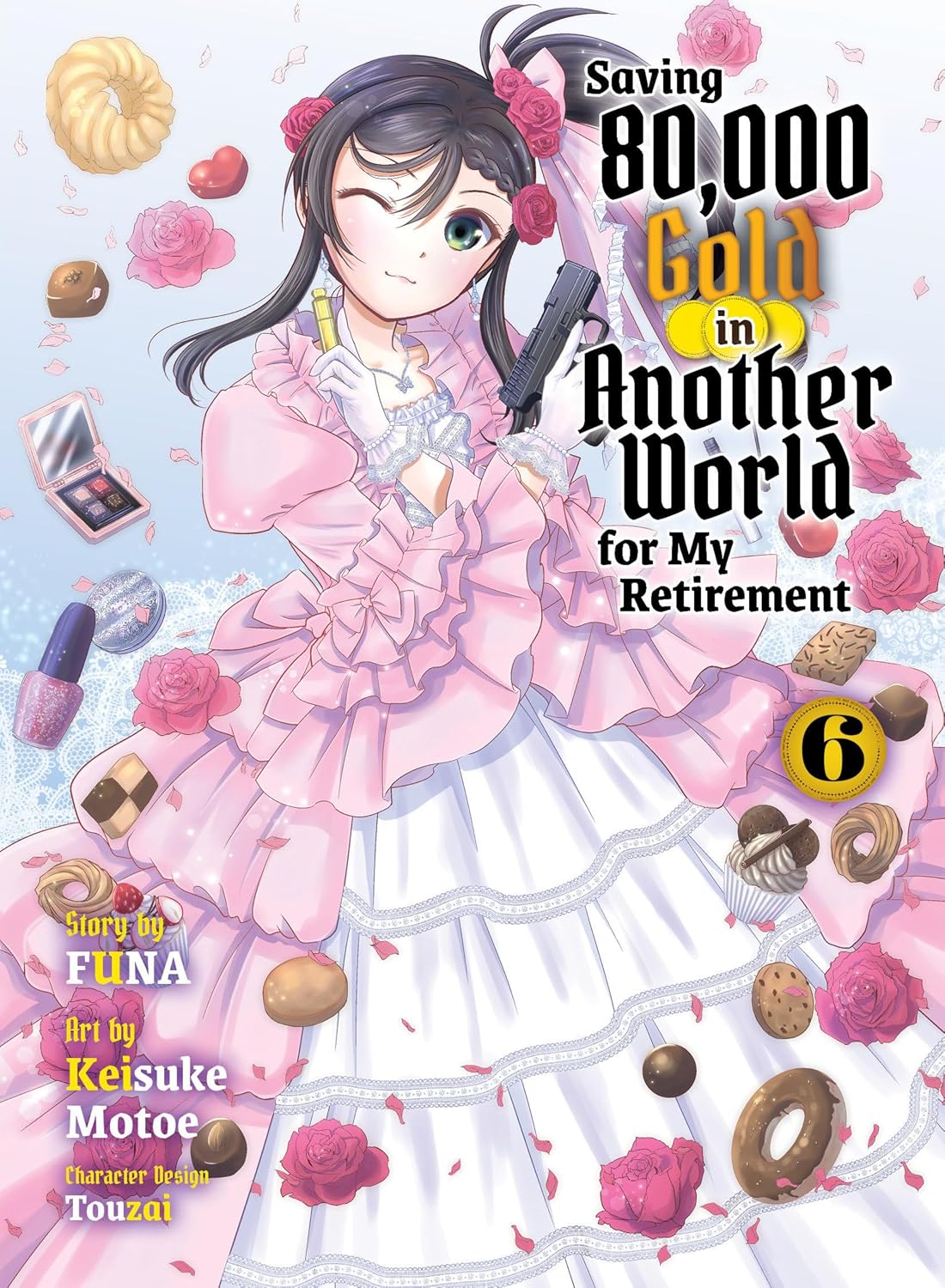
Saving 80,000 Gold in Another World for My Retirement, Vol. 6

October 16, 2024 by Sean Gaffney

By FUNA and Keisuke Motoe. Released in Japan as “Rōgo ni Sonaete Isekai de 8-Man-Mai no Kinka o Tamemasu” by K Lanove Books. Released in North America by Kodansha Books. Translated by Luke Hutton.

(A reminder that the English Vol. 6 is the equivalent of the Japanese Vol. 7.)

I seem to recall that in earlier reviews of this series, I would applaud the very rare effort to give Mitsuha some depth, such as her reaction of grief when discussing her family in the first book, etc. Anyone who has been following later volumes of this series will, I think, agree with me when I say that depth is the last thing I want now. That honestly applies to all three FUNA series, I think. As they’ve gone on and gotten bigger and bigger, it’s clear the author knows exactly what their skill set is, and it’s writing a cartoon. Not a Japanese anime-style cartoon, but like a Hanna-Barbera cartoon with Mitsuha as both Dick Dastardly AND Muttley. Not only do we not take Mitsuha seriously, but none of her allies take her seriously. The only ones who do take her seriously are the ones desperately trying to either curry favor from her or sabotage her. She destroys those people.

The bulk of this book continues to take place in Vanel, as the royal family finds out that Mitsuha holds grudges forever (though the third princess manages to find a way around this, in one of the funniest scenes of the book). She deals with a rival company breaking into their warehouse and stealing their merchandise, and then decides that the best thing to do is to start a society of cute teenage noble girls, get them to bond with each other over a shared goal (get Mitsuha’s makeup, which she starts to introduce here), and make then the biggest force in the country, as they also end up funding a relief column for one of their members whose barony is experiencing a famine. Meanwhile, back in Yamano County, she’s building entire islands just so she can trade as a tax dodge, and once again setting up a young girl to run it so they can get better marriage prospects.

As with all FUNA series, if you scratch at the core of this you find “I want to write about cute 8-13-year-old girls, but not in a sexual way, just in a cute and empowering way”. Potion Girl and MMAA also do this, with the “gimmick” being the lead is always a reincarnate in a permanently 12-year-old body. Mitsuha’s not a reincarnate, and is 18, but her looks are basically the same thing. And the goal of 80K Gold seems to be to get all these little girls running the economy. After 7 volumes they’re all store owners, merchants, etc., finding better ways to transport goods and Mitsuha can barely keep up with them, to the point that she needs to invent a better sugar here so she can make rum to use as a bribe. Honestly, this volume is best when it’s making fun of Mitsuha and itself – her tendency to monologue for pages on end about her grand plans are now shown to be her saying them all out loud without realizing it, which reminds me a lot of Elgala from Excel Saga. And honestly, this series sort of fits in with the vibe of Excel Saga. We’re even siding with a villain. (Mitsuha. Mitsuha is the villain.)

As always, if you don’t read everything by this author, don’t read this. If you do, it’s good.

Filed Under: REVIEWS, saving 80000 gold in another world

Young Lady Albert Is Courting Disaster, Vol. 8

October 15, 2024 by Sean Gaffney

By Saki and Haduki Futaba. Released in Japan as “Albert-ke no Reijō wa Botsuraku o Goshomō Desu” by Kadokawa Beans Bunko. Released in North America by J-Novel Heart. Translated by Ray Krycki.

Usually when I say that a final volume of a series is doing what I call a “victory lap”, I don’t mean it literally. And yet that’s exactly what happens here, as we join the main cast as they take a tour of every major character we’ve met before, every major place we’ve visited, and have all the possibly comedy antics you could want. Honestly, probably more than you’d want. It’s been so long since the first volume that I’d forgotten how particularly thick-headed Mary can be when she wants to ignore things that troubled her, A lot of the humor near the start of this book is her having to be reminded of all the bad things that happened to her in previous books, and her having completely forgotten everything about them entirely. That said, she and Adi at least have an excuse: Their lovely daughter, who is the spitting image of her mother both in appearance and attitude and is ready to take the world by storm.

This volume takes place six years after the previous one. Roxanne, Mary and Adi’s daughter, has a mission. She’s written invitations for a big party where her mother has an important announcement, and now she plans to deliver them all by hand in person – by herself. Needless to say, this requires strategy, so Mary and Adi seemingly agree while also secretly tailing her. She starts off visiting the royal palace, where we meet Patrick and Alicia’s son Felix, who if nothing else proves that Alicia does actually seem to love Patrick more than Mary – romantically, at least. Felix joins Roxanne in her solo (?) jaunt, and Patrick and Alicia join Mary and Adi in tailing them. We then get to see most of the major characters from previous books, including Parfette and Gainas’ newborn twins (it makes sense they’d take six years to get around to this). But what *is* Mary’s big news at the party?

This is pretty much one of those “everyone is going to be in male/female pairings by the end of it” series, so it’s rather surprising that the most interesting parts for me was when it went outside that bubble. Helene, the single mother from the last book, has moved to Albert Country, and is being courted by BOTH of Mary’s brothers, as well as their attendant. What’s more, it’s made clear from discussions about the brothers that they function as a unit far better than they ever would when competing. It’s no wonder this is the one romance left up in the air – a woman marrying three men would likely be one bridge too far for most readers of this genre. Then there’s Mary and Alicia, who manage to reaffirm their relationship and also admit that they love each other – and that they are NOT the villainess and heroine in an otome game, something Alicia has to sort of pound into Mary’s head. They’re still my favorite part of the series.

The ending twist promises that otome game villainesses may continue into the next generation, but we’re not going to be seeing that. Let’s be content with Mary Albert, drill-less, happily married, with a lovely daughter and another child on the way. She failed spectacularly in trying to engineer her doom. But then, so did Katarina Claes, who I remind everyone debuted only one month before this series in Japan.

Filed Under: REVIEWS, young lady albert is courting disaster!

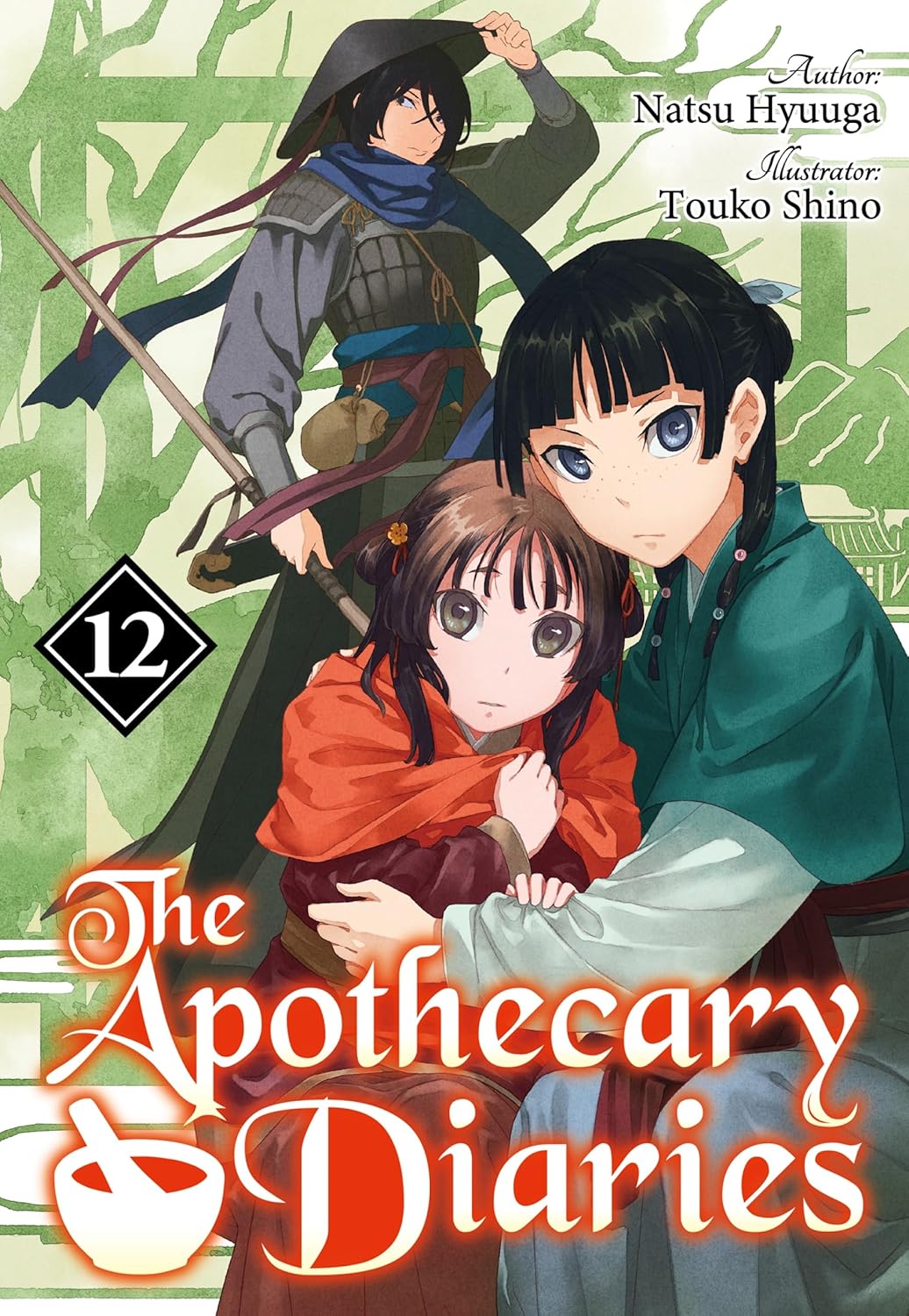
The Apothecary Diaries, Vol. 12

October 14, 2024 by Sean Gaffney

By Natsu Hyuuga and Touko Shino. Released in Japan as “Kusuriya no Hitorigoto” by Hero Bunko. Released in North America by J-Novel Club. Translated by Kevin Steinbach.

It’s very tempting to just type “Holy crap!” and leave the review at that, but I will try to go into more detail. This is the final book in the Western Capital arc (yes, we are back home by the end of the book, woo hoo), and it fires off all the guns it has been saving up since the 9th volume, with the last two-thirds or so being a very tense ride in which (sorry to spoil you a little, but this shouldn’t surprise you too much) Maomao is caught up in events and gets sort of kidnapped. She and Jinshi are apart, again, almost the entire book, but end it closer than ever before, with words not said but actions taken that will make the reader cheer. That said, what made *me* cheer was Chue. I’ve loved her since she was first introduced, even as I realized that she was clearly more than she seemed, and here’s where we find everything out and also worry that the author is going to kill her off. It’s a dangerous book.

At the end of the last book we saw the assassination of Gyoku-ou, and unsurprisingly we now have a succession crisis. The first son wants to give up his rights, the second son is against that, and the third son… is a very strange and deferential young man. Meanwhile, Maomao also meets the little grand-kids of the family: Gyokujun, a spoiled brat who serves as the annoying young boy you love to hate the entire book, and Xiaohong, a far-too-mature for her age girl who Maomao previously helped get over eating her own hair. As Maomao tries to sort out this tangled web of relationships, and also treat the occasional terrible nausea and horrible headaches, the first son is shot with a poison arrow. And the fallout of this puts Maomao far, far from the Western Capitol and in more danger than ever before.

I’ll be honest, I frequently have trouble with series that have huge casts with similar names, most of whom are some relation to each other, so a lot of the time I was trying to act like Maomao and just smile and nod. This isn’t even getting into the political situation, the fact that we’re still trying to save the capital from a famine, and even more bandits who somehow manage to be even worse than the first bandits, and one of the antagonists trying to immolate themselves. But come on, let’s talk about Miss Chue. After Maomao, she’s probably become my second favorite character in the series, even passing Shisui. And here we get her inevitable tragic backstory, and also frankly we almost get her tragic end. Possibly the most heartbreaking moment in the book is when Chue says “do I have no value anymore?” to her mentor (who I’ll leave a surprise). Fortunately, the answer appears to be “yes, you do still”, though Chue is probably going to have to find new ways to pull flags out of her sleeves in the future.

All this and Lahan’s brother too. Poor Lahan’s brother. Sometimes I can still hear his voice. In any case, this series remains amazing.

Filed Under: apothecary diaries, REVIEWS

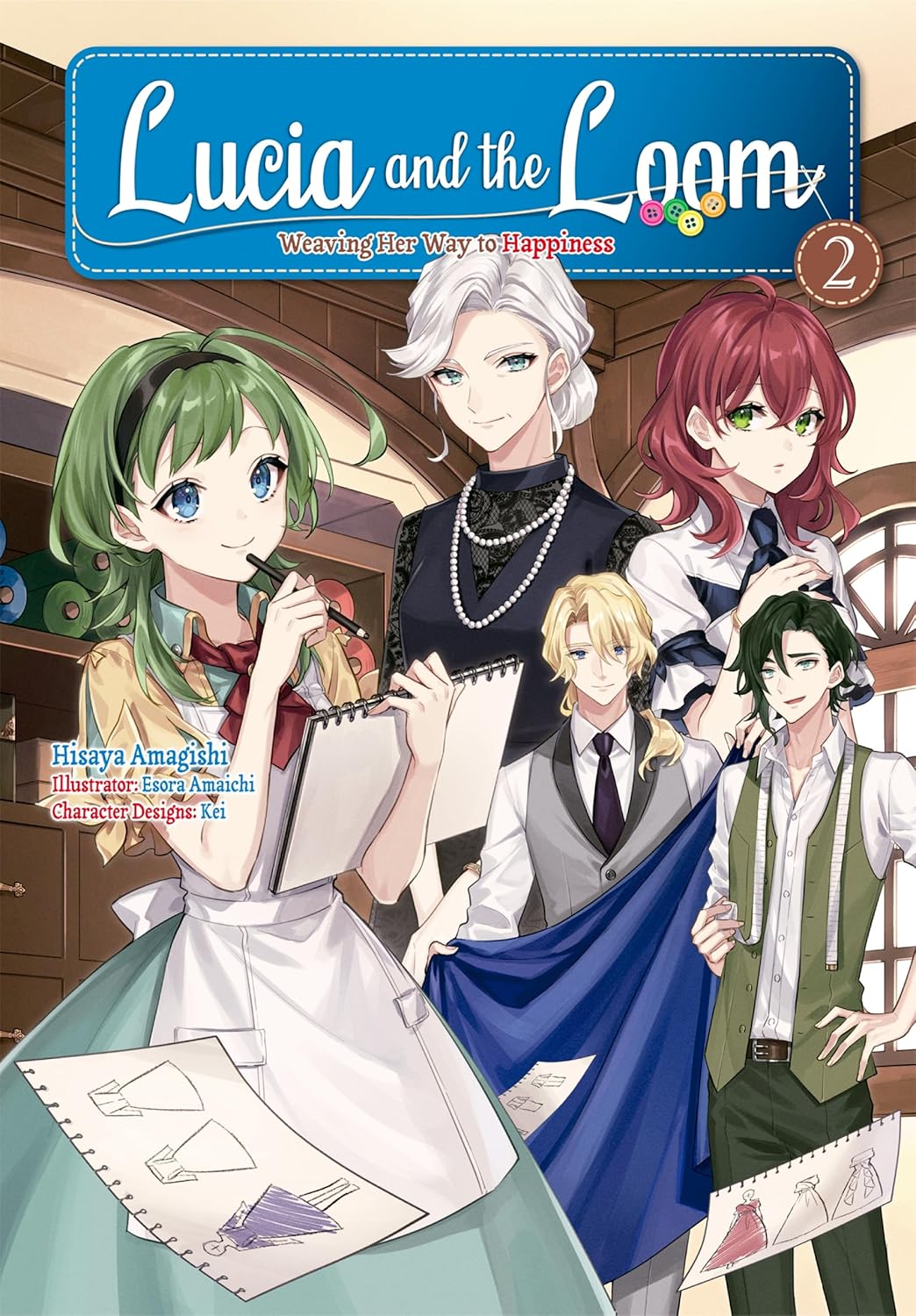
Lucia and the Loom: Weaving Her Way to Happiness, Vol. 2

October 13, 2024 by Sean Gaffney

By Hisaya Amagishi and Esora Amaichi. Released in Japan as “Fukushokushi Lucia wa Akiramenai: Kyō kara Hajimeru Kōfuku Keikaku” by MF Books. Released in North America by J-Novel Heart. Translated by A.M. Cola.

Dahlia, the protagonist of the main series, and Lucia, the protagonist of this spinoff, are on the face of it not all that alike. Aside from their tendency to deflect all achievements away from them, that is. Dahlia is reserved, while Lucia tends more towards the firey. But it is interesting how both the main series and its spinoff are pushing their respective protagonists into very similar situations. Dahlia keeps coming up with wonderful, insane inventions that will change their entire nation, and as a result is rapidly heading towards a future where she’d better be married and protected, or else she absolutely will be kidnapped. Lucia’s clothing designs are not as revolutionary (though the opera house in this volume may disagree), but her leadership skills and ability to inspire are absolute gold, and she too had better get married soon – she’s already starting to suffer kidnapping attempts.

The first chunk of this book follows the earlier Dahlia plotlines, as we see the debut of the cloth that basically has its own built-in air conditioner. Lucia and her staff have to work out where to best place the cloth, how to deal with those who are ticklish, etc. Lucia is also busy learning about nobility, and what not to say when a noble says something that seems innocent but isn’t. The latter half ot eh book is more along the lines of the latter half of the first, with Lucia running into various people and helping them with fashion/outfits, as well as sometimes being a big ol’ ball of sunshine. We also meet Forto’s attendant Lotta, who is an attendant who is also a blighted (sound familiar), but none of that matters to Lucia, who is great at getting people to come out of their shells. No wonder the “who will Lucia end up with?” sweepstakes are a lot more open than Dahlia’s.

Last time we saw a lot of teasing of a potential relationship with Forto, which is pretty bittersweet given that we’ve read later volumes of Dahlia and see her rejecting him. We’re starting to see a few other alternatives here. Such as Dante, her right-hand man, who is also dealing with trying to put off marriage proposals so he can concentrate on his work, and who is straight up told “do not let her get away” by his grandmother. Or Lotto, Forto’s attendant, who is pretty much given a plotline in this book that’s the equivalent of the sun coming out behind Lucia’s head while heavenly choirs play in the background. Speaking of attendants, Lucia’s found her Mr. Sunset, though he’s deflected it so that she’s not aware. That said, the main thing blocking any of these is Lucia herself, who (in a book that once again tries to be very progressive about gender and sexuality) seems to be demisexual, and has not found anyone she’s that emotionally close to yet.

The main Dahlia series is stalled over here while it finds a new translator, the previous one having stepped down, but we’re getting a third Lucia book soon. Will it catch up with the main series? Can we somehow get Lucia connected to a noble without her managing to avoid it? And will the clothing still be gorgeous? Signs point to yes on that last one.

Filed Under: lucia and the loom, REVIEWS

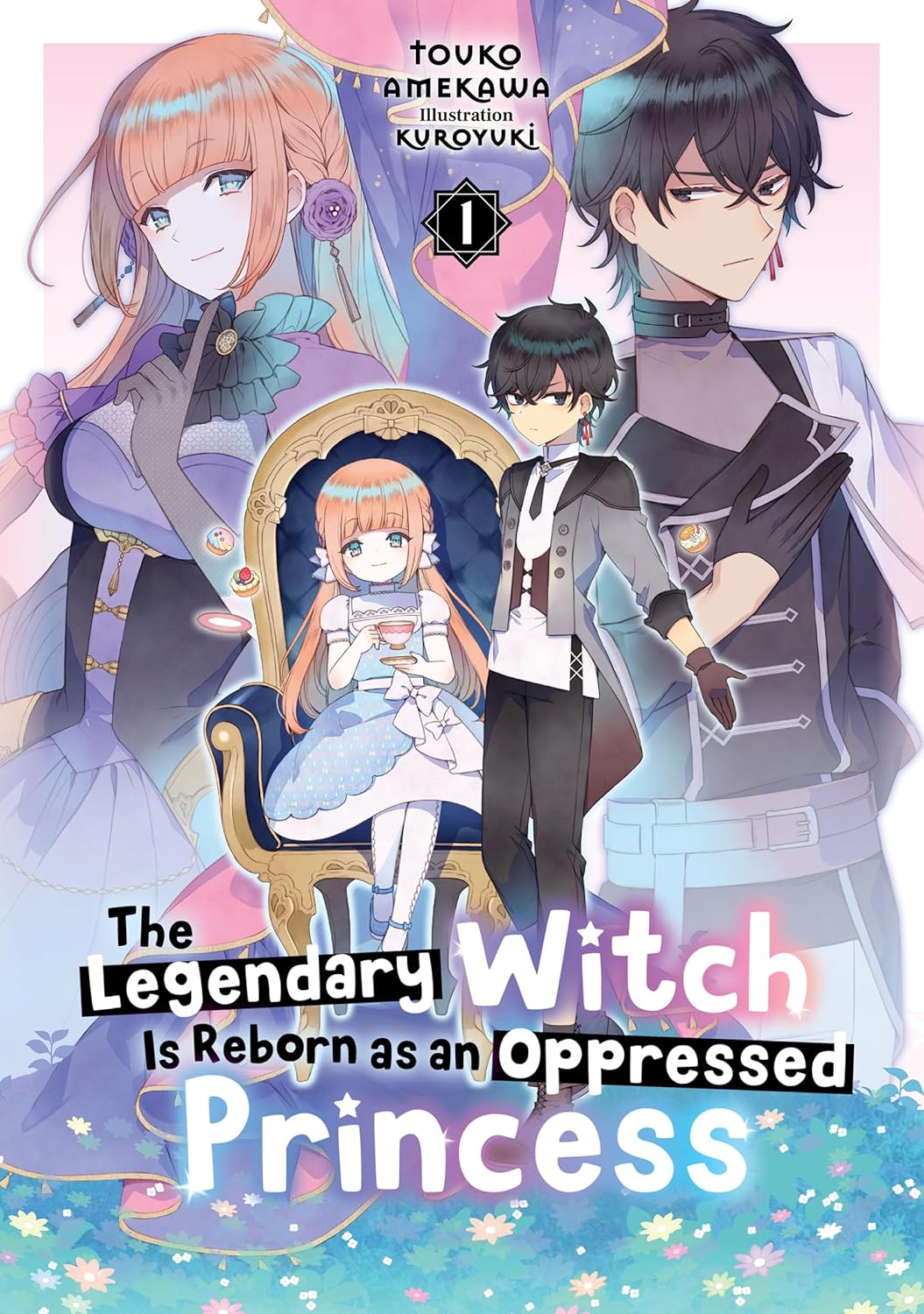
The Legendary Witch Is Reborn As an Oppressed Princess, Vol. 1

October 12, 2024 by Sean Gaffney

By Touko Amekawa and Kuroyuri. Released in Japan as “Shiitagerareta Tsuhō Ōjo wa, Tensei Shita Densetsu no Majo deshita” by Overlap Novels f. Released in North America by J-Novel Heart. Translated by Kashi Kamitoma.

Generally speaking, unless it’s a super-famous author I recognize immediately, I tend not to look at who’s written what else until after I’ve read an initial volume of a book. Usually it allows me to be surprised, and that’s definitely the case with this series, which it turns out is written by an author far more famous for the 7th Time Loop series, which recently got an anime. She’s actually got a number of series going at the same time on her Narou page, and this one seems to have been started a few months after 7th Time Loop. I’ll say straight up it’s not quite as good as that series, but it’s still a very decent start. I will say, and I’m sure that it was just as obvious in the Japanese, if not more so, the lead girl talks with a childish “Elmer Fudd” style lisp. If seeing textual accents bothers you, beware. It’s all over this book.

The opening of the book is absolutely dynamite, as Claudia wakes up to the memories of her previous life – by being pushed out of a high window by her evil uncle. She remembers that she used to be Lady Adelheid, the most powerful witch of legend. Sadly, she’s now Princess Claudia, who theoretically was found to have no magic, and so for the 6 years of her life she was put in a tower and abused. Now that she remembers who she was, she stops herself from hitting the ground – with magic. Turns out the “found to have no magic” thing was faked by the Queen Consort, who was angling for power. Claudia decides to wander into the forest to find a pet, having decided, in this new life, to live as she pleases. What she finds is a 9-year-old kid who has a curse that’s slowly killing him. A curse she is very familiar with…

This is a solid series. Claudia at first seems a bit blase and overly perfect, but as the book goes on and we learn more about her past it becomes clear why she’s acting this way – and why she’s determined to push Noah, the boy she saved, away. There’s a lot of people introduced who are set up as antagonists in an “oh look, it’s another evil noble” or “goody, another spoiled brat”, but who turn out to have better sides to them if you dig hard enough. Well, except for the Queen Consort. And possibly the King, who doesn’t necessarily have a nicer side to him, but is certainly very calculating and rapidly realizes that Claudia is someone he wants to find out more about. Too bad she wants to avoid him as much as possible. The relationship between Claudia and Noah is cute, and manages to avoid being romantic in a weird way, despite her being an 19-year-old in a 6-year-old body and him being 9.

So this was a good start. Recommended – Sorry, Wecommended – to 7th Time Loop readers and fans of smug OP witches.

Filed Under: legendary witch is reborn as an oppressed princess, REVIEWS

The 100 Girlfriends Who Really, Really, Really, Really, REALLY Love You: Secret Love Story

October 11, 2024 by Sean Gaffney

By Hamubane, Rikito Nakamura and Yukiko Nozawa. Released in Japan as “Kimi no Koto ga Dai Dai Dai Dai Daisuki na 100-nin no Kanojo Bangai Koimonogatari: Secret Love Story” by JUMP j BOOKS. Released in North America by Airship. Translated by Kim Morrissy. Adapted by Kathleen Townsend.

This review is dedicated to Nicholas Dupree, who would have loved this book. It’s time for CULTURE, folks!

I was a bit worried when I saw this was announced. 100 Girlfriends is, after all, very much a product of its medium. And, as is the case with all light novels that are spinoffs of Jump titles, even if they’re Young Jump titles, I knew it would be written by someone else. The question is, would the light novel have all of the things that we love about the source? The over the top humor, the breaking of the fourth wall, going way too far to the point of putting off its audience a bit, but above all being a wonderfully romantic story about one of the best polycules out there? The good news is that it has all of that. The bad news is it has ALL of that. Be aware, for fans only.

As you can tell by the eight girls on the cover (plus Rentaro – his first cover!), this book is meant to take place sometime between the 4th and 5th volume of the manga. Sorry, Iku fans. It’s a nested short story collection – five “main” short stories with the entire cast, and four 2-3 page short stories featuring two of the girls bonding. The girl pairings are the three you’d expect, plus Kusuri and Kurumi. As for the main stories: 1) Rentaro spends 30 hours dating each and everyone one of his eight girls, till they force him to sleep; 2) An alien possesses Nano to try to learn about the “emotional energy” that the cast possesses; 3) The vice-principal drinks a drug that makes her turn into a kaiju, and Rentaro and his girlfriends must get into a Giant Rentaro Robot that Hahari has prepared to battle her; 4) The cast end up in the world of Circlet Love Story, and when they accidentally break it, they have to work hard to make sure events unfold as the book says; 5) Rentaro loses his memories of high school, and has no idea who any of his girlfriends are!

As with most short story collections, some are better than others. The giant robot story contains a lot I’m not a fan of with this series – it heavily features the vice-principal, and also leans a bit too much on the fetishes – if the word “diaper play” squicks you, feel free to skip this story. On the other hand, the Circlet Love Story short is fun, and benefits from being in Shizuru’s POV, showing that, in her own inner monologue, she’s quite loquacious. The best parts of the book, though, are the ones that are why we read the manga – Rentaro being the best boyfriend in the universe, all the girlfriends acting like their stereotypes but still being well-rounded, lots of fourth-wall breaking about the fact that this is a novel, and even a bit of the yuri some fans like – when Nano is possessed by an alien, no one notices except Rentaro… and Shizuru, who also spotted it. As for Hakari and Karane, let’s face it, they’re also a couple.

I think people picking up this book know it’s going to go too far – Hahari and Kusuri are still in it, after all. But it was fun to read, and I laughed out loud in several places. Also, Karane gets to use a hammer that’s as big as she is AND we get art of the same. Chef’s kiss.

Filed Under: 100 girlfriends who really really really really really love you, REVIEWS

An Introvert’s Hookup Hiccups: This Gyaru Is Head Over Heels for Me!, Vol. 8

October 10, 2024 by Sean Gaffney

By Yuishi and Kagachisaku. Released in Japan as “Inkya no Boku ni Batsu Game de Kokuhaku Shitekita Hazu no Gal ga, Dō Mitemo Boku ni Beta Bore Des” by HJ Bunko. Released in North America by J-Novel Club. Translated by Satoko Kakihara.

I’ve talked before about how we, as the reader, are being driven absolutely mad by these two being both incredibly cute and incredibly horny at the same time, and yet somehow not even getting to kissing each other on the lips. Well, this volume is dedicated to the fact that we are not alone. It takes place almost entirely at the school, as it’s culture festival time, and everyone in the class is us, because all they can do is stare with their jaws dropped as Yoshin and Nanami do what they think is normal stuff that every couple does, and everyone else sees as the boldest, most shameless acts in the world. These two are in love with each other and it shows in everything they do, and frankly for high school kids that’s something to inspire jealousy. Which, well, probably explains the rumors that open the book…

There’s a rumor going round about Yoshin, and the rumor is that he has a harem. (Yeah, sorry, the idea of polycules is not a thing this series wants to deal with at all.) After all, not only does he have the incredibly hot Nanami as his named girlfriend, but he’s also hanging out with her two gorgeous best friends, AND he recently started hanging out with the class president, who also got a makeover just for him! What a player! This means that yes, Yoshin is dragged before the teachers as well, where he realizes the main reason that rumors like this gain traction: he’s only friends with girls. He needs to figure out a way to fix that. Before he can, though, it’s culture festival time, the class is doing a cosplay cafe, and Yoshin and Nanami are on the committee. Will they have time for the Best Couple Contest?

There are other things going on in this book, including an entire subplot about the class president and her tragic backstory, which turns out to be far more teenage than tragic. But for the most part we’re here for Yoshin and Nanami, and boy howdy does this book deliver on sweet romance. You’ll get diabetes. They discover the magic of falling asleep talking to each other on video call. Nanami wears a giant bunny suit to fake out the class, then shows off a playboy bunny outfit only for her boyfriend. Yoshin dresses up as a maid for the cosplay cafe, and everyone agrees that he looks really cute, much to his chagrin… but he’ll to anything for Nanami. The capper is the Couple Contest, when these two go above and beyond, essentially proposing to each other (again) and capping it off with the kiss we’ve been wanting to see. The whole book is there to make the reader go “squee!”.

The afterword promises the class trip next time. The cover of Vol. 9 has a sports festival, though, so buyer beware. Still buy it, though. This is the sweetest frosting around.

Filed Under: an introvert's hookup hiccups, REVIEWS

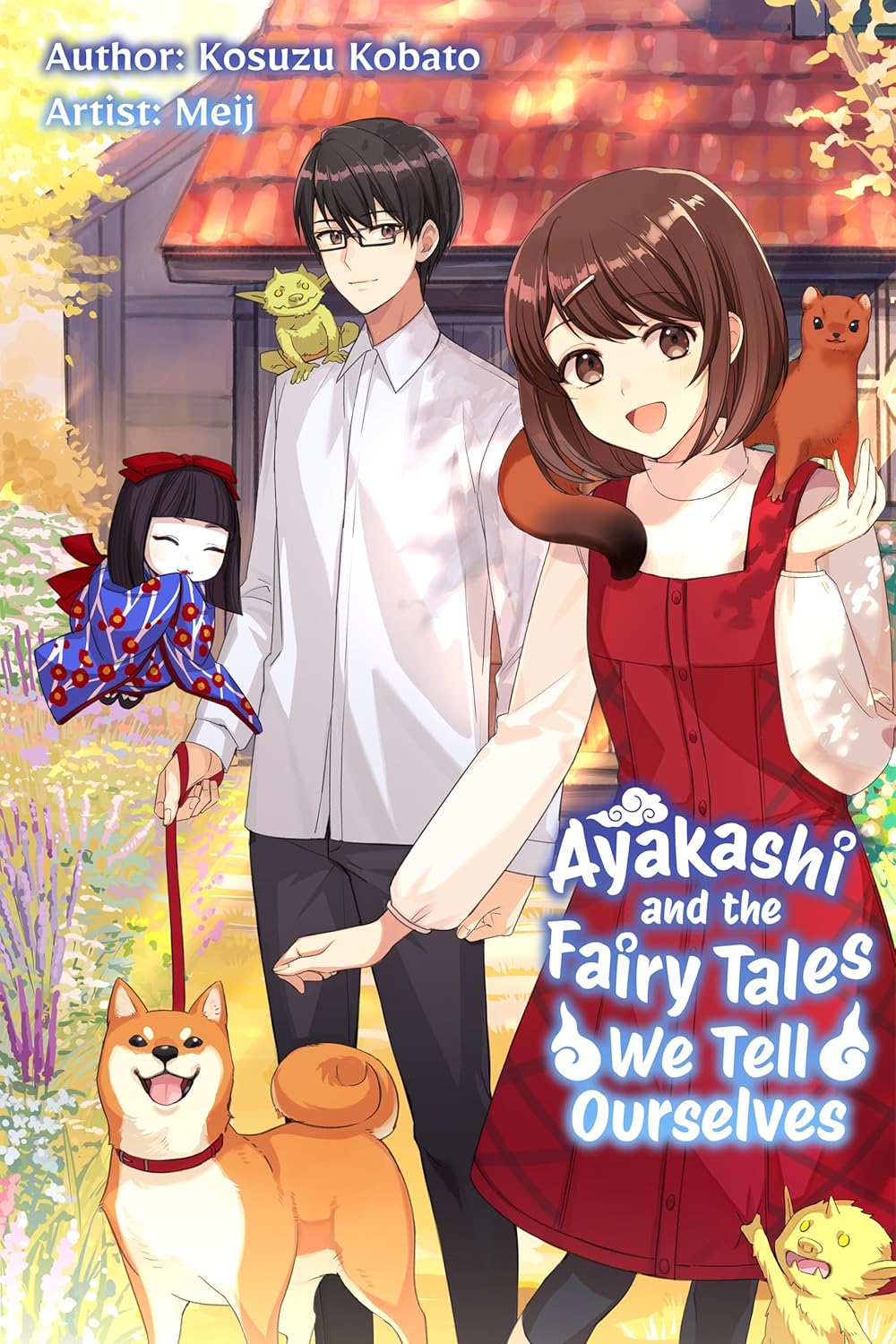
Ayakashi and the Fairy Tales We Tell Ourselves

October 9, 2024 by Sean Gaffney

By Kosuzu Kobato and Meij. Released in Japan on the Shousetsuka ni Narou website. Released in North America by Cross Infinite World. Translated by Dawson Chen.

This is one of those books that I probably would not have picked up if I didn’t already know the author. Kosuzu Kobato has basically never written anything I’d dislike, This is also complete in one volume, so it’s a good book to take a flyer on. And, unsurprisingly, I enjoyed it. The plot, though, actually ended up being a lot quieter than I expected. There were dark hints in this book that the heroine has bad ayakashi causing her harm (which leads to a reputation of being clumsy). There’s the heroine’s tragic past, as well as the hero’s tragic past. And there’s these weird ayakashi showing up away from the main house and acting, seemingly, menacing. It felt like it was building up to a big confrontation, or perhaps a kidnapping and rescue, or that sort of thing. But that’s not what happens here, and it’s not the point of the book. This book is about accepting your past, and it’s also about accepting that you don’t need to have your entire future mapped out by the time you’re fourteen years old.

Haruka has recently moved to the town, and is still settling in at school, though she has made two best friends. She’s a relatively shy, reserved person, and despite being exceptional at ballet and cooking she seems to regard herself as lacking in something. Then one day she runs into (literally) Ayako, a woman who was biking and not watching where she was going. Going back to her home to bandage Haruka’s scraped leg, she then runs into Takumi, who she doesn’t know but who clearly goes to her school. As the book goes on, and she stops by Ayako’s house more and more, it becomes apparent that she can see ayakashi, the mysterious spirits that litter the house. Takumi can see them too, and that fact has caused him grief throughout his life. Can these two damaged middle-schoolers be the best things that happened to each other?

This book sneaks up on you – it doesn’t really get into anything supernatural until about a quarter of the way in, and even then, the ayakashi end up being more of a spice than anything else – the book is solely about its two leads. Honestly, there were times when it felt like we were going to get more – Haruka’s childhood featured her being hospitalized, and the description of how it happened made me wonder if it was going to tie in with malevolent ayakashi impulsively seeking to harm her or something. But no, it was just a garden-variety horrible human thing. But that’s fine, as the book really excels in the two kids slowly recovering and looking forward to the future again. Haruka recalls her past, accepts it, and is able to move forward in being a blushing girl in love. Takumi realizes that despite everything that happened with his family, his father is trying to support him the best he can – he’s just horrible at emoting. The end of the book has them essentially becoming a couple without naming it as that, which fits the reserved tone.

It’s just a sweet little book. I wish there were more of it, but there isn’t. It’s a good read about some serious kids.

Filed Under: ayakashi and the fairy tales we tell ourselves, REVIEWS

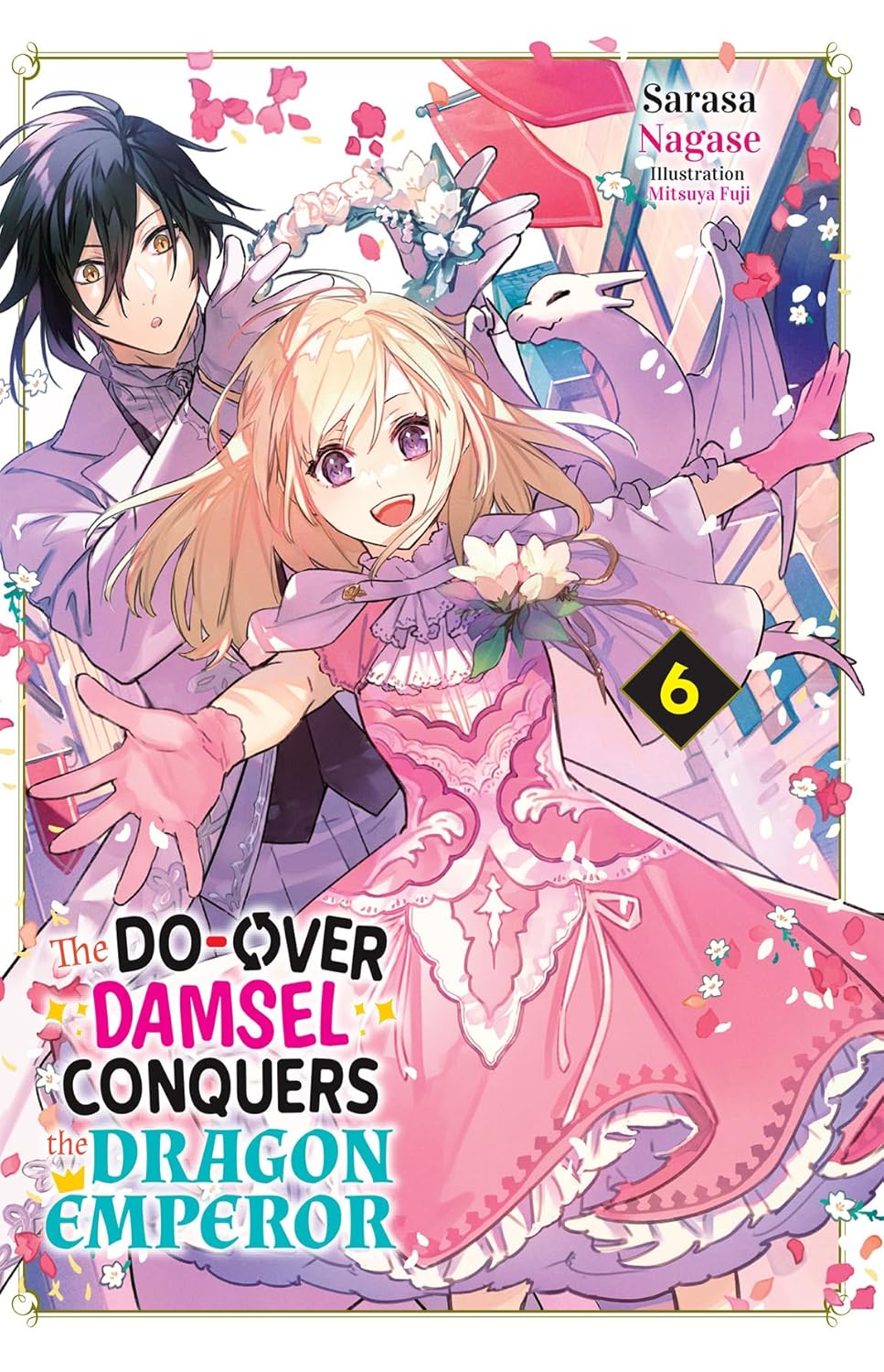
The Do-Over Damsel Conquers the Dragon Emperor, Vol. 6

October 8, 2024 by Sean Gaffney

By Sasara Nagase and Mitsuya Fuji. Released in Japan as “Yarinaoshi Reijō wa Ryūtei Heika o Kōryaku-chū” by Kadokawa Beans Bunko. Released in North America by Cross Infinite World. Translated by piyo.

As I write this, we are less than a day away from the premiere of the anime version of this series. As such, I wish to make it clear that I am well aware of the problematic nature of this series. We’ve discussed it before. The series opens with incest, and then it ends up hitting “I’m going to marry a ten-year-old”. It is the definition of “oh dear”. And I am here to tell you that the author is absolutely reveling in it. Given a chance to, say, have a timeskip, or perhaps move away from the incestuous kingdom, she instead insists on doubling down on everything. This volume in particular talks about how awkward it is for Jill to be eleven years old multiple times, and it also manages somehow to double the incest! Unfortunately… or, well, fortunately, to be honest… that does not double the fun. I can tell you that both plotlines are for plot-related reasons, and the plot is insidious, and REALLY wants war.

After the relative light-heartedness of the last volume, we’re bundled back into political intrigue at Jill and Hadis’ home base in this volume. There’s been a poor harvest, and the three dukes whose support Hadis need are 100% ready to throw Jill under the bus at a moment’s notice. They propose an impossible task – revive the Dragon Flower Crown Festival, something which will require the help of all the other consorts who stay at the Empress’ palace. Unfortunately, they’re all (well, almost all) trying to sabotage Jill – clearly at the behest of some mysterious party. Oh yes, and Jill has been getting mysterious love letters confessing to her and urging that she meet in the Garden of Resting Dragons… a place well known for adulterous affairs. There’s a mad old man setting traps in the Dragon Consort’s Palace (a place Jill didn’t even realize was there). Oh yes, and Minerd’s back, and totally not planning something evil.

It’s refreshing to see this series come back to “at any moment, history will revert and Jill will die” territory again. We’re not quite there yet, but we’re one step closer to war, thanks to the events near the end of this book, which lean heavily on the squickiest of the series’ plotlines and rub it in our faces. it’s chilling. As for the actual bad guy, well, they’re rather pathetic and sad, but that’s the point, and fits pretty well with everything that we’ve heard bfeore. Much better are the other consorts, who theoretically present an enemy that Jill simply can’t beat to submission with her fists. She is being forced to actually think politically and scheme… and then, when that doesn’t work, she beats them to submission with her fists. Jill does not quite shout “IT’S CLOBBERIN TIME!” once a volume, but it’s not for lack of trying.

After that nasty cliffhanger, it’s a good thing we’ve got the next volume coming s–what’s that? Short story volume? Sigh. Of course. In any case, please enjoy this series, which rampages through its problematic aspects with TINY FISTS.

Filed Under: do-over damsel conquers the dragon emperor, REVIEWS

  • « Go to Previous Page
  • Page 1
  • Interim pages omitted …
  • Page 29
  • Page 30
  • Page 31
  • Page 32
  • Page 33
  • Interim pages omitted …
  • Page 346
  • Go to Next Page »
 | Log in
Copyright © 2010 Manga Bookshelf | Powered by WordPress & the Genesis Framework