• Skip to primary navigation
  • Skip to main content
  • Skip to primary sidebar
  • Home
  • About Us
    • Privacy Policy
    • Comment Policy
    • Disclosures & Disclaimers
  • Resources
    • Links, Essays & Articles
    • Fandomology!
    • CLAMP Directory
    • BlogRoll
  • Features & Columns
    • 3 Things Thursday
    • Adventures in the Key of Shoujo
    • Bit & Blips (game reviews)
    • BL BOOKRACK
    • Bookshelf Briefs
    • Bringing the Drama
    • Comic Conversion
    • Fanservice Friday
    • Going Digital
    • It Came From the Sinosphere
    • License This!
    • Magazine no Mori
    • My Week in Manga
    • OFF THE SHELF
    • Not By Manga Alone
    • PICK OF THE WEEK
    • Subtitles & Sensibility
    • Weekly Shonen Jump Recaps
  • Manga Moveable Feast
    • MMF Full Archive
    • Yun Kouga
    • CLAMP
    • Shojo Beat
    • Osamu Tezuka
    • Sailor Moon
    • Fruits Basket
    • Takehiko Inoue
    • Wild Adapter
    • One Piece
    • After School Nightmare
    • Karakuri Odette
    • Paradise Kiss
    • The Color Trilogy
    • To Terra…
    • Sexy Voice & Robo
  • Browse by Author
    • Sean Gaffney
    • Anna Neatrour
    • Michelle Smith
    • Katherine Dacey
    • MJ
    • Brigid Alverson
    • Travis Anderson
    • Phillip Anthony
    • Derek Bown
    • Jaci Dahlvang
    • Angela Eastman
    • Erica Friedman
    • Sara K.
    • Megan Purdy
    • Emily Snodgrass
    • Nancy Thistlethwaite
    • Eva Volin
    • David Welsh
  • MB Blogs
    • A Case Suitable For Treatment
    • Experiments in Manga
    • MangaBlog
    • The Manga Critic
    • Manga Report
    • Soliloquy in Blue
    • Manga Curmudgeon (archive)

Manga Bookshelf

Discussion, Resources, Roundtables, & Reviews

Reviews

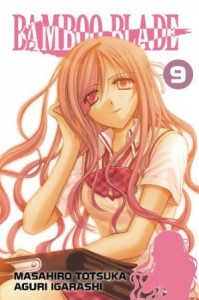
Bamboo Blade Volume 9

July 7, 2011 by Sean Gaffney

By Masahiro Totsuka and Aguri Igarashi. Released in Japan by Square Enix, serialized in the magazine Young Gangan. Released in North America by Yen Press.

I had mentioned in my review of Volume 8 that much of it was a setup for this being a meeting of two mismatched teams, and that I expected our heroes to spend most of the competition kicking asses. And indeed, that’s pretty much what I get here – well, at least until 3/4 of the way through it. But for that 3/4, it’s pretty much fantastic kendo action.
We begin with Azuma versus Chikamoto, which manages to be one of the few tense matches here, mostly as Chikamoto is the exception to most of the rest of her team. We can see her frustration as she realizes that Azuma is much, much better than she is – to the point where she recalls Azuma winning against someone who had previously beaten her in a competition, but can’t recall who beat her.

We then get what is, for me, the highlight of the volume. I’ve not tried to hide the fact that Miya-Miya is absolutely my favorite character in this series, and her split personality, angry snarling, and blunt honesty have been quite refreshing compared to her honest and forthright kendo leads. In Volume 8 we saw her training, and it was noted that she was shaping up well for a total novice. More to the point, Reimi has a cold, so is sick at home and not there to be a horrible distraction. As we see her fight, she scores a point, and is wise enough to realize that it only just barely landed, so didn’t feel “good enough.”

Counterpointing this is her arrogant opponent, who can tell that she'[s a beginner by her footwork, but can’t actually seem to do anything with that knowledge. And so, after giving up a point to stay even, Miya-Miya strikes, and gets the win. This is, in fact, her first win in the entire series. And she realizes… it’s an incredible feeling. Seeing the look of pure joy on her face, unshrouded by cynicism or anger, is worth the price of the book.

And so it goes through the match, with even Dan and Yuuji getting to play this time – and thrashing their opponents. And so finally we get Tamaki versus Takeshi, the sullen boy whose poor attitude has symbolized the spirit of the entire team. He has the most talent on the team, but lacks any will to fight. But even with that, Tamaki crushes him far too easily. So he notes the cords in his padding were loose, and asks for a rematch. And she does it again. Then the cords are actually too tight. So she beats him AGAIN. Then he stops trying to find excuses, and just starts demanding match after match. And slowly but surely, has a complete nervous breakdown as it becomes apparent just how far he’s fallen.

For the kids on the team it’s a vaguely happy ending – Takeshi is quitting, but he’s going back to a dojo to relearn the passion he had lost. And the rest of the team, now led by Chikamoto, is training much harder than before. I wish I could say that was it for the volume, but of course we have the match between Kojiro and Ishibashi. Which after the fantastic kendo action of the prior chapters, is a complete washout. The writer apologized in the afterword for there being too much focus on guys in this volume, but I had no issue with Takeshi’s plotline. Making Ishibashi into a complete comedic idiot, however, simply doesn’t work, and devoting almost an entire chapter to his and Kojiro’s post-match shenanigans makes it end on a poor note.

Still, it’s 3/4 of a volume of awesome, and you get to see the whole of Kojiro’s kendo team do an excellent job. Which is good timing, because the cliffhanger for Volume 10 suggests television might be in their future…

Filed Under: REVIEWS

Phoenix Wright: Ace Attorney Volume 1

July 6, 2011 by Sean Gaffney

By Kenji Kuroda and Kazuo Maekawa, based on the video game by Capcom. Released in Japan by Kodansha, serialized in the magazine Young Magazine. Released in North America by Kodansha Comics.

Back when Kodansha Comics was still Del Rey, they put out two doujinshi anthologies based on the popular video game series, featuring lots of cute stories and bad puns. In Japan, however, there was actually a genuine ongoing manga based off of the series. It ran for five volumes, and also spawned a sequel based off of Phoenix’s rival Miles Edgeworth which ran an additional four. Rather than a gaming magazine, it appeared in one of their titles aimed at young men, the appropriately named Young Magazine.

I’m not normally a gamer, but I make an exception for Phoenix, whose games were so much fun. For those unfamiliar with the premise, Phoenix Wright is a young up and coming defense attorney who usually finds himself dealing with clients who look incredibly guilty but profess their innocence. He and his partner, the perky teenage spirit medium Maya Fey, investigate the crime, stack up clues, and eventually arrive at the trial, where they cross-examine witnesses and try to get the judge to see what really happened.

The manga based off of it is much the same, and even starts the way most games in this series have, with Phoenix called on to defend his hapless childhood friend Larry Butz, who is accused of murder – again. Once this appetizer is finished, we get the main case of the volume, which actually will be spreading out into Volume 2 as well. Phoenix is called to the house of a somewhat jerkass president of an IT company, who suspects he will soon be arrested for murder and wants Phoenix to represent him before that even happens. What follows is a rather claustrophobic tale of a messed-up family, a building that screams ‘deathtrap’, and spiders. A whole mess of spiders.

The manga follows the general theme of the games quite well. We meet a pile of different characters, all of whom seem to be at odds with each other, leaving Phoenix and Maya to try to figure things out. I was also very pleased to see that they kept the basic humor that makes Phoenix Wright so much fun – Phoenix and Maya snark at each other (and other characters) constantly, and there’s no shortage of goofy characters and evidence, especially in the first case. That said, the murders themselves are treated quite seriously. The first case ends on a melancholy note, and the second one gets very intense – folks who don’t like spiders might want to steer clear of this volume.

The localization of the manga reads fine, sounding much like the games. Occasionally they have to cheat, as the manga can show things like Maya’s ramen obsession – so the translation notes say Maya likes burgers AND ramen! Fans of Miles Edgeworth should be warned, however, that he doesn’t appear here beyond Phoenix briefly thinking of him. Winston Payne is the prosecution in Larry’s case, and we have not gotten to the trial for the second one yet. Heck, even Dick Gumshoe doesn’t show up until the end!

Oh, and the Judge asking Phoenix and Maya to keep their lover’s spats outside the court did my little shipping heart good. :)

There’s nothing groundbreaking about this manga. It gives readers exactly what they want – more adventures of Phoenix Wright – and does it in a way that won’t disappoint fans. People who aren’t fans of the game might find its attitude hard to take at first – it’s very glib for a detective series – but for what it is, it works very well.

Filed Under: REVIEWS

Time and Again 6 by JiUn Yun

July 5, 2011 by Michelle Smith

From the back cover:
As war rips through the Tang Dynasty, leaving chaos and destruction in its wake, Baek-On and Ho-Yeon continue to eke out a living as traveling exorcists. While confronting vengeful grudges and putting to rest the lingering spirits of those long dead, Baek-On reflects on the tragic curse that led him to turn his back on the company of the living and follow in his father’s footsteps. While the world seems to crumble around him, Baek-On strives to keep moving forward, even if he must do so alone.

Follow Ho-Yeon and Baek-On as they journey on in the final volume of Time and Again.

Review:
I’m always a little wary of the final volume of a series I have really enjoyed. Will it disappoint? Or will it be exactly what I had hoped? Happily, volume six of Time and Again caps the series in a perfect way, which is to say “in a way that is simultaneously melancholy and hopeful.”

Baek-On has yet to recover from his crisis of self-doubt in the previous volume, in which his decision to force a man to see the truth about his inhuman wife had tragic consequences. He’s been holed up in his mother’s house for months, refusing all customers, but when a young woman arrives with a case that seems both simple and desperate, Ho-Yeon ushers her into Baek-On’s presence. Baek-On is rude at first, and it takes a threat of eviction before he actually begins to listen attentively to the girl, but he eventually goes to her home and deals compassionately with the ghost of a jilted girl who has been appearing there.

It’s clear that the words he uses when appeasing the spirit are what he would say himself to the girl in his own past—“I didn’t leave you. I’ve never left you.”—which leads to a gloriously long chapter that reveals the whole story of what happened with the girl (Wan) and why, and how it led to Baek-On being the person he is today. JiUn Yun handles this in a lovely way, because she doesn’t dwell on the pain of it all. Oh, it’s exceedingly painful for Baek-On, and awful and sad and all of those things that make for a great backstory, but it isn’t milked for melodrama. I shan’t spoil the details, but it’s this experience that motivates Baek-On to become an exorcist and to live and die alone.

The final chapter takes place after further time has elapsed. Baek-On and Ho-Yeon continue to travel together after a war has ravaged the country. Big things have happened, and yet they must continue on as usual, driving evil spirits out of children and chickens (really) and confronting the truth that animal spirits don’t seem to be all that innocent of the ways of humans. Baek-On realizes that his famous father was likely as uncertain as he is, which brings some peace, though he still intends to live his life alone and leave no descendants upon whom a spirit might inflict a grude. Ho-Yeon is also alone, having lost the last person he loved to the war, and the series ends with them pledging to carry on as they have been. Alone. And together.

Okay, yes, I totally spoiled that part, but it’s so absolutely perfect a conclusion for the series that I just had to wax rhapsodic about it. Time and Again has become one of my favorite manhwa series and, now that I know for what Baek-On has been seeking atonement all this time, I look forward to rereading it someday with the benefit of new insight.

Review copy provided by the publisher.

Filed Under: REVIEWS Tagged With: yen press

Soul Eater Volume 6

July 5, 2011 by Sean Gaffney

By Atsushi Ohkubo. Released in Japan by Square Enix, serialization ongoing in the magazine Shonen Gangan. Released in North America by Yen Press.

I somehow missed reviewing Volume 5 of this series, but no worries. This new volume sees the series doing a lot of things right, and the result is that I feel I can finally wholeheartedly recommend it in ways that go beyond the art style.

The plot here continues from the last volume: our heroes are trying to stop Medusa and her cronies from resurrecting the Kishin, a Very Big Bad who has been sealed up in a subbasement in a bag made of his own skin. Maka has found herself confronted by the series’ most disturbing character (and that’s saying a lot!), Crona, who definitely seems to have the upper hand. Maka can get it back, but only to abandoning herself to madness, and trusting that Soul will be able to bring her back.

This series runs in a magazine called ‘Shonen Gangan’, but the age bracket it seems to market itself to is noticeably higher than the big 3’s shonen titles – more of a 10-15-year-old market. I’d say that’s definitely a good thing, as some of the events in this volume can be downright unnerving and almost terrifying. In fact, at times the unnatural and abstract art style helps – at one point, Maka grabs Crona’s face and runs it along the blade of her scythe, something that would make you scream in horror if it weren’t so cartoonlike. The distancing works very well.

As for Crona (who Yen seem to have dubbed ‘male’ simply because avoiding pronouns is very awkward in English – Crona generally is sexless), in trying to open up, Maka discovers that Crona lacks a very good sense of self, and in many ways almost seems to have a split personality. Maka breaks through using the power of friendship, of course, but it’s very uneasy – Crona’s weapon rebels against this, and there’s a sense that everything is still hanging on a knife-edge.

The rest of the volume sees Black*Star and Death the Kid try to get to the basement to stop the Kishin’s resurrection. This is more shonen battle oriented, with lots of killer hidden moves and self-doubt – hallucinatory images play a big role here, and at one point even the villains almost commit suicide because they’re being tricked by the sheer insanity of the Kishin’s thoughts. However, they finally make it down there, and…

…well, they fail. The Kishin ends up being resurrected after all, though at least Medusa is killed (or is she?). This is the first really big plot line that our three groups have worked together on, and though they all get to strut their stuff and do cool things, it’s rather noticeable that it ends in failure. It has to be said that Soul Eater is, at heart, a world that seems to live off of fear and madness. As a result, things like this happening are far more the norm. Hopefully as they get stronger Maka and company will be able to help prevent this, but for the moment the bad guys have won.

This is not your typical shonen series. It has a high body count and a lot of blood, as well as facial expressions which can cause you to whimper in horror. And as always there is the art, giving you a comforting disconnect from reality to help with the worst gory bits, but also being nowhere near reality in terms of its everyday setting. I’m enjoying it more with every volume, and now that it’s settled down into a plot-oriented groove, it’s become one of Yen Press’s better acquisitions. Recommended, especially for those who want something a little different.

Oh yes, and Patty’s ‘Voice of Authority’ was hilarious. :D

Filed Under: REVIEWS

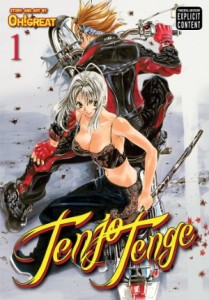
Tenjo Tenge Volume 1

July 4, 2011 by Sean Gaffney

By Oh!Great. Released in Japan by Shueisha, serialized in the magazine Ultra Jump. Released in North America by Viz.

Well, I must admit, I feel I brought this on myself. I kept bringing up the fact that Japan was filled with delinquent manga, featuring entire schools filled with young bruisers of both sexes who are there to kick ass, take names, and fight increasingly stronger other guys. And I noted how we rarely saw these over here, and that when we did (Digital Manga Publishing’s three released volumes of Worst come to mind), they tend not to do so well.

So now we have a re-release of the classic boobs ‘n martial arts extravaganza Tenjo Tenge, this time with all of the sex that original publisher CMX covered up or simply cut out. This volume actually contains the first two volumes of the original series (and confusingly, has the cover for Volume 2 on its cover and the original cover for Volume 1 before the second volume), and is unedited as far as I can tell. I don’t have the original Japanese to compare it to, but certainly looking at several of the sequences, if Viz *is* editing anything I can’t imagine what it is. It also has lots of nice color pages, and is slightly larger in size than the typical manga volume – it’s a really nice reproduction.

As for the content, it’s exactly what a young reader of Ultra Jump would want. Really, Oh!Great knows his audience and delivers exactly what they’re after without fail. There’s lots of nudity and suggestion of sex (and one rape scene that gets fairly graphic), lots of fists flying and kicks connecting, and a school full of people who like to pose and sneer. It is, in other words, the PERFECT manga for fourteen-year-old boys. There seems to be a bit of a plot regarding the past of the school’s club and the heroine’s dead brother, and some vague supernatural powers at work, but none of that detracts from what the manga is there to deliver. You need SOME plot to hang your sex and violence on.

Soichiro and Bob (half-black, half-Japanese) are two best friends who are used to dominating their old school by being the top fighters around. They arrive at Todo Academy ready to put it under their thumb, only to find that the students here are even better fighters, who can kick their ass without breaking much of a sweat. This delights them, as they’re itching to find anyone who can drive them to be even better. Of course, as Bob knows and Soichiro starts to learn here, you need a reason to be strong besides ‘strong is cool’.

The characters here are all types, but they’re decent enough types – for characters where you know their whole arc in advance, they don’t put a foot wrong. Aya is the classic overenthusiastic girl who has already declared the hero her husband (shades of Lum/Shampoo/etc.) but is plagued by inner doubts. Her sister Maya is a mentor figure so far, but shows signs that she has a troubling past that drives her. Soichiro seems to be the idiot hero who will get better and faster based on pure instinct. Heck, even Chiaki, Bob’s girlfriend whose sole role in the story seems to be to have sex with her boyfriend and get threatened, is handled pretty well – after the aforementioned rape scene (she was the victim), her laughter and bravado at saying that he didn’t go all the way and that she fought him off is both heartbreaking and realistic, especially contrasted with the three broken heroes she’s trying to pass it off to. (The rape itself is incredibly exploitative, of course, a classic example of Oh!Great trying to have his cake and eat it too.)

And then there’s Isuzu. A heh. Well, I know that sort of fetish is out there, and for those who love it, here she is.

I don’t want to give the impression that this is anything more than a pandering school delinquent manga with fantasy overtones, as that’s just what it is. There’s an incredibly bad onsen scene that is there to give faux yuri fanservice and nothing more. And though I did note that there are semblances of a plot here, I do not expect this to remotely overtake the manga’s primary goals: to excite and titillate. And yes, the girls look like plastic fantastic lovers.

That said, if a manga succeeds entirely at giving its target audience exactly what they want, can one call it a failure because it doesn’t deliver at all outside that target? Tenjo Tenge is what it is, a boobs ‘n martial arts manga. And with ten more omnibus volumes to go, there’s a lot of both of those still to come. I wouldn’t recommend it to anyone who doesn’t enjoy people hitting each other with grins on their faces while girls with unrealistic bodies lose their clothing a lot. If you don’t mind that? I think this is quite decent, and even entertaining.

Filed Under: REVIEWS

Monster Hunter Orage, Vol. 1

July 4, 2011 by Katherine Dacey

As a critic, few words fill me with more trepidation than “inspired by the popular video game.” I’ve read my share of video game manga, most of which were thin on plot and characterization but heavy on explanation. Every so often, however, I run across a series like Monster Hunter Orage, which manages to stay true to its roots while offering something to readers who’ve never played the game.

What makes Monster Hunter work is Hiro Mashima’s script, which does a solid job of translating game play into genuine plot. In the original game, players answered to a town guild, accepting orders to hunt or capture a variety of monsters. Players could fly solo or team up with one, two, or three other gamers to bring down bigger monsters and boost their skill rating. (The ultimate object of the game was to attain the highest skill level, rather than accumulate the greatest number of points.)

In the manga, Mashima builds a story around Shiki, a hunter on a quest to find Myo Galuna, a.k.a. the Thunder Dragon. Shiki is a Seal Hunter, a special category of monster-slayer who’s free to pursue game without interference from town guilds. Though he’s strong and skilled, his brash behavior and social cluelessness prove serious barriers to finding comrades — that is, until he meets Ailee, a fiercely independent hunter who shares Shiki’s desire to find the Thunder Dragon, and Sakya, a gunner who wants to avenge her father’s death.

Shiki and Ailee’s peppery rapport provides a welcome jolt of comic energy, whether they’re arguing about how to kill a monster or how to catch dinner. Like many of Mashima’s heroines, Ailee has little tolerance for teenage male foolishness, and frequently dismisses Shiki with a withering comment. (When they first meet, for example, Shiki blurts out, “Say, haven’t we met before?”, to which Ailee replies, “It’s been forever since I heard that stale pick-up line. Wait. Don’t respond. Just go somewhere else.”) Other supporting characters play a similar role in keeping the tone breezy: the Prince, a preening, foolish hunter, is font of malapropisms, while Maru, the Prince’s sidekick, provides an energetic stream of patter whenever the two appear together.

The art is as nimble as the script, relying heavily on Mashima’s crisp linework to give definition to his characters, monsters, and landscapes; he’s as sparing with screentone as Arina Tanemura is with white space. Though the characters have marvelous, elastic faces, capable of registering fifteen degrees of surprise and indignation, the monsters are unimpressive; they look a lot like dinosaurs with extra feathers and appendages. Put the men and the monsters together, however, and the results are terrific: the fights are graceful and swift, allowing the main characters to demonstrate their martial arts acumen without dragging out the conflict over three or four chapters.

If I had any complaint about Monster Hunter Orage, it’s that the story quickly falls into a predictable pattern. The outcome of the fights is never in question, nor is Shiki’s role as the hunter who will ultimately be the one to outsmart the monster. Even efforts to introduce subplots only go so far; by the end of volume one, it’s clear that the Prince will do anything to destroy Shiki, but his buffoonish behavior and general incompetence make him a less-than-credible threat to the heroes.

But if Monster Hunter isn’t as deep as it could be, it’s still a lot of fun, propelled by a goofy, anything-for-a-laugh script, appealing characters, and plenty of man-on-monster action. And at four volumes, the series won’t overstay its welcome. A good beach read.

MONSTER HUNTER ORAGE, VOL. 1 • BY HIRO MASHIMA • KODANSHA COMICS USA • 192 pp. • RATING: TEEN (13+)

Filed Under: Manga, Manga Critic, REVIEWS Tagged With: Capcom, Hiro Mashima, kodansha, monster hunter orage, Shonen

A Pair of TOKYOPOP Stragglers

July 4, 2011 by Michelle Smith

Just when it seemed like none of those May TOKYOPOP titles was going to materialize, Diamond Distributors revealed that it still had a few surprises up its figurative sleeve. Stragglers, originally scheduled for an early May release, began to trickle into comic shops. I managed to acquire several, including two books—volume eight of Happy Cafe and volume three of The Stellar Six of Gingacho—that I had lost all hope of ever seeing. Although I’m still incredibly sad about TOKYOPOP’s demise, I can’t help looking upon these last releases as an unexpected gift.

Happy Cafe 8 by Kou Matsuzuki
The eighth volume of Happy Cafe offers more cheerful yet insubstantial slice-of-life episodes revolving around the staff of Cafe Bonheur. We check back in with sixth-grader Kenji, Uru’s cousin, and meet the girl who likes him. We see Shindo apologize for making Uru cry, meet Ichiro’s doppelganger/father, and watch as two different guys try and fail to express their feelings for the oblivious Uru.

There are actually four guys now who fancy Uru, mostly because of her bright smile and talent at offering sunny advice as necessary. It’s a little much, but at least doesn’t feel as implausible as with series in which the heroine has no redeeming qualities whatsoever and yet seems to attract a bevy of hunky admirers. It also seems like Matsuzuki draws Uru in a regular style more often this volume—because she’s so childlike and spazzy, she’s usually in some state of super deformity but here we get a few, albeit fleeting, moments in which she looks genuinely pretty.

As a warning, however, readers of this volume are at risk of contracting the dreaded festitis (extreme irritability brought on by manga depictions of school festivals of any sort, including athletic). On the heels of Uru’s school festival in volume seven we first have Kenji’s athletic meet and then the school festival of Sou Abekawa, one of Uru’s suitors. I would seriously be happy if I never had to read about another school festival ever again.

So, how does this fare as the final volume (most likely) of Happy Cafe to be produced in English? Pretty well, actually. The episodic nature of the story precludes any sort of cliffhanger ending, and though Uru continues to be utterly clueless about the feelings she’s inspiring in the guys around her, it’s easy to imagine that, after several more volumes of cheerful yet insubstantial happenings, she will realize her feelings for someone (Shindo seems the most likely candidate) and a happy ending will ensue.

The Stellar Six of Gingacho 3 by Yuuki Fujimoto
Like Happy Cafe, The Stellar Six of Gingacho has so far been comprised of warm and fuzzy episodic stories featuring a childlike heroine who is “very dense when it comes to romance.” The third volume is no different, but takes the first tentative steps at fleshing out the other members of the group—while continuing to focus on Mike (Mee-kay) and her pal/partner Kuro, whose love for Mike is a secret to no one but her—and hinting a little at complications to come.

Chapters in this volume feature plots like “Mike and Kuro rescue a stray puppy,” “Mike insists that her friends go dig up a treasure they buried when they were five,” and “a photo of the boys appears in a teen magazine and fangirls descend.” But boiling them down in this way does them a disservice, because each chapter usually has at least one really nice moment, like Mike realizing that Kuro has always been there for her or the boys defending the honor of the girls when some punk insults them. In fact, the theme of the series could be summed up as “friends are precious and special.” If you don’t want to read stories in which this idea gets established over and over again, then The Stellar Six of Gingacho probably isn’t for you.

Although the volume doesn’t end on a cliffhanger, some glimpses of where the story might go make the lack of future releases particularly disappointing. Who is the object of ladies’ man Ikkyu’s (aka “Q”) unrequited love? (I hope it’s ultra-sensible Iba-chan.) Should I be expecting the six friends to form up into three tidy couples for a happy ending, or will messiness ensue when Sato’s feelings for Kuro come to light?

Sato provides the parting thought as we get a glimpse of an older Kuro. “To me you were special. But back then none of us truly understood what that “special” feeling really was. Not yet.” If you really want to get me hooked to a series, pepper it with retrospective narration like that. Jeez. Talk about bad timing.

Filed Under: REVIEWS Tagged With: Tokyopop

From the stack: Maid Shokun vol. 1

July 4, 2011 by David Welsh

As I was fulfilling my obligation to read Maid Shokun (Tokyopop), a question kept crossing my mind: is this what postmodern fan-service looks like? The cover promises to serve up a hearty tray full of pandering, and the concept – what is it like to work at a maid café? – invites the reader to impose all kinds of parenthetical phrases and subtext. But the series is really just about what it’s like to work at a maid café. Seriously, who does that?

In this case, Akira Kiduki and Nanki Satou are the ones who do that, and they did it for Comic Gum published by Wani Books. I don’t know much about Comic Gum, but it seems like the kind of magazine where fans of the up-skirt will feel right at home. This leads me to wonder what its target audience must have thought of a series that goes so far as to squarely consider the inner lives of women whose job it is to cater to one of their fetishes.

Kiduki and Satou are clearly and consciously creating tension between the services that the café provides – pretty girls in uniform cheerfully greeting guests as “Master” – and the fact that these employees are real women with complicated lives independent of their work. The maids display a fondness for their clientele that’s free of condescension; they like that they can provide these men with brief escape from their often bleak lives. But they’re very clear on the boundaries between occasional fantasy and the day to day.

The creators aren’t averse to letting things get messy. One customer loses sight of the aforementioned boundaries, which triggers a complicated series of responses among the café’s employees. It highlights the delicate balance those boundaries require to sustain the fantasy and keep it safe. Media attention proves to be a blessing and a curse for the establishment, and the maids are forced to consider the possibility of becoming an adult establishment. A relationship between two of the employees reveals homophobia in the workplace. Kiduki and Satou have a lot on their minds, and very little of it involves giving their readers a quick thrill.

Unfortunately, the series is more interesting conceptually than in execution. The creators are better at introducing ideas than incorporating them into a story, which results in a lot of chatter that’s more expository than involving. The characters inspire varying degrees of sympathy and interest. Some are clearly types – bossy girl Arumi, dippy innocent Chiyoko – but some show real potential – floor manager Haine, the most grounded, mature presence in the joint. Unfortunately, the types get the most focus, which makes it hard to invest much feeling in the series.

Still, this series is a whole lot more than a cursory consideration would suggest. If anything, it’s too cerebral in its approach to allow a reader to really enter the world it’s trying to evoke. With a little more heart, it could be something quite special. Of course, we’re unlikely to ever find out if it achieves that, since Tokyopop only managed to release one volume before shuttering its manga publishing efforts. I wouldn’t say I’m devastated by that outcome, as I can’t see Maid Shokun becoming a cherished favorite, but this book has offered a lot of food for thought.


Filed Under: REVIEWS

Oresama Teacher 1-2 by Izumi Tsubaki

June 30, 2011 by Michelle Smith

Sometimes, one just wants to read a silly, goodhearted comedy. And on that front, Oresama Teacher delivers admirably.

Mafuyu Kurosaki used to be the bancho of her school (though she didn’t realize it at the time) until she got nabbed by the cops and expelled. Her mother finds a school in the country that will accept Mafuyu, and ships her off for a fresh start. Although Mafuyu is a skilled and savvy fighter, the allure of life as a normal girl is appealing, and she embraces the opportunity to start over, full of self-assurance developed from her days as a gang leader.

Alas, she soon encounters her childhood first love (Tamaoki Saeki), who was responsible for steering her toward the path of delinquency in the first place. Worse, he’s now her homeroom teacher, and embroils Mafuyu and her lone-wolf classmate Hayasaka (another brawler) in his wager with the principal that he can boost the school’s enrollment by quelling the disciplinary issues arising from the lax admittance policy. Mafuyu and Hayasaka are the muscle to keep the other delinquents in line, essentially. Mafuyu is not very keen on this, especially because she’s enjoying how Hayasaka treats her like an ordinary girl, so masquerades as a couple of other people (a boy called Natsuo and Super Bun, a rabbit-mask-wearing girl whom Hayasaka idolizes) when administering the necessary smackdowns.

I almost wrote “hilarity ensues” at the end of the prior paragraph, because that’s just what one does after detailing a suitably wacky premise like this one, but the thing is… Oresama Teacher really is funny, and that’s got everything to do with the characters. I don’t care much for Saeki—mangaka Izumi Tsubaki resists the temptation to endow him with redeeming qualities—but he works as the instigator of over-the-top situations, and some of his interactions with Mafuyu are very amusing (like the scene in which they discover that neither of them can cook).

More to my liking is the relationship between Mafuyu and Hayasaka, which persists despite both of them frequently misunderstanding the other’s motivations. When she tries to find out more information about Saeki (in order to confirm he really is the same boy who used to live next door), for example, Hayasaka assumes she’s looking for material with which to blackmail him. At first, Hayasaka resists the idea that they are friends, but his prickly attitude gradually starts to dissipate. He’s incredibly dense and easy to fool with lame disguises, but Mafuyu, used to being looked up to by her followers/friends, likes the way he treats her as an equal. At one point, he begins to suspect that she is his idol, Super Bun, forcing Mafuyu to dissuade him of the notion just so he’ll stop looking at her all dreamy-like. It’s lonely being revered.

I never did read Tsubaki’s other Shojo Beat series, The Magic Touch, as general consensus seemed to be that it wasn’t that great, but I’m exceedingly glad I didn’t let that stop me from checking out Oresama Teacher, which is a genuinely entertaining read. Tsubaki herself doesn’t seem all that keen on the story—she makes several references in her author’s notes to the fact that various elements of the series were dictated by her editors—but you can’t tell while reading it. And anything that makes me snicker as much as these two volumes did is definitely a keeper.

Review copies provided by the publisher.

Filed Under: REVIEWS Tagged With: shojo beat, VIZ

From the stack: Saturn Apartments vol. 3

June 30, 2011 by David Welsh

Hisae Iwaoka’s Saturn Apartments (Viz) is the only title that I’d read prior to its inclusion in the top ten list of the Young Adult Library Services Association’s 2011 Great Graphic Novels for Teens. I can’t help but compare this book to Kou Yaginuma’s Twin Spica (Vertical), which earned a place on the main list. I like them both a lot, but I tend to think I’d have argued for Spica to take Saturn’s place in the top ten.

This is mostly because Spica has a stronger underlying narrative. It’s got a clearer arc and digs deeper into its cast of characters. That doesn’t suggest failure on the part of Saturn, as the first two volumes clearly indicate that it has different aims, favoring episodic world-building rather than sequential storytelling. It’s easy to enjoy Saturn chapter by chapter, but it’s easier to become involved in Spica, if that makes any sense.

In the third volume of Saturn Apartments, Iwaoka seems to undertake the construction of some substantial subplots. Stand-alone chapters give way to small story arcs, and threads start to recur throughout the volume. This is welcome in a way, because it shows an intention to give the series more weight, but it also seems like this kind of plotting may not be Iwaoka’s strongest skill.

After two volumes of beautifully drawn, gentle glimpses into Iwaoka’s orbital world, the subplots feel rather clumsily wedged into the narrative. They aren’t unpromising, but their emergence feels abrupt. It strikes me that none of the supporting characters were yet able to carry that much purpose at the time it was thrust upon them. The eventual (and logical) inclusion of Mitsu in that thread may change that, but the sequences are still hampered by an imbalanced quantity of expository dialogue that’s out of step with the rest of the script.

One thing that does constitute a welcome development here is a slight shift in tone. Iwaoki is also expressing more interest in the class disparities that characterize the culture she’s built. There was nothing wrong with her initial approach, affirming the value of unglamorous work in a society, but it’s nice to see her underline some of the unfairness that keeps her fictional society ticking.

Overall, the series is still one of my favorites. Iwaoki’s graceful illustrations and fragile character designs continue to hold the eye, and the underlying concept is as sturdy and productive as ever. I just wish the shift to a different, more complex kind of story felt less awkward.

(This review is based on a complimentary copy provided by the publisher.)


Filed Under: REVIEWS

The Betrayal Knows My Name, Vol. 1

June 29, 2011 by Katherine Dacey

For years, Tokyopop specialized in a particular genre — call it “forbidden bromance,” for want of a better term — in which two handsome, impeccably groomed young men teetered on the brink of a relationship. That relationship usually faced a serious obstacle: one might be a demon and the other a human, for example, or one may have killed the other in a previous life. Most of the story was devoted to uncovering the reason that fate united them, providing the heroes ample time for impassioned conversations and meaningful looks.

At their best, titles like Tokyo Bablyon, Silver Diamond, and X-Kai were silly but engrossing, with plot twists as gloriously melodramatic as an episode of Passions; at their worst, they read like bad slash fic, with purple dialogue and an abundance of poorly explained plot details. Yen Press’ latest offering, The Betrayal Knows My Name, has all the requisite elements to be a gas — pretty-boy leads, past-life tragedy, perfectly moussed locks — but never quite rises to the level of a great guilty pleasure.

Not that volume one wants for activity; every chapter is packed with action sequences, murderous demons, dramatic confrontations, and shocking revelations. What Betrayal lacks is the kind of tightly constructed narrative that made the best bromances such a treat to read. The characters barely rise above type, while script flirts with incoherence at every turn, introducing new characters and subplots at such a furious pace that the central love story is often in danger of being overshadowed. Even the dialogue sags; when the characters aren’t explaining things to one another, they’re so wrapped up in their own thoughts that their monologues become tedious. (Sample: “We can’t survive on principles alone. And everyone would like to live without getting tainted at all. But that’s not how things are.”)

That’s a pity, because The Betrayal Knows My Name looks a lot like my favorite bromances. The character designs owe an obvious debt to CLAMP’s high Baroque period, when characters wore trench coats and dog collars and always had windswept hair. And Hotaru Odagiri certainly knows how to draw brooding men; her heroes, Yuki and Zess, spend a great deal of time staring into space while wearing soulful expressions. (They also know how to pop a pose for readers, allowing us to savor the sheer ridiculousness of their outfits, and the artful way in which they leave their shirts unbuttoned to the waist.)

Yet the prettiness of the character designs can’t camouflage the fact that Betrayal is straining too hard for effect; what should be a great, emo-porn pleasure is something of a chore to read, thanks to its relentless pace, clumsy dialogue, and chemistry-free leads. Readers who can’t get enough of the forbidden bromance genre may find Betrayal an adequate fix; others are encouraged to hold out for Tokyo Babylon‘s return this fall.

Review copy provided by Yen Press.

THE BETRAYAL KNOWS MY NAME, VOL. 1 • BY HOTARO ODAGIRI • YEN PRESS • 368 pp. • RATING: OLDER TEEN (16+)

Filed Under: Classic Manga Critic, Manga, Manga Critic, REVIEWS Tagged With: Betrayal Knows My Name, yen press

From the stack: Kekkaishi 3-in-1 vol. 1

June 27, 2011 by David Welsh

I’ve always heard great things about Yellow Tanabe’s Kekkaishi (Viz) from eminently reliable sources, but I’ve dawdled on taking a serious look at the series because I feel so late to the party. When a title hits its twenties and you haven’t really tried it, there’s a barrier to entry. Viz, in its ongoing efforts to get more of my money, has softened that barrier by offering a 3-in1 edition of Kekkaishi.

You know that I’m very pro-omnibus. I’m not a fiend about paper quality; if I can focus on the page I’m reading instead of what’s on the flip side, I’m perfectly content. For me, it’s a worthwhile trade-off if it results in more content for a lower price. And sometimes the larger span of content makes a more persuasive case for the series that a single volume could. The first third of this collection is likeable but not particularly gripping. It takes a while for Tanabe to get into her groove and for the series to really take off.

Kekkaishi tells the story of young exorcists who spend their nights protecting their school from demons that range from pesky to violently destructive. The school used to be the site of a clan led by a lord whose spiritual aura made him something of a demon magnet. This forced him to hire a powerful exorcist to protect his home and family. After the exorcist’s death, his disciples split into two factions, each thinking their efforts were superior.

Yoshimori and Tokine are the chosen heirs of those two families of exorcists, and even though the family they served is long gone, their land is still demon central. It’s also the place where the kids spend their day in class. Tokine is a couple of years older than Yoshimori. She’s diligent in her training, and she’s eager to accept the family mantle. Yoshimori is resentful over the fact that he’s been forced onto the family career track, but his attitude changes when Tokine is hurt because of his carelessness and lack of skill. He vows to become a better kekkaishi, not to fulfill the family legacy, but to make sure his friend Tokine isn’t hurt again. (The emotional arc of his origin story is a much less dour version of Peter Parker’s, basically.)

That’s a lot of explanation, but it’s necessary, and Tanabe presents it in a lively manner. It sets up the relationship between Yoshimori and Tokine, which is as central to the series as the demon battles. Of course, the demon battles aren’t to be sneezed at. The kekkaishi’s skill set is refreshingly straightforward: they trap the demons in cubic force fields, then banish them. Things get complicated depending on the strength and malice of the demon in question, and Tanabe draws these sequences with great skill and clarity. Designs for the demons are wonderfully varied.

In the first volume, it can seem like Tanabe is holding back, sticking to short but effective stories rather than really digging into her characters and situations. Maybe the feat of collecting a full volume of material gave her the confidence to go deeper, since the second volume opens with a very involving multi-story arc that examines Tokine’s past and introduces more detail about the larger supernatural culture of the kekkaishi and the mystical types around them. From there, Tanabe goes from strength to strength, alternating between exciting battles, arcs full of emotional undercurrents, and goofy one-off stories that bridge between larger tales.

Aside from general approval of the series overall, there are some elements that I really, really like. One of them is the fact that she can render Yoshimori’s training in ways that are interesting and entertaining, which is a rare feat for a shônen mangaka. The kekkaishi’s means of battle are so simple, but Tanabe has given a lot of thought to how they can be applied, and it’s fun to watch the characters figure out the variations.

Another highlight are the cranky old people. Yoshimori’s crotchety grandfather and Tokine’s sly, spry granny are constantly trying to get each other’s goat. It’s the kind of half-serious, half-reflexive squabbling that can really liven up the vibe. Best of all is that they both get moments that reveal them as formidable kekkaishi in their own right.

The third element that I particularly enjoy is Tokine. In her author notes, Tanabe explains the character’s conception. She didn’t want to create a victim for the hero to rescue over and over, and she wanted to give Tokine some advantages that made her Yoshimori’s equal. Tanabe succeeded admirably in that regard. Tokine isn’t as powerful as Yoshimori, but she’s more skilled and certainly more mature. She’s an almost serene, steely presence amidst the demon-fighting mayhem, though she has her own goofy foibles. You can see why Yoshimori has such a huge crush on her, even if she doesn’t acknowledge it.

I didn’t really need another long, ongoing series on my to-read list, but I’m glad to add Kekkaishi to it. It’s got all of the elements of a sturdy supernatural adventure with plenty of quirks to keep things from turning formulaic. While I doubt Viz will run through the series entire back catalog in the 3-in1 format, it’s not so oppressively long that it will cost a fortune to fill in the gaps. And the series is available on the publisher’s iPad app, making that process relatively simple. I hope this strategy gives Kekkaishi the commercial boost it deserves.


Filed Under: REVIEWS

March on Earth 1-2 by Mikase Hayashi

June 23, 2011 by Michelle Smith

Man, I miss CMX. They had an awful lot of cute, short shoujo series, most of which were thankfully published in their entirety before the company’s tragic demise. One of these is the two-volume March on Earth by Mikase Hayashi. It’s a quiet little story and worth checking out, especially if you’ve burnt out on action or angst and just want to read about people being kind and helping each other out for a while.

The basic premise is somewhat implausible. Fifteen-year-old Yuzu Takamiya was raised by her teenage sister Tsubaki after their parents passed away, and now that Tsubaki has died in a car accident, it’s up to Yuzu to raise her two-year-old nephew, Shou. The city welfare guy has paid them a visit, but has allowed Shou to remain in Yuzu’s care, largely because their friendly landlady, Mrs. Kusano, is around in a supervisory capacity.

Yuzu goes to school while Shou is in daycare, but she’s never able to participate in any clubs or go on class trips. “Sometimes I’m vaguely jealous of their carefree lives,” she notes. “Even though I chose this path myself.” The chapters are largely episodic, as Yuzu must overcome her fear of cars to get Shou to a doctor, or contend with budget constraints while still providing Shou with a happy Christmas. Even though it’s tough for her to manage all of this, Shou’s adorableness—and the final picture book her sister completed prior to her death—helps remind her what she’s doing it all for.

Eventually, she meets Shou’s father, Takatoh, and together they begin to develop a sense of family. Yuzu also comes to rely more and more on Seita, the neighbor who has long had feelings for her (she’s one of those romantically obtuse heroines) and who is always there when he’s needed, like when Yuzu feels trapped and unable to pursue her dream of becoming a lawyer. In fact, one of the overall themes of the story is that people are fundamentally good and will be there to help you, whether it’s nice ladies in the supermarket who will buy the strawberries (or “stwawbewwies,” as Shou calls them) your nephew supposedly damaged or the schemey girl in class who will nonetheless look after Shou when he gets lost on a camping trip. Yuzu certainly wants to repay the kindness of others, but she’s not too proud to accept help.

I like Yuzu and Seita, but the real star of March on Earth is Shou. Now, I admit that he is a totally idealized version of a toddler. He does have a few flare-ups of disobedience, but for the most part he’s simply sweet and loving all the time. He has a speech impediment, gets dressed in cute outfits, and is impossibly delighted with a miniature version of the toy he really, really wanted for Christmas. No real kid could possibly be this angelic. But who cares? This is warm-fuzzy manga; relax.

Is March on Earth going to rock your world? No. But it might put a smile on your face.

March on Earth was published in English by CMX and is complete in two volumes.

Review copies provided by the publisher.

Filed Under: REVIEWS Tagged With: cmx

MMF: Likeability

June 23, 2011 by David Welsh

Note: This is the first thing I wrote about Wild Adapter from way back when I was doing Flipped columns for Comic World News. Usually I look at these old things and am visited with an urge to rewrite them from top to bottom, but I stand by every word of this one.

When storytellers devote a lot of narrative space to supporting characters extolling the virtues of their protagonists, it’s reasonable to suspect there isn’t a lot there. That kind of cheerleading can come across an unconvincing hard sell by a creator who suspects on some level that they haven’t provided enough reasons for the audience to reach a favorable opinion on their own.

Most of the cast of Kazuya Minekura’s Wild Adapter pause to muse on the intriguing qualities of Makoto Kubota, the mahjong-loving weirdo at the story’s center. In this case, they have reason, because he’s fascinating. But, then, fictional sociopaths generally are.

Kubota isn’t an especially malevolent sociopath; he’s not a Hannibal Lecter. But he views humankind with blithe, self-serving curiosity rather than empathy. He seems susceptible to neither anger nor warmth, and his interactions are driven by either self-preservation or their potential for amusement. He neatly sums up his worldview in an early chapter after he’s won a leadership position with the yakuza equivalent of Junior Achievement: “It was him or me, and I always choose me.”

So why is he engrossing rather than loathsome? It’s partly due to his imperviousness to opinion, which comes across as genuine as opposed to a constructed posture to win approval. It’s indifference without malice or ulterior motive; he has his interests and his needs, and they really don’t involve other people.

He’s also funny. Even surrounded by a central-casting crowd of mobsters and whores, he doesn’t modulate his behavior in the slightest. He’s quirky, blunt and unpredictable. With the macho posturing and calculating seduction that are part and parcel of the yakuza milieu, it’s not surprising that Kubota makes an impression. He’s refreshing.

I know I’m going on and on about Kubota, but I don’t think I’ve ever seen a creator pull off this kind of character as well as Minekura has here. I’ve seen plenty of storytellers try to invest an essentially unsympathetic character with charisma, and some even succeed, but Minekura absolutely nails it.

And liking Kubota, or at least being drawn to him, is absolutely central to liking Wild Adapter. As Minekura says in her closing notes, the first volume is essentially a prologue, allowing the reader to get to know Kubota and his world. There are hints of a plot (something involving a mysterious drug with the kind of side effects that don’t lend themselves to repeated use, so you know it isn’t a product of organized crime), but the volume’s primary function is introductory.

For me, it’s entirely successful. I’m sufficiently engrossed in Kubota to be fairly relaxed about where the plot might go. In a lot of manga I really like, I’ve noticed a high level of symbiosis between characters and the series they inhabit. Carefully crafting protagonists and taking pains to introduce them properly gives a narrative more weight than clever plot construction or instant momentum. (Look at Emma and Nana.) I get the sense that Wild Adapter is going to fit into that mold.

Attractive art never hurts, and Minekura provides. Unsurprisingly, I’m particularly taken with her character designs. There are strong shônen-ai elements to the story, but a cast of ridiculously beautiful boys isn’t one of them.

Minekura’s work is stylized, but her characters still look like people. Kubota’s coolness is more internal than aesthetic; he actually bears more than a passing resemblance to Madarame from Genshiken. Komiya, Kubota’s second-in-command, looks like a kid trying to appear tough, achieving an effect that’s an odd mixture of creepy and vulnerable. The supporting cast is delineated with similar care, even characters that are only around for a handful of pages.

Tokyopop seems to have spared less expense than usual with production. The book opens with some elegant plates with spot-color, and the paper quality is nice. Even better, the translation by Alexis Kirsch and adaptation by Christine Boylan make for very fluid reading. The attention to individual character voices is particularly welcome; it gives the world of the story extra layers.

I admit that when I first heard Wild Adapter described as a teen gangster drama with shônen-ai and science fiction overtones, I wasn’t particularly intrigued. Having read it repeatedly, with no diminishing returns in terms of enjoyment, I’m eager for more. Minekura has brought potentially outlandish story elements into service of a surprisingly nuanced, character-driven drama.


Filed Under: REVIEWS

From the stack: A Certain Scientific Railgun vol. 1

June 20, 2011 by David Welsh

The art is crisp and attractive, giving a reasonably clear rendering of events that range from stopping for a snack to frying a gang of thugs. Character designs are on the serviceable end of the spectrum, but they’re appealing enough.

Wait, I’m sorry. I started in the middle, and you don’t really have any idea what I’m talking about, do you? Isn’t that annoying? Let’s hit the reset button.

A Certain Scientific Railgun (Seven Seas), by Motoi Fuyukawa, is based on a side story from a very popular light-novel franchise, A Certain Magical Index, written by Kazuma Kamachi. There’s nothing in the way of publisher’s notes in Railgun to indicate that, but there are plenty of gaps in the story to suggest that you’re missing something. Characters and components of the fictional world have weight more by implication than by content which, let’s face it, is a lot less persuasive than it might be.

Railgun could be interesting on its own merits. It’s about a group of psychic schoolgirls who help keep the peace in their corner of a futuristic Tokyo. Some of them are on the law enforcement track, but the lead, Mikoto, is not, even though she’s one of the most powerful psychics in the city. This is never actually explained, and it never stops Mikoto from intervening, so the plot point hovers on the story’s fringes as a needless distraction. It’s hard not to like Mikoto for her toughness and independence, but it’s hard to care much about her adventures.

This is because Fuyukawa and Kamachi don’t seem to have much of an attention span for their actual story. Promising subplots and mysteries are put on hold for not-particularly-interesting slice-of-life sequences. I’m all in favor of manga where the heroines can both blow things up and take time to buy a new pair of pajamas, but these individual components actually seem to leech energy from one another rather than create an engaging or mutually supportive contrast. There’s an overall aimlessness that individual high points can’t overcome.

There are also bits of fan service that are both completely gratuitous and unimaginatively repetitive. The first time a classmate sneaks up on a scantily clad schoolgirl to feel her up, it’s jarring. The second time, the virtually identical staging makes me both irritated at the pandering and at the laziness. There isn’t a pervasive undercurrent of fan service, which makes these instances seem like somebody got a memo from the editor: “Our reader poll numbers are sagging. Throw in a girl-on-girl groping scene in the next chapter.”

Again, though, the real problem is that Railgun feels like a piece without a puzzle. If you squint (and search online), you can find the box with the picture, but that doesn’t improve the reading experience. I’d liken it to collecting one or two Marvel or DC comics that periodically get dragged into a major franchise event and have neither the time nor the inclination to fold that event into the narrative in an organic fashion. And that isn’t an experience I’m eager to repeat.

(Thanks to everyone who voted in the dubious manga poll that resulted in this review.)

Filed Under: REVIEWS

  • « Go to Previous Page
  • Page 1
  • Interim pages omitted …
  • Page 297
  • Page 298
  • Page 299
  • Page 300
  • Page 301
  • Interim pages omitted …
  • Page 346
  • Go to Next Page »
 | Log in
Copyright © 2010 Manga Bookshelf | Powered by WordPress & the Genesis Framework