For those who read my site by looking at the category archives, I have reviews of Eyeshield 21 36 and Skip Beat 24 on this week’s Bookshelf Briefs. They can be found here: Bookshelf Briefs
Reviews
The Avengers: Earth’s Mightiest Heroes
As much as I’ve loved super-hero comics, I’ve never really enjoyed super-hero cartoons. (Don’t even get me started on super-hero movies. I haven’t liked one since the second Tim Burton Batman movie.) The cartoons tended to seem overly simplified and overblown to me. They either didn’t have any character continuity at all, which made them suffer in comparison to the ongoing comics, or they handled it so baldly that I felt like I was getting a history lesson.
 It’s been a while since I’ve read super-hero comics regularly, mostly because they’ve become mope-y and insular beyond even my ability to tolerate. I do have a super-hero cartoon that I love, love, love. It’s The Avengers: Earth’s Mightiest Heroes, which airs on Disney XD (though I’ve been catching up on it on Netflix). Here are some of the reasons why I’m so smitten:
- The episodes can be very funny. Part of the fun of the comics is the banter and bickering among the heroes, and writer Christopher Yost does a great job with that. The banter is character-driven rather than writer-specific. The Hulk is a riot. I always thought that character’s addition into the Avengers’ comics canon was a mistake that was hastily and appropriately rectified. He just didn’t work as a part of a team, what with his portrayal elsewhere in Marvel’s shared universe. Here, there’s no other portrayal to consider, so he can be cranky and troublesome, but you still believe he wants to do good with this group. He’s smart in an instinctive way, and he likes to needle people, which yields some great lines. There are also some fun, subtle jokes. I thought it was terrific that the Avengers ended up fighting an alien robot in a drive-in movie theatre, since the tone of the episode was very much in keeping with the kind of creature flicks that ran there.
- The episodes that I’ve watched (about half of the first season) are very exciting. The Avengers face big stakes – massive prison break-outs, the Masters of Evil, alien invasion, a takeover by gamma monsters, etc. Even more importantly, those stakes tend to be external to the fact that the Avengers exist. (At a certain point with any super-hero property, a lot of what they do consists of reacting to villains who want revenge.)
- There’s a good division of attention among the characters. Someone clearly cares enough to track the way the characters interact and to make sure everyone gets time in the spotlight. There’s a consistent team dynamic that consists of specific individual relationships, which is something the comics don’t manage all of the time, so the show certainly gets extra points for that. And nobody gets marginalized because of power levels: Thor and Hulk are the best at hitting things, but everyone believably brings something to the table – Hawkeye’s skill, Wasp’s energy and speed, and so on.
 The gang’s all here. Aside from the horde of villains that crash in and out of the narrative, there are tongs of supporting characters to add spice. You can’t seem to do an adaptation without Nick Fury lurking on the periphery, obviously, but it’s nice to see Jane Foster driving an ambulance, Pepper Potts rolling her eyes at Iron Man, Doc Samson helping out with gamma-related issues, and so on.
- There’s good subplot management. The act of teasing to the next big thing while in the midst of the current big thing was always essential to my enjoyment of super-hero comics. That element is very much in place here. Yost is very good at suggesting the current adventure is part of a larger threat, adding a level of excitement and interest.
Now, the series isn’t perfect. The team’s roster needs more women. Wasp is a terrific character, an enthusiastic adventurer who holds her own rather than the dingbat girlfriend she was for so long in the comics. But, as much fun as it is to see the closing team shot at the end of the credits, it’s always sad to see Wasp doing solo duty when it comes to representing women. This might be rectified; Carol Danvers has appeared and taken steps toward her super-hero destiny. In the episodes I’ve watched, the Black Widow has played a significant (though morally ambiguous) role, and Mockingbird made a great impression as a SHIELD agent. But I want to see another super-heroine in the credits, if not more than one.
Also, the theme song is kind of terrible. Rhyming “one” with “won” always grates on my nerves; some couplings only work in print. And yes, that’s picky of me, but I’m a Sondheim devotee, so my expectations of lyrics are very high.
But if you’re like me, and have fond memories of when super-hero adventures were fun to follow, then you really should give this series a try. It’s terrific.
Cross Game Volume 4
By Mitsuru Adachi. Released in Japan in 2 separate volumes by Shogakukan, serialized in the magazine Shonen Sunday. Released in North America by Viz.
Summer is here, and that means it’s time for another volume of Cross Game, which Viz has cleverly set up to be released one per season for the next 2 years. (OK, that may be coincidence, but it’s nice to think about.) There’s lots of baseball here, as well as lots of Ko and Aoba. It’s just what we want in an Adachi manga.

For starters, we meet the guy who showed up at the end of last volume, Mizuki. He’s clearly nuts about Aoba, ad just as clearly is not going to get anywhere. This is played with nicely – Aoba has to change the way she gallivants around the house with a boy living there now, and Momiji is quick to pick up on this and tease her for it. Moreover, he manages to kill the rumors that Ko and Aoba are dating – which admittedly doesn’t lead to much yet, but that’s likely as the focus of the last half of this omnibus is baseball. For the most part, though, as a rival Mizuki fails. But since he was never intended to be serious, that’s not all that bad a thing.
(And yes, as noted, you can marry your first cousin in Japan, though it’s done far less frequently than it once was. Hence the need to make the belabored joke here.)
Meanwhile, we continue to see Ko and Aoba’s similarities, which are almost eerie at times. It’s shown time and time again how they think almost exactly alike, and can read each other better than anyone else out there. This can be a plus – neither of them can hide a minor injury form each other for long – but is also serving to keep things distant between the two, as Aoba is quick to note that Ko and Wakaba weren’t just hanging out all the time, they were a genuine couple – even if Ko wouldn’t admit it. At least we get to see Aoba actually get flustered by Ko for once, when he gets right in her face trying to show what the cameras at Koshien will be like.
I mentioned Wakaba, and her presence is still felt here. Aside form the aforementioned discussion, we see a nice scene of Ichiyo, the oldest sister, trying to show Ko that it’s possible to move on and find new love. Ko, of course, remains reticent on the subject. There’s also a lovely montage of Momiji’s memories of playing with Wakaba and Ko when she was a little girl, and her realization that time will eventually move on. But not yet – Ko buys Wakaba a sparkly pendant for her 17th birthday, just as her list asked.
And of course there is baseball. We meet Mishima, a player on the rival Ryuou team, and you know that he’s meant to be a feature of the series because Azuma remembers his name. He’s good too, with Ko noting that he’s the one batter that he’s really worried about. Of course, he’s not actually PLAYING due to another slugger wanting all the glory and convincing the coach to leave him on the bench. It’s been rather startling how much power politics has been in these volumes – and how it’s nice to see Ko’s team as the one who’s there to play the game, with everyone contributing.
The volume ends on a cliffhanger, of course, so the outcome of the game isn’t known. Still, at this halfway point, the series shows no signs of flagging or getting boring. I will admit that we have had it hammered home a great deal how alike Ko and Aoba are, and indeed they seem to be slowly inching towards a realization. The male rival didn’t do anything to sway Aoba’s heart at all. Hrm… perhaps a distaff counterpart?
Sasameke Volume 2
By Ryuji x Gotsubo. Released in Japan by Kadokawa Shoten, serialized in the magazine Shonen Ace. Released in North America by Yen Press.
Having just read through my review of the first volume of this manga, I did not particularly like it at all. So it may be somewhat of a surprise to see me reviewing the 2nd volume. I’m a stubborn guy, though, and one feature of that review was that I was defending the second volume’s right to exist, saying that it should not be cancelled based on bad word of mouth, even if it was a horrible manga. Well, Yen has now put out the second volume, and I thank them for that.
That will be the last word of praise you hear in this review. This volume actually managed to be worse than the first. MUCH worse.

On the somewhat bright side, there is a lot more soccer in this volume than there was in the first. Given this is a soccer manga, that can only be a good thing. Sadly, we continue to follow the exploits of the most annoying team ever, so the soccer does not rise to the occasion. We meet new players who hadn’t appeared (or barely) in Volume 1, such as Antonio. We then meet his four older brothers, who are playing for the other team, and who are all better than him. We have another team where the two stars are brothers, and the younger one tries to sabotage our heroes by kidnapping Inae because he loves his brother so much. Oh, and Rakuichi meets his archrival who he knew in Italy.
But wait, I hear you cry. What happened to the large amount of plot in Volume 1 regarding Maiko’s mother? Well, it was totally abandoned. She doesn’t appear in this volume. Hell, Maiko barely appears in this volume, mostly showing up as a comedic foil for whatever foolishness is going on and to provide the book’s climax. Indeed, every time we seem to be getting any plot development, it simply ends. Matsuri rescues a child, and proceeds to flirt with the kid’s mother, who is the wife of the opposing coach… except that’s it. Done just so the opposing coach can cry.
Then there’s Rakuichi, who spends this volume much like he did the last one, whining and bitching. He gets no chance to score a goal or justify everyone calling him talented (OK, he can run downfield with the ball well), and still has no desire for teamwork whatsoever. The author admitted in a note that he wanted to try drawing a team where the heroes were all lazy slackers, but he ended up with this instead. I’ve got news for him – he succeeded. There are precisely zero characters that you feel any empathy towards or want to see succeed.
Despite all of this, they manage to get through the qualifying rounds and end up in the final tournament in Tokyo. I was rather leery at this point, as I saw we only had about 40 pages left in the book. And then we get the ending. Oh my god. I’ve seen endings where the author was told “you’re cancelled next issue, wrap it up” before, but this really takes the cake. The team gets disqualified due to its president’s financial irregularities (which was lampshaded a bit earlier, somewhat incoherently, but lampshaded), and the school forces the team to disband.
My jaw dropped. This isn’t just ‘we only got to the second round, but next year we’ll be the champions’ ending you see in so many sports mangas, this is an active ‘screw you’ to everyone who has been reading this. It reminded me of the final episode of Seinfeld in the way that it seemed to show a total antipathy to its readers. Then it spends the last 10 pages showing everyone but Rakuichi is now successful, and dissolves into incoherence. No really, the last page is merely shonen one-liners spouted off, even the author notes it’s incoherent.
I haven’t mentioned the art, I notice. Suffice to say that it didn’t improve from Volume 1, and has the same issues. It reads like the author put out his first draft every week due to time constraints, without bothering to fix anything. Heck, the plot reads like that too, not only dropping things from chapter to chapter, but sometimes form page to page!
Apparently this manga did succeed fairly well when it first came out. The author mentions merchandise for sale a few times, and it doesn’t seem to read like a put on. There’s also some fanart on deviantart that seems to date from 2007, so some folks must have enjoyed it. And there’s a 4-volume sequel, god help us all. But to be honest, I spent most of my time reading this wondering what possessed Yen Press to license it in the first place? It being a sports manga doesn’t seem to be a big selling point, and it’s not a parody of sports manga or a gag manga, despite flirting with both of those slots unsuccessfully. It’s just a formless shapeless mess.
I did note, on Googling, that the author is known for one other thing besides his manga (which apparently continue in Shonen Ace to this day). When Twilight came out in Japan, they added illustrations and manga covers to the books, to make it more like a ‘light novel’. And Ryuji Gotsubo did those illustrations. Now, this is mere baseless speculation, but I wonder if, upon Yen getting the rights to the Twilight graphic novels they’re doing, there was a rider indicating they had to put out some of this author’s work? After all there have been weirder contracts.
I worry that some people, on reading this review, might think that Sasameke is one of those ‘fun’ bad manga, something to enjoy along the lines of Mystery Science Theater 3000. Let me tell you straight out, it isn’t. It is one of the most frustrating, irritating, and annoying manga ever put out in North America, and you will be grinding your teeth by the end if you even manage to get through it. Yen put out Volume 2, and good for them, but I beg them now: don’t license the sequel. Please?
From the stack: Wandering Son vol. 1
This phenomenon may have been before your time, but do you remember those movies of the week that dealt with social issues? Recognizable small-screen stars would grapple with family strife, illness, and other bits of contemporary malaise, ultimately (though conditionally) triumphing by the end of two hours, where we’d often see Michele Lee or Lindsay Wagner walking serenely on a beach or joyously pushing a child in a swing. Freeze frame.
As with any subset of entertainment, the quality of these outings varied widely. There’s only so much you can do with a big issue in two hours (minus commercials), which tended to necessitate a lack of nuance and a reliance on the star’s charisma to carry the audience through all the exposition. My favorite of these has to be The Last, Best Year, where Mary Tyler Moore helps Bernadette Peters make end-of-life choices after Peters learns she has a terminal illness. It’s great because it forgoes lessons about living wills and detailed diagnosis in favor of what’s going on inside the characters’ heads and hearts. I mist up just thinking about it.
 I mention this genre because it does tenuously relate to Takako Shimura’s Wandering Son, which recently debuted from Fantagraphics. It’s kind of a big-issue manga, as it deals with transgendered people, but it’s the best kind of big-issue anything, because it’s so measured and tender and treats its characters with so much respect. Since Shimura doesn’t need to confine her story to 120 minutes or 120 pages, she has the leisure to explore the issue entirely through the characters immersed in it. The time it takes to tell their story is dependent entirely on Shimura’s commitment and the interest of her audience. (The story has been running in Enterbrain’s fifth-genre marvel, Comic Beam, since 2002, so both the commitment and the interest must be substantial.)
Her protagonists are fifth graders in the same class. Shuichi Nitori has transferred to a new school, and he immediately bonds with Yoshino Takatsuki, the girl at the next desk. Both respond to activities and aesthetics that are typically assigned to the other’s gender. Nitori likes to bake. Takatsuki cuts her hair short and covets her father’s old school uniform. Shimura gently shows Nitori and Takatsuki noticing these resonances and starting to recognize what they might imply.
Of course, the characters are 11 years old, so Shimura keeps their evolving feelings and knowledge on the abstract side. One of the most impressive things about this debut volume is how age-appropriate the protagonists’ thinking is. Shimuri isn’t writing about transgendered people issues; she’s writing about two kids and the way they feel. It’s mesmerizing how she can do so with such simplicity and directness while still giving the content often heartbreaking weight.
As Nitori and Takatsuki inch towards a more complex understanding of a part of their identities (and back away from it from time to time), we meet their families and friends. Most fascinating to me is Saori Chiba, who seems to have a precocious understanding of her classmates’ states of mind. Of course, she’s also 11, so understanding a part of a concept doesn’t give her any guidance on how to act on that knowledge. She’s a great catalyst character, interesting in her own right, invested with contradictory feelings and motivations.
It’s often argued that the key element to any successful manga is a relatable protagonist. Shimura has crafted hers so meticulously and is revealing their natures so carefully that it’s virtually impossible not to be deeply invested in them. In part, it’s the actual portrayal in this volume, but it’s also the tremendous potential they have. I want to see them age and mature, struggle and succeed, and find their ways to lives that give them happiness and peace. I don’t think there’s any more a reasonable person could ask of a story like this.
The Stellar Six of Gingacho Volume 3
By Yuuki Fujimoto. Released in Japan as “Kirameki☆Gingachou Shoutengai” by Hakusensha, serialized in the magazine Hana to Yume. Released in North America by Tokyopop.
And so sadly we come to the end of this series in North America. I’m not optimistic about any license rescues, so it looks as if Volumes 4-10 will only be available in Japanese for the foreseeable future. Which is a shame, as this is a great volume of slice-of-life shoujo manga, and we’re finally starting to see at least one of the four other friends get some development.

The last volume of this series seems to have only come out via Diamond Distribution’s comic book stores – Amazon and Right Stuf never shipped it. Indeed, it was very hard to find any cover art at all that didn’t have ‘art not final’ stamped on it.
As for the volume itself, thankfully there seems to be only one of the ‘Mike wants everyone to be best friends 4-evah’ type of story we saw so often in the first two volumes. This leaves us with more regarding the relationship between Mike and Kuro. Mike is mostly as dense as ever (Q even tries hugging her close to show that she only feels ‘weird’ about it when Kuro does it, though this backfires on him spectacularly), but after the final story where she cheerfully agrees to go on a date with another guy without realizing what it actually is, she seems to at least start to get the idea that life is not all about happy smiles and that eventually real love and affection is going to have to come into play.
The character who gets the best focus here is Sato, the shy wallflower girl of the six friends. She’s at a different school from the others, and doesn’t stand out as much among the insane eccentrics in her group, so not only is she feeling depressed and inadequate, other kids are talking about her as the odd one out. Naturally, they stick her with the class rep job, the traditional job given in manga to the last person who wants it. Nothing unique or surprising happens here – with the help of her friends who show her that they love her no matter what, she’s able to overcome her fears and worries – but it’s still a heartwarming story nonetheless.
Mike and Kuro have been the focus of the romance to date, so it’s intriguing to see that we may be seeing the other four get in on the act. Kuro drags Sato along to pose as his date while he stalks Mike on hers, which shows that in many ways he can be Mike’s equal in cluelessness, as we note that she seems to have a crush on him. More intriguingly, in the funniest chapter of the book, where the three boys are candidly snapped for a gossip magazine and then become local ‘hottie’ celebrities, we get Kuro implying Q also has a crush. Indeed, Kuro’s angry “Mr. Eternally Unrequited Love” gets Q rather annoyed, and clearly it’s a plot point we would learn more about in future volumes were they coming out.
As I noted when I reviewed Happy Cafe, this type of shoujo manga is something we saw quite a bit of from CMX and Tokyopop but less from Viz. As a result, I suspect we won’t be seeing much of this genre, the manga where romance is there but not the focus, and you end up simply smiling at reminiscence of those happy childhood/teenage memories. Despite my above cynicism, I do hope that one day we find out how Mike and Kuro will get together, and see if the other four also find happiness (with each other? Well, it is that type of manga, so I wouldn’t be surprised). Try to track down a copy of this if you can.
Pandora Hearts 2-5 by Jun Mochizuki
 Reading Pandora Hearts is like mentally treading water. There is so much going on that one is constantly churning the plot waters, trying to stay afloat. It’s not that I’m saying this is a bad thing or that I object to thinking—far from it!—but that I never appreciated episodic lulls so much as when they weren’t around to give me a chance to understand and process what just happened.
The first volume introduced readers to fifteen-year-old Oz Vessalius, who is banished to a mysterious dimension known as “the Abyss” during his coming-of-age ceremony. He escapes by entering into a contract with a “chain” (denizen of the Abyss) named Alice, who wants to search for her scattered memories in the real world. When they arrive, ten years have passed and they are welcomed by a strange trio, one of whom (Raven) bears a striking resemblance to Oz’s childhood friend, Gilbert.
 The search for Alice’s memories begins in the second volume, with strong hints that the answer Oz seeks—what was the “sin” that led to his banishment?—lies within them. Oz and Alice have agreed to help an organization known as Pandora (which has several goals regarding investigating and gaining control over the Abyss) and have been assigned by one of its employees, the eccentric Xerxes Break, to take down an illegal contractor whose chain is devouring humans.
Now, at this point, I was thinking, “Okay, here’s our episodic gimmick. Oz and Alice deal with the dangerous contractors and collect memories and it’ll be a sort of basic shounen fantasy.” But that’s actually not how it turns out. Any time Xerxes arranges some sort of encounter with a contractor or chain, it always leads to major plot developments. Sometimes this involves answering some questions—the identity of the braided man we keep seeing in Alice’s memories, for example—but just as often generates several more. I considered keeping a scorecard of questions raised and questions answered so that I could keep track of what issues were still outstanding.
 Mangaka Jun Mochizuki also skillfully employs flashbacks to flesh out our understanding of Oz, who is far more complex (and clever and resilient) than he initially appears. His affinity for and faith in Alice, for example, persists despite various people advising him not to trust her, and we gradually learn that this is because he sees a lot of himself in her. Both he and Alice have cause to question why they exist, and since he, as a child, was afraid to pursue the truth regarding his father’s animosity towards him, he admires that Alice is fearlessly pursuing the recovery of her memories. Too, Oz displays an almost alarming equanimity about his situation, which can again be traced back to his father’s coldness, when Oz learned to “accept everything as it is.”
The end result is a story that combines a non-stop spooling out of multi-layered plot threads with some genuinely affecting character work. I particularly appreciate that the female leads—Alice and Sharon, a Pandora employee—are not the character types they initially seem to be (tsundere and meek girl, respectively) and just about any scene wherein Alice feels left out at the signs of affection between Oz and others or just vulnerable in general is a big favorite of mine.
Another aspect of Pandora Hearts that I must commend is the artwork, which, as MJ amply illustrated in a Fanservice Friday post on Manga Bookshelf, is definitely fujoshi-friendly. Consider the evidence:

Shallow confession: although I really like Raven for himself, I admit that I also enjoy just looking at him. It’s not all pretty fellows, though, as Mochizuki’s renderings of the Abyss are creepy and imaginative, and the inhabitants even more so. There are a few references to Alice in Wonderland scattered throughout, too, but it’s nothing that even comes close to dominating the story or its landscape.
As of the fifth volume, Pandora officials have vowed to protect Oz, who is destined to play a major role in their conflict with the Baskervilles, remnants of a clan that battled the four great families (who eventually formed Pandora) 100 years ago and sacrificed the capital city as an offering to the entity in control of the Abyss (not to mention being responsible for sending Oz there in the first place). Plus, Sharon has been abducted and someone just may be in league with the enemy. Many other questions—about both past and future—abound, which ensure that I will keep reading (and hoping everything is ultimately resolved) to the very end.
I hope I haven’t given the impression that Pandora Hearts is a slog, because it truly isn’t. It’s engaging, intriguing, and sometimes even funny. What it never is is tranquil or relaxing, so be sure to save it for a time when your brain needs a little exercise.
Review copies for volumes three through five provided by the publisher.
Bookshelf Briefs pointer
For those who read my site by looking at the category archives, I have reviews of Happy Cafe 8 and Amnesia Labyrinth 2 on this week’s Bookshelf Briefs. They can be found here: Bookshelf Briefs
Oresama Teacher Volume 3
By Izumi Tsubaki. Released in Japan by Hakusensha, serialization ongoing in the magazine Hana to Yume. Released in North America by Viz.
Another volume of Oresama Teacher, the antithesis of a cute and fluffy romance manga. There’s no romance here (beyond the implication that one of Mafuyu’s old classmates had a crush on her), but there’s plenty of laughs and action.

The majority of the third volume is about Mafuyu, who has discovered she has run out of food at her apartment, deciding to return home to mooch off her mother for the weekend. No sooner is she there, however, then she runs into the old turf war that she used to be deep in the middle of, as her old school is about to have a rumble with their rivals of West High. And what’s worse, she gets captured along with the current leaders! What’s a sweet young thing to do?
Good thing Mafuyu is not a sweet young thing. The two-page guide on how to escape as somebody is tying you up is not only genuinely useful, but is also hysterically funny. All of Mafuyu’s interaction with her two lieutenants is also comedy gold, as they manage to be stupider than she is, quite a feat if you’ve read the two previous volumes of this manga. Things are not helped by her being mocked by the bancho in charge of West High… who is, in the end, the only one sympathizing with her as well.
In the end, Mafuyu’s brief trip back home can only be just that, and she’s firmly told by her old crew that she’s not needed there any more. Naturally, she initially gets upset by this, but it’s for the traditional manga reasons of ‘it’s not your fight’ and needing to prove themselves without her… along with a big helping of having a crush, so wanting to protect her. Mafuyu doesn’t really need the protection (her punches can still knock guys out cold), but she’s thankful for this nevertheless.
A quick chapter follows showing her getting locked out of her apartment, and having to spend the night with Takaomi. Unfortunately, Takaomi is a very restless sleeper. If nothing else, this chapter may show us the most blood loss from an open head wound we’ve seen in a shoujo heroine – well, except maybe in Sukeban Deka. It’s a good thing this *is* a broad comedy, as the constant head injuries to Mafuyu, as well as her memory loss of even the most basic past events, might actually be tragic in any other context.
The final chapter seems more of a teaser for the next arc to begin in Volume 4, as we meet the Student Council and their charismatic leader Hanabusa. And when I say charismatic, this time I’m not just being descriptive, as his chief weapon is a charisma that borders on mind control. This chapter does see the welcome return of Hayasaka, who is mostly absent from this volume, and sees the two of them interacting like it’s old times. I look forward to seeing where this is going.
It’s fun seeing Tsubaki’s manga skills continue to improve as we move from the early volumes of The Magic Touch to the early volumes of Oresama Teacher. There’s less messy plotting and a more vibrant, modern Hana to Yume style heroine. But overall, the best reason to read this manga is still that it’s pure fun. Recommended.
From the stack: Tenjo Tenge vol. 1
 From my point of view, there are tons of reasons to dislike Oh!great’s Tenjo Tenge, which is getting a second English-language release, this time from Viz. The first source of complaint, obviously, is its disastrous first English-language release from DC’s lamented CMX imprint. CMX edited the raunchy, violent series for content, which triggered outrage among members of the most likely core audience for the book.
That decision, hardly genius, gave CMX a permanent black eye among a number of particularly enthusiastic manga fans. No matter how many excellent titles they published, they were always the greedy, tone-deaf censors who violated the purity of Tenjo Tenge. (Repeat the last part of that sentence to yourself.) Years later, when DC cynically shuttered its manga imprint, people were still crowing that they got what they deserved for the shoddy way they treated the series. Of course, some of us couldn’t muster that particular brand of schadenfreude.
And, at the time the series first dropped, some of us were too busy being mildly revolted by the content of the series that survived the editing. And, beyond a negative qualitative assessment, we were left to wonder why DC would publish the series at all if they couldn’t adhere to the style and presentation of the original, since it was hard to imagine how it could be that much more tacky and obnoxious. It was still gross and juvenile and occasionally profoundly offensive, even with the softening.
Now, Viz is presenting the series in its shrink-wrapped, Parental-Advisory glory, because Viz can get away with that sort of thing, having built up a respectable catalog of mature and/or adult manga in addition to its vast reservoir of general-audience material. Please note the “and/or” I put between mature and adult, because it’s a continuum rather than a binary.
I would define “mature manga” as dealing with complex themes in thoughtful and imaginative ways. I would define “adult manga” as including explicit sex and graphic violence. A given title can certainly be both – Felipe Smith’s Peepo Choo (Vertical), Osamu Tezuka’s MW (also Vertical), several of Fumi Yoshinaga’s yaoi works. And describing a title as simply “adult” doesn’t automatically imply that it’s no good; a book can pander all it wants as long as it does so with energy and force. Kazuo Koike defines good adult manga for me, because I don’t find his works thematically challenging, but I do find them engrossing for their structure and the ways his storytelling inspires his collaborating illustrators.
From my point of view, Tenjo Tenge is dumb, pandering trash, and the dumbness is the most unforgiveable quality. It’s about stupid boys who like to kick ass. They muck up the needlessly complex ass-kicking caste system at their new school. Neither lead is particularly likeable, nor are any of the members of the school faction that takes the boys under their wings. The structure of the series is basically “violence, violence, crude humor, violence, female nudity, violence, repeat,” with a truly egregious rape scene thrown into the mix to make the boys sad that someone touched their stuff, also serving to show how evil their nemeses are. That may be the surest way to make me hate a piece of fiction, and Oh!great makes the sequence even more distasteful than usual. (I did wonder, back in the days of CMX’s visual amendments, if that scene would be more or less offensive without the superimposed undergarments. It’s exactly as offensive.)
At some point, I should probably try and disclaim that I’m simply not the audience for this kind of things, because I’m generally not. I can’t really bemoan the fact that thug-brawl manga hasn’t hit it big here, simply because I don’t care to read it. But I really think, even factoring in matters of personal taste, this is just lowbrow and lazy and gross. I’m perfectly capable of liking adult manga. I’m just not in the market for bad adult manga.
(This review is based on a complimentary copy provided by the publisher.)
The Wallflower Volume 25
By Tomoko Hayakawa. Released in Japan as “Yamato Nadeshiko Shichihenge” by Kodansha, serialization ongoing in the magazine Bessatsu Friend (“Betsufure”). Released in North America by Kodansha Comics.
In a welcome if slightly odd return, the Wallflower manga is back to individual volumes, after a brief omnibus format for the prior three. So we only get one volume of fun here, but it’s a very good one, giving the reader all the humor they need, and even a few romantic bones thrown. Be aware, though: they’re only bones. The series is still running and still not resolving.

The first chapter continues on from the end of 24, where Kyohei kissed Sunako at a party. Despite his insistence that it was merely a ruse to distract people, she’s in full-blown “darkness take this creature of the light” mode and curses him. Strangely enough, the curse seems to WORK – Kyohei feels increasingly ill, and we see (though others cannot) the creepy spirits of young girls attaching themselves to his back. This chapter manages to combine everything good about Wallflower. The spirits are genuinely creepy and unsettling, the explanation for who they really are is hilarious, and Sunako has to admit that she was wrong to curse him and stave off the spirits, in what becomes a very sexy scene. And then they’re both hospitalized. Of course.
In the next chapter it’s Halloween, and Noi has another one of her cunning plans, which somehow always seem to end up about as cunning as Baldrick’s. (This is, I think the 5th Halloween in the manga, showing that the series is very much not running in realistic time.) She shows Sunako this great fake tree with skeletons attached to it, and notes that it’s the prize in a competition. Of course, it’s a modelling competition. Sunako does her best, and seeing her as a goth loli babydoll is so jarring it almost becomes parody, but still lacks confidence in her looks. As always it’s Kyohei to the rescue, even in the hospital, but the resolution is not what Noi wanted at all…
Speaking of Noi, she then gets a focus chapter with the gang all going hunting for Matsutake mushrooms. After approximately 10-11 chapters with Noi feeling unworthy of being Takenaga’s girlfriend, we now have her worried about taking things farther. It’s actually a rather interesting reminder that of the seven main characters, only four are still virgins – clearly this is not a series aimed at otaku guys. :) Of course, the only male in that group is Takenaga, and he still wants to wait, especially after the gang eats some poison mushrooms, and Noi starts trying to seduce him with her sexy. “Not like this,” he says. All ends well, but those frustrated at the lack of romantic progress with Kyohei and Sunako can be equally frustrated that Takenaga and Noi are equally slow.
The last chapter is Christmas (again? wasn’t Christmas in the last volume?), and involves many of our favorite themes. Noi and Tamao (Ranmaru’s fiancee, who is rarely named in the manga itself) are trying to knit handmade gifts, but are thwarted by being a beginner (Noi) or having Ranmaru admit he hates handmade stuff (Tamao). Sunako doesn’t have their issues, but Kyohei is also depressed by all of this talk of handmade gifts, as it reminds him of his past with his mother – one that ended badly. And poor Yuki is just upset that he can’t get a hold of his girlfriend at all. Naturally, all is resolved in the end with Sunako’s help, and the final chapter ends with a big Christmas toast from all four couples (well, OK, Sunako is more surprised than toasting).
If you want another great volume of Wallflower antics, this will give it to you. it’s a lot of fun. If you want character development or resolution of anything, may I recommend a nice cup of tea instead?
The Best Manga You’re Not Reading: Samurai Crusader
Whenever I see Ryoichi Ikegami’s name attached to a project, I know two things: first, that the manga will be beautifully illustrated, and second, that the plot will be completely nuts. Samurai Crusader, a globe-trotting, name-dropping adventure from the early 1990s, provides an instructive example. The story revolves around a young martial artist who teams up with struggling novelist Ernest Hemingway — yes, that Ernest Hemingway — to prevent an unscrupulous Japanese general from invading Shanghai with Nazi assistance. And if the thought of Hemingway as a butt-kicking action hero isn’t crazy enough, Ikeda and writer Hiroi Oji populate the story with such colorful bit players as a sadistic female military general, a bare-breasted priestess, an axe-wielding Aryan warrior, a demon whisperer, and a ninja with razor-sharp teeth. Ikeda and Oji don’t skimp on the cameos, either; Pablo Picasso, Joseph Goebbels, and Hermann Goering all have brief but memorable walk-on roles, as do Hitler and Emperor Akihito.
This motley assortment of characters are all chasing Kusanagi, a Japanese sword so expertly crafted that it can sever a canon in two. But Kusanagi isn’t just an elegant weapon; it’s a mystical object, capable of bestowing great power on its owner. The Nazis and the Japanese military alike believe that Kusanagi is the key to world domination, and double-cross each other in hopes of stealing it from the Oritsuin clan, a noble Japanese family. Kumomaru, the youngest member of the Oritsuins, is determined to stop both parties from abusing Kusanagi’s power, racing from Paris to Shanghai in a valiant effort to foil Japanese imperial ambitions in China. Along the way Kumomaru befriends Hemingway, beds a sexy French cat burglar, and falls in with a gang of Chinese warriors who disguise themselves as cooks. (As a sign of just how badass these cook-warriors are, each high-ranking solider in the organization has a dragon tattoo… on his tongue.)
As awesomely silly as the plot may be, the real attraction of Samurai Crusader is the art. The period settings provide Ikegami a swell excuse to draw zeppelins and biplanes, Nazi uniforms and samurai formal wear, French ballrooms and Chinese dives. No detail goes overlooked; even the most inconsequential characters’ clothing is meticulously rendered, and the street lamps in every city are drawn with such care as to distinguish a Parisian boulevard from a Shanghai corner.
The character designs, too, are arresting in their specificity; Ikegami’s great strength as an artist is his ability to convey character through odd facial features and posture, whether he’s drawing a crooked industrialist or a street urchin. Though his lead characters are impossibly attractive, Ikegami’s best creation, by far, is Juzo, a stealthy martial artist with the most distinctive set of choppers since James Bond crossed paths with Jaws. Juzo’s shark-like teeth, wild hair, and demonic squint make him an excellent foil for the handsome Kumomaru; Juzo moves with the lethal precision of a cobra, twisting his body into extraordinary positions to better deploy his arsenal of knives, wires, words, and pistols. Oh, and those teeth? They make swell weapons, too.
The only downside to Samurai Crusader is the dialogue. Though the story unfurls at a furious pace, the story grinds to a halt whenever Kumomaru crosses paths with his arch-nemesis, the deluded General Kamishima. Their all-caps exchanges feel more like policy discussions than real arguments, despite Ikegami’s best efforts to stage the scenes as dramatically as possible. Sweat drops bead, veins pulse and pop, but Ikegami can’t disguise the fact that these speeches are kind of a drag. (Sample: “Independence for all of Asia should be the way of Japan! We need national self-determination!”) What redeems these windy passages are the shoot-outs, tank fights, and sword play that proceed and follow them; aside from John Woo and Andrew Lau, few people can make bloodletting look as elegant as Ikegami does.
Perhaps the best way to summarize Samurai Crusader‘s appeal is to say that it has all the virtues of Crying Freeman and Wounded Man — crazy action scenes, sexy leads, mustache-twirling villains — without the copious nudity and sexual violence that can give even the most committed manga fan pause. Readers interested in tracking down copies should note that all three volumes of Samurai Crusader are out of print, though reasonably priced copies are readily available on Amazon and eBay. Highly recommended.
SAMURAI CRUSADER: THE KUMOMARU CHRONICLES, VOLS. 1-3 • STORY BY HIROI OJI, ART BY RYOICHI IKEGAMI • VIZ COMMUNICATIONS, INC. • NO RATING
Sayonara, Zetsubou-sensei Volume 9
By Koji Kumeta. Released in Japan by Kodansha, serialization ongoing in the magazine Weekly Shonen Magazine. Released in North America by Kodansha Comics.
Fans of this series may know that the translator/adaptor for the first four volumes was Joyce Aurino. She then left, and as of Volume 5 the translator was David Ury. Well, either Kodansha has a policy of switching up every few volumes, or this series burns translators out faster than most (the latter is more likely), as we now have a third translator, Joshua Weeks. Joshua has translated Pink Innocent, I Am Here!, and Panic x Panic for Del Rey in the past. How will he be able to handle the adaptation nightmare that is Zetsubou-sensei?

Well, for the most part, pretty well. The one piece of bad news is that there are even fewer endnotes than ever. I think Kodansha has realized that most folks don’t care who Mitsui-kun is or why he was hospitalized, and that explaining these would make the book 26 pages longer. For the most part the ‘Despair list’ references are ignored, and we just get footnotes when it’;s an important piece of plot or dialogue, such as Setsubun, or Giri Chocolate. I think I’m fighting a losing battle caring about this, so will try to shut up from now on.
That said, the actual translation is pretty excellent. Nozomu is despairing again, something that makes me happier than words can say. Kiri’s “Don’t Open” is also back to sounding more like what I was used to with earlier volumes. In general, though, it’s an excellent translation because I didn’t really notice it. There weren’t the continuity errors of past volumes that made me angry that Del Rey never credited an editor. (Kodansha does not either, in case you were curious.) So hooray, I am pleased and can now move on to talking about the actual volume.
The volume starts off with three very “Japanese” stories, and they’re possibly the weakest in the collection. That said, I was amused at Rin’s cherry chocolate factory, a giant cynical snarl at the Valentine’s Day industry in Japan. As the chapters go on we begin to discuss issues that are more “universal”, such as overaccessorizing, biased viewpoints, and the concept of “overcharging”. My two favorites were the ones that resonated with me the most, as Nozomu talks about people who try to look down on their betters with condescension, and trying to pretend that major decisions and announcements are really no big deal.
As the series has gone on, we’ve moved from a series driven by the insanity of its cast to one where it’s all about observational humor, so it’s no surprise that there’s not as much to discuss here character-wise. There are no major murder sprees from Chiri; in fact, her scariest moment is in a courtroom scene where she proves that the line between funny and terrifying is microscopically thin. We do see Jinroku-sensei has a huge tattooed back (implying he was once a yakuza, though this isn’t in the notes), and see the dangers of Chie-sensei being the serious type who doesn’t usually joke. My favorite character bit of humor was probably Manami, who’s absent from the overcharging chapter because she’s far too busy with housework, noting “Housewives don’t have time to recharge.”
Oh yes, one other reference I loved that wasn’t spelled out. As this volume was being written, the first anime series was broadcast. This meant that some of the characters were becoming associated with their voice actresses. Particularly Rin, who Kumeta Koji was very amused to see was voiced by Akiko Yajima, best known in Japan as “Crayon Shin-chan”. As a result, at the end of this volume and in subsequent ones, Rin will appear with her ass facing the reader, in tribute to Shin-chan’s tendencies. (Rin also joins the class as a student this volume, but will continue to be a “semi-regular”, only showing up when she needs to.)
I could go on about this series for a while, as you can see. And I’m pleased to see that many of the issues I had with prior volumes in terms of the editing and continuity seem to have been sorted out. Definitely recommended (though if you read Japanese, google for the Kumetan Wiki to find all the references you’re missing).
Kimi ni Todoke Volume 9
By Karuho Shiina. Released in Japan by Shueisha, serialization ongoing in the magazine Bessatsu Margaret (“Betsuma”). Released in North America by Viz.
I had a lot of questions at the end of Volume 8 that I wanted answered. Luckily, most of them are answered here, as we get a lot of resolution to various plot tentacles and head closer towards our leads becoming a couple. Though, word of warning, we still aren’t there yet.

I know that the focus of this volume is Sawako and Kazehaya, but I have to start off here by talking about Kento. Given that our two leads have so much trouble communicating, it’s somehow incredibly appropriate that everything that goes wrong in this volume (as well as one last thing going right) is the result of Kento simply talking and talking and NEVER SHUTTING UP. He is cheerfully trying to do what he thinks is best for everyone – but he’s wrong, and it takes the entire volume and a giant slap in the face from Kurumi (I hope people cheered) to make him see that. And so, when he realizes that his big mouth and misconceptions have screwed over everyone to date? He immediately goes to Sawako to talk to her some more, and tell her that he was totally wrong and he wished her good luck with Kazehaya. He’s such a contrast to everyone else in this manga my jaw almost drops.
Speaking of Kurumi, I never thought she’d become an audience identification character, but her ran to Sawako halfway through the book could almost have been the reader in many ways. It’s very easy to feel bad for her, even if you did dislike her at first. After all that sneaking around, she confessed straight out – and was rejected straight out. And now seeing the girl that she was rejected for being a giant coward is just too much to bear.
Is she really being cowardly, though? In many ways the entire plot of this series is ‘poor communication kills’, but nowhere is it hammered home more than in this volume, where not a page goes by without Kazehaya or Sawako misinterpreting each other, due to lack of confidence, poor verbal skills, and a whole lot of assumptions. It’s less surprising with Sawako, whose poor interpersonal skills are brought up when it’s noted how far she’s come with everyone EXCEPT Kazehaya. As for him, he gets less sympathy from most of the cast, especially Pin, who rather cruelly tells him to “just give up on her.”
Ayane and Chizu don’t get as much to do here except worry about their friend and constantly try to stop Kento from opening his mouth. Ayane’s reaction to Kento admitting he may have screwed things up is the comedic highlight of the volume. And Ryu too is almost absent, but that’s because he only gets involved when absolutely necessary – his line to Sawako “I don’t know if I should be saying this, but you need to explain yourself better.” is of course the entire book condensed into one remark. It’s also great that he tells her where Kazehaya is at the end.
“Did my words say what I wanted them to?” And so Sawako rushes off to find Kazehaya, and tracks him down to their classroom. And then… the book ends, in what is possibly one of the most frustrating cliffhangers I’ve seen in manga. We *desperately* want to see this resolved, want these two to finally get it, to see what they mean to each other. But now we must wait for Volume 10. In the meantime, what a great series.
The Prince of Tennis 40-42 by Takeshi Konomi
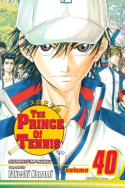 Although the final three volumes of The Prince of Tennis contain many ridiculous things and are, objectively speaking, really not that good, I still think the story wraps up reasonably well.
Volume 40 begins with the tail end of the set between Seishun’s captain, Tezuka, and Sanada of the Rikkai team. Tezuka is dragging things out to buy time for absentee Ryoma to arrive, and ultimately ends up losing. Then Momoshiro and Kaidou lose, but not before we get this sentence that has never been written before at any time in the course of human history: “The tornado snake won’t work against a player with red eyes.” Good to know, that.
Fuji is up next, taking on a player with the ability to mimic anyone’s ability. And who should he emulate but Tezuka, so we get a match that is drawn like the two of these guys playing against each other. Somehow I think this was intended to appeal to the fujoshi, but I’m certainly not complaining. “Maybe we’ve both been avoiding facing off against each other. Because we’re afraid of finding out who’s better,” Fuji thinks at one point. Too bad the promise of a real face-off between them is not realized before the end of the series.
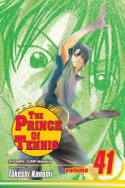 Fuji wins, so we move briskly on to the second doubles round, and somewhere around here Ryoma arrives with, and I am quoting the back cover here, “a wicked case of amnesia.” It’s completely stupid, and while Oishi and Eiji stall for time, various players (including rivals) go reacquaint Ryoma with his tennis memories by playing him off-camera. Why even employ an amnesia plot if it’s going to be cured so simply? It just makes me shake my head.
Anyway, it should be no surprise to anyone at all that Ryoma regains his memory and, though he starts off his match at a disadvantage, he soon summons the ultimate skill—“the pinnacle of perfection”—with which to vanquish his opponent. (Everyone can tell that he has achieved this because white light bursts from his body. As it often does in tennis.) And Ryoma’s dad drops by to tell everyone this is happening because Ryoma is playing simply for the joy of the game, and so that everyone can finally learn that Ryoma is the son of the famous Samurai Nanjirou. So, Seishun wins and there’s a montage while the lyrics of a song penned by Takeshi Konomi scroll by. It’s all very silly. There’s also a brief prose epilogue depicting the third years’ graduation.
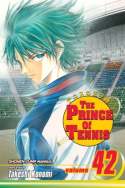 I just really don’t know what to say about The Prince of Tennis at this point. In the pursuit of ways to make games even more exciting, Konomi crossed my personal “suspension of disbelief” border with all these physically observable glowy states. Somehow, I was willing to accept Inui making instant probability calculations or Tezuka being able to control his spin so well that all return shots come directly to his location, but make a guy sparkly and have someone in the stands cry, “L-look at that! All his aura’s concentrated around his left arm!!” and it’s suddenly too much for me to take. Still, it’s not like the series was ever so fabulous that I’m actively disappointed. Just resigned.
Anyway, thus concludes The Prince of Tennis. The sequel, Shin Prince of Tennis (“Shin” means “new”), is currently serialized in Jump SQ magazine. The fifth collected volume came out in March of this year. It lamentably remains unlicensed for US release.