• Skip to primary navigation
  • Skip to main content
  • Skip to primary sidebar
  • Home
  • About Us
    • Privacy Policy
    • Comment Policy
    • Disclosures & Disclaimers
  • Resources
    • Links, Essays & Articles
    • Fandomology!
    • CLAMP Directory
    • BlogRoll
  • Features & Columns
    • 3 Things Thursday
    • Adventures in the Key of Shoujo
    • Bit & Blips (game reviews)
    • BL BOOKRACK
    • Bookshelf Briefs
    • Bringing the Drama
    • Comic Conversion
    • Fanservice Friday
    • Going Digital
    • It Came From the Sinosphere
    • License This!
    • Magazine no Mori
    • My Week in Manga
    • OFF THE SHELF
    • Not By Manga Alone
    • PICK OF THE WEEK
    • Subtitles & Sensibility
    • Weekly Shonen Jump Recaps
  • Manga Moveable Feast
    • MMF Full Archive
    • Yun Kouga
    • CLAMP
    • Shojo Beat
    • Osamu Tezuka
    • Sailor Moon
    • Fruits Basket
    • Takehiko Inoue
    • Wild Adapter
    • One Piece
    • After School Nightmare
    • Karakuri Odette
    • Paradise Kiss
    • The Color Trilogy
    • To Terra…
    • Sexy Voice & Robo
  • Browse by Author
    • Sean Gaffney
    • Anna Neatrour
    • Michelle Smith
    • Katherine Dacey
    • MJ
    • Brigid Alverson
    • Travis Anderson
    • Phillip Anthony
    • Derek Bown
    • Jaci Dahlvang
    • Angela Eastman
    • Erica Friedman
    • Sara K.
    • Megan Purdy
    • Emily Snodgrass
    • Nancy Thistlethwaite
    • Eva Volin
    • David Welsh
  • MB Blogs
    • A Case Suitable For Treatment
    • Experiments in Manga
    • MangaBlog
    • The Manga Critic
    • Manga Report
    • Soliloquy in Blue
    • Manga Curmudgeon (archive)

Manga Bookshelf

Discussion, Resources, Roundtables, & Reviews

Reviews

Negima! Magister Negi Magi Omnibus, Vol. 2

October 11, 2011 by Sean Gaffney

By Ken Akamatsu. Released in Japan as “Mahou Sensei Negima!” by Kodansha, serialization ongoing in the magazine Weekly Shonen Magazine. Released in North America by Kodansha Comics.

With this second omnibus of Negima, Ken Akamatsu is starting to make his move. He’s obeyed his corporate masters and written in a giant harem cast, with tons of fanservice and blushing tsundere heroine, just like his last title. Indeed, this omnibus contains a mini-arc where the cast fight a battle to get a kiss from Negi. However, bigger things are afoot, and this omnibus is also where Akamatsu lets us know that there will be adventure and pure shonen fighting here as well – and that eventually it will be the main thrust of the plotline.

The most obvious thing we get out of this re-read of Volumes 4-6 is we see another of the main cast introduced – Setsuna Sakurazaki. Just as Asuna bears similarity to Naru from Love Hina, and Nodoka is like Shinobu, Setsuna is clearly meant to be the Motoko of this series, right down to the flustered panicking whenever love is mentioned. (Indeed, the connection to the Aoyama family is later made explicit, about 20-odd volumes later). Setsuna is briefly introduced as a potential villain, but that doesn’t last long, and soon we’re finding out about her loyalty to her friends, her amazing sword powers, her yokai heritage, and of course her repressed yearnings for her Konoka-ojosama, which manages to be played for laughs *and* taken seriously at the same time.

The other thing I noticed here was how casually we’re introduced to two of the major villains of the entire work. Fate and Tsukuyomi both appear as supposed ‘mid-level bosses’ of the villain of this arc, Chigusa. However, Chigusa proves to be mostly useless (Akamatsu lampshades this by having her defeated by Chachazero, Evangeline’s two-foot-tall puppet creature), so Fate quickly takes over, and proves to be more than a match for Negi, who is powerful but inexperienced. Fate is mostly drawn as a blank here, though I did like some of his dry humor when he muses about the water spells he’s using on Asuna, and how they interact with her magic cancel abilities. And Tsukuyomi is cute and adorable, and only wants to fight her sempai in a sword battle! Except for one panel, she is not at all the terrifying lunatic we will see later on.

Akamatsu is still feeling around how to work in all 31 girls in his plot without making the whole thing too unwieldy – he never did quite master that, though he got close. The popularity poll included at the end shows that Makie is the most popular of all the girls for two polls running, so perhaps she is the character that is most disappointing – despite a late run, Ken hasn’t really worked out her potential. On the other hand, he’s also realizing which girls *do* work well as a main cast member. Setsuna arrives and is immediately one of the crew, as I mentioned, and Nodoka is the second girl to get a pactio with Negi (and oh what a pactio it is). As for Evangeline, let’s just say I think her skyrocketing popularity caused both Shonen Magazine and Akamatsu to go “Whoah,” and after being casually disposed of by Negi in the first omnibus, she’s back to full strength here, going toe to toe with Fate, taking out huge building-sized ancient demons, and laughing all the while.

The translation here is new, as with the first one, with the Nibley twins replacing the work of Peter David (Vols. 4-5) and Trish Ledoux (Vol. 6). A replacement of David’s very loose adaptation was quite welcome. The extras have the preliminary sketches included at the end, but lack the ‘character bios’ and cover art sketches we get with individual releases.

Overall, if you’re going to be getting into Negima, this is likely where you’ll hop on. Vol. 5-6 have a great arc that shows the series finally escaping its harem roots, and even though there will always be fanservice, it’s a gamechanger. Fans want magical battles, and Akamatsu is here to provide them.

Filed Under: REVIEWS

Love Hina Omnibus, Vol. 1

October 10, 2011 by Sean Gaffney

By Ken Akamatsu. Released in Japan by Kodansha, serialized in the magazine Weekly Shonen Magazine. Released in North America by Kodansha Comics.

Everyone has those titles. You know, the ones you were obsessed with 10-15 years ago. The ones you still enjoy, even though in the back of your mind you know you can never revisit it ever, because if you do you will be mature enough to see all the flaws you missed in the first rush of fandom. The mid-late 90s are a particularly strong time for me in that regard. Ranma, Oh My Goddess, Tenchi Muyo, and (a bit later) Love Hina. Four titles that in your early 20s are AMAZINGLY AWESOME, especially if you then get involved in fanfics, mailing lists, etc. And then you read them and you realize what you glossed over earlier annoys you now, and the plot you enjoyed has now been used by 80 other series to the point that you grow weary of it. Would Love Hina, now being re-released nine years after Tokyopop put it out, suffer the same fate?

There are a few things you will have to come to terms with as a reader if you are going to enjoy Love Hina. It is a harem manga. Worse, it is a harem manga where the outcome is never in doubt – thus if you like a girl who isn’t Naru, you know you’re doomed and spend 13 more volumes getting progressively more annoyed. It is filled with blatant and obvious fanservice, mostly involving girls under the age of 18. This never goes away. It is filled with what has been commonly dubbed ‘comedic sociopathy’ – which is to say characters are angry and hit each other all the time because the author thinks it’s funnier that way. In the 550 pages of this omnibus, I believe Naru punches Keitaro almost 50 times, and I may be underestimating that. And this doesn’t even count Su kicking him, or Motoko trying to slice him in two with her katana. It’s a comedy. Keitaro recovers 2 panels later. Learn to roll with it.

If you can get past all that… this is a fun, heartwarming title. Admittedly, it takes a while to get going. As with Negima, Volume 1 of Love Hina is pretty obviously the nadir. Keitaro was a highly influential harem lead, but for all the *wrong* reasons. Ataru was after the girls himself, Tenchi had actual superpowers to bust out, and Ranma was a martial arts master. Keiichi Morisato comes closest, and is certainly unlucky, but lacks the patheticness Keitaro Urashima has at the start. We see him as a 2nd year ronin, having failed to get into the prestigious Todai university. Again. He also notes that he’s not handsome, and has no real friends, and has never had a girlfriend. What does he have? Well, he has the bad luck to always walk in on women naked, and tends to fall over clutching their breasts. Oh yes, and he’s NICE. Keitaro was first, so I won’t get on his case as much, but he was the prototype for many harem leads who literally have no redeeming qualities except their ability to be extra super nice. (Not that there’s anything wrong with that.)

Added to this, we have a cross-section of girls that end up living in the inn his grandmother leaves to him in the introductory chapter. Tsundere Naru, aka the second most polarizing female in all of anime (Akane Tendo being first) tends to lash out with her fists when angry, embarrassed, or scared, which, around Keitaro, is all the time. Luckily, like most tsundere characters, this is only half of her persona, and we do over the course of these three volumes see Naru’s softer, more caring side. She also starts to see that Keitaro means well, and begins to realize that she might even be falling for him. Which… makes her angry, embarrassed, and scared. Cue fists, repeat as needed. If you leave out all the scenes when she’s hitting him, what you’re left with is quite a sweet relationship between two people who are a lot more alike than Naru would like to admit.

As for the others, like most ‘date sim’ or harem mangas they’re designed to provide a selection of different female leads to appeal to the reader. Cute and shy Shinobu, who’s 7 years younger than Keitaro – and can cook to boot! Hyperactive Su, who is foreign but not from India, and runs through each scene she’s in on pure energy. Stoic Motoko, the young kendo swordswoman who worries she may be dealing with those pesky feelings of love. Trickster Mitsune, who enjoys alcohol and teasing Keitaro and Naru, probably not in that order. Motoko and Shinobu will get far more focus in future volumes (indeed, Motoko seems rather out of character here, and won’t come into her own till she gets just as flustered and blush-ridden as Naru currently gets), Su slightly less so. Mitsune gets virtually no page time of her own, it needs to be said, and the anime deepened her friendship with Naru quite a bit.

Then there’s Mutsumi, a.k.a. my favorite character. Again, this is for purely irrational reasons – she only appears sporadically through the series, and is never one of the main cast. Of all the cast, she probably comes closest to winning Keitaro’s heart – except she’s nowhere near it either, and knows it – the man only has eyes for Naru. Mostly I think I like her because of my penchant for, if you’ll pardon the expression, ‘dizzy dames’. Mutsumi is the type who will get a perfect score on a test and forget to write her name; or will end up on a desert island without realizing that if she walks back into it 50 yards she’ll find her house. She is, however, savvy enough to pick up on Keitaro and Naru’s relationship almost immediately – certainly before either of them do. (She also kisses Keitaro, and then to make up for it kisses Naru. When I first read the series, this was VERY IMPORTANT to my young self.) I am always happy when Mutsumi’s around in this series.

I should take some time to talk about the re-release. If you’re a fan of the old manga, and are wondering if the upgrade is worth it – yes, it is. The artwork is much clearer, the translation retains honorifics and last name usage (important in a series like this where so much could depend on Keitaro saying Naru rather than Narusegawa – he doesn’t, in the entire omnibus, call her by her first name). The lettering is professional and looks neat – a far cry from Tokyopop’s… um, enthusiastic lettering job of old. The old ‘bonus pages’ are retained, and we get the usual Kodansha endnotes, detailing things such as Naru namechecking Doraemon.

I will admit that when I heard this series was going to be part of the Manga Movable Feast, I raised an eyebrow. Love Hina is no deep, meaningful masterpiece, and merely flipping through it can tell you that. But if you want a romantic comedy with a hearty emphasis on the comedy, and don’t find it aggravating when slapstick violence happens every two pages, there’s much to enjoy here. The loud rampaging scenes make the occasional quiet, heartfelt ones sweeter, and it’s there, where Naru is quietly cheering Keitaro on to study harder, or confessing her own worries and fears to him, that we start to see what a good couple they will eventually make.

Eventually. Once we have 11 more volumes of slapstick violence.

This review was based on a review copy provided by the publisher.

Filed Under: REVIEWS

Stargazing Dog

October 10, 2011 by David Welsh

I can’t critically address Takashi Murakami’s Stargazing Dog (NBM) without first admitting a bias and then describing some personal circumstances.

I freely recognize that I’m overly sensitive to portrayals of the pet-human relationship in any kind of fiction, and I have a huge number of deal-breaking tropes. For instance, I hate when pets are put at risk to prop up an antagonist and show how very, very evil that person is. I also hate shamelessly manipulative portrayals of the loss of a pet, pushing extremely personal buttons because the storyteller knows that it works.

On the personal front, I’ve lost two dogs this year. In January, our beautiful lady finally succumbed to old age at about 18 years. Over the summer, our boy dog (who will always be our boy dog in spite of the fact that he was about 12 years old) was diagnosed with pancreatic cancer, which was one of the more awful surprises we’ve experienced. (On the bright side, we’ve also adopted a sweet, hilarious little dachshund-Chihuahua mix who is a constant source of joy.)

So that’s the head space I was in when I picked up this book, which is about a man who loses pretty much everything but his beloved dog. When I say that, no matter how sad this story becomes, I never felt manipulated and that I was always reassured that Murakami was coming from the best, most genuine place in his storytelling, I think I have a certain level of authority in that opinion. If you’re like me in that you’re extremely wary when it comes to sad pet stories, be reassured in the case of Stargazing Dog.

Murakami’s human protagonist isn’t in a great place. He’s lost his job, he has health problems, his daughter is in the thicket of adolescent bitchery, and his wife has decided it’s all too much and is filing for divorce. The last remaining bright spot in his life is the family dog, Happie, brought home during the daughter’s more benign years but eventually becoming the father’s most loyal and constant companion (and vice versa).

That development represents the kind of astute choices Murakami makes in crafting the narrative. He shows the evolution of the relationship between man and dog, establishing it in incremental, unexpected ways that make it more persuasive in the long run. Murakami also shares the dog’s point of view, but he takes a very restrained approach to that, keeping the animal’s thoughts on a basic level that still manages to be extremely moving.

The pair embarks on an ultimately ill-fated journey that I really can’t bring myself to describe, mostly because I don’t want to spoil anything. But Murakami uses the trip and its individual events to reassert the foundational loyalty of the human-dog relationship to the point that, no matter the sorrow they may encounter, the uplift provided by that bond is what the reader ultimately takes away at the end. That’s kind of a magnificent accomplishment. (There’s also a sequel story, “Sunflower,” which goes to some less benevolent places using the main story as a framing device. It’s fine stuff too, but its effectiveness is entirely dependent on its grounding in Stargazing Dog.)

I love Murakami’s style of illustration. It straddles that line between stylized cartooning and very human vulnerability, not unlike Fumiyo Kouno’s Town of Evening Calm, Country of Cherry Blossoms (Last Gasp). I could have done without some bits of awkward copy editing. That’s always the case, but it’s particularly true with a story that just begs to flow effortlessly because it’s so finely crafted. The presentation is attractive overall, though.

This is an extraordinarily lovely comic. It’s sad in the best kind of ways, using sadness to make an extremely worthwhile point about a fine and enduring kind of relationship. Given where my head is on the nature of that bond, it could have been devastating, but I ultimately found it wonderfully reassuring.


Filed Under: REVIEWS

Manga Artifacts: The Legend of Mother Sarah

October 9, 2011 by Katherine Dacey

Most American manga fans know Katsuhiro Otomo as the creative force behind AKIRA and Domu: A Child’s Dream, but Otomo’s catalog also includes works like The Legend of Mother Sarah, in which Otomo penned the script but relinquished the illustration duties to another manga-ka. And while Mother Sarah isn’t quite as visually dazzling as AKIRA or Domu, this post-apocalyptic adventure is every bit as fun to read, thanks to its vivid characterizations and dynamic action sequences.

Set in the not-too-distant future, Mother Sarah begins in space — or, more accurately, space stations, where the survivors of a nuclear holocaust have sought refuge from the Earth’s extreme climate changes. When riots threaten the peace aboard these floating cities, the military evacuates civilians back to the surface, in the process separating thousands of children from their parents. Sarah, the story’s eponymous heroine, is on a quest to find her own family, all of whom disappeared in the chaos aboard the space stations. Traveling with Tsue, a trader, she wanders a desolate landscape of crumbling cities, slave-labor camps, religious compounds, and hardscrabble farms, karate-chopping anyone who threatens the honest folk she meets along the way.

Given its classic premise and cool, resourceful heroine, it’s curious that Mother Sarah had such a short shelf life here in the United States. As tempting as it may be to chalk up fan indifference to sexism, or antipathy towards Otomo’s other (read: not AKIRA) projects, I think the real reason lies with the way Mother Sarah was released. Dark Horse published the series from 1995-98, but only collected the first eight issues into a trade paperback. When read in thirty-page installments, The Legend of Mother Sarah: Tunnel Town is engaging but frustrating. Otomo and artist Takumi Nagayasu’s sense of pacing, in particular, is too leisurely for a stand-alone booklet: they establish a new setting with a dozen wordless panels, luxuriate in an explosion, or depict a fist-fight over five or six pages, gobbling up real estate that might otherwise be advancing the story. Contrast an issue of Tunnel Town with that of a long-running American series and the incompatibility of format and story becomes more apparent. In each issue of The Walking Dead, for example, one important event is dramatized: the characters make a critical discovery about their zombie foes or confront a troublemaker within their ranks. Though the issue may end on a cliffhanger, there’s a sense of closure that’s missing from an issue of Mother Sarah, even though both stories are clearly intended to extend beyond the confines of a single pamphlet.

When read in trade paperback form, however, Tunnel Town has a more satisfying rhythm. Those establishing shots and slow-mo fight scenes draw the reader deeper into the story; we feel like we’re actually part of the scene, rather than passive witnesses to the action. The continuity between events is easier to appreciate as well. Sarah’s skirmishes with authority no longer seem like a string of isolated incidents, but a steadily escalating pattern of violence that demands resolution. And what a finale! Coming at the end of two hundred pages, the denouement is less a cool stunt than a thrilling affirmation of Sarah’s courage and smarts, an emphatic punctuation mark at the end of a long but well-reasoned paragraph.

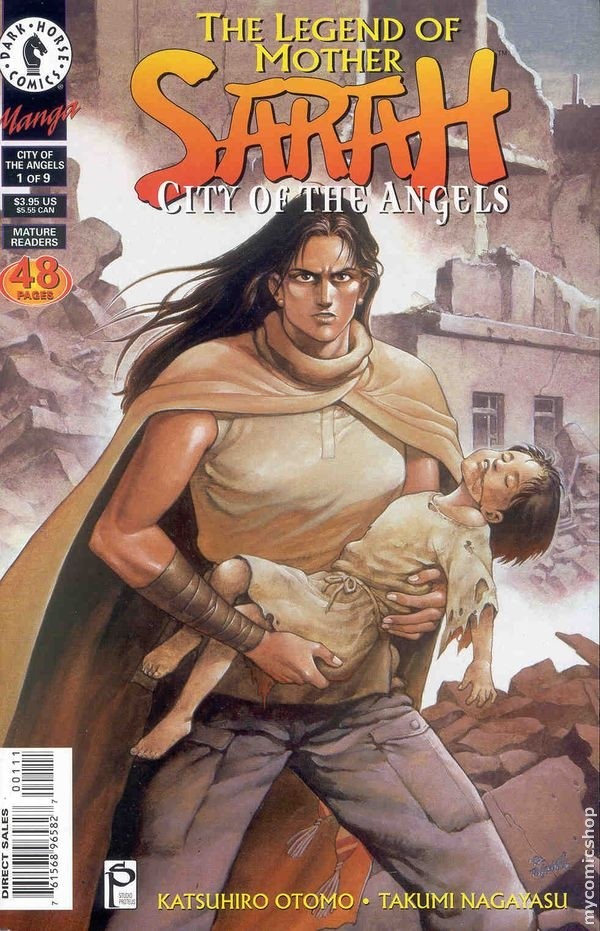
I’m guessing that someone at Dark Horse must have thought Mother Sarah was ill-served by the thirty-page format, as the next two arcs — City of the Children and City of the Angels — were published in forty-eight page installments, a development highlighted on the front covers of each issue:

As a result, the later mini-series are more engaging; we’re treated to a larger, more satisfying chunk of story in each installment, a chunk that I suspect corresponds more closely to the way the manga was serialized in Young Magazine. Alas, neither Children nor Angels were collected in bound form, making it harder for a new generation of manga fans to discover the series for themselves.

For all my grumbling about format and scarcity, however, all three story arcs are worth owning, both for the art and the story. Takumi Nagayasu’s crisp visuals are pleasingly reminiscent of Otomo’s. Nagayasu’s characters are drawn in a naturalistic fashion, with plenty of attention given to hands, facial hair, posture, wrinkles, and muscles; even the most inconsequential soldier or civilian is given a unique face and a thoughtfully constructed costume. Nagayasu also shares Otomo’s love of vehicles and decaying urban landscapes, rendering both in a fine, evocative fashion; one can almost hear the steel structures rusting from neglect.

Otomo’s writing is as strong as Nagayasu’s artwork. Though Sarah is a certifiable bad-ass, capable of kicking and stabbing her way out of a tight situation, she relies on her wits just as frequently as her fists. Her maternal instincts, too, inform much of her decision-making; throughout the series, Sarah is drawn to conflicts involving exploited or abused children, offering her a chance to symbolically “save” the family she lost ten years earlier. In short, Sarah is a woman warrior in the Lt. Ellen Ripley/Sarah Connor mold: fierce, strong, principled, and, above all else, a mama grizzly who sides with the young and the helpless. Oh, and she looks good while dispensing justice, too. Now that’s my kind of escapism, no matter how it’s packaged.

THE LEGEND OF MOTHER SARAH • STORY BY KATSUHIRO OTOMO, ART BY TAKUMI NAGAYASU • DARK HORSE • NO RATING

Filed Under: Manga, Manga Critic, REVIEWS Tagged With: Dark Horse, Katsuhiro Otomo, Post-Apocalyptic Sci-Fi, Takumi Nagayasu

‘Tis Pity She’s A Whore

October 9, 2011 by Sean Gaffney

By John Ford. First published in 1633 (approximately 7-8 years after its first performance) by Nicholas Oakes for Richard Collins. Current edition published by Arden Shakespeare in 2011.

Sometimes I think that the current generation on the internet likes to believe that they were the ones who made incest cool, what with all the squee and the Ouran and Harry Potter fanfics out there. But incest has been around since pretty much the dawn of mankind, and has been written about in the greatest works of literature just as much. Almost every high schooler has to read Oedipus Rex these days, though I suspect their local church likely skips over all the Old Testament fooling around.

Thus, in terms of being a play about incest, John Ford was not breaking exciting new ground. The new ground was in how he dealt with it. This is not the usual wacky comedy uncle lusting after his sweet young niece as we’ve seen in other Jacobean plays, nor are the siblings royalty (incest is always more acceptable when they’re kings, strangely enough). No, we have a merchant family here, and their son, Giovanni, is no slavering neanderthal. Not for him the baseless lust approach. He is madly in love with his sister and so he tries to rationalize it intellectually, coming up with all sorts of arguments he can present to his local friar. The friar’s position can basically be summed up by this ellipsis: “…” Luckily for Giovanni, his sister Annabella has fallen madly for him as well, and they declare, then consummate their love in Act II.

The next three acts are everything going to hell, as you can imagine. This is a tragedy, and there will not be door slamming and talk of sardines here. A lot of modern productions of this play apparently want to focus purely on the main couple, and cut out a lot of the other stuff going on, which mostly involves Annabella’s many suitors and a whole lot of plotting of revenge. Which is a shame, as it helps to show that, despite what many critics have said over the years (usually in the process of condemning the play), Ford is *not* sympathizing with the leads. He does not regard their love as Romeo and Juliet, and the way the production plays out shows this. He does not, however, portray either Giovanni or Annabella as monsters. This is the difference.

Annabella actually shows remorse for her mistakes of passion, right about when she realizes that her troublesome suitor, Soranzo, actually does love her. She is also not the instigator of the relationship (which makes it harder to blame the evil woman seducing the poor innocent man, a common enough reasoning in this time period), and ends up having her heart gouged out of her by a now insane Giovanni. Nevertheless, while the play was very popular at the time it was first written and performed, it was condemned by critics for years afterwards, with the compilers of Ford’s Complete Works choosing to omit the play entirely rather than sully the book with this heathenism. It also was thought unsuitable for the stage and unperformed for about 250 years, only being revived consistently after 1940 or so.

This is not exactly a fun play to read, but I think it’s very well-written. And, as with Shakespeare, I think it’s a lot more ambiguous than usually ends up being presented on the stage in modern productions. Ford is not saying the incestuous lovers are right, but he is saying that they are human, and that we can understand their all too human failings. Thus the title, which aptly sums up those two dichotomies: ‘Tis Pity She’s A Whore.

Filed Under: REVIEWS

Hark! A Vagrant

October 8, 2011 by Sean Gaffney

By Kate Beaton. Released in North America by Drawn & Quarterly.

Kate Beaton is a very funny woman. This is the main reason to buy this collection. Her words are funny, her situations are funny, and her art is funny. That’s a triple-funny combo, folks, and it’s rare these days. People have been reading Hark! A Vagrant as an online webcomic for some time now, and I even have her original self-published book Never Learn Anything from History as well. This is the one to get, though, a handsome hardcover with a larger collection of stories, including all of her high points.

You should still go and check out the HAV archives at her website (here), as this is cherry picked to collect the best of her historical and literary humor, rather than the more random strip we see every week. We don’t get the strips about her own life, or a lot of the dashed-off sketches and earlier comics. There’s fun stuff there as well, including punchlines I don’t even have to look up to laugh about again. “It’s okay, you’re upset.” “Sometimes I pretend to be Neptune!” My own personal favorite, where Kate Beaton reads the letters of James Joyce, is also absent here.

But this strip is an excellent collection, and I have no issues with how it was cherry-picked. I mentioned remembering Kate’s punchlines, and that’s because she has an ear for dialogue that almost begs to be read aloud. It’s not necessarily accurate to its period – Dude Watching with the Brontes is funny *because* of the dissonance, and most of the historical sequences are done in modern tones – but its cadences are funny in and of themselves. They stick in your head, like the best kind of humor. “Jam!” is a classic example of a punchline that’s since become a meme.

Of course, this is helped along by the subject matter. Kate’s a smart cookie, and does not stop to explain the joke as she goes along. She trusts that you will know why Pearson vs. Diefenbaker is fun, and that you have already read The Great Gatsby in high school like the rest of us had to. I had worried all the Canadian strips would be gone, but there’s a large chunk of Canada here. Don’t get me wrong, the strips are funny even if you don’t know who Raskolnikov is, but if you *have* read Crime and Punishment it’s even funnier.

Lastly, Kate’s art is funny. This is sometimes forgotten in a medium where it’s frequently OK to just have funny words and have bland talking heads impart them. The art is caricature, but expressions are conveyed easily and succinctly. Anger and rage are particularly fun, as she draws an open mouthed angry moan that just elicits a giggle. Faces are clearly the emphasis here – Kate’s arms sometimes owe their influence to Mickey Mouse cartoons from the early 1930s – and the cartoons wouldn’t work without the words, but the art helps to accentuate each comic and bring out its best.

Drawn and Quarterly has done an excellent job here as well, with a nice handsome hardcover with a fantastic index at the back for the true history nerd in all of us who wants to skip straight to the strip about The Perfect Joy of St. Francis. It even has a sketch of a portly Napoleon on the cover, his attempt to look menacing somewhat undercut by also looking like he will squeak when he hits the ground like a child’s toy. If you haven’t experienced the fun of Hark! A Vagrant, this is the starting point. Go get it.

Filed Under: REVIEWS

Edo Nekoe Jubei Otogizoshi, Vol. 1

October 7, 2011 by Sean Gaffney

By Maru Nagao. Released in Japan by Shonen Gahosha, serialized in the magazine Nekopanchi. Released in the United States by Shonen Gahosha on the JManga website.

I’m not sure I’ve come across a title at JManga that so typifies what I wanted from the site – at least intellectually. This is a cat manga. From a magazine devoted entirely to cat mangas. About supernatural cat stories in the Edo period. And no, it’s not particularly adorable, though the cats can be cute. It’s not meant for a casual fan. It’s meant for hardcore manga readers who buy this magazine for cats and by god, they will have cats. (It also has one of the flaws of the site, which is the title is in Japanese with no English translation. I don’t mind the Japanese title, but at least tell me what it means. I think Jubei, Cat-Painter of Edo is close to an approximation.)

The plot is basically a series of supernatural mysteries, wrapped around our hero and his yokai cat-spirit. Jubei is a wandering painter, who specializes in painting cats – more specifically, a painting of a cat that will terrify the nice and other creatures from the Edo home. One reason his paintings are so good is they are semi-sentient, thanks to the magic of Nita, the aforementioned cat-spirit, who infuses the painting with some of his essence. We learn a little bit about Jubei as we go through this first volume, but for the most part the stories are about various cat owners, and the trials and tribulations they are going through with their pet. Jubei happens to be around at the time, and takes it upon himself to solve the mystery.

It was hard when I first read this not to think of Natsume’s Book of Friends. The art style is very similar, and a man and his wandering cat spirit solving mysteries, many of them featuring ghosts, also rings very close to home. But we aren’t really all that connected to Jubei the way we are to Natsume. Jubei seems to drift through the manga as he does through Edo. He has several admirers (a few women throughout are clearly attracted to him, but nothing comes of it), and is in fact the Edo Period’s version of a bishonen, complete with the hair, which the artist mentions is out of period but she didn’t want to cut it. I expect as we get more volumes we’ll learn about his backstory with Nita and see some depth, but the lead character is not the reason to read this manga.

On the other hand, the stories themselves are very well done. Sometimes a bit melodramatic, and designed to pull on the heartstrings of cat lovers, but that’s okay. You’re hear to read about cats being adorable, so some extent. Admittedly, there’s a lot more of cats being mysterious or aloof than there is adorable, but that’s okay. We see a cat who sacrifices his life to save his owner’s sight; a young man who realizes his cat may be MORE than just a cat; a pretty tea-shop worker with a tragic cat past; a stoic courtesan whose cat never leaves her side; and a samurai who is terrified of cats due to a haunting from when he was a child. Even the last story, which is mostly about a young man who’s about to be disinherited and is sent to Jubei’s master to try to find a profession, ends up being about how to paint cats, and how cat’s bodies move. You can’t say this doesn’t cater to its audience.

This is, I believe, the first Shonen Gahosha title we’ve ever seen over here that is not from their seinen otaku magazine Young King OURS. They really only have a few demographics as a publisher: Young King/Ours readers, porn readers (their Young Comic titles), and Nekopanchi, the magazine this title runs in. I’m happy to see something from the latter, which, as has been noted, is a classic example of something that would never otherwise have been licensed in Japan. Recommended, even if you’re not a cat lover.

Filed Under: REVIEWS

Gandhi: A Manga Biography

October 6, 2011 by Katherine Dacey

British historian Phillip Guedalla famously described biography as “a very definite region bounded on the north by history, on the south by fiction, on the east by obituary, and on the west by tedium.” Were I to locate Gandhi: A Manga Biography on Guedalla’s map, its longest borders would be to the south and west: it’s both contrived and dull, a series of historical tableaux that do little to reveal Gandhi’s true humanity.

Most of the book’s problems stem from its scope, as author Kazuki Ebine attempts to cover Gandhi’s entire life in a mere 192 pages. Ebine treats us to brief glimpses of Gandhi’s childhood, when Gandhi was first exposed to the injustices of India’s caste system; his time in England, where he studied law; his time in South Africa, where he challenged the government’s classification of Indians as second-class citizens; and his time in India, where he used strikes, boycotts, and other forms of non-violent resistance to protest English rule.

Though Ebine carefully inserts major historical figures into the narrative, none of them are treated as individuals. Some are straw men, representing unenlightened points of view, while others are apostles, converted to the cause through the power of Gandhi’s words. Even Gandhi’s wife is relegated to a minor supporting role; her primary function within the narrative is to patiently reflect on her husband’s inherent courage and goodness, rather than interact with him as a partner, friend, confidante, or lover. (“Your duty is to lead people in a right direction,” she solemnly informs Gandhi.) Ebine attempts to portray her as the one person who truly knew Gandhi, but the relentless pace of the story prevents him from showing the natural evolution of their relationship.

The script is equally problematic, abounding in typos and grammatical errors. (“Pease enjoy this humble farewell party for you,” one character tells Gandhi.) The problems extend beyond mere editorial sloppiness: the dialogue would have benefited from a vigorous re-write, as it sounds more like a poorly translated Power Point presentation than natural conversation. In one crucial scene, for example, a young South African man confronts Gandhi with what amounts to an eighth grader’s gloss on the crisis in South Africa. “When I first heard your speech, I was so inspired as if you boiled in my blood!” he declares. “No one else has tried to rise up against the whites. As Indians, we have decided to fight together beyond the differences in religions.” Another character tells Gandhi, “By revoking Indians’ right to vote, they try to shut our mouth up regarding sovereignty” — an indignity up with which he will not put.

The biggest disappointment, however, is that Ebine makes such uninspired use of the comics medium. The artwork is plain and lifeless, relying too heavily on computer shortcuts and pre-fab backgrounds to create a genuine sense of place or time. Though Ebine depicts numerous violent confrontations, most of the layouts are an unvaried parade of talking heads addressing assemblies and conducting back-room negotiations. To judge from the characters’ facial expressions, these scenes are meant to be as dramatic as the brawls and massacres, but the monotony of the presentation robs these scenes of specificity and urgency.

The bottom line: readers who want an overview of Gandhi’s life and work may find this slim volume helpful, but readers hoping to move beyond what Mark Twain called the “clothes and the buttons of the man” will be sorely disappointed.

Review copy provided by Penguin Books.

GANDHI: A MANGA BIOGRAPHY • BY KAZUKI EBINE • PENGUIN BOOKS • 192 pp. • NO RATING

Filed Under: Manga, Manga Critic, REVIEWS Tagged With: Biography, Gandhi, Penguin

My Girlfriend’s a Geek, Vols. 1-3

October 4, 2011 by Michelle Smith

By Rize Shinba (manga) and Pentabu (story) | Published by Yen Press

The good news is that I liked My Girlfriend’s a Geek more than I expected to. The bad news is that I’m not sure if I should feel particularly good about that.

Taiga Mutou is a penniless college student in need of a part-time job. When he spots Yuiko Ameya—who fits his ideal of the “big sis-type”—in the office of one prospective employer, he devotes himself to getting hired and thereafter attempts to find opportunities to engage her in conversation. He’s largely unsuccessful until a bit of merchandise goes missing and she helps him look for it. They talk a bit more after that, but it’s not until she sees him in a pair of glasses that she really begins to take notice.

At first, Taiga is puzzled but pleased that certain things about him meet with Yuiko’s approval—in addition to the glasses she also appreciates his cowlick and has an unusual level of interest in his methods for marking important passages in his textbooks. When he finally asks her out and she confesses that she’s a fujoshi (“Is that okay with you?”) he’s so exuberant that he agrees without really understanding what that entails.

From that point on, My Girlfriend’s a Geek is essentially a series of situations in which Yuiko’s fujoshi ways make Taiga uncomfortable, and here is where my conflicted feelings begin. On the one hand, it’s absolutely true that Yuiko did try to warn him and that she shouldn’t have to pretend to be someone she isn’t. On the other hand, she is so caught up in her BL fantasizing that she never considers Taiga’s feelings, and even ceases to refer to him by his actual name. Taiga is always the one doing the compromising, and when it seems like Yuiko might be on the verge of doing something nice for him, it usually turns out that she has some self-serving motive.

And what if Yuiko’s character was male? How would this read then? She frequently concocts scenarios in which Taiga is getting it on with his friend Kouji and expresses the desire to take pictures of them together. If she was a male character saying such things to his girlfriend this would be the epitome of skeavy behavior! I seriously wonder whether she likes Taiga for himself at all, but that’s not to say he’s blameless here, either, because it’s hard to see what he could like about her except that she fits the bill for the cute older woman he’s always wanted to date.

All that said, there is still quite a bit to like about this series. For one thing, it’s often quite amusing, especially Taiga’s reactions to Yuiko’s flights of fangirl and the fictional shounen sports manga (with shades of Hikaru no Go and The Prince of Tennis) that Yuiko is obsessed with. For another, it does occasionally touch on what it’s like to discover that someone you fancy has this bizarre secret that you’ve got to try to cope with if you want to stay together. Taiga occasionally laments how far apart they are emotionally, and though we’ve yet to really see inside Yuiko’s head, her attempts to sustain a real-life relationship remind me some of Majima in Flower of Life, another hard-core otaku with a moe fixation.

There’s only two more volumes of this series and I plan to keep reading, but I hope that these characters will manage to achieve more of an equal relationship. Even if Yuiko could just learn to see Taiga’s exasperation and take some genuine step to engage him on a serious personal level, then I’d be happy.

My Girlfriend’s a Geek is published in English by Yen Press. The fourth volume has just come out (to be featured in this week’s Off the Shelf!) and the fifth and final volume is due in December 2011. They have also released the two-volume novel series upon which the manga is based.

Review copies provided by the publisher.

Filed Under: REVIEWS Tagged With: Rize Shinba, yen press

Shocking Pink

October 4, 2011 by Sean Gaffney

By Yasuiriosuke. Released in Japan as “Pink Shock!” by Max Corporation Tokyo, serialized in the magazine Comic Potpourri Club. Released in North America by Project-H Books.

(This review is of an explicit title, be warned.)

You’ll note there’s no picture of the cover in this review, and with good reason – it’s covered in nude women. Shocking Pink is the first in Digital Manga Publishing’s Project H line, a chance to see if folks will actually pay for pornography for guys the way they shell out if it’s BL for girls. They announced 3 titles to start with, and this is the first, a harem version of Romance of the Three Kingdoms, finished in one volume.

The plot is actually quite busy for porn. Takaaki is a grumpy 20-something, working 3 different jobs to try and escape the debt his parents got into after their business failed. Then one day a busty pink-haired girl named Ryuubi shows up at his door, pays off all his debt, and announces that she’s the reincarnation of Gentoku Ryuubi from Romance of the Three Kingdoms. She’s here to take over the world, and wants Takaaki – who is apparently the reincarnation of Koumei Shokatsu – to be her chief strategist.

Of course, not much battling goes on. Our hero is reluctant to believe the words of a clearly insane women. However, once she strips and starts to seduce him, he ends up going along fairly quickly (if grumpily). We quickly meet her two compatriots, Kan’u and Chouhi, both of whom are different personality types and also quite willing to sex him up at the drop of a hat. And then we discover he also has a large-breasted childhood friend, Moutoku, who’s been tsundere for him for years but has never done anything about it. Is she going to just accept all these new women in his life?

The characters are right out of a typical hentai dating sim, though there are a few interesting variations. The adorable shy girl has a split personality that turns her into an evil sadist, a nice way to fit two types into one girl. And Moutoku’s sister not only doesn’t have sex with the lead male (she’s happily married, and does have sex with her husband, fear not), but also has an eyepatch and a backstory more interesting than most of the other girls. Eventually we do have a battle of sorts, as our heroine and her new harem face off against Moutoku and her family to see who gets to keep screwing Takaaki.

The sex is, with one exception, fairly tame, and also fairly consensual. The girls are all sex-starved, and Takaaki is the sort of guy who is reluctant to do anything until people are naked in front of him, then just goes along. The exception is during the competition, where Moutoku’s twin cousins kidnap Chouhi and plan to blackmail her into giving up. Of course, they had to pick the girl who has an evil split personality. She quickly turns the tables, ties the siblings up, and then forces them to have sex with each other. It’s the only non-consensual scene in the book, and also involved incest and urination, as well as the implication of mind-control (the two love what Chouhi does to them so much they become her slaves). I note they’re also supposed to be in “prep school”, and are clearly the youngest of the entire cast. However, for the sake of legality, they are of course over the age of 18.

In the end, this is what it is. 200-odd pages of nonstop sex with a thin plot wrapped around it. That said, it could have been much worse. This lacks the faceless gangrapes seen so often in many Japanese hentai manga and doujinshi, and the Romance of the Three Kingdoms plot, though never actually used well, at least attempts to make things interesting. In fact, the main argument against it is the heroine, a shallow Haruhi Suzumiya-alike who never gets to be remotely likeable, unlike almost every other woman in the book. Nevertheless, I have to say this book delivers what Project-H promised to give us.

Filed Under: REVIEWS

A Zoo in Winter

October 3, 2011 by David Welsh

As gifted and versatile as Jiro Taniguchi is, I do find myself ambivalent about some of his work. I can sometimes find it too cerebral (The Times of Botchan), too burly and stoic (The Ice Wanderer), or even too sentimental (A Distant Neighborhood). I always appreciate his comics, particularly for their flawless draftsmanship, but there can be those nagging reactions to tone that keep me from admiring it without reservation.

A Zoo in Winter, Taniguchi’s latest translated offering from Fanfare/Ponent Mon, ends up being one of his titles that ends up working for me without qualification. It starts out a bit on the stoic side, but it ends up being thoughtfully sentimental in just the right way, at least by my standards.

Taniguchi reveals his early days in the manga industry, working as an assistant to a popular shônen artist. When we first meet him, or at least his avatar, Hamaguchi, he’s working in an unsatisfying job at a textile concern, making deliveries and wondering if he’ll ever get a promised chance at design work. An awkward series of events involving the owner’s daughter leads him from Kyoto to Tokyo, where a high-school friend sets him up with a job in a manga-ka’s studio.

Hamaguchi learns the assistant’s trade on the job, finding the workplace dynamics somewhat trickier than he expected. He’s jealous when a co-worker seems to be on the verge of his professional debut, and he’s quietly alarmed by the news that his superior had his shot at a solo career and went back to supporting someone else’s work. Hamaguchi also hits that wall any cartoonist faces: what kinds of stories does he want to tell?

He also gradually starts taking advantage of life in Tokyo. The studio is sort of a wheel-spoke for the kind of weird, low-grade arty types that congregate in cities. Between Kikuchi, the ne’er-do-well friend of Hamaguchi’s manga-ka boss, and his high-school buddy, Hamaguchi begins to develop something resembling a social life. Those two threads intersect when Kikuchi asks Hamaguchi to hang out with his girlfriend’s sickly sister.

The waif ends up inspiring Hamaguchi merely by expressing an interest in what happens next in one of Hamaguchi’s half-formed stories. His fondness for the girl (and probably the ego boost her admiration provides) prompts Hamaguchi to take his own work more seriously. After a rather clinical starting point, the narrative goes to some shamelessly romantic places, and I’m surprised at how well it works. There are few things quite as clichéd as the sickly inspiring the hale to make the most of their lives, but Taniguchi pulls it off by acknowledging that this is what’s happening but keeping his protagonist sweetly in the dark about what a stereotype he’s executing. It ends up being lovely rather than gooey, though the gooey mien gives it all an extra something. Taniguchi gets to frost his cake and eat it, too.

As a tale of a young artist, A Zoo in Winter is generally understated, which is a blessing. Taniguchi is in his best kind of thoughtful, restrained mode with this material, which results in some very astute observations about the hothouse quality of artists in collaboration. I think that restraint and understatement also give Taniguchi license to tug at the heartstrings a bit more than otherwise might be palatable. It strikes a very nice balance overall, and it’s certainly among my favorites of Taniguchi’s licensed works.


Filed Under: REVIEWS

Negima! Magister Negi Magi, Vol. 31

October 3, 2011 by Sean Gaffney

By Ken Akamatsu. Released in Japan as “Mahou Sensei Negima!” by Kodansha, serialization ongoing in the magazine Weekly Shonen Magazine. Released in North America by Kodansha Comics.

When I reviewed the previous volume of Negima, I noted that our heroes would start kicking ass in this next one. Which is true, but we do have about 50 pages before that happens. And in that 50 pages, a whole lot more sympathetic characters get killed off by our suddenly body-count happy author.

Of course, this is a shonen romantic comedy manga, despite occasional drama, and the people killed off are being turned into magical feathers and dissipated, not having huge bloody chunks cut out of them. Thus, it is not particularly a surprise when, just a few chapters later, it’s revealed we may be able to get all of them back. Still, for the chapters where it’s happening, it’s horrible to see. Yue’s rival Emily, Jerk with a Heart of Gold Tosaka, and even the giant Teddy Bear woman all get taken out. Least surprising but most devastating of all, Fate takes out Jack Rakan, who manages to briefly resurrect himself from the dead (because he’s just that awesome – no, really, that’s the canon explanation) and give our heroes a brief pep talk. Even Chisame ends up in tears.

Of course, not everyone takes this lying down. Yue’s reaction to Emily’s death is to turn into MAGICAL PSYCHO BERSERKER, and it works for about 10 seconds till Mana talks her down. Then there’s Nodoka. Remember a few months ago, when I posted my top 10 Negima moments, and hinted more would be in future books? This is the one I was thinking of. Nodoka, having seen two of her companions killed in front of her, snaps out of her funk and proceeds to kick the bad guy’s ass with her pactio powers, cleverness, and a few magical dodging skills she picked up in case stuff like this happened. Afterwards, the entire cast’s jaw drops when they hear about it. Normally when an author has the characters lampshade how awesome something was, it seems self-serving, but here, it’s more acknowledgement.

And so, after Chachamaru takes care of the giant Chtulhu monster with her new pactio weapon, we pause to briefly run away and regroup. Which is good, as Rakan noted something else that our heroes are finally clued in on (even if the reader has known for some time): the Asuna they’re with is a fake, and the reason the villains are able to do all this damage is they’re using the real Asuna’s power. So it’s time to interrogate the false Asuna… which is a bit of a problem, as the fake doesn’t know she’s a fake. Luckily, Negi has his secret weapon. (cough) Hey, when all you have is a hammer…

As the volume ends, Luna is no longer Asuna, and tells them what she knows (which isn’t a lot), without even needing enhanced interrogation (kudos to the Nibleys for that phrase, by the way). So Negi needs to power up again, and must call on imaginary Evangeline once more to draw out his inner beast… which may not be able to be put down after all this is over. This is the trouble with siding with dark magic.

Much as I enjoyed the volume as a story, I would be remiss if I did not point out that it was even more riddled with typos than usual. In previous Kodansha/Del Rey reviews, I asked who was editing the books and if they knew what continuity was; in this one, I wonder if they even use editors at all anymore, or just have the translators edit their own work. “Nodoka56…” was particularly egregious. It also seems to be missing the character commentary on Asuna. I realize that there was a rush to get out Negima every 2 months to catch up after the hiatus, but come on, shoddy product does not help you at all, Kodansha.

That said, another great volume of Negima, and I do look forward to seeing how this battle continues to play out. Surely Akamatsu can’t introduce anything more surprising than what we’ve already had…

Filed Under: REVIEWS

Kitty Hawker

September 30, 2011 by Sean Gaffney

By Takao Saito. Released in Japan by LEED Publishing, serialized via Shogakukan in the magazine Big Comic Special. Released in the United States by LEED Publishing on the JManga website.

(Note: Despite saying Vol. 1 on the JManga site, I believe the series is complete in one volume.)

The main player involved so far in JManga’s site has been Futabasha, but there are several other companies who also have made previously unseen content available. LEED Publishing was created by Takao Saito in the early 1970s to market his manga empire, which was already monumentally successful due to his action thriller Golgo 13. I’m not certain how many of his titles are done by Saito himself and how many are his huge team of artists – he’s sort of the Jim Davis of Japan, if Garfield was a stone-faced assassin, of course. (Yes, I’ve read that fanfic.)

This particular title, Kitty Hawker, dates from the mid-1990s. It ran sporadically from 1995-1998 in the magazine Big Comic Special, and is the story of Oki, a Japanese hotshot pilot who gets stranded in the United States after he accidentally breaks an incredibly expensive flight simulator due to his hotshot antics. Forced to take on jobs so he can pay off his debt and return home to his wife and child, he signs on with a tiny airport in Texas, and takes on dangerous political jobs that no sane pilot would ever take on. All the while, of course, while enduring the casual racism and looks of hatred from his immediate superiors (though he does also gain some friends as well).

Oki looks a lot like Golgo 13 (not a huge surprise – Saito’s heroes tend to have similar features), but certainly doesn’t act like him, and it took me a while to get used to him actually talking and having conversations, not to mention showing emotion. Oki is likeable enough to be a hero, but lacks Golgo 13’s super-perfection – Oki’s cockiness and tendency to mouth off to people get him in trouble quite a bit. As for the other characters, everyone in the manga is painted with rather broad strokes – there’s enough depth to keep you reading, but this is in no way a manga that lives and dies by its characters.

What it is is another action thriller, with added political content. Oki gets a job that needs to be done hush-hush, has massive political implications, and will require superhuman flying skills. And he manages to pull it off, usually with the help of his copilot and mechanic Bud. Again, we get stock characters from Action Thriller 101 here: the sexy and mysterious government agent, the nervous CIA guy who hinders more than he helps, and of course the sexy Latin American native who has an affair with the aforementioned Bud. (Oki is married, and though occasionally remarking on the attractiveness of his clients, does not stray.)

So, what you see is what you get here: a political thriller with lots of wordy dialogue followed by lots of awesome scenes of planes doing difficult to impossible stuff, all to save the world. By the end of this volume, Oki has come to terms with his exile, and tells his wife that he’ll be staying a little longer. Kitty Hawker may appeal to those who like old Westerns – it has much the same feel. Very little pretension or attempts to be anything more than a good yarn.

Filed Under: REVIEWS

Bloody Monday, Vol. 1

September 29, 2011 by Sean Gaffney

By Ryou Ryumon and Kouji Megumi. Released in Japan by Kodansha, serialized in the magazine Weekly Shonen Magazine. Released in North America by Kodansha Comics.

Take a typical John le Carré novel, only have it star a bunch of Japanese high school students, and you might come close to what’s going on in Bloody Monday. This sort of story demands a certain suspension of disbelief (indeed, this particular story might need an entire suspension bridge for your disbelief), but once you get past that and accept the premise, there’s a lot of fun stuff to be found here.

The basic premise has our hero Takagi, who is an ordinary high school student – except he has absolute world-class hacking abilities, and his father appears to be a super-spy. But other than that? He goes to class, he worries about his sister, who apparently is hospitalized often, and he spends his spare time decrypting mysterious files that are vital to national security. His friends (who, at the start of this, are mostly unaware of his talents) are a typical shonen bunch: handsome laid-back best friend, tsundere childhood female friend, shy girl who probably has a crush on him, and geeky guy.

Unfortunately, his worlds are about to intersect. There’s a virus going around that makes folks cough up blood, collapse and die, and it would seem to be engineered by a nasty enemy agent (that’s her on the cover in her lingerie)… who now shows up at Takagi’s school as the new teacher, and gives off a lovely aura of ‘I am not an enemy spy honest’ for the rest of the book. What’s more, his father has disappeared after calling to tell him “Bloody Monday” (how cryptic… if it weren’t the title), and he’s getting special deliveries of boxed agents sent to defend him from mysterious foes.

Much of this volume is simply setting up the premise of the series, so things move pretty slowly at first. Takagi and his friend Otoya are the only ones who we really get to know, though we also get a nice impression of Takagi’s father before he is forced to leave the manga for reasons of plot. Takagi seems a bit too perfect, so I actually liked them undercutting this by having him reveal everything he knows to his friends… and the new teacher who mysteriously arrived there recently. Hey, she’s an authority figure! And stacked! I imagine as the series goes on this lack of precaution will become less common.

I was reminded of last year’s aborted Del Rey series Code: Breaker a bit with the style of this manga, which is very much in the thriller style. It may seem startling that it runs in Shonen Magazine, given the children coughing up blood and dying, as well as the enemy agent in her underwear, but honestly the magazine has always been like that – it’s the most fanservicey of the three, and also sometimes hardest to pin down in terms of genre.

In the meantime, we have a series that I suspect we won’t really know how good it is until three or four volumes in. Not that there’s anything really wrong with this first volume, but it’s much like reading Chapter 1 of a le Carré novel, then having to wait two months to read Volume 2. This may be a series to collect in batches.

Filed Under: REVIEWS

The Book of Human Insects

September 28, 2011 by David Welsh

While Osamu Tezuka’s The Book of Human Insects (Vertical) focuses its bug metaphors primarily on notions of transformation and parasitism, I find myself irresistibly reminded of that old fable by Aesop, “The Ant and the Grasshopper.” You know the one, where the lazy grasshopper assumes that the hard-working ant will care for him when things get tough, and the ant shows its conservative credentials by just letting the grasshopper die, because the ant has his, and that’s what counts.

With customary perversity, Tezuka turns the old morality play on its head. The grasshopper does benefit from the ant’s labors, because the grasshopper steals the ant’s stash and, if she feels it necessary, kills the ant for good measure. Preach on that, Aesop.

Tezuka follows dazzling celebrity Toshiko Tomura, who’s achieved remarkable and varied success. Though only in her twenties, she’s an acclaimed actress, gifted designer, and award-winning novelist. That she’s achieved this by seducing and metaphorically leaching the life blood of her mentors is of no moral consequence to Toshiko who, not unlike Aesop’s ant, got hers, which is all that matters to her.

Like Yuki from Tezuka’s MW (also Vertical), Toshiko is a quick and creative thinker. She’s not the sadist Yuki is, and she doesn’t have a grand plan beyond staving off boredom and getting what she wants. She also has a self-destructive streak, at least to the extent that she gets a gleam in her eye whenever her plans hit a roadblock. Part of the fun for Toshiko is reacting on the fly to remove unexpected obstacles. She doesn’t have Yuki’s emotional gravitas or his unapologetic perversity, but she has the same Energizer Bunny quality that helped make him such a fascinating protagonist.

And, yes, Toshiko is a protagonist, in that it’s her story and that Tezuka demands that the reader be invested in the outcome of her schemes. You don’t necessarily need to root for her, though I found myself doing so more than made me entirely comfortable, but you do need to care about what she does next and how it works out for her. The fact that she’s a clever and powerful woman at the center of a Tezuka noir tale helps enormously. Works from this category tend to push women to the side in terms of agency; they’re either doormats or harpies. Toshiko may be amoral, but she owns her choices and doesn’t shrink from adversity.

This is right in my Tezuka center of gravity. It’s a compelling story with a moral, though satirical core, taking the flaws of a generation to almost ridiculous extremes and crafting a thriller from that starting point. It’s great looking, possessed of a sexy energy that Tezuka’s adult works don’t always achieve with this level of confidence. And it’s got an indelible central figure, surrounded by an interesting cadre of marks and foes.

And it’s got one of my favorite recurring visual motifs, Toshiko in repose. When her stunts pay off, she takes a moment to just breathe and smirk, looking like a grasshopper on a sunny rock. You can almost see the ant’s leg sticking out of the corner of her mouth.


Filed Under: REVIEWS

  • « Go to Previous Page
  • Page 1
  • Interim pages omitted …
  • Page 291
  • Page 292
  • Page 293
  • Page 294
  • Page 295
  • Interim pages omitted …
  • Page 346
  • Go to Next Page »
 | Log in
Copyright © 2010 Manga Bookshelf | Powered by WordPress & the Genesis Framework