• Skip to primary navigation
  • Skip to main content
  • Skip to primary sidebar
  • Home
  • About Us
    • Privacy Policy
    • Comment Policy
    • Disclosures & Disclaimers
  • Resources
    • Links, Essays & Articles
    • Fandomology!
    • CLAMP Directory
    • BlogRoll
  • Features & Columns
    • 3 Things Thursday
    • Adventures in the Key of Shoujo
    • Bit & Blips (game reviews)
    • BL BOOKRACK
    • Bookshelf Briefs
    • Bringing the Drama
    • Comic Conversion
    • Fanservice Friday
    • Going Digital
    • It Came From the Sinosphere
    • License This!
    • Magazine no Mori
    • My Week in Manga
    • OFF THE SHELF
    • Not By Manga Alone
    • PICK OF THE WEEK
    • Subtitles & Sensibility
    • Weekly Shonen Jump Recaps
  • Manga Moveable Feast
    • MMF Full Archive
    • Yun Kouga
    • CLAMP
    • Shojo Beat
    • Osamu Tezuka
    • Sailor Moon
    • Fruits Basket
    • Takehiko Inoue
    • Wild Adapter
    • One Piece
    • After School Nightmare
    • Karakuri Odette
    • Paradise Kiss
    • The Color Trilogy
    • To Terra…
    • Sexy Voice & Robo
  • Browse by Author
    • Sean Gaffney
    • Anna Neatrour
    • Michelle Smith
    • Katherine Dacey
    • MJ
    • Brigid Alverson
    • Travis Anderson
    • Phillip Anthony
    • Derek Bown
    • Jaci Dahlvang
    • Angela Eastman
    • Erica Friedman
    • Sara K.
    • Megan Purdy
    • Emily Snodgrass
    • Nancy Thistlethwaite
    • Eva Volin
    • David Welsh
  • MB Blogs
    • A Case Suitable For Treatment
    • Experiments in Manga
    • MangaBlog
    • The Manga Critic
    • Manga Report
    • Soliloquy in Blue
    • Manga Curmudgeon (archive)

Manga Bookshelf

Discussion, Resources, Roundtables, & Reviews

Reviews

Ai Ore! Vol. 3

November 21, 2011 by Sean Gaffney

By Mayu Shinjo. Released in Japan as “Ai wo Utau Yori Ore ni Oborero!” by Shogakukan, serialized in the magazine Shoujo Comic (“Sho-Comi”). Released in North America by Viz.

This is a turning point for Ai Ore! in many ways. It’s the last volume published before the move from Shogakukan to Kadokawa Shoten, which is why it reads very much like it’s ending. It marks a point where the series stops trying to be a satire or parody of these sorts of mangas and simply becomes another example of them, albeit a funny one. And it also has Akira develop to the point where, though I still have a few reservations, I can now admit without irony that I am enjoying this title.
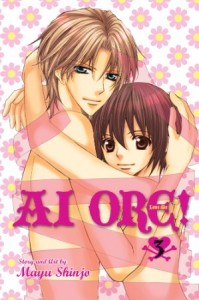
For one thing, this volume doesn’t even pretend to be about Mizuki anymore. Akira is the star here, and most of what we see are his attempts to deal at being in love with Mizuki. He wants to win her affection and love, his hormones are raging at him to seduce her as soon as possible, and he’s getting bad advice all round from many of his friends – some of which, in fact, we’ve seen him use before in earlier chapters. Akira is trying to find a balance between ‘women like a strong, sexy guy who can take command’ and ‘I know what’s best for her because I am an asshole’, and it’s not as hard a line to cross as he would like.

This makes him stand out from other typical Shogakukan male heroes, even more than the cutesy pretty girl looks he’s stuck with. An excellent example is a chapter where a rival shows up – Tsubasa, another pretty boy who looks like a girl that Mizuki met and accidentally enthralled a couple of years earlier. He challenges Akira to a competition, with Mizuki being the winner. Akira, of course, accepts, and is very curt to Mizuki – “just sit back and wait for me to come claim you”, he notes, and you want to smack him all over again. The contest itself, though, which shows him basically letting his lecherous classmates practically rape him just so that he can get their vote – shows that power is not really what drives him at all. And a good thing too, as he’s so bad at using it.

The end of that chapter has Ran, the slightly more sensible of Akira’s two playboy friends, asking him “Have you given any thought to how Mizuki feels about this?” Well, no, he hadn’t. It’s only partly his fault – Mizuki is still the weak link in this story, though she’s not as bad as she has been. We don’t worry as much about her doubting her femininity or trying to act girly… but we also empathize with Akira, as her waffling really is driving the reader crazy now as well. Mizuki here, I believe, finally at least understands what love is, and that she’s madly in love with Akira. I just wish the couple had better communication. But then I say that about most manga couples.

In the last chapter, everything comes together. Mizuki says that she loves Akira, Akira realizes that this wasn’t something that he could have forced, no matter how he tried, and the two have now been intimate. As I said, it READS like an ending – readers of Shoujo Comic would be satisfied with the way it wrapped up here. Of course, if they also purchased Kadokawa Shoten’s Asuka, they would see the series continue – and so will we, with Vol. 4. Which will also see it return to standard 200-page format, I believe. In any case, finally recommended with few reservations.

Also, great title drop right at the end there, for folks who wondered what Ai wo Utau Yori Ore ni Oborero meant.

Filed Under: REVIEWS

Dawn of the Arcana, Vol. 1

November 19, 2011 by Katherine Dacey

“Today, I belong to the enemy” — so begins Dawn of the Arcana, a medieval fantasy in which a feisty princess marries into a neighboring country’s royal family. Nakaba characterizes herself as “a lamb,” sacrificed by her people to help two warring kingdoms maintain a fragile peace. Her husband, the handsome but insolent Prince Caesar, initially snubs his new wife; not only does she have red hair — a commoner’s color — but she also flouts palace conventions, wearing the traditional dress of her homeland, employing a male Ajin (humanoid) as her valet, and excoriating Caesar in front of his servants.

Adding fuel to this combustible situation are Caesar’s mother, a Lady Macbeth figure who urges her son to seek the throne; King Guran, her husband; Cain, Caesar’s half-brother; and Louise, Cain’s flirty fiancee. Nakaba is keenly aware of their contempt for her, and struggles to maintain her composure as they openly mock her and threaten her faithful servant Loki. Though Loki is devoted to his mistress, he, too, poses a danger to Nakaba, as he quickly antagonizes Caesar and Guran with his impulsive behavior.

As predictable as the plot may be — would you be surprised to learn that Caesar soon becomes smitten with his ginger-haired bride? — Dawn of the Arcana proves engaging nonetheless, a heady mixture of palace intrigue and romance. Nakaba, in particular, is a winning heroine: she’s tough and principled, but savvy enough to appease Caesar and his family when it suits her own agenda. (Early in volume one, for example, Nakaba slaps Loki after a tense stand-off between the prince and the valet, telling Loki, “Disciplining my husband is my duty!”) Nakaba’s enemies are two-dimensional at best, but each displays a Joan Collinesque flair for making Nakaba’s life miserable, spitting out their lines with gusto. (“You look wretched!” the queen exclaims upon seeing Nakaba in her people’s native costume. “Typical red-hair!”)

What gives Dawn of the Arcana its real dramatic juice, however, is the way in which Rei Toma draws parallels between Nakaba’s situation and everyday teenage experience. Anyone who’s ever transferred to a new school, run the gauntlet of a junior high school cafeteria, or been hassled for wearing the “wrong” clothes will immediately recognize herself in Nakaba’s shoes. Sitting at a royal banquet, for example, Nakaba squirms under the withering stares of her new subjects. “I can feel it,” she thinks. “The hatred. The curiosity. The sneers.” In an added note of realism, Toma depicts Caesar as two-faced, the sort of fair-weather friend who openly mocks Nakaba in public — where nasty comments score points with his family —while privately acknowledging her sincerity and courage.

If I had any criticism of Arcana, it’s that the artwork is unimaginative. The character designs are attractive, with careful attention to costumes and hairstyles, but lack personality; I’d have difficulty distinguishing Rei Toma’s work from other popular shojo manga artists’. The minimalist backgrounds are likewise disappointing, doing little to situate the story in a particular time or place. Perhaps that’s a deliberate decision on Toma’s part, an attempt to make Nakaba’s story seem more universal. Given the sloppiness with which the establishing shots are rendered, however, it seems more likely that architectural details and landscapes aren’t her forte.

Still, that’s a minor criticism of an engaging story — one that benefits from a terrific premise, an intelligent heroine, and a supporting cast that wouldn’t be out of place in a juicy historical soap opera like Rome or The Tudors. Recommended.

Review copy provided by VIZ Media, LLC.

DAWN OF THE ARCANA, VOL. 1 • BY REI TOMA • VIZ • 192 pp. • RATED: TEEN (13+)

Filed Under: Manga, Manga Critic, REVIEWS Tagged With: Rei Toma, shojo, shojo beat, VIZ

Tesoro

November 18, 2011 by Sean Gaffney

By Natsume Ono. Released in Japan by Shogakukan, serialized in the magazine Ikki and in various doujinshi. Released in North America by Viz.

It’s time for another Manga Movable Feast, this one timed for the release of Tesoro, a collection of short stories by Natsume Ono. It’s a good collection to discuss, as I think it contains most of her strengths and weaknesses in one convenient package. Plus it has a bear on the cover. Everything’s better with bears.

The strengths of the book are mostly all at the front, as she’s put her later work first. This is good, as by 2003-2006 (the period we see here), she’s already developed and honed her style and type of dialogue. There’s some Italian stuff here, as you’d expect (it’s almost inevitable by this point, Ono simply loves Italy – and no doubt finds the constant conversation she does easier to justify with Italian men). But there’s some excellent stuff that takes place in Japan as well, including what is probably my favorite of the collection, a story about a couple who are both very thin, and tend to have gossip floating around them. “Quiet stubbornness” is possibly the most defining trait of Ono’s men, and it’s in full flower here.

The other story that really captures the attention here is Eva’s Memory, about an orphan girl with a tendency to call various men her father and how that gets a man running for election into a bit of controversy. It’s told through the point of view of her friend, who has just the right amount of exasperation and sympathy. Which is good, as Eva also rides the line here between liking her and wanting to smack her. It’s a good thing that the politician in question is so nice… and there’s also a question of who her real parents actually are, something our hero finds out as he tries to help Eva and also regain his sense of optimism about anything good in the world.

The second half of the book contains doujinshi that were written in the late nineties and early 2000s, and it shows – they’re far messier, and not just in the art. There’s a story about a young man getting out of a 5-year prison stint (he killed someone while drunk driving) that cries out to be rewritten now that she’s at the height of her powers, but instead comes across as… well, here’s the thing. When Ono is on, you can read 800 pages of her characters sitting in one room talking and you don’t care a lick. When she isn’t, it’s all just so much verbosity that you want to scream at people to “get on with it!”. Likewise, her characters ride a fine line, as I noted above in the Eva story. In a later story involving a girl named Monica and her bad luck with men, she came across as the villain to me, so I never got into the story.

Tesoro is therefore an excellent sampler of Ono’s work, but not something that should be a beginning for anyone who wants to try her. They’re better off with Ristorante Paradiso, in my opinion. For the seasoned Ono fan, however, there’s several gems in here. And even the sketchy ones have something to pick out – the story involving the chef who wants to see a movie is almost incoherent at times, but the punchline is fantastic. (And yes, he’s right – it *is* OK if it’s The Sting).

Filed Under: REVIEWS

Seiho Boys’ High School, Vol. 8

November 17, 2011 by Sean Gaffney

By Kaneyoshi Izumi. Released in Japan as “Men’s Kou” by Shogakukan, serialized in the magazine Bessatsu Comic (“Betsucomi”). Released in North America by Viz.

I’d put off reviewing this final volume for a while. I’m a romantic sop at heart, and it has to be said that much of what we see here is bittersweet. But then Seiho hasn’t really been about the happy warm fuzzy moments of relationships in any case. This is realistic, and that’s not always pretty.

First off, Nogami and his nurse girlfriend don’t even get a mention. I guess we should assume they live happily ever… nah, I can’t. Presumably at some point Nogami says something colossally stupid and they break up. That leaves our two main couples, who have struggled with a) communication and b) how others see them since the start of this series, and it’s no different here. Miyabi has split up with Kamiki as she feels that she’s not cool enough to be seen beside him as his boyfriend. She also thinks of herself as stupid, which is questionable given how she shows easy flashes of understanding others in here. Kamiki is stubborn and understanding, though, and things eventually work out. Mostly, as it’s noted how fragile their relationship is.

Maki and Erika is another story. Having spent their entire time together talking around each other, it’s unsurprising to see their neither really knows how to read the other and see what the other one is thinking. And due to circumstances, Erika is leaving soon anyway. A lot of things come together here. The fact that they know little about each other; Maki jumping to conclusions; Erika having figured out that Maki is still in love with someone else (but not who it is)… and so they break up. (And the moment where Erika finds out about the other Erika, which I’d been waiting for for about 6 volumes, is actually very understated and quiet.) It’s very bittersweet, and though Maki indicates that he will definitely ask her out if he ever meets her again, it’s melancholy as well.

Still, the boys all move up to being third years, and Maki gets stuck with the RA job (which he’s perfect for, admittedly). All seems well. This means, like the first volume in this series, we have to end with a sleazy shoujo smut story complet4ely unrelated to Seiho itself. Reverse Guilt is about a former ‘princess’ whose grades weren’t good enough for an elite school and so is now shunned. She tries to hide from life, but has trouble with this as the hottest, jerkiest guy in school is in love with her. He used to be a poor, abused child. He isn’t anymore. More communication misunderstandings here, but this time it makes you yearn for the relative niceness of the Seiho cast. Even Nogami wouldn’t be quite as bad as the guy is in this short. There’s also some explicit sexual situations here, for those who note this is still rated OT.

Overall, despite that, the main series was a great pickup for Viz. I know it didn’t sell quite as well as their other licenses of this period, but then it’s not big or flashy. It’s a series about a bunch of goofy guys who remind us of ourselves, and their ephemeral high school years. Definitely a keeper.

Hey, Takano never found out that Maki’s old girlfriend had the same name! Grr…

Filed Under: REVIEWS

Only Serious About You, Vol. 1

November 15, 2011 by David Welsh

I suspect that Kai Asou might have been indulging in little irony when she titled Only Serious About You (Digital Manga Publishing), as her storytelling is extremely conscientious. She fleshes out every beat of the story, which makes it a little slow to start, but it proves to be a very rewarding strategy as the plot moves along.

Oosawa is a single father who works as a cook at a pub. He juggles his demanding job with the needs of his young daughter, Chizu. Yoshioka is a regular customer, a gay guy with a string of exes who can’t quite seem to entirely let go or fully commit. Oosawa finds Yoshioka’s romantic life baffling and his flirting irksome, but Yoshioka steps up when Chizu gets sick. He takes father and daughter into his home, and the visit is prolonged when Oosawa comes down with a fever himself.

There’s a degree of implausibility to the set-up, and I’ve never quite understood the dire import the Japanese seem to place on the common cold. Still, it forces Oosawa and Yoshioka into close proximity, and it allows Asou to explore Yoshioka’s true nature, which is much more generous and sensitive than his behavior in the pub suggested.

There’s also the pesky “suddenly possibly gay” gambit that crops up a lot in this category, but Asou’s meticulous approach helps smooth this over. This volume is much more about Oosawa getting to know Yoshioka as a person than it is about an instantaneous, inexplicable attraction. Both guys are fairly guarded for different reasons, and it’s very sweet to see Oosawa start to want to figure out what makes Yoshioka tick, then build on his understanding of his surprisingly dependable and compassionate new friend.

Readers might also wonder why Asou would place so much trust in a stranger, especially when it comes to the care of his daughter, but Asou makes that fairly easy to set aside. Oosawa is a very dedicated father, and the rendering of the challenges faced by a single parent feels very authentic. Low key as the story generally is, there’s a real sharpness to Asou’s portrayal of how one small thing can throw Oosawa’s life out of whack. It allows the reader to share in both his anxiety when things go wrong and his relief when thing work out.

The art is generically attractive. Asou clearly favors the lanky body type, but it’s easy to distinguish one character from another. (This isn’t always true, not just in yaoi but in just about any type of manga that features a large, primarily male cast.) She does a nice job with body language and day-to-day activities that help ground the work. There are also some funny little visual grace notes that any mangaka should have in her or his toolkit.

Asou gets little moments so right. In the beginning, this feels too scrupulous and mundane. As things progress, and as readers get to know the characters better, these articulated bits of life gain more weight. By the halfway point, I found myself smiling in recognition or indulging in a little wistfulness at how things were progressing. It’s quite a lovely experience – not particularly urgent and certainly not stylized, but definitely immersive in a very gentle way. I’m really looking forward to seeing how things turn out for these characters.


Filed Under: REVIEWS

Twin Spica, Vol. 10

November 15, 2011 by Sean Gaffney

By Kou Yaginuma. Released in Japan as “Futatsu no Spica” by Media Factory, serialized in the magazine Comic Flapper. Released in North America by Vertical.

Foreshadowing can be a dangerous thing, especially when we want to be wrong. In amongst all of the love of space and hope for the future and plucky youngsters banding together, Twin Spica has taken us to some very uncomfortable places. And this volume makes us realize that they aren’t going away, and that our gang of five is not going to be together forever like many a manga series before it. Real life is intervening.

It’s especially ironic given that we also deal in this volume with the sheer stubborn determination to never give up that several of the lead characters have. Marika’s poor self-image and distrust of her own feelings and memories wars with her determination to go past that and see what she can achieve as her own person. Fuchuya continuing to persevere despite the fact that it still appears that he only is doing this so that he can be near Asumi. And of course Asumi herself, who may be incredibly tiny but still has the endurance of most grown men, and is running herself half to death even on her days off.

The middle of this volume shows the five kids relaxing once again in Asumi’s hometown for a vacation. It’s mentioned several times that they should try to do this every year – in fact, it starts to be a little ominous. And once Marika reveals her secret to the others, we begin to suspect that this story is going to end, if it does pick one, with only Asumi actually making it out into space. I don’t know any spoilers, but the basic theme of “keep on trying even if you lose your dream” seems to speak to that. Powerful words, but they can be hard to live up to.

In addition to Fuchuya’s crush, hidden to Asumi but obvious to everyone else, there’s also Kei and Shu. Her crush is even less hidden, and it’s possible that Shu does know about it, but he’s so inscrutable that it’s hard to get a handle on him. Their scene together at the festival is really sweet and heartwarming, giving you a brief look at typical awkward high school romance in a series that in generally not about that.

And then we get that ending, which I will attempt not to spoil. Again, I note Twin Spica’s ability to be both uplifting and soul crushing at the same time. The majority of this volume has tended towards the former, so we were probably due. Of course, it’s mostly a cliffhanger here, and I’m sure we will deal with the fallout in volume 11. But I admire the author’s ability to convey on the page what’s going on – that feeling where your heart stops, your head is buzzing and dizzy, and you want to deny everything that’s being told to you. This is where the silence of the printed page works best.

Due to Vertical’s condensing of the series into 12 volumes, we’re only 2 away from the end. (I believe that this volume was half of 11 and all of 12 in Japan). I’ll miss it. Asumi is a heroine you really want to root for, and I’m really curious as to how realistic this series will get. Will one of the group – OK, will Asumi if we’re honest – he able to get past all the roadblocks and make it into space? Or will this be like all those sports mangas that show the team all coming together but losing in the semifinals? And will I be able to read the start of Volume 11 without curling into a tiny little ball?

Filed Under: REVIEWS

Tesoro

November 14, 2011 by David Welsh

It makes me a little wistful to think that Tesoro is probably the last work by Natsume Ono that Viz will debut, at least for a while. Viz was responsible for introducing English-language readers to Ono’s work, at least in licensed form, and they’ve provided a steady supply since not simple arrived at the beginning of 2010. There’s more House of Five Leaves to come, which is reassuring, but Viz has pretty much run through her catalog of works that ran in Shogakukan’s IKKI or Ohta Shuppan’s Manga Erotics F.

She’s got a number of titles in progress, mostly for Kodansha’s Morning magazines, but Viz has almost never published a Kodansha title. Kodansha itself seems to be reluctant to publish its own seinen works, so the best hope of Ono fans would probably be Vertical. As for the yaoi titles she created under the name BASSO, I have no idea who might publish those, though perhaps Viz’s new boys’-love line might be a possible home.

I can see why Viz saved Tesoro for last. It’s charming, but it benefits from having a larger view of Ono’s body of work. It contains some of her earlier short works for magazines like IKKI and some self-published stories, and I can see it gaining a non-manga audience. It’s very much in an indie-comics vein, especially if we’re talking about recent indie comics where the creators seem to feel freer to indulge in some genial whimsy.

Readers who are familiar with the rather leisurely pace Ono adopts for her longer works might wonder how she manages a smaller number of pages. (Ono herself expresses skepticism about her abilities in this vein, though mangaka rarely sound confident in their author notes.) Given her facility for small, finely articulated moments, she proves to be a natural at short stories. There’s a lot of charming material in Tesoro, and while the tone tends to be genial, there’s a surprising amount of variety on display.

My favorite entry is “Senza titolo 1,” which dips into Ono’s beloved well of grumpy older Italian men. A sophisticated lady helps a doctor friend make his way home on a night when he’s had too much to drink. She learns the source of his distress, and, while he’s helped her in his capacity as a psychologist, she discovers that they share some of the same anxieties. It’s lovely and sad, and it’s probably the most sleekly drawn piece in the collection.

Other charmers here include the third of “Three Short Stories About Bento,” which is spare in its details but very emotionally potent in an understated way. It focuses clearly and compassionately on a parent-child relationship, which is also familiar Ono territory, and she revisits that ground a few times in this collection. In the “Froom family” shorts, she introduces a father who tries to carve out special time for his son that will give the kid a break from his bossy older sisters. I liked the quirky, chatty “Padre” strips about a baker with three demanding children better than “Senza titolo #6,” where we see the kids as somewhat dysfunctional adults.

Speaking of dysfunctional adults, or at least near-adults, the contingent that found not simple a bit too much will probably see its seeds in “Eva’s Memory.” I personally loved not simple, but I can look at “Eva’s Memory” and see justification for the accusations of contrivance and maudlin melodrama. “Senza titolo #5” is flawed in some of the same ways, but it’s on the sweeter side, so it’s easier to take.

On the whole, it’s a wonderful sampler of a lot of Ono’s core sensibilities. There are many characters here who have reason to be sad or discontent trying to focus on their pleasures and blessings. There’s a lot of eating and aimless chatter. And there are a lot of nicely observed moments, especially among messy, loving families. If you like Ono, Tesoro is essential, and if you’re unfamiliar with her work, it’s a good, gentle introduction that gives you a sense of her range.


Filed Under: REVIEWS

Tokyo Mew Mew Omnibus, Vol. 1

November 11, 2011 by Sean Gaffney

By Reiko Yoshida and Mia Ikumi. Released in Japan by Kodansha, serialized in the magazine Nakayoshi. Released in North America by Kodansha Comics.

I have to admit that I was looking forward to this one. When Kodansha announced the Love Hina omnibus, they mentioned this as well. I hadn’t read it the first time around, but I recall fans talking about it quite a bit. Cute heroines, magical girl battles, etc. They also seemed to get annoyed when folks compared it to Sailor Moon. So I wanted to see what it was like.

Well, it was all a bit underwhelming, wasn’t it? I admit that my brain is somewhat influenced by the many magical girl series that are already out there, but I didn’t really see much in Mew Mew that made it stand out above the pack. The heroine is cheerfully cute but clumsy, in love with a cute normal guy, and can turn into a catgirl superhero after a magical experiment gone awry. She is met by the two cute bishie guys responsible for this accident (including one who teases her constantly, and whom I suspect may be a love interest or rival later), and she must find her four other teammates, because groups of 5 magical girls as a team is nothing like Sailor Moon at all. (Or indeed every other sentai series, as Sailor Moon is, to a degree, the magical girl as sentai motif.)

As for the team itself, we find the rich girl/snooty one, the shy and meek one, the airheaded athletic one (who seems to be on the lookout for ways to make money, which makes sense as she is Chinese and Japan does love its stereotypes just as North America does), and the cool aloof loner who will no doubt be breaking down in tears before the end of the series. And they too transform into magical girls that are based around endangered species. Together, they are told, they must battle aliens who are bent on destroying our world by polluting its natural resources.

The environmental angle, I admit, is somewhat interesting. It’s a bit overly earnest, but then, we’re reading a Nakayoshi title, not Evening. The alien plot is not entirely clear now beyond the fact that they have a snarky and rude underling, but I did find it amusing that one of the alien’s first targets is a cherry blossom park. Heathens! They cannot dare to ruin the majesty of the cherry blossom festival! The authors know how to push the right emotional buttons.

There’s also Aoyama, the guy Ichigo is in love with, who actually manages (so far) to be fairly nice and not overly rude to our heroine. (One of Ichigo’s allies fulfills that role, though he’s more on the teasing end of the spectrum. It helps that other characters get to be clumsier than she is.) Yes, you get the sense that he’s hiding something important, but hey, welcome to magical girl manga. I’m not sure if he’ll end up with Ichigo, but I am pretty sure he’ll tie into the plot somehow.

Overall, though, while the manga didn’t do much that was annoying or irritating, this ended up being a standard magical girl zap the monsters and save the world plot. Most series like this are slow burners, and I’ve no doubt it will pick up, but there’s only 7 volumes, so I was hoping for a bit more oomph here. Pleasant, but not exceptional.

Filed Under: REVIEWS

Princess Knight, Vol. 1

November 10, 2011 by David Welsh

The thing that frequently strikes me about Osamu Tezuka’s comics is how fresh they feel, no matter when they were created. I suspect this is because, while he was as solid and conscientious an entertainer as has probably ever worked in the medium, he was also always pushing to bring new ideas to manga and to infuse new levels of ambition into comics. This isn’t always true, and there are some Tezuka works that feel locked in the time of their birth (Swallowing the Earth, Ayako), but it happens with a frequency that just about any creator of any kind of entertainment would envy.

Princess Knight (Vertical) exhibits that lively timelessness that I associate with Tezuka at his best. I have no idea if he sat down one day and decided that he wanted to take comics for girls in an entirely new direction or if it just happened because he wanted to take all comics in entirely new directions, but the comic exudes that feeling of opportunity and transformation.

It’s hard not to think of the princesses of Walt Disney’s motion pictures, mostly because Tezuka references them so often. Disney was an influence and inspiration to Tezuka, but Tezuka didn’t seem content to merely mimic Disney. Princess Knight seems like the best example of that. While Disney’s princesses were titular, they were never the heroine of their own story, at least with Disney at the rudder. Tezuka’s Sapphire may be pulling plot points out of a Disney grab bag, but she’s nothing like her American sisters.

Before Sapphire is born, a mischievous angel named Tink gives her the heart of a boy shortly before she receives her assigned girl’s heart. Beyond the supernatural complications, her earthly parents are hoping for a son, or rule of the kingdom will pass to a craven moron. The king and queen love their daughter, but archaic tradition forces them to raise her as a boy. Sapphire’s extra heart makes this easier than it might have been otherwise.

She’s great with a sword, and she stands up for what’s right. She’s smart, tough, and good-hearted, though she keenly feels the call of her feminine side. She falls for the prince of a neighboring kingdom, but she can never act on those feelings. And she’s constantly wary of her unscrupulous, ambitious uncle, who would love to expose her and open up the throne for his idiot son.

Things go from difficult to impossible when her charade is exposed. Loss piles upon loss and peril upon peril, and she’s imprisoned and exiled. Fortunately, adversity brings out the best in her, and she takes steps to reclaim her kingdom, not because of any air of entitlement but because it’s right and the best thing for her people. She’s not passive and she doesn’t want a prince to save her; you can’t come close to saying that about any of her Disney princess contemporaries.

That’s not to say her adventures don’t draw on familiar princess tropes. Like Cinderella, she gets to don glamorous disguise to connect with her handsome prince. Like Snow White, she’s targeted by an evil and ambitious witch. Like Ariel, she loses her ability to communicate. Beyond that, there are pirates and assassins, scheming courtiers and incompetent angels, magic and monsters. Sapphire faces more difficulties than the entire coterie of Disney princesses combined, which makes for an insanely lively narrative flow.

Of course, another fascinating aspect of Tezuka’s work was the way his well-intentioned thinking regarding women’s roles was betrayed by execution that wasn’t quite as involved. Sapphire’s agency is entirely connected to her boy’s heart. In moments when she loses that heart, she becomes as passive a victim as Snow White and Sleeping Beauty ever were. And it’s not entirely clear what Tezuka is trying to say in those moments. Is it just another form of peril to keep things moving, or did Tezuka wholeheartedly own those gender roles, even if he regretted them? It also makes me wonder about likely outcomes in the next volume – will a happy ending for Sapphire constitute a satisfying conclusion for me as a reader?

Jarring as those considerations are, they do give the reader an extra layer to ponder. You don’t really need to think about Princess Knight in the context of its time too often, since Tezuka the entertainer is in such fine form here. But the chance to consider Tezuka the figure of his era, no matter how progressive he may have been in relative terms, is always intriguing to me. It’s kind of like how you can ride along with the madly entertaining antics in Dororo (Vertical) only to be occasionally slapped with how genuinely bleak Tezuka’s world view must have been.

Speaking of aspects that could date the work, I have to take issue with the packaging here. Vertical has an admirable history of crafting vibrant covers for classic titles, so why does Princess Knight look like a paperback textbook from the 1970s? The washed-out palette and the minimalist cover design aren’t up to Vertical’s usual standard, and the design does nothing to communicate the excitement contained within. Vintage manga is always a tough sell, so why make the book look so blah? It wouldn’t look out of place in a book stack at a suburban garage sale.

That sounds harsh, but I’ve got a protective bent for this book. I’ve wanted someone to republish it in English for ages, and I think I imagined it being perfect. And it is almost perfect – wonderful characters, a terrific story, and Tezuka’s wonderful illustrative style, packed with action and humor and feeling. Vertical has done a marvelous job making a range of Tezuka’s work available in English, though it generally falls in his seinen vein. That’s great and entirely welcome, but I feel like it’s equally important to showcase Tezuka’s work as an entertainer for a wider, younger audience. Because even those pieces feel fresh and ambitious, just like Princess Knight.


Filed Under: REVIEWS

Cage of Eden, Vol. 2

November 8, 2011 by Sean Gaffney

By Yoshinobu Yamada. Released in Japan as “Eden no Ori” by Kodansha, serialization ongoing in the magazine Weekly Shonen Magazine. Released in North America by Kodansha Comics.

As we head into the second volume of our survival story, we’re starting to see a few more familiar trappings. The airplane homebase is rendered uninhabitable, they try making a raft, and we get a lot more survivors, some of whom are likeable and some of whom aren’t. We also get to see our hero Akira develop increasing leadership qualities, and Kanako start to prove she is more than just a walking fanservice poster. Things aren’t getting more original, but they’re staying interesting.

As you would expect when you get a bunch of emotional Japanese teenagers and toss them into the middle of an island with prehistoric monsters on it, not everyone is handling it the same way. Akira and company are trying to band together and be a team. One guy with a Jason mask names himself Hades and seems to go off the deep end at the earliest opportunity. Akira’s friend Arita is seemingly doing the same thing, but is in reality barely holding it together because of guilt over a previous impulsive action. And then there’s Yarai, who seems to be leading a third group simply by virtue of being so badass people instinctively want to follow him.

The action here is well-done and exciting. The animals are suitably dangerous, while remaining just realistic enough that our heroes managing to defeat them only feels a little ludicrous. The power politics also feels realistic, though I could do without everyone lampshading how Akira is becoming a great leader. We already see it, no need to hammer it home. Likewise, while the deaths of two classmates was done well, and was suitably gruesome, I think a true test of the series will be to see what happens when likeable people start getting killed.

And then there’s the fanservice. Look, I can take a lot of fanservice with no qualms. I read Negima, after all. But I honestly would not blame anyone who wants to drop the series here, because man, the sheer obsession with panty shots and breasts is over the top even for a Shonen Magazine manga. I realize that this is a magazine for young teens, and they are pubertylicious. Still, after a while I was flicking through them faster, trying to get past it. “Yes, the two girls fall on top of each other. Yes, squoosh. OK, let’s watch them climb down a ladder from the bottom. I GET IT, they’re sexy!” It can be very taxing.

I will admit that the cliffhanger makes me quite eager to see what happens next. I’m fairly certain that Akira and Yarai will disagree, but seeing the groups lock horns should be fun. And we still really have no idea why this island is filled with long-dead creatures. Is it a plot point, or is this just an excuse for carnage? Oh, and no doubt we will meet more female characters, and their breasts as well. Cage of Eden remains good candy, even if you sometimes feel a bit sick after eating too much of it.

Filed Under: REVIEWS

Manga Artifacts: GeGeGe no Kitaro

November 7, 2011 by Katherine Dacey

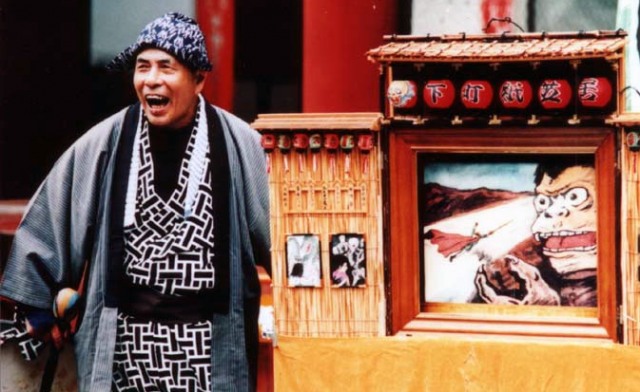
From the early 1920s through the late 1950s, before television became a fixture in Japanese homes, audiences flocked to kamishibai performances on street corners and parks around the country. A kamishibaiya (storyteller) would pedal from village to village with a butai (small wooden stage) perched on the back of his bicycle. When he arrived in a new community, he would click two sticks together to announce his presence, selling candy to the growing assembly of children. He would then show the audience a series of colorfully painted panels that told a story in much the same fashion as a comic book, narrating as he removed them one at a time from the butai.

At the height of its popularity in the 1930s, nearly five million people attended kamishibai performances every day. There were kamishibai for every demographic: sentimental tales about kittens and orphans for girls, adventure stories about masked heroes and mountaineers for boys, and pulpy mysteries and historical dramas for adults. A small army of artists and writers cranked out new installments of popular stories such as Golden Bat, Tiger Boy, Prince Gamma, and Cry of the Andes, providing an important training ground for such postwar manga-ka as Kazuo Koike, Sanpei Shirato, and Shigeru Mizuki.

A contemporary kamishibaiya performs in front of a butai.

Mizuki’s best-known comic, GeGeGe no Kitaro, traces its roots to the 1930s, when kamishibaiya around Japan performed Hakaba no Kitaro, a supernatural tale about a yokai boy who lived in a graveyard. Though Mizuki didn’t create Kitaro, he was responsible for adapting Hakaba no Kitaro into manga form, publishing his first Kitaro stories for the akabon (rental comics) market in 1959. Kitaro eventually found a home at Weekly Shonen Magazine in 1966, where the editors renamed it GeGeGe no Kitaro. Kitaro proved immensely popular, spawning animated television shows, feature-length movies, and video games, not to mention numerous manga sequels in Shonen Sunday, Shonen Action, and Shukan Jitsuwa.

Despite its immense popularity in Japan, none of the GeGeGe no Kitaro manga have been licensed for the North American market. In 2002, Kodansha International hired Ralph McCarthy to translate a handful of the Weekly Shonen Magazine stories, collecting them in three bilingual editions. Those volumes are scarce — at least on this side of the Pacific — although I was able to snag the first on eBay for less than $20. (Caveat emptor: Some Amazon retailers are asking as much as $345.00 for a single volume of the Kodansha Bilingual Comics edition.)

Looking through the pages of volume one, the story’s roots in kamishibai are apparent. The first chapter, “Ghost Train,” is a classic example of comeuppance theater: after two Tokyo businessmen abuse Kitaro and his sidekick Ratman, the men find themselves aboard a mysterious train whose final destination is Tama-reien (Tama Cemetery). The pacing suggests a story told at a campfire, allowing the audience to savor the word play (all the stops on the Tama-reien line have eerie names), the description of the passengers, and the two businessmen’s growing sense of terror. Though the pictures carry the weight of the storytelling, Mizuki uses an omniscient narrator to heighten the reader’s awareness of sound. “The skeleton-thin attendant blew his flute, and a tram came screeching into the station like a rickety hearse,” the narrator informs us. “The door rattled open like the door to a crematorium.”

The narrator serves another important purpose as well, filling in the gap between images, just as a kamishibayai would have done in the 1930s. Towards the end of the story, for example, the two men decide to leap from the train, rather than ride it to its final destination. Mizuki draws their awkward jump, then cuts to an image of the ghost train speeding along a dark track, barely distinguishable from the night sky and grassy wasteland it traverses. “Their heads cracked against something hard — rocks, perhaps,” the narrator explains. “A wail of agony splits the air, then all was silence once again.” This statement proves essential to setting up the story’s punchline, bringing the men’s ordeal to a dramatically suggestive end that is deftly clarified in the last four panels.

The second chapter, “The Leviathing,” owes a debt to such kamishibai mainstays as Golden Bat and Prince Gamma, serial adventures that freely mixed elements of science fiction, mystery, and fantasy. In “Leviathing,” Kitaro joins a scientific expedition to New Guinea, where an unscrupulous scientist injects Kitaro with a prehistoric animal’s blood, transforming Kitaro into a hairy, seven-story beast with the head of a whale and the body of a yeti.

As in “Ghost Train,” an omniscent narrator plays an important role in advancing the story, describing the changes in setting, and revealing the limitations of Kitaro’s new form. “Kitaro tried to yell, ‘Father!’, but all that came out was the Leviathing’s roar,” the narrator intones. “He put down his frightened father and walked away.”

Vital as the narration may be, it’s the artwork that underscores the poignancy of Kitaro’s situation. Mizuki draws the Leviathing in a dramatically different fashion when viewed from below than when viewed close-up: from the perspective of a human bystander, the Leviathing is monstrous, with an enormous, gaping mouth and short, grasping arms. Up close, however, he’s a gentle creature, capable of frowning, sighing, and shedding tears. These close-ups help remind us that it’s Kitaro trapped inside this destructive body, unable to communicate with humans or yokai; there’s simply no place for a giant prehistoric creature in such a thoroughly urbanized landscape, a point underscored by the military’s brutal efforts to eradicate Kitaro by driving him out to sea.

Although “The Leviathing” may strike readers as a sci-fi romp and not a ghost story, it illustrates one of the series’ most important themes: displacement. In many of the Kitaro stories, he struggles to find a place for himself — and his yokai friends — in an increasingly modernized world. As Jonathan Clements observes,

Mizuki was one of the first manga creators to deal with the rush of modernity, depicting Japanese ghosts largely as peaceful, gentle creatures forced into action by the encroachment of human civilisation on their remote, secluded places of haunting. In particular, he cited electric light as the main nemesis of spirits from the otherworld, giving his stories an elegiac quality that celebrates Japanese folktale traditions, even as he laments their passing.

Readers familiar with GeGeGe no Kitaro from its numerous film and television adaptations may find the bilingual edition a frustrating introduction to the manga, as many of the series’ colorful supporting players — Daddy Eyeball, Catchick, and The Sand Witch — play minor-to-nonexistent roles in the first volume. Readers interested in manga’s history, however, will find the first volume of the bilingual edition a fascinating window into the pre-war Japanese entertainment industry, offering English-speakers a hint of the stories and storytelling practices that once enchanted Japanese audiences on street corners around the country. Below, you’ll find a short bibliography of articles and books about Kitaro and kamishibai, should you wish to learn more about this famous character’s roots.

For Further Reading

Clements, Jonathan. “Spooky Ooky.” Schoolgirl Milky Crisis. 13 September 2010. <http://schoolgirlmilkycrisis.com/blog/?p=1710>. Accessed 11/6/11.

Kobayashi, Kenji and Kelly Yamamoto. “Kamishibai Theater.” Japanese American National Museum. <http://www.janm.org/janmkids/kamishibai.php>. Accessed 11/7/11.

Kyogoku, Natsuhiko. “Afterword.” GeGeGe no Kitaro, Vol. 1. Trans. Ralph F. McCarthy. New York: Kodansha International, 2002. 123-25.

McCarthy, Helen. “Spooky Kitaro’s Sixth Generation.” Suite 101. 6 May 2008. <http://helen-mccarthy.suite101.com/spooky-kitaros-sixth-generation-a52997>. Accessed 11/6/11.

Nash, Eric. Manga Kamishibai: The Art of Japanese Paper Theater. New York: Harry N. Abrams, 2009.

Filed Under: Manga Critic, REVIEWS Tagged With: GeGeGe no Kitaro, Shigeru Mizuki, Shonen, Yokai

The Drops of God, Vol. 1

November 7, 2011 by David Welsh

I promise to use only one wine metaphor in this review of the first volume of The Drops of God (Vertical): it gets better after it has a chance to breathe. The first few chapters of Tadashi Agi and Shu Okimoto’s tale of wine aficionados are kind of a slog.

There’s a behavior known as “mansplaining,” and I certainly think there’s a variation of it, “fansplaining.” You’ve all been engaged in conversation with someone who’s passionate about a particular entertainment who proceeds to bury you under unsolicited detail delivered with an unsettling degree of authority. (I’ve been both victim and perpetrator; I have no illusions about that.)

And Drops of God is absolutely fansplaining manga as only a certain type of seinen can be. Even though its protagonist is a novice to the world of wine, he’s surrounded by people who aren’t, and he’s thrust into a situation where he has to join their informed ranks. And the audience must gauge their tolerance for the level of detail they can endure regarding varietals, vineyards, rankings, price, and so on. There’s a lot of that, and the world of wine is often viewed as kind of byzantine and elitist and twee to begin with.

Personally, I can deal with a lot of fictional fansplaining if the characters are engaging. That’s why the first couple of chapters of this volume worried me. The leads came off as fairly flat, cookie-cutter versions of types you can see in literally a hundred different licensed manga: the brash, ignorant hero who happens to be enough of a savant to unsettle his highly trained, elitist rival, especially with the help of a book-smart rookie. Agi and Okimoto almost literally drown them in exposition in the early going, and I was kind of anxious that this eagerly anticipated title would turn into a charmless, didactic experience.

Then, a few chapters in, the creators start to relax a bit. The hero, Shizuku, reveals himself to be kind of an endearing dork. Yes, he’s suspiciously astute in terms of his ability to evaluate wine by taste, even though he tastes it for the first time in this comic, but he’s a pretty funny guy. Trainee sommelier Shinohara doesn’t quite transcend the thanklessness of her role as “girl who knows things but has no real personal stakes,” but I like her well enough.

The ostensible plot is a contest between Shizuku and a snooty wine critic to see who’s worthy of inheriting the legendary wine collection of Shizuku’s late father, a snooty wine critic in his own right. But the series really seems to be more about teaching readers about wine by showing the ways it can influence people’s character. Agi and Okimoto prove themselves to be pretty deft with that sort of thing, and, lectures aside, it’s the sort of thing I really enjoy in a manga.

It’s about hooch, it’s got amiable stars, and you can learn stuff about a subject that may be new to you while occasionally enjoying the comfortable structure of competition manga. I’m in for the duration.


Filed Under: REVIEWS

Gate 7, Vol. 1

November 7, 2011 by Sean Gaffney

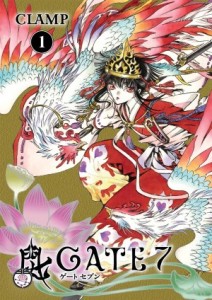
By CLAMP. Released in Japan by Shueisha, serialization ongoing in the magazine Jump Square. Released in North America by Dark Horse.

It’s been a busy fall for CLAMP here in North America. xxxHOLIC is finishing out its run at Del Rey, The re-release of X is out this week from Viz, and their new series, Gate 7, has come out from Dark Horse. This one runs in Shueisha’s Jump Square, which is still shonen but is well known for experimentation. And, like its parent magazine Weekly Shonen Jump, also has a large female readership. Which plays right into what CLAMP does best.

The trouble with giving the audience what they want, of course, is that they do not particularly want originality, or experimentation, or new things. What an audience typically wants is the same story told over and over, only with the names changed so we can pretend that they’re different characters. Heck, sometimes CLAMP even bypasses that, relying on using tried and tested characters in new situations (Tsubasa, X…). Of course, the problem with this is that reading the first volume of a new work of theirs can feel a bit like making ticks on a list.

Let’s see, straight man hero who seems to exist to be exasperated, befuddled, and ask questions: check. With a supernatural secret: check. Meets up with two complementary hot, long-legged and tall guys who may or may not be lovers but the fandom will have decided they are from panel one: check. And a mysterious person of ambiguous gender to hook up with the hero, again giving a frisson of BL while still having an out if the creators do decide they need them female for some reason: check. And the entire plot, about a war between two sides to see who can gain the powers of demons.

So I think we’ve established that this is The Pick Of The Best Of Some Recently Repeated CLAMP Hits Again, Vol. 2. That said, CLAMP would have to work much harder than they are to tell a boring story, and the whole thing ends up being interesting and a page-turner almost despite itself. Working in the Edo period history is not only a good way to ground everything, but quite timely given how many Edo period manga are coming out here these days. The lead is nice enough, even if his “history buff” trait screams of a plot device. I wish he’d have more personality, but I suspect if he got upset he’d be a complete Watanuki clone, instead of just half of one. Hana is Hina from Suki with added powers: still having that same sense of childlike naivete that everyone wants to protect. Tachibana and Sakura are any number of types, but in this volume I was most reminded of Kurogane and Fai.

See how I try to talk about how I still found the manga enjoyable, but ended up drifting off into how everything reminded me of something else again? Yeah, I think I’ll have to go with that. CLAMP are now marketing nostalgia for CLAMP. And this title is for everyone who liked X and Tokyo Babylon and RG Veda and Tsubasa and wants to set their empty glass down on CLAMP’s bar and say “Another, please!” And y’know, it’s still pretty tasty, even if you know exactly what you’re getting.

Filed Under: REVIEWS

Oresama Teacher, Vol. 5

November 6, 2011 by Sean Gaffney

By Izumi Tsubaki. Released in Japan by Hakusensha, serialization ongoing in the magazine Hana to Yume. Released in North America by Viz.

In the last volume of Oresama Techer, it was non-stop wall-to-wall delinquency. Here we get a change of pace, and we see a few chapters of Mafuyu managing to deal with life as herself. Although, being who she is, delinquency is never all that far away…

The cliffhanger kiss from last volume is rightly tossed away quickly. Despite a bit of tease, this is not particularly a romance manga. Instead, we start off with our two leads showing us once again that they completely fail at anything resembling normal in their life. Mafuyu’s idea of beach couple fun is straight out of shoujo manga (old-school shoujo, not the modern HtY-style), and Takaomi is far more interested in working off steam and starting fights. He’s always been menacing in a comedic way in the prior volumes, now we get another glimpse of the sort of beast lurking within – Mafuyu is awestruck, and she should be.

Takaomi actually gets a bit of backstory here, though its presentation is fairly elliptical. Given the author’s style, both here and in The Magic Touch, her previous series, I’d say it’s 50-50 whether the subtlety is deliberate or accidental. Tsubaki-san is fantastic at basic gag comedy – even more here than in her prior series – and her pacing has improved monumentally. But plotting is still a weakness, and it’s noticeable even in this volume, which is a collection of ‘breather’ anecdotes. No one is reading this series to discover Takaomi’s past, or to see which guy Mafuyu will hook up with. (Contrast this with The Wallflower, another gag manga, where people *are* reading it for the romance – and thus are far more annoyed.)

Still, you can get away with this as long as the book is funny. And it’s funny. I read this while I was depressed over having no power this week, and it managed to buoy me right up. There’s facial expression comedy – the entire sequence with the ninja boy, and the contrast between his stolid expression and his actions, capped by Mafuyu and Takaomi’s stares. There’s character-based comedy – the entire sequence with the rich girl and her butler, typing in with Takaomi’s past and featuring him being both brutal (he carries the heiress around like a sack, as he’s used to doing with Mafuyu) and touching (his yelling at the butler to step up and not be satisfied with what little he has). And there’s the purely random “what the hell” style Osaka comedy (the entire sequence with the flower arranging club, or Sakurada imagining Mafuyu revealing that she’s really an alpaca wearing a human skin).

This volume was not as strong as previous ones – the extended 4-koma series at the end reeked of filler – but it’s still great fun. And now that Hayasaka has managed to tick off another villain with his sheer denseness, I expect things to get even worse for the public morals committee. Perhaps we may even need to see the return in Volume 6 of… SUPER BUN!

Filed Under: REVIEWS

Cross Game, Vol. 5

November 5, 2011 by Sean Gaffney

By Mitsuru Adachi. Released in Japan in 2 separate volumes by Shogakukan, serialized in the magazine Shonen Sunday. Released in North America by Viz.

At last, we can now talk about the big secret that comes halfway through Cross Game. Well, after we finish up the big game, of course. It’s an 8-volume series, and we’ve still got four to go. Will our team manage to defeat their rivals and go to the Koshien in their second year, and first with Ko and Azuma?

Hi, spoiler on the cover, thanks for ruining everything as always. In any case, no, of course they don’t. Sports manga have to follow a certain pattern, after all. Ko and Azuma and company have no had to experience the harsh realities of competition nearly enough. And Ryuou is a very good team. We really know that they’re going to win when we’re introduced to the likeable players they have behind the two supposed “superstars” – calm and patient Mishima to contrast with overhyped slugger Shimano, and cocky yet analytical phenom Oikawa replacing the cool – perhaps too cool ace pitcher Matsushima. It’s no coincidence that both replacements mirror Seishu’s own Ko and Azuma.

So yes, Ryuou wins and goes to the Koshien, and Ko and Azuma get a reminder that they’re not perfect yet – but also that they have another year to go. There’s lots of the usual Adachi touches here. Ko’s apology to the third years who will be graduating, and their hug. Ko’s fatigue and injuries, and his pitching through them. Aoba, once again, asking what Wakaba would be like were she there. (Her sister’s reply is both accurate and eerie foreshadowing.) Half the enjoyment of this manga is re-reading it and picking out little subtle bits you missed the first time around.

As for what Wakaba would be like were she around, well, one merely needs to look at the cover, which clearly shows Aoba standing next to a teenage Wakaba… oh, wait, no it isn’t. Instead, it’s Adachi using one of the hoarier cliches in fiction – the lookalike of the dead romantic interest. There’s a new soba shop in town, and their daughter, Akane (come on, he HAS to be trolling Takahashi here, even if it is a common Japanese name) is a dead ringer for a 17-year-old Wakaba… well, at least that’s what everyone isn’t saying. There’s a lot of stunned gazes, a few muttered asides, and some discussion of “ghosts growing older”, but mostly what we see here is Ko and Aoba trying to deal with her mere presence. They both, typically, share the same reaction – they’ve no idea if she looks like Wakaba as a teen or not, as Wakaba is still 12 in their heads.

As with the previous section, the second half of the volume is rife with fantastic character moments. Azuma’s quiet happiness at seeing his brother being cheerful, and his needling of Ko about fulfilling Wakaba’s dream – and Aoba’s, since she can’t participate. Mizuki doing his best to be nice and helpful to Aoba, but never quite getting the hang of it, mostly as he tries hard to do what Ko does naturally by being a brat towards her. Aoba’s detailed research on Akane, and Ko’s annoyance that everyone seems to assume that he’ll end up with her the moment she arrives. (Clearly they read the same big book of cliches Adachi did). And of course Akane herself, mostly still a nice, polite cipher, but her increasing puzzlement at everyone staring at her as if she’d grown a third head is apparent.

I remain ecstatically happy that Viz picked this series up. I do hope they do more Adachi in the future (digital?), but for now I will enjoy this, a release once again appropriate for the season – baseball is wrapping up, time to move on.

Filed Under: REVIEWS

  • « Go to Previous Page
  • Page 1
  • Interim pages omitted …
  • Page 289
  • Page 290
  • Page 291
  • Page 292
  • Page 293
  • Interim pages omitted …
  • Page 346
  • Go to Next Page »
 | Log in
Copyright © 2010 Manga Bookshelf | Powered by WordPress & the Genesis Framework