• Skip to primary navigation
  • Skip to main content
  • Skip to primary sidebar
  • Home
  • About Us
    • Privacy Policy
    • Comment Policy
    • Disclosures & Disclaimers
  • Resources
    • Links, Essays & Articles
    • Fandomology!
    • CLAMP Directory
    • BlogRoll
  • Features & Columns
    • 3 Things Thursday
    • Adventures in the Key of Shoujo
    • Bit & Blips (game reviews)
    • BL BOOKRACK
    • Bookshelf Briefs
    • Bringing the Drama
    • Comic Conversion
    • Fanservice Friday
    • Going Digital
    • It Came From the Sinosphere
    • License This!
    • Magazine no Mori
    • My Week in Manga
    • OFF THE SHELF
    • Not By Manga Alone
    • PICK OF THE WEEK
    • Subtitles & Sensibility
    • Weekly Shonen Jump Recaps
  • Manga Moveable Feast
    • MMF Full Archive
    • Yun Kouga
    • CLAMP
    • Shojo Beat
    • Osamu Tezuka
    • Sailor Moon
    • Fruits Basket
    • Takehiko Inoue
    • Wild Adapter
    • One Piece
    • After School Nightmare
    • Karakuri Odette
    • Paradise Kiss
    • The Color Trilogy
    • To Terra…
    • Sexy Voice & Robo
  • Browse by Author
    • Sean Gaffney
    • Anna Neatrour
    • Michelle Smith
    • Katherine Dacey
    • MJ
    • Brigid Alverson
    • Travis Anderson
    • Phillip Anthony
    • Derek Bown
    • Jaci Dahlvang
    • Angela Eastman
    • Erica Friedman
    • Sara K.
    • Megan Purdy
    • Emily Snodgrass
    • Nancy Thistlethwaite
    • Eva Volin
    • David Welsh
  • MB Blogs
    • A Case Suitable For Treatment
    • Experiments in Manga
    • MangaBlog
    • The Manga Critic
    • Manga Report
    • Soliloquy in Blue
    • Manga Curmudgeon (archive)

Manga Bookshelf

Discussion, Resources, Roundtables, & Reviews

Reviews

A Devil and Her Love Song, Vol. 4

September 19, 2012 by Katherine Dacey

A Devil and Her Love Song has been one of 2012’s best surprises. Though the series uneven — and sometimes a little silly — its heroine is one of the most memorable in the Shojo Beat canon. Maria Kawai looks like a mean girl on the surface: she’s pretty and unsparingly blunt, pointing out her classmates’ insecurities with all the delicacy of Dr. Phil. Yet Maria’s bull-in-a-china-shop demeanor reflects her own uncertainty about how to be the kind of person who’s liked for who she is, not the kind of person who’s admired for telling unpleasant truths. And that makes her interesting.

Early in volume four, for example, Maria confronts queen bee Ayu in the bathroom, where she finds Ayu primping for the television cameras. When Maria questions Ayu’s behavior — “But you look the same,” she tells Ayu — Ayu is furious. Maria, however, persists — not because she wants the embarrass a rival, but because she wants to share a hard-won piece of advice. “If someone likes you, or wants to get to know you, it’s not because of how you look,” she tells Ayu. “It’s because you show them how you feel.”

Ayu’s subsequent behavior, however, points to one of the series’ weaknesses: characters have epiphanies with whiplash-inducing frequency. (Saul would never have made it to Damascus if he fell off his donkey as many times as Maria’s classmates do.) Though some of these epiphanies feel genuine, many are contrived: would an alpha girl suddenly confess her feelings to a cute boy in front of all her friends, risking public rejection? Or the class darling admit that she’s actually a nasty manipulator, risking her popularity? Those are nice fantasies, but not very plausible ones; Tomori is working too hard to convince us that Maria’s classmates secretly wish they could be more like her, and not giving group-think and fear enough due.

The series also relies heavily on shopworn gimmicks to advance the plot. The arrival of a television crew in volume three, for example, serves no useful purpose; they disappear for long stretches at a home, only to materialize when the plot demands that someone bear witness to the class’ antics. Maria’s long-running feud with her teacher, too, feels more like an editor’s suggestion than an original idea. To be sure, a student as outspoken as Maria might infuriate a certain kind of adult, but her teacher’s cartoonish behavior renders him ineffective; his actions seem too obvious, too ripe for exposure, for him to pose a real threat to Maria.

Where A Devil and Her Love Song shines is in Maria’s one-on-one interactions with other students. These scenes remind us that everyone is wearing a mask in high school — even Maria, whose sharp comments are as much a pose as Hana’s forced cheerfulness. Though Tomori nails the mean-girl dynamic in all its exquisite awfulness, the best of these exchanges belong to Maria and Shin. Their will-they-won’t-they tension is certainly an effective narrative hook, but what makes these scenes compelling is their honesty. Tomori captures her characters’ body language and fitful conversations, which unfold in fragments, silences, and sudden bursts of feeling, rather than eloquent declarations.

I don’t know about you, but that’s how I remember high school, as a time when I had flashes of insight and bravery, but a lot more moments of cringe-inducing stupidity, cowardice, or tongue-tied helplessness. That Tomori captures adolescence in all its discomfort while still writing a romance that’s fun, readable, and sometimes endearingly silly, is proof of her skill. Now if she could just ditch the television crew and the evil teacher…

Review copy provided by VIZ Media.

A DEVIL AND HER LONG SONG • BY MIYOSHI TOMORI • VIZ MEDIA • 200 pp. • RATING: TEEN (13+)

Filed Under: Manga, Manga Critic, REVIEWS Tagged With: Miyoshi Tomori, shojo, shojo beat, VIZ

Hayate the Combat Butler, Vol. 20

September 19, 2012 by Sean Gaffney

By Kenjiro Hata. Released in Japan as “Hayate no Gotoku!” by Shogakukan, serialization ongoing in the magazine Shonen Sunday. Released in North America by Viz.

In general, you find two types of Hayate fans when you look at your average message board discussing the series. Those who appreciate that this is, at heart, a comedic gag manga, and those who do not. To be fair, Hata does not make this easy for us. Indeed, Volumes 23-24 will be almost entirely gagless, as was Vol. 18. Hata brought this on himself by creating, as part of his comedy manga, a classic harem manga where you genuinely *don’t* have a clue which way it will eventually resolve. And the interaction of the girls with Hayate can be adorable, heartwarming, and fluffy. Thus, when Hata decides after a particularly shippy chapter to suddenly do something incredibly silly with Fumi, or a fanservicey plot that goes nowhere with Izumi and company, fans who want harem resolution (i.e., more Hinagiku and Maria) tend to get irritated.

Fortunately for the romance fans, Volume 20 should keep them very happy indeed. There are no real pointless gag chapters (though there is much humor), and lots of character development – well, the closest one gets in a title where nothing can be resolved. We open with the resolution of the Las Vegas story, as Wataru and Saki manage to finally get one over on his mother and escape. Wataru’s ambivalent feelings towards her are nicely portrayed – he acknowledges that she’s a horrible, immature person who is not ready to raise her son even though he’s a teenager – but she is still his mother, and should she show up at his door one day, he’d likely take her in.

Parents in Hayate tend to get a raw deal – there are no less than three different characters whose parents have saddled them with a huge amount of debt and run off, Nagi’s grandfather seems to be the main villain of the series, and Mikoto is happy to use and abuse even her own son. Interestingly, we also see far more of Nagi’s late mother (in flashbacks) in this volume than in any of the previous ones. She is the one exception – she’s allowed to be, as she is dead – and seems to be a kind and loving, if flakey, mother. I sometimes wonder if all the parents of our current gang knew each other growing up (it’s clear some of them did), and are taking it out on the next generation. Luckily, Hayate and company seem to be a bit more with it.

On the love front, Ayumu has drawn Hina out to where she can admit her love for Hayate openly as long as there’s no one else around. Progress! Of course, actual conversation with Hayate is still awkward – they both tend to put their foot in their mouth a lot – and she’s annoyed when she realizes that, because she’s strong and Hayate trusts her to take care of herself, he may not see her as feminine. As for Ayumu, she’s still the most mature of the cast, and gets to think what most North American harem fans don’t want to hear – that Nagi is the most important person in his life right now. (If Hayate resolves with a Nagi ending, by the way, watch this fandom crash and burn even faster than School Rumble and Negima did. This is why so many harems are unresolved…)

So now everyone’s in Greece, having fun and accidentally ending up in underground tunnels. You know, the usual vacation antics. If I recall correctly, we still have a ways to go before we get back to the serious Athena scenes (and yes, there are also folks who primarily read Hayate, a gag manga, for the serious parts), so when Vol. 21 comes out the usual six months from now, expect hijinks! Meanwhile, this is a great volume for fans of the series – though obviously a bad place for newcomers to jump in.

Filed Under: REVIEWS

One Piece, Vol. 64

September 17, 2012 by Sean Gaffney

By Eiichiro Oda. Released in Japan by Shueisha, serialization ongoing in the magazine Weekly Shonen Jump. Released in North America by Viz.

The Fishman Island arc, considering that we spent such a long time waiting for it to finally arrive, has been n unfortunate mixed bag so far. And that doesn’t really change with this volume, as while there are a lot of cool things going on, some good dialogue and humor, and some interesting bad guys, for once I wish that Oda would try pacing a little more like Bleach and let things slow down a bit.

The Straw Hat Pirates (plus Jimbei) are on the cover of this particular volume, and they do all get to show off their respective skills, in Oda’s standard shonen “see how I have grown stronger!” montage. Indeed, Zoro is captured and put into a cage (along with Usopp and Brook), but you get the sense that he barely treats it as something more than a minor inconvenience – he’s faced off against worse than this. Robin, meanwhile, can seemingly not only duplicate body parts but also herself now (let’s see Usopp try to imitate that!), and Nami gets to steal something for the first time in what seems like forever.

Speaking of Nami, given that we were at Fishman Island we were always going to touch on her past at some point. After the long flashback, Jimbei apologizes to her for not stopping Arlong, but this is an older, more mature Nami, and she can mourn the past while still looking forward to the future, and realizes that she’s met her crew and had grand adventures because of all this as well. It’s very heartwarming (as the rest of the cast seems to note, as several tear up in a “this is so heartwarming!!!” moment).

You would think Oda would have his hands full dealing with the prejudice moral that’s running through this arc, but apparently that wasn’t quite enough, so we also have some drug abuse going on, with the bad guys taking the Fishman equivalent of stimulants to keep going. As for the bad guys themselves, we meet Hody’s four lieutenants here, who are basically all variations on ‘goofy Fish guy Oda thought up to be funny’. There’s the one who adds sound effects to his sentences, the one whose camouflage is so good he gets run over, and the Drunken Master, just for a nice Hong Kong reference. Like Vander Decken, they are there to be bad guys you want to see beaten down but also enjoy reading about.

And so we finally start getting into the big fight about 2/3 through this book. It took longer than I thought – Luffy’s brief battle with Jimbei was particularly pointless filler but it’s here at last. So I’m hoping for some really good fights to take my mind off the fact that this arc is, for Oda, pretty mediocre. I mean, it’s still worth picking up – this is One Piece, and I don’t think Oda is capable of making anything not entertaining – but it’s not as fulfilling as what has come before it.

Filed Under: REVIEWS

Pretty Guardian Sailor Moon, Vol. 7

September 16, 2012 by Sean Gaffney

By Naoko Takeuchi. Released in Japan as “Bishoujo Senshi Sailor Moon” by Kodansha, serialized in the magazine Nakayoshi. Released in North America by Kodansha Comics.

Sailor Moon continues to introduce us to the Outer Senshi and their way of dealing with things in this volume. It can be a bit hard to take, and the anime was never quite sure when to quit with the whole ‘no, we are right and you are wrong’ schtick. To be fair, one can argue that it’s all that the Outers know. We see, in their flashback (and note that their memories of past lives seem MUCH clearer than the Inner Senshi pasts have ever been) that they basically patrol their solitary planets looking for distant threats. They don’t even have cute animal companions to keep them company. And the one time they were able to do something, it was pushing the big red ‘PRESS THIS TO DESTROY UNIVERSE’ button of summoning Sailor Saturn. So it stands to reason they’d regard this as something that’s their job, and has to be done their way. Plus they’re two years older than Usagi and company. For a teenager, that’s, like, FOREVER.

That said, it’s Sailor Moon’s manga, and you know she’s going to be right in the end, so it can be a bit aggravating to see them try to do the whole ‘go away and let us handle this’ thing. Luckily, there are several moments that endear them to us. For one, I loved that, immediately after Setsuna’s memories awaken and she reclaims her powers as Pluto, she rushes to embrace Chibi-Moon. From a story perspective, Pluto’s death was devastating to Chibi-Moon the most, so it stands to reason that if you’re going to retcon it (and I don’t remotely understand how Pluto gets reincarnated in the past, but hey, timey-wimey ball and all that) you’d better reclaim that emotional moment. Pluto’s joy at seeing Chibi-Moon is equally fantastic. Of course, once that’s over she joins the Outers in their aloofness, but hey, can’t have everything.

I know that it’s a common theme throughout all 12 volumes of the manga, but it always seemed to me that S really ramped up the idea of possession as an attack to an insane degree. Here the Inners and Outers get pitted against each other by pumping up their negative emotions, we see Kaolinite (back when she was just Kaori, presumably) getting possessed by Pharaoh 90, and of course there’s Hotaru, whose success at fighting off the Evil Mistress Nine within her is even more admirable in this context, given that nobody else seems to have any luck fighting anything off at all. Speaking of Hotaru, her father in the manga is a really evil bastard, who it’s made clear seems to have been off the rails even BEFORE turning evil, so no redemption for him as you may have seen in the anime. That said, Hotaru’s reaction to all this is sweet and loving, even as a disembodied spirit.

Lastly, while bonds of friendship, love and respect are all very well and good, there’s a lovely reminder that being a senshi is a calling rather than a cute little fantasy. Most magical girl manga tend to have their heroines thinking of romance first and foremost – and indeed Usagi is fairly typical in that regard – but we’ve seen over and over again that this is a lifetime profession for Sailor Moon and the others – and that the lifetime is going to last MUCH LONGER than most. The Witches Five (brought back to life again, in one of the poorer plot choices in the entire series – don’t kill off minions if you need them again!) each taunt the Inners with the idea that there are other careers they could be doing – doctor, fortune-teller, florist, idol – that they’re sacrificing by choosing to be a senshi and help Sailor Moon instead. This is not a one-time theme, and will become even more important in the SuperS arc that follows this.

This isn’t a perfect volume of Sailor Moon – it’s a bit more messy and chaotic than it’s been in the past, and there’s more shouting at everyone else than I’d like (most of it designed to fill up pages while we wait for Mistress Nine to be powerful enough to break out). But, as noted above, it’s filled with food for thought, and now that we have all our ducks in a row we’re ready for a powerful climax. Will the Outers have to kill Hotaru to save the world? (Note: if you want this to remain secret, try not to look at the color pages for this volume.)

Filed Under: REVIEWS

Dorohedoro, Vol. 7

September 12, 2012 by Sean Gaffney

By Q Hayashida. Released in Japan by Shogakukan, serialization ongoing in the magazine Ikki. Released in North America by Viz.

Once again I am struck by how much this manga develops close bonds of friendship and respect between people who, were they in the real world, would be horrible monsters. En and his gang, Caiman’s ongoing search for Nikaido, even Kasukabe’s strangely distant yet loving relationship with his (as yet unseen) wife. The reason I bang on about how much I like Dorohedoro is that its world building makes it FEEL like a world. This is a place where life goes on even when the protagonists are not on screen, and has people whose priorities are more than simply helping the hero carry out his master plan. Let’s face it, finding your lost friend is all well and good, but there are pies to be sold!

And Dorohedoro also has a glorious sense of humor, not afraid to let everyone embarrass themselves in the name of broad comedy. Thus we have Pieman, Caiman’s alter ego while in En’s mansion, who looks like a refugee from Burger Time with fake breasts. Even better, not only does Caiman pretend to be Tanba’s new wife, but he finds himself getting too into the role, needing to actually remember what he’s here for. As for the pie battle itself (between Tanba and a rival merchant/ex-girlfriend), it ends the way you’d think, even with the use of supernatural aid on the enemies’ side.

There is also Risu and his attempts to connect with a gang of cross-eyed. I will admit that I still tend to find the parts of the manga with Risu a weak point of the book, mostly as he’s simply not as boisterous as our 4 protagonists and not as downtroddenly pathetic as Fujita. I know he has a story that will pay off down the road, however, so it’s worth paying attention. Likewise, I find Chota’s obsession with En to be a bit much, but then that’s how it’s supposed to be. And his imitation of Nikaido is quite funny (you just know this will end badly for him).

There’s darkness afoot, though – this is still a dark and gory manga. First we have Nikaido, still possessed for about half of this book, getting her back sliced open by… well, as she says it’s not caiman, but it’s certainly connected to him in some way, just as Risu is. Unpleasant stuff, especially given how happy-go-lucky Caiman is in general (there’s a nice heartwarming flashback to how he and Nikaido first meet, and he gets his name). Secondly, when chasing after Kasukabe and company, who have gone to visit his wife and found some nasty goons instead, Shin and Noi get the crap beaten out of them – indeed, Shin gets left for dead. Which no doubt will prove to be a mistake, as the cliffhanger shows a not-dead Shin preparing to wreak his revenge.

The beauty of Dorohedoro, in addition to his morally grey but fun characters and its amazing crapsack world, is that after finishing a volume you can’t wait to see what’s next. That’s absolutely the case here. Bring on Vol. 8, I have to know how Shin wins!

Filed Under: REVIEWS

OreImo, Vol. 1

September 10, 2012 by Sean Gaffney

By Tsukasa Fushimi, Sakura Ikeda, and Hiro Kanzaki. Released in Japan as Ore no Imōto ga Konna ni Kawaii Wake ga Nai by ASCII Media Works, serialized in the magazine Dengeki G’s. Released in North America by Dark Horse Comics.

After reviewing I Don’t Like You At All, Big Brother!, I have to admit that I was not particularly looking forward to OreImo, which does not quite swim in the same waters but is in the same general area, featuring a sister who may harbor closer feelings for her brother than most would be comfortable with. So readers may be pleased to know that I didn’t really hate this, it cleared the low bar that I had set it when I came into it. That said, there’s a lot here that I found awkward, overdone or creepy too. Japanese harem manga lately seems to not only find originality unnecessary, but positively revels in its cliches, and you can see that going on here.

The premise of this work, which is also translated as “My Little Sister Can’t Be This Cute!”, is that our generic everyhero Kyousuke discovers that his pretty, popular and standoffish younger sister Kirino has a secret fetish for anime and otaku stuff. Specifically, she loves H-games. And even more specifically, she loves H-games based around older brother/younger sister incest. When confronted about this, she’s upset, but even more she’s relieved that she can finally talk to someone about it, even if it’s her brother. Kyousuke is (of course) a Really Nice Guy, so he tries to find ways to get her to make friends and be able to not repress everything until she’s unhappy. This is hard, as she’s a massive tsundere (see the cover image), but eventually she bonds with a grumpy goth and a busty Gundam fanatic, and all seems well. At least until their father finds her porn…

Let’s start with the things I liked. All the characters are more likeable than IDLYAA,BB. Kyousuke may be a generic everyhero, but at least he *is* the nice variety, trying to do his best for his little sister, bonding with his childhood friend who clearly has a massive crush on him (that he doesn’t see), and so forth. The emphasis in this title is clearly meant to be about the two kids growing closer and opening up as family, with the incest providing a plot setup but (I hope) not really the main thrust of everything that happens. It’s lower-key and sweeter, and the humor is more character based. I also liked the Gundam Girl, who seems poised to be this series’ Cool Big Sis, and who I suspect is hiding something behind those huge otaku-parody glasses.

Now for the bad. The art is terrible. This is not all that uncommon in light novel adaptations these days, but unfortunately it really caught my attention here. All the girls are 14 but look about 4-5 years younger, and the artist has this very odd habit of drawing smiling happy girls as if they’ve just been drugged. Also, I suspect someone took Ikeda aside after the first four chapters and said “Yo, tone it down”, as the overemphasis on asses and the incestual imaginings vanish rapidly when we reach the halfway point and things get less big brother-ey.

The other problem is simply that there’s not really much here that’s new and exciting. A harem comedy with a tsundere lead and a generic male who will, no doubt, get involved in all sorts of wacky misunderstandings, with the ‘gimmick’ being that the supposed cool and beautiful younger sister character is actually an otaku with a slight big brother fetish. The brother-sister incest thing is very big in Japan right now, as a quick look at the bestsellers charts may tell you, but in and of itself it’s not all that interesting. Indeed, I Don’t Like You At All, Big Brother! is at least upfront about its perversions. OreImo’s attempt to be the kinder, gentler incest title comes off as more boring than anything else.

Filed Under: REVIEWS

Otomen, Vol. 13

September 9, 2012 by Sean Gaffney

By Aya Kanno. Released in Japan by Hakusensha, serialization ongoing in the magazine Bessatsu Hana to Yume (“Betsuhana”). Released in North America by Viz.

Note that I say ‘serialization ongoing’ up there. One might be forgiven, after reading the final two chapters here, in thinking that Otomen ends with this volume, wrapping up on a high note where we finally see a bit more into Ryo’s psyche and see Asuka struggle with what he wants to do with his future. But fitting as it might be, it’s not the end – these chapters ran in early 2011 in Japan, and the manga is still going in Betsuhana, so we have at least three more volumes to go, including one Viz has scheduled for January.

This is not, however, to take away from what might be one of Kanno’s best volumes in this series. It was deliberately written to focus on Ryo, who also gets the cover, albeit disguised as a boy. 3/4 of the book has her meeting up with a judo club that’s being taught poorly by its physically skilled captain whose frustrations make him completely incapable of leading. After seeing him attack one of his students, Ryo throws him into a wall, where he “breaks his arm”. Now Ryo has to dress up as a boy and lead the judo team to victory against their opponents… who happen to by her own school. This means she will have to fight Asuka.

If this sounds incredibly cliched, clearly you haven’t read Otomen before, which specializes in taking the most hideously cliched plots imaginable and doing something with them. In this particular case there are two plots interweaving, both involving Ryo. The main one has her making the judo team into a force of awesome. They have skills, as Sakata (the captain Ryo took over for) has drilled things into them, albeit poorly. Seeing what she can make of them sends Sakata spiraling into despair and self-loathing (not helped by the fact that he doesn’t realize the boy teaching them is Ryo at first, so we get a standard ‘why do I have feelings for this guy?’ reaction) and declaring he’s quitting. Ryo, who can see the good guy underneath, asks if he’ll stay if Odo is victorious. Eventually we *don’t* get our expected Asuka vs. Ryo match, as Sakata breaks his cast (showing he was faking, as we suspected) and demands to fight Asuka himself.

Asuka has a smaller role here, but it’s important – Juta plants a seed of uncertainty in his head about Ryo, and Asuka can’t stop thinking about it. Even after he learns what Ryo is doing, he still puts on a false front in front of her. Because let’s face it, Ryo is not the most demonstrative of people. He’s said he loves her three times now, as well as dated her, and her reactions seems to be more of a cheery “Okee doke!” than anything else. Here, helped out by her father and Sakata, Ryo is starting to realize that her lack of direct expression is bothering Asuka, and she does something about it. THIS. This is what I wanted from this series all along – a direct, honest statement from Ryo that she is also in love with Asuka, as well as some insight into her inner thought process. Very well done.

Then there’s the last chapter. It’s Valentine’s Day, but this is Otomen, so naturally the guys are the ones giving out the chocolate. In between this, we see them all discussing plans for their future, as he’s expected to inherit the family business… but isn’t sure he really wants to do that. Making matters worse, everyone else seems to have a firm goal in mind – including Ryo, who is following in her father’s footsteps in becoming a police officer. This is another chapter that’s more about the heart than the laughs, though I did laugh at Asuka’s realization of what it is he truly wants – or more accurately, what he’s focused on when it happens (truly an otomen to the end). His response, however, is fantastic, and leads to that ending which I told you feels like the end of the series, but isn’t. I hope (and pray!) that finally we can move away from “are we truly a couple?” stories and show Asuka and Ryo growing and getting closer.

Of course, Asuka’s mother probably has a few things to say about this. We’re not done, and I will look forward to Otomen 14 in January. But this particular volume put its foot on the ‘heartwarming’ pedal and never let up, and finally gave focus to one of my favorite characters in the series. Very well done.

Also, anyone notice that the guys in Otomen blush constantly, and Ryo never does? There’s only one time in the volume we see her blush, and it’s not at either of the two places I expected.

Filed Under: REVIEWS

Bunny Drop, Vol. 6

September 5, 2012 by Sean Gaffney

By Yumi Unita. Released in Japan as “Usagi Drop” by Shodensha, serialized in the magazine Feel Young. Released in North America by Yen Press.

Please do not discuss Bunny Drop beyond Vol. 6 in the comments. At all.

When I reviewed Vol. 5, I noted that I couldn’t wait to see what direction Unita would take things, even though I thought it would make me cringe. And I was 100% correct – this entire volume is like a giant train wreck, where both of the main ‘ships’ we could be rooting for are faced with tortured reality.

Last time around, we had been told about Kouki’s ‘bad boy’ period in middle school, and now we get to see it in the form of an extended flashback. Which is good, as it really gives us insight as to why Rin has decided that she’s no longer ‘romantically’ inclined towards him. The two of them walked that fine line between ‘like brother and sister’ and small crush last time, but seeing Akari’s wholehearted efforts to drive Rin away, you can’t help but feel horrible for her. Cyber-bullying isn’t just an American thing.

This is paralleled with the ongoing not-relationship between Daikichi and Kouki’s mother, who still doesn’t have a first name (and likely never will, sadly). Their conversation at the end of the volume is all about wishing things could be different but having to move forward anyway, and it almost feels like Nitani-san cares about Daikichi too much to get involved with him. They’ve been there for each other in order to raise their children, but this has perhaps led both of them to be too self-sacrificing – Nitani-san is marrying someone else so that Daikichi can move on and find anotehr as well. The whole scene is heartbreaking.

Rin and Kouki aren’t as sad, but they’re equally hemmed in by feelings that things have moved beyond a point where everyone can go back to how it was before. This is helped, of course, by Akari, who Rin confronts when she tricks Kouki into thinking she’s pregnant. There’s a nice effort to show Akari’s side of things, which isn’t sympathetic at all, but it’s quite understandable – and mercenary. Akari wants to be her own woman, and if that means abusing the love of a gullible high schooler for money, well hey. Unfortunately, all this seems to have done is shown Rin that she needs to get over Kouki, and she tells him so – though notably getting over him is not as simple as she thinks, judging by her red-eyed face the next day.

We all make bad choices in life, and wish that we could turn back the clock and do things better. But we can’t, and that’s what this volume is all about. There’s no going back in time so Nitani could meet Daikichi when she was younger. There’s no do-overs so Kouki isn’t sucked in by Akari’s schemes. And sometimes you can’t fix things, and you have to accept it and move on. Which is where we are now in this series that, while it still has a lot of quiet and cute moments, has come an awful long way from the saga of a young guy raising an adorable daughter.

Filed Under: REVIEWS

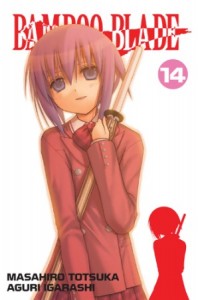
Bamboo Blade, Vol. 14

September 3, 2012 by Sean Gaffney

By Masahiro Totsuka and Aguri Igarashi. Released in Japan by Square Enix, serialized in the magazine Young Gangan. Released in North America by Yen Press.

Throughout the 14 volumes of Bamboo Blade, we’ve seen its heroine, Tamaki Kawazoe, grow and evolve. She’s always been an amazing kendo student, but that’s not her goal, or her passion, or even her hobby – it’s just what she does. Meeting with Kirino and the others has helped bring her out of her shell, and she’s learned the value or true friendship, but they aren’t able to challenge her enough in regards to kendo. Now, after her defeat by Erina in Vol. 13, we come to the final volume, where Tama-chan spends half of it asking: why do people do kendo?

Everyone’s answer is slightly different, but they all end the same. Azuma uses kendo to improve herself (and make up for her hopeless study habits); Miya-Miya, in addition to finding beating the hell out of everyone fun, wants to see how strong she can be and how far she can go. Saya, who’s suffered from being the ‘comedy character’ in a manga filled with them, finally admits that kendo gives her discipline she needs to grow up. Kirino, of course, simply lives and breathes kendo. It’s surprising to realize that, like Tama, she hasn’t had a real reason for doing kendo beyond “I love it!”, but given her simple and direct personality, this fits. Yuuji and Kojiro-sensei both chime in briefly, but are savvy enough to note that Tama-chan has to find this answer by herself.

Everyone’s final ‘real reason’ for doing kendo is elided out at first, and we only hear it once Tama-chan is back in her bedroom, watching a tape provided for her of her mother on a kendo TV show years ago. Her mother is asked the exact same question, and notes that she wants to make everyone feel the same joy and satisfaction in kendo that she does – its ideals, it’s disciplines, its purity – and that she teaches to to this. And then we flash to the end of everyone’s answer, the one thing all the other girls said. They want to be like Tama-chan. She is their goal, what they are pushing themselves to. And as she breaks down in cathartic tears (part grief over her mother’s death, part simply feeling the weight of everything, and part because she now has that goal), she knows what it is she wants to do kendo for. To be a teacher.

And this ties back in with Kojiro-sensei. I’ll admit, when the series began I had little time for him, putting up with his waffling and goofball tendencies because I liked the rest of the cast so much. But he’s grown just as much as Tama-chan has, and it’s also due to kendo. Seeing him strive to teach the girls how to use kendo to further themselves, and realizing what he can and cannot do in that regard (much of the series has been his angsting about not finding the right way to teach something), he knows he wants to keep doing this – but not with these girls, who he feels have learned all they can from him. He’s leaving for a different school to start with a new class of beginners. We only see Kirino’s reaction to this (and she outright says she’s refraining from saying what she thinks…), but I think they’ll understand his reasoning, just like they did with Tama-chan.

Despite the comedy throughout (even the last climactic battle features Saya (of course) getting herself in trouble by not having eaten for 48 hours prior out of nerves), Bamboo Blade has been almost the pinnacle of idealistic sports manga. If someone is at a loose end in life, or trying to make a change, or needing to find something within themselves… all this can be found through kendo. It’s a trend we see in a lot of sports manga, be it baseball, soccer, or what have you. but despite the idealism (or because of it), this is a manga that really makes you feel good about yourself, and have confidence in the lives of its cast. And it’s not just our 5 heroines – even the ‘rival’ characters such as Sakaki and Erina find strength and fulfillment in kendo, and in bringing kendo to others. Filled with emotional moments, goofy comedy, and of course awesome sports battles, anyone who likes to see humanity striving for a goal should read Bamboo Blade, where kendo will have the answers.

Filed Under: REVIEWS

A Certain Scientific Railgun, Vol. 5

August 22, 2012 by Sean Gaffney

By Kazuma Kamachi and Motoi Fuyukawa. Released in Japan as “Toaru Kagaku no Railgun” by ASCII Media Works, serialization ongoing in the magazine Dengeki Daioh. Released in North America by Seven Seas.

As we get into Vol. 5 of Railgun, it strikes me how many sociopathic killers are really in this series. It’s a whole lot. Misaka has found out about the experiment where 20,000 of her clones are killed off in order to force a Level 5 to get even higher, but that’s just the tip of the iceberg. Academy City and its dedication to science clearly continues to have a dark and sordid underbelly, and I doubt that the enemies this time will be as misguided but ultimately likeable as in the Level Upper arc.

First we have Accelerator, this arc’s “Big Bad”, who just finished brutally murdering Misaka 9982 at the end of last volume. The real Misaka is understandably upset by this, and does her best to try to make Accelerator see reason, or at least beat the shit out of him. This is especially true when she hears his motives are simply power, thus making the killings even more appalling. There’s a short battle, but a) it becomes clear that Misaka is severely outclassed by her enemy, and b) the clones stop things fairly quickly, pointing out that if he defeats the real Railgun now, that sort of ruins the experiment.

So now Misaka knows about the experiment, and has to stop it. The clones are of no help at all, as they don’t value their own lives so can only point out how easy it 9is to build new ones. She briefly has the help of Shinobu, a scientist who is trying to fix things after realizing that the clones are more than just lab rats. But for the most part it’s just Misaka straightforwardly trying to destroy the experiment by destroying every single site where it takes place – all 10 of them, supposedly used to combat muscular dystrophy. Yes, it’s Misaka the terrorist. Given that the hero of the main series, Touma, tends to solve problems by simply punching them very hard, it’s somehow fitting that our heroine is cut from the same cloth – if there are no more labs, there will be no more experiment.

Of course, things aren’t made that easy, as we also meet ITEM, the anti-terrorist group sent off to take Misaka out. These are basically child soldiers, with a slightly older leader, and are, like Accelerator, rather blase about all the people they have killed. The team is actually balanced nicely between two hotheads who glory in killing and torture, and two cool stoics who seem more blase about the whole thing. Naturally, it’s the hotheads who get most of the focus, and as we see a 10-year-old girl brag about the number of people she’s killed, we are reminded again what kind of environment this is.

And so in the end Misaka thinks she’s won, but somehow I doubt it. Blow up 10 labs, and 10 more will spring up. This is about defeating an entire scientific culture, and that will take far more than electroshock therapy. Luckily, we have an exciting cliffhanger, where… she sees Touma at a vending machine! Gasp! (This is actually more exciting to those who have read or seen A Certain Magical Index, as the two stories now join up, all of the past two volumes having been prelude.) Will she ask Touma for help? Or just be tsundere at him? It’s been a while since we’ve seen that side of her…

Filed Under: REVIEWS

I Don’t Like You At All, Big Brother!!, Vol. 1-2

August 20, 2012 by Sean Gaffney

By Kouichi Kusano. Released in Japan as “Oniichan no Koto Nanka Zenzen Suki ja Nai n da kara ne!!” by Futabasha, serialization ongoing in the online magazine Web Comic High!. Released in North America by Seven Seas.

People follow trends. It’s just a way of life. When something is popular, the first instinct of a business looking for profit, or writer looking for a surefire seller, is ‘what did it do and how can I use that to replicate it?’ And this is fine sometimes. I’ve known many derivative works that have been very good and sometimes even surpassed the original. But too often someone goes too far. Either they miss the original point that was being made, or they deviate in an unacceptable manner, or they add too many other, equally trendy things to make a giant stew of trends that all cancel each other out.

And incest as a sexual thrill is, god help us, popular these days. Especially in Japan. Naturally, *genuine* incest seems to be saved for the actual porn magazines, but there’s no end of manga and (more importantly) anime that feature guys crushing on their sisters, and girls worshiping their brothers. Usually at some point they find out they aren’t related after all. Other popular trends in anime these days include the tsundere type who says mean things and hits the object of her affection as she’s too embarrassed. And let’s not forget the pretty, reserved princess type who secretly turns out to be a stalker and pervert.

If all this sounds like a lot of moe animes seen in the past five years, it’s by design. I’ll be honest, I had initially confused this title with ‘My Little Sister Can’t Be This Cute’, which comes out next month by Dark Horse, and has a somewhat better reputation. IDLYAA,BB!! features Nao, who loves her older brother a lot (the title may have given that away), despite his being a somewhat perverse non-entity in these two volumes. She goes to wake him up every day by hitting him (and giving him calculated panty flashes) and throws out anything in his porn doujinshi that it’s brother/sister incest. In fact, when told that she’s actually not related to him after all, this *depresses* her briefly, as it ruins the incest fantasy she’s been going for for so long.

This may seem rather hardcore for what’s meant to be a typical seinen title for horny guys, but rest assured there’s no actual sex, merely piles and piles of suggestion (though I note this is the author’s first ‘mainstream’ work after years of drawing adult titles). And to be fair, Nao’s obsession is treated in-story as immature and wrong. Then we meet our second heroine, Iroha, a long-lost childhood friend who meets Nao’s brother after all these years and proceeds to sexually assault him. This is actually one of the few interesting scenes in the book – it’s presented as incredibly disturbing (after all, we’re meant to root for Nao), and her brother’s horrified reaction to it, and realization that he may have led to her turning out this way, is a brief moment of soul searching that could be interesting… if it weren’t undone by Nao and Iroha’s determination to make sure that their man stays perverted and does not ‘turn over a new leaf’.

There’s a couple more things to like here – Nao’s two female friends are meant to function as a Greek chorus of sorts, and their reactions towards the end of the book at all the slapstick are well done – but to be honest, I have rarely seen a manga that seemed to calculated to hit as many fetishes as possible as this one. If you enjoy perverse moe harem comedies, well, I think you’ll get a big kick out of this, though even the most hardcore fan might finish the volume and say, “Erm, isn’t this a bit over the top?”

Filed Under: REVIEWS

Sakuran

August 15, 2012 by Sean Gaffney

By Moyoco Anno. Released in Japan by Kodansha, serialized in the magazine Evening. Released in North America by Vertical.

The oiran, or high-ranking courtesan, is a very popular character in manga of the Edo period. We’ve seen them solving crimes, manipulating high level politicians, and craftily playing one side against another. We have even, occasionally, seen them entertaining clients. However, a lot of those plots have been typical manga fodder, and the life of a typical Edo brothel worker is far more painful, degrading and tortuous. Sakuran shows us the story of Kiyoha, a strong-willed and rebellious girl who must be broken (but not completely) into the role of a courtesan.

We meet Kiyoha when she’s a child, and a good deal of the book is witnessing her grow up. Well, to a certain degree. One good thing about Anno’s characterization of her heroine is that Kiyoha can be quite unlikeable at times – willful, stubborn, quick to violence. They’re qualities that *also* make for a good oiran – the job is so grinding and will-breaking – this is forced prostitution we’re talking about – that only the strong can hope to survive. (Note that Kiyoha makes friends at one point with another cute and lively girl, and briefly bonds with her… before the other girl dies (the dialogue makes it unclear if she killed herself or was beaten to death). And indeed, once Kiyoha comes of age and rises to the level of oiran, she is noted for both her young beauty and her cynical smile.

We see Kiyoha try to escape quite a few times, but it’s made clear that the ideal way to escape is to have a man take so much notice of you that he proposes – buys out your contract. We see this with Kiyoha’s mentor Shohi, who I think comes off the best out of everyone in this manga. She’s certainly cruel and sadistic to Kiyoha, but it’s that sort of ‘it’s in order to make you stronger’ mentoring that always seems to pay off in the end. There’s nothing Shohi can *do* for Kiyoha in this environment except that. Notably, Kiyoha’s own love affair, which is made out to be more ‘illicit’, does not end nearly as well.

The ending of Sakuran can be seen as a bit bleak. After her most successful escape attempt yet, Kiyoha realizes that things on the outside are not any better for her than life in the brothel. She says in dialogue that she returned on her own, and in her inner monologue (showing us scenes of her being punished and tortured) that she feels better now that she knows there’s no ‘better world’ to go to. Kiyoha, unlike Shohi, does not seem to be the sort who can simply gain the favor of a rich man in a way that would get her out of there – I think she’d sabotage it. At least in the way she is now. The manga is open ended in that you question how broken she really is. I like to think that she still has a lot of strength in her.

The tension between what is needed to be a good oiran and the fact that it also makes a person realize how awful their life is and yearn for freedom is the core of Sakuran. Combined with Anno’s stunningly gorgeous artwork (you can argue everyone looks too similar, but that’s more a function of the time period than the artist), you have a manga whose images and ideas will stay with you long after you read it.

Filed Under: REVIEWS

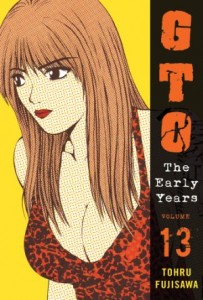
GTO: The Early Years, Vol. 13

August 13, 2012 by Sean Gaffney

By Toru Fujisawa. Released in Japan as “Shonan Jun’ai Gumi” by Kodansha, serialized in the magazine Weekly Shonen Magazine. Released in North America by Vertical.

It always seems as though there’s more dumb comedy in the Early Years manga than comes up in its sequels featuring Onizuka. Now, I’m sure if I went back and checked all of GTO this would not be the case – GTO has some monumentally silly things going on, and I’ve noted just last week how much dumb fun is in 14 Days in Shonan – but here Onizuka has the better excuse of actually being an immature high schooler, meaning that he and his friends lend themselves even well to situations that make one cry with laughter and weep at the stupidity of all involved.

First, though, we get some more epic fighting, as Onizuka still has to resolve his rivalry with Mafuyu, who is determined to take on Eileen, the one that killed his brother. Now, I figured out that Eileen was actually the name of a tropical event right off the bat, meaning it can be grating seeing everyone going around just NOT GETTING that Eileen isn’t a woman. But it leads to some interesting situations, as well as some epic surfing. We also get a very shonen moment where Onizuka is taking on a group of washed-out ex-military Americans, as he notes that saying ‘dreams will die’ and ‘know your limits’ is something that happens to other people. Oh, and showing them the wrath of a true Japanese person, of course. (It almost reads like the U.S. and Japan are rival gangs here, probably deliberately.)

After this, which takes half the volume, the other half is devoted to far shorter and sillier situations. We are reminded that this manga takes place in the late 80s/early 90s with Onizuka’s obsession with bootleg video porn. We see a chapter devoted to Onizuka’s mother, and realize just how horrible it must be trying to deal with a kid like him. There’s an amusing parody of Kindaichi Case Files where Onizuka and friends try to solve the murder of one of their own (spoiler: he’s not really dead). And after his mother finally throws him out, we see Onizuka and Danma moving into a roach-infested rathole of an apartment, which brings its own levels of disgusting humor.

And then there’s the Russian night vision goggles. First off, I really like how Onizuka and Danma are shown here as the leaders of their gang. Even though everything spiraled out of control because of their underlings being stupid and not getting the point, they still don’t back down from a fight, because, well, they’re leaders. Secondly, the idea of a shonen title spending this long discussing night vision goggles being used to masturbate while watching a neighbor strip through a peephole is simply mind-numbing. I’ve noted before that Shonen Magazine seems more ‘mature’ than its rivals Jump and Sunday, and apparently that was the case 20 years ago as well. This leads to an amazing finale, which for once features Danma as the stupider one. He likes to pretend he’s the more mature, especially given he actually has a girlfriend and has gotten lucky, unlike Onizuka, but the peephole situation (which I don’t care spoil) shows he can be even more perverse when it gets right down to it.

I can see why this was such a big success for teenage boys in Japan. Even though I doubt that’s the market for it here, fans of Onizuka should really pick up this prequel, which features less teaching but just as much badassery.

Filed Under: REVIEWS

GTO: 14 Days in Shonan, Vol. 4

August 8, 2012 by Sean Gaffney

By Toru Fujisawa. Released in Japan by Kodansha, serialized in the magazine Weekly Shonen Magazine. Released in North America by Vertical.

It may come as a surprise to those reading GTO 14 Days, and noting its onging bevy of nudity and sexual situations (without any actual sex, of course), that it runs in Weekly Shonen Magazine, a title that supposedly has the same age 10-13 dynamic as its competitors Shonen Jump and Shonen Sunday. But Shonen Magazine skews much older than those two in reality, as readers of Akamatsu’s love comedies and the romantic hijinks of GE Good Ending could tell you. That said, talk to any 10-13 year old boy and I think you’ll find ‘boobies!’ is high on their list of priorities. And it’s not just the nudity: some of the pasts revealed in 14 Days are dark and definitely seem not for kids, but kids their age *do* deal with abuse and abandonment. Best not to sugarcoat it… or at least sugarcoat it with Onizuka’s brand of goofy humor.

It’s all about keeping a balance, and knowing when it’s OK to do action-adventure suspense stuff and when perversion is needed. Onizuka’s own life is balanced this way, as we’ve seen him use toilet humor and lechery as a mask to hide behind when he wants to avoid discussing serious situations. In the case of this volume, however, it’s Ayame and her shattered illusions that provide the humor. She’s gotten a biased sense of Onizuka through Fuyutsuki’s image of him, and was rather taken aback at Shinomi’s violent reaction last time. But here, seeing him ogling her in the bath, running around with his “tackle out”, and seemingly unable to take on assassins in a desperate emergency simply as they’re dressed like strippers, Ayame realizes that Onizuka really is just a horny guy after all.

Which is for the best, as now she can appreciate his better sides even more. It’s not as if knowing the ‘real’ Onizuka stopped Shinomi from falling in love with him, and seeing the brief instance in the hospital when she thinks he’s dead is rather touching, even if it quickly leads back to humor of the “how dare you make me reveal my emotions” variety. And his dogged persistence in helping these kids no matter what, getting them to see that they don’t have to turn out bad, and sheer nigh-invulnerability to physical attacks are also on display here, for those who love it when Onizuka gets badass.

Likewise, the situations these kids are in have to be deepened, or else their lives will be seen by the manga reader as a checklist. “Well, he’s solved Seiya’s problems, so who’s next?” But he hasn’t solved Seiya’s problems. He’s gotten him to think seriously about them, but there’s been pressure Onizuka doesn’t know about (not just twins, but evil twins!) and the end of this volume seems to have come full circle in that we see Seiya ready to confront his stepfather with violence. It’s also a good thing that we not only see a flashback showing the abuse that he suffered at his mom’s boyfriends hands, but also another showing his mother’s abandonment, and how it affected him just as hard. These are complex situations that Onizuka can’t just solve by punching people and giving inspirational speeches. Well, not ENTIRELY by that, at least.

Another cliffhanger for this volume, but I expect that nxt time we’ll move on to the twins Riko and Miko, who look to be even harder to get through to. (The twins are apparently popular in Japan – they got their own spinoff after 14 Days ended.) But for manga about inspirational, never say die teachers who nevertheless cannot resist looking at naked women, there’s no better than GTO.

Filed Under: REVIEWS

Book Girl and the Wayfarer’s Lamentation

August 6, 2012 by Sean Gaffney

By Mizuki Nomura. Released in Japan by Enterbrain. Released in North America by Yen Press.

This volume of Book Girl does not introduce a new situation of tragic consequences that resonate with our hero’s own past and causes him to grow and change a little more. We’re done with that. Instead, we tie the previous four books together and bring things full circle, as Konoha must confront his past head on, deal with the return of his objectified girl, and realize that despite all the growth he’s made in this last year, he still has quite a ways to go.

These books are all told from Konoha’s point of view, and thus sometimes things can happen around him that he is unaware of. This is especially true of this volume, but Nomura-san is very skilled at letting the reader in on things that Konoha either doesn’t know or is deliberately deluding himself about. Those who have been frustrated by Konoha’s attitude in the past are not going to find this book any easier to delve into. Indeed, as a reader I found myself identifying more with Akutagawa, who is clearly sympathetic to Konoha, but also can’t stand what he’s doing to Kotobuki (and himself). There’s a wonderful scene where Akutagawa lays everything out for Konoha to see, with an expression on his face that says “you aren’t going to believe this or care but I am doing it anyway, dammit.” When his frustration boils over into violence, it’s very cathartic.

Speaking of Kotobuki, I think I’m finally coming to like her. It’s taken a while – she was very stereotypical to start with – but as she’s opened up we’ve seen more of her inner turmoil, and here we see her risking everything in order to protect Konoha. It’s inspiring, but also rather sad, as I think by the end of the book, despite what he may say, he’s no closer to Kotobuki than he was when the book began.

And then there’s Takeda. I’d mentioned in my review of the third volume that it was rather refreshing seeing how in this series, people’s issues aren’t magically fixed by page 235. And indeed, we see that sometimes they aren’t fixed at all. Takeda still puts on a mask of happiness to hide her confusion and sorrow, and now has even taken to self-harm. It’s quite interesting how she actually takes up with Ryuto, a boy who seems to delight in girls with issues, so to speak. Even by the end of the book, after another cathartic moment, we’re not sure if she’ll be OK.

And then there’s Miu. I was predisposed to liking her because of my nature (I find myself drawn to and supporting unlikeable characters), and felt that I was correct when I read the scene with a young Miu meeting Konoha, and telling him a story. Konoha’s narration of it is beautiful, and you believe that it shows you the real Asakura beneath all the anger, hatred and manipulation we’ve seen. And then, later on, that beautiful scene is thrown back at us, as we get it from Miu’s point of view and see the horrible pedestal Konoha has placed her on, leading to writer’s block and her desperate cribbing of stories from other sources. I’m not sure it makes up for everything she’s done, but at least I look forward to seeing if she can finally move on and begin to heal.

I haven’t talked all that much about the book as a book, but that’s mostly as I’m so drawn into the character’s lives. It’s a good book. Frustrating at times, but that’s the frustration of a reader towards the characters doing dumb things, not the author. I do wish we’d had more of Maki – she’s the only supporting character whose story didn’t tie into the others, and her presence at the end seems to be nothing more than ‘I need the whole cast here’ – but she apparently features heavily in Book 6, so I’ll let it go. I also haven’t mentioned Tohko, the titular Book Girl, but that’s because Tohko’s story is still so diffuse. Yes, she’s studying to get into university – barely – but she’s the one who helps others, the detective who puts everything together. We haven’t had her own story yet – clearly that will be Books 7 and 8, the finale. For now, all we get are suggestions and small tastes.

Filed Under: REVIEWS

  • « Go to Previous Page
  • Page 1
  • Interim pages omitted …
  • Page 279
  • Page 280
  • Page 281
  • Page 282
  • Page 283
  • Interim pages omitted …
  • Page 346
  • Go to Next Page »
 | Log in
Copyright © 2010 Manga Bookshelf | Powered by WordPress & the Genesis Framework