• Skip to primary navigation
  • Skip to main content
  • Skip to primary sidebar
  • Home
  • About Us
    • Privacy Policy
    • Comment Policy
    • Disclosures & Disclaimers
  • Resources
    • Links, Essays & Articles
    • Fandomology!
    • CLAMP Directory
    • BlogRoll
  • Features & Columns
    • 3 Things Thursday
    • Adventures in the Key of Shoujo
    • Bit & Blips (game reviews)
    • BL BOOKRACK
    • Bookshelf Briefs
    • Bringing the Drama
    • Comic Conversion
    • Fanservice Friday
    • Going Digital
    • It Came From the Sinosphere
    • License This!
    • Magazine no Mori
    • My Week in Manga
    • OFF THE SHELF
    • Not By Manga Alone
    • PICK OF THE WEEK
    • Subtitles & Sensibility
    • Weekly Shonen Jump Recaps
  • Manga Moveable Feast
    • MMF Full Archive
    • Yun Kouga
    • CLAMP
    • Shojo Beat
    • Osamu Tezuka
    • Sailor Moon
    • Fruits Basket
    • Takehiko Inoue
    • Wild Adapter
    • One Piece
    • After School Nightmare
    • Karakuri Odette
    • Paradise Kiss
    • The Color Trilogy
    • To Terra…
    • Sexy Voice & Robo
  • Browse by Author
    • Sean Gaffney
    • Anna Neatrour
    • Michelle Smith
    • Katherine Dacey
    • MJ
    • Brigid Alverson
    • Travis Anderson
    • Phillip Anthony
    • Derek Bown
    • Jaci Dahlvang
    • Angela Eastman
    • Erica Friedman
    • Sara K.
    • Megan Purdy
    • Emily Snodgrass
    • Nancy Thistlethwaite
    • Eva Volin
    • David Welsh
  • MB Blogs
    • A Case Suitable For Treatment
    • Experiments in Manga
    • MangaBlog
    • The Manga Critic
    • Manga Report
    • Soliloquy in Blue
    • Manga Curmudgeon (archive)

Manga Bookshelf

Discussion, Resources, Roundtables, & Reviews

Reviews

Twinkle Twinkle

June 12, 2013 by Ash Brown

Author: Kaori Ekuni
Translator: Emi Shimokawa
U.S. publisher: Vertical
ISBN: 9781932234015
Released: May 2003
Original release: 1991
Awards: Murasaki Shikibu Literary Prize

Kaori Ekuni’s novel Twinkle Twinkle was the first of her works to be translated into English. Ekuni is both a bestseller and a literary award winner in Japan. Initially she wrote poetry and children’s stories before beginning to write for a more general audience. Twinkle Twinkle, originally published in Japan in 1991, was her debut novel and earned Ekuni the Murasaki Shikibu Literary Prize in 1992. Also in 1992, Twinkle Twinkle was adapted into a film directed by Joji Matsuoka. The novel was translated into English by Emi Shimokawa and published by Vertical in 2003. (Twinkle Twinkle was actually the first book ever to be released by Vertical.) Despite being a well-known and admired author in Japan, before reading Twinkle Twinkle I was unfamiliar with Ekuni and her work. After reading Twinkle Twinkle I sincerely hope that more of her writing is translated. Currently the only other novel by Ekuni available in English is God’s Boat.

Shoko and Mutsuki married four months after they first met, much to the delight of their respective parents who feared that their progeny would never find someone to spend the rest of their lives (and hopefully have children) with. Although Shoko and Mutsuki are pleased with their arrangement, each is hiding a secret from their new in-laws. Shoko is an alcoholic and emotionally unstable while Mutsuki is gay and continues to see his long-term boyfriend Kon. Shoko and Mutsuki care for each other, but their marriage is one of convenience more than anything else. They are each free to live their lives how they choose while at the same time are able to keep up appearances for their families. It seems like a perfect marriage as long as they can prevent their parents from discovering the farce. But during their first year together things begin to unravel. Neither Shoko or Mutsuki quite realize what all of the consequences of their marriage might actually be.

Each chapter of Twinkle Twinkle alternates between Shoko and Mutsuki’s individual perspectives. It’s a great technique that lets readers see both sides of their relationship and how they view each other. It also allows a glimpse into the newlyweds’ internal states of being. Throughout the novel it is clear that both Shoko and Mutsuki deeply care about the other. They’re not exactly romantically involved and they may not be having sex together, but they both want the other to be happy and work to make that happen. It’s not always easy, though. Both of them have habits that either baffle or annoy the other and they’re not always sure what to do about it. As Twinkle Twinkle and the first year of their marriage progresses Shoko becomes increasingly unstable—anxious that she isn’t able to adequately fulfill her role. As for Mutsuki, as wonderful as he can be, he’s unable to ease Shoko’s fears; his kindness often makes matters worse.

Twinkle Twinkle is a very peculiar love story between two incredibly imperfect people. But it’s Shoko and Mutsuki’s faults and flaws that make the novel as effective as it is. No marriage is perfect and even a fake one takes a tremendous amount of effort to maintain. To make matters even more complicated there’s Kon, who at times is on better terms with Shoko than he is with Mutsuki. Kon is extremely important to both of them as well as to the story itself. Together Kon, Shoko, and Mutsuki form an intense triangle with relationship dynamics crucial to their development as people and to the development of the novel. Twinkle Twinkle is fairly light in its tone and is immensely readable, but Ekuni still manages to pack several hard-hitting punches into the narrative. Personally, I loved Twinkle Twinkle. It’s one of the best novels that I’ve read recently and I can easily see myself reading it again.
Filed Under: REVIEWS Tagged With: Kaori Ekuni, Murasaki Shikibu Literary Prize, Novels, vertical

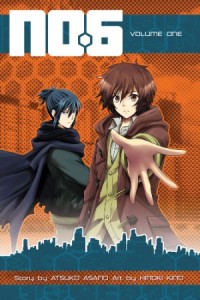
No. 6, Vol. 1

June 11, 2013 by Sean Gaffney

By Atsuko Asano and Hinoki Kino. Released in Japan by Kodansha, serialization ongoing in the magazine Aria. Released in North America by Kodansha Comics.

Dystopias are, as a general rule, not my cup of tea. Those who read this blog on a regular basis already know that I’ll forgive a lot of a story if it has a happy ending; likewise, if a series is just unrelentingly grim, all I really feel is exhausted. But that isn’t to say that a series can’t still win me over with enough interesting things going on. No. 6 is indeed one of those series. It takes place in a supposed elite utopia that turns out to have many deep, dark secrets, and our hero quickly finds out how fast events can turn against him. It’s also shoujo – it runs in Aria, Kodansha’s upscale magazine that’s competing with titles like Asuka and Wings to get the teen “not quite BL” market.

number6

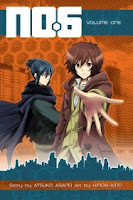
Our hero’s name is Shion, a stoic and reserved young man who is on the fast track for the elite school (and this is among a city of elites) until he lets a young fugitive, who seems to be called Rat, briefly stay at his place, and sews up his wounds. This causes him to lose that elite privilege, something which… really doesn’t bother him much. Several years later, he’s working part-time jobs and staring blankly at his female best friend, who blatantly says she wants to sex him up but is just not registering on his radar, when he comes across a hideous government conspiracy that is killing people by aging them to death. He’s rescued by Rat, and is forced to abandon his life and go on the run, where he’ll find out what the city is really like.

Passive characters like Shion have to be handled very carefully not to be boring. Luckily, these creators are doing a good job so far. Shion may be reserved, but he’s not unemotional, and I like his youthful enthusiasm (which sadly wears down as the volume goes on) and bluntness when he first meets Rat. The scenes with Safu, the aforementioned best friend, are also both quite funny and very telling. It’s not entirely clear if he’s uninterested because he’s not into girls (certainly he bonds better with Rat than he has with Safu) or if the concept of sexual love has simply never occurred to him, but it’s another thing that serves to make him watchable. (By the way, Safu will be dying at some point in this series, sacrificing her life for Shion. I don’t know any spoilers, but bank on this happening anyway, because DUR HEY.)

Rat is less successful, being more of a standard smug pretty boy who has learned not to trust anyone but can’t help but be drawn to our hero. Likewise, the government conspiracy itself, along with its Orwellian officers who administer it, are very much out of the school of Dystopias 101. The aging-to-death thing is pretty horrific, but we don’t know either of the victims long enough for it to really sink in. And the art is serviceable, but doesn’t really pull you in much.

That said, I’m interested to see what happens with Shion, who’s an intriguing enough character that I’ll try another volume of this. The genre isn’t my cup of tea, but the lead may be. And it’s a definite must-buy for anyone who likes conspiracy thrillers with overtones of possible BL romance.

Filed Under: REVIEWS

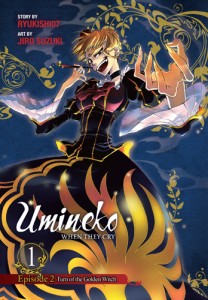
Umineko: When They Cry, Vol. 3

June 9, 2013 by Sean Gaffney

Story by Ryukishi07; Art by Jiro Suzuki. Released in Japan in two and 1/2 separate volumes as “Umineko no Naku Koro ni: Turn of the Golden Witch” by Square Enix, serialized in the magazine GFantasy. Released in North America by Yen Press.

(In case there are any Umineko obsessives reading this, please avoid any future spoilers in comments. No need to Yasu this up till we have to.)

We’ve had our first go-round, and now Umineko begins its second arc. Surprisingly, for most of this volume Battler isn’t the protagonist, either. I was expecting, as with Higurashi, a few arcs that are simply “Battler is dumb” before things really got going. Here, though, we get a wider view of the cast. The fist half of this has the servants Shannon and Kanon as the dual protagonists, showing Shannon’s love for George and how she got a chance to make that love happen, as well as Kanon’s combination of jealousy and self-loathing that balance this out. Between the two of them, Beatrice has a lot to manipulate, and that’s exactly what she does here – though Shannon, at least, is starting to see through Beatrice’s motivations. Certainly more than Battler is.

RYUKISHI07_UminekoV2E1_TP

The second half of the “island story” (more on the meta world later) focuses more on Maria and her mother Rosa, and oh dear I worry about the fandom just dropping this like a hot potato. Parental abuse is not unique to anime and manga, certainly, but it’s rare in a protagonist, and I think that’s what Ryukishi07 is trying to set Rosa up as here – particularly after the events of the first Twilight that remove the other potential adult protagonists. Her bipolar tendencies are simply hard to read, and we definitely see why Umineko fandom has sarcastically nicknamed her “BEST MOM EVER”. Maria’s not exactly helping her case, either – she’s just as hyper-annoying and creepy as she was in the first arc, and it’s easy to see (though not justify) why she would grate on every one of Rosa’s nerves. Basically, this is a horribly broken family, and putting them in a situation like this is just mean.

Which brings me to Battler and Beatrice. No, not the Battler who’s on the island, or the Beatrice who’s showing up doing magic things and dressing in stockings and short skirts; I’m talking about the Beatrice and Battler from the first arc, who are sitting over a gameboard watching as Battler tries to prove that the murders are human-caused, and Beatrice tries to prove they’re all due to magic. The arcs certainly tie together more than they do with Higurashi, and even more than that series, this one rewards re-reads – and is harsh to those who don’t pay attention. I have to say that I think Beatrice’s ‘move’ here is excellent – Battler could easily deny witches in the first arc when she was just portraits and butterflies, but now Beatrice is everywhere, flouting Battler by simply existing and doing supposed magic.

No one really reads this to identify with or bond over the characters, I hope – leaving aside the fact that they always die, these folks are simply far more unlikeable and broken than even Higurashi’s broken cast, and they’re explicitly compared to “game pieces”. No, we read this to try to figure out what’s actually happening here – particularly now that we have multiple realities stacking up with the ‘meta’ gameboard. I’m pretty sure that this arc isn’t going to give us any answers – in fact, as with Higurashi, I’m not expecting anything concrete till at least the 5th arc – but it does have a lot of pointing and shouting, and over the top faces (sometimes too over the top – I think the artists overdo it in Umineko based on the fan reaction to Higurashi’s faces), and grand guignol horror.

A manga that requires you to think about everything that’s happening, while also trying not to overthink things, seems very contradictory. But that’s Umineko in a nutshell, and if you don’t mind horrible things happening to horrible people, it’s still a great deal of fun. Especially now that Beatrice, who is pure evil on a stick, has made her grand debut.

(By the way, for those curious, Yen didn’t leave out any extras – the 2nd volume in Japan also lacked the extras Vol. 1 had.)

Filed Under: REVIEWS

Attack on Titan, Vol. 5

June 8, 2013 by Sean Gaffney

By Hajime Isayama. Released in Japan by Kodansha, serialization ongoing in the magazine Bessatsu Shonen Magazine. Released in North America by Kodansha Comics.

(There may be spoilers in this review for people who are only following the anime.)

In general, I tend to do a lot of reviews for this blog. But sometimes, I don’t have as much to say. So I am very grateful to the Manga Bookshelf team, who allow me, with their Bookshelf Briefs column, to do quick reviews of titles I can’t really spend 500+ words talking about. That said, I have my pet series, which will always get full reviews no matter what. Sailor Moon. Excel Saga. Higurashi. And now, after a few briefs, I’ve decided that Attack on Titan is going to join that crowd. Because guys, this is seriously one of the best manga out there. Its popularity is very much on the rise, helped by the release of the anime, but also by its compelling plot and fantastic characterization, which has been helped by greatly improved facial art. The art is still the weak point, but it’s not enough to make this any less gripping.

attackontitan5

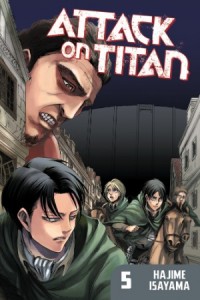
Things pick up right where last volume left off, as we’re dealing with the fallout from Eren’s Titan reveal. Eren is not quite sure about it himself, and that’s the wrong answer to give to a city that’s very much had enough of its family and friends being eaten by Titans. The military trial that follows is great, showing off the “kill him before he kills us all” folks (who are more than one group, and for different reasons) and contrasting him with the Survey Team group, who think Eren may be the best way to help them gain ground and learn about the other Titans. Levi in particular makes an instant impression (that’s him in the foreground on the cover), being that sort of commanding officer who appears cold and unfeeling but has your best interests at heart.

Eren is thus taken to a new squad, and for a moment we worry that we may not see our other main heroes again. Fear not, though: their training is over and they’re all given the opportunity to join the Survey Team themselves. The speech inspiring this is stark and depressing, deliberately so, and it’s no surprise that the majority of those who’ve been through basic training walk away. We then get a great montage of the decisions the others make to join the team. Mikasa and Armin are givens, and I’m not surprised by Reiner and Bartolt either, as they’re the strong stoic types. But Jean, Connie and Sasha are genuinely worried and scared. Sasha, in fact, is absolutely terrified, having almost been taken out by a Titan in Volume 2, to the point where she begged for her life. We get a horrific image of what it would be like for those three to be assaulted and eaten by Titans. Connie recalls his mom back home would love him to be safe with the military police. And yet, in the end, they stay and join the Team, even if Sasha and Krista are crying. (Annie leaves, though. I’m sure she’ll pop up again, though, if only to beat up more guys.)

(Note that we also have some cast who have been around, but aren’t named yet. Gosh, who is that freckled girl next to Krista, and why is she so grumpy and yet always next to her? On a completely different note, there was a somewhat depressing side story at the start of the volume, where a survey team member tries to take notes regarding the Titans before she is brutally eaten. We later see her notebook is rescued, so it’s not all for naught. This chapter was far more important in retrospect, but I think a lot of people may have been spoiled about something or other, so it’s an odd case where those spoiled go “Oh my God!” more than those who haven’t.)

So yes, we now get a merging of the two casts, as Levi and Eren’s group (which also has Zoe Hange, who is marvelous and tortures Titans FOR SCIENCE and is a great reminder that Sasha is not the only weirdo in this series) merge with Mikasa and Armin’s crowd and go merrily off to train and capture Titans. And again we’re reminded how brutal this series is, as many of the people we’ve only just come to know are cut down by Titans who are simply too fast, too large, too homicidal, and (for a cliffhanger) too clever to go quietly. Armin, in fact, realizes what the rest of us may have not – if Eren can transform into a Titan, maybe the other Titans are actually humans as well? Does that mean that the entire Corps could be full of secret Titan spies?

Leaving aside the truly ludicrous “next time” page spread – the author allows himself to have fun with these – this is another very serious volume of Attack on Titan, and you really shouldn’t get too attached to many of the people in this cast. But man, it’s an amazing read, and I just can’t wait to find out what happens next.

Filed Under: REVIEWS

No. 6, Volume 1

June 8, 2013 by Ash Brown

Creator: Hinoki Kino
Original story: Atsuko Asano

U.S. publisher: Kodansha
ISBN: 9781612623559
Released: June 2013
Original release: 2011

Hinoki Kino’s manga adaptation of No. 6 is the second adaptation of Atsuko Asano’s nine-volume series of science fiction novels to be released in English. The first, and my introduction to No. 6, was the 2011 anime adaptation directed by Kenji Nagasaki. While I largely enjoyed the anime, the rushed and fumbled ending left me disappointed. The first volume of the No. 6 manga was originally published in Japan in 2011, a few months before the anime began airing. Kodansha’s English-language edition of No. 6, Volume 1 was released in 2013. It’s highly unlikely that Asano’s original novels (which are really what I would like to read) will ever be licensed in English, and so I was intrigued when Kodansha announced that Kino’s manga adaptation would be published. Since the series is still currently being serialized in Japan, I’m hoping that the story will have a properly executed ending this time around.

On the surface, the city of No. 6 appears to be an ideal, utopic society. The crime rate is negligible. Medical and technological advancements offer its citizens unprecedented comfort and care. Shion is among the elite of the elite. Identified at a young age as a prodigy with a particular affinity for medicine and ecology, he and his mother have their every need provided for by the city. But when Shion saves the life of a young fugitive named Rat, helping him to escape, Shion is stripped of his status and special privileges. He has seen a brief glimpse of the darker side of No. 6. Four years later he’ll see even more when he stumbles upon a pair of bizarre deaths and he becomes the perfect scapegoat for the supposed murders. With his own life now in danger, Shion has a decision to make: flee No. 6 and the only life he knows or remain in a city that no longer considers him human.

The first volume of No. 6 does a nice job of establishing the series’ two main protagonists: Shion and Rat. Although the two young men share an important connection with each other, they come from very different backgrounds and have very different personalities. Shion is intelligent but sheltered and there’s a certain innocence about him. He comes across as a bit naive and socially awkward, but he is intensely curious and searches for the significance behind things. Even though most of Rat’s past hasnt’ been revealed, it is quite clear by the end of the first volume of No. 6 that he has had a much rougher time of it. He is quick-witted but world-weary and cynical. The underlying meaning of a situation isnt’ nearly as important to him as is the immediate reality. It’s simply a matter of survival. In part because they are so different, Rat and Shion find themselves drawn to each other.

After only one volume, No. 6 has yet to really distinguish itself from other dystopian fiction. It’s a fairly standard set up with a seemingly perfect society that’s not quite everything it appears to be. The manga itself often feels very rushed in places and lacking in details in others. There were a few scenes that had I not previously seen the anime would have left me momentarily confused. In the afterword Kino admits to having had to cut much more from the manga than was ideal in order not to surpass page limits. Even so, No. 6, Volume 1 provides the needed introduction to the story and outlines the world in which it takes place. I hope that now that the stage has been set that the manga will have room to breath and slow down a little. It is a different version of the story than was seen in the anime; I’m looking forward to seeing where Kino takes it.

Filed Under: REVIEWS Tagged With: Atsuko Asano, Hinoki Kino, kodansha, Kodansha Comics, manga, no. 6

Are You Alice?, Vol. 1

June 6, 2013 by Sean Gaffney

By Ikumi Katagiri and Ai Ninomiya. Released in Japan by Ichijinsha, serialization ongoing in the magazine Comic Zero-Sum. Released in North America by Yen Press.

I have often joked in the past about how North American licensors will pick up any manga with the word ‘Vampire’ in the title. It’s now looking as if that may apply to two other genres that are exploding over here: Alice in Wonderland pastiches, and survival games. Alice in the Country of Hearts sells quite well, and BTOOOM!/High School Of The Dead/Battle Royale/Doubt stuff has been in Yen’s wheelhouse for some time. As such, this book may be one of the least surprising licenses of all time. Shame it’s so dull.

areyoualice1

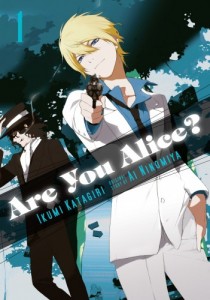
In its favor, the book does seem to get the dreamlike atmosphere and the sense that it would make more sense if only you could figure out the rules of the world. It’s also drawn quite well, with lots of pretty boys being crafty and/or manacing while looking really hot. (This ran in Zero-Sum, one of those “BL only not really” magazines Japan has.) Unlike Alice from the ‘Country Of’ series, this Alice seems to have a very clear awareness of his past in the real world, and is quite willing to do anything to escape it. That said, he’s running into problems, mostly as everyone else in this world is so smug and aggravating.

I’ve read books that start off with everyone being unlikeable before, but never have I had such a sense that this is where they’re going to be in 5-6 books time. And Alice is 7+ volumes and still running in Japan, so that’s quite an investment to have in these guys. For a lead character, Alice sure does come across as a whiny brat. The Mad Hatter’s stoicness seems more like malaise, the Cheshire Cat is amazingly two-faced… I did like The Duchess, but not only does it look like we won’t see much more of her, but it’s somewhat aggravating that the only female character in the entire series is the one placed in peril, and indeed Alice is specifically told “Your weapon cannot protect her, it can only kill”.

But my biggest problem with the series is that 200 pages later, I’m still not really sure where this is going beyond a cat and mouse game. Alice has to kill the White Rabbit in order to stay in this land (presumably Wonderland, though the backgrounds look more like an Italian cityscape than any Wonderland I’ve seen before), but they don’t meet here, so there’s no emotional investment behind it. Indeed, Alice doesn’t seem emotionally invested in much of anything, which is fine if you’re bouncing off a bunch of freaks and weirdos in the cast (say, like the Country Of series), but in a series like this where everyone else is equally detached, it leaves the reader with nothing to grab.

If I was a BL fanfic writer, I’d probably love this series. There’s lots of hot pretty guys who could get into a relationship, and none of that pesky character development that makes writing canon fics harder. They’re just two-dimensional enough to make flesh9ing out an appealing choice. I hope that in future volumes the authors might also try to do something with them, because for now, this is all flash, no substance.

Filed Under: REVIEWS

Sunny, Vol. 1

June 4, 2013 by Anna N

It makes me feel good that there are still new series coming out from Viz in the Viz Signature imprint. Sunny by Taiyo Matsumoto is also an addition to the trend of nicely packaged manga hardcovers. With a slightly larger trim size (the same as the other IKKI titles) and color pages before most chapters, this is a volume that will delight manga collectors looking for something nicer than the average paperback. I’ve only read Blue Spring by Matsumoto before, I really need to get around to reading Tekkon Kinkreet.

Sunny is written in one of my favorite fiction formats – a collection of interrelated short stores with shifting main characters that are all tied together. The Sunny of the title of the book refers to a broken down old Nissan Sunny car that sits in the back of a group home for abandoned children. The Sunny is a secret hideout, place to stash porn and other illicit materials, and a means of escape for a group of kids that doesn’t have much security or fun in their daily lives. The volume opens with a brief glimpse of foster home chaos, quickly inter cut with a scene showing the imagination of Haruo, who sits in the car imagining that he’s bleeding out in the desert like a tragic movie tough guy. Haruo’s reverie is abruptly interrupted by Junsuke, an overly hyper snotty-nosed kid who eagerly announces that there’s a new arrival in the house. The readers of Sunny and the new kid Sei both get an abrupt introduction to the children’s home as Sei goes through the house and sits in the Sunny with Haruo and Junsuke. When Sei says that his mom is going to pick him up before summer Haruo says, “No way you’re goin home. You got dumped.”

Sunny captures Haruo’s frustration and anger about his own situation, combined with his helplessness about being able to change anything. Junsuke struggles with his instinct to grab anything shiny, even stealing from his classmates at times. While Haruo is a central viewpoint character, Sunny fluidly moves among different points of view, showing Megumu’s concern for a dead cat and the real-world concerns of older kid Kenji. While there’s a lot of hopelessness in the lives of the kids who live at the home, they also stick up for each other and come together when one of them goes missing.

Matsumoto has a scratchy pen and ink style in his drawings, which incorporate cartoonish elements like circles for rosy cheeks. Washes of ink in varying intensity and hand-drawn textures instead of screentones give Sunny a hand-crafted feel that stands out among more corporate glossy manga. Matsumoto’s detailed backgrounds firmly establish the neighborhood the kids live in, as well as the run-down environment of their house. Overall, Sunny is exactly what I’d expect from the Viz Signature line – a nuanced work that is set apart from more commercial manga due to its artistic and literary value .

Filed Under: REVIEWS Tagged With: SigIKKI, sunny, viz media

The Sacred Blacksmith, Vol. 1

June 4, 2013 by Sean Gaffney

By Isao Miura and Kotaro Yamada. Released in Japan as “Seiken no Katanakaji” by Media Factory, serialization ongoing in the magazine Comic Alive. Released in North America by Seven Seas.

In general, the review of Sacred Blacksmith is simple. This is a fantasy manga that takes place in a world recovering from a Demon war, which features girls with swords, bandits, elf-girl companions, etc. If you like fantasy like that, this is probably right up your alley. It doesn’t seem to have too much problematic content so far – the hero completely and utterly outclasses the heroine, but she also gets her share of badass things to do. If I have any complaints, it’s that I wasn’t really ‘wowed’ by anything in it – “a pretty good read” is not a bad thing, but doesn’t add up to 500 words very often.

sacredblacksmith1

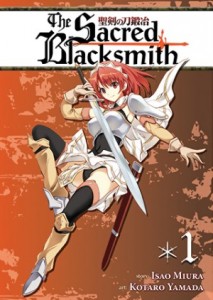
There is the old standard “the anime changed things and made male fans hate the girl more” discussion, which I’ve used before in talking about Zero’s Familiar. Cecily as seen in the manga is an OK swordswoman who gets by on guts a lot, but doesn’t back away from an enemy and has a few badass moments towards the end of the volume. In the anime, I’m led to understand, she’s a lot less competent, because… well, no idea. She’s also a tsundere, and we know how much male Western fandom hates them. The manga at one point does the “it’s my fault I’m naked in front of you but I’m embarrassed so will hit you anyway” standard, and I was amused that Luke immediately called her on this.

As for Luke, he clearly has a tragic past, and does not suffer fools gladly, but at least isn’t outright horrible to Cecily, possibly as this isn’t a shoujo manga. His familiar Lisa is there to be adorable, and she is indeed cute as a button. The art is also very good at showing the awfulness of the demonic casting, and several scenes made me wince as people were basically possessed (and sometimes consumed) by monsters. There’s sort of a tense peace going on as the book begins, and the plot is no doubt going to be attempting to stop that peace.

There’s also a lot of discussion of katanas, which are unknown to this fantasy world that is no doubt supposed to be Western Europe. Lisa even has a long, mostly textual discussion at the end of the book on how they are made and why they are superior to straight Western swords. The katana is a nice weapon, but there’s just a touch of ‘and this is why Japan is better’ to the whole thing (not that this is exclusive to this series – off the top of my head, Attack on Titan is doing similar things as well). The action scenes are solid as well, which speaks well to the artist. I never had to go back and reread to figure out what was happening.

So while there’s nothing really wrong with Sacred Blacksmith after one volume, I’m not sure it has enough oomph to really excite me either. It seems like the authors are making tick boxes on a ‘fantasy anime franchise’ checklist. Hopefully a second volume will give me a bit more to chew on.

Filed Under: REVIEWS

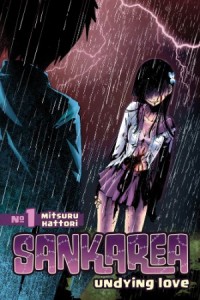
Sankarea: Undying Love, Vol. 1

June 2, 2013 by Sean Gaffney

By Mitsuru Hattori. Released in Japan as “Sankarea” by Kodansha, serialized in the magazine Bessatsu Shonen Magazine. Released in North America by Kodansha Comics.

I have been running into the same sort of problem lately with many new manga, even though most of them are completely different on the face of it. They all seem to boil down to the same thing when I review them, which is “quite readable and even better than I expected, the big downside being crushing unoriginality”. This probably does the title a disservice, as originality, particularly in recent Japanese manga, is what DOESN’T sell. In general, what readers want is “something familiar with a slightly new spin on it”. And Sankarea provides that in a perfectly readable way.

sankarea1

I should note that the cover you’re seeing is one created by the artist especially for the North American market. The original Japanese cover just has Rea staring at the reader in that sort of cute seductive ‘girl posing’ way, with absolutely nothing to suggest what the content within is like. Except, of course, the title, which is a play on words based off of a very popular zombie movie (seen over here as Zombi 2, and one of the most terrifying movies of the late 70s, if I recall.) Kodansha decided that they’d need more than ‘generic cute girl staring at reader’ to sell this, so asked for the more… gruesome shot. I approve. It’s a better cover.

As for the content, it’s mostly a fairly standard romantic comedy. Nice if somewhat weird hero, who has a cousin who’s busty and secretly likes him, as well as a younger sister who’s an emotionless stoic. At his all-boys school, we see him with his two friends, one of whom is girl-crazy and overdramatic, the other pleasant and unmemorable. They are most impressed by the perfect Japanese princess girl who’s going to the all-girls’ school across the river, who is gorgeous and popular. Except that it turns out she has a secret, which our hero quickly finds out.

So far so boring, but it’s the nature of the secret, and the nature of our hero’s weirdness, that perks things up. Rea’s father is not so much possessive as disturbing. We don’t see a lot of him in this volume, but given she’s talking about him taking nude pictures of her and his increasing paranoia at Rea being touched by other men, I think Daddy’s shaping up to be our main villain here, with a side of incestuous creeper. (To the book’s credit, this ISN’T played for laughs at all – after all, he’s not an older brother.) As for Chihiro, he’s trying to resurrect his dead cat using a magic potion that turns things into zombies. Which is presented as mildly eccentric – he’s a normal guy at heart, he just wants to bring back his cat. From there, things start to go desperately wrong.

Rea is probably the best part of the title – she’s written very well. Her sheltered upbringing is warring with her desperate Attempts to get away from her father’s smothering. Her immediate attraction to Chihiro could be read as romantic, but could also be read as a little bit unnerving – fitting for a title like this. Her zombification (yeah, sorry if I spoiled that for you, as if the cover didn’t) reads almost like a rite of passage – she demands Chihiro “accept responsibility” in a seductive voice, equating death/resurrection with loss of virginity.

The question is which direction this goes in. If it continues to do fanservice and comedy (and there is quite a bit of fanservice – particularly from Chihiro’s cousin Ranko), I’m not sure it would keep my attention. But there’s a lot of potential for both depth and darkness here. If it manages to mine those two veins, Sankarea could be a real winner.

Filed Under: REVIEWS

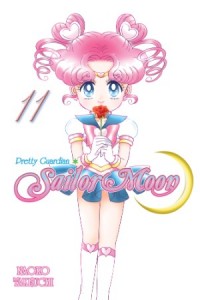
Pretty Guardian Sailor Moon, Vol. 11

May 30, 2013 by Sean Gaffney

By Naoko Takeuchi. Released in Japan as “Bishoujo Senshi Sailor Moon” by Kodansha, serialized in the magazine Nakayoshi. Released in North America by Kodansha Comics.

First off, this review has spoilers for the volume, as it’s kind of hard to discuss it without them. Second, this volume is a first for me. I’d never seen the dubbed Sailor Moon anime, and for the most part always read the manga before I saw the subbed anime – probably one reason I like the manga so much. Stars is the one exception, and I worried that I would inevitably find the manga wanting, as I seemed to when I first read it years ago. And to be fair, there is a bit of ‘let’s drag this out for one more apocalypse’ to the story. I also found it hideously rushed, even more so than usual for Takeuchi, but am putting that down to seeing the anime first. All that said, there’s still piles of stuff I want to talk about.

sailormoon11

I always recalled this being the most depressing arc, and there is certainly a lot of bleakness and death. But I liked how the volume began with everyone happy and content. Minako has now joined the others in high school (Rei is still at her private school), and everyone’s getting involved in club activities and various things that aren’t being senshi. It’s peaceful days, folks. Also, the introduction of the Three Lights leaves room for humor, particularly Yaten’s catty remarks to Michiru, leaving her in a rare instance of losing her cool. And much as I find Chibi-Chibi as puzzling as the rest of the cast, I was amused at everyone’s attempts to figure out who the hell she was.

And now on to the trauma. This is a vicious volume of Sailor Moon, probably the worst to date. By the end of the volume, all the senshi bar Sailor Moon are either dead or presumed dead. Indeed, Mercury and Jupiter get taken out so early they barely get a chance to appear. What’s more, these deaths look deadly, if you’ll pardon the expression. Takeuchi uses the same “flesh melting off” death mask she’s used before when minor villains are dispatched, and having it happen to folks like Mars or Venus seems wrong. Worst of all is Mamoru, who’s killed in front of Usagi at the airport, something so trauma-inducing that she blocked it out for months afterwards. And while Seiya and the others do note that if the Senshi Star Seeds survive, they can be reborn, it honestly feels like he’s talking about reincarnation. Or heaven.

Mars and Venus do get a few cool things to do before they’re dispatched. Rei infiltrates Minako’s school, a nice mirror to the short story where Minako did the reverse – or at least it would be if the re-release didn’t shuffle the short stories off to the end. They draw out the Three Lights, amusingly, by Minako going over the top about finding herself a man. Yaten calls her on this, noting that their duties to Usagi mean there will never be room for love in their lives (Minako in particular has heard this before – see Code Name: Sailor V). Minako smirks, and admits that this is true. She then leans into Rei and notes that the two of them have no use for men. It’s meant to be “duty over love” and threatening the Lights, but can easily be read as homoerotic if one chooses. And many do.

Speaking of senshi in general, one interesting thing going on here is the use of innocents from other planets as a sort of “failed Senshi” – their planets were destroyed by Galaxia and they’re being brainwashed/forced into attacking Earth. It’s interesting because of the Lights’ insistence that they’re all just as genuine as our heroines – on another planet, for example, Iron Mouse was Sailor Chu (yes, yes – it’s Nakayoshi, folks). Tying Lead Crow into Phobos and Deimos and Tin Nyanko into the cats thus works even better – I loved Luna’s accusation to Tin Nyanko that she’s defiling Planet Mau’s ‘One True Hero”, Sailor Mau. The Sailor Moons of other worlds are being used to kill off the cast of Sailor Moon. Which is really horrible if you think about it.

Even more than previous volumes, I find this one works best when you immerse yourself in it rather than try to understand each nuance. There’s too much going on here. But for the Sailor Moon fan, there are always so many rewards that the experience is never dull. It all ends next volume (except for the short stories).

Filed Under: REVIEWS

Demon Love Spell, Vol. 3

May 28, 2013 by Anna N

Demon Love Spell Volume 3 by Mayu Shinjo

It is nice being able to read a Mayu Shinjo series that I can wholeheartedly enjoy. There are so many overly serious paranormal romance stories out there, it is still refreshing to visit Demon Love Spell for a bit of a comedic spin on the genre. Bumbling shrine maiden Miko and overly alpha male incubus Kagura are just goofy enough to be funny but not ridiculous, and their relationship has enough character-based humor that it is easy to root for them as a couple.

This volume opens with the overly theatrical banishing of a demon by Sou Yamabuki, a former pupil of Miko’s father. Kagura in chibi-form gets jealous that Miko is crushing on Yamabuki on TV, but she assures him that she thinks he’s the coolest. At school the next day Miko gets a bunch of attention from other guys and excitedly assumes that she’s now popular with boys. Miko and Kagura go on an actual date with some great moments where Miko blackmails Kagura into ignominious activities like eating hamburgers by threatening to shrink him again. The ending of the date is interrupted by Sou, who promptly banishes the source of Miko’s new found charms – a weak succubus demon. With Sou, Shinjo explores the old standby “sudden fiance” as he decides that he needs to marry Miko in order to take her away from Kaguya. Sou also reveals that while Miko’s ability to apply her power might not be the best yet, she’s actually extremely gifted. Sou’s desires seem to center more on gaining demon fighting power than truly caring for Miko. Kaguya decides upon an extremely unorthodox method to fend off his rival, but it does show how much he actually cares for the priestess. The next main story in the volume focuses on the sudden appearance of a handsome snow demon who spends some time protecting Miko when Kaguya storms off in a huff.

I still sort of wish that some of Shinjo’s other, earlier series would be translated over here. Sensual Phrase has most other English-translated shoujo beat for unadulterated melodrama. But Demon Love Spell is a nice substitute. It has the humor of Ai Ore without going too far out into left field, and the relationship between Miko and Kaguya is nicely balanced due to the power imbalance inherit in him spending a good portion of each day as mini-figure clipped to her handbag. This was a satisfying volume of this series, and I’m looking forward to seeing what happens with Miko’s newly revealed power in future volumes.

Filed Under: REVIEWS Tagged With: demon love spell, shojo beat, viz media

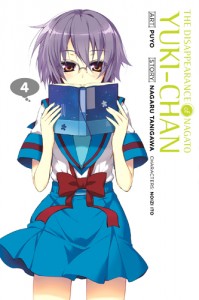
The Disappearance of Nagato Yuki-chan, Vol. 4

May 28, 2013 by Sean Gaffney

By Nagaru Tanigawa and Puyo. Released in Japan as “Nagato Yuki-chan no Shoushitsu” by Kadokawa Shoten, serialization ongoing in the magazine Young Ace. Released in North America by Yen Press.

This volume of Nagato Yuki-chan is pretty much impossible to review without spoiling the major plot twist that happens in the first chapter, be warned.

So, when we last left Yuki, she was about to be hit by a car, ending our cute little AU spinoff before it really began. Luckily, it doesn’t do major physical damage. That said, there’s something… odd about Yuki after the accident, which Ryouko, being the perfect best friend and oneesama, figures out right off the bat. Yuki seems more serious, speaks more precisely, isn’t a giant goofball, and acts more like another Nagato Yuki that readers may be far more familiar with. Yes, that’s right, this series that is an AU spinoff of a movie where Kyon crossed over into a world where Yuki was a shy adorable human is now crossing back over with the canon and dealing with a very different Nagato.

Tanigawa_YukiChanV4_TP

Please note that nowhere in the actual text does it say this. Indeed, there’s very little ‘explanation’ given at all. Yuki has an alternate personality due to the accident, which acts much like Nagato from the main Haruhi series, and everything resolves at the end of the volume with a similar lack of explanation – her mind re-orients itself and Nagato essentially says goodbye. Indeed, some may argue it’s not the canon Nagato due to the amount of emotions shown by this version – ranging from embarrassment at her stomach growling to a full-on body blush when Ryouko suggests that she may be in love with Kyon. But then again, Nagato in canon is an alien whose emotional growth is deliberately stunted by her masters. Here, she’s in a real human body and has no such tethers. So dealing with these feelings makes sense.

More to the point, Ryouko and Kyon’s reactions to this new Nagato are pitch perfect (Haruhi and Koizumi are conveniently absent for tests, so this book is pretty much just Kyon, Nagato and Ryouko). They’re both worried about what’s happened to Yuki, but both instinctively realize – even if Kyon’s much better at expressing it – that this Nagato is also her own person and shouldn’t just be treated as a clone or as if she’s “taken over” Yuki’s body. (Ryouko worries even more than usual here – also, great meta-joke about her saying she’ll just stab Kyon to relieve her stress.) There is a lack of conflict here that in most series would serve to make things rather boring – but this is the light and fluffy Suzumiya Haruhi spinoff, so it makes sense that there’s no accusations or attempts to return Yuki to her head – just calm acceptance, patience, and watching Nagato grow as a character of her own – to the point that she also falls head over heels for Kyon.

I’m not sure what the fallout from all this will be – whether Yuki will have memories of the time she spent as Nagato (it seems unlikely from what little we see) or whether Kyon will be able to deal with a love confession that wasn’t really – but I will admit that this volume really is a major step forward by Puyo, and the best in the series. Which is still light and frothy, but now deals with its characters on a level equal to its source.

Filed Under: REVIEWS

Basara, Vols 13-16

May 25, 2013 by Anna N

Whenever I pick up and read a few volumes of Basara, I’m always struck by how much story and emotion Yumi Tamura is able to pack into a few pages. I’d started rereading Basara last year, but got distracted by having too many volumes of shiny new manga. The Manga Moveable Feast seemed like a great excuse to dig up these volumes again. These volumes cover Sarasa’s journey as she escapes from prison and wages war on the desert city of Suo, only to encounter the Red King. The battle doesn’t go the way either of them planned.

Sarasa is able to escape Abashiri prison with her comrades, but she doesn’t have time to settle back and appreciate freedom again. It is time to head south and take up the struggle to determine the fate of Japan. Ageha leaves Sarasa, saying that he can’t become a crutch to make things easier for her. She has to execute her plans on her own, based on her convictions. Shuri heads to his precious desert city of Suo, but things have changed there for the worse as the administrator there Momonoi attempts to remake it in the image of Kyoto by displacing the poor and blowing up buildings. Asagi prevents a reunion between Sarasa and Shuri in a southern market, because he thinks if they each find out the truth about each other now, it would be “too dull.” Sarasa and Shuri both head to Suo with drastically different purposes.

The struggle in Suo is portrayed in mental as well as physical terms. Sarasa meets up with Hozumi, Momonoi’s son who his a non-violent artist. His girlfriend Renko runs an underground newspaper in the city. Sarasa starts unsettling the city by plastering notices that “Tatara was here” on the walls, and even flying the message from a kite. Sarasa starts to reflect a bit about what it means to be both a strong and feminine woman after spending some time with Renko. Hozumi stages his own form of protest by painting elaborate pictures on the walls of buildings slated for destruction, so people hesitate to blow them apart.

When Shuri sees the wreckage of Suo, he’s angry at what it has become. Momonoi brutalizes both Hozumi and Renko. Sarasa and Shuri both go after Momonoi for different reasons. Sarasa is nervous about being in close proximity to the Red King, the man who destroyed her village. Shuri sees that he’s not welcomed as a savior in his treasured city, and begins to reflect that his previous philosophy about a good leader inspiring fear was mistaken. Sarasa’s reinforcements come, but her plan to use Momonoi’s own explosives to cut off the palace kills the water supply for the city. The Red King’s army executes a tricky sneak attack, and the star-crossed lovers seem like they are headed towards mutual destruction. Sarasa is devastated when she realizes that she’s bring more destruction to the people of Suo. A horrible sandstorm prevents the battle from progressing further, but rather than regroup with her comrades, Sarasa runs off and finds Shuri in the chaos.

It is a little unbelievable that Sarasa and Shuri have managed to keep their identities from each other for so long, especially considering the way they both tend to show up and meet each other right around the time that Tatara and the Red King have a skirmish. It is clear now that part of reason is that they honestly don’t care, and they are both blinded by love for each other so much that they aren’t going to stop and ask inconvenient questions when they could just enjoy each other’s company. This idyll is very short, and the Red King and Tatara’s army clash the next day and Shuri and Sarasa finally get a glimpse of each other from across the battlefield.

What follows is one of the most emotionally devastating scenes in the series, as Sarasa and Shuri react to this newfound knowledge in different ways. Sarasa slips into a fugue state, forcing out commands to kill the Red King, while Shuri mechanically tries to kill himself at the suggestion of his followers because his group is so clearly outnumbered by the rebel forces. Both armies flee the battle as King Ukon’s army approaches and Ageha takes Sarasa away in an attempt to bring back Tatara. Ageha thinks “Was he…that good? Why not just take me instead?” Ageha concludes that Sarasa isn’t his “woman worth dying for” and decides to leave. Sarasa ends up finding shelter with a local priest and his family, but her destiny isn’t going to let her sit back and do nothing.

Sarasa strikes up an odd friendship with Kikune, one of the White King’s spies. Sarasa and Kikune end up befriending Lady Purple, the Black King’s estranged wife. Lady Purple ends up being another type of mentor to Sarasa, but Sarasa’s emotional healing really begins when she’s reunited with her mother. In a very nurturing way, Sarasa’s mother asks her some pointed questions about the reasons why she was fighting and what she wants the future of Japan to be.

There’s some funny yet poignant exchanges happening as Asagi has rescued Shuri, who is undergoing his own emotional rehabilitation. Asagi is all but twirling his non-existent evil mustache in an attempt to get Shuri to have some sort of emotional reaction to him, but Shuri calmly accepts the prospect of being sold into slavery by his half-brother.

Overall, these volumes server as a great emotional climax to the first half of the series. The central mystery about what would happen if Sarasa and Shuri would find out about each other has been answered, and now they have to pick up the pieces of their lives yet again. While Ageha might have given up on Sarasa, it is clear that her destiny as Tatara will not allow her to just retire into the countryside and life out the rest of her life peacefully. Shuri has his own set of trials ahead, and it will be interesting to see how both of these powerful leaders manage to build a new Japan with such strong and well-connected enemies lining up against them. One of the strengths of Basara is the way Tamura will intersperse shorter, more personal adventures into the larger struggle with the extended cast. Having Sarasa and Shuri both on their own a little bit, without their customary support systems allows them to grow more as individuals, making the battles much more human. I’m glad I set aside the time to get back with my Basara rereading program, and I’ll likely finish up rereading the rest of the series outside of this week’s manga moveable feast.

Filed Under: REVIEWS Tagged With: basara, Manga Moveable Feast, shoujo

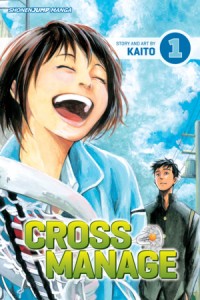
Cross Manage, Vol. 1

May 21, 2013 by Sean Gaffney

By Kaito. Released in Japan by Shueisha, serialization ongoing in the magazine Weekly Shonen Jump. Released in North America by Viz Media.

Note: this is only available digitally right now.

As I have mentioned before, sports manga and North American have a very iffy relationship, with none of the contenders really hitting the heights of Naruto or One Piece sales. That said, there’s a lot of sports manga out there, and I’ll give credit to Viz (and let’s be honest, it’s pretty much just Viz, unless I count Sasameke, WHICH I DON’T) for continuing to experiment with them. Especially as such series are HUGE in Japan, and tend to run and run. Slam Dunk was 31 volumes, Eyeshield 21 was 37. Kuroko’s Basketball is 20+, and continues to succeed despite terrorist threats (though it’s sadly not licensed here, possibly as Slam Dunk is still ongoing.) And of course we’ve had Cross Game on the Sunday side of the fence.

CrossManage1

And now we have Cross Manage, one of Viz’s ‘we’ll try a new weekly series and see if it dies in 2 volumes’ attempts they’ve had recently, and easily the most successful, given it actually seems to have survived the most recent round of cancellations in Japan. I particularly like the cover, which has Toyoguchi’s beaming face (and oh boy, does it beam – sometimes her face gets so happy it’s almost surreal) right in the foreground and Sakurai’s passive gaze in the background. Because this is about a female lacrosse team, and Sakurai is signed up/blackmailed into being their manager.

There’s a lot to love here. Toyoguchi is just great, being a perky, naive girl who looks like she could burst into a Disney song at any moment, but is also fueled by pure determination and smiles just as widely when threatening to tell everyone our hero accidentally groped her. She’s so relentlessly upbeat and caring that when Hayami shows up and attempts to guilt-trip Toyoguchi into letting Sakurai return to the soccer team (and her arms), not only does Toyoguchi not get it, but the other girl finds herself automatically trying to comfort and reassure her. That needs to be weaponized somehow.

Then there’s the team itself, which is made up of…. drum roll please… girls with all sorts of body types! Yes, the other main girl we get to know is the tall butch tomboy, but we also see pudgy girls, and tiny girls, and girls that sort of look like Sumiyoshi in Excel Saga. And they’re some of the best players. I like the fact that the team is not going to be used simply as an excuse to see a lot of hot girls changing constantly (imagine if the Cage of Eden artist drew this manga… *shudder*) and hope we get to know everyone better. And, of course, we have a classic Bad News Bears team – they’re newbies, with some ra2w skills, but mostly horrible, and they get curbstomped in their first match.

As for Sakurai, our hero, the goal of the first volume is to get him to rediscover the passion he lost to a knee injury, and mission accomplished. He’s a fairly subdued and diligent young man, which contrasts nicely with Toyoguchi’s perkiness and the hotheads and airheads that are also on the team. I think he’ll be an excellent manager, provided the soccer girl doesn’t pry him away. Not that she has any chance… she has ‘unsuccessful rival girl’ written all over her.

I’m pumped to see more of this series – its mood is pretty infectious, and it makes me want to learn more about lacrosse. Roll on Vol. 2!

Filed Under: REVIEWS

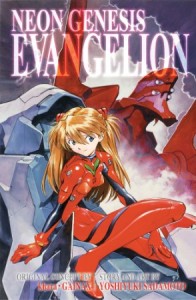
Neon Genesis Evangelion Omnibus, Vols. 7-9

May 19, 2013 by Sean Gaffney

By Yoshiyuki Sadamoto and GAINAX. Released in Japan by Kadokawa Shoten, serialized in the magazine Shonen Ace. Released in North America by Viz Media.

Well, the party’s over. As if it weren’t obvious from the events at the end of the previous omnibus, the light and fluffy ‘everyone is slightly more tolerable’ manga antics end here, as these three volumes are a brutal kick in the teeth reminding us over and over again that humanity is desperately fighting to survive… and that most of the people in charge actually have a different agenda OTHER than fighting to survive. And, just as we finally add our last major cast member, we also get the first of our major cast deaths. There will be more.

evangelion3

The Evangelion fandom doesn’t use “I mustn’t run away” as a meme for no good reason. This volume sees Shinji in a constant cycle of attempting to flee from his destiny and the responsibilities being thrown at him, and constantly being drawn back as he’s unable to just let everyone else get annihilated. Of course, that doesn’t necessarily mean that he gets to accomplish anything here – he returns, but is basically “sat in the corner” by his father, who punishes him by having him watch everyone get annihilated without his help ANYWAY. The manga is less emotive than the anime, with characters at times seeming to underreact to horrible crises, but that’s unsurprising – the pace of the manga is such that there is a state of constant danger, and I imagine after a while the senses just get numbed.

There’s a lot of backstory here. Kaji’s is designed to make him both more likeable and more vulnerable. For all that we like to pretend that we wouldn’t crack under the threat of death, the reality is that we probably would. And so much of Kaji’s life has revolved around finding out the real reason that things happened the way they did – an attempt to expose what led to his own actions. Shinji at one point notes that Misato still loves him, and indeed he’s clearly in love with her, but these are two people, like the rest of the cast, who are unable to grasp at the happiness that could be theirs. As for the other flashback, Fuyutsuki seems to be the perfect “follower”, and Gendo seems even worse than we’d originally suspected. As for Yui, I suspect that she’s being idolized in the memories of both Fuyutsuki and Shinji when we see her, but I agree that it’s easy to see Gendo could have genuinely loved her.

And then there’s Asuka and Rei. I’ve said before that I find manga Asuka far more likeable, and the counter argument to that is that she’s involved in the manga plotline so much less than in the anime, so doesn’t get the time to be irritating. Asuka’s backstory is also shown to us, which is bad news for her, as backstory in this manga is always followed by trauma. Asuka’s attempts to take out the Angel are interrupted by it raping her – yes, yes, mentally, but given that she screams “don’t come inside me” at one point, I think the distinction is fairly irrelevant here. It’s the most horrific we’ve ever seen the Angel attacks, and she comes away from it basically comatose. Rei, meanwhile, is struggling with a distance growing between her and Gendo as she and Shinji grow closer. Ritsuko seems to realize that Rei is growing more human and less doll-like, something that nearly drives her to murder. This, naturally, leads up to the cliffhanger for this omnibus, showing Rei’s “last stand”.

As for Kaworu, it’s interesting that he arrives right as Kaji departs, given his presence as “the mole”. He’s shipped with Shinji a bit harder than in the anime, with Shinji’s “have some sense of personal space” going unheeded. And the scene with the kitten shows a somewhat unbreakable wall between his own value system and that of the First Child. Nevertheless, you can even see Kaworu getting caught up in the struggle against the Angels, and wonder if he’s oing to be a double/triple/quadruple agent the way Kaji was.

The plot may be going places I don’t want it to go, but the writing is still top notch, with a complete inability to put the book down. The news that the manga will end with Chapter 95 in June means that this is likely to be 5 omnibuses (14 volumes) long, and thus this volume begins the second half of the story. It’ll be hard to make things even more tense after this, but I’m sure we’ll find a way.

Filed Under: REVIEWS

  • « Go to Previous Page
  • Page 1
  • Interim pages omitted …
  • Page 269
  • Page 270
  • Page 271
  • Page 272
  • Page 273
  • Interim pages omitted …
  • Page 346
  • Go to Next Page »
 | Log in
Copyright © 2010 Manga Bookshelf | Powered by WordPress & the Genesis Framework