• Skip to primary navigation
  • Skip to main content
  • Skip to primary sidebar
  • Home
  • About Us
    • Privacy Policy
    • Comment Policy
    • Disclosures & Disclaimers
  • Resources
    • Links, Essays & Articles
    • Fandomology!
    • CLAMP Directory
    • BlogRoll
  • Features & Columns
    • 3 Things Thursday
    • Adventures in the Key of Shoujo
    • Bit & Blips (game reviews)
    • BL BOOKRACK
    • Bookshelf Briefs
    • Bringing the Drama
    • Comic Conversion
    • Fanservice Friday
    • Going Digital
    • It Came From the Sinosphere
    • License This!
    • Magazine no Mori
    • My Week in Manga
    • OFF THE SHELF
    • Not By Manga Alone
    • PICK OF THE WEEK
    • Subtitles & Sensibility
    • Weekly Shonen Jump Recaps
  • Manga Moveable Feast
    • MMF Full Archive
    • Yun Kouga
    • CLAMP
    • Shojo Beat
    • Osamu Tezuka
    • Sailor Moon
    • Fruits Basket
    • Takehiko Inoue
    • Wild Adapter
    • One Piece
    • After School Nightmare
    • Karakuri Odette
    • Paradise Kiss
    • The Color Trilogy
    • To Terra…
    • Sexy Voice & Robo
  • Browse by Author
    • Sean Gaffney
    • Anna Neatrour
    • Michelle Smith
    • Katherine Dacey
    • MJ
    • Brigid Alverson
    • Travis Anderson
    • Phillip Anthony
    • Derek Bown
    • Jaci Dahlvang
    • Angela Eastman
    • Erica Friedman
    • Sara K.
    • Megan Purdy
    • Emily Snodgrass
    • Nancy Thistlethwaite
    • Eva Volin
    • David Welsh
  • MB Blogs
    • A Case Suitable For Treatment
    • Experiments in Manga
    • MangaBlog
    • The Manga Critic
    • Manga Report
    • Soliloquy in Blue
    • Manga Curmudgeon (archive)

Manga Bookshelf

Discussion, Resources, Roundtables, & Reviews

Reviews

JoJo’s Bizarre Adventure: Battle Tendency, Vol. 4

August 18, 2016 by Sean Gaffney

By Hirohiko Araki. Released in Japan as “Jojo no Kimyou na Bouken” by Shueisha, serialized in the magazine Weekly Shonen Jump. Released in North America by Viz Media. Translated by Evan Galloway.

By now I think the seasoned JoJo reader is used to the ‘Bizarre’ part of the title, to the point that when the vampire horses show up early in this volume it merely earns a slight shrug, as if to say “of course there would be vampire horses, this is JoJo’. And I feel much the same way. That said, the vampire squirrel growing from the villain’s severed hand took even me by surprise, and reminded us of why this title was so successful – it really does not know when to quit. Be it amazingly graphic violence (for a Jump title), badass boasting, cool posing, or even coming back from near death almost a dozen times over the course of the book, Battle Tendency can be exhausting.
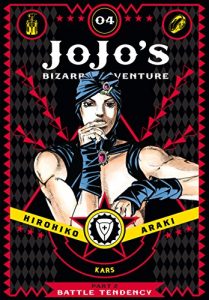
jojo4

We’re down to only two villains, each based off of a classic 1980s music reference, and the book is almost entirely devoted to JoJo taking out the two one by one. (What, you thought they would double team him? Get real. This is an HONORABLE fight between MEN!) First we have Wham… pardon me, Wamuu (is anyone else here reminded of the old Bastard!! translations?), who goes all Ben-Hur on JoJo with a chariot race to the death. This gives us a chance to see JoJo’s strength and weaknesses, because trust me, he’s filled with weaknesses. Sometimes you want to strangle the kid for how impulsive he is. It’s also a good way to see how he thinks, though, and to show us that much of his fabled “I’m going to predict what you say/do next” is just bluffing. Then we’re supposed to see his mentor (and, as it turns out, something more) Lisa Lisa fight Cars… sorry, Kars. But alas, this is JoJo’s title, and so she’s reduced to hostage bait. Sigh.

And so we come to the end of another arc. The villain has been destroyed after multiple attempts, but just as in the first series, the hero dies. Or so one might think. As I said in my last review, Caesar’s death allows JoJo to live on, in a parallel of Speedwagon and Erina living on after Jonathan’s death. It also gives us a hilariously silly graveside scene where JoJo shows up with Suzi Q in tow, wondering why everyone is at his grave and surprised to see him. (It also reads as very rushed – I suspect Araki ran out of time, or maybe just didn’t care enough. More Suzi Q, please!) And we see an older, grumpier, and apparently Japanese-hating Joseph at the very end, showing that amazingly, a Joestar *can* live to a ripe old age. This dovetails nicely with the start of the third arc, which takes place in Japan.

I enjoyed Battle Tendency a lot, more, I think, than the first part. It lacks a truly memorable villain like Dio, but Joseph is a lot more charismatic and likeable than Jonathan was. I look forward to seeing how Jotaro is different from both of them. I also look forward to less good-hearted Nazis in the next series. But above all, I hope we can top the vampire squirrels for hands thing, because that’s what JoJo’s Bizarre Adventure, in the end, is all about.
Filed Under: REVIEWS

Attack on Titan, Vol. 19

August 16, 2016 by Sean Gaffney

By Hajime Isayama. Released in Japan by Kodansha, serialization ongoing in the magazine Bessatsu Shonen Magazine. Released in North America by Kodansha Comics. Translated by Ko Ransom.

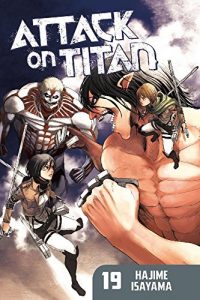
It feels like it’s been forever since we’ve seen a volume of Attack on Titan that is almost entirely devoted to fighting titans. The stakes are higher this time, though, as we know these titans. Most of the volume is devoted to dealing with Reiner and Bertholt, led by the Beast Titan, doing their best to wipe out the Survey Corps, followed by humanity. Our heroes, of course, are trying their best to stop them, and not only have Armin’s tactics but Erwin’s planning and Hange’s scientific genius. Attack on Titan has done ambiguity well in several past volumes, but there’s little of that here – though they try to portray themselves in a sympathetic way, there’s no doubting Reiner and Bertholt are the bad guys, and both seem to have accepted that, though we still don’t know the big ‘reason’ everyone has to die.

titan19

The most interesting thing here plotwise is the extended flashback we get to Marco, and how he died. Marco was killed off at the very beginning of the manga, but his picture appears in the cast list every time regardless, with a big X through it. This is for a reason – his death was very much a turning point. Now we find out it wasn’t just a turning point for the main cast, but for the secret Titan infiltrators as well. I still have trouble seeing the normally stoic Annie as emotional and panicky as she gets here, but Reiner is handled perfectly. We’ve seen before how he sometimes disassociates himself from the actions he has to take as a traitor, and that certainly comes through here. There’s also an astonishing contempt for Bertholt throughout the book – he’s always been a meek follower, but this just underlines that, with Reiner saying “I’ve never considered you reliable.”

It’s telling therefore that Bertholt’s big screaming confrontation is with Armin, who I think has also felt a bit weak at times, though unlike Bertholt he has the strength of his convictions. Bertholt’s ridiculous demands – give us Eren, and kill all of humanity – cause everyone to just stop and stare, and rightly so. Of course, humanity is not giving in so easily. Hange’s “thunder spears” are quite clever, even if they can also be extremely dangerous, and they may have actually dealt serious damage to Reiner. That said, he is a named character, and for all of Attack on Titan’s reputation as a dark and brutal series, named characters have done pretty well for themselves – Word of God said Sasha was supposed to die in the ninth volume but the editors asked for her to be spared.

That may change soon, though. Did we really see Hange killed off in the last page? Probably not, not in an offscreen manner like that. What about Reiner or Bertholt? And have we totally forgotten about the Beast Titan – what are his plans aside from letting those two try to destroy everything? This volume had a lot of noble fighting and impassioned screaming. I suspect next time may bring us a bit more tragedy.

Filed Under: REVIEWS

One Piece, Vol. 79

August 14, 2016 by Sean Gaffney

By Eiichiro Oda. Released in Japan by Shueisha, serialization ongoing in the magazine Weekly Shonen Jump. Released in North America by Viz. Translated by Stephen Paul.

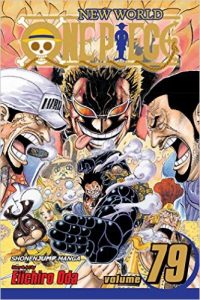
Well, I did not quite get my wish, as we’re still in Dressrosa at this end of this volume, but the final battle has finished, and Doflamingo is seemingly defeated for good. This is done through a combination of Luffy, who uses his Gear Four rubber monster and a bunch of haki to finally punch Doflamingo into next week, and the rest of the cast, who help Luffy when he needs ten minutes to recover by fighting off minions, pushing back on unpushable deathtraps, knocking over entire buildings, or even (sigh) being a pretty princess and not fighting, because yes, Rebecca is still a massive failure of a character. One Piece shows what happens when everyone puts differences aside and fights for a common goal, and even when the goal is mere survival, it’s still cool.

op79

The fight is good, but the aftermath is where things really pick up. One Piece has never been too much about current political events, insofar as Oda would much rather base Marines on caricatures of old Japanese actors then connect them with military atrocities. But there is a point in this volume where Fujitora, having seem enough (metaphorically speaking) of what’s going on in Dressrosa, gets onto his hands and knees and bows to the ground, apologizing to the King what what has happened, and saying that the World Government allowed it. This wouldn’t be so bad were it not being broadcast worldwide, and he ends up in a huge shouting match with Akainu later (Akainu, you may recall, murdered Luffy’s brother Ace, so is the opposite of a moral compass). There is a great discussion about ‘losing face’ vs. accepting blame and gaining trust. It’s really hard not to imagine this may be commending on some real-world events (Iraq, perhaps).

As with most epilogues in One Piece, we get several chapters showing off where everyone else has been and what they’ve been doing while Luffy and company fight. We see more of the Eleven Supernovas, including fan favorite Eustace Kidd. We see Fujitora resolving to continue to chase after and capture Luffy and company, thus literally taking the place of Smoker, still recovering from the Caesar Clown stuff, and Tashigi, who seems to have literally turned into a kindergarten teacher. We get the backstory for Sabo at last, showing how he was indeed rescued by Dragon but had lost his memory, which is why he never tried to find Luffy and Ace afterwards. It was only seeing news of Ace’s death that triggered his old memories to resurface again. (Also, again, I totally ship Sabo x Koala, as much as any couple in One Piece can ever be shipped.)

And, at last, we see the rest of the Straw Hat Pirates, who have apparently been having unpleasant adventures of their own, being chased after for harboring a mystery girl. I can’t tell you how happy I was to see Nami doing what she does best after all this time: scream in frustration about being surrounded by idiots. I am very hopeful that the next volume will unite all the Straw Hat Pirates, and most importantly get them the heck away from Dressrosa, though I fear we are going to be seeing a few Pretty Princess Dresses and No Swordfighting Ever Again before it’s over.

Filed Under: REVIEWS

Yona of the Dawn, Vol. 1

August 13, 2016 by Sean Gaffney

By Mizuho Kusanagi. Released in Japan as “Akatsuki no Yona” by Hakusensha, serialization ongoing in the magazine Hana to Yume. Released in North America by Viz. Translated by JN Productions, Adapted by Ysabet Reinhardt MacFarlane.

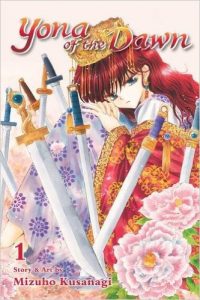
The cover to this first volume features our heroine, Yona, surrounded by swords, and on the back cover we see her confidently wielding one. But on the front she’s looking at them with a look of melancholy, and I feel that this fits the tone of the volume. For although this is the story of a princess who will take up the sword and become a warrior, we’re not there yet. Instead, what we get here is a sweet, sheltered young girl with a crush on her cousin and childhood friend and an antagonistic relationship with her bodyguard and other childhood friend. In other words, were it not for the fantasy castle setting, this could easily be any other shoujo high school romantic comedy. Then… things happen.

yona1

The layout of this volume actually ends up being very odd. We start off with the love triangle setup, and then things rapidly turn serious and deadly with the murder of Yona’s father, the king. We’re told that, as a king, he wsa rather conciliatory, so it’s no great surprise that someone wishes to replace him, but it’s still a chapter of Yona avoiding also being put to death and running for her life. The second half of the book is a series of flashbacks, told as Yona and Hak (the aforementioned bodyguard) hide in the woods and deal with things like leeches and snakes, things that Yona is clearly totally unfamiliar with. The flashbacks show us more of the relationship between Yona, Hak and Su-won (said cousin she’s in love with, and again it’s really sweet and shoujo-ey, as she turns to Hak for advice on how to deal with suitors she doesn’t want, and how they all get colds as kids after a snowball fight and the King tries to make broth for them, which is ridiculously awful but makes her happy.

In other words, we are shown a tragedy, then we get to see why it was so tragic after the fact. Yona’s father does indeed seem to be a rather ineffectual king most of the time, though there’s a hint or two that this is all just a facade. There’s also some backstory that I’m sure will be developed more later, with Su-Won’s father having been killed before the book began, and various tribes (there are five, and one is the “wind tribe”, so I won’t be surprised if we see a water and fire tribe at some point down the road) all jostle for political influence. And then there’s Hak, who is apparently an incredibly strong warrior, but is also devoted to Yona, both because he was “tricked” into doing it by her father, and also because he clearly loves her, though he keeps that hidden for now.

Yona of the Dawn’s first volume is good setup, with an interesting story structure, and I look forward to seeing how its naive and sheltered heroine becomes the confident swordslinger on the back cover. Oh, and we also have a serious dark-haired good guy and a nice but secretly evil blond bad guy as rivals for Yona’s affection, for those of you who play shoujo manga bingo.

Filed Under: REVIEWS

Kuroko’s Basketball, Vols. 1-2

August 11, 2016 by Sean Gaffney

By Tadatoshi Fujimaki. Released in Japan as “Kuroko no Basket” by Shueisha, serialized in the magazine Weekly Shonen Jump. Released in North America by Viz. Translated by Caleb Cook.

I’ll be honest with all of you. Of the ‘big four’ North American sports, I’ve always found basketball the least interesting. Sure, I’ll get excited by March Madness, but the pros do nothing for me, and watching the games on TV just makes me want to do something else. That said, I can’t deny that the sport has an allure that attracts a lot of people, particularly high school kids and promising young manga artists. And now that it appears Viz has vanquished the curse of sports manga in the States once and for all (with the possible exception of baseball – sorry, Adachi), we can see why this series was absolutely huge. The only reason it wasn’t licensed sooner, I expect, is that Viz was still releasing Slam Dunk, the ur-basketball manga, and didn’t want the two to compete.

kuroko1

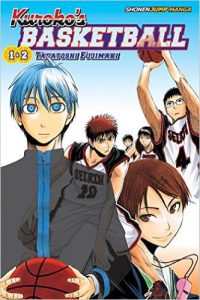
Kuroko is the blue-eyed stoic on the cover, and the title is pretty telling, as Kuroko’s style of basketball is very much not like the rest of the team, as it’s designed around his own lack of a personality. While this is, for the most part, a typical fiery sports manga, it has its fair share of humor, and a great deal of it revolves around Kuroko’s stoicness and ability to not be noticed even when he’s literally standing in front of someone. Most other basketball manga would star the redhead behind him – indeed, Slam Dunk did, as Kagami is very clearly modeled after that character. But it’s Kuroko that makes this interesting, as he uses his quasi-invisibility to the team’s advantage. He can’t make shots, of course, but it makes him a near-perfect passer. And with Kagami on the team, who is driven by the desire to compete against the strongest teams and win, they become well-nigh unstoppable.

Basketball does not appear to be all that big in Kuroko’s school itself. The manager, also pictured on the cover, is the coach as well, and they sometimes have trouble with school discipline. Riko, by the way, seems to be the sole female in the manga so far, and there’s no hint of romance. Because the other big reason that this manga is getting licensed is that, like many other recent Jump series, it has an absolutely huge BL fandom. There’s none of that in the actual manga itself, of course, but you do get an awful lot of handsome guys sweating and being athletic, and combined with the usual Jump goals of friendship, training and victory the combination can be irresistible. Heck, Kise, Kuroko’s old teammate from middle school introduced as the first semi-antagonist, seems to behave very much like the ex-boyfriend who wants to get back together really badly.

I haven’t talked much about the basketball itself, mostly because, as I said, it’s not my thing. But it’s the majority of the book, and it’s exciting, well-told and well-drawn – I was never confused or bored. Still, you read this for the characters, and I greatly look forward to more of Kuroko and his quiet, eccentric linefaced self.

Filed Under: REVIEWS

Yona of the Dawn, Vol. 1

August 9, 2016 by Anna N

Yona of the Dawn Volume 1 by Mizuho Kusanagi

It is no surprise that I was eagerly anticipating Yona of the Dawn. I feel like there’s been a little bit of a gap in currently translated shoujo fantasy, so I was very much looking forward to this manga. I have a feeling that Yona of the Dawn is one of those manga that will be easier to evaluate once the second volume comes out, because the first volume was mostly set-up. I did enjoy the worldbuilding and some of the plot twists that I wasn’t expecting.

Yona is a sheltered princess whose main issues involve fretting over her red hair. She’s watched over by her guard Hak, and she nurses an intense crush on her cousin Su-won. As she’s getting older the question of her marriage is starting to come up, and her father the king seems to be determined to get her married to anyone but Su-won. Yona is a bit headstrong and pampered, but she still comes across as a sympathetic heroine in the early pages of the manga.

One thing I was dreading a bit is the development of a fairly typical love triangle, because it seemed like that’s the way things might be headed for Yona, Hak, and Su-won at the start of the manga. I was extremely happy when my expectations were foiled within the first couple chapters, and the story took an abrupt turn as Yona has to flee the palace with only Hak by her side. I’ve heard that this series features awesome archery, which is nowhere in evidence yet. I’m much more intrigued by the potential storyline of Yona having to toughen up and learn how better to fend for herself, so I’m eagerly awaiting the next volume.

yona1

Filed Under: REVIEWS Tagged With: shojo beat, shoujo, viz media, yona of the dawn

Legend of the Galactic Heroes: Ambition

August 9, 2016 by Sean Gaffney

By Yoshiki Tanaka. Released in Japan as “Ginga Eiyū Densetsu” by Tokuma Shoten. Released in North America by Haikasoru. Translated by Daniel Huddleston.

In the first volume, we saw the Galactic Empire and the Free republic spend most of the book at war with each other. This time around, they spend most of the book at war with themselves. Reinhard is not the best at making friends and influencing people, and so the aristocracy decide to take him out in a coup. Meanwhile, knowing that he needs the republic to be distracted while this is going on, Reinhard plants a traitor in order to start a coup on the republic side, which will keep Yang Wen-Li busy doing what he hates the most – fighting military battles. By the end of the book, both Yang and Reinhard have suffered grievous losses, though you could argue that Yang’s is merely sad, while Reinhard’s amounts to a grand tragedy of epic proportions.

galactic2

This series has a huge cast, to be frank, bordering on the ridiculous. I will not blame the reader from getting completely lost among the Empire’s admirals, not knowing their Wittenfelds from their Mecklingers. That said, I never felt lost, mostly because, with the exceptions of the obvious main characters, the book is more about the plot than the characters. And it still has its obvious agenda – war is a tragic, horrible thing that devastates everyone. As with the first book, neither side comes off very well. The Empire is filled with arrogant scheming aristocrats who regard ‘the people’ as their toys, and indeed most of the latter half of the book hinges on such a jaw-droppingly heinous incident that I am reluctant to spoil further. As for the Republic, we see the dangers of the military assuming that they know what’s best for the people – sure, there’s martial law and no freedom of speech now, but freedom will return. really. Any day now.

If LOGH has a huge cast, it also has a reputation for killing that cast off. The aforementioned heinous incident leads directly to the most astonishing one, but (again trying not to spoil) its main purpose is also to show us that Reinhard is still stunningly immature at times, and can react just the way the aristocrats that he’s trying to put down do. I think the nest volume will be very important in seeing whether he manages to mature as a leader, or if he’s going to be the villain of the series. (The author is being very even-handed about both sides being tremendously flawed, though I suspect most Western readers will automatically side with Yang Wen-Li.) Speaking of Yang, he’s forced to admit at the end of the book that the republic’s own leader is a dangerous tyrant – and Yang feels a great desire to do something about it, something that goes against his very nature.

Having introduced most of the backstory in book 1, the second book does not feel quite as much like a history lesson. The translation can still get pompous and didactic, but again, I’m fairly sure the original was exactly like that as well. And the space battles are described well enough that even those uninterested in such things will be drawn in. I suspect the third volume will be a giant signpost as to where the rest of the series is heading – I highly look forward to it.

Filed Under: REVIEWS

Haikyu!! Vol. 2

August 7, 2016 by Anna N

Haikyu!! Volume 2 by Haruichi Furudate

I thought that the first volume of this volleyball manga series was unusually strong, and it set up some interesting dynamics between Hinata, the enthusiastic volleyball player with untapped athletic abilities and absolutely no experience, and Kageyama, the star player who is incapable of being a team player.

The second volume opens with the team getting a chance to play a practice match against a rival school where some of Kageyama’s former teammates ended up. This provides an opportunity for the Karasuno High volleyball team to test out their newest players. As with the best sports manga, this volume does a great job maintaining the tension and action of competition, sprinkled with a bit of exposition of volleyball rules, with a great deal of character development packed into a single game.

Hinata’s overwhelming enthusiasm about the simplest things like getting a team jacket also has some ill effects, as he is so nervous about playing his first game he keeps visiting the bathroom every five minutes leading up to the match. Kageyama finds himself in the position of being an unlikely sports psychologist, which serves to contrast the personalities of the two protagonists of the series even more.
Hinata ends up awakening Kageyama’s full potential as a volleyball setter, as Kageyama finally realizes that he needs to consider the player he’s feeding the ball to. Hinata’s jumping abilities also inspire a degree of trust in a teammate that Kageyama that he never had before. He gets the timing down so exactly that Hinata just has to jump and expect that the ball will be there when he arrives for that brief moment at the top of the net.

The ending of this volume showcases the potential of the scrappy Karasuno High team. They might not be functioning as a full team yet, but they have a lot of potential and a real future, if only they get some help working on some fundamentals and even more practice time. The volleyball action scenes were as dynamic and gripping as the first volume. I’m happy that this series is on an accelerated release schedule, so I don’t have to wait too long before the next volume!

hai

Filed Under: REVIEWS

Queen Emeraldas, Vol. 1

August 7, 2016 by Sean Gaffney

By Leiji Matsumoto. Released in Japan by Kodansha, serialized in the magazine Weekly Shonen Magazine. Released in North America by Kodansha Comics. Translated by Zack Davisson.

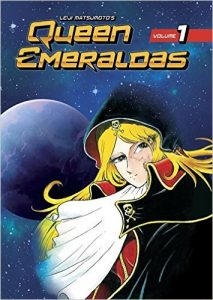
Sometimes you don’t read a manga for its plot, or characters, or artwork. Sometimes you read a manga because of its mood. You need something that’s evocative, that’s lyrical, that takes you into a different headspace – that of pirate ships in space, and betrayal and heartache, and the repeated narration of a gorgeous scar-faced woman who seems to know she’s speaking to the reader. If you need this, I have good news for you, as Queen Emeraldas is all this and more, and it’s in an omnibus hardcover edition to book, with expensive paper stock. Of course, don’t just get it as a collector’s item. Get it because it’s Leiji Matsumoto at the height of his powers.

emeraldas1

The Japanese audience, of course, is familiar with Emeraldas by the time this manga first appeared in the late 1970s. Matsumoto had carved out worlds for everyone – Galaxy Express 999, Space Battleship Yamoto, Captain Harlock – and she was part of the extended cast that flit through these worlds. Let’s just say if she reminds you of Maetel, that’s not an accident. No worries about being lost here, though, as this is her own self-contained title, where she plays a mentor role to a young, driven boy – Hiroshi Umino – who wants to build his own spaceship and go to space. These aren’t just hollow words, either. He does so twice during the course of this volume, though his drive is perhaps somewhat better than his spaceship-building capability. He keeps running into Emeraldas, who stops what she’s doing to prevent him getting killed by the many people and creatures that try to stop him. And along the way, we even get a bit of her own backstory.

Harlock was once rewritten to fit in with Wagner’s Ring Cycle, and reading this it’s not surprising that the two would intermesh – this is not so much a story as it is high opera, with Emeraldas functioning both as the title character and as the chorus. The manga definitely feels like a weekly title, and unlike similar titles the narrative makes no effort to smooth out the constant repetition of who Emeraldas is and why she travels the stars. But she’s not the only one. Characters expound upon their hopes and dreams, and except for Hiroshi, these dreams are mostly shattered or abandoned for various reasons. But their stories also serve to inspire and educate. There’s also some bad guys as well, and the manga does not shirk on the violence – one spoiled rich daughter who tries to have Hiroshi murdered is shot by a firing squad organized by her own father.

There’s not much ongoing plot to follow here, and the characters are mostly static throughout the book. You don’t care, though, because the book is thrilling, and moody, and shows you how cold and vast space really is, and how this can make many people as cool as Emeraldas is. It’s not so much a manga as it is a song. But you’ll want to listen to it again and again.

Filed Under: REVIEWS

Liselotte & Witch’s Forest, Vol. 1

August 6, 2016 by Sean Gaffney

By Natsuki Takaya. Released in Japan by Hakusensha, serialization ongoing in the magazine Hana to Yume. Released in North America by Yen Press.

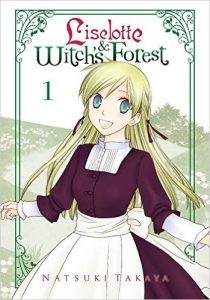
Backstory is important when you’re reading fictional works. It helps to show depth to the characters, show that they’re meant to be real people and not just caricatures. And it can kickstart a plot, or add some tragedy to give emotional catharsis. Occasionally, though, you run into a problem, and it’s especially true of first volumes of manga, where you have to wait a while to see what happens next? Liselotte & Witch’s Forest, by the author of Fruits Basket, has that problem – at least for me. Liselotte is the princess of a feudal family, who took up arms and warred against her brother for control of the land. She lost, and now she’s in exile in the middle of a somewhat fantastical forest, along with two servants and a mysterious young man who reminds her of her lost love.

liselotte1

The difficulty here is twofold. First, the badass princess going up against her family with a sword is literally less than a 2-page spread, and we don’t even see her face. The majority of the volume is dedicated to seeing the somewhat inept at common things princess trying to make the best of it, seeing her servants be a) frustrated and b) stoic about the whole thing (the servants are polar opposite twins, and I can’t help but be reminded of Hiro and Kisa, to be honest), and discovering the aforementioned vague supernatural forest. We don’t quite see the witch herself, though her presence is felt. We do see her familiar, who is the equivalent of a 5-year-old pretending to be a badass grownup. And then we have Engetsu, who seems to clearly be related to whoever is in Liselotte’s past, but is also clearly connected to the witch, though we’ll no doubt find out more in future volumes.

So yes, I’m complaining about the plot I didn’t get, and I know I should just read Yona of the Dawn if I want that. What I do get is thoroughly pleasant, with Liselotte being a bit useless at cooking and gardening but with a good heart, though it’s quite clear why her male servant tends to spend his days in a state of apoplexy. I’m not sure how dark this will get, or whether we will see more figures from her past. As always with Takaya’s works, she’s best at conveying people with terrible sadness inside them who nevertheless show a smiling face to the world. Tohru was like that, and I’ve no doubt that Liselotte will be the same. Of course, the series is still mostly lighthearted – the male servant, Alto, provides half of the comedy moments, and is highly amusing. (The other half come from the witch’s familiar and his puppy villain antics).

We have four more volumes till we catch up with Japan. The series is currently on hiatus while Takaya writes a sequel to Fruits Basket that’s running online, I believe. I worry this means Liselotte isn’t popular – worst case, it may be like Millennium Snow and keep readers waiting a while while the author does something else. But I’m ready to read on, and look forward to the next volume, even if it doesn’t have a sword-swinging princess.

Filed Under: REVIEWS

Fruits Basket Collector’s Edition, Vol. 3

August 4, 2016 by Sean Gaffney

By Natsuki Takaya. Released in Japan by Hakusensha, serialized in the magazine Hana to Yume. Released in North America by Yen Press.

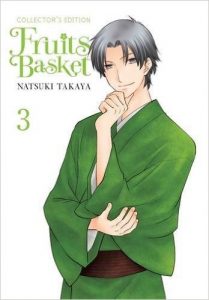
The benefit of re-reading a series with so much going on like Fruits Basket is that things you hadn’t noticed before turn out to be signposted, whereas things that once held your attention don’t appear to be as relevant in the long run. We only get one new Sohma this time around, as we meet shy, bullied Kisa trying to escape from serious bullying at school and a somewhat hysterical mother at home. I remember being impressed at the time with the fact that Takaya had the characters take exception to the standard Japanese response for bullying, which is “if you were strong enough, they wouldn’t bully you”. Of course, this is sort of what happens – the newfound bonds with Tohru and, to a lesser degree Yuki, allow Kisa to find inner strength and return to school. So the message is a bit undercut, but it’s still a very good arc, I think.

fb3

Speaking of Yuki, he talks about his own past and that he once turned in on himself the way Kisa did, but the details are sketchy – no doubt to be saved up for later. Certainly he once again contrasts with Kyo – the head of the family, Akito, seems to have smothered Yuki a bit, whereas the opposite is true of Kyo. There’s also the love triangle, which at this point Takaya is still trying to keep as balanced as possible, but knowing the outcome as I do, it’s difficult not to see that she had Kyo and Tohru in mind as the endpoint even at this stage. And while most of the latter part of this omnibus deals with Kyo’s family issues, as he and his sensei Kazuma try to show affection while still somewhat not understanding the other person, it’s very clear that Tohru is why Kazuma showed up in the first place.

This will be deconstructed later in the series, but at this point it’s astonishing how straight it’s played that everything can be healed with the power of Tohru’s all-loving presence. Shigure is betting everything on Tohru being what finally breaks the curse. Kazuma arrives as he’s heard about Tohru and wants to make sure that she’s not going to run away if she sees the actual true form of what Kyo’s curse is. And her immediate “I love you!” to Kisa, even if it’s more in a “so cute!” way, is what starts her on the road to healing. In retrospect, of course, this really is setting us up for a fall – the arrival of Hiro next time around will help, but right now Tohru is being portrayed as a saintly goddess as that’s how most of the main characters are viewing her.

As with previous volumes, this is a good adaptation of the Japanese omnibuses. The interstitials are gone, replaced with simple SD-art, but it was like that in the Japanese reprint as well. and there’s nice color pages at the start. And the translation is smoother but also looser than the original Tokyopop one. Anyone wishing to upgrade should be quite happy.

Filed Under: REVIEWS

Re: ZERO -Starting Life in Another World-, Vol. 1

August 2, 2016 by Sean Gaffney

By Tappei Nagatsuki and Shinichirou Otsuka. Released in Japan by Media Factory. Released in North America by Yen On.

Given the sheer number of ‘person goes to a world based on a game’ light novel plots out in Japan, a genre so oversaturated that some competitions have banned the premise, it’s not a surprise that we’re starting to see the genre poked fun at a bit. Re: Zero begins with our hero, who went out to get snacks, suddenly in a busy intersection of a fantasy world, complete with anthropomorphic creatures, noble princesses, and sneaky thieves. The joke is that this is exactly the sort of thing that he’s read about constantly, and (given that he’s sort of become an ungraduating loser NEET in our world, albeit a buff one who keeps in shape) he is absolutely ready to gain cool new powers and save the world through the power of being awesome. Thankfully, this is not that series.

rezero1

In fact, Subaru himself may be the weak point in the book – deliberately, to be fair. He’s meant to be the sort of character you want to give a swift kicking to for being so stupid, but that’s always a high wire act, particularly if it’s your protagonist. Subaru is a smartass, and not really in a good way – he’s there with a snarky response most of the time, but it almost feels overscripted, as if it’s a default he drops into when he’s not really sure how to act in a situation. When things get more dire and serious, as they inevitably do, he gets more interesting, though not necessarily more competent. Because his powers are the main title of the series: when he dies, he resets to zero, which is to say he returns back to the start of the day to try to avoid dying. He’s not particularly good at avoiding this.

The rest of the cast fares better than Subaru, as they merely have to be fairly standard fantasy types that will get development later. There’s the overearnest princess, who can’t help but worry about Subaru even though there’s no good reason to do so; the aforementioned sneak thief Felt, who the epilogue shows us is more than she seems (my money’s on missing royalty); and Reinhard, who is perfect in every way, and basically is the character that WOULD normally be our hero in most works – the best part of the book is when we figure out that the way Subaru saved the day and avoided getting himself killed is to call for help rather than fight, which indirectly lets Reinhard come in and save the day, something Subaru is simply ill-equipped to do.

I’m not sure where this will go in the future – I assume if he dies in Book 2 he’s not going to go back to that intersection, as that would quickly grow tedious. I do hope that he matures and acts a bit less of a doofus, though I have zero hopes of that coming true. That said, this is a fun series with a premise that can go in many different directions, and I want to see where it takes me.

Filed Under: REVIEWS

After School Nightmare, Vol. 10

July 29, 2016 by Ash Brown

After School Nightmare, Volume 10Creator: Setona Mizushiro
U.S. publisher: Go! Comi
ISBN: 9781933617718
Released: February 2009
Original release: 2008

Many years after reading the first volume of Setona Mizushiro’s manga series After School Nightmare, I have now read the tenth and final volume. After School Nightmare is a dark and intense psychological fantasy with strong horror elements. Despite finding the first few volumes compelling, I also found them to be challenging since many of the themes explored hit fairly close to home for me. However, while After School Nightmare continued to be unsettling, I am glad that I finally made a point to read the entire series. After School Nightmare, Volume 10 was first published in Japan in 2008. A little over a year later the tenth volume was released in English by Go! Comi in 2009. Go! Comi no longer exists as a company and so After School Nightmarish has gone and currently remains out-of-print. Sadly, that also means that the series is becoming more difficult to find with each passing year.

Mashiro has slowly come to terms with his gender identity, but it has been a struggle. His body can’t be easily defined as either male or female and although he initially made the decision to live as a man, he has since realized that may not have been the correct choice to make. Although he was always uncomfortable with who he was, in large part Mashiro started to reevaluate his self-identity when he was placed in a special after school class required to graduate. Along with several other students, Mashiro was forced to confront and share his most personal fears, anxieties, and insecurities within a literal nightmare. Mashiro’s fellow classmates, each dealing with their own traumas, are also in the position to graduate, but to accomplish that will require active change and desire on their part. Every one of the students in the class must participate in the brutal, violent nightmares if they hope to leave the agony and anguish of their old lives behind.

After School Nightmare, Volume 10, page 44The final volume of After School Nightmare is almost impossible to discuss without spoiling the entire series—it contains a fair number of plot twists and major revelations which greatly impact the understanding and interpretation of the manga as a whole. The boundaries of birth, life, rebirth, and death are much thinner than one might expect and very closely intertwined. However, while Mizushiro leads readers down multiple dark and twisting paths over the course of the series, the true nature of the nightmares and of the school itself have been hinted at from the very beginning of the series. After School Nightmare, Volume 10 addresses many of the mysteries and answers many of the questions raised by the story and setting of the manga. In the end, there is a reason for the ominous and disquieting atmosphere and a purpose behind everything that the students have been through.

Honestly, After School Nightmare, Volume 10 leaves me feeling conflicted. In concept, I like what Mizushiro was attempting to do with the series, however I ultimately found the execution and much of the resolution to be unsatisfying. Although almost everything is explained by the end of the series, that explanation seems to effectively render meaningless all of the character development, their struggles and triumphs as they grow and overcome personal strife. I think in part After School Nightmare was intended to be uplifting or even empowering as the characters find the strength to survive. That’s certainly a legitimate interpretation, but to me it came across as exceptionally depressing as though the manga is needlessly or at least unnecessarily cruel. (And for the most part, I actually really liked the darkness of the series.) Still, I’m glad that I finally finished reading After School Nightmare. Even though I’m still working out my feelings regarding the conclusion of the series, over all I found it to be worthwhile.

Filed Under: REVIEWS Tagged With: after school nightmare, Go! Comi, manga, Setona Mizushiro

Log Horizon: A Sunday in Akiba

July 26, 2016 by Sean Gaffney

By Mamare Touno and Kazuhiro Hara. Released in Japan by Enterbrain. Released in North America by Yen On.

Unlike Sword Art Online, which in many ways was less about the game itself and more about the romance between Kirito and Asuna, Log Horizon tries not to focus too hard on romantic pairings. This is not to say they aren’t there, of course, but they’re never going to take over the plot. The closest we get may be this book, in which Akatsuki and Minori both independently realize that they’re in love with Shiroe. This initially starts off being fairly mediocre – the cake eating scene is not as funny as it thinks it is, and reads as quite cliched – but it begins to get good when each of the two girls spies on the other bonding with Shiroe and is forced to deal with ugly feelings of jealousy and self-hatred. Minori, being a middle schooler, has never felt like this before. Akatsuki’s older, but she has a different issue – Minori sees the bigger picture better than she does. In fact, Akatsuki has trouble with the big picture in general.

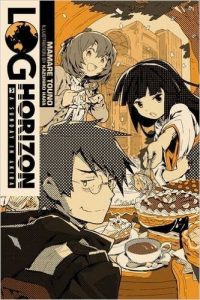
loghorizon5

As you might imagine from the romantic sideplot, this is a bit of a ‘break’ volume for Log Horizon, with the crisis being less epic and more annoying. We get to see more of what we’ve enjoyed from prior volumes – Marielle being genki, Raynesia and Krusty snarking at each other, etc. The adventurers are holding a festival in their town, and people are coming from all over the area to join – both other adventurers and People of the Earth, many of whom have ulterior motives. The idea that these are just NPCs has long left town, and indeed the loathsome Lord Malves could hold his own with some of the other Adventurer villains we’ve seen before. But we save the true villain for the epilogue – we’d seen Shiroe worrying about another large town’s issues at the start o the book, and now we see why: it’s a dark mirror imagine of Akiba.

Nureha is clearly being set up as a major villain, though I’m not sure if she’s really the one manipulating everything here. She’s quite content to turn on her seductive wiles to lure Shiroe to their side, and they really, really want him – rewriting reality last volume to make Rundelhaus an adventurer was something that got noticed, and suddenly Shiroe, who was always the introverted social nerd – is dealing with unwanted attention. This is likely why he’s so comfortable making himself the ‘scary villain’ in Akiba, despite Minori’s protests. Being the center of attention, being wanted, is something that he desires, but makes him too uncomfortable. Not even Nureha’s manipulative sob story about her background (I do think it’s true, but it was still manipulative) or revelation that they may have a way back to the real world can sway him.

For a volume that seemed to be marking time, there was a lot going on here, and some good setup for future volumes. Log Horizon continues to be one of the best of the ‘people trapped in a game world’ books, and deserves attention.

Filed Under: REVIEWS

Black Clover, Vol. 1

July 25, 2016 by Anna N

Black Clover Volume 1 by Yuki Tabata

Black Clover is an engaging action fantasy Shonen Jump manga, with plenty of comedy thrown in to liven things up. Like most shonen manga, it features a scrappy underdog hero. Orphan boy Asta dreams of becoming the Wizard King, the ultimate protector of his country. His enthusiasm isn’t hampered by reality, as he passionately proposes marriage to a nun in his home village, only to be refused for entirely sensible reasons. Asta’s boyhood companion is fellow orphan Yuno. Yuno is tall while Asta is short, and skilled in magic while Asta seems to have no abilities whatsoever. When children turn 15 they attend a ceremony where they are granted a magical grimoire that enhances their magical abilities. Yuno gets a lucky grimoire with a four leaf clover. Asta gets a beat up grimoire with a hidden five leaf clover.

I enjoyed the art in Black Clover, especially the level of detail in the supporting characters and in the backgrounds. The scene of grimoire distribution looked appropriately fantastic, with an almost infinite library of magical books stretching up to the ceiling, with books floating out to their new person. An early scene in the book provides some backstory to the manga, showing people laboring near a giant animal skull with three eye sockets.

It turns out that Asta has the power of anti-magic, and when this combines with his formidable physical training, he actually has a fighting chance when he has to face more skilled magical foes. Asta and Yuno return to see if they are going to be chosen to join a company of magical knights. Asta distinguishes himself with ease, and ends up getting chosen by the most desirable company, the Golden Dawn. Asta ends up in the company of misfits, the Black Bulls. This is where most of the character based comedy in the series gets set up, as Asta’s new companions include a perpetually drunken witch in a bikini, a odd man with a sister complex, a wizard who seems like a wanna-be biker, and a few more misfits. A probable new love interest is also included in the group, a noble girl named Noelle Silva who has fallen in with ignoble company because she can’t control her extremely powerful magic.

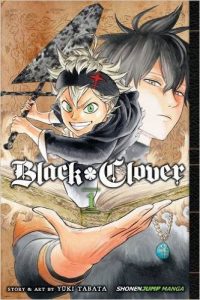
bc1

This was a extremely effective first volume, setting up the cast of characters and future conflict well, without ever weighing the reader down with too much exposition. There was a good mix of action scenes and comedy. Some of the characters and situations seem like pretty typical Shonen Jump people and plots, but I was entertained even though I tend to be unreasonably picky about shonen manga.

Filed Under: REVIEWS

  • « Go to Previous Page
  • Page 1
  • Interim pages omitted …
  • Page 215
  • Page 216
  • Page 217
  • Page 218
  • Page 219
  • Interim pages omitted …
  • Page 346
  • Go to Next Page »
 | Log in
Copyright © 2010 Manga Bookshelf | Powered by WordPress & the Genesis Framework